

If you live in a two-story home and the second floor stays hot while the first floor is comfortable, you are not imagining it. Heat stratifies, and the upper level is where a single central system struggles most. A whole house fan fixes that by pulling cool night air in through open windows and pushing the accumulated hot air straight up and out through your attic. Sizing it is straightforward arithmetic: target roughly 2 to 3 CFM per square foot of conditioned floor area. For a 2,000 sq ft two-story home that lands near 4,000 to 6,000 CFM of airflow, and for a 3,000 sq ft home you are looking at around 6,000 to 9,000 CFM.
That range covers a lot of hardware, and the differences between models matter more in a two-story layout than they do in a ranch. A fan installed at the top of the stairs catches the rising air column that a fan mounted in a first-floor hallway never touches. This stack effect is the single reason whole house fans outperform single-zone air conditioning upstairs, and it is why placement matters as much as CFM.
We spent weeks comparing the eight strongest options currently on the market, reading owner reviews closely and matching each one against real two-story layouts rather than spec sheets alone. The result is a lineup where airflow, noise, power draw, and attic vent requirements trade against each other in ways that make the wrong pick genuinely disappointing. If you want the wider view on whole house cooling gear first, our general whole house fan roundup covers the basics before this guide narrows in on two-story homes.
Top 3 Best Whole House Fans For Two Story Homes (October 2026)

Centric Air QA-Deluxe 5500
- 5072 CFM airflow
- 630 watt brushless motor
- 51 dB
- Up to 3400 sq ft
All 8 Whole House Fans Compared for Two-Story Homes in 2026
The table below puts airflow, power draw, noise, and the attic venting each unit demands in one place. Attic vent requirements are the number most buyers ignore, and they are the most common reason an installation disappoints.
| Product | Specifications | Action |
|---|---|---|
| Centric Air QA-Deluxe 5500 |
|
Check Latest Price |
 QuietCool QC CL-4700 RF QuietCool QC CL-4700 RF |
|
Check Latest Price |
 QuietCool QC CL-7000 RF QuietCool QC CL-7000 RF |
|
Check Latest Price |
 QuietCool QC ES-7000 RF QuietCool QC ES-7000 RF |
|
Check Latest Price |
 Centric Air QA-Deluxe 4800 ECM Centric Air QA-Deluxe 4800 ECM |
|
Check Latest Price |
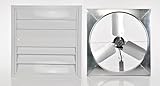 Master Flow GAF 24 Inch Master Flow GAF 24 Inch |
|
Check Latest Price |
 AC Infinity CLOUDWAY T12 AC Infinity CLOUDWAY T12 |
|
Check Latest Price |
 Solatube EPS Extreme Solatube EPS Extreme |
|
Check Latest Price |
1. Centric Air QA-Deluxe 5500 – Best Overall for Large Two-Story Homes
QA-Deluxe 5500 Energy Efficient Whole House Fan 2 Speed Temp/Timer Control
5072 CFM airflow
630 watt brushless motor
51 dB noise level
Fits 16 to 24 on-center joists
Pros
- Strong airflow that owners report drops two-story homes 10+ degrees in under an hour
- R-5 insulated damper seals the attic when the fan is off
- 2-speed wireless remote with temperature and timer control
- Quiet on low speed
- Assembled in the USA with a 10-year motor warranty
Cons
- Audible on high speed
- Printed installation instructions are unclear on damper and duct connection
- Foam damper doors can rattle on windy days
- Controller menus feel awkward to navigate
The QA-Deluxe 5500 is the model we keep coming back to because it does the one thing a two-story home demands best: it moves serious air without asking you to reframe a wall. At 5,072 CFM rated airflow on a 630 watt brushless motor, it lands in the band that covers homes up to about 3,400 sq ft including a second floor. Owners running it in two-story homes report indoor temperatures dropping ten degrees or more in under an hour.
What separates it from the cheaper big-box options is the fit. The housing drops between 16 and 24 inch on-center joists with no framing required, which covers the overwhelming majority of existing homes built with standard spacing. That single spec removes the most expensive part of a retrofit in many houses.
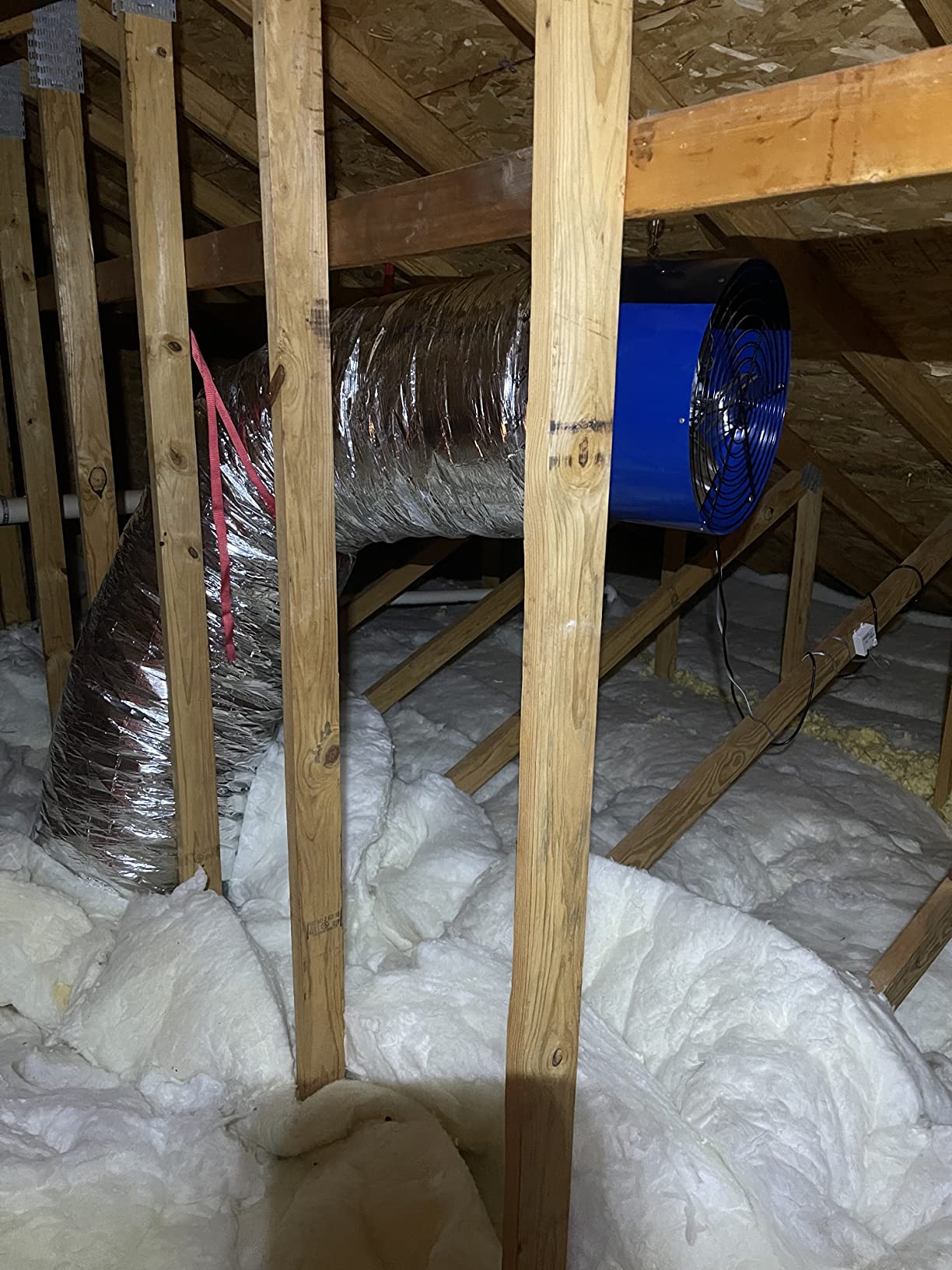
The R-5 insulated damper is the other reason this one earns its place at the top. When the fan is off, the damper doors close and the attic stops feeding heat back into your living space through the opening. Owners generally rate low-speed operation as quieter than a box fan running in an adjacent room, which is what makes overnight use practical.
Not everything is perfect. The printed instructions leave the damper-to-duct connection vague, and a few owners report the foam damper doors rattling on windy days. The remote controller also draws criticism for feeling inexpensive, with one owner reporting intermittent temperature cutoff faults.
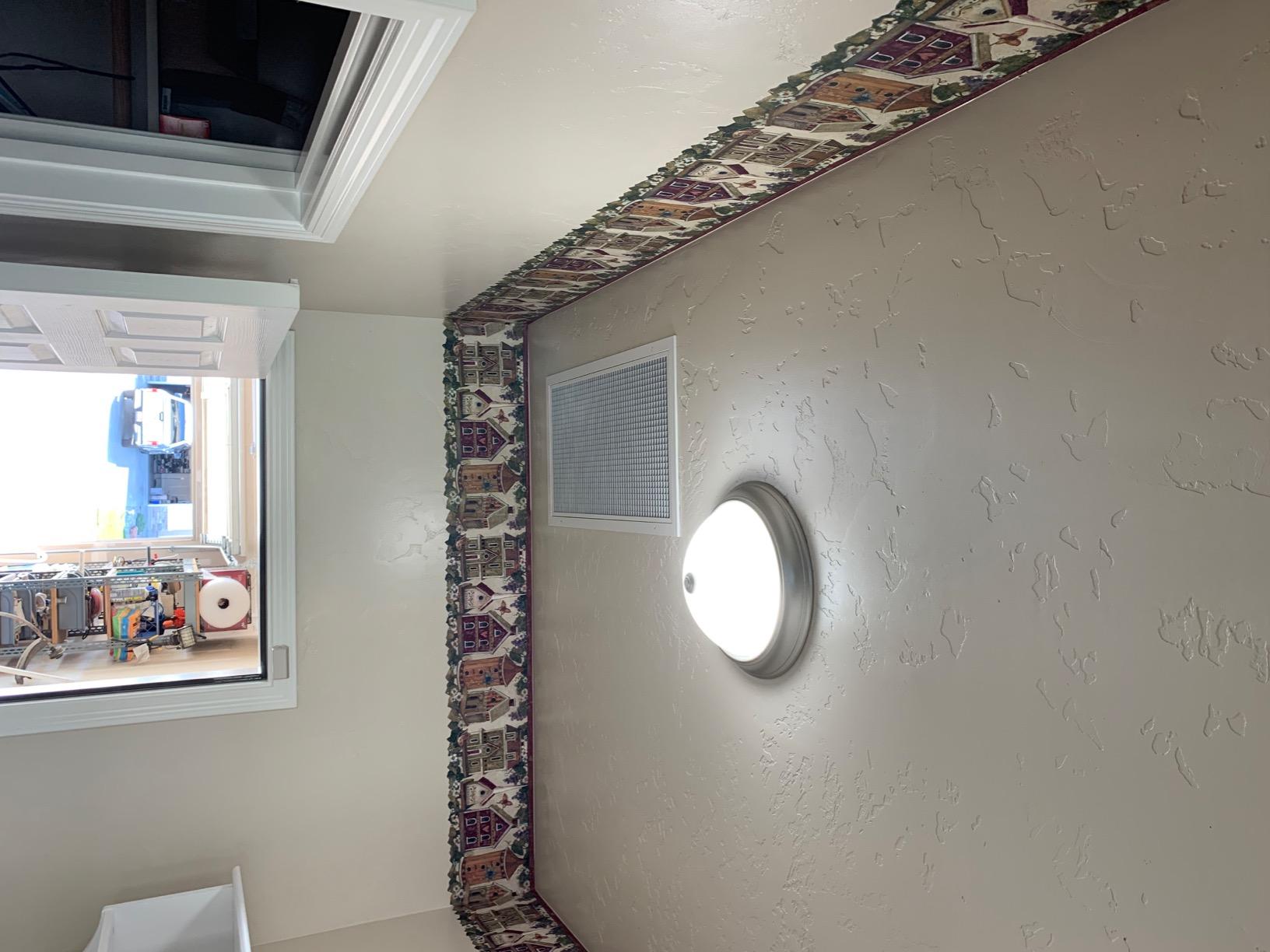
What you should check before buying the 5500?
Confirm your attic venting before anything else. This airflow class wants a meaningful net free vent area, and if your attic is short on soffit and ridge venting, the fan will be loud and underperforming no matter how good the motor is. Check the joist spacing in the ceiling where you plan to mount, and make sure you have a circuit and an outlet within reach.
Who the 5500 suits and who should skip it?
It suits owners of two-story homes between roughly 2,200 and 3,400 sq ft who want one central fan instead of a zoned system. People sensitive to sound should plan to run it on low speed overnight, since high speed is clearly audible in an adjoining room. If your attic venting is marginal, choose a smaller unit that matches what your roof can exhaust.
2. QuietCool QC CL-4700 RF – Best Value for Homes up to 2208 Sq Ft
Quietcool QC CL-4700 RF Classic Advanced Whole House Fan with Wireless Control – Up to 4415 CFM – Two Speed – Covers up to 2,208 SQFT – 10 Year Warranty – Removable Grille
4415 CFM high and 3402 CFM low
551 watt PSC motor
37.2 dB rated noise
5.89 sq ft of net free venting needed
Pros
- Quietest rated unit in this lineup at 37.2 dB
- Wireless RF glass wall switch with a 12-hour countdown timer
- Installs in about 1 to 2 hours with no joist cutting
- R5 damper doors insulate the attic when idle
- Window locks included
Cons
- No printed instructions in the box
- Wireless control menus take practice
- Owners of larger homes report needing a second unit
This is the quietest rated whole house fan we found, and for a two-story home with bedrooms directly above or beside the fan location, that number does more for your nights than raw CFM. At 37.2 dB it sits well below the other units in this guide, and owners consistently describe it as audible only as a soft rush of air.
Airflow is 4,415 CFM on high and 3,402 CFM on low from a 551 watt PSC motor. QuietCool rates it for homes up to 2,208 sq ft, which covers a comfortable two-story layout in that range but runs out of headroom past about 2,500 sq ft. Owners of bigger houses in that bracket report adding a second unit rather than pushing this one.
The wireless RF control kit is a genuine convenience. You get a glass wall switch with a countdown timer up to 12 hours, so there is no switch wire to fish down through the wall, and the unit ships with window locks for ground-floor security. Installation is quoted at 1 to 2 hours and fits 16 or 24 inch on-center joists without cutting framing.
The main complaint is documentation. Printed instructions are not included in the box, and owners consistently report hunting for the manual online. The R5 damper doors keep the attic sealed when the fan is idle, which matters in winter and during shoulder-season months when you are not running it daily.
What you should check before buying the CL-4700 RF?
Measure your conditioned square footage including both floors. If you land under about 2,200 sq ft this fan fits comfortably. Above that, plan on two units or step up a size, because forcing a 4,415 CFM fan to cover 3,000 sq ft leaves it running on high much of the time.
Who the CL-4700 RF suits and who should skip it?
It suits two-story homes where upstairs bedrooms sit near the fan, since the low noise floor is the whole point. It also suits anyone who wants remote control without running a switch wire through finished drywall. Skip it if your attic has minimal venting, or if you need zoned control that lets you cool one floor independently of the other.
3. QuietCool QC CL-7000 RF – Best Airflow for Very Large Two-Story Homes
Quietcool QC CL-7000 RF Classic Advanced Whole House Fan with Wireless Control – Up to 6924 CFM – Two Speed – Covers up to 3,462 SQFT – 10 Year Warranty – Removable Grille
6924 CFM high and 5518 CFM low
1147 watt PSC motor on high
Covers up to 3462 sq ft
Needs 9.24 sq ft of net free venting
Pros
- Handles very large two-story homes up to about 3462 sq ft
- Owners report being able to shut off air conditioning entirely
- Wireless RF switch with a 12-hour timer means no wall wiring
- R5 damper doors insulate when the unit is idle
- Installs in about 1 to 2 hours with no framing
Cons
- RF controller does not work with Alexa or other voice assistants
- Noticeably audible at the top speed setting
- High power draw at 1147 watts on high
If your two-story home runs past 3,000 sq ft, this is the airflow class that keeps up. The CL-7000 RF moves 6,924 CFM on high and 5,518 CFM on low, and QuietCool rates it for homes up to about 3,462 sq ft. That is the top of the range most central systems struggle to serve on the second floor.
Owners with large two-story homes report being able to turn their air conditioning off entirely once this unit was installed, which is the outcome whole house fans are sold on. The R5 damper doors seal the attic when it is idle, and the wireless RF kit means no switch wiring to chase through the second floor.
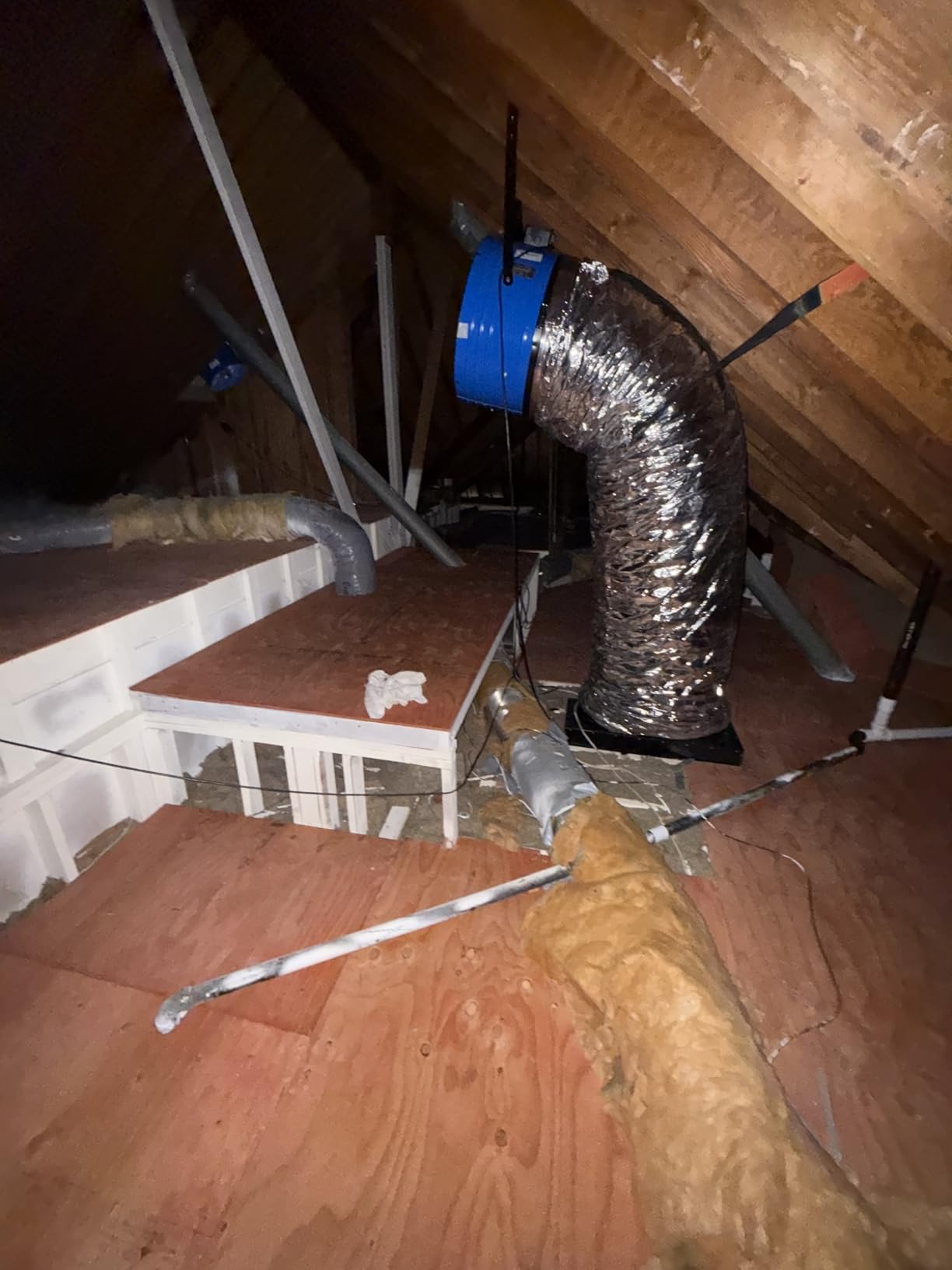
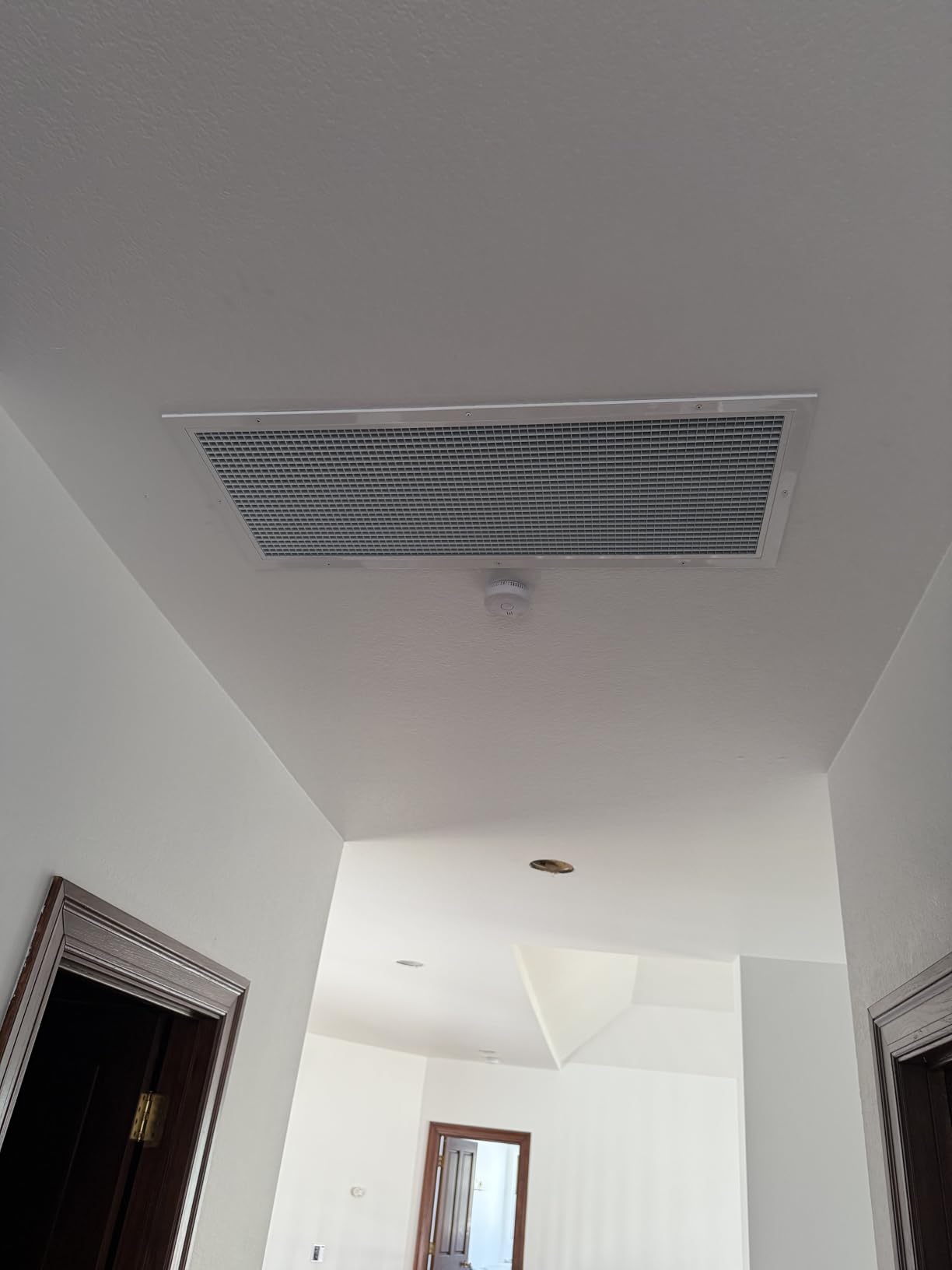
The ceiling cut-out is 14 by 36 inches and the motor head suspends from the attic rafters, so the living-space opening stays modest even at this size. Installation is still quoted at 1 to 2 hours at 16 or 24 inch on-center joists with no framing required, though this is a large unit to maneuver through an attic hatch.
Two honest limitations. The RF controller does not integrate with Alexa or other voice assistants, so if smart home control is part of your plan this is not the box. And at 1,147 watts on high, this is one of the most power-hungry fans in the guide, which is a real tradeoff for the raw airflow.
What you should check before buying the CL-7000 RF?
Attic venting is the gating item here. This unit needs 9.24 sq ft of net free vent area, and many existing attics were never designed for that. Confirm your ridge and soffit venting can deliver it, or plan to add powered or passive vents before install, because an under-vented attic turns a strong fan into a noise problem.
Who the CL-7000 RF suits and who should skip it?
It suits large two-story homes where the second floor is the main complaint and central air runs constantly. Families who want hands-off cooling and do not care about voice assistant integration will get the most from it. Skip it if your power budget is tight, if noise in a two-story space is a dealbreaker, or if your attic simply cannot vent this much air.
4. QuietCool QC ES-7000 RF – Best for Lowest Power Draw
Quietcool QC ES-7000 RF Energy Saver Advanced Whole House Fan with Wireless Control – Up to 6878 CFM – As low as 164 watts – Two Speed – Covers up to 3,439 SQFT – 10 Year Warranty
6878 CFM high and 4304 CFM low
ECM motor at 164 watts on low
Covers up to 3439 sq ft
Needs 9.18 sq ft of venting
Pros
- ECM motor draws as little as 164 watts on low while still moving 4304 CFM
- Contractors rate the suspended attic mounting as quick to install
- Owners report very low noise relative to belt-drive units
- Wireless control avoids cutting into drywall for a switch
- Rugged housing and smooth-running motor
Cons
- One owner reported a blade shearing off within a few months
- Two people needed for some installation steps
- Highest high-speed wattage of the ECM options here at 727 watts
The ES-7000 RF is the efficiency answer to the same question the CL-7000 answers with brute force. It moves 6,878 CFM on high, nearly identical airflow, but the ECM brushless motor draws only 727 watts on high and just 164 watts on low. On low speed it is moving more air than most of the smaller PSC units here move on high.
Contractors who installed it call the suspended attic mounting straightforward. The motor head hangs from the rafters, leaving a 14 by 36 inch ceiling cut-out, and owners report noise well below comparable belt-drive equipment. That low-wattage low-speed mode is exactly how most people run a whole house fan overnight.
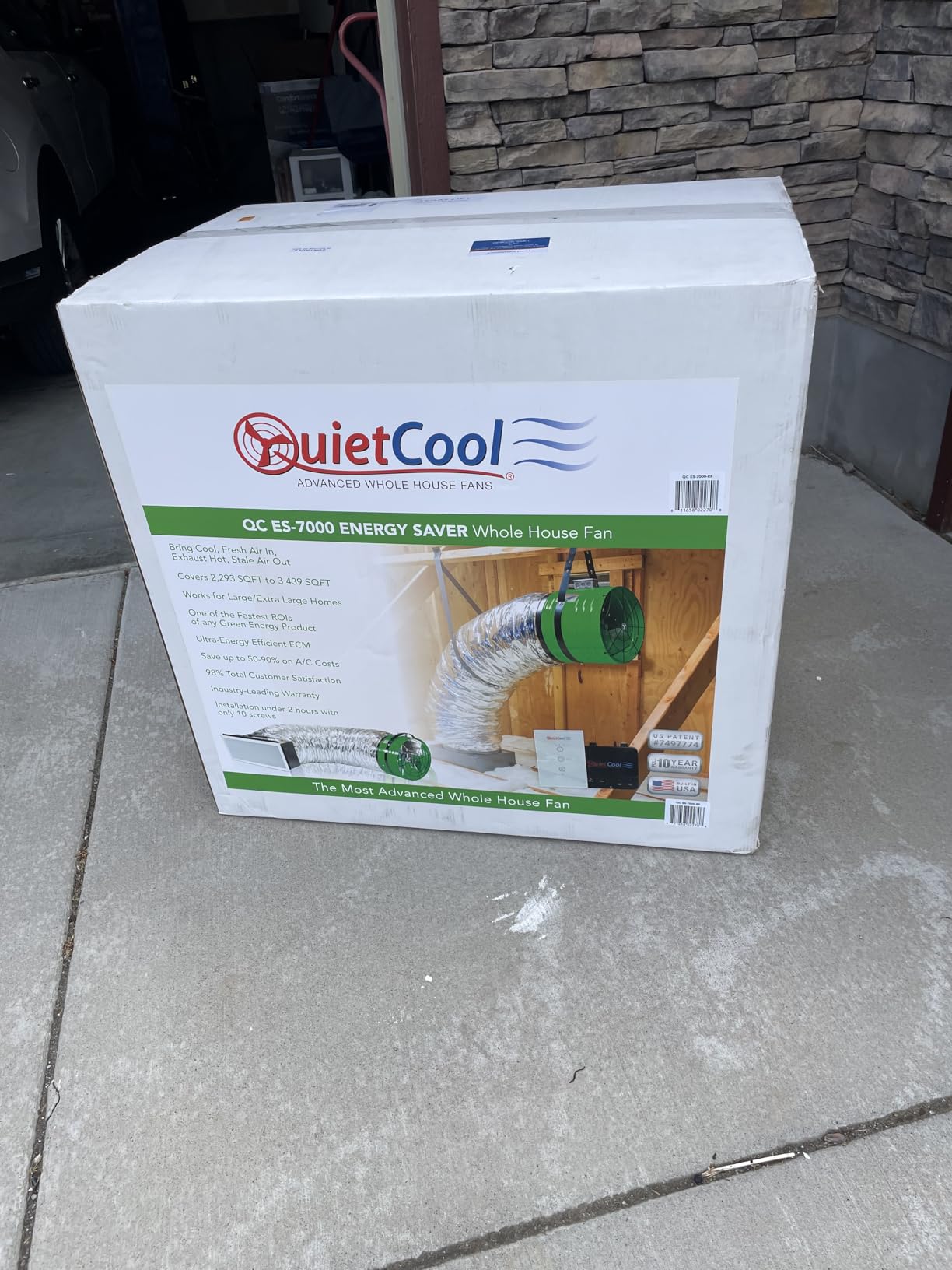
The build quality gets described as rugged, with a solid housing and a motor that runs smoothly. Wireless control means no drywall cutting for a switch line, which is a meaningful saving on a finished second floor. This is the fan to pick if you plan to run it a lot rather than occasionally.
The rating holds back for durability and service, not performance. One owner reported a fan blade shearing off within a few months and poor follow-up from the manufacturer on the replacement. At this size two people are needed for some installation steps, which is worth knowing before you plan a solo weekend install.
What you should check before buying the ES-7000 RF?
You still need about 9.18 sq ft of net free attic vent area, so nothing changes about your venting requirements compared to the CL-7000. Also confirm you have someone to help lift it into the attic, since the motor head on this size is not a one-person job through a standard hatch.
Who the ES-7000 RF suits and who should skip it?
It suits owners who want maximum airflow per watt, particularly anyone planning long overnight runs on low speed. It also suits large two-story homes where the second floor needs serious volume but the power bill matters. Skip it if you are installing solo, or if a single reported durability issue is a dealbreaker for you at this price tier.
5. Centric Air QA-Deluxe 4800 ECM – Best Thermostat-Controlled Option
QA-Deluxe 4800 ECM Energy Efficient Whole House Fan, 3 Speed Remote
4203 CFM raw and 3209 CFM Title 24
491 watt ECM motor
3-speed remote with thermostat
Sized for two-story homes to 2800 sq ft
Pros
- Three-speed remote with timer and temperature control that cycles the fan overnight
- ECM motor delivers strong airflow at 491 watts
- Acoustical ducting and rubber bushings for quiet running
- Laser-cut R-5 damper box with heavy-duty support brackets
- Fits 16 to 24 on-center joists with no framing
Cons
- Damper box assembly is fiddly and the duct shape does not match the housing hole
- No paper template for the ceiling cut-out
- Some noise at full output
- May need a nearby outlet and rafter cross-bracing
Most whole house fans run until you turn them off. This one has a thermostat in the remote that cycles the fan automatically, which is the feature that turns a whole house fan into a system you can actually leave running overnight without thinking about it. The three-speed remote adds a middle setting that single-speed kits do not offer.
Performance sits in the middle of the class at 4,203 CFM raw, or 3,209 CFM by California Title 24 measurement, from a 491 watt ECM motor. Centric Air rates it for two-story homes up to 2,800 sq ft and one-story homes up to 1,900 sq ft, with 4.0 sq ft of attic ventilation required.
What makes this one quieter than its numbers suggest?
Centric Air uses acoustical ducting, a precision-spun aluminum housing, and rubber bushings to isolate vibration, and owners rate it as quiet relative to its airflow class. The R-5 damper box is laser-cut and sits on heavy-duty support brackets so the damper does not rest on the ceiling drywall, which both helps sealing and cuts structure-borne noise.
The friction is installation ergonomics. Owners report the damper box assembly takes troubleshooting to get the doors swinging freely, and the round duct does not match the oblong housing opening, so the fit needs help. There is no paper template for the ceiling cut-out, and some installs need a nearby outlet plus cross-bracing between rafters.
Who the 4800 ECM suits and who should skip it?
It suits mid-size two-story homes up to about 2,800 sq ft where you want automatic temperature-based control and only three ventilation settings. Skip it if you are confident with the damper assembly, or if you need more airflow than the Title 24 figure suggests for a very tall or vaulted space.
6. Master Flow GAF 24 Inch – Budget Pick for Smaller Two-Story Homes
Master Flow GAF 24″ Whole House Fan, 2920 max CFM, PSC Motor – WHFS24M
2920 max CFM
Direct drive quarter HP PSC motor
562 sq in of attic exhaust ventilation needed
UL and UL Canada listed
Pros
- Direct drive quarter HP PSC motor runs quietly with reduced vibration
- Installs without joist cutting and needs only 562 sq in of attic venting
- Included automatic ceiling shutter seals the attic when off
- Alloy steel housing with a long service life
Cons
- Louvered shutter is noticeably noisy and leaks hot air in winter
- Under-specced for larger two-story homes above 2000 sq ft
- One owner reported blades catching the shroud and bending
The Master Flow GAF 24 is the entry point here, and it is genuinely good at what it does. A direct-drive quarter HP PSC motor moves up to 2,920 CFM with reduced vibration, and one owner reports running the same unit for more than 30 years. That kind of service life is hard to argue with at any price.
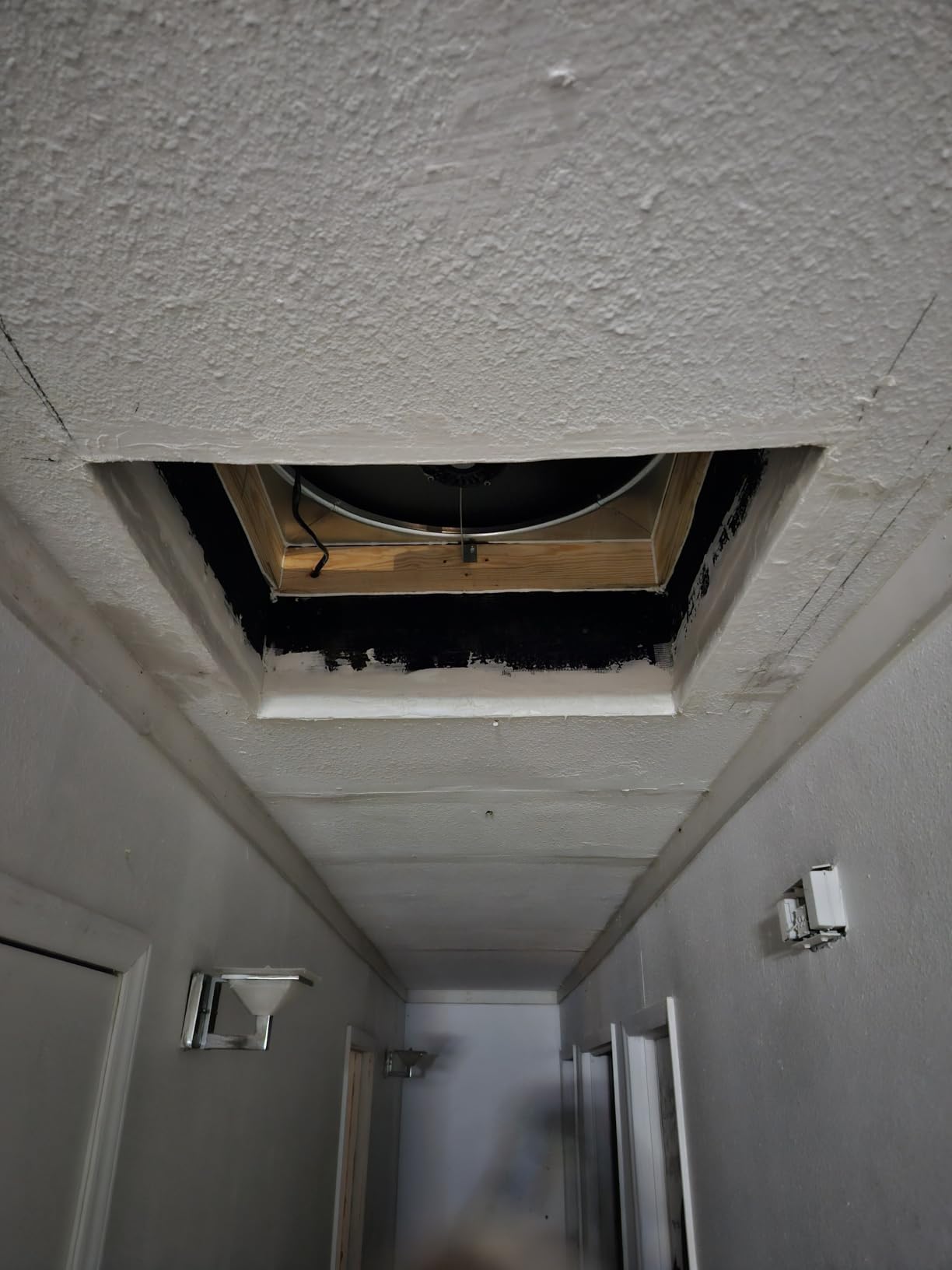
Installation is the easiest in this group. It fits without joist cutting, needs only 562 square inches of attic exhaust ventilation, and ships with an automatic ceiling shutter that seals the attic when the fan is off. It is also UL and UL Canada listed, which matters if your local inspection cares.
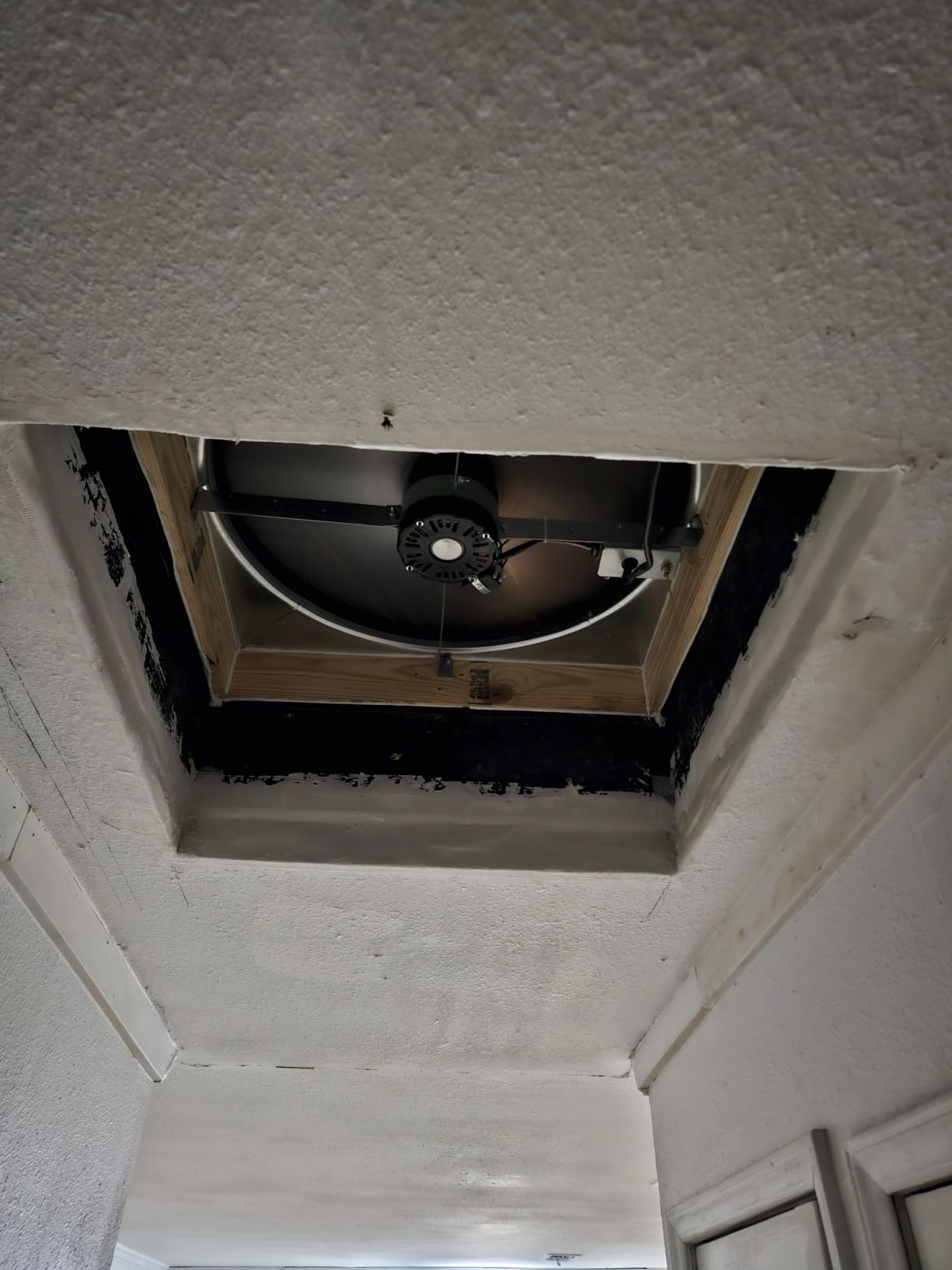
Where it falls short is the louvered ceiling shutter. Owners describe it as noticeably noisy while running and as a path for hot air leakage in winter, sometimes bolting their own insulating block over it to compensate. The louvered design is simply less refined than the tight-sealing R-5 and R-6 dampers on the newer units.
Sizing is the other limit. At 2,920 CFM it is specced for homes up to about 2,000 sq ft, which is the smaller end of the two-story market. One owner also reported blades catching the shroud and bending within two nights, so check clearance carefully if you install it yourself.
What you should check before buying the Master Flow GAF 24?
Confirm your home is genuinely in the 2,000 sq ft class or smaller. A two-story home of 2,600 sq ft will leave this fan undersized, and an undersized fan runs louder and longer without fully exchanging the air volume. Also decide how you will handle the winter shutter leakage before the first cold month.
Who the Master Flow GAF 24 suits and who should skip it?
It suits smaller two-story homes, older houses without attic access or existing ductwork, and buyers who want the lowest-cost path to whole house air exchange. Skip it for larger layouts, for anyone sleeping directly under the fan, or if tight winter sealing matters more than upfront cost.
7. AC Infinity CLOUDWAY T12 – Most Versatile with WiFi App Control
AC Infinity CLOUDWAY T12, Whole House Fan with WiFI Temperature Controller
1250 CFM airflow
11 speed PWM controlled EC motor
WiFi app with scheduling and VPD programming
62 dBA noise level
Pros
- Only unit here with true WiFi app control including scheduling and VPD programming
- PWM controlled EC motor with dual ball bearings is quiet and efficient
- ABS housing rated for high-humidity environments
- Plug-and-play power avoids running new attic wiring
- Fine-grained speed control for low-noise overnight use
Cons
- Air box does not fit standard 16 on-center joists without modification
- Included duct and control wire are short
- Louder than premium competitors above speed 5
- Most owners run a matched pair to cover a whole home
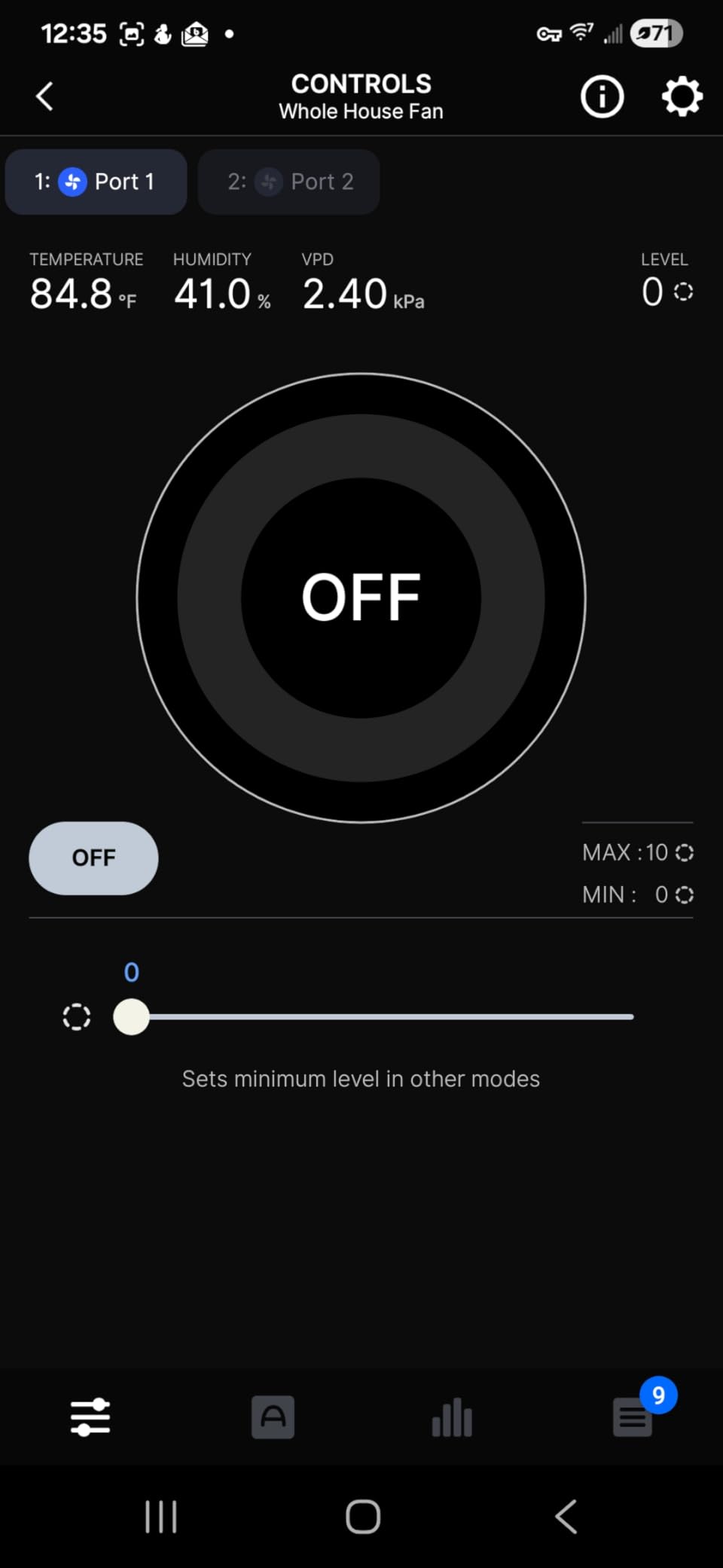
The CLOUDWAY T12 is the only fan in this lineup with genuine app control. You get scheduling, timers, cycles, minimum speed settings, and programming based on temperature, humidity, or vapor pressure deficit, all from a phone. That is a different category of automation than a countdown timer.
Under the app sits a PWM-controlled EC motor with dual ball bearings and up to 11 speed levels. The fine-grained control is what lets you dial it down to a genuine overnight whisper rather than choosing between off and high. The housing is ABS rated for high-humidity environments, which makes it one of the few here suited to a damp attic.
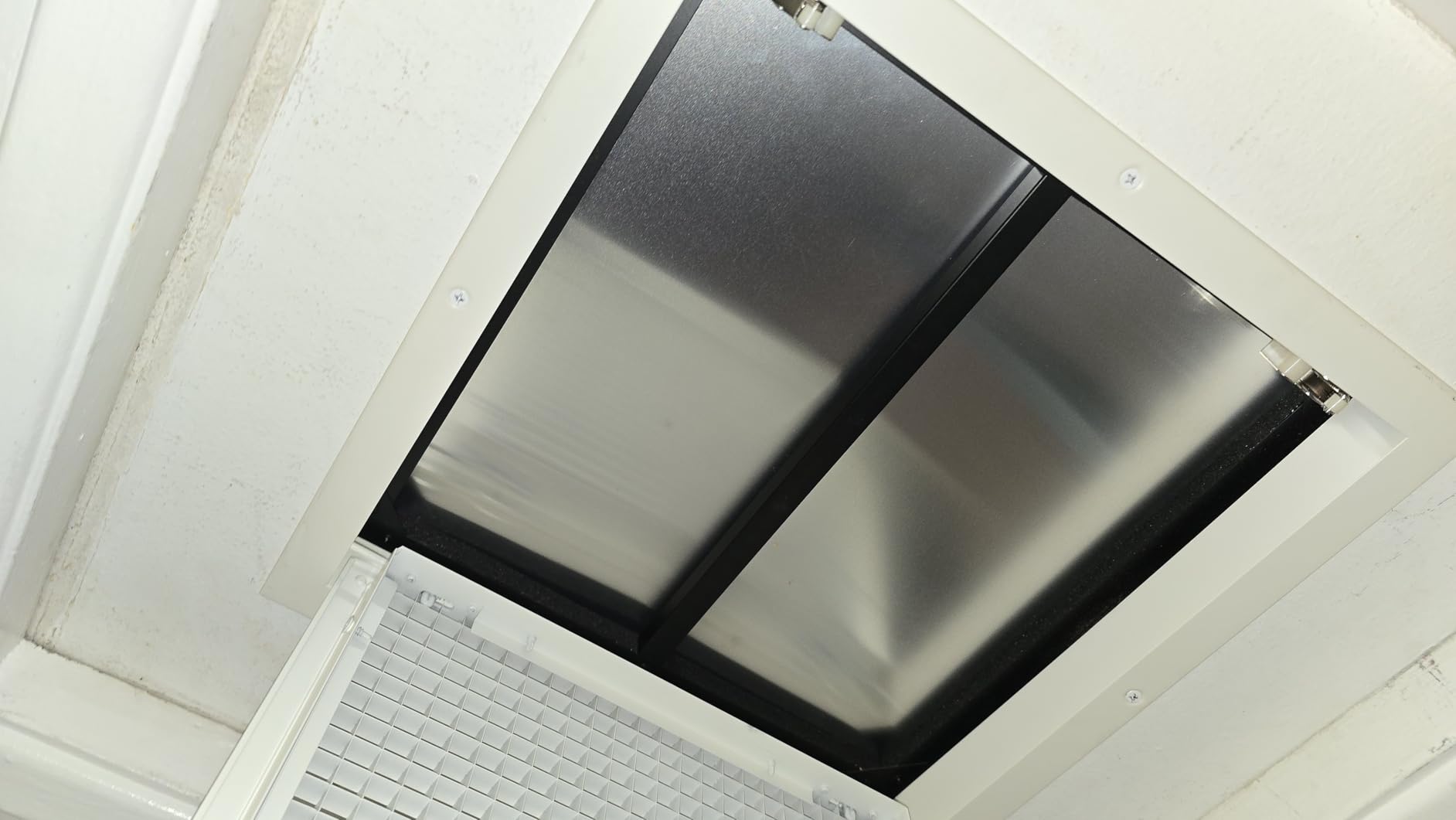
Power is plug-and-play with a US plug, so you avoid running new wiring into the attic. Buyers also point out the value against premium whole house fans costing far more for comparable power draw. For zoned layouts, the app is genuinely useful because you can run matched units independently.
Be realistic about the airflow figure though. At 1,250 CFM this is a component fan, not a whole home fan, and most owners in two-story homes pair two of them. The air box also does not fit standard 16 inch on-center joists without modification, and several owners had to build a wood boot to make it work.
What you should check before buying the CLOUDWAY T12?
Check your joist spacing before you commit. If you are on standard 16 inch on-center framing, budget for a custom boot or a framing adjustment, since that is the most common installation complaint. Also note that the included duct and control wire are short, which limits where you can mount the controller.
Who the CLOUDWAY T12 suits and who should skip it?
It suits two-story homes where you want zoned control, app-based automation, and the ability to run each floor separately. It also suits humid regions and damp attics where the housing rating matters. Skip it if you need one unit to move whole-home airflow, or if noise at mid-to-high settings bothers you.
8. Solatube EPS Extreme 4567 CFM – Best for the Longest Warranty
Solatube Whole House Fan EPS Extreme 4567 CFM Home Cooling Fan 3000 Sq Ft
4567 CFM airflow
7 speed EC brushless motor
50 dB noise level
15 year limited motor warranty
Pros
- 4567 CFM suits the middle of the two-story market
- Patented HushMount 2 mounting minimizes vibration noise
- Precision-cut jet blade design maximizes airflow and cuts vibration
- Seven adjustable speeds on an EC brushless motor
- R6 insulated damper doors reduce infiltration when off
Cons
- Very limited owner feedback on record right now
- No long-term durability or installation detail from customers yet
Solatube is best known for daylighting, and this is the first whole house fan from a brand people know for light tunnels. The spec sheet is credible for the middle of the two-story market: 4,567 CFM, a 7-speed EC brushless motor, and a 50 dB noise rating.
The mounting system is the interesting part. HushMount 2 is a patented vibration-isolating mount, and the precision-cut jet blade design is meant to push maximum air with low vibration. Seven speed settings on an EC motor gives finer control than the two-speed PSC units, and R6 insulated damper doors are among the tightest seals in this group.
The package is unusually complete for a do-it-yourself install. The kit includes motor, fan, damper, mounting system, remote, grille, fasteners, and ducting, so you are not hunting for parts. The motor carries a 15-year limited warranty, the longest in this lineup, split into 10 years mechanical and 5 years electrical.
Here is the honest caveat. There is very limited owner feedback on record, and no customer reports yet describe build quality or installation difficulty over time. A single positive rating is encouraging but thin, so treat this as a spec-sheet purchase rather than a proven one.
What you should check before buying the Solatube EPS Extreme?
Confirm the ceiling cut-out and your joist spacing against the dimensional listing before you buy, since this is a newer kit with thinner install history. The complete box contents are a real advantage if you are comfortable with attic work and do not want to source a separate damper or ducting.
Who the Solatube EPS Extreme suits and who should skip it?
It suits buyers who want fine speed control, tight damper sealing, and the longest warranty in the category without moving to the highest airflow class. Skip it if you depend on a long history of owner reports, or if you want the very highest CFM for a very large two-story home.
How to Size a Whole House Fan for a Two-Story Home?
The rule of thumb every manufacturer uses is 2 to 3 CFM per square foot of conditioned floor area. Multiply your total square footage, including both floors, by that range, then check the result against the attic venting you actually have. A fan that outruns your roof vents will run loud and move less air than its rating suggests.
Adjust upward for ceiling height. A two-story home with 10 foot ceilings on both floors holds more air volume than one with 8 foot ceilings, so add roughly 10 to 15 percent. Vaulted great rooms, bonus rooms, and a stairwell that opens to a third-floor or high ceiling all push you toward the higher end of the range or the next size up.
Here is how the bands work in practice. Under 2,000 sq ft you can get away with a fan in the 2,900 to 4,200 CFM class, which is where the Master Flow and the Centric Air 4800 ECM sit. From about 2,000 to 2,800 sq ft you want the 4,400 to 5,100 CFM range, which covers the QuietCool CL-4700 RF and the Solatube. From 2,800 to 3,500 sq ft you are in the 6,900 CFM class, where the QuietCool CL-7000 RF and ES-7000 RF live.
Beyond 3,500 sq ft, the honest answer is that one fan is asking a lot. Two smaller fans, one per floor, give you better control and often better noise results than a single unit forcing air through a two-story volume.
Why the top of the stairs is the right spot?
Hot air rises, and in a two-story home that rising column collects at the stairwell opening because it is the path of least resistance. A fan mounted near the top of the stairs pulls that accumulated hot air directly into the attic instead of pushing it around the second floor first. Homeowners who installed at the top of the stairs report the largest improvement in upper-floor comfort of any placement.
The airflow pattern that follows is the stack effect. Open windows on the shaded, windward side of the lower floor to pull cool air in, and open upper-floor windows to let air escape and help draw the cool air upward through the house. Running a fan on a lower level window to push air out is a variation of the same idea.
Attic venting math you should do before you buy
The standard requirement is about 1 square foot of net free vent area per 750 CFM. Net free area is the actual open area after screening is deducted, which is why manufacturers publish figures like 9.24 sq ft rather than a vent count. For a 6,900 CFM fan that works out to just over 9 sq ft of net free area, and a typical home will not have that without adding vents.
If your attic is short, add ridge vents or soffit baffles before you install, or add powered vents. An under-vented attic is the most common reason a good fan gets uninstalled after a season of noise and weak performance. Measuring your existing net free vent area takes an afternoon and saves you a bad purchase.
One central fan or two smaller fans
One central fan at the top of the stairs is the right call for most two-story homes up to about 3,000 sq ft. It is simpler to control, cheaper to install, and the stack effect does the work of moving air between floors for you.
Two smaller fans, one per floor, make more sense past roughly 3,500 sq ft, in homes with a wide floor plan and separate heating zones, or whenever you want independent control of each level. The AC Infinity CLOUDWAY T12 is built for exactly that pattern, and app-based scheduling lets you run the two floors on different schedules.
Noise and bedroom placement
The number that matters is decibels at the ceiling register, not the motor rating. Anything above 55 dBA will register in an adjacent room, and in a quiet two-story house that is often a bedroom. If you are noise-sensitive, put the register in a hallway rather than a bedroom ceiling, use flexible acoustical ducting to isolate vibration, and run the fan on low overnight.
Which is why we keep coming back to the QuietCool CL-4700 RF. At 37.2 dB it is the quietest rated unit here, and its low speed is genuinely gentle enough to sleep under. If the fan has to sit near an upstairs bedroom, start there.
Motor type: ECM versus PSC
A PSC motor is cheaper to buy and pulls more watts for the air it moves, which is why the QuietCool CL-7000 RF draws 1,147 watts on high. An ECM brushless motor costs more upfront and drops to a fraction of that on low speed, as with the ES-7000 RF at 164 watts on low while still moving 4,304 CFM.
If you plan to run your fan a lot, especially overnight, ECM wins on running cost. If you run it occasionally in shoulder season, PSC is a reasonable trade. And if you pair the fan with a thermostat that automates cycles, the ECM low-speed figure is the number that decides your bill.
Window intake area and backdrafting
Your windows are the intake, and they need enough open area to feed the fan. A common guideline is about 4 sq ft of screened opening per 1,000 CFM, so a 5,000 CFM fan wants roughly 20 sq ft of open window area. Opening two or three rooms on the shaded side usually covers it in a two-story home.
Keep windows open whenever the fan runs. That creates the negative pressure that drives flow, and it is also what keeps combustion appliances from backdrafting into living space. If you have gas appliances or a fireplace, this is not optional. If you want to know how the rest of your indoor air quality gear compares, our whole house humidifier guide covers the humidity side.
Controls and seasonal integration
Timer-based controls are the norm, and the RF kits here add a glass wall switch with a countdown timer up to 12 hours so you avoid fishing a switch wire down the wall. Thermostat-controlled models cycle the fan automatically, and app-controlled units add humidity and vapor pressure programming.
One setup many owners like is running the fan on low overnight, letting it flush the house, then handing off to the air conditioner when outdoor temperatures climb. Because a whole house fan draws far less power than central air, that handoff sequence is where the savings come from. If you are also planning for power interruptions, our whole house generator comparison covers that side, and our surge protector picks handle electronics protection.
When Not to Buy a Whole House Fan?
A whole house fan moves outside air and nothing else. It does not dehumidify, it does not filter, and it does not cool when the outdoor air is warmer than the indoor air. In humid climates or during the hottest stretch of summer, running one can make a house less comfortable rather than more.
Check your nights before you commit. Owners report these fans earn their keep when overnight temperatures fall into the 50s and 60s. If your nights stay warm and muggy until late in the season, the fan will sit idle, and noise plus weak performance are the two reasons people stop running them altogether.
Skip the purchase entirely if you rent, if your attic is already badly under-vented and you cannot add vents, or if you have no windows you can open on a shaded face of the house. It is also the wrong tool if your primary goal is humidity control, since owners fighting high humidity with window air conditioners will not find an answer here.
Frequently Asked Questions
How many CFM do I need for a 2,000 sq ft two-story home?
For a 2,000 sq ft two-story home with standard 9 or 10 foot ceilings, target roughly 4,000 to 6,000 CFM using the standard 2 to 3 CFM per square foot rule. Add 10 to 15 percent if you have vaulted ceilings or a bonus room. A fan in the 4,400 CFM class is a realistic match, provided your attic can exhaust it.
What is the recommended CFM for a whole house fan?
Most sizing guides point to 2 to 3 CFM per square foot of conditioned floor area. Multiply that by your total square footage across both floors, then increase for ceiling height above 9 feet, vaulted spaces, or a stairwell open to a higher level. Always check the result against your available attic net free vent area before choosing a model.
How much attic venting does a whole house fan need?
The standard requirement is about 1 square foot of net free vent area per 750 CFM of airflow. Net free area is the real open area after screening deductions. A 4,415 CFM fan needs roughly 5.89 sq ft, while a 6,924 CFM fan needs about 9.24 sq ft. Add ridge vents or soffit baffles before installing if your attic falls short.
Can you run a whole house fan with the central AC on?
Running both at once is usually counterproductive, because the air conditioner needs to close registers and recirculate cool air while the whole house fan is exhausting air upward. Most owners run the fan first to flush the house with cool night air, then switch to the air conditioner once outdoor temperatures rise. Many pair the fan with a thermostat that automates that handoff.
Are whole house fans loud enough to wake people upstairs?
It depends on both the model and where it sits. The QuietCool CL-4700 RF is rated at 37.2 dB, while several others here run 50 to 62 dBA. In a two-story home, mount the ceiling register in a hallway rather than a bedroom ceiling, use acoustical ducting to isolate vibration, and run low speed overnight. Placement changes perceived noise more than the model does.
Why don’t people use whole house fans anymore?
Most people stop using them because they were sized wrong, installed in the wrong place, or paired with an under-vented attic, which makes them loud and disappointing. They also do nothing about humidity, so in humid climates they never feel like a real cooling option. Installed correctly at the top of the stairs with adequate venting, they remain one of the cheapest ways to cool a two-story home.
Bottom Line for Two-Story Homeowners
The best whole house fans for two story homes are the ones matched to your square footage, your attic venting, and your tolerance for sound. For most homes between 2,200 and 3,400 sq ft, the Centric Air QA-Deluxe 5500 is the pick we would install, with the QuietCool CL-4700 RF as the quieter option for homes under 2,200 sq ft and the CL-7000 RF or ES-7000 RF for anything larger.
Whatever you choose, install it at the top of the stairs, verify your net free vent area first, and open windows on the shaded side whenever it runs. Get the sizing right and the second floor stops being the room nobody wants to sleep in.