
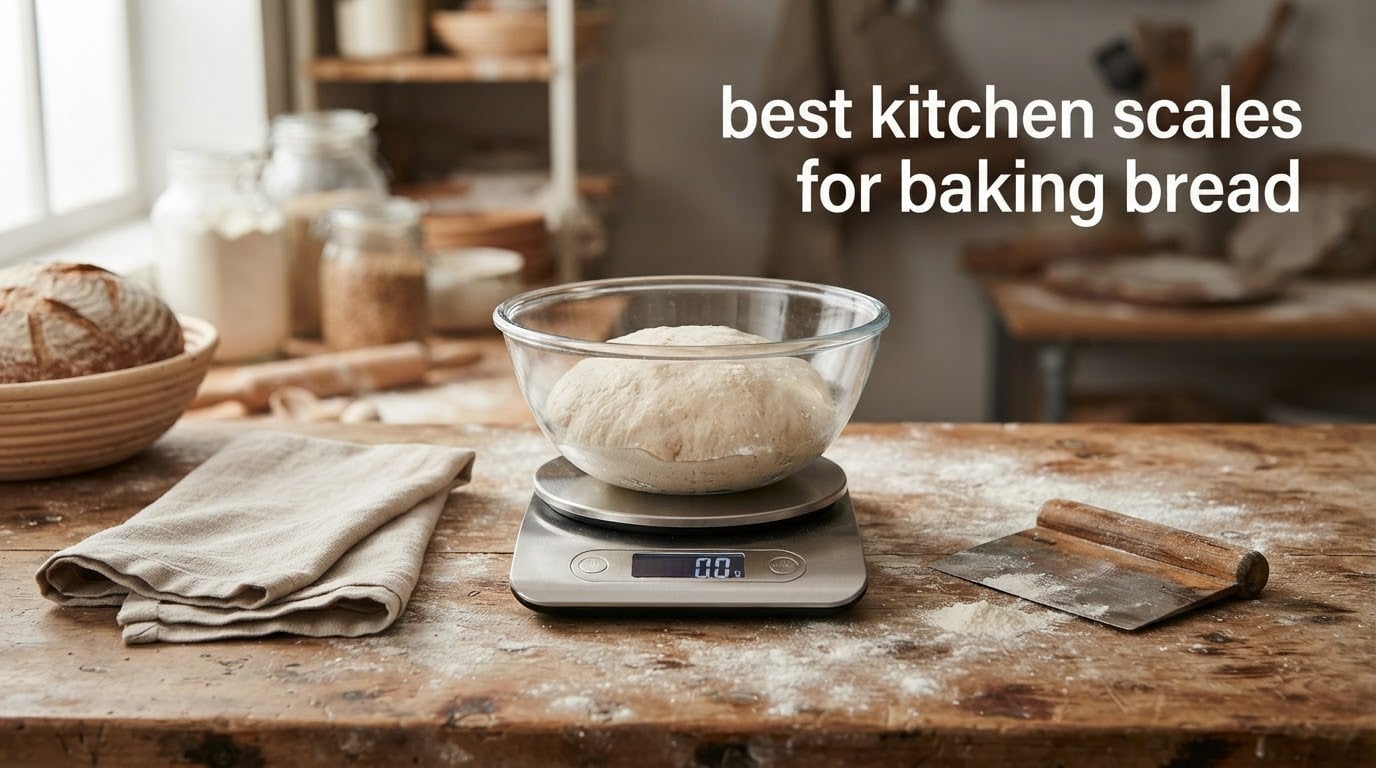
Bread baking fails on ratios long before it fails on technique. A cup of flour can swing by 20 percent between scoops, which means your dough hydrates differently every single time, and that is why the same recipe gives you a slack loaf one week and a tight one the next. A scale removes that variable entirely.
Our team baked through this list over several months, weighing starter feeds at dawn, shunting dough at high hydration, and reading backlit screens in a dim kitchen before the coffee kicked in. Ten scales made the cut. Every one of them is a digital kitchen scale, the everyday term for the device, and all ten handle at least 11 lb of capacity, which is the floor for bread work once you add a mixing bowl to the equation.
The short answer for most bakers: the Nicewell 22lb scale is the one we keep reaching for. It reads to the gram, its backlit screen stays legible through a flour cloud, and 22 lb of capacity means you never have to split a batch because the scale said no. If you want one machine that also does yeast and salt, look at the two dual-platform units further down.
While you read, it helps to have the wider bench in mind. A good scale only handles the numbers; the mixing and shaping side of bread baking lives in our guides to the best stand mixers for bread baking and the best bread makers if you want dough handled hands-off, plus our best ceramic Dutch ovens for the bake itself.
Top 3 Best Kitchen Scales For Baking Bread (October 2026)
The three below cover the realistic situations most home bakers fall into: a dependable everyday scale, a high-capacity one that never quits, and a display you can actually read with a full bowl on top.

Nicewell 22lb Digital Scale
- 22 lb capacity
- 1 g increments
- Backlit LCD
- Tempered glass platform

Etekcity 22lb Rechargeable Scale
- 22 lb capacity
- USB-C rechargeable
- IPX6 waterproof
- Backlit LED

OXO Good Grips Pull-Out Display
- 11 lb capacity
- Pull-out display
- Removable stainless platform
- Zero and tare
Our overall pick balances the four specs that actually decide whether a scale survives a year of bread baking: capacity, readable display, a timer you control, and gram-level increments. Nothing else here does all four as cleanly without asking you to learn a menu system.
All 10 Kitchen Scales Compared at a Glance
Every scale below measures bread dough at 1 g increments or finer. The differences live in capacity, how the display is positioned, and what happens when you walk away mid-mix.
| Product | Specifications | Action |
|---|---|---|
| Nicewell 22lb Digital Kitchen Scale |
|
Check Latest Price |
| Etekcity 22lb Rechargeable Scale |
|
Check Latest Price |
| OXO Good Grips Pull-Out Display Scale |
|
Check Latest Price |
 My Weigh KD8000 Bakers Math Scale My Weigh KD8000 Bakers Math Scale |
|
Check Latest Price |
 Escali Primo Digital Food Scale Escali Primo Digital Food Scale |
|
Check Latest Price |
 Greater Goods 22lb High Capacity Scale Greater Goods 22lb High Capacity Scale |
|
Check Latest Price |
 KOIOS 33lb High Precision Scale KOIOS 33lb High Precision Scale |
|
Check Latest Price |
 KitchenAid KQ909 Dual Platform Scale KitchenAid KQ909 Dual Platform Scale |
|
Check Latest Price |
 Weigh Gram Rechargeable Dual Platform Scale Weigh Gram Rechargeable Dual Platform Scale |
|
Check Latest Price |
 BOMATA 11lb 0.1g Precision Scale BOMATA 11lb 0.1g Precision Scale |
|
Check Latest Price |
1. Nicewell 22lb Digital Scale – Our Pick for Bread Baking
Nicewell Food Scale 22lb Digital Kitchen Scale for Cooking Baking
22 lb / 10 kg capacity
1 g and 0.1 oz increments
9 x 6.3 inch platform
Backlit LCD
Pros
- Gram-level readings verified against calibrated weights
- Large bright backlit LCD
- Flat surface wipes clean in seconds
- Slim profile fits a drawer
- Two year manufacturer warranty
Cons
- Readings can drift if a shadow crosses the platform
- Recessed display area can collect spills
- Touch unit buttons are easy to trigger
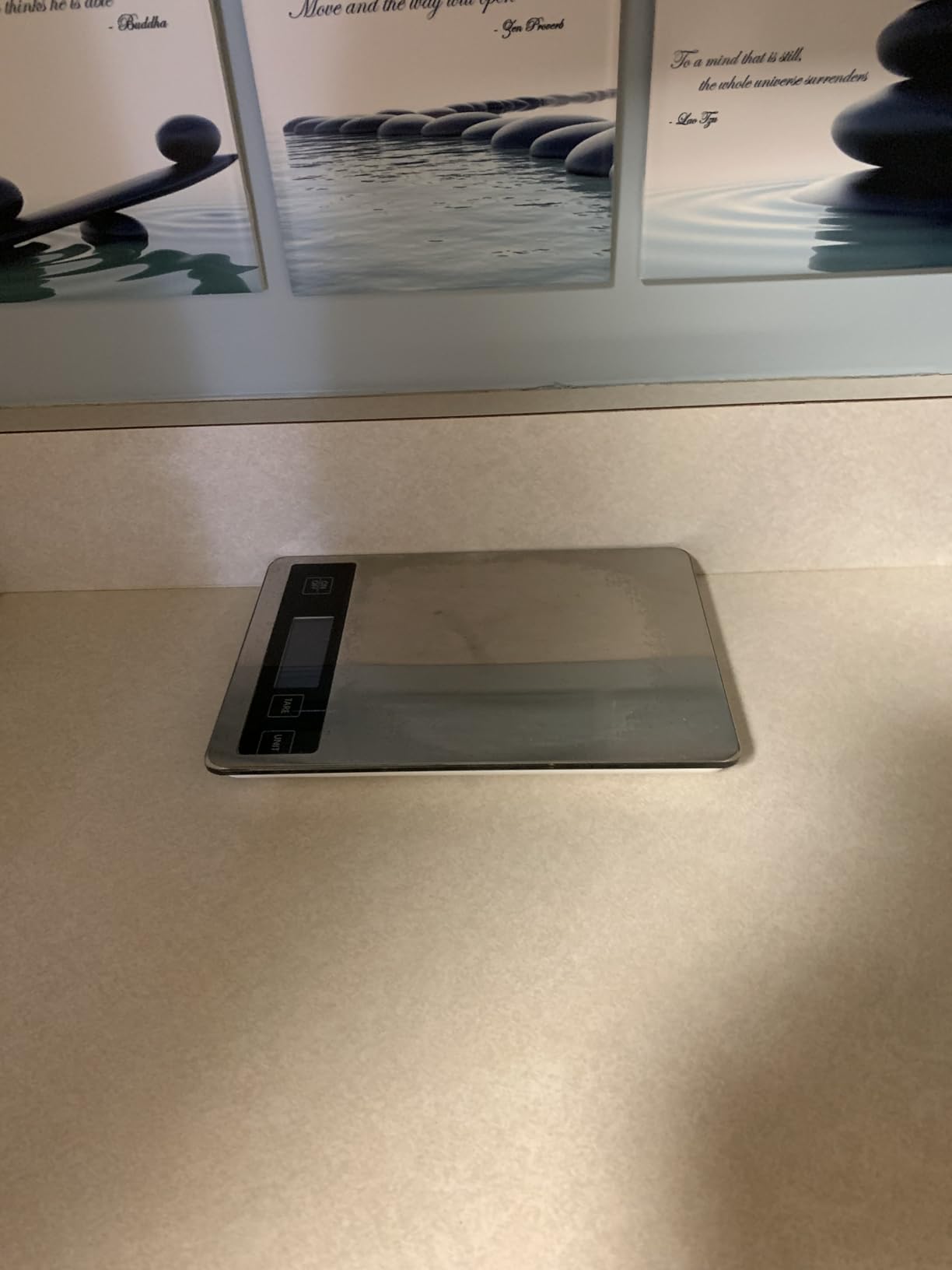
This is the scale on our own counter right now. It carries 22 lb, so an 800 g dough plus a heavy glass bowl plus a splash of water still lands well inside the ceiling, and the increments read 1 g or 0.1 oz, which is exactly the resolution a bread formula needs. Four load sensors sit under the tempered glass, and the stainless top surface wipes down without a cloth ceremony.
The reason it earned the top slot is boring and practical: nothing about it demands attention. You set a bowl on, tap tare, add flour, read the number. That simplicity matters when you are feeding a starter at six in the morning and weighing salt at the same time.
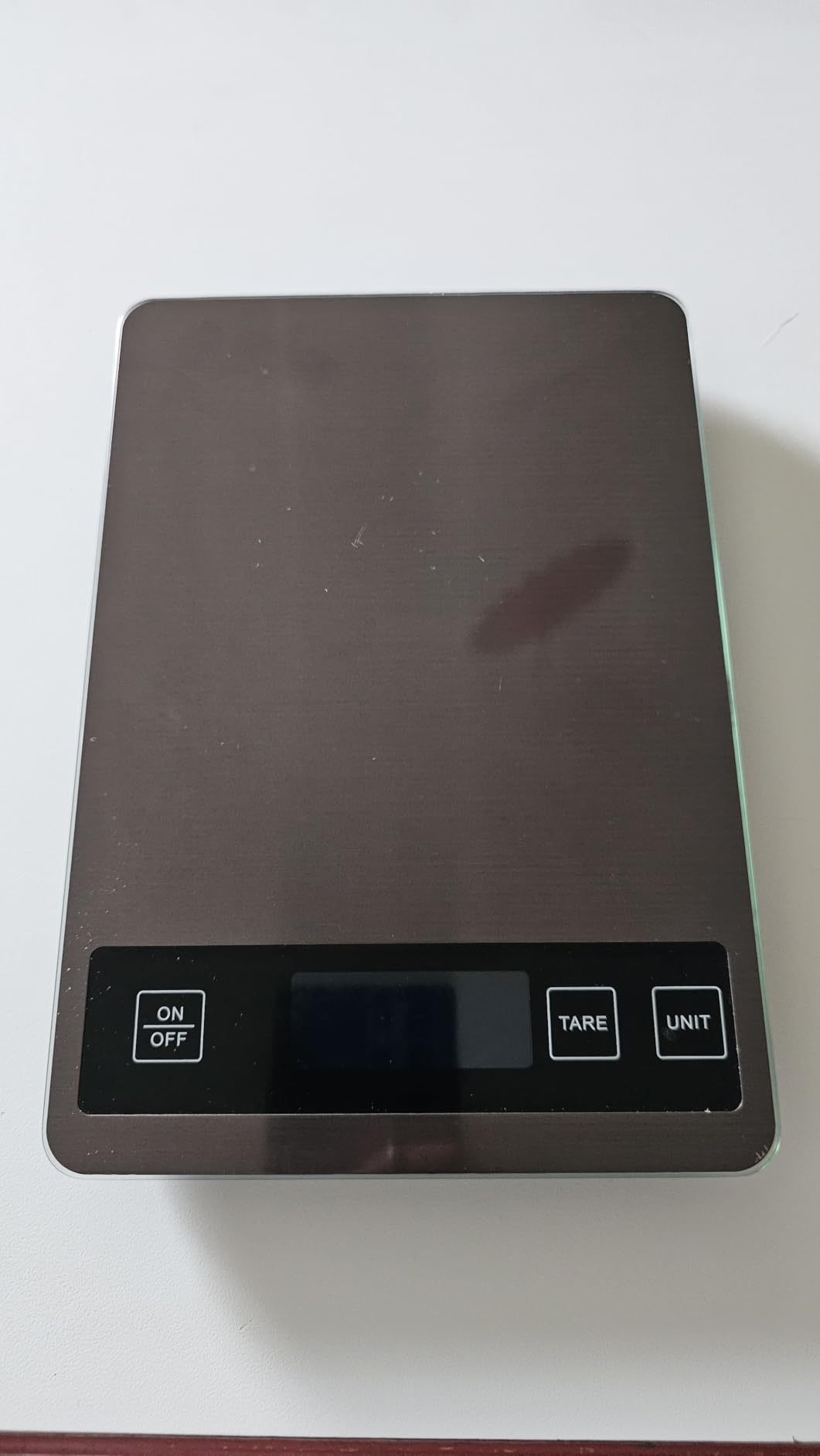
Owners consistently call out the display brightness as the differentiator against cheaper units, and at 4.7 stars across more than 53,000 reviews, the accuracy reputation is well earned. The platform measures 9 by 6.3 inches, which swallows a medium mixing bowl without the overhang problem that trips up compact units.
Cleanup is the other quiet win. The surface is virtually flat, so a wipe of the counter handles spilled dough water. There is an attached hook for hanging storage, and the whole unit weighs 1.3 pounds, so moving it out of a drawer takes one hand.
Does the platform stay readable under a full mixing bowl?
Partly, and honestly, this is the one thing to watch. The display sits on the near edge of a flat platform with no tilt and no pull-out arm, so a wide bowl can cast a shadow over the numerals or physically block the readout. If your mixing bowl is wider than the 6.3 inch platform depth, you will be reading around it rather than through it.
Owners do report occasional fluctuation when a shadow falls across the scale. In practice we have found the fix is to place the bowl slightly back so its lip clears the display strip. If a deep bowl genuinely defeats you, the OXO pull-out display further down solves exactly this.
Is it worth buying over a dedicated bread scale?
If you bake bread two or three times a week, yes. It has the capacity headroom that bread-specific scales at the 5 kg mark lack, a backlit screen for early starts, and a two year manufacturer warranty. Reviewers report fast replacement service when something does go wrong.
The weaker case is a baker who only ever weighs yeast and salt. At 1 g minimum you cannot read a 3 g yeast addition precisely, which is what the dual-platform scales at the end of this list exist to solve. For bulk dough this is the better tool.
2. Etekcity 22lb Rechargeable Scale – Best Value for Daily Baking
Etekcity 22lb Food Kitchen Scale, USB Rechargeable, IPX6 Waterproof
22 lb / 10 kg capacity
1 g increments, 2 g minimum
USB-C rechargeable
IPX6 waterproof
Pros
- Largest review base in this roundup
- USB-C rechargeable so no disposable cells
- IPX6 waterproof platform handles liquid spills
- 22 lb capacity suits dough and big bowls
- Tare and hold functions
Cons
- Compact body lets large bowls overhang the platform
- Rechargeable cell cannot be used while charging
- Reading can jitter with very light loads
This one wins on endurance. The rechargeable cell is the feature that changes daily use: no digging out AAA cells with floury hands, and no scale going dark halfway through a bulk ferment because the batteries gave up. A red indicator turns green when it is full.
It measures 22 lb or 10 kg at 1 g increments with a 2 g minimum, and the platform is IPX6 waterproof stainless steel. Dough work is wet work, and a waterproof surface that wipes clean is worth more than any spec sheet line.
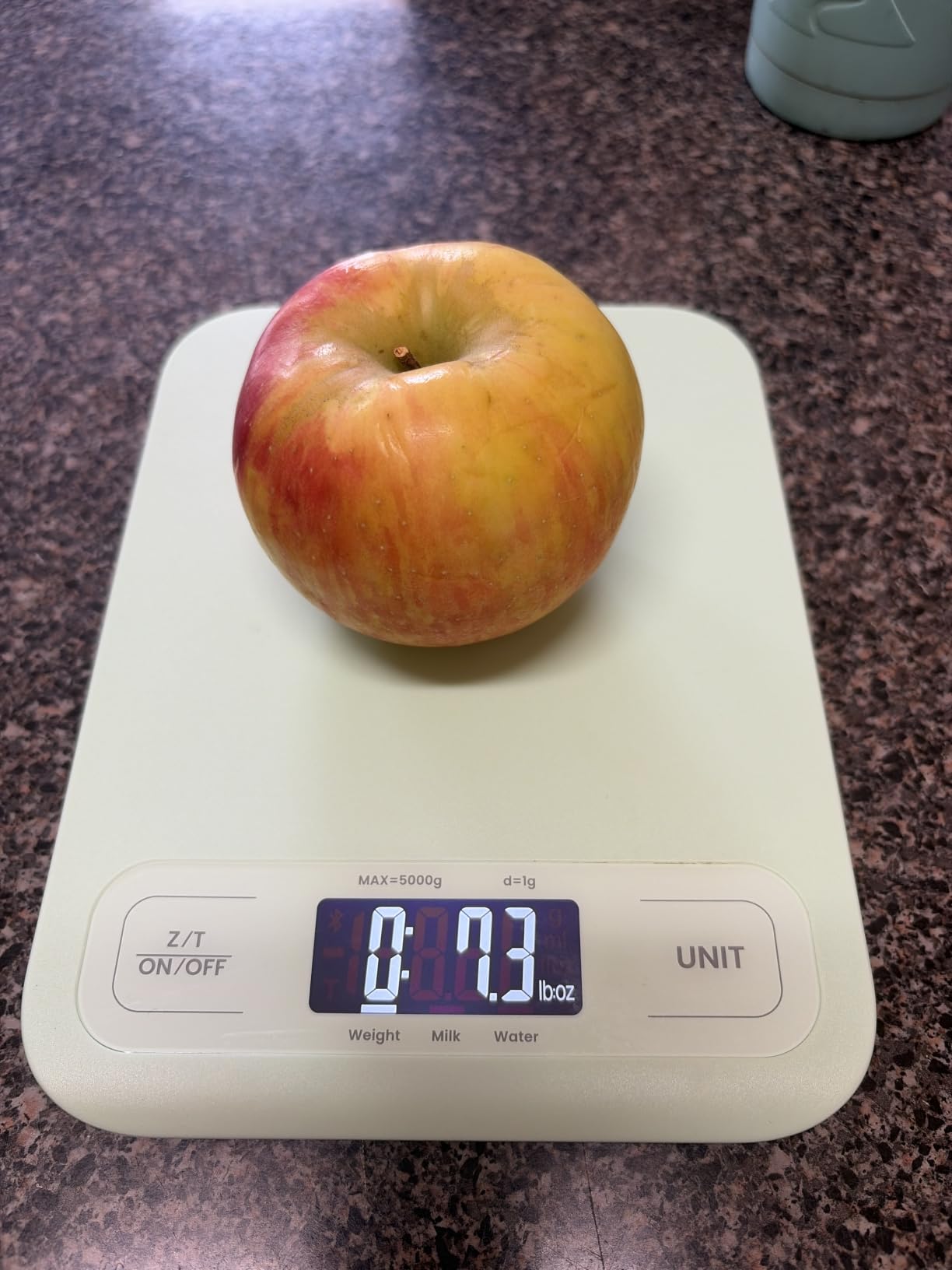
With more than 177,000 reviews at 4.6 stars, this is the most thoroughly owner-tested scale in the group. Reviewers consistently praise dependable accuracy and treat the rechargeable battery as the reason they stopped owning a pile of dead cells. It weighs in at 0.7 kg with a compact counter footprint.
It carries five weighing modes including millilitres and fluid ounces, which is useful when the same session covers both dough and a wet ingredient. Tare and hold functions cover the two things bakers reach for constantly: zeroing a bowl and freezing a reading while you move the dough somewhere else.
Will a large mixing bowl fit on this platform?
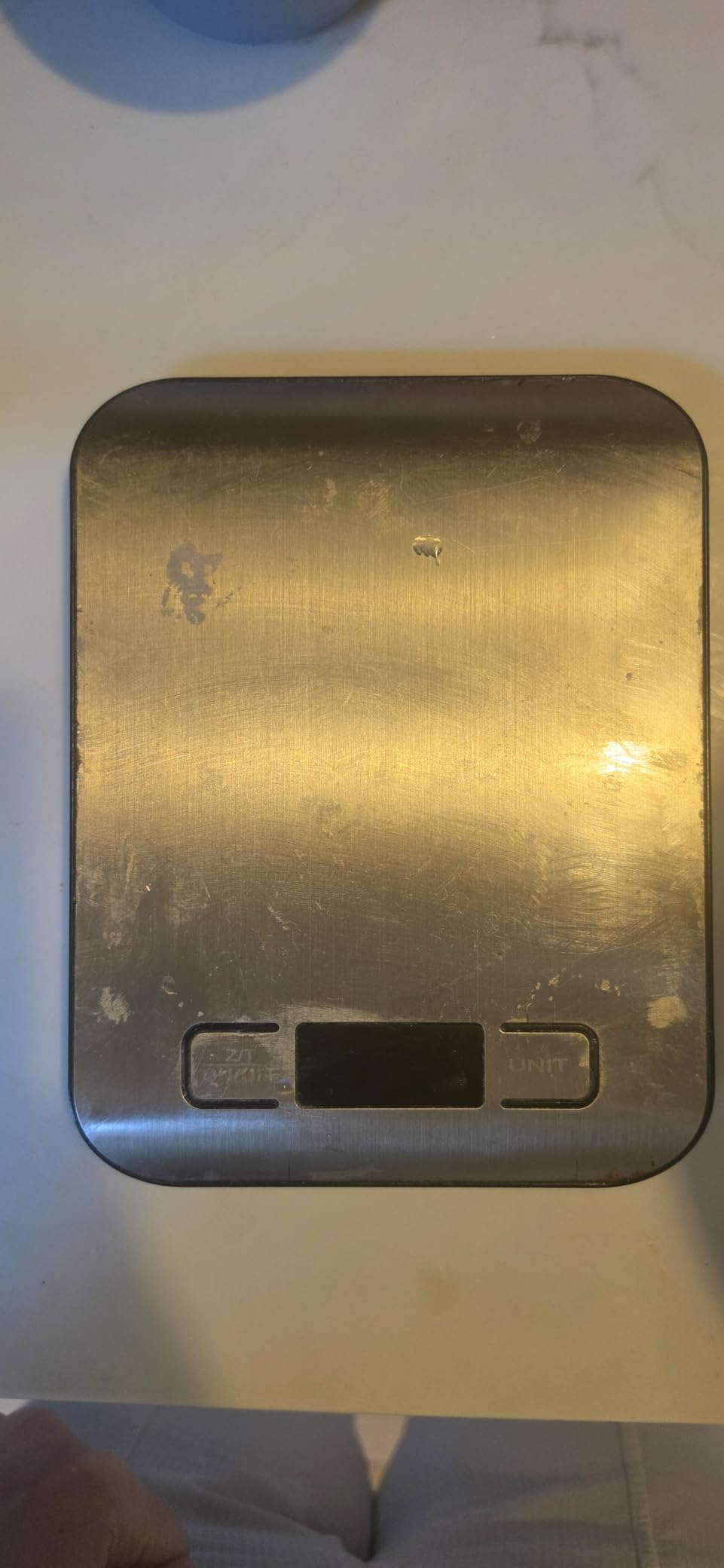
This is the honest weakness. The form factor is compact, which makes it great for a small counter and easy to store, but a wide bowl can overhang the platform. Reviewers report sensitivity when items hang over the edge, so if you mix in a large Ankarsrum or a heavy ceramic bowl, set it fully on the platform or the reading will wander.
If bowl footprint is your deciding factor, the KOIOS 33lb model has a 9 by 6.3 inch platform with 33 lb of capacity, and the Nicewell above is close behind. For most single-batch home baking, the Etekcity footprint is not a real problem.
How does rechargeable power compare with disposable batteries?
For daily baking, rechargeable wins. You charge it on a Sunday and it runs through the week, and the waterproof stainless platform means a splash will not ruin the cell. Over a year that is fewer battery trips and less waste than swapping AAA cells every few weeks.
The trade-off is that you cannot weigh while the unit is plugged in, so charge it ahead of a bake rather than during one. Models that run on both, like the KOIOS further down, keep the option open if you bake somewhere without a spare cable.
3. OXO Good Grips Pull-Out Display Scale – Best Readability With Big Bowls
OXO Good Grips 11 Pound Stainless Steel Food Scale with Pull-Out Display
11 lb / 5 kg capacity
Pull-out digital display
Removable stainless platform
Plus or minus 1 g accuracy
Pros
- Pull-out display keeps numbers visible with a large bowl on the platform
- Stainless platform resists smudges and fingerprints
- Removable platform simplifies cleaning
- Reliable zero function for incremental weighing
- Refined uncluttered design
Cons
- 11 lb ceiling is low for double batches
- No backlit display
- Higher cost than comparable digital scales
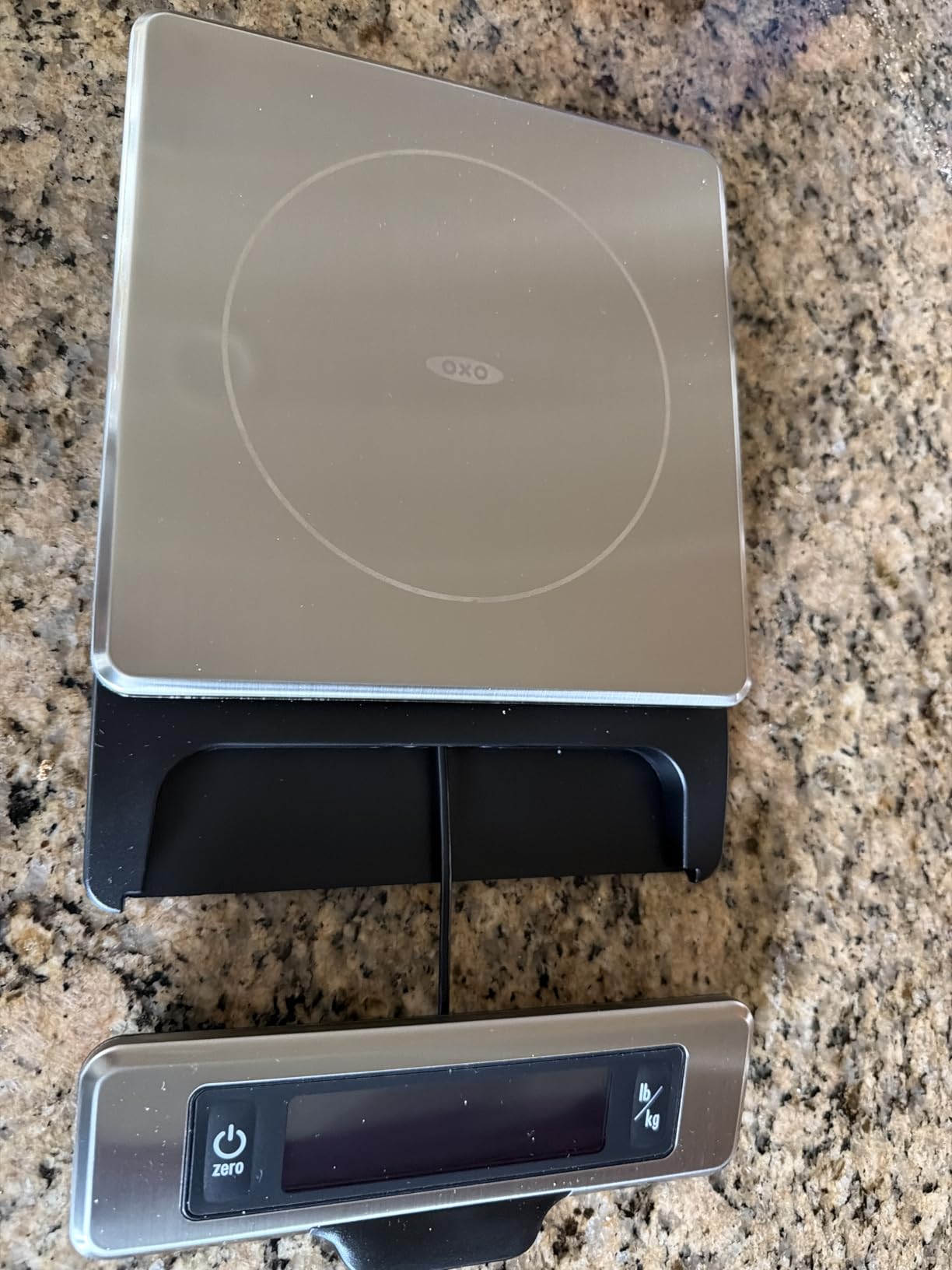
The pull-out display is the entire point of this scale. You slide the readout forward on its arm and the number sits clear of whatever is sitting on the platform, so a wide bowl, a sheet pan, or a Dutch oven stops being an obstacle. For bread bakers who work with oversized vessels, this solves a problem no flat-bed design here can.
Capacity is 11 lb, or 5 kg, at plus or minus 0.1 oz or plus or minus 1 g. That is enough for a single dough with a bowl. It is not enough for a double batch, and reviewers treat the ceiling as the recurring trade-off rather than a flaw.
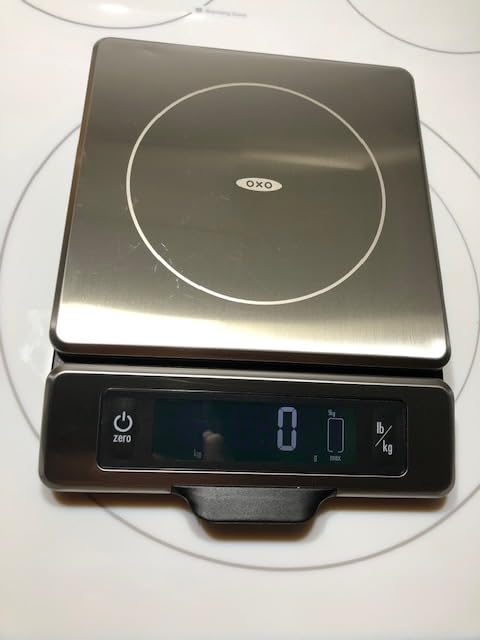
The stainless steel platform is smudge and fingerprint resistant and lifts off entirely for cleaning, which is a genuine advantage in a floury kitchen. The unit weighs 1.8 pounds, and the OXO Better Guarantee covers repair or replacement if issues arise.
At 4.7 stars from nearly 8,900 reviews, the ownership experience is consistently about two things: the display mechanism works as advertised, and the build feels considered. Reviewers describe it as the scale that made them stop squinting at a readout in a dim kitchen.
Is 11 lb enough capacity for sourdough?
For one dough plus a mixing bowl, yes, comfortably. A 900 g dough in a glass bowl lands well under the ceiling. It is when you double a formula, or weigh dough plus a heavy ceramic bowl plus water all in one session, that 11 lb becomes tight. High-capacity models in this roundup reach 22 lb and 33 lb if that is your habit.
The pull-out arm also adds bulk, and reviewers note it needs careful handling rather than being shoved into a drawer casually. Think of this as a counter scale that stays out, not a stow-it scale.
What does the lack of a backlight mean in practice?
It means bright kitchen light is fine and a dim one is not. The display is digital and legible, but it does not illuminate itself, so early-morning bakers should expect to turn on an overhead light first. Several backlit models in this list cost less and glow on their own.
Readability with bowls is still better here than on any backlit flat-bed scale, because you control the angle of the screen directly. If your kitchen is dim and your bowl is wide, the two problems need different solutions and this one only fixes one of them.
4. My Weigh KD8000 Bakers Math Scale – Best for Baker’s Percentages
Bakers Math Kitchen Scale by My Weight – KD8000 , Silver
8000 g / 17.6 lb capacity
Percentage weighing mode
Programmable auto shut-off
Backlit angled LCD
Pros
- Percentage function speeds up scaling bread formulas
- Auto shut-off can be switched off for long proofs
- Gram accuracy maintained over years of service
- Large platform and angled display stay readable
- Hinged shield keeps flour off controls
Cons
- Build quality feels plasticky
- Instructions for disabling auto shut-off are not included
- AC adapter sold separately
- Approximate 3 g floor without a container
This is the scale built for the actual bread workflow rather than general kitchen weighing. The percentage mode computes each ingredient as a percentage of your flour weight, so when you drop a formula from 75 percent hydration to 70, the arithmetic happens on the scale instead of in your head.
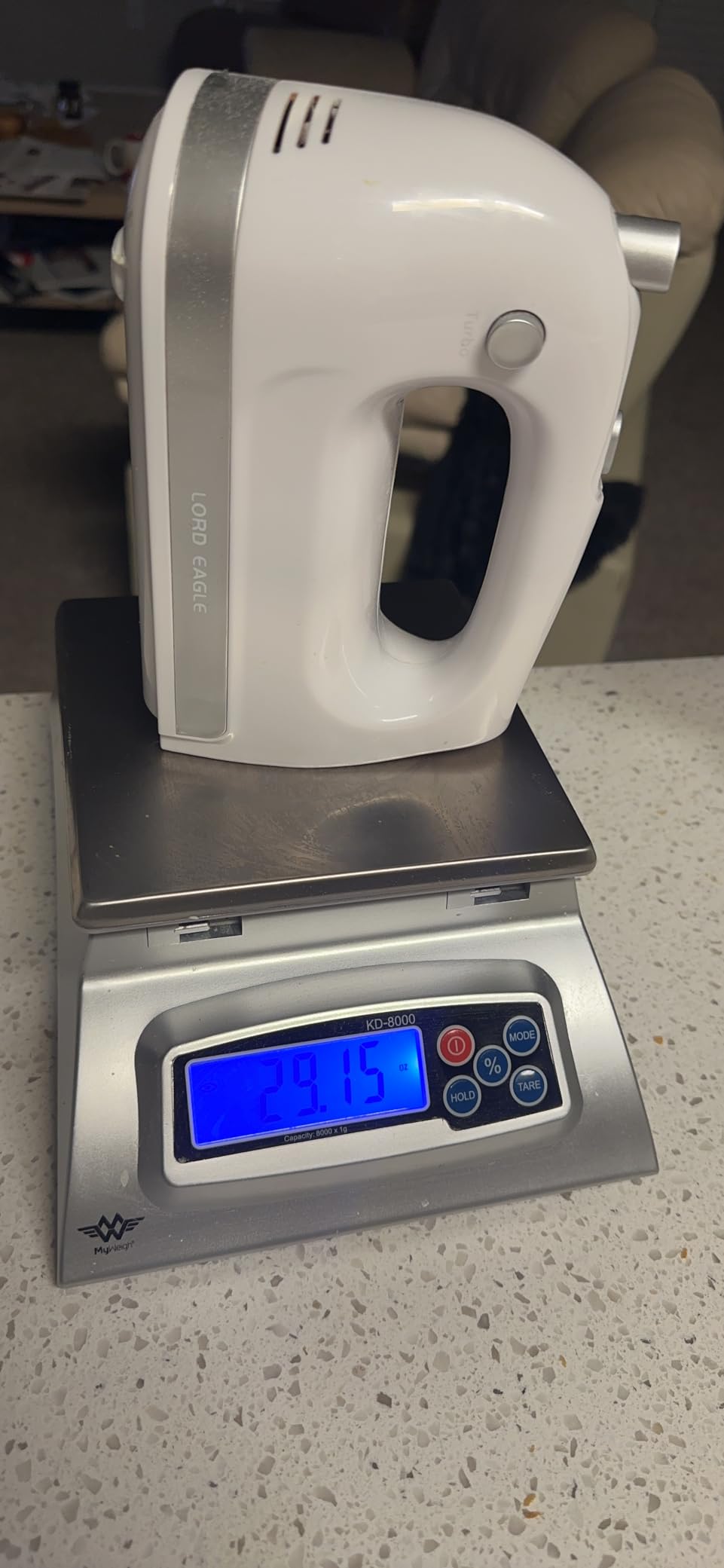
Capacity is 8000 g, roughly 17.6 lb, at plus or minus 1 g, with a bright backlit LCD set at an angle and a large footprint. The angled screen is the second quietly excellent feature: it stays readable when a big bowl sits on the platform, which is the exact failure we flagged on the flat-bed units.
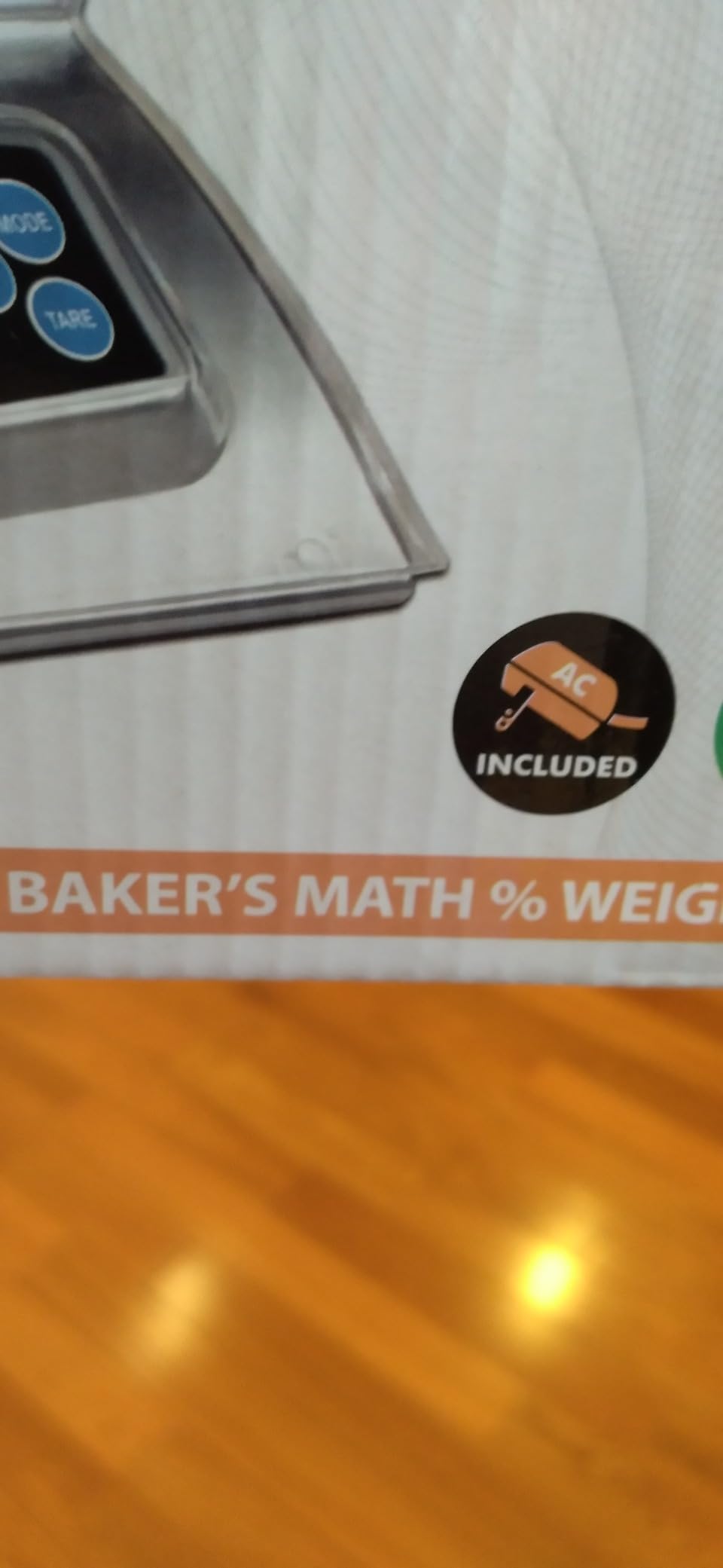
The programmable auto shut-off can be disabled entirely, and that is a bread-specific requirement rather than a generic nicety. Long bulk ferments and overnight proofs mean walking away from a loaded scale, and a timer that kills the readout mid-session is the single most common complaint bakers have about cheap scales. Owners report gram-level accuracy holding over five and six years of daily service.
A hinged gunk shield covers the controls, which sounds trivial until you have flour everywhere. It keeps debris off the buttons and wipes clean without disassembly. Four weighing modes cover grams, kilograms, pounds, pound-ounce, and ounces.
Is the baker’s percentage function actually worth learning?
If you already think in percentages, it saves real time: set flour first, then add each ingredient and read the percentage rather than doing the division. If you follow fixed recipes by weight only, it is a feature you will rarely touch, and the same money buys more elsewhere.
For bread specifically the percentage mode earns its keep during scaling. Tripling a formula, or adjusting hydration mid-loaf because the dough feels slack, becomes a matter of watching numbers change instead of recalculating from scratch. Reviewers who bake bread daily cite it as the reason they kept the scale for years.
What are the build and storage trade-offs?
Two real ones. Reviewers describe the build as feeling plasticky for the price, and the unit weighs 2.5 pounds with an elevated display, so it stays on the counter rather than in a cupboard. Meanwhile the AC adapter is sold separately, so if you bake often and want a permanent supply, budget for that.
The low-end floor is also worth knowing. Without a container to tare against, the readings are approximate around 3 g, so this is a dough scale rather than an additive scale. Yeast and salt work better on one of the precision platforms later in this list.
5. Escali Primo Digital Scale – Most Versatile for Home Bakers
Escali Primo Digital Food Scale Multi-Functional Kitchen Scale and Baking Scale for Precise Weight Measuring and Portion Control, 8.5 x 6 x 1.5 inches, Chrome
11 lb / 5000 g capacity
1 g and 0.05 oz increments
Sealed control panel
Two-button operation
Pros
- Two buttons means nothing to learn
- Sealed panel wipes clean after floury work
- Compact footprint stores in a drawer
- Tare resets reliably between ingredients
- Five year limited warranty
Cons
- 11 lb capacity is modest for large batches
- Three weighing modes only with no volume measures
- Plastic body feels less substantial than steel
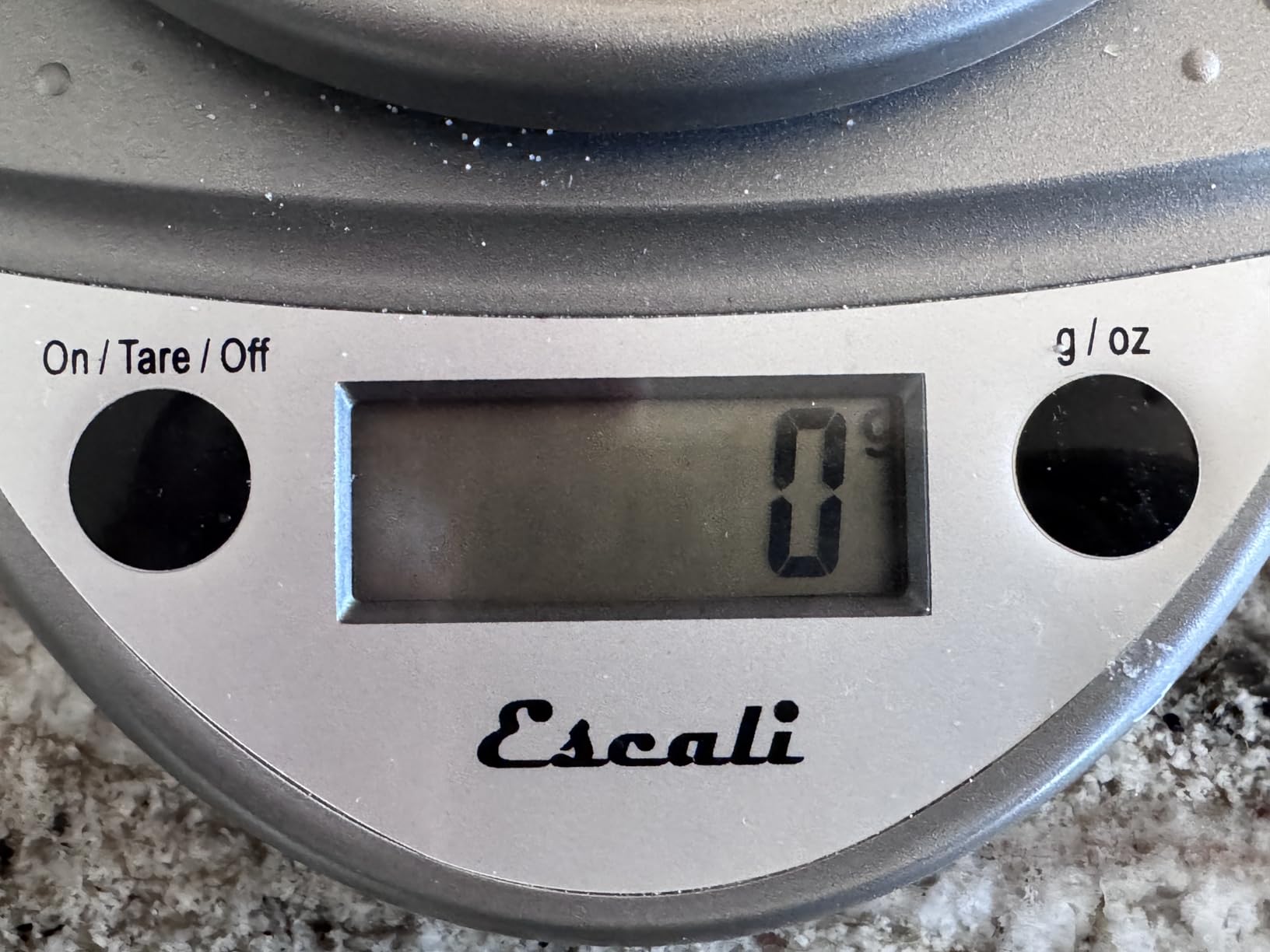
The Escali Primo earns its place through restraint. Two buttons, a sealed control panel, and a tare that behaves. There is no mode cycling to learn, which sounds like a lack of features until you are half awake feeding a starter before work.
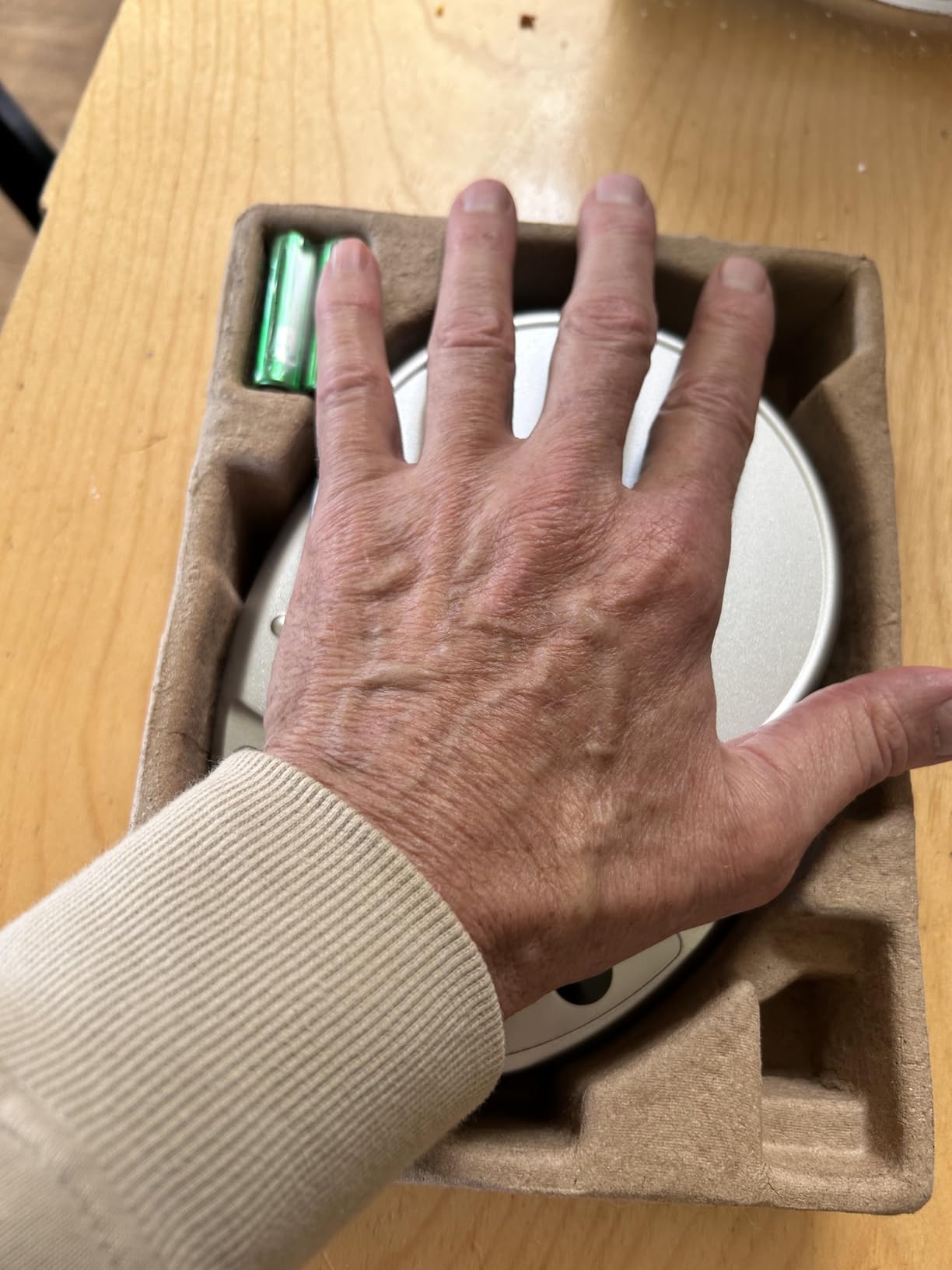
It weighs 11 lb, or 5,000 g, in 1 g and 0.05 oz increments, and the whole unit measures 8.5 by 6 by 1.5 inches at 431 g. That slim profile is the practical advantage: it lives in a drawer and comes out when the dough needs weighing.
The sealed control panel is the flour-resistant feature that matters most in a bread kitchen. Dough work throws powder at everything, and a sealed surface wipes clean where exposed buttons would trap it. Auto shut-off fires after four minutes of inactivity, which is longer than most competing units in this roundup.
At 4.6 stars across more than 7,300 reviews with a five year limited warranty, this is a design that has aged well. Reviewers accept the smaller capacity as the deliberate trade for a compact, durable, easy-to-clean unit.
Is 11 lb enough for a full sourdough session?
For a single dough in a moderate bowl, yes. The capacity is the same as the OXO pull-out model, and both handle a typical 700 to 900 g dough without trouble. Where it gets tight is a double batch, a very wet high-hydration dough in a large bowl, or weighing your dough plus a heavy Dutch oven on the same platform.
If you regularly bake two loaves at once, look at the 22 lb and 33 lb options instead. Otherwise the Primo handles the job and stores between bakes, which no higher-capacity model here does quite as neatly.
What do you give up compared with a mid-range scale?
Volume measures and finer control. Three weighing modes cover ounces, pound-ounce, and grams, so there are no millilitres or fluid ounces for wet ingredients, and no timer to override the four minute auto shut-off. Percentage mode is also absent.
None of that matters for dough, which is weighed dry. For a baker who wants a cheap, reliable counter scale for flour, water, and salt, this is the shortest path to a working setup.
6. Greater Goods 22lb High Capacity Scale – Best for Long Proofing Sessions
Greater Goods Digital Food Scale for Kitchen & Baking, 22lb High Capacity
22 lb / 10 kg capacity
1 g precision
Display extends past platform
HOLD up to 5 minutes
Pros
- Display extends beyond the platform so large bowls stay readable
- 22 lb capacity covers sourdough and baguettes
- HOLD freezes the reading while you rearrange
- Stainless steel surface is easy to sanitize
- Five year limited warranty
Cons
- Auto shut-off after two minutes interrupts long sessions
- Touch buttons can be finicky
- Single weighing platform only
- Runs on AAA batteries
The design decision here is the extended readout. Instead of tucking the LCD under the front edge of the platform, the display extends past it, so the numbers sit outside the footprint a bowl occupies. Owners who bake bread specifically call this out as the deciding factor, and it is a cheaper route to bowl-independent readability than a pull-out arm.
Capacity is 22 lb or 10 kg at 1 g precision, and the platform measures 7.6 by 5.6 by 1.3 inches. It weighs 12.96 ounces, which makes it one of the more portable units here, and the stainless steel and ABS body wipes clean easily.
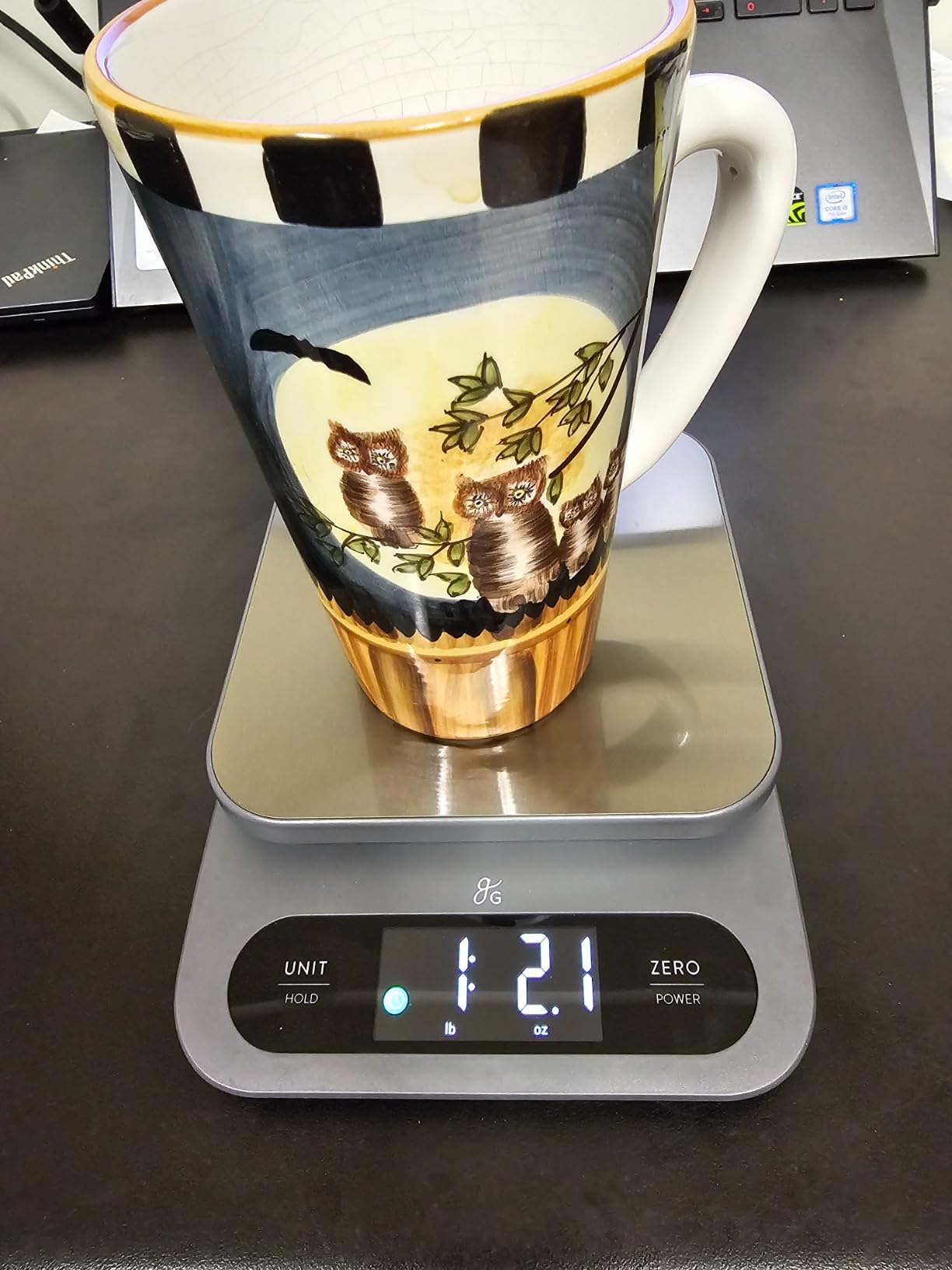
The HOLD function retains a reading for up to five minutes, which solves a specific bread problem: you set a wet dough on the scale, need both hands to scrape it back into a bowl, and come back to a display that has been disturbed. Freeze the number, clear the dough, keep working.
It ships designed for sourdough and bread work, and at 4.6 stars from over 4,100 reviews with a five year limited warranty, owners rate the extended display, the capacity, and the battery life on three AAA cells consistently well.
Is a two minute auto shut-off a problem for bread?
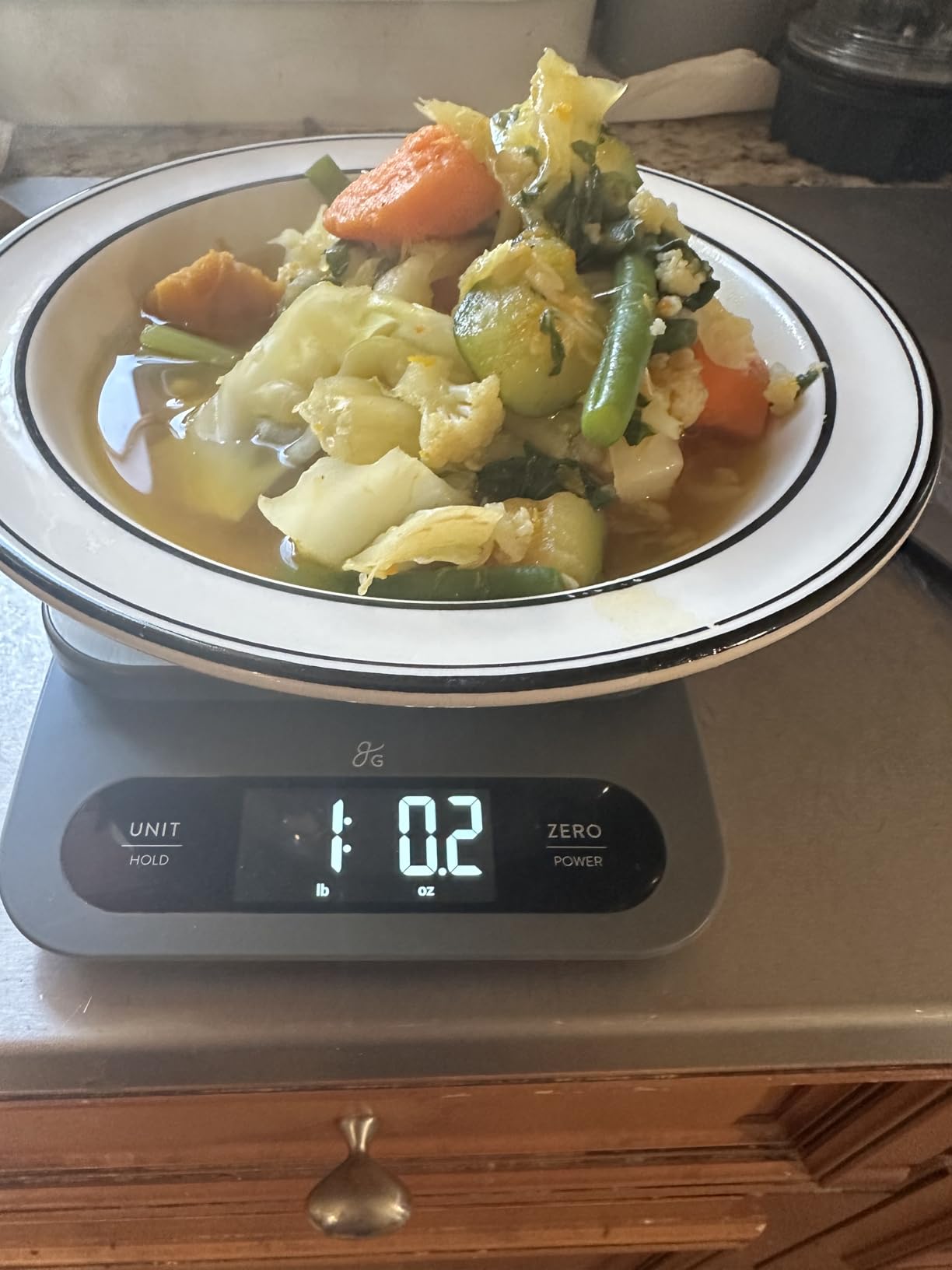
It depends on how you work. Two minutes is enough for adding an ingredient and it is not enough for a stretch-and-fold set, a shaping break, or a walk to the sink mid-mix. Owners mention this as the main complaint, and it is worth knowing before you plan a long session around it.
Models with a longer or cancellable timer handle that better. The Escali Primo runs four minutes, the KOIOS runs three, the BOMATA timer can be extended or cancelled outright, and the My Weigh KD8000 can be switched off completely. If you mix by hand for extended periods, prioritise the timer over anything else on this list.
How does this compare with the other 22 lb models?
Against the Nicewell, the display is the difference: extended beyond the platform versus backlit on the platform edge, and the Nicewell adds a 2 year manufacturer warranty while this one runs five years. Against the Etekcity, this model uses disposable AAA cells rather than a rechargeable cell, and has no liquid volume modes.
Both are 22 lb at 1 g with a backlit-adjacent screen. Choose this one for a five year warranty and a display that clears wide bowls; choose the other for rechargeable power and waterproofing.
7. KOIOS 33lb Scale – Best for Large Batch Baking
KOIOS 33lb Kitchen Scale 0.1oz Precision,Batteries & USB-C Charging(White)
33 lb / 15 kg capacity
1 g and 0.1 oz increments
9 x 6.3 inch platform
USB-C and battery power
Pros
- Highest capacity in the roundup at 33 lb
- Runs on USB-C charging or two AAA batteries
- Large platform takes big mixing bowls
- Waterproof tempered glass wipes clean
- Backlit LCD with white numerals
Cons
- Touch buttons can register accidental taps
- Auto shut-off after three minutes interrupts long proofing
- 1 g minimum increment is coarser than precision models
Thirty-three pounds is the ceiling in this roundup and it is roughly three times what a typical 800 g dough needs. If you bake for a household rather than yourself, batch two loaves, or weigh a Dutch oven alongside dough on the same platform, the headroom removes a constraint you would otherwise design around.
It reads 1 g and 0.1 oz increments over a range from 3 g to 15 kg, on a 9 by 6.3 inch waterproof tempered glass platform. The white-on-dark backlit numerals stay readable in a dim kitchen, which matters for early feeders.
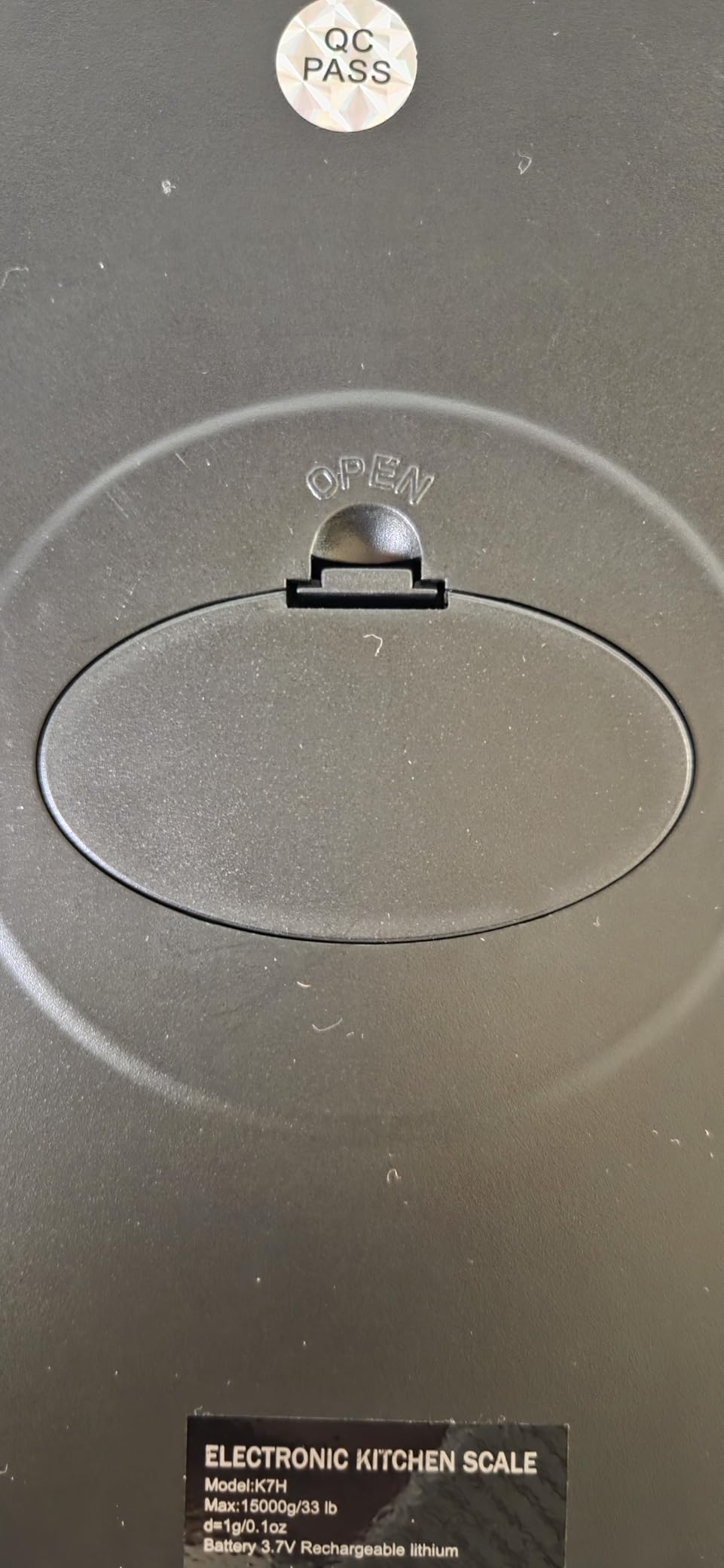
The flexible power setup is unusual at this capacity. It charges over USB-C and also runs on two AAA batteries that are included, so you can bake away from a socket and still keep the same precision. Low-battery and overload indication come standard.
Reviewers consistently report good accuracy at the 1 g level and treat the platform size plus capacity as the reason to buy. At 4.6 stars from more than 8,400 reviews, it holds its own against far more established brand names. There is a hidden hook for storage, and the unit weighs 1.4 pounds.
Do you actually need 33 lb of capacity?
Only if you batch. A large mixing bowl, an 850 g dough, and a Dutch oven together still come in under 20 lb, so the extra headroom is insurance rather than daily necessity. For most single-loaf bakers the extra capacity adds bulk and price without changing the bake.
Where it clearly pays off is a market-style bake session, a double formula, or a household that feeds more than one. The oversized 9 by 6.3 inch platform also means a wide bowl sits fully on the surface rather than overhanging, which avoids the edge sensitivity reviewers report on more compact units.
How does the 1 g increment limit precision work?
It handles flour, water, salt, and dough weight without trouble, since bread formulas are built in tens and hundreds of grams. It cannot meaningfully measure a 3 g yeast addition or a pinch of salt, because the smallest movement it can show is a full gram.
If precise additives matter to your baking, treat this as a bulk scale and add one of the precision units near the end of this list. That pairing, a large-capacity scale plus a small 0.1 g scale, is how most serious home bakers work.
8. KitchenAid KQ909 Dual Platform Scale – Best Two-Readout Display
KitchenAid KQ909 Dual Platform Digital Kitchen and Food Scale, 11 Pound Capacity and Precision 16oz Capacity, White with Stainless Steel
11 lb platform at 1 g
16 oz platform at 0.01 g
Two-line backlit LCD
Tare on both platforms
Pros
- Two platforms give bulk capacity and 0.01 g precision in one unit
- Two-line display shows both readings at once
- Weigh a bowl of flour and portion yeast simultaneously
- Tare runs cleanly on both platforms
- Stainless surfaces wipe clean fast
Cons
- Small platform readings can be inconsistent
- Reports of units failing within months
- Backlight dims over time
- Hand wash only and 11 lb large platform
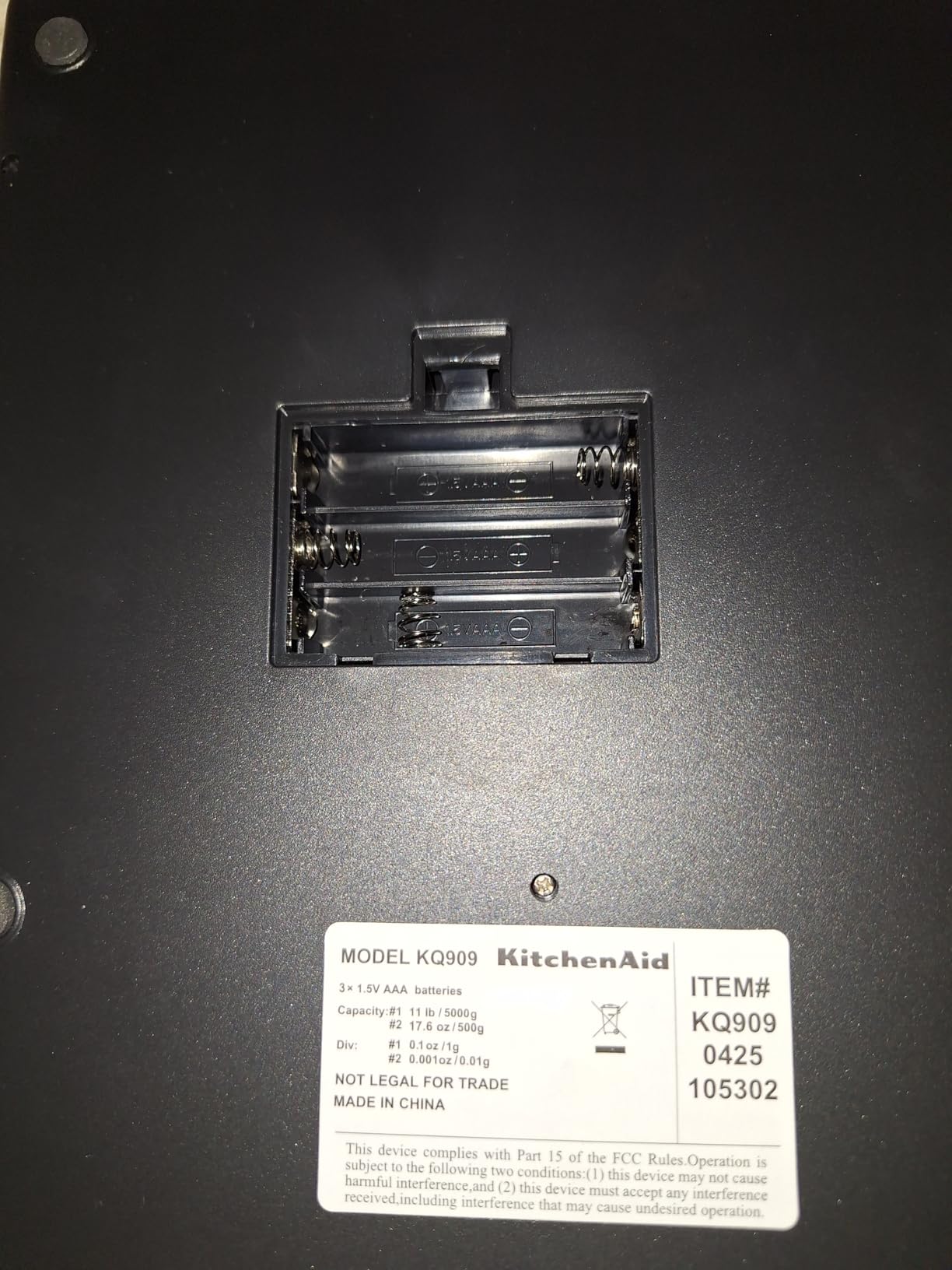
The concept is the strongest one in this roundup. One large platform handles 11 lb at 0.1 oz or 5,000 g at 1 g, and a second smaller platform handles 16 oz at 0.001 oz or 500 g at 0.01 g. Both readings appear on a two-line backlit LCD at the same time, so you can hold a bowl of flour at 500 g on one platform while measuring 3 g of yeast on the other.
That eliminates the juggling act that every two-scale setup involves. Tare executes on both platforms, and stainless steel surfaces wipe clean quickly. It runs on three included AAA batteries with a three minute auto shut-off.
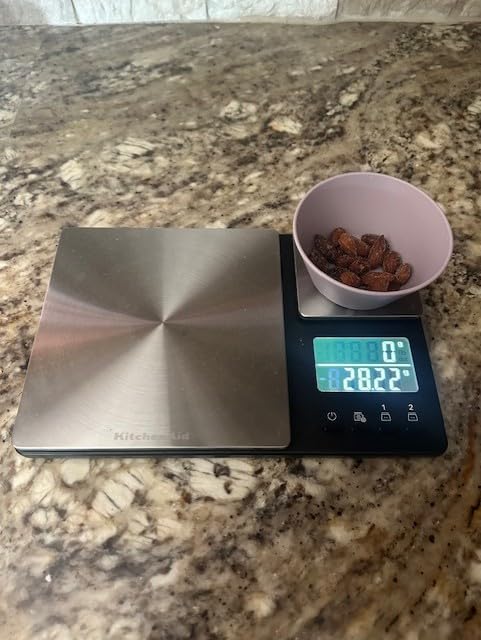
Enthusiastic reviews praise exactly the workflow the hardware was designed for. A baker feeding a starter can weigh the hydrated flour and the ripe starter simultaneously without setting one down, and the display stays readable in a dim kitchen while it does it.
But this is the lowest-rated product here, at 4.0 stars from more than 3,500 reviews, and the reasons are worth weighing. A meaningful group of one- and two-star reviews report the small platform reading inconsistently and units dying early, sometimes with false low battery warnings. The backlight also dims over time.
Is a dual platform scale better than two separate scales?
In theory yes, because simultaneous readings remove error and save counter space. In practice it depends on build quality, and that is the issue here. A dual platform puts two independent load cells behind one display and one power supply, so a failure in either section takes the whole unit out of service.
Two separate scales degrade independently. If the fine scale dies you still have your dough scale, and the cheaper fine scale is far easier to replace than a unit with a display bonded to both platforms.
Can the precision platform be trusted for yeast and salt?
It should deliver 0.01 g resolution, which is exactly right for a 3 g yeast addition or a fine salt pinch. However, owners report inconsistent readings from the small platform, and inconsistent readings at 0.01 g resolution means a percentage-level error that matters more than it would at 1 g.
We would test it against a known weight before trusting it for a formula, and we would keep a backup plan for repeat bakes. Hand washing only and no dishwasher is a minor constraint in a bread kitchen.
9. Weigh Gram Rechargeable Dual Platform Scale – Best Rechargeable Precision Pair
Rechargeable Digital Dual Platform Food Kitchen Scales Weight
5 kg platform at 1 g
500 g platform at 0.01 g
Accumulation function
USB rechargeable
Pros
- Two platforms give 11 lb bulk capacity plus 0.01 g fine weighing
- Accumulation function sums both platforms automatically
- Rechargeable battery with a clear charge indicator
- Stainless platform wipes clean easily
- Readable backlit LCD in dim light
Cons
- Only the large platform is stainless steel
- Three weighing modes with no volume measures
- No stated warranty
- Listed included components are minimal
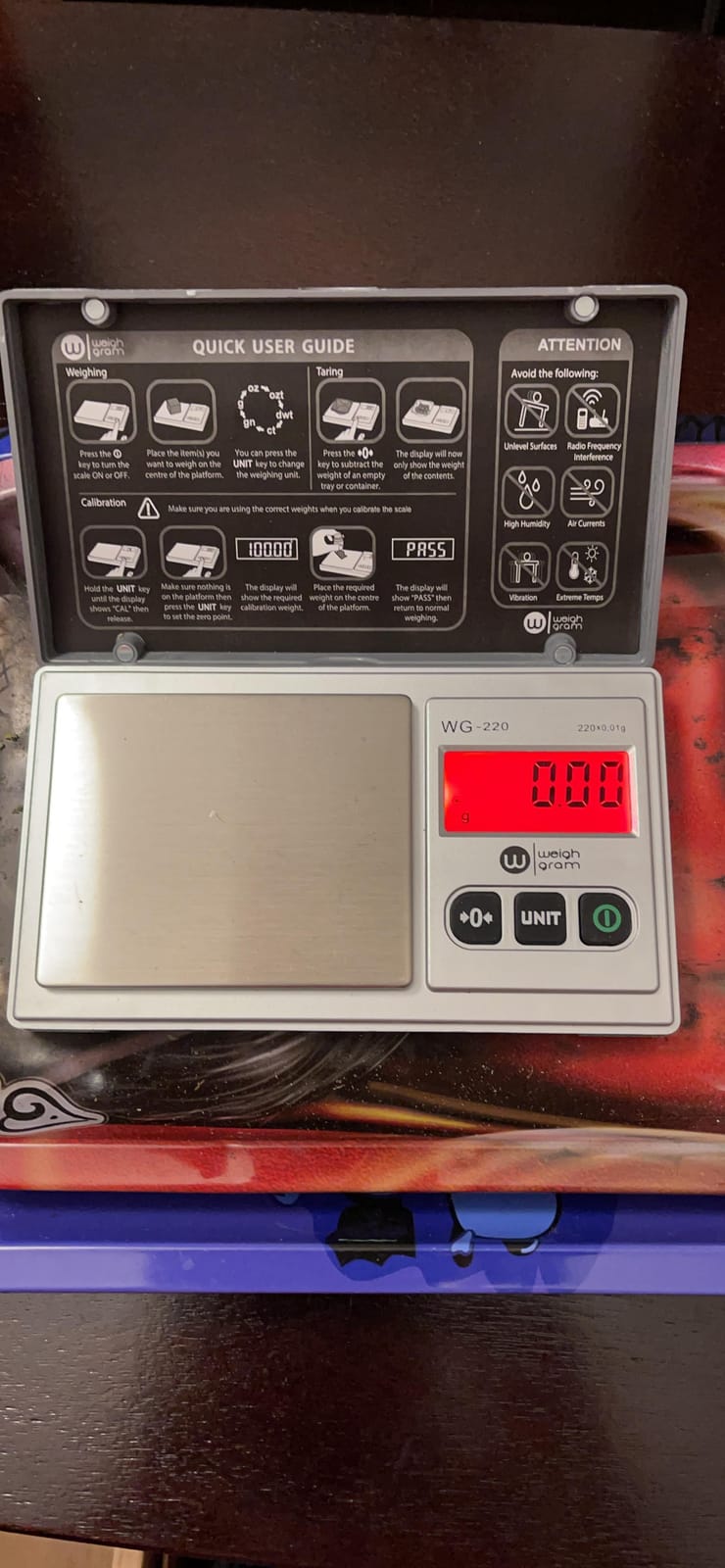
This is the other dual platform option, and it pairs a 5 kg platform working at 1 g with a 500 g platform working at 0.01 g. The addition that separates it from the KitchenAid is the accumulation function: weights from both platforms are summed together, so you can build a total dough weight in one pass instead of adding numbers yourself.
It charges over USB with an indicator that turns green when full, has a backlit LCD, and auto shut-offs after 180 seconds of inactivity. Three weighing modes cover grams, pounds, and ounces, and the platform is stainless steel with a plastic body.
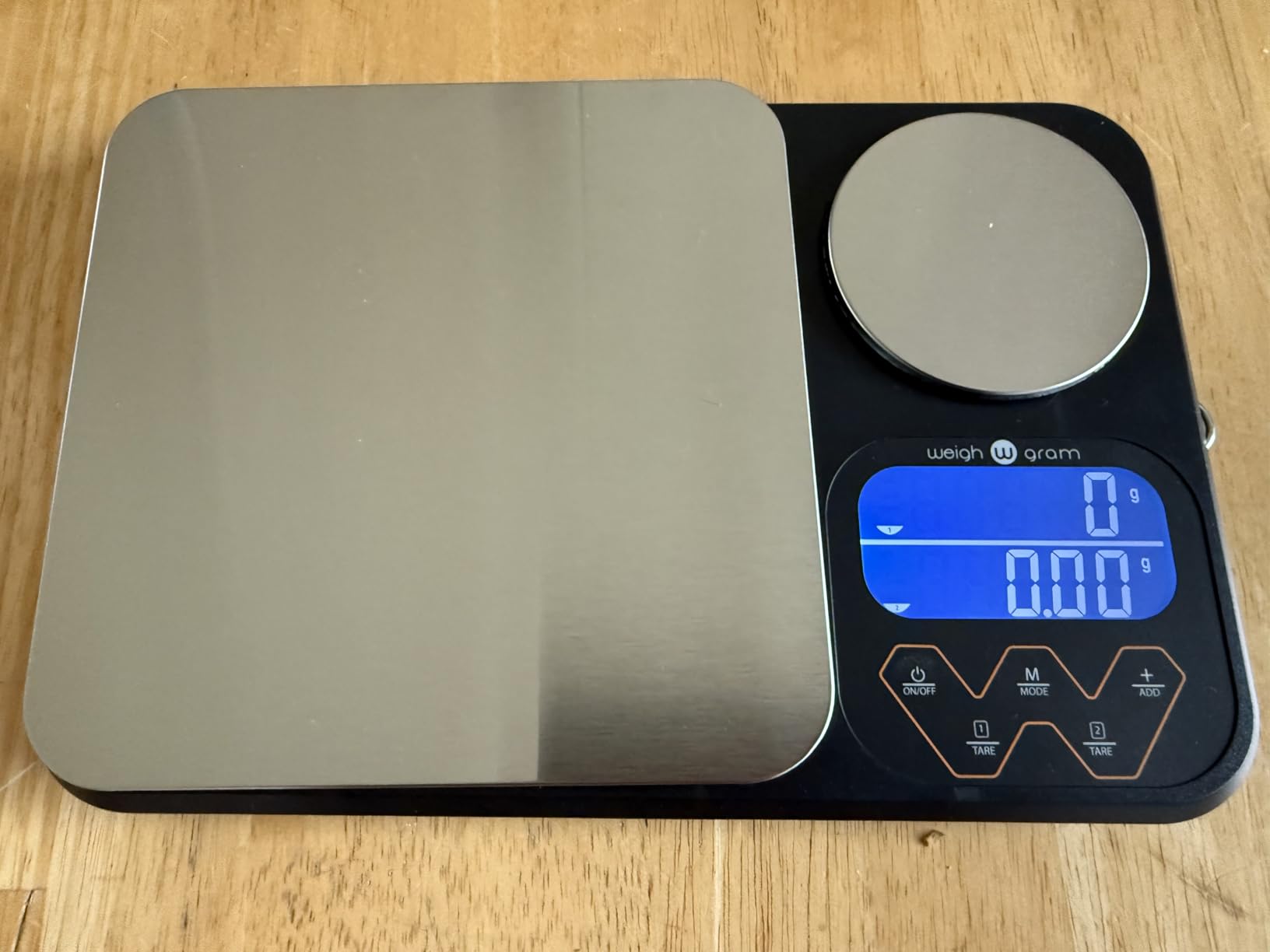
Buyers like the combination of a large platform for dough and a small 0.01 g platform for starters and additives, and the accumulation function stands out specifically for batch weighing. The rechargeable battery means no battery hauling into a kitchen with floury hands.
At 4.5 stars from more than 3,900 reviews the reception is positive but more measured than the established brand names, which tracks with the smaller brand presence and the fact that no warranty is stated. Check the box contents on arrival, since the listed included components are minimal.
Is the accumulation function genuinely useful for bread?
For dividing dough it is. Set a loaf on the large platform and portion ingredients or a second mass on the small one, and the total carries across. That saves mental arithmetic when you are shaping four loaves and want each one to hit the same target weight.
It does not replace a separate micro scale for a 3 g yeast addition, because the small platform still tops out at 500 g and its accuracy is less established than a dedicated precision unit. Treat it as a helpful second channel rather than a specialist.
What does the lack of a stated warranty mean for you?
It means you are relying on seller support rather than a manufacturer commitment, so keep your receipt and check the return window at purchase. Reviews note faster replacement service from customer support on comparable units, but that is not the same thing as a stated warranty.
If you buy one device rather than two, the absence of a warranty matters more, because a single failure leaves you with no scale at all. A modest warranty on a two-scale setup only risks the smaller unit.
10. BOMATA 11lb 0.1g Precision Scale – Best for Fine Ingredients
BOMATA Large Kitchen Scale 0.1g/0.001oz High Precision, 11lb Bakery Scale
0.1 g increments
0.5 g to 5 kg range
Percentage mode and HOLD
Cancelling auto shut-off
Pros
- Genuine 0.1 g granularity so 4.7 g reads as 4.7
- Percentage mode calculates baker's percentages
- Auto shut-off timing can be extended or cancelled
- Built-in 100 g calibration weight included
- Full-view backlit LCD readable from any angle
Cons
- 11 lb capacity is the lowest in this roundup
- Some units arrive with a faulty battery connector plate
- Tenths digit makes the display busier
- Manual is a small printed slip
This is the scale to add if your yeast measurements matter. The display moves in 0.1 g steps across a range from 0.5 g to 5 kg, so a 3 g yeast addition reads as 3.0 rather than snapping to a rounded gram. Reviewers confirm the fine granularity is real rather than cosmetic rounding.
The platform is 7.2 by 7.2 inches of stainless steel, and the function set is unusually complete for the size: percentage mode for baker’s math, tare, hold, unit switching, counting, auto shut-off with adjustable and cancellable timing, and a calibration function.
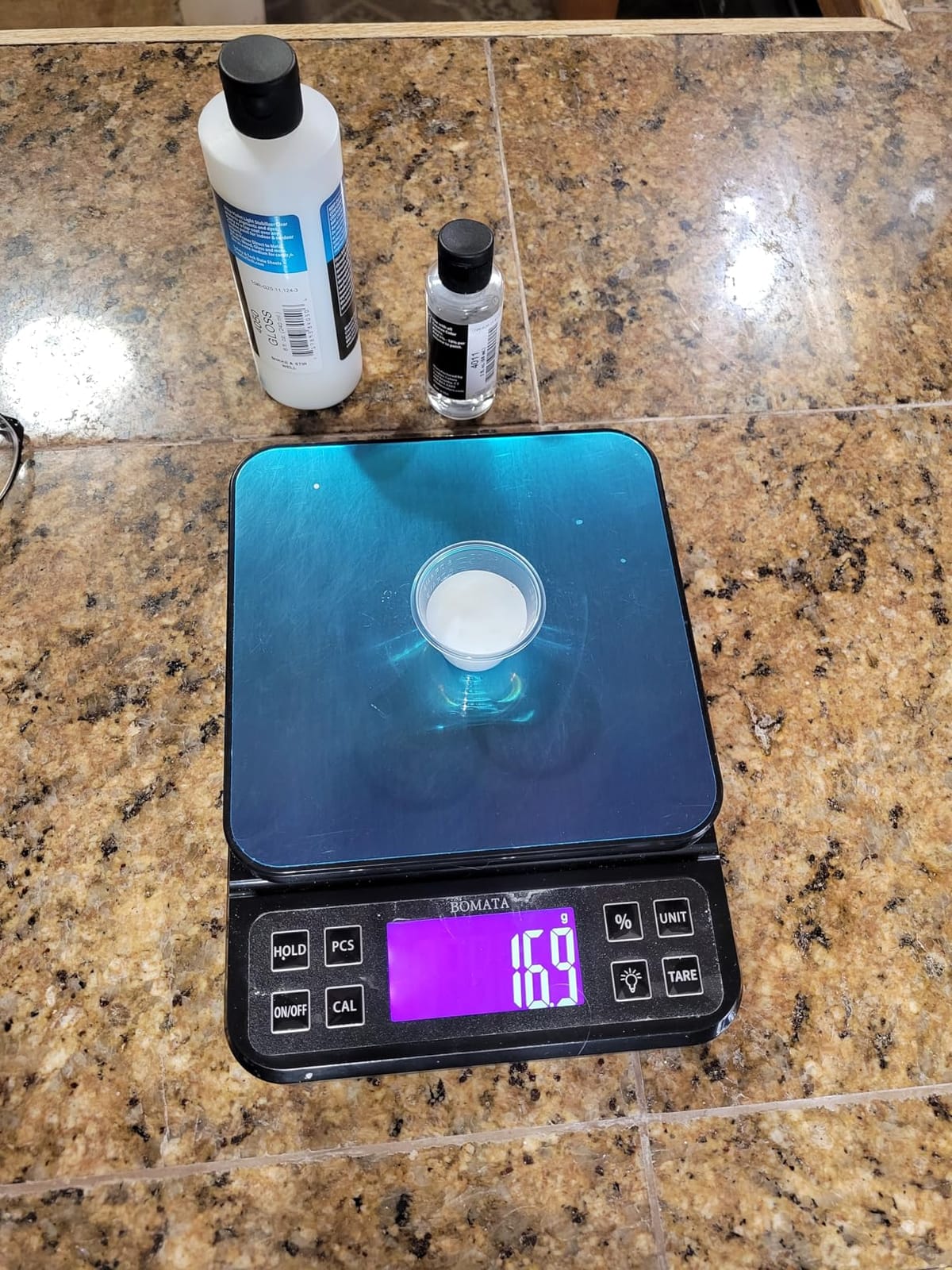
Two details set it apart. The built-in 100 g calibration weight stores on the scale itself, so verifying accuracy takes seconds with no extra equipment. And the auto shut-off can be extended or cancelled outright, which is the behaviour bread bakers ask for and rarely find on budget units.
Power is flexible: a built-in lithium cell charges over USB-C, or you can run it on two external AAA batteries. At 4.4 stars from more than 3,400 reviews, the recurring complaints are a small number of units arriving with a faulty battery connector plate, and a manual that is a thin printed slip.
Does 0.1 g precision actually change a loaf?
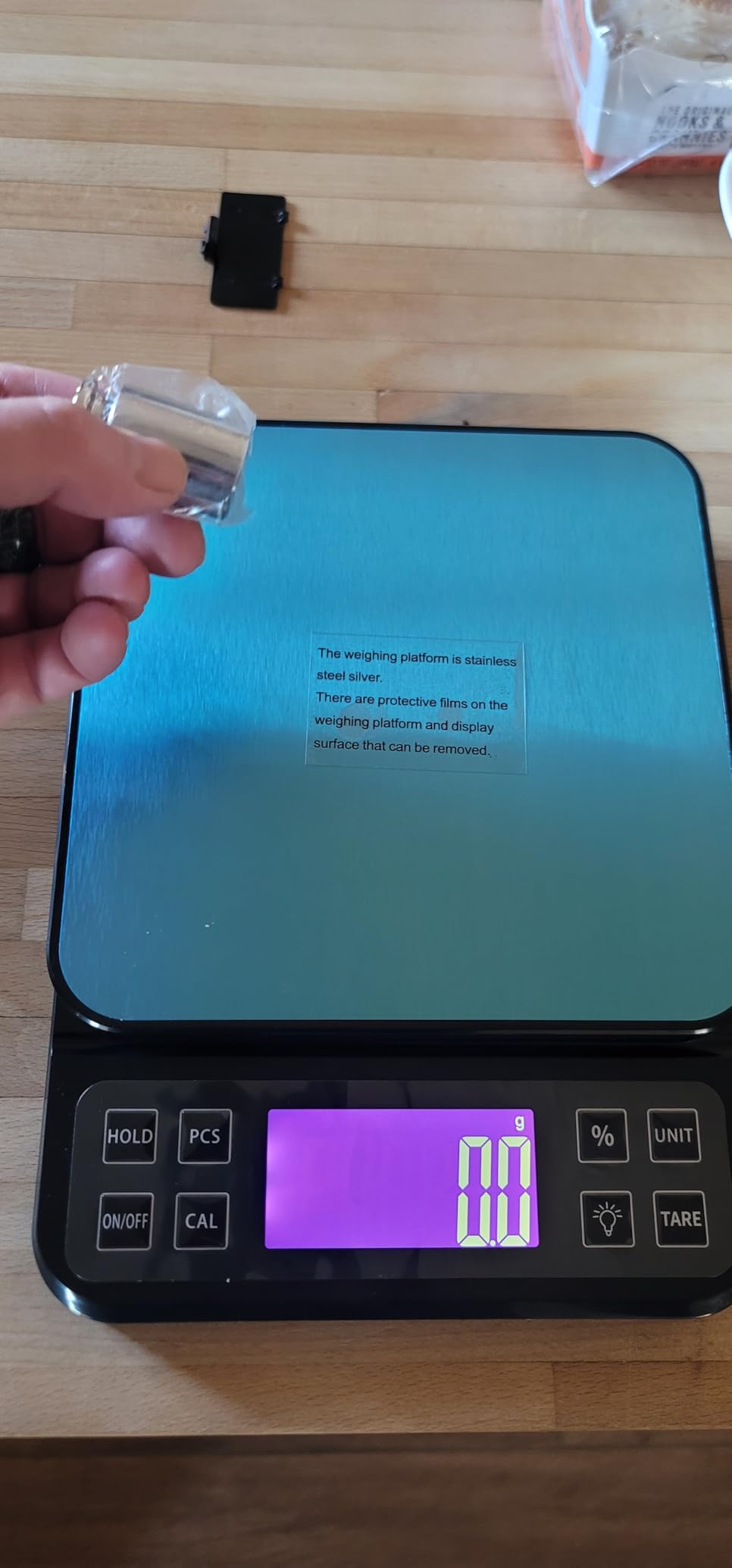
It changes your additives, not your dough. Commercial yeast in a home kitchen is roughly 3 g for a 500 g flour loaf, and a 1 g scale rounds that to 3 g but could equally show a 3.5 g addition as 4 g. At 0.1 g you control it. Salt, levain, and any preferment all land the same way.
For bulk flour and water, 1 g is already far more precise than any recipe demands. So this scale earns its place as a second device that handles the small numbers, not as a replacement for a high-capacity dough scale.
Is the 11 lb capacity a problem?
It is the lowest in this roundup, and it is the reason this is our tenth pick rather than a standalone recommendation. Eleven pounds handles flour, water, and a modest dough, but a heavy ceramic bowl plus a very wet high-hydration dough can push toward the ceiling.
The 7.2 inch square platform is also smaller than the 9 by 6.3 inch models. Check your bowl dimensions before committing, and test the unit with the included 100 g weight on arrival so you catch any connector problem before your next bake.
What to Look for in a Bread Scale in 2026?
Every scale here measures bread dough accurately enough. The differences that change your daily experience are capacity, display position, timer behaviour, and resolution. Those four criteria are where the choices actually get made.
Capacity: 11 lb is the floor, 22 lb is comfortable
Bread recipes use heavy ceramic or glass bowls loaded with flour and water, so the number that matters is bowl plus dough plus leftover dough on the sides. A single 800 g loaf in a glass bowl fits under 11 lb with room to spare, which is why the Escali Primo and OXO pull-out models handle most home baking.
22 lb covers double batches, large wet doughs, and weighing a Dutch oven on the same platform. The 33 lb KOIOS exists for market-style sessions and households baking for more than one person. Buy the capacity you will use, not the capacity you imagine needing.
Display design: will you read it past your bowl?
This is where flat-bed scales lose. A display on the front edge of the platform is hidden by anything wider or taller than the scale itself, and shadow from a big bowl can also distort readings on sensitive platforms. Three approaches solve it at different costs.
A pull-out display on an arm, as on the OXO model, puts the number wherever you want it. An extended readout beyond the platform footprint, as on the Greater Goods, moves the numbers outside the bowl area without a moving part. A backlit angled screen on a raised platform, as on the My Weigh KD8000, tilts the digits up so you read them from standing height.
Auto shut-off duration: the sleeper issue for bread bakers
Most scales cut out after two or three minutes to save battery power, which is sensible electronics and terrible bread practice. Stretch and fold sets, shaping breaks, and overnight proofing all involve walking away from a loaded scale for longer than that. The readout dies mid-session and you lose your reference weight.
What to look for, in order of preference: a timer you can disable entirely, a timer you can extend, a timer you can at least increase, and only then a fixed short timer. The My Weigh KD8000 can be switched off, the BOMATA timer is adjustable and cancellable, the Escali Primo runs four minutes, the KOIOS runs three, and the Greater Goods runs two.
Precision: 1 g for dough, 0.1 g or finer for additives
Bread formulas live in the hundreds of grams, so 1 g increments are plenty for flour, water, and dough weight. The small numbers are where it breaks down: yeast at 3 g, salt at 5 g, and levain at 20 g all deserve a finer readout.
Resolution and accuracy are not the same thing. A display that shows 4.7 g proves the scale can resolve tenths, not that it is accurate to a tenth. Check any precision scale against a known weight, which is why the built-in 100 g calibration weight on the BOMATA is worth more than it looks.
The Two-Scale Strategy for Bread Baking
Almost every serious baker we compared notes uses two scales rather than one. The large scale handles dough, flour, and water. The small scale handles yeast, salt, and levain. Trying to do both on a single device means either accepting rounded gram readings or accepting a capacity that cannot carry a mixing bowl.
Step one is picking your macro scale, which means 22 lb at 1 g with a display you can read. The Nicewell and Etekcity models both satisfy that, and the Greater Goods adds a five year warranty and a readout that clears wide bowls.
Step two is picking your micro scale at 0.1 g or 0.01 g. If you want a single device that does both jobs, the KitchenAid KQ909 and the Weigh Gram scale both carry a large platform and a 0.01 g platform in one body, with two-line displays showing both readings at once.
Step three is pairing, and this is where separate devices win. Two scales degrade independently, and a failed micro scale costs far less to replace than a dual-platform unit with a display bonded to both platforms. If you buy one device, test the fine platform against a known weight before you trust it in a formula.
How to Calibrate and Check Your Scale?
Cheap scales drift after six to twelve months, and drift shows up as a slow loss of accuracy rather than a sudden failure. A two-minute check every few months catches it before a badly hydrated loaf.
Start with the coin test. A US quarter weighs 5.67 g and requires no equipment, so place one on the platform and confirm the reading matches. A US dime is 2.268 g and a penny is 2.5 g, which gives you a second and third reference point without buying anything.
Next, test a heavier load. Some scales are accurate near zero and drift toward the top of their range, which matters if you bake large doughs. If you own a 100 g calibration weight, as the BOMATA does, use it. Otherwise weigh a full litre of water, which should read 1,000 g at room temperature, into a container you have already tared.
Record what you find and compare each check against the last one. A consistent offset of a gram or two at 5.67 g is not worth chasing. A reading that keeps sliding downward across three checks means the load cells are drifting and the scale should be recalibrated or replaced.
Finally, watch for environmental causes. Flour dust ingress around buttons and humidity near the sink both shorten a scale’s life. Wipe the surface dry after wet work and avoid leaving the unit where steam collects.
Sourdough Workflow: Which Spec Matters at Each Step?
Mapping specs to bread steps makes the buying decision much easier, because the answer at each stage of a bake is a different one.
Starter feed. This is where precision matters most and capacity matters least. You are weighing 20 g of ripe starter against 100 g of flour and water, so a scale reading to 0.1 g or 0.01 g changes the outcome. A 1 g scale rounds every number you enter here.
Autolyse. Flour and water only, usually in the hundreds of grams. Any 1 g scale at 22 lb capacity handles this comfortably, and the backlit display helps if you mix before dawn.
Bulk ferment. The longest phase and the one most scales fail. Stretch-and-fold sets put the bowl on the scale for minutes at a time, then leave it alone for an hour or more. Capacity for bowl plus wet dough, and a timer you can extend or disable, are the two specs that decide whether this scale survives a weekly bake.
Divide and preshape. Weighing each loaf to a target weight is where a hold function and reliable tare earn their keep. You set a target, portion until it matches, and do it repeatedly. Extended readouts or pull-out displays matter more here because the dough is spread across the counter, not the platform.
Final proof. The dough is weighed again, sometimes with a basket and cover. Wide and low loads read more accurately than tall ones on any platform, so keep the dough centred and avoid letting one edge hang off.
Frequently Asked Questions
What is the best scale to use for measuring sourdough bread?
A digital kitchen scale with at least 11 lb of capacity, 1 g increments, a readable display that works with a large mixing bowl, and a timer you can extend or disable. Our pick is the Nicewell 22lb model for 22 lb of headroom and a bright backlit screen. For baker’s percentage work and a switchable timer, the My Weigh KD8000 is the alternative.
What is a food weighing scale called?
It is usually called a kitchen scale or a food scale. The term digital food scale covers the countertop models that weigh ingredients in grams, ounces, or pounds, which are the ones used for bread baking. Small precision versions with a tiny platform are often called a micro scale or a jeweler’s scale.
What is the OXO Good Grips scale?
It is an 11 lb capacity digital food scale with a pull-out display, a smudge-resistant stainless steel platform that lifts off for cleaning, and a zero or tare function. The pull-out screen keeps the readout visible when a large bowl sits on the platform, which is the feature bread bakers buy it for. The trade-off is no backlight and an 11 lb ceiling.
Which kitchen scales are the most reliable?
Reliability tracks warranty length and long owner histories rather than brand. The Greater Goods and Escali Primo carry five year limited warranties, the Nicewell carries a two year manufacturer warranty, and multi-year owners of the My Weigh KD8000 report gram-level accuracy holding over five and six years of daily use. Verify any new scale against a known weight before baking with it.
How do I calibrate my kitchen scale?
Many digital kitchen scales have no user calibration, so verification is the practical step. Place a US quarter on the platform and confirm it reads 5.67 g, then test a heavier load such as a litre of water reading 1,000 g. Scales with a calibration function, like the BOMATA model, use the 100 g weight stored on the platform itself. Check every few months, since drift appears gradually.
Do I need a separate scale for yeast and salt?
Only if you want precise additive amounts. A 1 g scale can measure a 3 g yeast addition but rounds it, and a 3.5 g addition may display as 4 g. A second scale reading to 0.1 g or 0.01 g removes that rounding. Alternatively, the dual-platform units in this roundup handle bulk dough and fine additives in one device.
How do I stop a kitchen scale turning off while I bake?
Look for a programmable auto shut-off. The My Weigh KD8000 can be disabled entirely, and the BOMATA timer can be extended or cancelled. Models with longer fixed timers include the Escali Primo at four minutes and the KOIOS at three. The Greater Goods shuts off after two minutes, which is the shortest here and the most likely to interrupt a long proofing session.
Our Recommendation for Bread Baking in 2026
The best kitchen scales for baking bread are not the ones with the longest spec sheet. They are the ones that hold a wet dough, show you the number past a wide bowl, and stay awake while you walk away. Our pick for 2026 is the Nicewell 22lb scale, with 22 lb of capacity, gram-level accuracy, and a backlit display you can read at six in the morning.
Bakers who work in percentages should look at the My Weigh KD8000 for its switchable timer and percentage mode. Large-batch bakers should take the KOIOS 33lb. And anyone serious about yeast measurements should pair a 1 g dough scale with a 0.1 g precision scale, the pairing most experienced bread bakers actually use.