
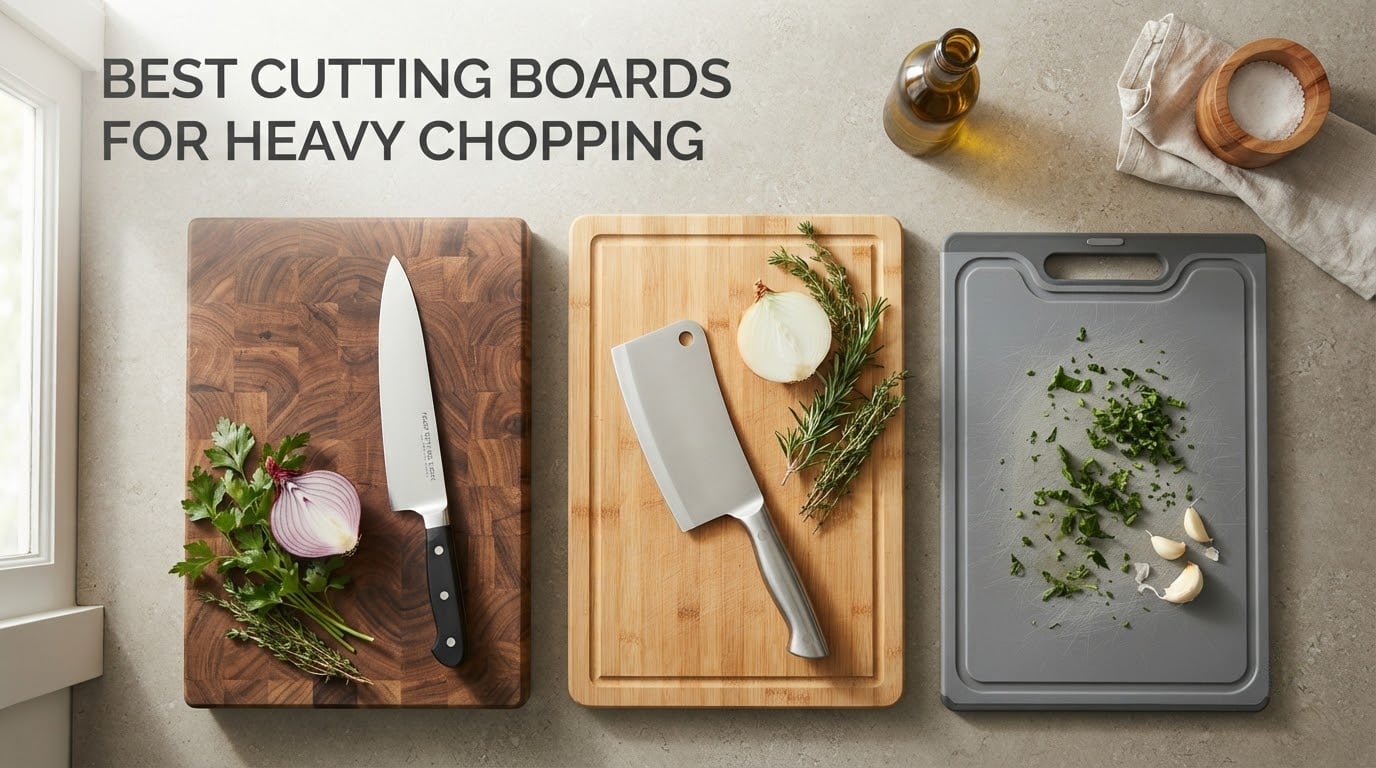
The best cutting boards for heavy chopping are thick, dense and big enough that you never have to balance a whole brisket on a corner. After working through a dozen boards in our kitchen, the Winco 18 x 24 polyethylene board earned the top slot for staying flat, cleaning in a dishwasher and surviving cleaver work without any care routine. If you prefer wood and do not mind an oiling habit, the 36 x 24 inch FSC-certified bamboo board gives you the most cutting area we tested.
Heavy chopping is a specific kind of punishment for a board. You are swinging a cleaver or rocking a chef’s knife through dense ingredients, and every impact pushes force into the surface, the glue lines and the wood underneath. Boards that fail do it in predictable ways: they slide across the counter, they flex until your knife lands at an angle, they split along the grain, or they cup and warp after a few weeks of washing.
So we judged these boards on the things that actually break under load: thickness and mass, how the surface is built, whether it holds a knife edge or destroys it, and how much effort it takes to keep the board flat and sanitary. We looked at nine pound and twenty pound slabs side by side, at edge-grain maple and end-grain walnut, and at plastic boards that cost a fraction of the wood.
We also weighed the practical constraints that never appear in a spec list. A board you cannot lift with one hand to reach the sink will annoy you every single day, and a board that needs oiling every week is a real cost in time. If you enjoy tools that outlive trends and get better with age, our guide to metal cutting band saws covers the same buy-it-for-life philosophy for workshop gear.
Top 3 Best Cutting Boards For Heavy Chopping (October 2026)

Winco 18×24 Poly Board
- 0.5 inch thick polyethylene
- 6.9 pounds
- Dishwasher safe and reversible
- NSF and HACCP approved

HIWARE 36×24 Bamboo Board
- 36 x 24 inch FSC-certified bamboo
- 1 inch thick at 20 pounds
- Juice grooves plus a pour spout
- Arrives pre-oiled

Greener Chef 30×20 Bamboo Board
- 30 x 20 inch bamboo surface
- 0.75 inch thick at 11 pounds
- Corner juice reservoir with pour spout
- Lifetime replacement warranty
The Winco board wins because it asks nothing of you. The HIWARE board wins on raw surface area, and the Greener Chef board wins for anyone who carves a turkey or trims a whole brisket with a juice gutter that actually contains the mess.
All 12 Boards Side by Side in 2026
| Product | Specifications | Action |
|---|---|---|
| Winco 18×24 Polyethylene Board |
|
Check Latest Price |
| HIWARE 36×24 Bamboo Board |
|
Check Latest Price |
| Greener Chef 30×20 Bamboo Board |
|
Check Latest Price |
 John Boos 24×18 Maple Board John Boos 24×18 Maple Board |
|
Check Latest Price |
 Kikcoin 30×20 Bamboo Board Kikcoin 30×20 Bamboo Board |
|
Check Latest Price |
 Sonder LA Alfred Walnut Board Sonder LA Alfred Walnut Board |
|
Check Latest Price |
 Babilonia End Grain Walnut Board Babilonia End Grain Walnut Board |
|
Check Latest Price |
 Thirteen Chefs 30×18 HDPP Board Thirteen Chefs 30×18 HDPP Board |
|
Check Latest Price |
 Royal Craft Wood 3-Piece Set Royal Craft Wood 3-Piece Set |
|
Check Latest Price |
 Titanium and Polypropylene Board Titanium and Polypropylene Board |
|
Check Latest Price |
 OTAVILEM Stainless Steel Board OTAVILEM Stainless Steel Board |
|
Check Latest Price |
 Snowclad Steel and PP Board Snowclad Steel and PP Board |
|
Check Latest Price |
1. Winco 18 x 24 Polyethylene Board – Best Overall for Heavy Chopping
Winco Cutting Board, 18 by 24 by 1/2-Inch, White, 18″ x 24″
23.75 x 17.88 x 0.5 inch polyethylene
6.9 pounds
NSF certified and HACCP approved
Dishwasher safe and reversible
Pros
- Non-porous and will not absorb juices or odors
- Survives repeated sanitizing without warping
- Large surface for breaking down primal cuts
- Reversible so one side can handle raw meat
- Most owner reviews of any board we tested
Cons
- No rubber feet so it slides on smooth counters
- Half inch thickness flexes more than thick wood
- Bulky at this size and needs a large sink
This is the board we kept reaching for during heavy prep sessions, and it is the one we recommend to almost everyone. It measures 23.75 by 17.88 inches at half an inch thick and weighs 6.9 pounds, which is enough mass to stay put on a laminate counter while you work a boneless leg through it.
The polyethylene surface is genuinely non-porous, so blood, onion sulfur and marinade wipe off instead of soaking in. That single property matters more for heavy chopping than most people expect, because a wooden board used for raw meat every week needs a serious scrubbing routine.

Because it is dishwasher safe and rated for 176F to 196F, clean-up takes seconds. We ran this board through a sanitation cycle between meat sessions and it came out flat and unmarked, which is something we could not say for any of the bamboo boards here.
The board is reversible, so a common setup is raw meat on one side and produce on the other. Color-coded sizes are part of the same Winco line, which makes it easy to build a matching system if you break down meat regularly.
What we liked about it in the kitchen?
Weight and size hit the sweet spot. It is heavy enough that pressing down with a palm keeps it planted, yet light enough to carry to the sink with one hand. That combination is why it took our top slot ahead of several larger boards.
Owner reviews are overwhelmingly positive on the same two points: it never warps and it never stains. A few buyers do put a damp towel or a silicone mat underneath to stop sliding, which is an easy fix for a board this large.
Where it falls short?
Half an inch of polyethylene does flex under a hard cleaver blow, and that flex is felt in the knife handle. If your heaviest work is bone-in cuts and you care about knife feedback, one of the one-and-a-half-inch wood slabs will feel more solid.
Plastic is also harder on a fine knife edge than wood. Keep the plastic board for meat and bulk prep, and use wood or bamboo for vegetables and herbs where edge retention matters.
2. HIWARE 36 x 24 Inch Bamboo Board – Best for Maximum Surface Area
36 x 24 Extra Large Bamboo Cutting Board for Kitchen, Cutting Board Stove Top Cover with Handle, Butcher Block Chopping Board with Juice Groove, Large Charcuterie Board Over the Sink
36 x 24 x 1 inch FSC-certified bamboo
20.1 pounds
Hand wash only, oil periodically
Built-in handle and pour spout
Pros
- Largest cutting surface we tested for heavy prep
- Very heavy and does not move while chopping
- Arrives pre-oiled and usable immediately
- Juice grooves plus a well with a spout
- Doubles as a stove-top or island cover
Cons
- No feet or corner pads so it slides on smooth counters
- Can arrive very dry with loose splinters to brush off
- Unwieldy at 20 pounds when washing
Thirty-six by twenty-four inches is a genuinely unusual amount of board. Most home kitchens do not have that much uninterrupted counter, which is exactly why this board doubles as a cover for a cooktop or a sink when you are not prepping.
It is one inch thick and weighs just over twenty pounds, so it plants itself during heavy chopping without any pressure from your off hand. The FSC-certified bamboo is a plus for anyone who wants a renewable material with documented sourcing.
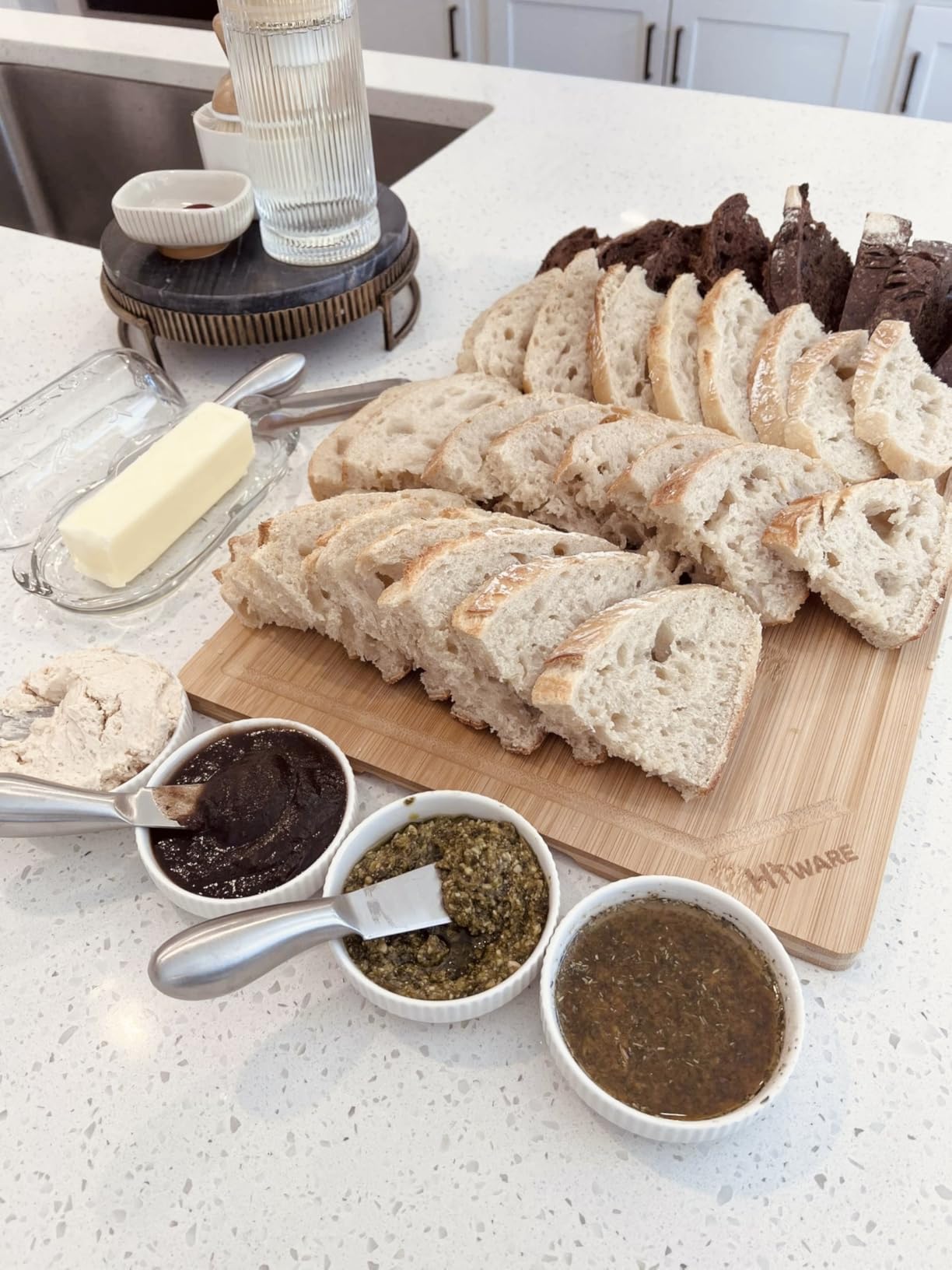
Juice grooves run around the board and feed into a well with a spout, so the liquid from a whole turkey or a large batch of fruit ends up in one place instead of across your worktop. The built-in handle gives you a secure grip for lifting and draining.
It arrives pre-oiled, so you can use it immediately. We still recommend a second coat within the first week, because bamboo that dries out between sessions is where cracking starts.
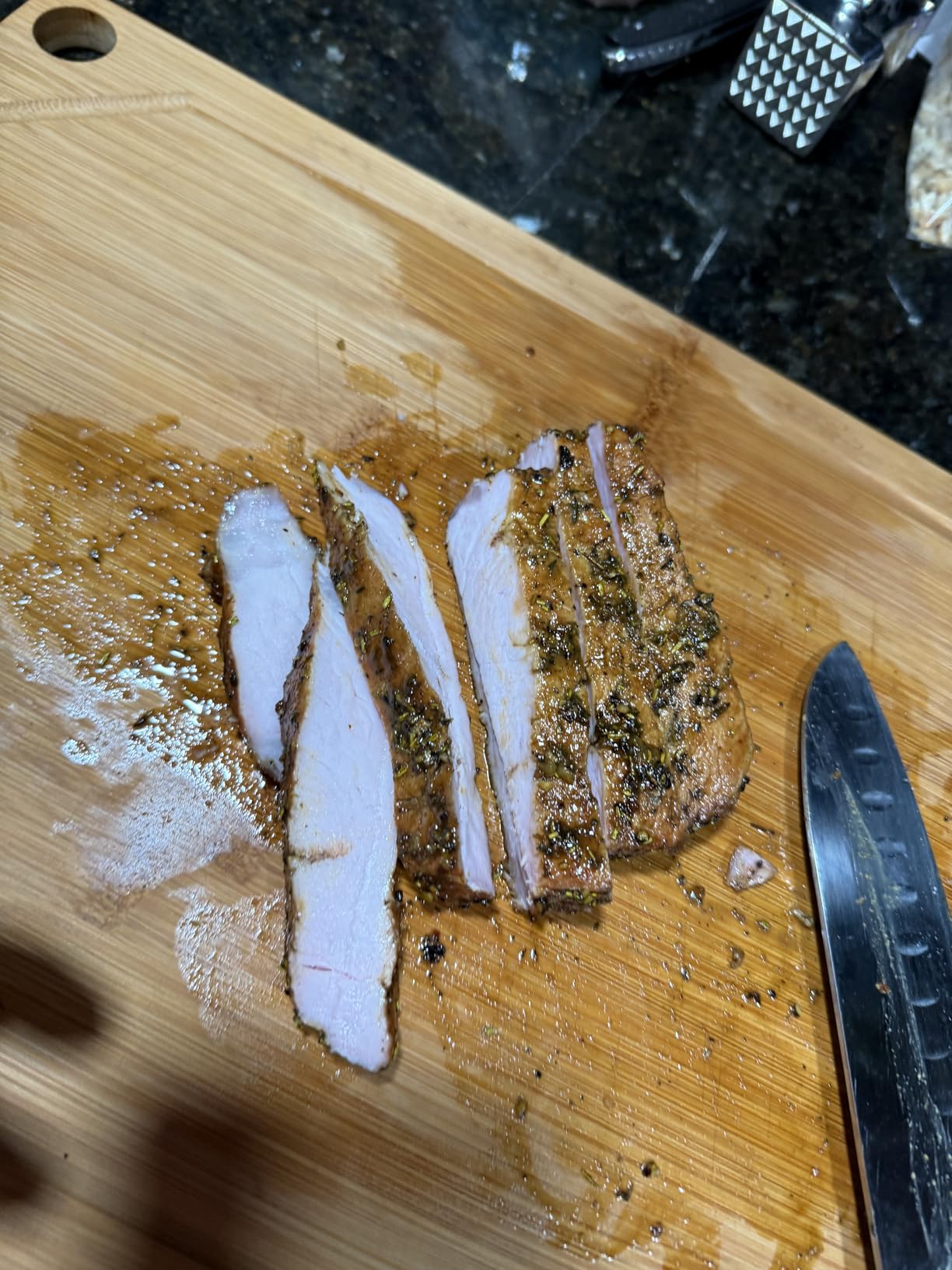
What we liked about it in the kitchen?
Surface area is the whole point. If you break down a whole bird, trim a brisket, or set out a full mise en place for a large meal, the difference between a 24-inch board and a 36-inch board is the number of times you have to turn food around.
Owners consistently report that the board does not move. Some note that it slides on a smooth counter if you push it hard, so a thin towel underneath is a cheap insurance policy.
Where it falls short?
Twenty pounds is a lot to lift to the sink. If your prep zone is far from the sink, this becomes an annoyance every day, and it is the single biggest reason we did not put it in first place.
Reports of cracking after months of inconsistent oiling are common, and dishwasher use will pull the laminate apart. Hand wash, dry upright, and re-oil on a schedule, and this board stays flat for years.
3. Greener Chef 30 x 20 Inch Bamboo Board – Best for BBQ and Turkey Carving
ENORMOUS 30 x 20 Organic Extra Large Cutting Board with Lifetime Replacements – Wood Bamboo Chopping Board – Wooden Butcher Block Cutting Board for Carving Turkey, Grilling Brisket and BBQ
30 x 20 x 0.75 inch bamboo
11 pounds
Hand wash and oil regularly
Lifetime replacement warranty
Pros
- Handles a large turkey or brisket with room to spare
- Corner juice reservoir with a pour spout
- Fits over a stove or sink to free counter space
- Backed by a lifetime replacement warranty
- Non-porous bamboo wipes down quickly
Cons
- At 11 pounds it is awkward to move and wash
- Bamboo needs periodic oil conditioning
- Hand wash only so cleanup takes longer
Thirty by twenty inches is the size most people picture when they say heavy chopping board, and at eleven pounds this one is easier to handle than its footprint suggests. We used it to break down a whole bird and to trim a slab of meat, and the surface never flexed.
The built-in gutter is deep enough to catch real liquid rather than a smear, and the corner reservoir with a pour spout means you can empty it without carrying a wet board to the sink.
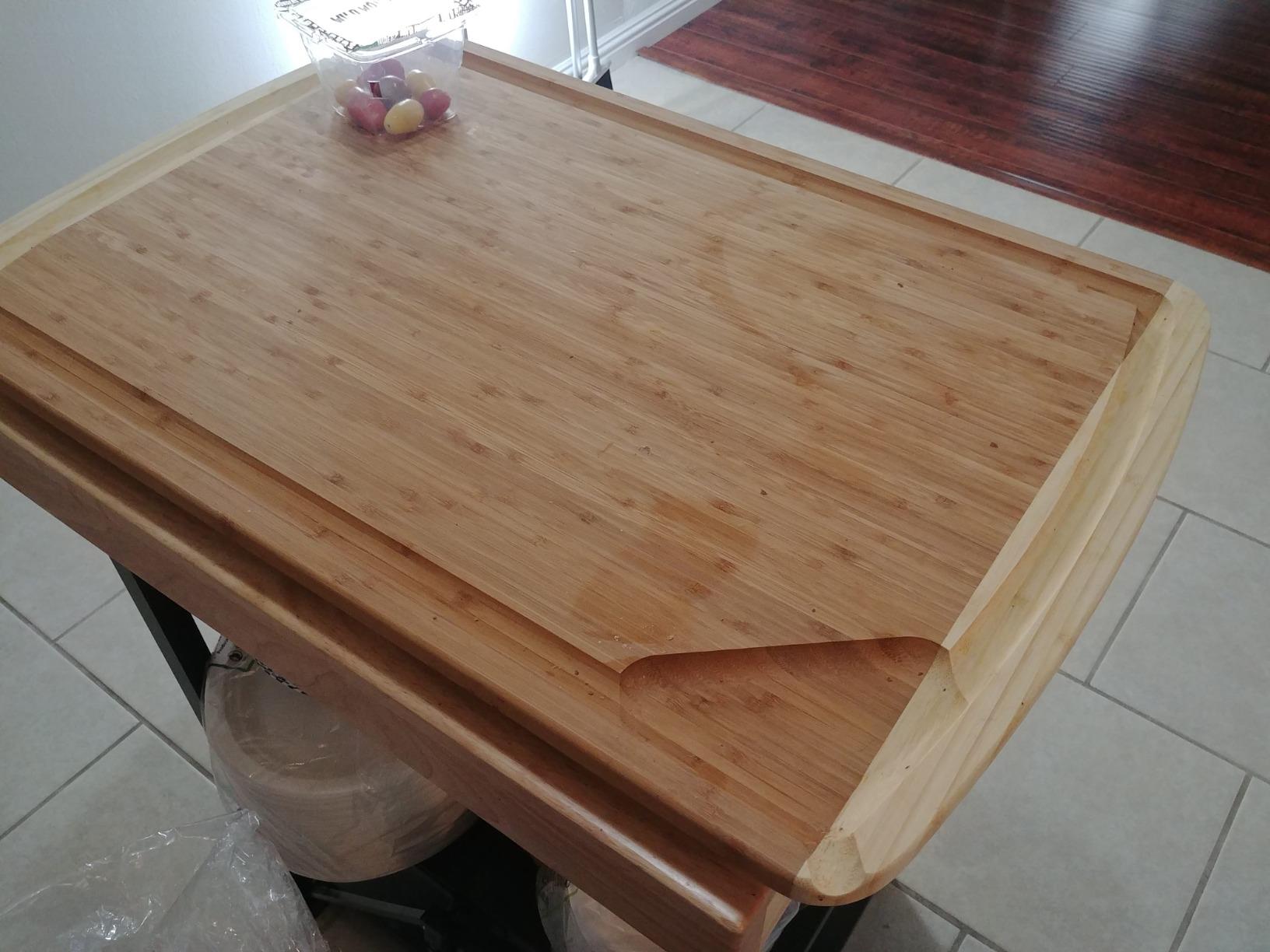
Because it fits over a cooktop or sink, this is also a countertop-space solution for small kitchens. When prep is done, it becomes a cover rather than a board taking up the only clear surface you have.
The lifetime replacement warranty is unusual in this category and covers manufacturing defects. Bamboo itself is a fast-growing grass, so the material choice lines up with buying for renewability, though the adhesive lines still need sensible care.
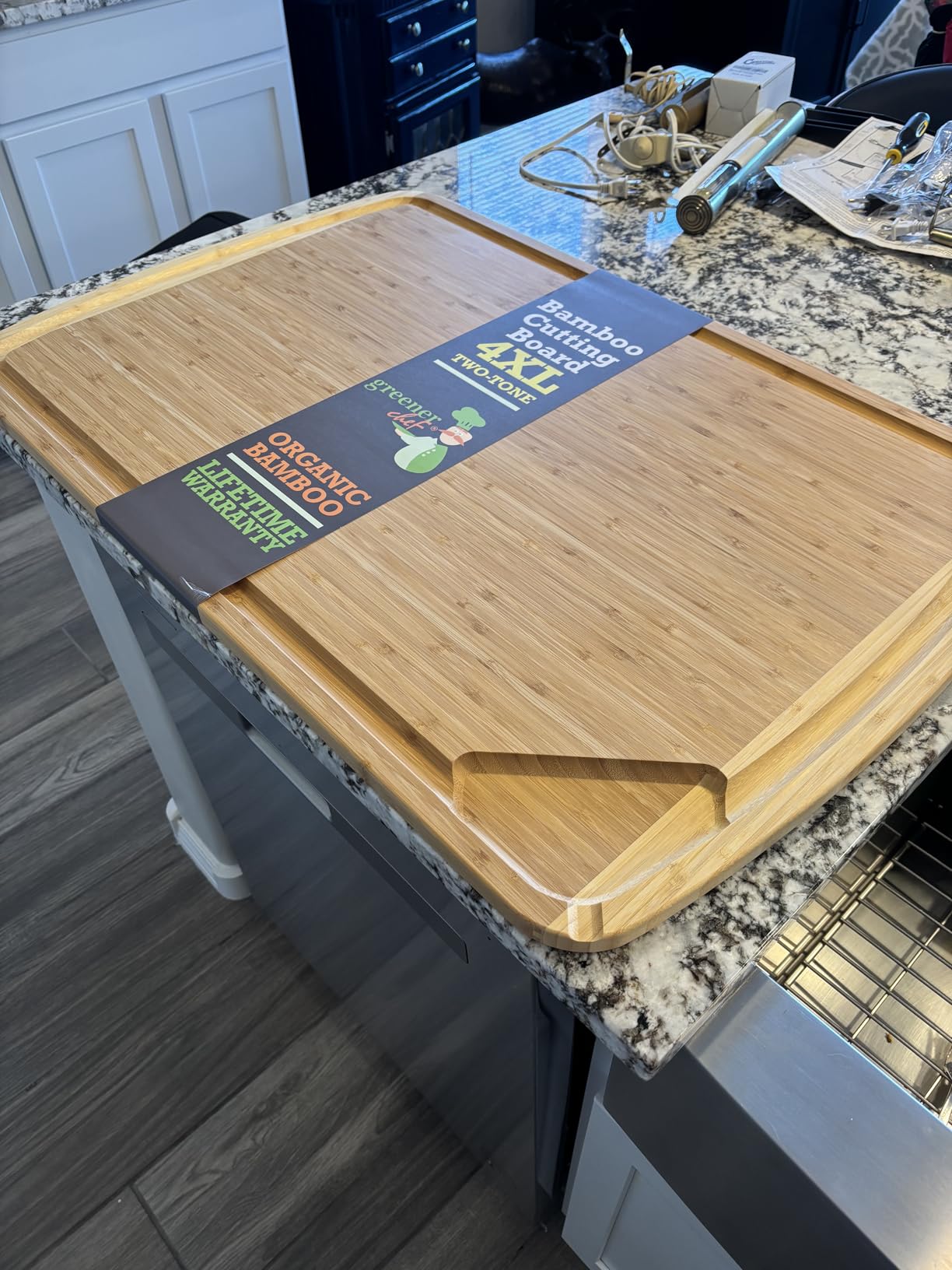
What we liked about it in the kitchen?
The gutter and spout turned out to be more useful than the size during a carving session. Meat juices ended up in the reservoir instead of running down the front of the board onto the counter.
Owner reviews point to the same combination of large area and easy cleaning. Very few mention anything other than weight and hand-wash care as drawbacks.
Where it falls short?
At three quarter inch, this board is thinner than the wood slabs in this roundup, so a heavy cleaver blow produces a little more give than a one-and-a-half-inch edge-grain board.
Bamboo that is allowed to dry out will crack along the edges, and humid storage makes that worse. A towel underneath also helps, since the board arrives without non-slip feet.
4. John Boos 24 x 18 Inch Edge-Grain Maple Board – Best Solid Wood
John Boos R-Board Series Rectangular Wooden Maple Cutting Board 24”x18” – 1.5” Thick, 18-lb Reversible Butcher Block with Edge-Grain & Finger Grips – Made in the USA
24 x 18 x 1.5 inch edge-grain maple
6.5 pounds
Hand wash only, oil regularly
Recessed finger grips on both sides
Pros
- Thick edge-grain maple that stays steady while chopping
- Level surface is kind to fine knife edges
- Reversible sides with recessed finger grips
- Made in the USA by a maker operating since 1887
- Holds up for years when oiled regularly
Cons
- Arrives very dry and needs a multi-day seasoning routine
- Quality control varies with reports of knots and grooves
- Packaging sometimes leads to dents in transit
One and a half inches of edge-grain American maple is the classic answer to heavy chopping, and this board delivers it. The surface is flat and consistent, which is what keeps a chef’s knife tracking straight through dense vegetables.
Both sides carry recessed finger grips, so you can lift and rotate it safely when it is loaded. That reversibility means you can dedicate one side to meat and keep the other for produce, the same approach we use with plastic boards.
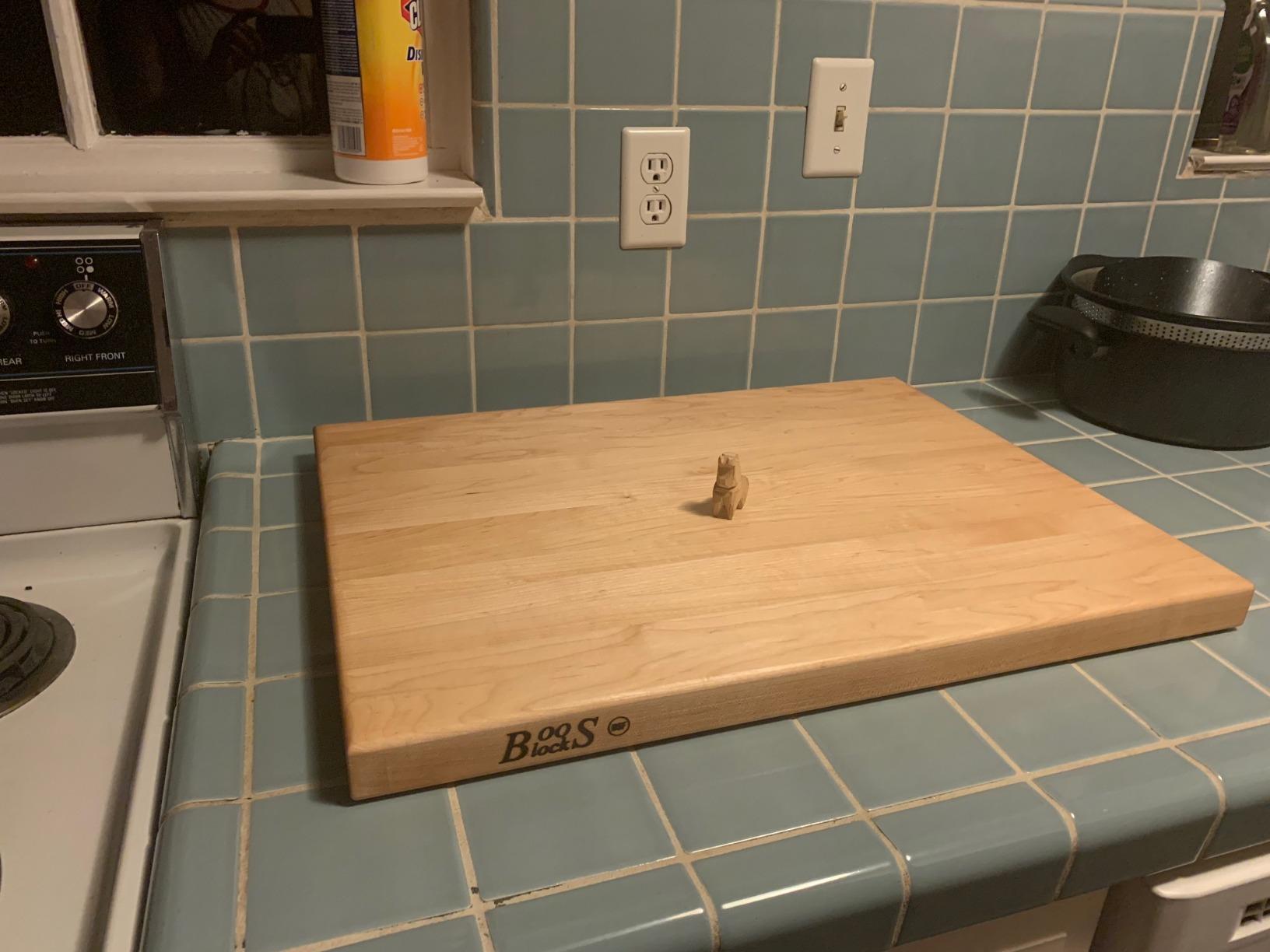
Maple is among the harder common board woods, and the published Janka figure for hard maple sits near 1400 lbf, well above the softer species. In practice that shows up as a surface that scars rather than dents.
Be realistic about setup. It arrives very dry, and most owners in owner reviews describe an extended oiling and board cream routine over several days before the surface stops drinking oil.
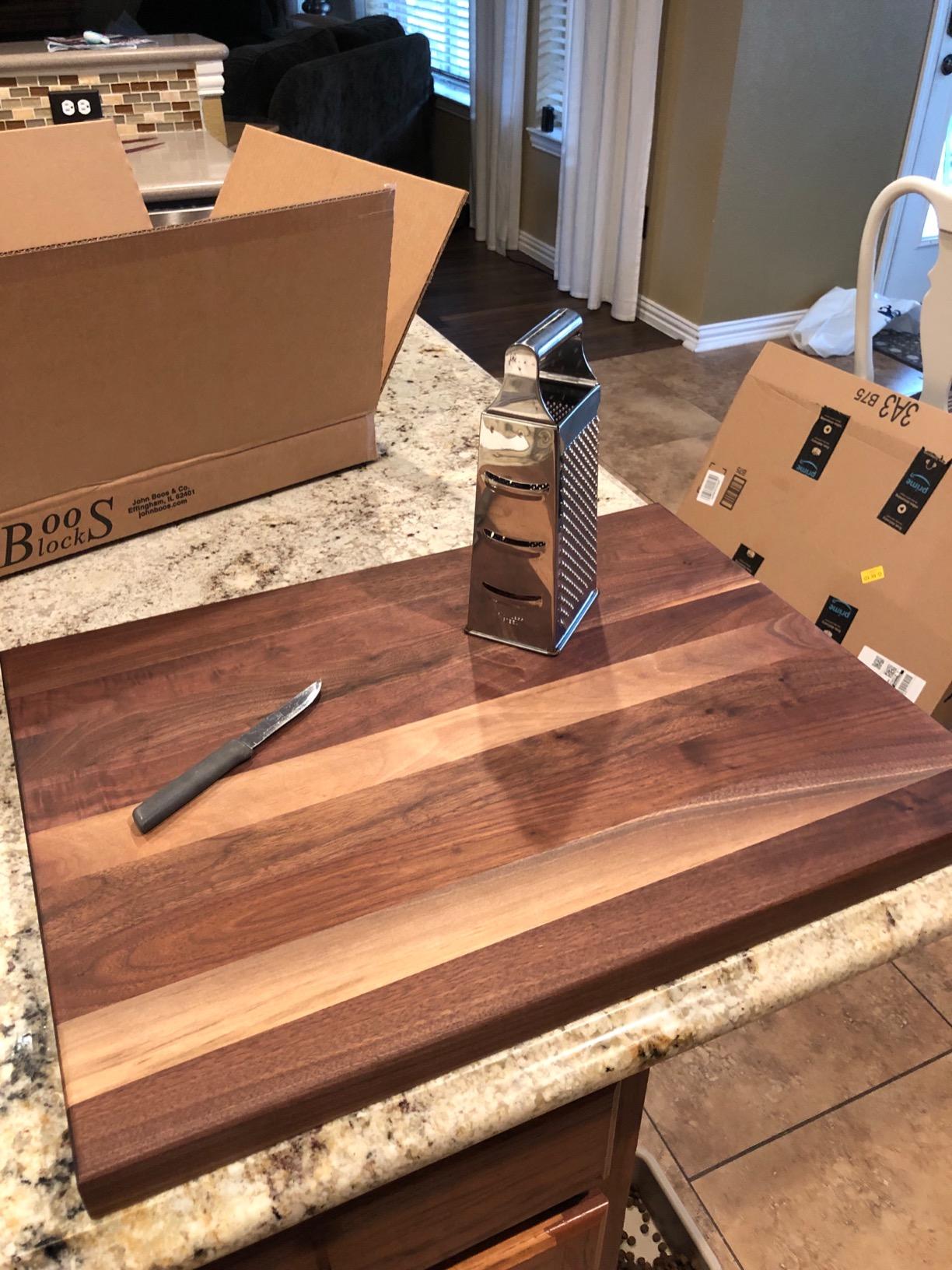
What we liked about it in the kitchen?
It feels like a professional tool rather than a kitchen accessory. The mass, the thickness and the level surface combine so that a rocking chop stays on the board from heel to tip.
Long-term owners report boards that still look good after years of daily use, and a one-year guarantee against defects in workmanship and material comes with it.
Where it falls short?
Quality control is the recurring complaint. Owner reviews mention unfilled knots, knife marks in the surface and boards arriving with unsanded shavings, so inspect it on arrival and sand or return it if the face is not level.
Wood requires hand washing and regular oiling, and a maple board stored flat and damp can warp or pick up mold. Stand it on edge between uses.
5. Kikcoin 30 x 20 Inch Bamboo Board – Best Anti-Slip Grip
Kikcoin 30”×20” Bamboo Cutting Boards for Kitchen, Heavy Duty Wooden Cutting Boards, Healthy Extra Large Chopping Boards with Deep Juice Groove and Handle, Oversized Stove Top Cover, Natural
30 x 20 x 1 inch bamboo
15 pounds
Hand wash only, oil periodically
Includes anti-slip silicone stickers
Pros
- One inch thickness handles very heavy chopping
- Fifteen pound weight keeps it planted
- Deep wide juice groove catches a lot of liquid
- Supplied silicone stickers add real stability
- Reversible design separates raw and cooked prep
Cons
- Fifteen pounds is heavy to carry to the sink
- Sticker grip only works if the stickers are applied
- Bamboo can splinter if left unsealed
Sliding is the complaint we heard most often about boards in general, and this one includes anti-slip silicone stickers for exactly that reason. Apply them and the board stops creeping even while you push a cleaver down and forward.
One inch thickness at thirty by twenty inches and fifteen pounds gives it the stability of a butcher block without the twenty-plus pound lifting problem of the largest board here. It also works as a cooktop or sink cover.
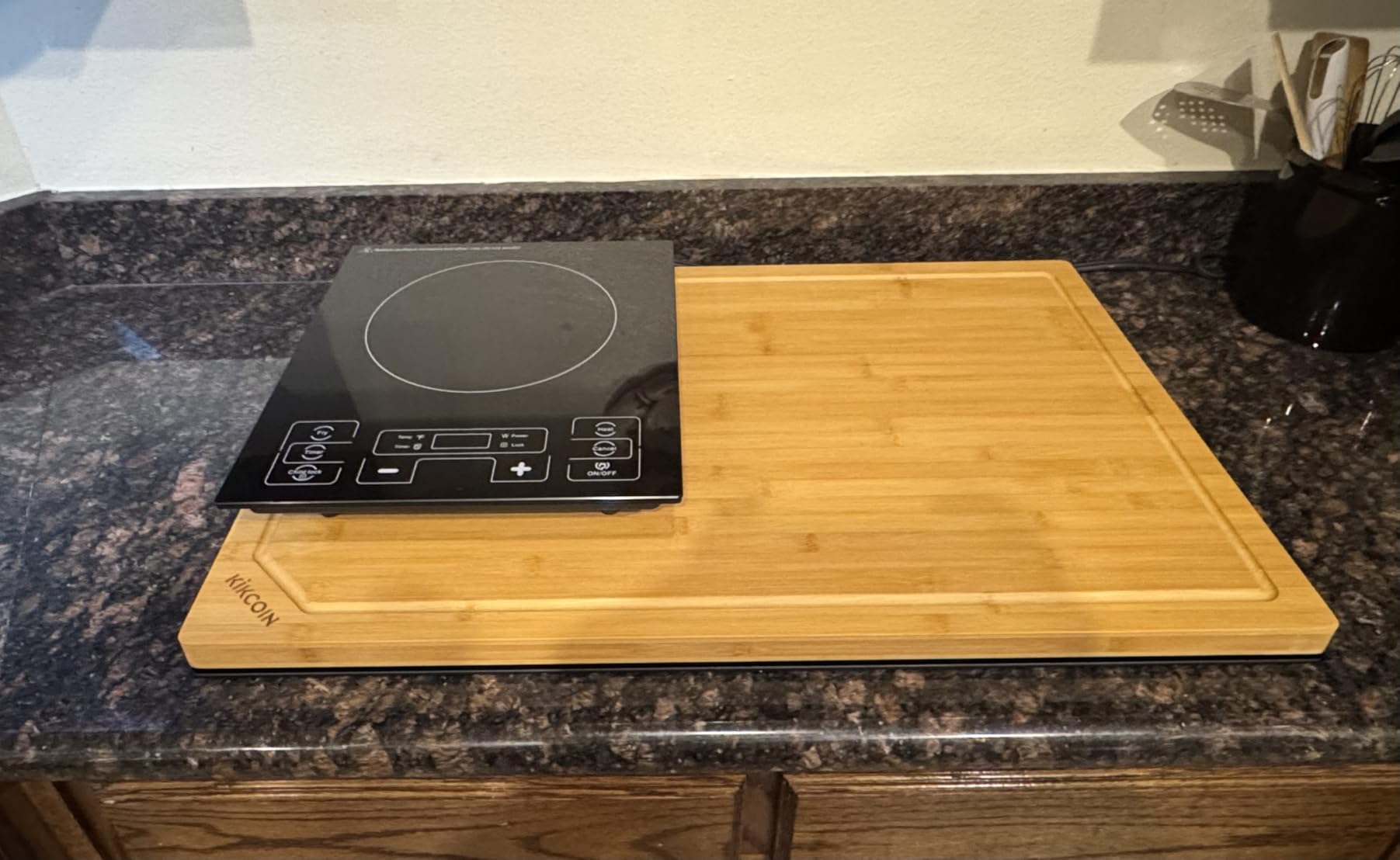
The bamboo is polished and coated with food-grade oil for a burr-free finish, and the deep, wide groove is genuinely deep. The double-sided design lets you separate raw and cooked prep on one board.
An invisible built-in handle lets you lift and hang it without hunting for a grip hole. Lifetime limited support covers manufacturing defects.
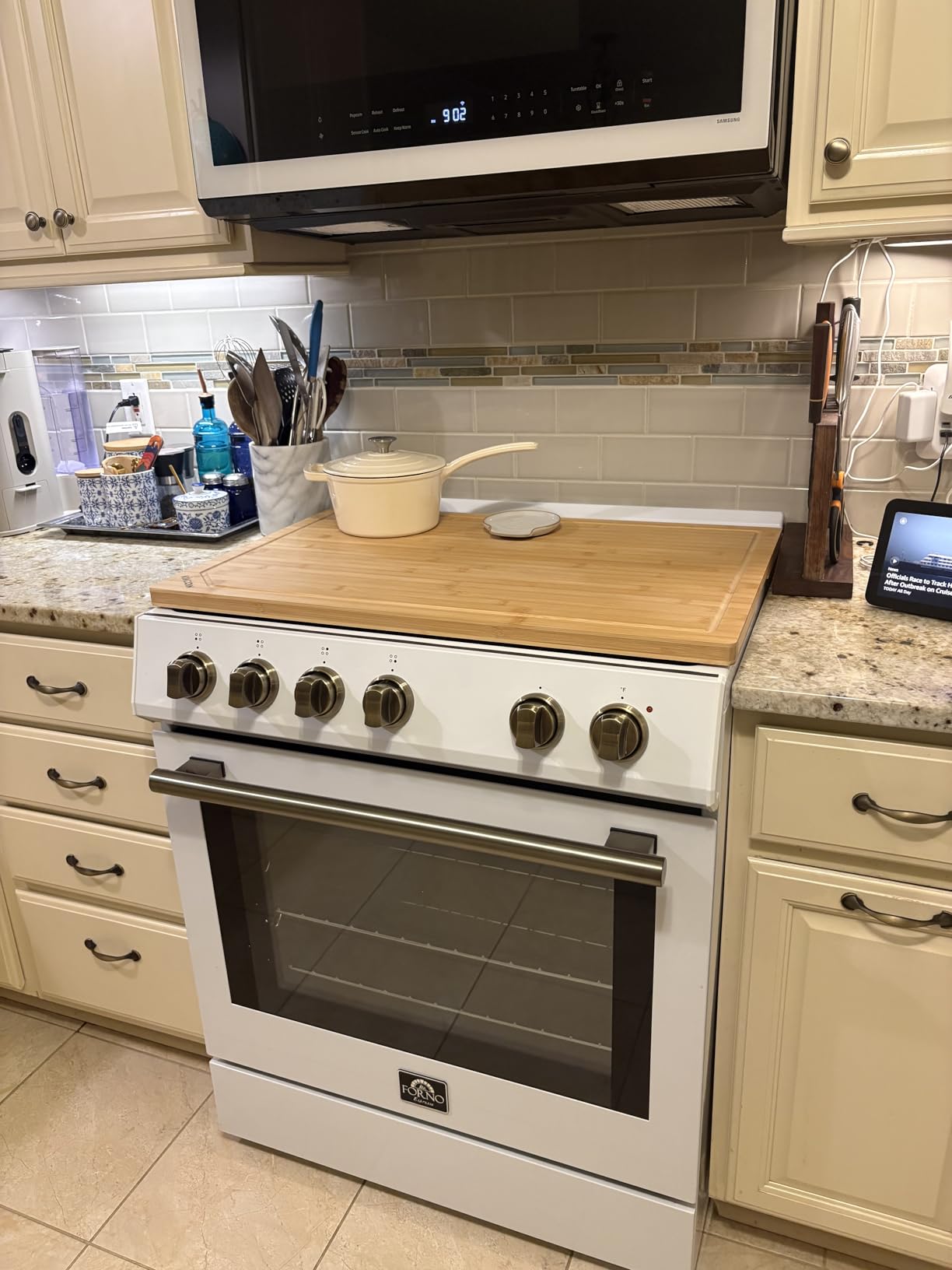
What we liked about it in the kitchen?
Stability was the stand-out. With the stickers down, we could chop hard without pressing down with our free hand, which is the difference between a controlled cut and a wandering one.
The finish arrived smooth with no rough patches, and the deep groove kept a full chopping session of onions, peppers and meat juice on the board.
Where it falls short?
Fifteen pounds is heavier than it looks. If your sink is far from the prep area, you are carrying real weight each time, and that is the top complaint in owner reviews.
Bamboo needs hand washing and periodic oiling. Dishwasher heat will split it, and a board that dries out in a humid kitchen will splinter along the edges within a few months.
6. Sonder Los Angeles Alfred End-Grain Walnut Board – Best End-Grain Walnut
Sonder Los Angeles Alfred Cutting Board, End Grain Walnut, 17x13x1.5 in
17 x 13 x 1.5 inch end-grain walnut
7.5 pounds
Hand wash, oil every 2-3 weeks
Removable non-slip feet
Pros
- End grain is gentle on knife edges and self-healing
- Removable non-slip feet give genuinely stable chopping
- Three built-in sorting wells organize prep
- Deep 3.5 fl oz juice groove contains liquid
- Sustainably sourced American black walnut
Cons
- Smaller footprint than the oversized bamboo boards
- Requires oiling every two to three weeks
- Solid walnut carries a premium price
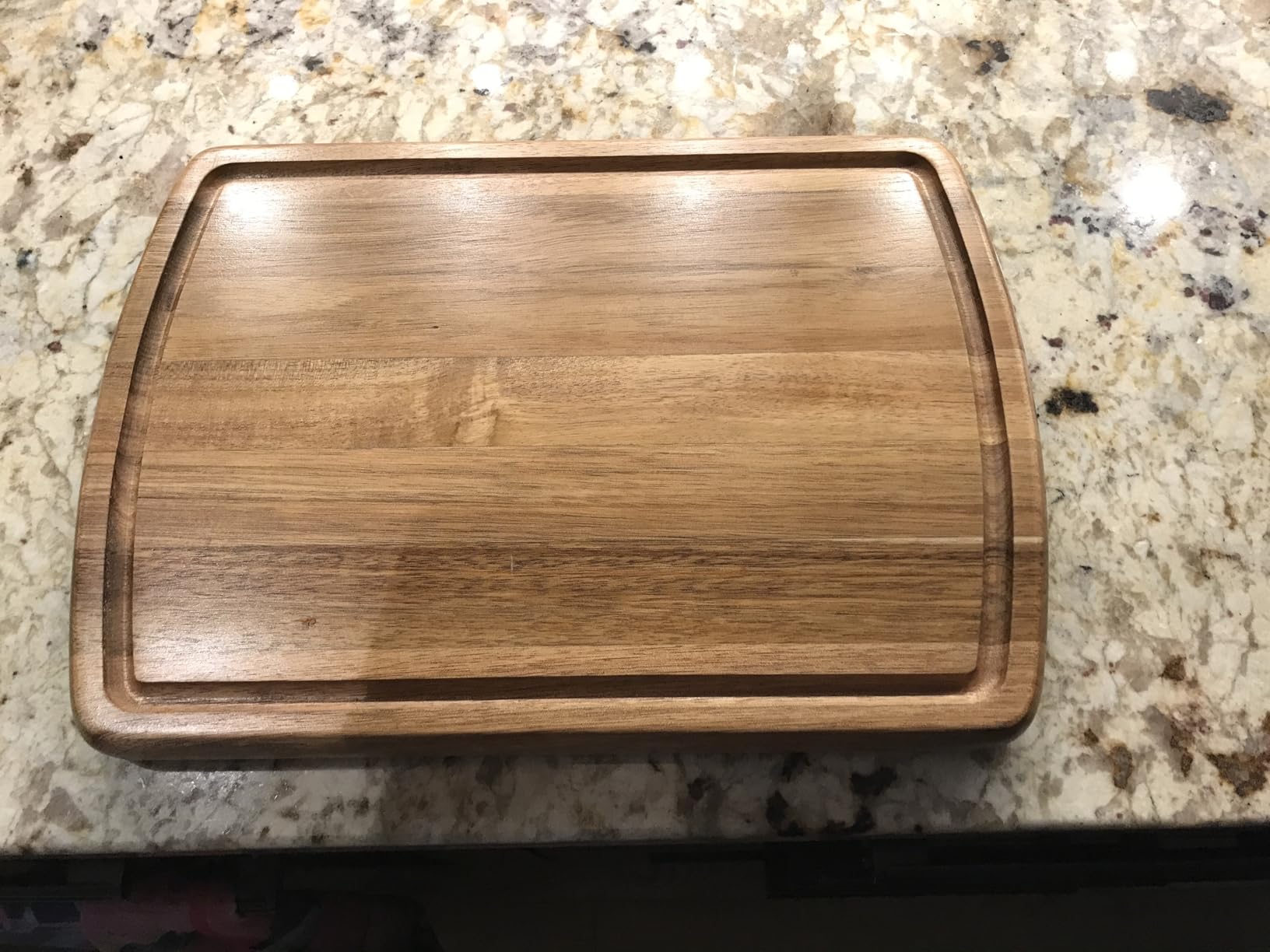
End grain is the construction to know about: the wood fibers point straight up, so cuts compress rather than split the surface, and the fibers close back on themselves as the board dries. That self-healing behavior is why end grain boards are the traditional choice for knife work.
American black walnut is dense and naturally resistant to contaminant growth on the surface. At one and a half inches thick and seven and a half pounds, this board holds still under pressure without being unwieldy.
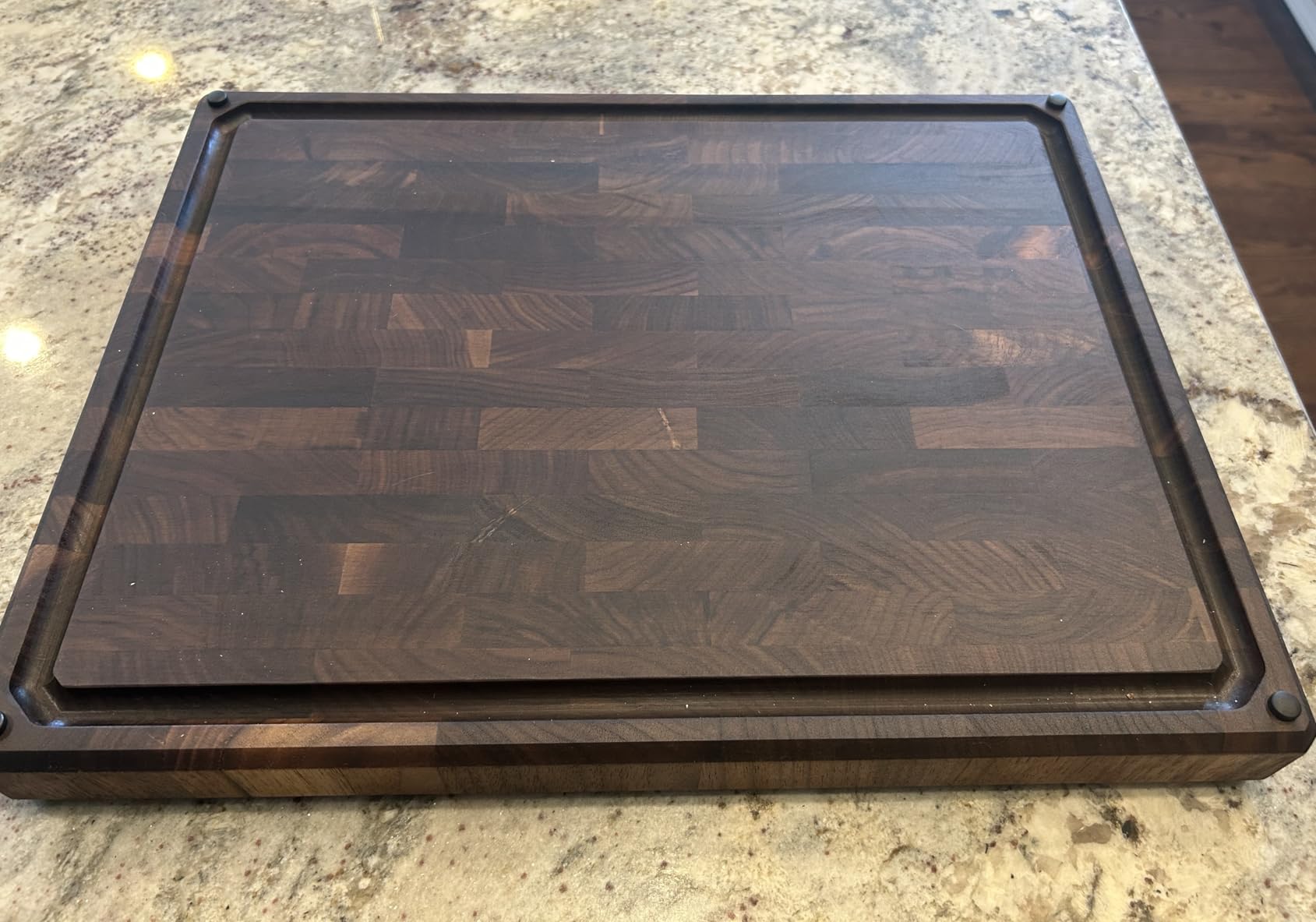
The removable non-slip feet are the detail we liked most, because they let you change the board from chopping mode to charcuterie mode by lifting them out. Three built-in sorting wells keep chopped ingredients separated mid-prep instead of piling up.
The juice groove holds 3.5 fluid ounces, which is a real capacity rather than a decorative channel, and built-in handles plus a gift box round out a well-made package.
What we liked about it in the kitchen?
Knife feel. On end grain the blade sinks in with almost no resistance, and after a session of herb chopping our edges were noticeably better than after the same work on plastic.
The sorting wells changed how we prep. Diced onion, herbs and diced tomato each had a home instead of migrating across the board.
Where it falls short?
Seventeen by thirteen inches is small for breaking down a whole bird. This board is for prep work rather than butchery, and we would pair it with a larger board for holiday cooking.
The maintenance schedule is the real trade. Oiling every two to three weeks is not optional for walnut, and skipping it is how end grain boards start to crumble at the edges.
7. Babilonia End-Grain Walnut Board – Best Transfer Notch Design
American Walnut Wood Cutting Board, End Grain Butcher Block for Kitchen
19.7 x 12.2 x 1.7 inch end-grain walnut
8.8 pounds
Hand wash only, store cool and dry
Arrives pre-oiled with oil bottle
Pros
- One point seven inch thickness for chopping stability
- Self-healing end grain is gentle on knife edges
- Notch and plate slide chopped produce into a pot
- Reversible with a hidden handle for serving
- Arrives seasoned and ready to use
Cons
- Surface area is smaller than the oversized bamboo boards
- Hand wash only and needs cool dry storage
- Walnut darkens over time with heavy use
One point seven inches is the thickest slab in this roundup, and you feel the difference immediately: a cleaver lands and the board does not move or flex. This is the most solid-feeling board we handled during heavy chopping tests.
The notch and included plate are the cleverest feature here. Instead of chopping a board of onions and then scraping them into a bowl, you slide the plate into the notch and push the pile straight into the pot.
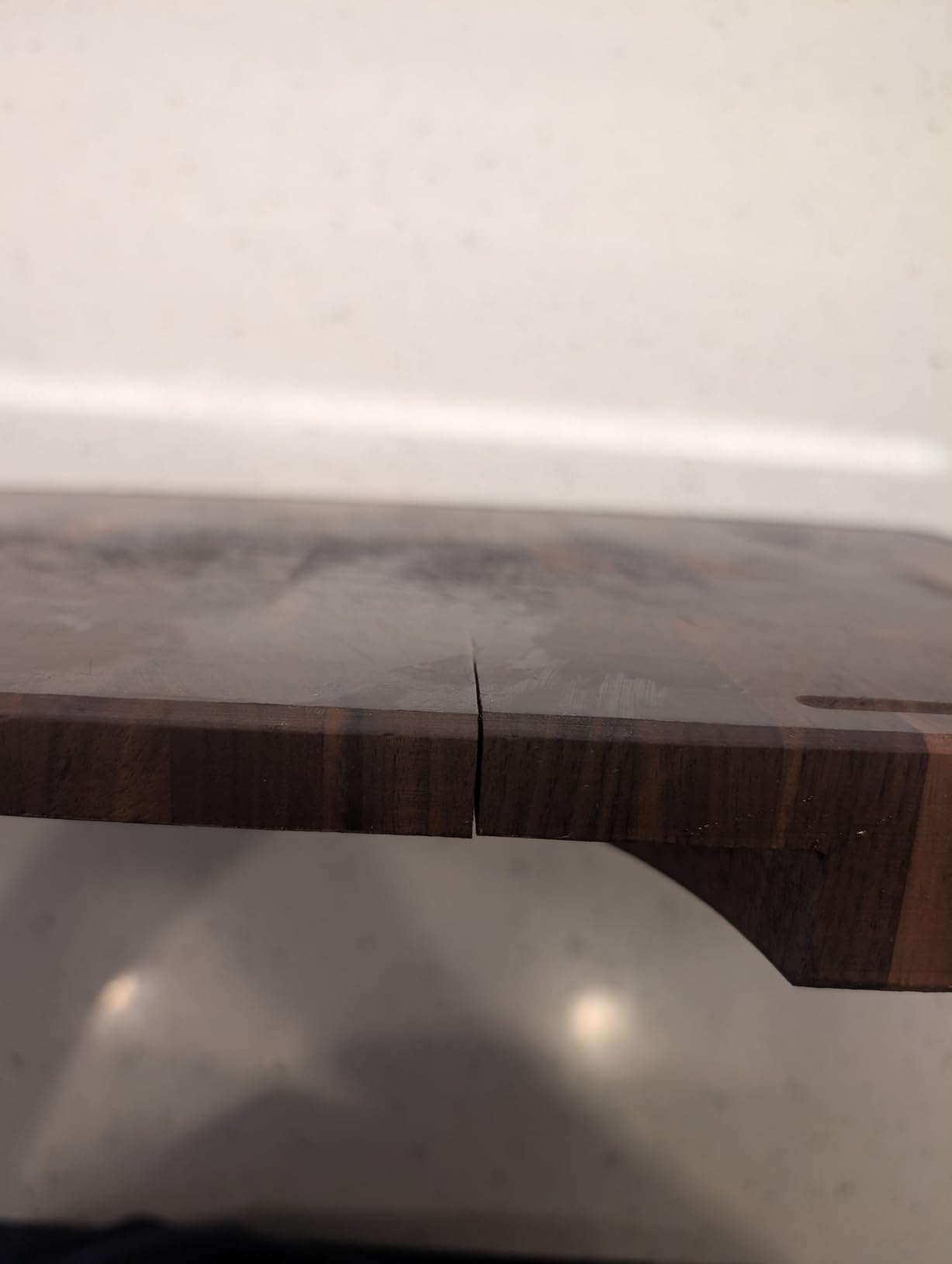
It arrives seasoned and pre-oiled with a bottle of oil in the box, so there is no multi-day setup like you get with a dry edge-grain board. Two-year warranty with money-back support backs it up.
The board is reversible and doubles as a serving tray with a hidden handle, which makes it a three-in-one piece: butcher block, cutting board and serving surface.
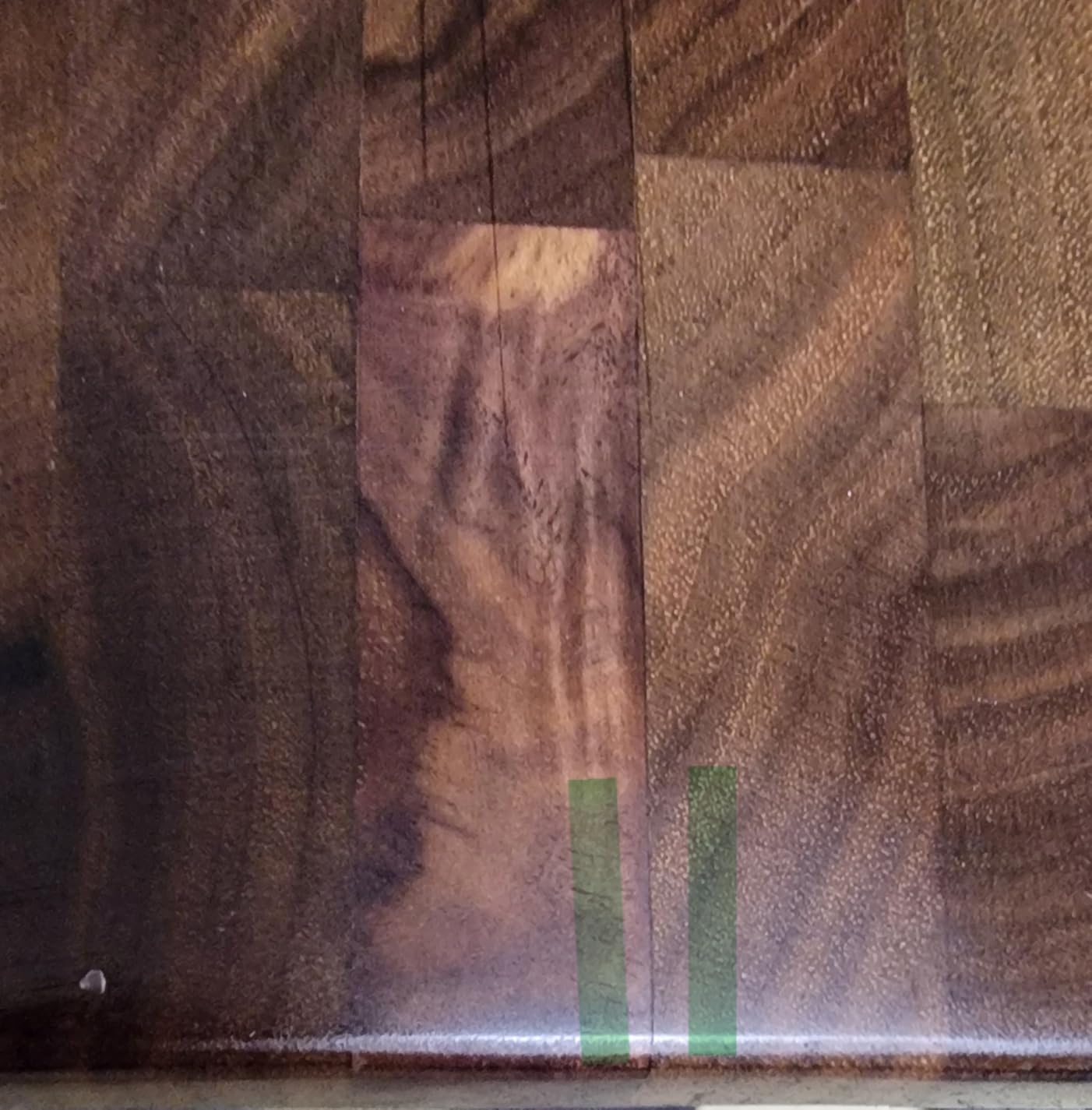
What we liked about it in the kitchen?
Walnut color and figure make it the board guests comment on. End grain also means it is the easiest of the hardwoods here on a fine knife edge.
The transfer notch quietly improved our workflow. Moving a full board of diced produce without a second cutting surface is a small trick that saves a lot of scraping.
Where it falls short?
Nineteen point seven by twelve point two inches is on the small side next to the oversized bamboo boards, so it complements a larger board rather than replacing one for butchery.
Walnut darkens over years of heavy use, and the board must be hand washed and stored somewhere cool and dry. It also needs occasional oiling to avoid drying out.
8. Thirteen Chefs 30 x 18 Inch HDPP Board – Best Commercial Grade
Big 30 x 18 Plastic Cutting Board – 3/4 Inch Thick for Meat, Game and Fish – Commercial Grade HDPP Poly with NSF Stamp, Weighs 13 Pounds, White
30 x 18 x 0.75 inch HDPP
13 pounds
NSF stamped for food service
Dishwasher safe to 200F
Pros
- Thirteen pounds of heft barely moves while chopping
- HDPP resists warping cracking and staining
- NSF stamped for restaurant food service
- Textured surface grips food and stops sticking
- Dishwasher safe up to 200F
Cons
- Mold-in dimples catch very sharp knife tips
- Soft plastic dulls edges faster than wood
- Serrated knives permanently score the surface
- Too large for a household sink
This is the board we would buy for game processing or fish cleaning, and it is the only one here stamped NSF for professional kitchens. The commercial-grade HDPP will not absorb liquid, will not stain and will not warp in a dishwasher.
Thirteen pounds across a thirty by eighteen inch surface makes it effectively immobile during heavy chopping. The textured face also adds grip so cut pieces do not slide under the blade.
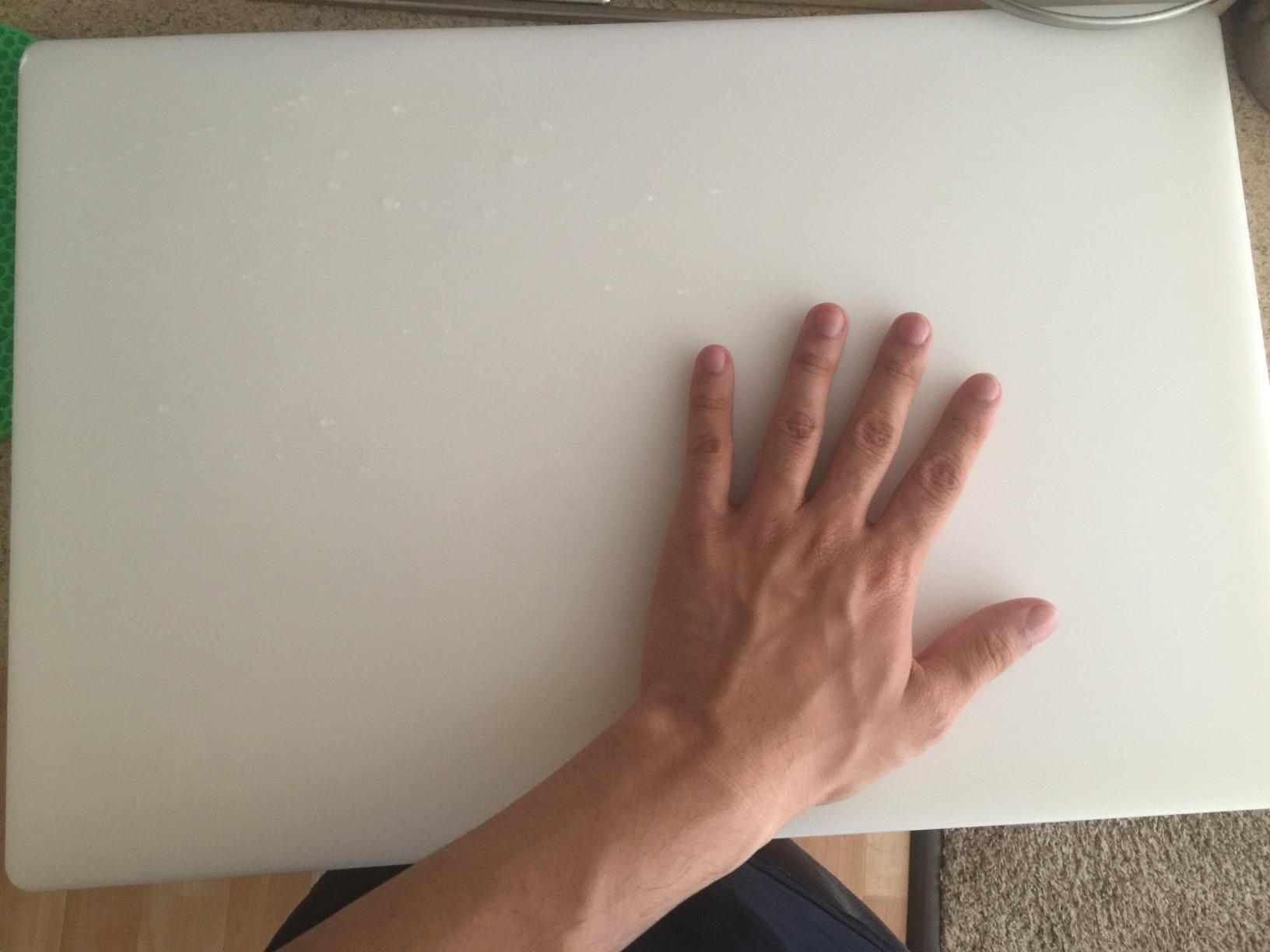
The manufacturer is upfront that this board is too big and too heavy for many home kitchens, so measure your counter first. If it does not fit your sink, you are washing it with a hose or a sponge in place.
It is also explicitly not a board for serrated knives, boiling water or hot pans. Treat it as a meat and fish station rather than an all-purpose surface.
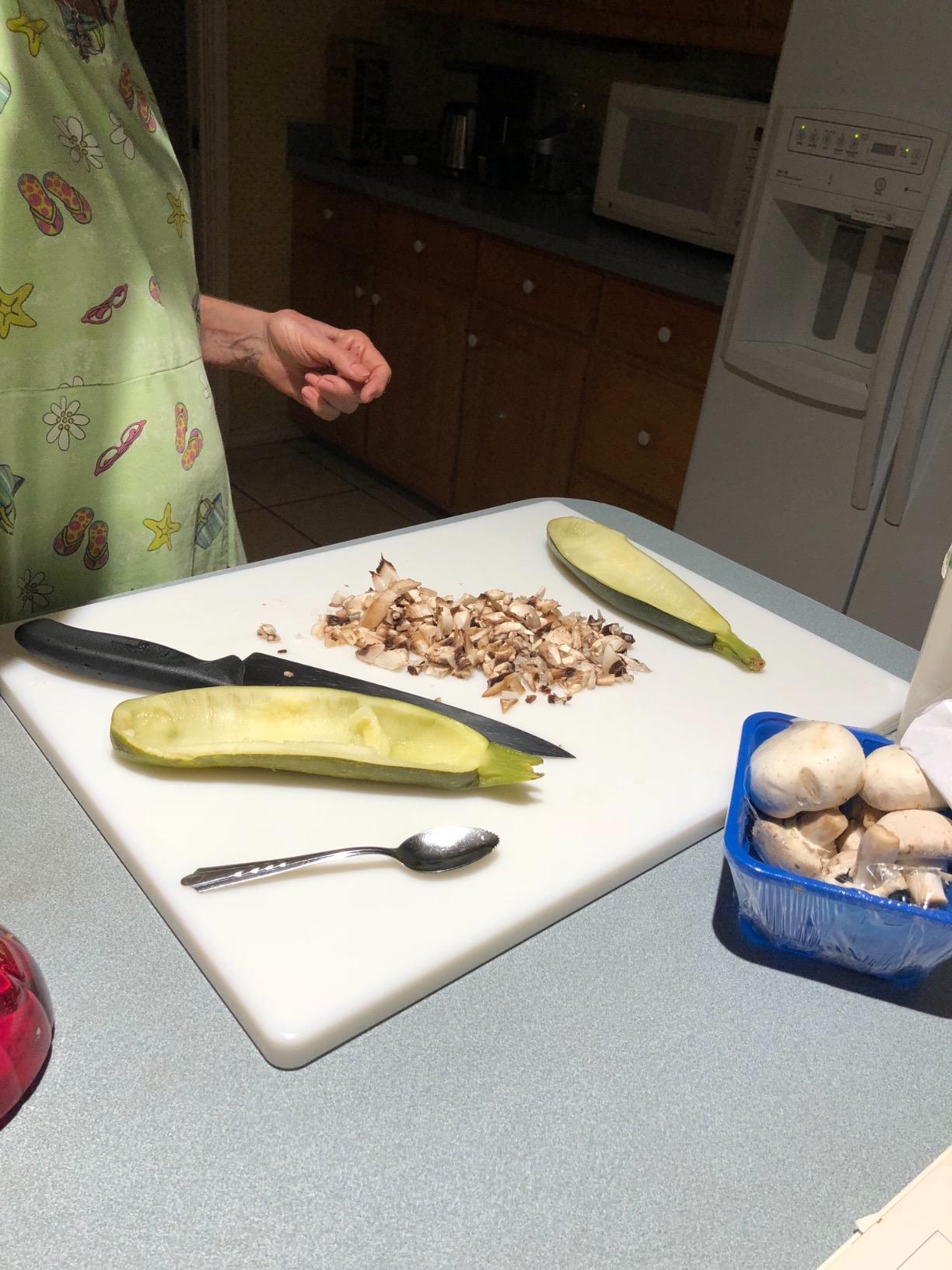
What we liked about it in the kitchen?
Dishwasher survival is the reason this board exists. We sanitized it repeatedly between raw meat sessions and it came out flat, white and unmarked every time.
For hunters, fishers and anyone processing large volumes of meat, the combination of mass, NSF approval and zero maintenance is very hard to argue with.
Where it falls short?
The mold-in dimples that create that texture will catch the tip of a sharp knife when you scoop, which is a real hazard when scooping chopped onion into a hot pan.
Soft plastic is less kind to knife edges than wood, and cleaning it requires somewhere other than a normal kitchen sink. A towel underneath helps with sliding on smooth counters.
9. Royal Craft Wood 3-Piece Bamboo Set – Most Versatile
ROYAL CRAFT WOOD Wooden Cutting Boards for Kitchen Appliances – Non Toxic Bamboo Wood Cutting Board Set with Deep Juice Groove, Side Handles, Charcuterie & Butcher Block for Meat, Meal Prep & Serving
15x10, 12x8 and 9x6 inch bamboo set
4.1 pounds total
Hand wash only
Juice groove on each board
Pros
- Three sizes cover fruit produce and meat carving
- Carbonized bamboo feels sturdy for the money
- Juice grooves keep counters genuinely clean
- Side handles let each board serve as a tray
- Solid without being excessively heavy
Cons
- Edge cracking after months of use without oil
- Some units arrive with a rough unsanded finish
- Groove is shallower than competing designs
Three boards in one package is the cheapest path to a separated prep system, and this set is the most-reviewed product we tested by a wide margin. The fifteen by ten inch board is the largest, with twelve by eight and nine by six for smaller jobs.
At four point one pounds for the set, this is a board you can pick up with one hand and move without thinking about it, which is exactly what you want during a fast weeknight prep session.
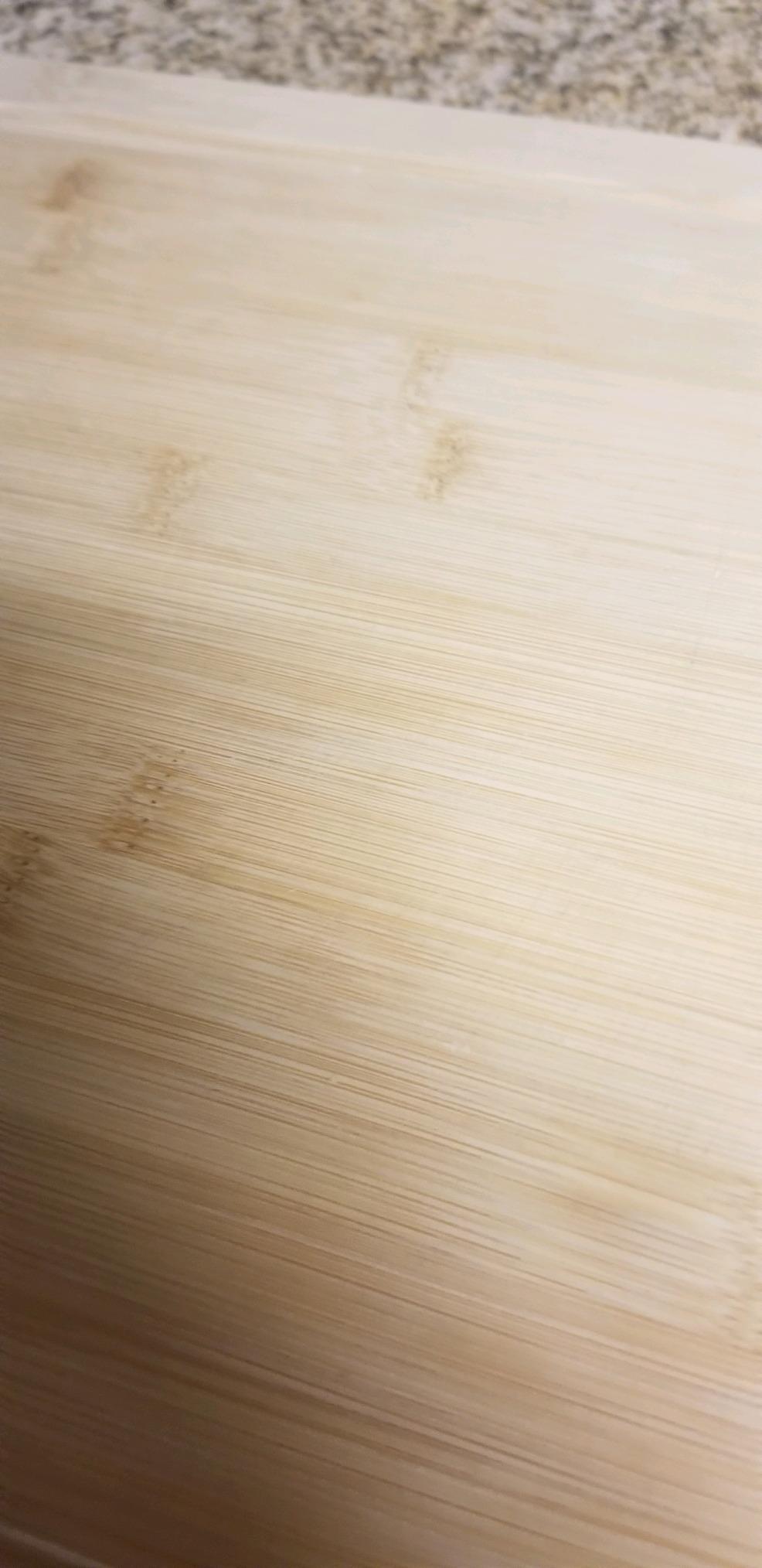
Each board has a deep juice groove and built-in side handles, so a board can go from cutting to carrying to serving without a tray. The carbonized bamboo is reversible on each piece.
For heavy chopping specifically, treat the large board as a vegetable and fruit station. It will not take the same cleaver punishment as a one-and-a-half-inch maple slab.
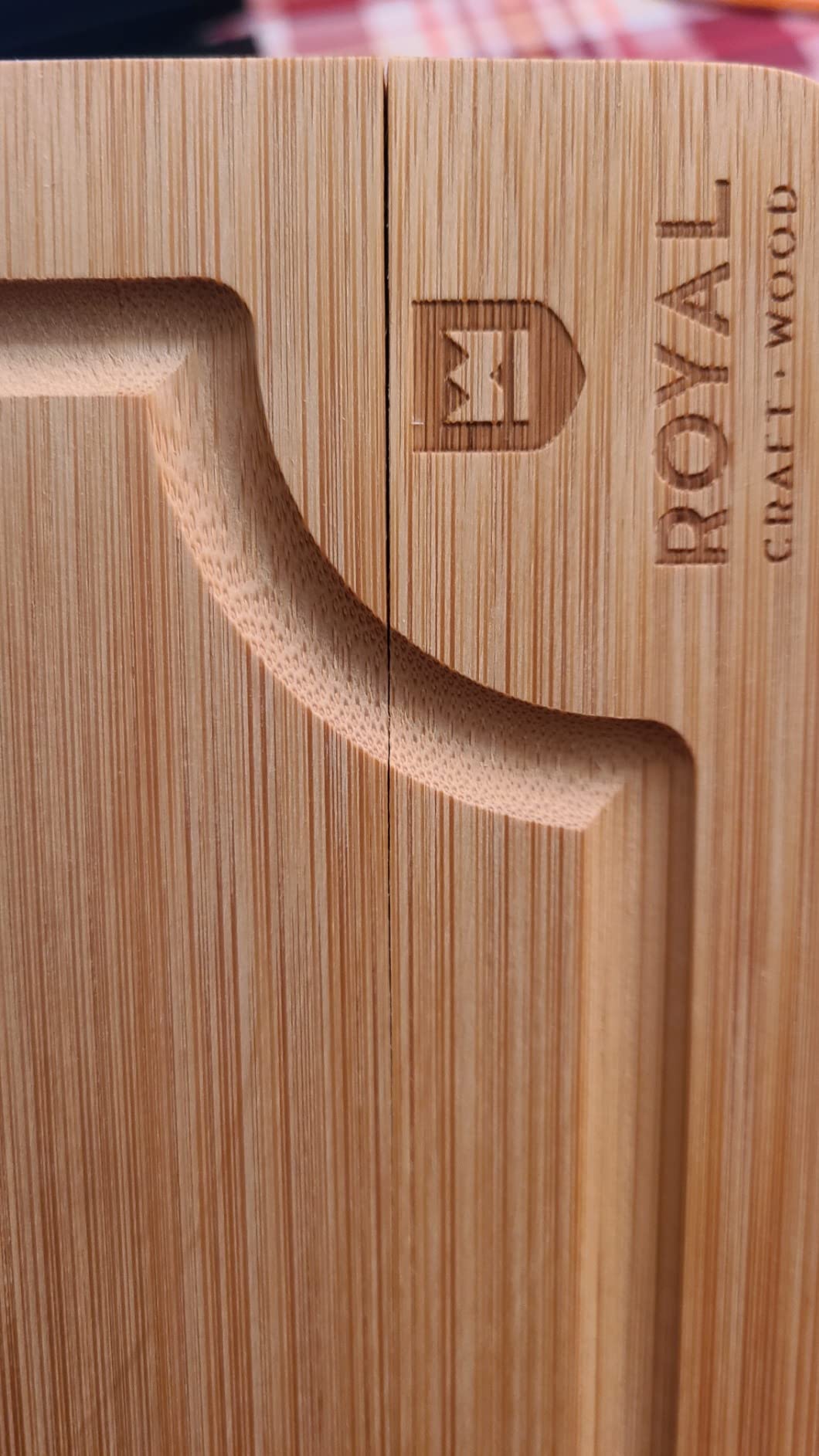
What we liked about it in the kitchen?
Having three sizes removes the guesswork. The small board handles garlic and ginger, the medium handles herbs and peppers, and the large one takes on the bulk chopping.
Reviews consistently praise the build quality for the money, with several owners calling it a convincing swap away from plastic sets that cost more.
Where it falls short?
Bamboo cracks along the edges after months of use if it is never oiled. A light coat of food-grade oil a couple of times a month prevents most of that.
Some units arrive with a rough, unsanded surface that needs a pass with sandpaper before first use, and the groove is shallower than the dedicated BBQ boards here.
10. Titanium and Polypropylene Board – Best Non-Porous Design
Titanium Cutting Board for Kitchen, Pure Titanium/PP, Size 16”×11”
16 x 11 x 2 inch double-sided board
Pure titanium one side, PP the other
Rinse or hand wash
Hanging hole included
Pros
- Titanium face wipes clean and holds no odors or stains
- Double-sided design separates raw meat from produce
- Soft PP reverse gives a gentler cutting surface
- Stays put during use without needing a towel
- Built-in hanging hole for drying and storage
Cons
- Titanium face scratches visibly within weeks
- Hard surface is less forgiving of knife edges
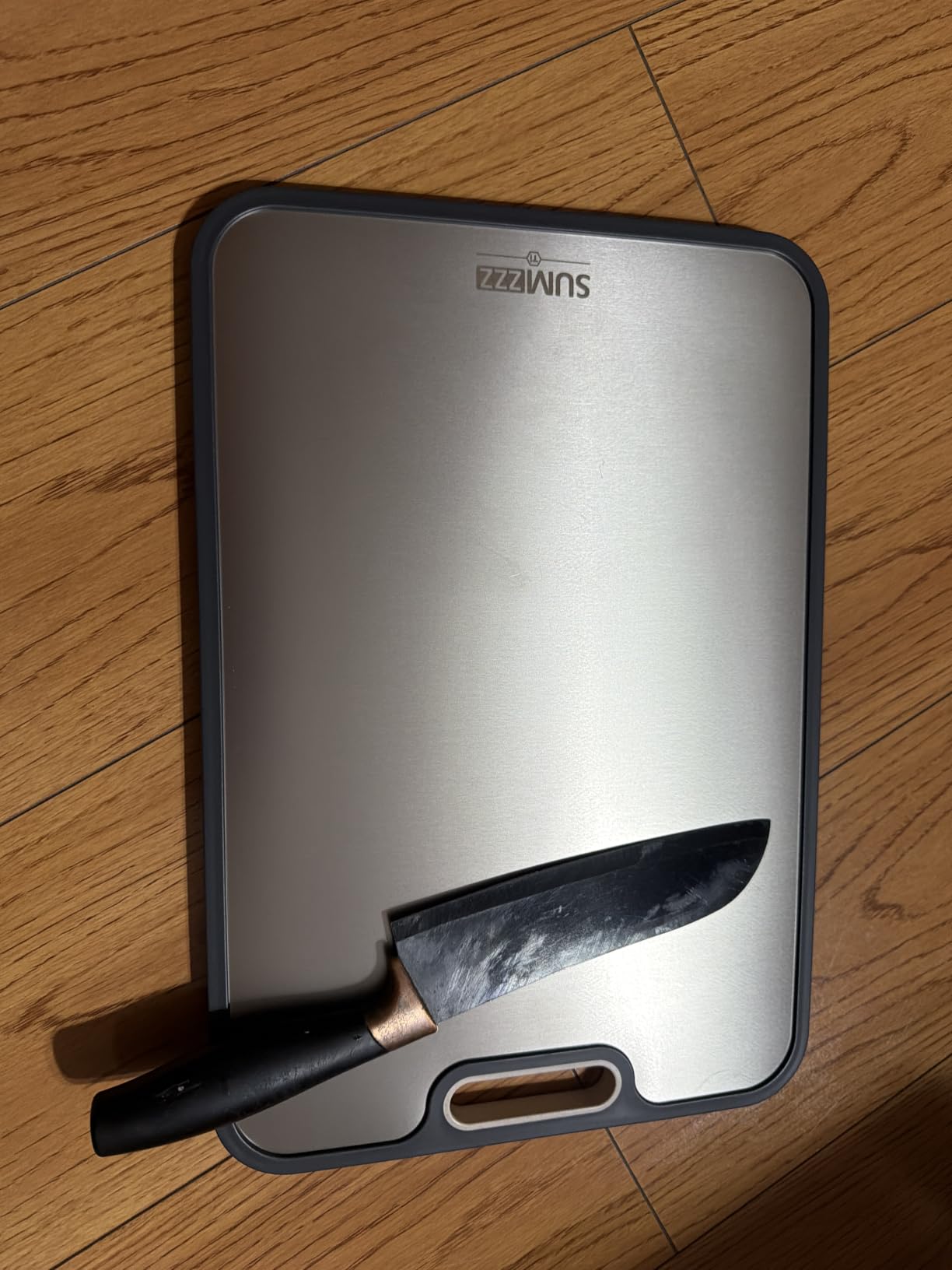
- Smallest cutting area of the large options here
- Hand wash only
Two inches thick and completely non-porous, this board takes the hygiene argument as far as it goes. Nothing soaks in, nothing holds an onion smell after washing, and there is no finish to degrade.
The double-sided design gives you a dedicated face for raw meat and a polypropylene reverse that is noticeably softer and gentler on an edge. At sixteen by eleven inches it is a prep board rather than a butchery surface.
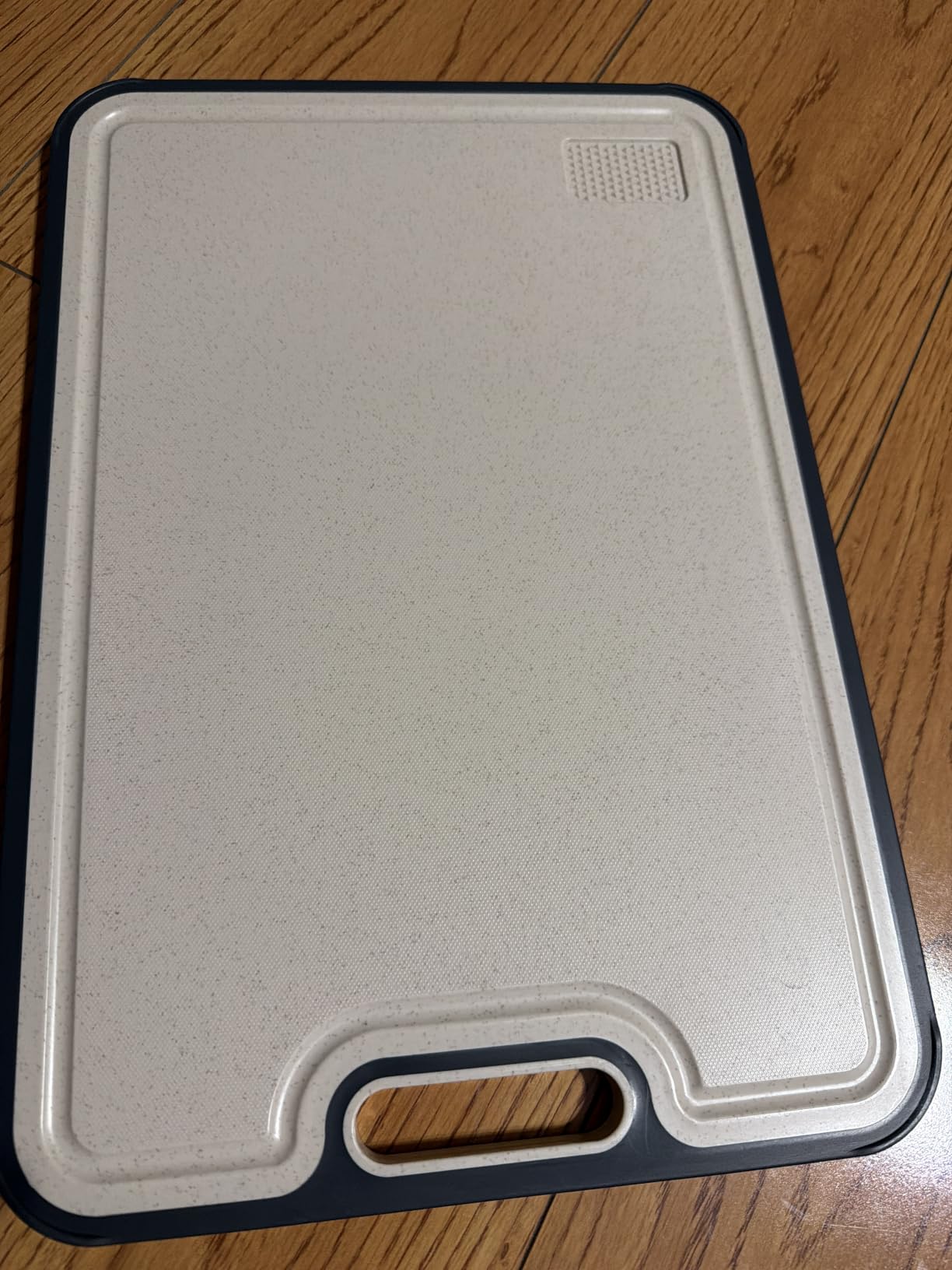
It does not move while you cut, and the hanging hole means you can dry and store it without stacking anything on top. A built-in juice groove and a garlic grinding area cover the small-kitchen essentials.
Versions with two and three boards are also available, which is a sensible way to separate meat, produce and bread without buying separate products.
What we liked about it in the kitchen?
Cleanup. After working raw chicken on the titanium face, a rinse and a wipe was enough, with no disinfectant and no overnight soak. That is a genuine advantage in a busy kitchen.
The soft PP reverse is the surprise. It behaves much more like a modern plastic cutting board than the metal side does, which is where most of our chopping actually happened.
Where it falls short?
The titanium face scratches visibly within weeks of normal use, and a hard metal surface gives a fine edge far less purchase than wood or end grain.
Sixteen by eleven inches is small compared with the oversized boards here, so it complements a larger board rather than replacing one for big prep days.
11. OTAVILEM Stainless Steel Board – Best for Dough and Baking
Stainless Steel Cutting Board for Kitchen, Extra Large Cutting Board Non Toxic, Metal Cutting Boards for Kitchen,Chopping Board for Meat, Veggies, Fruits and Kneading (70 x 50cm/27.6 x 19.7 inch)
27.6 x 19.7 inch food grade stainless steel
7 pounds
Hand wash or quick wipe
L-shaped backsplash lip
Pros
- Very large surface handles kneading and bulk prep
- L-shaped lip stabilizes the board at the counter
- Drawn texture adds friction so dough does not slide
- Absorbs no liquids odors or stains
- Wipes clean in seconds and resists rust
Cons
- Thin steel sheet flexes under heavy pressure
- Hard surface is unkind to knife edges
- Scratches visibly with use
- Hand wash only
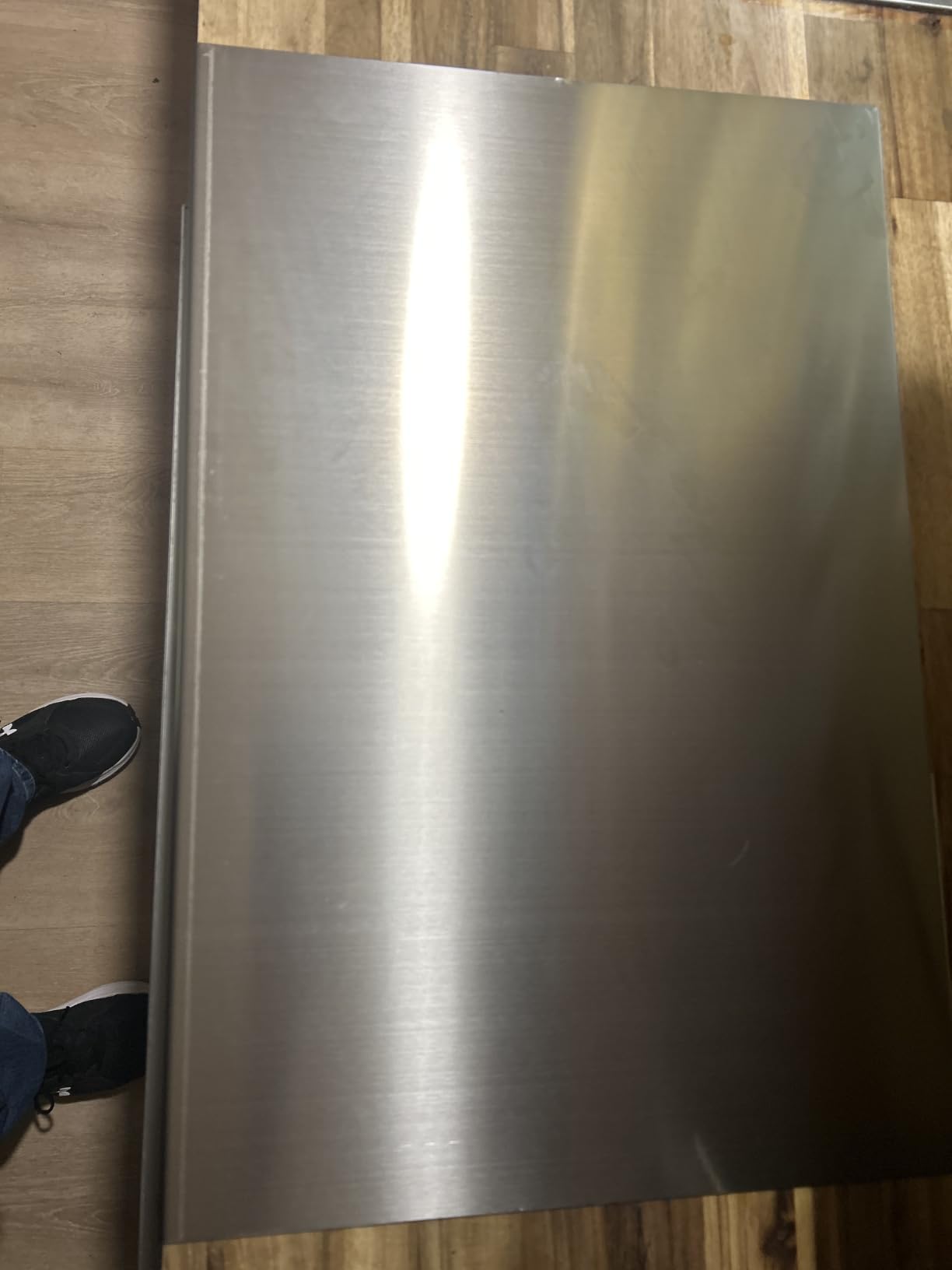
Twenty-seven point six by nineteen point seven inches of food grade stainless steel is built for volume work: kneading dough, rolling and shaping, or bulk chopping when a wooden board would soak up every drop of liquid.
The right-angled lip along one edge butts against your backsplash and is a simple, effective stability trick. The manually drawn surface adds friction, so dough and wet ingredients stay put instead of creeping.
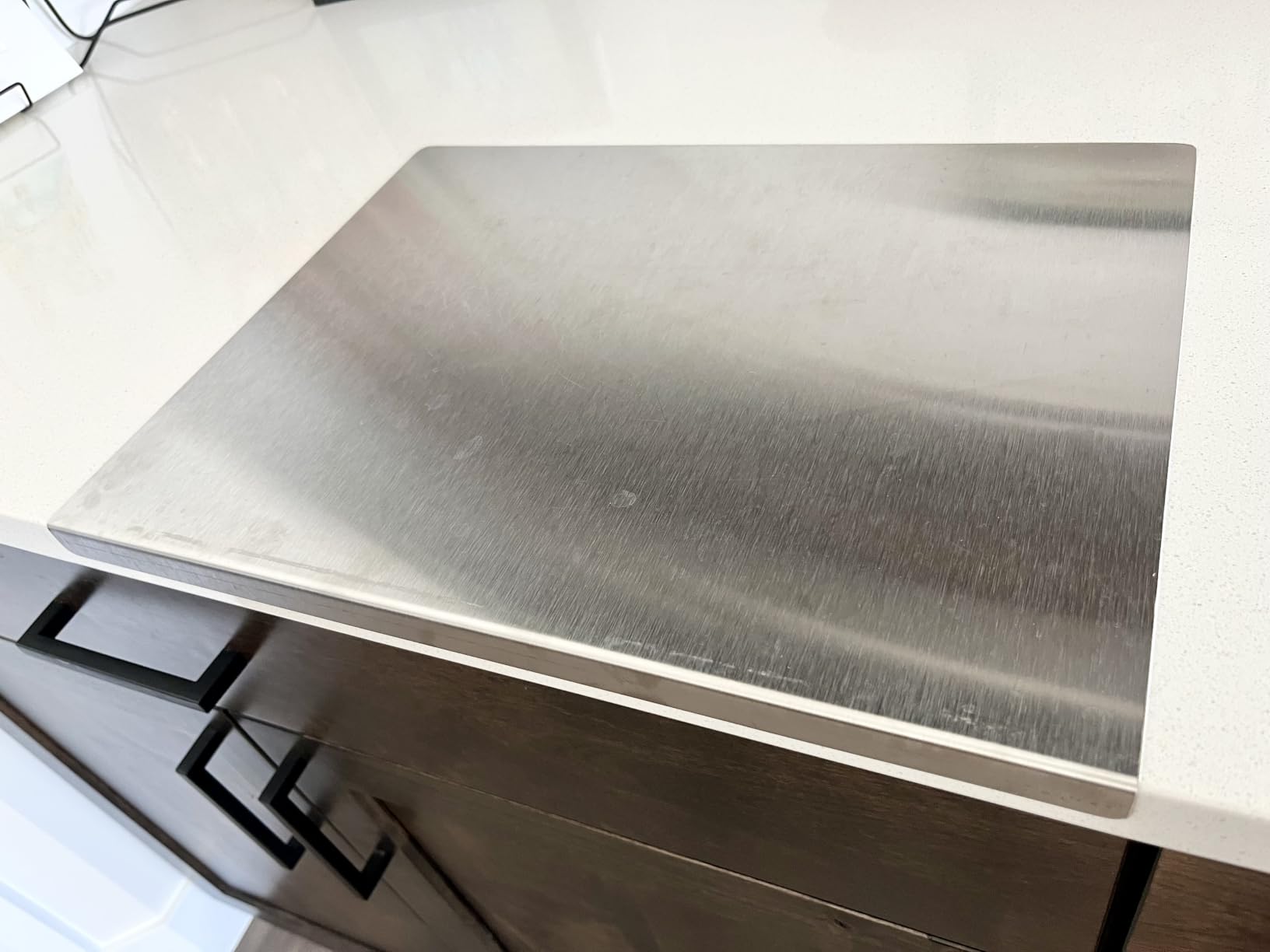
Because steel absorbs nothing, it will not carry the smell of onion, garlic or raw meat from one session into the next. A quick rinse is the entire clean-up.
Lengths from about sixteen to thirty-one inches are available, so you can size it to your counter rather than the other way around.
What we liked about it in the kitchen?
Dough work. The friction of the drawn surface combined with zero absorption makes this the easiest board we own for a big batch of bread or pizza dough.
It is also completely indifferent to heat and water, so unlike every wood and bamboo board here, you can rinse it hot without any consequence.
Where it falls short?
The sheet is thin and flexes under a hard cleaver blow, which takes it out of contention for the heaviest butchery work despite the large area.
Steel is hard on knife edges and scratches quickly. If your priority is cutting rather than kneading, choose wood or the polypropylene side of a dual-sided board.
12. Snowclad Stainless Steel and Wheat Straw Board – Best Lightweight Design
SNOWCLAD Stainless Steel Cutting Board,Non Toxic chopping for kitchen
16 x 11 x 1 inch double-sided board
Stainless steel one side, PP the other
Two pounds
Dishwasher safe
Pros
- Non-porous steel side holds no odors or stains
- Removable stainless handle stops slipping and hangs for storage
- Dual-sided for meat and bread versus produce
- Juice groove around the edge
- Only two pounds to lift one-handed
Cons
- Thin construction flexes and feels insubstantial
- Scratches readily with repeated use
- Reports of the PP side swelling after dishwasher cycles
- Bulky for its size when storing
At two pounds, this is the board in the roundup you can pick up and put away without thinking about it. That sounds trivial until you have carried a twenty-pound slab across a kitchen a hundred times.
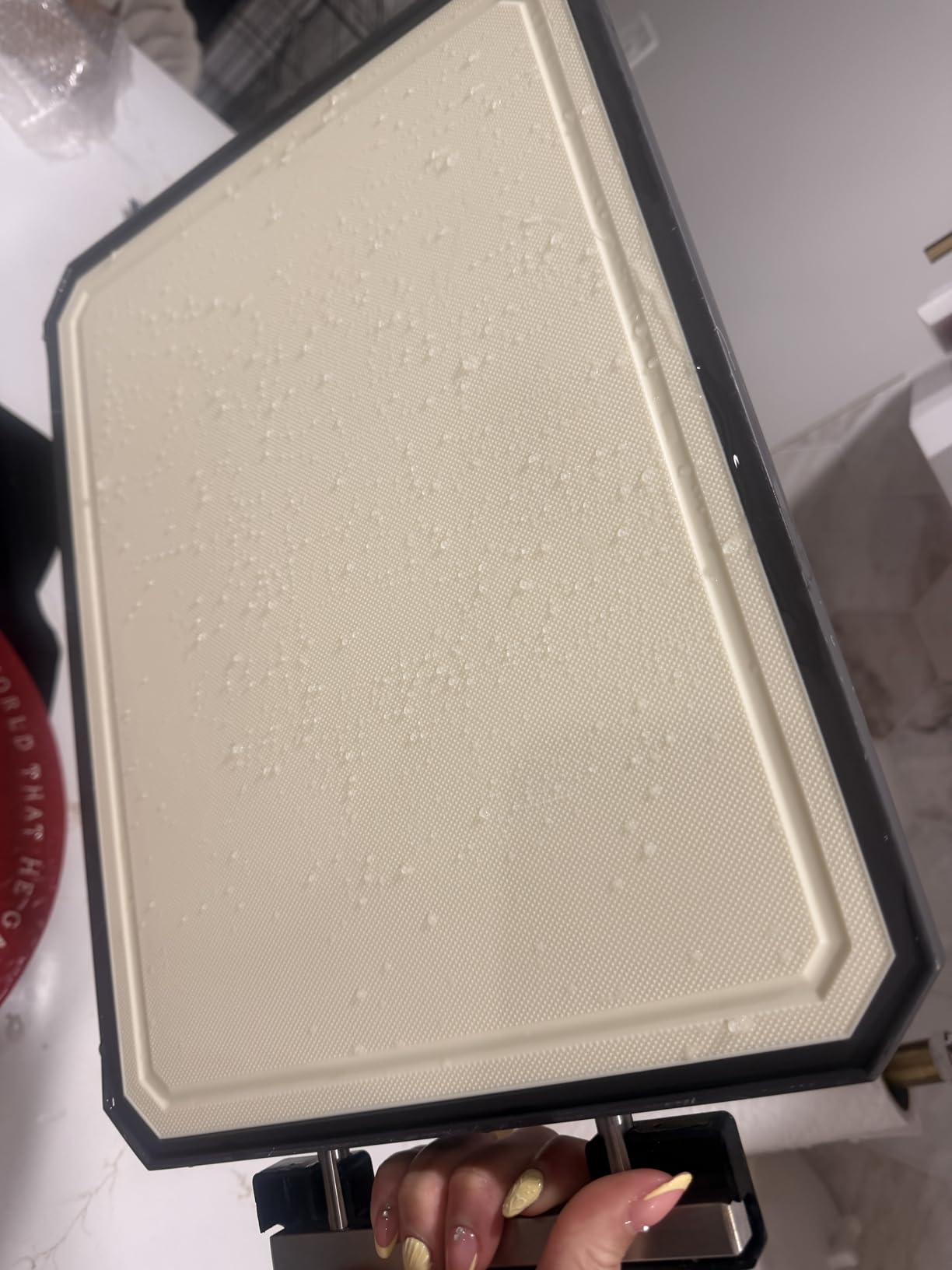
The stainless face is non-porous and takes a meat prep session with a wipe-down, while the wheat straw polypropylene side handles vegetables and fruit. A juice groove around the edge keeps liquid off the counter.
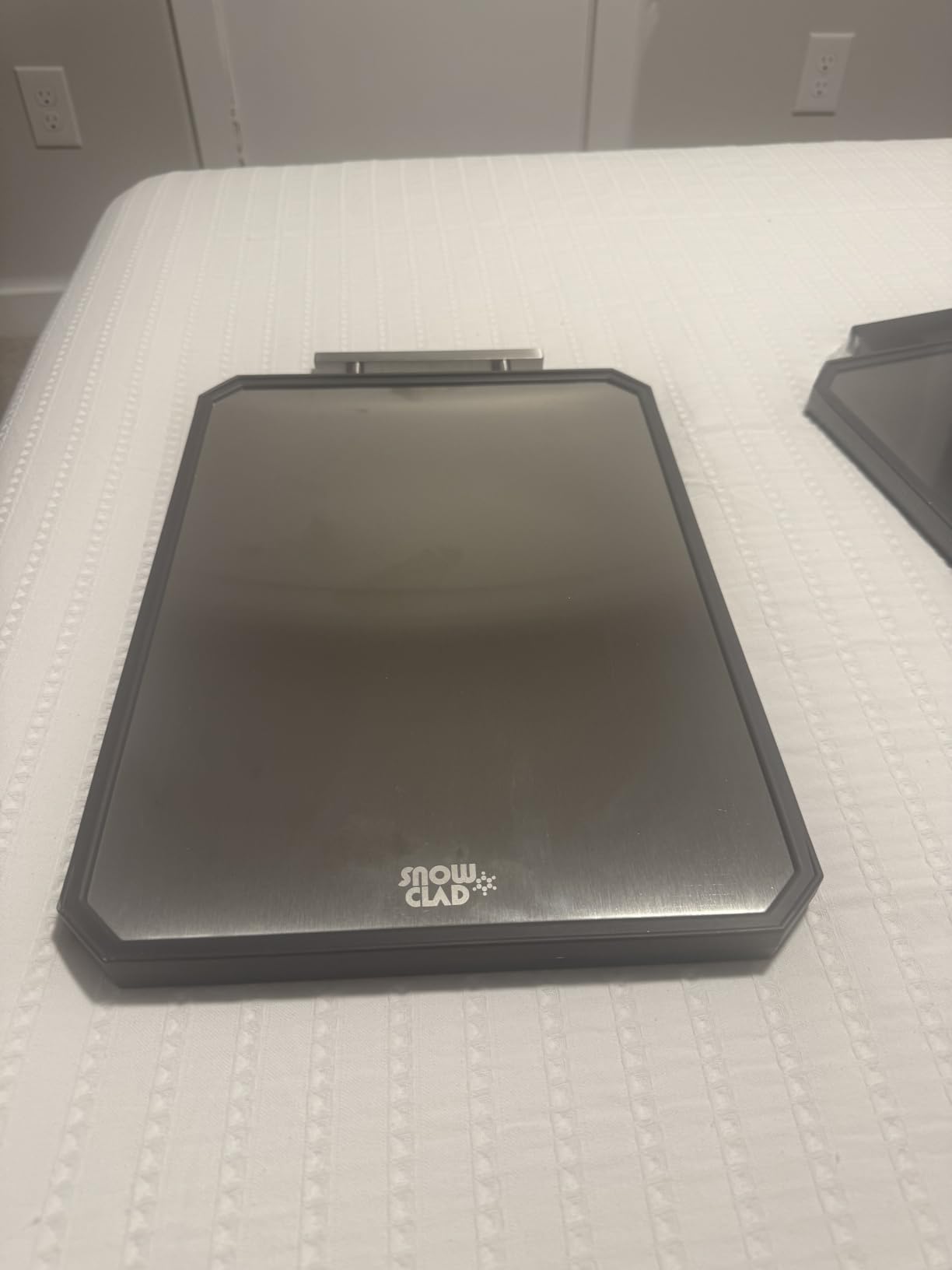
The removable stainless handle is the useful part: it stops the board sliding while you chop and doubles as a hanger for drying and storage. Sets of one, two or three are available for a layered system.
It is dishwasher safe on paper, which matters for anyone who wants zero maintenance and does not want to think about sanitizing a wooden board.
What we liked about it in the kitchen?
The handle solves sliding without adding rubber feet that trap grime. For a small kitchen where counter space is scarce, that is a good trade.
Owners value the separation of materials: steel for meat and bread, plastic for produce, on one compact board that stores flat.
Where it falls short?
One inch of this construction flexes. For genuinely heavy chopping it feels insubstantial, and it is the wrong tool for bone-in cuts.
A small number of owners reported the polypropylene side swelling and molding after dishwasher cycles despite the claim. If you run it through the machine, inspect it before trusting it again.
How to Choose a Cutting Board for Heavy Chopping?
Choose on mass and construction first, material second. A board that stays where you put it and holds a flat surface under a cleaver will outperform a more expensive board that is thin, light and slippery. Here is the short version of what matters, and the reasoning behind each point.
Thickness and weight beat everything else
Heavy chopping destroys thin boards. Once a surface flexes, your knife meets the board at an angle and you lose both precision and edge life. Boards in the one-and-a-half-inch range, weighing roughly eight to fifteen pounds, are the sweet spot between stability and the ability to lift the board with one hand to reach the sink.
The very heaviest options we tested were twenty pounds and above. They are immovable during chopping, which is genuinely satisfying, but they are unpleasant to carry and impossible to wash in a normal sink.
Edge grain or end grain?
Edge grain is harder and heavier, resists impact better, and is the right choice for cleaver work and bone-in cuts. End grain is gentler on knife edges and self-heals as fibers close back up, which makes it the traditional surface for vegetables, herbs and general prep.
Neither is risk-free. End grain can crumble at the edge under very heavy knife work, which several owners of the walnut boards in this roundup mentioned, while edge grain needs more oiling to stay flat.
Wood species and knife retention
Hard maple, walnut, cherry and teak all sit in the harder end of the common board species, with published Janka figures ranging from roughly 900 to 1400 lbf, while bamboo is a laminated grass reported near 1480 lbf. Softer woods like hinoki are wonderful for knife feel but are not built for heavy chopping.
If you keep sharpening edges regularly, hardwood is worth the oiling habit. If you do not want a care routine at all, a high-density polyethylene board costs you some knife sharpness and buys you maintenance freedom.
Stability: feet, grips or a damp towel
Sliding was the single most repeated complaint across the forums we read while researching this roundup. Removable rubber feet, silicone stickers or a recessed lip against the backsplash are all real solutions.
When nothing is built in, the community workaround is a damp paper towel or silicone mat under the board. It costs nothing and it works, which is why it shows up in almost every heavy-chopping thread we found.
Size and how you will actually wash it
Measure your counter and your sink before buying anything over twenty-four inches. A thirty by twenty board is wonderful until you realize it does not fit in the basin, at which point it lives on the counter permanently and traps water underneath.
For the same reason, check whether your kitchen has a second flat surface for raw meat. Separating meat and vegetable boards is the single most effective food safety habit, and it works best if you own more than one board.
Materials, food safety and what to skip
Wood, bamboo, high-density polyethylene, stainless steel and titanium are all safe choices when used as intended. The material question matters far less than how you clean and store the board.
Avoid glass boards entirely; they destroy edges and offer no grip. Also treat sealed or varnished wood as a display piece rather than a prep surface, since the finish can crack and shed. If you want an eco angle, look for FSC-certified wood or bamboo, and note that fast-growing bamboo is renewable but is glued from strips, so glue lines are the weak point to watch.
For readers who enjoy the buy-it-for-life mindset, our balance board reviews cover the same durability testing approach applied to fitness gear.
How to Keep a Heavy Chopping Board Flat?
Warping is the number one complaint about wood and bamboo boards, and it is almost always caused by the same thing: water sitting on or inside the board. Wood swells when it is wet and shrinks when it dries, and repeated cycles in one direction produce a cup.
Start by oiling a new board generously. Food-grade mineral oil or board cream saturates the fibers so they swell less when they get wet. Wipe on a thin coat, let it soak for a few hours, buff it off, and repeat over several days for a dry board.
Then dry it properly. Stand the board on its long edge with air moving around both faces rather than laying it flat, and never put it away in a closed cabinet while it is still damp. Wash by hand with soap and warm water, skip the dishwasher entirely for wood and bamboo, and re-oil whenever the surface starts to look pale or thirsty.
If a board has already cupped, you can often bring it back. Lay coarse sandpaper on a flat counter, sand the cupped face in circular passes until it is level, round the edges, wash and dry it fully, then re-oil several times. For a split along a glue line in bamboo, the realistic options are a food-safe epoxy repair or replacement.
Finally, know when to retire a board. Deep grooves that no longer clean out, cracks that reach through the core, persistent odor after washing, or delamination along the glue joints all mean the board should go. If you want to compare long-term testing approaches across tools, our diving board roundups use the same durability-first method.
Frequently Asked Questions
What is the best solid wood chopping board?
Hard maple, walnut and teak are the best solid wood choices for heavy chopping because they are dense, heavy and resistant to impact. Look for edge-grain construction at least 1.5 inches thick for cleaver work, and choose end grain if knife-edge retention matters more than impact resistance. All wood boards need mineral oil every few weeks to stay flat.
Why does my cutting board keep warping?
Boards warp because wood swells when wet and shrinks when dry, and one-sided wetting cups the surface. The usual causes are leaving a board flat and damp after washing, storing it in a closed cabinet while wet, or skipping mineral oil. Stand the board on its long edge to dry, oil it regularly and hand wash only.
When should you throw out a cutting board?
Replace a board when it has deep grooves that no longer clean out, a crack running through the core, persistent odor after washing, or separation along glue joints. Boards that are deeply grooved cannot be properly sanitized, and any board with a through-crack harbors bacteria. Light surface scratching on wood is normal and is not a reason to replace it.
Can you flatten a warped cutting board?
Yes, a cupped wooden board can often be restored. Sand the cupped face on coarse sandpaper laid over a flat counter until the surface is even, round the edges so nothing digs in, wash and dry it completely, then re-oil several times. A split along a bamboo glue line is harder to fix and usually means replacement.
Are plastic cutting boards dishwasher safe?
Most commercial-grade polyethylene cutting boards are dishwasher safe, and the Winco and Thirteen Chefs boards here are rated for high-temperature commercial cycles. Cheap bamboo and multi-material boards are not: heat and detergent delaminate the glue strips and cause cracking. Always check the care instructions printed on the board.
What do professional chefs use as cutting boards?
Professional kitchens use a mix of materials: thick wood or composite boards for general prep and high-density polyethylene for meat, fish and heavy cleanup work. Restaurants favor plastic and composite because they survive sanitizing cycles, while cooks who value knife feel and appearance stay with hardwood boards.
Conclusion
The Winco 18 x 24 polyethylene board is our pick for the best cutting boards for heavy chopping in 2026, because mass, flatness and dishwasher cleanability add up to the board that asks the least of you. If you want wood, the 36 x 24 inch FSC-certified bamboo board gives you the largest surface we tested, and the John Boos edge-grain maple board is the one to buy if knife feel matters most.
Whichever you choose, the habits matter as much as the hardware: stand the board on its edge to dry, keep it oiled if it is wood or bamboo, and keep a separate surface for raw meat. Use the buttons above to compare current options and pick the size that actually fits your counter and your sink.