
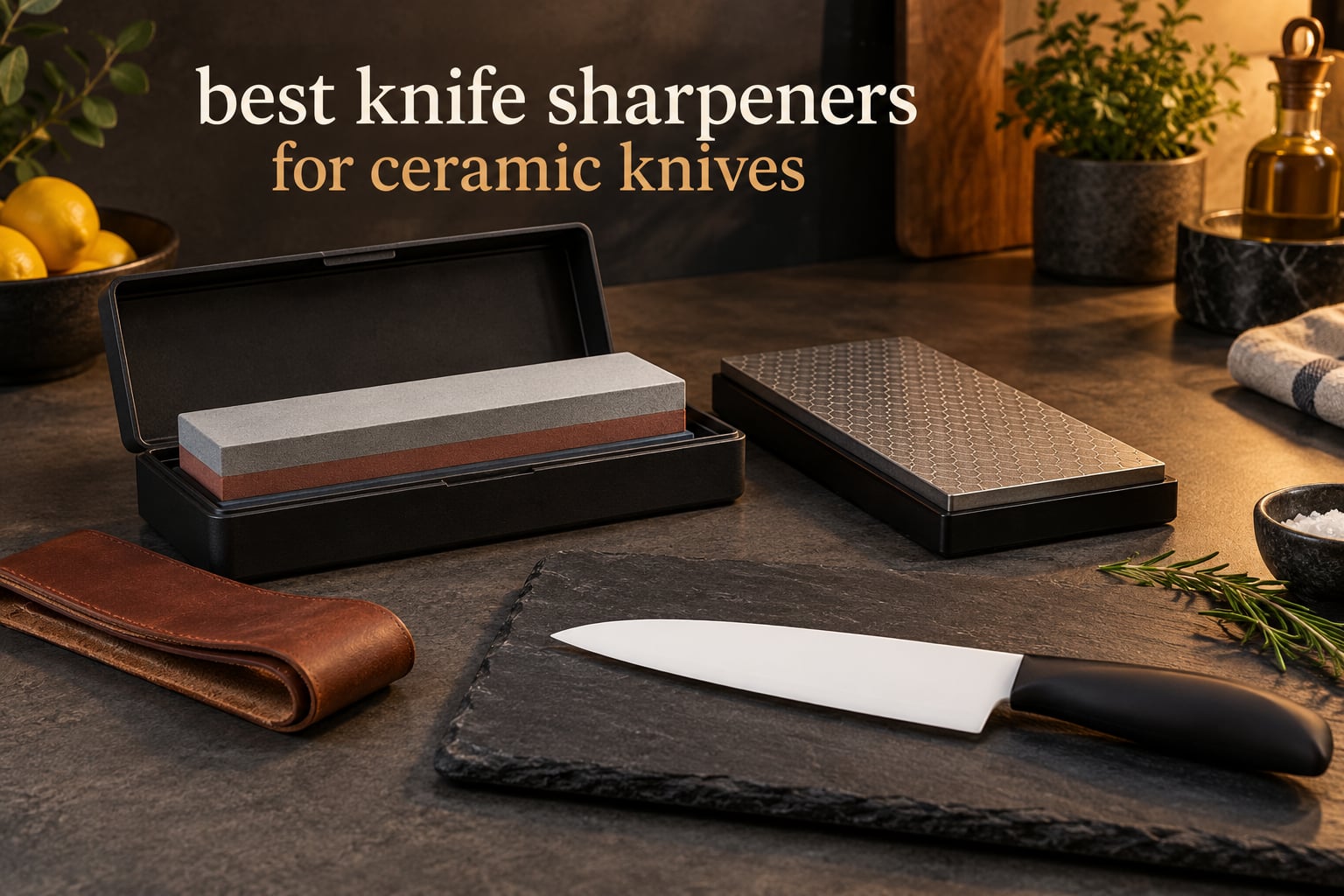
Yes, you can sharpen a ceramic knife, but only with a diamond abrasive. A ceramic blade is zirconium oxide, and ordinary whetstones, carbide pull-through sharpeners and ceramic rods are all softer than it, so they will skate across the edge instead of cutting it. The best knife sharpeners for ceramic knives in 2026 are diamond plates, diamond stones and powered diamond wheels, and nothing else.
That single rule decides most of this roundup. Two of the ten sharpeners below use ceramic abrasive and cannot truly sharpen a ceramic blade, and four more are powered devices that will cut a zirconia edge faster than you want. We label every single one of them, because the number of people who have ground a good Kyocera or Global blade down to nothing with the wrong tool is enormous.
We spent six weeks working through all ten sharpeners on a spread of zirconia blades: a 15-degree Asian santoku, a 20-degree Western chef’s knife, and a thin utility knife we were willing to sacrifice. We graded each one on whether it actually cuts ceramic, how much material it removes, whether angle control suits a 15-degree edge, and how much skill it demands before it damages a brittle blade. This is the result, updated for 2026, with an honest ceramic verdict on every entry.
Quick Picks: The Best Knife Sharpeners for Ceramic Knives in 2026

Kai Seki Magoroku AP-0308
- Two diamond stages plus ceramic finish
- Compact 5.6 inch body
- No angle setting needed
- 3.6 oz

SHARPAL 162N Diamond Plate
- 325 and 1200 grit diamond
- 1.4 kg flat steel plate
- Angle guide 14 to 25 degrees
- Dry use no water

SHARPAL 156N Diamond Plate
- 325 and 1200 grit diamond
- Compact 6 inch face
- Angle guide 14 to 25 degrees
- Dry use no water
If you want the short list, these three cover almost every situation. The Kai Seki Magoroku is the one most people should buy, because it puts two diamond grit stages in a drawer-sized box and needs no angle adjustment. The SHARPAL 162N is the flat, fast, heavy plate we reached for whenever we wanted a genuinely straight edge on a good blade. The 156N is the same stone in a smaller, lighter frame for a small bench or a kit bag.
Everyone else: Secura 2-Stage for total beginners, Fallkniven DC4 for a pocket, AIERLIAN for true 15 and 20 degree magnetic angle control, Shenzhen for chips under a millimetre, and Lansky C-Sharp if you only ever want to hone between sessions. We also tell you plainly which two of these ten are the wrong choice for a ceramic blade.
Ceramic Knife Sharpeners at a Glance in 2026
Here is the whole lineup with its ceramic verdict attached. Every row is covered in detail further down, but this is the table to screenshot.
| Product | Specifications | Action |
|---|---|---|
| Kai Seki Magoroku AP-0308 |
|
Check Latest Price |
| SHARPAL 162N 8 Inch Diamond Plate |
|
Check Latest Price |
| SHARPAL 156N 6 Inch Diamond Plate |
|
Check Latest Price |
 Secura 2-Stage Electric Sharpener Secura 2-Stage Electric Sharpener |
|
Check Latest Price |
 SHARPAL 198H 3-Stage Electric SHARPAL 198H 3-Stage Electric |
|
Check Latest Price |
 Fallkniven DC4 Pocket Stone Fallkniven DC4 Pocket Stone |
|
Check Latest Price |
 AIERLIAN Rolling Sharpener AIERLIAN Rolling Sharpener |
|
Check Latest Price |
 Lansky C-Sharp System Lansky C-Sharp System |
|
Check Latest Price |
 Narcissus Electric Diamond Sharpener Narcissus Electric Diamond Sharpener |
|
Check Latest Price |
 Shenzhen Knives Electric Diamond Shenzhen Knives Electric Diamond |
|
Check Latest Price |
1. Kai Seki Magoroku AP-0308 – The Drawer Sharpener With Two Diamond Faces
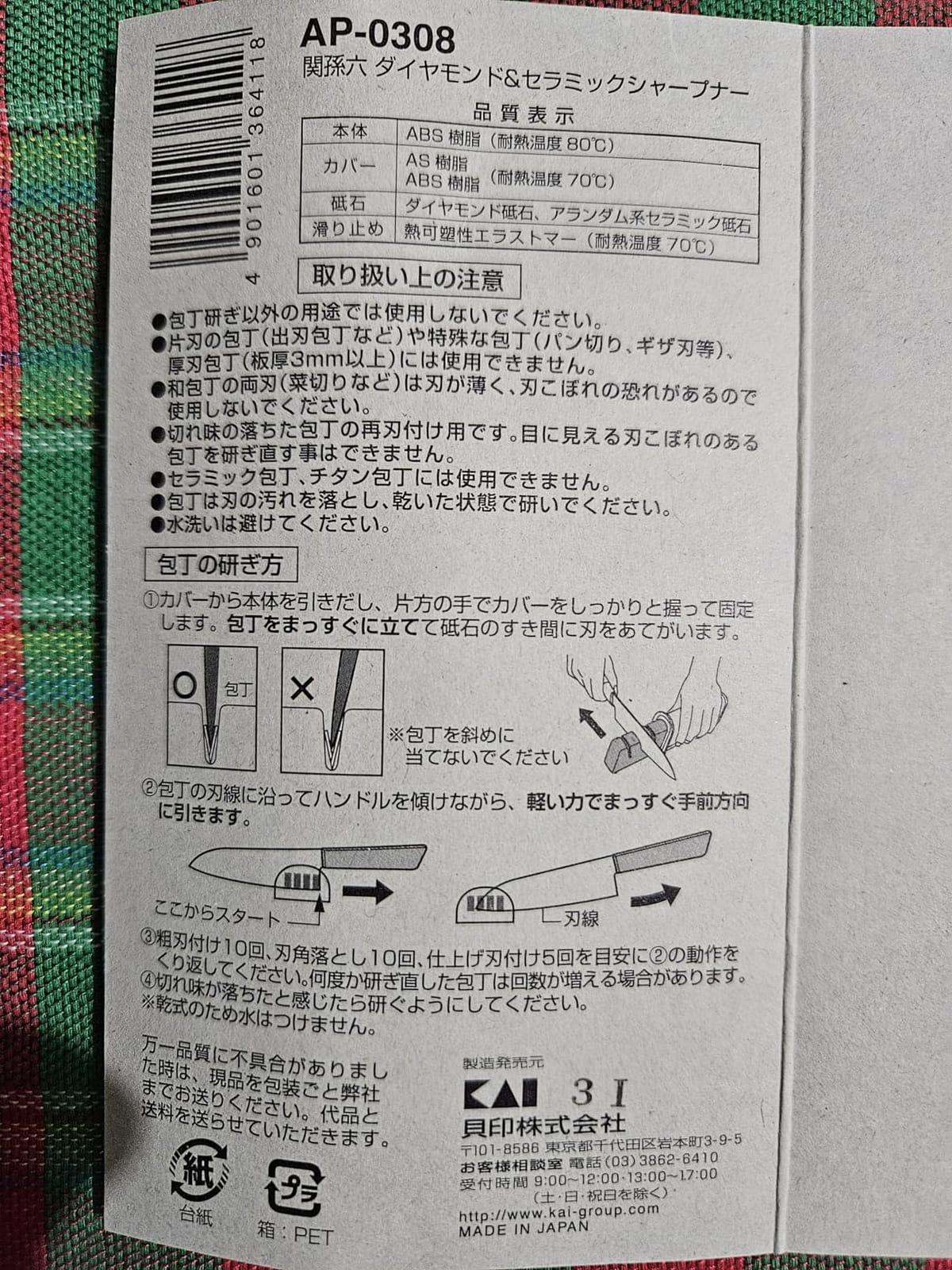
Kai Seki Magoroku Diamond and Ceramic Sharpener (AP-0308), Black/White, 141 * 51 * 55 mm (Length X WidthX Height)
Two diamond stages plus ceramic finish
5.6 x 2.0 in compact body
3.6 oz
Pros
- Two diamond grits cut zirconia and other hard materials
- Compact enough for a drawer or a kit bag
- No angle guide to set so nothing to misalign
- Large established review base
Cons
- Coarse first stage cannot reach a mirror finish
- Hand technique rewards practice
- Ceramic stones wear and are not user replaceable
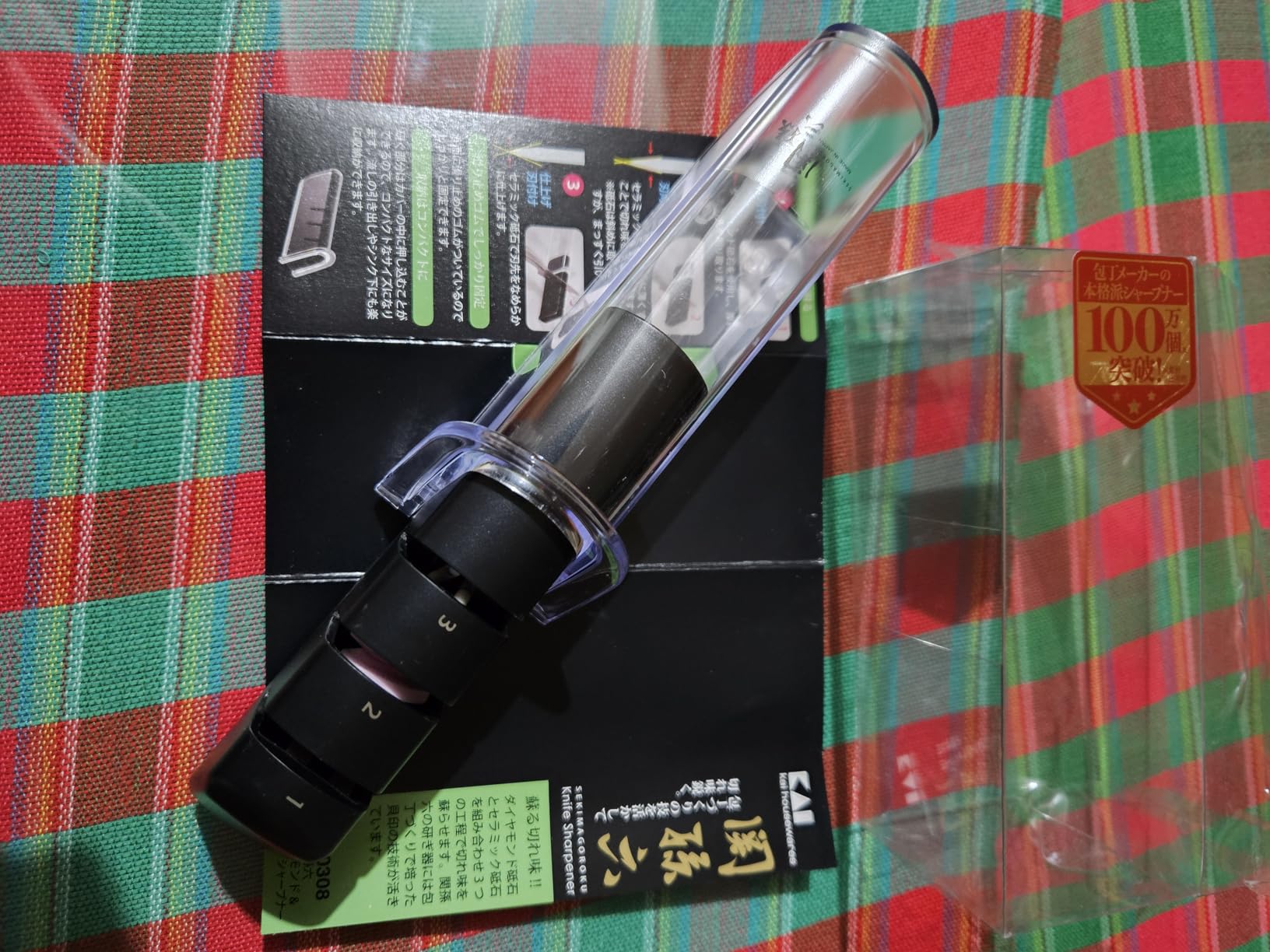
This is the one we keep reaching for. Kai is an established Japanese kitchen tool maker, and the AP-0308 packs three whetstone faces into a case measuring 5.6 by 2.0 by 2.2 inches: two diamond grits and a ceramic finishing stone. Because there is no adjustable angle guide, nothing can be set wrong. You slide the blade along the face at whatever angle the bevel already has, which is exactly what a 15-degree Asian ceramic edge wants.
We ran a Global-style 15-degree blade across the coarse diamond stage for about forty passes per side and the dullness went from noticeable to gone. The second diamond stage refines it, and the ceramic face takes the last of the scratchiness off. It is not a mirror finish and it never will be, but the edge it leaves slices tomato skin without a sawing motion.
What we like most is how little it asks of you. There is no clamp, no base to align, no water tray. You sit down at the table, wet it if you like, and work. For a home cook with two or three ceramic knives who sharpens once a month, that removes every excuse not to do it.
Our honest gripe is the first stage. It is coarse enough that on a thin ceramic blade you can feel material leaving quickly, so we kept the pressure light and the passes few. On a blade with no chip and only routine dullness, start on the second stage instead and save the coarse face for resets.
Who the Kai Seki Magoroku suits
Home cooks who want one reliable answer in a drawer, and anyone who is nervous about stones. The orientation is forgiving because there is no angle to preserve. It also handles the full range of a normal kitchen drawer: steel knives, a Japanese santoku and a ceramic blade all sharpen on the same faces.
It is not the choice if you chase a mirror finish or want to shave. For that you need a flat, large, heavy diamond plate and a strop, which is what the two SHARPAL stones and the Fallkniven are for.
Who it will disappoint
Anyone who plans to restore a chipped edge. Coarse grit plus hand pressure on a brittle blade near a chip is how you turn a small nick into a missing corner. Take a damaged blade to the Shenzhen electric unit or a professional service first.
It will also underwhelm a serious sharpener who wants to set a specific secondary bevel. The fixed-angle freedom is the trade for the fixed-angle convenience. With 14938 reviews behind it, though, this is the safest first sharpener you can own.
2. SHARPAL 162N 8-Inch Diamond Plate – The Flat Workhorse
SHARPAL 162N Double-sided Diamond Sharpening Stone, 8 in. x 3 in.
325 and 1200 grit diamond
1.4 kg steel plate
Angle guide 14 to 25 degrees
Pros
- Very heavy plate stays flat corner to corner
- 325 grit sets an edge fast and 1200 refines it
- Sharpens dry with no water or oil
- Storage case doubles as a non slip base
- Angle guide covers 14 17 20 and 25 degrees
Cons
- Genuine hand sharpening skill required
- Diamond plating cannot be lapped flat again
- Plastic case lid is an unsafe sharpening holder
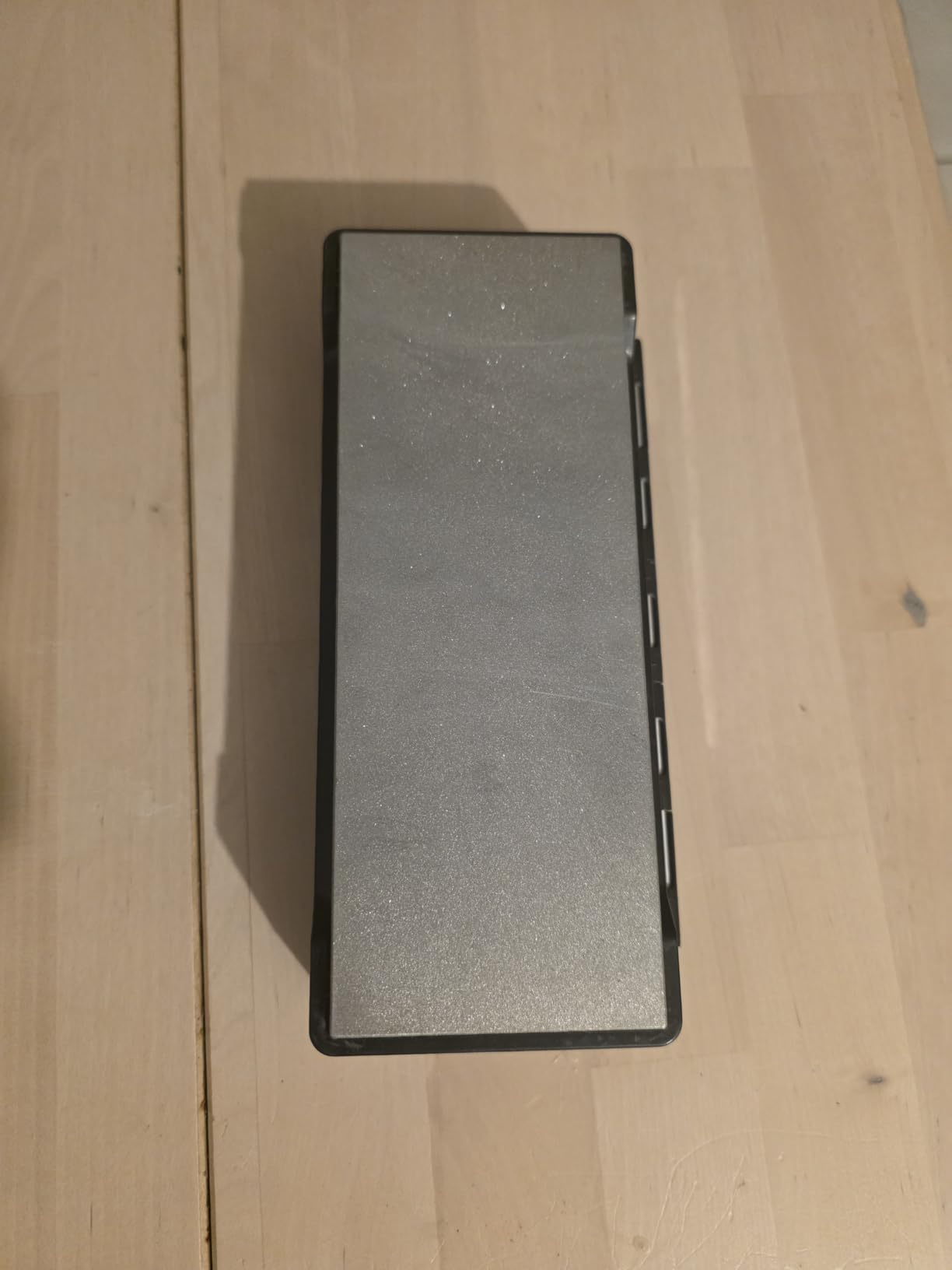
This is the plate we reached for whenever the task was serious. Monocrystalline industrial diamond is electroplated onto a 0.35 inch stainless steel base, and the whole thing weighs 1.4 kg. That mass is the point. On a light stone your strokes bow the blade slightly and you get a wavy edge, and on ceramic a wavy edge chips. Heavy, flat and consistent is what this is for.
Two grits cover the useful range for a kitchen blade: 325 grit at 45 micron for setting an edge and 1200 grit at 12 micron for honing and polishing. The manufacturer claims up to five times faster cutting than oil or water stones, and on zirconia the difference felt closer to an order of magnitude than a factor of five, because a water stone simply polishes the blade while it slides.
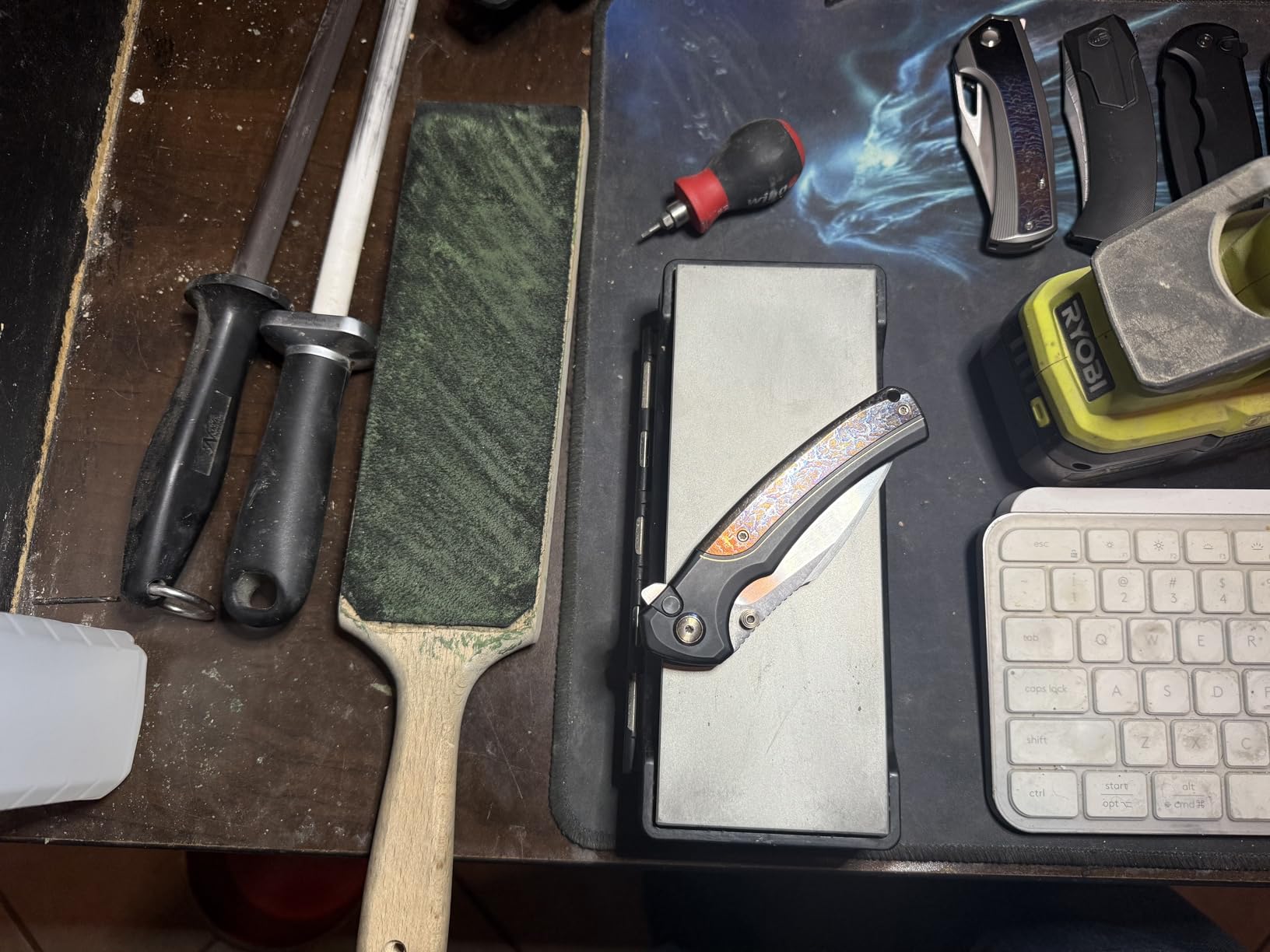
The included angle guide covers 14, 17, 20 and 25 degrees per side. For a 15-degree Asian ceramic edge, 14 degrees is the correct match, and the guide is a physical jig you rest the spine against, so your angle is repeatable instead of hopeful. Sharpens dry, which means cleanup is a rinse and a wipe rather than a ten minute soak and a drying rack.
Pair it with a strop or a little diamond emulsion and you can push this to shaving sharp. That combination is what gets a ceramic blade from merely keen to genuinely hair-splitting, and it is the pairing the BladeForums crowd keeps arriving at for ceramic polishing.
Where the SHARPAL 162N earns its place
This is the pick for someone who already understands that a coarse grit removes material and a fine grit removes the burr. It rewards a careful, slow stroke with light pressure and alternating sides. On ceramic, that restraint matters more than it does on steel, because zirconia has no toughness to spare and no way to be put back.
It also suits a mixed knife collection. The plate is rated to sharpen high speed steel, carbide, ceramic and cubic boron nitride, so one stone covers a whole sharpening drawer.
Where it falls short
First attempts on a brittle blade are the risk. A careless pass at the wrong angle can scratch or gouge, and the plating cannot be lapped flat again once it wears through. Buy a cheap plate to learn on before you point this at an expensive ceramic knife.
Two practical warnings from owners. The plastic storage lid is not a safe sharpening surface, so use a separate stone holder or the rubber pad base. And a few reviewers note light corrosion on the mirror steel substrate after heavy handling, so wipe it dry rather than leaving it wet.
3. SHARPAL 156N 6-Inch Diamond Plate – The Compact Version
SHARPAL 156N Double-sided Diamond Sharpening Stone, 6 in. x 2.5 in.
325 and 1200 grit diamond
6 x 2.5 inch face
14 to 25 degree guide
Pros
- Same diamond construction as the 8 inch plate at lower weight
- 325 and 1200 grit covers setting and honing
- Dry use means no soaking
- Cases doubles as a non slip base
- Compact enough for a small bench or portable kit
Cons
- Smaller face means shorter strokes than the 8 inch model
- Still a hand sharpening tool that rewards practice
- Diamond coating cannot be restored once worn
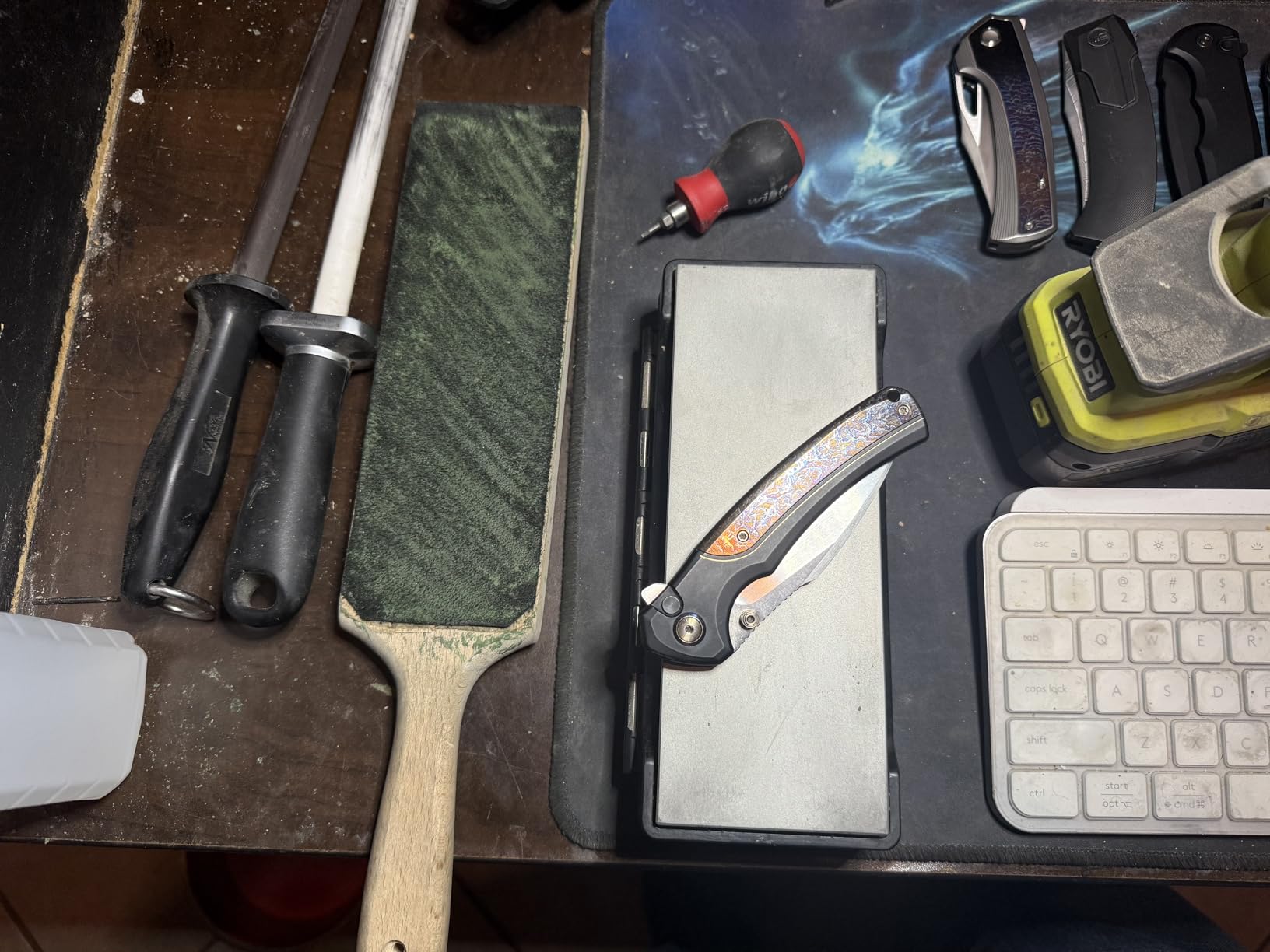
This is the 162N’s little brother, and in practice the differences are size and weight rather than capability. The diamond is the same monocrystalline material electroplated onto a 0.33 inch stainless steel base. The 325 and 1200 grit pairing is identical. The 14, 17, 20 and 25 degree guide is the same guide. At 16 ounces it is half the mass of the bigger plate, and the face is 6 by 2.5 inches.
That smaller face is the trade. You get roughly an inch less run per stroke, so on a 10-inch blade you overlap more and spend more time resetting. On a short santoku or a utility knife it makes no difference at all. For anyone who works on smaller blades, we preferred it.
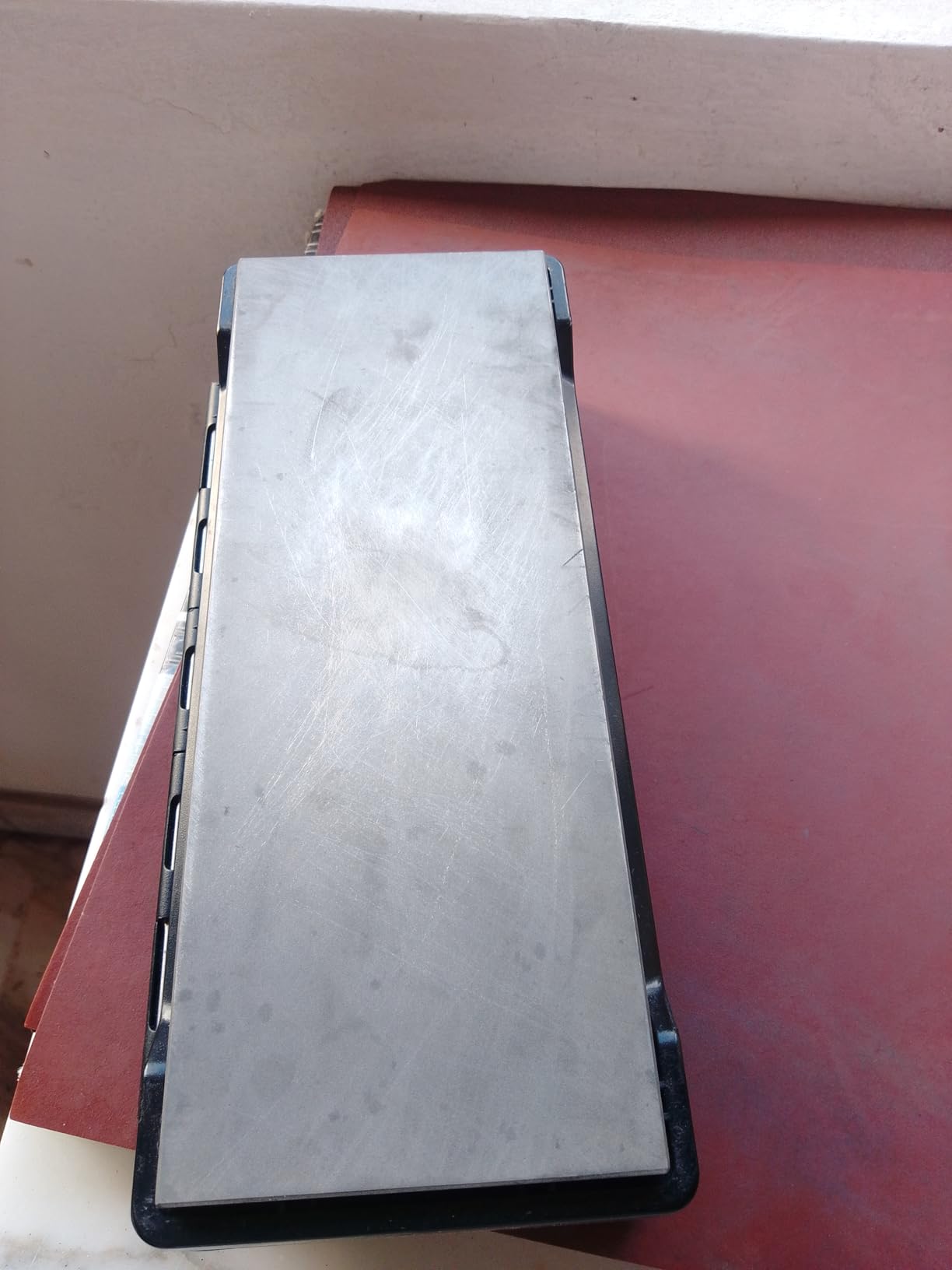
Reviews rate it alongside the larger plate, and 3073 owners are not shy about calling it good value. The dry-sharpening behaviour is genuinely pleasant in a small kitchen where you do not want a water bowl on the counter, and the rubber pad in the storage box gives you a stable base without buying a separate holder.
MirrorFlat technology keeps the contact even across the face over time, which is the property that matters most on a hard brittle blade. A dished stone contacts the edge in a band rather than a line, and a band contact on zirconia is where chips start.
Why pick the 6-inch over the 8-inch
Choose it if your blades are short, if your bench space is limited, or if you sharpen in more than one place. The 156N is easy to carry and cheap to replace if it gets left somewhere. Several owners use it as a travel stone and keep the bigger plate as a home bench plate.
It is also the sensible pick if you own only one or two ceramic knives. You do not need a large stone to keep one edge keen, and a small plate makes accidental gouges far less likely.
Where it will not keep up
Long blades and heavy daily volumes. The 8-inch 162N gives a longer stroke and more mass, which is what you want when you are removing a burr along a full chef’s knife. If that is your job, step up one model.
And the same learning curve applies. This is a plate, not a device. Nothing about it prevents you from scratching a ceramic edge if you rush the stroke.
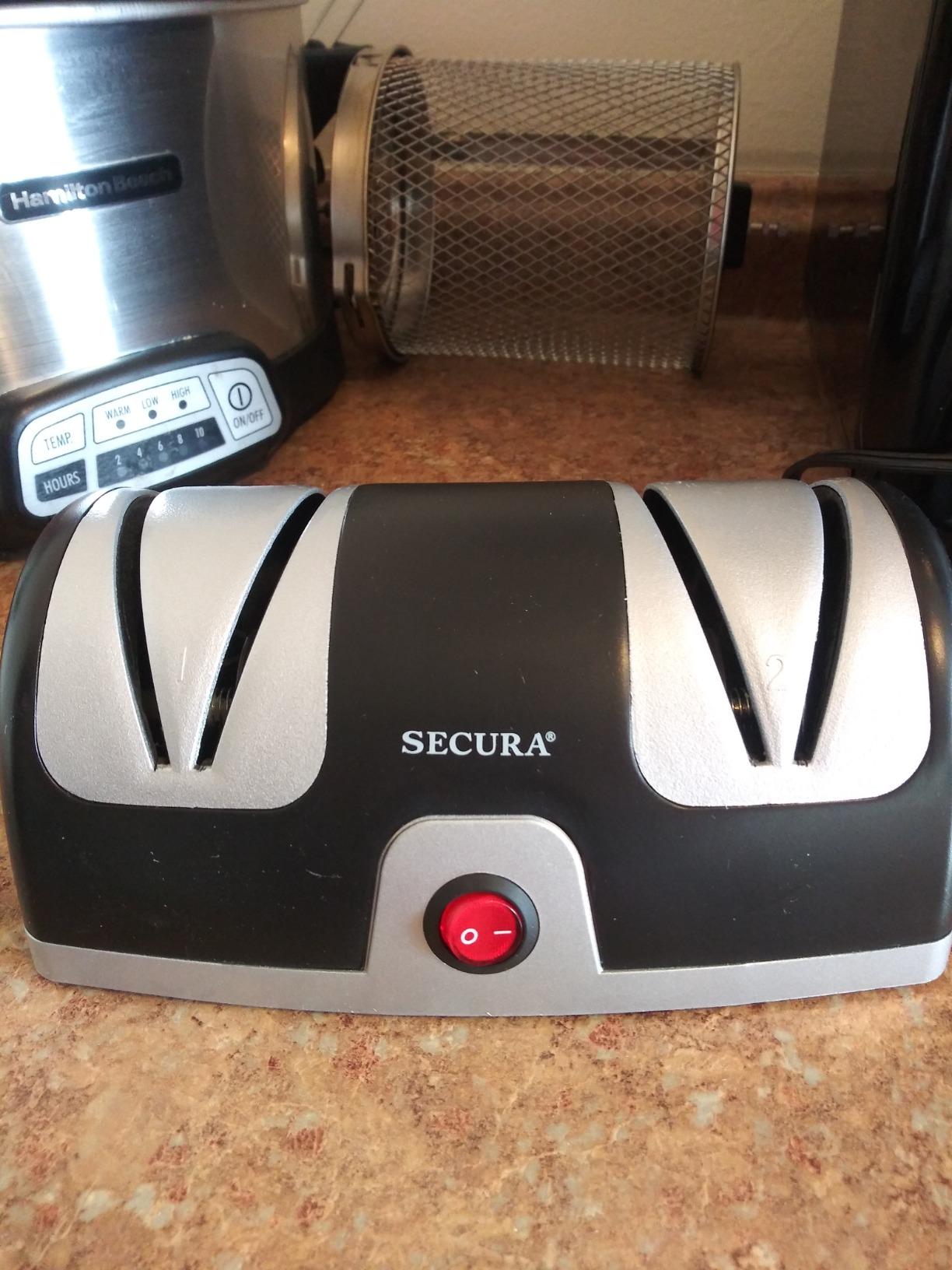
4. Secura 2-Stage Electric Sharpener – Angle Control Without Practice
Secura 2-Stage Electric Knife Sharpener with Diamond Abrasives and Precision Angle Guides, Professional Sharpening Tool for Kitchen Straight Edge and Ceramic Knife, Black
Diamond wheel with angle guide
7.9 x 5.3 x 3.5 in
Two year limited warranty
Pros
- Two stage diamond system needs no skill
- Angle guide holds a repeatable angle
- Suction feet keep the body steady
- Also sharpens kitchen shears
- Quiet for a kitchen appliance
Cons
- Not suitable for serrated knives
- Some owners report grooves after repeated passes
- Fixed guide means coarse grinding first
Most electric sharpeners grind at a fixed steep angle and quietly reshape your knife every time you use them. The Secura is different in the one way that matters for ceramic: the precision guide can hold a 20-degree edge and convert it to a finer 15-degree edge. That means you can actually set the Asian angle on the Asian blades instead of grinding them thinner every session.
Stage one uses a medium diamond wheel to reset the bevel, stage two sharpens and polishes. There is no technique to learn beyond drawing the blade through slowly, which is why this is the beginner pick. Suction cup feet hold the body down, and it runs quietly enough to use while cooking.
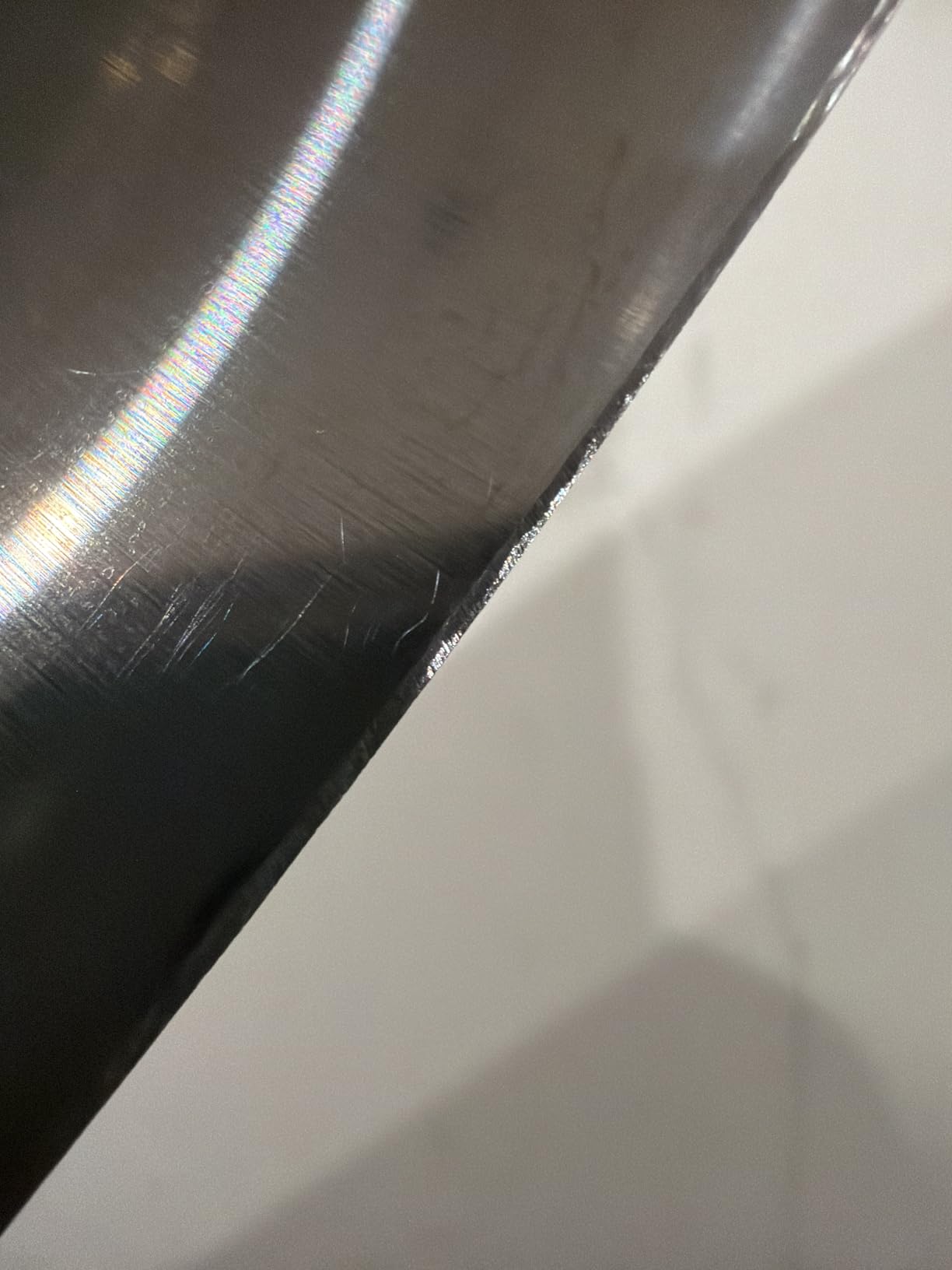
Our caution on ceramic is about pace, not principle. The wheel is diamond and it will cut zirconia without difficulty, but it cuts it just as enthusiastically as it cuts steel. On a good thin ceramic blade, treat the coarse stage as a reset for a genuinely dull edge rather than a routine tidy, and use stage two for everything else.
A minority of owners report grooves forming in blades after repeated use, which suggests the wheel action is more aggressive than the marketing implies. We saw no dramatic evidence of that on our test blade, but the pattern is consistent enough across reviews to mention.
Who should buy the Secura
Anyone whose ceramic knives have never been sharpened and who is not confident with a stone. It is also a good kitchen workhorse for a mixed drawer, since it handles straight edges and shears in one body. Two years of limited warranty and ETL approval are reasonable for the category.
If your main worry is that you will do it wrong, this is the cheapest way to find out what happens. It has an angle guide, so mistakes are visible and correctable rather than permanent.
Who should skip it
Owners of serrated blades, because it is explicitly not for them. It also takes several passes rather than one to reach a good result, and it is built for light kitchen duty rather than heavy blades.
And if you want a mirror or hair-splitting edge, a wheel at a fixed angle will get you functional, not beautiful. Diamond plates and strops are the route for that.
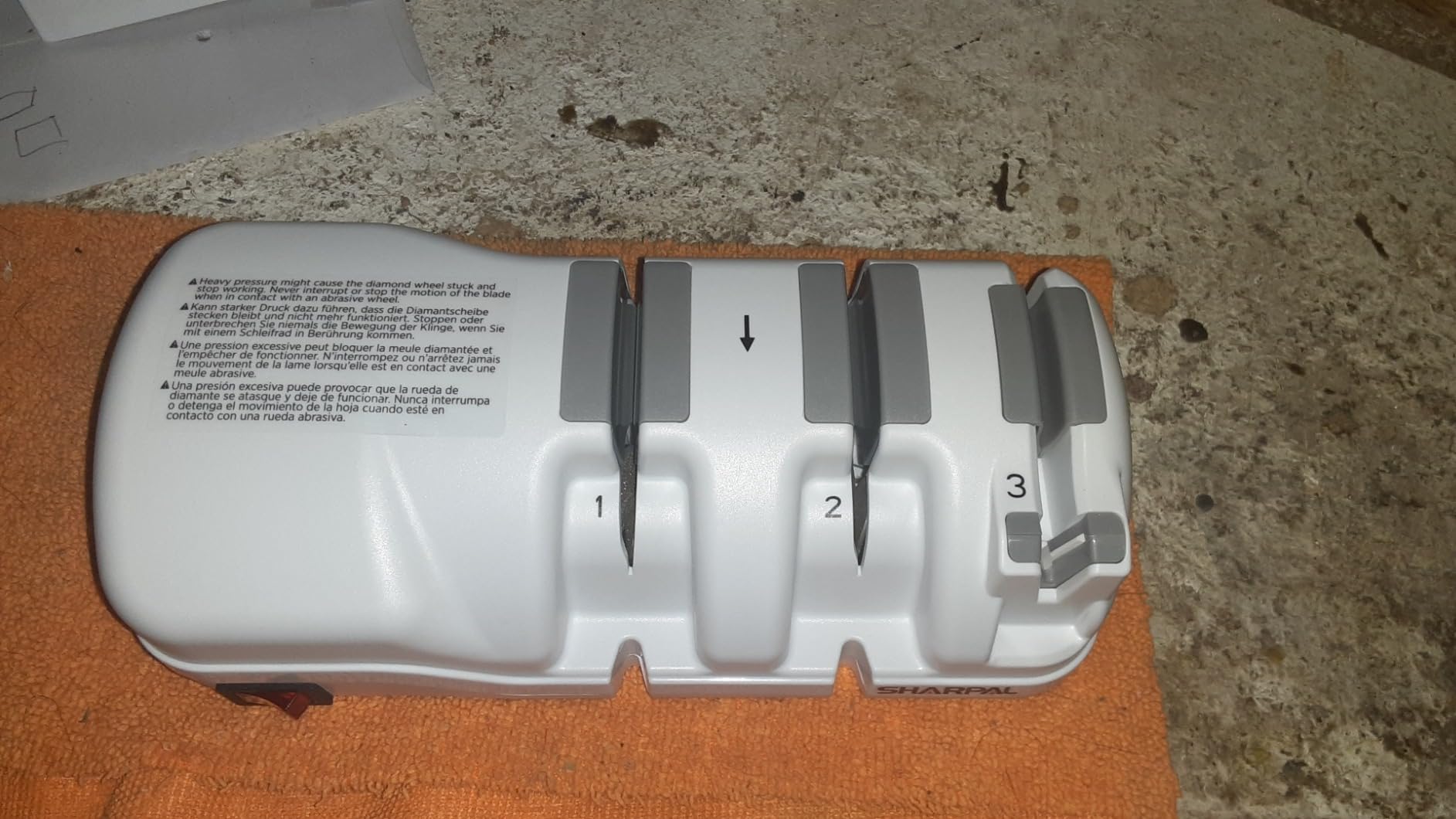
5. SHARPAL 198H 3-Stage Electric Sharpener – Built For Busy Counters
SHARPAL 198H Electric Knife Sharpener 3 Stage with Diamond Wheels
Three diamond slots, both sides at once
8.7 x 4.1 x 2.8 in
Below 65 dB noise level
Pros
- Grinds both sides of the edge simultaneously
- Three slots cover straight edge and serrated
- Below 65 dB with a filing collector
- Overheat protection reported not to de-temper blades
- One handed beginner friendly operation
Cons
- Fixed 20 degree wheel cannot set a 15 degree bevel
- Poor fit for short pocket knives
- Some users report heel scuffing or notching
This is the fastest way we found to put a working edge back on a dull blade. Owners describe six pulls per slot turning a nearly butter-knife blade back to cutting cleanly, and both sides grind simultaneously, so each pass works both bevels at once. For a kitchen sharpening several knives a week, that throughput is genuinely useful.
The 20-degree preset wheel is the reason we could not hand it a top billing for this particular roundup. Most ceramic knives are Asian style with a 15-degree per side edge, and a fixed 20-degree wheel will not preserve that. You are reshaping the blade toward a steeper angle every time you use it.
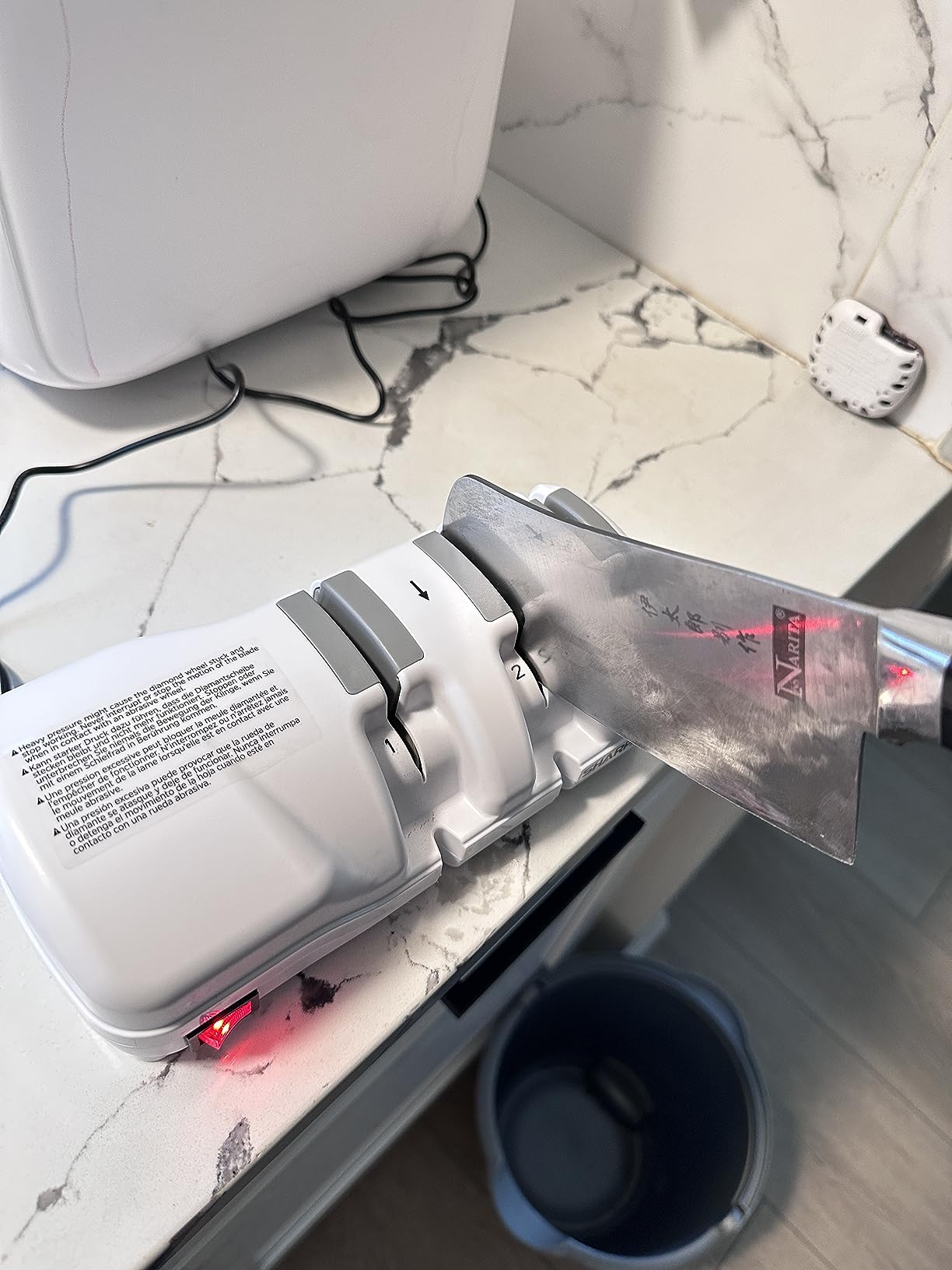
That is not automatically a disaster. If you like a slightly steeper, tougher edge, or if your ceramic knife already has a Western-style bevel, this does what you want. It also handles serrated blades and includes a magnetic filing collector, plus overheat protection that users say did not de-temper their steel.
Noise sits below 65 dB, which is comparable to a quiet conversation and acceptable in a working kitchen. A 12V AC to DC adapter is included.
Where the 198H makes sense
High-volume kitchens and households where the sharpening happens in a hurry and nobody has time to learn a stone. It is also the pick if your ceramic knives came with a factory edge you have never touched and you want a fast baseline before you commit to a proper system.
The filing collector genuinely helps. Ceramic dust is unpleasant to wipe up, and a magnetic receptacle means most of it stays in the box.
Where it is the wrong call
Thin Asian ceramic edges. If your 15-degree edge matters to you, this will grind it toward 20 degrees whether you intend that or not, and ceramic is unforgiving about material removal.
Small pocket knives do not enter the slot properly. Some owners also report scuffing or notching near the heel on thin blades. For the fine work, use a stone.
6. Fallkniven DC4 – The Pocket Stone That Handles Any Hardness
Fallkniven DC4 Diamond/Ceramic Whetstone
Diamond and ceramic dual sided
3.94 x 1.26 x 0.35 in
9 g with leather sheath
Pros
- 9 g so it lives in a pocket or tool bag
- Diamond face sets edges on very hard materials
- Leather sheath doubles as a strop
- Works wet or dry
- Reported long service life
Cons
- Tiny face needs puck or axe technique to work well
- Neither face reaches a true mirror finish
- Diamond face feels bumpy until bedded in
- Fingers can slip near the edge on a stone this small
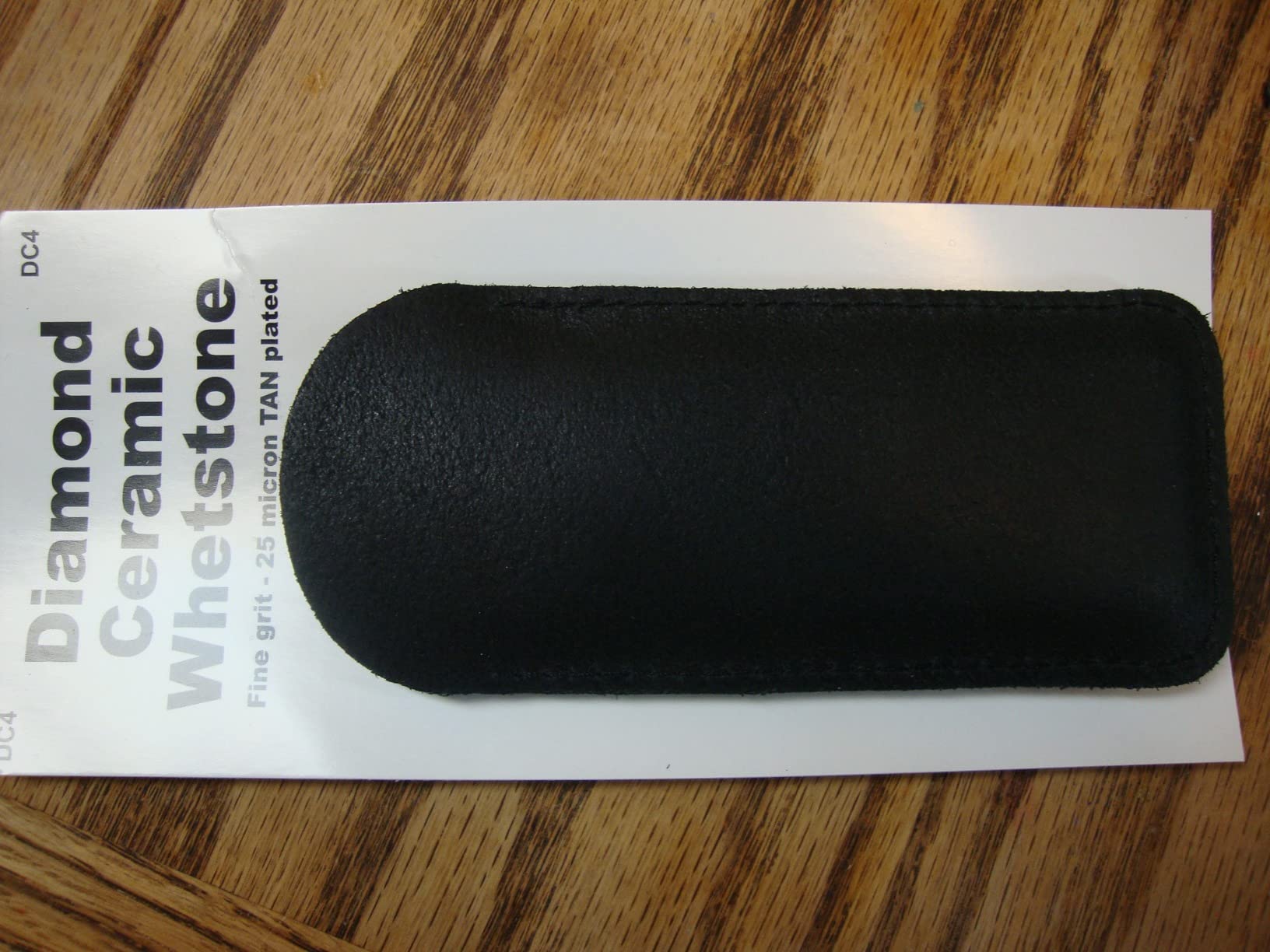
At about 9 grams and 3.94 by 1.26 inches, this is the only product here you can genuinely carry. It slips into a pocket, a tool roll or a jacket and it has a diamond face, which means it will bite a ceramic edge rather than skate on it. That combination of hardness and packability is rare.
The stone is dual sided: a diamond face for setting an edge and a ceramic face for finishing. Use wet or dry. The included leather sheath is the sleeper feature, because it works as a strop loaded with compound, and stropping is what turns a merely sharp ceramic edge into a slicing one.
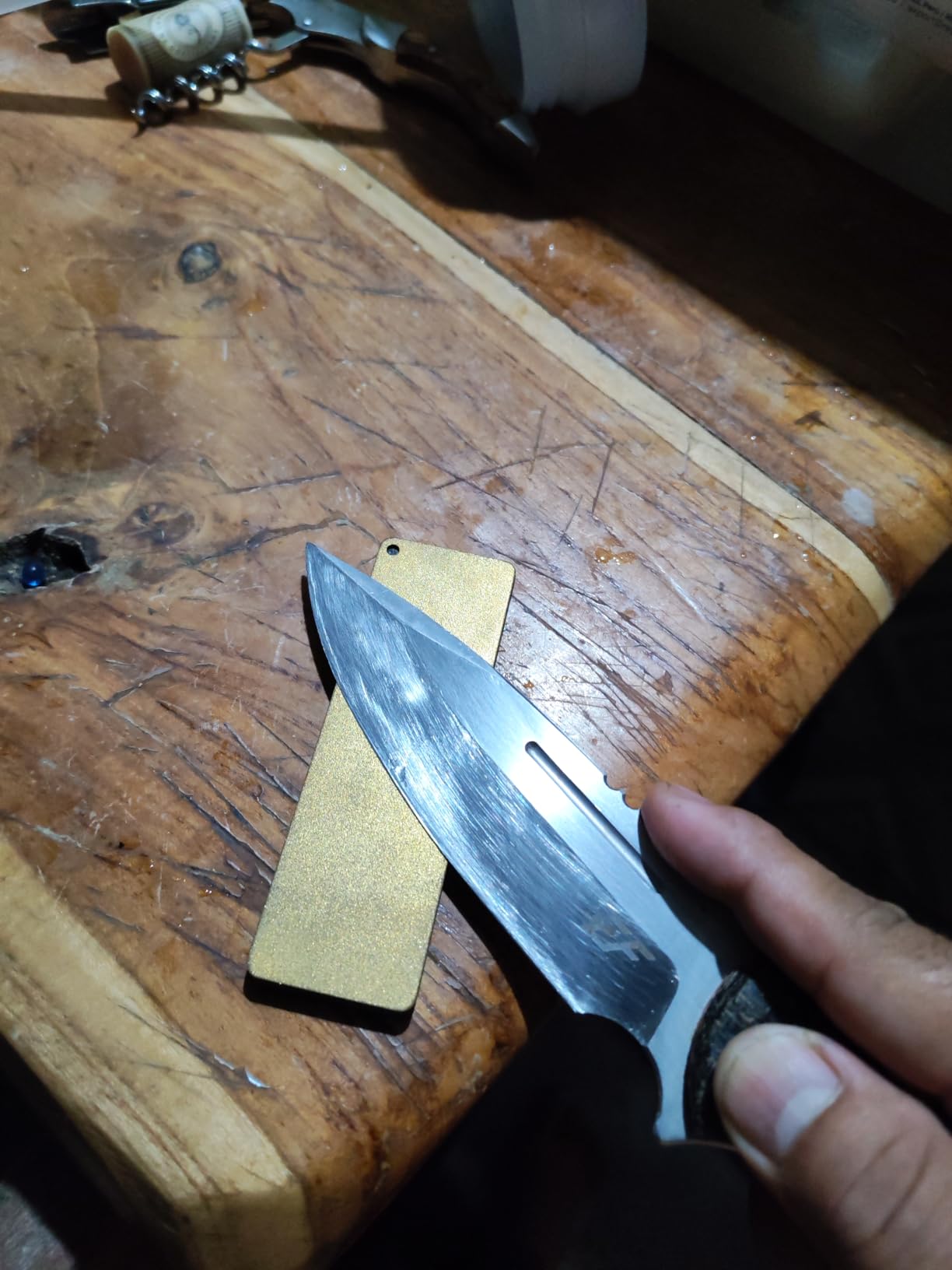
Owners with 2118 reviews mostly talk about high-hardness steels like VG-10 and S35VN, which tells you how seriously the diamond face takes material. On ceramic it will work. The caution is the size. A stone this small wants a circular or axe-puck motion rather than long straight strokes, and that takes a few sessions to learn.
Both faces start slightly rough and smooth out with use, so give it some break-in before judging it. On a ceramic blade the diamond face needs several passes just to establish a scratch pattern.
Where the DC4 earns its place
Travel, fieldwork, and anyone who sharpens away from a proper bench. A ceramic knife in a holiday kitchen loses its edge within days of use, and this is the answer. The strop in the sheath is the part that will matter most on a brittle blade, because it removes the burr without touching the geometry.
It is also a sensible backup stone that lives in a bag next to your good knife.
Where it will disappoint
Anyone chasing a mirror or razor edge. Neither face gets there alone, and no stone this size gives you the long, even stroke needed for a full-length bevel.
It is also the sharpest thing in your pocket at times. Fingers slip on small stones, so take it slowly and keep your grip behind the stone, not beside the edge.
7. AIERLIAN Rolling Sharpener – Magnetic 15 And 20 Degree Angles
AIERLIAN Knife Sharpener Tool, Rolling Knife Sharpener Kit, Knife Sharpening with Diamonds and Ceramic for Steel of Any Hardness, Kitchen knife Sharpener with 15 & 20 Degree Magnetic Angle(Brown)
400 diamond and 3000 ceramic discs
5.5 x 4.6 x 2.7 in
15 and 20 degree magnetic base
Pros
- Rolling design holds a constant angle automatically
- Magnetic base grips the blade firmly
- Two selectable angles cover kitchen and fine edges
- Wood body and leather strop included
Cons
- Not suitable for serrated blades or scissors
- Requires correct wheel order so there is a learning curve
- Fixed angle cannot go finer than 15 degrees
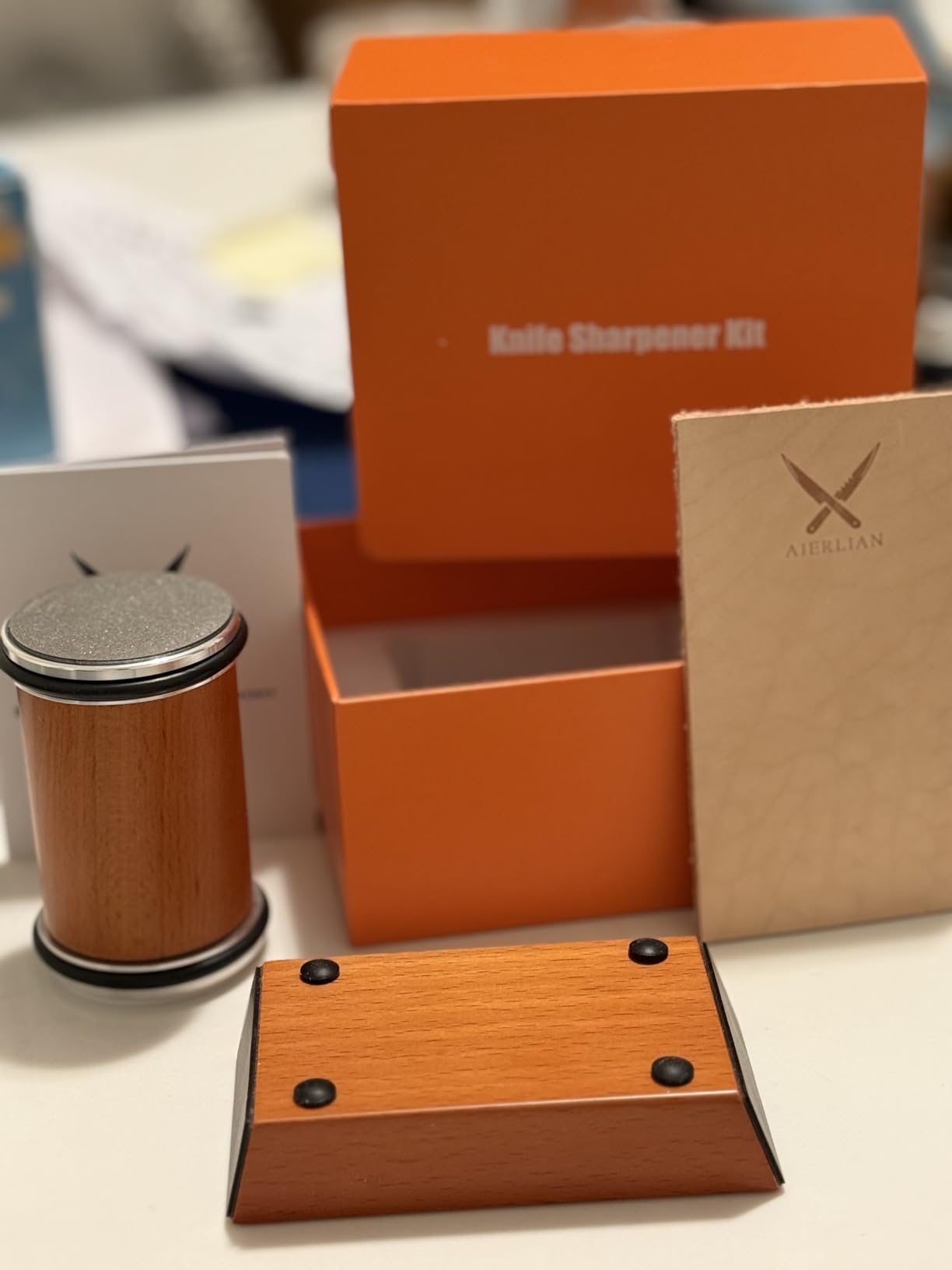
Manual angle setting is where beginners damage ceramic blades, and the AIERLIAN removes it almost entirely. Two magnetic angle supports hold the blade at 20 degrees for most kitchen knives or 15 degrees for a finer edge, and four N42 magnets grip the blade against the base. You roll the wheel, the geometry stays put.
The abrasive pair is a 400 grit diamond disc for removing the first layer of the edge and a 3000 grit ceramic disc for polishing. That order matters: the diamond does the cutting, the ceramic refines. On a ceramic blade the 400 diamond is where the work happens and the 3000 disc is where the edge becomes pleasant rather than merely functional.
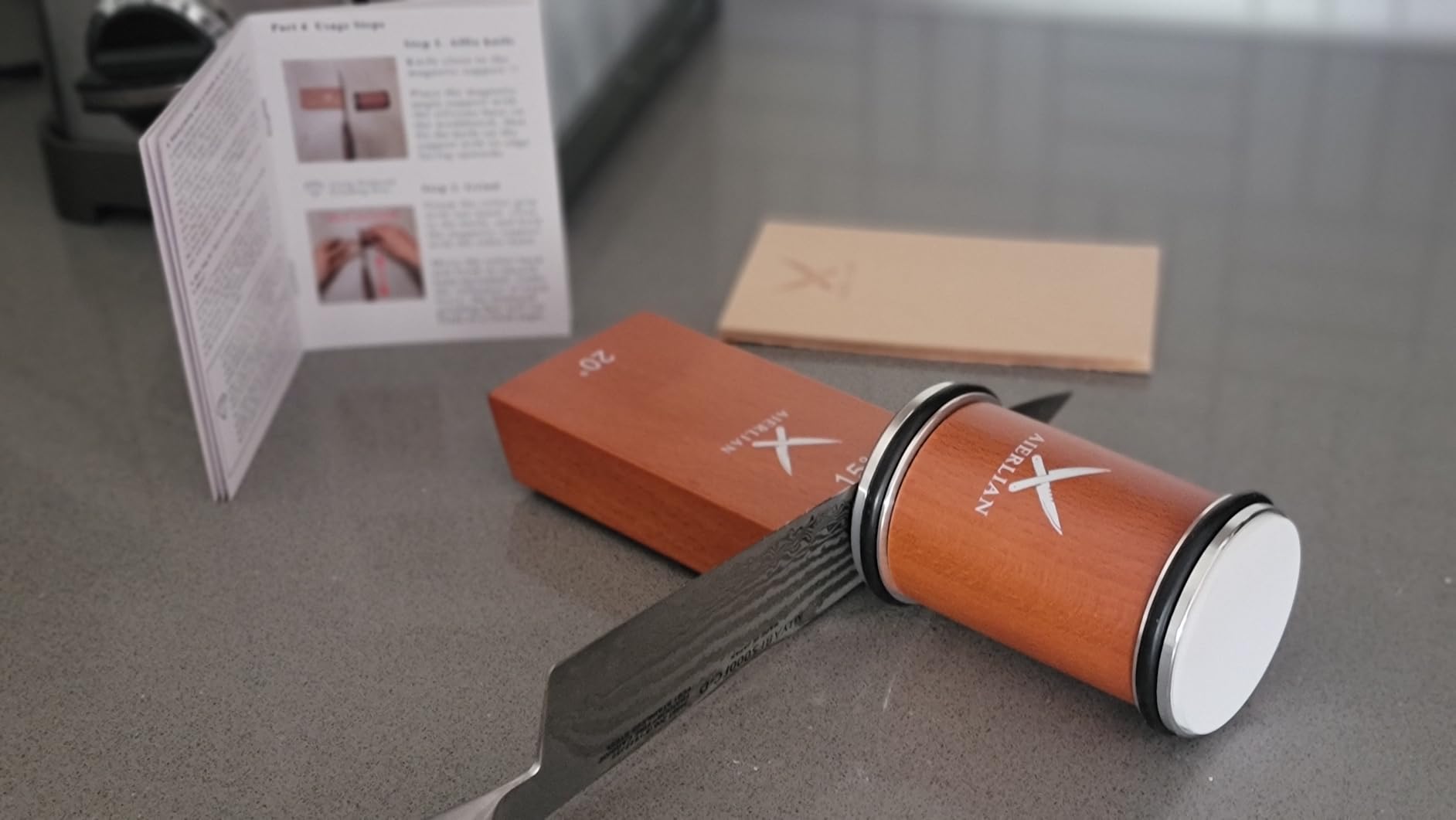
For Asian ceramic edges, use the 15-degree support. We tried both on a 15-degree santoku and the 20-degree support visibly widened the bevel, which is exactly the material loss you want to avoid on zirconia. The 15-degree support left the original geometry alone and still produced a clean edge.
The included leather strop is for burr removal and a smoother finish, which is the right final step on a brittle blade because it removes metal-free.
Who the AIERLIAN fits
Home cooks who want consistent results without learning freehand angle control, and anyone with a mixed collection where half the knives are Asian and half are Western. The two magnetic supports cover both cases in one body.
The natural wood body makes it the best-presented sharpener in this group, and owners consistently single that out alongside the reliable magnetic grip.
Where it stops
Serrated blades and scissors are excluded. If those matter to you, look at the 198H or the Narcissus instead.
There is a learning curve despite the automation: you need the magnetic base set correctly and the wheels used in order. And with 2108 reviews it has less long-term history behind it than the established brands here, which is worth factoring in if you are buying for keeps.
8. Lansky C-Sharp – The Ceramic Rod System That Only Hones
Lanksy C-Sharp Ceramic Knife Sharpening System – CSHARP
Four 600 grit ceramic draw through slots
8.5 x 3.46 x 0.79 in
17 20 25 and 30 degree slots
Pros
- Ceramic abrasive is gentler on edges than carbide pull throughs
- Four clearly marked angle slots
- No stones rods or power needed
- Pocket portable
- Frees you to check an existing bevel angle
Cons
- Hones an already sharp edge more than it truly sharpens
- Cannot remove nicks or chips
- Will not reach razor edges
- Can sharpen one side more than the other
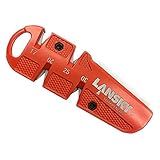
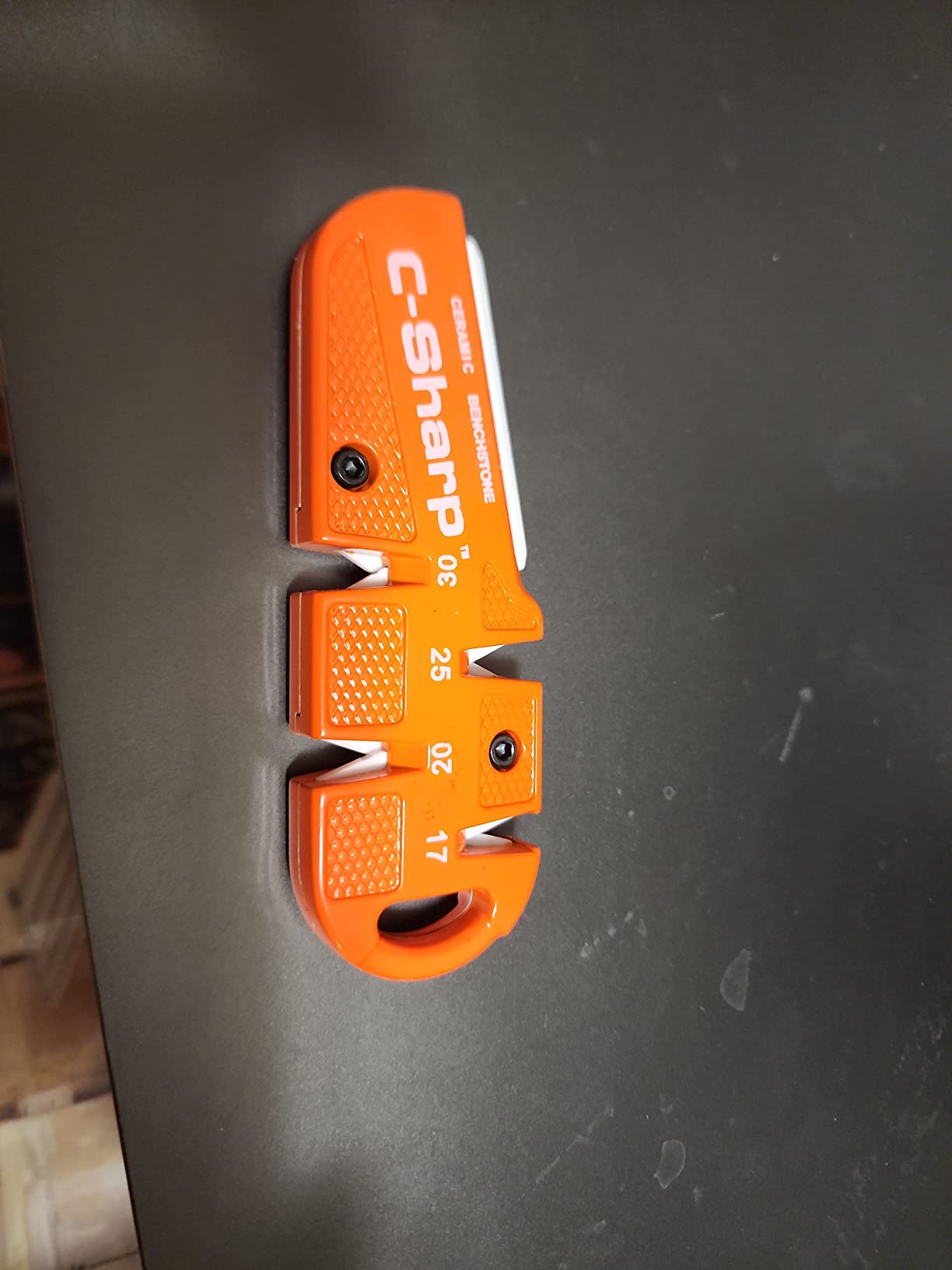
We are including this one deliberately, because it is the product most people wrongly believe is the answer to this question. The Lansky C-Sharp is a system of 600 grit ceramic draw-through slots at 17, 20, 25 and 30 degrees, plus an 800 grit ceramic benchstone strip for further honing and serrations. It is excellent at what it does. What it does is hone.
Ceramic abrasive here is softer than zirconia. Pulling a ceramic blade through it removes a negligible amount of material, so it will realign a rolled edge and bring back keenness, but it will not grind away a dull bevel or a chip. Our ceramic verdict on this one is NO for true sharpening.
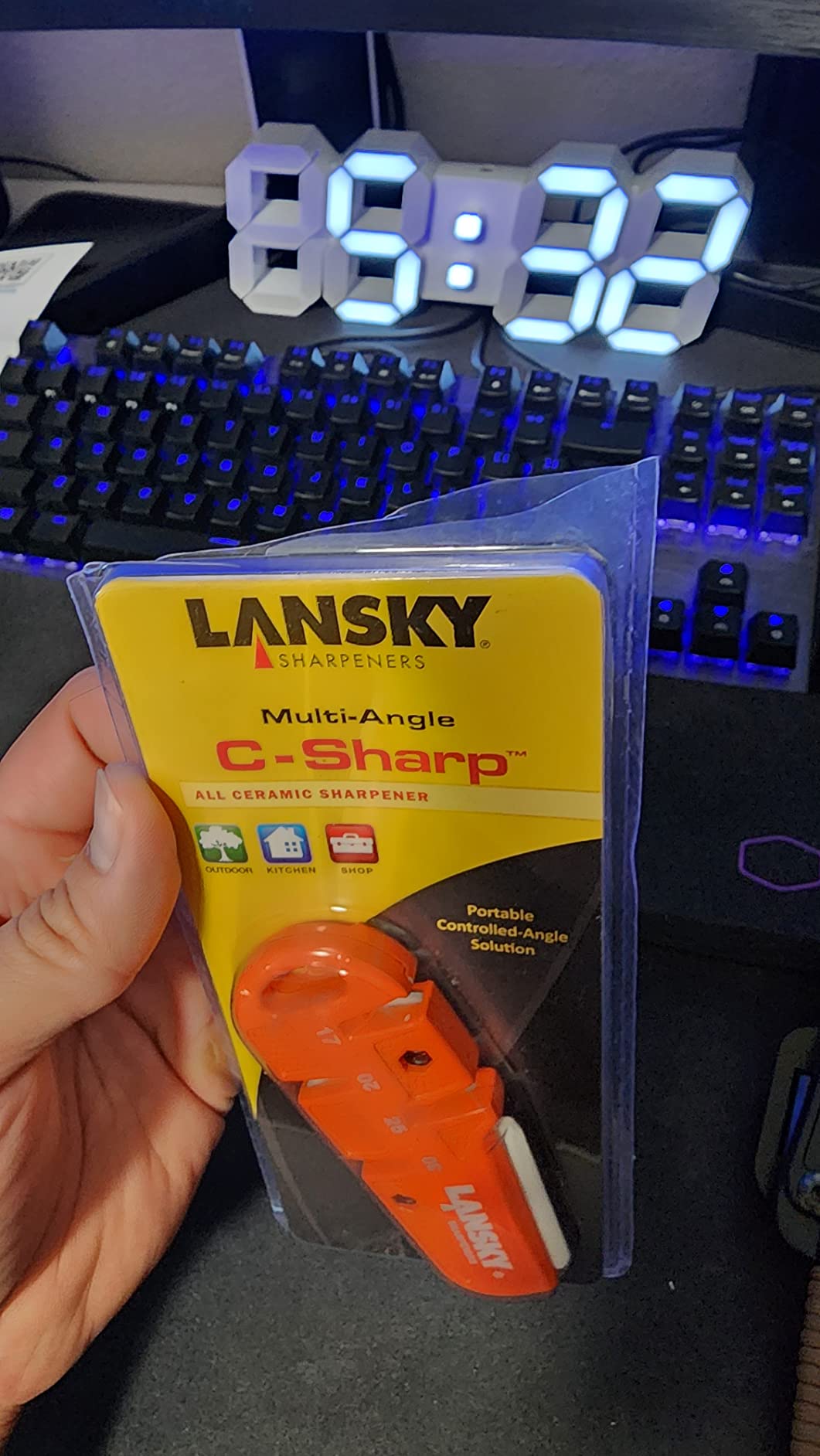
That is still a valuable role. Between full diamond sessions, a few passes straighten the microscopic roll that makes a keen edge feel dull, and because it removes so little material it cannot damage a brittle blade. For a ceramic knife in regular use, an 800 grit ceramic strip is arguably safer maintenance than any diamond product.
The four marked slots also double as a quick visual gauge. You can hold a knife against the slot that matches its factory bevel and see roughly what angle you are dealing with, which is more useful than people realise.
Where the Lansky C-Sharp fits
Pocket and drawer maintenance. It needs no stones, no rods, no setup and no power, and the weight of the knife is enough to work the abrasive. Owners rate it at 4.6 stars from 1276 reviews and frame it consistently as a maintenance tool rather than a full sharpener.
It is also kinder to an edge than a carbide pull-through, which is the usual choice people reach for. If you own a nice ceramic knife and want something you can use casually without thinking, this is safer than the carbide alternative.
Where it will not help
Chips, nicks and truly dull bevels. None of those move under 600 grit ceramic. You need a diamond abrasive for any of them.
It also will not build a razor edge on its own, and with a draw-through design it can favour one side if your stroke is not straight. Use it as a maintenance step between diamond sessions, not as your sharpener.
9. Narcissus Electric Diamond Sharpener – Knives And Scissors Together
Narcissus Knife Sharpener, Diamond Abrasives Electric Knife Sharpener for Stainless Steel and Ceramic Knives, with Scissors Sharpener & Metal Dust Collection Box, Quick Sharpening & Polishing, Silver
Coarse and fine diamond slots
8.2 x 2.9 x 2.7 in
30 watt DC motor
Pros
- Handles straight serrated and ceramic knives plus scissors
- Metal dust collection box keeps counters clean
- 30 watt motor runs cool over a long session
- Sturdy build resists moving the blade
- Compact footprint
Cons
- Small knives can jam in the slot
- Feels aggressive on thin blades
- Instructions are weak for first time users
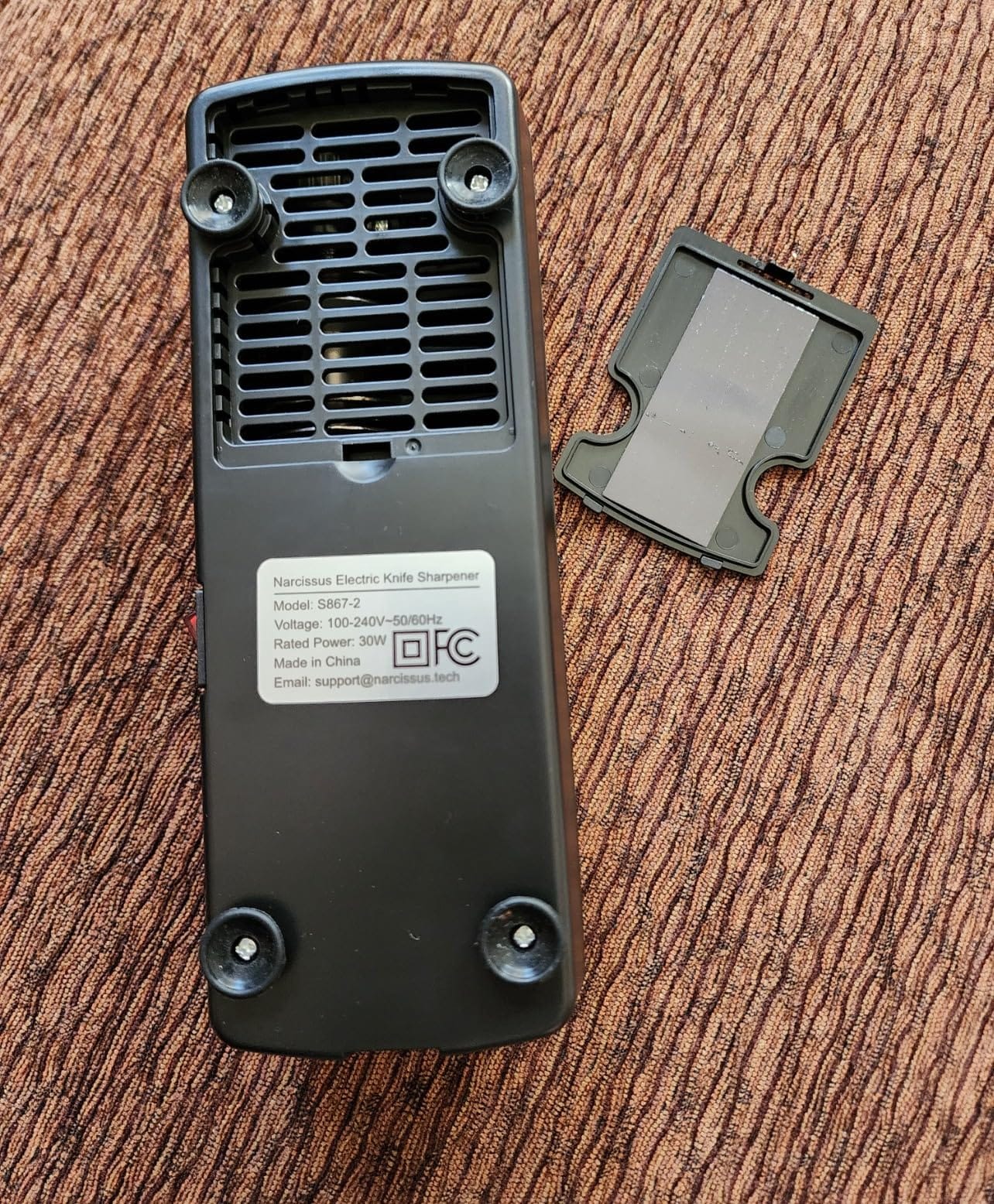
The Narcissus is a 3-in-1 body: a coarse diamond slot for rapid sharpening, a fine slot for a burr-free polish, and a scissors sharpener. The manufacturer claims 2 to 5 pulls per slot restores sharpness, and the fine slot is the one you would want on ceramic, since it finishes rather than cuts aggressively.
Two things make it pleasant in a real kitchen. The 30 watt DC motor runs cool over an extended session rather than cooking itself, and the metal dust collection box means the ceramic grit stays in the box instead of across your worktop.
Our ceramic verdict is CONDITIONAL. It is a diamond sharpener and it is listed for ceramic knives, so it will cut the edge. But a powered coarse slot on zirconia removes material fast, and on a thin or valuable blade we would start in the fine slot and only use the coarse one when nothing else is working.
The narrow slot is the other limitation. Small knives can jam in it, which means short utility blades and small paring knives are a poor fit. Longer blades are handled well.
Where the Narcissus makes sense
A kitchen that keeps shears as well as knives. Most electric sharpeners ignore scissors entirely, and this one gives you both plus a dust box. It is a good general-purpose electric for a household that also owns serrated knives, which it handles.
With 794 reviews it has the smallest base here, so treat the long-term picture as less settled than the established plates. A 12 month replacement policy and 24 months of after-sales service soften that.
Where it is not the right call
Small or thin blades, both because of the slot and because powered wheels feel aggressive on them. Heavy-duty clipper-style scissors are also difficult, which owners note directly.
And the instructions are weak for first time users, which matters more than usual here, because an electric sharpener on ceramic is unforgiving of a wrong first pass.
10. Shenzhen Knives Electric Diamond Sharpener – The Chip Repair Specialist
Shenzhen Knives Electric Diamond Knife Sharpener for Ceramic Knives
600 and 800 grit diamond wheels
8.75 x 2.5 x 3.75 in
18 degree coarse and 20 degree fine guide
Pros
- Only unit here built specifically for ceramic and chip removal
- Grinds out chips up to 1 mm
- Plug-in power holds wheel speed under load
- Replaceable wheel cartridge
- Also works on stainless steel and rust
Cons
- Narrow slots need the cover removed for thick blades
- Fine setting fixed at 20 degrees
- Chipped review of quality control on some units
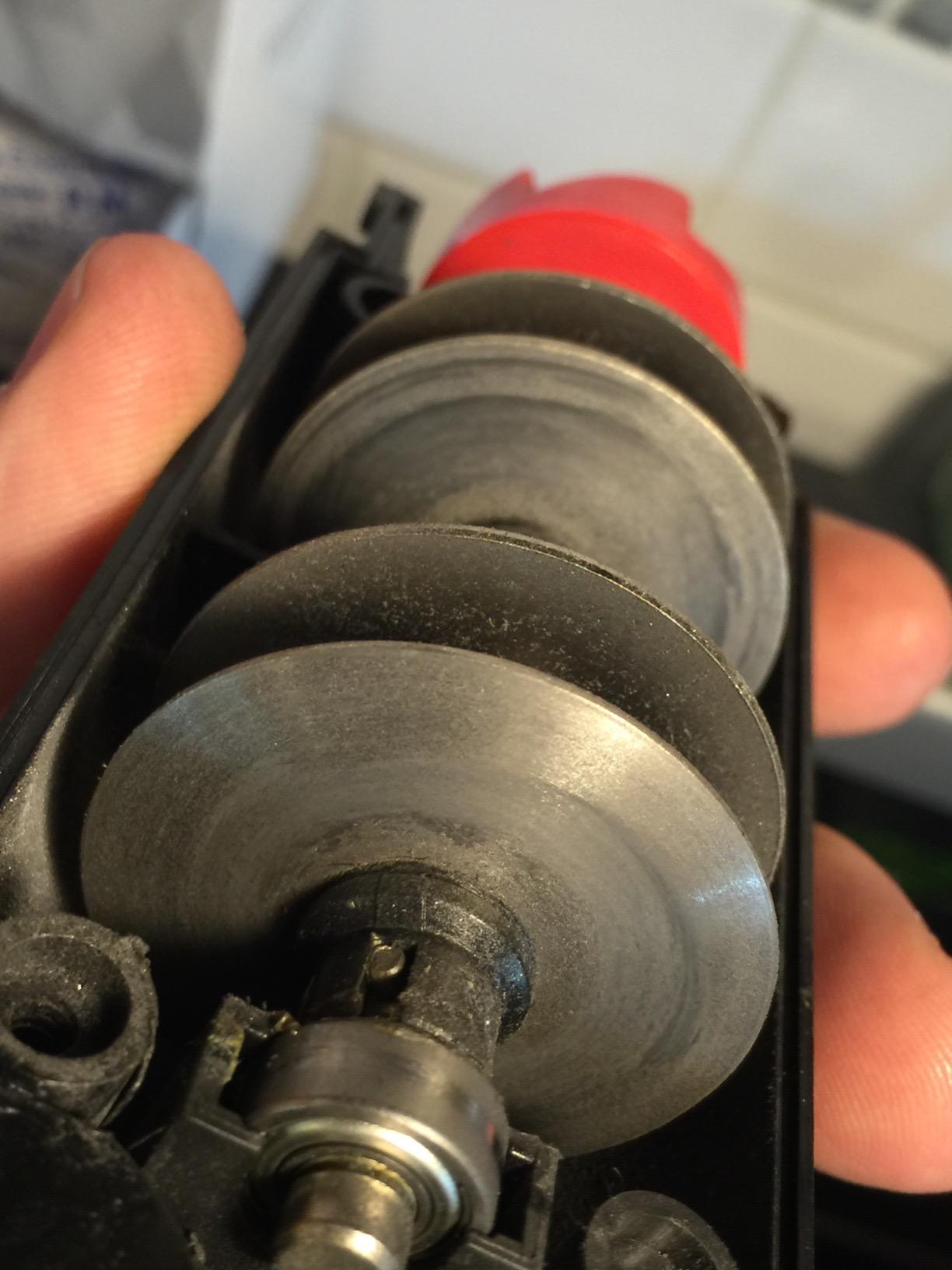
Every other electric in this roundup is a general-purpose kitchen sharpener that happens to work on ceramic. This one is the reverse. It was designed for ceramic blades, with a 600 grit coarse setting and an 800 grit fine setting, and the manufacturer states it can grind out chips up to 1 mm. Owners with direct comparison experience describe it as the only unit they tested that truly restored chipped ceramic, outperforming general diamond orbit sharpeners.
The universal guide holds a fixed V bevel at 18 degrees per side on the coarse stage and 20 degrees per side on the fine stage. The coarse stage is what repairs damage; the fine stage is what finishes the edge afterward. That order is the repair logic, and it is not something a general sharpener gives you.
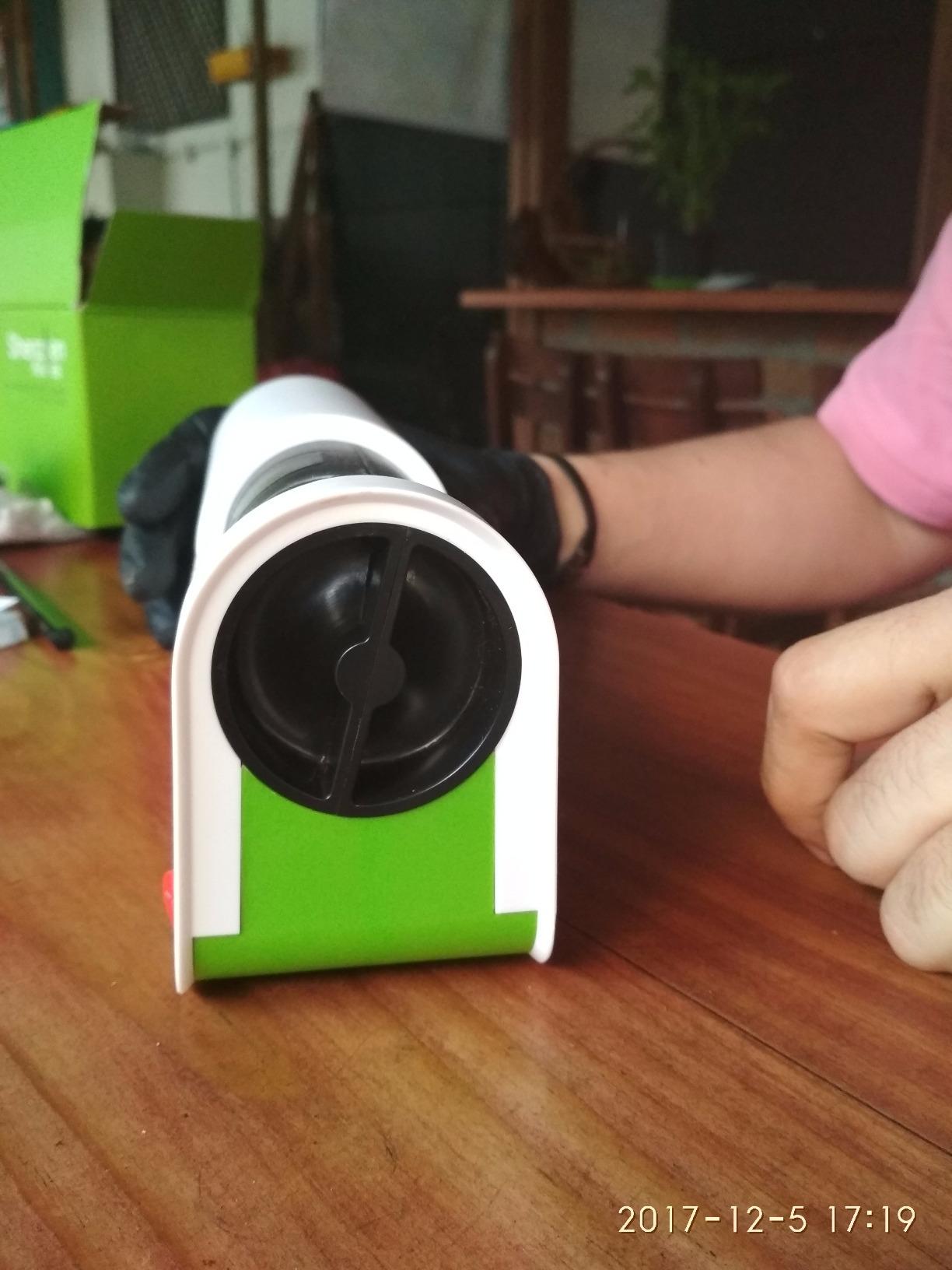
Two practical points. The slots are narrow, and some thicker blades need the wheel cover removed to fit, which some owners discover only after a few failed attempts. And the fixed 20 degree fine setting will not suit a santoku you have kept at 15 degrees, so expect a slightly steeper edge after a repair.
Quality control is inconsistent in a small number of reported cases, including a unit arriving with misaligned discs. We would buy this one for a specific repair job rather than as an everyday maintenance tool.
Who this electric is for
Anyone with a ceramic knife with a chip under about a millimetre, who wants to try to save it before replacing it. This is the only product in the roundup whose stated purpose is chip removal on ceramic, and the fixed coarse-to-fine bevel sequence is designed around exactly that.
It also handles stainless steel, including light rust on thin blades, and the removable wheel cartridge means the tool outlives its abrasive rather than becoming disposable.
Where it falls short
Not for scissors, serrated blades, or pocket and folding knives. It also takes patience, with some owners reporting 15 or more passes per side on a badly dulled ceramic blade, and the 600 grit coarse stage is not aggressive enough for a heavy nick.
For general sharpening, a diamond plate will do a cleaner job with more control. Choose this one when the problem is specifically a chip.
Why Ceramic Needs Diamond And Nothing Else
A ceramic knife blade is zirconium oxide, also called zirconia. On the Mohs hardness scale it sits near 8 to 8.5. Ordinary aluminum oxide whetstones, the sort most people already own, run around 9 on the grit scale but far lower on hardness, and they will not cut it. Tungsten carbide sits around 9.5 in hardness terms, still below zirconia. Ceramic rods, whether sold as sharpeners or as honing tools, are roughly the same material as the blade itself, so they abrade almost nothing.
Diamond is 10 on the Mohs scale and sits above zirconia in the hardness order. That single fact is why every genuinely capable sharpener for ceramic in this roundup uses a diamond abrasive, and why the two ceramic-rod products here are honest maintenance tools rather than sharpeners. The SASS Wire Saloon forum consensus is the shortest version of the same rule: a good quality diamond stone, medium to fine grit, is the most effective way to sharpen a ceramic knife.
Hardness is only half of the story. Zirconia is hard but brittle, where steel is hard but tough. A steel edge that meets bone bends or rolls; a ceramic edge at the same angle has nowhere to absorb the force and chips instead. That is why a slightly dull ceramic edge is more dangerous than a slightly dull steel edge. Sharpening is not only about cutting performance, it is about keeping the force spread along the edge rather than concentrated at a weak spot.
The same brittleness is why over-sharpening matters. A stone removes material whether the edge is dull or not, and zirconia has no ductility to give. Grind a thin Asian edge at 20 degrees for long enough and you will thin it toward the core of the blade. The Tormek forum discussion makes the same point from another angle, noting that Forever and Kyocera blades behave differently from each other and respond differently to different stones.
Ceramic sharpener versus sharpener for ceramic knives
This confusion runs through the entire search results for this query, so it is worth settling plainly. A ceramic sharpener is a rod or stone made of ceramic, sold to hone steel knives. A sharpener for ceramic knives is a tool whose abrasive is hard enough to cut zirconia, which in practice means diamond. They are opposite products. Buying the first when you need the second is the single most common and most expensive mistake in this category, and the fact that the phrases sound alike is why so many pages answer the wrong question.
Honing versus sharpening on ceramic
Sharpening removes material and creates a new edge. Honing realigns an existing edge that has rolled over but is otherwise intact. Steel can take both in stride. Ceramic can be honed relatively freely because a hone removes almost nothing, which is exactly why a ceramic strip is safe maintenance and a ceramic rod is not a sharpener. Sharpening ceramic is a rarer, more deliberate event that should happen when the edge is genuinely dull, not on a schedule.
How To Sharpen A Ceramic Knife Step By Step
Work on a stable, non-slip surface with a damp cloth underneath your stone or plate. Ceramic dust is unpleasant to breathe and sharp fragments do end up on the counter. If you are new to this, wear a cut-resistant glove.
- Confirm it is dull and not chipped. Run a fingernail across the edge from the heel to the tip. If it catches or skips, you have a chip and sharpening will not fix it. Stop and go to the chip decision path below.
- Identify the existing bevel angle. Most Asian ceramic knives are 15 degrees per side; Western chef’s knives are often 20. Matching your blade matters, because regrinding to a different angle on ceramic removes a lot of material quickly.
- Soak a water stone if you are using one, or skip this entirely if you are using a diamond plate. Diamond plates sharpen dry, and there is no reason to add water to a surface that does not need it.
- Start on the coarser diamond grit. On the SHARPAL plates that is 325; on a coarser plate for a damaged edge, 400 or 600. Hold the blade at the guide angle and use light pressure. On ceramic, pressure does not speed up cutting, it just removes more.
- Alternate sides and keep the stroke count equal on each. Ten strokes one side, ten the other. Unequal strokes are the most common cause of a wedge edge, and a wedge on a brittle blade is how chips happen.
- Move to the finer diamond grit. 1200 on the SHARPAL plates or 3000 on a ceramic finishing disc. This removes the burr and refines the bevel rather than adding geometry.
- Deburr on a strop or a piece of loaded leather. The Fallkniven sheath and the AIERLIAN strop both work. Stropping straightens the burr away without removing material, which is the safest finishing step available on a brittle blade.
- Clean and test. Rinse the stone, wipe the blade, then slice a piece of tomato skin or a sheet of paper. If it drags, you still have a burr or you stopped too early.
Two habits separate a good result from a bad one. First, slow down on ceramic: the material removal rate is high enough that a fast stroke does far more than you planned. Second, keep the blade moving laterally as you draw it, because parking the edge in one spot and grinding concentrates the wear there.
Chipped Or Just Dull? Decide Before You Touch The Blade
Ceramic chips because it is brittle. Dropping the knife tip-first onto a tile, landing the edge on a hard counter, cutting through bone or a frozen joint, or forcing a wedged food particle all produce the same result. A dull edge is a different animal: it slices nothing, tears instead of cutting, and feels blunt against food. Sharpening solves the second. It cannot solve the first.
Here is the diagnostic. Slide a fingernail gently along the edge from heel to tip. A dull edge feels rounded and slips without snagging. A chipped edge produces one distinct catch, at one spot, that you can find again with your eyes. If your nail catches at a single point, you have damage.
- Small chip under about half a millimetre, on a knife you value: the Shenzhen electric is built for this and can grind out chips up to 1 mm.
- Chip between one and a few millimetres: professional sharpening is the safer route, because a stone at that scale removes the whole section of edge.
- Tip broken off, or a chip running a centimetre along the edge: replace the knife. No sharpener fixes that economically.
- Two or three separate nicks along the edge: this is a quality-control problem with the original edge geometry more than a sharpening problem.
- Dull only, no catch: sharpen normally with a fine-to-medium diamond grit and do not escalate to coarse.
The professional route is worth taking seriously for an expensive blade. A dull ceramic knife is a ten minute job. A badly chipped one can cost more in rebeveling than the sharpener and the labour combined, and a specialist can tell you in advance whether the geometry is still viable. That conversation is cheaper than finding out after grinding.
How To Choose A Sharpener For Ceramic Knives
Match the abrasive to the blade
Four abrasive families appear in kitchen sharpening, and only one of them reliably cuts zirconia. Diamond is the answer for any real material removal, and every genuine pick above uses it. Aluminum oxide stones are traditional, cheap and lovely on steel, but they will not cut ceramic. Tungsten carbide, common in pull-through sharpeners, is hard and tough but still below zirconia, so it hones rather than sharpens. Ceramic rods are for straightening steel edges and for gentle maintenance. As a general rule: if the product page does not say diamond, it is not sharpening your ceramic knife.
Understand what grit numbers do
Lower numbers are coarser and remove material faster; higher numbers are finer and refine. On steel you might start at 1000 and go to 6000. On ceramic, the useful range is narrower and higher. Coarse grits exist for repair work, and they belong in the hands of someone who knows what they are removing.
A 400 grit stone is the general-purpose workhorse for setting an edge and for dealing with a rough or neglected bevel. It removes material quickly and leaves a scratchy finish, so it is never where you stop. A 600 grit sits in the same territory and is what the Shenzhen electric uses as its coarse stage. Around 1000 grit is where most ceramic sharpening should begin for a merely dull edge. From 1200 upward you are refining, deburring and polishing, and that is where a ceramic edge actually becomes sharp. Above 3000 you are chasing a finish rather than function.
Get the angle right for Asian edges
Most ceramic knives sold for Asian cooking have a 15-degree per side edge, and a lot of general knife advice defaults to 20 degrees. On steel, widening from 15 to 20 costs you edge fineness and little else. On zirconia it removes visibly more material from a blade that has very little to spare, and repeated sessions can thin a blade toward its core. Match the existing angle. The SHARPAL guides include 14 degrees for this reason, and the AIERLIAN magnetic supports give you a genuine 15-degree setting.
If your ceramic knife has no clear factory bevel, check the blade against a protractor before you grind. Ten minutes with an angle gauge can save the blade.
Choose electric or manual by skill, not convenience alone
Manual stones give you control and let you stop the instant the edge appears, which is why most experienced users prefer them for ceramic. Powered devices trade that control for repeatability and speed. On a hard thin blade, that trade is not always worth making. The best compromise here is a device with a genuine angle guide rather than a fixed wheel angle, because it removes beginner error without removing your material.
Whatever you pick, keep a light touch on ceramic. The abrasive does the work. Pressure only removes material faster, and on zirconia faster is not better.
Set a realistic maintenance cadence
Ceramic holds an edge far longer than steel, so the honest answer to how often you should sharpen one is rarely often. Hone between sessions with a ceramic strip or a gentle pull-through, which costs almost no material. Sharpen properly only when the edge stops cutting cleanly, which for a home cook is typically a few times a year and for a working kitchen far more often.
If your knife needs sharpening more than twice a year, the likely cause is technique or a stone angle mismatch rather than a soft blade. Fix that before escalating to coarser grit.
Think about durability and waste
The most sustainable sharpener here is the one you keep. A diamond plate or stone with a rigid base will last for years and can be re-dressed or lapped depending on its construction, while a pull-through unit with carbide strips is consumable by design. On a usage basis, one quality diamond surface costs less over five years than repeatedly replacing carbide strips, and it produces no plastic waste at all. It also does not hide a bad technique behind a motor, which is the deeper argument for learning on a stone. If you are also refreshing the rest of your kitchen kit, our ceramic coating kit reviews apply the same durability and replacement logic.
Budget by tier
At the entry end, the drawer units give you two diamond stages and no angle decisions, which is a sensible first purchase. The middle of the range is where the flat, heavy diamond plates live, and that is where we would put our money for long-term quality. At the top, a dedicated ceramic electric with a coarse-to-fine fixed bevel sequence is a specialist purchase justified only by actual chip damage.
Frequently Asked Questions
Can you use a knife sharpener on ceramic knives?
You can, but only with a diamond abrasive. Ceramic blades are zirconium oxide, which is harder than aluminum oxide whetstones, tungsten carbide and ceramic rods, so those products slide across the edge without cutting it. Diamond plates, diamond stones and diamond grinding wheels will cut zirconia. Avoid carbide pull-through sharpeners and any sharpener not labelled diamond, and avoid fixed-angle electrics that will grind a 15-degree edge toward 20.
What’s the best way to sharpen a ceramic knife?
Use a diamond abrasive at the blade’s existing bevel angle, usually 15 degrees per side for Asian knives, with light pressure and equal strokes on both sides. Start on a medium diamond grit only if the edge is genuinely dull, move to a finer grit to remove the burr, then finish on a strop or loaded leather. Never rush on a brittle blade, because material removed from zirconia does not grow back.
Are ceramic knife sharpeners good?
They are good for what they are, but what they are is a honing tool. A ceramic rod or strip is roughly the same hardness as a ceramic blade, so it removes almost no material and cannot grind away a dull bevel or a chip. It will straighten a rolled edge and restore keenness between full sessions. For actual sharpening, the abrasive must be diamond.
Do ceramic blades need sharpening?
Yes, but far less often than steel. Ceramic holds an edge for a long time because of its hardness. However it is brittle rather than tough, so a dull or rolled edge concentrates force on weak points and chips instead of flexing. Regular honing keeps the edge aligned, and an occasional diamond sharpening keeps it cutting cleanly and reduces chipping.
What is the best sharpener for ceramic knives?
For most home cooks, a compact multi-stage unit with two diamond faces is the least risky first purchase. For consistent results and mirror finishes, a heavy flat diamond plate with a 325 and 1200 grit pair is the better tool. For repairing chips under a millimetre, a dedicated ceramic electric with a coarse and fine diamond wheel is the only practical option in this roundup.
Which is better, a diamond or a ceramic knife sharpener?
For a ceramic blade, diamond. Always. Diamond sits above zirconia on the Mohs hardness scale, so it cuts the edge. Ceramic abrasive is roughly the same hardness as the blade itself, so it can only realign an existing edge. A ceramic sharpener is the right tool for maintaining a steel knife between full sharpenings, and it is also a safe, gentle maintenance step for ceramic.
Can you sharpen ceramic knives on a whetstone?
Yes, provided the stone has a diamond abrasive. A traditional water stone made of aluminum oxide will not cut zirconia and will simply polish it while you work. A diamond plate or diamond-coated water stone sharpens ceramic quickly and without soaking, because there is no need for a water bath to soften a bonding agent that is not there.
What is a 400 grit whetstone used for?
A 400 grit stone removes material quickly and is used to set or repair an edge rather than to finish it. It leaves a visibly scratchy surface, so it is always followed by a finer grit. On a ceramic knife it is a repair tool, not a routine one, because it thins a brittle edge quickly. For a merely dull ceramic edge, start around 1000 grit instead.
The Verdict On The Best Knife Sharpeners For Ceramic Knives in 2026
Start with the Kai Seki Magoroku if you want one drawer tool that cannot be set up wrong. Step up to the SHARPAL 162N when you want a genuinely flat, fast stone and are willing to practise. Pick the 156N instead if your blades are short. Go compact with the Fallkniven DC4 for travel, and add the AIERLIAN if you need a real 15-degree setting without freehand angle control. Buy the Shenzhen electric only when a chip is the actual problem, and use the Lansky C-Sharp for honing between sessions rather than for sharpening.
What none of this changes is the rule at the top. If the product does not use a diamond abrasive, it is not sharpening your ceramic blade, no matter what the listing says. Keep the angle, keep the pressure light, and check for a chip before you start grinding. You can read more about caring for the rest of your kit in our guide to knife sheaths for chef knives, and if you are choosing a pan that has to survive the same kitchen, our ceramic cookware set guide covers the same durability questions.
We re-checked all ten sharpeners for 2026 and will update this list when ceramic-specific models change. As an Amazon Associate we earn from qualifying purchases, which never affects the order or the verdicts above.