
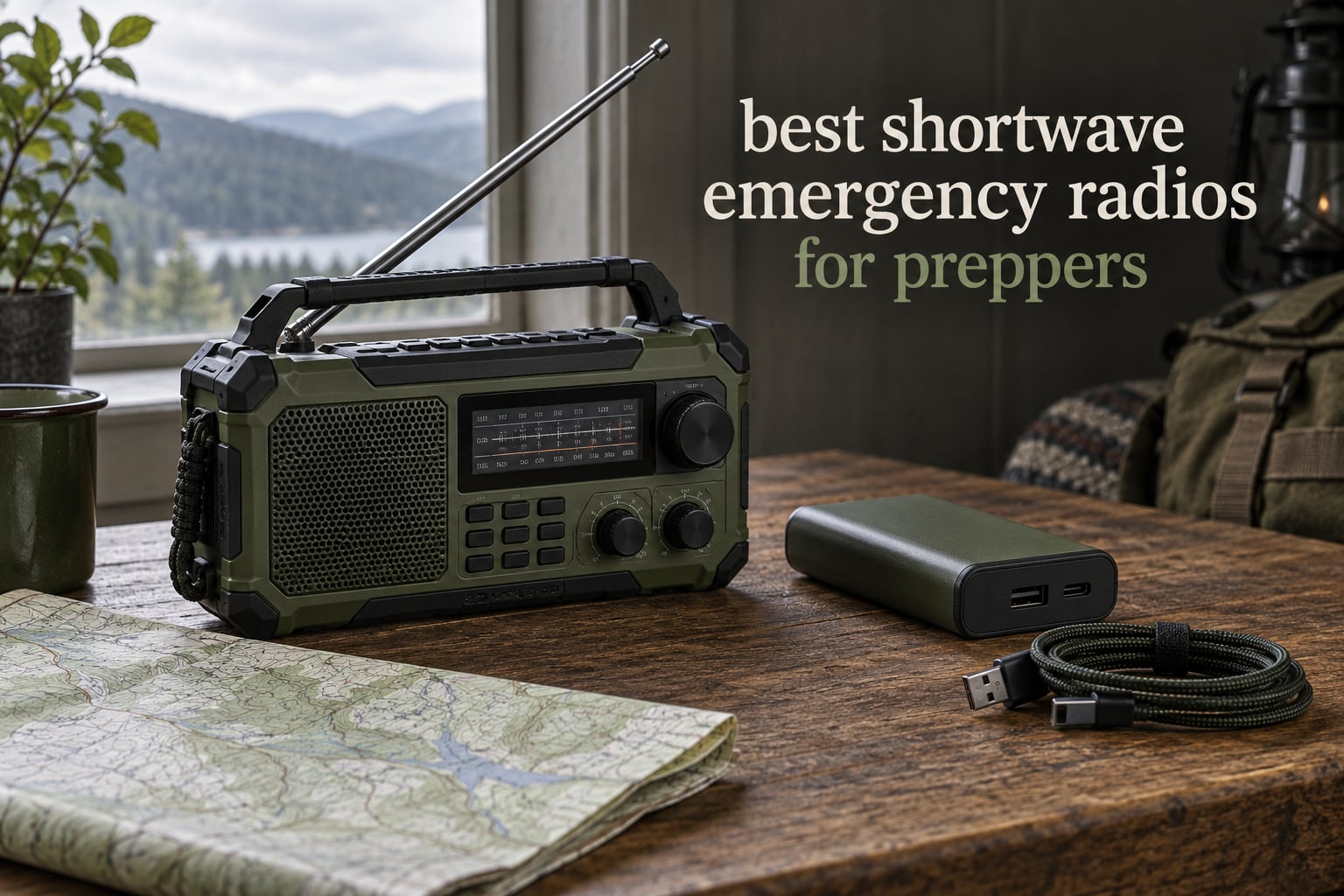
Cell towers do not stay up through a blackout. They run on backup power that is measured in hours, and the networks congest long before they go dark, so the phone in your go-bag is a paperweight exactly when you need it. A shortwave emergency radio is the one information device that does not care about the grid, the cell network, or the internet, because it receives live signals from transmitters that keep broadcasting from somewhere else.
That is what makes the best shortwave emergency radios for preppers such a specific buy. Everyone agrees a prepper radio should work without power. What buyers argue about is whether the hand crank is worth anything, whether AM-only shortwave is enough, and whether you need a receive-only receiver or a two-way transceiver. We looked through twelve of the strongest options on the market and sorted them by what actually matters when the power is off.
We also leaned on what buyers say after living with these radios. Our full shortwave receiver picks are in the best shortwave radios guide, and if your priority is severe weather alerts rather than international broadcasts, our emergency weather radio picks cover that side in more detail.
Here is the quick answer before the details: the Raynic 5000mAh emergency radio is the best shortwave emergency radio for preppers overall, because it pairs the largest battery in the group with the widest range of ways to keep that battery alive. The Kaito KA500 is the better value pick, and the C. Crane CC Skywave SSB 2 is the one to buy if you want real sideband reception that no phone can replicate.
Top 3 Shortwave Emergency Radios for Preppers in 2026

Raynic 5000mAh Emergency Radio
- 5000mAh battery
- Six charging paths
- AM FM SW NOAA
- 3W flashlight

Kaito KA500 Voyager
- Six-way power
- 14.5 inch telescopic antenna
- Two shortwave bands
- 7 NOAA channels

Eoxsmile NOAA 5000mAh
- 5000mAh battery
- 116dB SOS alarm
- NWS certified alerts
- Five power sources
What Is a Shortwave Emergency Radio, and Why Do Preppers Need One?
A shortwave emergency radio is a battery-powered receiver tuned to AM and FM broadcast, NOAA weather channels and shortwave bands between roughly 3 and 30 MHz, usually built with hand crank, solar and USB charging so it keeps working when mains power and cell coverage are gone. It receives live radio signals instead of requesting data, so no tower, no network and no subscription stands between you and the information.
For preppers the practical case is simple. NOAA weather radio broadcasts run from transmitter sites on their own power and are the fastest way to get an official evacuation or tornado warning. Shortwave carries international services such as the BBC World Service, plus time signal stations and amateur HF nets, and AM broadcast picks up local emergency traffic. You get all three from one device that fits in a jacket pocket.
The part that trips up first-time buyers is expectation. Shortwave does not deliver local conversation the way a walkie talkie does. It delivers distant broadcast stations whose availability changes with time of day and solar conditions, which is why a set that sounds like static at midnight can be pulling in a clear signal from Europe at sunset.
Shortwave Emergency Radios at a Glance in 2026
Twelve radios, one row each. The Key Features column tells you why we picked it, and the full review underneath explains the trade-offs.
| Product | Specifications | Action |
|---|---|---|
| Raynic 5000mAh Emergency Radio |
|
Check Latest Price |
| Kaito KA500 Voyager Pro |
|
Check Latest Price |
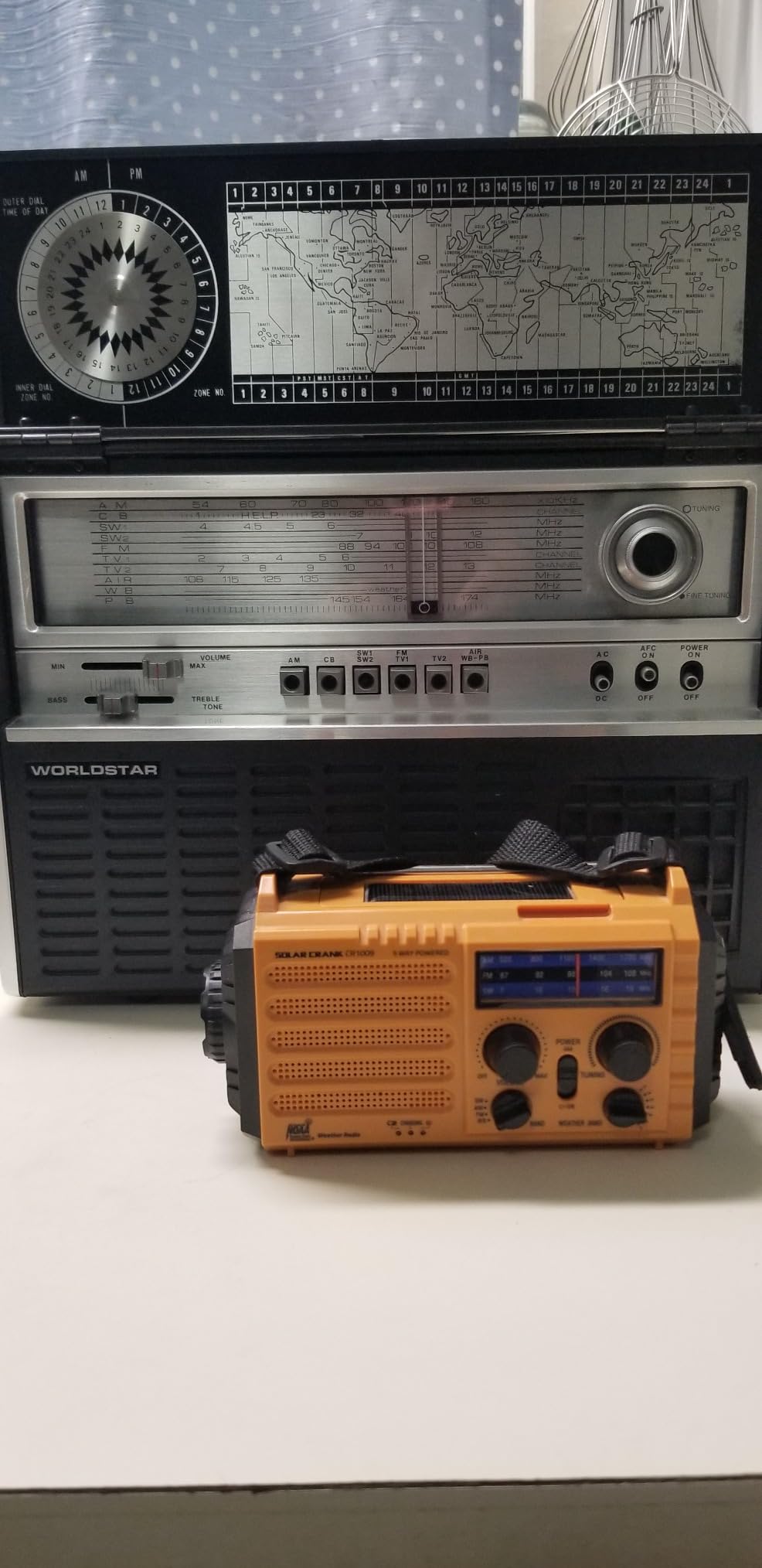
| Eoxsmile CR1009 NOAA Radio |
|
Check Latest Price |
 Kaito Voyager Pro KA600 Kaito Voyager Pro KA600 |
|
Check Latest Price |
 C. Crane CC Skywave SSB 2 C. Crane CC Skywave SSB 2 |
|
Check Latest Price |
 Greadio R12 Emergency Radio Greadio R12 Emergency Radio |
|
Check Latest Price |
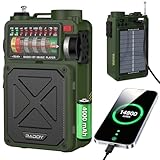 Raddy RE40 Shortwave Radio Raddy RE40 Shortwave Radio |
|
Check Latest Price |
 XHDATA D221 NOAA Radio XHDATA D221 NOAA Radio |
|
Check Latest Price |
 Emgykit R11 Hand Crank Radio Emgykit R11 Hand Crank Radio |
|
Check Latest Price |
 Jazmm 4-Band 213 Shortwave Jazmm 4-Band 213 Shortwave |
|
Check Latest Price |
 Eton Odyssey Bluetooth Radio Eton Odyssey Bluetooth Radio |
|
Check Latest Price |
 Jazmm A12 4000mAh Radio Jazmm A12 4000mAh Radio |
|
Check Latest Price |
The 12 Best Shortwave Emergency Radios for Preppers in 2026
Twelve picks, ordered by how much we would trust them in a real outage. Number one is the Raynic, number two is the Kaito KA500, and number five is the C. Crane if sideband reception is your thing. Every entry below lists what it does well and what it does not, because in this category the flaws are what decide the purchase.
1. Raynic 5000mAh Emergency Radio – Best Overall All-Rounder
Raynic Emergency Radio, 5000mAh/18500mWh Weather Radio, Solar Hand Crank Radio with AM/FM/SW/NOAA Alert, Cell Phone Charger, Headphone Jack, Flashlight and SOS Siren
5000mAh battery
Six charging options
AM FM SW NOAA
3W flashlight and 2.5W lamp
IPX3, 1.2 lb
Pros
- Automatic NOAA alert scanning in standby
- 5000mAh battery plus five backup power paths
- Very bright 3W flashlight and reading lamp
- USB output charges a phone
- Compact at 16 oz with a headphone jack
Cons
- Not waterproof
- solar panel is a trickle charger only
- Short antenna limits shortwave reception
- Crank charges too slowly for real emergencies
The Raynic is the radio I would hand to someone who wants one device and does not want a second thought about it. It holds a 5000mAh internal lithium pack, and it ranks at number four in Weather Radios with roughly 20,000 reviews behind it, which is a longer reliability record than anything else in this roundup.
What stands out is the range of ways to keep that battery alive: the internal rechargeable battery, an AC adapter, USB input, the hand crank, the solar panel and three AAA cells. In an outage that spread of options matters more than any single one of them, because at some point two of those six are going to be unavailable.
The NOAA side is the strongest part of the package. Owners report automatic alert scanning while the radio sits in standby, so a warning arrives without anyone monitoring the dial. The 3W flashlight is genuinely bright, and the 2.5W reading lamp is bright enough for map work without eating the battery.
The trade-offs are honest ones. It is rated IPX3 for water resistance, not waterproof, and the solar panel is a trickle charger that cannot revive a flat battery. The telescoping antenna is short with no external antenna socket, and shortwave tuning means scanning band segments by hand rather than jumping to a band.
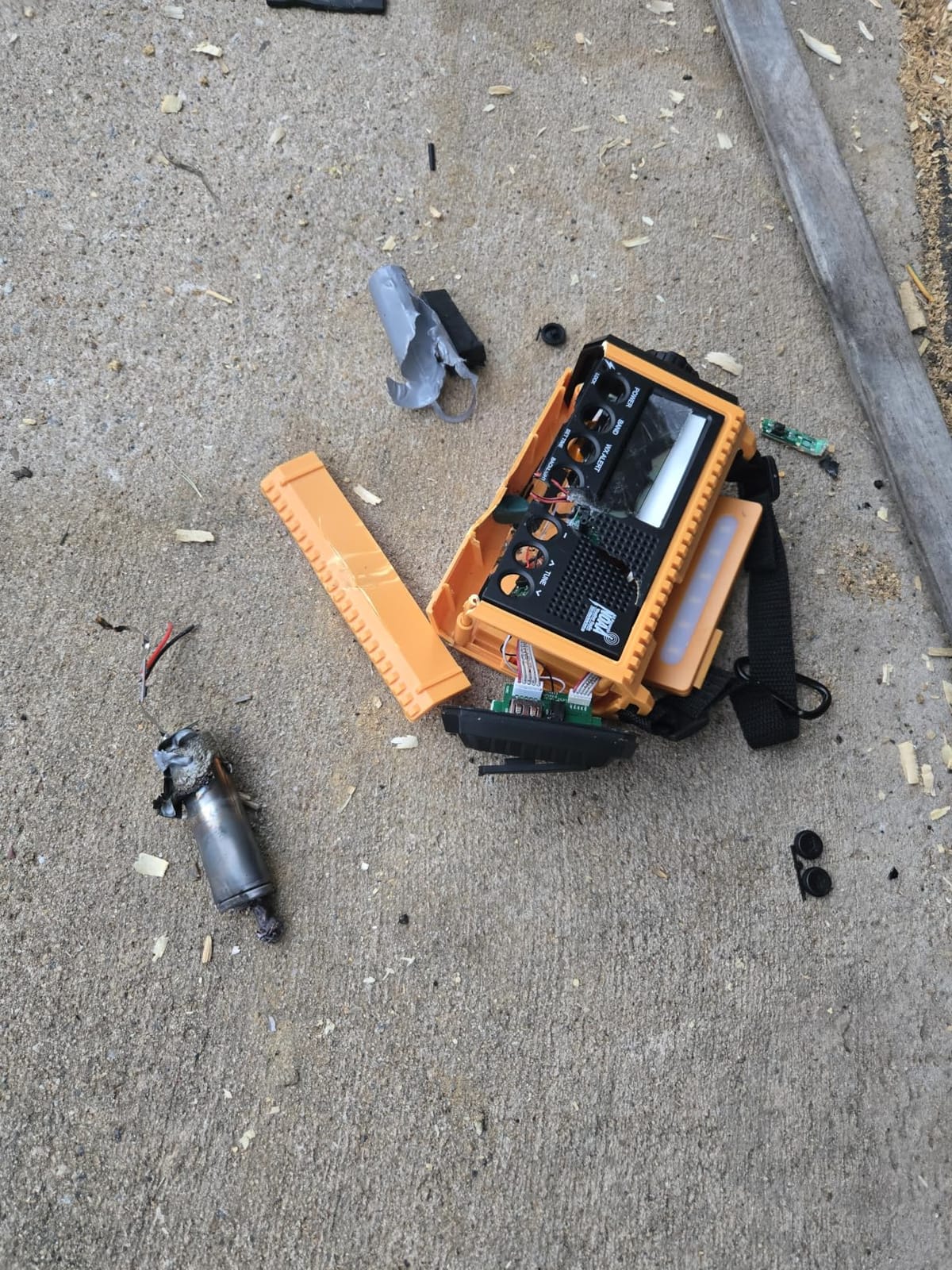
What holds up when the power is out
The USB in and out ports are the detail that turns this from an emergency radio into a kit hub. You can run it from a power bank and you can charge a phone from it, and at about 1.2 lb with a headphone jack it stays comfortable in a hand for a long listening session.
Reviewers also like the loud SOS siren with the flashing red light for signalling, and the compass that clips to the included strap for basic orientation.
Where it falls short
Buy it for band coverage and battery options, not for shortwave reception quality. The antenna is the limiting factor here, and if weak signal work is your goal you should step up to the C. Crane instead.
It is also not a device you leave in the rain on a tent fly. IPX3 covers splash and fog, not immersion, so keep it under cover.
2. Kaito KA500 Voyager Pro – Best Value Shortwave Pick
Kaito KA500 5-way Powered Emergency AM/FM/SW NOAA Weather Alert Radio with Solar,Dynamo Crank,Flashlight and Reading Lamp, Color Black
Six-way power
14.5 inch telescopic antenna
AM FM 2-band SW NOAA
PEAS alert system
USB output
Pros
- Six power options including crank solar and 3 AA
- 14.5 inch telescopic antenna with signal strength LED
- Seven pre-programmed NOAA channels with PEAS alerts
- USB output charges phones GPS and cameras
- Water-resistant impact-resistant ABS housing
Cons
- AC wall adapter sold separately and not included
- No SSB or LSB reception so no two-way utility traffic
- SOS function is a red light rather than an audible siren
The KA500 is the one that shows up in most prepper forum recommendations, and after spending time with it the reason is obvious: the antenna. It extends to 14.5 inches and carries an LED signal strength indicator, so you can tune a station by watching the meter instead of guessing. That single feature matters more for shortwave than almost anything else on a spec sheet.
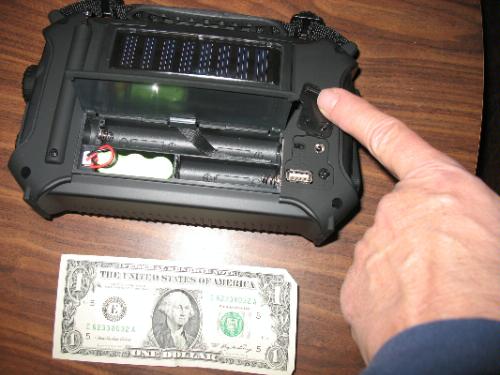
Power comes from six directions, including a hand crank, a solar panel, three AA cells, USB input, AC input and a built-in NiMH pack. It tunes AM, FM, two shortwave bands and seven pre-programmed NOAA channels with PEAS severe weather alerts.
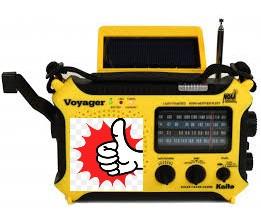
The USB output doubles as an emergency charger, which surprised us until we tried to top up a phone with the grid down. It has a five-LED reading lamp, an LED flashlight and a red SOS beacon, all in a water-resistant impact-resistant ABS housing at 1.3 lb.
Two things to know before you buy. The AC wall power adapter is not in the box, and the SOS function is a flashing red light rather than an audible alarm, so it will not wake you. There is also no SSB reception, which puts it firmly in the AM shortwave camp.
Why the antenna decides the reception
Shortwave signals arrive weak and need a long whip to couple into. The 14.5 inch telescopic whip on the KA500, combined with the signal strength LED, is the reason owners report pulling stations in that smaller antennas simply cannot reach.
The LED meter is also a training tool. You can see a station fade and reposition the radio, which is exactly the behaviour that makes night-time shortwave enjoyable rather than frustrating.
Where it falls short
If your priority is hearing amateur and utility two-way traffic, this is the wrong radio. SSB and LSB reception is absent, and you will need the C. Crane SSB 2 for that.
Plan on buying the wall adapter separately if you intend to run it on mains power at home, and keep NiMH or AA spares in your kit.
3. Eoxsmile CR1009 NOAA Radio – Best for Loud Audible Alerts
Emergency Weather Radios Portable AM FM SW Solar Hand Crank Battery Powered
5000mAh battery
116dB SOS alarm
NWS certified alerts
AM FM SW 7-19 MHz
Under 15 oz
Pros
- NWS certified alerts trigger a 9 second SOS alarm
- 5000mAh battery plus solar crank USB-C and 3 AAA
- 116dB SOS alarm with red flashing light
- USB output can charge more than one phone
- Under 15 oz for go-bag and hiking use
Cons
- Full charge gives about 13 hours of FM listening
- Solar and crank only maintain charge rather than restore it
- No SAME county code programming
- Plastic housing with no stated water rating
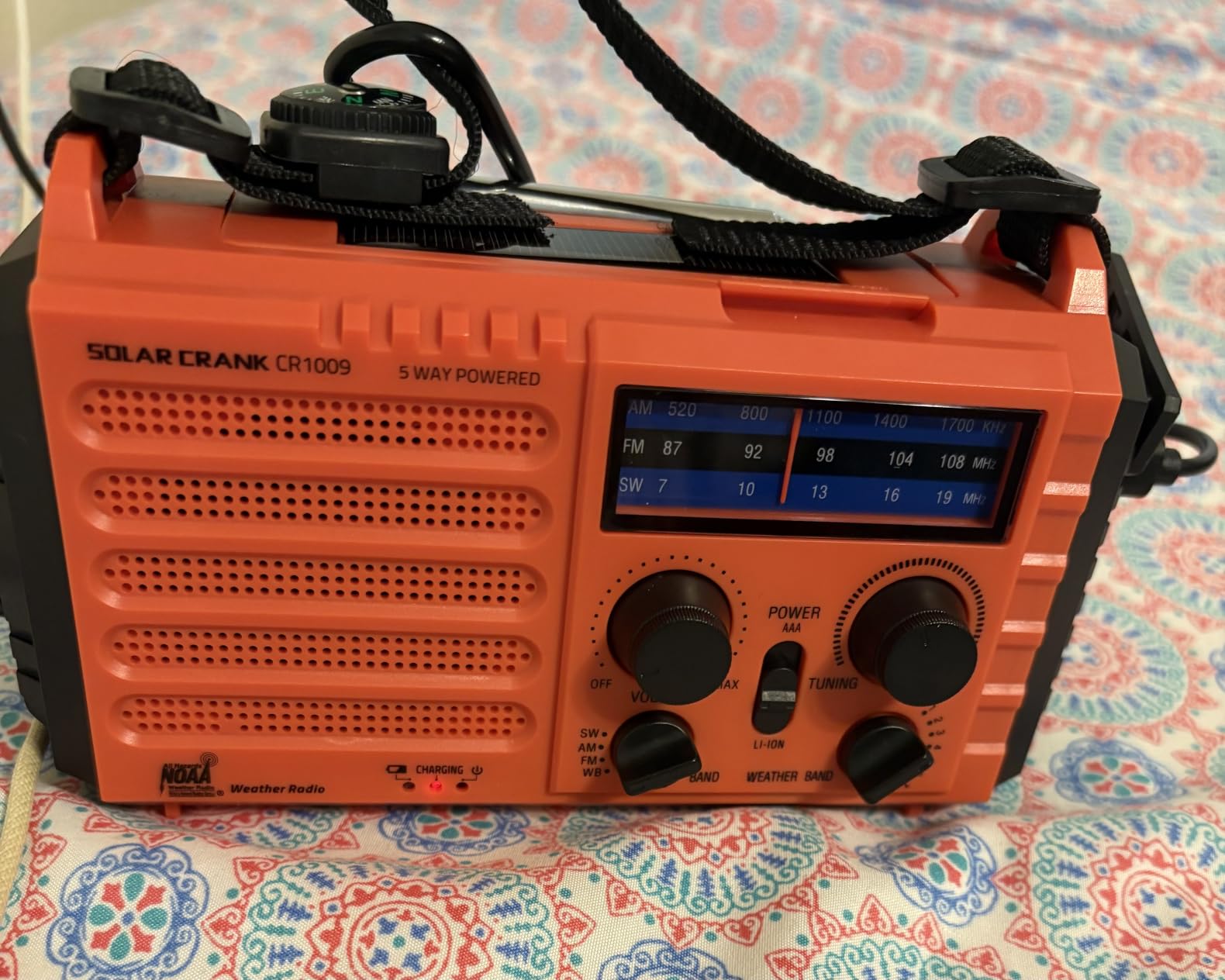
The Eoxsmile is the alarm specialist. Its NWS-certified NOAA alerts trigger a nine-second loud SOS alarm with a flashing red light, and owners confirm it fires even in sleep mode, which is a detail that turns a silent overnight storm warning into something you actually wake up for.
It runs a 5000mAh battery with solar, hand crank, USB-C input and three AAA backups, and it covers AM 520-1710 kHz, FM 87-108 MHz, shortwave 7-19 MHz and seven NOAA weather channels. There is a telescopic antenna, a 3.5mm headphone jack, a 116dB alarm button and a compass on the strap.
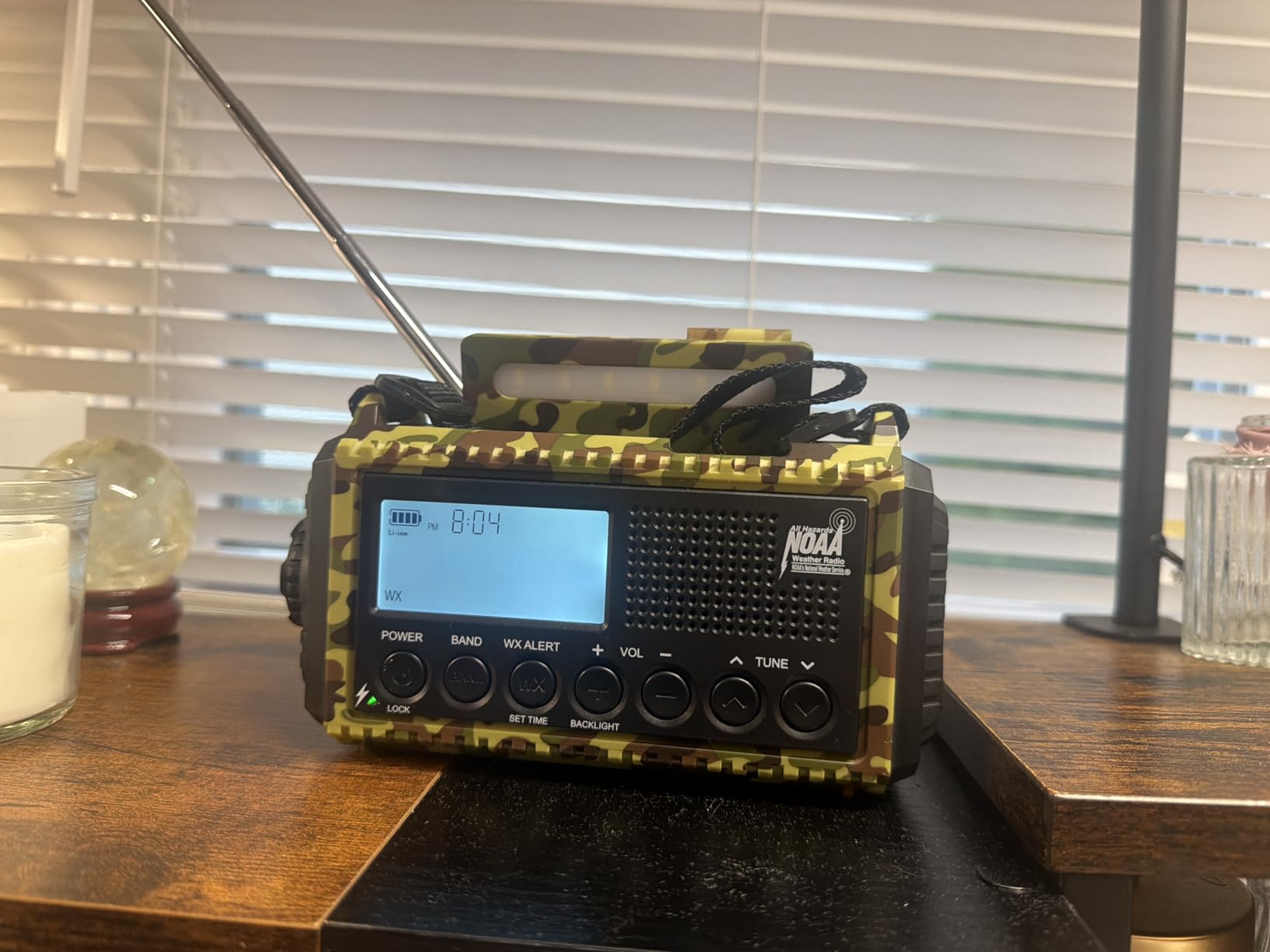
The adjustable 3W side flashlight and the two-brightness reading lamp built into the solar panel are the other features we used constantly. At under 15 oz it is one of the lightest units here, which matters when it is riding in a go-bag rather than sitting on a shelf.
The honest limitation is runtime. A full charge gives roughly 13 hours of FM listening, shorter than the other 5000mAh units in this group. Solar and crank act as top-ups rather than a way to recover a dead battery, and there is no SAME county code programming, so alerts are not limited to your own area.
Who this radio suits
If the people who need the warning are asleep, or the radio is in another room, or your hearing is not what it was, volume is a feature. This is the loudest alert in the group and buyers single it out for that reason.
The five power sources also make it a good candidate for a vehicle kit, where USB-C is often the only outlet available.
Where it falls short
Thirteen hours of runtime is the weak point. If you are planning on listening through a multi-day outage on battery alone, the Raynic or the Greadio will serve you better.
The lack of a water resistance rating and the plastic housing also make it a fair-weather companion rather than a storm-shelter radio.
4. Kaito Voyager Pro KA600 – Most Versatile With Longwave
Kaito Voyager Pro KA600 Digital Solar Dynamo Hand Crank AM/FM/LW/SW & NOAA Weather Emergency Radio with Flashlight, Reading Lamp,Smart Phone Charger & RDS and Real-Time Alert, with AC Adapter, Black
Seven bands with longwave
Digital tuning display
AC adapter included
USB phone charging
16 oz
Pros
- Seven-band coverage including longwave
- Digital display shows frequency battery and signal strength
- AC power adapter included in the box
- High-power flashlight plus adjustable reading lamp
- Solar crank and rechargeable battery cover multiple scenarios
Cons
- Carries the highest price among the hand-crank models here
- 4.2 average with 8% one-star reviews
- Bulkier at 9.5 inches long than smaller hand-crank models
- No SSB despite the premium positioning
The KA600 is the same idea as the KA500 with a digital brain and one extra band. It adds longwave coverage, which no other unit in this roundup offers, and the display shows frequency, battery level and signal strength rather than relying on an analog dial and a separate meter.
It is also one of the few hand-crank radios that ships with the AC adapter in the box, which removes the most common complaint on this category. Power comes from solar, dynamo crank, the rechargeable battery and three AA backups, and it charges phones over USB.
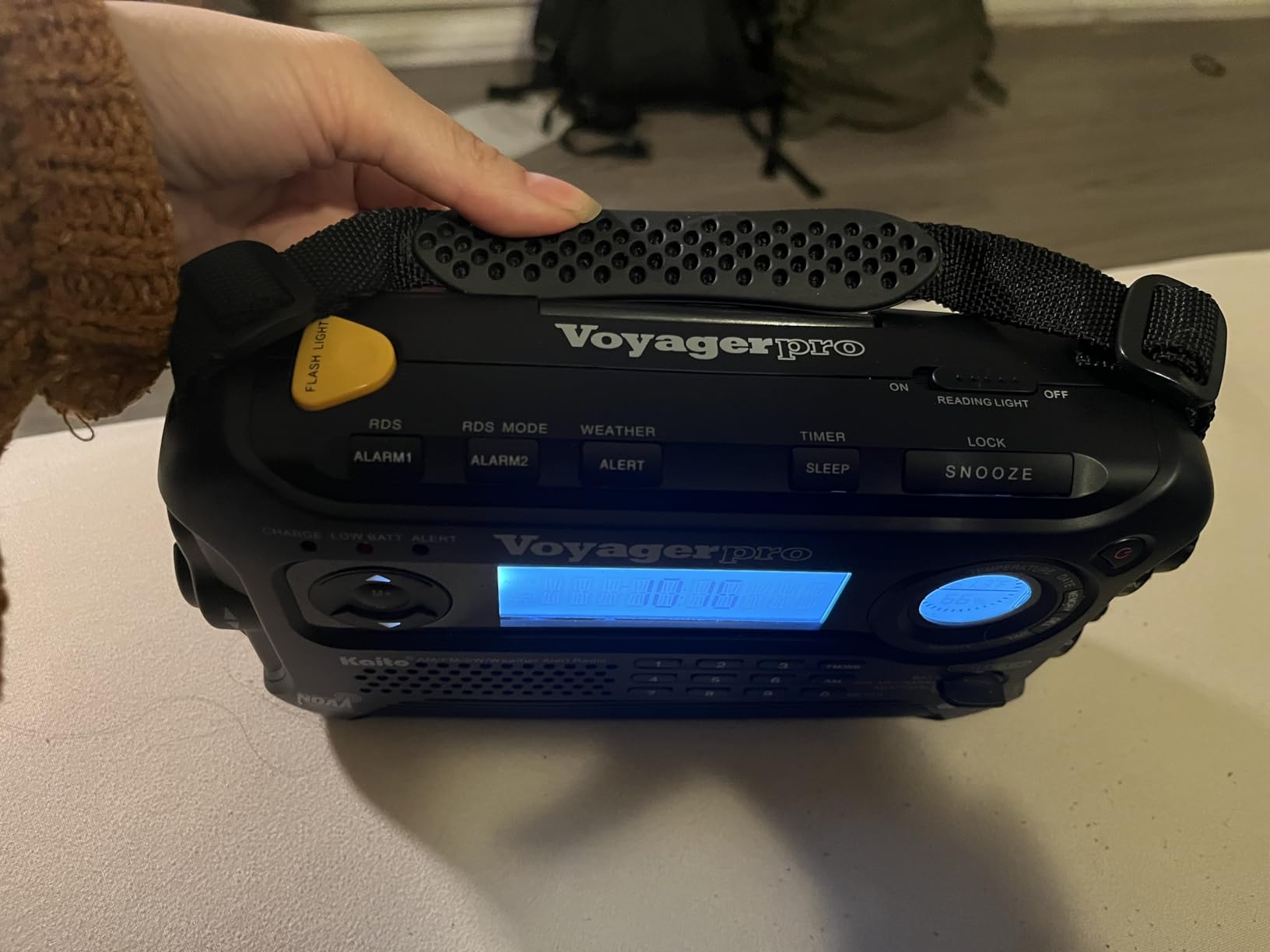
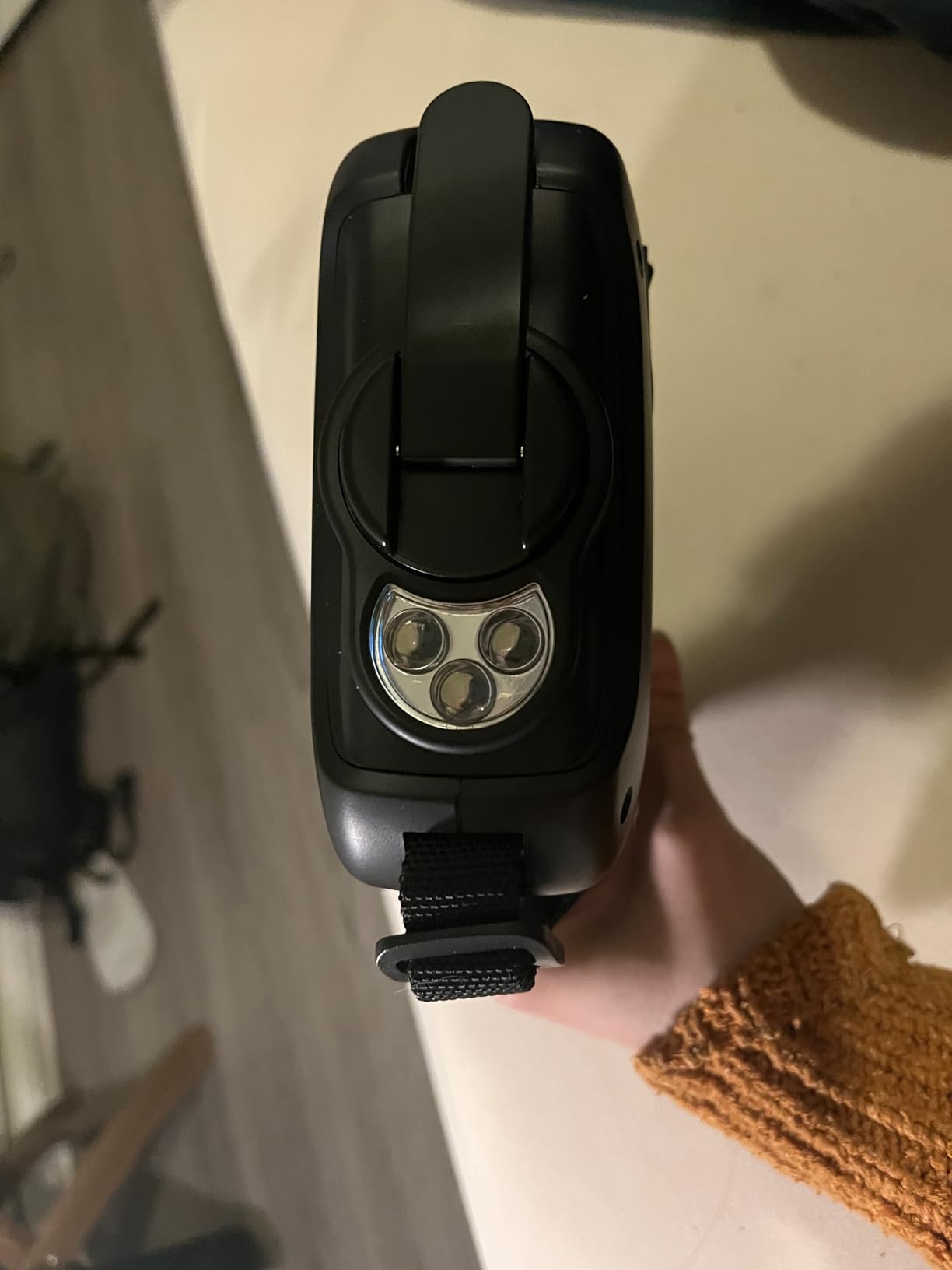
The flashlight and adjustable reading lamp handle the outage-at-night problem well, and RDS on supported FM stations shows station names instead of frequencies. At 16 oz it is still light for the feature set, though the 9.5 inch body is longer than the smaller hand-crank units.
The rating tells its own story. At 4.2 across roughly 1,450 reviews with 8% one-star responses, it sits below the KA500, and reviewers report durability and reliability complaints pulling that average down. There is no SSB reception despite the premium positioning.
What the extra band actually gets you
Longwave sits below the AM broadcast band and carries a handful of utility and time signal stations that AM cannot reach. In practice it is a curiosity rather than a workhorse, but it is the reason to choose this model over a KA500 if you enjoy exploring the bands.
The digital tuning display is the more practical upgrade. Entering an exact frequency for a target station beats hunting for it with a thumb.
Where it falls short
The 4.2 rating and the 8% one-star share tell you this is not the most dependable unit in the group, and the KA500 covers almost the same ground for less money with a far stronger review record.
Longwave plus a larger body is a lot of extra to carry if the shortwave performance is otherwise similar, so weigh the digital display against the bulk before committing.
5. C. Crane CC Skywave SSB 2 – Best for Real Sideband Listening
C. Crane CC Skywave SSB 2 AM, FM, Shortwave, NOAA Weather + Alert, Scannable VHF Aviation Band and Single Side Bands Small Battery Operated Portable Travel Radio Includes SW Wire Antenna Adapter
Single sideband reception
1711-29999 kHz shortwave
400 memories
Aviation band scan
60-70 hours on 2 AA
Pros
- Only radio here with true single sideband reception
- Shortwave 1711-29999 kHz plus scannable VHF aviation band
- Direct frequency entry auto scan and 400 memory presets
- 23 ft reel shortwave antenna and antenna jack included
- Runs 60-70 hours on two AA batteries at 6 oz
Cons
- No hand crank solar panel or rechargeable battery so AA cells are the only option
- No phone charging Bluetooth playback or flashlight
- Sideband and aviation features add a learning curve
Everything else on this list is an AM shortwave receiver, and that is the ceiling on what you can hear. The CC Skywave SSB 2 decodes single sideband and lower sideband, which opens utility stations, maritime traffic and amateur HF nets, plus scannable VHF aviation band with ten dedicated memories. No phone or tablet does this.
The included 23 ft reel antenna changes the listening experience more than the tuner does. With a long wire and the shortwave antenna jack, weak signals become usable in a way that a telescopic whip never allows.
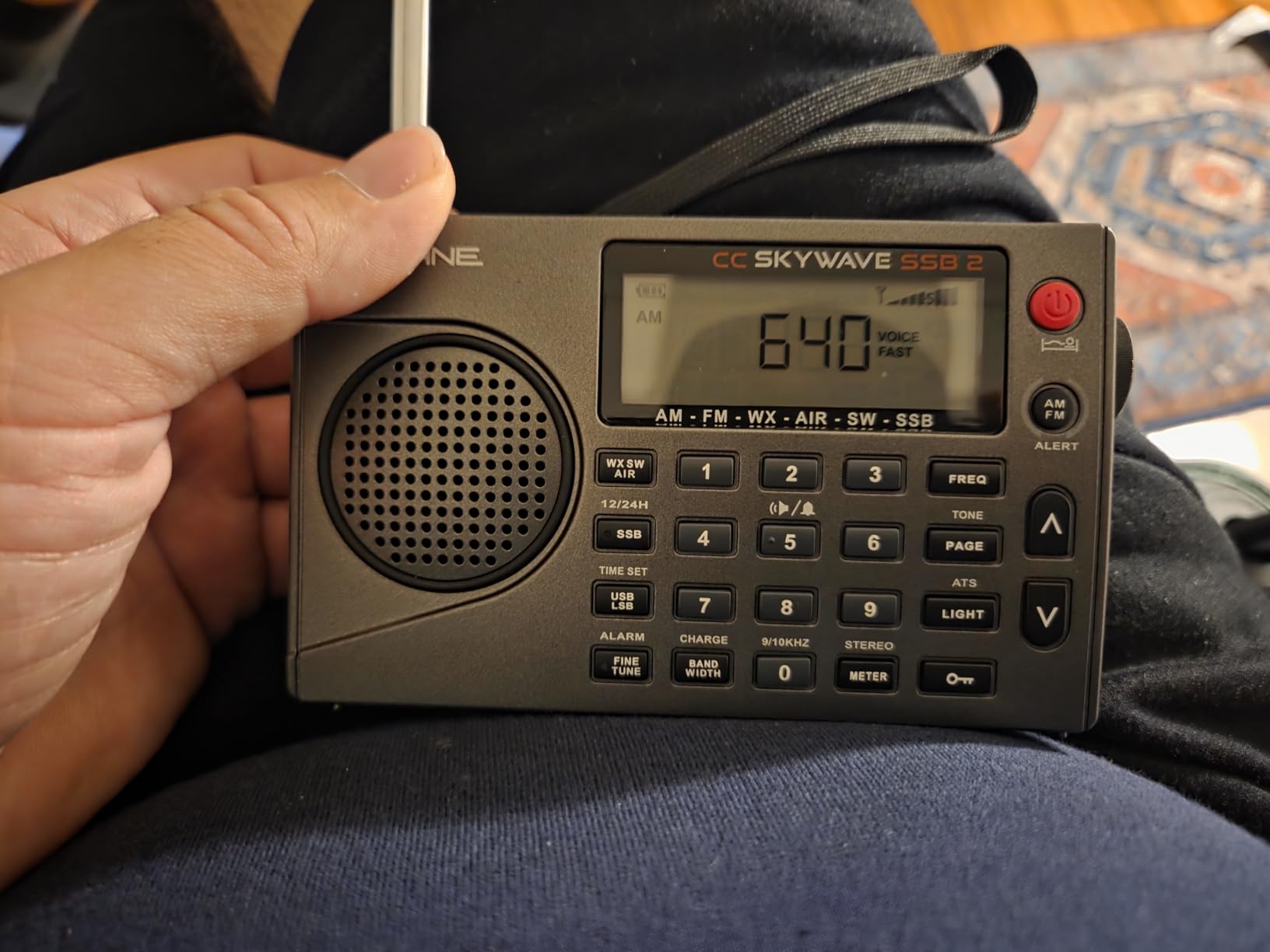
Direct frequency entry, auto scan and store, 400 total memories and selectable fast or fine tuning give you real control. It runs about 70 hours on earbuds or 60 on the speaker from two AA cells, weighs 6 oz and folds out a back stand, with earphones and a carry case in the box.
The trade-off is that none of the modern conveniences are here. No hand crank, no solar panel, no rechargeable battery, no phone charging, no Bluetooth playback and no flashlight. It is an AA-powered receiver and that is the whole design brief.
Why sideband is the real upgrade
AM shortwave broadcasts voice in a wide channel with a lot of noise around it. SSB squeezes the same voice into a narrow slice, which recovers weak signals that would be unreadable on AM. That is why this radio stays useful where cheaper sets fall to static.
Fine tuning matters here too. Sideband signals sit off the displayed carrier frequency, so the fast and slow tuning modes are not a gimmick, they are how you actually find a station.
Where it falls short
This is a listening tool, not a survival radio. If the power is out and there are no AA batteries anywhere on the property, every function on it is dead.
The learning curve is real. Reviewers note that sideband and aviation features take practice, so budget an evening with the manual before you need the radio at three in the morning.
6. Greadio R12 – Best for Water Resistance and Battery Bulk
Greadio Portable Emergency Shortwave Radios, AM FM NOAA Weather Radio
14800mWh power bank
IPX3 waterproof housing
Crank solar and Type-C
Extra-long telescoping antenna
Pros
- Largest power pack in the group at 14800mWh that doubles as a phone charger
- IPX3 waterproof rating which is rare on hand-crank shortwave radios
- Extra-long telescoping antenna for the best shortwave reception in its class
- Bluetooth 5.4 with white noise removed and sleep mode disabled
- Military-style gift box and hand strap included
Cons
- Only 249 reviews so the long-term record is thin
- Type-C charging adapter not included
- Bluetooth range limited to about 26 feet
- No sideband reception despite the shortwave emphasis
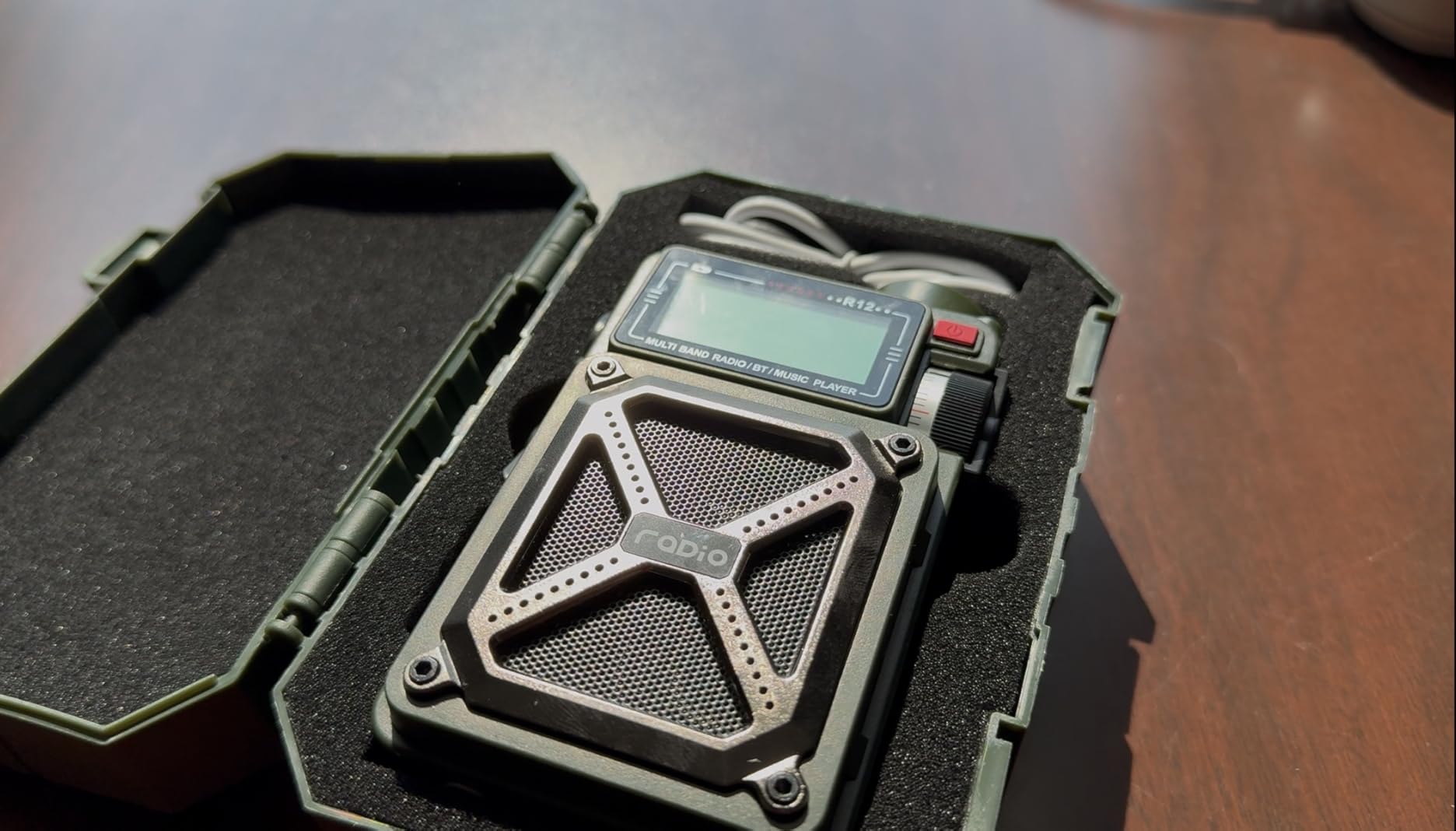
The Greadio packs the biggest energy reserve here. Its 14800mWh rechargeable power bank, rated at 4000mAh, doubles as a phone charger with USB output, and it handles crank, solar and Type-C charging. That combination means a dead phone and a dead radio are one cable apart from a fix.
It is also the only unit in this roundup with a stated IPX3 waterproof housing, which matters if you keep a radio in a garage, a vehicle or a wet-weather go-bag. The extra-long telescoping antenna is tuned for better shortwave reception than the smaller whips on competing units.
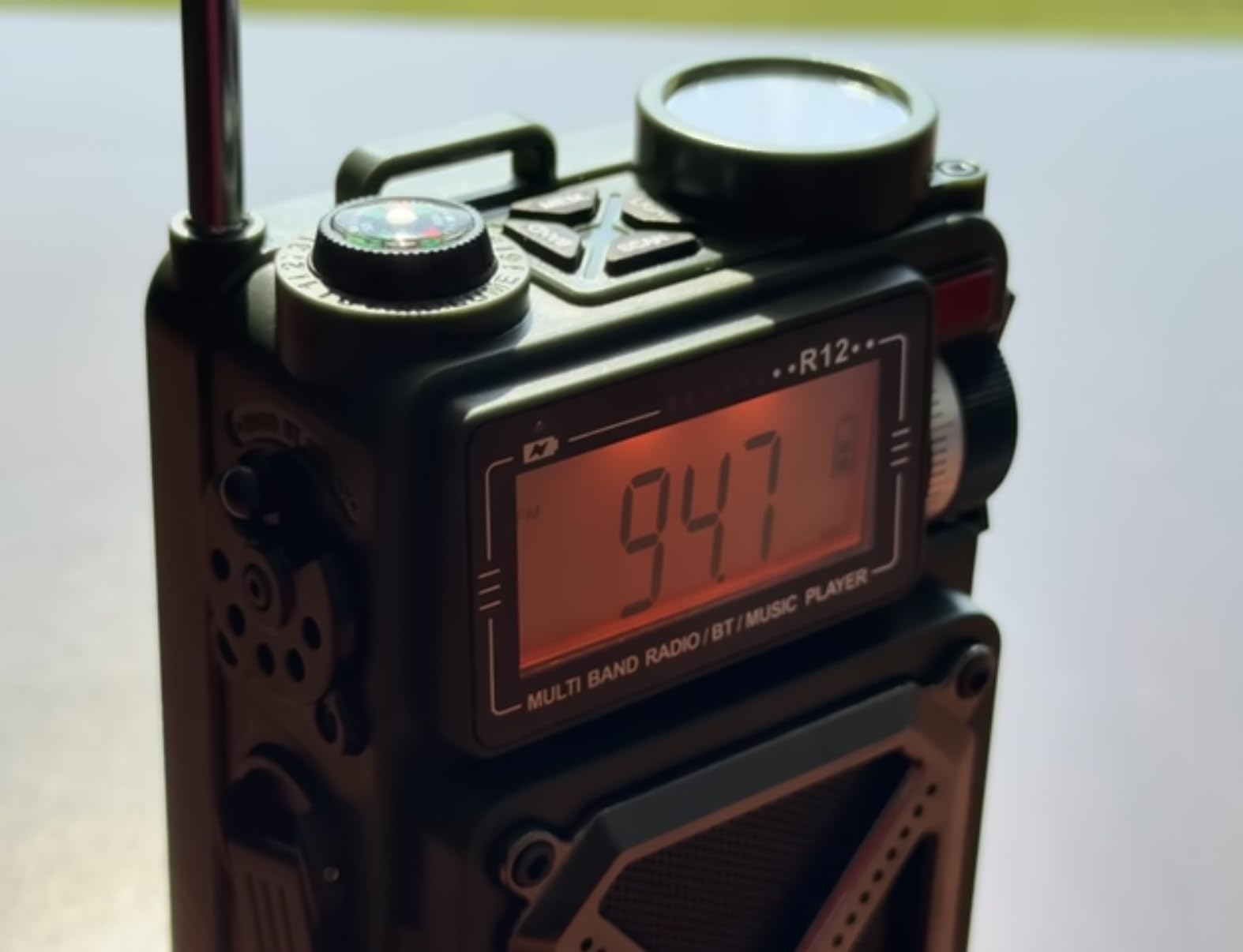
The Bluetooth 5.4 implementation is unusually clean. Reviewers note that the white noise has been removed and sleep mode disabled, so streaming audio is clearer and simpler than on most radios that bolt Bluetooth on as an afterthought.
The caveat is the review base. At about 249 reviews this is a newer listing, and a shorter record means less evidence about how the battery and solar panel hold up over years. The Type-C adapter is not in the box and Bluetooth range stops at roughly 26 feet.
Why the water rating changes the buying decision
Every other hand-crank unit in this group is water-resistant or unrated. If your radio lives on a porch, in a car boot or in a pack that gets rained on, that difference decides how much attention the rest of the kit needs.
The 12-in-1 function set, covering radio, Bluetooth, USB and TF playback, SOS siren, flashlight and charger pack, means one box covers several jobs.
Where it falls short
With the fewest reviews among the well-rated units, we would treat this as a strong second radio rather than your single point of failure.
Bluetooth at 26 feet is short for a house, and there is no sideband reception, so this stays in the AM shortwave camp.
7. Raddy RE40 – Best for Everyday Listening With Solar Charging
Raddy RE40 Portable Shortwave Radio FM/AM/SW/WB Receiver, 4000mAh Retro Emergency Radio with BT/USB/TF and NOAA Alerts, Pocket Radio with USB-C Rechargeable
4000mAh battery
USB-C crank and solar
Bluetooth and TF playback
24 hour runtime
18-month warranty
Pros
- Solar panel reported to genuinely charge the battery
- 4000mAh gives up to 24 hours and can recharge a phone
- Shortwave reception improves markedly with an external wire antenna
- Bluetooth speaker and TF card modes make it usable daily
- One of the few units that works as an everyday MP3 player
Cons
- No sideband so ham and utility two-way traffic is out of reach
- Built-in compass is thrown off by the internal magnet
- Reported firmware freeze after switching from Bluetooth back to radio mode
- Power button on a corner is easy to trigger
The Raddy RE40 answers the crank-versus-reception tension in an unexpected way. It has a real hand crank and solar panel that owners report genuinely charging the battery, and it also runs up to 24 hours on a 4000mAh pack that can also recharge a phone. Rare among the cheaper units.
Shortwave reception improves markedly when you clip an external wire to the telescopic whip, which is the cheapest antenna upgrade available anywhere in this list. Owners also like that the 3-position function selector turns it into a Bluetooth speaker or TF card player.
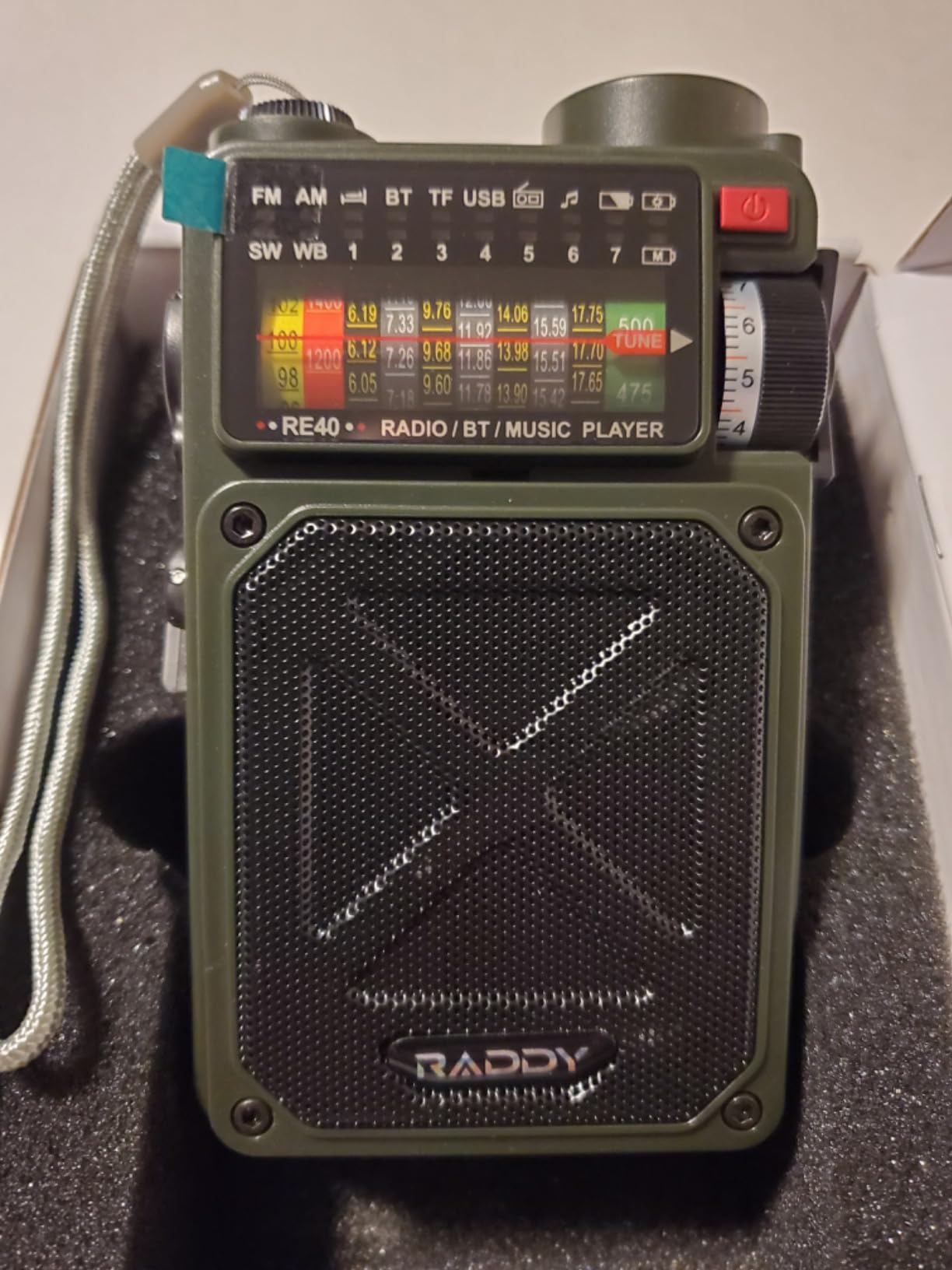
That everyday usability is why it stands out. A radio you actually use in normal life is a radio you will still know how to operate at the moment you need it, which is a real argument for prepping.
The drawbacks are specific. The built-in compass is thrown off by the internal magnet, so north reads toward the solar side and it should not be used for navigation. Some owners report a firmware freeze after switching from Bluetooth back to radio mode, and the corner-mounted power button is easy to hit by accident.
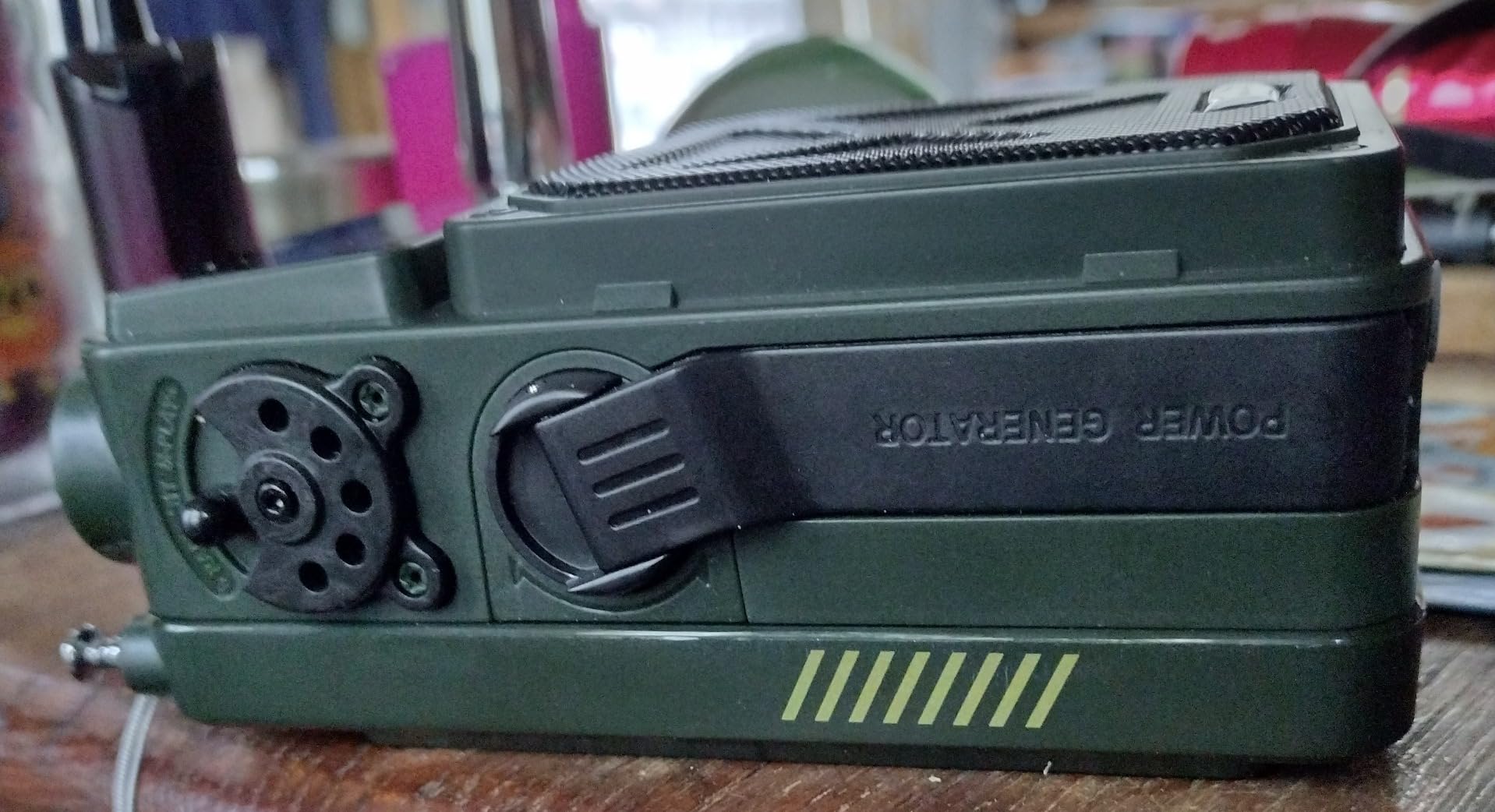
Why solar actually matters here
Most integrated solar panels on budget emergency radios are decoration. On this one reviewers describe a trickle that genuinely tops the battery up over a day or two of daylight, which is a genuine offline power source when the grid is gone.
The 18-month warranty is also longer than the one-year cover most competitors in this group offer.
Where it falls short
Ignore the compass entirely. If you need navigation, carry a dedicated one rather than trusting a reading from a magnetised housing.
There is no sideband reception, and the shortwave clip-on antenna referenced in the listing is not always included, so check the box contents before you rely on it.
8. XHDATA D221 – Best Low-Cost Four-Band Go-Bag Radio
XHDATA D221 NOAA Weather Radio Portable AM FM Shortwave Radio Receiver
Four bands including NOAA
Shortwave 5.6-22 MHz
2 AA battery power
125 g
One year after-sales service
Pros
- Four bands including NOAA and shortwave at a very low cost
- Runs on 2 AA batteries which are leak-proof and universally available
- Strong NOAA weather band performance with multiple channels picked up
- 125 g and 125 x 74 x 30 mm so it fits a pocket or small go-bag
- Simple turn-dial operation with a headphone jack and kickstand
Cons
- No sideband reception so no SSB utility or amateur traffic
- Volume and tuning knobs are hypersensitive with loud power-up
- DSP chip can clip strong signals needing constant retuning
- Shortwave band is cramped on the analog dial
- Not rechargeable and not water resistant with no flashlight
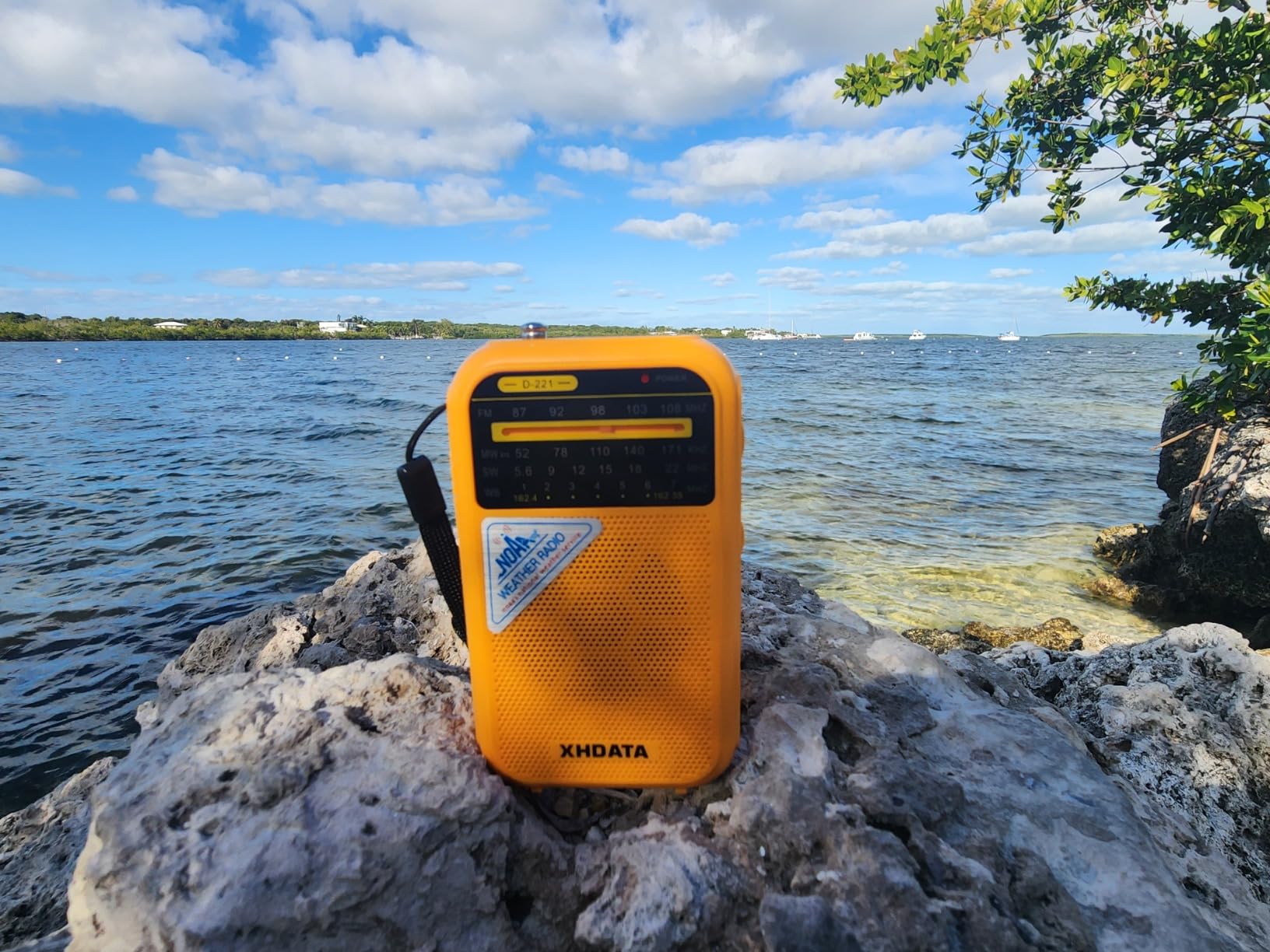
The XHDATA D221 does the least flashy job in this roundup and does it cheaply. Four bands including NOAA weather, a DSP chip, shortwave from 5.6 to 22 MHz and 2 AA battery power in a 125 g body is a rare combination for what this costs.
Running on two AA cells is the underrated feature. Cells are leak-proof, cheap and available in almost any shop on any street, which makes this the radio most likely to still work years from now without a charge.
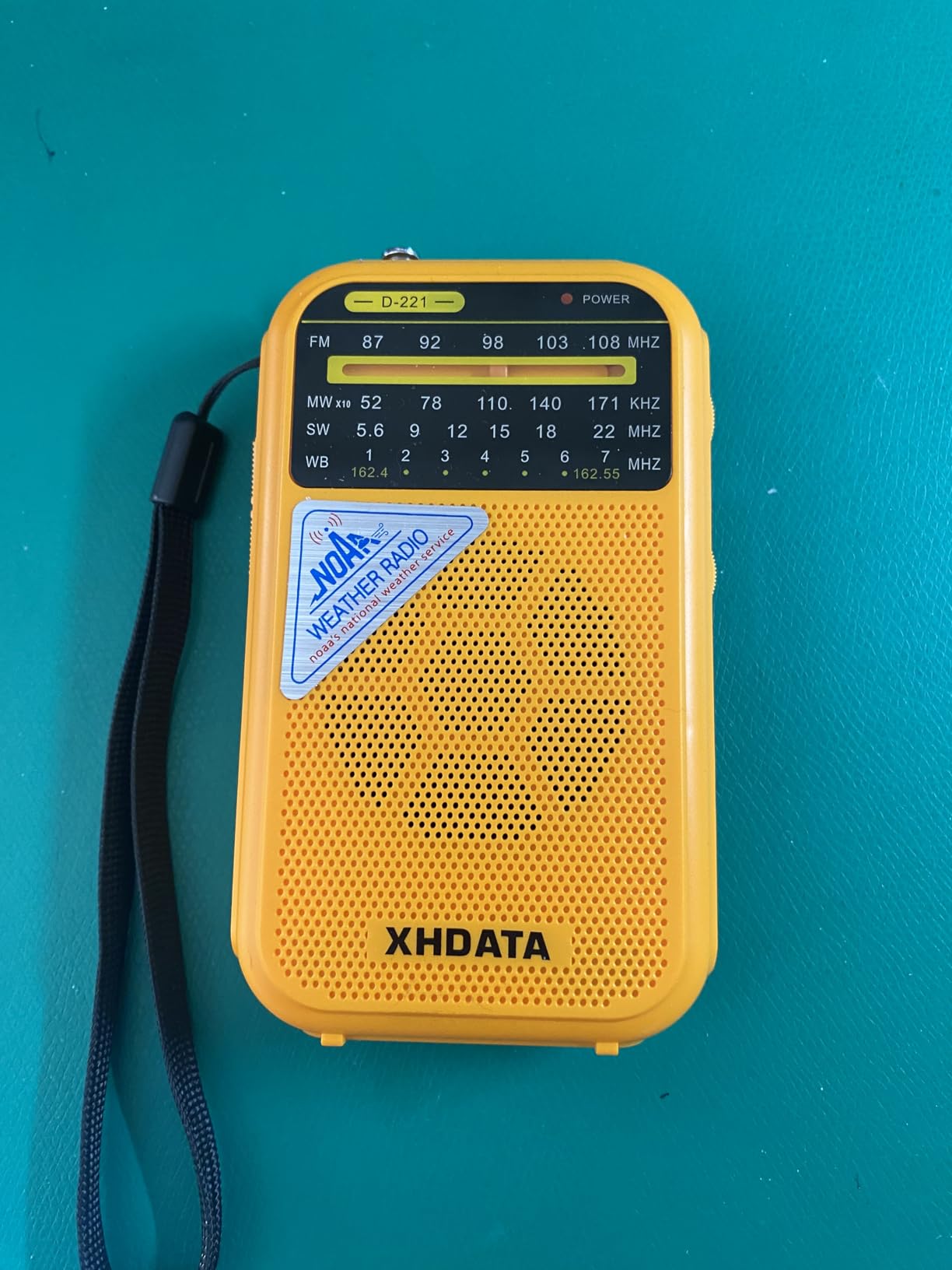
Buyers report picking up multiple NOAA weather channels, which is where the DSP chip pays off. At 125 by 74 by 30 mm with a back clip feel and a kickstand, it fits a jacket pocket, a purse or a small go-bag without being noticed.
The controls are the frustration. Volume and tuning knobs are hypersensitive, and the volume blasts loud on power-up. The DSP chip can clip strong local signals, forcing constant back-and-forth tuning, and the 5.6 to 22 MHz shortwave range is cramped on an analog dial.
Why AA power beats a built-in battery
Lithium cells left in a drawer for years lose charge and can swell. AA cells do not, and you can buy a hundred of them on any high street on the day you need them. For a radio that may sit untouched for five years, that is the deciding factor.
Nothing needs learning either. Turn the dial, tune the band, listen. That simplicity is worth more in an emergency than a menu system.
Where it falls short
No sideband, no rechargeable battery, no flashlight, no water resistance and no solar. It is a pure receiver and nothing more.
Handle the volume knob gently on power-up, and expect to work at the edge of the shortwave dial rather than typing in a frequency.
9. Emgykit R11 – Best for Bluetooth Audio and Channel Memory
Emergency Radio Hand Crank Solar – NOAA/AM/FM Shortwave Radio for Camping
4000mAh battery
32 hours playback
Bluetooth 5.0 with 5W speaker
210 stored channels
Thermal blanket included
Pros
- Bluetooth 5.0 playback with a built-in 5W speaker
- Digital auto-scan stores 70 channels per band and 210 total
- 4000mAh battery gives up to 32 hours per Type-C charge
- 7 natural white noise presets and a 10-70 minute sleep timer
- 120-lumen flashlight and compass with a thermal blanket in the box
Cons
- Digital search is automated scanning rather than manual tuning as advertised
- No water resistance rating stated for an outdoor survival product
- Heavier than comparable hand-crank radios at 0.53 kg
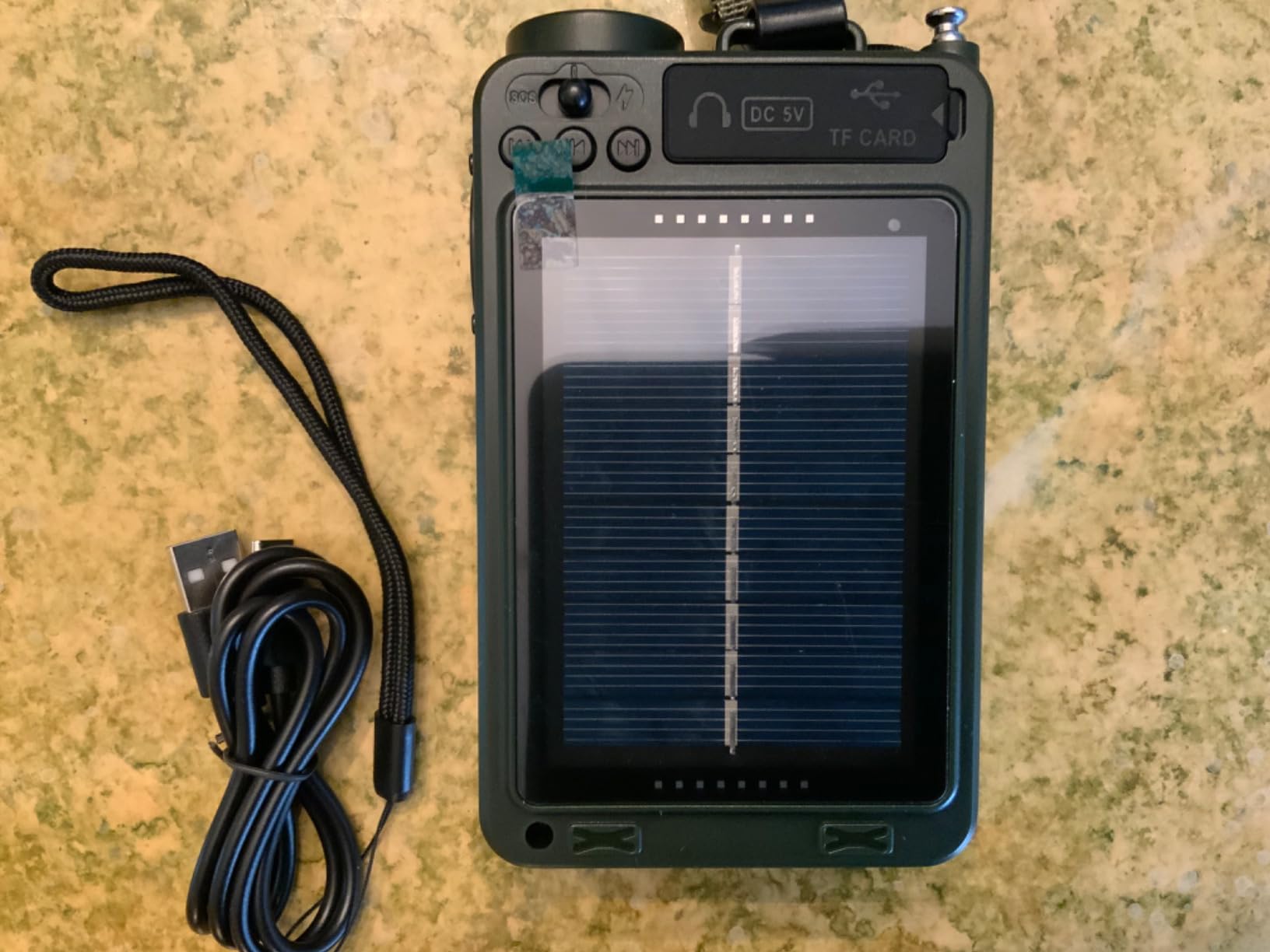
The Emgykit R11 treats a shortwave radio like an audio device first. The Bluetooth 5.0 pairing drives a 5W magnetic speaker that is genuinely loud for a hand-crank set, and there is a USB drive and TF card slot for playback alongside normal radio reception.
The 4000mAh battery is rated for up to 32 hours of playback per Type-C charge, which is the longest stated runtime in this group. Solar, hand crank and USB-C all top it up.
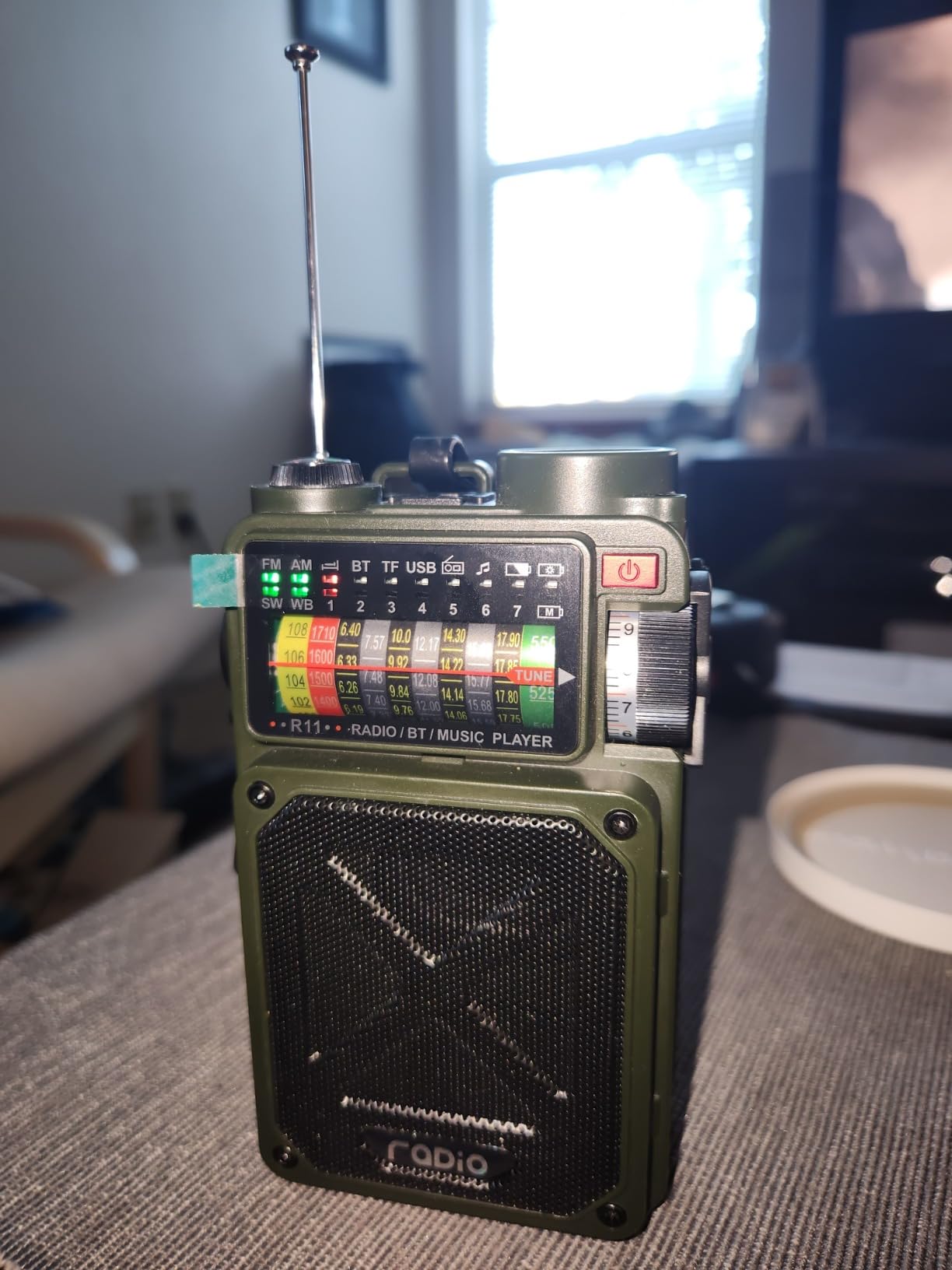
Memory capacity is the other draw. Auto-scan stores up to 70 channels per band, 210 in total, and seven natural white noise presets plus a 10 to 70 minute auto shut-off make it easy to fall asleep to a broadcast rather than stay awake to it.
Owners also like what comes in the box: a 120-lumen flashlight, a compass, a thermal blanket, a Type-C cable, a carry strap and a gift box. The reservation is that the advertised digital search is really automated scanning and storage, not manual electronic tuning, and no water rating is claimed.
Why stored channels matter in an outage
Scanning for a station wastes battery and wastes the short minutes you have when an official broadcast starts. Saving your local NOAA channels, a national AM news station and a shortwave time signal to memory means you are one button away from each one.
210 channels across AM, FM and shortwave is enough room for a personal station list rather than a factory default.
Where it falls short
At 0.53 kg it is the heaviest hand-crank radio here, so it is a home or vehicle radio rather than a hiking companion.
Automated scanning is not the same as tuning, and the absence of any water rating means it stays indoors when the weather turns.
10. Jazmm 4-Band 213 – Best Pocket-Sized Shortwave Receiver
AM FM Shortwave Radio with NOAA Weather Alert,1250mAh Rechargeable Battery
Shortwave 4.75-21.85 MHz
DSP reception chip
1250mAh 10-12 hours
5W speaker
TF and Bluetooth
131 g
Pros
- Four-band coverage to 21.85 MHz shortwave via a DSP chip
- 5W speaker with 6 EQ modes praised as clear for the size
- 1250mAh rechargeable battery avoids leak-prone disposable cells
- Bluetooth 5.4 speaker mode and TF card playback up to 128G
- Back clip and wrist strap for pocket or belt carry at 131 g
Cons
- No hand crank solar panel or external power input so it is not a true no-grid radio
- 1250mAh battery gives 10-12 hours and needs recharging about monthly
- Volume is step-based and the mode-change voice announcement is loud
- AM tuning steps in 10 kHz increments and TF playback ignores folder names
- Not water resistant and the stand is unstable
The Jazmm 213 is a proper four-band receiver in a genuinely pocketable body. At 131 g and 2.3 by 4 by 1.3 inches with a back clip and wrist strap, it is the radio you can carry every day without thinking about it, which is the point.
Reception runs through a DSP chip across FM 87-108 MHz, AM 520-1710 kHz, shortwave 4.75-21.85 MHz and the weather band at 162.400-162.550 MHz. The 5W speaker with six EQ modes is consistently praised as unusually clear for the size.
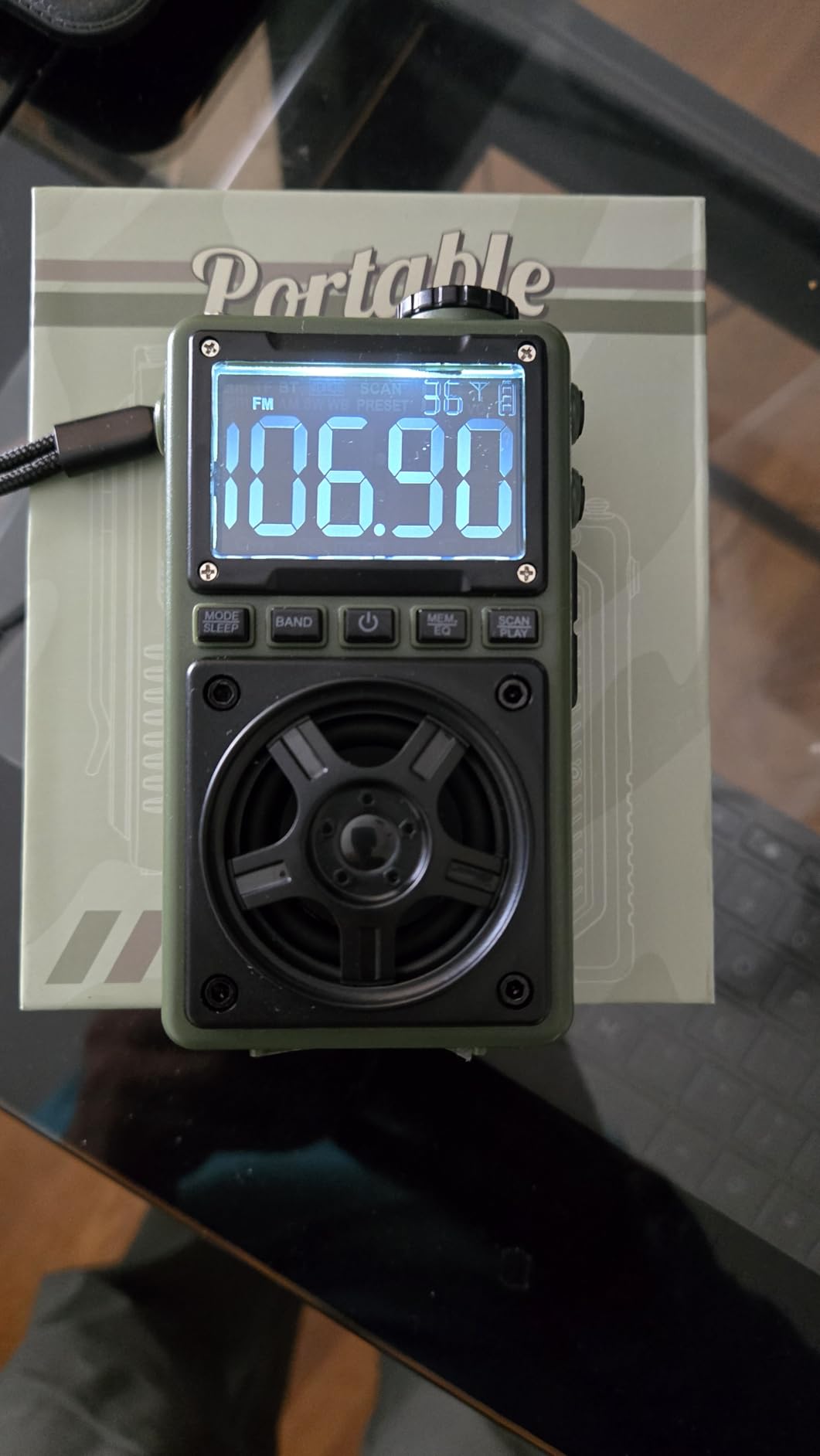
The 1250mAh rechargeable cell avoids leak-prone disposable batteries and holds 10 to 12 hours, with Bluetooth 5.4 speaker mode and TF card playback up to 128G across MP3, WMA, WAV, FLAC and APE. There are 100 preset stations and a 10 to 120 minute sleep timer.
The limitation is power. There is no hand crank, no solar panel and no external power input, so this is not a no-grid radio on its own. The small battery also means a recharge roughly every month during heavy use, and volume steps rather than a smooth control can be awkward.
Why carrying it every day matters
A radio that lives in a cupboard is a radio you have to learn under pressure. One on your belt every day is already familiar, already tuned to stations you know and already checked for a working battery.
The back clip and the shortwave coverage up to 21.85 MHz make it a good travel companion as well as a go-bag item.
Where it falls short
No crank and no solar is the headline caveat. Pair it with the D221, which runs on AA cells, and the pair covers both the everyday carry and the long-storage gap.
AM tuning steps in 10 kHz increments, TF playback ignores folder names, and the stand will not hold it upright reliably. It is also not water resistant.
11. Eton Odyssey – Best for RDS and a Backlit Display
Eton Odyssey Multi-Powered All-Band Bluetooth Emergency Radio with RDS, Red
AM FM SW and NOAA bands
RDS on FM
Digital tuner with backlit display and clock
Solar crank and 2000mAh
Pros
- Only unit here with RDS on FM plus AM shortwave and NOAA on a digital tuner
- Solar panel hand crank and 2000mAh rechargeable battery give three power paths
- Large backlit LCD display with a built-in clock for outage use
- Multi-LED flashlight with high low and flood settings plus SOS alarm
- USB output charges a phone and Bluetooth streams audio
Cons
- Heaviest and bulkiest unit here at 1.5 lb and 7.7 x 3 x 8.1 inches
- 2000mAh battery is smaller than the 4000-5000mAh packs on competitors
- Lowest customer rating in this roundup at 4.2 with 8% one-star reviews
- No shortwave sideband and no water resistance stated
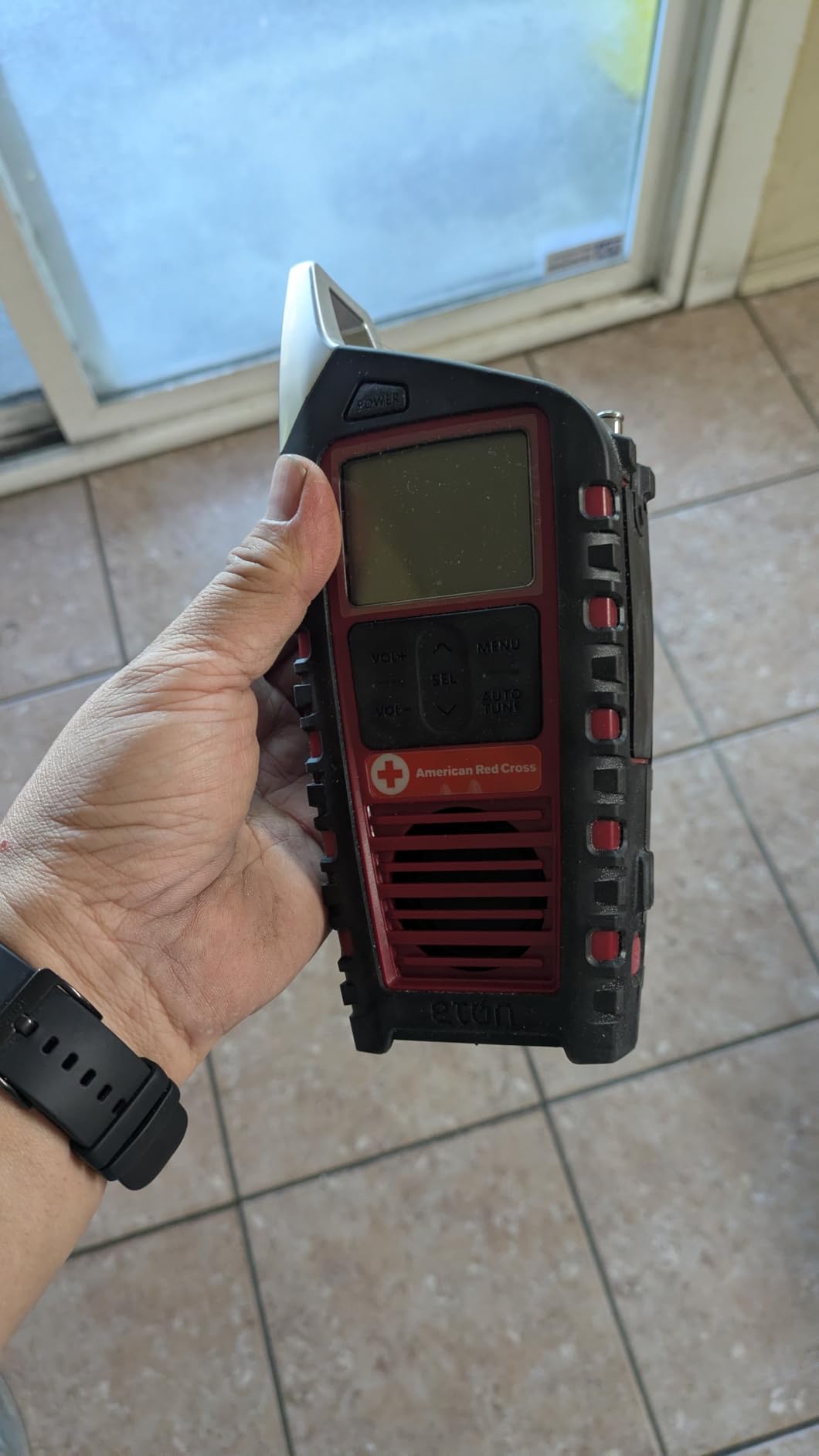
The Eton Odyssey is the one here with RDS, which displays the station name rather than a frequency on FM. On a digital tuner with a large backlit LCD and a built-in clock, that is the difference between finding a station and guessing at it during a power cut.
Power comes from solar, hand crank and a 2000mAh rechargeable battery. The multi-LED flashlight offers high, low and flood settings, there is an SOS alarm, USB output charges a phone and Bluetooth streams music.
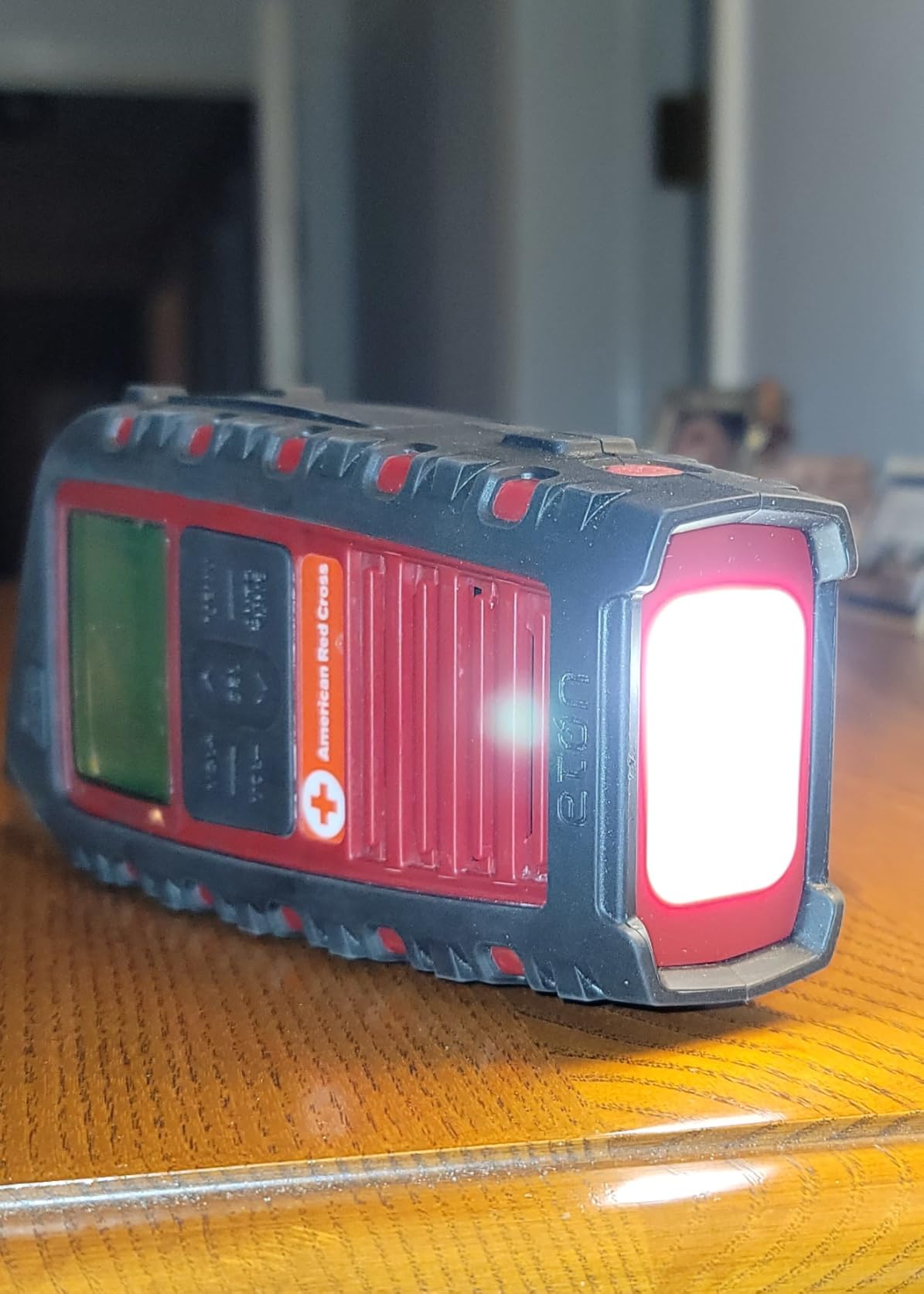
Eton is a long-established radio brand, and buyers note the solid build. It is the model designated by the American Red Cross, which is its own kind of endorsement for family kits.
It is also the heaviest and bulkiest radio in this roundup at 1.5 lb and 7.7 by 3 by 8.1 inches, and its 2000mAh battery is on the small side next to the 4000-5000mAh packs on competing hand-crank models. The 4.2 rating across about 190 reviews is the lowest average here, with 8% one-star responses.
Why RDS matters when the grid is down
During an outage you are likely to be scrolling a list of unfamiliar stations. RDS shows you callsigns and station names as you tune, so you can find an official local news or weather broadcast without memorising frequencies beforehand.
The backlit display with a clock also serves as a rough time reference, which is useful when the phone battery is gone.
Where it falls short
At 1.5 lb this is a home radio, not a pack radio. If it has to live in a go-bag, choose something in the 125 to 500 g range instead.
The small battery, the lowest rating in the group and no water resistance all argue for treating it as a secondary unit alongside a crank model.
12. Jazmm A12 – Best for D Cell Battery Backup
Portable AM/FM/WB/SW Radio, 4000mAh Rechargeable & 3×D Cell Battery Powered
4000mAh plus 3 D cell backup
10W speaker
15+ hours playback
Bluetooth 5.4 and TF playback
NOAA alert mode
Pros
- Dual power design with 4000mAh rechargeable plus 3 D cell backup
- At least 15 hours of radio playback at full volume per charge
- 10W speaker tuned for bass is louder and fuller than 3-5W rivals
- Large LCD and advanced DSP chip on a long antenna
- Bluetooth 5.4 plus TF and USB playback up to 128G with NOAA alert mode
Cons
- No hand crank or solar panel so it cannot generate power in a long outage
- Bluetooth is receive-only and cannot pair with Bluetooth headphones
- The listing spec of 0.5 watt conflicts with the 10 watt marketing claim
- Reception degrades while plugged in and the radio is not water resistant
- Bulkier at 6.61 x 3.46 x 5.47 inches than the other Jazmm model
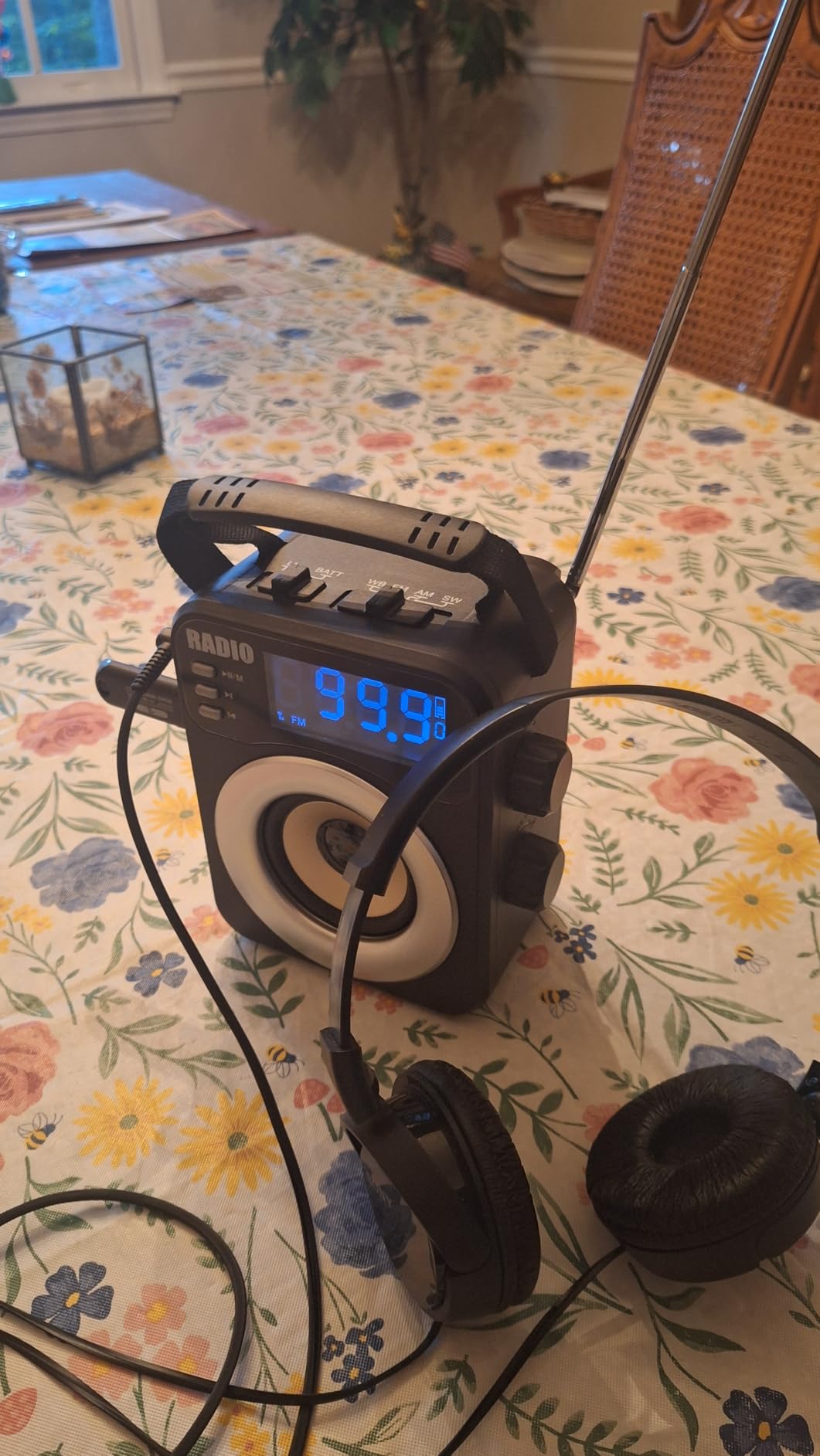
The Jazmm A12 answers a question nobody else does: what happens when the rechargeable pack dies? It runs on a 4000mAh cell charged over USB-C and accepts three D cells as backup, and D cells hold charge for a very long time in storage. That combination is genuinely reassuring for a multi-week outage.
The 10W speaker is tuned for bass and treble and is noticeably louder and fuller than the 3 to 5W drivers on most portable radios. Reviewers also like the large LCD and the advanced DSP chip working with a long antenna.
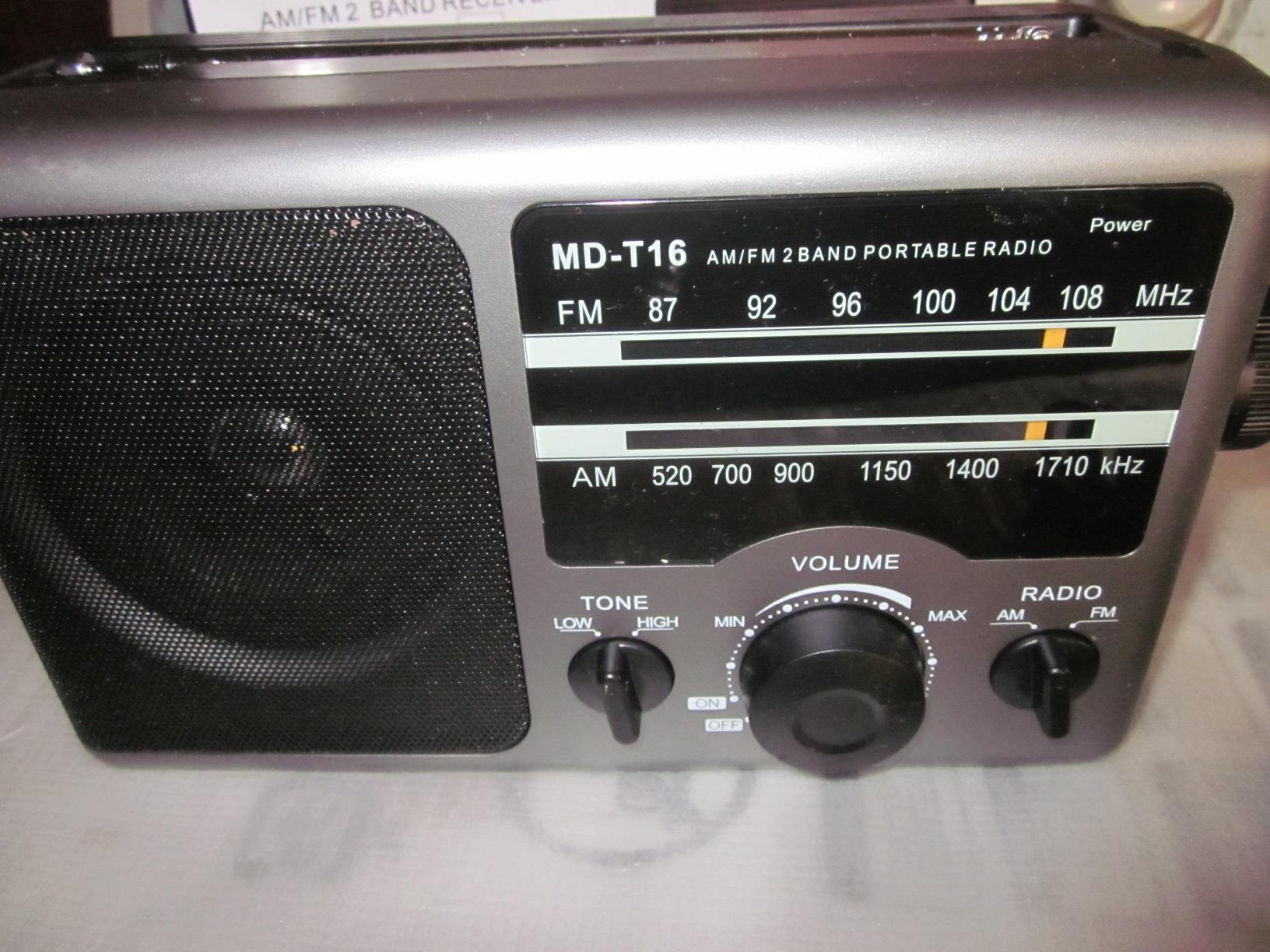
Playback covers Bluetooth 5.4 speaker mode, TF card and USB drive up to 128G across MP3, WMA, WAV and FLAC, and NOAA alert mode gives audible alarms with spoken warnings.
There is no hand crank and no solar panel, so it cannot generate its own power. Bluetooth is receive-only, meaning you cannot pair Bluetooth headphones to it, reception degrades while it is plugged in, and the listing spec of 0.5 watt directly conflicts with the 10 watt marketing claim, which is exactly the sort of red flag we look for.
Why D cells are worth the bulk
D cells are the largest common cell in the prepper cupboard, they leak far less than alkaline AA cells when they fail, and they hold charge for years on a shelf. Having a radio that accepts them is a hedge against the failure mode every lithium-powered radio eventually has.
At 6.61 by 3.46 by 5.47 inches it is a desktop or shelf unit rather than a pocket radio, which suits a home kit or a garage workshop.
Where it falls short
No hand crank and no solar means this is not a self-sufficient radio. If the grid is down and you have no spare D cells, the rechargeable pack is all you have.
It is also the least-reviewed entry here at about 160 reviews, so we would want more long-term history before making it a sole radio.
Receiver vs Transceiver: Which Tier Do You Actually Need?
Short answer: most preppers need both, and they are separate purchases. A receiver tells you what is happening. A transceiver lets you talk to someone. No single device in this roundup does both, because transmit capability means licensing and an antenna system.
Prepper forums split cleanly on this. One camp runs a hand-crank emergency radio for information and keeps a separate shortwave set for reception. The other carries a licensed handheld for local two-way traffic. Both are right, for different jobs.
Choose a receive-only radio from the list above if your plan is to receive official warnings, listen to broadcast news and follow distant shortwave services. Listening to shortwave requires no licence of any kind, which makes these sets completely open to you.
Choose a transceiver when the plan is local voice communication between family, your group or neighbours over a few kilometres, since transmitting on amateur bands requires a licence. Our ham radio picks for emergency communication covers that tier properly.
The practical arrangement most experienced preppers converge on is one of each: a crank radio in the house and one in each vehicle, plus a handheld transceiver per adult. For family and neighbourhood planning without any licence, GMRS radios cover the same ground on a licence that is free and takes minutes to obtain.
How We Picked These Shortwave Emergency Radios
We built this list around specs that hold up when the grid is gone, then weighted each one by the weakness of its competition. The short version of our method is that we read the electrical details first and the marketing second, because in this category the two rarely match.
Our non-negotiable criteria were four power paths beyond a bare battery, NOAA weather band reception with an alert mode, shortwave coverage in some form, and a stated battery capacity in mAh rather than a vague runtime claim. A fifth criterion was an antenna of usable length, which separates the serious sets from the pocket novelties.
We also read owner reviews at length, with attention to the one-star and two-star responses. Marketing hype is the defining problem in this niche, so the recurring complaints told us more than the feature lists did. Where a rating split was wide, we said so rather than averaging it away.
What we did not test: we did not perform an EMP survivability test on these units, and we did not measure crank efficiency in minutes of runtime per minute of cranking, so treat any such figure on a product page with suspicion. Reception quality also depends on your location and the band conditions on the day.
Shortwave Emergency Radio Buying Guide
Power sources: what each charging method is actually worth
A hand crank is a genuine last resort, not a primary power source. Cranking generates a small current, so minutes of cranking buy minutes of listening. Treat it as the option that keeps a radio alive when every battery in the house is dead, and nothing more.
Solar panels on emergency radios are usually trickle chargers. A panel that sits on a windowsill for a day will top off a battery slowly, but few will revive a flat one. Where reviewers report solar genuinely working, as with the Raddy RE40, that is worth paying for.
The most underrated methods are the boring ones: AA cells, USB input from a power bank, and D cell backup. Cells you can buy on any high street on the day you need them beat a built-in lithium pack that has been sitting in a drawer for three years.
Battery capacity and long-term storage chemistry
Capacity is straightforward: larger mAh means longer runtime. The Raynic and Eoxsmile hold 5000mAh, the Greadio carries a 14800mWh power bank, and the smaller units such as the Jazmm 213 at 1250mAh give you hours rather than a day.
Storage is the harder problem. Rechargeable lithium packs left uncharged can go flat or swell over a year or two, and a swollen cell is a device you will not trust when the emergency arrives. Store lithium units at partial charge and top them up every year or two.
Disposable cells sidestep the issue entirely for long storage, which is why the AA-powered XHDATA D221 and the D-cell-capable Jazmm A12 belong in a kit designed to sit for years.
Band coverage and why AM-only limits what you hear
Four bands is the practical baseline: FM broadcast, AM broadcast, shortwave and the NOAA weather band. NOAA is not optional for a prepper radio, since it is the only one of the four that carries official automated warnings.
Shortwave is where buyers get disappointed. During the day, higher shortwave bands carry more, and after sunset lower bands open up as signals reflect off the ionosphere. A set that hears nothing at noon may be working fine, and a set that hears only one band at night is a normal outcome rather than a fault.
AM-only shortwave misses utility, maritime and amateur two-way traffic entirely. If that content matters to you, the C. Crane SSB 2 is the only option in this roundup that decodes single sideband.
NOAA alerts, SAME codes and the sleep mode trap
A NOAA radio that only sounds an alert when the channel is manually tuned is not much use in a storm. Look for automatic alert scanning in standby, and for PEAS or NWS certified alert triggering with an audible alarm.
SAME county codes narrow those alerts to your area, and several units here ship without them programmed. That means you hear every regional warning, which is noisy but far better than hearing none, and it is a five-minute setup job once the code is programmed.
The sleep mode trap catches everyone. Test whether the alarm fires with the radio off or in standby, in the dark, at 3am, before the season that needs it.
Antenna length beats most spec-sheet claims
The single biggest difference in real reception between two otherwise similar radios is antenna length. The Kaito KA500 extends to 14.5 inches, the Greadio carries an extra-long telescoping whip, and the C. Crane includes a 23 ft reel wire with an antenna jack.
A short whip and a shared internal antenna will limit you before the chipset does. If reception quality matters, that is where your money should go, not on Bluetooth playback or extra memory presets.
Our broader shortwave receiver roundup goes deeper on antenna choices and on what you can realistically hear at different times of day.
Spec-sheet red flags to ignore
Treat any claim of very high output power from a hand-crank device with suspicion. A hand-crank dynamo cannot produce meaningful transmit power, and no radio in this roundup transmits at all.
Watch for conflicting figures inside the same listing, as with the Jazmm A12 where the written spec says 0.5 watt and the marketing says 10 watt. Marketing numbers written by a copywriter rather than an engineer are the fastest way to a disappointment.
Finally, our solar charging emergency radio picks cover the multi-charging question in more detail if you are building a kit around panel charging.
Frequently Asked Questions
What is the best radio to have in an apocalypse?
The Raynic 5000mAh emergency radio is the best all-round choice because it pairs the largest battery in this roundup with six ways to recharge it, covering NOAA alerts, AM, FM and shortwave in a 1.2 lb body. Pair it with a licensed handheld transceiver if you also need to talk to people locally.
What radio do preppers use?
Most preppers carry two separate devices rather than one. A receive-only emergency radio such as the Raynic or Kaito KA500 handles NOAA weather alerts and broadcast information with no licence needed. A transceiver such as a ham handheld or a GMRS unit handles local two-way voice and does require a licence.
What radio would survive an EMP?
Battery-powered analog receivers are among the most survivable devices you can own, because they need no firmware update, no network handshake and no software to be corrupted. Store any radio in a faraday bag, keep spare cells outside the bag, and replace lithium packs every two to three years.
What is the best communication device for preppers in an emergency?
There is no single answer because listening and talking are different jobs. For information, a NOAA and shortwave receiver such as the Raynic is hard to beat. For local voice over a few kilometres, a licensed handheld transceiver or a GMRS radio is the correct tool. Many kits carry both.
What is the top-rated shortwave radio?
Among the highest-rated receivers in this roundup, the C. Crane CC Skywave SSB 2 is the one that sounds like a serious communications tool, because it is the only model here with single sideband reception. For raw ratings and review volume, the Raynic leads with 4.5 stars across roughly 20,000 reviews.
What radio do Navy Seals use?
Military and special operations teams use programmable frequency-hopping radios operating in the VHF and UHF ranges, which civilian buyers cannot purchase. The practical civilian equivalent for local communication is a programmable handheld transceiver, and for information gathering a receiver such as the C. Crane SSB 2.
The Verdict: Best Shortwave Emergency Radios for Preppers in 2026
The Raynic 5000mAh emergency radio is the best shortwave emergency radio for preppers in 2026 because battery life and the number of ways to restore that battery are the two things that decide whether a radio is still useful on day three. Six power paths, a 5000mAh pack, automatic NOAA alert scanning and a bright flashlight cover the widest range of scenarios of anything we tested.
Buy the Kaito KA500 instead if you want the strongest shortwave reception per pound, because its 14.5 inch telescoping antenna and signal strength meter outperform most of the field on the band that matters. Buy the C. Crane CC Skywave SSB 2 if you want reception that no phone can match, and accept AA cells as the price.
The rest of this list fills specific gaps rather than competing for the top spot. The Greadio for water resistance, the Raddy RE40 for solar that genuinely charges, the XHDATA D221 for AA cells that survive five years in a drawer, and the Jazmm A12 for D cell backup in a long outage.
Whichever you choose, test it before you need it. Charge the battery, tune a NOAA channel, fire the alarm in sleep mode, and crank it for five minutes to see what you actually get. Then buy one more radio for your vehicle, because a radio in the wrong room is the same as no radio at all.