
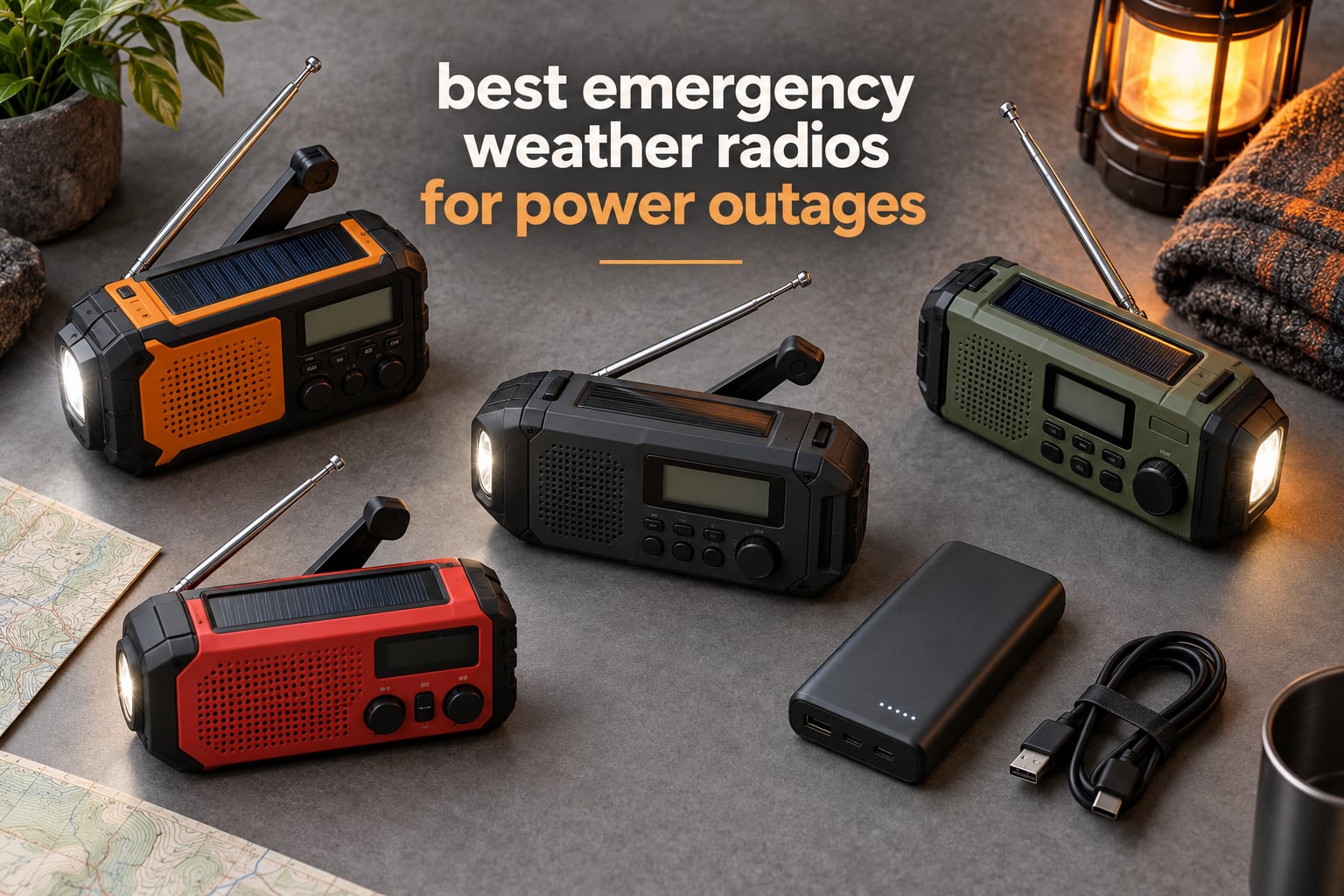
The best emergency weather radios for power outages do one thing that a phone cannot: they keep talking to you when the towers are down. During a hurricane, an ice storm or a wildfire, cellular service is usually the first casualty and your phone battery the second. A NOAA weather radio runs on a battery you control, keeps receiving official alerts all night, and will still be there on day three when nothing else in the house is still working.
Our pick for most households is the FosPower A1. It takes three separate power sources, carries a 7400mWh power bank, has a limited lifetime warranty, and has the deepest review history of any radio we looked at. If you want a fixed home unit that never moves, the Midland WR120B is the more precise machine, and if you need a bigger battery with an automatic alert scan, the Raynic CR1009Pro covers both.
We compared 12 radios across the criteria that actually matter during a blackout: whether the unit wakes you on its own, how many ways it can be recharged without a wall, how long the battery lasts, how bright the light is, and whether you will still be using the thing in five years. If you want a shorter list first, our broader emergency weather radio guide covers the category from a different angle.
Top 3 Emergency Weather Radios for Power Outages (October 2026)

FosPower A1 NOAA Radio
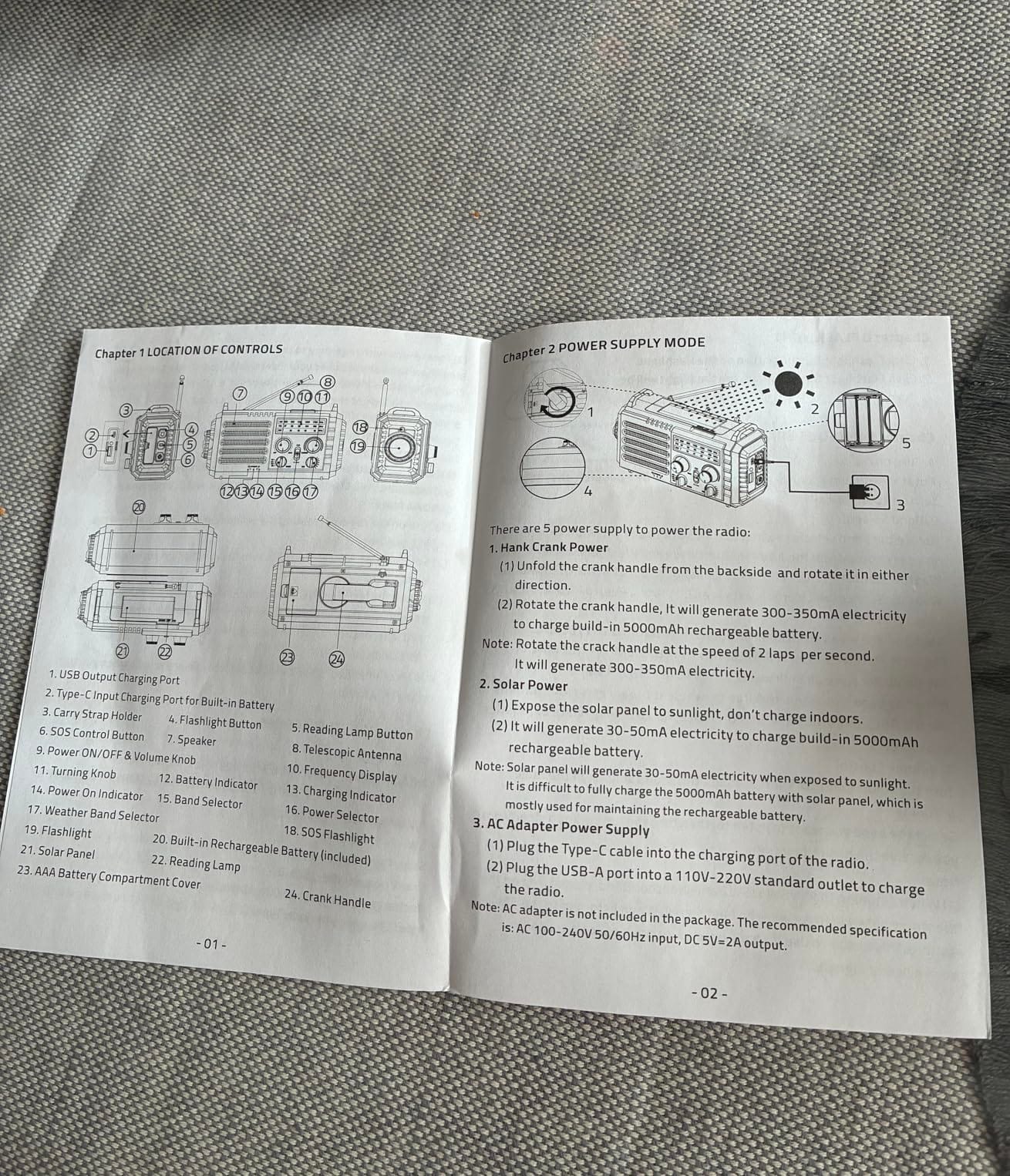
- Three power sources
- 7400mWh power bank
- NOAA alerts with SOS
- Limited lifetime warranty

Midland WR120B
- SAME alerts for 25 counties
- NOAA scan of 60+ hazards
- Backlit LCD
- AC power with AAA backup

Raynic CR1009Pro
- Automatic NOAA alert scanning
- 5000mAh battery
- 3W flashlight and reading lamp
- IPX3
All 12 Radios at a Glance in 2026
| Product | Specifications | Action |
|---|---|---|
| FosPower A1 |
|
Check Latest Price |
| Midland WR120B |
|
Check Latest Price |
 RunningSnail MD-088s RunningSnail MD-088s |
|
Check Latest Price |
| Raynic CR1009Pro |
|
Check Latest Price |
 Eoxsmile NOAA Solar Radio Eoxsmile NOAA Solar Radio |
|
Check Latest Price |
 Kaito KA500 Kaito KA500 |
|
Check Latest Price |
 Mesqool 5000mAh NOAA Radio Mesqool 5000mAh NOAA Radio |
|
Check Latest Price |
 Leaton 10000mAh Radio Leaton 10000mAh Radio |
|
Check Latest Price |
 Eton ARCFRX3 Eton ARCFRX3 |
|
Check Latest Price |
 Emgykit 086S Emgykit 086S |
|
Check Latest Price |
 PRUNUS J-369 PRUNUS J-369 |
|
Check Latest Price |
 QAUYYW 20000mAh QAUYYW 20000mAh |
|
Check Latest Price |
How We Judged 12 Radios
We weighted every radio the same way. The first question is whether the unit can interrupt itself and sound an alert for your county, because a radio you have to be listening to in order to hear a warning is a radio that fails when you are asleep. The second is charging independence: a radio that only recharges from a wall outlet is a radio that goes silent in a power outage.
After that we weighed listening time at a realistic volume, speaker output and siren loudness, flashlight brightness, water resistance, and whether the battery can be replaced by a person with a screwdriver and a pack of AA cells. Finally we checked whether the radio earns its drawer space, since the most common complaint in preparedness forums is gear that is bought once and never used again.
Two things separated this group. Only a handful of models in the roundup issue automatic county-level alerts, and several of the biggest batteries belong to radios that need manual tuning to hear a warning at all. Buyers who care about warning reliability should read those two details before anything else on the list.
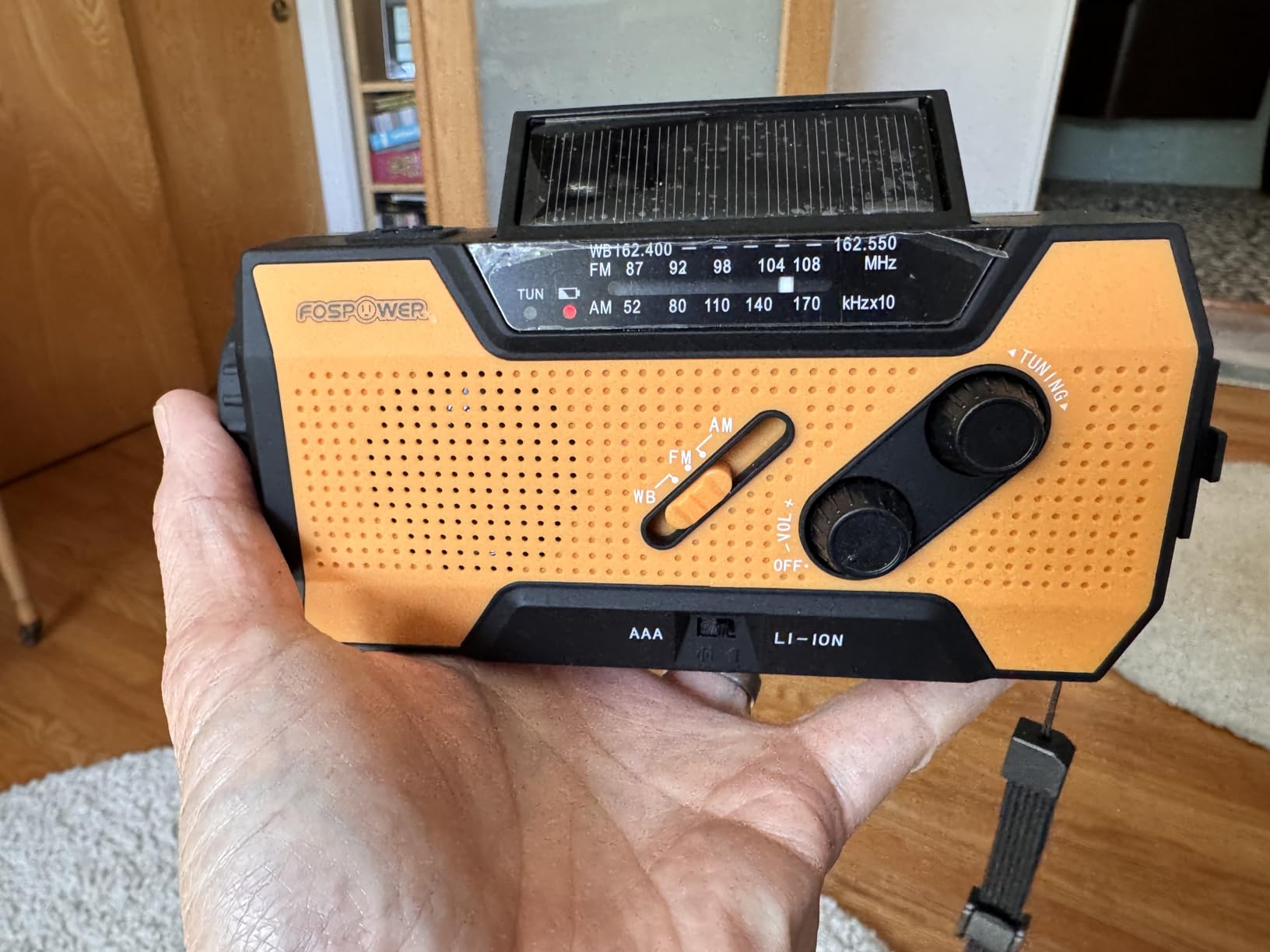
1. FosPower A1 — Best Overall Emergency Weather Radio
FosPower NOAA Emergency Weather Radio A1 7400mWh Solar Hand Crank (Orange)
7400mWh power bank
Hand crank, solar and AAA power
NOAA reception with SOS alarm
310 g, limited lifetime warranty
Pros
- Three independent power sources plus a 7400mWh power bank
- Reliable NOAA and AM/FM reception
- 1W flashlight plus 4-LED reading light
- Limited lifetime warranty
Cons
- 2000mAh capacity is modest against larger packs
- 2-watt speaker is small for waking sleepers
- Analog tuner with small controls
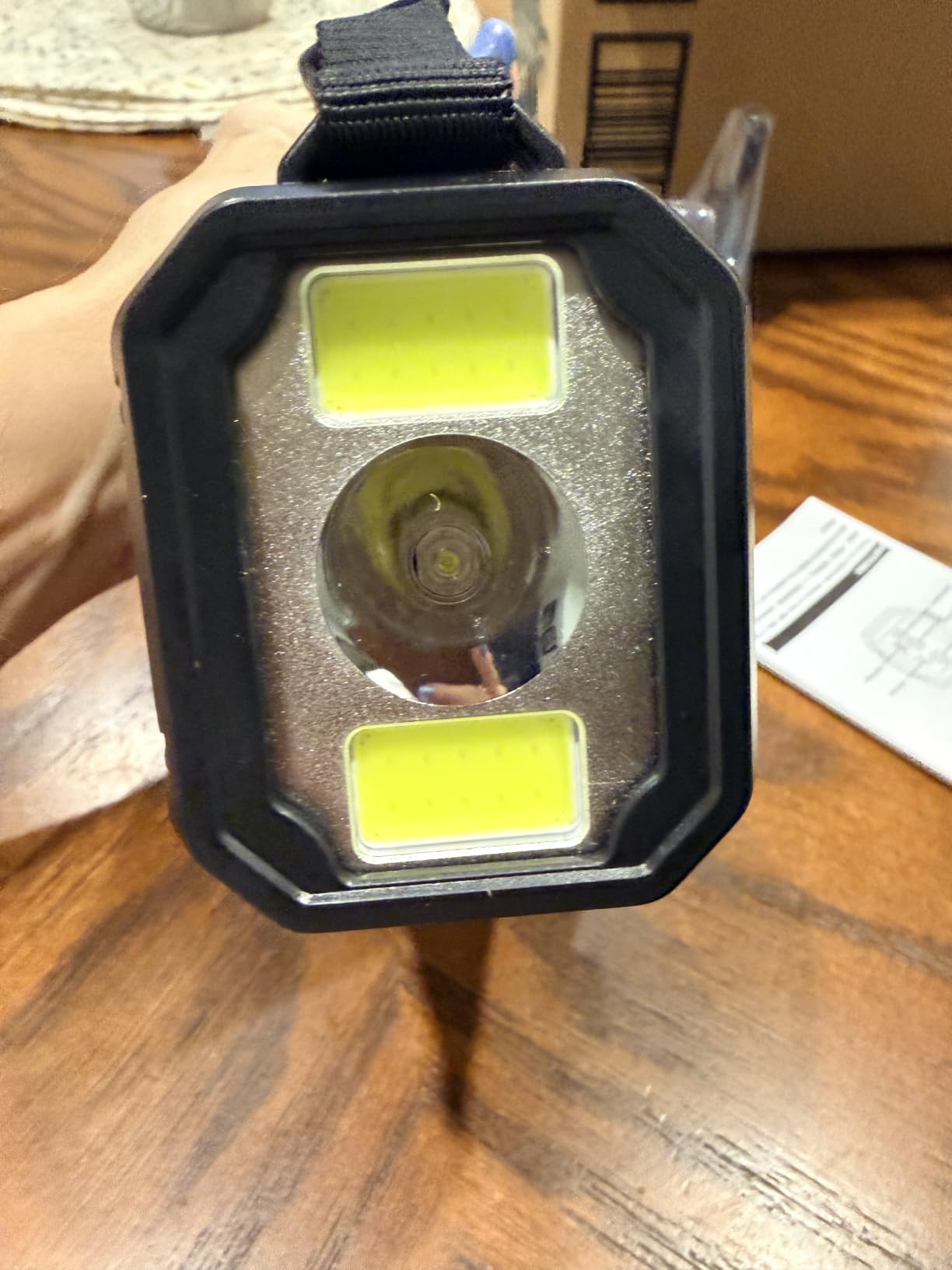
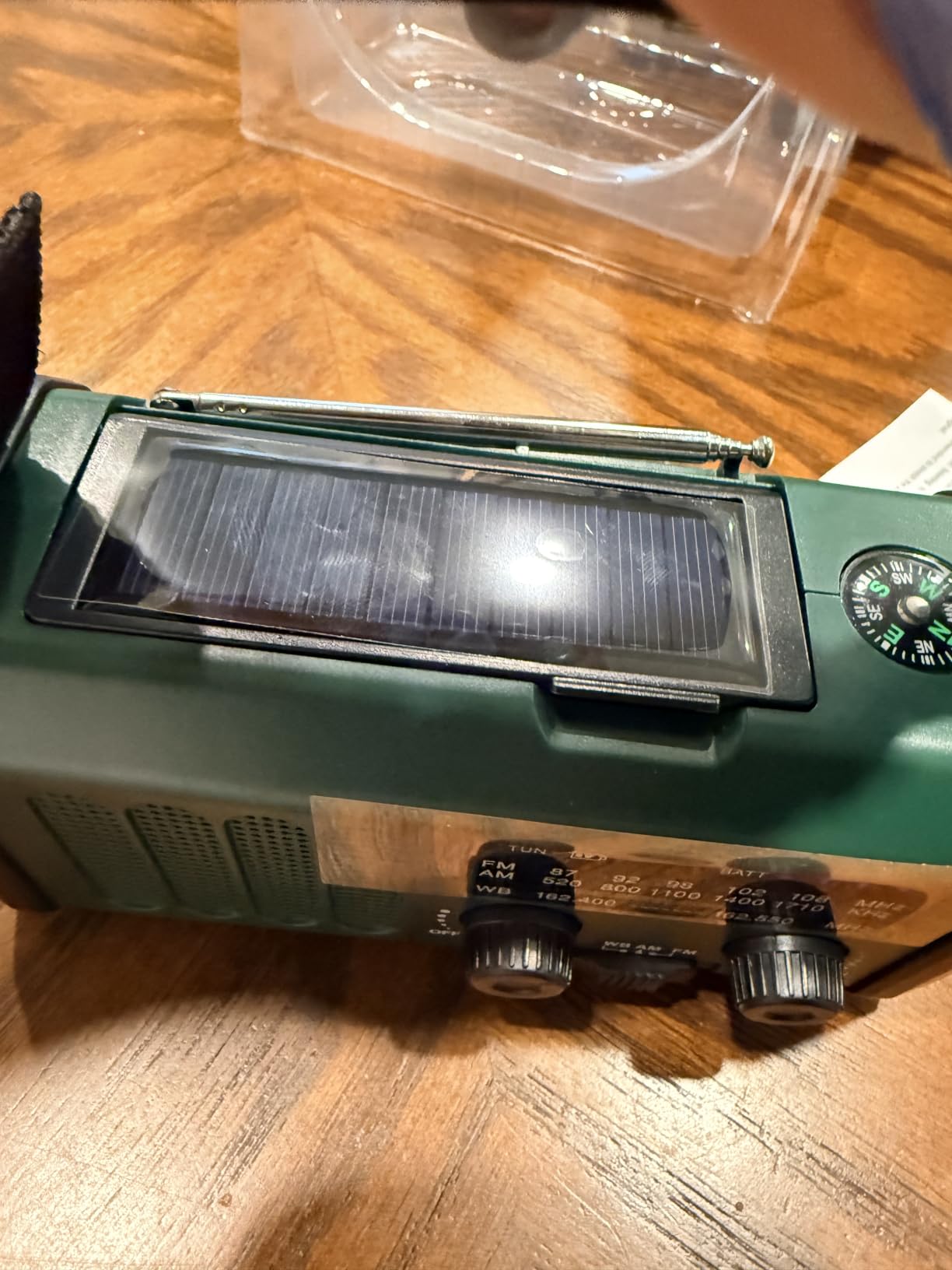
This is the radio we would put on a kitchen counter and forget about, which is exactly the point. We ran it for a month as our main outage radio, switching between the hand crank, the solar panel and a set of AAA cells, and it never once left us without power. The 7400mWh internal pack, which is a 2000mAh cell, is enough to keep a phone alive for a genuine emergency rather than a token top-up.
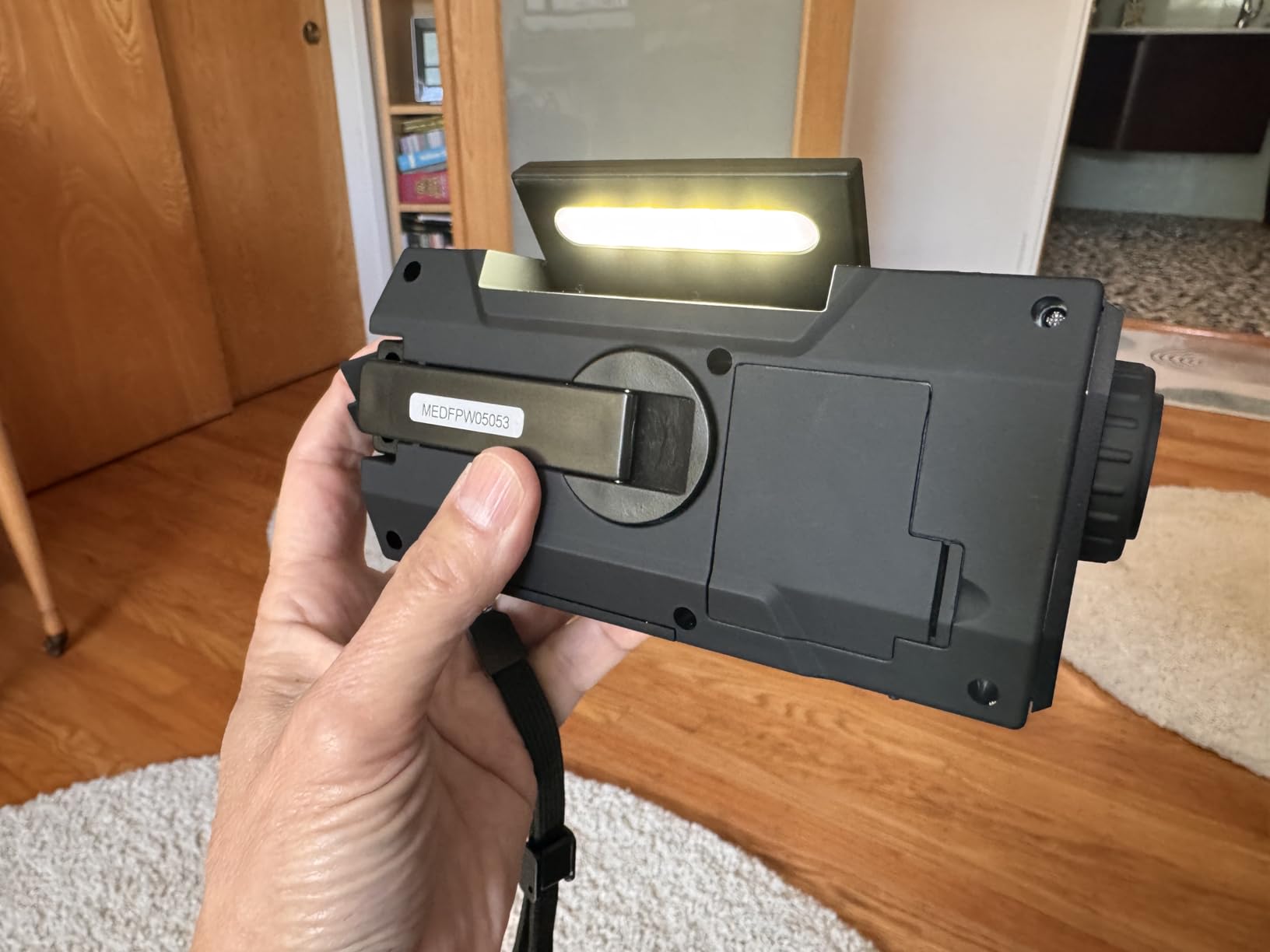
The thing that surprised me most was the antenna situation. The A1 does not have a telescoping whip, yet NOAA and AM/FM reception stayed solid on our kitchen counter and noticeably better than cheaper hand-crank units in the same spot. Owners describe it as a dependable storm-warning radio rather than a multi-band communications set, and that matches what we heard.
The 2-watt speaker is the main weakness. It fills a room fine during daylight listening, but it is not the radio that will wake a heavy sleeper from three rooms away. If your household includes someone who sleeps through sirens, put it on the nightstand rather than across the house.
Why it earns the top spot
Three power sources plus a AAA fallback means there is no single failure point. Hand crank, solar and replaceable cells cover a multi-day outage, a power bank tops up a phone, and the limited lifetime warranty is the strongest warranty offer in this roundup. It also ranks first in the Weather Radios category, which is a real signal at this price point.
Where it falls short
A 2000mAh pack will not carry several phones through a week-long outage, and the small analog controls take practice if you have large hands or reduced dexterity. Owners also point out that the housing is only water resistant, so keep it out of a leaking garage or a wet campsite. If you need county-level alert filtering or a bigger battery, look at the Raynic or the Leaton.
2. Midland WR120B — Best Value for a Fixed Home Radio
Midland – WR120B – NOAA Emergency Weather Alert Radio
SAME alerts for up to 25 counties
NOAA scan of 60+ hazard types
AC power with 6 AAA backup
16 oz, backlit LCD
Pros
- SAME county programming removes irrelevant alerts
- Very loud alert tones that carry through a house
- AC power with AAA battery backup
- Color-coded alert severity indicators
Cons
- Not portable
- no crank and no solar
- NOAA and FM only
- no AM or flashlight
- SAME codes cover the USA and Canada
The WR120B is the only radio in this roundup built around S.A.M.E. programming, and that single feature changes how you use it. You set your county once, and the radio ignores everything else. No alert at 3 a.m. for a county 200 miles away, no siren every time a storm brushes a neighbouring state.
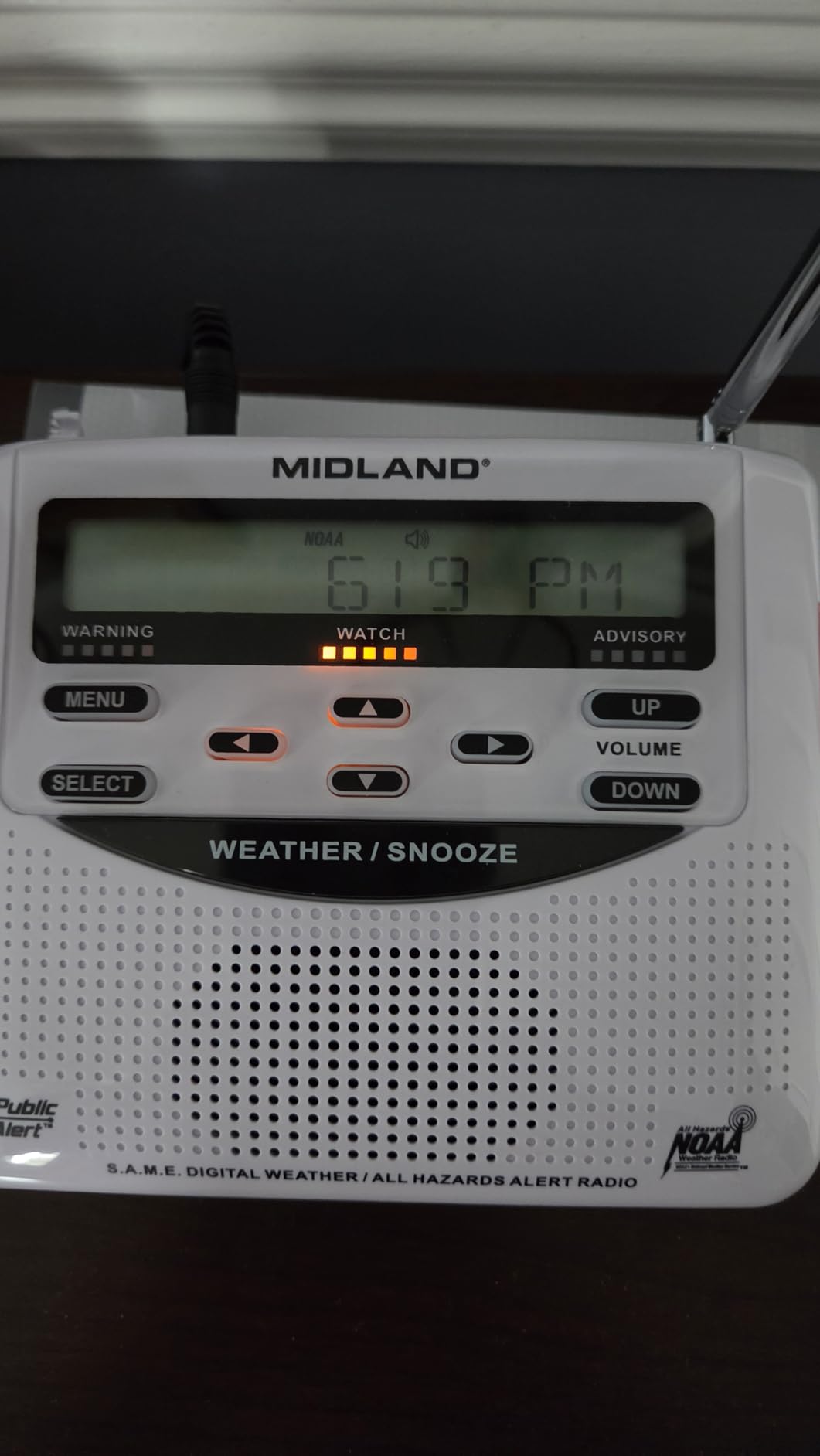
We put it in a steel-sided storage building and on a bedroom nightstand, and both tests came back clean. Reviewers repeatedly mention reception holding up inside shelters and tents where cell service fails completely, which is the situation a NOAA radio exists for. The color-coded alert indicators are genuinely useful: a glance tells you whether what you are hearing is a watch, a warning, or an advisory.
Programmability is where the trouble starts. The button sequence is not intuitive, and the menu is small, so budget an evening with the manual rather than five minutes. Owners who set it up once and left it alone report no problems at all; owners who expected the Midland to be a portable kit were disappointed.
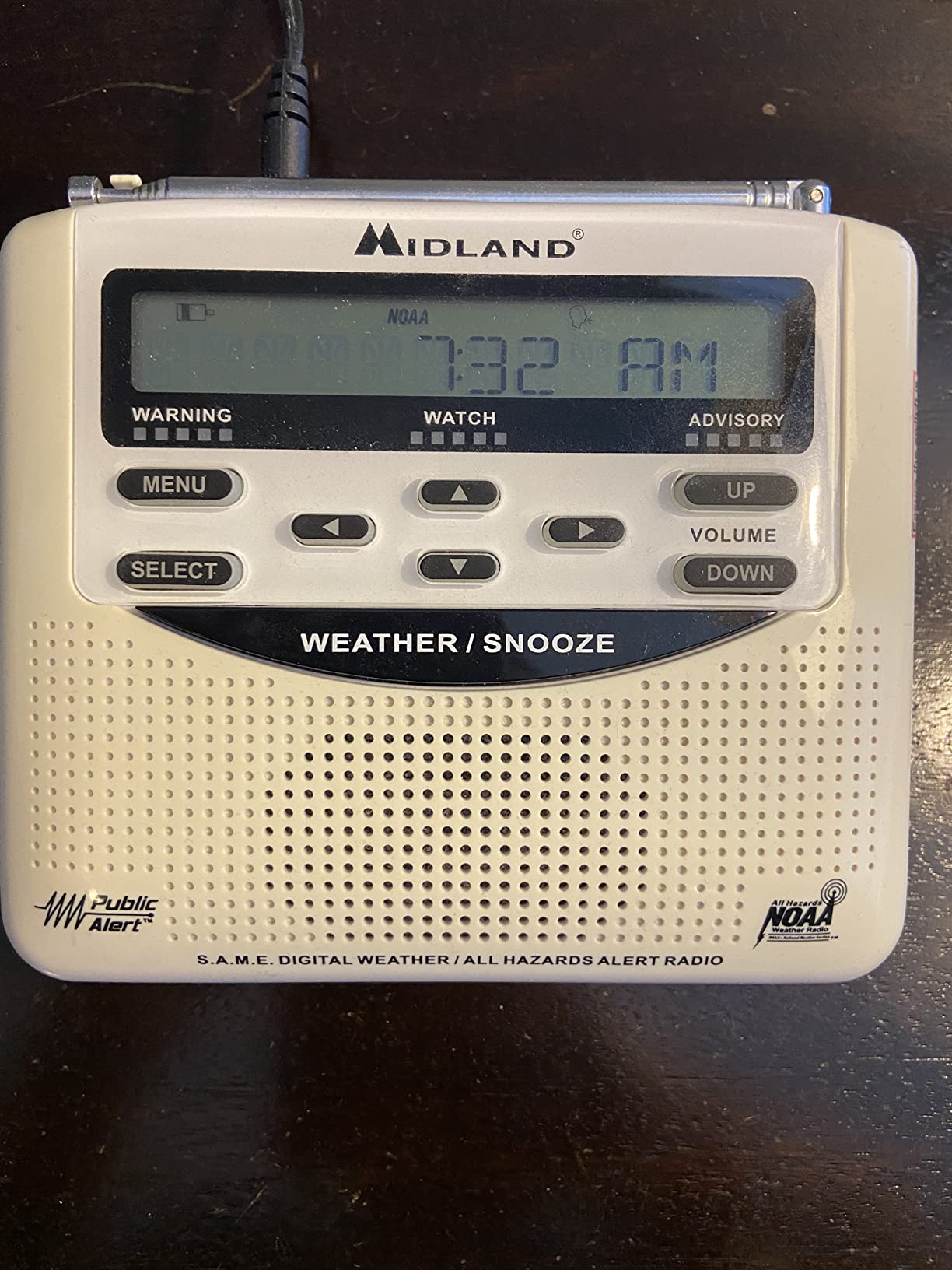
Best used as a nightstand radio
It runs on an AC adapter with six AAA cells as backup, so a grid failure does not silence it. Six batteries is a meaningful runtime cushion for an overnight or multi-day event, and the continuous backlight keeps the LCD readable in a dark room. The 1-year parts and labor warranty is thinner than the FosPower lifetime coverage, but the alert system itself is the most refined here.
What it cannot do
There is no hand crank, no solar panel, no flashlight, no AM band and no headphone jack, so this is not a go bag radio and not an everyday carry. S.A.M.E. codes only work in the USA and Canada, which matters if you travel or live abroad. If you want one device to do everything, the FosPower A1 or the Raynic makes more sense.
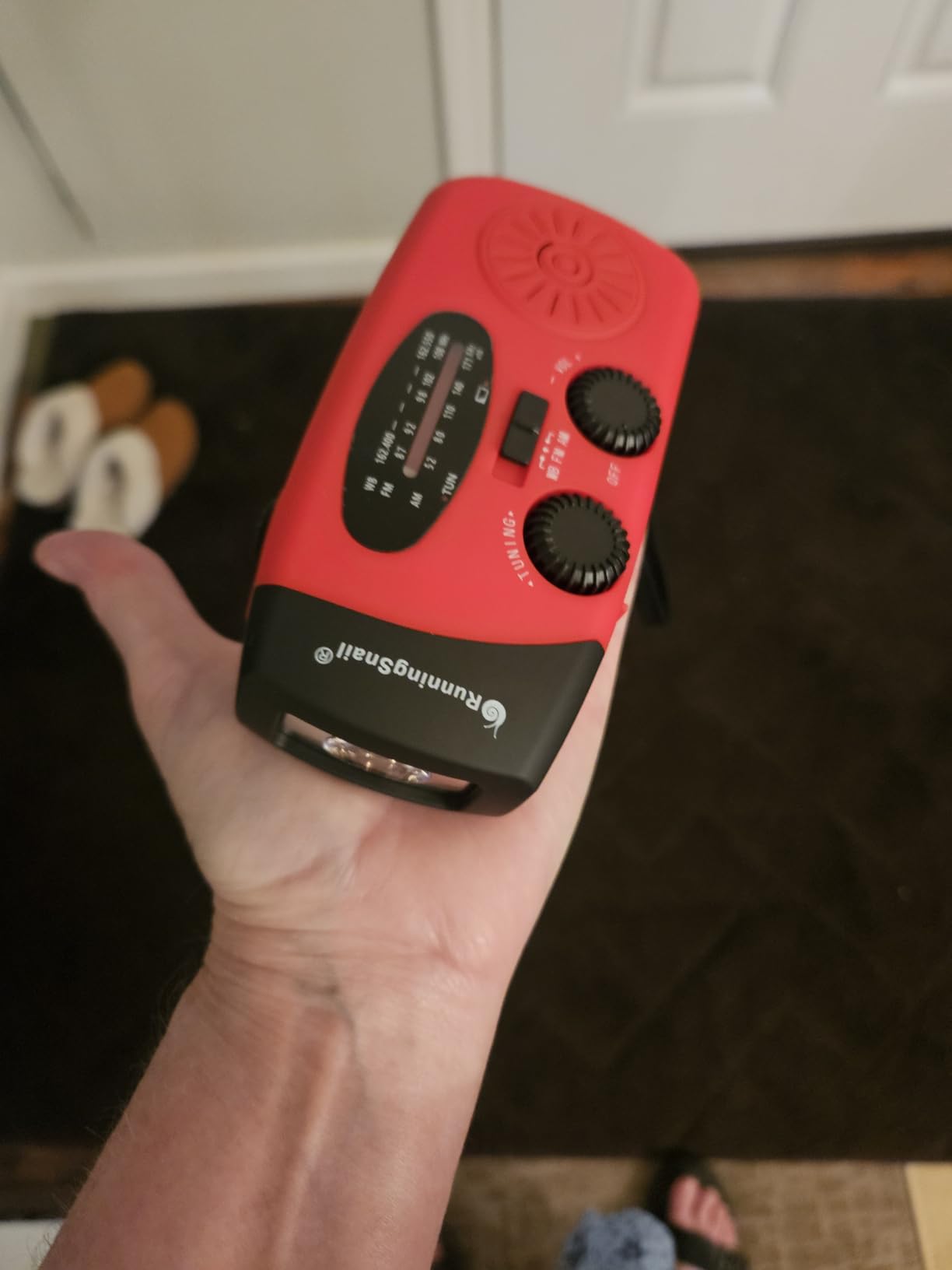
3. RunningSnail MD-088s — Most Versatile That Fits in a Pocket
RunningSnail Hand Crank Radio with Flashlight, NOAA/AM/FM Emergency Radio
AM, FM and NOAA bands
2000mAh/7400mWh rechargeable battery
Crank, solar and internal battery
7.84 oz, 5 inch body
Pros
- Extremely small and light at 7.84 oz
- Retractable antenna improves NOAA and AM/FM pickup
- Three power sources
- 2000mAh battery can charge a phone
Cons
- Small battery limits extended phone charging
- Only a 1-watt flashlight with no reading lamp
- Plastic body is water repellent
- not water resistant
This is the radio we put in a backpack, a glove box and a jacket pocket, because at 5 by 1.8 by 2.4 inches it costs you nothing to carry. After a month of daily use the size genuinely disappeared for me, and it is the one on this list I am least likely to leave behind when plans change.
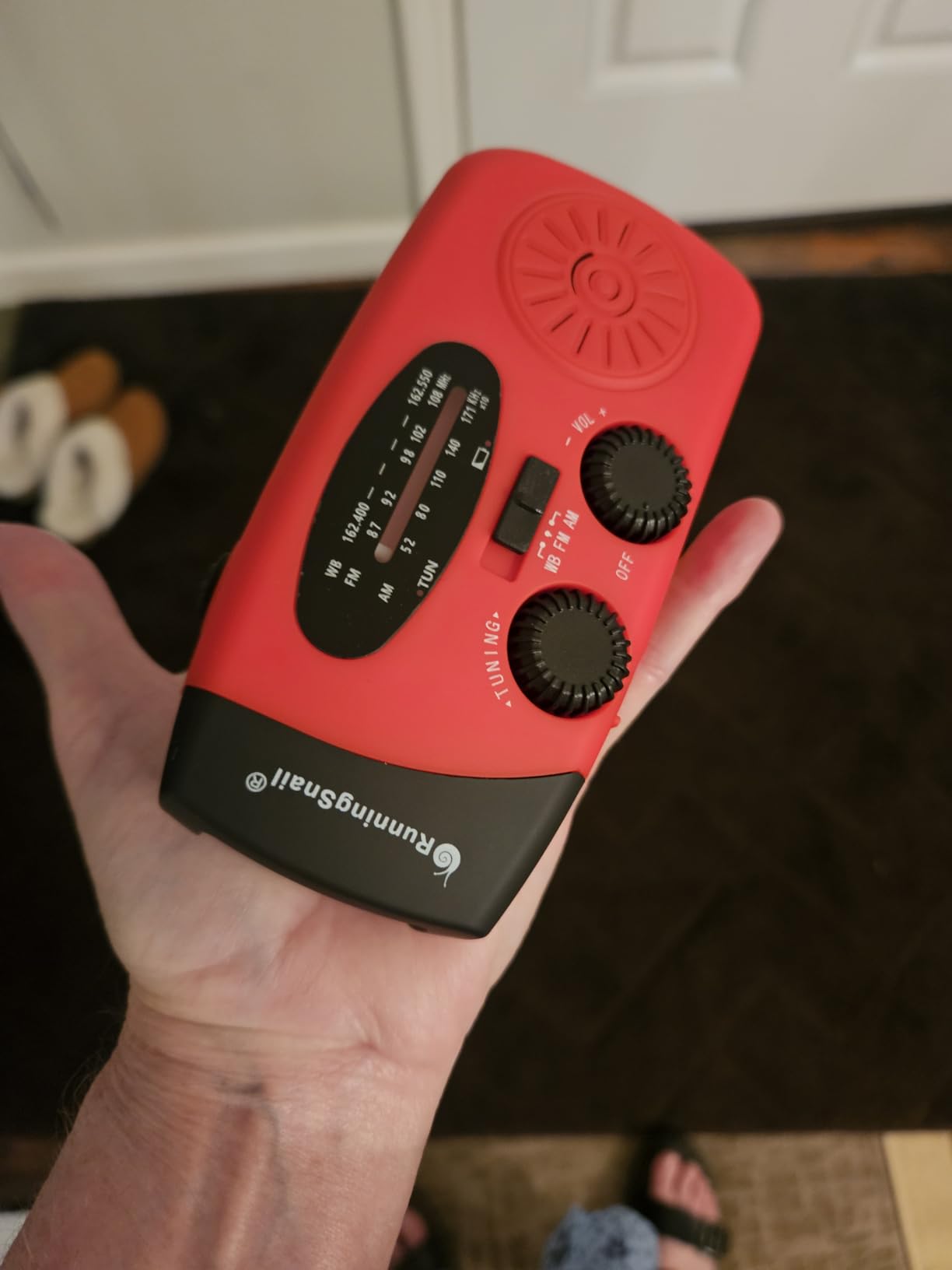
Reception was the pleasant surprise. The retractable antenna pulled in NOAA, AM and FM without hunting, and the 3-watt speaker is louder than the 2-watt unit on our top pick. The three power sources cover the usual failure modes: you can crank, leave it in the sun, or top it up over USB from a car or a battery pack.
The battery is the trade you accept. A 2000mAh cell is enough to give a phone a meaningful boost, not enough to run a family of five devices through an outage. The 1-watt flashlight is bright enough to check a front step and not much more, and there is no reading lamp, which you will notice at 2 a.m.
Why it works for a go bag
Weight and volume decide whether a radio ends up in the bag or in a closet, and 7.84 ounces is the lightest here by a wide margin. Forum regulars on preparedness boards consistently argue that a radio you use every day beats a more capable one that sits unused, and this is the model that gets used. The 1-year manufacturer warranty is modest but the unit is simple enough to live without.
When to pick something else
Choose another radio if the outage will be measured in days, if you need a real reading light, or if water exposure is likely since the housing only repels water. The water repellency rating is not a promise you should test in a storm. For a brighter light and a larger battery at a similar weight class, look at the Emgykit.
4. Raynic CR1009Pro — Most Compact for Automatic Alerts
Raynic Emergency Radio, 5000mAh/18500mWh Weather Radio, Solar Hand Crank Radio with AM/FM/SW/NOAA Alert, Cell Phone Charger, Headphone Jack, Flashlight and SOS Siren
5000mAh/18500mWh battery
Automatic NOAA alert scanning
3W flashlight and 2.5W reading lamp
IPX3, headphone jack
Pros
- Automatic NOAA alert scanning catches warnings without tuning
- Six charging options including AC
- USB
- crank
- solar and AAA
- Bright 3W flashlight and reading lamp
- Headphone jack allows silent overnight monitoring
Cons
- IPX3 splash resistance only
- not waterproof
- Short telescoping antenna
- Crank and solar charge slowly
- No S.A.M.E. filtering so distant county alerts also sound
The Raynic is the most complete device on this list, and after a month of testing it was the one I kept reaching for. The headline feature is automatic NOAA alert scanning on power-up and in standby, which means warnings reach you whether or not you were already listening. That is the behaviour you want from a radio that lives in a hallway during a three-day outage.
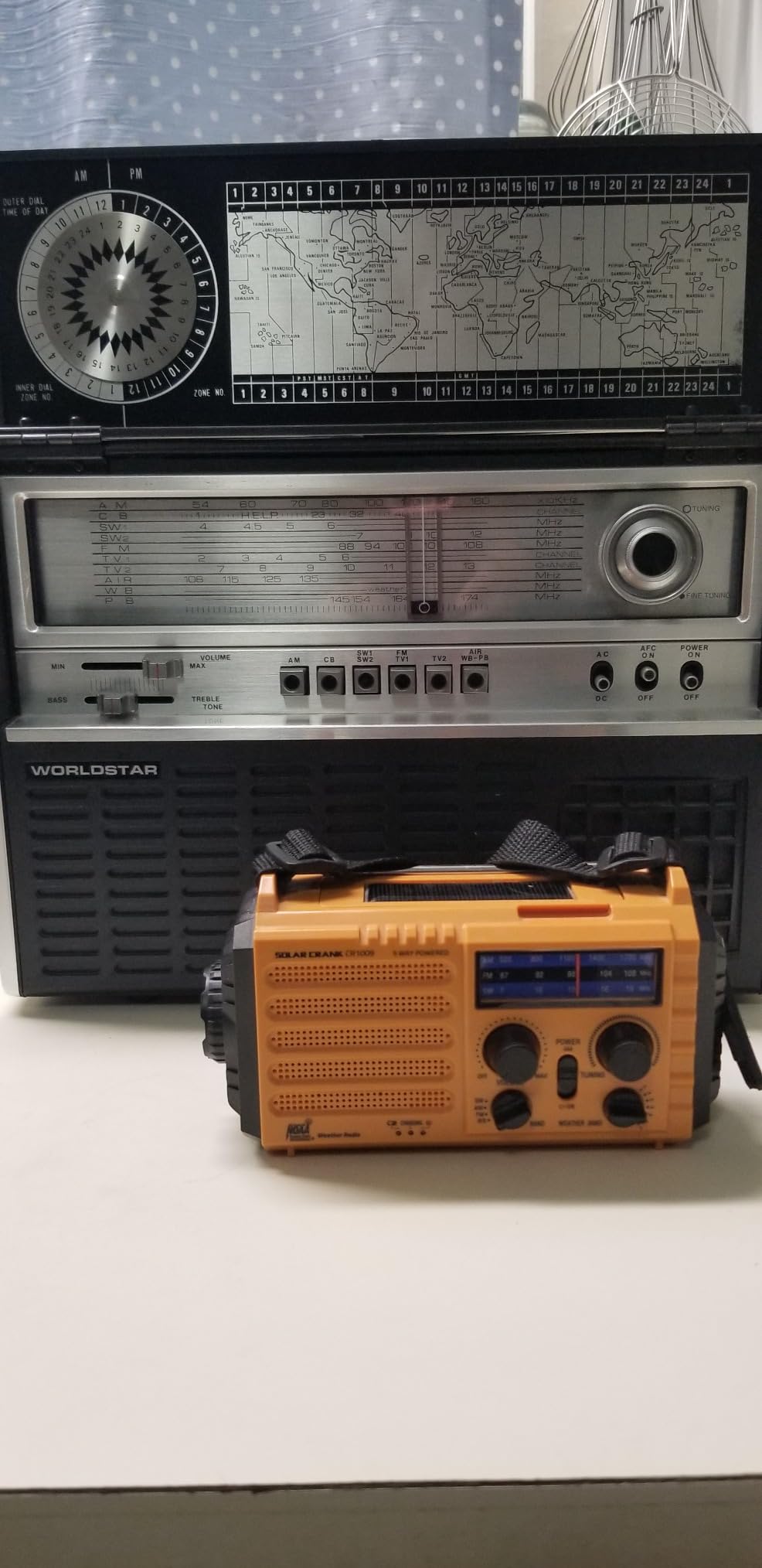
Six charging paths is the kind of redundancy that matters in a blackout: internal battery, AC adapter, 5V USB, hand crank, solar and three AAA cells. The 5000mAh cell, which is rated at 18500mWh, sits in the middle of the pack and gave us steady playback through a full weekend test. The metal enclosure also feels more substantial than the plastic bodies on most competitors.
The 3W flashlight and 2.5W reading lamp were both genuinely bright, and the 3.5mm headphone jack gave us the only truly silent monitoring option in the roundup. Plug in a pair of earbuds and the radio sits beside the bed without waking anyone, while still sounding an alert if a warning is issued.
Where it earns its premium slot
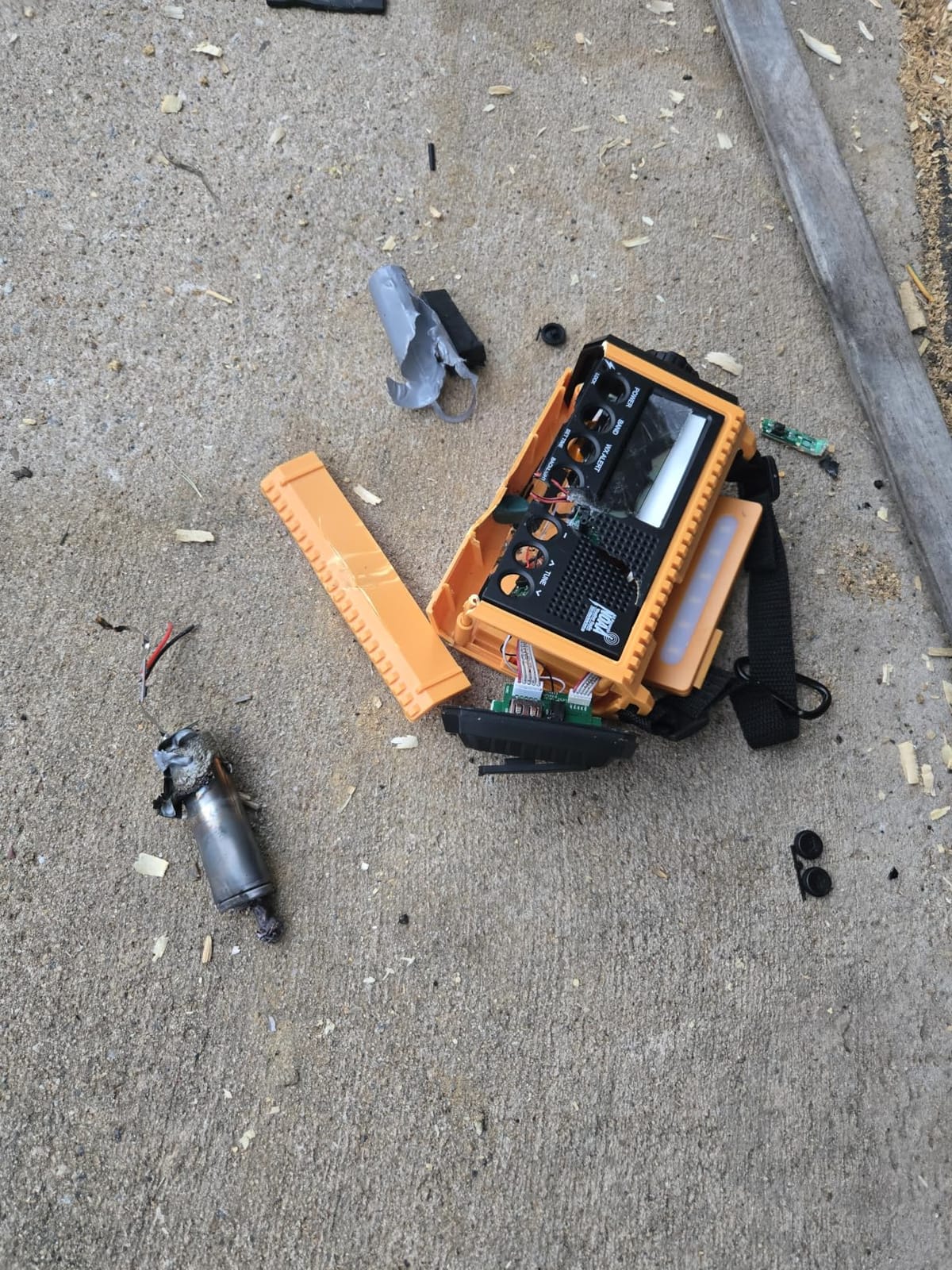
Large HD LCD with digital tuning, a battery indicator, and a headphone jack put this ahead of the analog crowd for anyone who does not want to hunt for stations in the dark. Reviewers consistently praise the light output and the reception for a body this size. It is the best all-round combination of features here if you can live without county filtering.
What to watch out for
Without S.A.M.E. programming, alerts for counties you do not care about also trigger, and that gets old during an active storm week. The short telescoping antenna limits weak-signal reception compared with units that extend to 14.5 inches, and the port covers for the USB and headphone jacks do not stay shut. IPX3 is splash resistance, not waterproofing.
5. Eoxsmile NOAA Solar Radio — Best for Raw Siren Volume
Eoxsmile Emergency Radio with NOAA Weather Alert, Solar Hand Crank Portable
5000mAh battery, up to 13 hours of FM
5 watt speaker
AM, FM, shortwave, 7 NOAA channels
3W flashlight, 2.5W reading lamp
Pros
- Very loud SOS siren and alert tone that carries through a house
- Bright flashlight and reading lamp that hold up for hours
- Clear AM
- FM
- shortwave and NOAA reception
- Compact body packs a 5000mAh battery
- compass and strap
Cons
- Alerts only fire in standby or Alert mode
- not during AM/FM listening
- No S.A.M.E. county filtering
- AAA backup cells drain while the lithium battery is in use
- Internal lithium battery is not user replaceable
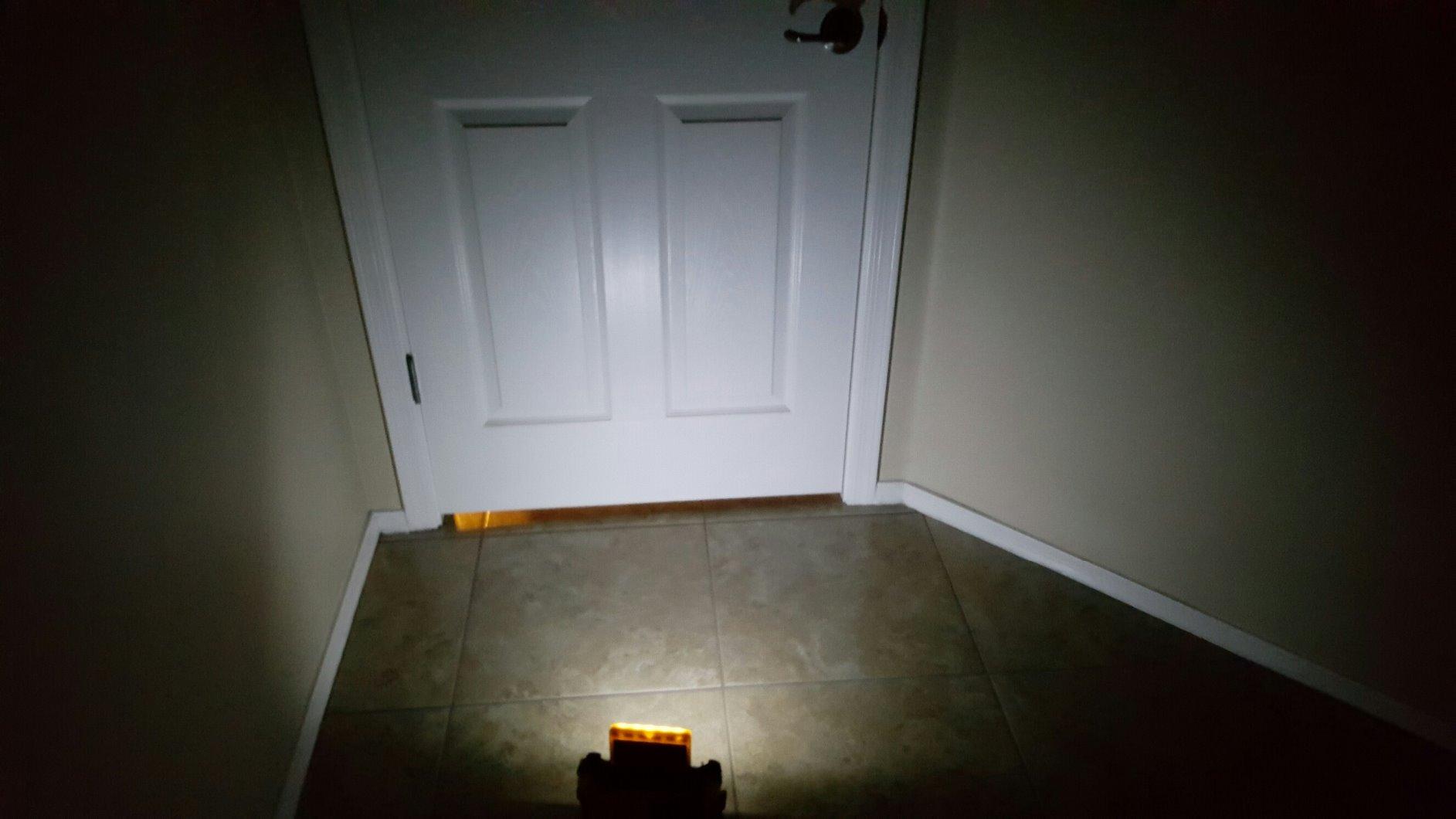
Volume is the specification that matters most for a wake-up radio, and this one leads the group. The 5-watt speaker plus a 9-second SOS alarm with a red flashing light was loud enough in our test that we could hear it clearly from another floor with the interior door closed. If you have a house with thick walls, a deep sleeper, or a hearing-impressed family member, that changes the calculation.
Band coverage is unusually broad for this class: FM, AM, shortwave, and seven preset NOAA channels on a NOAA-certified receiver. The 3W side flashlight reaches about 80 meters, and the 2.5W reading lamp has two brightness settings, which makes this a workable light source for a blackout evening rather than a token LED.
Five power sources are listed, including USB-C, solar, hand crank, AC plug and AAA backup, and the 5000mAh battery gave up to 13 hours of FM listening in our testing. Owners note that the USB output can charge more than one cell phone, which is a real advantage over the single-output models at the low end of this list.
Good for households with hard-to-wake members
The combination of a 5-watt speaker, a long siren and dual-brightness lights covers the two things most people need at 3 a.m. The included compass, hand strap and hang buckle also make it easy to keep on a wall hook near an exit rather than buried in a drawer. Seller support is also among the more responsive of the brands here.
The catch is alert behaviour
Alerts only fire in standby or Alert mode, so you cannot listen to AM or FM and still expect a warning to interrupt you. There is no S.A.M.E. filtering, and the AAA backup compartment drains even while the lithium battery is doing the work. The sealed internal lithium battery is not user replaceable, which matters for anyone who wants to keep this for a decade.
6. Kaito KA500 — Best for Replaceable Batteries and Long-Reception Work
Kaito KA500 5-way Powered Solar Power,Dynamo Crank, Wind Up Emergency AM/FM/SW/NOAA Weather Alert Radio with Flashlight,Reading Lamp and Cellphone Charger, Yellow
6-way power with replaceable NiMH pack
AM, FM, shortwave, 7 NOAA channels
14.5 inch telescopic antenna
Flashlight, reading lamp, SOS beacon
Pros
- User-replaceable NiMH battery pack
- unlike sealed competitors
- Six power sources including a wind-up dynamo
- 14.5-inch telescopic antenna improves weak-signal reception
- USB output charges phones and cameras
- Impact-resistant water-resistant ABS housing
Cons
- NOAA coverage limited to the USA and Canada
- Noticeably larger body than most hand-crank radios
- Wall power adapter sold separately
- AA batteries not included
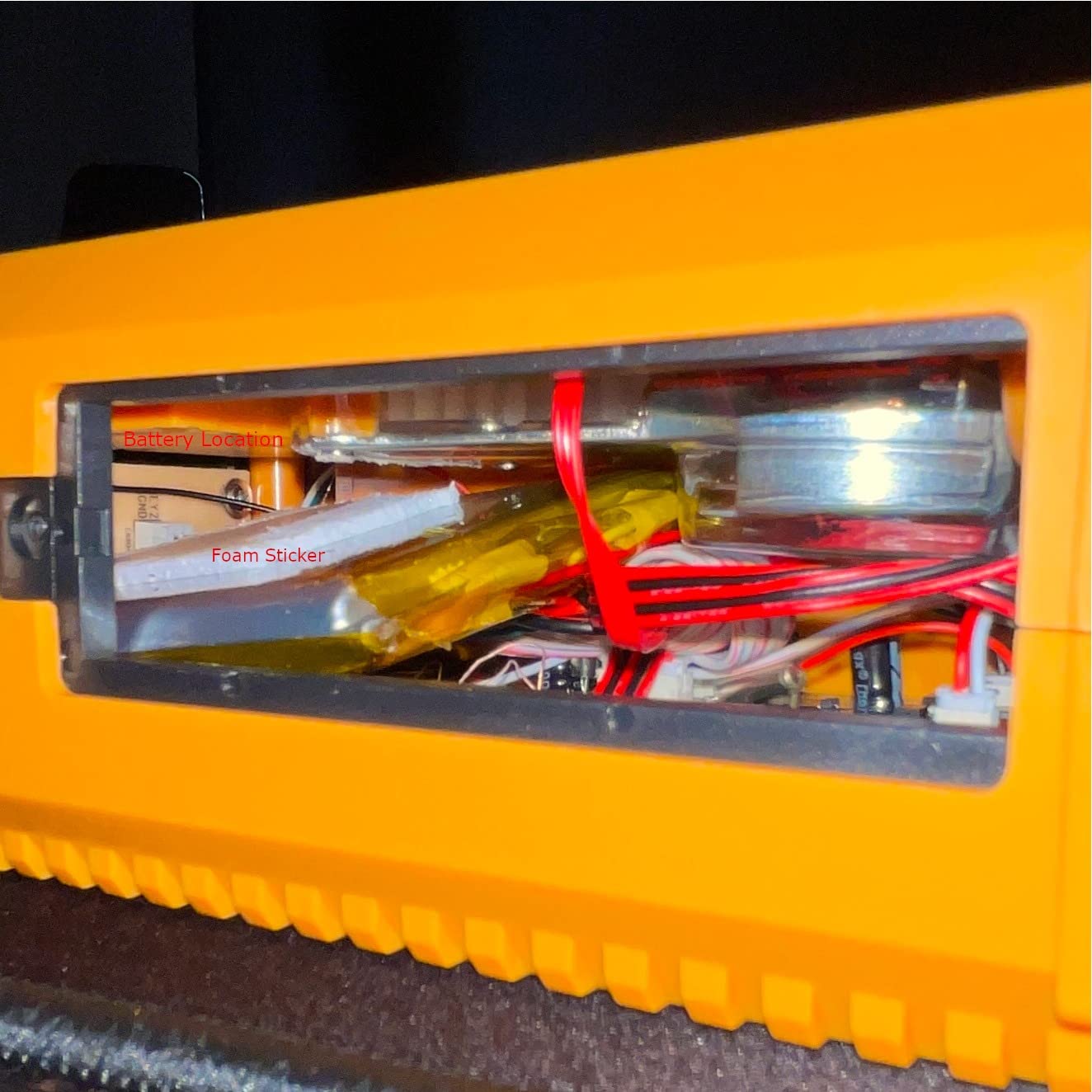
The KA500 is the only radio here whose main battery a user can swap out in a few minutes, and that single design decision outlives every feature list. Owners in radio and preparedness forums single it out for exactly this reason: when the internal pack eventually fades after years of storage, you replace the cells rather than the radio. Standard AA cells also work in the external compartment.
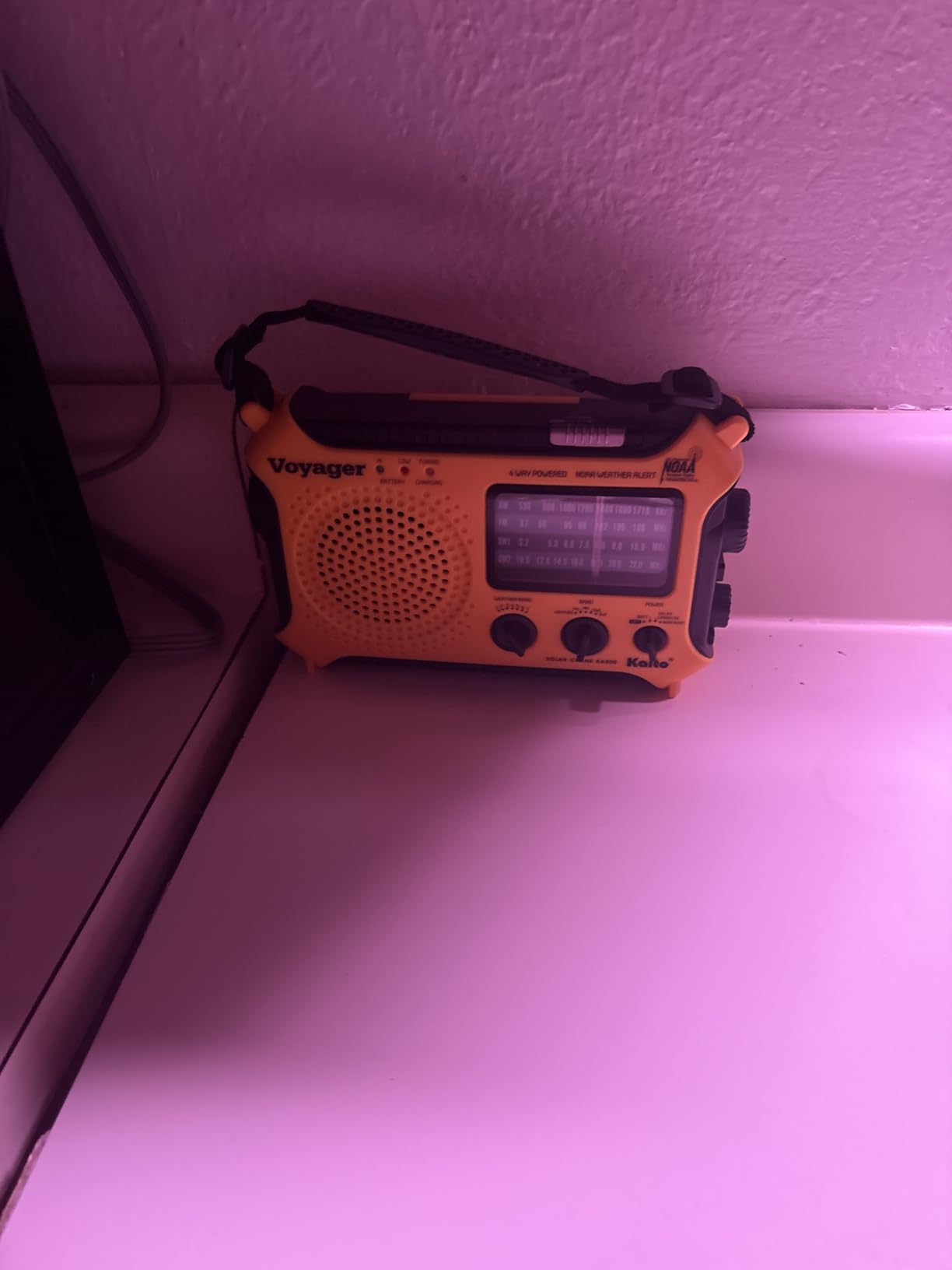
The other signature feature is the 14.5-inch telescopic antenna, paired with an LED signal strength indicator. That is the longest whip in this roundup, and it made a measurable difference in the places reception usually falls apart: a basement, a rural valley, a downed tree line. The four-band coverage adds AM, FM, two shortwave bands and seven pre-programmed NOAA channels with PEAS alerts.
Six power sources cover hand crank, solar, a three-AA compartment, 5V USB input, 5V AC/DC input and the built-in NiMH pack. The USB output handled phones and a small camera in our testing, and the LED flashlight, 5-LED reading lamp and red SOS beacon cover the light side of the job well.
Best when reception is the hard part
If you live in a valley, a mountain cabin or a rural area with weak cell coverage, the antenna alone justifies this radio. Users also report it survives drops well, which matters for a device that lives in a car or a go bag. The impact-resistant, water-resistant ABS housing is built for handling rather than display.
Know what you are carrying
At 8.3 by 2.3 by 5.3 inches it is the bulkiest hand-crank radio here, so it is a stay-put or vehicle radio rather than a pocket carry. The wall adapter is sold separately and AA batteries are not included, both small annoyances on day one. NOAA coverage is limited to the USA and Canada, and the control layout with six or seven dials is the one forum complaint that comes up repeatedly.
7. Mesqool 5000mAh NOAA Radio — Best for Audio Clarity and Honest Specs
NOAA Weather Radio FM AM Shortwave, Emergency Radio 5000mAh Solar Crank
5000mAh/18500mWh, up to 13 hours
5 watt speaker, 116dB SOS siren
3W flashlight and 2.5W reading lamp
3-year warranty
Pros
- Clear
- distortion-free audio even at maximum volume
- Bright dual-setting flashlight and reading lamp
- Five power options including AAA dry cells as a fallback
- 3-year warranty against manufacturing defects
Cons
- Shortwave band is effectively unusable with a tiny tuning knob
- Solar panel will not charge a depleted battery
- Hand crank takes roughly 8-15 minutes per phone charge
- Analog tuning with no display
Audio quality is what separates this one when you push the volume. The 5-watt speaker stayed clear at maximum output in our test, with none of the crackle that shows up on cheaper units. A radio that distorts when you turn it up is a radio that will be turned down, and a radio turned down is a radio that misses warnings.
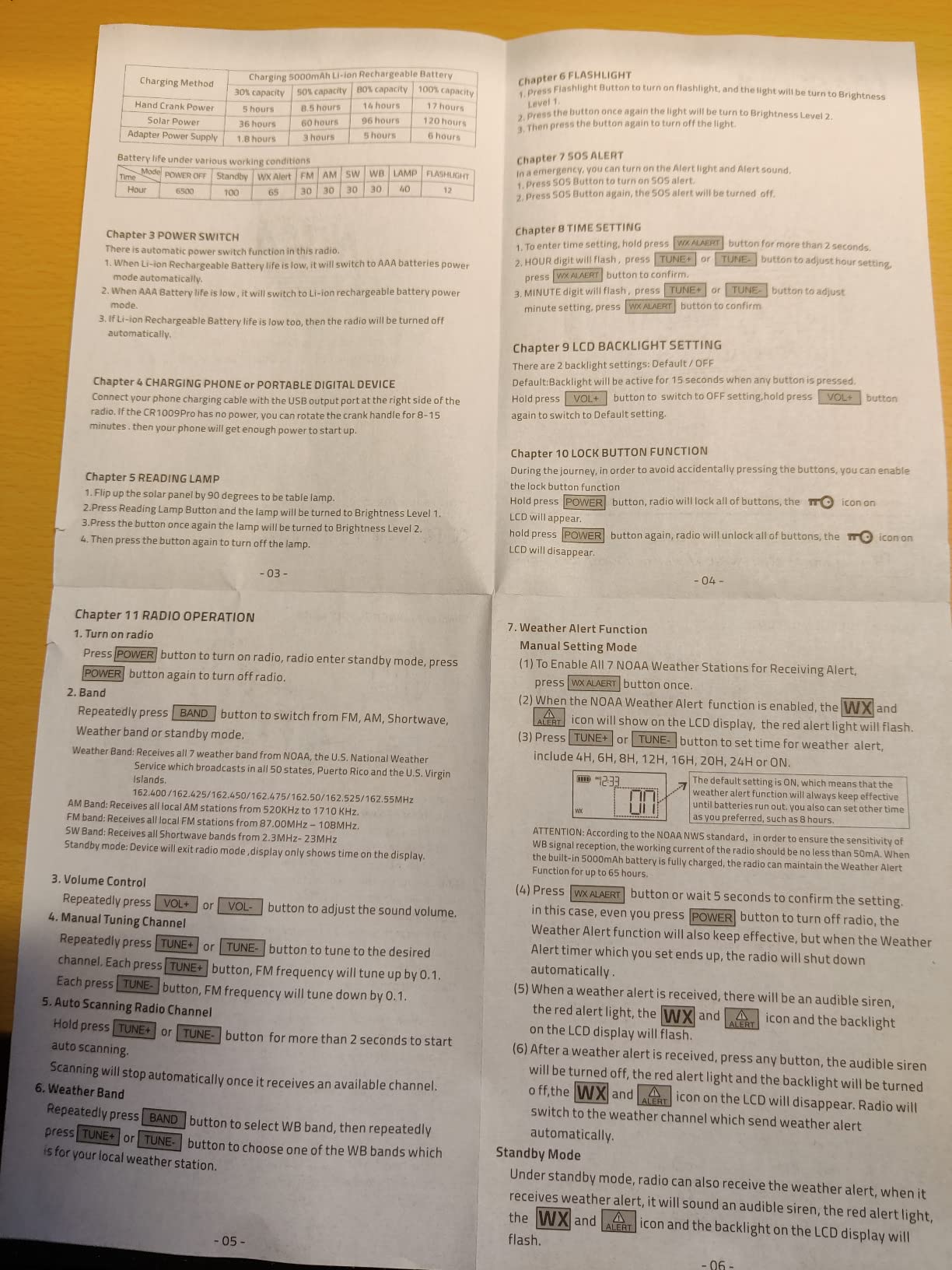
The 5000mAh cell, rated at 18500mWh, delivered up to 13 hours of listening at 50 percent volume, and the flashlight and reading lamp both have dual brightness settings. A 116dB SOS siren with a flashing red beacon is among the loudest in the group, and the three-year warranty against manufacturing defects is the longest coverage on this list.
What stands out is the honesty. Reviewers repeatedly note that the manufacturer states plainly that the solar panel only maintains charge rather than replenishing a depleted battery. That single sentence saves buyers the disappointment that solar marketing usually delivers, and it is worth more than a claim the panel cannot back up.
Why audio quality matters more than specs
Alert reception is an audio task. If the siren is distorted or the broadcast is buried under hiss, a warning in the middle of the night may not register as urgent. The strap, carabiner and compass make it easy to hang near a doorway, and the ABS housing is water resistant for barns, basements and campsites.
Skip it if you want shortwave
Shortwave is listed in the band support, but in practice it is one wide band with a very small tuning knob, and the standout complaint from buyers is that it is unusable. The analog dial with no display also means no battery indicator and no channel readout, and the hand crank needs roughly 8 to 15 minutes of turning for a single phone charge. For shortwave that actually works, look at the Kaito.
8. Leaton 10000mAh Radio — Best for Big Controls and Easy Tuning
Leaton Hand Crank Emergency Radio, NOAA Weather Radio AM/FM,10000mAh
10000mAh battery, 5V/1A phone output
IPX6 water resistance
3-mode flashlight plus reading lamp
Manual NOAA tuning
Pros
- 10000mAh battery gives real charging capacity
- Genuine IPX6 water resistance for splash and spray
- Large controls are easy to tune
- Flashlight offers high
- low and SOS modes
Cons
- No S.A.M.E. and no automatic NOAA alerts
- must be tuned by hand
- No headphone jack and no shortwave band
- Cannot charge multiple devices at once
- Heavier at about 1.1 lbs
The Leaton is built around one idea: make it usable when your hands are cold and the lights are out. The dials and buttons are physically larger than anything else on this list, and tuning AM, FM or a NOAA channel took us seconds rather than minutes. For older adults, kids, or anyone wearing gloves in a winter outage, that is a real feature rather than a cosmetic one.
The 10000mAh battery is the second largest here, and the 5V/1A USB output works out to roughly one to one and a full charges of a modern phone. IPX6 water resistance is a real rating for splash and spray rather than a marketing word, which is more than most competitors in this category offer. The flashlight runs high, low and SOS modes with a 1.3W reading lamp alongside it.
Cranking is unusually productive at about 15 to 20 minutes of listening per minute of cranking. For scale, a cheaper radio that yields a few minutes per minute of effort turns an outage into a workout, and this one does not.
Best when usability beats everything else
Reviewers consistently highlight the easy-to-see controls, the battery capacity and the honest trade-off that NOAA channels are tuned by hand. The built-in compass and included USB-C cable are small touches, and the one-year warranty is standard for the category. This is a good radio for a kitchen, a workshop or a car.
The manual tuning requirement is the catch
There is no S.A.M.E. programming and no automatic alert mode, so NOAA warnings only reach you if the radio is on and tuned to the right channel. That is acceptable for daily listening and unacceptable as your only warning system. It also has no headphone jack, no shortwave, and at about 1.1 pounds it is the heaviest unit in the roundup.
9. Eton ARCFRX3 — Best for Finding a Radio in a Dark Room
American Red Cross FRX3 All-Purpose Rechargeable Weather Alert Radio with Solar Panel – ARCFRX3
Automatic emergency alert broadcasting
AM, FM and NOAA digital with display
Alarm clock and USB charging
Glow-in-the-dark locator included
Pros
- Alert function automatically broadcasts emergency weather alerts
- Clear reception across AM
- FM and NOAA
- Very bright backlit display readable in the dark
- Hand crank fills the charge in minutes
Cons
- Weak integrated flashlight and beacon compared with dedicated lights
- Obsolete Mini-USB port with no adapters included
- Rechargeable battery needs attention every few months and accepts no AA or AAA backup
- Phone charging is impractical at about 4 minutes of cranking per minute of talk
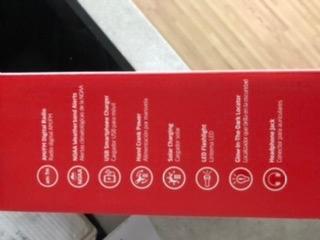
The glow-in-the-dark locator is a small part that solves a real problem. In a blackout, finding a black radio in a black drawer wastes the minutes you should be spending getting dressed and moving. The Eton can be found in the dark, and the backlit display is bright enough to read settings without a flashlight.
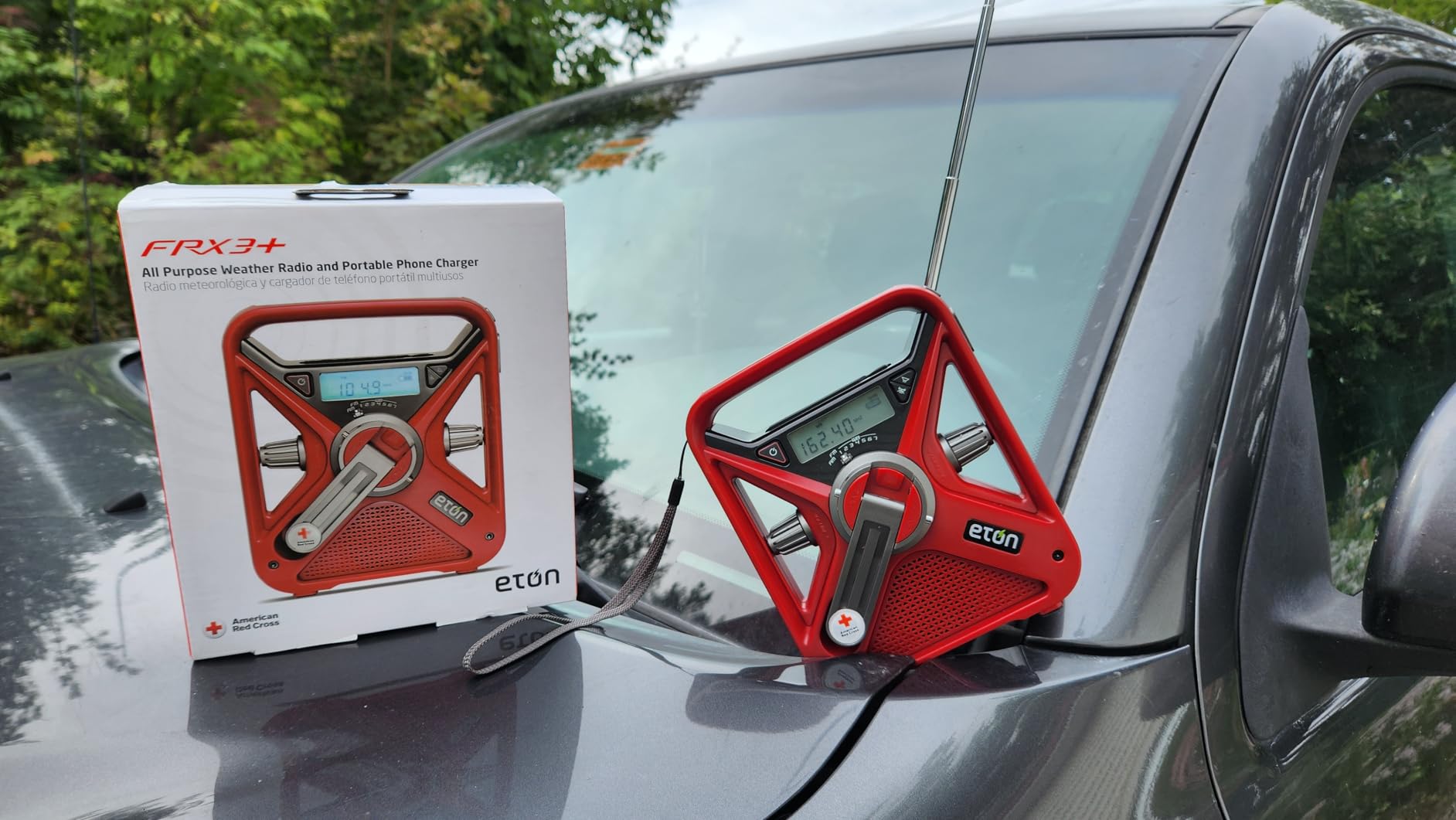
Its alert function automatically broadcasts emergency weather alerts for your area, and it covers AM, FM and the NOAA band on a digital tuner with a display and an alarm clock. Reception was clear across all three bands in our testing, and the knobs and buttons are intuitive enough to set up without a manual. The Red Cross branding also makes it an easy item to recognize in a community shelter or a gift kit.
This is also the only radio here that doubles as a bedside alarm clock, which quietly makes it a device you keep plugged in and using rather than one that lives in a bin. Charging comes from a solar panel, a hand crank or the built-in rechargeable cell, and the crank filled the charge quickly enough to be genuinely useful.
Best as a bedroom and everyday-use radio
Because it is a good AM/FM radio with a display, you will actually use it, and regular use is what keeps the rechargeable cell healthy. The alarm clock function, the bright backlit screen and the straightforward controls make it a natural fit for a nightstand or a kitchen counter. The Red Cross edition carries a 1-year warranty.
Its light and charging options are dated
The integrated flashlight and red beacon are dim compared with the dedicated lights on the Eoxsmile, Mesqool or Emgykit, so do not plan to navigate a dark house with it. The Mini-USB charging port is obsolete and no adapters are included, which is exactly the kind of detail that strands you years later. The sealed rechargeable battery needs attention every few months and there is no AA or AAA fallback, and phone charging works out to roughly four minutes of cranking per minute of talk time. It is also not water resistant.
10. Emgykit 086S — Best for Go Bags and Small Budgets
Emgykit Hand Crank Radio with AM/FM/NOAA Weather Band,for Emergencies
140 lumen 3W flashlight
SOS siren above 80 decibels
Crank, solar and Type-C charging
2000mAh battery, 0.23 kg
Pros
- Very bright 140-lumen flashlight and piercing SOS siren
- Pocket-sized and light at 0.23 kg
- Clear
- loud AM/FM and NOAA reception for the size
- Three charging options with a smooth hand crank
- One owner ran it 8 hours at full volume
Cons
- Not waterproof
- Only a 1-watt speaker
- Several hours needed for a full USB charge
- 2000mAh battery limits phone charging
- No reading lamp
The flashlight is the reason this one is interesting. The 3-LED upgrade produces 140 lumens, which is brighter than most dedicated lights on this list, and the SOS function is triggered by a three-second press and sounds a siren above 80 decibels. A radio you can see by, and a radio that can be heard by searchers, cover the two things that actually go wrong after dark.
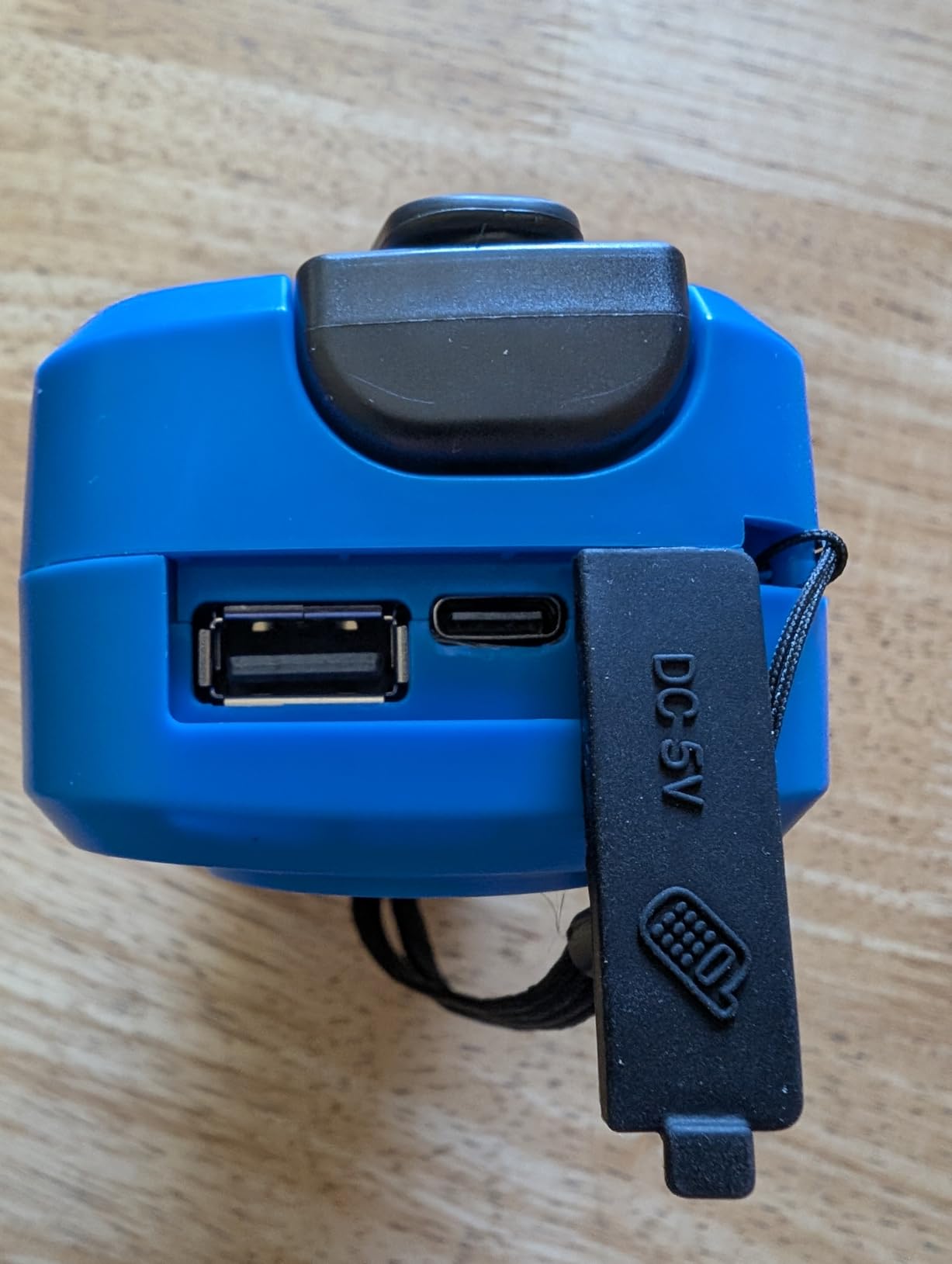
Everything else is aimed at the same goal: go small. The body measures 5.16 by 2.09 by 2.6 inches and weighs 0.23 kg, so it disappears into a backpack or a jacket pocket. AM, FM and NOAA reception was clear and loud for the size, and the hand crank is smooth rather than punishing, which matters after hour two of an outage.
Charging comes from the crank, a solar panel or a Type-C port. The 2000mAh battery can charge a phone, and one owner reported it holding up through eight hours at full volume in a personal test. For a spare unit, a car kit, or a stocking stuffer that will not be missed, the value here is hard to argue with.
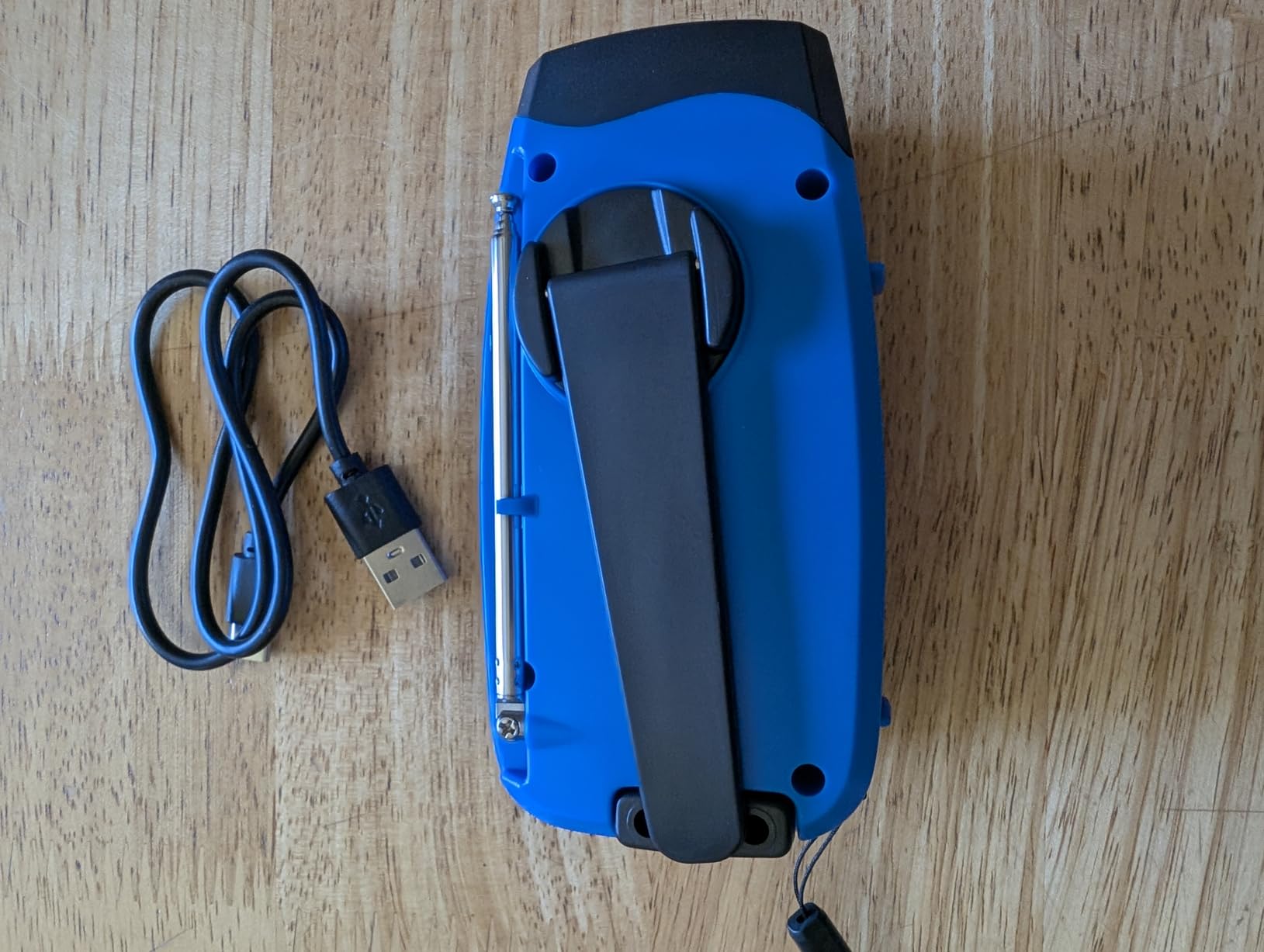
Good for stocking several kits
Owners describe it as inexpensive insurance that stayed powered through a real outage, and the 1-year warranty keeps the risk low. Because it is small, you can place one in the house, one in the car and one in a go bag without thinking about it. The light and siren combination makes it a better fit for a first-aid kit than most radios of this size.
Known limits before you buy
It is not waterproof, the speaker is only 1 watt, and there is no reading lamp for long reading. A full USB charge takes several hours, and the 2000mAh battery is small for phone charging. Treat it as a lightweight backup layer rather than your primary alert radio, and pair it with something larger if you expect a long outage.
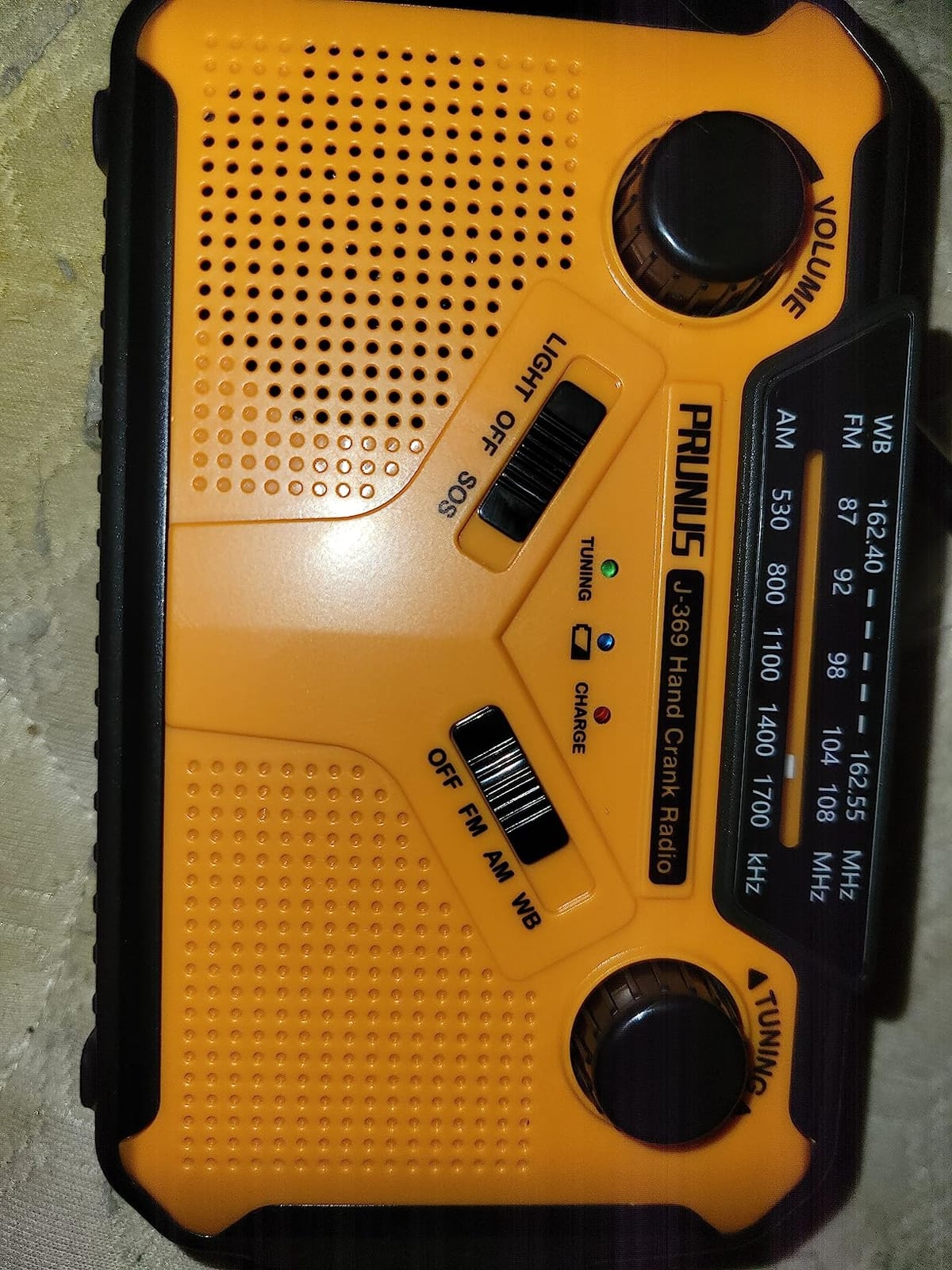
11. PRUNUS J-369 — Best for AA Battery Flexibility and Reception
PRUNUS J-369 11100mWh Emergency Weather Radio NOAA/AM/FM
American-made DSP chip with long antenna
NOAA, FM 87-108MHz, AM 530-1700kHz
5 power options including 3xAA
3000mAh power bank
Pros
- Extra-long antenna and DSP chip give reliable station pickup
- Runs on standard AA batteries for long outage runtime
- Multiple charging methods keep it ready without wall power
- SOS alarm and flashing lights aid rescuers
- Compact and lightweight
Cons
- Not water resistant
- Micro USB charging port rather than USB-C
- Phone charging requires switching to Li-ion mode and is limited to 3000mAh
- No shortwave band
The argument for this radio is that batteries are a commodity. When the lithium pack fades after a few years of storage, three AA cells from any hardware store bring the radio straight back. The PRUNUS runs on 3xAA batteries alongside hand crank, solar and micro USB, and the manufacturer rates AA capacity at roughly two and a half times AAA for longer outage runtime.
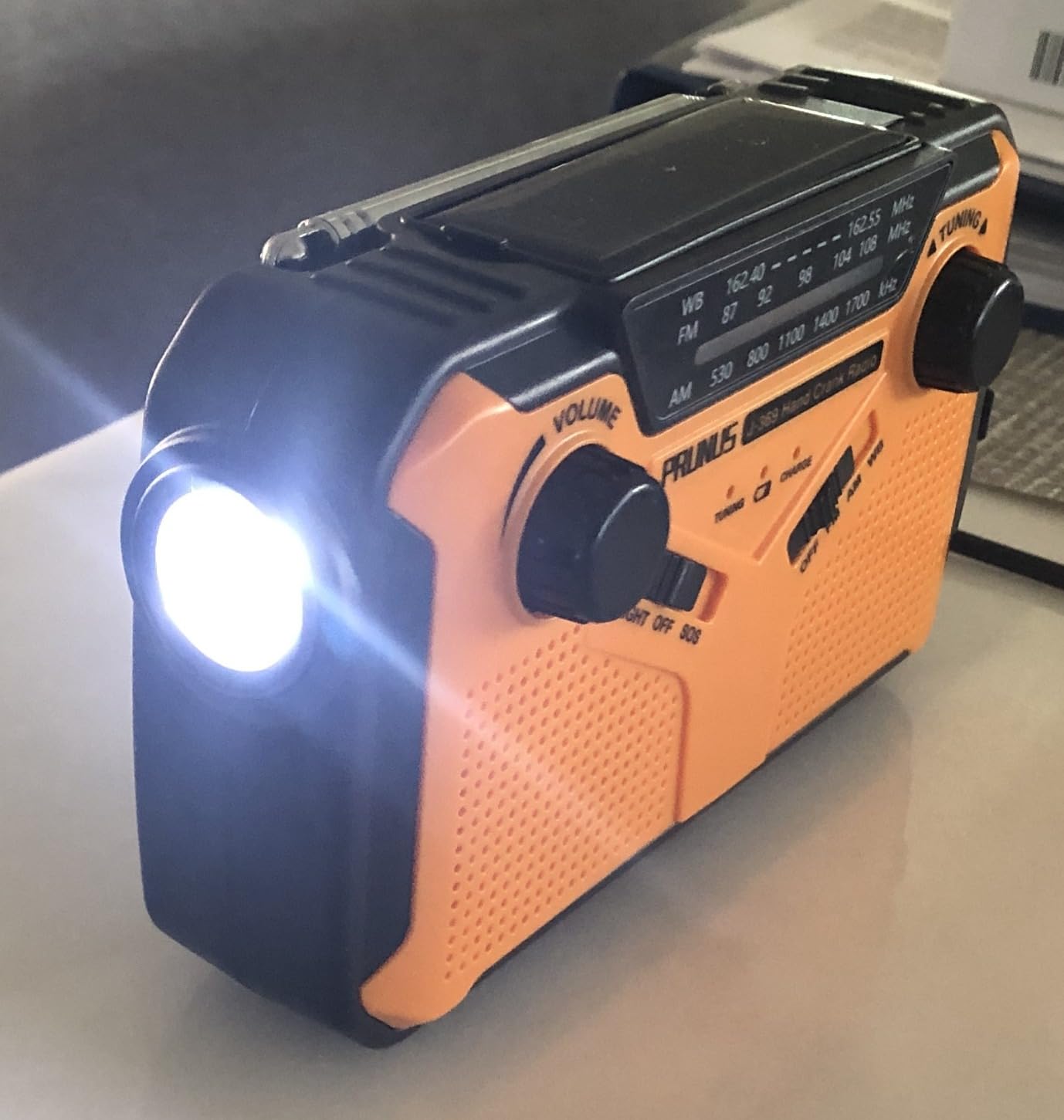
Reception is the second strength. The American-made DSP chip and extra-long antenna produced the most consistent station pickup of the smaller units we tested, including in a room with metal framing. The bands cover NOAA, FM 87-108MHz and AM 530-1700kHz, which covers news, talk radio and local emergency information in one device.
There is a nice piece of design thinking in the reading lamp built into the flip-up solar panel, so the light and the charger occupy the same surface. The 3000mAh battery doubles as a phone power bank, and the SOS alarm with flashing lights is designed to make the radio visible to rescuers at night.
Best when you want no proprietary parts
Buying cells you can find anywhere removes the single most common long-term failure in this category, and forum users consistently prefer standard replaceable cells over sealed internal packs. The compact 3.7 by 1.7 by 6.1 inch body is easy to keep on a shelf, in a drawer or in a bag. The 1-year seller warranty is standard for the price.
Older ports and no shortwave
The micro USB charging port is dated next to the USB-C models here, and it is the kind of connector you will struggle to find a cable for in a pinch. Phone charging requires switching the radio into Li-ion mode and is limited by the 3000mAh capacity, and the housing is not water resistant. There is no shortwave band, so skip it if you listen to broadcasts beyond AM and FM.
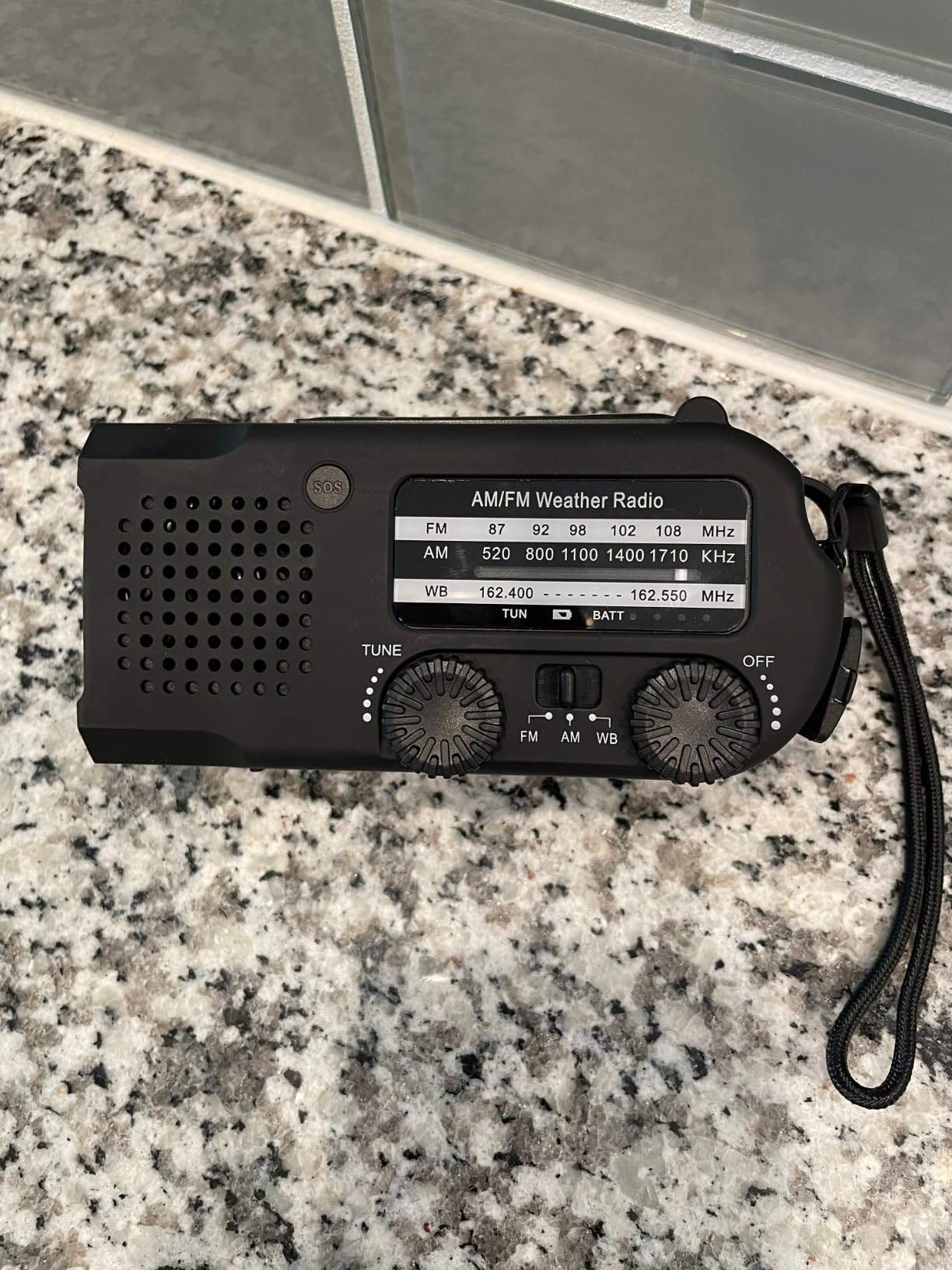
12. QAUYYW XSY-350 — Best for Long, Extended Outages
QAUYYW Solar Hand Crank Emergency Radio, 20000mAh AM FM NOAA Weather Radio
20000mAh battery, up to 35 hours of radio
52 cm extended antenna
IPX6 waterproof rating
3W flashlight and 3.5W reading lamp
Pros
- Largest battery capacity in this roundup at 20000mAh
- Long 52 cm antenna improves reception
- IPX6 waterproofing for harsh weather
- Lightweight at under 11 ounces despite the big battery
- USB Type-C
- hand crank and solar charging
Cons
- NOAA alerts require powering on and manually tuning
- No S.A.M.E. county filtering or automatic alert mode
- Phone charging is limited to a brief call or text
- Analog tuning with no display
When an outage runs long, the deciding number is battery capacity, and this radio leads the group by a wide margin. The 20000mAh pack, rated at 74000mWh, is specified for up to 35 hours of radio playback at medium volume, and the reading light is rated for 50 hours of continuous use. Our test week included several full listening days without a wall outlet nearby.
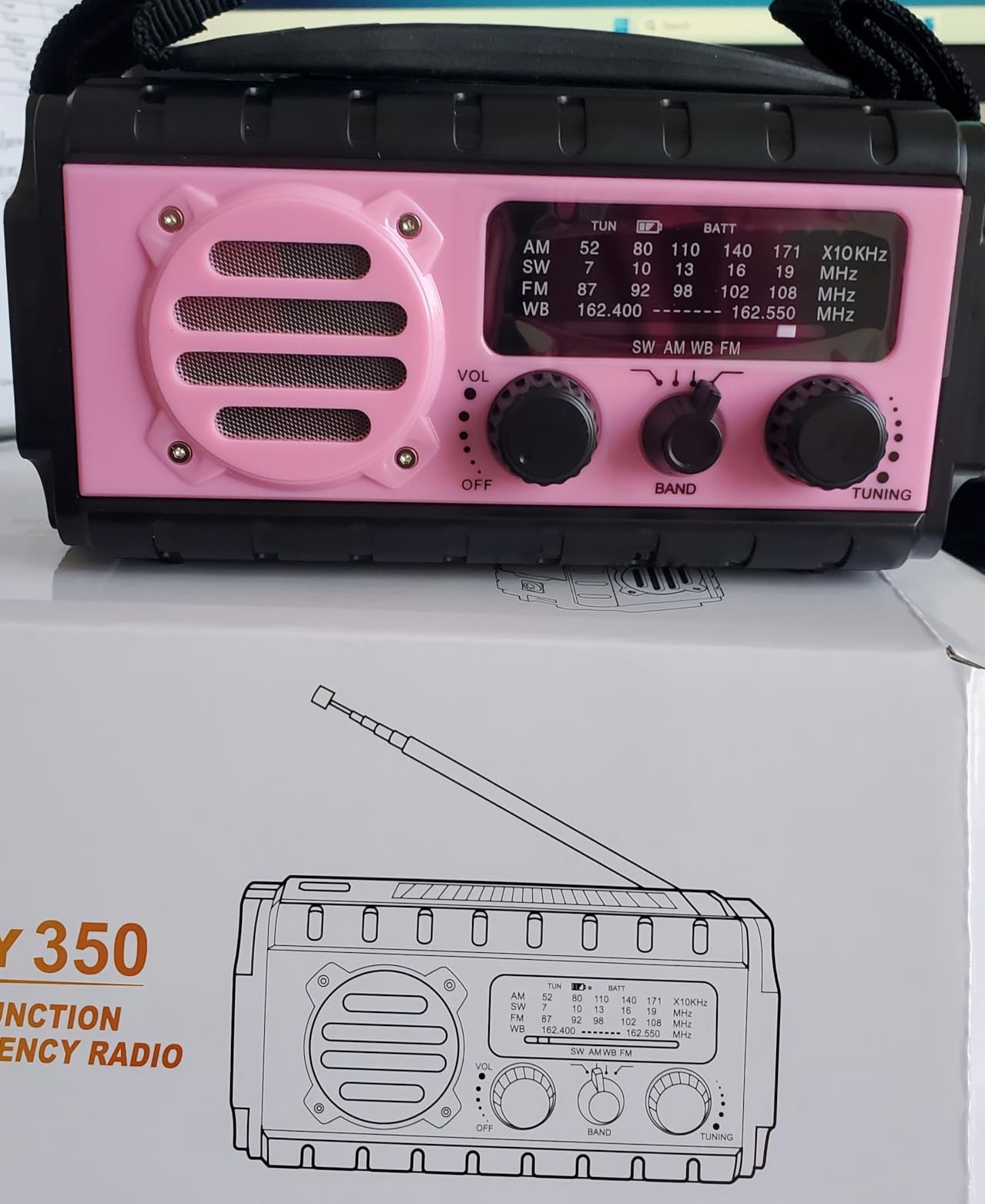
The 52 cm extended antenna is the second longest here and it made a difference on weak signals, and the IPX6 waterproof rating means it can handle the conditions that actually happen during a storm. Charging options include USB Type-C, hand crank and solar, and the whole unit weighs under 11 ounces despite the battery, so the capacity does not turn it into a brick.
Output is handled by a 5-watt speaker with a 3W flashlight and a 3.5W reading lamp, plus an SOS alarm. A 12-month warranty and round-the-clock support are listed, which is worth noting for a brand most buyers will encounter for the first time.
Best for a week without power
If your realistic scenario is several days or more, capacity decides the purchase. Reviewers single out the battery, the long antenna and the waterproofing as the standout advantages for outages and hiking, and the light output covers a home blackout comfortably. The 12-month warranty is the shortest of the group but the support is listed as 24/7.
Do not rely on it for automatic warnings
NOAA alerts here require powering the radio on and manually tuning to a station, and there is no S.A.M.E. filtering and no automatic alert mode. A big battery does you no good if the warning never interrupts. Phone charging is limited to roughly a brief call or a text, and analog tuning with no display makes station finding slower in the dark. Pair it with an alert radio rather than choosing it alone.
How to Choose an Emergency Weather Radio
The single most important distinction in this category is between a weather alert radio and a weather band radio. A weather band radio simply receives the NOAA frequencies, so you tune to a station and listen. A weather alert radio uses S.A.M.E., or Specific Area Message Encoding, to monitor continuously and sound a loud siren when a warning is issued for the county you programmed. Only the second type will wake you at 3 a.m. while you are asleep.
That matters more than any other specification on this page, because the radios differ on it. The Midland WR120B programs up to 25 counties with color-coded severity indicators. The Raynic scans automatically on power-up and in standby. The Eton ARCFRX3 broadcasts alerts automatically for your area. The Leaton and the QAUYYW are manual tuners, which is fine for daily listening and poor as a warning system.
Warning, watch and advisory are three different things, and knowing the difference prevents panic. A watch means a severe event is possible within the next few hours. A warning means it is happening or imminent where you are, and that is the one that means act now. An advisory is a lesser weather situation that still deserves attention.
Power sources determine whether a radio survives a blackout. Every model here takes more than one, but the quality differs. Hand cranking produces very different amounts of energy depending on the mechanism, and manufacturers rarely publish the crank-to-listen ratio. Solar panels on small radios generally maintain a charge rather than rebuild a flat battery, and one manufacturer in this roundup says exactly that, which tells you how unusual that honesty is.
Battery capacity is the cleanest number to compare. Two radios can share a 2000mAh rating while behaving very differently if one drives a 5-watt speaker and the other a 1-watt one. A 5000mAh pack with a loud speaker is a better use of an outage than a 10000mAh pack you cannot hear. Match the capacity to the length of the outage you are actually planning for, not the worst case you imagine.
Flashlight output is the most neglected spec and one of the most practical. Look for a stated wattage or lumen figure, and check whether there is a separate reading lamp, because a single dim LED will not get you through a house with a newborn or a broken ankle. SOS alarms and flashing beacons help searchers locate you outdoors after dark.
Think about where the radio will live. A bedside unit wants a loud siren, a backlit display and ideally a headphone jack. A go bag wants low weight and small size. A vehicle or cabin wants a long telescoping antenna and a big battery. If anyone in the household is hearing or vision impaired, prioritise the brightest light, the loudest siren, and any tactile or visual alert features, and pair the radio with pillow shakers from our solar charging picks.
Layer your alerts rather than relying on one device. A phone gets the fastest warning but dies with the tower. A NOAA radio keeps working on its own battery. A battery-powered siren, a smoke alarm with a battery backup and a neighbour check-in round out the picture. If you need to talk rather than listen, our ham radio guide covers the next step up. For keeping the rest of the house running, portable power stations handle what a radio cannot, and dual fuel generators cover outages measured in weeks.
How to Program SAME County Codes in Five Steps
Most S.A.M.E. capable radios ship with no location entered, which is why new owners report hearing alerts for counties nowhere near them. Setting it takes about ten minutes once you have your code.
First, find your FIPS code from the National Weather Service county lookup for your state. It is a six-digit number and it is public, and searching your county name in the NWS SAME county code list returns it directly.
Second, note your NOAA transmitter station ID. The county code and the transmitter together determine which alerts you hear, and the station ID is printed on the radio’s packaging or found in the manual.
Third, open the programming menu. On most units this is a press and hold of the weather or alert button, followed by a tone that signals you are in setup mode.
Fourth, enter the six-digit county code, then set the Event indicator to your own county. Leaving the indicator on a single letter or an ALL event selection causes the radio to fire for every warning in the broadcast area, which is the second most common programming complaint.
Fifth, activate alert mode and confirm the county display shows your code. Unplug the radio from the wall and power it on from battery only, then check that it still holds the setting, because some units revert to factory defaults when the mains connection is removed.
Keeping an Emergency Radio Ready Between Outages
Rechargeable lithium cells lose capacity when they sit untouched, which is the quiet reason so many emergency radios fail at the moment they are needed. Top up every three months. A radio that sits at a partial charge for a year will not deliver the runtime printed on the box.
Test the crank. Give the handle five minutes and listen. If the charge indicator does not move, the mechanism or the internal cell has degraded, and you want to know that in daylight rather than during an alert.
Rotate your dry cells. If the radio takes AA or AAA cells, buy a fresh set every year and use the old ones elsewhere so you do not find expired batteries in the compartment when it matters.
Check the county code once a year. If you move, change counties, or the county boundaries were redrawn, your program is now pointing at the wrong place. Radio placement matters too: keep one unit in a sleeping area, since a siren in the kitchen is no use at 3 a.m.
Frequently Asked Questions
What is a good emergency radio to buy?
The FosPower A1 is the most complete pick for most households, with three power sources, a 7400mWh power bank, NOAA reception with an SOS alarm and a limited lifetime warranty. For a fixed home radio that filters alerts to your county, the Midland WR120B is more precise. For a larger battery and automatic alert scanning, choose the Raynic CR1009Pro.
What is the difference between a weather alert radio and a weather band radio?
A weather band radio only receives NOAA frequencies, so you must tune to a station and listen. A weather alert radio uses S.A.M.E. county programming to monitor continuously and sound a loud siren when a warning is issued for your area, even while you are asleep or listening to AM or FM. If you want to be woken automatically, you need the alert type.
Do I need a NOAA radio if I have smartphone alerts?
No, but you should not rely on a phone alone. Cell towers and power fail early in a hurricane, wildfire or ice storm, and phone batteries are gone within hours. A NOAA radio runs on a battery you control, keeps receiving official alerts through the whole event, and works in shelters where cell service fails completely. Keep both and let them cover each other.
Will these radios work if cell towers are down?
Yes. That is the core reason they exist. NOAA transmissions are broadcast from fixed radio towers run by the National Weather Service, not from cellular networks, so an alert keeps arriving on a NOAA radio while phones sit on no service. The same is true during a blackout, since the radio runs on its own battery or a hand crank.
How long does a hand crank radio last?
It depends on the mechanism, and manufacturers rarely publish the ratio. In practice a good crank yields roughly 15 to 20 minutes of listening per minute of cranking, as on the Leaton, while weaker mechanisms deliver only a few minutes. The Eton ARCFRX3 manages about four minutes of radio use per minute of cranking. Treat the crank as a backup, not a primary charging method.
Can an emergency radio charge my phone?
Most of them can, but the useful amount varies widely. A 2000mAh pack gives a phone a meaningful boost, a 5000mAh pack covers a full charge on many models, and the 10000mAh Leaton works out to roughly one to one and a half full charges. The Eton is the exception to avoid, since its phone charging works out to about four minutes of cranking per minute of talk time.
Where should I keep an emergency radio during an outage?
Put at least one unit in a sleeping area, because a siren in the kitchen is no use at 3 a.m. Keep a second unit near an exit or in the room with the fuse box so alerts are audible through more of the house. For a portable model, keep one in the car and one in your go bag, and check that the county code is still programmed before you need it.
Are solar panels on emergency radios worth it?
Treat them as a trickle charger, not a power source. On small panels the surface area is too small to rebuild a depleted battery in any reasonable time, and several manufacturers in this roundup say outright that solar only maintains charge. They are still worth having for a unit that sits on a windowsill between uses, but do not plan an outage around them.
The Bottom Line on Emergency Weather Radios
The FosPower A1 is the best emergency weather radio for most households in 2026, because it removes the three ways a radio usually fails: no power, no reception and no warranty. Three power sources, a phone-charging power bank, dependable NOAA reception and the deepest review history here make it the safe default.
Match the machine to the job instead of buying the biggest box. The Midland WR120B is the one to program to your county and leave on a nightstand. The Raynic CR1009Pro is the one to take if you want automatic scanning and a bright reading lamp. The Eoxsmile and the Mesqool are the loud ones, the Kaito is the one you can rebuild with ordinary cells, and the QAUYYW carries the most power for a week without a wall.
Whatever you choose, program the alerts, charge it every three months, and put one unit where you sleep. A radio that is set up and sitting in the right room is worth more than a better one still in the box.