
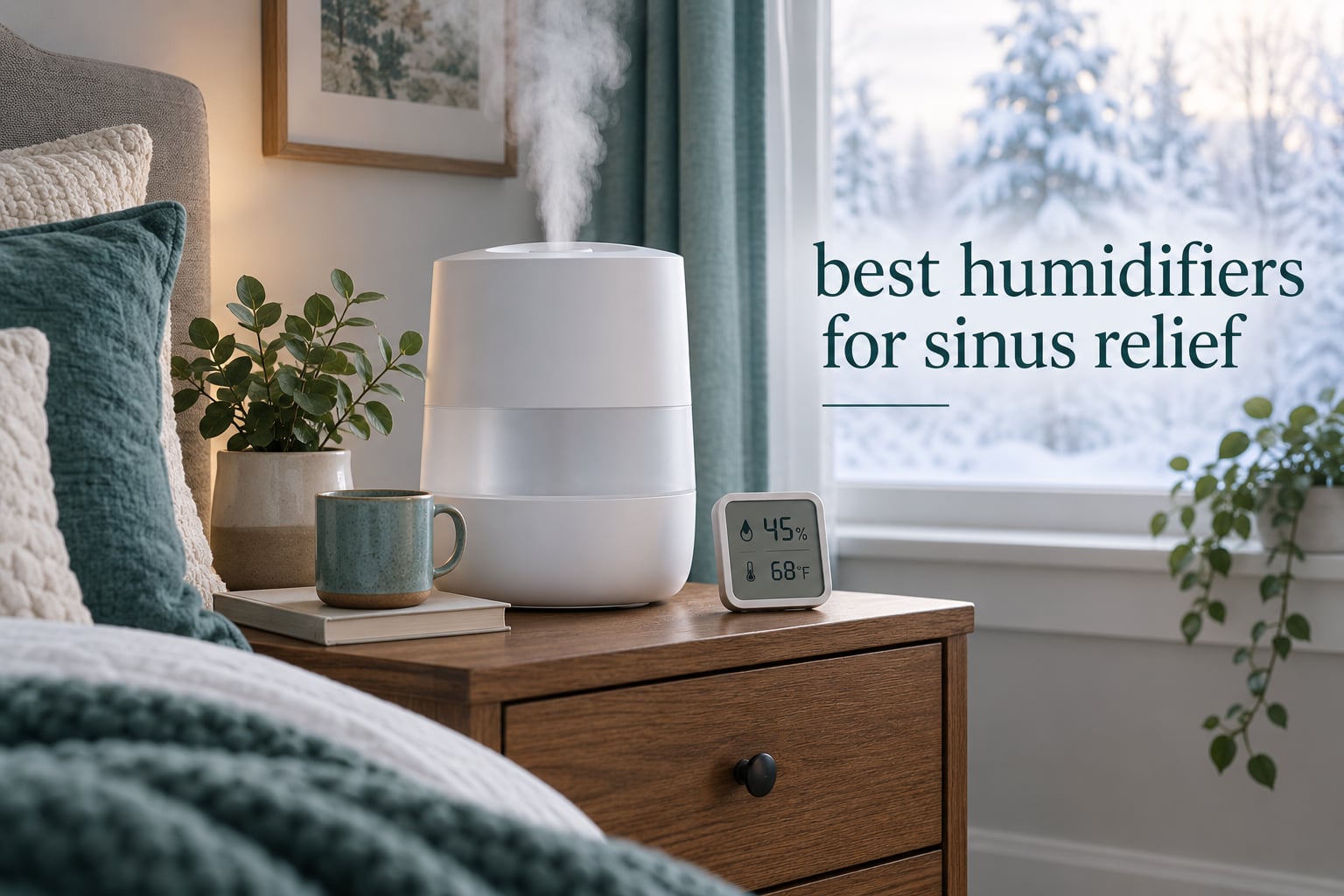
Cold, dry air does most of the damage to your sinuses. When relative humidity drops, the mucous membrane lining your nasal passages loses moisture, mucus thickens, and drainage slows down. That is why congestion is worst overnight and first thing in the morning. Adding moisture back keeps the lining damp so mucus stays thin and drains normally.
Our top pick for the best humidifiers for sinus relief is the Levoit LUH-O451S. It runs warm or cool mist, holds a 4.5L top-fill tank for about 45 hours, and holds the room in the 40-60% band automatically. For anyone who wants fewer moving parts and no filter costs, the Everlasting Comfort 6L is the better value pick. One honest note before we start: a humidifier relieves symptoms. It does not treat a bacterial sinus infection.
We compared ten units across tank size, runtime, noise, mist type, humidity control and cleaning burden. We also weighted the things that actually decide whether a humidifier helps or hurts: how easy it is to scrub clean, whether it throws mineral dust, and whether it can run all night without waking you. All ten have customer photos in their listings, so you can see the tanks and mist outlets before you decide.
If your symptoms run wider than one bedroom, our guides to the best whole house humidifiers and the best humidifiers for large rooms cover open-plan and whole-home setups in more depth.
Top 3 Picks for Sinus Relief in 2026

Levoit LUH-O451S Smart Warm and Cool Mist
- 4.5L top-fill tank
- 45H runtime
- Warm and cool mist
- auto 40-60% RH
- VeSync app
- remote and voice control
- Display-off night mode

Everlasting Comfort 6L Cool Mist
- 6L filterless tank
- 50H runtime
- 28 dB quiet operation
- Up to 500 sq ft coverage
- Built-in aroma tray

Crane EE-5301CW 1 Gallon Cool Mist
- 1 gallon tank
- 24H runtime
- Up to 500 sq ft coverage
- Optional filter slot
- Auto shut-off
The Best Humidifiers for Sinus Relief in 2026: All 10 Compared
| Product | Specifications | Action |
|---|---|---|
| Levoit LUH-O451S Smart Warm and Cool Mist |
|
Check Latest Price |
| Everlasting Comfort 6L Cool Mist |
|
Check Latest Price |
 Vicks V745 Warm Mist 1 Gallon Vicks V745 Warm Mist 1 Gallon |
|
Check Latest Price |
 Vicks V4600 Ultrasonic 1.2 Gallon Vicks V4600 Ultrasonic 1.2 Gallon |
|
Check Latest Price |
| Crane EE-5301CW 1 Gallon Cool Mist |
|
Check Latest Price |
 Homvana H101 3.6L Top-Fill Homvana H101 3.6L Top-Fill |
|
Check Latest Price |
 DREO Smart 4L Cool Mist DREO Smart 4L Cool Mist |
|
Check Latest Price |
 DREO 3L 26 dB Quiet DREO 3L 26 dB Quiet |
|
Check Latest Price |
 DREO 6L Smart Warm and Cool Mist DREO 6L Smart Warm and Cool Mist |
|
Check Latest Price |
 Honeywell HCM350B Evaporative Honeywell HCM350B Evaporative |
|
Check Latest Price |
How Humidification Relieves Sinus Symptoms
The mechanism is simple. Your nose warms and humidifies inhaled air, and when the surrounding air is already dry it has less moisture to give. The membrane dries, mucus concentrates, and small openings in the sinus drainage pathway swell and slow down. Symptoms follow: pressure behind the eyes or cheeks, a stuffy nose, and thicker mucus that is harder to clear.
Forum discussion on this topic repeats a useful pattern. People on r/Sinusitis describe mornings as the worst part of the day, especially in winter with heating running overnight. One poster with a crooked sinus passage said adding humidity essentially eliminated blood in their mucus. Others on r/Sjogrens describe a nightly routine of humidifier plus a nose rinse and treat the humidifier as essential rather than optional.
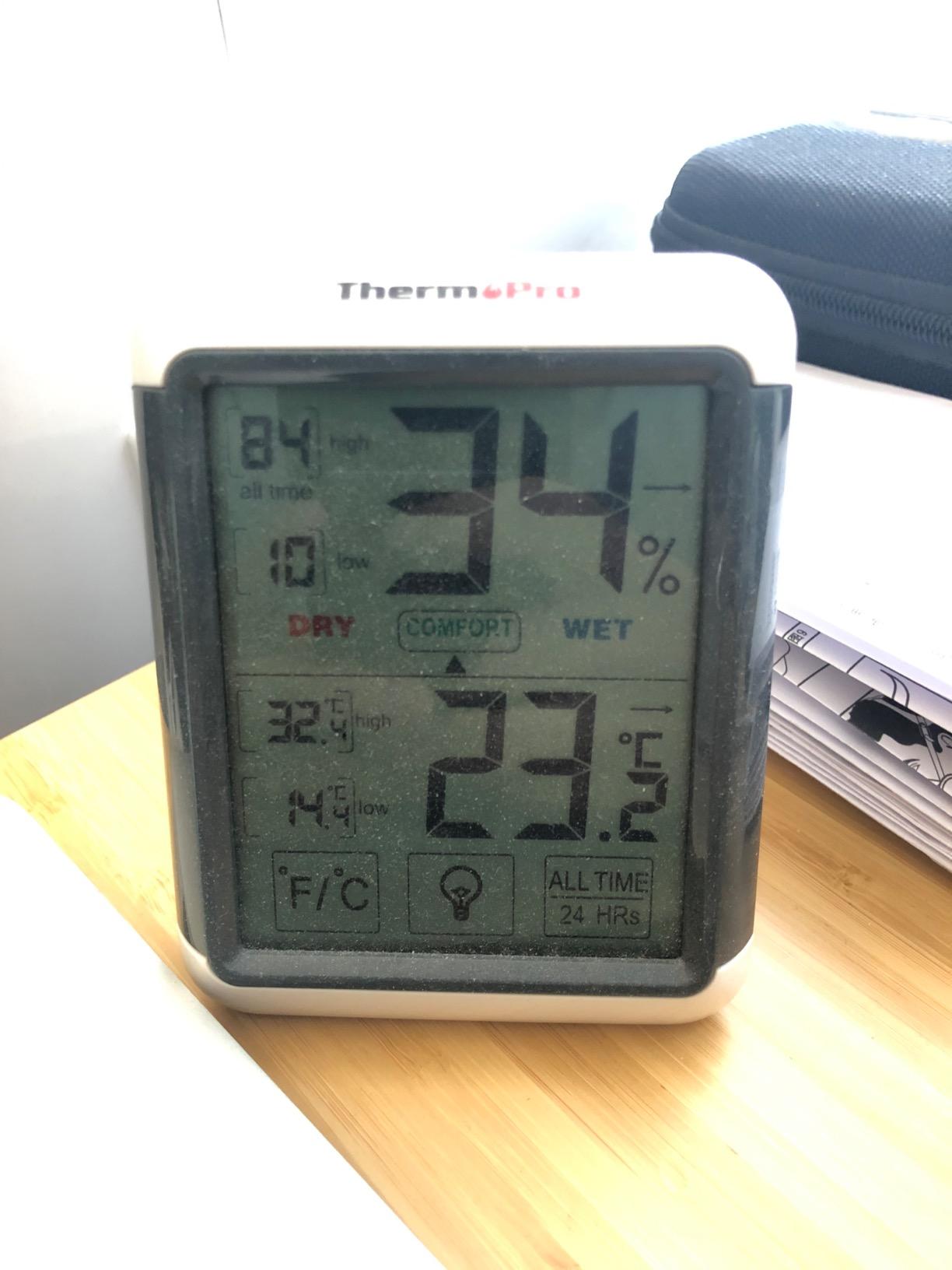
The indoor numbers explain why. One r/Sinusitis poster checked their bedroom and found it sitting near 20-30% relative humidity. The comfortable band for nasal passages is 40-60%. That gap is why a correctly sized humidifier can change how the night feels within a day or two.
Warm Mist vs Cool Mist vs Evaporative: Which Type Works Best for Sinuses
Three technologies compete here, and no competitor roundup we studied covers all three. Here is the short version:
Cool mist ultrasonic is the default choice for adults and the safest for children and pets, because there is no boiling water. A high-frequency transducer shatters water into a fine aerosol. The tradeoff is mineral dust: dissolved solids in hard tap water get atomized along with the water and settle as white residue.
Warm mist boils the water first, so minerals stay behind and dust drops sharply. Many people report warm mist feels better for winter congestion and cold air. The risk is the heating element, which reaches hot enough to scald, plus mineral scale that needs vinegar descaling on a schedule.
Evaporative wick draws water up a wick and lets a fan pull moisture through it, so only vapor reaches the room. It is the lowest maintenance option and cannot produce white dust. It also self-regulates better because output falls as the room air approaches saturation.
If you want one sentence: pick a cool mist unit if the room will be cleaned daily, warm mist if winter congestion is your main complaint and there are no small children in the room, and evaporative if mold anxiety or dust on furniture is what has been keeping you from buying one.
1. Levoit LUH-O451S Smart Warm and Cool Mist – Best Overall for Sinus Relief
Levoit Humidifiers for Bedroom, Smart Warm and Cool Mist, Symptom Relief
4.5L top-fill tank
45 hour runtime
Warm and cool mist
Auto 40-60% RH
430 sq ft
Pros
- Quiet operation with a display-off night mode
- Warm mist sharply cuts white dust
- Wide top-fill opening makes daily cleaning easy
- App
- remote and voice control with scheduling
- Reviewers report relief from sinus congestion
Cons
- Humidistat readings are not accurate across a whole room
- Coverage falls short of 430 sq ft in large rooms
- Sponge filter discolors and needs frequent replacement
This is the unit we would put in a bedroom with chronic or recurring congestion. The double duct design and the option to run warm or cool mist mean you can match output to the season, and auto mode holds the room inside the 40-60% band that keeps a mucous membrane from drying out in the first place.
The part that matters most for sinus users is the top-fill tank with a wide opening. A humidifier only helps if you are willing to empty it every day and wipe it out. This design lets you refill and clean from the top without tipping the tank over a sink, which is the difference between a habit you keep and a unit that ends up growing biofilm.
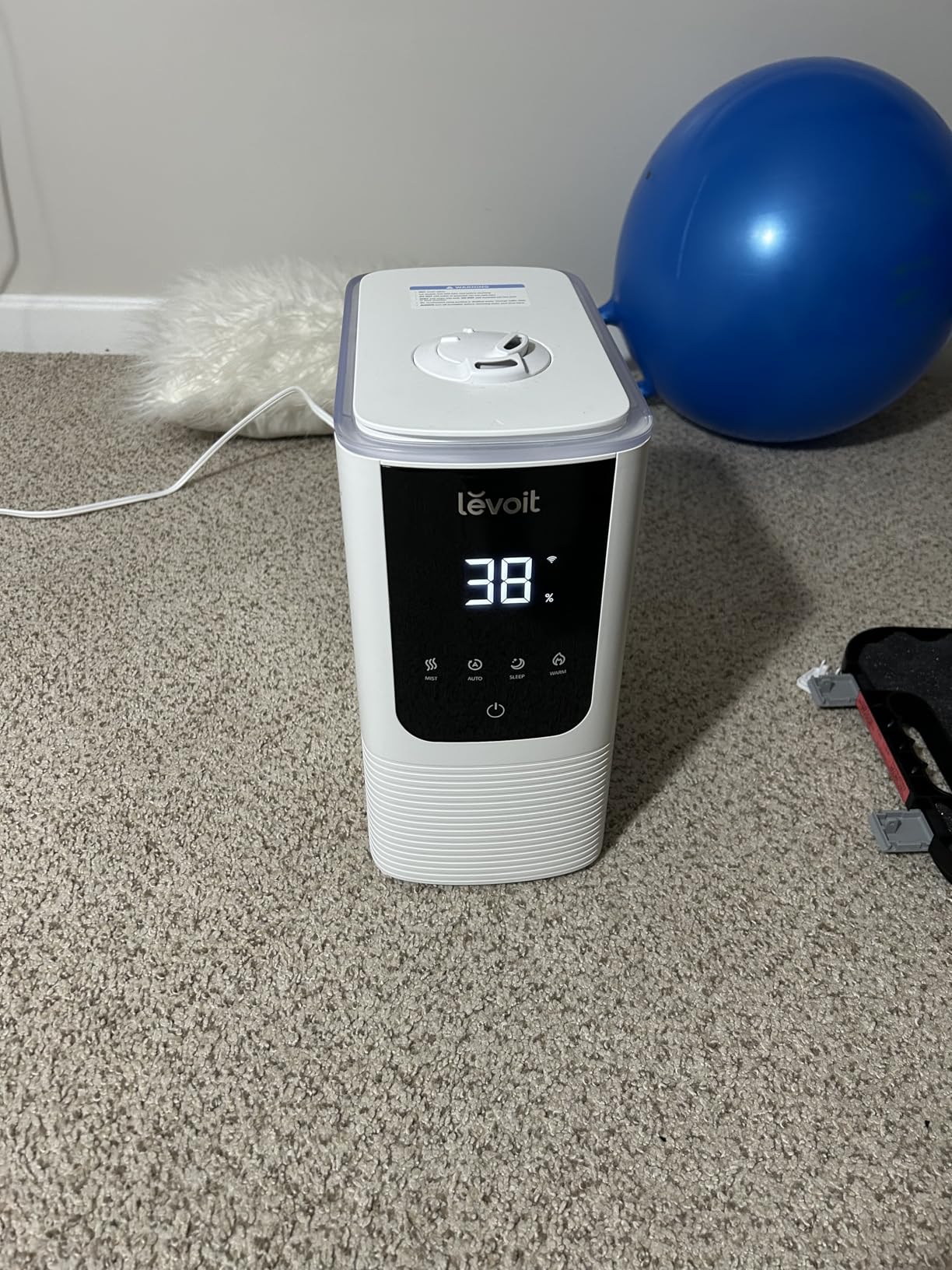
Controls are thorough: VeSync app, remote, voice, and scheduling that syncs with your routine. You can set it to ramp up before bed and drop after you wake, which removes the need to touch it in the dark.
Reviewers also report a measurable benefit with dry-air sinus problems. The recurring gripes are honest and specific: the onboard humidistat does not read the whole room accurately, real coverage falls short of the 430 sq ft figure in larger spaces, and the sponge water filter discolors quickly.
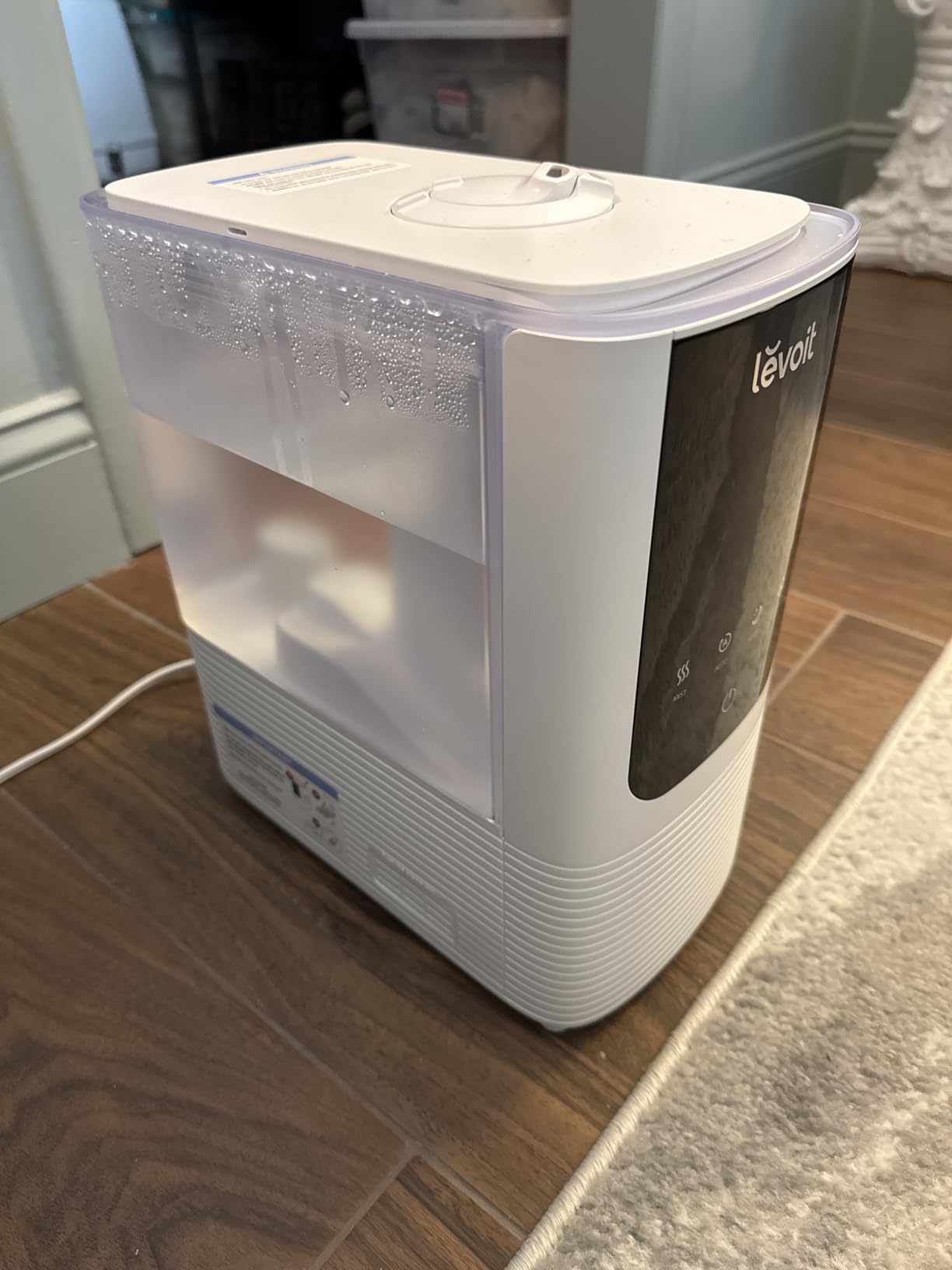
How it handles overnight congestion
Display-off night mode drops the lighting and the panel noise so it disappears as a sound source. A 45 hour runtime means a full night’s mist plus the following night before a refill, and warm mist at 40-60C cuts the white dust that makes people distrust ultrasonic units.
Where it falls short
If your bedroom is much bigger than 430 sq ft, the advertised coverage overstates what you will get, so pair it with an independent hygrometer rather than trusting the panel. The sponge filter is a recurring consumable, and the default auto target is adjusted through the app or voice rather than a physical dial.
2. Everlasting Comfort 6L Cool Mist – Best Value for Long Runtime
Everlasting Comfort 6L Large Humidifier for Bedroom, 28 dB Cool Mist
6L filterless tank
50 hour runtime
28 dB operation
500 sq ft
Aroma tray
Pros
- 6L filterless tank runs long between refills
- No replacement filter cost
- 28 dB is quiet enough for sleep
- 360 degree nozzle spreads mist evenly
- Built-in aroma diffuser tray
Cons
- Ultrasonic design can leave a light white dust residue
- Touch controls have no humidity display or humidistat
- Large footprint suits big rooms better than bedside tables
The argument for this one is capacity per unit of hassle. At 6L and roughly 50 hours of runtime, it covers several nights before a refill, and the filterless design means there is no cartridge to replace every few months. For a household where someone is congested often, fewer refill trips matters more than a digital readout.
At 28 dB it sits at the quiet end of what a fan-driven humidifier produces. The 360 degree nozzle lets you aim mist upward toward the ceiling so it disperses instead of landing on furniture, and the built-in oil tray handles aromatherapy if you want it.
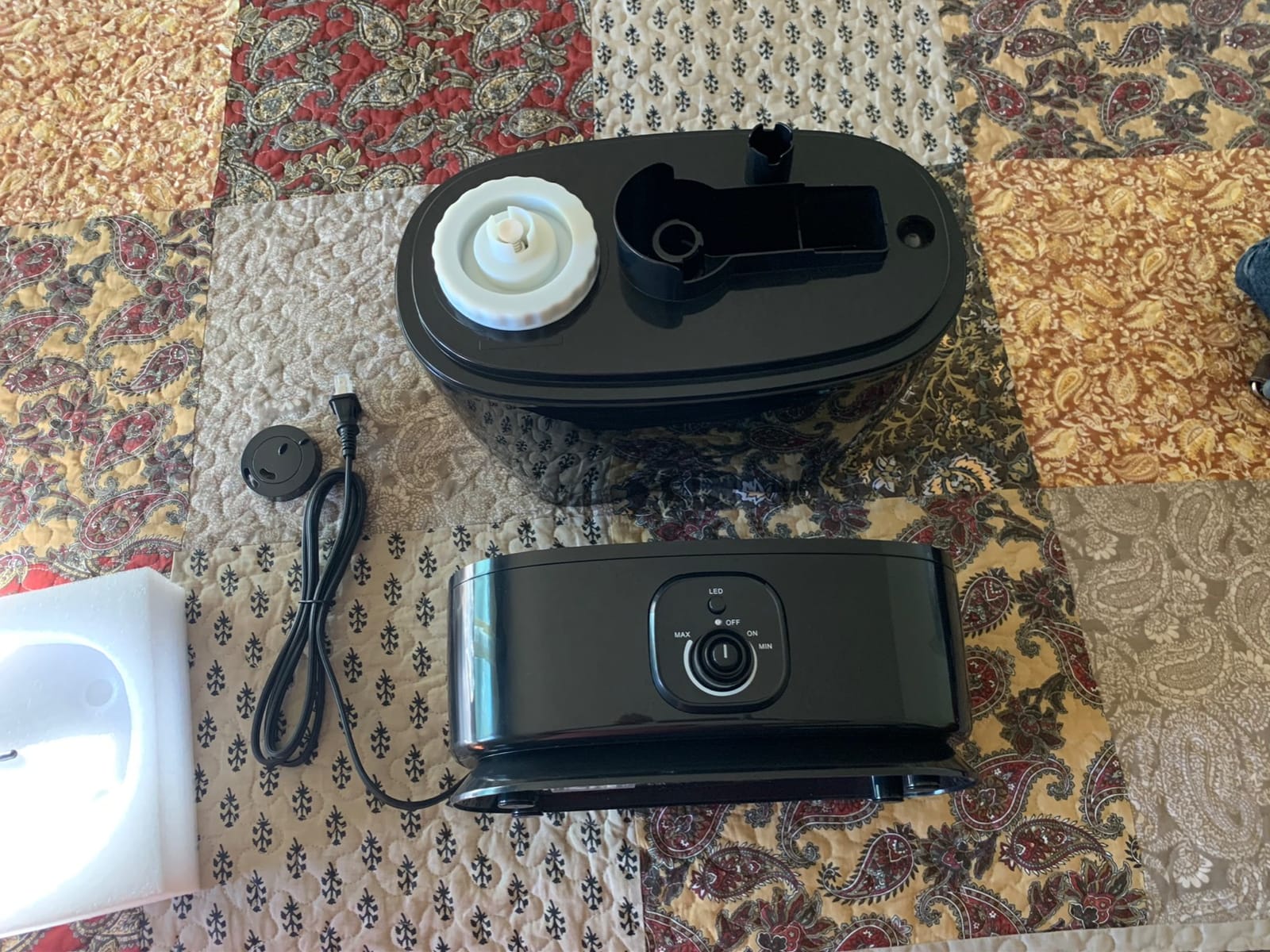
Reviewers single out the wide tank opening and filterless simplicity most often. The most common complaint is that the touch panel gives you no humidity number, which matters if you are trying to hold a specific target rather than just run it.
Because it is ultrasonic, it can throw a light white dust residue on nearby surfaces. Distilled water handles this, and we cover the routine in the cleaning section below.
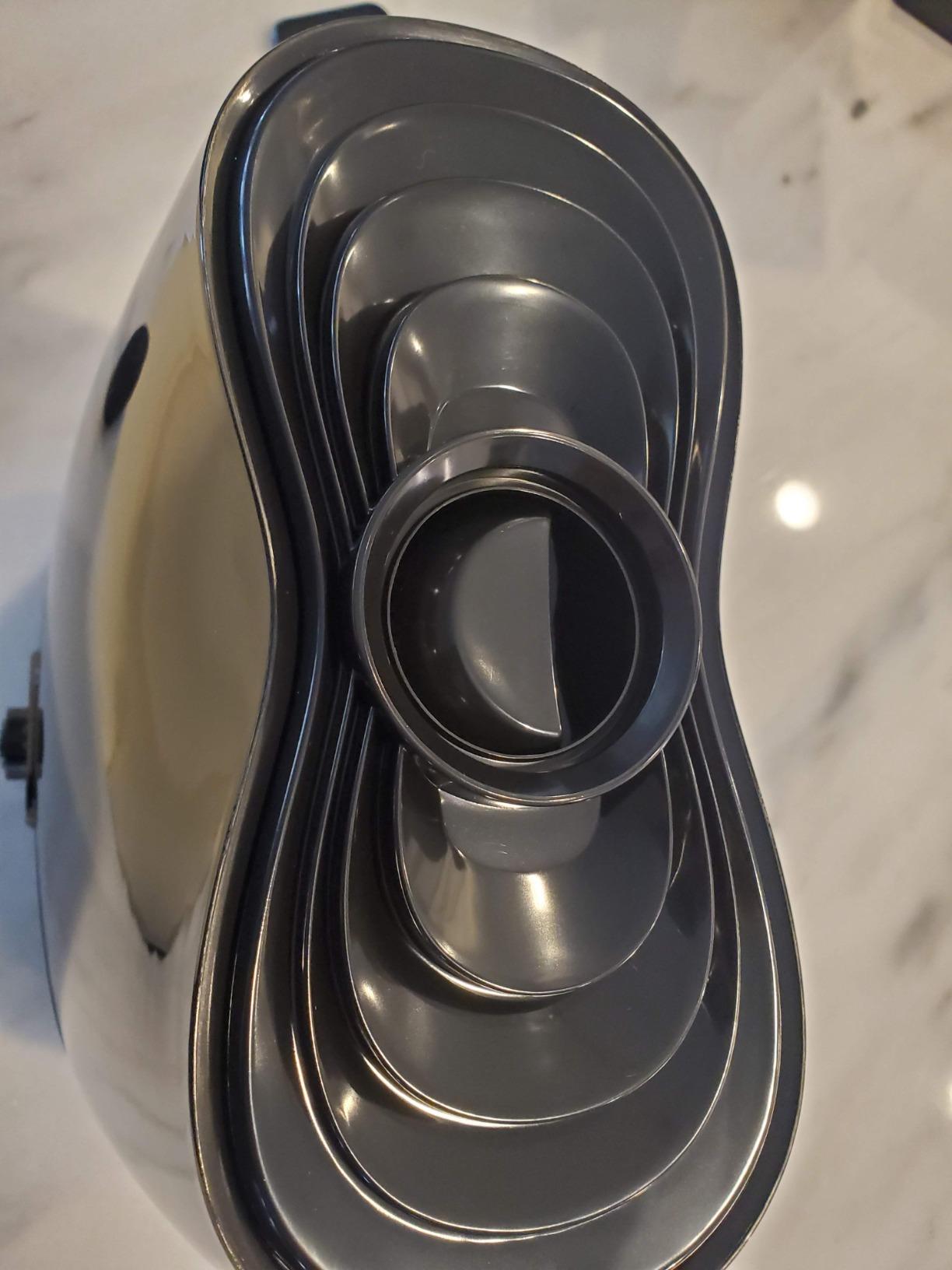
Best for multi-night coverage
With 50 hours on tap, this is the pick if you do not want to think about water at bedtime. The larger body also means more surface to wipe down, so pair it with a wide-mouth brush rather than a cloth that only covers the lid.
Where it falls short
No humidistat means you need a separate hygrometer to know whether you are in the 40-60% band or overshooting. The tall body takes real estate on a small nightstand, and ultrasonic atomization can still leave white dust on hard water.
3. Vicks V745 Warm Mist 1 Gallon – Best for Winter Congestion
Vicks Warm Mist Humidifier for Medium to Large Rooms, 1 Gal Tank
1 gallon top-fill tank
12 hours per fill
Up to 600 sq ft
Auto shut-off
Filter-free
Pros
- Warm mist widely reported to relieve winter sinus dryness
- 12 hours per gallon fill with no filters
- Simple top-fill design with reliable auto shut-off
- Quiet on the low setting for bedrooms
- Long-standing widely trusted brand
Cons
- Heating element collects mineral scale and needs vinegar cleaning
- Scent pad and inhaler dispenser produce little aroma
- Noticeably audible on the high setting
Warm mist is the traditional answer for cold-weather congestion, and this is the unit that category was built on. Boiling the water first means less mineral reaches the air, so this is the shortest route to humidity in a cold room where cool mist struggles to lift readings. At 600 sq ft of rated coverage it handles a large bedroom without crowding.
The 1 gallon tank gives about 12 hours per fill, with low and high settings and an auto shut-off that kicks in when the tank empties. There are no filters to buy, which keeps the running cost simple.
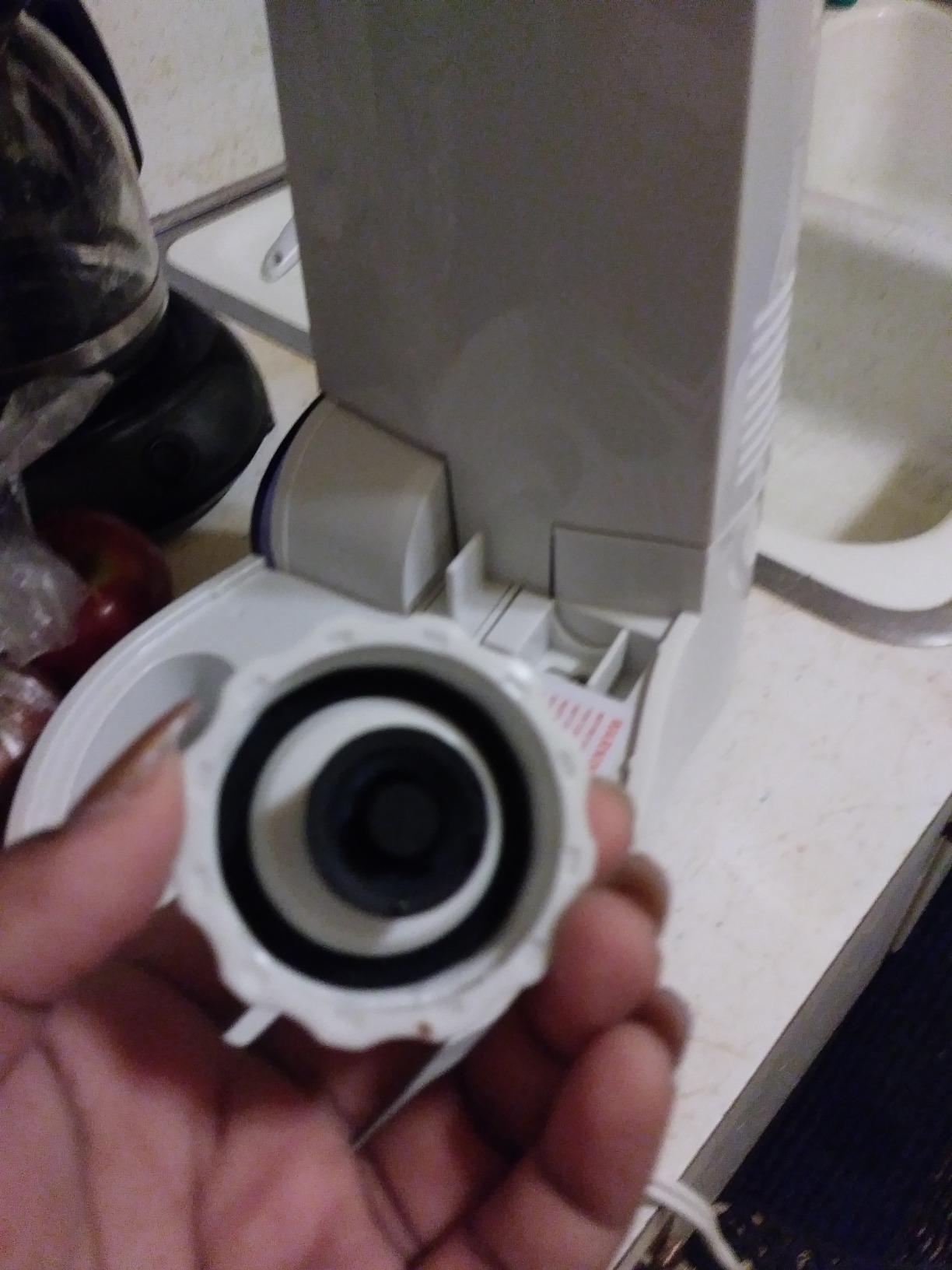
Long-term owners describe it as durable and reliable, and warm-mist sinus relief is the most common praise in the review base. One owner in an r/boston and r/moderatelygranolamoms thread reported that it sometimes smells after use, which points at the same biofilm risk any standing-water tank carries.
The scale on the heating element is the maintenance cost you accept for that. It needs regular vinegar cleaning, and the small tank opening means the corners are hard to reach with a cloth.
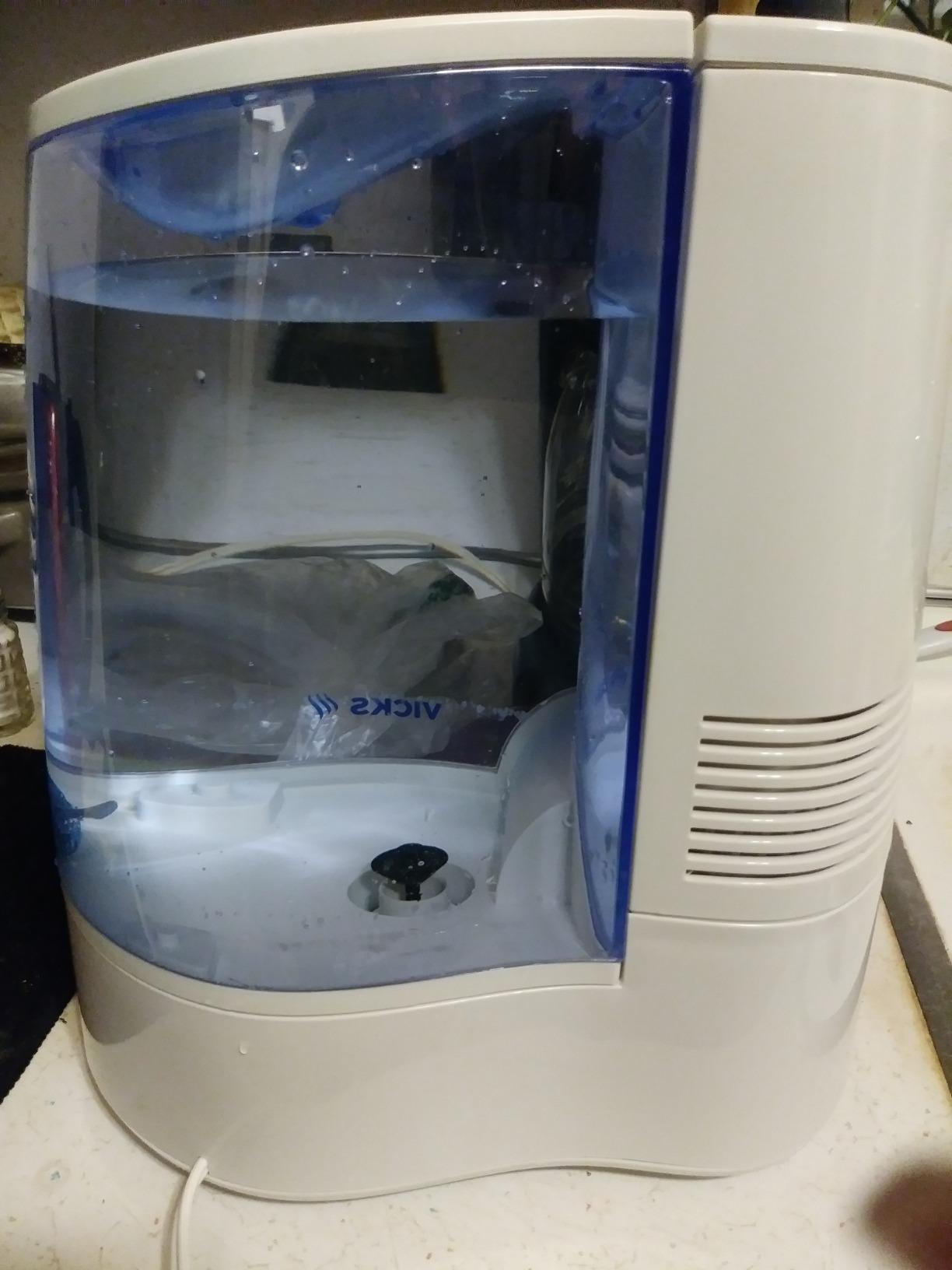
When warm mist is the right call
Use it when winter congestion is the main complaint, the room is genuinely cold, and there are no toddlers or pets who could reach the steam outlet. The heated output also means noticeably less white dust than an ultrasonic unit in hard-water areas.
When to pick something else
Skip it if a child or pet shares the room, because of the scald risk. Skip it if you have no plan to descale the element weekly, since scale is the fastest route to a musty smell, and skip it if noise matters, because the high setting is clearly audible.
4. Vicks V4600 Ultrasonic 1.2 Gallon – Best for Nurseries and Bedrooms
Vicks Filter-Free Ultrasonic Humidifier for Bedroom or Nursery 1.2 Gal Tank
1.2 gallon tank
Up to 30 hours mist
Ultrasonic cool mist
Filter-free
4 pounds
Pros
- Filter-free design removes replacement filter cost
- 1.2 gallon tank delivers up to 30 hours
- Very quiet operation suited to nurseries and sleep
- Reviewers report eased cough and congestion
- Light 4 pound body is easy to move
Cons
- Ultrasonic mist can leave fine white dust on surfaces
- Fixed mist output levels limit humidity control
- Tank drips slightly when lifted from the base
This is the cold-mist counterpart to the V745, and it solves the safety objection. There is no hot water, so it is the sensible pick for a nursery or any room where a small child sleeps. The 1.2 gallon tank runs up to 30 hours, which comfortably covers a full night at the lower settings.
Reviewers point to quietness as the headline feature. At 4 pounds and filter-free, it is easy to move between a bedroom and a kid’s room when the dry season shifts.
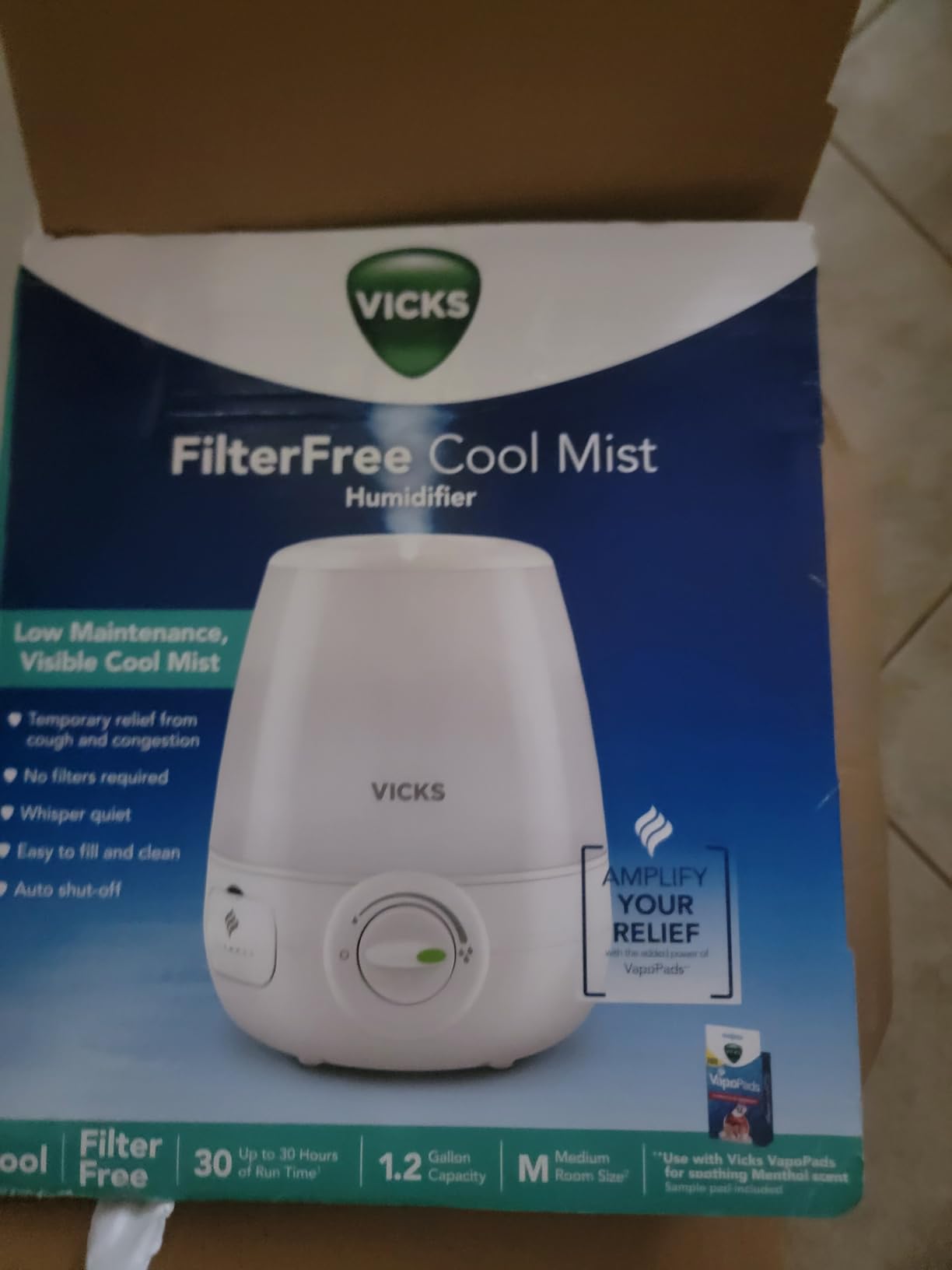
The trade-off is control. Mist output sits on fixed levels rather than a humidity target, so you are tuning by ear or by watching a separate hygrometer. White dust is the usual ultrasonic complaint, and reviewers mention it often.
There is also a small practical annoyance: the tank drips a little when you lift it off the base, so plan to set it over a towel or in the sink rather than on a nightstand.
Best for a shared nursery
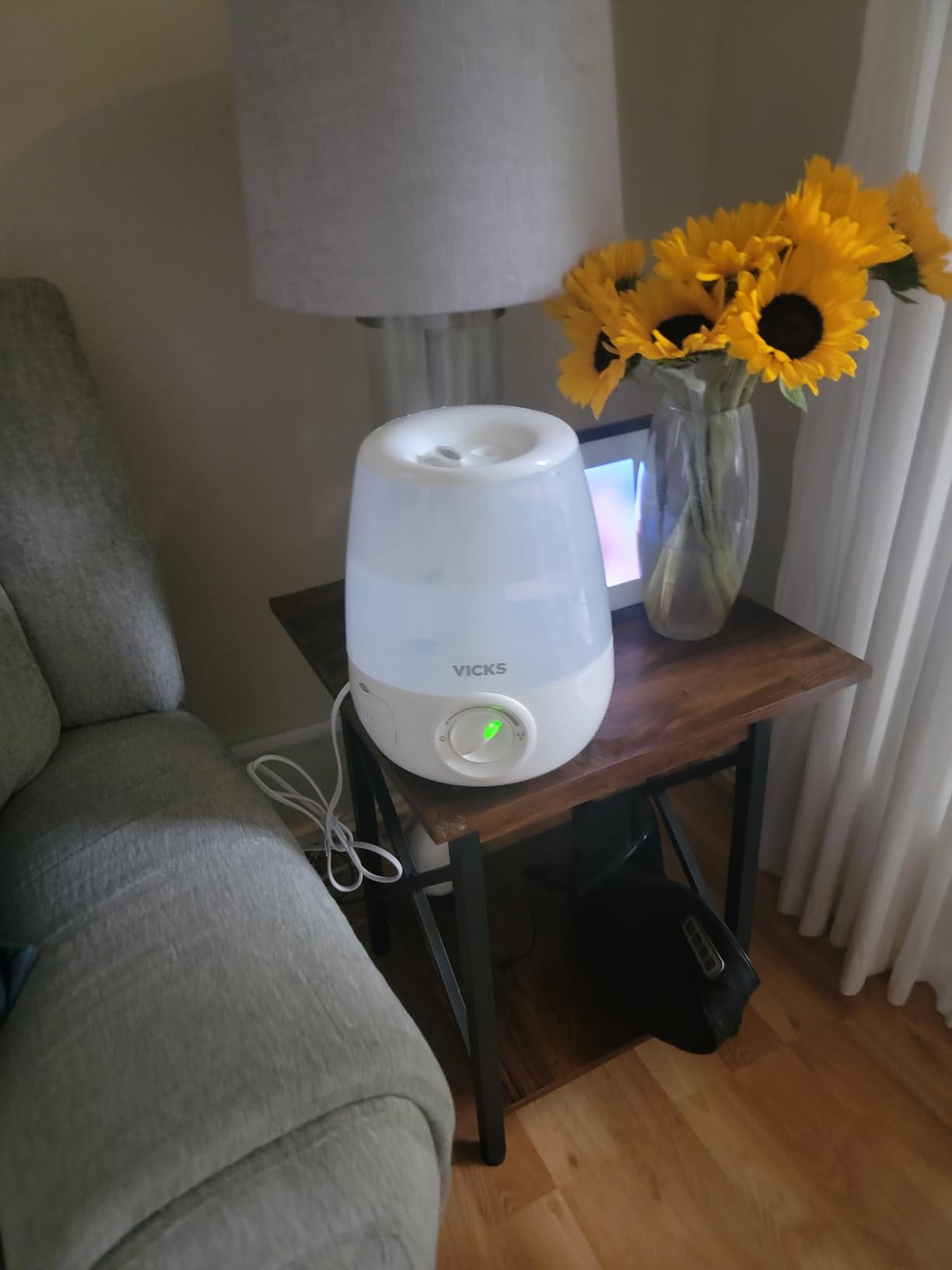
No scald risk, quiet enough for a sleeping baby, and a 30 hour tank that lasts most of the night at low output. The 4 pound weight means you can move it out of the way during daytime play.
Where it falls short
Without a humidistat you are guessing at output, and fixed levels make it harder to hold a steady target in a drafty room. Expect some white dust unless you use distilled water.
5. Crane EE-5301CW 1 Gallon Cool Mist – Most Versatile with Serious Quiet
Crane Ultrasonic Cool Mist Humidifier for Bedroom, Baby Nursery, Kids Room, Plants, or Office, Large 1 Gallon Tank, Filter Optional, Clear and White
1 gallon tank
Up to 24 hours
500 sq ft coverage
Optional filter slot
Auto shut-off
Pros
- Very quiet on low and medium settings
- Strong mist output and long runtime on low-medium
- Compact drop shape fits a bedroom or nursery
- Auto shut-off works reliably
- Reviewers report relief from dry-air sinus pressure
Cons
- Thin plastic tank has cracked and some units stopped working
- Refilling requires removing and inverting the tank
- Green indicator light inside the tank cannot be turned off
The Crane drop shape has been a bedroom standard for years, and the reason is not the plastic. It is the combination of low noise at the low and medium settings and a 1 gallon tank that covers up to 500 sq ft for a full day of run time. Many owners describe the sound as white noise rather than a machine.
It also has an optional filter slot, which is unusual at this level. If your tap water is hard, a mineral cartridge there is a cheaper fix than switching every drop to distilled water.
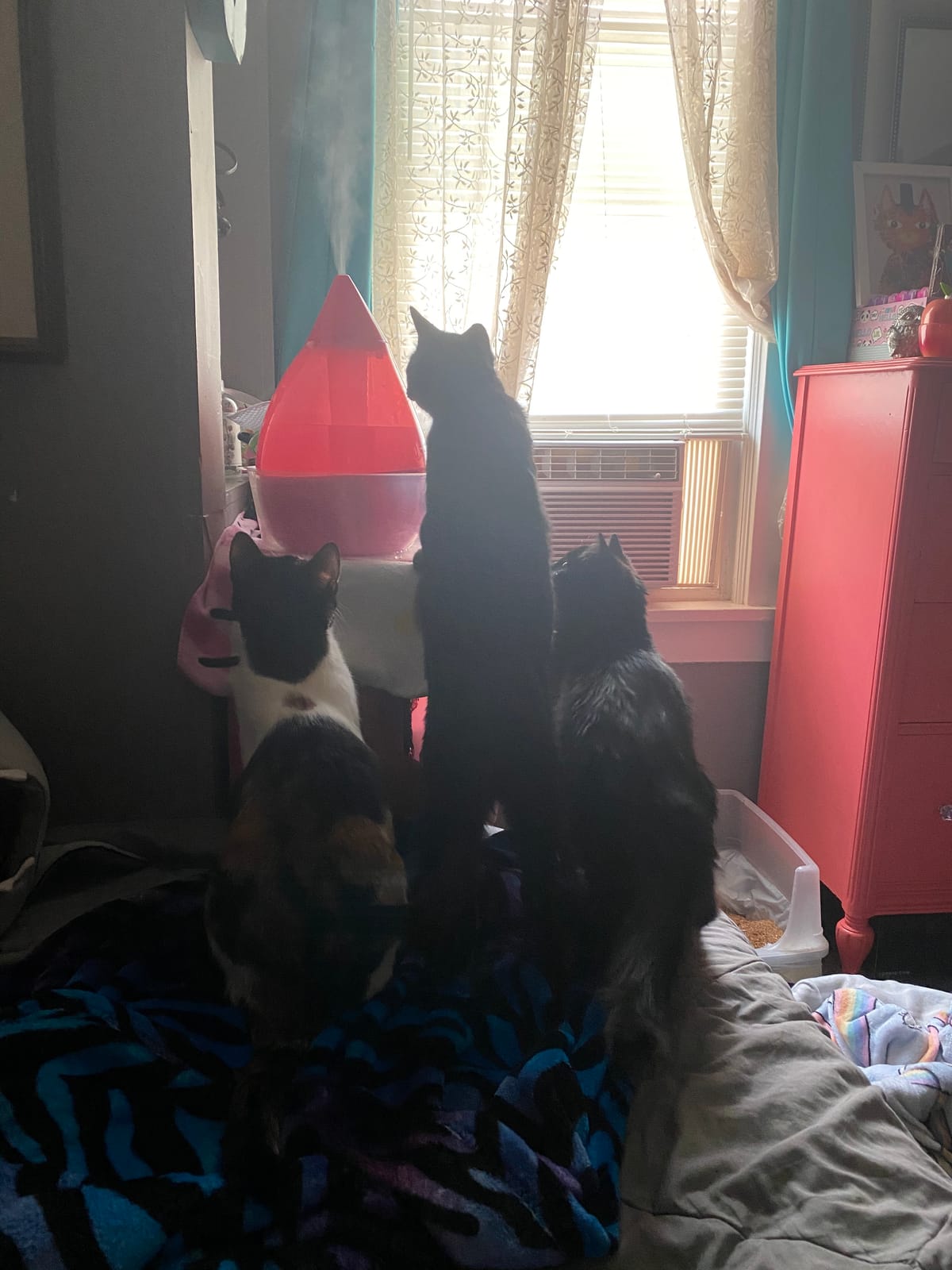
Auto shut-off works reliably and the light changes to red when the tank is empty, which is a small thing that matters when you are asleep. Owners with dry-air sinus pressure report the pressure easing once the room is properly humidified.
The complaints are durability and handling. The thin plastic tank has cracked for some owners after a few months, refilling means removing and inverting the tank, and it drips while you do it. The internal green indicator light cannot be switched off, which bothers people who sleep in a dark room.
Best for a small bedroom on a budget
You get genuinely quiet operation, a full day of runtime and 500 sq ft of coverage without paying for smart features you will not use. The optional filter slot gives you an easy path to controlling dust.
Where it falls short
The inverted refill is the biggest daily friction, and it is exactly the chore that leads people to skip cleaning. If you are worried about long-term durability or a light you cannot dim, pick a top-fill model instead.
6. Homvana H101 3.6L Top-Fill – Best for Light Sleepers
Homvana 3.6L Cool Mist Humidifiers for Bedroom, Baby, Large Room, Grey
3.6L top-fill tank
Under 23 dB sleep mode
BPA-free
Auto shut-off
3 year warranty
Pros
- Very quiet below 23 dB with a display-off sleep mode
- Wide top-fill opening is easy to refill and clean
- BPA-free build with auto shut-off
- Combines humidifier
- aroma diffuser and mood light
- Compact 2.2 pound body
Cons
- Coverage limited to roughly 161 square feet
- No digital humidity display or humidistat
- Mood light cannot be fully disabled in a dark room
Noise is the first thing light sleepers ask about, and at under 23 dB in SilentSpray sleep mode this is the quietest unit in our list. The display goes off with it, so there is no glowing panel across the room at 3 AM.
The 3.6L tank is top-fill with a 5.3 inch opening and a detachable tank, which makes daily cleaning fast and keeps water off the table. BPA-free materials and auto shut-off cover the safety basics, and the 3 year warranty is longer than most in this category.
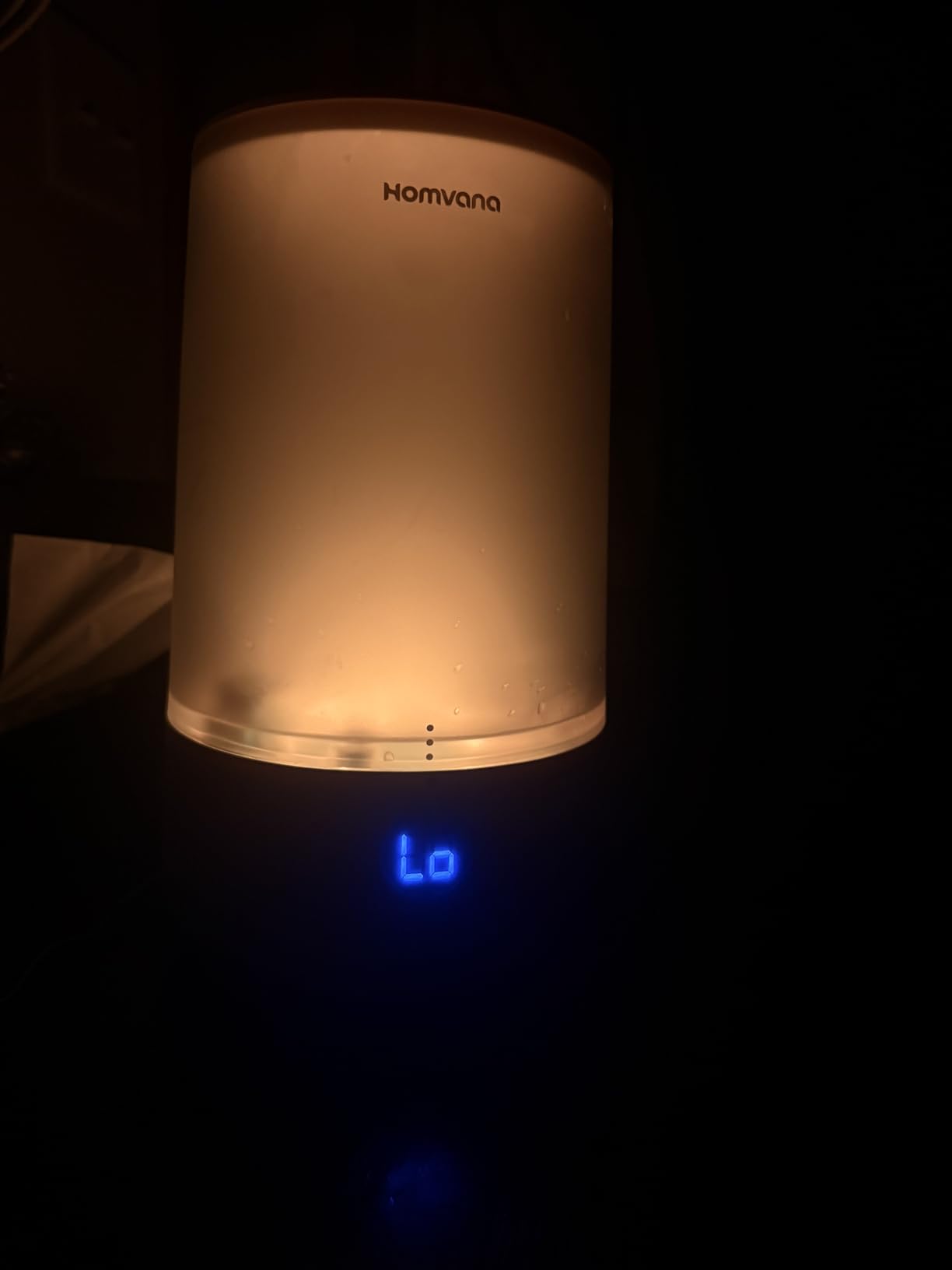
It also folds in an aroma pad and a mood light in one body, which is convenient if you use the same unit for a child’s room. Reviewers consistently mention quietness and easy refilling as the reasons they keep it.
The real limitation is coverage. At roughly 161 sq ft it suits a small bedroom, a guest room or an office, and it will not keep up with an open-plan space. There is also no humidity readout, so you need your own hygrometer, and the mood light cannot be fully turned off.
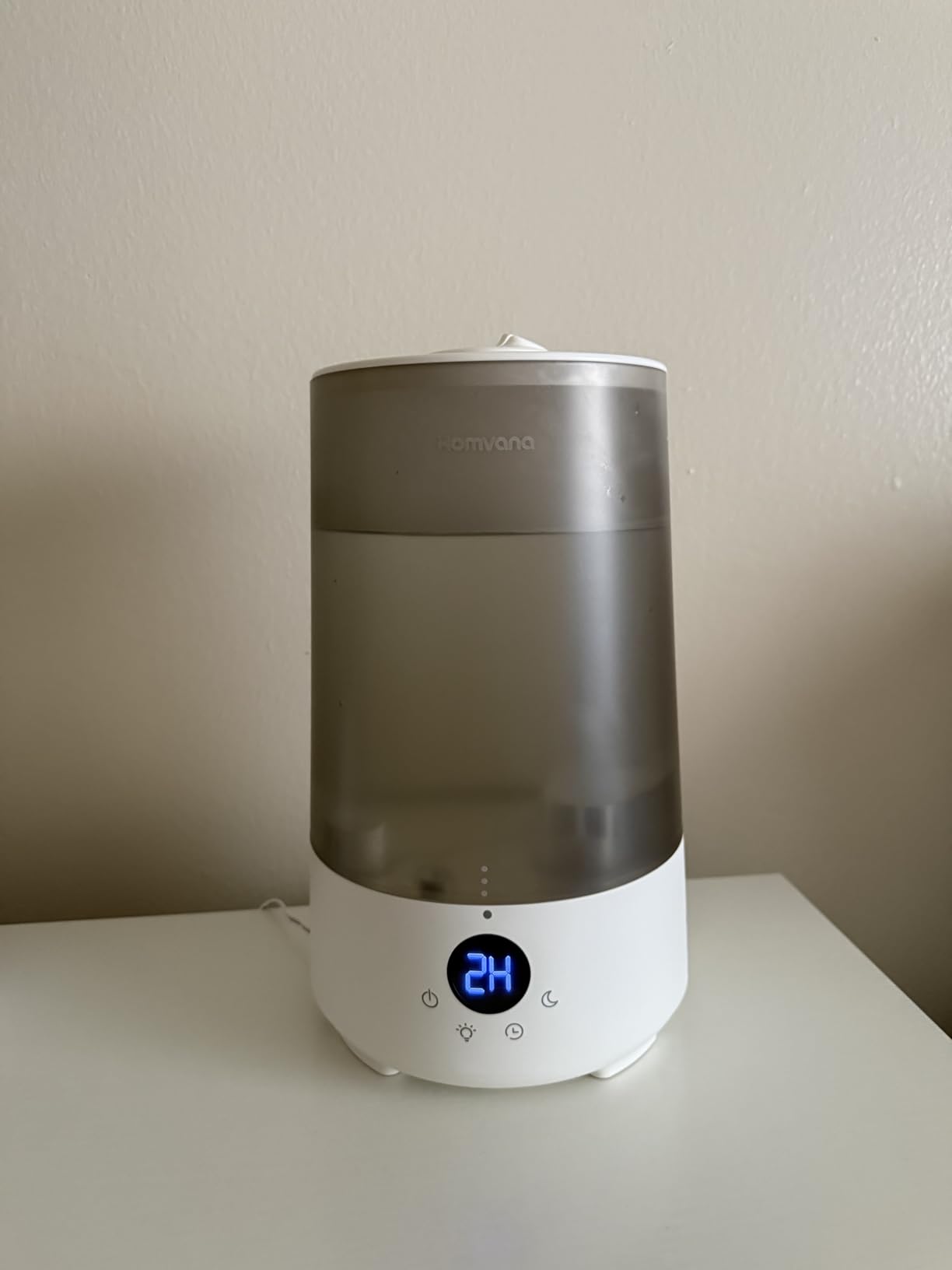
Best when noise is the deciding factor
If you wake at any sound, the sleep mode figure matters more than tank size. Under 23 dB with the display off is close to the practical floor for a fan-driven unit, and the top-fill tank makes the nightly refill almost silent.
Where it falls short
Match it to room size carefully. Above about 160 sq ft the mist disperses before it reaches the far side of the room, and with no humidistat you will not see that happening until symptoms plateau.
7. DREO Smart 4L Cool Mist – Best for App and Voice Control
DREO Smart Humidifiers for Bedroom, 4L Cool Mist Humidifier
4L top-fill tank
36 hour runtime
28 dB
5 micron mist
App, touch and voice
Pros
- Precise auto humidity control with a sensor and digital display
- App
- touch panel and voice assistant support
- 36 hour runtime avoids overnight refills
- Quiet 28 dB operation
- 5 micron mist avoids dampening furniture
Cons
- Demineralization and Clean Mist cartridges are optional add-ons
- Ultrasonic operation still produces some white dust
- Wide low oval body uses more surface area than a round unit
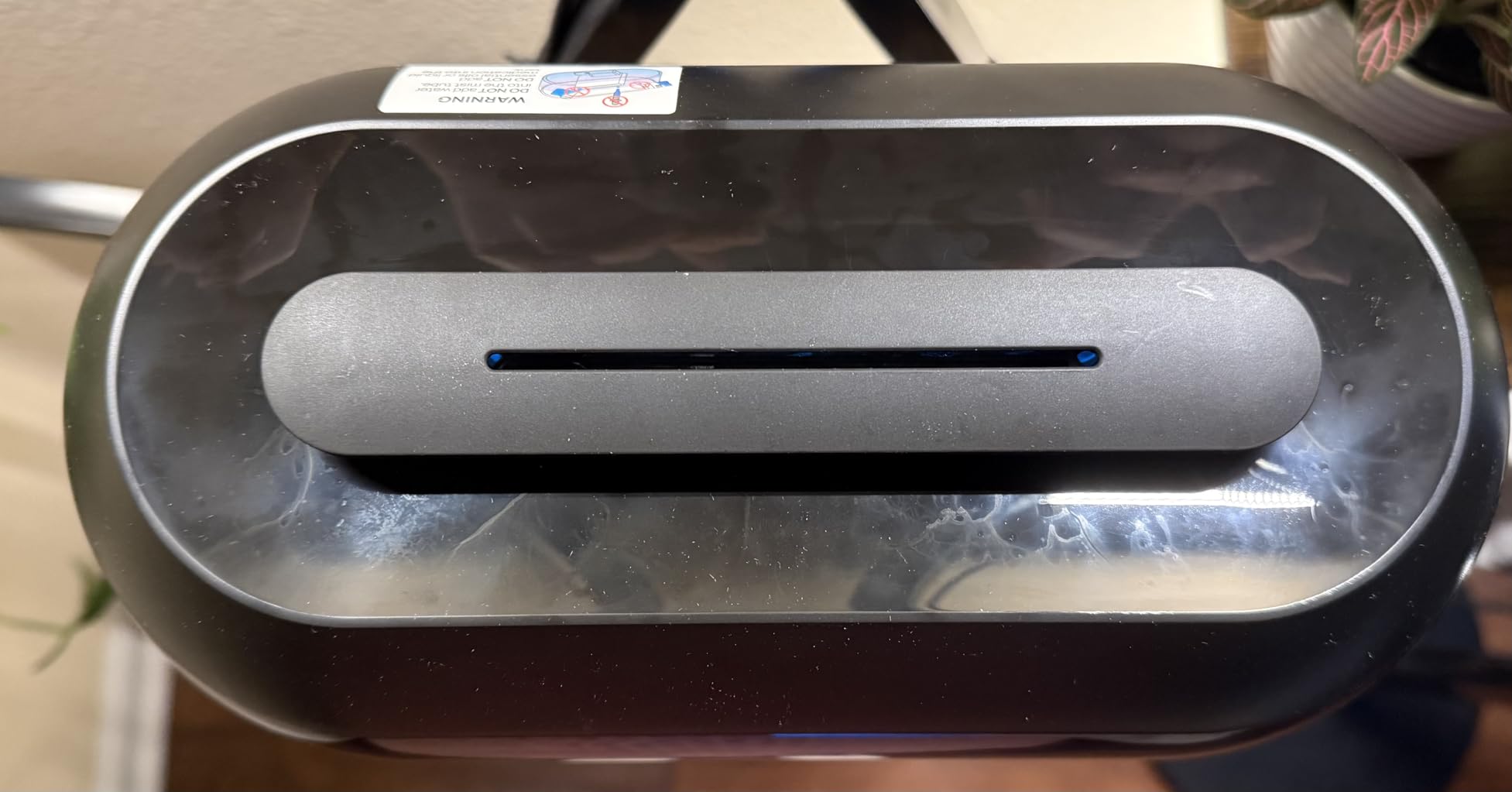
This is the one to buy if you want the humidifier to manage itself. An integrated sensor with a digital display feeds an auto mode that holds a target rather than leaving you to guess at mist levels, and the app, touch panel and voice support cover every control style.
The Dual-Intake system pushes a lot of mist quickly, and the 5 micron droplet size is fine enough to disperse before it wets surfaces. At 28 dB and a 36 hour runtime from the 4L top-fill tank, it clears a night comfortably.
Reviewers single out the accuracy of the humidity sensing as the standout feature, with a filter reminder light on the front that tells you when a cartridge needs attention. Ambient light cues give a second read on room status without opening the app.
The catch is that the demineralization and Clean Mist cartridges are optional and not included. That is a running cost most people do not expect at the point of purchase, and without one you are back to managing white dust with water choice alone.
Best when you want hands-off control
Auto mode plus a real sensor means you set a target once and stop thinking about it, which is the closest thing here to the evaporative self-regulation principle. App scheduling also lets it warm up the room before you wake.
Where it falls short
The filter cartridges are add-ons, so budget for them if your water is hard. The wide oval footprint also takes more surface than a compact round unit, which matters on a small bedside table.
8. DREO 3L 26 dB Quiet – Best for Post-Surgery Dryness
DREO 3L Humidifiers for Bedroom, 30H Runtime, 26 dB Quiet, New Edition
3L top-fill tank
30 hour runtime
26 dB sleep mode
250 ml/hr mist
300 sq ft
Pros
- Exceptionally quiet at 26 dB in sleep mode
- Simple top-fill design that is fast to refill and clean
- Digital display with auto mode
- Indicator light changes color with humidity and can be turned off
- Compact round footprint fits a nightstand
Cons
- Power cord is fixed to the base and cannot be disconnected
- Not app or voice connected
- Displayed hygrometer reading is a close approximation
Users recovering from nasal surgery mention this model specifically for post-operative dryness, where the nasal passages are more sensitive to dry air than usual. A 250 ml/hr mist output and a 40 inch throw reach past the bed, and 300 sq ft of coverage fits a standard bedroom.
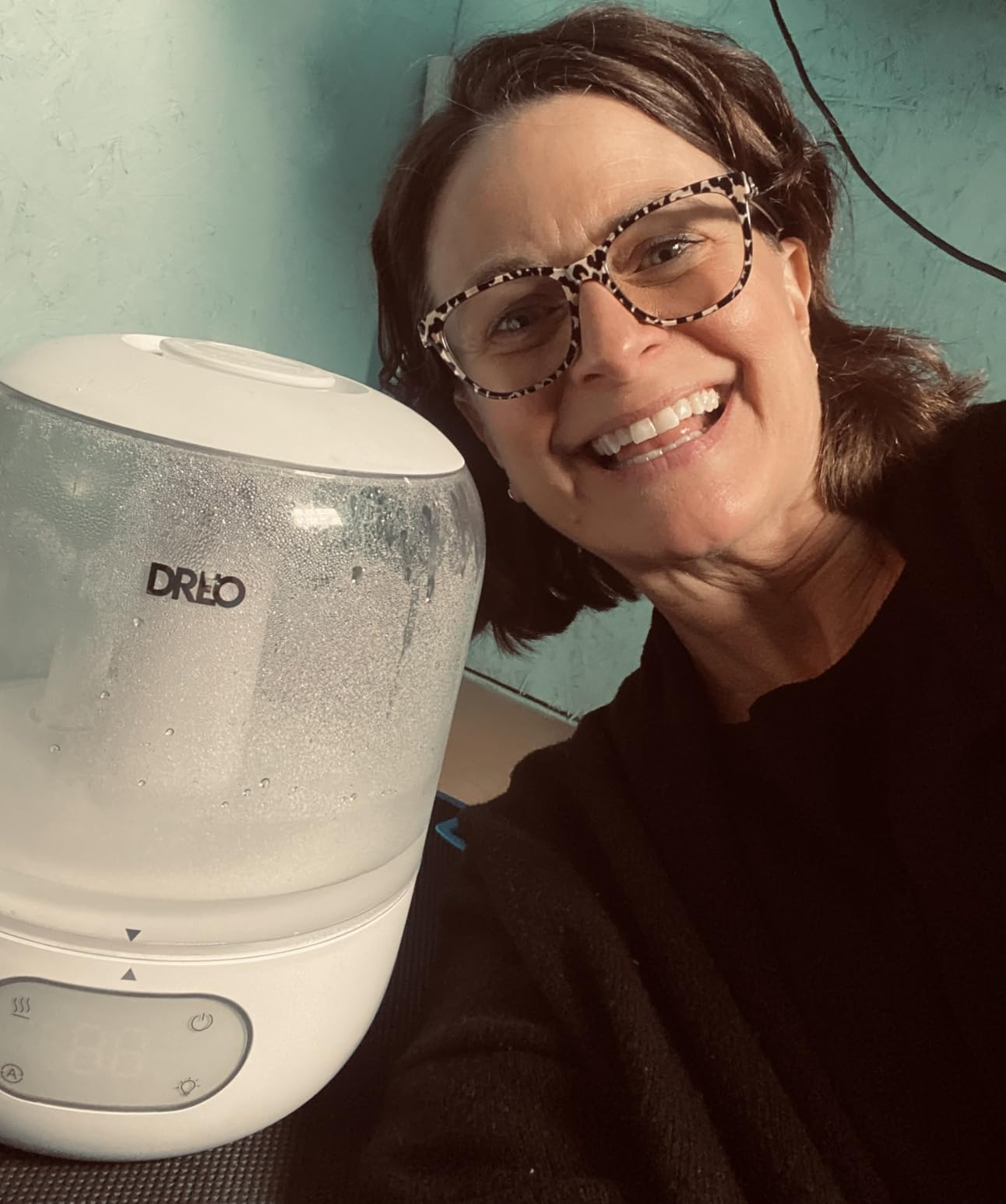
It is quiet at 26 dB in sleep mode and the night light is adjustable, with an indicator that changes color with humidity and can be turned off entirely. The 3L top-fill tank runs up to 30 hours, and the round body fits a nightstand without crowding it.
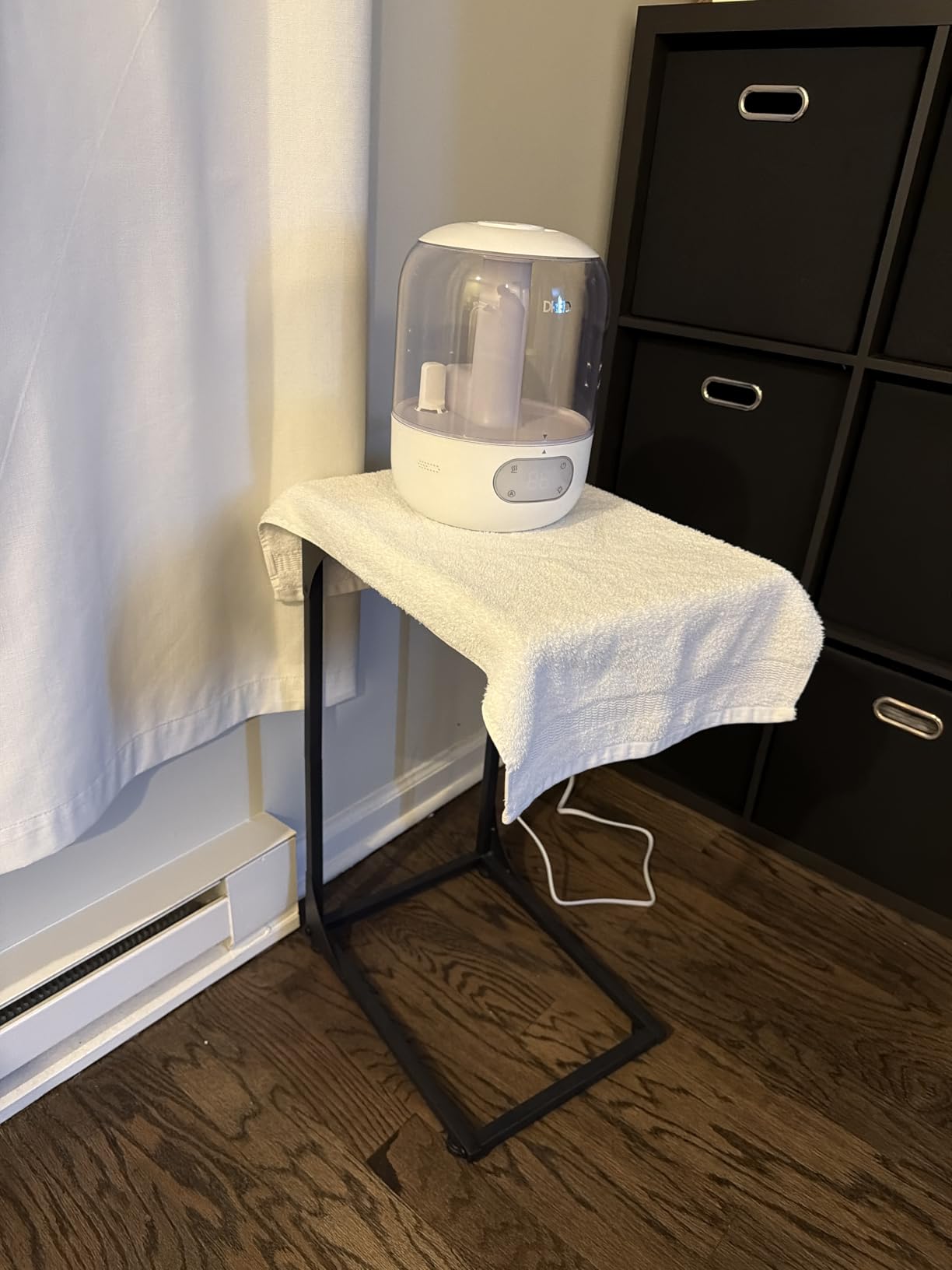
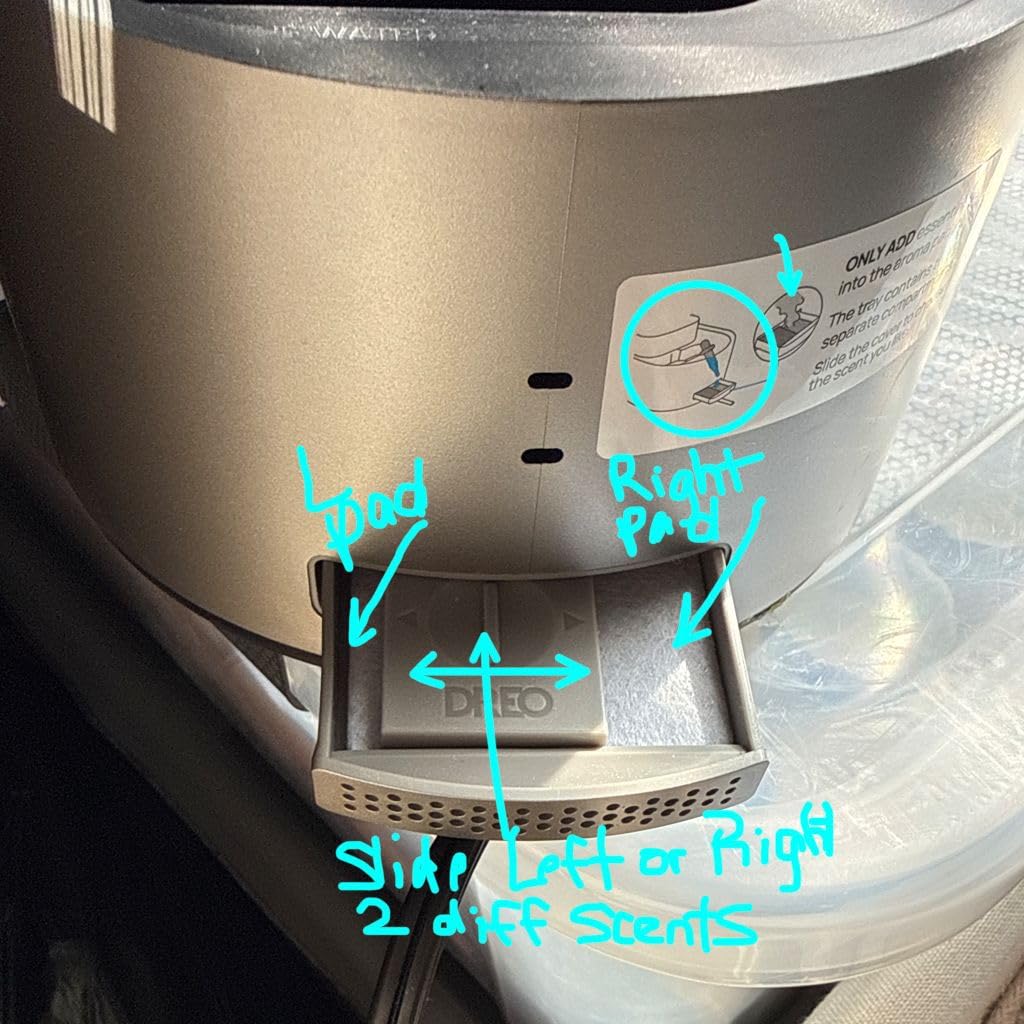
The spec sheet lists a demineralization cartridge filter type, which matters in hard-water areas, and 5 micron mist from 2.4 MHz atomization for even dispersal. An aroma pad tray sits on top for essential oils if you want them.
Two practical notes. The power cord is fixed to the base, so the water channel and base need to be cleaned in place with a damp cloth rather than rinsed under a tap, and there is no app or voice control, so everything happens on the panel.
Best for sensitive, healing nasal passages
Quiet, compact, and fine enough mist that it does not wet bedding or nightstand. The adjustable light and turn-off indicator make it a good fit for a shared room where someone else is trying to sleep.
Where it falls short
The fixed cord limits how thoroughly you can clean it, and that is the part you most need to keep clean. The built-in humidity reading is approximate, so confirm it with a separate hygrometer for the first week.
9. DREO 6L Smart Warm and Cool Mist – Best for Multi-Day Runtime
DREO 6L Smart Humidifiers for Bedroom, Warm & Cool Mist for Large Room
6L tank
60 hour runtime
133 F warm mist
550 sq ft
Auto 30-90% RH
Pros
- Warm mist spreads moisture into cold air better than cool mist alone
- High mist output reaches usable humidity where cheaper units stall
- Mist output and sensing verified against external hygrometers
- 6L tank holds several days of water
- App includes cleaning tutorials and usage tracking
Cons
- Some owners report tank cracking and failure within months
- Warm mist mode uses considerably more water and electricity
- Replacement units have shown no-water error codes
At 6L and a quoted 60 hours, this is the pick when someone in the house is congested for weeks rather than days. It is also the only unit here rated high enough in output to matter in a 550 sq ft room, where smaller machines tend to stall around 35% humidity and never reach the band you need.
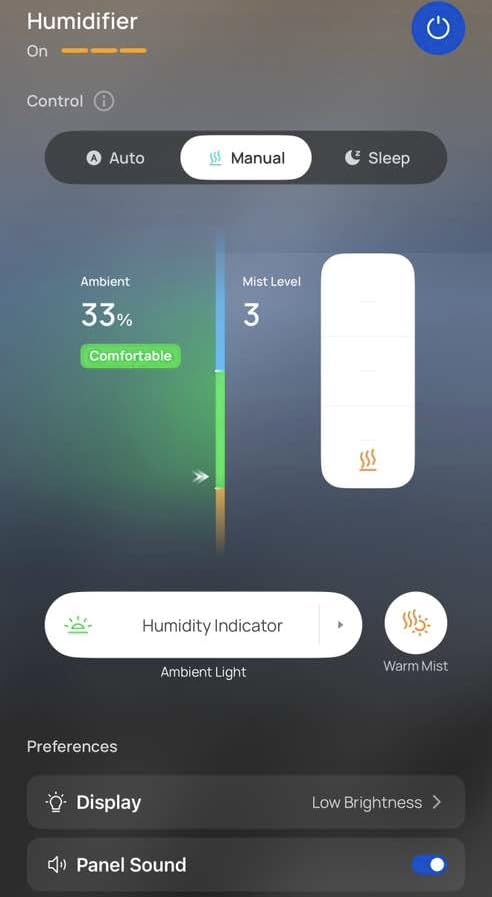
Warm mist at 133 F is the useful part in a cold bedroom, because heated output disperses into cold air far better than cool mist alone. Three modes cover manual with three mist levels, auto from 30-90% RH, and a sleep mode.
Precision is the word reviewers use most. The humidity sensing has been checked against external hygrometers and holds a 5% tolerance, and the app shows real-time readings, 30-day trends and cleaning reminders.
The warnings are worth taking seriously. Some owners report tank cracking and failure within months, and replacement units throwing no-water error codes. Warm mist mode also draws considerably more water and electricity, and the optional filter is not available in every market.
Best for chronic symptoms in a large room
If your congestion is a daily feature rather than a winter flare, the tank size and the accuracy of the sensing are what matter. The 30-day humidity trends in the app also let you spot patterns, like a room that only gets dry after the heating cycles on.
Where it falls short
It is the heaviest and most power-hungry unit here, at 6 pounds and 280 watts, and warm mist mode increases both water and electricity use further. The durability reports are a genuine consideration if you are buying it as a long-term fixture.
10. Honeywell HCM350B Evaporative Wick – Best for Mold-Prone Homes
Honeywell Cool Moisture Humidifiers for Bedroom, Medium Rooms, 1.1 Gallon, Invisible Moisture Humidifier for Baby, Kids, Quiet, Easy to Clean, UV Technology, Black, HCM350B
Evaporative wick technology
1.1 gallon tank
24 hour runtime
UV water treatment
3 year warranty
Pros
- Evaporative wick design means no white dust residue
- Soft fan-like sound suits a bedroom or nursery
- 1.1 gallon tank runs up to 24 hours
- All water-contact parts are dishwasher cleanable
- 3 year limited warranty
Cons
- Requires periodic replacement of the Honeywell wicking filter
- Performance depends on genuine Honeywell filter parts
- Bulkier and heavier at 9 pounds
If the thing holding you back is the fear of a dirty humidifier making you sicker, this is the technology to look at. An evaporative wick cannot put minerals into the air because the water passes through a wetted filter first, which is why there is no white dust at all, not even reduced.
Evaporative units also self-limit. Output drops as the air approaches saturation, which makes overshooting the 60% ceiling much less likely than with a fixed ultrasonic output. UV water treatment adds another layer of water treatment on top of that.
Reviewers like the soft fan-like sound, the 1.1 gallon tank that runs up to 24 hours, and the fact that every water-contact part is dishwasher cleanable. The 3 year limited warranty is the longest in our list.
There is a running cost. The wicking filter needs periodic replacement, and the stated performance depends on genuine Honeywell parts. At 9 pounds it is by far the heaviest unit here, and there is no digital humidity display.
Best when dust and overshoot are your worries
No mineral residue on furniture, natural self-regulation as the room fills, and dishwasher-safe parts that make the daily clean genuinely easy. For a mold-anxious household this removes the two biggest objections to humidifying at all.
Where it falls short
The wick is a consumable, so this is not the lowest running cost despite the filterless look of some competitors. It is also bulky, and without a humidity display you need a separate hygrometer to confirm you are in range.
What Humidity Level Do Your Sinuses Need?
The target is 40-60% relative humidity, with 45-55% as the comfortable middle. Below about 30% the mucous membrane begins to dry and mucus thickens. Above 60% you get a different set of problems: condensation on cold windows, dust mites multiply, and mold starts finding surfaces. One r/Sinusitis poster measured their bedroom near 20-30%, which is the kind of deficit a humidifier can genuinely close.
Buy a cheap digital hygrometer and place it at bed height rather than on a shelf. Then run the humidifier until readings settle in the band and stop. The single best feature you can pay for is a unit with a real humidity sensor and auto mode, because guessing is how people overshoot.
Two stop signals matter. If you see condensation forming on windows or walls, back the output down immediately. If your congestion gets worse rather than better after a few nights of running a humidifier, stop and read the section below.
Cleaning Schedule and How to Keep a Humidifier Mold-Free
Mold fear is the number one reason people do not buy a humidifier, and it is a reasonable one. Standing water plus warmth is exactly the condition bacteria and mold need. The fix is not avoiding the device, it is a routine you actually keep.
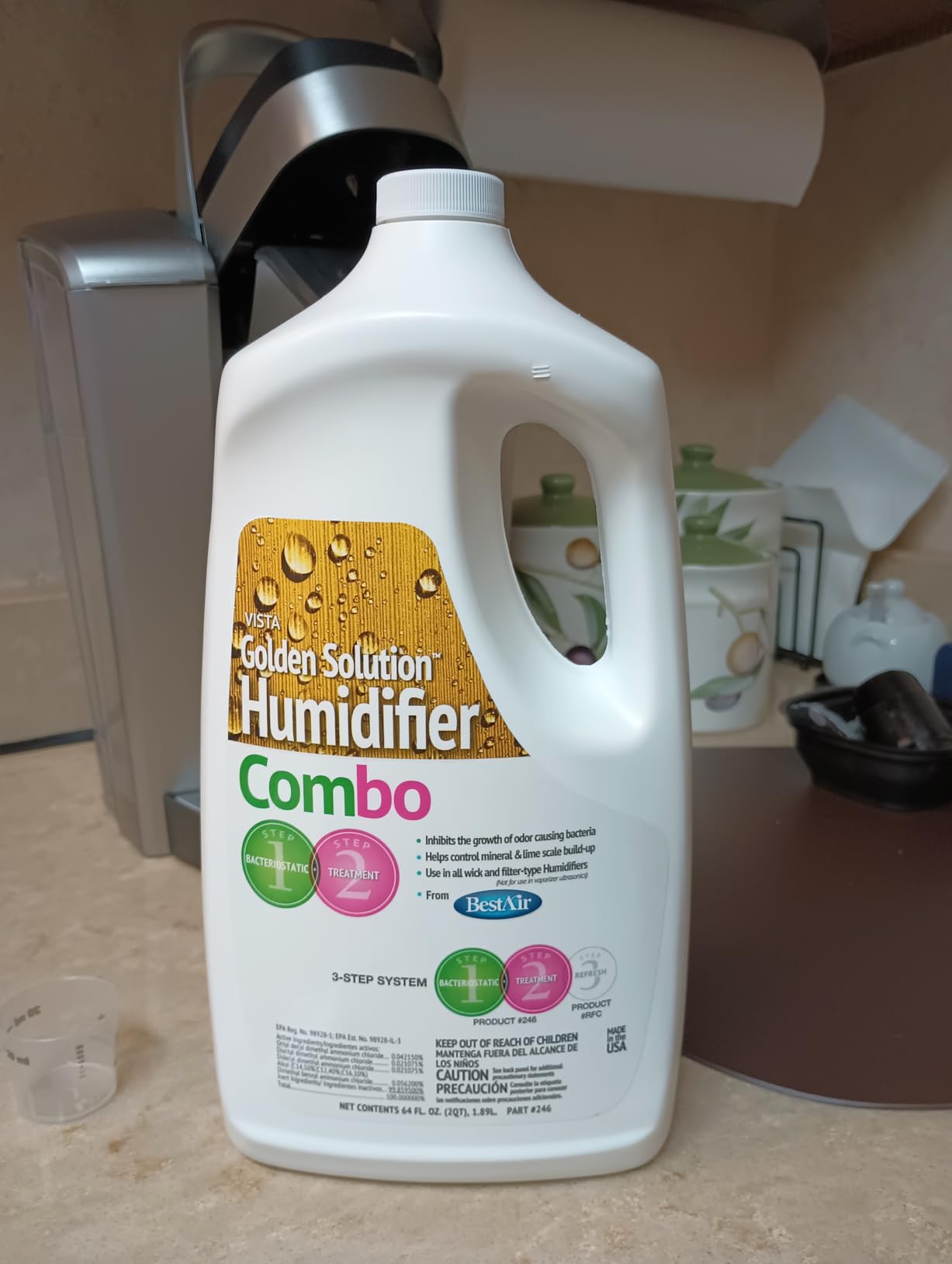
Daily: Empty the tank, wipe the base and water channel, and refill with fresh water. Do not top off yesterday’s water. This single habit prevents almost all odor problems.
Weekly: Take the tank apart and wash it with warm water and a little dish soap, paying attention to corners and the fill port. For warm mist models, descale the heating element with white vinegar, then rinse twice.
Monthly: Deep clean the base and the mist outlet, and replace any filter cartridge or wick on its schedule rather than when it looks dirty.
Always: Use distilled or demineralized water if you can. Tap water minerals are what turn into white dust on furniture and into scale inside the unit.
If it starts to smell musty, empty and scrub everything, refill with distilled water, and run it for a full day before judging the result. If the smell returns quickly, the biofilm has probably taken hold in a seam that a cloth cannot reach, and the tank needs a deeper soak or replacing.
How to Choose a Humidifier for Sinus Relief
Match the tank to the room and the night. Tank capacity and runtime decide whether you are refilling at 3 AM. Anything from 3L upward covers a normal night at moderate output, while a 6L tank means several nights between fills for chronic symptoms. Under-filling leads to running the unit dry overnight, which is both pointless and a reason to stop.
Prefer top-fill with a wide opening. Bottom-fill and inverted designs ask you to tip a full tank over a sink or a wastebasket every single day, and that friction is the number one reason tanks end up unwashed. Cleaning convenience is not a nicety here. It is the feature that decides whether your humidifier helps or becomes a mold source.
Check noise for overnight use. Anything under 30 dB with a display-off sleep mode keeps a humidifier from waking a light sleeper, and the display matters as much as the motor.
Match coverage to room size honestly. Ratings cluster between 161 sq ft and 600 sq ft in this list, and manufacturers are generous. A unit rated for 300 sq ft will underperform in a 400 sq ft room, so for open-plan spaces read our guide to the best humidifiers for large rooms before you buy.
Decide how much auto control you want. A humidity sensor with auto mode is the difference between holding 45% and hoping. If you skip it, buy a hygrometer so at least you are measuring.
Factor in water type and consumables. Ultrasonic units throw white dust with hard tap water, evaporative units need a replacement wick, and several models here use an optional demineralization cartridge. If you are willing to use distilled water, that removes an entire category of ongoing cost.
When Not to Use a Humidifier
There are real cases where adding moisture does nothing useful or makes things worse, and no roundup we studied says so plainly.
Your room is already above 60%. Measure before you fill the tank. Overshooting encourages dust mites and mold, both of which worsen sinus problems.
You cannot change the water daily. A humidifier that sits for a week is a mold source. If your routine will not support a daily change, do not buy one.
You are mold-allergic or have asthma that flares with damp air. Extra humidity feeds the triggers. An air purifier is the better tool.
There are small children in the room. Skip warm mist. The scald risk is real and the cool mist alternatives on this list perform just as well.
Symptoms are getting worse after a few nights. That is a stop signal, not a signal to raise the output.
You expect it to treat an infection. Humidification eases congestion, dryness and post-nasal drip. It does not clear a bacterial sinus infection, and symptoms lasting beyond about 10 days, facial pain with thick discharge, or repeated episodes are reasons to see a clinician rather than buy another device.
Humidifier or Air Purifier: Which One Helps Sinus Problems?
A thread on r/Sinusitis asks exactly this, and the honest answer is that they solve different problems. A humidifier adds moisture when your air is too dry. An air purifier removes particles, and the relevant ones for sinus sufferers are dust, pollen, pet dander and fine debris that irritate an already inflamed airway.
If your congestion tracks seasons and your indoor humidity reads below 40%, humidity is your problem. If your symptoms track pets, dust or pollen and your windows stay open in spring, purification is. Chronic and post-viral sinus sufferers often want both, and running a purifier alongside a humidifier works as long as the purifier model itself does not add humidity back into the room. Check that before you combine them.
Frequently Asked Questions
What type of humidifier is best for sinusitis?
Cool mist ultrasonic is the default for adults because it is cool, quiet and has no burn risk. Warm mist suits winter congestion but needs careful descaling and must stay away from children. Evaporative wick models are the lowest maintenance and cannot produce white dust.
What is the best humidifier for sinus congestion?
The Levoit LUH-O451S is our top pick because it runs warm or cool mist, holds a 4.5L top-fill tank for about 45 hours, and keeps the room in the 40-60% humidity band automatically. For a lower running cost and no filter expenses, the Everlasting Comfort 6L filterless model is the alternative.
Will sleeping with a humidifier help my sinuses?
For most people, yes. Dry overnight air is a common reason congestion peaks at night and in the morning, and a bedroom unit running into the 40-60% band keeps mucus thin enough to drain. Use a unit rated under 30 dB with sleep mode, and one with auto shut-off so it stops safely when the tank empties.
Which is better for sinus conditions, a vaporizer or a humidifier?
A vaporizer boils water to make steam, which reaches a higher temperature and can feel more intense but uses more power and carries a scald risk. A cool or warm mist humidifier is quieter, safer and better suited to a bedroom. Choose a vaporizer mainly for a child in a room where safety is supervised.
When should you not use a humidifier?
Do not use one if your room already reads above 60% relative humidity, if you will not change the water daily, if you are mold-allergic or asthma-prone, or if small children share a warm mist room. Stop also if symptoms worsen after several nights. Measure with a hygrometer before you fill the tank.
Does a humidifier get rid of mold?
No. A humidifier can grow mold if water sits in the tank, which is why a daily water change and a weekly wash are required. To reduce the risk, choose an evaporative wick model, use distilled water, and keep the room below 60% relative humidity. Air purifiers handle airborne mold spores rather than preventing them.
Final Verdict: Which Humidifier Should You Buy for Sinus Relief?
Choose the Levoit LUH-O451S if you want one unit that handles warm and cool mist, holds the room in the 40-60% band by itself, and refills and cleans from the top. That combination is why it is our pick among the best humidifiers for sinus relief in 2026.
Choose differently when one factor dominates. Go warm and steamy with the Vicks V745 for winter congestion in a cold room with no small children. Go dust-free and low-maintenance with the Honeywell HCM350B if mold anxiety is what has been stopping you. Go quiet with the Homvana H101 in a small room under about 160 sq ft, and go long-running with the DREO 6L when symptoms last for weeks.
Whatever you pick, buy a hygrometer, change the water daily, and stop if your congestion gets worse. That routine is worth more than any feature on the box.