
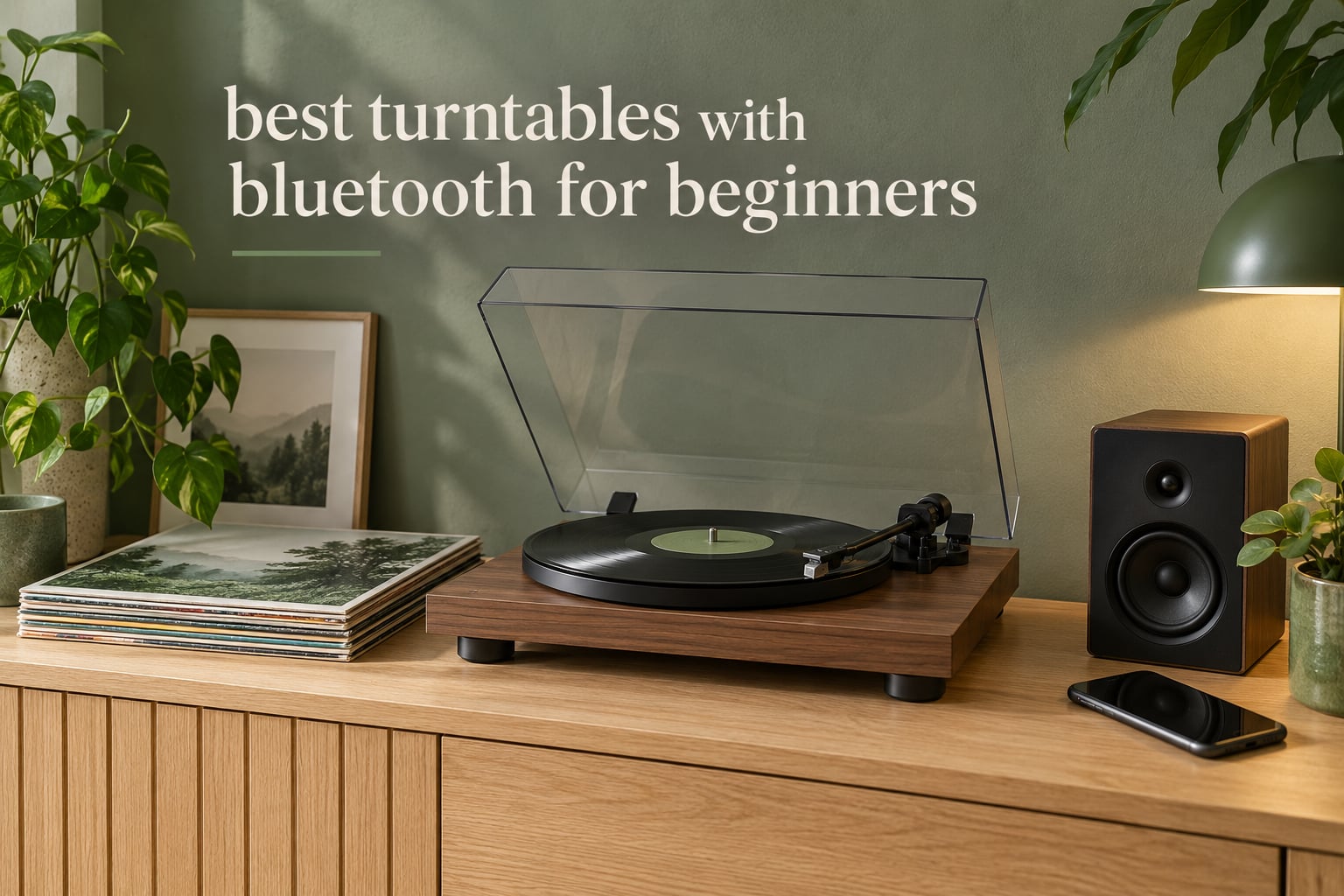
The short answer: the Audio-Technica AT-LP60XBT is the best turntable with Bluetooth for beginners in 2026. It pairs in seconds, plays both 33 and 45 rpm records, and streams your vinyl to any Bluetooth speaker or pair of wireless headphones. The one thing you must check before buying any model is whether its Bluetooth transmits or only receives.
That distinction trips up more first-time buyers than anything else in this category. A turntable with Bluetooth receive can play your phone’s music through its own speakers, which is a party trick. A turntable with Bluetooth transmit sends the record out to your own wireless speakers, which is the reason most people want this feature. Roughly half the decks in this guide do one and not the other.
We spent weeks with these ten units, comparing pairing behaviour, tonearm tracking, and what each one leaves you holding after the novelty fades. The honest headline for 2026: Bluetooth on a turntable is a convenience feature, not a fidelity feature. A wired RCA connection into powered speakers always sounds better. If you already own a Bluetooth speaker or wireless headphones, though, a transmitting deck turns vinyl into a one-box purchase and removes the amplifier, the speaker cable and the hunt for a phono input.
If you are still deciding on the wider category, our guides to the best turntables for beginners and the best belt drive turntables cover the wider market, including decks with no wireless at all.
Our Top 3 Bluetooth Turntables for Beginners in 2026
The three picks below cover the three situations most beginners fall into. One is the best all-round first deck, one is the cheapest sensible way to start, and one is the lowest-cost way to get a turntable in the house today.
Audio-Technica AT-LP60XBT
- aptX Bluetooth transmit
- Fully automatic belt drive
- Replaceable ATN3600LC stylus
- Die-cast anti-resonance platter

Victrola Journey
- Three speeds including 78 rpm
- Built-in stereo speakers
- Bluetooth receive
- Headphone jack

cotsoco 3-Speed Retro Player
- Lowest entry cost
- Three speeds and three sizes
- Built-in speakers
- Removable dust cover
All 10 Bluetooth Turntables at a Glance in 2026
Read the Bluetooth column first. A transmit model can send your vinyl to wireless speakers; a receive model can only play audio back from a phone through its own speakers.
| Product | Specifications | Action |
|---|---|---|
| Audio-Technica AT-LP60XBT |
|
Check Latest Price |
| Victrola Journey |
|
Check Latest Price |
| cotsoco 3-Speed Retro Player |
|
Check Latest Price |
 Victrola Quincy Victrola Quincy |
|
Check Latest Price |
 Victrola Haley Victrola Haley |
|
Check Latest Price |
 Retrolife R609 Retrolife R609 |
|
Check Latest Price |
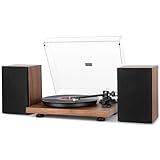 1byone HiFi System 1byone HiFi System |
|
Check Latest Price |
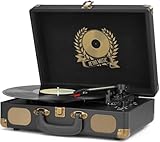 Mersoco M415 Mersoco M415 |
|
Check Latest Price |
 Sony PS-LX310BT Sony PS-LX310BT |
|
Check Latest Price |
 Audio-Technica AT-LP70XBT Audio-Technica AT-LP70XBT |
|
Check Latest Price |
Bluetooth Output vs Bluetooth Input: The Detail That Decides Your Purchase
Bluetooth output (transmit) sends your vinyl to another device. Bluetooth input (receive) pulls audio from a phone into the turntable. Only output lets you use your own speakers, and only output matters if your goal is to cut the cable between deck and speakers.
How it works: the stylus reads the groove, the cartridge converts that movement into a tiny electrical signal, and a built-in phono preamplifier raises it to line level. Bluetooth then ships that line-level signal to your speakers or headphones, exactly like a Bluetooth speaker working in reverse. The two Audio-Technica decks and the Sony in this list transmit. The Victrola Journey, Victrola Quincy, Victrola Haley, Retrolife R609, cotsoco and Mersoco units all receive only.
One further limit worth knowing: a Bluetooth signal arrives compressed, with roughly 150 to 300 milliseconds of latency. That is invisible for background listening and obvious if you are trying to cue a record against a film or a live performance. Bluetooth is for convenience listening, and nothing else.
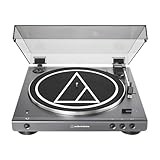
1. Audio-Technica AT-LP60XBT: Best Overall Bluetooth Turntable for Beginners
Audio-Technica AT-LPGO-BT Fully Automatic Wireless Belt-Drive Turntable (Gun-Metal/Black)
Belt drive
Fully automatic
aptX transmit
ATN3600LC stylus
2 year warranty
Pros
- Transmits over Bluetooth with aptX codec
- Plug-and-play fully automatic start and stop
- Replaceable ATN3600LC diamond stylus
- Die-cast anti-resonance platter
- Two year manufacturer warranty
Cons
- Only 33 and 45 rpm so 78 rpm records will not play
- No built-in speakers so you need a speaker or headphones
- RCA cable needed for a wired connection
This is the deck we recommend to almost everyone. It weighs 6.4 pounds, sets down on a shelf, and plays a record without you touching a single control. The tonearm lifts, swings, drops and returns on its own, which matters more for a first-time buyer than almost any specification on the spec sheet.
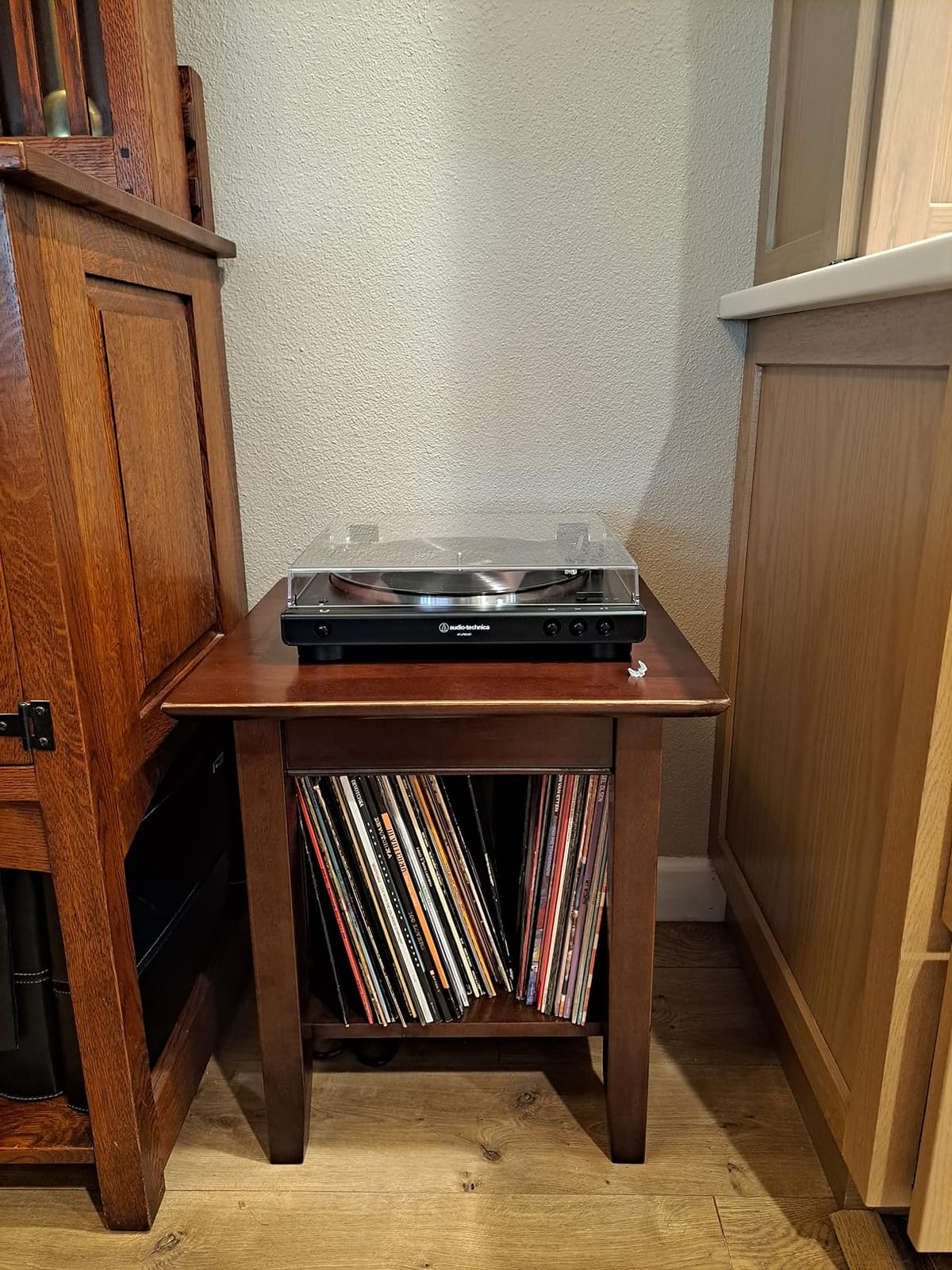
The Bluetooth side is the strongest in this class. It transmits with aptX codec support, and an external AC adapter handles power conversion outside the chassis to keep noise out of the signal chain. On r/turntables this is the model that comes up again and again as the safe first wireless deck, and the pairing behaviour backs that up: it reconnects to a familiar speaker without a manual re-pair.
Sound quality comes from a die-cast anti-resonance platter and a redesigned tonearm base and headshell aimed at better tracking and less resonance. The integrated dual moving magnet cartridge uses a replaceable ATN3600LC diamond stylus, so when the needle wears you replace a small part rather than the whole cartridge.
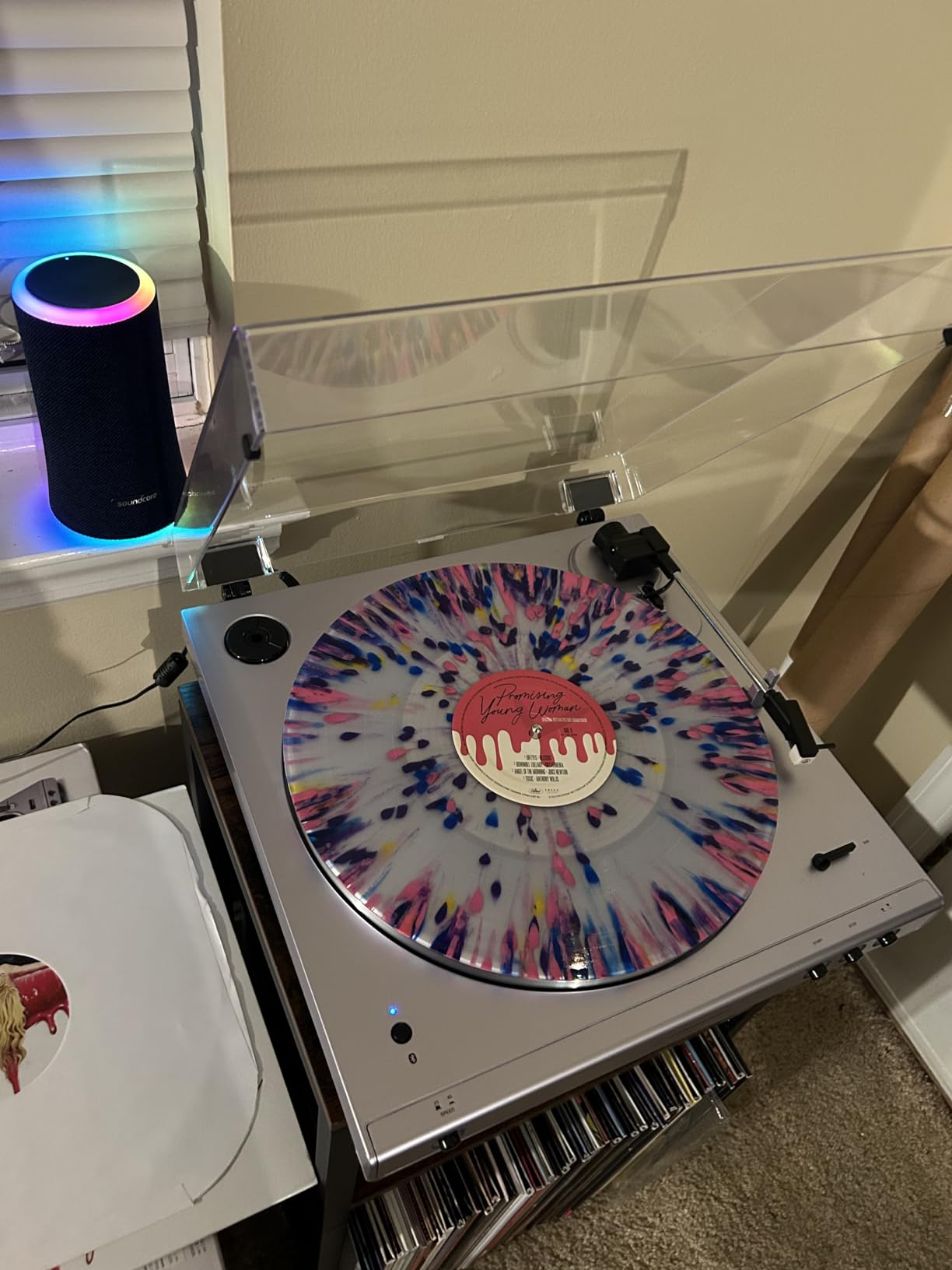
What you get that most competitors skip
The replaceable stylus is the detail that separates this deck from the disposable budget units. Community buyers treat the VM95 and ATN3600LC families as the number one longevity signal, because a deck with a swappable stylus is a deck you keep for years rather than replace.
It also ships with a two year manufacturer warranty, double what the Victrola models in this list offer, and the RCA output cable is included for a wired path into an amplifier or powered speakers later.
Where it falls short
Two speeds only, so 78 rpm shellac records from an estate sale simply will not play. There are no built-in speakers either, which means the deck is silent on its own until you pair something or run the RCA cables.
If your listening happens in a kitchen with no Bluetooth speaker anywhere near it, you need a different answer. Our portable Bluetooth speaker picks fill that gap well.
2. Victrola Journey: Best Value Suitcase Turntable
Victrola Journey – Bluetooth Suitcase Record Player – Smoky Blue
Three speeds to 78 rpm
Built-in speakers
Bluetooth receive
60 dB signal to noise
1 year warranty
Pros
- Largest review base of any deck in this guide
- Three speeds covering 7 inch 10 inch and 12 inch records
- Built-in stereo speakers need nothing else
- Compact and light at 16 ounces
- Stereo RCA outputs and a headphone jack
Cons
- Bluetooth only receives so it cannot send vinyl to your own speakers
- Cartridge and stylus typically need replacing after a few hundred hours
- Lightweight tonearm can flutter on some records
- Only a one year warranty
The Journey is the most-reviewed record player in this roundup, with more than 55,000 ratings, and that is not accidental. It is the box that arrives, gets plugged in, and plays a record. Built-in stereo speakers mean no amplifier, no speaker wires and no separate buying trip.
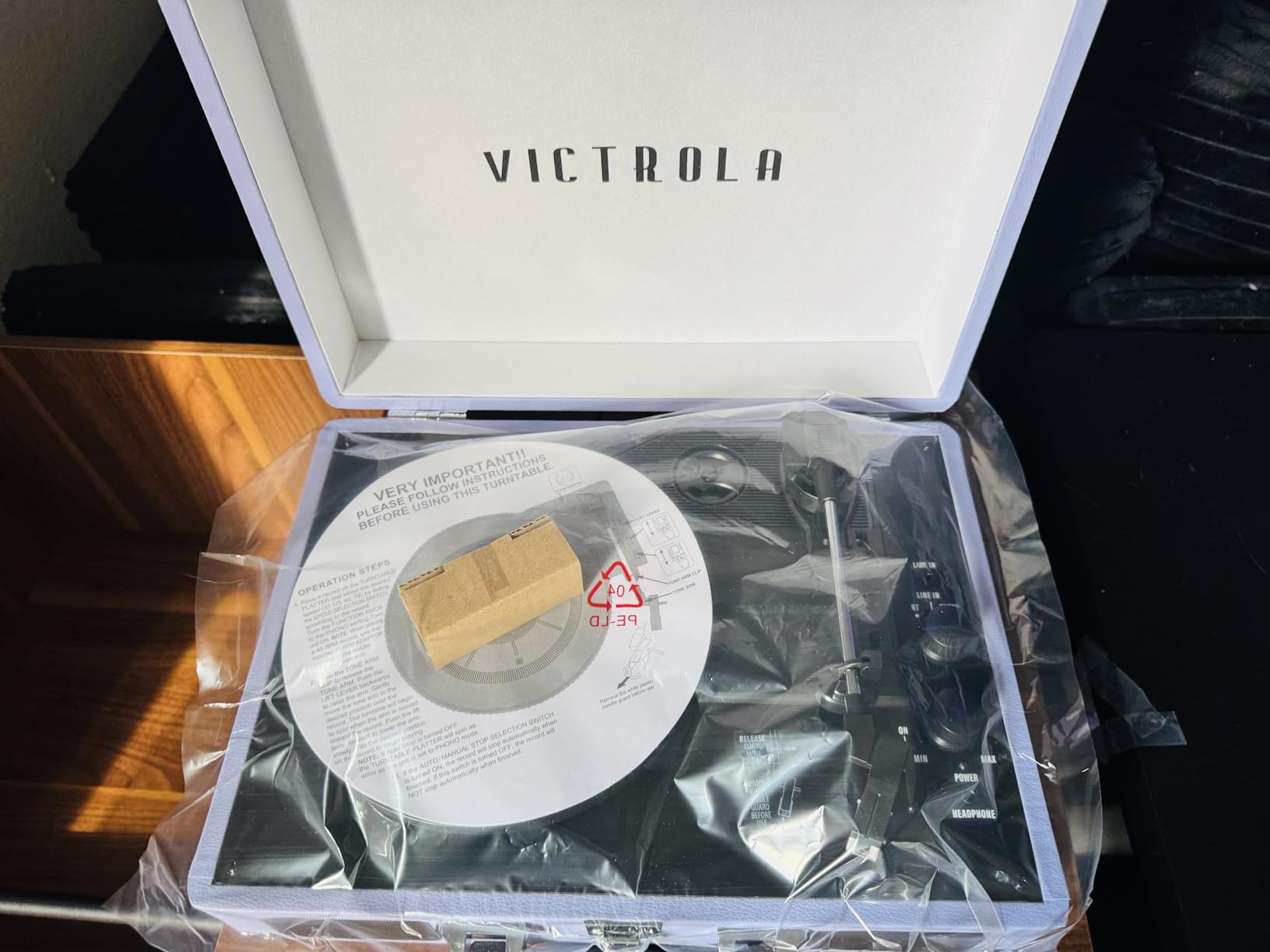
It covers all three standard speeds: 33 1/3, 45 and 78 rpm. That 78 rpm support is the feature that matters if you have inherited shellac discs, and it is the main reason we rank this above other budget decks. A 60 dB signal-to-noise ratio is respectable for the class, and the input select knob, power and volume knob and auto stop switch are all clearly labelled.
Bluetooth here is receive only, so the unit works as a speaker for phone audio. That is a genuine convenience, but if you own a wireless speaker you would rather stream to, this is not the deck. RCA outputs and a headphone jack are there, so external speakers via cable are the better path for sound.
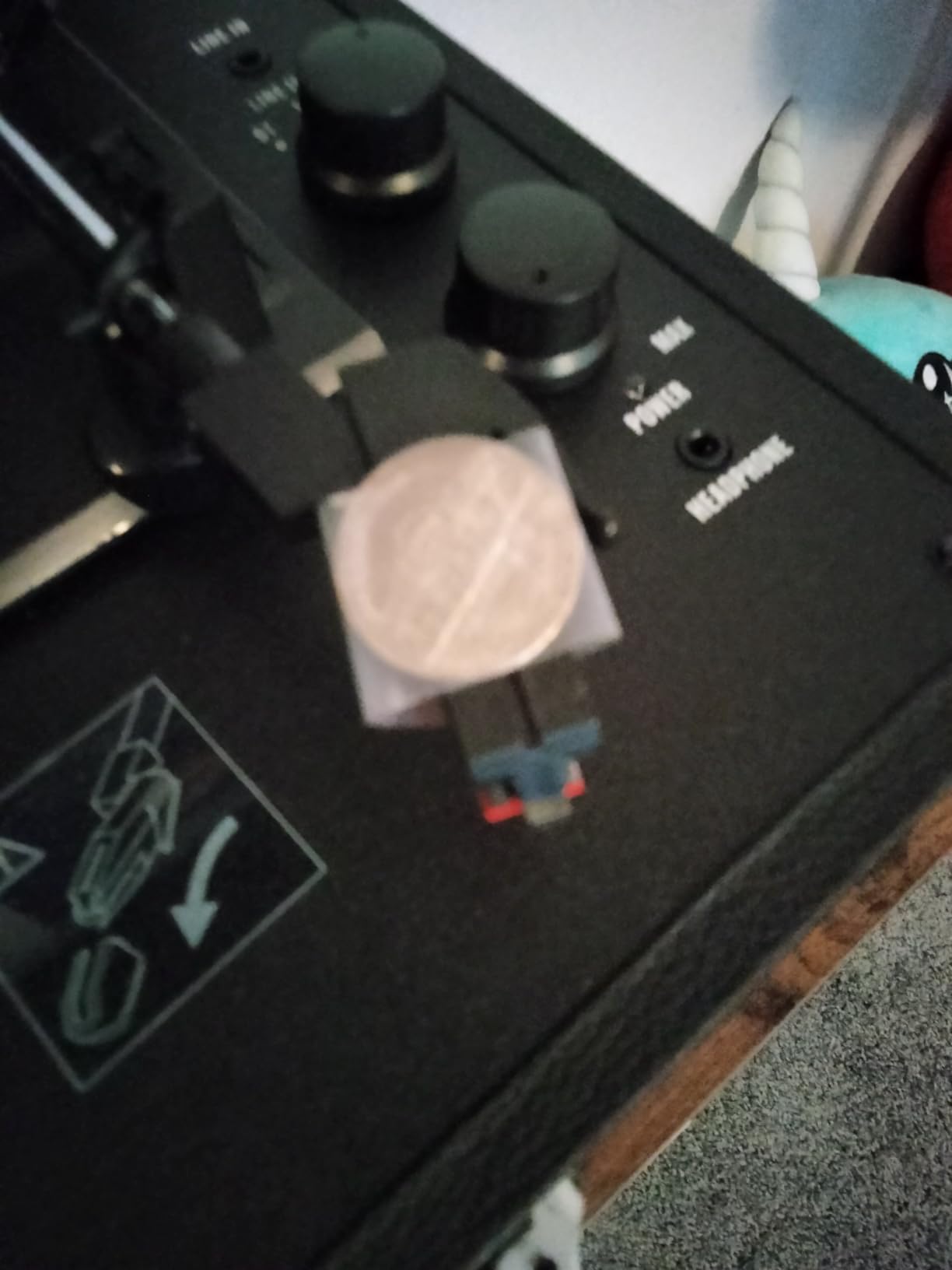
Why the styling is not just decoration
The suitcase format with a carry handle and foldable design gets bought as much for the shelf as for the sound, and owners consistently describe it as the easiest first player. Sound isolating feet help a plastic chassis that weighs 16 ounces.
Buyers also flag that it must be plugged in to operate despite the portable styling. Plan for a permanent spot near an outlet rather than a spot in the garden.
Where it falls short
Enthusiasts rate the audio as basic, with a thin sound at higher volume levels and some vibration. The cartridge and stylus typically need replacing after a few hundred hours, and the light tonearm can flutter on worn records.
Most owners upgrade out of a suitcase player within a few months. Treat this as a first step rather than a final system, and read our beginner turntable guide when that time comes.
3. cotsoco 3-Speed Retro Player: Best Budget Pick
Vinyl Record Player Turntable with Built-in Bluetooth Receiver & 2 Stereo Speakers, 3 Speed 3 Size Portable Retro Record Player for Entertainment and Home Decoration
Three speeds
Bluetooth receive
45 dB signal to noise
4.8 pounds
2 year warranty
Pros
- Lowest entry cost in this guide
- Three speeds and three record sizes
- Built-in stereo speakers plus AUX RCA and headphone
- Removable dust cover included
- Two year warranty at a budget price
Cons
- Bluetooth is receive only
- Modest 45 dB signal to noise ratio
- Light tonearm with limited tracking on worn records
- Budget construction
This is the cheapest deck here that still covers all three speeds and ships with a dust cover, and its 12,000-plus ratings suggest plenty of people have made it their first record player. Setup takes about two minutes and the wood-effect cabinet looks less plasticky in person than in photos.
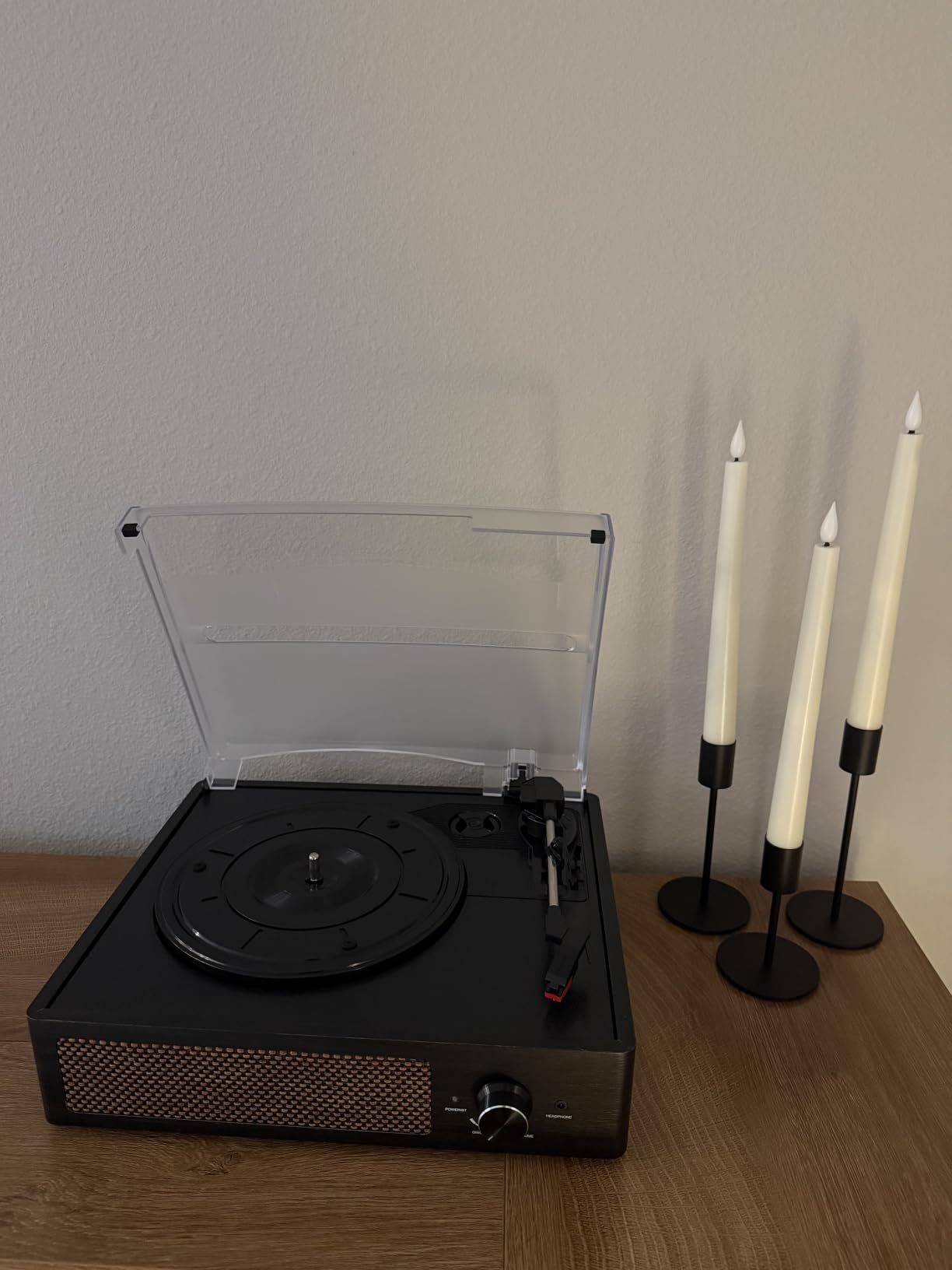
Connectivity is generous for the money: a built-in Bluetooth receiver, two stereo speakers, an AUX input, RCA line output and a headphone jack. The power cable, RCA cable and auxiliary cable all come in the box, which is rare at this end of the market. A 45 rpm adapter is included too.
Mechanically it is a straightforward DC motor belt drive playing 7 inch, 10 inch and 12 inch records. That simplicity cuts both ways. There is no counterweight to balance, which is friendly, but also no cartridge upgrade path, so this is closer to a sealed appliance than a deck you grow into.
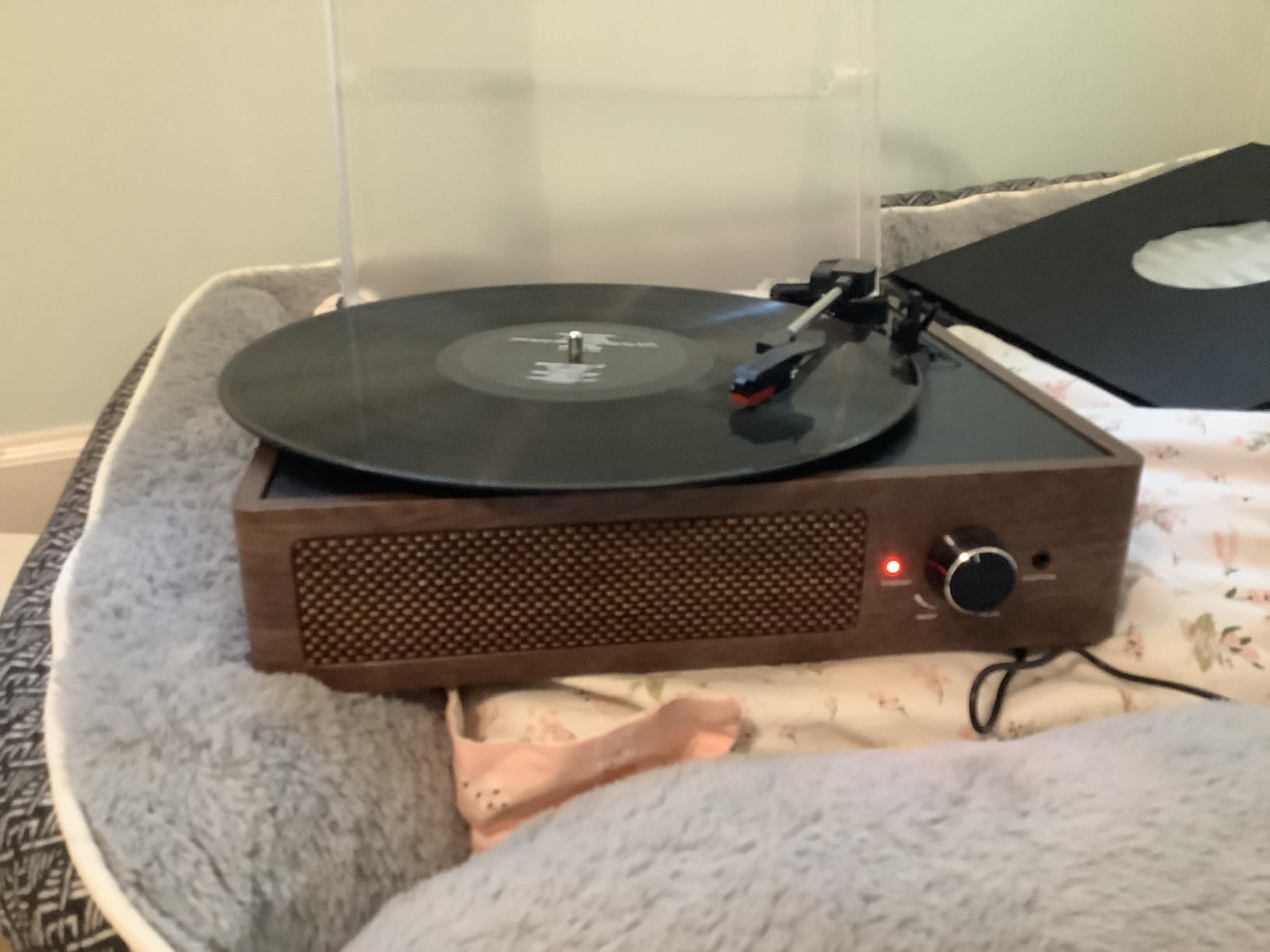
Where the money was saved
The 45 dB signal-to-noise ratio is the clearest indicator. Compare it with the 70 dB figure listed for the Victrola Quincy and the 75 dB listed for the Sony, and you can hear where the cost went. Bass response is modest and the light tonearm loses tracking on worn records sooner.
On the positive side, the two year warranty is longer than the one year offered by every Victrola in this guide, and cotsoco lists a warranty term at all.
Where it falls short
Bluetooth receive only, so vinyl cannot be sent to your own wireless speakers. If wireless is the reason you are here rather than a bonus, the Victrola Journey or an Audio-Technica will serve you better.
It suits a child, a dorm room or a first taste of vinyl better than a system you expect to keep for a decade.
4. Victrola Quincy: Best Multi-Format Cabinet
Victrola Quincy – 6-in-1 Bluetooth Record Player – Mahogany
6-in-1 system
70 dB signal to noise
Three speeds
Bluetooth receive
18.1 inch wide
Pros
- Plays vinyl CDs cassettes and radio in one cabinet
- 70 dB signal to noise is the second highest here
- Warm full sounding built-in speakers
- Quick Bluetooth pairing from phones
- RCA line outputs for an external system
Cons
- A transport screw must be tightened before first use
- FM tuning is slow and needs careful adjustment
- Bluetooth range limited to roughly ten feet
- One year warranty and occasional dead cartridges
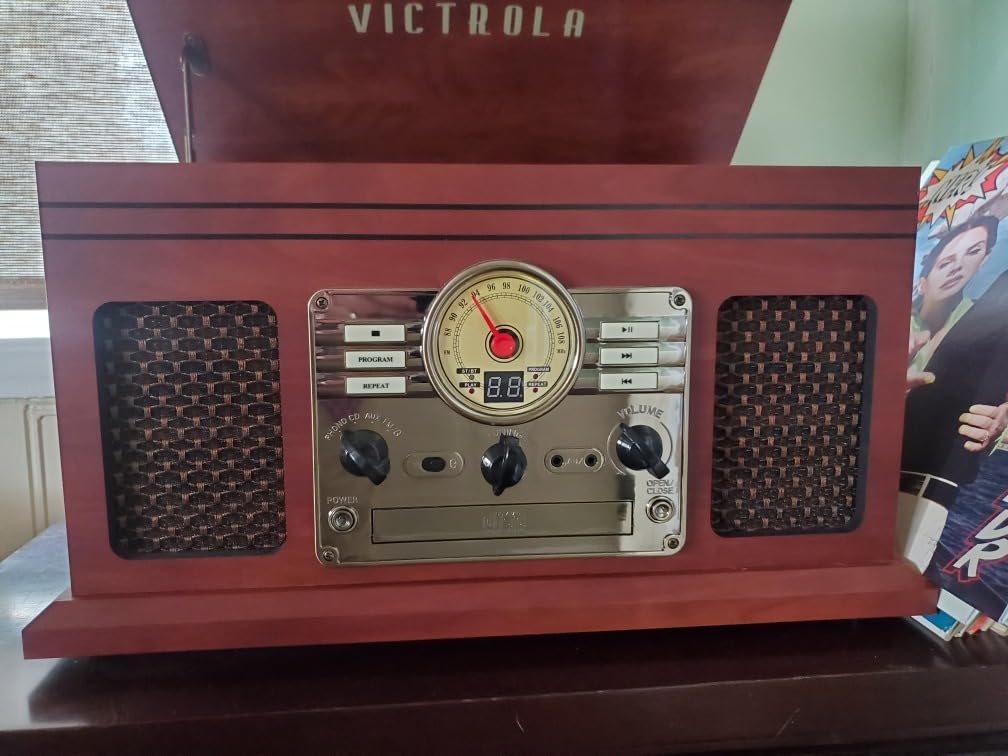
The Quincy is the one deck here that replaces a whole hi-fi stack. It plays vinyl, CDs, cassettes, AM and FM radio, streams over Bluetooth and takes a 3.5 mm aux input. At 18.1 inches wide and 14.9 pounds, it reads as furniture rather than as an accessory, and owners frequently describe the built-in speakers as a step up from a portable player.
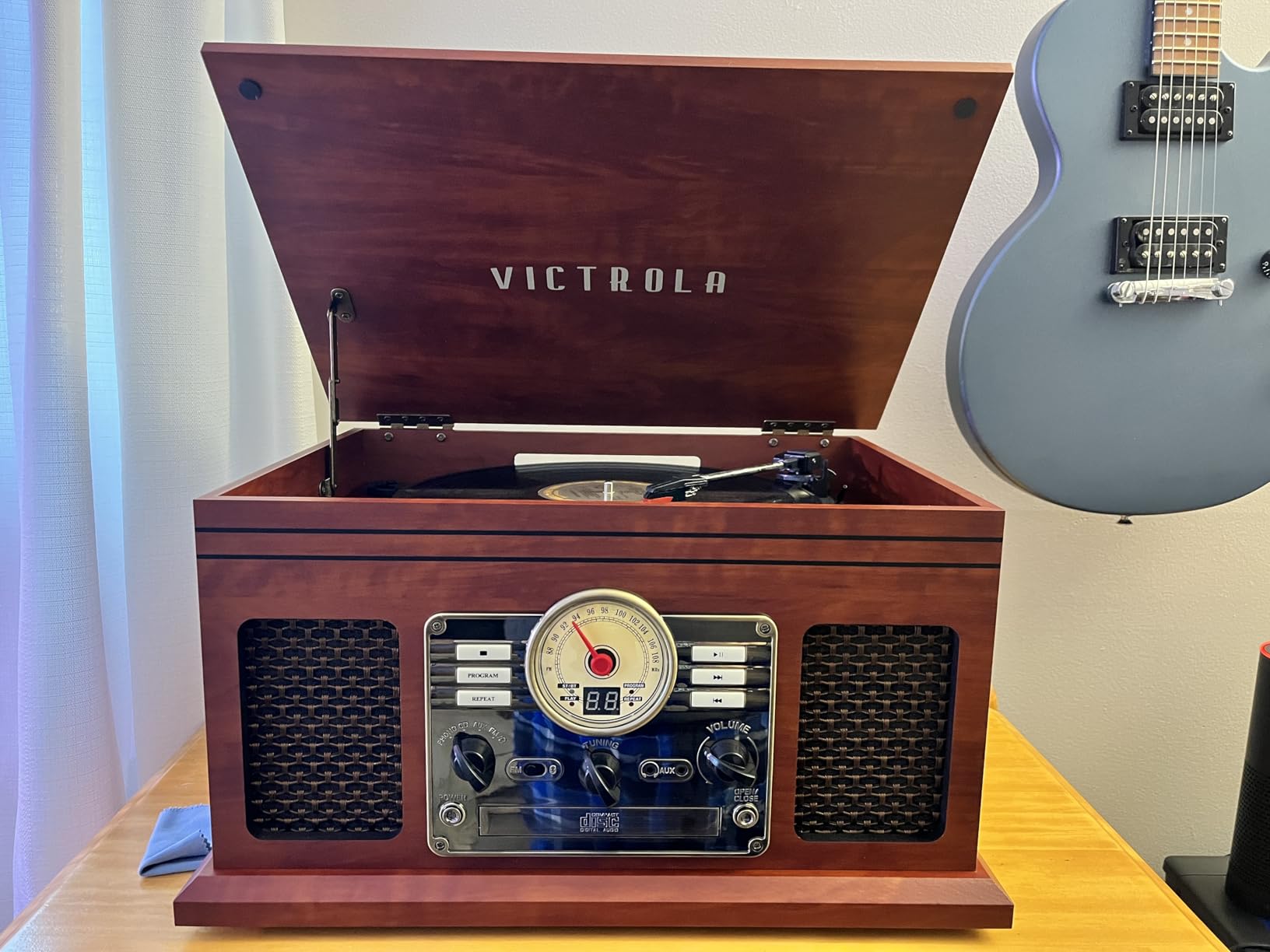
Sound specifications back that up. The listed 70 dB signal-to-noise ratio is the second highest in this roundup, and the engineering-wood cabinet gives the speakers more volume than a plastic deck can. The three-speed belt drive covers 33 1/3, 45 and 78 rpm, so inherited shellac is in scope.
RCA line outputs with a cable included let you attach a proper amplifier or powered speakers later, which keeps this from being a dead end. A headphone jack covers private listening.
The part that catches first-time owners out
A transport screw has to be tightened before the first record turns, and the turntable can still shift slightly if the cabinet is nudged. It is a two minute job that sounds far worse when the record is wobbling.
Beyond that, the FM tuner is slow to find stations and Bluetooth range stops at roughly ten feet. Cassette transport and the CD tray both feel basic, though the CD drive itself is well regarded.
Where it falls short
Bluetooth is receive only, so this is a Bluetooth speaker with a turntable attached rather than a wireless transmitter. Some buyers also report units arriving with a damaged or dead phono cartridge, so inspect it on arrival.
The one year warranty is the shortest we would accept on a deck this size. If you want the multi-format convenience with better longevity, the Audio-Technica route below is worth the extra thought.
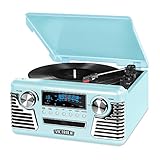
5. Victrola Haley: Best for Small Rooms and Low Volume
Victrola Haley – Retro Bluetooth Record Player with CD Player – Teal
CD player and radio
Three speeds
Bluetooth receive
8.4 pounds
1 year warranty
Pros
- Retro 1950s styling in a colour people comment on
- Clear sound for the price
- CD player and AM/FM radio with LED display
- Headphone jack and aux input
- Durable enough for daily use
Cons
- Not particularly loud even at high volume
- Plastics and buttons feel cheap and wobbly
- Bluetooth can be finicky with several devices
- US two pin plug is awkward outside North America
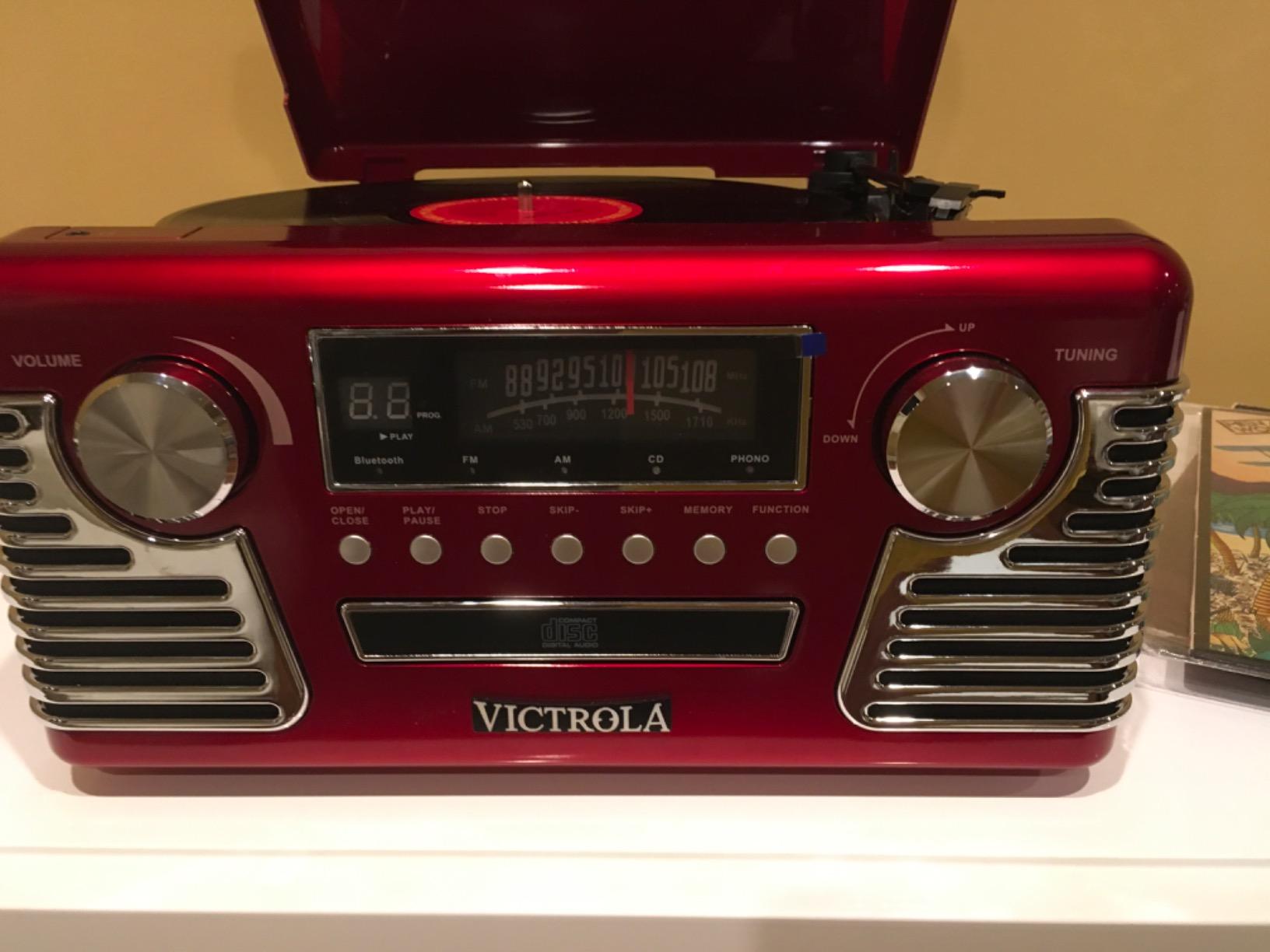
The Haley sits between the portable suitcase players and the full cabinets. It is a teal, 1950s-styled unit weighing 8.4 pounds with built-in stereo speakers, a CD player, an AM/FM radio with a blue LED display, Bluetooth, aux and a headphone jack. The three-speed belt drive again covers 78 rpm.
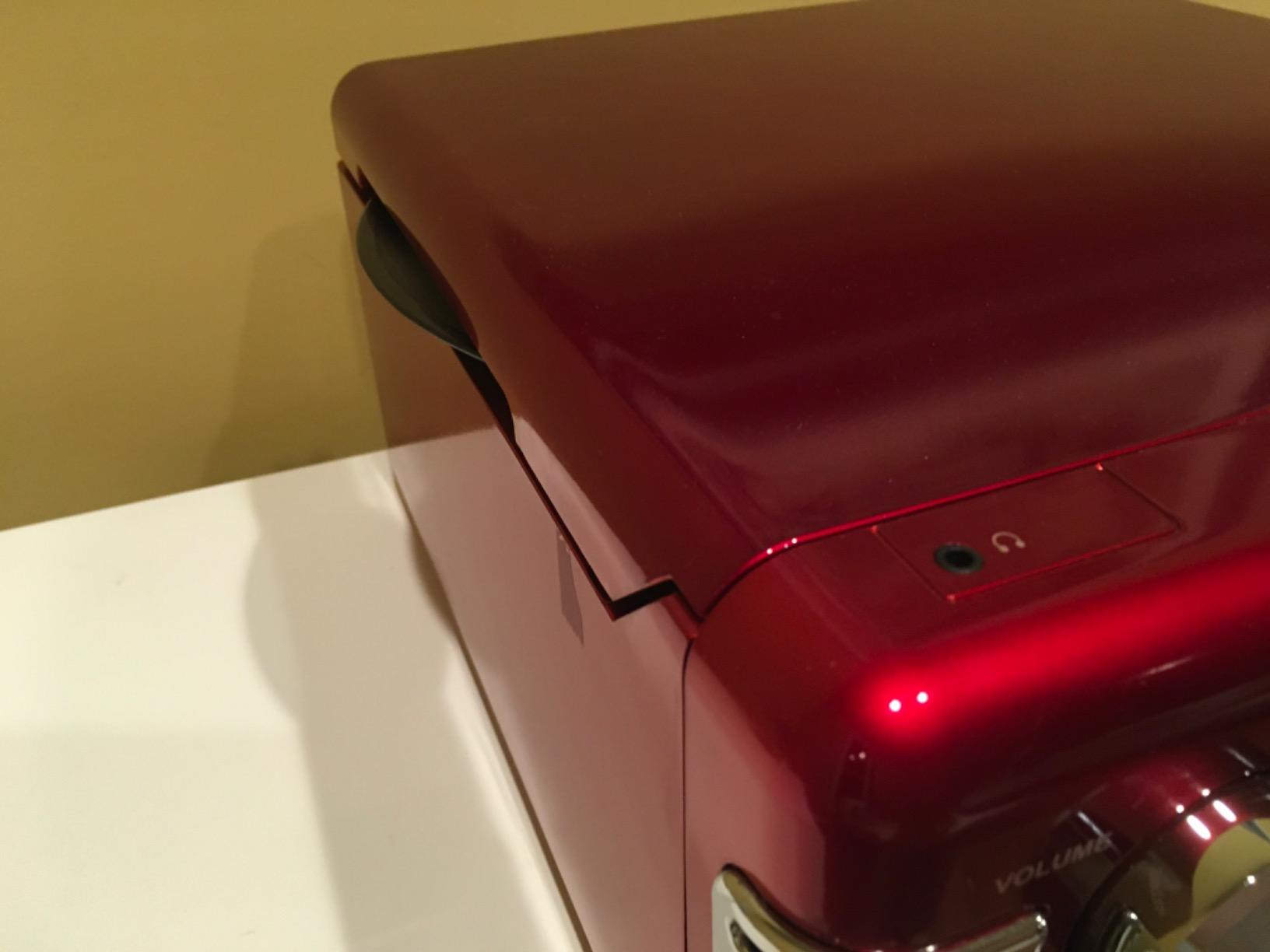
Reviewers consistently rate the CD drive as the standout. If you are building a first system around a small bedroom or dorm room and want the deck to double as a compact stereo, the extra formats earn their place in a way they do not on a bare deck.
Sound is described as clear for the price rather than impressive, and the practical detail to plan around is volume. Owners note it is not particularly loud even at high settings, which is fine at arm’s length in a bedroom and frustrating in a living room.
Best-case listening situation
A desk or a bedside table at a few feet, with the unit doing the work of a small stereo rather than filling a room. The style is the other draw: it is a gift that does not look like a gift, and the colour choice gets compliments.
Bluetooth, radio and aux give you three ways to play something that is not a record, which is more than any bare turntable here offers.
Where it falls short
Plastics and buttons feel cheap and can feel wobbly under a hand. Bluetooth can be finicky when several devices try to connect at once, and some records spin slightly wobblily, with the tonearm needing added weight to avoid skipping.
It also uses a US two-pin plug, which is a genuine nuisance outside North America. Verify the plug type before you order.
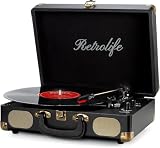
6. Retrolife R609: Best Portable Four-Connection Deck
Retrolife® Vinyl Record Player with Speakers, Bluetooth Vinyl Player-Black
Four connection options
Three speeds
55 dB signal to noise
2.5 kg
1 year warranty
Pros
- Bluetooth RCA output aux-in and headphone jack in one deck
- Three speeds and three record sizes
- Auto-stop and quick mode switch for simple operation
- Anti-resonance design with sound isolating feet
- Compact suitcase form with a carry handle
Cons
- Non adjustable tonearm and light tracking force skip on worn records
- Entry level sound with modest bass
- Compact built-in speakers limit volume and separation
- One year warranty
The R609 is one of the most connected decks in the budget group. Four options in one unit: Bluetooth streaming, RCA output, aux-in and a headphone jack, with a quick mode switch to move between Bluetooth, aux and phono without hunting through menus. That single switch does more for daily usability than most of the specifications on this list.
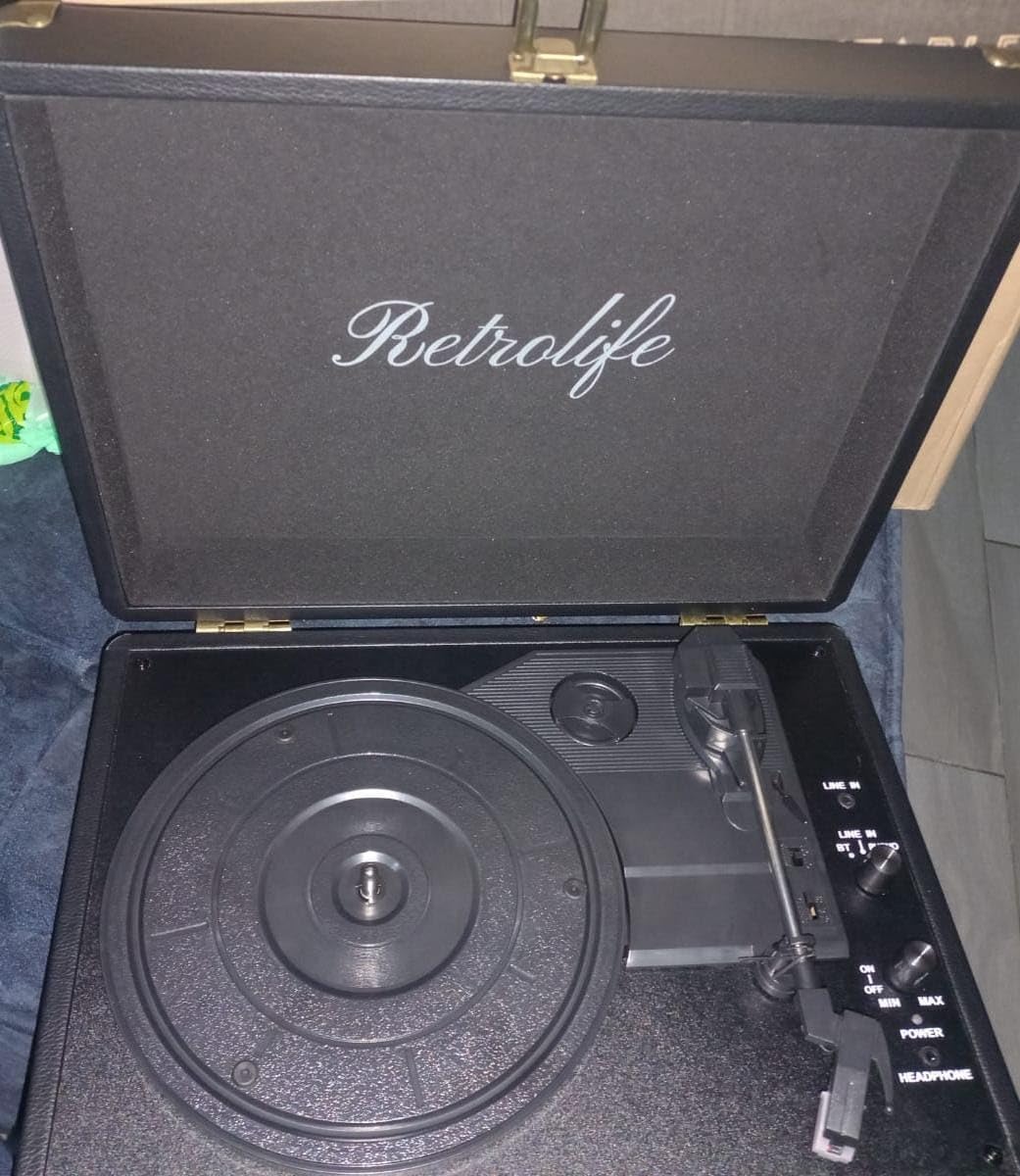
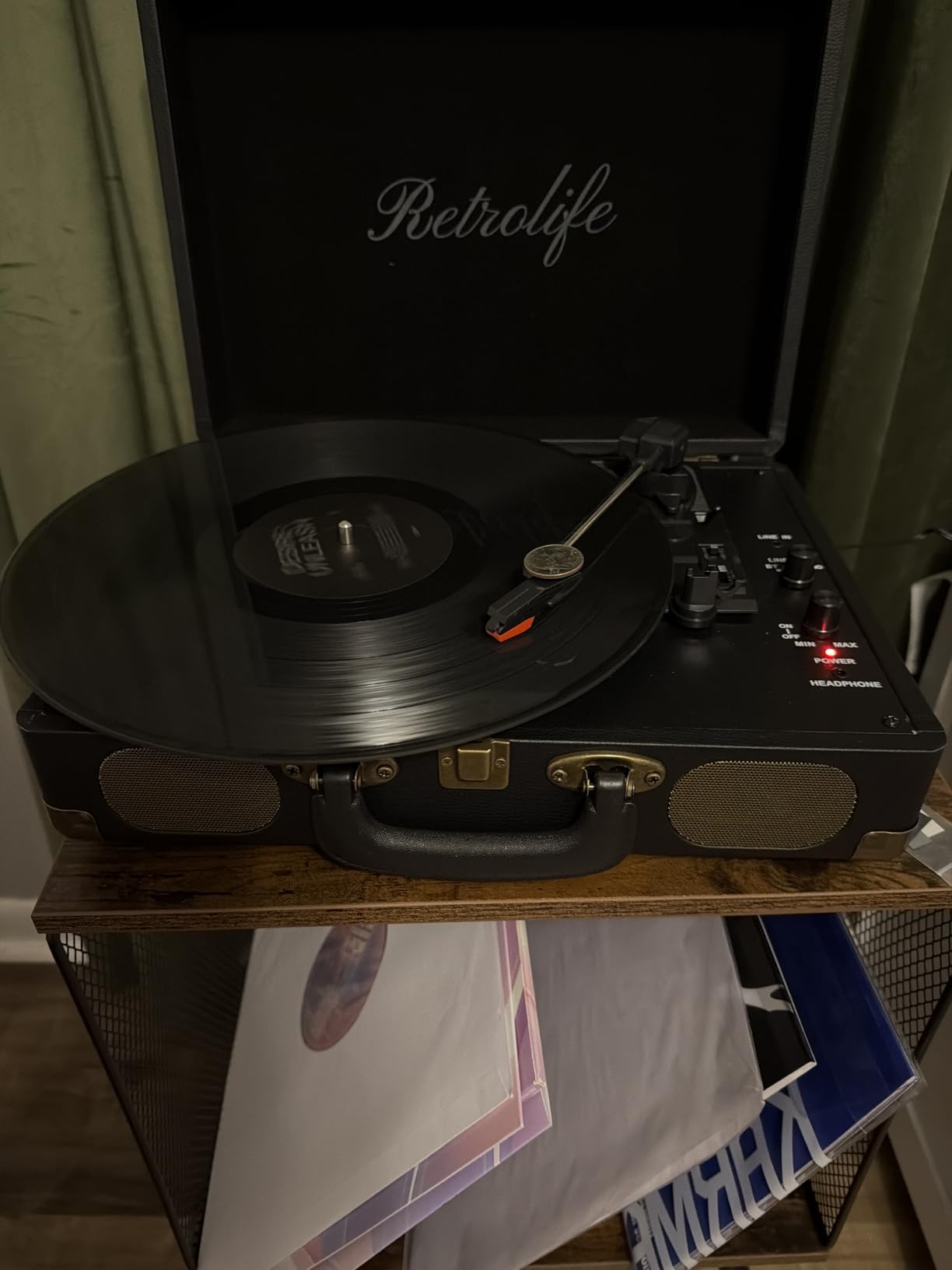
Mechanically it is a belt-driven three-speed turntable for 7 inch, 10 inch and 12 inch records, weighing 2.5 kg, with a PU leather suitcase body, bronze hardware and an anti-resonance design. The 55 dB signal-to-noise figure sits in the middle of this group, above the cotsoco and Mersoco units and below the Victrola Quincy and Sony.
Auto-stop ends playback at the end of a record, which protects the stylus from sitting in a locked groove. Remember that auto-stop is not auto-return: the arm stays parked at the rest and the deck is not broken.
What makes it a good second-room deck
The carry handle, 4.15 inch height and anti-resonance design make this easy to move between a bedroom and a living room. Four connection options mean it can take over as a small speaker system when the turntable is not in use.
Reviewers also note no extra equipment is needed to get started, which is the same promise the Audio-Technica makes with a different mechanism: add speakers later, and nothing is wasted.
Where it falls short
The tonearm is non-adjustable with a light tracking force, and that is the item to watch. On worn records it can skip, and unlike a counterweight deck there is nothing you can do about it in the settings.
Sound is entry level with modest bass, and the compact built-in speakers limit both volume and stereo separation. Bluetooth here is receive only, so it will not send vinyl to your own speaker.
7. 1byone HiFi System: Best Sound With Real Speakers
1 BY ONE Bluetooth Turntable HiFi System with 36 Watt Bookshelf Speakers
36 watt speakers
Solid iron platter
Counterweight
Switchable preamp
USB output
65 dB signal to noise
Pros
- Separate 36 watt bookshelf speakers included
- Standard mount AT3600L cartridge you can upgrade
- USB output for recording vinyl to MP3
- Switchable phono and line preamp with RCA cables
- 65 dB signal to noise with a solid iron platter
Cons
- Tonearm balance and anti skate setup takes patience
- Instructions are confusing for first time owners
- Cartridge can arrive loose and not making contact
- Speakers have no RCA input of their own
- System auto shuts off after a few minutes idle
Most decks in this roundup hide two small speakers inside a single cabinet. This one does not. You get a walnut-finished deck plus a pair of 36 watt bookshelf speakers, and the difference is the clearest upgrade step in this guide. Owners describe a warm, full presentation with good clarity and respectable bass.
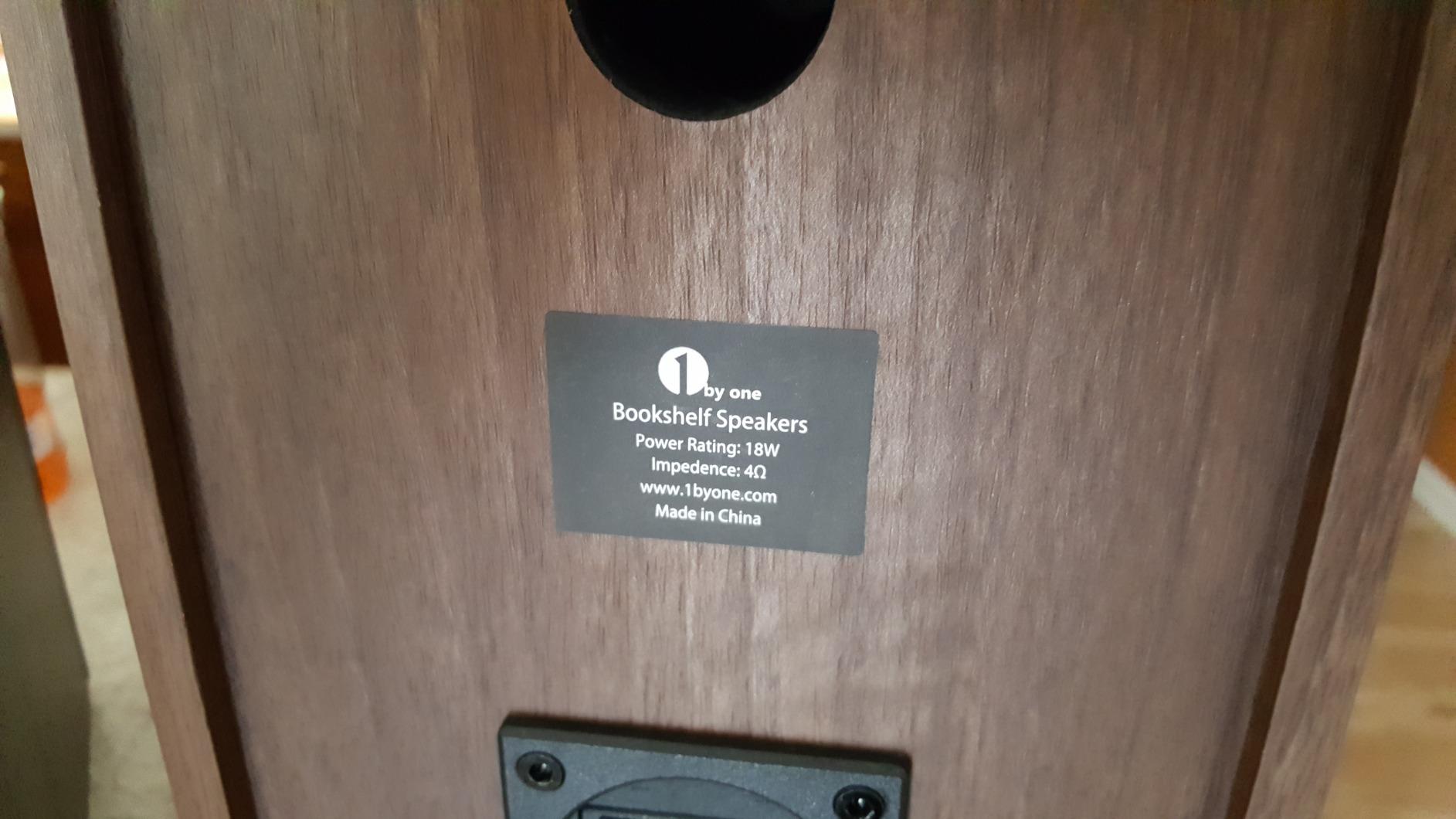
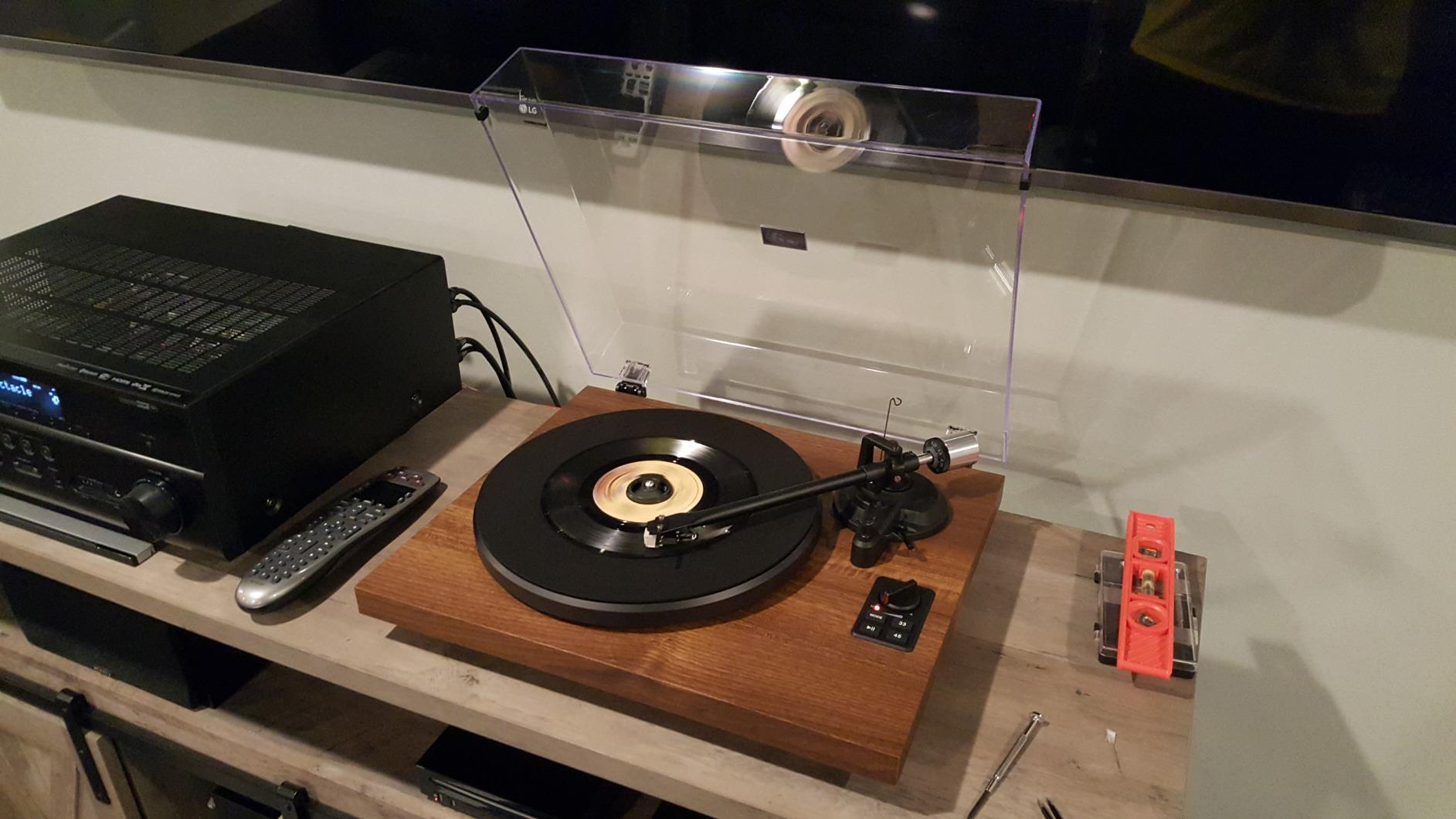
The deck itself has a solid iron platter with uniform inertial mass, an adjustable counterweight and a hanging anti-skating system, which is real hi-fi furniture. A switchable phono and line preamp plus dual RCA output cables mean you can move to a proper amplifier later without buying a preamp box.
There is a USB output for recording vinyl to MP3 on a computer, and Bluetooth streaming from phones, tablets and PCs through the included speakers. The 65 dB signal-to-noise ratio beats every budget deck here.
Why the upgrade path is the real story
The standard-mount Audio-Technica AT3600L cartridge is the part that keeps this deck alive. Standard mount means you can fit an Ortofon or another moving magnet later instead of being locked into one vendor’s cartridge, which is how decks survive a decade rather than three.
At 20.9 pounds and 16.5 inches wide, it is a two-box system rather than a one-box system. Plan shelf space for the speakers, not just for the deck.
Where it falls short
The counterweight and anti-skate setup takes patience, and reviewers specifically call the instructions confusing for people new to turntables. That is a real cost for the very buyer this guide is written for, and it is why we rank this seventh rather than higher.
The cartridge can also arrive loose and not making contact. Check it before you play anything valuable. Bluetooth playback is noticeably quieter than vinyl, and the speakers have no RCA input of their own, so they only work as part of this system.
8. Mersoco M415: Best Suitcase Deck for Moving Between Rooms
Vinyl Record Player Bluetooth 3-Speed Portable Vintage Suitcase with Built-in Speakers, RCA Line Out AUX in Headphone Jack Vintage Turntable, Black
Latchable suitcase case
Three speeds
44.98 dB signal to noise
5.7 pounds
2 year warranty
Pros
- Latchable suitcase case and solid handle for real portability
- Plays within two minutes of unboxing
- Three speeds including 78 rpm
- RCA output allows a large sound upgrade
- Two year manufacturer warranty
Cons
- Built-in speakers sound thin and tinny at higher volume
- Auto stop can cut a 45 rpm record before the end
- Plastic tonearm and platter need gentle handling
- Bluetooth mode is quieter than vinyl
If the idea of vinyl is that it travels, the M415 is the honest answer. The case latches, the handle is solid and the whole unit weighs 5.7 pounds, so it moves between a flat and a home without ceremony. Reviewers report playing a record within two minutes of opening the box.
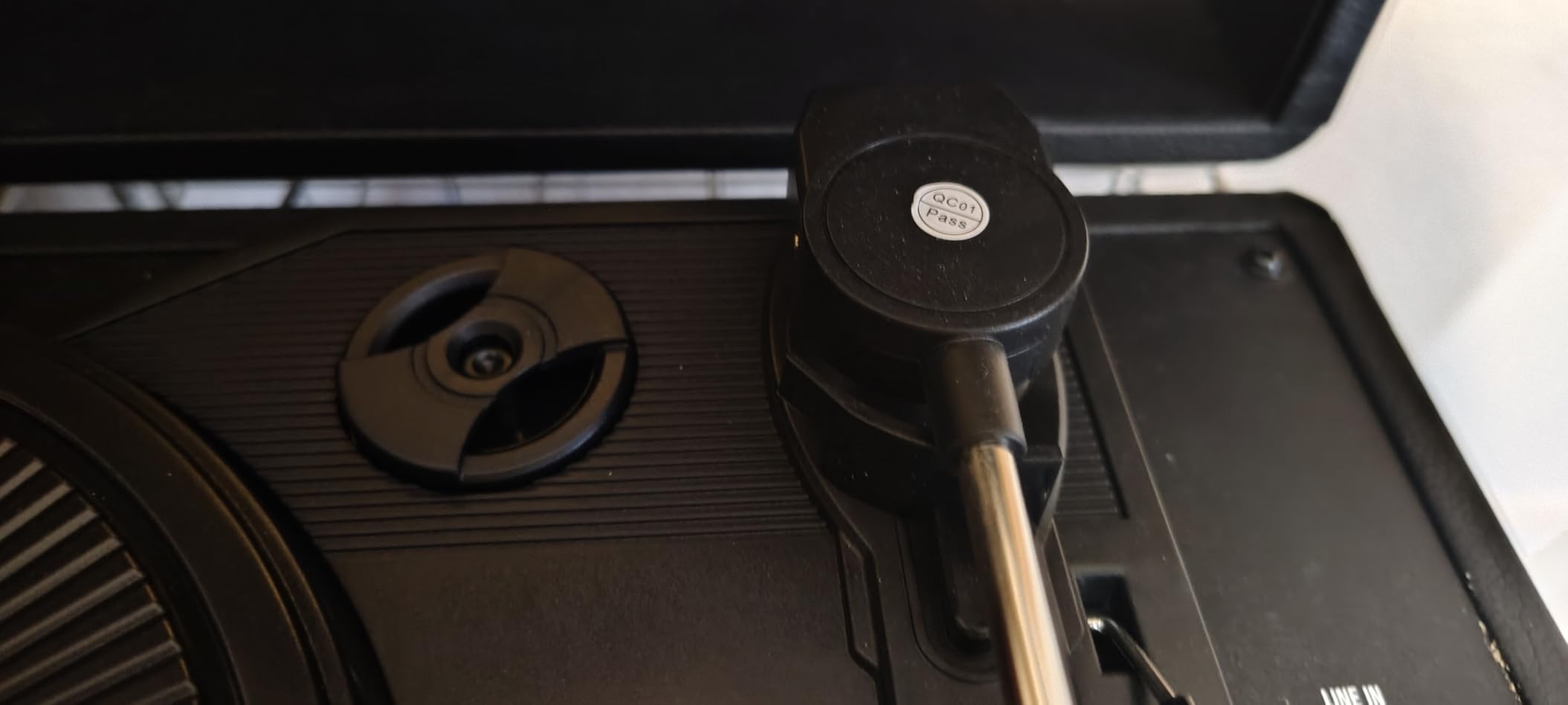
It is a belt-driven, semi-automatic deck at three speeds and three record sizes, with two front-facing dynamic stereo speakers and a smart auto-stop switch. Connectivity is 4-in-1: Bluetooth streaming, RCA line out, AUX-in and a headphone jack. The stylus is a ruby needle with anti-rust metal fittings, and a power adapter, 45 rpm adapter, RCA cable and AUX cable are all included.
The 44.98 dB signal-to-noise ratio is the lowest of the ten alongside the cotsoco, and it shows. Treat the built-in speakers as a convenience and plan to use the RCA output into something better.
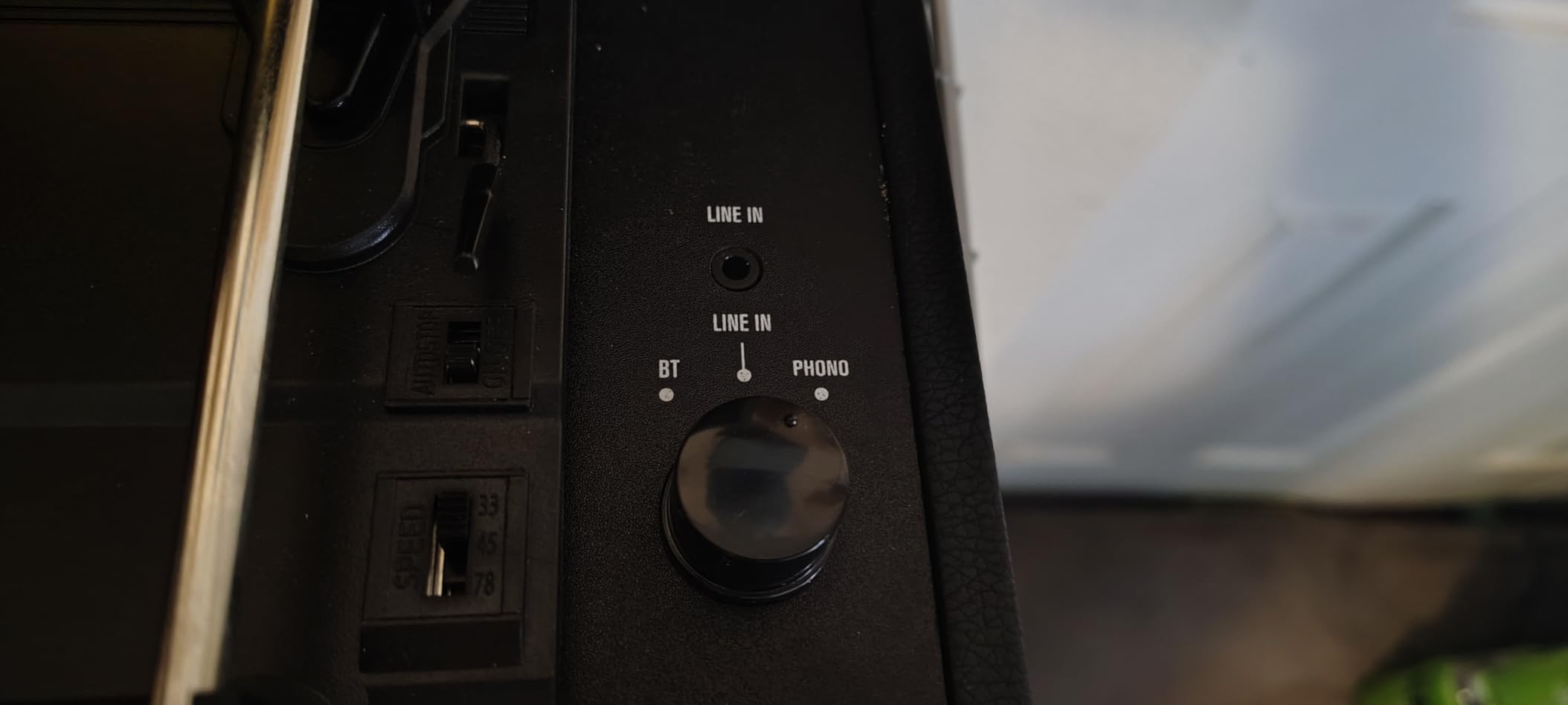
The one upgrade that transforms it
Reviewers consistently say the same thing: run the RCA output into better external speakers and the sound improves a great deal. That advice applies equally to the Victrola Journey and the cotsoco, but with this deck the jack is right there on the back.
It is one of the few decks here that covers 78 rpm at a genuinely low outlay, and the latching case is what makes that entry price portable rather than merely cheap.
Where it falls short
The built-in speakers sound thin and tinny, especially at higher volume, and the plastic tonearm and platter need gentle handling in transit. That is the trade for a unit designed to be carried.
Auto-stop can cut a 45 rpm record off before the track finishes, which is a known quirk on this model. Bluetooth mode is quieter than vinyl playback, and Bluetooth is receive only.
9. Sony PS-LX310BT: Best for Digitizing Vinyl to MP3
Sony PS-LX310BT Belt Drive Turntable: Fully Automatic Wireless Vinyl Record Player with Bluetooth and USB Output Black
USB MP3 output
75 dB signal to noise
Switchable preamp three gains
Bluetooth transmit
Automatic return
Pros
- Highest listed signal to noise ratio at 75 dB
- USB output records vinyl to MP3 on a computer
- Built-in phono preamp with three gain settings
- Full automatic start stop and tonearm return
- Aluminum die-cast platter and aluminum pipe tonearm
Cons
- Feels cheap and lightweight with plastic buttons
- RCA cables are permanently hardwired
- No tonearm locking clip so secure the arm when moving it
- Only 33 and 45 rpm with no 78 rpm support
The Sony is the specification leader in this group. A 75 dB signal-to-noise ratio is the highest figure listed across all ten decks, the platter is die-cast aluminium to cut vibration, and the tonearm is a newly designed aluminium pipe. It also transmits over Bluetooth with a built-in phono EQ, so the wireless path is properly done rather than tacked on.
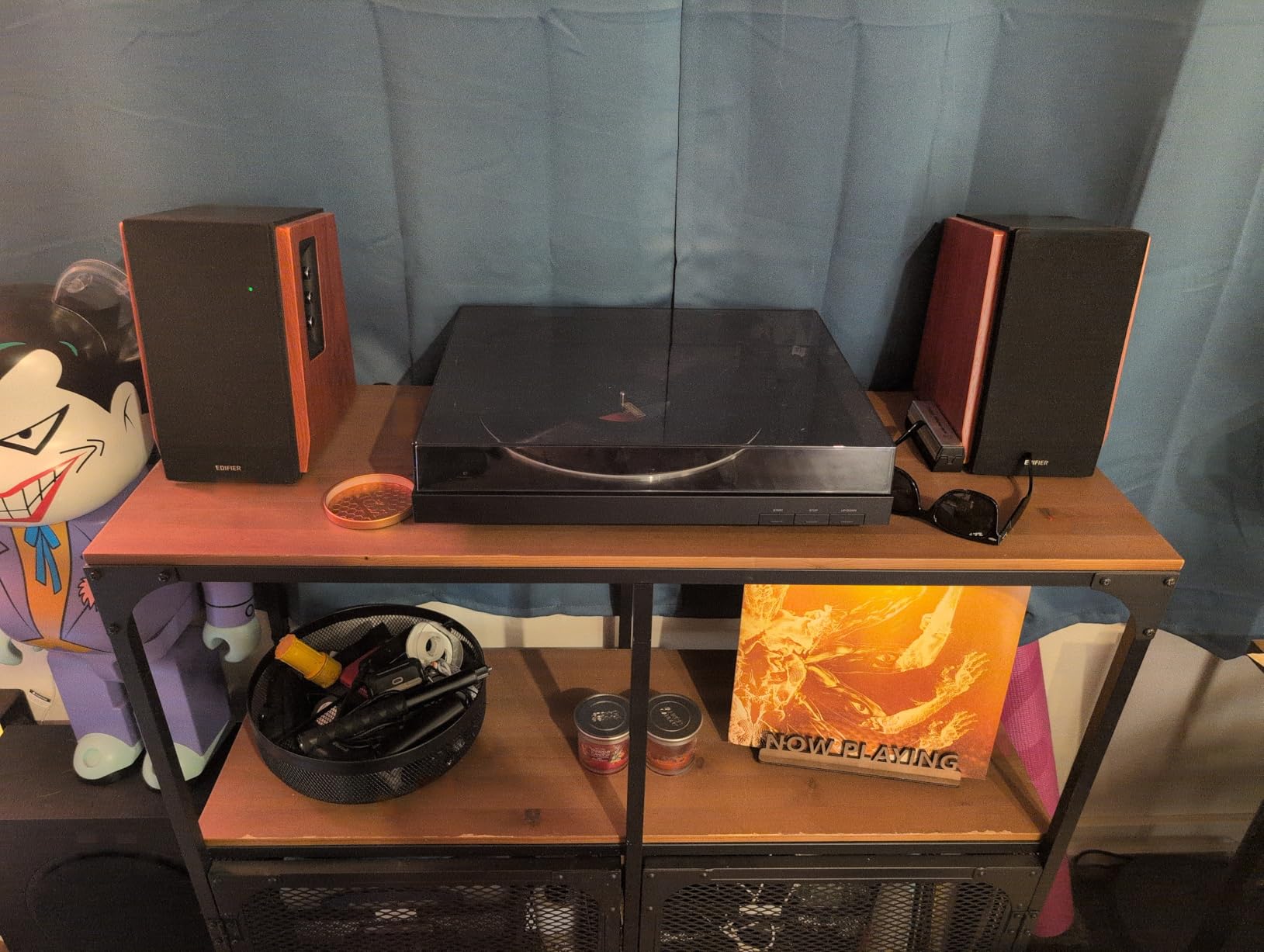
Fully automatic operation covers one-step start, stop and return, and the built-in switchable phono output and line out preamp has three gain settings. That gain switch matters with real vinyl, because worn records need more level than new ones. The detachable dust cover, slip mat, 45 rpm adaptor, USB B cable and RCA cables all ship in the box.
This is the deck to buy if you want your records as files. The USB output records vinyl straight to MP3 on a computer, which no other deck in this roundup matches except the 1byone system.
What the three gain settings are for
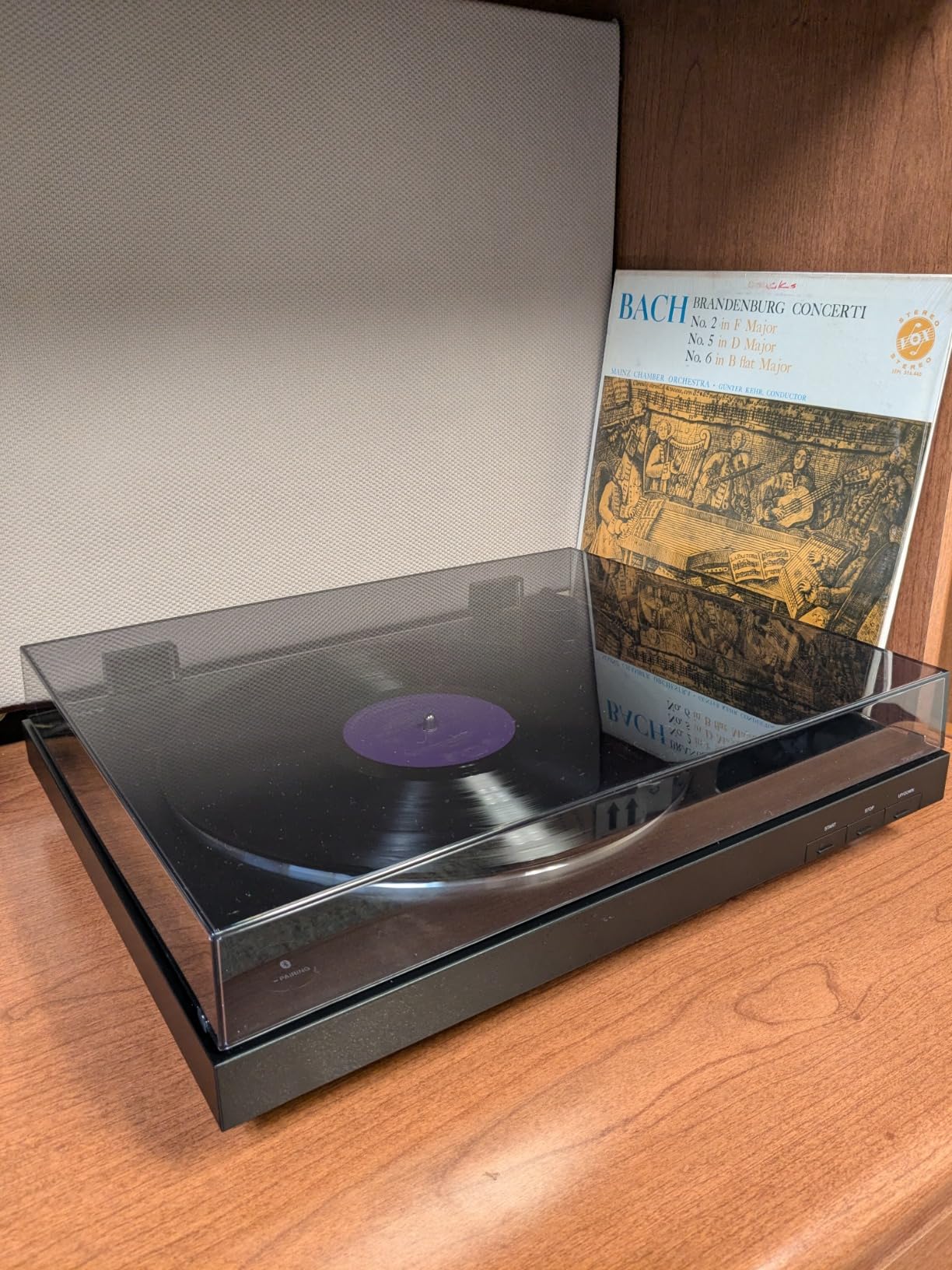
A phono preamp raises the tiny cartridge signal to line level, and the switchable version lets you output either phono or line level. The three gain settings let you match the deck to different cartridges and different record conditions instead of running one fixed level.
On the AVForums threads that surface for this category, the Sony PS-LX310BT is the model most often named alongside much dearer decks. Many owners compare its sound favourably against far more expensive manual decks.
Where it falls short
At 7.9 pounds with plastic buttons, the build feels cheap and lightweight for the specification sheet it carries. The RCA cables are permanently hardwired rather than removable, so repositioning the speakers means moving the whole deck.
There is no tonearm locking clip, so the arm must be secured every time you move the unit, and the only speeds are 33 and 45 rpm. USB ripping can also introduce a high-pitched whine into recordings, and replacement styli are expensive relative to the unit.
10. Audio-Technica AT-LP70XBT: Best for Growing Into Your Setup
Audio-Technica AT-LP70XBT Wireless Turntable (Black/Bronze)
AT-VM95C cartridge
Switchable phono line preamp
J-shaped tonearm
55 dB signal to noise
2 year warranty
Pros
- AT-VM95C cartridge accepts the entire VM95 stylus range
- Built in switchable phono and line preamplifier
- J-shaped tonearm engineered to reduce tracking errors
- Three piece chassis dampens resonance
- Detachable RCA cable dust cover and 45 rpm adapter included
Cons
- Only two speeds so 78 rpm records will not play
- No built-in speakers so external audio is required
- Lightweight plastic chassis moves when pressed
- Fewer reviews than the other Audio Technica deck
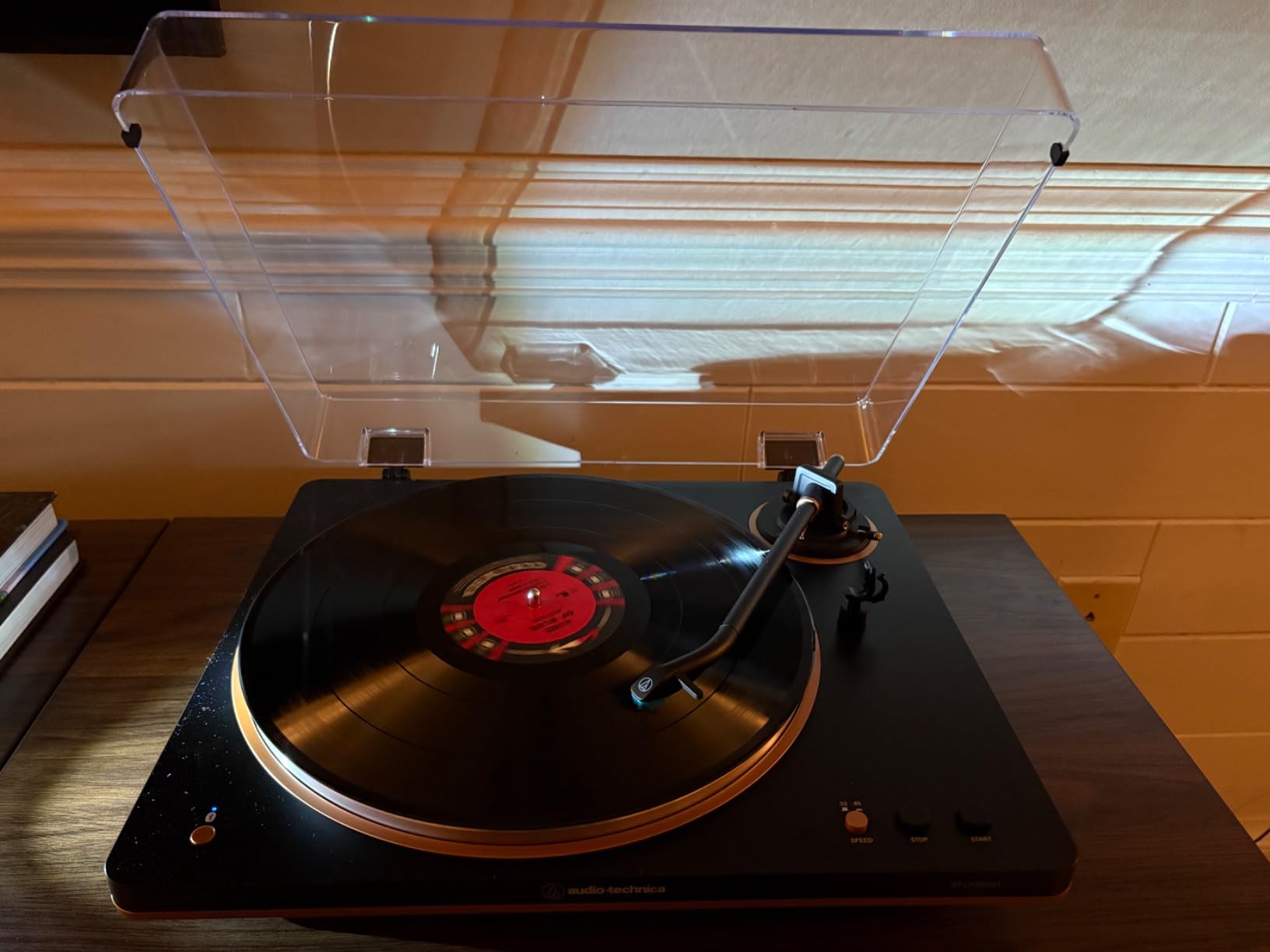
The AT-LP70XBT is the deck to buy if you already know you will keep playing. It ships with the AT-VM95C cartridge, and that cartridge accepts any stylus in the VM95 series, so upgrading the needle is a small, cheap part swap rather than a new cartridge. For a beginner, that is the difference between a first turntable and a first turntable that lasts.
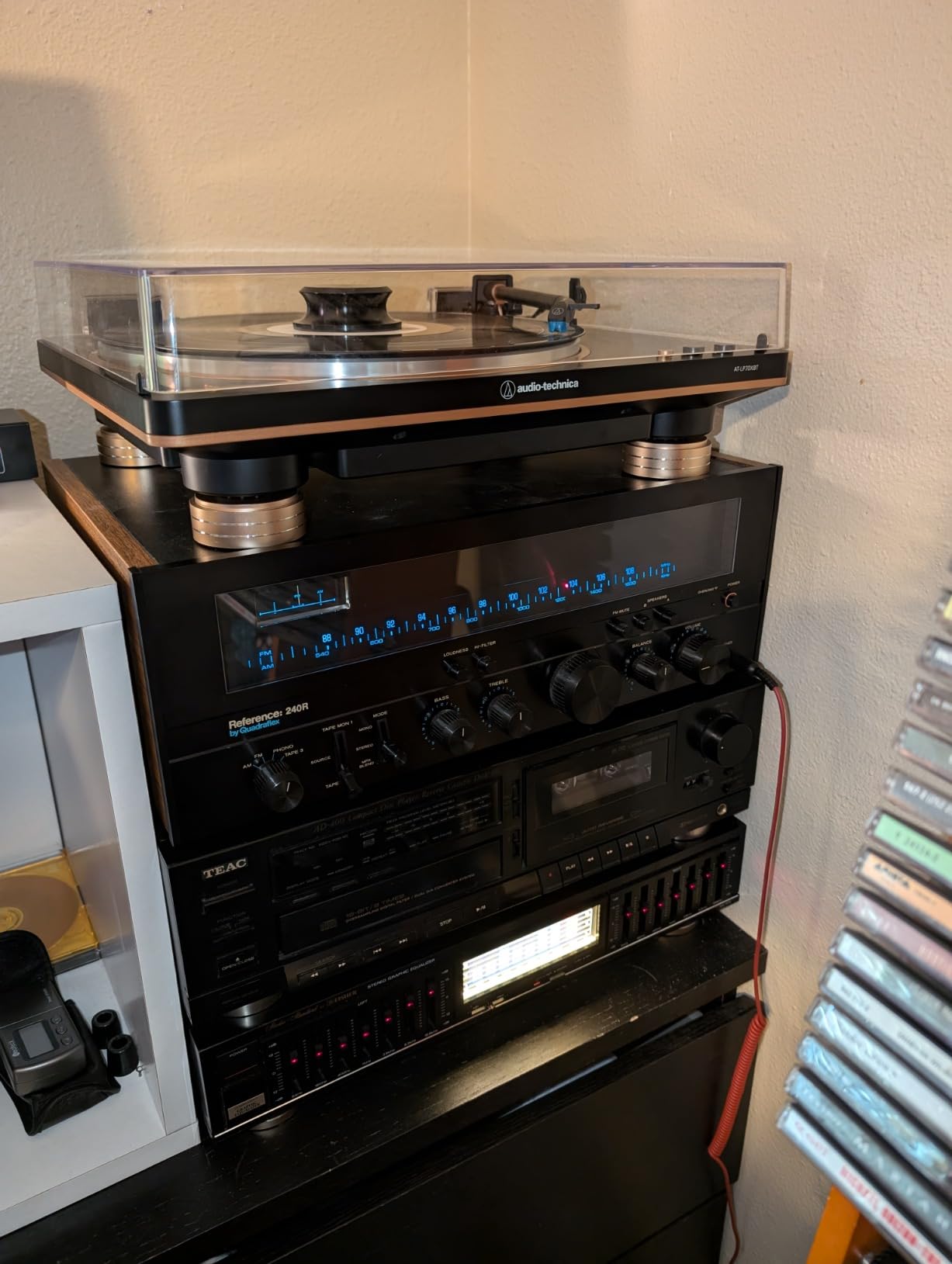
It also has a built-in switchable phono preamplifier, so it outputs either phono or line level depending on what you connect it to. That is the feature that lets a deck graduate to a real amplifier later without buying a separate preamp box, and it is why we rank this above several better-sounding budget options.
Construction is a three-piece chassis meant to dampen resonance, with a J-shaped tonearm engineered to minimise tracking errors. A detachable RCA output cable, 45 rpm adapter and removable hinged dust cover are included. The 55 dB signal-to-noise ratio and two year warranty both beat most of the affordable decks here.
AT-LP60XBT or AT-LP70XBT: which one?
This is the most common question on beginner turntable forums, so here is the short version. The AT-LP60XBT is the plug-and-play pick: a fixed tonearm, an integrated cartridge with a replaceable ATN3600LC stylus, no settings to touch. The AT-LP70XBT is the same idea with a switchable phono and line preamp, a J-shaped tonearm, a damped chassis and a VM95 cartridge that opens up a much wider stylus range.
If you will only ever stream to one Bluetooth speaker, the cheaper deck is enough. If you might add an amplifier and a better cartridge later, pay the step up now and you will not have to replace anything.
Where it falls short
Two speeds only, so 78 rpm records cannot play. There are no built-in speakers, so something else has to make sound, and the lightweight plastic chassis moves when you press on it.
It also carries a much smaller review base than the AT-LP60XBT, at 695 ratings, so you are buying on a shorter owner history rather than a volume of feedback.
How to Tell If a Listing Transmits or Receives
Check the compatible devices line before you add anything to a basket. If it lists speakers, headphones or earbuds, the deck transmits. If it lists only a smartphone or tablet, it receives.
Second, look for the words Bluetooth output, wireless output, TX or aptX in the feature list. Those words almost always mean transmit. A listing that simply says Bluetooth compatible is telling you nothing.
Third, treat any deck that also lists built-in speakers with suspicion. A machine that plays phone music through its own speakers and sends vinyl to your own speakers is unusual, and a listing claiming both without naming them is worth a question to the manufacturer. Every deck in this guide is labelled TX or RX in the table above for exactly this reason.
Bluetooth Turntable Buying Guide for Beginners
Do you need a phono preamp? Almost certainly, and look for one that is built in and switchable. A turntable produces a phono-level signal far quieter than any speaker can play. A phono preamp raises it to line level. If a deck has no built-in preamp and no speakers, plugging it into an amplifier means buying a separate preamp box first, which is the single most common reason a first setup ends up silent.
Is Bluetooth worth it on a turntable? It is worth it if you already own a Bluetooth speaker or wireless headphones, or if you refuse to buy an amplifier. It is not worth it if you intend to buy a hi-fi amplifier and good speakers, because a wired RCA connection into those speakers will always sound better than a compressed Bluetooth stream.
Belt drive or direct drive? Belt drive isolates the platter from motor vibration, which is quieter and gentler on your records, and it is what most of the decks here use. Direct drive spins faster to start and holds speed tightly, which matters for DJ-style use. For home listening, belt drive is the calmer choice.
Automatic or manual tonearm? For a first-time buyer, fully automatic start, stop and return is the safe answer. Nothing gets left in a locked groove, nothing swings across a record by accident, and you can put a record on and walk away. Manual arms with a counterweight sound better once calibrated, but they demand a setup ritual you do not yet have.
What about replaceable styli? This is the longevity question forum buyers care about most, and we think it is the right one. A deck with a swappable stylus or a standard-mount cartridge can be repaired for the cost of a small part for years. A sealed cabinet with a fixed cartridge is closer to a disposable appliance.
Which speeds do you need? 33 1/3 and 45 rpm cover standard LP and single records. 78 rpm only matters for old shellac, and if an estate sale is how you will get records, buy a three-speed deck such as the Victrola Journey or the Retrolife R609.
Finally, warranty and parts. The Audio-Technica and cotsoco units here carry two year terms, while every Victrola in this roundup carries one. A longer warranty and an available replacement stylus are two of the better signals that a deck will still be working in five years.
What a Complete First Vinyl Setup Actually Costs
Budgetting only for the deck is the most common mistake. A workable first setup has three or four parts, and the extras are where beginners get surprised.
The budget route is one of the all-in-one decks, the Victrola Journey or the cotsoco player, with no speakers and no amplifier to buy. Add a set of replacement styli if the fixed one wears, plus a carbon brush and a record cleaning cloth.
The mid route is an Audio-Technica AT-LP60XBT or AT-LP70XBT with a pair of powered bookshelf speakers connected by RCA, plus one replacement stylus in the VM95 family and a basic cleaning kit. This is the configuration that satisfies the most first-time buyers, because you can add speakers now and a better cartridge later.
The quality route is the deck plus a proper amplifier and real speakers, which is where a wired connection finally pays off. If you are spending at that level, work through our best turntables for vinyl guide as well, since Bluetooth is no longer the deciding factor at that budget.
First-Time Setup Checklist in Eight Steps
Unbox the deck on a level surface with clearance behind it, not in a corner. Turntables need the tonearm to swing free.
Fit the 45 rpm adapter if you have singles, and check whether a transport screw needs tightening before the first record, as on the Victrola Quincy.
Leave the dust cover open or off while you listen. A closed cover pressing on a spinning record is a near-universal cause of skipping.
Set the speed to match the record label, place the anti-slip mat down, and drop the stylus at the outer edge of the first track rather than the lead-in.
On a manual deck, balance the counterweight until the arm floats, then set tracking force and anti-skate as the instructions describe. Skip this on a fully automatic model.
Decide the output path before you play anything. Bluetooth pairing, RCA cables into powered speakers, or the aux input if you are streaming from a phone.
Pair Bluetooth once, then leave the device connected. Auto-reconnect works on the Audio-Technica and Sony models and saves the usual re-pairing frustration.
Expect auto-stop to park the arm at the rest rather than returning it. That is normal behaviour, not a fault, and it is the moment most beginners think the deck has broken.
Common Beginner Mistakes to Avoid
Buying a receive-only deck when you meant to transmit. This is the most expensive mistake available, and the compatible devices line settles it in five seconds.
Buying a bare turntable with no speakers, no amplifier and no built-in preamp. Nothing plays, and the missing part is a preamp box you did not plan for.
Playing with the dust cover closed and blaming the deck when a record skips.
Leaving a turntable running after a record ends, so the stylus sits in a locked groove for hours. Use auto-stop.
Dragging a non-adjustable tonearm across a worn record at a high tracking force, which is why the entry-level cabinets wear new vinyl faster than they should.
Paying for a sealed budget cabinet and replacing it a year later, when the same money spent on a deck with a replaceable stylus would have lasted a decade.
Frequently Asked Questions
Is Bluetooth worth it on a turntable?
Yes, if you already own a Bluetooth speaker or wireless headphones, because it turns vinyl into a one-box purchase with no amplifier and no speaker cables. No, if you are buying an amplifier and good speakers anyway, since a wired RCA connection always sounds better than a compressed wireless stream. Bluetooth is a convenience feature, not a fidelity feature.
What is the difference between Bluetooth transmit and receive on a turntable?
Bluetooth transmit sends your vinyl out to wireless speakers or headphones, and Bluetooth receive plays audio from a phone through the turntable’s own built-in speakers. Many budget decks, including the Victrola Journey and the Retrolife R609, only receive. Check whether the listing’s compatible devices include speakers and headphones, which means it transmits.
Do I need an amplifier for a Bluetooth turntable?
Only if the deck transmits and you want better sound. A transmitting deck pairs directly with Bluetooth speakers or wireless headphones with no amplifier. If the deck only receives or you prefer cables, you need either built-in speakers, a pair of powered speakers, or an amplifier with a phono input or a separate preamp box.
Do Bluetooth turntables damage records?
No more than any other turntable with a correctly set tracking force. Damage risk comes from a heavy fixed tracking force on a cheap non-adjustable tonearm, from leaving the stylus parked in a groove, or from playing warped records at the wrong speed. Automatic start and stop, which most decks in this guide offer, remove the most common causes.
What is a phono preamp and does my turntable need one?
A phono preamp raises the tiny phono-level signal from the cartridge to line level, which is what speakers and amplifiers expect. Most decks in this roundup have one built in. A switchable phono and line preamp, as on the Audio-Technica AT-LP70XBT and the Sony PS-LX310BT, lets the deck work with either an amplifier or powered speakers.
Do Bluetooth turntables work with AirPods and wireless headphones?
Yes, as long as the deck transmits. The Audio-Technica AT-LP60XBT and AT-LP70XBT and the Sony PS-LX310BT all send your vinyl to wireless headphones over Bluetooth. Expect roughly 150 to 300 milliseconds of latency, which is fine for listening and obvious if you are watching video or playing a game.
Can a turntable rip vinyl to MP3?
Only if it has a USB output. The Sony PS-LX310BT and the 1byone HiFi System in this roundup both record vinyl to MP3 files on a computer through a USB cable. Every other deck here outputs audio only, so capturing your records as files means buying one of those two or a separate USB phono capture box.
Final Recommendation
The best turntables with Bluetooth for beginners in 2026 start with the Audio-Technica AT-LP60XBT. It transmits with aptX, it plays automatically, and its replaceable ATN3600LC stylus means it will still be running long after the novelty of your first record wears off.
Buy the Victrola Journey instead if you want three speeds including 78 rpm and built-in speakers at the lowest sensible outlay. Buy the 1byone HiFi System if sound quality matters more than simplicity, and pair the Audio-Technica AT-LP70XBT with it if you want a preamp you can keep for a decade. Whatever you choose, check transmit versus receive before you pay, because that single detail decides whether the deck does what you bought it for.