
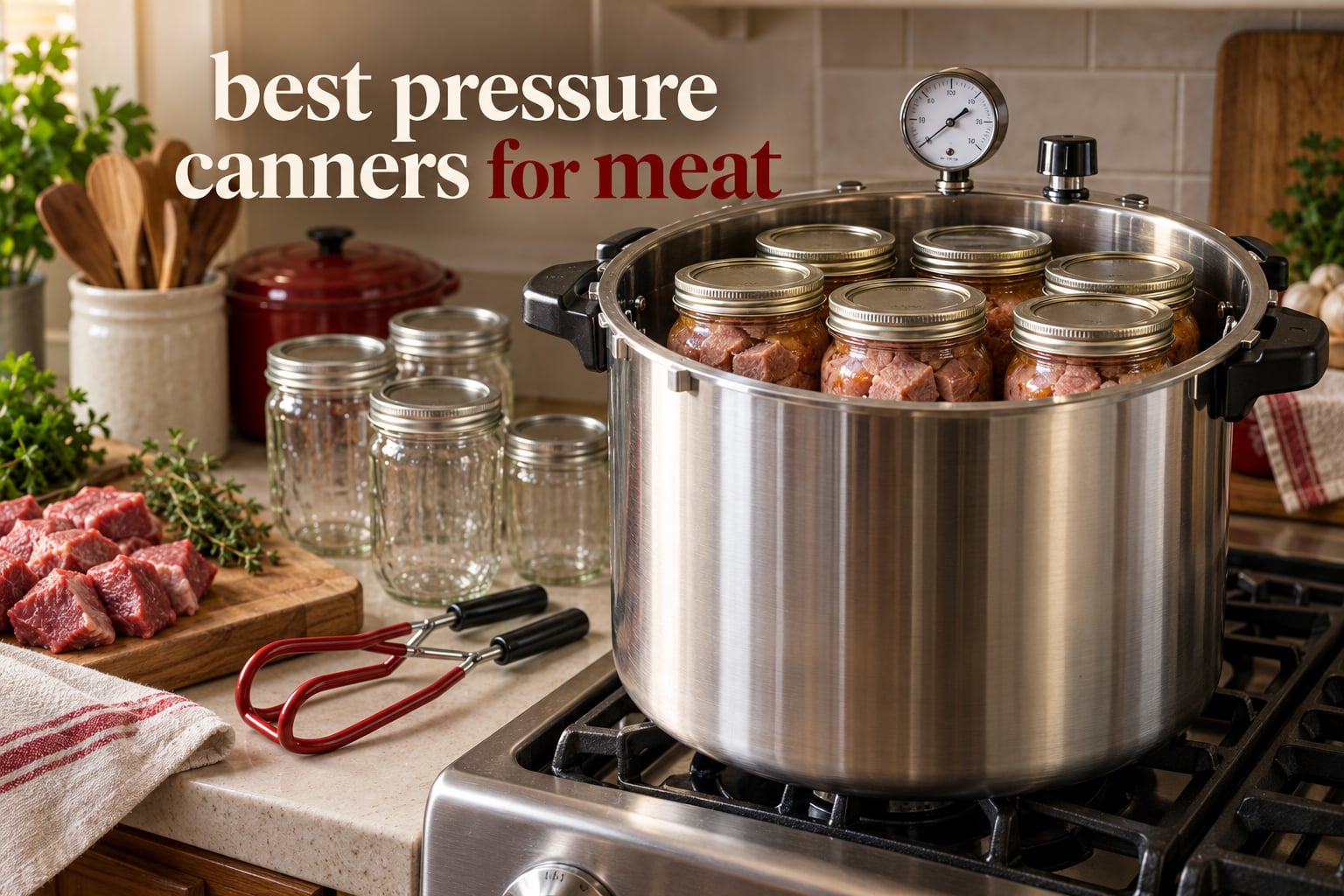
Meat is a low-acid food, so the only safe way to put it on a pantry shelf is a pressure canner holding jars at 240F under 10 to 11 PSI. A boiling water bath tops out at 212F, which is not hot enough to destroy the spores behind botulism, and no amount of extra boiling time changes that. That single fact drives every pick in this guide to the best pressure canners for meat roundup below.
Our top pick is the Presto 01781 23-Quart Pressure Canner. It holds 7 quart jars or 20 pints in a single load, carries a deluxe dial gauge that reads the full processing range, and has enough review history to be boring in the best possible way. The best heavy-duty option is the All American 1930 15.5-quart, which seals metal to metal and never needs a gasket replaced. For induction cooktops, the Presto 01784 is the one to buy.
We compared ten canners across four brand families, checking capacity against real jar loads, gauge type, sealing system, altitude behavior and the parts you will still need in fifteen years. Along the way we also sorted out which appliances are not pressure canners at all, which is the question that comes up most often in canning forums. If you are still choosing equipment, our broader pressure canner roundup covers non-meat loads in more depth.
Top 3 Picks for Canning Meat in 2026

Presto 01781 23-Quart
- 7 quarts or 20 pints per load
- Deluxe dial pressure gauge
- 12-year limited warranty

All American 15.5-Quart 915
- Metal-to-metal seal with no gasket
- Holds about 10 pints or 7 quarts
- 4.9 stars from 9772 reviews

Presto 01784 Induction
- Stainless clad induction base
- Air vent cover lock
- 7 quarts or 20 pints per load
All 10 Pressure Canners for Meat Compared in 2026
| Product | Specifications | Action |
|---|---|---|
| Presto 01781 23-Quart |
|
Check Latest Price |
| Presto 01784 23-Quart Induction |
|
Check Latest Price |
| All American 15.5-Qt 915 |
|
Check Latest Price |
 All American 25-Qt 925 All American 25-Qt 925 |
|
Check Latest Price |
 Presto 02152 17-Qt Digital Presto 02152 17-Qt Digital |
|
Check Latest Price |
 T-fal 22-Quart T-fal 22-Quart |
|
Check Latest Price |
 Granite Ware 20-Quart Granite Ware 20-Quart |
|
Check Latest Price |
 Mirro 22-Quart Mirro 22-Quart |
|
Check Latest Price |
 NESCO NPC-9 Electric NESCO NPC-9 Electric |
|
Check Latest Price |
 Carey DPC-9SS Electric Carey DPC-9SS Electric |
|
Check Latest Price |
1. Presto 01781 23-Quart Pressure Canner – Best Overall for Meat
Presto 01781 23-Quart Pressure Canner and Cooker
23 quart capacity
7 quarts, 20 pints or 26 half-pints
Deluxe dial pressure gauge
12-year limited warranty
Pros
- USDA-recommended pressure method for meats
- poultry and seafood
- Deluxe dial gauge registers the full processing pressure range
- Warp-resistant heavy-gauge aluminum heats fast and evenly
- Includes canning rack and a 76-page instruction and recipe book
Cons
- Manual operation means watching heat and pressure for the whole process
- Aluminum body is not for highly acidic foods and can discolor
- Will not work on an induction cooktop
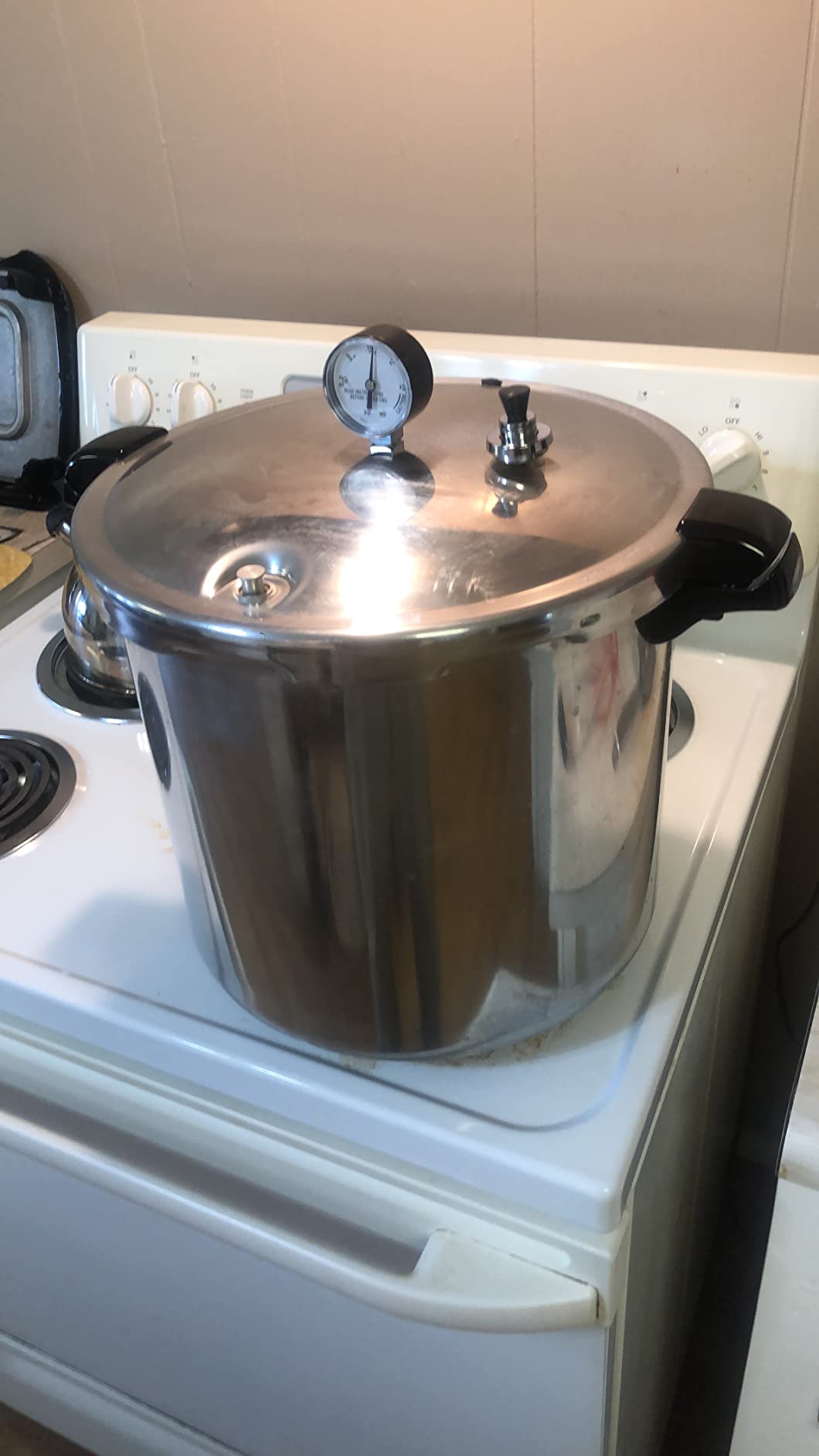
This is the canner most people end up owning after a few seasons, and for meat it is hard to argue with. The 23-quart body takes 7 quart jars or 20 pints, which is a realistic full load of cubed meat plus broth rather than a specification-sheet fantasy. Quart jars matter more here than they do for vegetables, because a family eats through a quart of meat in a couple of meals and a pint is often a leftover.
What sold me on it is the dial gauge. It registers the complete range of processing pressures instead of a single weighted stop, so you can read actual pressure during the process and confirm it holds. That readback is exactly what you want when the clock is running on 75 minutes of processing time per jar.
The construction is warp-resistant heavy-gauge aluminum, which is the right material for even heat and fast recovery. It works on regular and smooth-top ranges, and the canner includes both a canning and cooking rack plus a 76-page instruction and recipe book that covers the USDA methods. The same pot doubles as a large-capacity pressure cooker for the days you are not canning.
It weighs 12 pounds, which is light for a 23-quart canner and one of the reasons it stays friendly to handle. The 12-year limited warranty is the longest on the list, and the manufacturer has been replacing stuck gauge needles for owners at no charge.
Who the Presto 01781 suits best
It suits anyone processing a real batch of meat: venison after a hunt, a whole chicken, or a weekend of cubed beef. Seven quart jars in one load is what turns canning into a useful substitute for freezer space rather than a hobby that takes all afternoon.
It also suits first-time canners who want a readable gauge and clear instructions in one box. The included recipe book is a genuine starting point instead of an afterthought.
Who should skip the Presto 01781
Skip it if you own an induction cooktop, because the plain aluminum base will not work on one. The Presto 01784 below is the same capacity with a stainless clad base.
Skip it if you plan to can pickling liquids or tomato-heavy vinegar recipes on the same pot, since aluminum reacts with high-acid foods and discolors over time.
2. Presto 01784 23-Quart Pressure Canner – Best for Induction Cooktops
Presto 01784 23-Quart Induction Compatible Pressure Canner
23 liter capacity
Induction compatible stainless clad base
7 quarts, 20 pints or 26 half-pints
12-year limited warranty
Pros
- Works on induction
- gas
- electric and smooth-top stoves
- Air vent cover lock prevents opening under pressure
- Same 7 quart or 20 pint load as the classic Presto
- 12-year limited warranty
Cons
- Manual operation requires constant heat management
- Heavier than the non-induction Presto model
- Aluminum body reacts with highly acidic foods
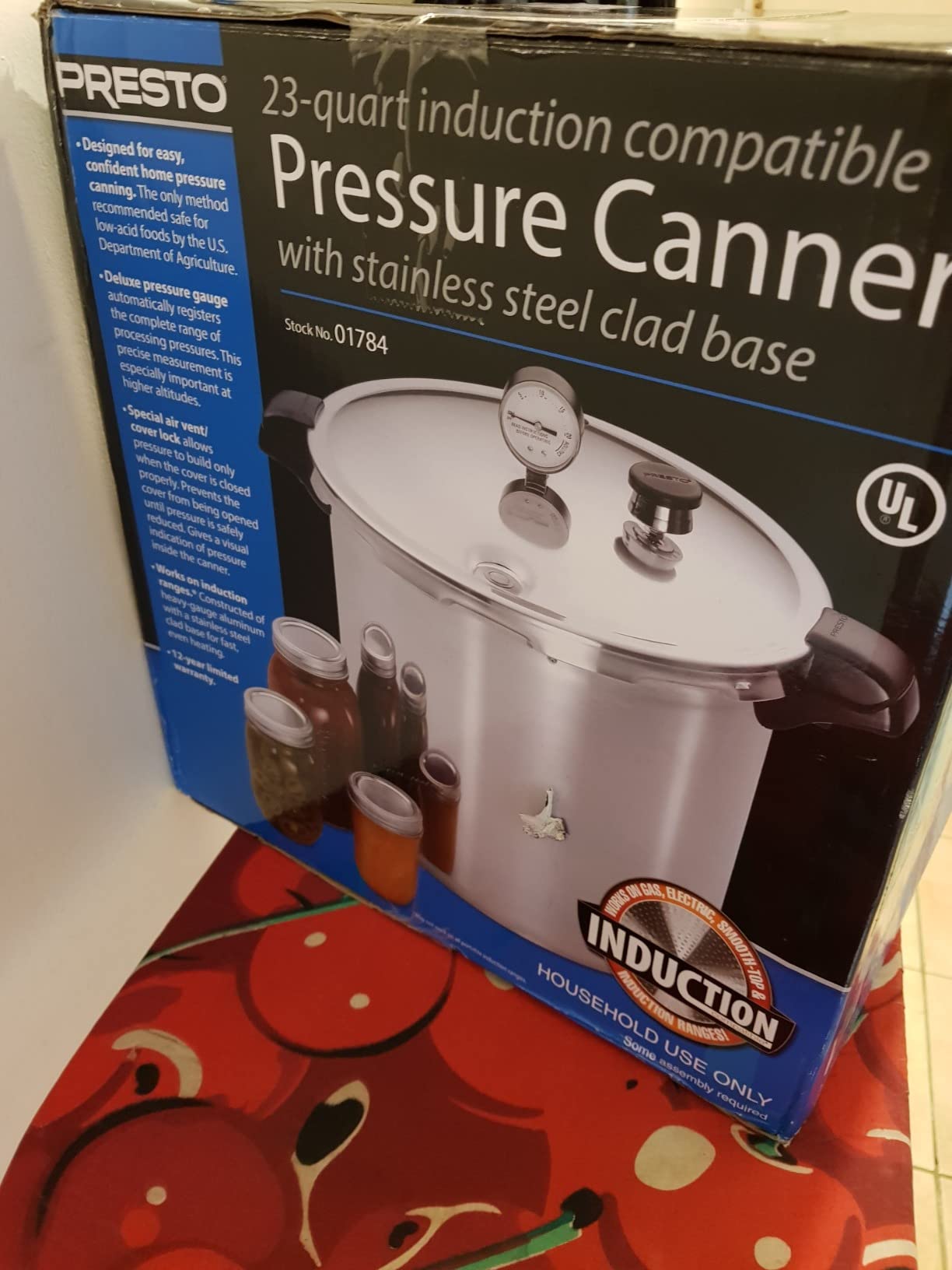
Almost every canner on the market is a stovetop unit that quietly will not work on an induction range, and buyers often find this out after the canner is already in the kitchen. The 01784 is the full-size answer. It is a stainless steel-clad induction compatible base on heavy-gauge aluminum, so it works on induction, gas, electric and smooth-top stoves.
Everything else is the 23-quart recipe: 7 quart jars, 20 pints or 26 half-pints per load, and the same deluxe dial pressure gauge. For meat, capacity is capacity, and this matches the pick above load for load.

The air vent and cover lock is a feature worth naming. It lets pressure build only when the cover is properly closed and blocks the lid from being opened while pressure remains in the pot, which removes the most dangerous mistake a new canner can make. Buyers who were nervous about stovetop pressure cite that lock and the gauge as the reason the process felt dependable.
It is heavier than the non-induction Presto because of the clad base, and it is still a manual canner, so you manage the heat yourself for the full 75 minutes or more of processing. The 12-year limited warranty matches the classic model.
Who the Presto 01784 suits best
It suits anyone whose kitchen has an induction cooktop, which is most new builds and a growing share of renovated ones. It also doubles as a boiling water canner for jams, pickles and salsa when you are not processing meat.
For meat specifically, the air vent cover lock is a genuine advantage for a first batch, because it is physically hard to open a pressurized canner by mistake.
Who should skip the Presto 01784
Skip it if you have a gas or coil range and do not need the clad base, because the 01781 is the lighter and cheaper route to the same jar load. Skip it if you canner high-acid foods in volume, since the aluminum body is not the right surface for it.
3. All American 1930 15.5-Quart Pressure Canner (Model 915) – Best Heavy-Duty Pick
All American 1930: 15.5qt Pressure Cooker/Canner (The 915) – Exclusive Metal-to-Metal Sealing System – Easy to Open & Close – Suitable for Gas, Electric, or Flat Top Stoves – Made in the USA
14.67 liter capacity
Metal-to-metal sealing system, no gasket
About 10 pint jars or 7 quart jars
18 pounds
Pros
- 4.9 stars with 93% five-star from 9772 reviews
- No gasket to replace and no annual gauge test
- Precision-machined metal-to-metal seal
- Holds about 10 pints or 7 quarts per batch
- Built in the USA with free replacement manuals
Cons
- Load it on the stove because a full pot is very hard to lift
- Six dog-down knobs must be tightened in a star pattern
- The 15.5-quart size does not stack pint jars
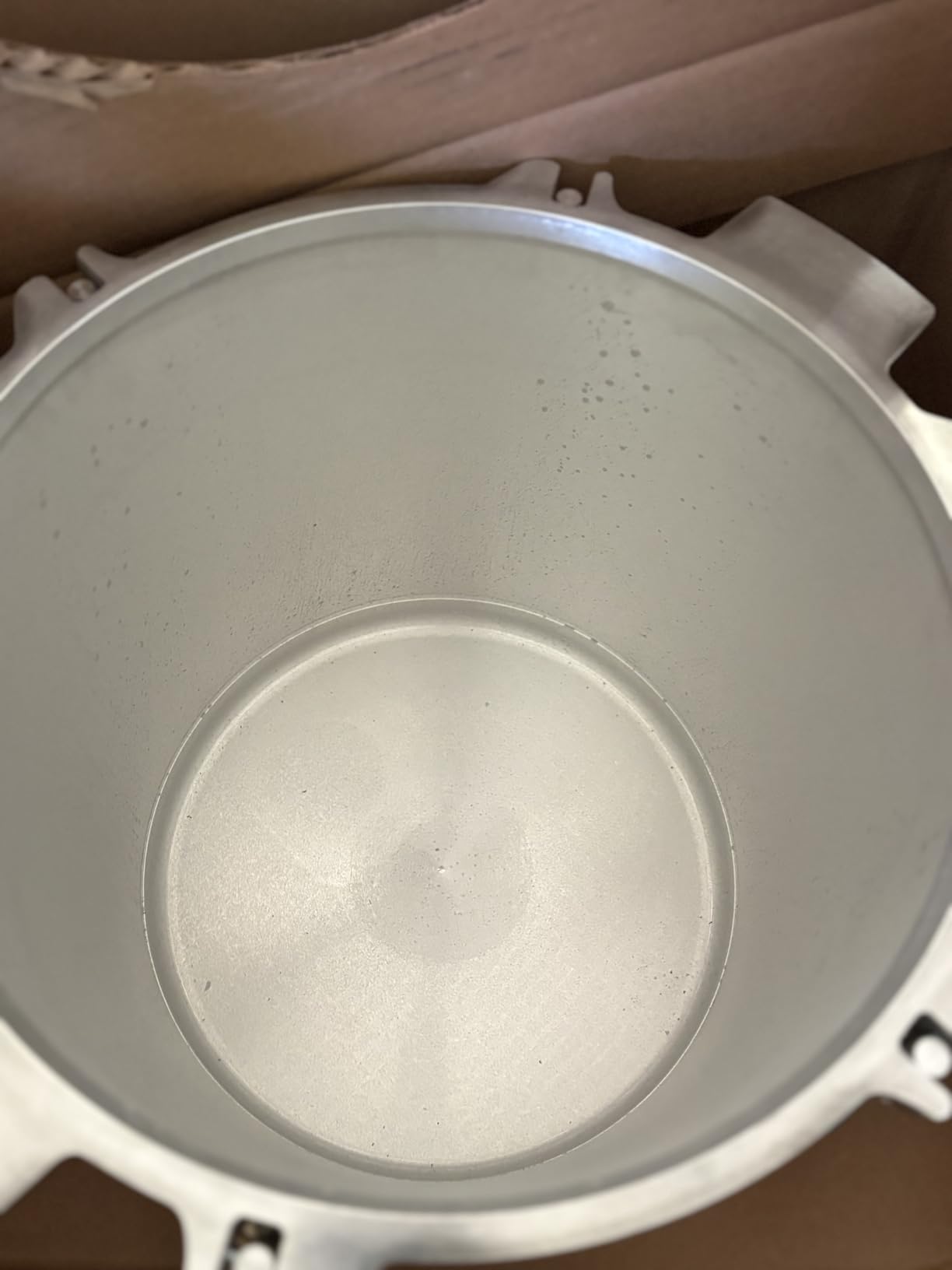
The All American is the one canner in this roundup with no rubber gasket. The lid seals metal to metal through a precision-machined system, so there is nothing to replace, nothing to leach into your food, and no annual dial test to remember. For a buyer who intends to can meat for two decades, removing the gasket removes the single most common long-term failure point.
The rating reflects that. It holds 4.9 stars with 93% of reviews at five stars across 9772 reviews, and owners describe it as a generational purchase. It runs on gas, electric or flat top stoves and carries a 1 year limited warranty from Wisconsin Aluminum Foundry.
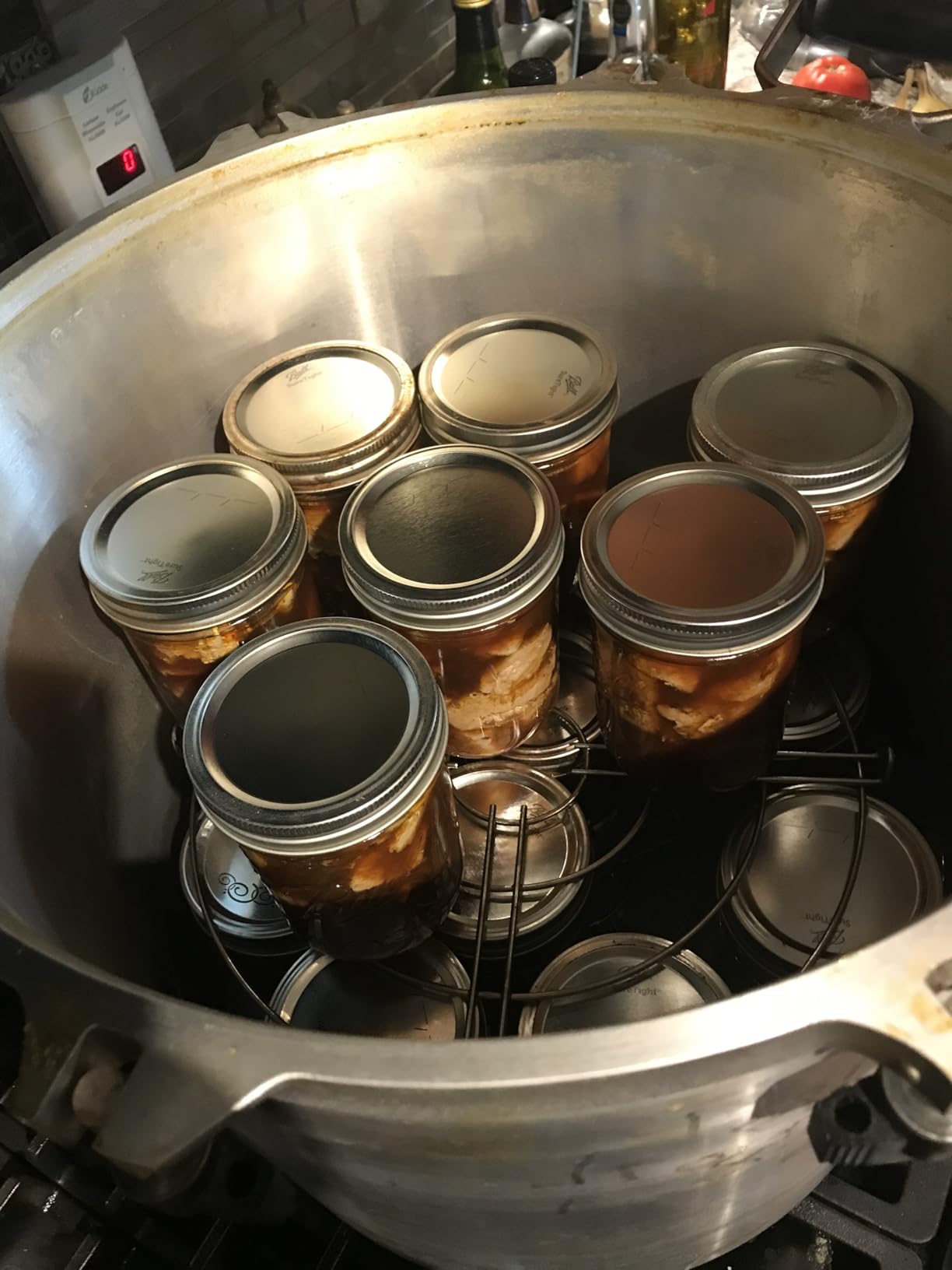
Jar math is the trade-off at this size. It holds roughly 7 quart jars or 10 pints, so a full load of meat is seven jars, not twenty. Multiple owners running three or more canners at once point to this one for the meat batch while a larger pot handles vegetables.
It weighs 18 pounds empty, which is 6 pounds more than the Presto 01781, and the mass means long heat-up and cool-down times. Both are the same bargain you accept for cast aluminum: slow and steady, with a temperature reservoir that does not swing while you process.
Who the All American 915 suits best
It suits the buyer who has decided to can meat for the long haul and does not want to think about gaskets again. The no-gasket seal and USA-based service with free replacement manuals are the deciding factors for most owners.
It also suits anyone running multiple canners at once, since seven quart jars is a clean, repeatable meat batch and this pot will still be going long after a lighter canner is retired.
Who should skip the All American 915
Skip it if lifting 18 pounds of loaded pot is a problem, because a full canner must be loaded on the stove. The six dog-down knobs also need tightening in a star pattern, and an uneven seat breaks the seal.
Skip it if you need more than 7 quart jars per load or if you can vinegar-based or heavily acidic products, since aluminum can pit on those. The 25-quart 925 below is the larger body if capacity is the constraint.
4. All American 1930 25-Quart Pressure Canner (Model 925) – Best for Maximum Jar Loads
All American 1930: 25qt Pressure Cooker/Canner (The 925) – Exclusive Metal-to-Metal Sealing System – Easy to Open & Close – Suitable for Gas, Electric, or Flat Top Stoves – Made in the USA
23.66 liter capacity
Metal-to-metal seal, no gasket
About 19 pints or 7 quart jars
24 pounds
Pros
- Stated capacity of about 19 pint jars or 7 quart jars per batch
- Gasket-free metal seal with no annual gauge testing
- USA-built with long-term parts availability
- Metal handle stays cool enough to touch during use
Cons
- Heaviest canner reviewed here at 24 pounds
- Manufacturer does not recommend use on glass cooktops
- Aluminum can pit when canning acidic foods
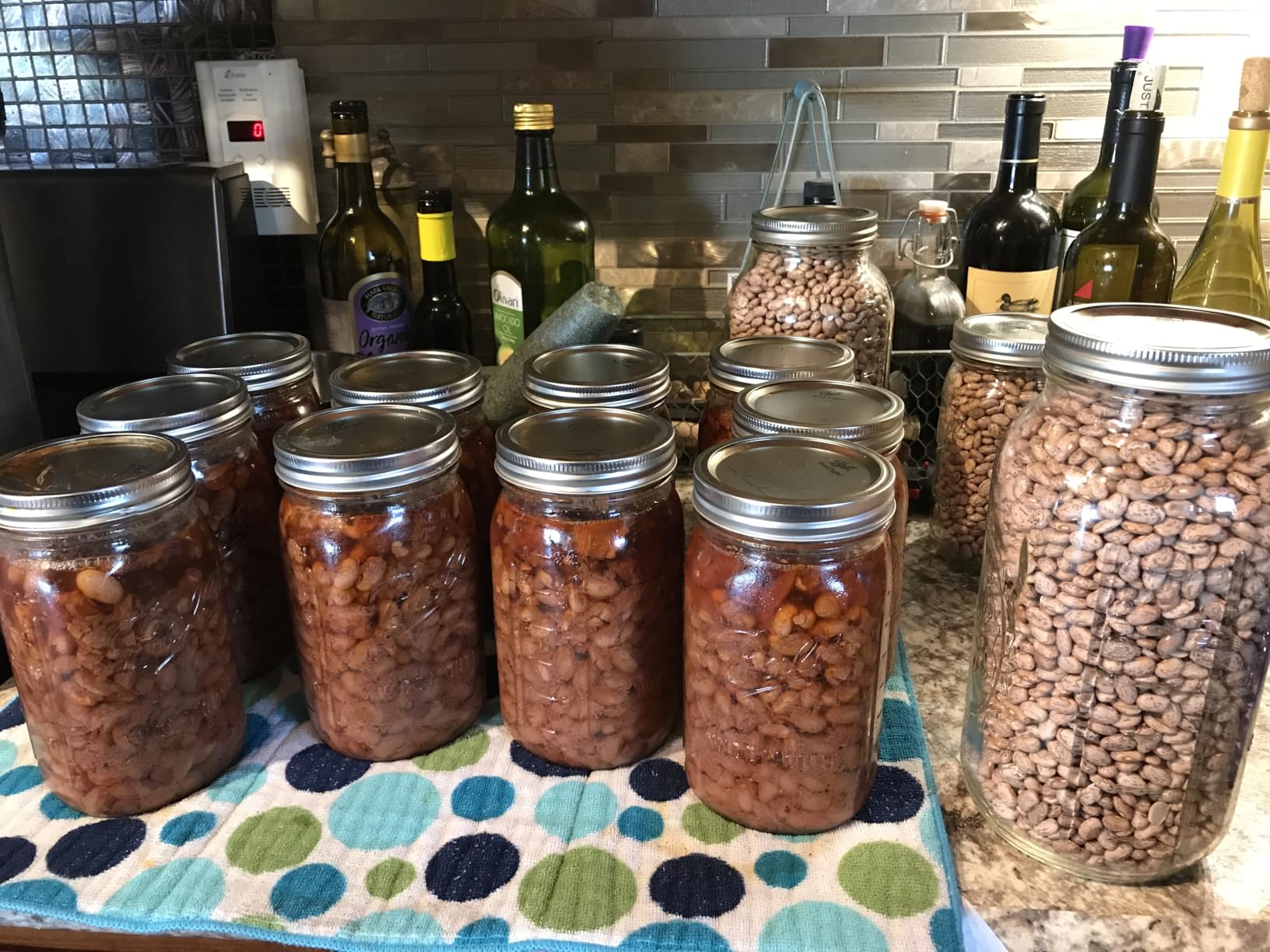
This is the can you buy when a hunting season, a large family or a market garden of venison and beef arrives all at once. The 25-quart body holds about 19 pint jars or 7 quart jars per batch, so the pint capacity is nearly double the 15.5-quart model while quart capacity stays the same. That single number decides the purchase for most bulk meat canners.
It carries the same gasket-free metal-to-metal sealing system as the smaller All American, so there is still no seal to replace. The rating matches at 4.9 stars with 93% five-star across 9758 reviews.
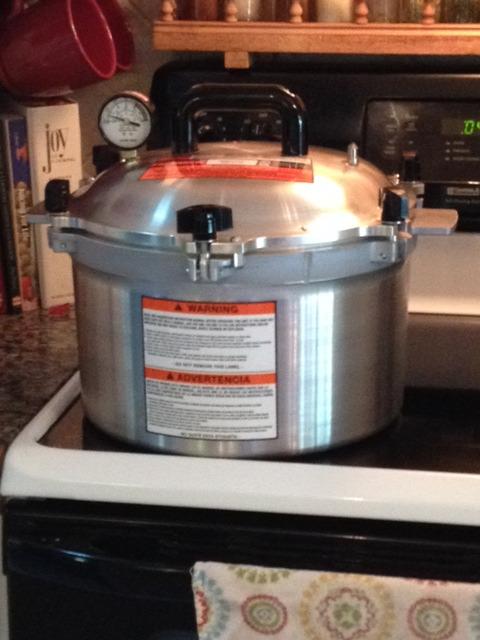
It is built in the USA with long-term parts availability and USA-based service, which matters more than it sounds when you are planning to own a canner through many seasons. The phenolic top handle and double-thickness edges at the points of heaviest wear are the details experienced canners mention first.
At 24 pounds it is the heaviest canner here. Loading has to happen on the stove, and the mass of the cast aluminum body means a long heat-up and a long cool-down before the lid comes off. That patience is the price of the biggest load.
Who the All American 925 suits best
It suits hunters, small homesteads and anyone putting up more meat than a 7 quart load can absorb in an afternoon. Nineteen pints or seven quarts from a single heat is the throughput argument that sells it.
It also suits buyers who want zero gasket maintenance and who are not worried about weight because their canner lives on a fixed stove position.
Who should skip the All American 925
Skip it if you have a glass cooktop, because the manufacturer does not recommend the canner on glass surfaces. Skip it if you can tomatoes, pickles or vinegar recipes on the same pot, as the aluminum body will pit.
Skip it if a full pot will need to be lifted or carried regularly, since 24 pounds plus jars is not a load many people should be moving.
5. Presto 02152 17-Quart Digital Pressure Canner – Best Automatic Control
Presto 02152 17-Quart Digital Pressure Canner
17 quart capacity
Extra-tall chamber fits quart jars
Automatic temperature sensor
1485 watts
Pros
- Sensor holds the exact processing temperature with no monitoring
- No altitude adjustments required
- Extra-tall chamber designed to hold quart jars
- LED display guides you through each step
Cons
- Heaviest canner in the group at 24.3 pounds
- Electric cycles take longer than a stovetop weighted canner for some users
- Higher purchase cost than a stovetop Presto canner
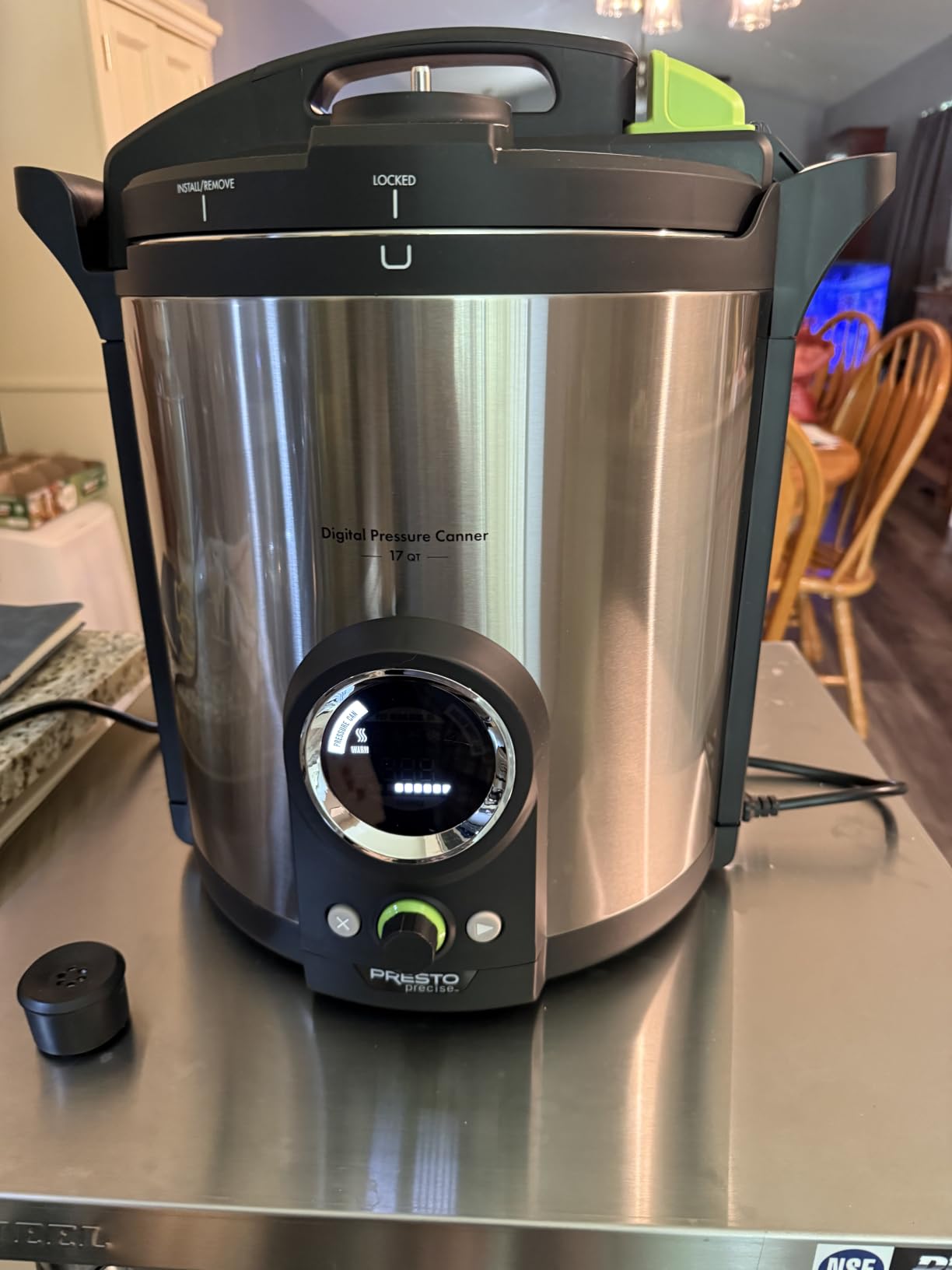
Here is where you stop watching a gauge. The Presto 02152 uses a temperature sensor that automatically maintains the exact temperature required for safe canning, and a control knob that sets the canning method and processing time. For someone nervous about holding 10 to 11 PSI by hand for 75 minutes, that removes the single hardest part of pressure canning meat.
It is also the canner here that needs no altitude adjustment at all. Manufacturers of dial-gauge stovetop canners tell you to increase processing time or pressure above 1000 feet; this unit removes that variable entirely, which matters a lot for anyone in a mountain or high-desert county.
The extra-tall chamber is sized to hold quart jars, which is the jar size that matters for meat. Buyers processing quart jars of beef and venison rate the chamber height as the deciding feature over smaller digital units.
It draws 1485 watts, the highest in this group, and it is 24.3 pounds, so it is a countertop unit rather than a portable one. Some users report that electric heating and cycling takes longer per batch than a stovetop weighted canner.
Who the Presto 02152 suits best
It suits first-time canners who want automation instead of a learning curve, and anyone living above 1000 feet who does not want to think about altitude corrections. The 4.6 rating from 5739 reviews reflects broad approval of the sensor approach.
It also suits households that prefer quart jars of meat over pints and need a chamber tall enough for them.
Who should skip the Presto 02152
Skip it if you are price-sensitive, since it is one of the most expensive pressure canners on the market and a stovetop Presto reaches the same safety standard for far less. Skip it if you plan to can more than a small batch at a time.
Skip it if a 24.3 pound appliance is a problem to move, because it should not be carried while hot or full.
6. T-fal 22-Quart Aluminum Pressure Canner – Best First-Time Setup
T-fal 22-Quart Aluminum Pressure Canner, 3 PSI Settings, Home Canning, Includes Racks & Canning Guide, Large Capacity, Pressure & Water Bath Canning for Vegetables, Meats, Seafood & Fruits, Silver
22 quart capacity
5, 10 and 15 PSI regulator dial
7 quarts, 18 pints or 24 half-pints
Gas and electric cooktop compatible
Pros
- Three-setting regulator dial needs no gauge reading
- Holds 24 half-pints
- 18 pints or 7 quarts
- Two canning racks plus a step-by-step canning guide
- Owners report steady results with venison and chicken
Cons
- Some units auto-vent before reaching 15 PSI at medium heat
- Gasket can seep after use and needs re-seating or cleaning
- Lowest rated canner here with a 9% one-star share
The T-fal sells the idea that a first canner does not need to read a pressure gauge. A single dial selects 5, 10 or 15 PSI, and you turn the heat up until the weight sits at the setting you chose. There is no dial needle to interpret and no altitude correction to compute, which is why a lot of first-time canners start here.
Capacity is genuinely good for meat. It holds 24 half-pints, 18 pints, 16 wide-mouth pints or 7 quart jars per batch, and two canning racks plus a step-by-step guide come in the box. Owners report steady results canning venison, chicken and other low-acid meats, and it doubles as a boiling water canner.
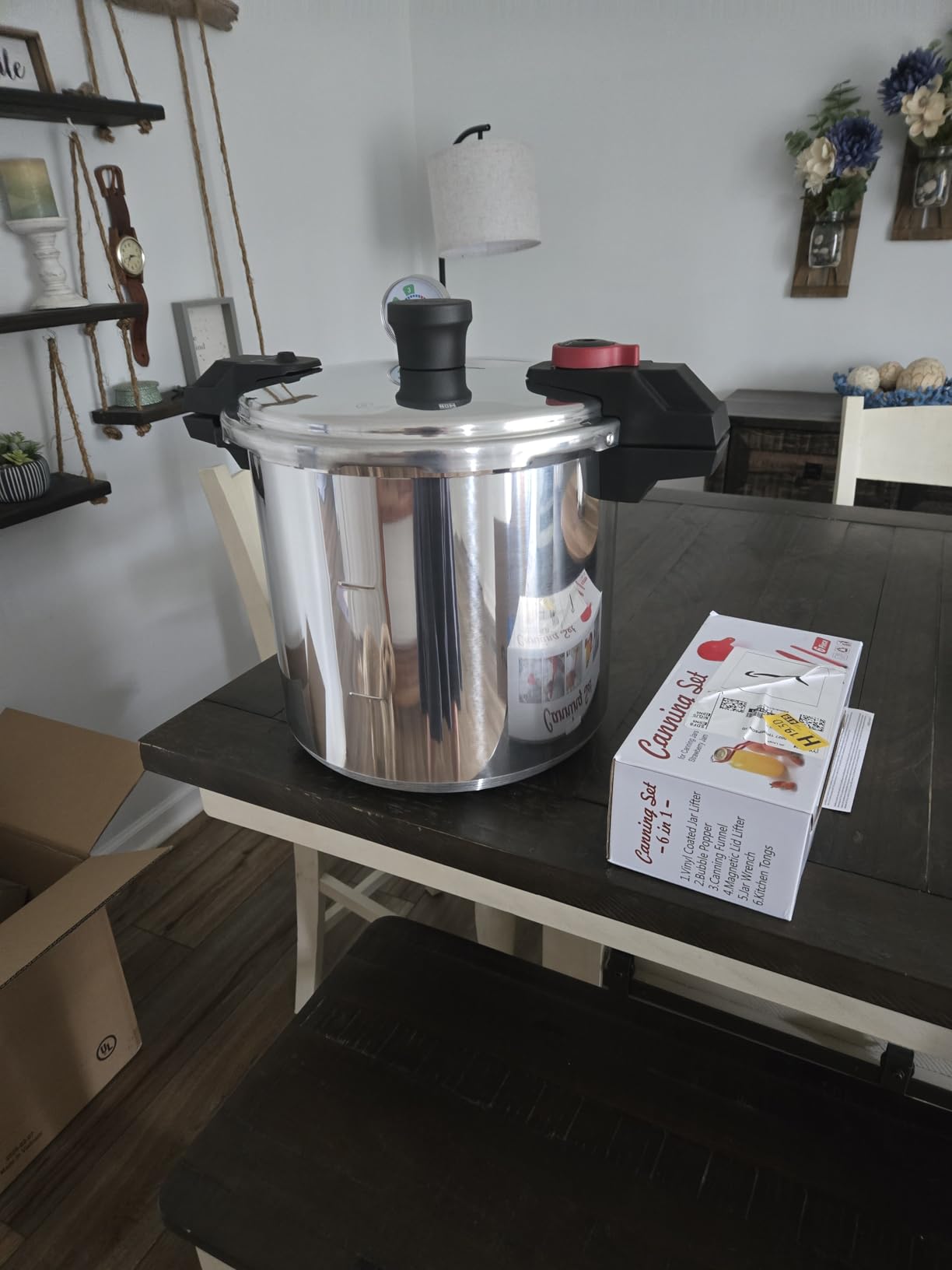
The T-fal is the most heavily criticized unit we reviewed. It carries the lowest rating in the group at 4.4 stars, with a 9% one-star share against 74% five-star, and the complaints cluster around three things: units that auto-vent before reaching full 15 PSI unless the burner is turned very high, a gasket that seeps and needs re-seating, and a gauge that can be hard to read.
It weighs 14.8 pounds and measures 19.33 by 15.39 by 16.26 inches, so it is bulky and difficult to move when loaded. The warranty is one year, the shortest here, and the aluminum body will discolor and can pit with use.
Who the T-fal 22-Quart suits best
It suits a first-time canner who wants a big batch and simple pressure control without dial math. If your heat source is strong enough to drive a full 15 PSI weight, the included racks and guide make a seven quart meat load manageable on day one.
It also suits buyers who already know the 5, 10 and 15 PSI settings from another brand and want the same design at a different price point.
Who should skip the T-fal 22-Quart
Skip it if you cannot turn your burner to high heat easily, because owners who run out of PSI report the canner venting early. Skip it if you want a warranty longer than a year or a seal system that does not depend on a rubber gasket.
Skip it if you are canning a large hunting season, because the early-venting reports and a one-year warranty are a poor match for a heavy multi-year workload.
7. NESCO NPC-9 Smart Electric Pressure Canner – Best for Small Batches
NESCO NPC‑9 Smart Electric Pressure Canner and Cooker for Home Food Preservation, 9.5‑Quart Stainless Steel with Digital Controls
9.5 quart capacity
About 4 quarts or 5 pints per load
Digital presets and timer
Stainless steel body
Pros
- Electric canning removes stovetop weight and dial guesswork
- Digital display with preset programs and a timer
- Safety lock lid
- float valve and pressure regulation
- Removable nonstick pot with canning rack and condensation catcher
Cons
- Only about 4 quarts or 5 pints per load
- Instructions are wordy with a steep learning curve
- Loud audible beeps at plug-in and timer set
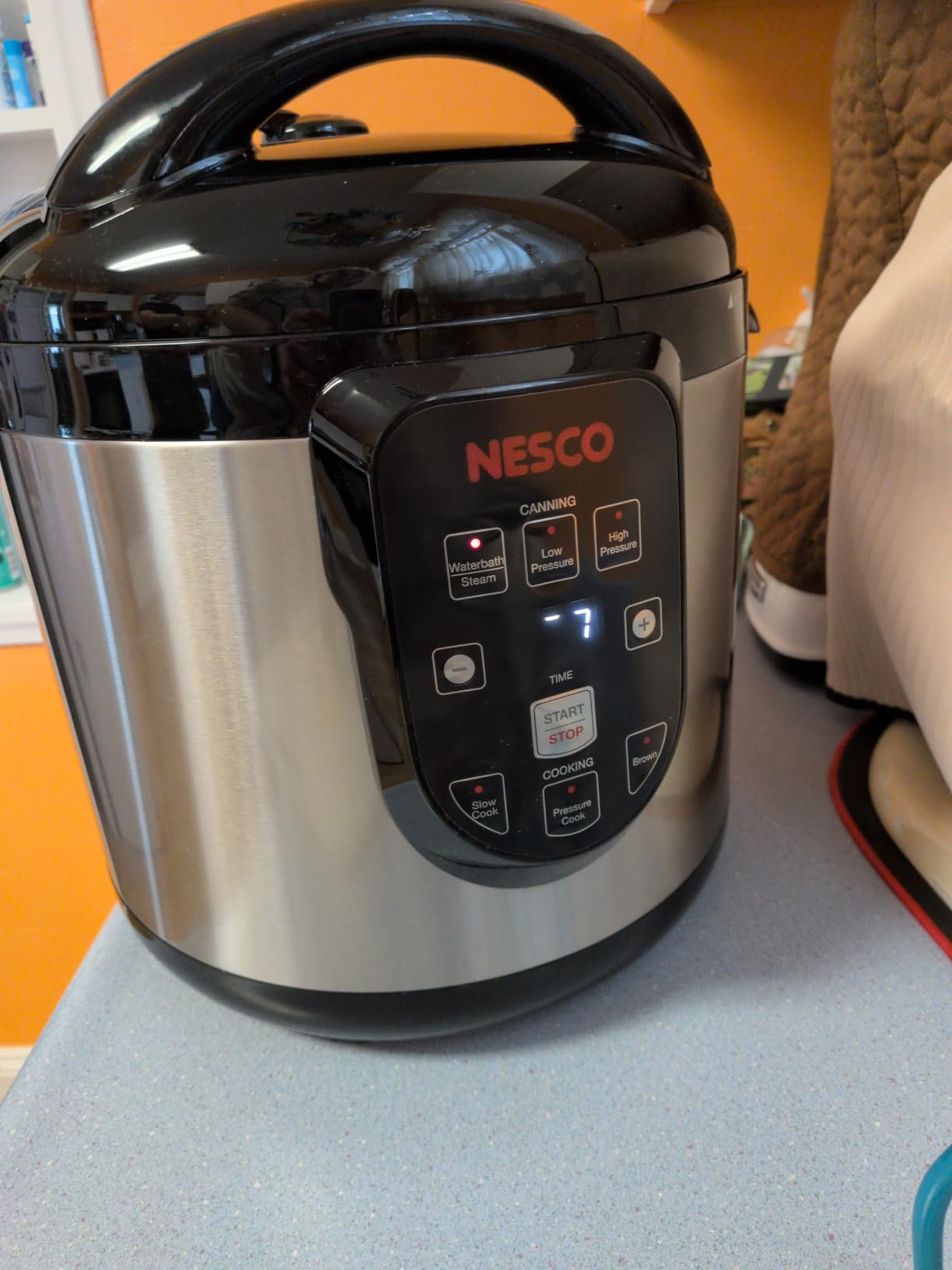
For a household of one or two, or a person with a handful of home-raised chickens, the NPC-9 solves a problem the big stovetop canners create. It processes 4 quarts or 5 pints per load, which is a manageable batch for a small kitchen, and it does so without a stovetop, a dial gauge, or a hand on a weighted regulator.
Owners who were afraid of stovetop pressure canning describe it as a confidence booster. It has a safety lock lid, an automatic float valve and a pressure regulation system that prevent opening under pressure, and it runs pressure cook, slow cook, steam and water bath modes from the same 1000 watt unit.
It also does not heat up the kitchen, which several owners single out as a major benefit during warm months. The removable nonstick inner pot, canning and steam racks, and removable condensation catcher make cleanup simple compared with a stovetop unit.
The limits are equally clear. Standard and high-altitude limiting valves are included, but the tall chamber makes wide-mouth pint jars awkward to grip and lift out, and the audible beeps at plug-in, timer set and gauge switching are loud enough that owners mention them repeatedly.
Who the NESCO NPC-9 suits best
It suits beginners, apartment dwellers and small households where a 20-pint load would be more food than you can use before it goes bad. Owners of home-raised flocks who put up a few jars of chicken at a time get the most out of it.
It also suits anyone who would rather not manage a stovetop flame for 75 minutes, or who lives somewhere where a hot kitchen in summer is genuinely unpleasant.
Who should skip the NESCO NPC-9
Skip it if you process meat in bulk, because four quarts per load means a hunting season takes many sessions. Skip it if you are sensitive to loud beeps or dislike wordy instructions, both of which recur in reviews.
It is also a 1 year warranty unit, so for heavy use the longer-warranty stovetop options are a better fit.
8. Granite Ware 20-Quart Pressure Canner – Best for Interchangeable PSI Weights
Granite Ware Pressure Canner/Cooker/Steamer, 20-Quart
20 quart capacity
Hard-anodized aluminum body
Interchangeable 5, 10 and 15 PSI regulators
10.5 pounds
Pros
- Hard-anodized body resists rust and staining
- Interchangeable 5
- 10 and 15 PSI regulators
- Lightest metal canner here at 10.5 pounds
- Works as canner
- cooker and steamer
Cons
- Smallest review base of the ten at 801 reviews
- Manual operation with no digital or dial readback
- Anodized surface can still discolor with high heat
Granite Ware solves the PSI problem the cleanest way of any weighted canner here. Instead of one fixed weight, it uses a three-piece regulator system calibrated at 5, 10 and 15 PSI, so you swap a weight rather than recalculate anything. For meat at altitude that matters, because 15 PSI is the correct processing pressure for most low-acid meats.
It is 20 quarts and weighs 10.5 pounds, making it the lightest metal canner in this roundup and easy to move for its size. The body is heavy-gauge hard anodized aluminum, which reviewers credit with not rusting or staining the way ordinary aluminum can.
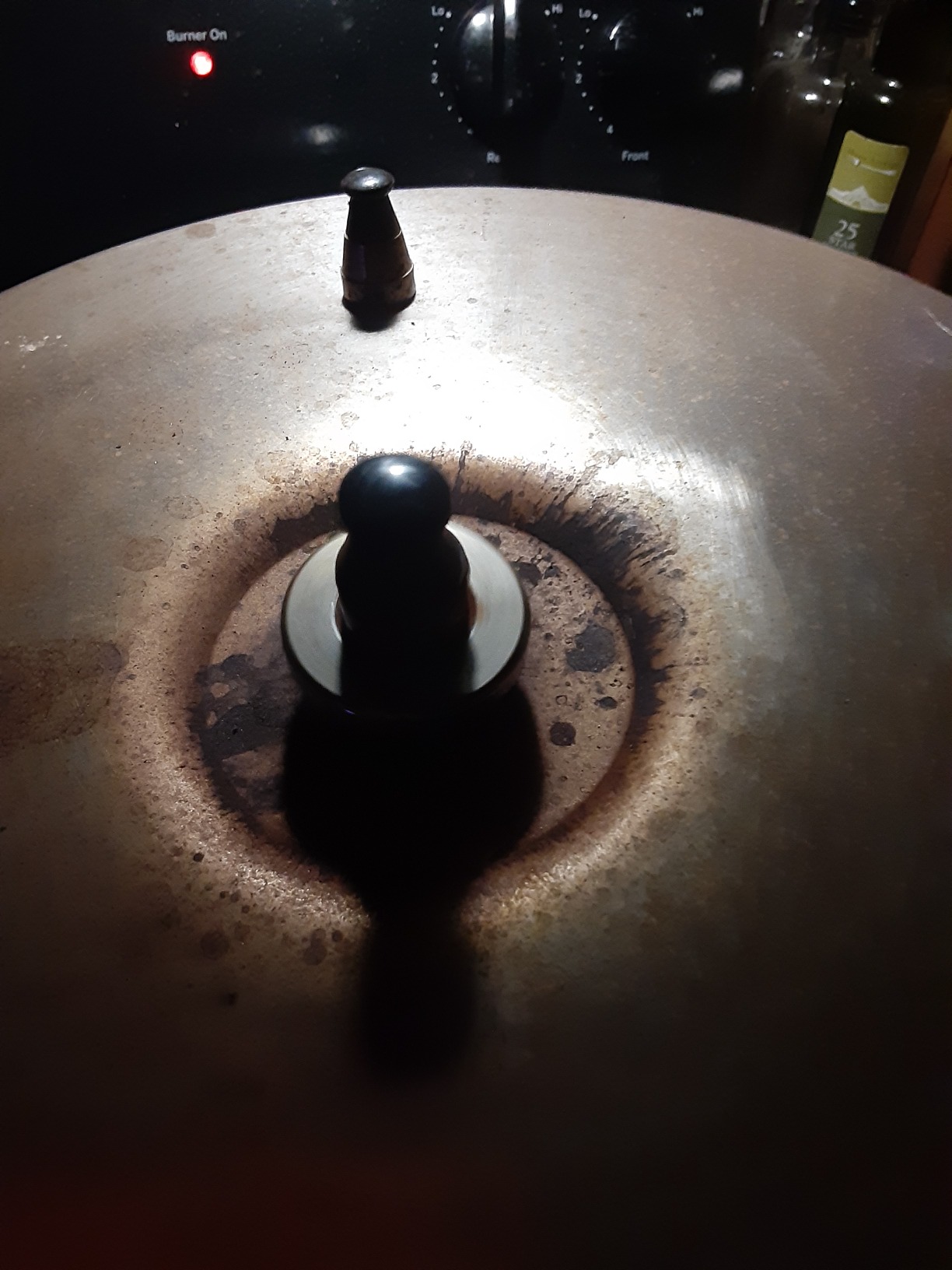
It uses the USDA-recommended pressure canning method for meats, poultry and low-acid vegetables, and it doubles as a pressure cooker and steamer. The 1000 watt figure and manual operation mean you set the burner yourself, with no gauge to read back and no readout of actual pressure.
The caution is evidence, not design. At 801 reviews it has the smallest review base of the ten, so there is less long-term feedback on gasket aging or steam vent wear than the Presto and All American listings offer. Reviewers still rate the adjustable regulators and the light, rust-resistant body as the standouts.
Who the Granite Ware 20-Quart suits best
It suits canners who want to switch between 5, 10 and 15 PSI without buying a separate regulator, and anyone who wants a 20-quart canner they can lift and move without planning the lift. The 10.5 pound weight is a real advantage over cast aluminum competitors.
It also suits buyers who can pickles and high-acid sauces on the same pot, since the hard-anodized interior is less reactive than bare aluminum.
Who should skip the Granite Ware 20-Quart
Skip it if you need a dial gauge readout, because there is none, and processing confidence at altitude depends on your weight selection being right. Skip it if you want a large review base to draw long-term ownership advice from.
Skip it if you need more than 7 quarts per load or a roomy pint capacity, since 20 quarts sits below the 22 and 23-quart units on jar count.
9. Mirro 22-Quart Aluminum Pressure Canner – Best Budget 22-Quart Load
MIRRO 22 Qt Aluminum Pressure Canner with 3 Regulators, 5, 10 & 15 PSI
22 quart capacity
Three regulators at 5, 10 and 15 PSI
Dual cool-touch handles and two racks
Dishwasher safe
Pros
- Generous 22-quart body built for large-batch meat canning
- Three pressure regulators mean no dial gauge to watch
- Dual cool-touch handles and two racks for optimized canning space
- Owners report steady heat and reliable pressure holding without adjustment
Cons
- The regulator must be pushed onto the stem firmly to seat
- The weight can leave a rust-colored stain around the steam vent
- Not recommended for glass cooktops
The Mirro is the familiar weighted-regulator design at a 22-quart size, and long-time canners returning to it rate it highly on value. It holds up to 7 quart jars of meat per batch, uses three regulators at 5, 10 and 15 PSI, and needs no gauge reading at all. Owners report steady heat, correct locking and reliable pressure holding without constant adjustment.
At 741 reviews it also has one of the smaller evidence bases here, with 79% five-star and a 6% one-star share. The one-star share is the second highest of the group, and it tracks to specific mechanical complaints rather than canning failures.
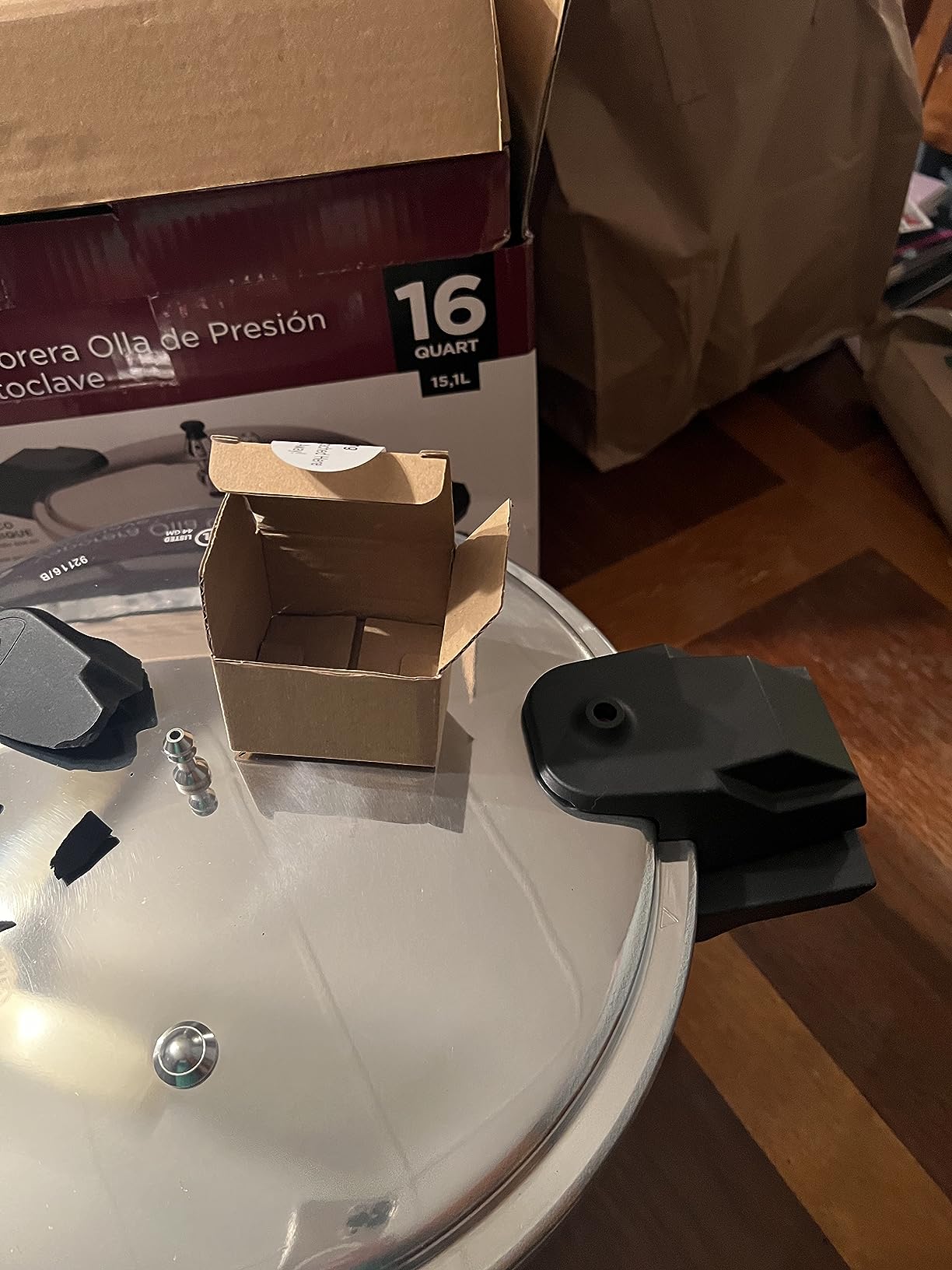
Those complaints are worth knowing before you buy. The regulator has to be pushed firmly onto the stem to seat properly, and if it is not fully seated the canner will not hold pressure. The weight can also leave a rust-colored stain around the steam vent, which is cosmetic but permanent.
The body is aluminum with a natural interior finish and a mirror-polished exterior, it is dishwasher safe, and it includes two racks plus dual cool-touch handles. It weighs 6.21 kilograms and should not be used on glass cooktops.
Who the Mirro 22-Quart suits best
It suits canners who want a 22-quart load with the simplest possible pressure control, and buyers who already know how a weighted regulator feels from an older canner in the family. Steady pressure with no siphoning is the reported experience for game meat.
It also suits anyone who does not want a dial gauge to calibrate or test each season.
Who should skip the Mirro 22-Quart
Skip it if you have a glass cooktop, because it is not recommended for that surface. Skip it if you are sensitive to cosmetic wear, since the vent staining is reported often enough to plan for it.
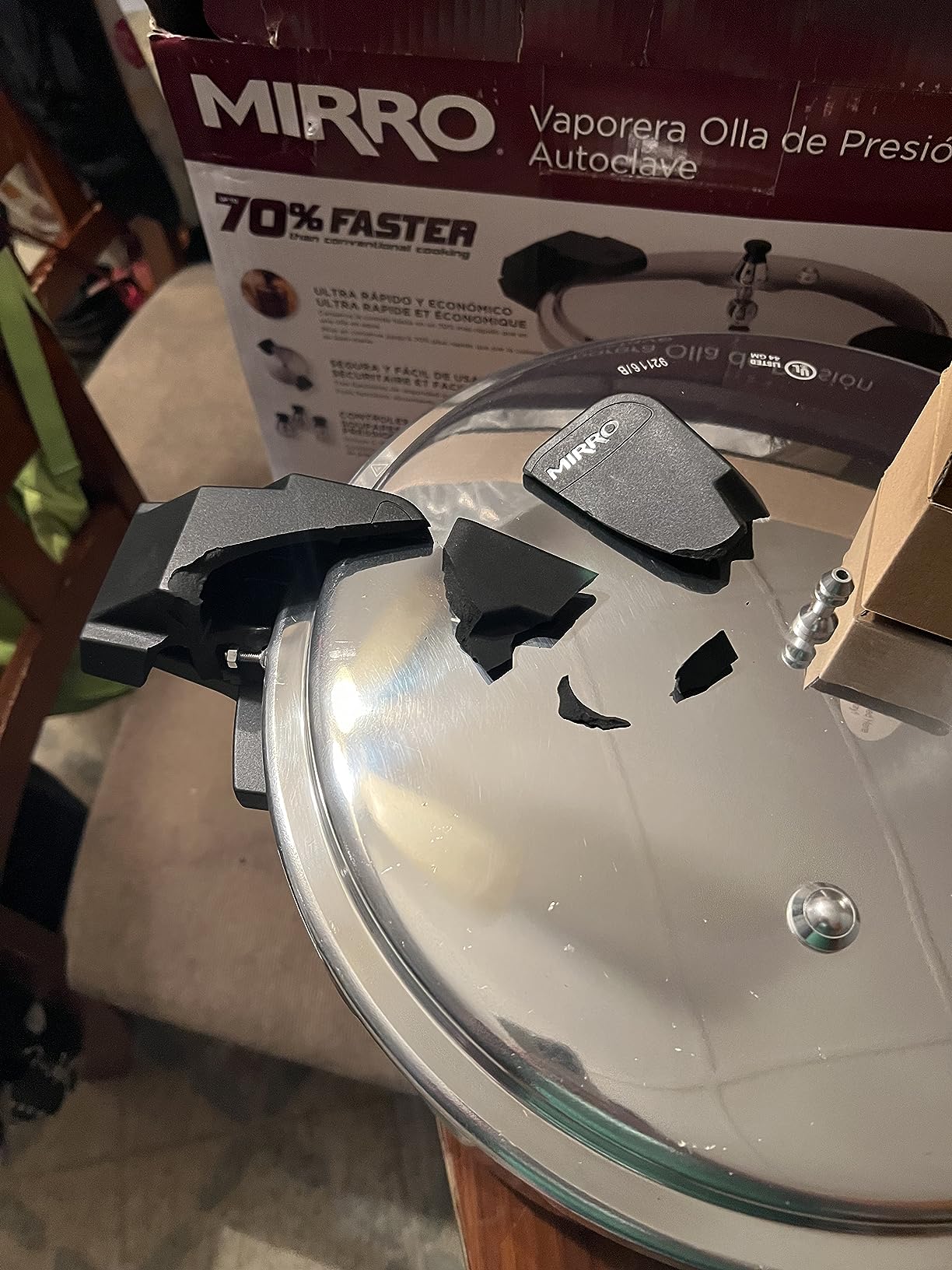
Skip it if a smaller shipment arriving damaged would be a problem, because a minority of buyers report delivery damage or a size that differs from the listing.
10. Carey DPC-9SS Smart Electric Pressure Cooker and Canner – Best for Warm Kitchens
CAREY DPC-9SS Smart Electric Pressure Cooker and Canner, Stainless Steel, 9.5 Qt
9.5 quart capacity
About 4 quarts or 5 pints per load
Automatic canning cycle with presets
1200 watts
Pros
- Canning function manages time
- pressure and temperature automatically
- Digital LED presets give repeatable cycles batch after batch
- Automatic safety lock lid
- float valve and pressure regulation
- Releases far less heat and humidity than a stovetop canner
Cons
- Holds only about 4 quarts or 5 pints per load
- Nonstick inner pot scratches easily
- Loud uncontrollable beeps at plug-in and timer set
The Carey DPC-9SS is the other route into hands-off canning, and it shares the small-batch design of the NESCO with a slightly different feature set. Its dedicated pressure canning function manages time, pressure and temperature automatically, and the digital LED presets deliver repeatable, controlled cycles batch after batch. Novices and experienced canners both describe it as worry-free, which is the point.
At 4.7 stars from 3303 reviews with 84% five-star, it draws strong marks for the low-heat, low-humidity operation. In practice that means you can can meat in a warm house without making the rest of the house uncomfortable, which is why it earns its place here.
The capacity limit is the trade-off everyone names. It holds about 4 quarts or 5 pints per load, roughly half a stovetop canner, and for a bulk meat harvest that is a feature for small batches and a real limitation for serious putting up.
Other recurring notes: the nonstick inner pot scratches easily and owners wish a stainless insert were offered, the beeps at plug-in, timer set and gauge switch are loud and uncontrollable, condensation can drip toward the heating element, and the drip catcher groove around the top is difficult to reach and clean.

Who the Carey DPC-9SS suits best
It suits anyone who wants canning without a stovetop flame, in a small kitchen, in a warm climate, or in a home where heat is a real constraint. The automatic cycle and safety lock lid make it a confident first appliance for meat canning.
It also suits households that already own a large stovetop canner for bulk work and want a second unit for small weekly batches.
Who should skip the Carey DPC-9SS
Skip it if you process meat in volume, because four quarts per load turns a large harvest into a long project. Skip it if you can a lot of high-acid food, since water-bath performance is the weakest in this group and jars can tip in the canning rack and siphon.
Skip it if you dislike loud beeps, scratch-prone nonstick, or hard-to-clean drip channels, because all three come up repeatedly.
Why Meat Needs a Pressure Canner and Not a Water Bath
Meat is low-acid, which means its pH sits in the range where Clostridium botulinum spores can survive ordinary boiling. A boiling water bath reaches about 212F. Pressure canning reaches 240F, and that extra 28 degrees is the difference between a jar that is shelf-stable and one that is a botulism risk.
That is the whole reason the USDA lists pressure canning as the only recommended method for meats, poultry and seafood, and why none of the ten canners above are a compromise on that point. If a product page claims canning safety, check that the appliance is a listed pressure canner and not a multi-cooker. We break the difference down further in our water bath canner guide.
Some foods should never be pressure canned at all: pasta, flour, cornstarch and pureed potatoes thicken into a paste that blocks heat transfer and can shoot the lid off. Cream, milk and pureed soups scald and break apart under that much heat, and blanched or soaked vegetables that are packed raw into jars are a spoilage risk rather than a safe product.
The same logic rules out general electric multi-cookers. An Instant Pot, Midea or COMFEE runs a different program, holds a different amount of water, and is not USDA-listed for canning low-acid food. Several people on canning forums call them too good to be true, and the caution is correct: they are pressure cookers, not canners, and using one for meat risks processing time and temperature that never happened.
How to Load a Pressure Canner for Meat Safely
Lean cuts only, and brown them about two-thirds of the way done before they go in the jar. Rendered fat does not can well, and undercooked meat packed cold takes far longer to reach a safe temperature than the process time accounts for. Cut meat into uniform 1-inch cubes so every jar processes at the same rate.
Leave 1 inch of head space above the meat, and 1.25 inches if you are packing chunky meat or seafood. Add hot broth or water to cover the meat and leave the same head space, which is what displaces air from the jar so the vacuum seal has something to pull against. Wipe the rims with a damp cloth before applying lids.
Jars should not touch the side of the canner or each other, and the canning rack keeps jars off the bottom of the pot so steam circulates under them. Overfilling means uneven processing, which is why seven quart jars is a real ceiling in a 23-quart canner rather than a place where more is better.
When processing is done, turn off the heat and let the canner depressurize on its own. Do not force the vent, do not tighten the clamp further, and wait for the pressure to reach zero before you try to open the lid. Then cool the jars 12 to 24 hours untouched before testing seals. Our Presto versus Mirro comparison covers the sealing differences in more detail.
Meat Processing Times and PSI at a Glance
Meat is processed at 10 to 11 PSI in a weighted canner, or at 10 PSI when the dial gauge reads in the USDA range. The NCHFP table at the University of Georgia, the reference most canners cite, gives the times below. Always verify against the current published table before every batch, since recipes and altitudes get updated.
Typical process times for pressure canning meat at 10 to 11 PSI and 0 to 1000 feet are: cubed meat 1 inch or smaller, 75 to 90 minutes; ground meat, 1.5 to 2 hours; venison, 90 minutes; cured ham, 85 minutes; poultry pieces, 50 to 65 minutes; and fish and seafood, 1.25 inch head space, 1 hour to 1 hour 35 minutes.
Altitude changes these numbers. Above 1000 feet, the NCHFP tables call for higher pressure or longer processing, commonly 15 PSI weights, and the adjustable 5/10/15 PSI regulators on the Granite Ware, Mirro and T-fal are the reason we include them. The digital Presto 02152 sidesteps the issue entirely because its sensor holds exact temperature at any elevation.
You can pressure can for too long, and over-processing shows up as a set of specific failures: meat turns mushy and loses texture, broth clouds, and lids can deposit minerals. Stay within the recipe time rather than adding margin out of caution, and never shorten it. If the canner never reached full pressure, you need to restart the clock, not extend it.
How to Choose a Pressure Canner for Meat in 2026
Capacity is decided by jar size, not by quart count in the pot name. Meat is normally packed in quart or pint jars, so look at the pint and quart figures first: 7 quarts or 20 pints in a 23-quart unit, 7 quarts or 18 pints in a 22-quart unit, and 4 quarts or 5 pints in a 9.5-quart electric. If a hunting season or a large family drives your canning, a 16-quart canner is the minimum most experienced canners recommend for meat.
Next, choose your pressure control. A weighted gauge canner gives you a fixed 10 or 15 PSI with no reading, which is simple and forgiving of a badly calibrated needle. A dial gauge lets you read actual pressure across a range, which is more precise and more informative, and is why the Presto and All American units lean on it. A digital electric canner holds temperature for you and needs no altitude correction, at the cost of heat, counter space and a longer cycle.
Stovetop or electric is the next fork. Stovetop models are cheaper per jar processed and faster per batch, but they heat your kitchen, need manual heat management for the entire run, and most of them will not work on induction. Electric canners run cooler, automate the cycle, and hold quart jars comfortably, but they process roughly a third as many jars per hour. Our steam canner roundup covers the high-acid equipment that belongs beside either one.
Finally, think about ownership rather than purchase day. Gasketed models like the Presto and T-fal need a replacement seal and an annual dial accuracy test, and a stuck gauge needle is a common repair. Gasket-free models like the All American 1930 series skip both, and carry USA-based service with free replacement manuals and long-term parts availability. Warranty length follows the same line: 12 years on the Presto models against 1 year on the All American, T-fal and NESCO units. A canner you will still own in fifteen years is worth a few more dollars now.
Frequently Asked Questions
How many PSI do you need for canning meat?
Meat is processed at 10 to 11 PSI in a weighted-gauge pressure canner, or 10 PSI when using a dial gauge that reads in the USDA range. Above 1000 feet of altitude the NCHFP tables call for higher pressure or longer processing, and 15 PSI weights are the usual answer. Most adjustable regulators are sold as 5, 10 and 15 PSI so you can match the process to the elevation.
How long do you pressure can meat?
At 10 to 11 PSI and 0 to 1000 feet, the NCHFP table gives roughly 75 to 90 minutes for 1-inch cubed meat, 1.5 to 2 hours for ground meat, 90 minutes for venison, 85 minutes for cured ham, and 50 to 65 minutes for poultry pieces. Always check the current NCHFP table before each batch, since processing times are revised.
Can I use a pressure canner to cook meat?
Yes, and most pressure canners double as large-capacity pressure cookers for braising and stock. The canning process and the cooking process are different operations: canning holds 10 to 11 PSI for a recipe time at 240F to sterilize low-acid food, while cooking runs at a natural vent. Never shorten a canning run and substitute cooking time.
Which canner is better, Presto or NESCO?
For bulk meat, the Presto 23-quart wins on capacity at 7 quarts or 20 pints per load, with a dial gauge and a 12-year warranty. The NESCO NPC-9 wins for small households, beginners and warm kitchens because it automates the cycle and runs cool, but it only processes 4 quarts or 5 pints per load. Most canners own a Presto for volume and consider a small electric unit for weekly batches.
Which All American pressure canner should I buy?
The 15.5-quart model 915 holds about 10 pints or 7 quart jars and suits a single household or a second canner running alongside a larger pot. The 25-quart model 925 holds about 19 pints or 7 quarts and suits bulk meat from hunting season or a large family. Both use the metal-to-metal seal with no gasket to replace.
Can jars touch the side of a pressure canner?
No. Jars should not touch each other or the side of the canner, and a canning rack is required to hold them above the water so steam circulates evenly underneath. Packing jars tight against the wall creates uneven processing, which is the most common reason meat jars fail to seal or process inconsistently.
Final Verdict for Canning Meat Safely in 2026
The best pressure canners for meat are the ones that give you a real jar load and a pressure reading you can trust. Our Editor’s Choice, the Presto 01781 23-quart, takes 7 quart jars or 20 pints with a deluxe dial gauge and a 12-year warranty, and it is the one we would put in a kitchen with a gas or coil range.
Buy the Presto 01784 instead if you cook on induction. Buy the All American 1930 15.5-quart if you want a gasket-free metal seal and can load the pot on the stove, and step up to the 25-quart 925 when a hunting season fills more than seven quart jars. For small households, the NESCO NPC-9 and Carey DPC-9SS trade bulk throughput for automatic cycles and a cooler kitchen.
Whichever one you choose, pack lean meat browned two-thirds of the way, leave 1 inch of head space, process at 10 to 11 PSI using the current NCHFP times, and let the jars cool untouched for 12 to 24 hours before testing seals. Check the gauge every season, source gaskets early, and the canner you buy this year will still be canning meat for the next one.