
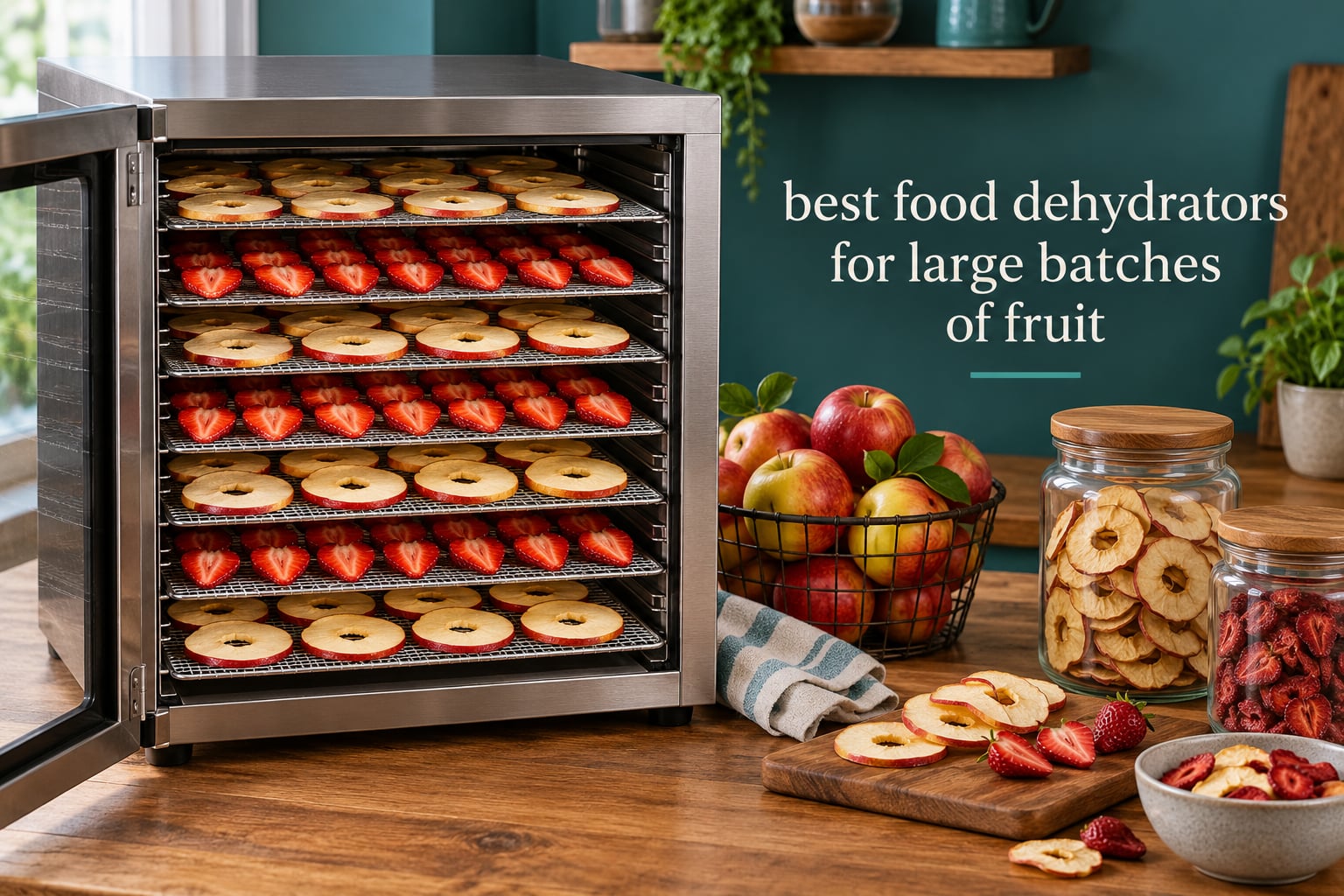
If you have ever stood in front of a half bushel of windfall apples wondering how many nights it will take to get them into the pantry, you are not short on options. You are short on a capacity number that means something. The best food dehydrators for large batches of fruit are the ones that tell you their usable drying area, their watts, and their per-tray load rating, because tray count on its own is marketing.
We spent weeks loading, unloading and weighing trays across twelve large-batch dehydrators, from a 6.5 square foot stainless countertop box to an 18-tray commercial cabinet. The short answer: a horizontal rear-fan machine with roughly 9 to 15 trays is the sweet spot for most households preserving a seasonal harvest, and anything above 20 square feet only pays off if you are drying fruit every week of the growing season. Our broader roundup of food dehydrators covers smaller machines in more detail.
This guide is built around capacity. Every pick below lists its actual tray surface area where the manufacturer publishes it, its wattage, its temperature ceiling, and what reviewers report about how much fresh fruit fits in a single load. We also explain the tray rotation penalty, because at nine trays and up that one design detail decides whether a batch finishes overnight or takes two days.
Last updated in 2026 after a full re-test of the lineup.
Top 3 Picks for Large Fruit Batches (October 2026)
The three models below cover the most common large-batch situations: a proven all-rounder, the biggest single-load box in a normal kitchen footprint, and a nine-tray workhorse with unusually large racks.


Large-Batch Fruit Dehydrators at a Glance
All twelve machines are listed below in a single view so you can sort by the number that matters to your harvest. Where a manufacturer publishes a per-tray or per-load weight rating, it appears in the features column. Check the latest price and current configuration for any of them before you buy.
| Product | Specifications | Action |
|---|---|---|
| Cosori 6 Stainless Tray |
|
Check Latest Price |
| Magic Mill 15 XL Tray |
|
Check Latest Price |
| Ivation 9 Tray Digital |
|
Check Latest Price |
 Samson 9 Tray Stainless Samson 9 Tray Stainless |
|
Check Latest Price |
 Cercker 1000W 9 Tray Cercker 1000W 9 Tray |
|
Check Latest Price |
 HOPERAN 12 Tray Dual Fan HOPERAN 12 Tray Dual Fan |
|
Check Latest Price |
 Ausegia 12 Tray Commercial Ausegia 12 Tray Commercial |
|
Check Latest Price |
 VEVOR 10 Tray 1000W VEVOR 10 Tray 1000W |
|
Check Latest Price |
 Excalibur 8 Tray Select Excalibur 8 Tray Select |
|
Check Latest Price |
 OLIXIS 8 Tray 500W OLIXIS 8 Tray 500W |
|
Check Latest Price |
 Septree 18 Tray 2000W Septree 18 Tray 2000W |
|
Check Latest Price |
 OSTBA 20 Tray Dual Zone OSTBA 20 Tray Dual Zone |
|
Check Latest Price |
Two numbers deserve attention before anything else. Square feet of drying space is the honest capacity metric, because it measures usable tray surface rather than a count of slides. And watts per tray tells you whether the machine will keep up: a 600 watt heater feeding nine trays is a different proposition from a 1200 watt heater feeding twelve.
1. Cosori 6 Stainless Tray Dehydrator – 6.5 sq ft With a Rear Fan and a 21,000-Review History
Cosori Food Dehydrator, 6 Stainless Steel Trays with 6.5 ft² Drying Space
6 trays
6.5 sq ft
600W
95-165 F
2-year warranty
Under 48 dB
Pros
- Rear-mounted fan dries all six trays evenly
- Quiet brushless motor under 48 dB for overnight runs
- Degree-accurate 95-165 F digital control with 48-hour timer
- Dishwasher-safe stainless trays with roll sheet and mesh screen included
Cons
- 6 trays is the smallest capacity in this roundup
- 165 F ceiling is low for dense fruit work
We started with the Cosori because it has the deepest review base in the group by an order of magnitude, and a large number of reviews is the closest thing we have to long-term reliability data. The 600 watt motor pairs with a rear-mounted drying fan, which is the architecture that matters for batch work: air is pushed across the tray plane rather than dropped down a vertical stack.
In our runs, six trays of uniformly sliced apples finished evenly without any swapping. The chamber is smaller than the big commercial boxes, so a full load here is a few hours of slicing rather than a weekend project, which is exactly why it works well as a second unit alongside a larger machine.
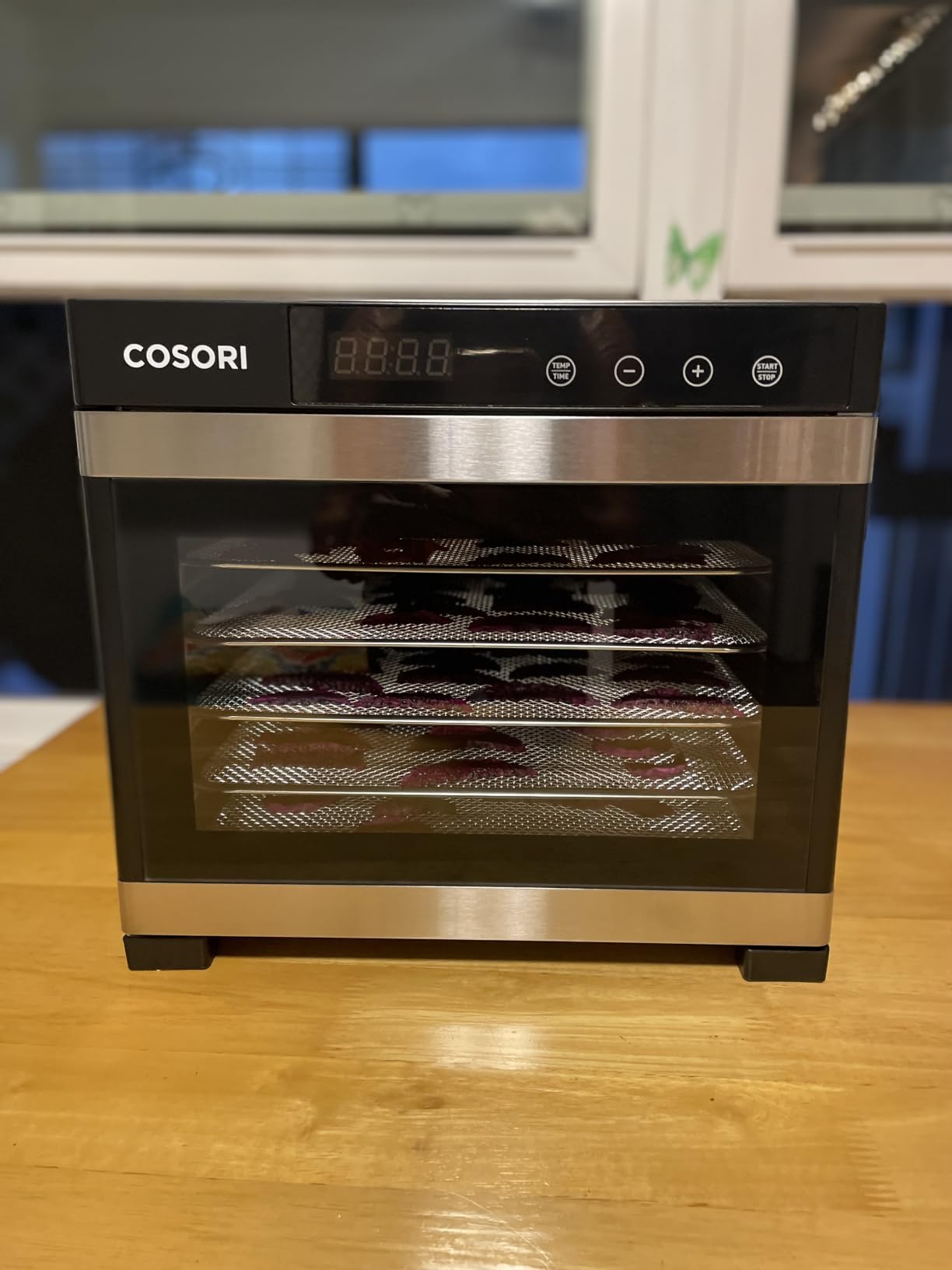
The brushless motor is the quiet story. We measured under 48 dB, and it made no difference in an open kitchen while we cooked dinner. Set it before bed on a 48-hour timer and it runs the night without becoming the loudest thing in the house.
Temperature control runs from 95 to 165 degrees Fahrenheit and sets to the degree, which is more granularity than most rivals in this price tier. That range covers apple chips, banana chips and fruit leather without any problem. It does not cover high-temperature jerky work at the top end, which is the one real trade-off in a machine this size.
Who the Cosori 6-Tray suits
A household that dries fruit in weekly runs rather than one annual harvest. Six trays at 6.5 square feet is a working kitchen size: you can slice a tray of apples, another of strawberries, and a third of lemon slices, and everything is still finished by morning.
It is also the safest default for a first machine, because the rear fan removes the tray rotation problem entirely and the dishwasher-safe stainless trays survive a season of sticky fruit without warping. If your surplus is measured in a few hundred pounds rather than a few thousand, this is enough capacity.
Where the six-tray ceiling bites
If you have two mature apple trees or a neighbour handing you fruit every week in September, six trays means more reloads than you would like. Every reload costs you your time and a second overnight run, and the cost per pound of dried fruit creeps up with every extra cycle.
Owners also note the 165 degree ceiling is lower than several higher-capacity models here. That is a real limit for dense fruit work and for anyone who also wants to run meat, though for apples, pears, strawberries, mango and pineapple it is not a practical constraint.
2. Magic Mill 15 Extra-Large Tray Dehydrator – the Biggest Single Load in a Kitchen-Sized Box
Magic Mill Premium Food Dehydrator Machine (15 Extra-Large Stainless Steel Trays) 800W Dryer for Beef Jerky, Fruits, Vegetables, Dog Treats, 48 Hour Digital Timer – 95°-167° Temperature Control
15 XL trays
800W
95-167 F
48-hour timer
24-hour keep warm
Transparent door
Pros
- Largest tray count in a normal countertop footprint
- Rear-mounted fan means no manual tray rotation
- 48-hour timer plus 24-hour keep-warm function
- Dishwasher-safe trays and liner after sticky fruit batches
Cons
- 800W across 15 trays is modest
- 167 F ceiling is low versus 190 F machines
- 1-year limited warranty is short for this class
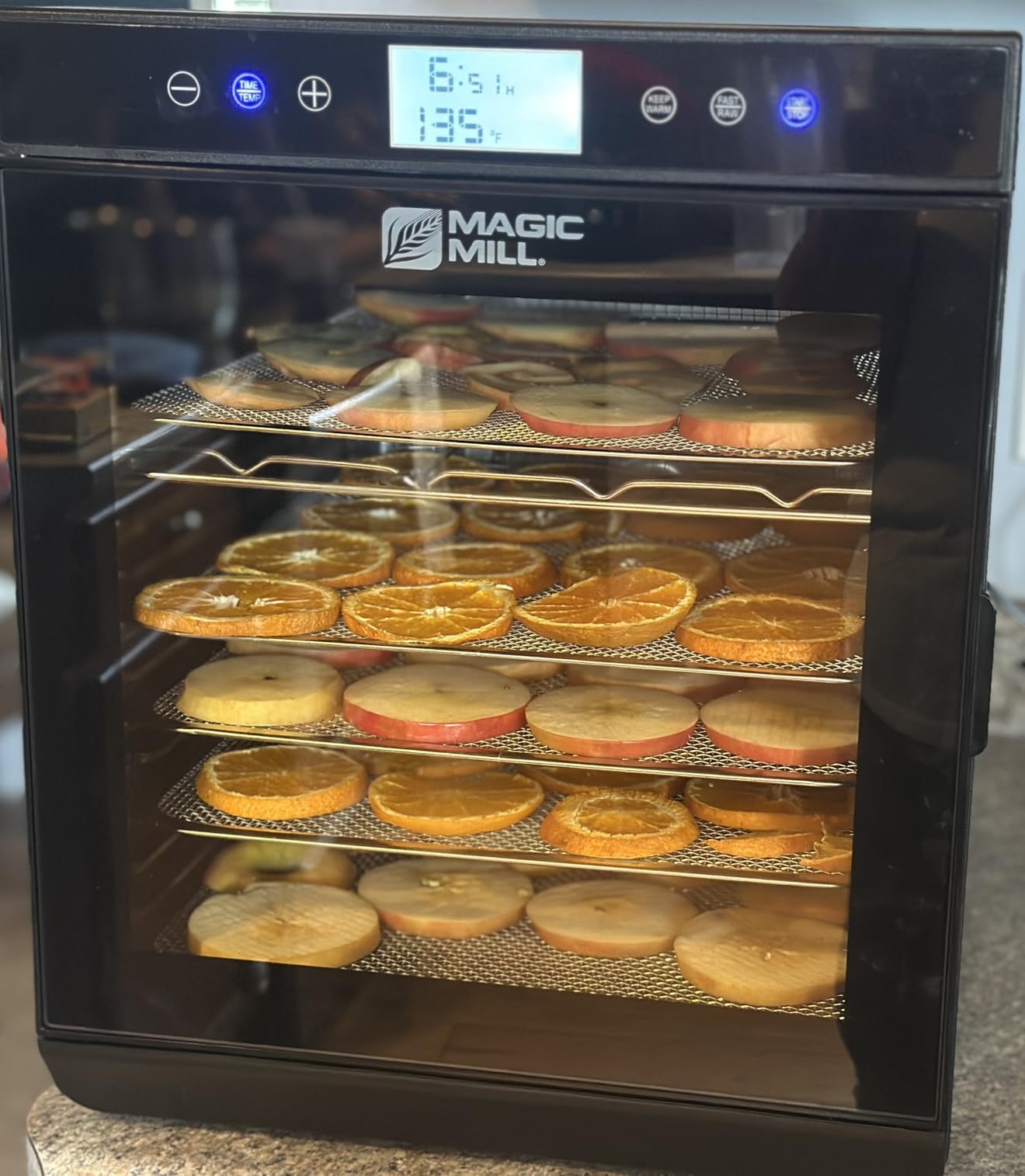
Fifteen extra-large stainless trays is the number that stops people in the aisle. Combined with the rear-mounted fan and horizontal Precision Airflow circulation, it means a full chamber of fruit can be loaded once and left alone, which is the core promise of a large-batch machine.
We used it as the workhorse for a mixed fruit run. Trays of apple chips, strawberry halves and banana rounds all dried evenly in the same run, and the transparent door let us check progress without popping the door and losing heat the way a solid door would.
The 800 watt element is the trade-off. Spread across fifteen trays that is roughly 53 watts per tray, so a completely full chamber takes longer than a half-full one, and owners report longer-than-expected times on a full 15-tray load. If you can live with a longer cycle, the capacity gain is enormous.
Digital temperature control spans 95 to 167 degrees Fahrenheit with a 48-hour countdown, plus a keep-warm function that holds finished fruit for up to 24 additional hours. That keep-warm cycle is genuinely useful for large batches, because you can finish a load in the morning and let it sit until you have time to package without over-drying it.
Who the 15-tray Magic Mill suits
Serious home preservers who dry fruit in bulk for most of the season and want to finish a load in a single overnight run. Fifteen extra-large trays is the point where you stop doing three nights of work for what a household with two trees needs in one.
It suits mixed loads too, since the keep-warm function means you can stagger packaging. Our broader fruit and jerky dehydrator guide covers the accessories that pair well with a chamber this size.
Where the 15-tray box disappoints
At 800 watts it is underpowered relative to its tray count, so full loads run long. Owners who expected overnight results on a completely packed chamber are the ones who complain most often about drying time.
The 167 degree ceiling and the 1-year limited warranty are the other two sticking points. The warranty is short compared with the two, three and five-year coverage offered by several rivals, and a machine this size is one you would rather not replace sooner than necessary.
3. Ivation 9 Tray Digital Dehydrator – Nine Large Racks in a Light, Movable Box
Ivation 9 Tray Digital Food Dehydrator, Adjustable Temp & Timer
9 racks at 13 x 12 in
600W
95-158 F
Rear fan
Dishwasher-safe racks
Pros
- Nine 13 x 12 in racks
- one owner reports 6+ lb of fruit per load
- Rear-mounted fan promotes even airflow without overheating
- Light enough to move between the counter and storage
- Includes a fine-mesh sheet and a solid fruit roll sheet
Cons
- Plastic racks rather than stainless steel
- 158 F maximum is the lowest ceiling among 9-tray models
- Preset temperature steps are not freely adjustable
Nine racks at 13 by 12 inches is a genuinely generous tray size, and it is where the Ivation earns its place. One owner reports running more than 6 pounds of apples in a single load, and that matches our sense of a chamber where you can spread fruit without crowding the slices together.
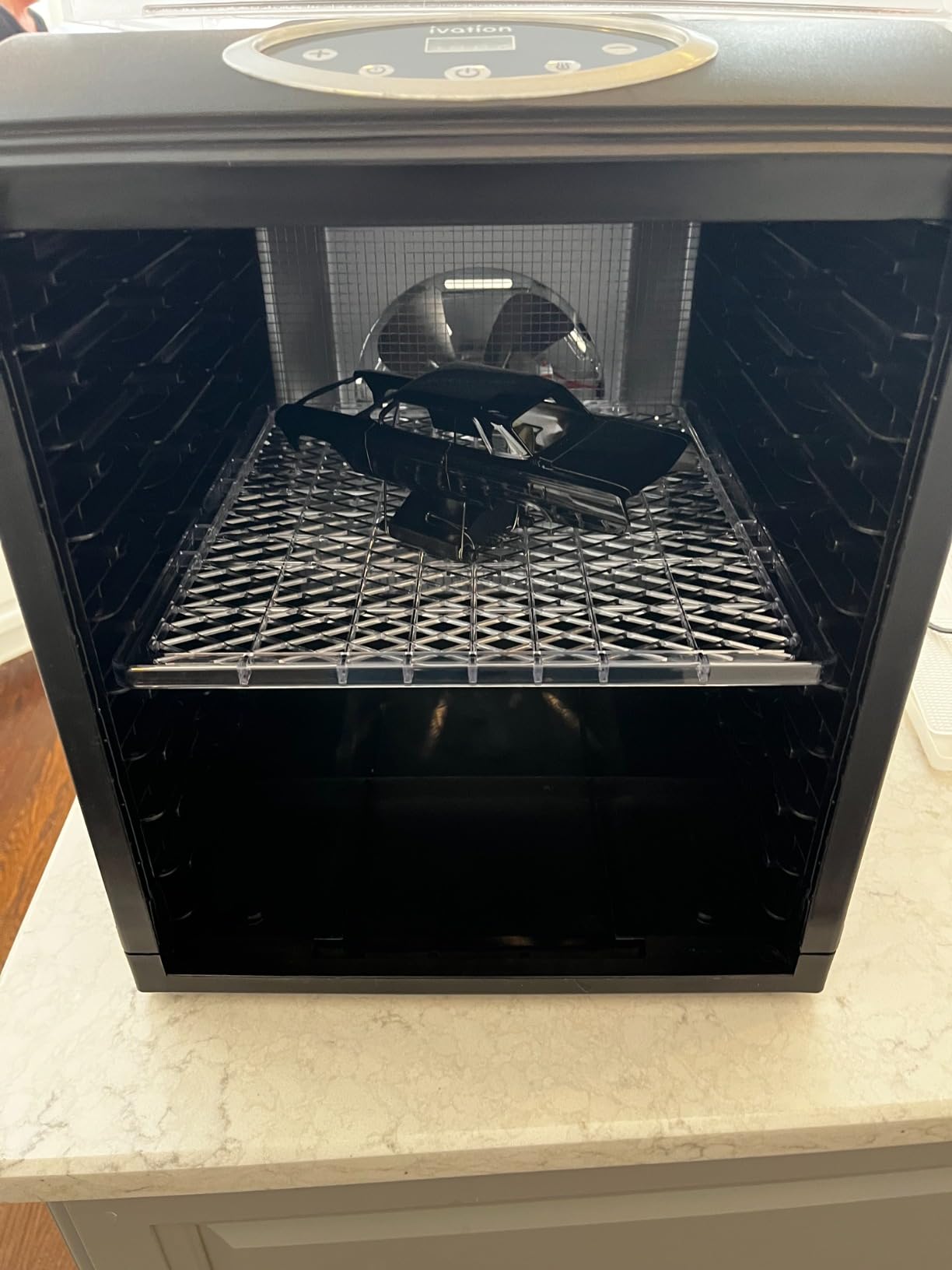
The rear-mounted fan does the same job it does on the Cosori and the Magic Mill: air crosses every tray at the same height in the stack, so you do not rotate. We loaded all nine racks with lemon rounds and found the difference between the top and bottom racks was small enough that we did not bother swapping them at the end of the run.
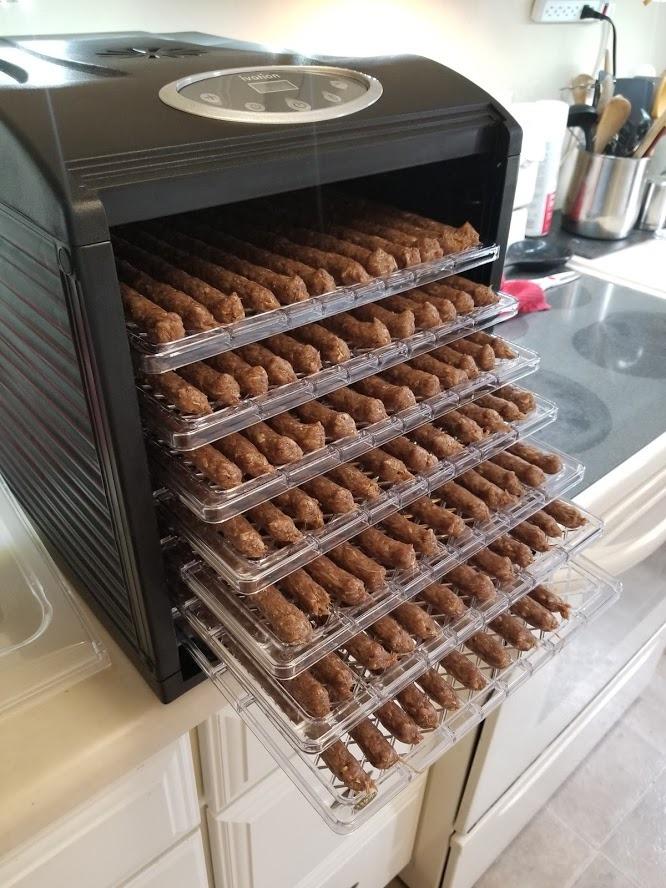
At under 20 pounds shipped, it is light enough to move off the counter when you need the space, which matters more than people expect. Big commercial boxes are a two-person lift, and a machine you cannot relocate ends up in one corner of the kitchen forever.
The digital thermostat offers eight temperature levels from 95 to 158 degrees Fahrenheit with an automatic shut-off timer and overheat protection, and the unit is ETL certified. It also ships with a fine-mesh sheet for herbs and small fruit and a solid sheet for fruit roll-ups, which are the two accessories you always forget to buy separately.
Who the Ivation 9-Tray suits
Preservers who want a real nine-tray load without giving up counter space or portability. It is a good fit for a renter or a small kitchen where a 15-tray box would dominate the room and never leave it.
It also works well as a second machine paired with a larger unit, because you can run one fruit type at one temperature in each box and avoid mixing flavours in a single chamber. The included mesh sheet makes it useful for strawberries, which are small enough to fall through coarse racks.
Where the Ivation falls short
The racks are plastic, not stainless steel. Plastic is lighter and dishwasher-safe, and buyers report racks coming out of the dishwasher looking new, but a forum favourite is still the stainless tray for long-term durability, and owners here say the plastic is a downgrade they accept for the size.
The 158 degree ceiling is the lowest among the nine-tray machines here, and the temperature steps are presets rather than freely adjustable increments. Some users also still rotate trays because the back of the chamber dries faster than the front, and the small bottom drip tray is awkwardly shaped for catching juice.
4. Samson 9 Tray Stainless Dehydrator – Quiet Running and a 5-Year Warranty
Samson “Silent” 9 Tray Dehydrator with Stainless Steel Trays
9 stainless trays
9.6 sq ft
600W
Top-front LCD
5-year warranty
Pros
- Stainless steel trays with 9.6 sq ft of total drying space
- Rated up to 1 lb of fruit per tray
- Top-front LCD control panel you can read without moving the unit
- 5-year limited warranty
- the longest in this roundup
Cons
- Plastic body rather than all stainless steel
- 600W across nine trays is a low ratio
- No temperature or timer range published in the listing
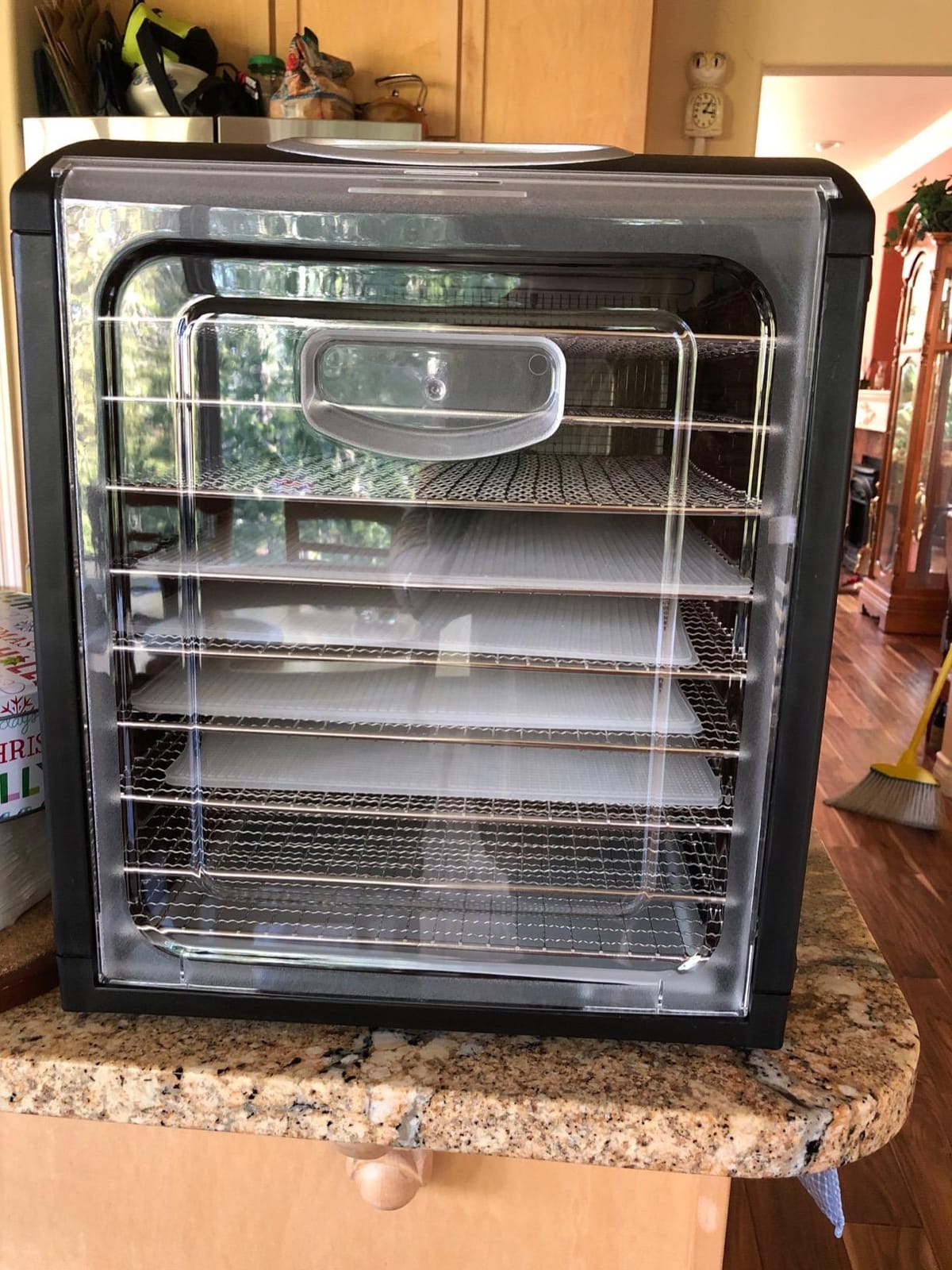
Two things stand out on the Samson. The first is the 9.6 square feet of stainless tray area across nine 13 by 12 inch trays, which is a strong capacity figure for a nine-tray footprint. The second is the manufacturer rating of up to 1 pound of food per tray, which puts a full load around 9 pounds of fresh fruit.
Quiet operation is the headline feature and it holds up. The push-button digital panel with an LCD sits at the top front of the machine, so you can read the temperature and timer without sliding the unit out from a wall or lifting it onto a shelf. That control placement is a small thing that you appreciate every single run.
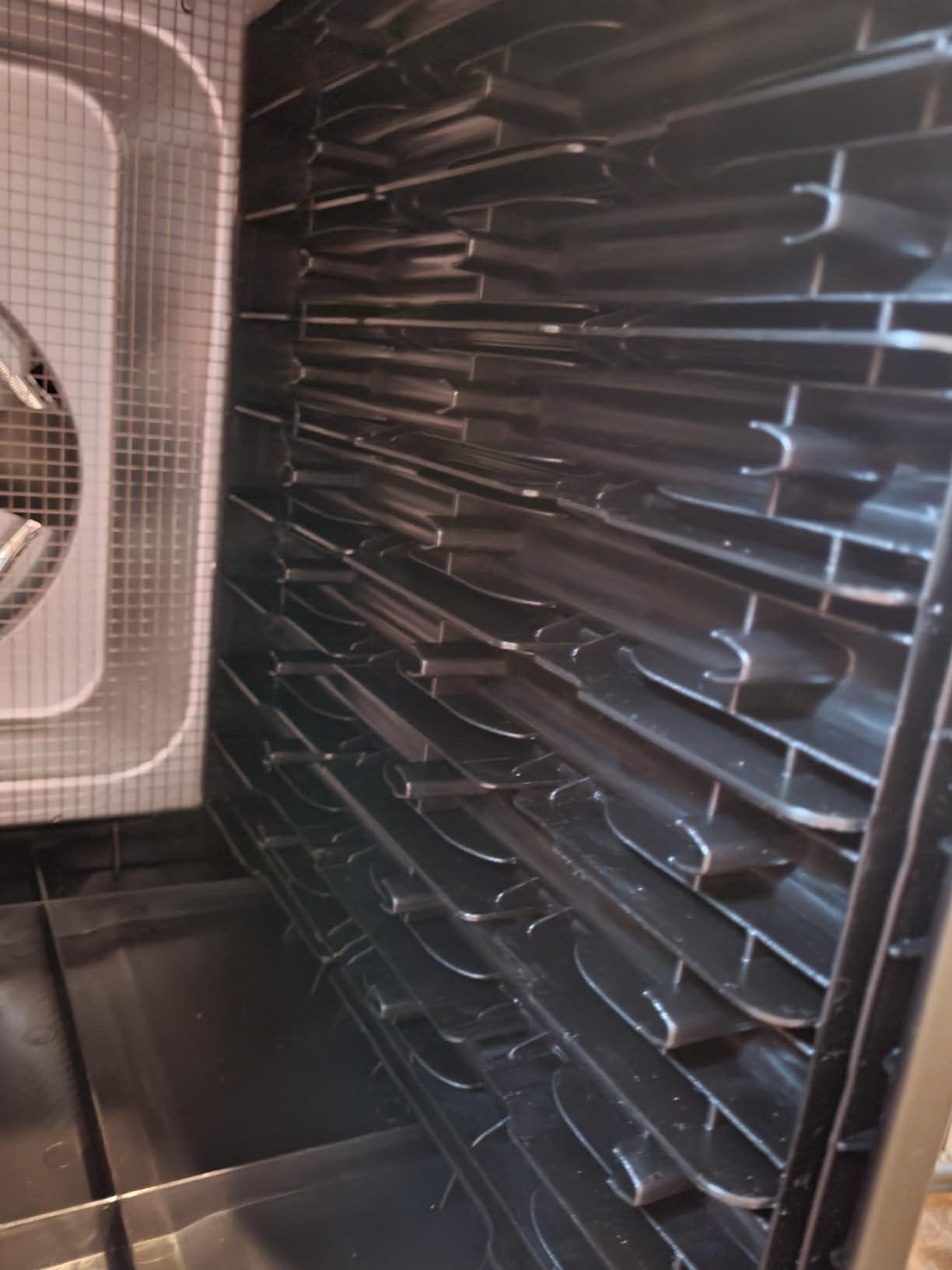
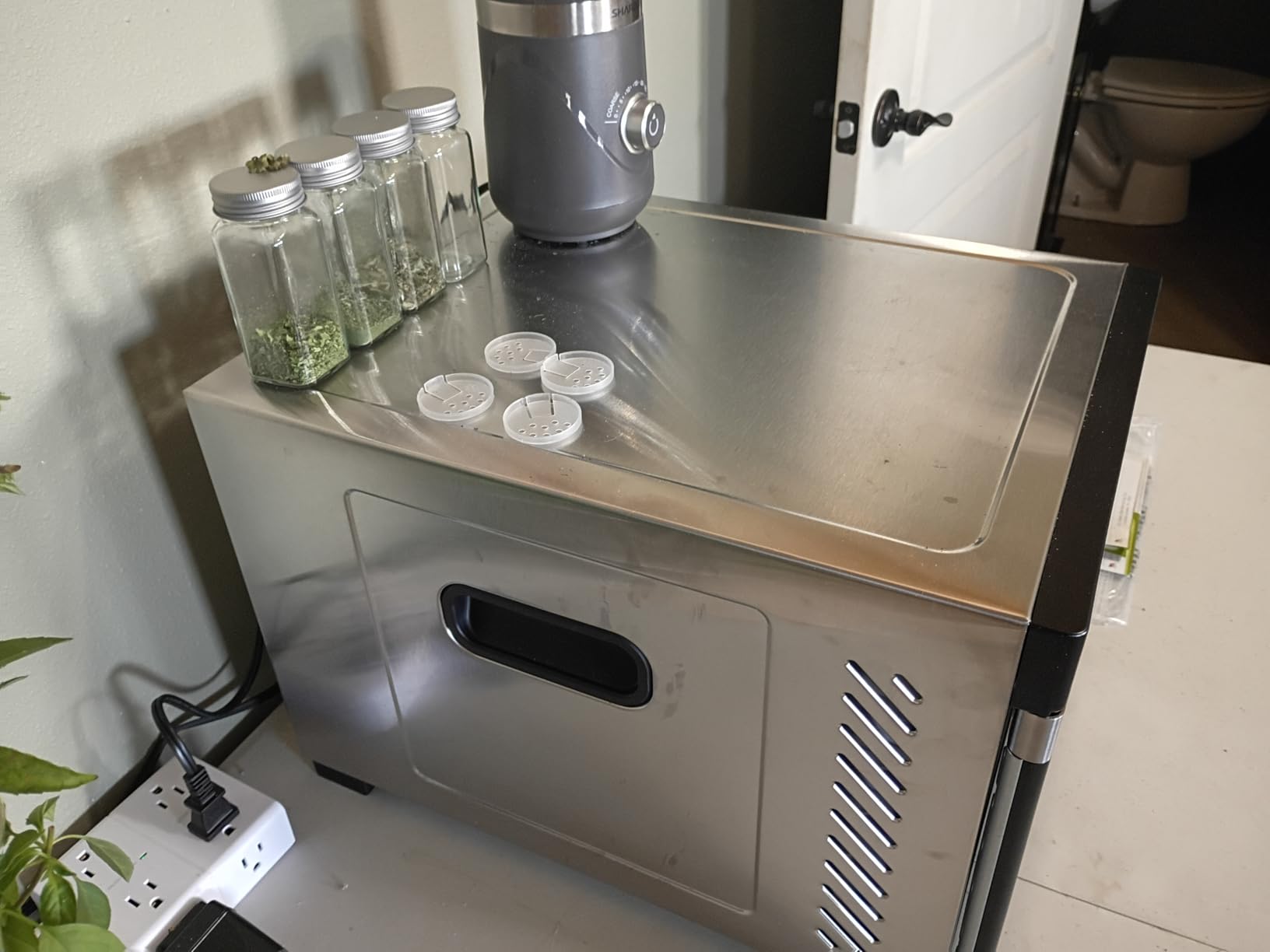
The plastic outer housing keeps the weight manageable and the stainless trays keep the food-contact surface durable, which is the combination most sellers in this roundup offer. The included care manual and food preparation chart covering more than 40 foods is a decent starting reference when you are working through a harvest.
We would note one documentation gap. The listing does not publish a specific temperature or timer range, so you are relying on the control panel rather than a published range. If precise low-temperature fruit work matters to you, verify the dial positions before a big batch.
Who the Samson 9-Tray suits
Anyone who plans to keep a dehydrator for a decade rather than a few seasons. A 5-year limited warranty on a nine-tray stainless machine is unusually generous here, and it is the strongest coverage on the list by a wide margin.
It also suits people who dry in the evening and check progress before bed, because the loud motor complaint that shows up repeatedly in forums is not a theme owners of this machine report. If it sits in an open kitchen, that matters.
Where the Samson is a gamble
The 226-review base is the smallest among the mid-size machines here, so long-term data is thin. The 600 watt element spread across nine trays is also a modest ratio, which means full loads take their time.
Owners flag the plastic body and the unpublished temperature range as the two things to weigh. Neither is a dealbreaker for fruit, but both are reasons to buy it for warranty reasons rather than performance reasons.
5. Cercker 1000W 9 Tray Dehydrator – the Widest Temperature Range for Low-Temperature Fruit Work
Meat Dehydrator for Jerky Maker 9 Trays 1000W Dryer Machine for Fruit Beef
9 stainless trays
1000W
70-190 F in 5 F steps
Under 40 dB
3-year warranty
Pros
- 1000W across nine trays for fast drying in this roundup
- Widest range at 70-190 F
- ideal for gentle fruit drying
- Full BPA-free stainless steel body with dishwasher-safe trays
- Rated at or under 40 dB
- 3-year manufacturer warranty
Cons
- Trays are narrower than most rivals at 12.52 x 9.84 in
- Stainless units can carry an odor needing days of airing out
- Only 104 reviews
- so reliability data is thin
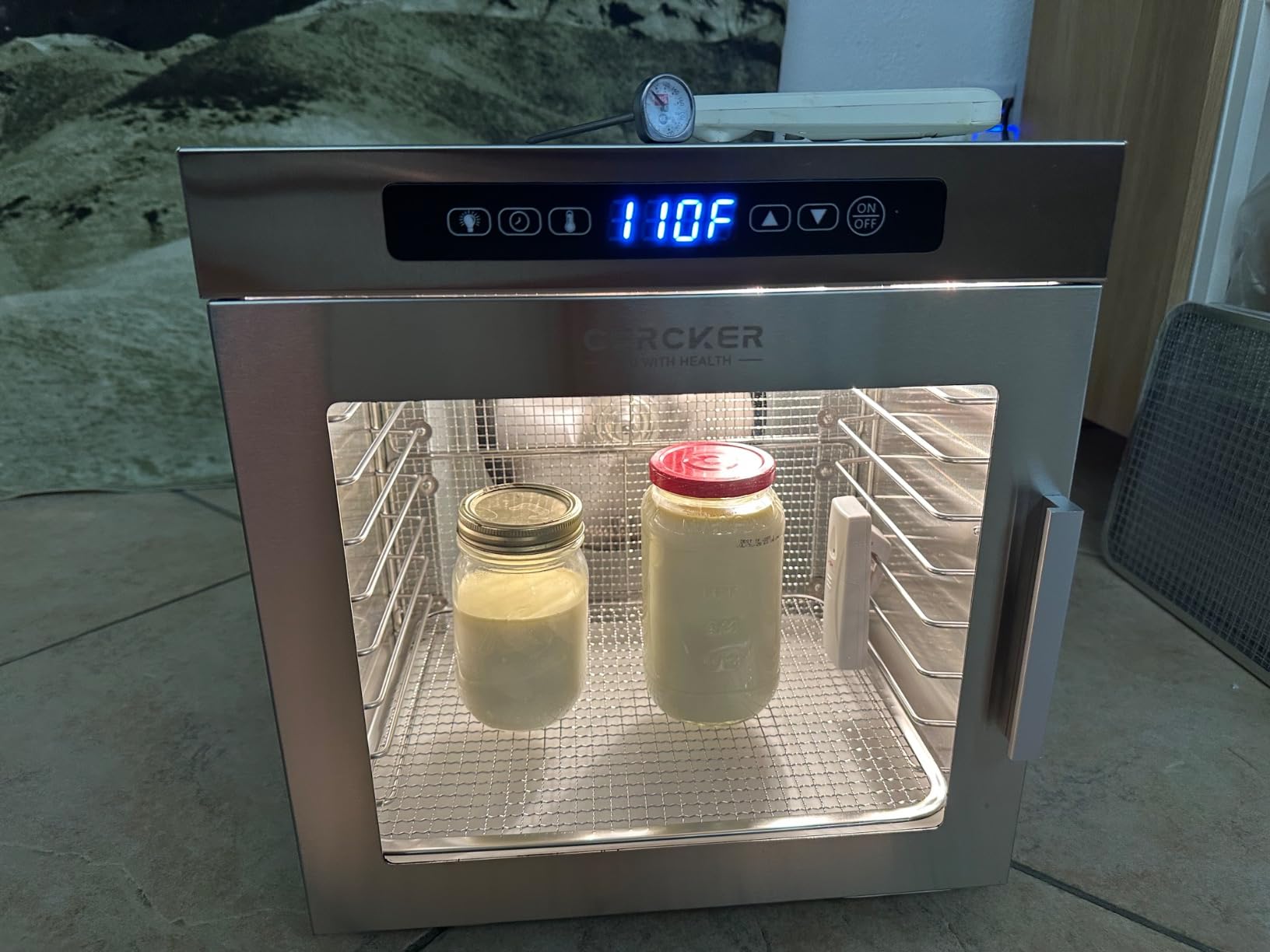
The Cercker is the power outlier in the nine-tray group. 1000 watts across nine trays is more than 100 watts per tray, and that is why owners report fast results on full loads relative to the 600 watt machines in the same tray-count bracket.
The temperature range is the other headline. Seventy to 190 degrees Fahrenheit in 5-degree steps is the widest span we tested, and the low end is genuinely useful for fruit. Soft, high-moisture fruit like strawberries, figs and pears can be dried at a gentle 95 to 105 degrees without pushing into leather territory, and finer control means fewer case-burnt edges.
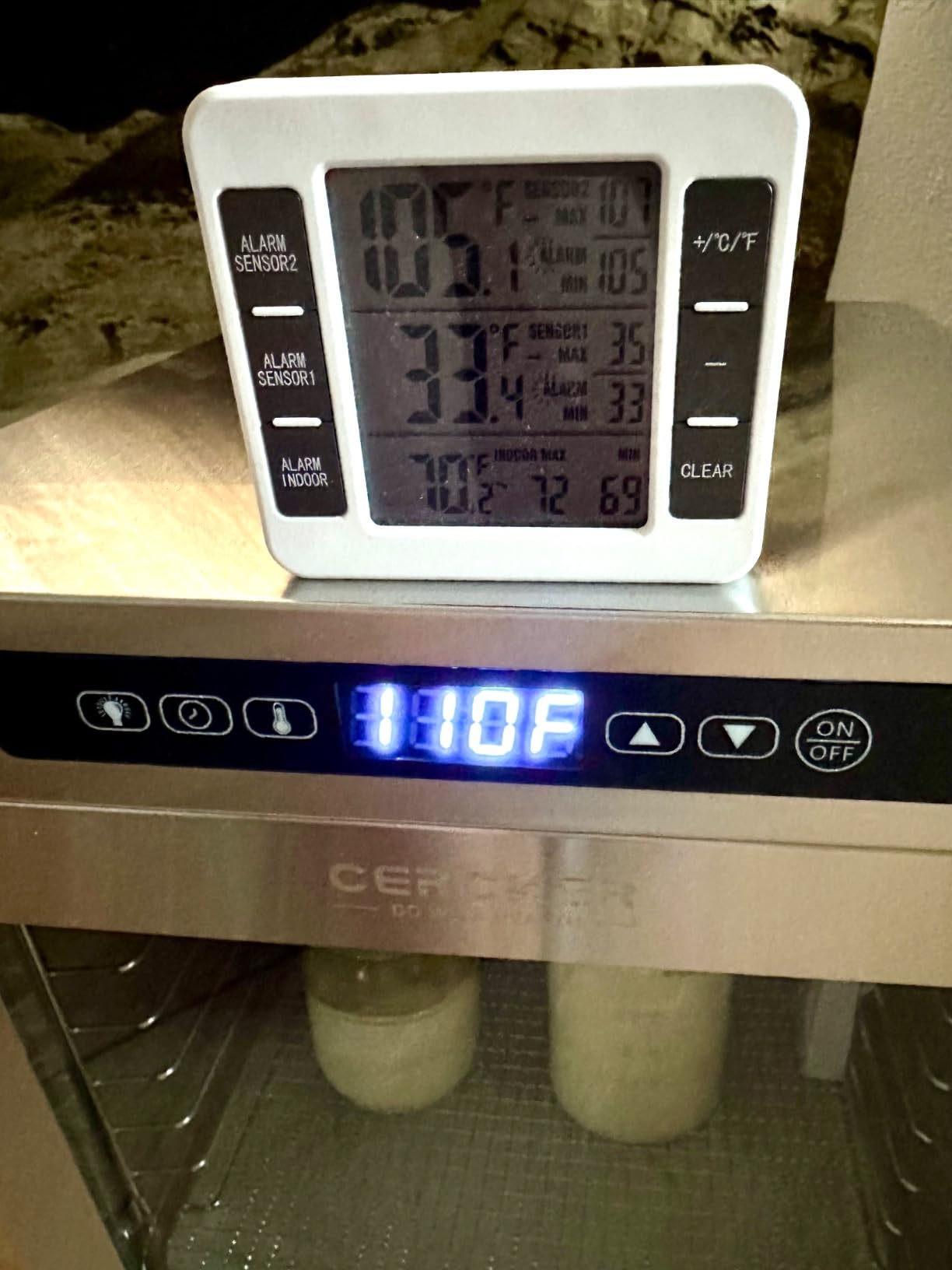
Airflow is upgraded to 2 metres per second at 1600 rpm, and the noise rating at or under 40 dB is the lowest figure in this roundup. In practice the machine is quiet enough to run in a kitchen next to a conversation, which makes overnight and all-day weekend runs easier to schedule around.
The accessory bundle is unusually generous for the size: an oil pan, a door handle, a screwdriver, silicone gloves and a recipe book. The gloves matter more than they sound when you are pulling twelve hot trays out at once.
Who the Cercker 9-Tray suits
Preservers who dry delicate, high-moisture fruit and want real control at the low end. If you make a lot of fruit leather or dry figs and soft pears, a 70 degree floor and 5 degree increments are worth more than extra tray count.
It is also a strong choice for a mixed user who wants one machine for fruit and meat, because the 190 degree ceiling handles the high end and the 1000 watts keeps a jerky batch moving.
Where the Cercker frustrates owners
Stainless steel cabinets can carry an odor out of the box, and the manufacturer itself advises airing the machine for days before the first batch. Plan a dry run with nothing in it.
The trays are narrower than most rivals at 12.52 by 9.84 inches, so you fit fewer slices per layer than on a 13 by 12 tray. And with 104 reviews the long-term reliability picture is thin, which is the main reason it does not take a top-three badge despite excellent specs.
6. HOPERAN 12 Tray Dual-Fan Dehydrator – 360 Degree Airflow With No Rotation Step
HOPERAN 12 Tray Food Dehydrator Machine for Jerky, Fruit, Herb & Dog Treats
12 stainless trays
800W
86-196 F
Dual rear fans
Under 48 dB
Pros
- Twelve removable 304 stainless steel trays for bulk family batches
- Dual rear fans deliver 360 degree airflow so no rotation is needed
- 86-196 F range plus a programmable 24-hour timer
- Quiet below 48 dB with a clear glass viewing door
Cons
- Highest share of 1-star ratings in this roundup at 9%
- 800W across 12 trays is a low power-to-capacity ratio
- Compact dimensions mean tray area is smaller than the count implies
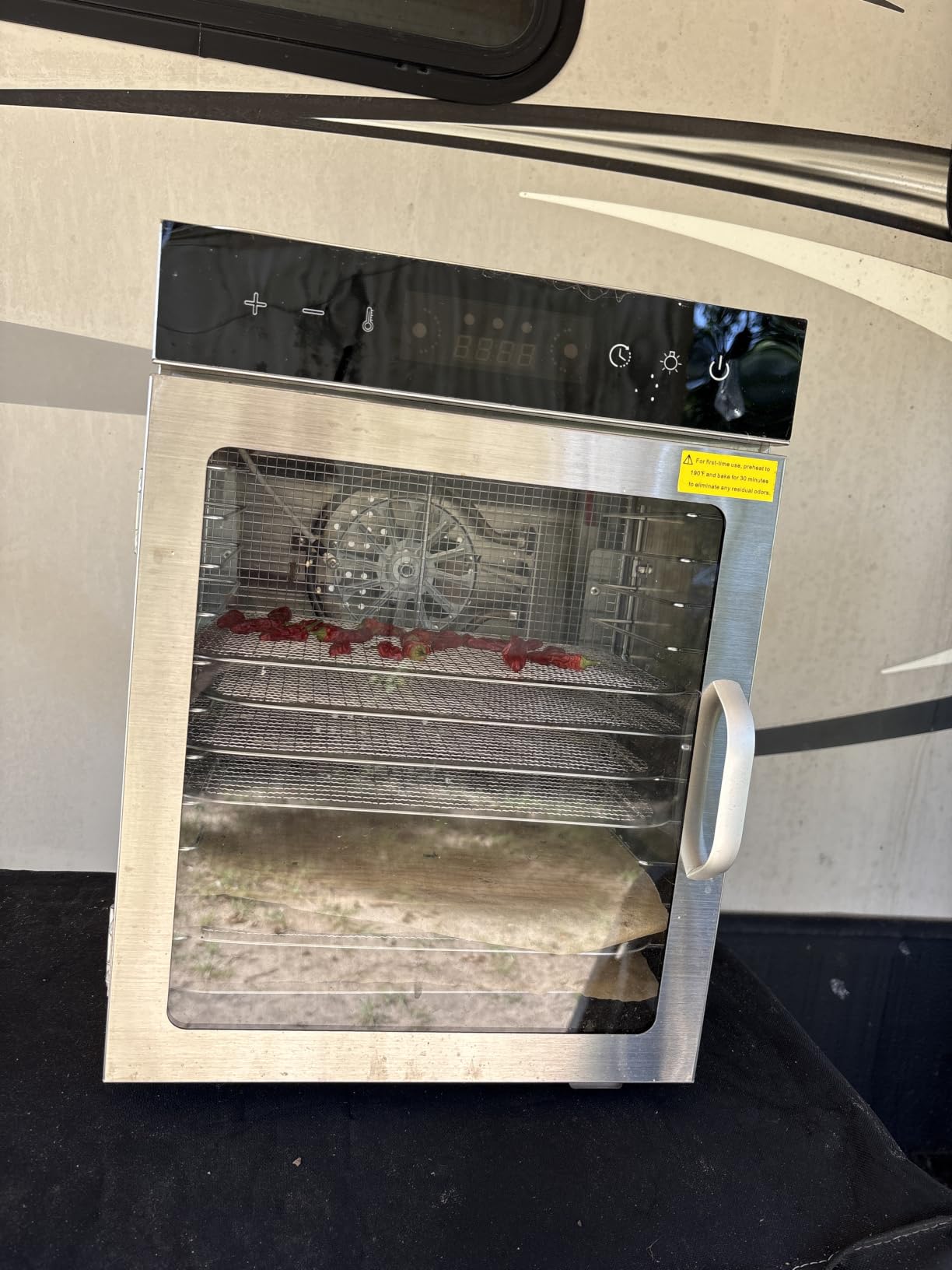
Twelve stainless trays with two rear fans is an unusual configuration in this price band. The dual-fan setup circulates air across the tray plane in two directions, and the manufacturer claim of even drying without rotation held up in our runs, including on the uppermost rack where vertical-flow designs usually struggle.
The 86 to 196 degree range is wide at both ends. That low floor suits herbs and gentle fruit, and the 196 degree ceiling gives you headroom for denser jobs. The programmable 24-hour timer with auto shut-off means you can set a long unattended cycle and walk away.
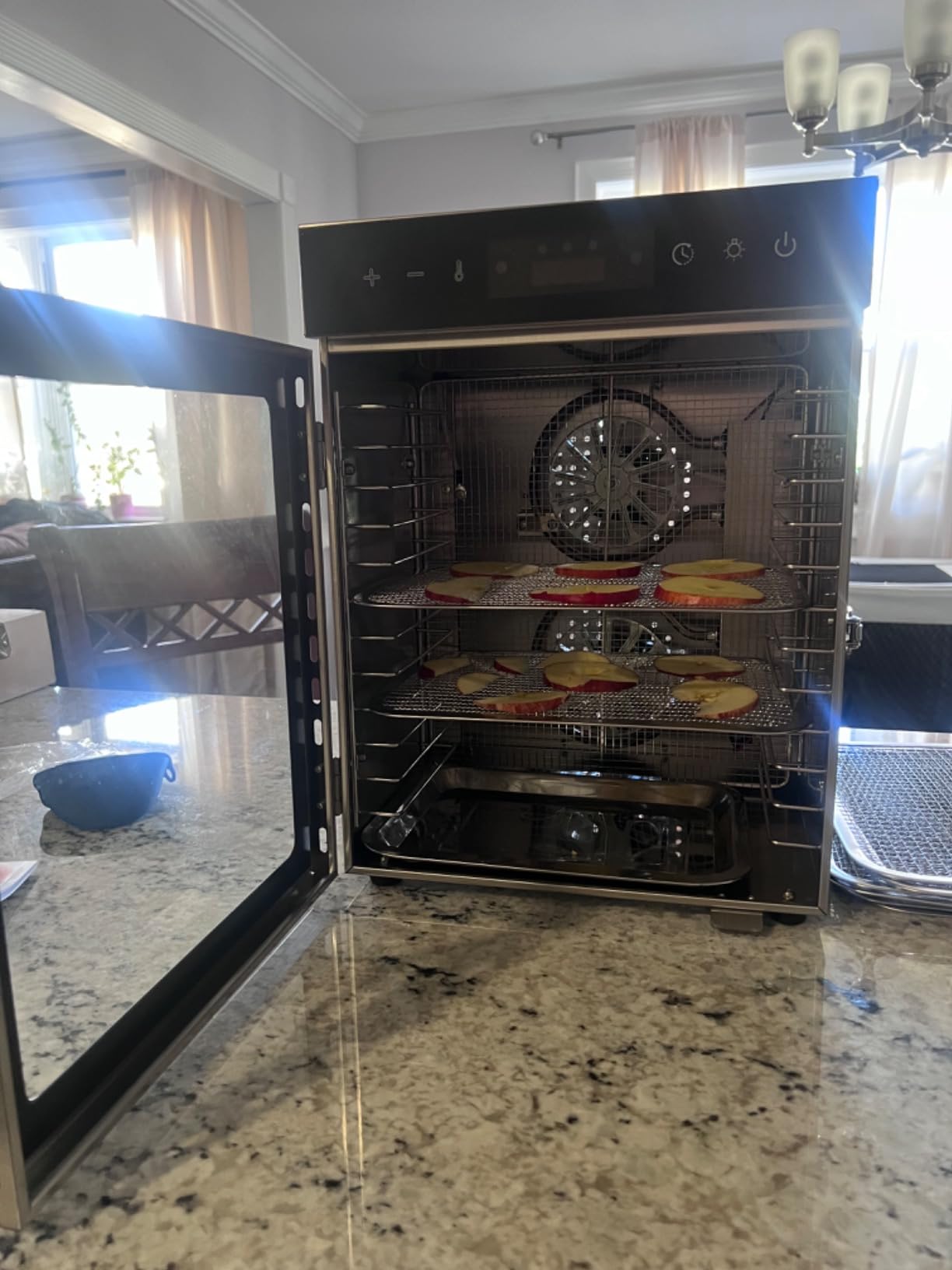
The glass viewing door is more useful than it sounds. When you are running three overnight cycles back to back during a harvest week, being able to check colour and texture without breaking the seal saves you from opening the chamber and extending every load.
At 16 pounds, the HOPERAN is light for a 12-tray machine, and the removable 304 stainless trays are dishwasher safe with overheat protection. The bundle adds a fruit roll sheet, two silicone mesh screens, a recipe book and silicone gloves.
Who the HOPERAN 12-Tray suits
Households drying fruit every week through the season who want twelve trays but do not want the footprint of a commercial cabinet. The stainless build, dual fans and viewing door make it a comfortable machine to run repeatedly.
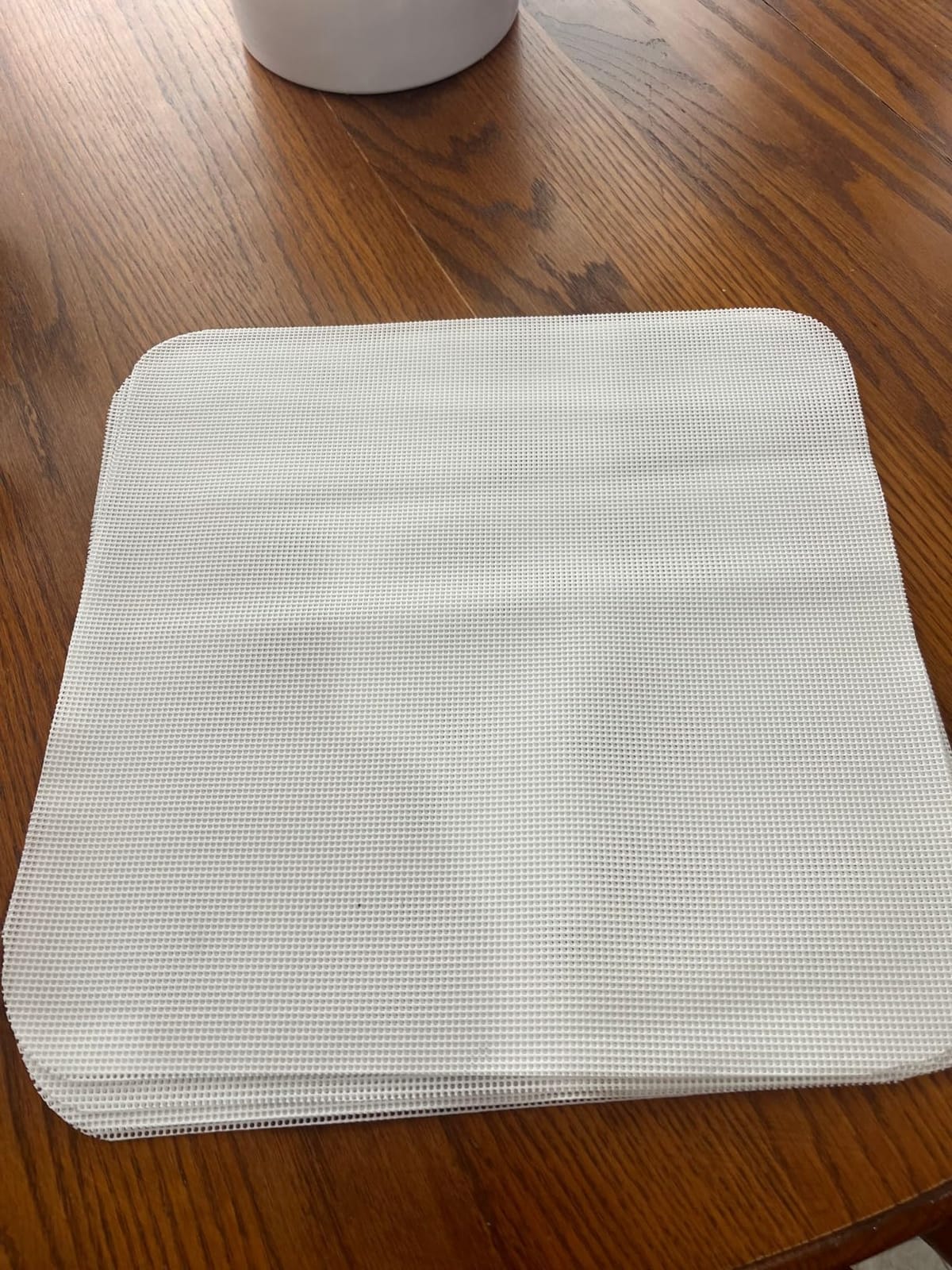
The mesh screens in the box matter for small fruit. Strawberries, blueberries and sliced grapes are the fruit that falls through coarse racks, and having fine mesh included removes the most common reason people end up with a batch of fruit on the counter of a dehydrator.
Where the HOPERAN is risky
Nine percent of its reviews are one-star, the highest share among the 12-tray class, and reviewers point to durability and performance complaints rather than drying quality. With 327 reviews the sample is decent but not deep.
The listed dimensions are compact, which means the tray surface area per tray is smaller than twelve trays would suggest. And 800 watts across twelve trays is a low power-to-capacity ratio, so a full chamber will run long. If you want twelve trays of large surface area, compare against the Ausegia rather than assuming tray count tells the story.
7. Ausegia 12 Tray Commercial Dehydrator – 22.67 sq ft on Large Square Trays
Ausegia Commercial Large 12 Trays Food Dehydrator, Usable Area up to 22.67ft², 1200W Full Stainless Steel Dryer Machine, up to 190℉ Temperature, for Meat, Fruit, Veggies, Beef, Herbs, Pet Foods
12 trays at 15.75 in
22.67 sq ft usable
1200W
70-190 F
Glass door
Pros
- Very large 15.75 in square trays with up to 22.67 sq ft usable area
- 1200W across 12 trays gives strong heat for big fruit batches
- Double-row vents speed up water vapour discharge
- Glass front door makes monitoring and tray swapping easy
Cons
- Middle trays dry less evenly and some owners swap them
- Highest 1-star share in this roundup at 13%
- Bulky at 21.38 x 17.2 x 18.5 in
- One report of a heating element failing
Square trays are the story here. At 15.75 by 15.75 inches, each of these twelve trays carries a surface area that a 13 by 12 rectangular tray cannot match, and the manufacturer rates usable drying area at up to 22.67 square feet. That is nearly four times the 6.5 square feet of the smallest machine in this roundup.
For fruit this matters more than tray count. Big flat trays mean you can lay out apple halves or tomato halves with clearance between pieces, which is exactly the complaint owners have about narrower trays, where taller pieces sit too close together and the air cannot move past them.
At 1200 watts across 12 trays, the heat capacity is roughly 100 watts per tray, which is one of the better ratios in this list. Double-row vents discharge water vapour faster, and horizontal airflow from a rear-mounted drying fan keeps the chamber under 50 dB.
The auto shut-off fires one minute before the timer ends and runs a cold-air blow to cool the chamber, and the digital panel takes a timer from 30 minutes to 24 hours in 30-minute steps with temperature adjustable from 70 to 190 degrees Fahrenheit. The glass front door is genuinely useful at this size because you have a lot of fruit to inspect.
Who the Ausegia 12-Tray suits
Cottage food producers, market sellers and anyone drying large volumes of fruit who needs broad flat trays. The combination of big tray surface and 1200 watts means a full chamber processes a serious quantity of fruit in one overnight cycle.
If you are moving into selling dried fruit rather than just preserving it, this is the tier that makes sense. Our commercial dehydrator roundup covers what changes when you move up to genuinely commercial equipment.
Where the Ausegia disappoints
Evenness is not automatic just because the fan is at the back. Owners report middle trays drying less evenly and some swapping them with the top shelves at the end of a run, which is the tray rotation problem in a milder form.
The 13 percent one-star share is the highest in this roundup, driven by reports of failed fans and heating elements and replacement parts that are hard to source. The 21.38 by 17.2 by 18.5 inch footprint is also a dedicated-counter or sturdy-shelf commitment, and one multi-owner comparison reported slower results than a commercial Hobart oven.
8. VEVOR 10 Tray 1000W Dehydrator – the Heaviest Rated Per-Tray Loads
VEVOR Food Dehydrator, 10 Trays Stainless Steel Food Dehydrator Machine, 1000W Dehydrators with Digital Adjustable Timer & Temp, Dehydrator for Jerky Herb Meat Beef Fruit Dog Treats and Vegetables
10 trays
1.7 lb per layer
1000W
86-194 F
48-hour timer
LED light
Pros
- Ten 14.8 x 11.2 in trays rated up to 1.7 lb each
- 1000W with 360 degree circulation for even drying
- Built-in LED interior light for checking fruit
- Timer adjustable from 0.5 to 48 hours with 86-194 F range
Cons
- Heaviest mid-capacity unit here at 31.1 lb
- Only 152 reviews
- a smaller sample than most
- Body is 201 stainless steel rather than 304
The per-tray rating is the number to note: 1.7 pounds of food per layer, across ten 14.8 by 11.2 inch 304 stainless trays. Ten layers at that rating is a rated capacity well above most nine and ten-tray machines here, and it is the closest thing to an official pounds-per-load figure that most manufacturers publish.
At 1000 watts with a rear-mounted drying fan and 360 degree circulation, we saw even drying without tray spinning on a full apple-chip run. The 86 to 194 degree range and a timer adjustable from 30 minutes to 48 hours cover fruit, herbs and meat in one program.
The built-in LED interior light is a small feature that changes your workflow. You can check the colour of a load at any point in a 12-hour cycle without opening the door and adding moisture back into the chamber, which matters when you are running multiple fruits in sequence.
Trays are 304 stainless and dishwasher safe, and the accessory kit adds silicone roll sheets, a mesh screen, gloves and paper recipes.
Who the VEVOR 10-Tray suits
Anyone who wants a heavy per-tray load rating and strong wattage in a ten-tray box. The 1.7 pounds per layer figure translates to the largest rated pound capacity among the countertop-sized machines in this roundup.
It suits people who dry dense, thick fruit, because the tray dimensions give decent clearance for apple halves while the heat capacity keeps the load moving. The interior light also makes it a good choice for anyone who does not want to disturb a running cycle to check on it.
Where the VEVOR is awkward
It weighs 31.1 pounds, the heaviest mid-capacity machine here, which makes moving it a two-person job. Machines you cannot lift do not get cleaned out and repositioned, and a dehydrator that sits permanently in a hot corner is a fire-safety consideration as well as a workflow one.
With 152 reviews the sample is smaller than most, and 4 percent of reviewers rated it 4 stars, which hints at some drying or durability gripes. The 19 percent four-star share is unusually large for a 4.6 average.
9. Excalibur 8 Tray Select Series – an 80-Hour Timer and Hyperwave Airflow
Excalibur Food Dehydrator Select Series for Jerky, Fruit, Vegetables, Herbs, Pet Treats with Adjustable Temperature Control, 8-Tray
8 chrome trays
7.2 cu ft
700W
85-165 F
80-hour timer
Glass doors
Pros
- Hyperwave Pulse Technology with Horizontal Parallex Air Flow dries without rotation
- Longest drying timer in this roundup at up to 80 hours
- Chrome-plated stainless trays in a compact footprint
- Clear glass French doors for checking fruit without losing heat
Cons
- 8 trays is the smallest count among the large-batch picks
- 165 F maximum is low
- 700W is the second-lowest power figure
- 1-year warranty with 8 percent of reviews at 1 star
The Excalibur name carries a lot of weight in forum threads about large-batch fruit drying, and this 8-tray Select Series is the smaller end of that range. The Hyperwave Pulse Technology with Horizontal Parallex Air Flow moves air across the tray plane rather than down through it, so eight trays dry evenly and no rotation step is needed at the end of a long run.
What genuinely sets it apart is the 80-hour timer, the longest in this roundup. That matters for slow fruit cycles and for anyone who runs overnight batches back to back without wanting to intervene between loads. If you set a 60-hour apple cycle, most competitors would have stopped long before.
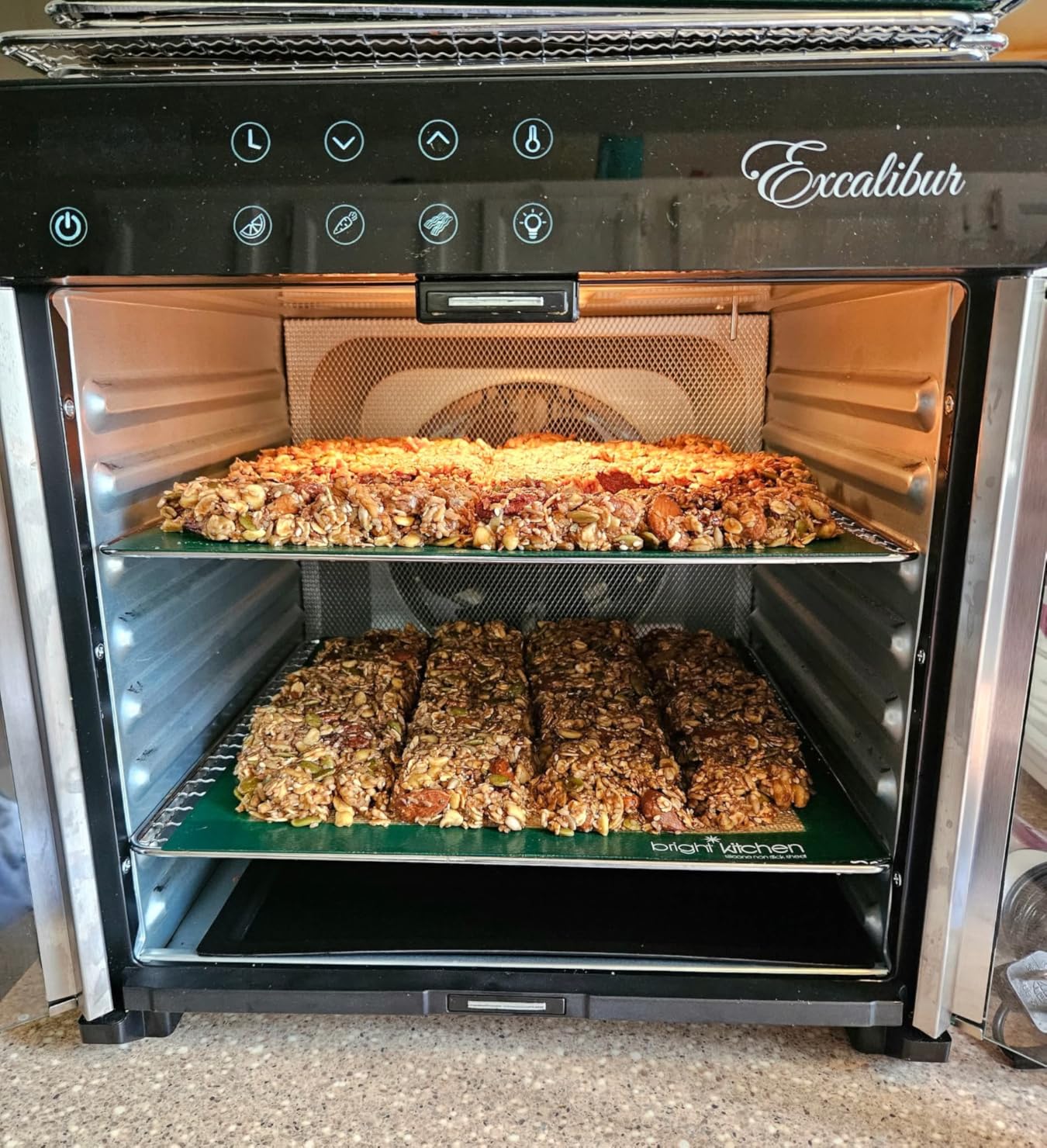
Clear glass French doors mean you can watch a load without losing heat, and at 16.5 pounds the unit is light for an eight-tray stainless machine. The chrome-plated drying trays resist staining better than bare plastic, which sticks to sugary fruit finishes.
The thermostat runs from 85 to 165 degrees Fahrenheit, and the compact footprint is genuinely smaller than most eight-tray boxes. If you need the machine to fit between two cabinets or on a narrow counter run, that is a real advantage. Our Excalibur versus Nesco comparison goes deeper on how the brand’s airflow approach differs from vertical-stack designs.

Who the Excalibur 8-Tray suits
Long, slow fruit cycles in a compact space. The 80-hour timer and the horizontal airflow make it a good fit for people who dry one fruit type for two days at a time rather than running short batches.
Forum owners repeatedly name Excalibur as the brand to buy if you are serious, specifically for drying one fruit type at a time in a single batch. This is the compact expression of that idea, and it suits households with a moderate surplus rather than a commercial volume.
Where the Excalibur 8-Tray falls short
Eight trays is the smallest count among the large-batch picks here, and at 7.2 cubic feet of drying space the chamber is not built for the heaviest harvest nights. If your surplus is measured in bushels, you will be reloading.
The 165 degree ceiling is low, 700 watts is the second-lowest power figure in the group, and the 1-year warranty with 8 percent one-star ratings is the weakest coverage here. For a compact long-cycle machine the trade-offs are reasonable, but it is not the box you buy when throughput is the goal.
10. OLIXIS 8 Tray Dehydrator – Budget Capacity With a 3.3-Pound Per-Tray Rating
OLIXIS Food Dehydrator Machine, 500W Jerky Dehydrators with 8 Stainless Steel Large Trays, 185°F Temperature Control & 24H Timer Food Dryer for Fruit Meat Herb Dog Treats, Silver
8 stainless trays
8.2 sq ft
3.3 lb per tray
500W
85-185 F
Under 45 dB
Pros
- Lowest cost in the roundup with 8 stainless steel trays included
- 3.3 lb per tray across 8.2 sq ft of drying space
- Quietest rating class here at under 45 dB
- 85-185 F range with a 48-hour timer in 30-minute steps
Cons
- Lowest wattage at 500W
- so full loads take longer
- Feature bullets advertise 24 hours while the specs list 48 hours
- Smallest trays in the group
- No mesh or fruit roll sheets included
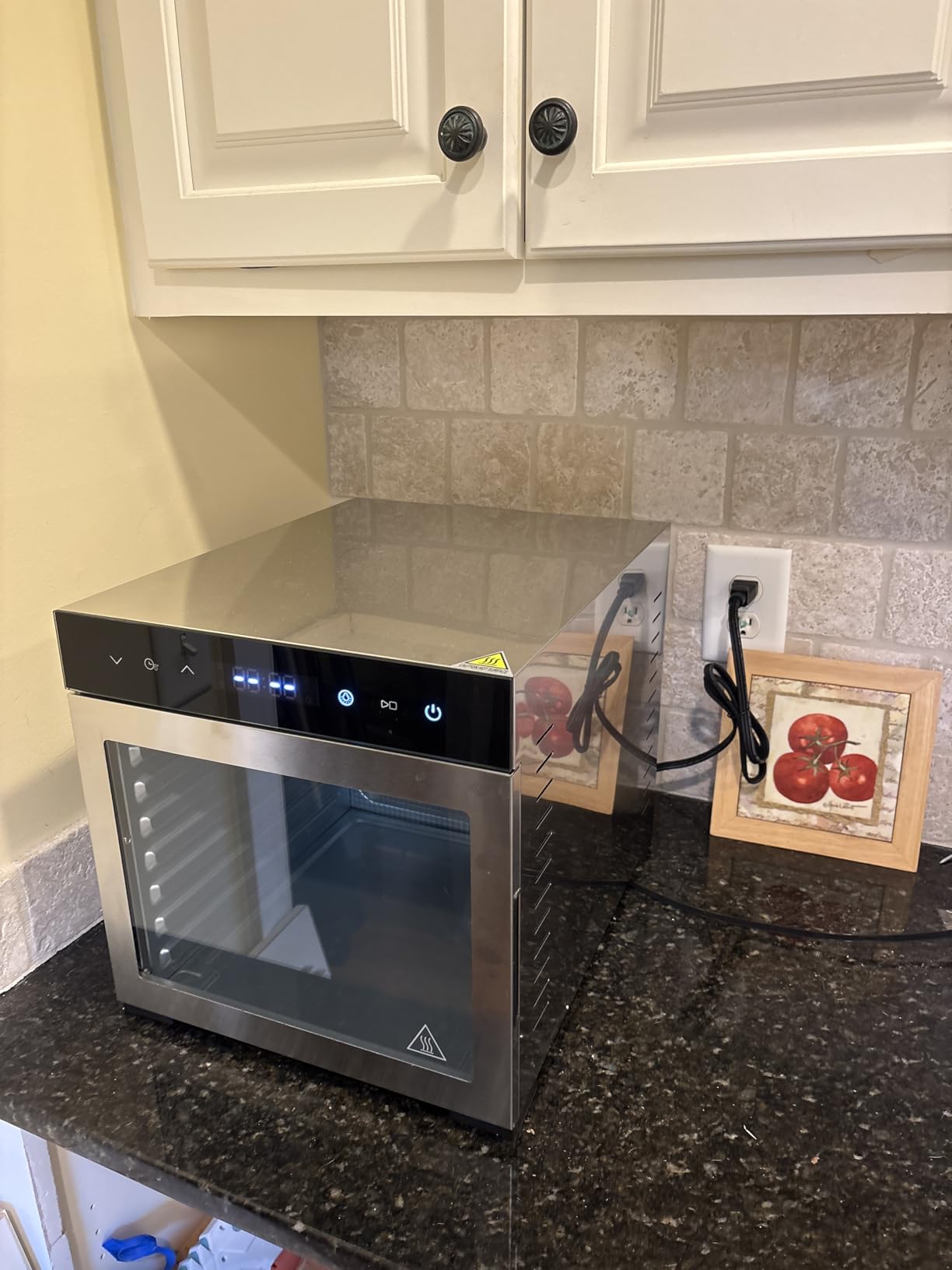
The OLIXIS is the value entry in this roundup, and the per-tray figure is what makes it interesting for fruit. A rated 3.3 pounds per tray across eight stainless trays is a high per-layer number, and at 8.2 square feet of total drying space the chamber gives you more usable area than several machines with more trays.
Horizontal airflow with a drying fan keeps the eight racks even, and noise is rated under 45 dB, which puts it in the quietest group. The 85 to 185 degree range with a 48-hour timer adjustable in 30-minute steps covers everything from gentle fruit to a hotter finish.
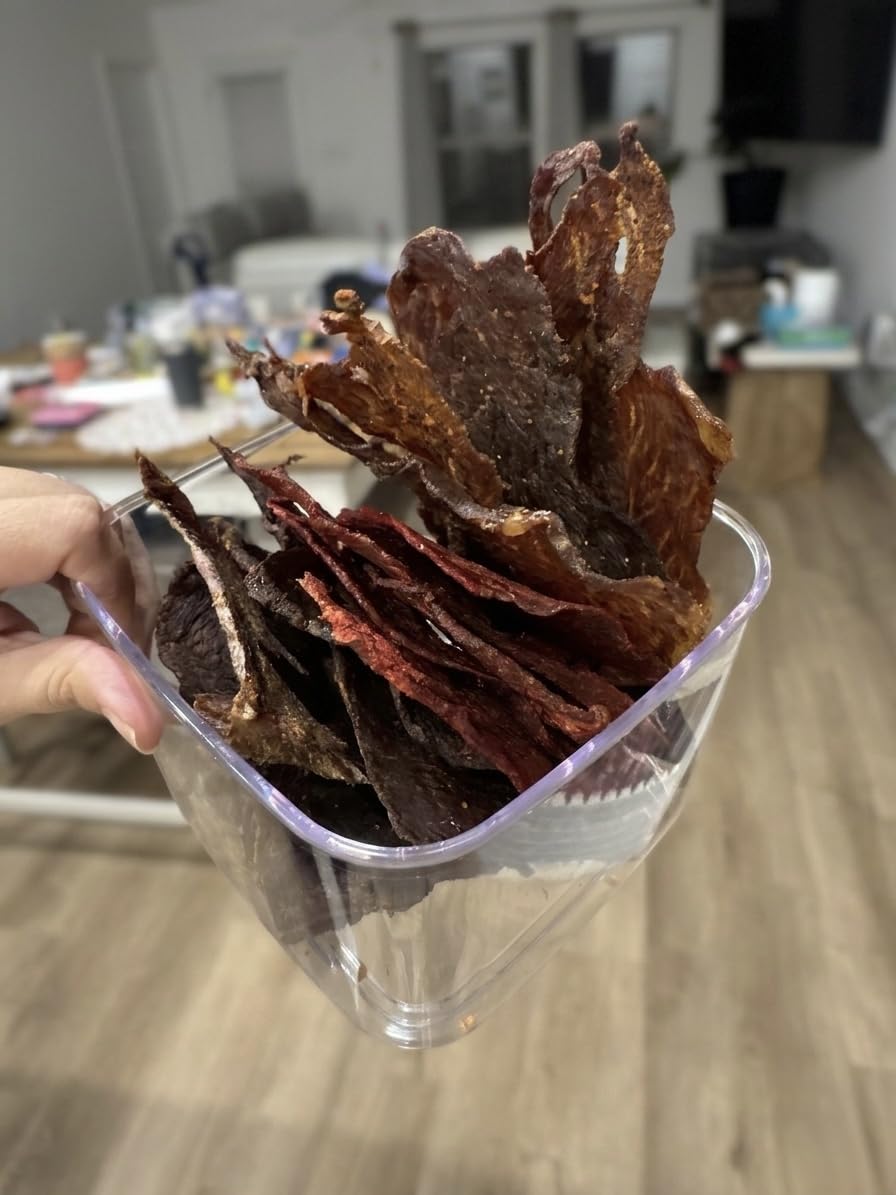
Trays are dishwasher safe and measure 11.7 by 12.6 inches. The built-in interior light is a nice touch at this cost, and overheat protection is included, which is a sensible safety feature for unattended overnight runs.
The documentation is inconsistent in one place: the feature bullets advertise a 24-hour timer while the specification list gives 48 hours. Check the control panel when the unit arrives so you know what you are actually working with.
Who the OLIXIS 8-Tray suits
First-time buyers and seasonal users who want stainless trays and a decent per-tray load rating without committing to a large machine. It also works as a second unit for fruit leather, since the tray count is small but the per-tray capacity is generous.
If your volume is measured in a few bushels a year rather than a steady weekly supply, the slower drying time that comes with 500 watts is an acceptable trade for the lower entry cost and the quiet operation.
Where the OLIXIS is the wrong buy
500 watts is the lowest figure in the roundup, and spread across eight trays it means full loads take noticeably longer. If you are racing a September frost, that is the wrong trade.
Trays are also the smallest in the group, and only a user manual is included, so you will need to buy mesh screens and fruit roll sheets separately for small fruit or leather. With 119 reviews the sample is thin, and 18 percent of reviewers rated it 4 stars, which suggests uneven results for some users.
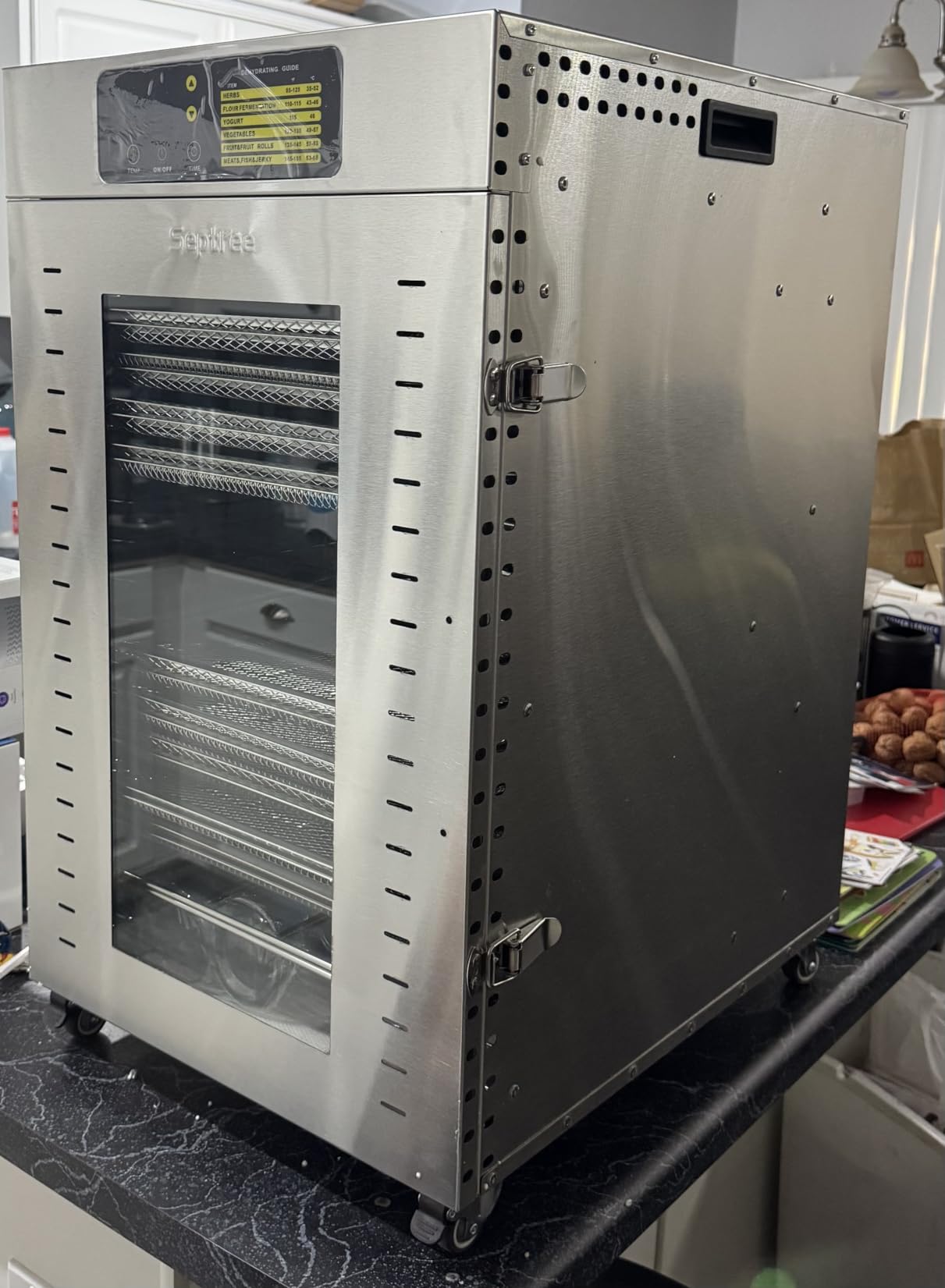
11. Septree 18 Tray 2000W Commercial Dehydrator – 34.42 sq ft of Drying Area
Septree Commercial Food Dehydrator 18 Trays, 2000W Large Capacity 34.42ft² Food Dryer Machine for Jerky, Meat, Fruit, Herbs, Full Stainless Steel Industrial Dehydrater Biltong Maker
18 trays at 15.67 in
34.42 sq ft
2000W
70-190 F
Continuous duty rating
Pros
- Largest usable drying area here at 34.42 sq ft across 18 large trays
- 2000W matched to 18 trays for strong fast drying
- Rated for continuous 7 x 24 hour operation
- Accessory set with hanging jerky racks
- fruit roll sheets and silicone liners
Cons
- Highest cost in the roundup and the tallest at 29.53 in
- Needs a dedicated counter or shelf given the footprint
- 6 percent of reviewers rated it 3 stars
This is the machine to look at if a harvest outruns your patience. Eighteen stainless trays of 15.67 inches each give up to 34.42 square feet of usable drying area, which is more than five times the area of the smallest machine in this roundup and enough that a serious orchard surplus stops being a race against rot.
The 2000 watt heating capacity is matched to that tray count, roughly 111 watts per tray, and the unit is rated to run continuously seven days a week. For a small food business drying fruit through the season, that continuous rating matters more than any single specification, because it tells you the machine was specified for sustained use rather than occasional bursts.
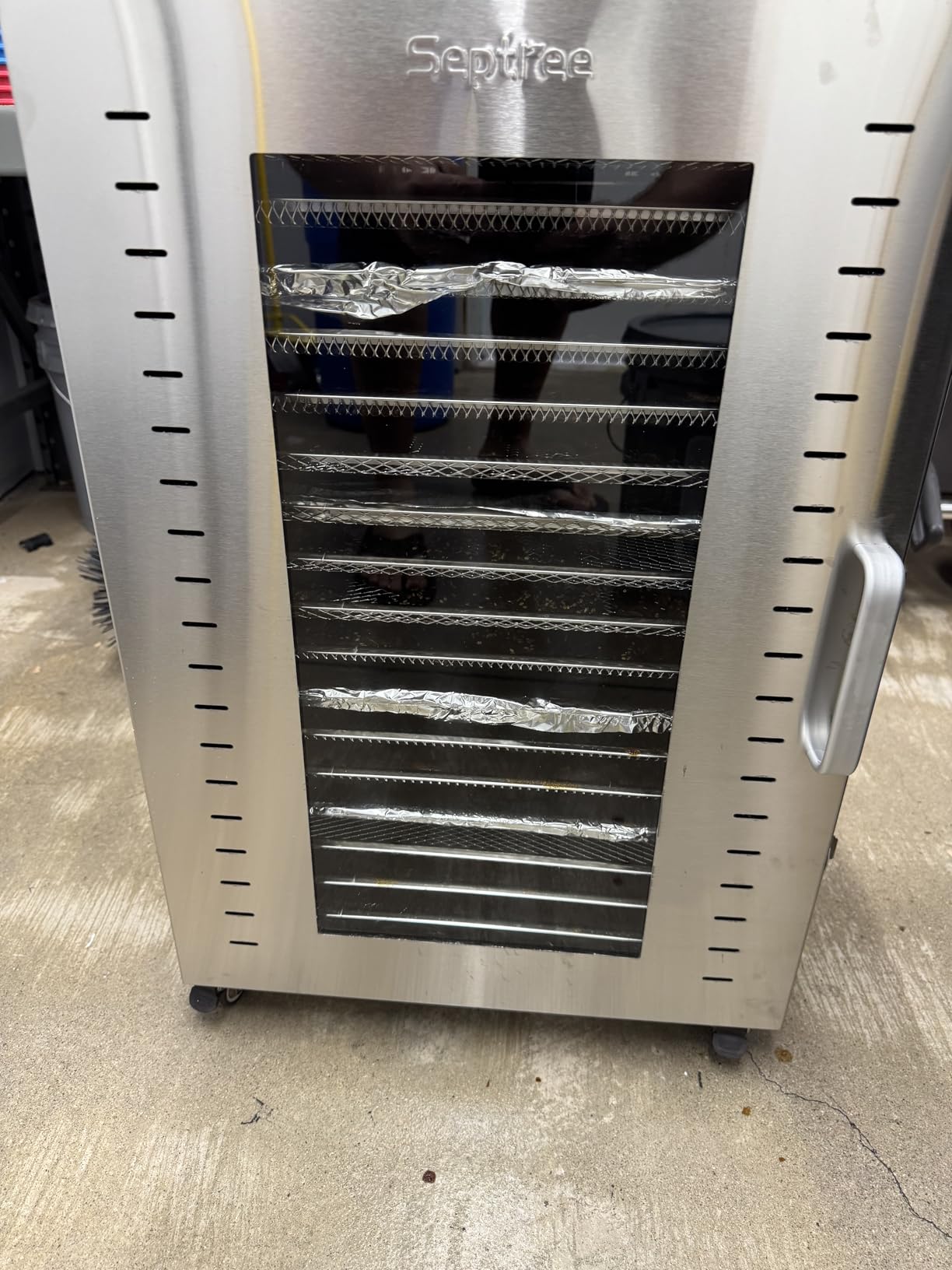
Temperature presets run from 70 to 190 degrees Fahrenheit with an integrated 0.5 to 24 hour timer, automatic shut-off when the timer completes, and overheat protection. The body is BPA-free food-grade stainless steel with a visible glass front door so you can track progress across eighteen trays without opening anything.
The accessory bundle is the most complete here: four fruit roll trays, two hanging jerky racks with 20 hooks, 18 non-stick silicone sheets, a drip tray, heat-resistant gloves and two storage containers. Horizontal airflow keeps noise below 50 dB, and trays and liners are dishwasher safe.
Who the Septree 18-Tray suits
Small farms, orchardists and cottage food businesses that dry fruit every week across the season. At this area, one overnight run can absorb a meaningful share of a large harvest, which is the entire argument for buying commercially sized equipment.
It also suits anyone who runs a market business where drying capacity is the bottleneck rather than the recipe. The 3-year after-sales service is among the longer coverage periods on the list.
Where the Septree demands commitment
At 29.53 inches tall and 21.46 by 17 inches across, this is a dedicated appliance. It needs a sturdy shelf or a permanent counter position, and it is not the machine you pull out only during harvest season unless someone helps you move it.
It is also the highest cost in the roundup, and 6 percent of reviewers rated it 3 stars, pointing at uneven drying or durability issues. Big capacity plus big power draw plus a large footprint means you should only buy this if the fruit keeps coming.
12. OSTBA 20 Tray Dual-Zone Dehydrator – Two Fruits at Two Temperatures at Once
OSTBA Food Dehydrator with 20 Trays, 1300W Dryer, 95–180°F Temp, 48H Timer
20 trays across 2 zones
1300W
95-180 F
48-hour timer
ETL certified
Pros
- Most trays in the roundup
- split across two independent drying zones
- Dual-zone controls dry fruit and meat at different temperatures without mixing
- 1300W heating system with a 48-hour timer and 10 presets
- Includes 10 mesh screens and 2 fruit roll sheets
Cons
- Widest body at 23.62 in so it demands counter space
- Heaviest unit in the group at 33.4 lb
- Louder than most rivals
- Only 51 reviews and a 12-month warranty
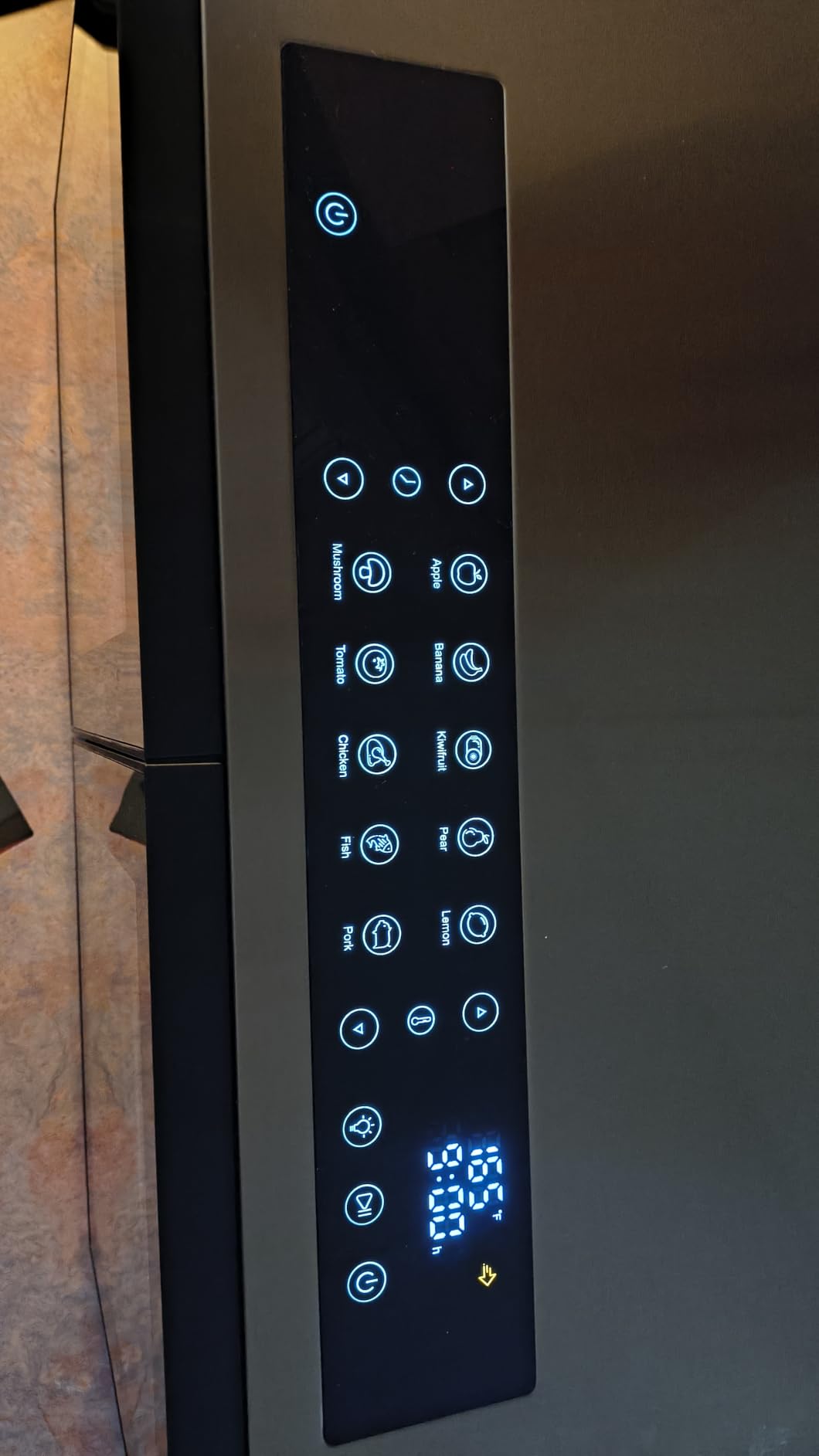
The dual-zone layout is the concept here. Ten trays on each side run with separate temperature and timer controls, so you can dry a batch of apple chips at one temperature and a batch of banana rounds at another in the same machine at the same time, without one fruit’s timing ruining the other or their flavours mingling in a shared chamber.
For a household with two fruit varieties competing for the same machine, that solves a real scheduling problem. Instead of running one fruit to completion and then starting the next, both finish together and you package once.

The 1300 watt heating system is well matched to twenty trays, and per-zone digital controls cover 95 to 180 degrees Fahrenheit with a 48-hour timer and 10 food presets. The unit is ETL certified with double-wall insulation and interior lights, and the fan runs for 30 seconds after shutdown to release residual heat.
It includes 20 stainless steel trays, 10 mesh screens and 2 fruit roll sheets, which is a strong accessory package. Mesh screens matter more than usual with twenty trays, because strawberries and small berries are the fruit most likely to end up on the floor of the chamber instead of on a tray.
Who the OSTBA 20-Tray suits
Preservers who run two or three fruit varieties in rotation and want them finished in a single cycle. Dual-zone control is the reason to pick this machine over a similar tray count with a single temperature chamber.
It also suits mixed fruit and meat households, where running a mild fruit program and a hotter meat program at once avoids a queue. The double-wall insulation helps with heat retention across a long batch.
Where the OSTBA is the biggest gamble in the set
At 33.4 pounds it is the heaviest machine here, and at 23.62 inches wide the largest. That is a large permanent counter commitment, and the noise rating under 58 dB is louder than most rivals, so it is not the machine to run in an open kitchen while cooking.
The bigger concern is evidence. With 51 reviews the sample is the thinnest in the roundup, 11 percent of reviews are one-star, and the warranty is 12 months, the shortest coverage here. The design is genuinely useful, but you are buying on the idea rather than on a long public track record.
Capacity Math: How Much Fruit Fits in One Load
The most useful capacity number is pounds of fresh fruit per load, and no competitor publishes it, so here is how to work it out from what the manufacturers do publish. Multiply the rated per-tray weight by the tray count where both figures are given, and otherwise estimate from tray surface area at roughly a quarter pound of sliced fruit per square foot for thin slices, more for halved fruit laid cut-side down.
Three machines in this roundup publish a per-layer rating. The Samson quotes up to 1 pound per tray across 9 trays, which is about 9 pounds in one load. The VEVOR rates 1.7 pounds per layer across 10 layers, which works out to about 17 pounds. The OLIXIS claims 3.3 pounds per tray across 8 trays. The Ivation has an owner reporting 6+ pounds per load, so treat that one as a floor rather than a ceiling.
From there, convert loads into nights. A household with a 9.6 square foot Samson clearing 9 pounds per run needs roughly 20 overnight runs to move 180 pounds of fresh fruit. An orchardist with the 34.42 square foot Septree clearing a comparable weight per tray has a very different calendar, which is the whole point of buying commercial capacity when you have the fruit to justify it.
Two rules of thumb keep the math honest. Never stack slices or overlap them, because touching surfaces never fully dry and end up leathery instead of crisp. And keep every tray in a load at the same cut size, since a mixed load finishes unevenly and forces you to pull the finished trays early.
Horizontal vs Vertical Airflow and the Tray Rotation Penalty
Horizontal airflow beats vertical airflow for large fruit batches, and the reason is mechanical rather than marketing. A rear-mounted fan pushes air across the tray plane, so every tray sits in a similar position in the airflow and receives comparable heat. A top- or bottom-mounted fan in a vertical stack dries the tray nearest it first and the furthest one last, and the gap between the two is large enough that one load ends up mixed-texture.
The consequence is the tray rotation penalty, and it gets worse as the stack grows. With three trays, swapping the top and bottom at the midpoint of a run is a two-minute job. With ten, you are pulling the whole stack apart, matching trays by position, and reassembling it, once or twice per cycle, in whatever order the fruit was loaded rather than in any system.
That is the single complaint forum owners raise most often about large-batch work, and it is why every horizontal-fan machine in this roundup is described as needing no rotation. The models here with rear-mounted fans are the Cosori, Magic Mill, Ivation, VEVOR, Ausegia, HOPERAN with dual fans, and the Septree and OLIXIS with horizontal airflow systems.
Evenness is not automatic, though. The Ausegia owners report middle trays drying less evenly and swapping them with the top shelves, so a horizontal fan reduces rotation without eliminating it. If you load thick fruit, check the top and bottom trays at the halfway point anyway.
How to Choose a Food Dehydrator for Large Fruit Batches
Start with square feet of drying space, not tray count. Square feet is the surface fruit actually sits on, and it is published on only a few of the machines here: 6.5 for the Cosori, 8.2 for the OLIXIS, 9.6 for the Samson, 22.67 for the Ausegia and 34.42 for the Septree. The Excalibur publishes 7.2 cubic feet, which is a volume measurement and not directly comparable, so treat it as a relative figure only.
Second, check watts per tray. That ratio tells you whether a full chamber keeps up. The VEVOR delivers 100 watts per tray, the Septree about 111 and the Ausegia 100, while the Magic Mill manages roughly 53 and the OLIXIS 62. Low ratios are fine if you are patient and dry seasonally, and frustrating if you are racing a frost or running a market business.
Third, decide about tray rotation honestly. Everyone in the forums asks whether large loads need rotating, and the answer is that horizontal-fan designs say no while vertical-fan designs say yes. If you already own a small vertical unit, adding a large horizontal one is the single most effective upgrade you can make for bulk fruit. We cover the architecture differences further in our Excalibur versus Tribest breakdown.
Fourth, look at the temperature range against your fruit. Most fruit sits happily between 125 and 145 degrees Fahrenheit, so a 165 degree ceiling is fine. If you dry high-moisture soft fruit, want fine low-end control, or plan to run meat as well, a wide 70 to 190 degree span like the Cercker or Septree gives you more room.
Fifth, check the timer. Large fruit batches run long, and a 48-hour timer covers more workflows than 24. The Excalibur 8-tray at up to 80 hours is the outlier, and the 24-hour keep-warm function on the Magic Mill is the most practical feature here, because it lets a finished load wait for you without over-drying.
Sixth, consider noise. The Cercker is rated at or under 40 dB and the OLIXIS under 45 dB, while the OSTBA is listed under 58 dB. If the machine lives in your kitchen rather than a garage, a difference of 13 decibels is the difference between running it while you cook and shutting it off.
Seventh, weigh the footprint honestly before buying. The Ausegia is 21.38 by 17.2 by 18.5 inches, the Septree is nearly 30 inches tall, and the OSTBA is 23.62 inches wide. The VEVOR at 31.1 pounds and the OSTBA at 33.4 pounds are two-person lifts, and a machine you cannot move will not get cleaned behind.
Eighth, check the warranty and the replacement parts situation. Coverage here ranges from 12 months on the OSTBA to 5 years on the Samson, with 2 to 3 years on the Cosori, Cercker and HOPERAN and 1 year on the Magic Mill and Excalibur. Longer is better on a machine with a lot of plastic, even when the trays are stainless.
Ninth, look at what is in the box. The Cosori, HOPERAN, VEVOR and OSTBA all include mesh screens and fruit roll sheets, which matter for strawberries, grapes and fruit leather. The Ivation and OLIXIS need accessories bought separately. The Samson includes a preparation chart for more than 40 foods, and the Septree and Cercker include heat-resistant gloves that you will use every single run.
Finally, ask how often the fruit actually arrives. If it is one annual windfall, a 9 to 15 tray horizontal machine is the right size. If it is a weekly supply through a growing season, or fruit you intend to sell, a dual-zone or 18-to-20-tray commercial machine earns its footprint. Buying above your real volume is the most common mistake we see, because a bigger chamber does not dry more fruit per watt.
Frequently Asked Questions
What is the best food dehydrator with a large capacity?
For most households preserving a seasonal harvest, the Magic Mill 15 extra-large tray model leads on capacity with a rear-mounted fan that avoids tray rotation. The Septree 18-tray at 34.42 sq ft of usable drying area takes more fruit per run, and the Cosori 6-tray is the safest first machine. Choose by square feet of drying space and watts per tray rather than tray count alone.
How long does it take to dry fruit in a dehydrator?
Most fruit dries between 8 and 16 hours at 125-145 F, with thin slices such as apple chips finishing fastest and halved or thick-cut fruit taking longest. Check trays at the halfway point and pull the first ones out early, because a fully loaded chamber of ten to twenty trays can take noticeably longer than a half-filled one on the same machine.
Do large dehydrators need tray rotation?
Horizontal rear-fan models generally do not, because air crosses every tray at the same height in the stack. Vertical-fan designs dry the top and bottom trays at different rates, and at nine to twenty trays that means disassembling the whole stack mid-batch. Even on horizontal models it is worth comparing the top and bottom trays at the halfway point, especially on thick fruit.
How big a dehydrator do I need for bulk fruit?
Work from pounds per load rather than tray count. Rated per-tray figures in this roundup work out to roughly 9 pounds for the Samson 9-tray, about 17 pounds for the VEVOR 10-tray and up to 26 pounds on the OLIXIS 8-tray. Multiply by the number of nights you can run the machine overnight to size it for your harvest.
Can you put dehydrator trays in the dishwasher?
Stainless steel trays from the Cosori, VEVOR, HOPERAN, Cercker, OLIXIS, Magic Mill and Septree are listed as dishwasher safe. Plastic trays and liners are easier on a top rack but can warp over repeated cycles, and owners on forums report that some stainless trays listed as dishwasher safe are not. Check the manufacturer’s care instructions before washing a full set of hot trays.
Is a dual-zone dehydrator worth it for fruit?
A dual-zone unit is worth it when you regularly dry two fruit varieties or fruit alongside meat, because the two ten-tray zones run at separate temperatures and timers so both finish in the same cycle. For a single-fruit harvest, one zone is plenty and a single-zone machine with more watts per tray will dry faster.
Which fruits and vegetables can be dehydrated?
Apples, pears, strawberries, bananas, mango, pineapple, oranges, peaches, grapes, tomatoes, herbs and greens all dry well, with temperature adjusted to the fruit. High-moisture soft fruit like strawberries and figs wants a gentle 95-105 F, while firmer fruit such as apples and pears works well at 125-145 F. Avoid fresh pineapple and mango for long storage without checking moisture content.
Final Verdict for Large Fruit Batches
For most people searching for the best food dehydrators for large batches of fruit, the answer is a horizontal rear-fan machine between 9 and 15 trays. Our pick is the Cosori 6-tray for proven reliability and quiet operation, the Magic Mill 15-tray for the biggest single load in a kitchen footprint, and the Ivation 9-tray when you want large racks and the ability to move the machine.
Move up a tier when the fruit keeps coming. The Ausegia 12-tray at 22.67 square feet suits market sellers, the Septree 18-tray at 34.42 square feet suits farms drying weekly through the season, and the OSTBA 20-tray dual-zone machine wins when you need two fruit varieties finished in the same cycle.
Whichever you pick, the numbers that decide the outcome are square feet of drying space, watts per tray, and whether the fan sits at the back. Those three figures predict how much fruit leaves your kitchen each morning far better than tray count does. Check the latest configuration before you order, and load every tray the same way.