
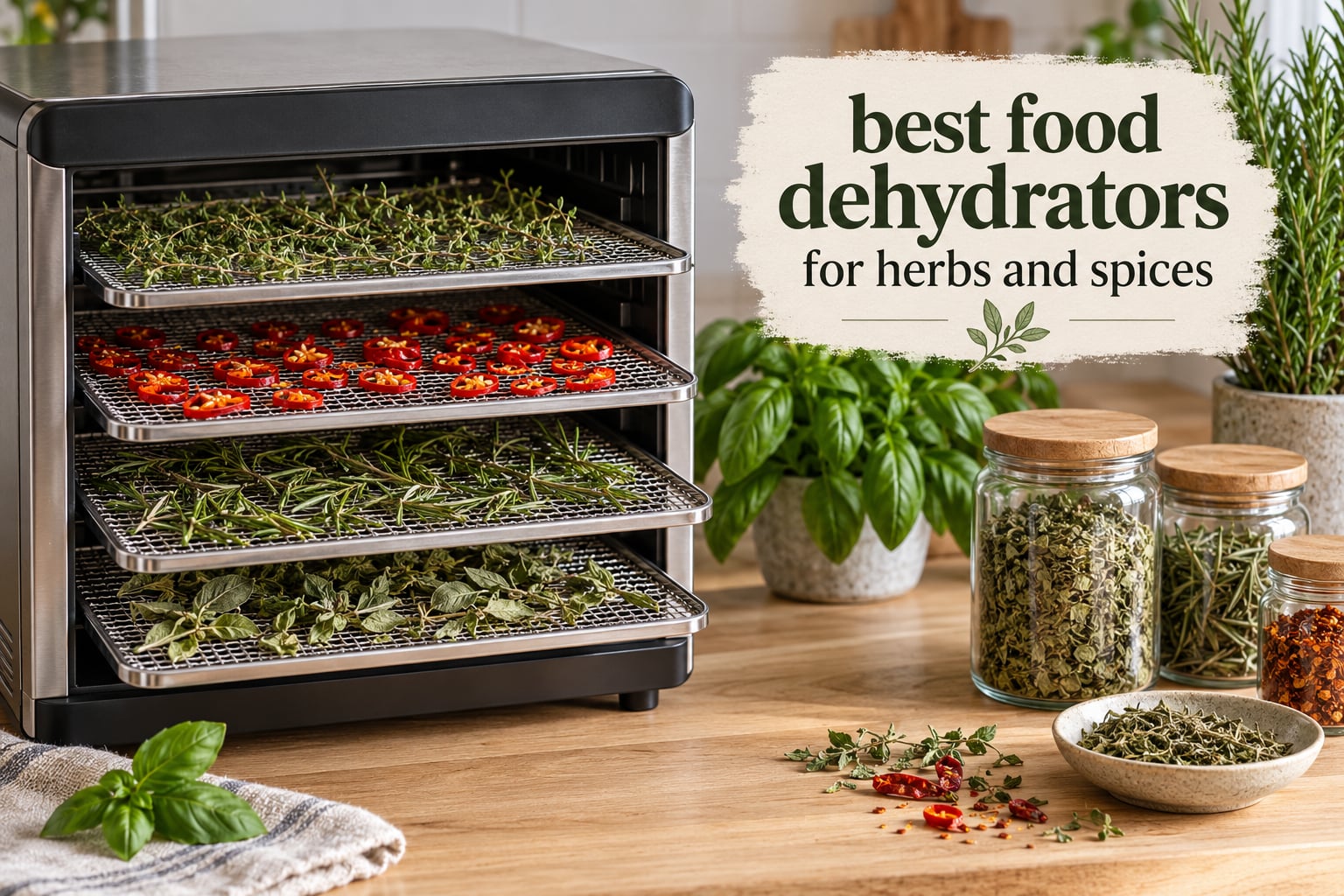
A summer herb garden produces far more basil, oregano, thyme and mint than any kitchen can use before it wilts. The same goes for a hot pepper harvest, and a fistful of fresh chilies turns into a jar of paprika that lasts all winter if you dry it properly. Choosing the best food dehydrators for herbs and spices comes down to one thing most spec sheets bury: how well the machine holds a low, steady temperature. Herbs live or die in the 95-115°F band, and a thermostat that drifts a few degrees up can bake off the volatile oils that give a dried leaf its aroma.
We spent weeks comparing the countertop dehydrators that actually show up in home kitchens, and we grouped them by how they behave on a tray of leaves rather than by price. The details that matter for herbs and spices are tray material, whether the fan sits at the back or the bottom, the width of the temperature range on the low end, and how many trays a real harvest fills. We also looked at noise, because a four-hour herb dry often starts after dinner and runs while you sleep.
If you are still working out how much herb you will grow, our hydroponic grow system guide for herbs covers the growing side. If you want the wider picture on all-around machines, our food dehydrator roundup covers jerky and fruit as well. This one is only about the low-temperature drying that herbs and spices demand.
Top 3 Picks for Drying Herbs and Spices in 2026
The short answer: the Cosori CP267-FD is the best food dehydrator for drying herbs because it holds 95-165°F precisely across six stainless steel trays, and its rear-mounted fan dries leaves evenly enough that you never have to swap trays mid-batch. Below it, the Cosori 5-tray gives you the same temperature range in a smaller, lighter body, and the Magic Mill 10-tray is the one to buy when a single garden harvest fills more than a couple of trays at once.

Cosori 6-Tray Stainless Steel
- 6 stainless steel trays
- 6.5 ft2 of space
- 95-165F digital control
- rear fan horizontal airflow

Cosori 5-Tray BPA-Free
- 5 BPA-free trays expandable to 7
- 95-165F in 1F steps
- 48-hour timer
- adjustable tray heights

Magic Mill 10-Tray 700W
- 10 extra-large stainless trays
- rear fan precision airflow
- 95-167F with keep-warm
- auto shutoff and overheat protection
All 12 Dehydrators Side by Side in 2026
Every model below dries herbs, but they are not interchangeable. Read across the temperature range first: anything that starts at 104°F cannot hold the very slow temperature that soft leafy herbs prefer, and anything that stops at 158°F is not a jerky machine. Tray count matters less than most buyers expect, since most gardeners run one or two big batches a season.
| Product | Specifications | Action |
|---|---|---|
| Cosori 6-Tray Stainless Steel Dehydrator |
|
Check Latest Price |
| Cosori 5-Tray BPA-Free Dehydrator |
|
Check Latest Price |
| Magic Mill 10-Tray 700W Dehydrator |
|
Check Latest Price |
 Magic Mill Pro 7-Tray Dehydrator Magic Mill Pro 7-Tray Dehydrator |
|
Check Latest Price |
 Hamilton Beach Digital Dehydrator Hamilton Beach Digital Dehydrator |
|
Check Latest Price |
 Cosori 5-Tray Compact Dehydrator Cosori 5-Tray Compact Dehydrator |
|
Check Latest Price |
 Magic Mill 5-Tray Compact Dehydrator Magic Mill 5-Tray Compact Dehydrator |
|
Check Latest Price |
 Elite Gourmet 4-Tray Dehydrator Elite Gourmet 4-Tray Dehydrator |
|
Check Latest Price |
 Septree Compact 4-Tray Dehydrator Septree Compact 4-Tray Dehydrator |
|
Check Latest Price |
 Commercial Chef 5-Tray Dehydrator Commercial Chef 5-Tray Dehydrator |
|
Check Latest Price |
 HOPERAN 12-Tray Dehydrator HOPERAN 12-Tray Dehydrator |
|
Check Latest Price |
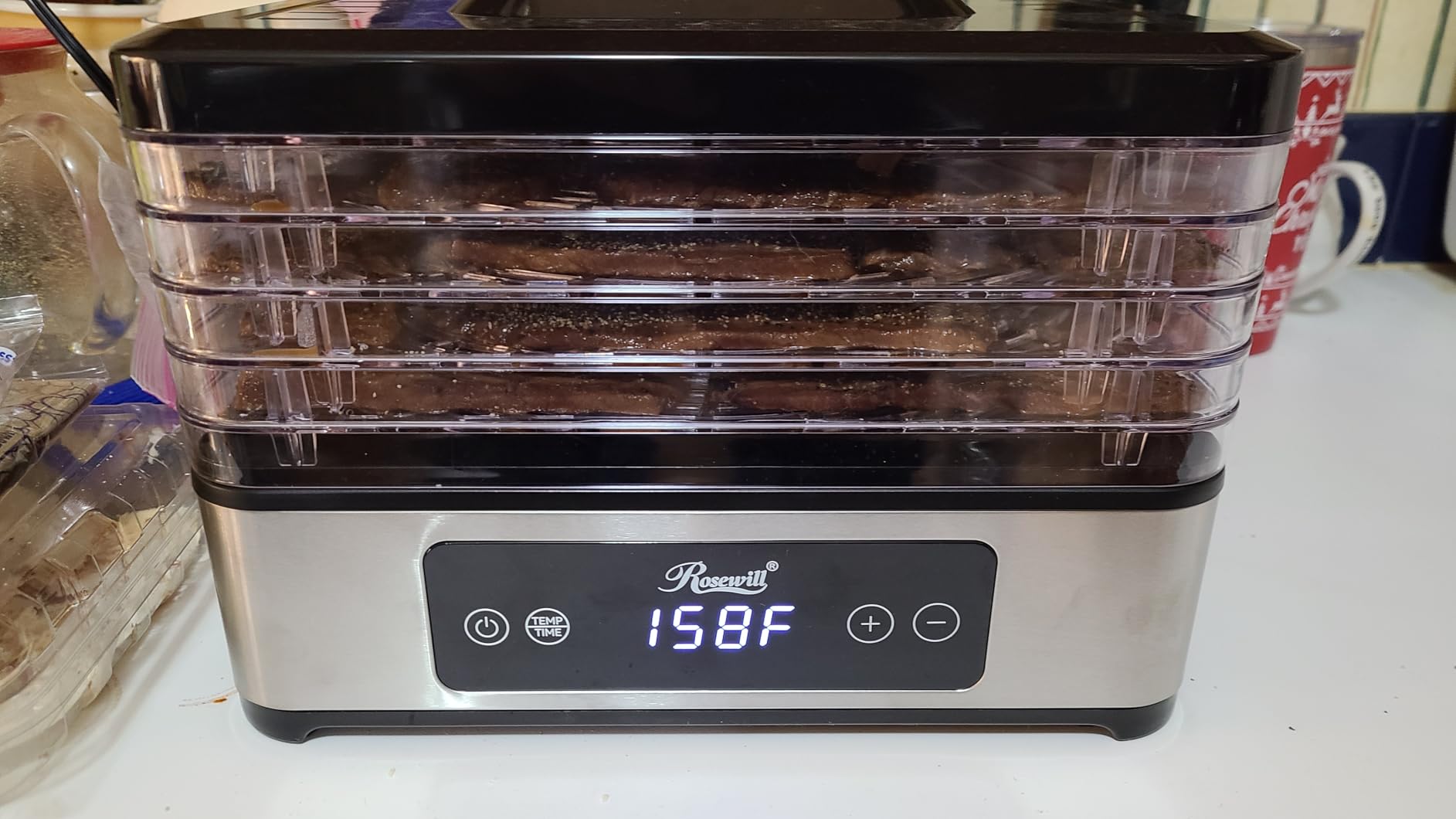
 Rosewill Compact 5-Tray Dehydrator Rosewill Compact 5-Tray Dehydrator |
|
Check Latest Price |
How to Dry Herbs and Spices Step by Step
Yes, you can dry herbs in a food dehydrator, and it is the right tool for the job. A household oven cannot do it: ovens either run far hotter than a leaf can tolerate or sit cool enough to encourage mold. A dehydrator holds a steady low temperature and moves air across every tray, which is exactly the combination that removes water without removing aroma.
Wash and dry the herbs. Rinse under cool water, shake off the excess, and lay on a towel. Any surface water left on a leaf turns into steam and slows the dry.
Strip the leaves. Pull leaves from stems for basil, thyme and oregano, and snip chives into short lengths. Woody herbs like rosemary, sage and bay can stay on the stem, or you can strip them for faster, more even drying.
Load one layer, no piling. Spread a single layer on the mesh screen. Touching leaves hold moisture between them and finish damp.
Set 95-115°F and start the timer. Leafy herbs need the low end. Chilies and thicker stems tolerate and prefer 125-150°F.
Check at one hour, then every 30 minutes. Leaves are done when they crumble between your fingers with no cool or damp spot in the center.
Cool, then store airtight. Let the trays cool before sealing into glass jars, because warm herbs trapped in a closed jar give up their last moisture as condensation.
Drying temperature and time by herb type
Leafy herbs, woody herbs and chilies are three different jobs. This list is the shortcut most roundups leave out.
Basil, mint, oregano, thyme, dill – 95-115°F, 1-4 hours. Strip the leaves, load a single layer, use the lowest setting.
Chives, parsley, cilantro – 95-115°F, 1-3 hours. Snip into short lengths so the centers dry through.
Rosemary, sage, bay, woody thyme stems – 115-125°F, 3-6 hours. Can dry on the stem, or strip the leaves to speed it up.
Jalapeno, chili and cayenne peppers – 125-150°F, 8-20 hours. Halve or split large peppers for even drying.
Mushrooms, banana and apple chips – 135-160°F, 6-12 hours. Needs the higher end of the range.
1. Cosori Food Dehydrator with 6 Stainless Steel Trays – Best Overall for Herbs
Cosori Food Dehydrator, 6 Stainless Steel Trays with 6.5 ft² Drying Space
6 stainless trays, 6.5 ft2 space
95-165F digital control, 48-hour timer
600W, rear fan, under 48 dB
Pros
- Holds 95-165F precisely across every tray
- Large 6.5 ft2 area means a full herb batch in one run
- Rear fan dries evenly without tray rotation
- Quiet enough below 48 dB to run overnight
- Dishwasher-safe trays
- mesh screen and fruit roll sheet included
Cons
- Bulky stainless body takes real counter and cabinet space
- Recipe times are approximate for herbs
This is the machine we keep coming back to for herbs. Six stainless steel trays give 6.5 square feet of drying area, which sounds modest until you realize a tray holds a double layer of stripped basil leaves. Two or three trays cover most of what a home herb bed produces at peak, and the rest of the stack stays free for peppers or mushrooms in the same run.
Temperature control is the reason it earns the top spot, not the tray count. It holds 95-165°F with a 48-hour digital timer, and the rear-mounted fan pushes air across the trays rather than up through them. For a four-hour basil dry at 100°F, that difference decides whether the last tray finishes at the same time as the first.
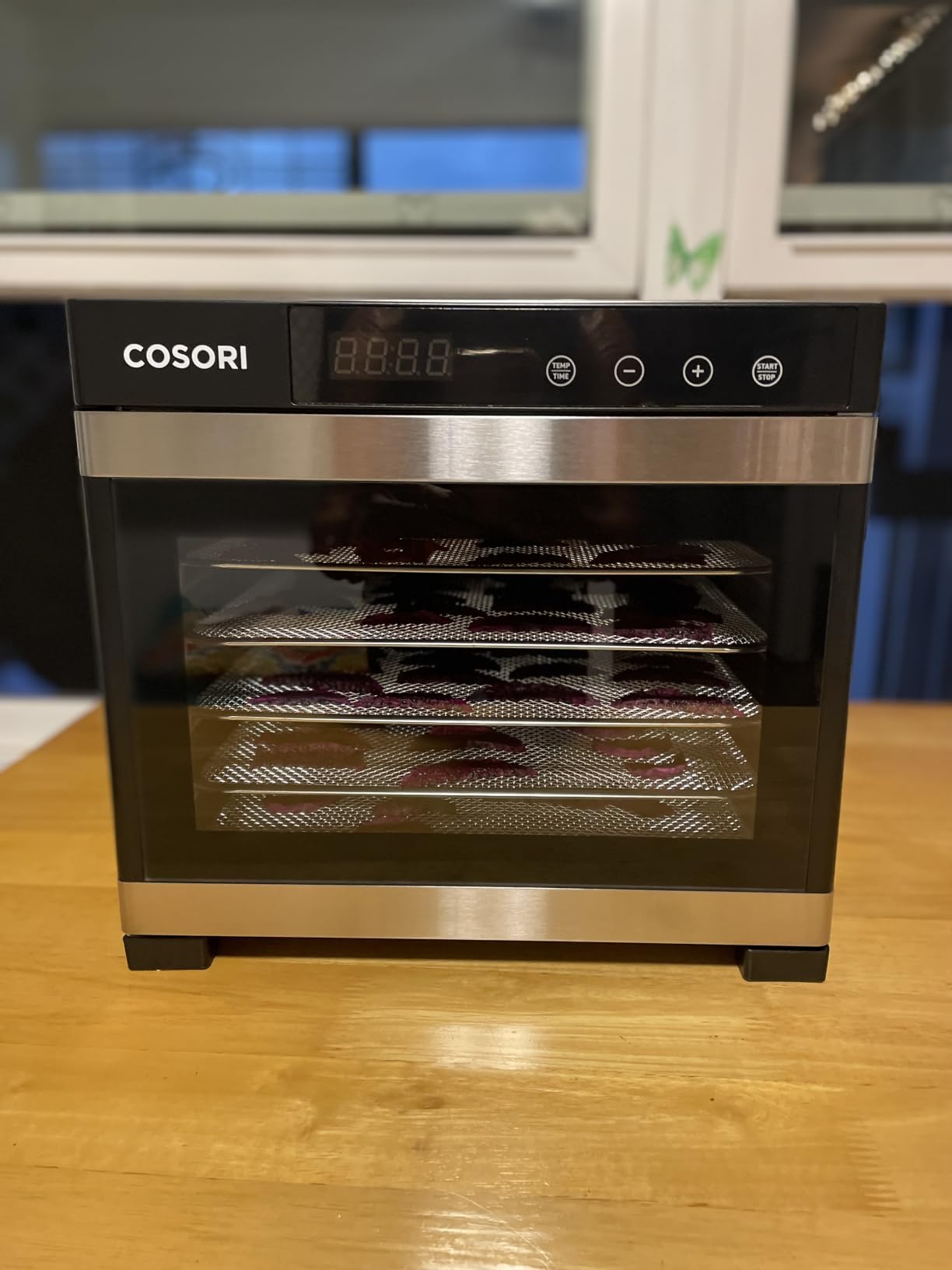
Owner reports repeat the same three points: drying is even, the controls are accurate, and the brushless motor keeps noise under 48 dB. That last figure is the practical difference between this machine and an older vertical-airflow box, where tray rotation becomes a permanent step in the process.
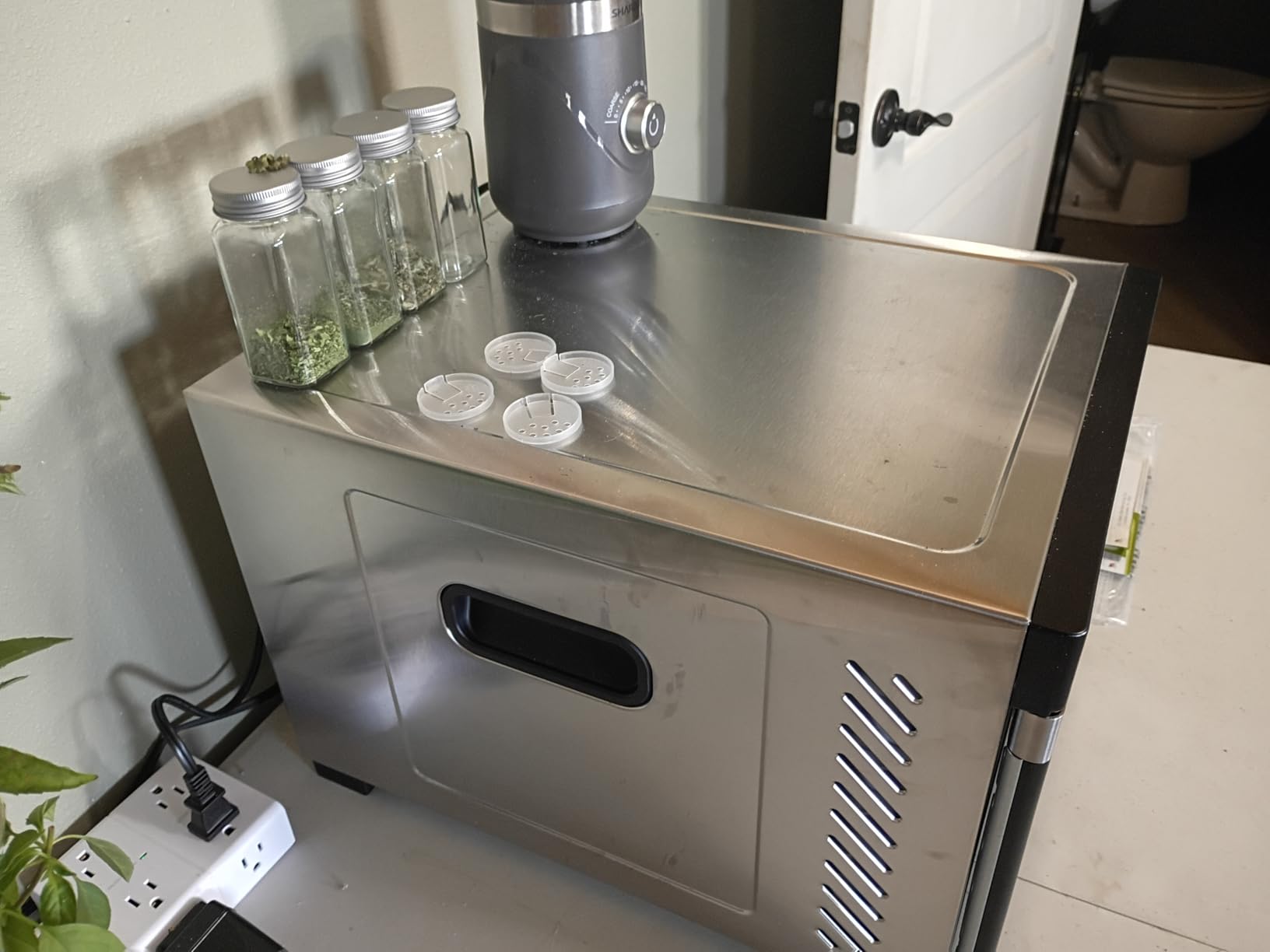
The 600W motor and the horizontal airflow design are what make that possible, and the included mesh screen gives small leaves like thyme something to sit on so they do not fall through the slots. Trays are stainless steel and dishwasher safe, which matters more for herbs than it sounds: basil and oregano leave behind sticky resinous oils that soak into plastic mesh and never fully come out.
Who this dehydrator suits
This suits a home gardener who dries a real harvest once or twice a season, wants trays that survive a decade of washing, and would rather set a number and walk away than babysit a stack. It also suits anyone who plans to grind dried herbs into powder, because the rear-fan airflow gives you evenly crisp material instead of a mix of brittle and slightly damp leaves.
If you live in an apartment, the measured sub-48 dB brushless motor is a genuine advantage over the older box-fan designs that dominate noise complaints in drying forums.
Where it falls short
At 18.1 pounds it is a heavy appliance for its size, and it is not something you will tuck away. If your counter is the only flat surface you have, the bulk is real. The bundled recipe book gives approximate drying times rather than herb-specific guidance, so the first two batches are still trial and error.
2. Cosori Food Dehydrator with 5 BPA-Free Trays – Best Value
Cosori Food Dehydrator, 5 BPA-Free Trays, 165°F Temperature Control, 350W
5 BPA-free trays, expandable to 7
95-165F in 1F steps, 48-hour timer
Under 47 dB, adjustable tray heights
Pros
- Same 95-165F range as the larger Cosori
- Expands from 5 to 7 trays as your harvests grow
- Adjustable tray heights suit thick stems and big pepper halves
- Runs quietly under 47 dB
- Tray coating releases sticky fruit leather easily
Cons
- Recipe times are rough guides
- top trays dry faster than bottom trays
- Round trays waste center space unless you trim parchment
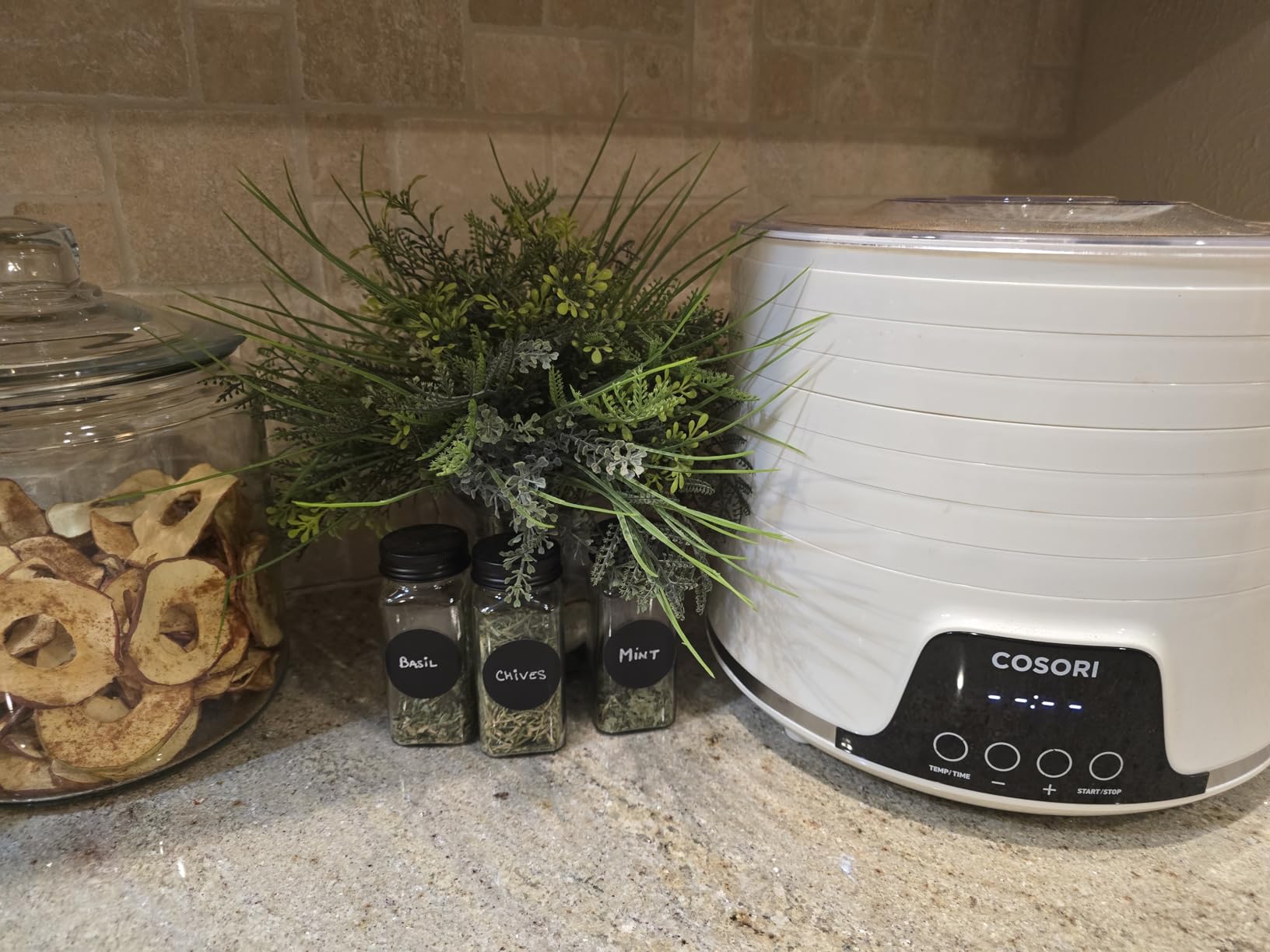
For most home users this is the right-sized answer. It runs the same 95-165°F range as the six-tray model and adjusts in single-degree steps, so the herb setting that matters is available. The difference is capacity and the housing: this one is plastic-bodied, weighs under 5 pounds, and expands from five trays to seven when you add the extras.
What we like most for herbs is the adjustable tray height. Sparse layout on a bed of sage or rosemary is the one adjustment that reliably shortens the dry, because air can move past the stems instead of pooling underneath them. On a fixed-spacing machine you are stuck leaving gaps around everything, which wastes the tray.
Reviewers highlight stable temperature control and quiet running, and the tray coating does release sticky fruit leather and jerky without scrubbing. The 350W draw is modest, so a full load of herbs at 100°F takes a few hours rather than an afternoon, but herbs are not a rush job.
The round tray shape is the part we would design differently. It is efficient to manufacture and easy to stack, but it leaves an unused circle in the middle of every tray and it does not accept a standard sheet of fruit leather or parchment, so you have to trim your own liners. For flat leaves like oregano that is a minor issue. For peppers and larger cuts it is mildly annoying.
Who this dehydrator suits
This suits a first-time buyer with a small herb bed, or anyone in a kitchen where a stainless box simply will not fit. The ability to grow from five trays to seven means you do not have to buy a second machine the year your garden takes off, which is the most common upgrade path reviewers describe.
It is also a good match for blending custom spice mixes, since the single-degree steps let you dry basil at 100°F and then push to 135°F for peppers in the same machine without swapping equipment.
Where it falls short
The top trays finish ahead of the bottom trays on long runs, so swapping the stack partway through helps if you are drying for powder rather than for whole leaves. The included recipe timings are approximate, and the mesh liners used for fruit leather and jerky are sold separately. Treat the built-in times as a starting point, not a schedule.
3. Magic Mill Premium Food Dehydrator with 10 Extra-Large Trays – Best for Big Harvests
Magic Mill Premium Food Dehydrator Machine (10 Extra-Large Stainless Steel Trays) 700W Dryer for Beef Jerky, Fruits, Vegetables, Dog Treats, 48 Hour Digital Timer – 95°-167° Temperature Control
10 extra-large stainless trays
Rear fan, 95-167F, 48-hour timer
Auto shutoff and overheat protection
Pros
- Ten extra-large trays cover a full garden harvest in one run
- Rear-mounted fan and precision airflow dry evenly across all levels
- 95-167F with keep-warm hold
- Auto shutoff and overheat protection for unattended runs
- Dishwasher-safe trays with a transparent door
Cons
- Heaviest unit here at over 20 pounds
- Bulk footprint occupies substantial counter or shelf space
When people underestimate dehydrators, this is the failure mode: buying a five-tray unit and running four batches in a row because the first one was full. Ten extra-large stainless trays solve that. If you grow a serious herb bed, dry peppers for paprika, or hand jars to people, one run of this machine replaces an afternoon of shuffling trays in and out of something smaller.
The rear-mounted fan and 700W element are the reason we can recommend it for a full load without reservation. Air moves horizontally across all ten levels, so a tray of mint on level two dries at close to the same rate as a tray of mint on level nine. Owners running large fruit and jerky batches single out the same evenness.
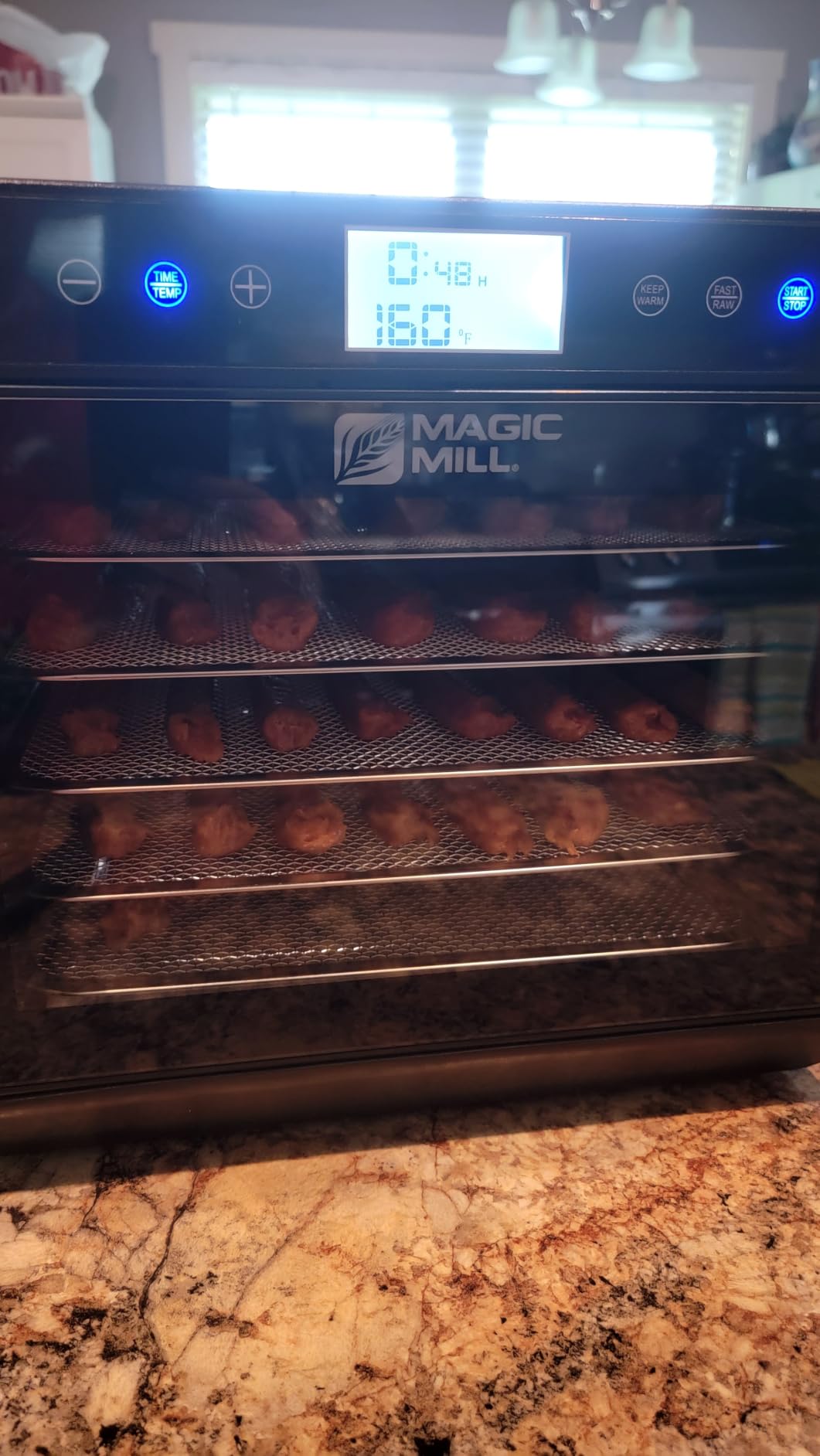
Control runs from 95-167°F with a 48-hour countdown, and there is a keep-warm hold once the cycle ends so you can pull trays off at their own pace instead of racing a shutoff. Automatic shutoff and overheat protection are the two features that make an overnight run reasonable, and the transparent door means you can check progress without opening the box and losing heat.
Trays and liners are dishwasher safe, and the extra-large footprint means more leaves per layer, which is the metric that actually matters for herbs. Most small trays hold a thin scatter; these hold enough to finish a season of basil in a single pass.
Who this dehydrator suits
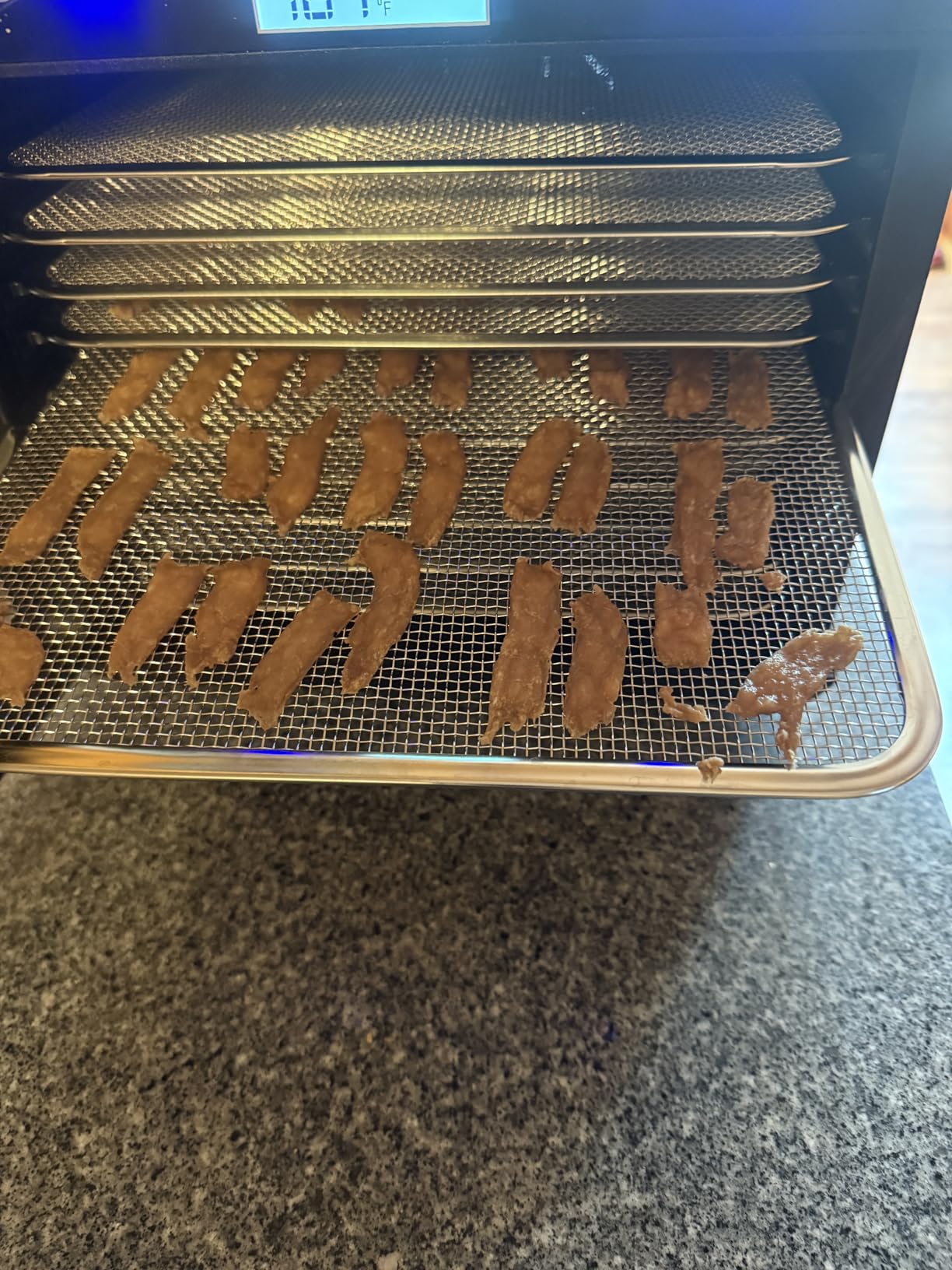
This suits the person whose herb problem is volume, not precision. A big garden, a CSA membership, a cottage food operation, or a habit of gifting labeled jars will fill ten trays. It is also the right call if you plan to dry chilies in quantity, since peppers take far longer than leaves and any queue of waiting batches doubles the total time.
The keep-warm function earns its keep for anyone batching at scale, because you can start a full load, let it finish, and then harvest each tray over a relaxed window without everything sitting there for hours afterward.
Where it falls short
It weighs over 20 pounds and takes up more room than anything else here. Moving it to a high cabinet is a two-person job, and it will not disappear into a small kitchen. If you are only drying a few trays a year, this capacity is money and counter space spent on a problem you do not have.
4. Magic Mill Pro 7-Tray Dehydrator – Full Stainless Build
Magic Mill Pro Food Dehydrator Machine | Powerful 600W Rear Fan Even-Drying System | 7 Full-Size Stainless Steel Trays | 95°-176° Temperature Control, 48H Timer, Keep Warm + Auto Shutoff | ETL Listed
Full stainless interior and exterior
600W rear fan, 95-176F in 1F steps
7 trays, keep-warm, auto shutoff, ETL Listed
Pros
- Stainless steel inside and out with no plastic walls
- Rear fan and rear heat remove bottom hot spots
- 1F control from 95-176F covers herbs through jerky
- 48-hour timer with auto shutoff
- Mesh screens and fruit roll tray bundled
Cons
- Start and stop button is very touch-sensitive
- Seven trays cover less ground than the 10- and 12-tray models
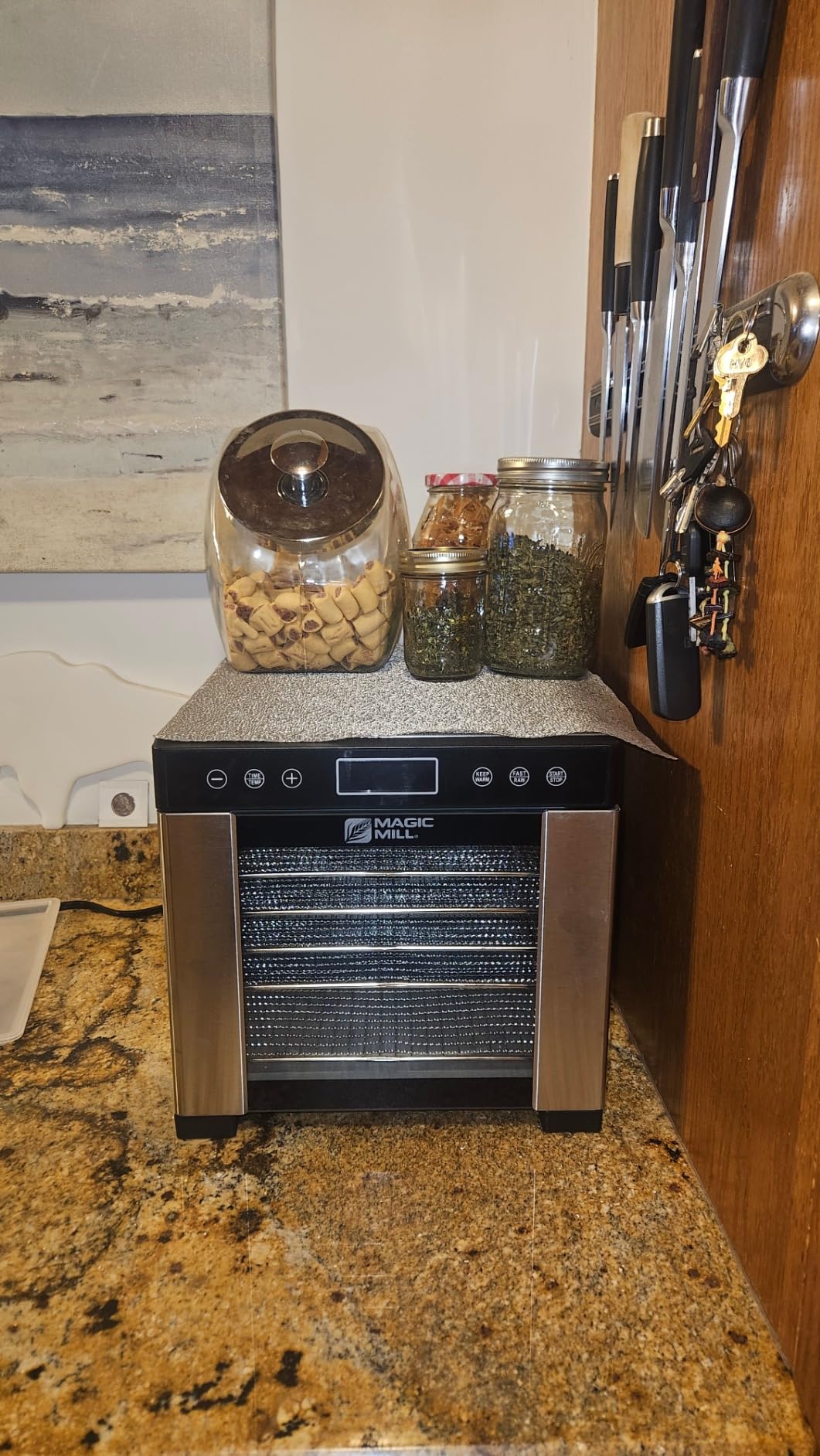
The Magic Mill Pro is the one we recommend when someone is bothered by plastic housings. The interior and exterior are stainless steel, which matters over a decade of use because plastic bodies yellow, crack around hinges, and eventually give you a door that does not seal. Seven full-size trays plus two mesh screens and a fruit roll and drip tray cover everything a spice-focused user does.
Temperature control runs 95-176°F in single-degree increments, giving you both ends of the herb range and enough headroom for peppers on the same machine. The rear fan and rear heat placement is the design decision here: it moves air across the trays rather than up them, which removes the bottom-tray hot spot that makes people rotate on cheaper units.
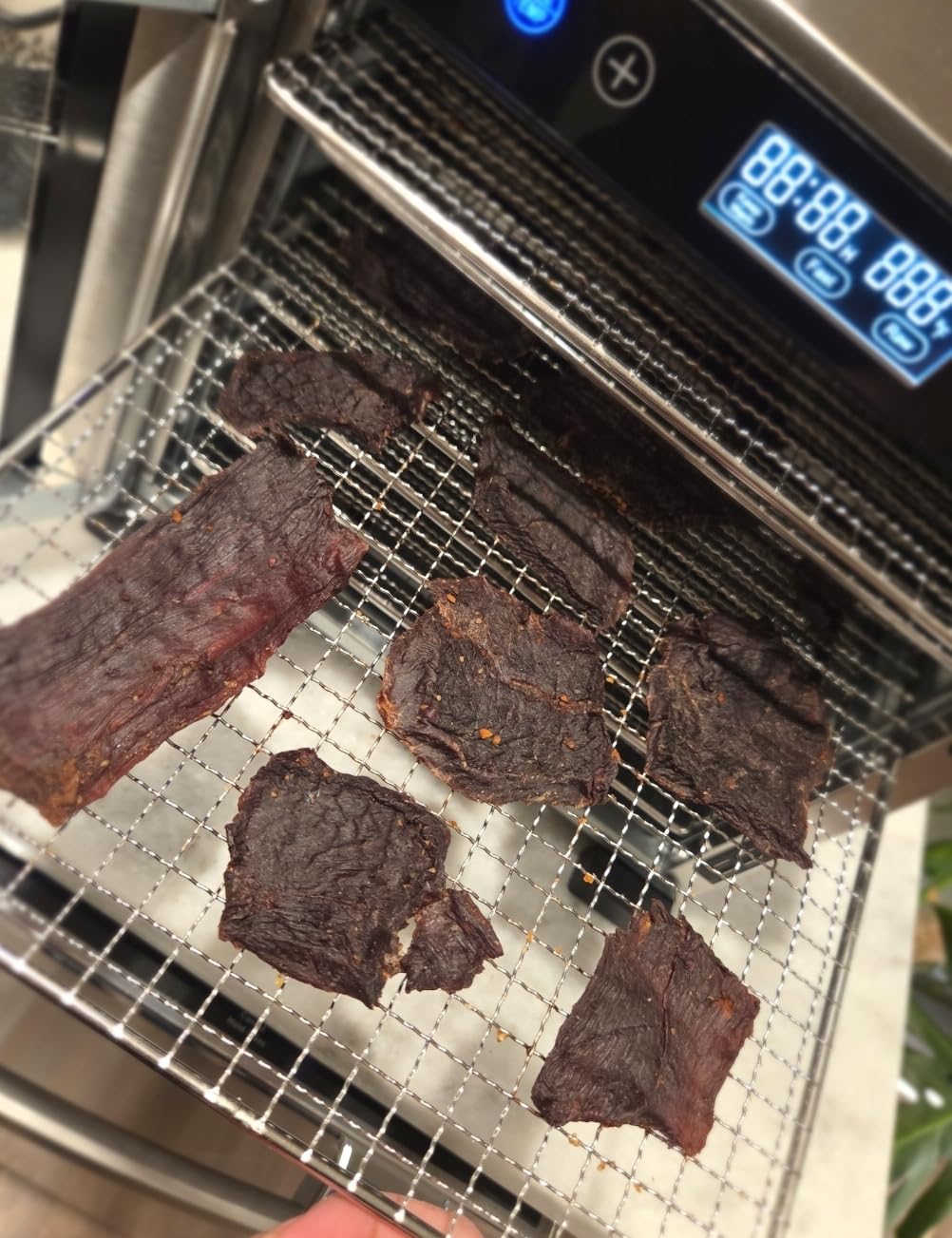
Owners report fast, even drying and quiet operation, and the ETL Listed certification is a reasonable signal for an appliance that will run unattended for hours. There is a 24-hour keep-warm hold alongside the 48-hour timer and auto shutoff, so a batch does not have to be harvested the second it finishes.
The bundled mesh screens are worth calling out for herbs specifically. Small leaves like thyme, oregano and marjoram need a screen with openings fine enough to hold them, and buying a replacement set after the fact is a step most owners forget until they are chasing leaves across the kitchen floor.
Who this dehydrator suits
This suits anyone who plans to keep their dehydrator for years and would rather not think about plastic parts again. It is a natural fit for a household that dries herbs, chilies and mushrooms in the same week, since the 176°F ceiling covers pepper powder work without a second appliance.
The compact footprint also helps. It fits under most kitchen cabinets, which removes the objection that pushes people toward a small tower unit in the first place.
Where it falls short
The start and stop button is very touch sensitive and can halt a cycle by accident, which is a genuine problem on an overnight herb dry where nobody is awake to press it again. That is the one design flaw owners raise most often, and it is worth knowing before you commit.
5. Hamilton Beach Digital Food Dehydrator – Best for Small Kitchens
Hamilton Beach Digital Food Dehydrator for Fruit, Jerky, Vegetables & More
5 stackable trays, 4.2 sq ft space
100-160F adjustable
48-hour digital timer with auto shutoff
Pros
- Square footprint stores neatly in a cupboard
- 5 stackable trays give 4.2 sq ft of space
- Base heater and fan dry without tray rotation
- Digital 1-48 hour timer shuts off automatically
- Mesh screen and fruit leather sheet included
- Dishwasher-safe trays and lid
Cons
- Only one coarse mesh screen so small leaves fall through
- Top racks dry faster than bottom racks
- Fan noise is noticeable
The square footprint is the reason this one earns a place. Dehydrators are usually wide rectangles that eat a stretch of counter permanently, but this box is 10.4 by 13.2 inches and stacks down into a cupboard when the harvest is done. For an apartment kitchen with one clear surface, that changes the math more than any spec on the label.
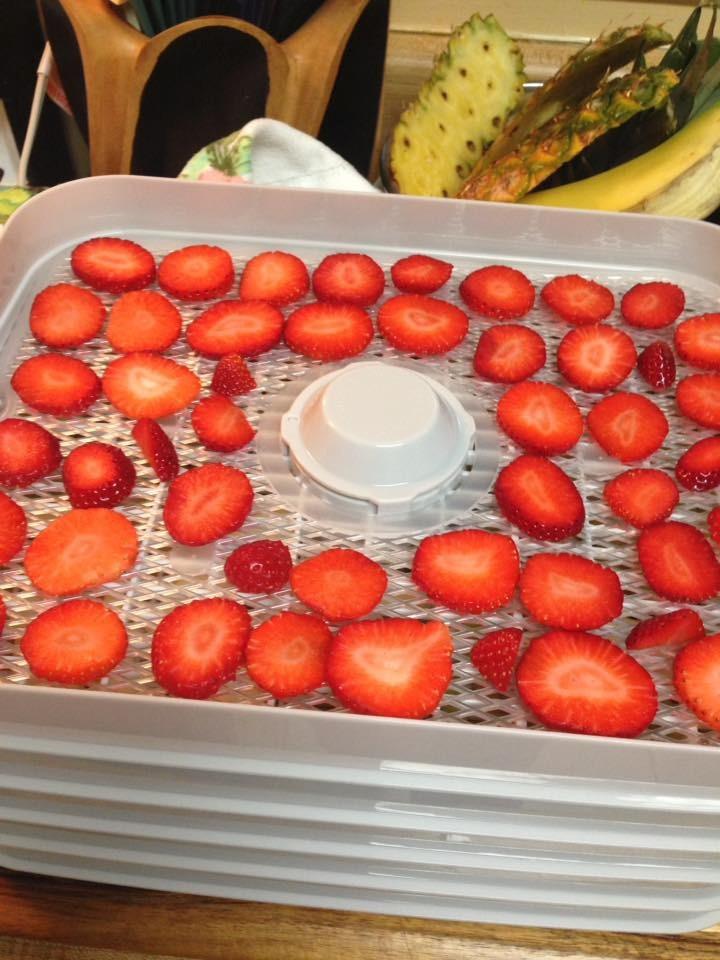
Five stackable BPA-free trays give 4.2 square feet of space, temperature is adjustable from 100-160°F, and the digital timer counts down from 1 to 48 hours before shutting off on its own. The 100°F floor sits slightly higher than the 95°F that the gentlest herbs prefer, but it is within the range most people use for basil, oregano, mint and thyme without any trouble.
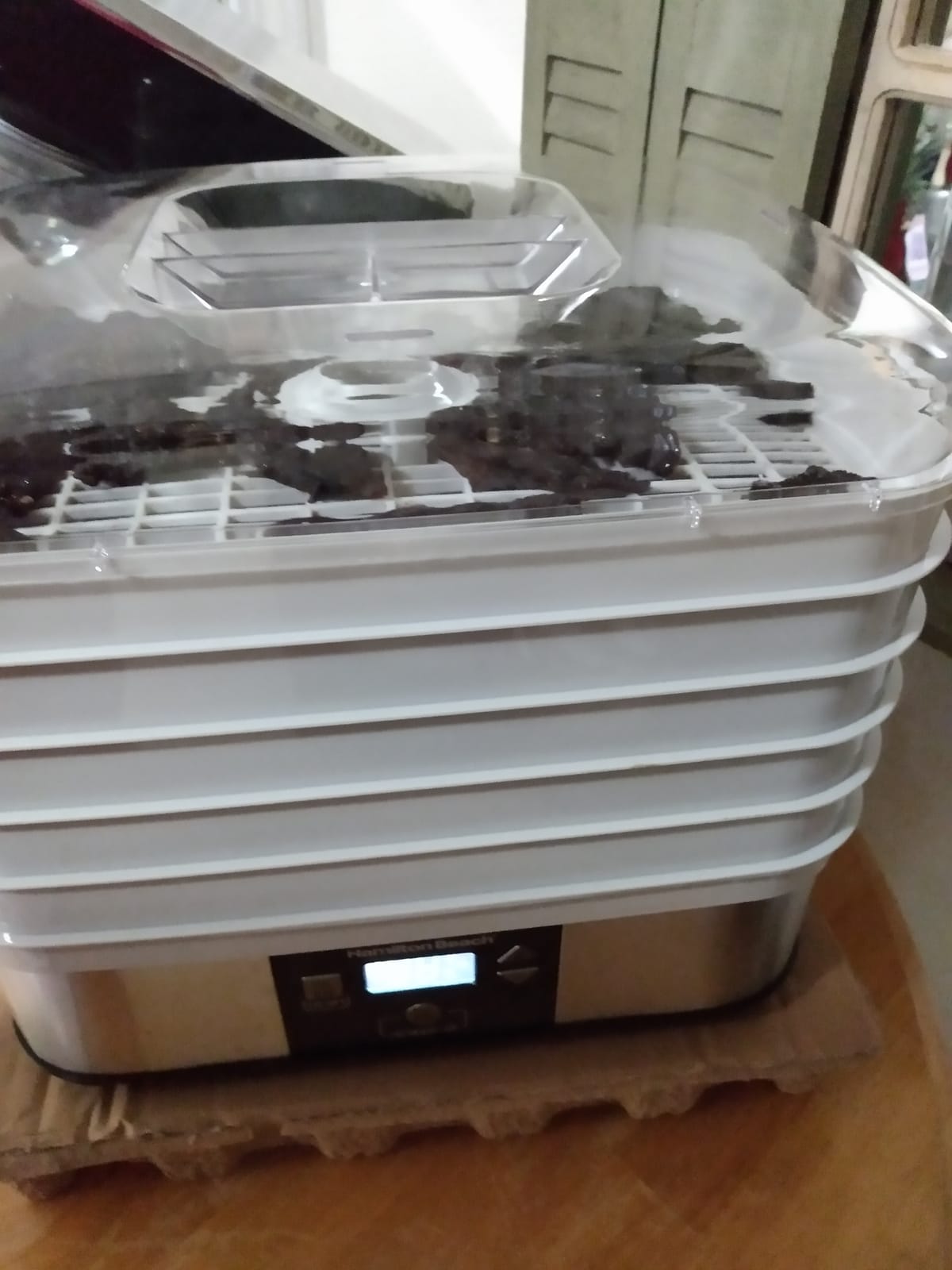
The base-mounted heater and fan move air evenly enough that buyers do not report needing to rotate trays mid-run, and the included mesh screen is a nice touch for herbs since you can spread a whole tray of small leaves on it. Trays and lid go in the dishwasher, which matters when every load leaves behind a film of resinous herb oil.
Two caveats are worth planning around. The mesh screen included is coarse, so very small leaves like thyme can drop through, and owners commonly note that top racks finish ahead of bottom racks on long runs. If you are grinding herbs to powder rather than keeping whole leaves, that unevenness matters more.
Who this dehydrator suits
This suits someone drying a moderate amount of herbs who cares far more about where the machine lives than about maximum tray count. It is also a good first machine for someone who wants the timer and auto shutoff that cheaper dial models lack, so an overnight run does not need supervising.
It works well for a mixed household load too, since 160°F is enough for fruit chips and vegetable crackers alongside your herb trays, as long as you run them in separate batches.
Where it falls short
Fan noise is noticeable, closer to a box fan on low than to a brushless motor, so it is a poor choice for a bedroom or a quiet open-plan apartment overnight. Buying a second, finer mesh screen is close to mandatory if thyme, oregano or marjoram is part of your harvest, and the top-to-bottom drying difference is a real consideration for powder work.
6. Cosori 5-Tray Compact Dehydrator – Best for Small Batch Herb Drying
Cosori Food Dehydrator, 5 Stainless Steel Trays, 3.1 ft² Drying Space
5 stainless steel trays, 3.1 ft2 space
95-176F in 1F steps, 48-hour timer
Rear fan horizontal airflow, 4 presets
Pros
- Stainless steel trays with no plastic contact with food
- 95-176F in 1F increments
- Rear fan horizontal airflow avoids rotation
- 4 presets for jerky
- fruit
- vegetables and yogurt
- Compact 3.1 ft2 footprint stores easily
Cons
- Bundled mesh screen and fruit roll sheet are plastic
- Small tray area limits meat batches
- A slight odor on new machines fades after a few batches
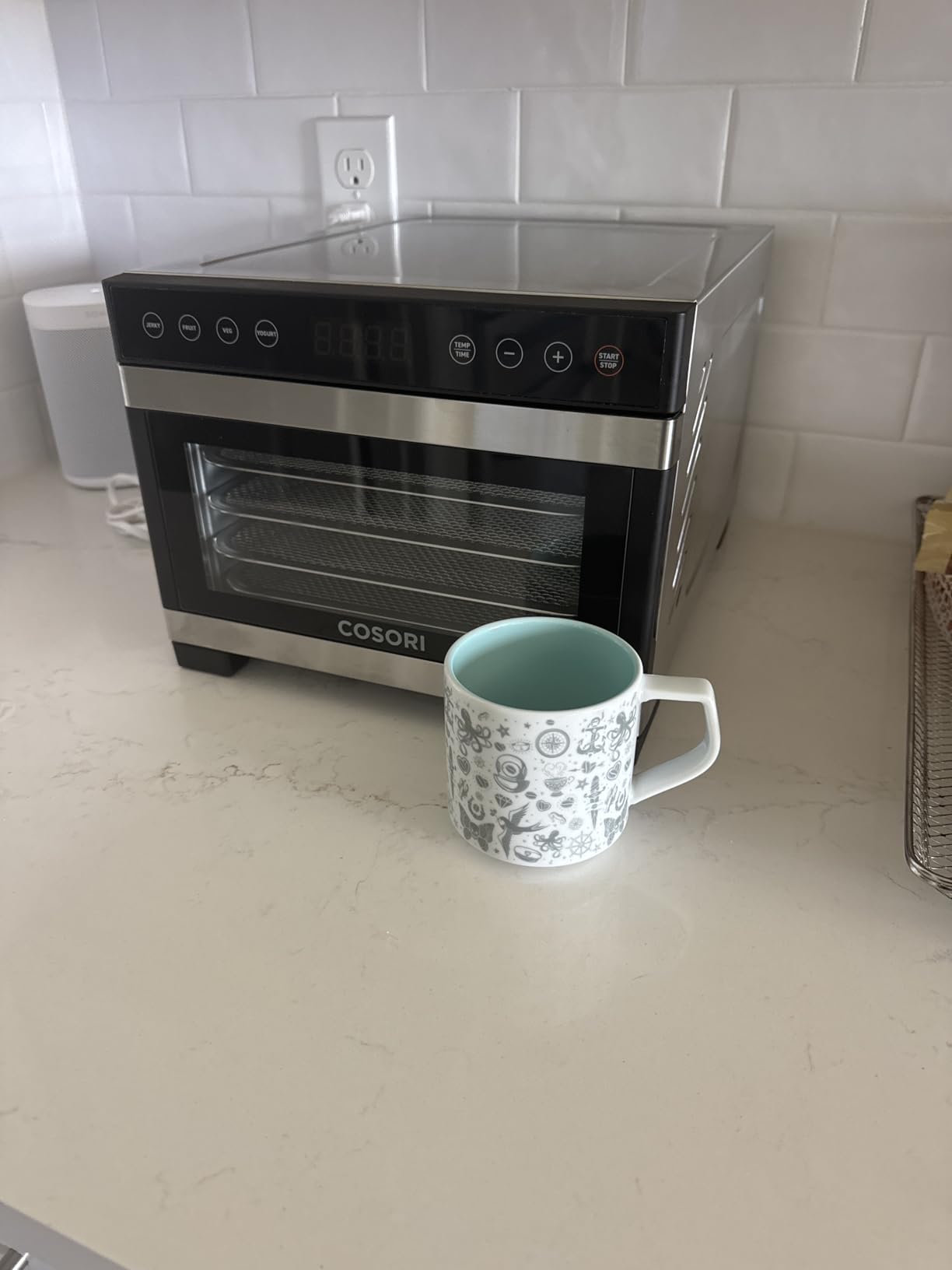
At 3.1 square feet, this is one of the smallest stainless-tray machines here, and for a person who dries a few trays of basil and a jar of chilies that is genuinely enough. The trays are stainless steel with no plastic contact with the food, which is the property most often claimed and least often true on compact units.
Temperature runs 95-176°F in one-degree increments, so the full herb range is available and you can push to 135-150°F for peppers on the same machine. The rear fan provides horizontal airflow, which is why owners do not talk about tray rotation on this model the way they do on vertical-airflow boxes.
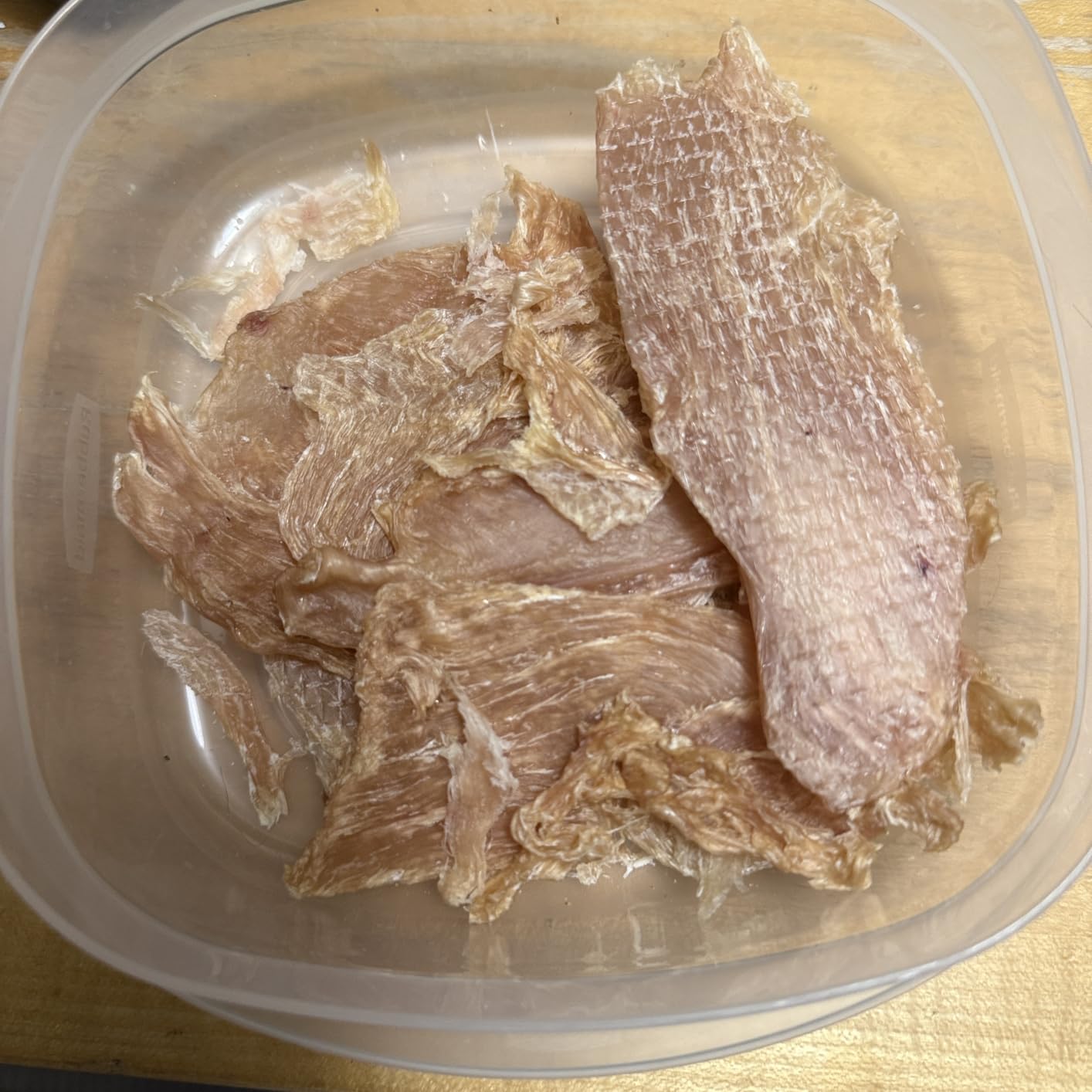
Four presets cover jerky, fruit, vegetables and yogurt, the touch controls and timer are reported accurate, and it runs quietly for its size. The 48-hour timer with auto shutoff means you can set a long herb and pepper cycle and go to bed without checking on it.
Two details to weigh. The bundled mesh screen and fruit roll sheet are plastic rather than metal, so if sticky herb oils are a regular part of your process you will want to replace the screen early. And at 3.1 square feet, this is a small-batch machine by design, not a mistake.
Who this dehydrator suits
This suits a cook who wants whole stainless trays and accurate low-temperature control in something that stores in a cabinet between uses. It is a strong pick for drying herbs to grind into custom blends, because the single-degree steps are what let you hold 100°F for basil and then 140°F for chilies without touching anything but the dial.
The compact dimensions also suit a kitchen where a larger box simply could not go, and the four presets are handy if you also want mushrooms and fruit chips.
Where it falls short
The tray area is small, so any batch beyond a few trays means multiple runs, and it is not the machine for large meat cuts. Some owners notice a slight plastic odor on a new machine that fades after the first few batches, and the hinge area can run warm.
7. Magic Mill 5-Tray Compact Dehydrator – Best for First-Time Buyers
Magic Mill Food Dehydrator Machine | 5 Stackable Stainless Steel Trays, 48H Digital Adjustable Timer & Temperature Control Upto 167° Electric Dryer & Preserver for Jerky, Fruit, Dog Treats & Much More
5 adjustable stainless steel trays
240W, 95-167F, 48-hour timer
Tray spacing 0.6 to 1.1 in, dishwasher trays
Pros
- Adjustable tray heights handle thick stems and produce
- Touch panel sets 95-167F and a 48-hour timer
- Trays detach for washing
- 240W draw is gentle on running costs
- Lightweight BPA-free body with stainless base
Cons
- Only 240W so drying runs longer than 500W units
- Housing is plastic rather than metal
- Listing shows conflicting temperature figures
This is the compact, uncomplicated version of a Magic Mill, and for someone drying herbs a few times a year it does the job without ceremony. Five food-grade stainless trays, a touch panel that sets 95-167°F and a 48-hour timer in 30-minute steps, and trays that detach for soapy water or the dishwasher.
The adjustable tray spacing is the feature that matters for herbs, running from 0.6 inches standard to 1.1 inches. A bed of rosemary with a little air moving past each sprig dries considerably faster than the same rosemary packed tight, and on a fixed-tray machine you have no way to make that space.
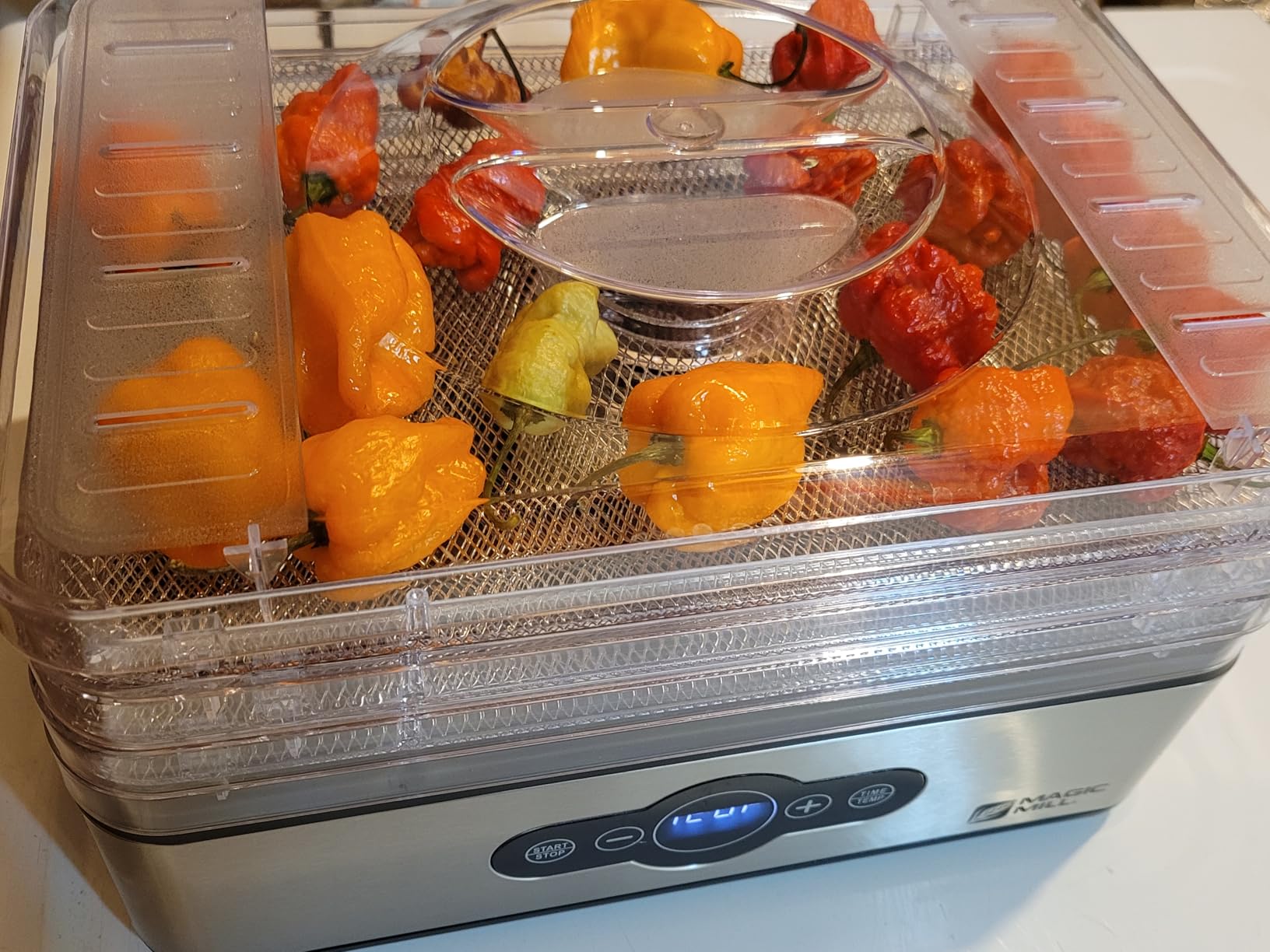
At 240W this is the lowest-wattage machine we list, and that cuts both ways. The upside is a very low electricity draw on a batch that may run several hours. The downside is longer drying times than a 500W or 700W unit, which is the reason owners mention slow progress first.
Housing is BPA-free plastic with a stainless base rather than full metal, so it is a step down in longevity from the stainless-bodied models. What it does offer is genuine stainless trays and a real digital thermostat at an entry-level outlay.
Who this dehydrator suits
This suits a first batch: someone who has a windowsill herb pot, wants to try drying, and would rather not commit counter depth to an appliance they may barely use. The stainless trays and dishwashability mean you are not starting with plastic mesh that traps basil oil permanently.
It is a sensible second machine too, if your main unit is a large box and you want something small for quick herb trims without waiting for a big empty chamber.
Where it falls short
The 240W element makes every batch slower, and the plastic body will not match the service life of a stainless unit. One more thing to check before buying: this listing carries a 158°F field alongside a 167°F claim, so confirm the real ceiling on the unit you receive if peppers are part of your plan.
8. Elite Gourmet 4-Tray Food Dehydrator – Compact and Accurate
Elite Gourmet Food Dehydrator, Stainless Steel Trays, Adjustable Temp
4 stainless steel trays
95-158F adjustable, 24-hour timer
Bottom-mounted fan, horizontal airflow, ETL Listed
Pros
- Temperature holds accurately across 95-158F
- Bottom fan circulates air evenly
- Transparent trays show progress without opening
- Rectangular trays clean more easily than round ones
- Quiet and small enough to live on the counter
Cons
- Only four trays and a very small batch size
- 158F ceiling limits jerky options
- 350W draw for the small batch
- Plastic housing
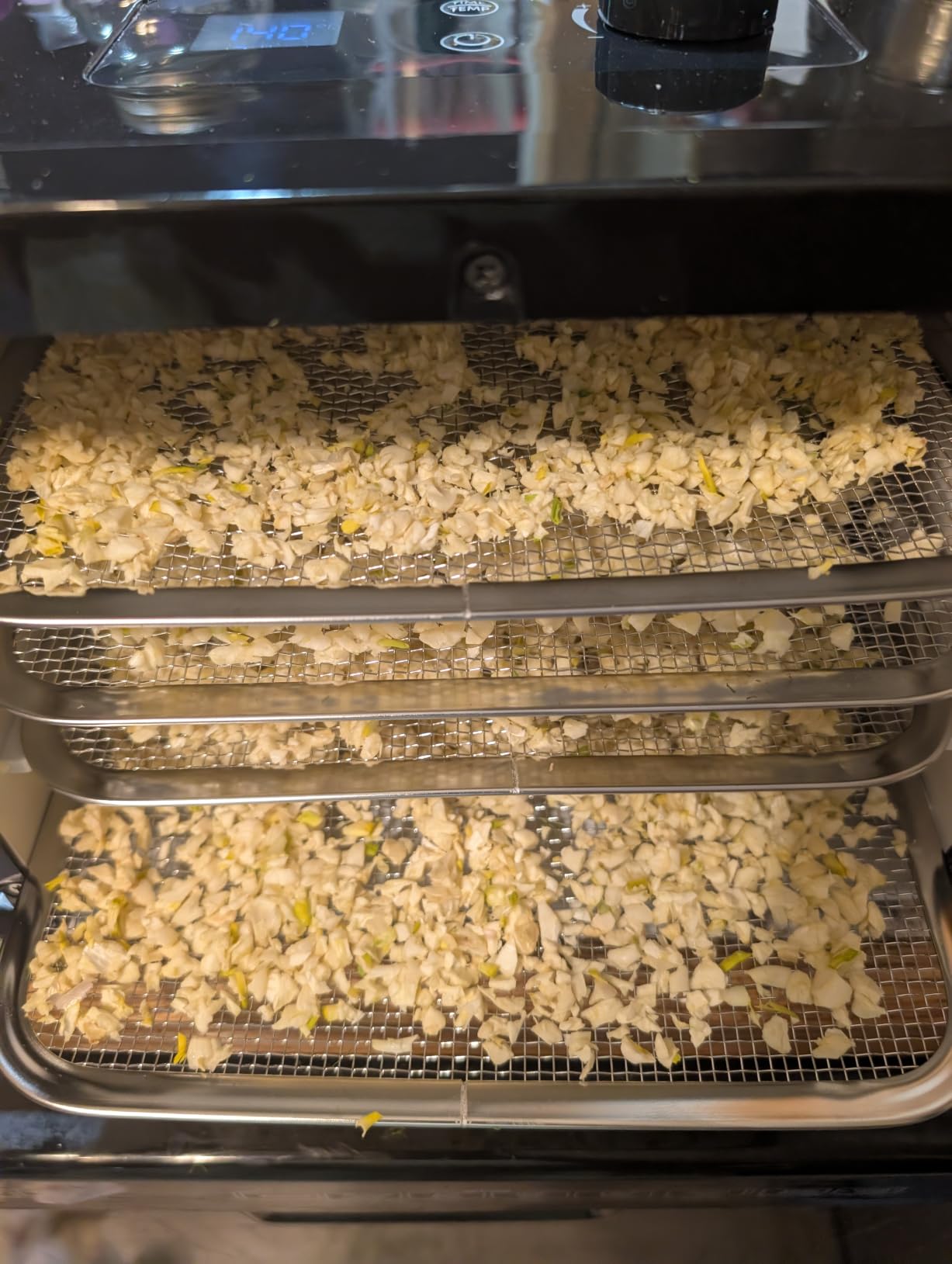
The Elite Gourmet is the one to consider if your herb drying is occasional and small: a bunch of dill, a few sprigs of basil, one tray of mint. Reviewers who checked with a thermometer report the temperature reads accurately across the 95-158°F range, which is more than can be said for a dial model, and delicate herbs like dill and basil finish in under three hours.
The bottom-mounted fan circulates air evenly for consistent results, and the transparent trays let you watch progress without lifting the lid and letting heat out. Because the trays are transparent you can see a leaf go from limp to crisp without opening the box at all, which is a nicer way to judge a herb dry than a timer.
Rectangular pull-out shelves dry and clean more easily than round tray designs, and with sticky herb oil involved that difference compounds over a year of use. The trays and lid are dishwasher safe, it is ETL Listed at 350W and 120V, and the whole thing is small enough to leave out on the counter rather than put away.
Capacity is the honest limitation. Four trays is a genuinely small batch, and the 350W element for that volume means a lower cost per load but more time per load. The plastic housing is also a shorter-life material than stainless.
Who this dehydrator suits
This suits an apartment cook who wants a dehydrator that stays out on the counter, a small kitchen with limited surface, or anyone who dries herbs in small, frequent batches rather than one seasonal marathon. The quiet operation and small footprint are its strongest features for that kind of use.
It is also a good fit if fruit leather and small vegetable chips share the machine, since 158°F is plenty for both and the transparent trays make the whole thing easy to learn on.
Where it falls short
Four trays is the smallest capacity in this roundup, matched only by the Septree, so a real garden harvest means many runs. The 158°F ceiling rules out any serious jerky work, and the plastic housing is a compromise you accept for the size and shape rather than a deliberate choice.
9. Septree Compact 4-Tray Dehydrator – Widest Temperature Range
Septree Compact Food Dehydrator, 4 Stainless Steel Trays Fresh Dryer Machine for Jerky Herbs Fruit Veggies Snacks, with Digital Timer | 190F Temperature Control, Great Size for Small Family
70-190F range, 4 stainless trays
Large digital display with memory
400W even airflow, 3-year service
Pros
- Widest range here at 70-190F for very slow herb drying
- Large fan moves even airflow so trays do not need rotating
- Digital display is large and remembers previous settings
- Patented 304 stainless mesh is smooth and hand-safe
- Compact and light at under 7 pounds
Cons
- Only four trays limits batch size
- Polycarbonate body rather than stainless steel
The Septree earns its place on one specific number: a 70-190°F range. Nothing else in this roundup goes below 86°F, and the extra headroom at the cold end is genuinely useful for very slow drying of soft, watery herbs where you want the moisture to creep out over many hours rather than be driven off quickly.
Everything else about it is competent and compact. Four stainless steel trays measure 10.2 by 8.1 inches, a 400W fan moves air evenly enough that trays do not need rotating, and the digital display is large, readable, and remembers your previous settings so you are not re-dialing 100°F and three hours every single time.
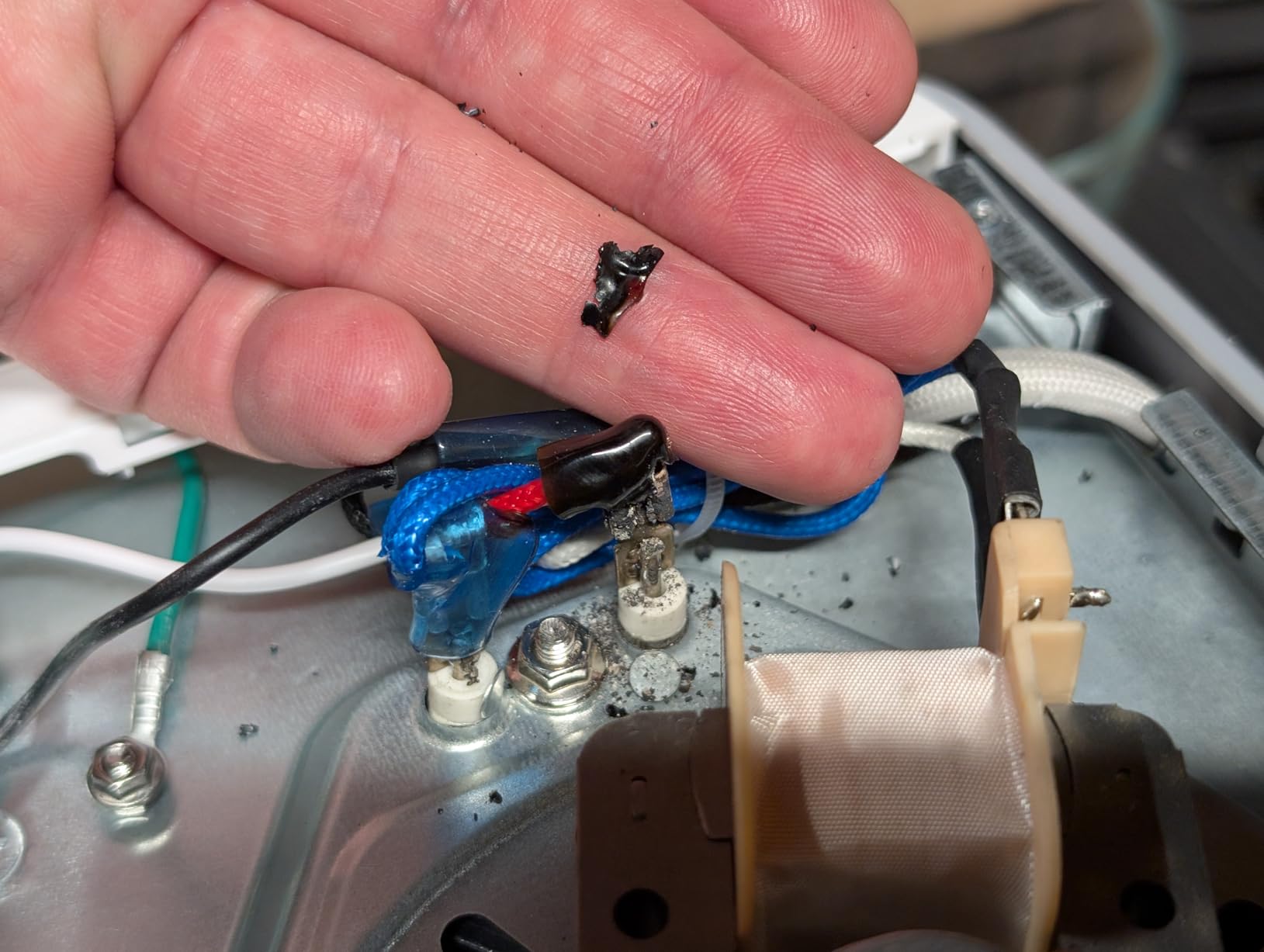
The patented 304 stainless steel wrap-around mesh is worth a look for herbs. It is smooth, flat and hand-safe, which matters when you are pulling a tray of brittle dried leaves out of a hot chamber. A textured or plastic mesh tends to catch thin leaves and tear them as you lift.
It weighs under 7 pounds and includes a three-year after-sale service, which is a longer commitment than the one-year warranty on several machines here. The body is BPA-free polycarbonate with 304 stainless trays, so the food contact surfaces are metal even though the shell is not.
Who this dehydrator suits
This suits someone drying delicate, high-moisture herbs who wants a slower, cooler process than the standard 95-115°F band allows, and anyone who moves between small kitchens or travels with the appliance. The light weight and small footprint make it the easiest machine here to carry and store.
The settings memory is a small thing that gets noticed every single time you use it, particularly on a repeat recipe of dried mint for tea.
Where it falls short
Four trays is the smallest batch size in the group, tied only by the Elite Gourmet, so anyone with a real harvest will queue batches. The polycarbonate body is a shorter-life material than full stainless, and a narrower-than-usual range at the top end is not a problem for herbs but does cap other uses.
10. Commercial Chef 5-Tray Dehydrator – Budget Pick
Commercial Chef Food Dehydrator, Five 9.25” BPA-Free Trays, CCD100W6, White
5 BPA-free 9.25 inch trays
Dial thermostat 104-158F
280W, clear trays, 3.3 pounds
Pros
- Five full trays in a cabinet-friendly body
- Clear trays show progress without lifting the lid
- Compact and light at 3.3 pounds for cupboard storage
- Manual includes a fruit and vegetable dehydration chart
- Handles herbs
- flowers and mushrooms
Cons
- Dial thermostat is not precisely accurate and stops at 158F
- Some production runs have no digital timer
- Clear plastic trays feel flimsy
- 280W extends drying times
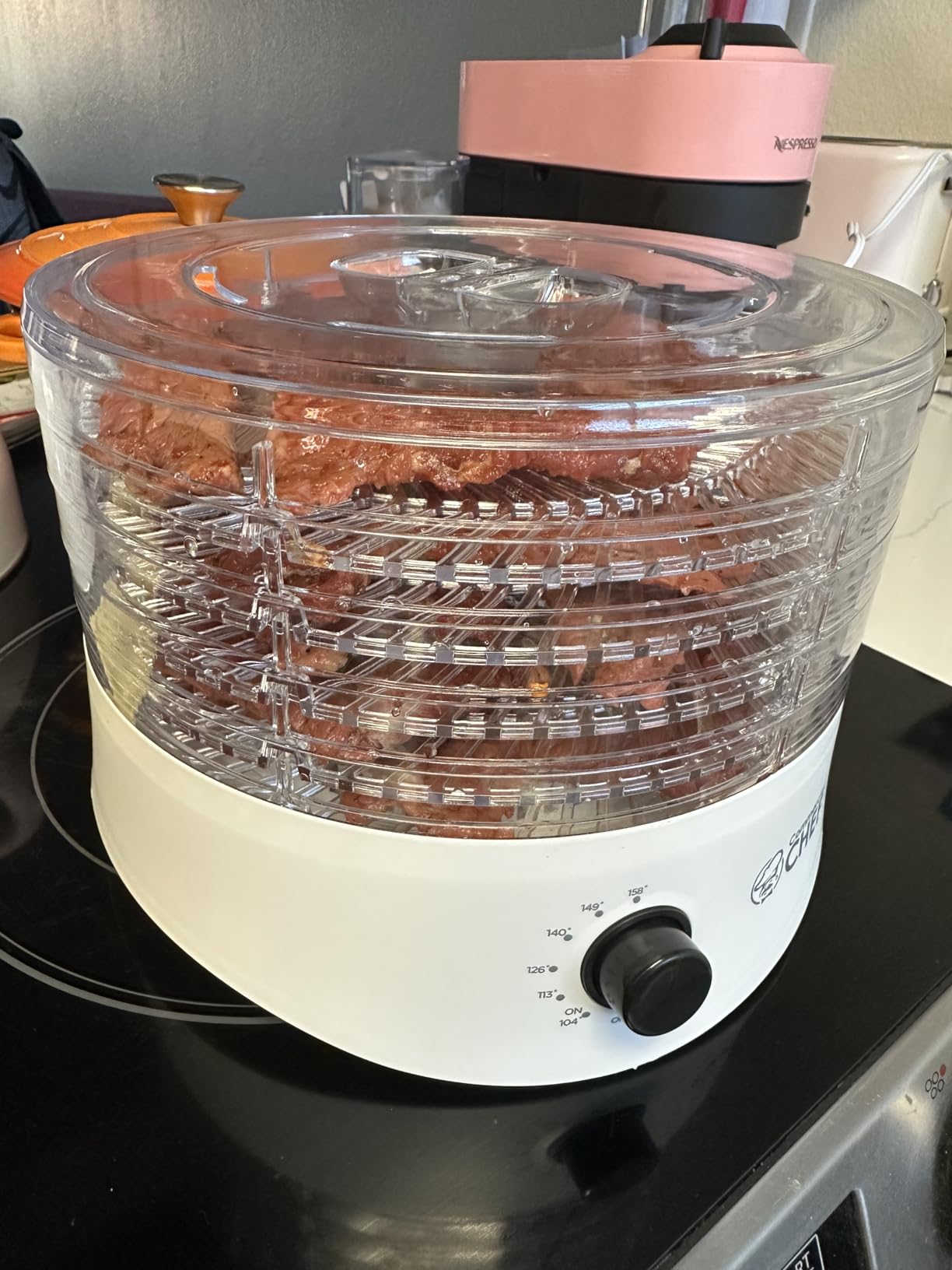
The Commercial Chef is the simplest way to find out whether you like drying herbs at all. Five 9.25-inch BPA-free trays, a dial thermostat from 104 to 158°F, 280W of drying power, and clear trays so you can watch a leaf curl without opening the lid. Owners use it for herbs, flowers, mushrooms, banana chips and pet treats.
It is also the easiest to live with. At 3.3 pounds and just under 10 inches wide, it lives in a cupboard and comes out twice a year. The manual carries a dehydration chart, which is more than several of the compact machines here offer.
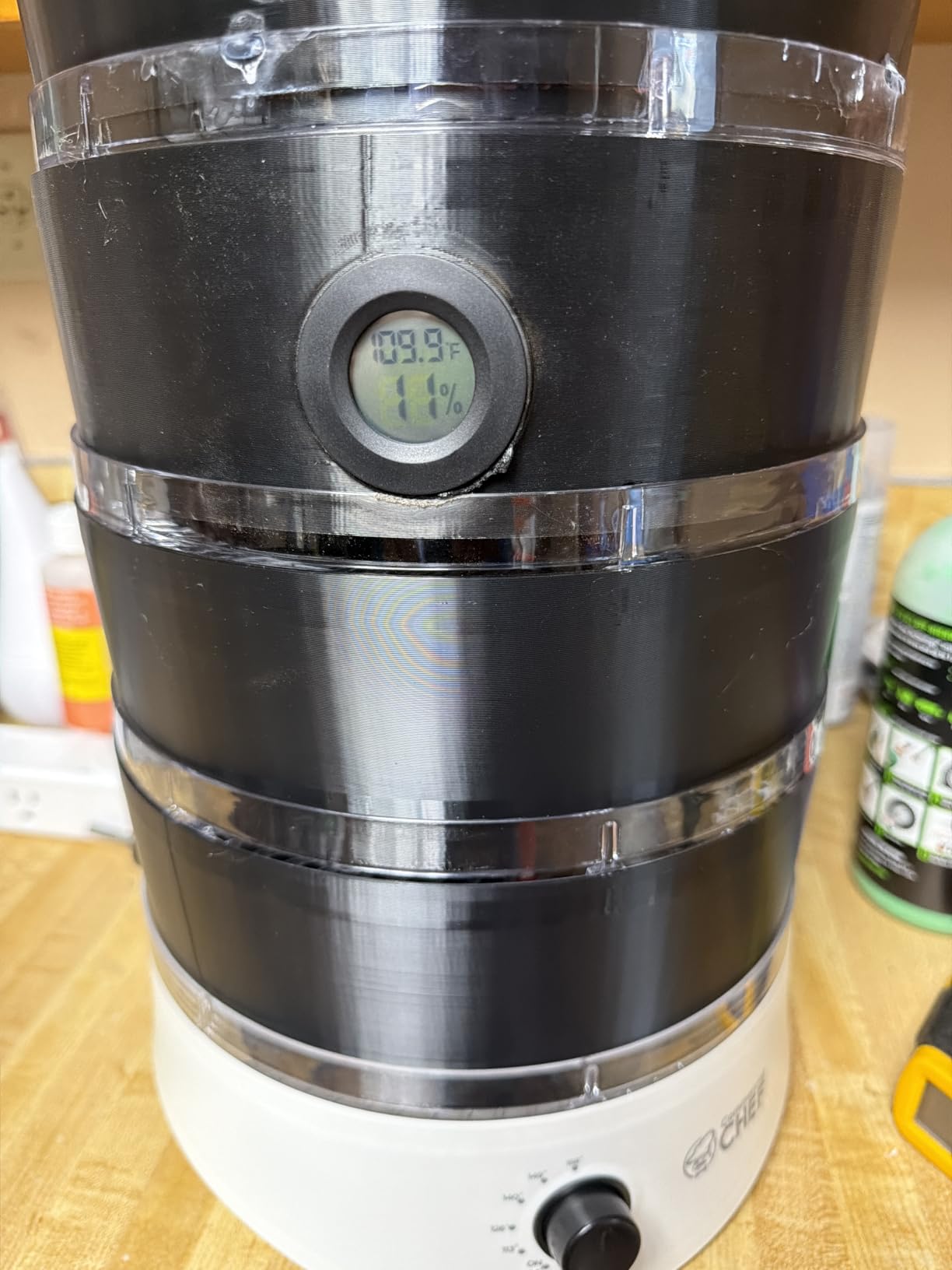
The honest drawback is the dial thermostat. Owners consistently report it is not precisely accurate, and the 104°F floor is higher than the 95°F that very soft herbs do best at. If you can live with that band, it is fine for oregano, thyme, rosemary and most things you would put in a jar.
Some production runs of this model arrive without a digital timer, the clear plastic trays feel flimsy and can crack if dropped, and 280W means longer runs than anything else here. Treat it as a seasonal tool rather than an appliance you leave running.
Who this dehydrator suits
This suits a beginner on a strict budget, someone in a very small kitchen, and anyone who wants a second machine for flowers, seeds or pet treats without spending real money. The clear trays make it a genuinely pleasant machine to learn on, because you can see what is happening.
It is also the one to buy if you only dry herbs a couple of times a season and storage space is the binding constraint. Nothing else in this list is this easy to put away.
Where it falls short
A dial thermostat without a digital readout means you cannot tell what the box is actually holding, and that is a real handicap in the 95-115°F band. The 104°F minimum and 158°F ceiling also narrow your range, and the low wattage stretches every batch.
11. HOPERAN 12-Tray Dehydrator – Most Tray Capacity
HOPERAN 12 Tray Food Dehydrator Machine for Jerky, Fruit, Herb & Dog Treats
12 stainless steel trays
Dual rear fans, 86-196F
24-hour timer, glass door, under 48 dB
Pros
- Twelve removable 304 stainless trays cover huge batches
- Dual rear fans deliver even airflow without rotation
- 86-196F spans herb drying through jerky
- 800W with operation under 48 dB
- Dishwasher-safe trays
- overheat protection and auto shutoff
- Glass viewing door plus two silicone mesh screens
Cons
- Tallest and largest cabinet footprint in this group
- Smaller review base than the Cosori and Magic Mill models
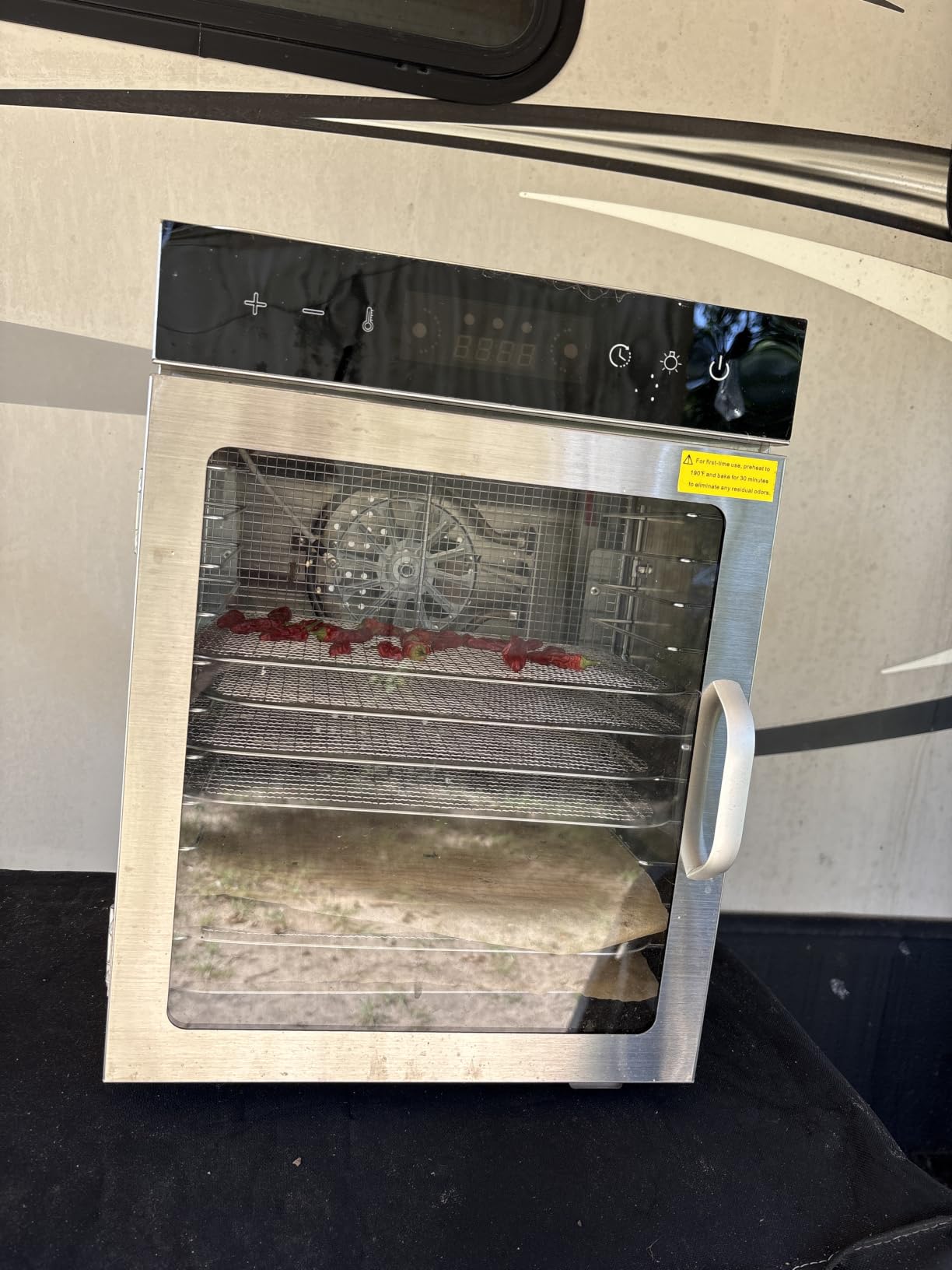
The HOPERAN has the most tray capacity in this roundup, and its two-fan design is a different approach from the single rear fan most brands use. Dual rear fans push air through 360 degrees across twelve removable 304 stainless trays, so the airflow is built for depth rather than width. Owners highlight the evenness it produces on large herb and pepper batches.
Temperature runs 86-196°F digitally, which is the widest span here once you exclude the 70°F compact unit, and the 24-hour programmable timer with auto shutoff plus overheat protection is a sensible combination for a long unattended pepper run. At 800W it has the power to pull moisture out quickly, and it stays under 48 dB.
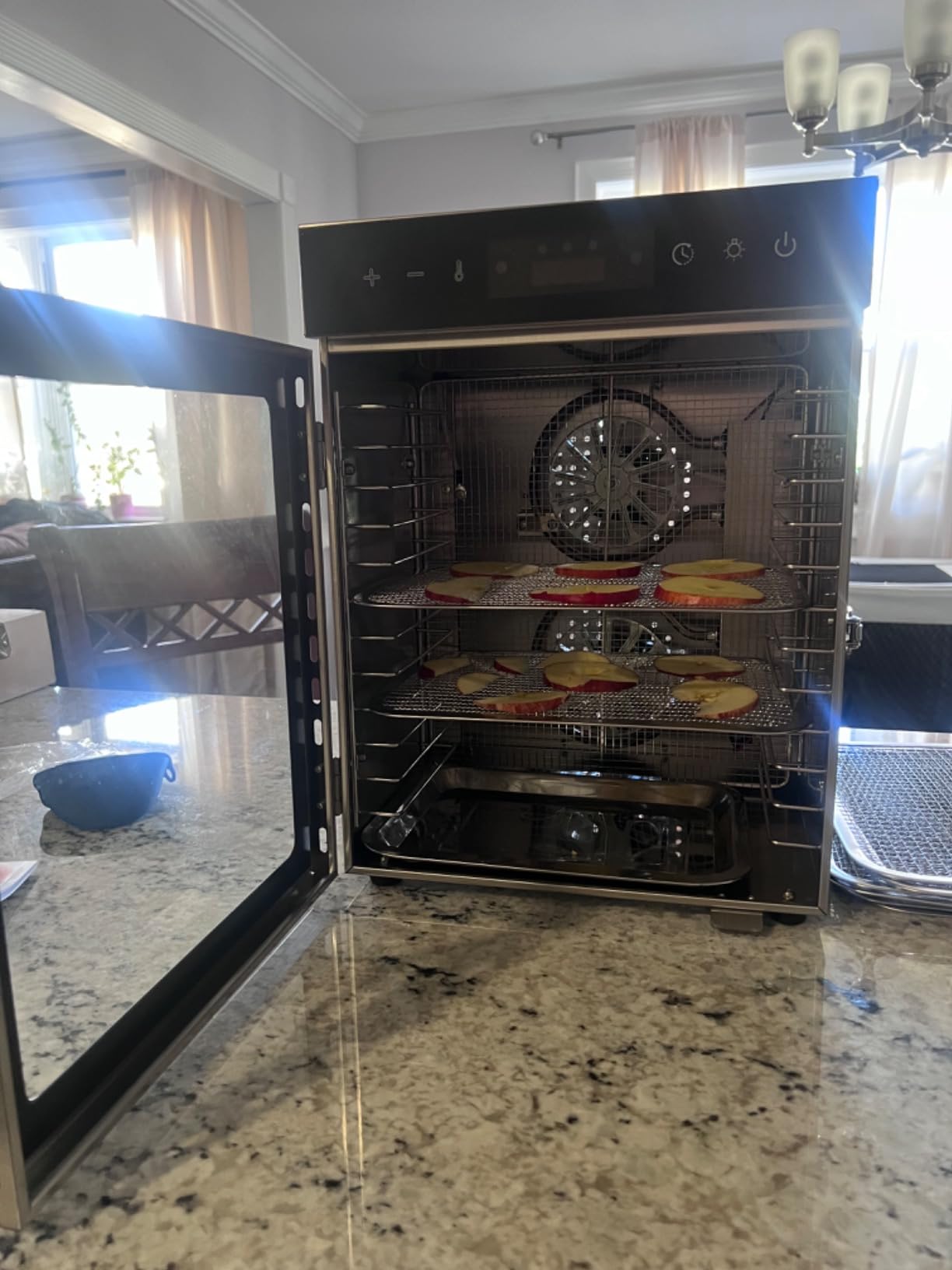
The glass viewing door is a nicer feature than it sounds for herbs, because you can judge crispness by color and curl without opening the chamber and losing heat. Two silicone mesh screens and a fruit roll sheet are included, and the bundled silicone gloves are a small courtesy that matters when trays come out at 150°F.
At 16.1 inches tall, this is the tallest unit in the group and it needs a genuine cabinet or shelf rather than a counter corner. Its review base is also the thinnest here, so treat long-term owner reports as less established than the Cosori and Magic Mill machines.
Who this dehydrator suits
This suits a serious gardener, a small producer or anyone who dries chilies in quantity and wants one box that handles it. The 86°F floor gives you true low-and-slow herb drying and the 196°F ceiling covers the hot end, so a single machine covers the whole spice spectrum.
The glass door and quiet fans also make it a good fit for someone who wants to check on progress without opening the box, which is helpful when a batch runs through the night.
Where it falls short
Size is the trade-off. At 16.1 inches tall it will not tuck under a standard cabinet, and twelve trays of herb material is a lot of counter to give up permanently. Fewer owners have logged long-term experience with it than with the established brands, so parts and repair support are less proven.
12. Rosewill Compact 5-Tray Dehydrator – Small-Footprint Value
Rosewill Compact Food Dehydrator, 5 Stackable Trays with Adjustable 48H Timer and Temperature Control – 400W Electric Food Dryer for Jerky, Fruits, Herbs, Veggies, Meat & Dog Treats
5 adjustable trays, 400W
Tray height 0.8 to 1.5 in
95-158F, 0.5-48 hour timer
Pros
- Trays adjust from 0.8 to 1.5 inches for thick stems
- Timer runs 0.5 to 48 hours with auto shutoff
- Trays wipe down and dishwasher clean easily
- Quiet enough for overnight runs
- Non-slip feet keep it stable
- Owners report a large load for the size
Cons
- Instructions are sparse
- A minority report low airflow and slow drying
- Small tray area limits capacity
The Rosewill pairs a digital panel with a shallow 8.3-inch depth, which is more than several cheaper competitors offer. Five food-grade BPA-free trays adjust from 0.8 inches to 1.5 inches by rotating them, so you can open up space for rosemary and sage stems or close it down for thin basil leaves. The timer runs from half an hour to 48 hours and shuts off automatically.
Owners like the compact size, the accurate timer and temperature, easy cleaning and the quiet run, and several mention being surprised by how much it holds for a box this small. For a first herb season or a countertop that is already crowded, that combination is hard to argue with.
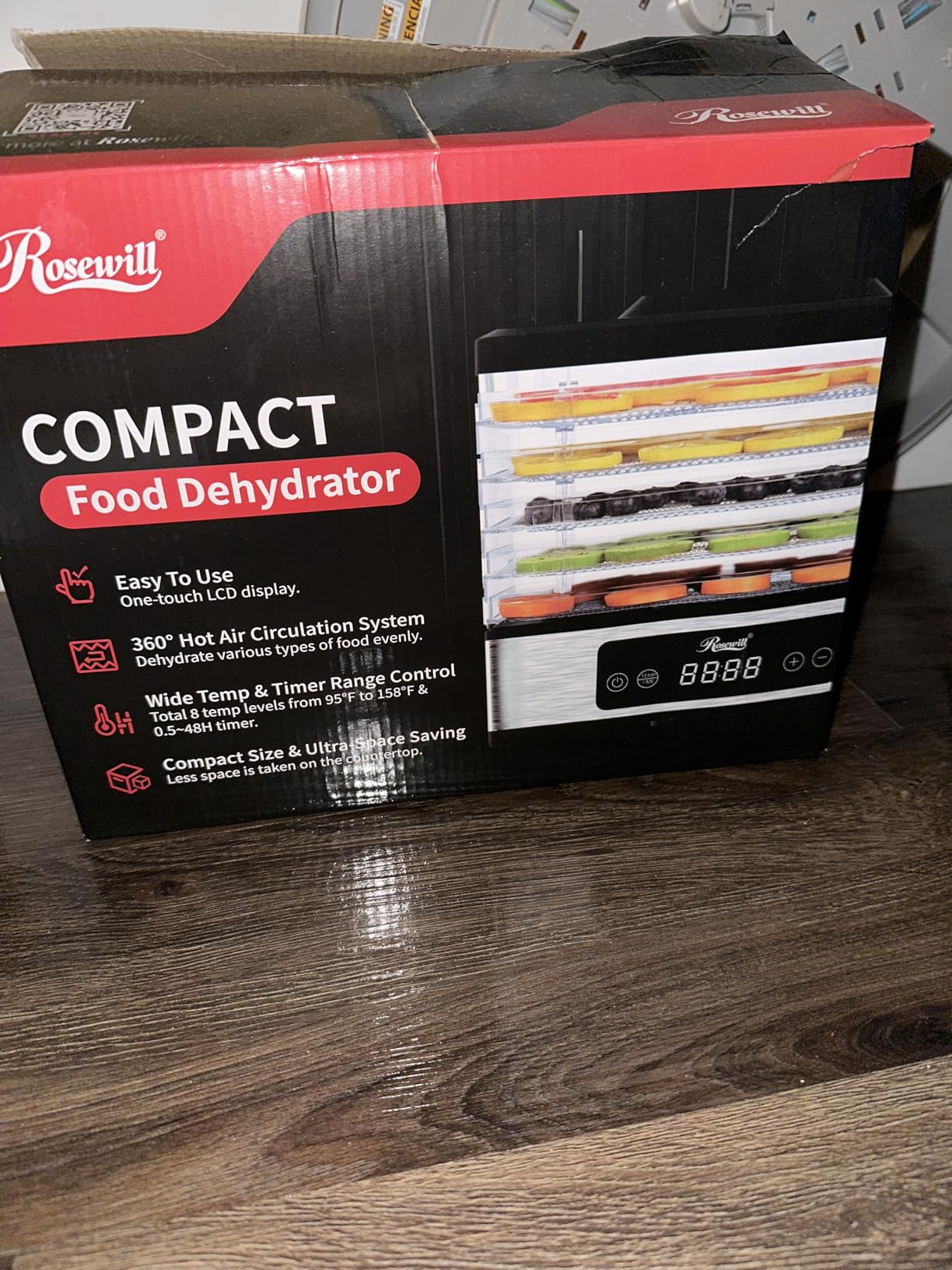
The weaknesses are consistent across reviews. Instructions are sparse enough that the first run is trial and error, and a minority of owners report low airflow that leaves fruit rubbery even after long runs, which points to a fan that is modest relative to the tray area.
The 95-158°F range is narrower than most of the list, which is fine for herbs and disappointing for anyone who also wants to make jerky. Tray area is small enough that capacity is limited to a modest load per cycle.
Who this dehydrator suits
This suits someone with tight counter space who still wants a digital thermostat and an auto-shutoff timer rather than a dial. The adjustable tray height makes it a decent fit for a mixed herb harvest where leafy basil and woody sage go in together.
It is also a reasonable second machine for quick trims, or a first machine for someone who wants the feature set without committing counter depth.
Where it falls short
Weak airflow on some units leads to slow drying, and the sparse instructions mean your first batch teaches you the machine rather than the other way around. The 158°F ceiling and small tray area also mean you will not use this for jerky or large harvests.
What to Look for in a Dehydrator Built for Herbs
Most buying guides start with wattage or tray count, and both are secondary when your ingredient is a leaf. Here is what actually decides whether herbs come out fragrant or come out scorched.
Low-temperature accuracy is the number one spec
Herbs want 95-115°F. Above roughly 125°F you start driving off volatile oils, and the dried leaf loses the aroma that made you dry it in the first place. A machine that only reaches down to 104°F, or a dial thermostat with no readout, makes it impossible to know what you are actually holding.
Look for a digital panel with single-degree or few-degree adjustment. That is the feature that separates a machine you can fine-tune for basil from one you set and hope.
Airflow design decides whether you rotate trays
Rear-mounted fans push air horizontally across the trays. Bottom-mounted and vertical-airflow designs move air up through the stack, which is why owners of budget towers talk constantly about swapping trays halfway through. Horizontal airflow removes a step and, more importantly, gives you evenly dried material for grinding.
Single-degree adjustment is a proxy for the same quality. Manufacturers who bother with precise control usually also position the fan properly. If you plan to run batches overnight, check the noise rating too, since older box-fan designs are loud enough to hear in the next room.
Capacity, tray size and how a harvest actually fills a machine
Most home gardeners run one or two big batches a season, not a weekly routine. That means capacity matters less than expected, and tray area per layer matters more than tray count. A person with a windowsill pot of basil is well served by four or five trays. Someone with a full garden row is not.
Count for the real case: a single mature basil plant yields enough leaves to fill one tray several times over. Estimate your harvest by square footage of bed rather than by number of plants, then pick a machine that holds it in one or two runs. Our commercial food dehydrator guide covers what to look for if you genuinely have more produce than a home unit holds.
Trays, cleaning and noise for overnight runs
Stainless steel trays with no plastic contact with food are worth paying for, and dishwasher-safe trays matter more for herbs than the spec sheet suggests. Basil, oregano and sage leave sticky resinous oils that permanently soak into plastic mesh. Trays that go in the dishwasher let you wash after every batch instead of once a year.
For noise, sub-48 dB brushless motors are a real step down from older box-fan designs. If you plan to dry overnight, that difference decides whether the machine is a pleasure or a neighbor complaint.
Where the picks we list sit on cost per batch
Running cost is a wattage-times-hours calculation, and it lands differently for herbs than for jerky. A 240W machine taking six hours uses about 1.4 kWh; a 700W machine taking two and a half hours uses about 1.75 kWh. The smaller machine is cheaper, but it occupied your counter twice as long, which is the cost people forget.
That is the whole argument for buying enough capacity once. Our Excalibur versus Nesco comparison goes deeper on the tradeoff between a large box and an expandable one if you are weighing that decision.
Which Herbs Dry Well and Which Ones Disappoint
Not every herb survives a dehydrator, and knowing which ones saves you a wasted tray. The reliable performers are thyme, oregano, rosemary, sage, mint and marjoram. They hold their aroma at low temperatures, dry within a few hours, and grind well if you want powder.
Basil works but loses some of its identity. It dries fast and smells fine whole, but the flavor in a dried leaf is not the same as fresh, which is one reason so many people dry basil only to grind it into a paste-friendly powder. Dill and cilantro are similar, and cilantro in particular tends to taste vegetal once dried.
Tarragon is the one most people are disappointed by. Its aroma fades badly in drying, and reviewers consistently say the result does not justify the tray space. Chives dry well but need to be snipped into short lengths, because a whole chive blade traps moisture in the middle and finishes leathery at the edges.
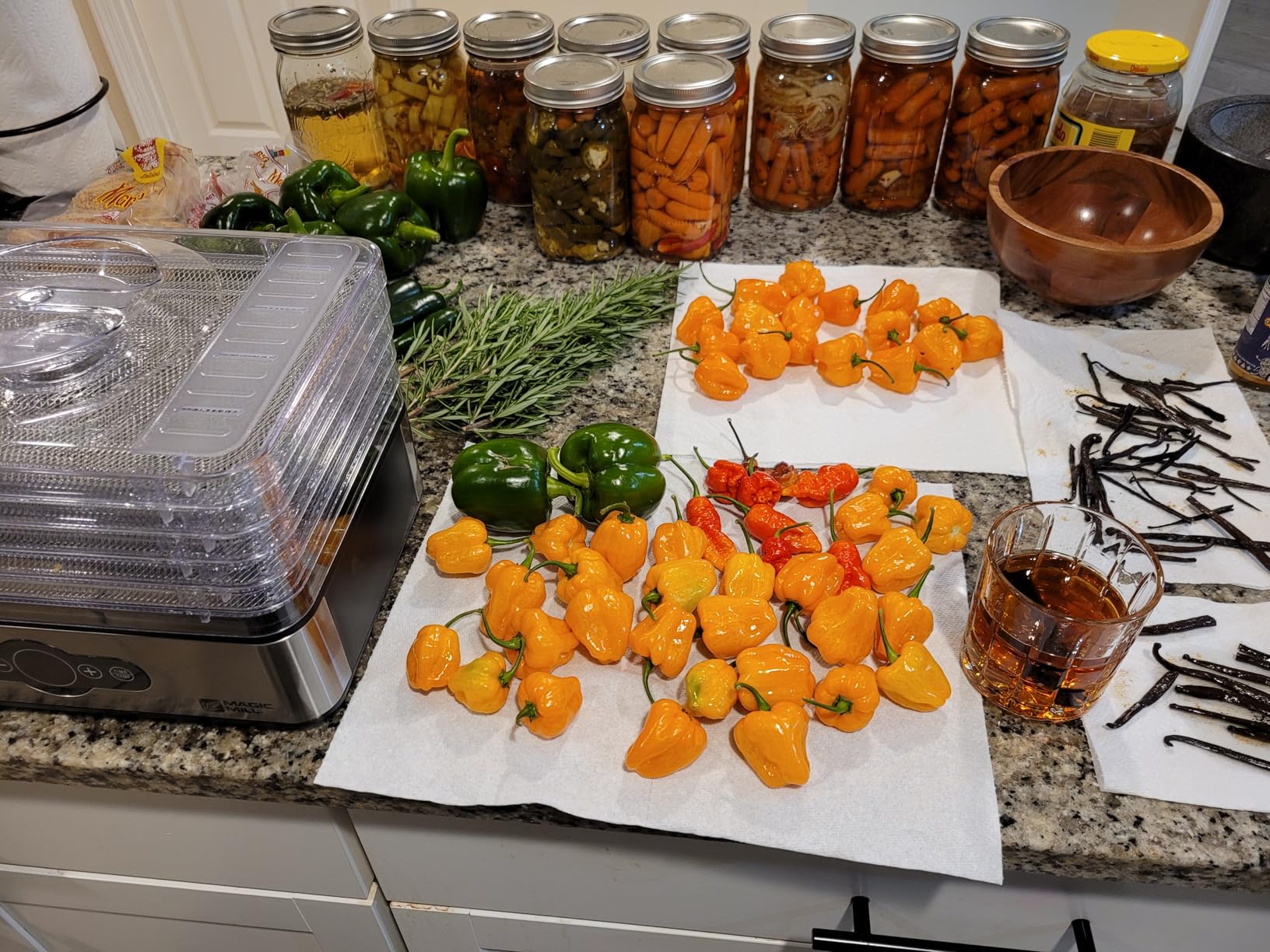
Chilies are the opposite case and dehydrate beautifully, though they take eight to 20 hours at 125-150°F. Splitting large peppers exposes the interior so the seed and inner flesh dry at the same rate as the skin.
Grinding Dried Herbs and Chilies Into Spice Powder
Grinding is the reason most spice-minded buyers get a dehydrator at all, and it is straightforward once the material is properly dry. A dedicated spice grinder gives a finer result, but a small blade grinder or a dedicated coffee grinder reserved for spices will turn a jar of dried basil into a usable powder in seconds.
The key is dryness. If your herbs are not crisp through the center when you test them, the powder will clump in the grinder and stay damp in the jar. Test a leaf by bending it: if it snaps cleanly, grind it. If it bends and feels cool, give it another 30 minutes.
Dried chilies go into a grinder at 125-150°F for 8-20 hours, then pulse for short bursts with the lid on securely. A dust mask is not a bad idea, because fine pepper particulate irritates. Mix powders afterward in a jar to make custom blends, and label them with the herb, the blend ratio and the month you ground them.
Storing and Labeling Dried Herbs
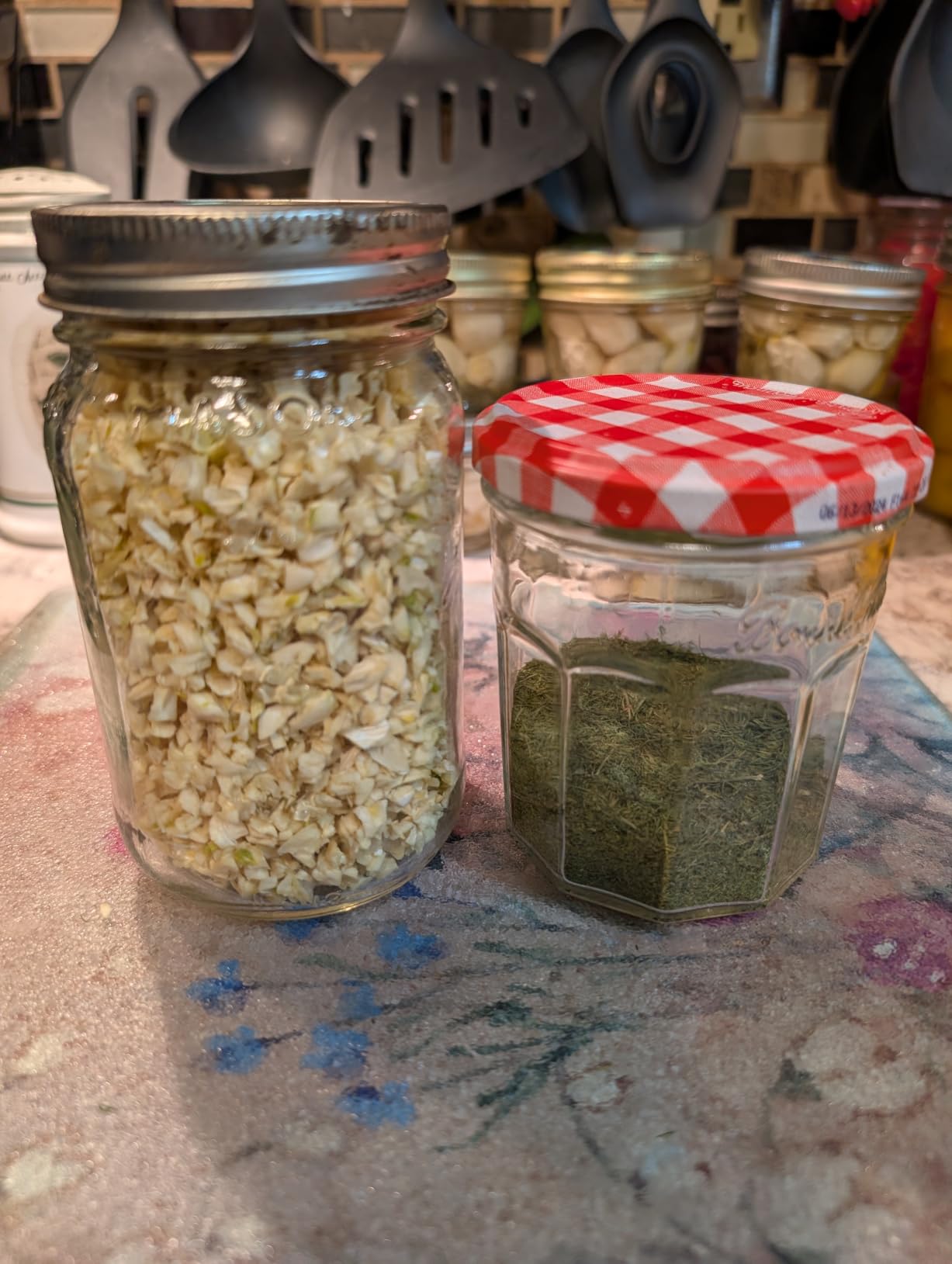
Storage decides whether the work you did survives the winter. Long-time users report dried herbs still smelling strong months later when they have been stored in airtight glass jars, and the difference between good and poor storage is almost entirely air and light.
Let the trays cool completely before you seal anything. Warm herbs trapped in a closed jar give up their last moisture as condensation, which is the fastest route to a jar that goes soft or moldy in a month.
Use airtight glass jars kept out of direct light, and add a silica packet or an oxygen absorber for anything you will keep past a few months. Store the whole leaves rather than powder when you can, and grind only what you need; ground spice loses aroma much faster than whole dried leaves do.
Label with the herb name, the variety if it matters, and the month and year of drying. A simple format of herb plus month plus a rough yield note makes it easy to use the jar oldest-first before potency fades.
Frequently Asked Questions
What is the best food dehydrator for drying herbs?
The best food dehydrator for drying herbs holds a steady 95-115°F with a digital thermostat and uses a rear-mounted fan so trays dry evenly without rotating. Our top pick is the Cosori 6-tray stainless steel model, which combines 95-165°F control, six dishwasher-safe trays and a brushless motor under 48 dB.
Can I dry herbs in a food dehydrator?
Yes. Wash and dry the herbs, strip the leaves, spread them in a single layer on the mesh screen, set 95-115°F and start checking at one hour. Leaves are done when they crumble with no cool or damp spot in the center. Let them cool before sealing into an airtight jar.
How long does a dehydrator take for herbs?
Most leafy herbs such as basil, mint, oregano, thyme and dill take 1-4 hours at 95-115°F. Woody herbs like rosemary, sage and bay need 3-6 hours at 115-125°F, and dried chilies take 8-20 hours at 125-150°F.
What herbs are best for dehydrating?
Thyme, oregano, rosemary, sage, mint and marjoram dry reliably and keep their aroma. Basil works but shifts in flavor, and tarragon loses too much aroma to be worth the tray space. Chives dry well only when snipped into short lengths so the centers dry through.
Can you overdry in a dehydrator?
You can, and it costs you aroma rather than safety. Running herbs past the point of crispness cooks off volatile oils and leaves a brittle, flat-tasting leaf. Start checking at one hour, test every 30 minutes, and pull the trays as soon as leaves crumble cleanly.
The Best Food Dehydrators for Herbs and Spices in 2026
When we had to name a single winner in the best food dehydrators for herbs and spices category, the Cosori 6-tray stainless steel model is the one we would put in a kitchen without hesitation. It holds the low temperatures herbs need, dries six trays evenly without rotation, runs quietly enough for an overnight batch, and has trays that survive years of washing. If the counter is tight, the 5-tray Cosori gives you the same temperature range in a smaller body and expands as your garden does.
For a real harvest, the Magic Mill 10-tray is the upgrade that pays for itself in a single season, and the HOPERAN 12-tray goes further if peppers are the priority. At the small end, the Hamilton Beach is the one to buy when storage space decides the purchase, and the Commercial Chef remains the most compact way to find out whether you enjoy the hobby at all.
Whichever you choose, set it to 95-115°F, load a single layer, and check at one hour. That habit, more than any spec on the box, is what turns a harvest into jars that still smell like the garden in February. If you want a second opinion before you buy, our Excalibur versus Tribest comparison covers the enthusiast end of the market.