
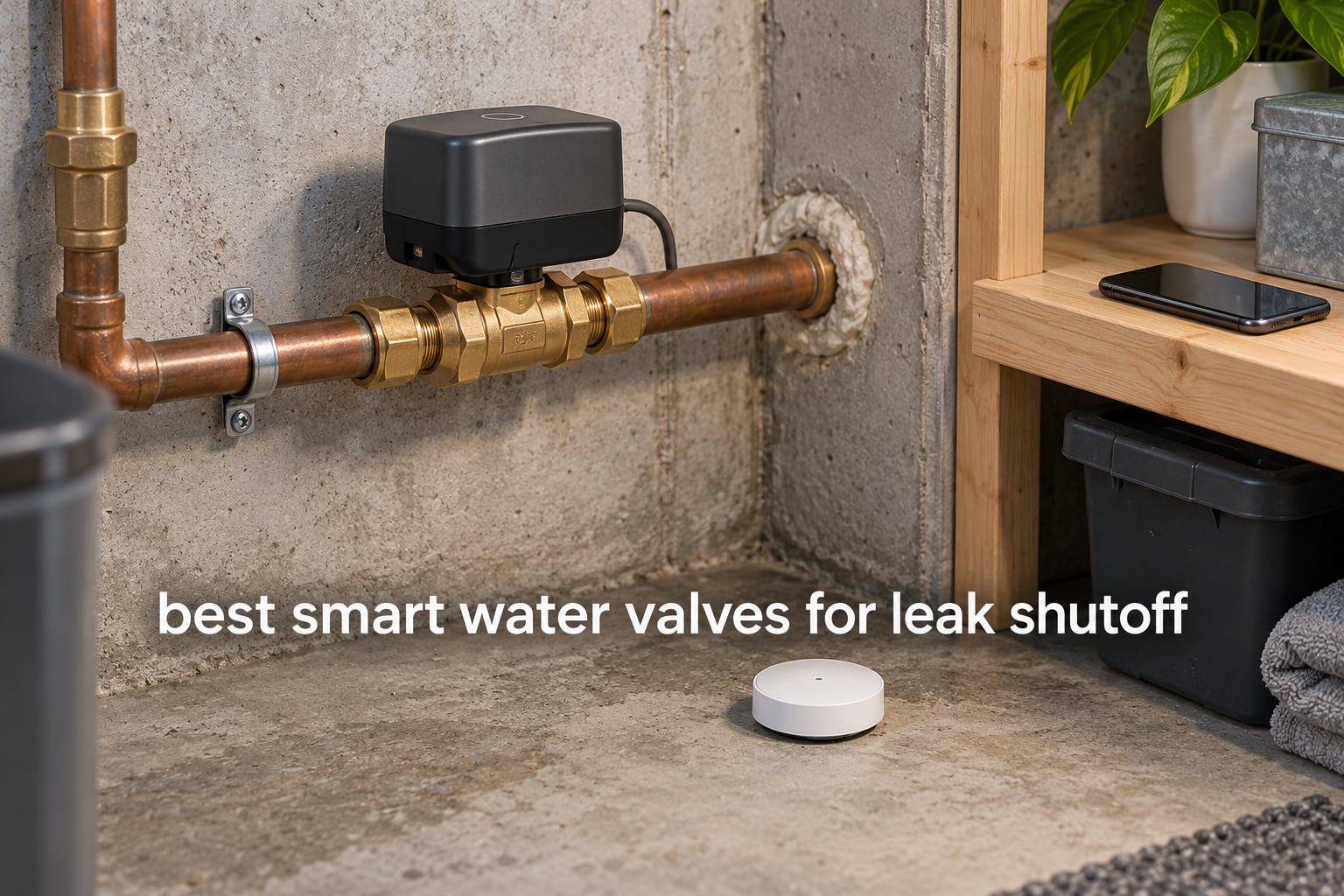
Are automatic water shut off valves worth it? For most single-family homes, yes. A motorized valve that closes your supply line converts a five-figure water damage claim into a mop-up, and the hardware no longer costs more than a weekend of plumbing. The catch is that most devices people buy as “smart water leak detectors” cannot close anything at all, and the ones that can usually need a licensed plumber before protection is actually live.
This roundup covers the eight smart water valves that genuinely shut off supply, not the sensor pucks that merely send you a notification. We scored every pick on reliability, detection accuracy, installation burden, value and ecosystem fit, and we weighted reliability most heavily because that is where this category quietly fails. Our rubric puts reliability at 35 percent, detection at 25 percent, installation at 20 percent, value at 15 percent and ecosystem fit at 5 percent. A valve that cannot be trusted to close is not a discount, it is a false economy.
Two distinctions drive everything below. First, there is a difference between a device that alerts you and a device that closes the water, and only one of those is protection. Second, there are three completely different kinds of hardware, and the wrong one for your plumbing is money you spend on nothing. If you are starting from scratch with sensors rather than valves, our guides to smart leak detectors for basements and water leak detectors for the whole home cover that side of the system.
Top 3 Smart Water Valves for Leak Shutoff in 2026
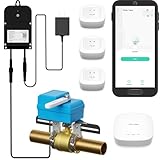
YoLink Water Shutoff Kit
- Device-to-device shutoff works offline
- 1/4 mile LoRa range
- Bundles hub plus three sensors

EcoNet Bulldog Valve Robot
- No pipe cutting
- High-torque 18 second motor
- Fits valves to 1.5 inch
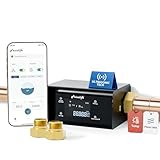
Frizzlife LP365
- Ultrasonic flow sensing to 0.01 GPM
- In-line motorized shutoff
- Adjustable leak thresholds
All 8 Smart Water Valves Compared in 2026
| Product | Specifications | Action |
|---|---|---|
| YoLink Water Shutoff Kit |
|
Check Latest Price |
| EcoNet Bulldog Valve Robot |
|
Check Latest Price |
| Frizzlife LP365 |
|
Check Latest Price |
 iSpring LS43 System iSpring LS43 System |
|
Check Latest Price |
 Zooz Titan ZAC36 Zooz Titan ZAC36 |
|
Check Latest Price |
 Frizzlife LPG365 Frizzlife LPG365 |
|
Check Latest Price |
 U.S. Solid Shut-Off Kit U.S. Solid Shut-Off Kit |
|
Check Latest Price |
 FRANKEVER DN20 Valve FRANKEVER DN20 Valve |
|
Check Latest Price |
Only six of these eight detect a leak on their own. The FRANKEVER DN20 is a remote shutoff and flow controller with no sensing at all, and the EcoNet Bulldog and Zooz Titan are valve operators that depend on a paired sensor to tell them what to do. The other five close the water themselves.
1. YoLink Water Shutoff Kit – Best Overall for Basements and Detached Areas
YoLink Water Shutoff Kit: Controller + EVO + 3-Pack Sensors + Hub
Valve controller plus EVO operator
1/4 mile LoRa range
Device-to-device offline shutoff
Hub and 3 sensors
Pros
- Shuts off during power or internet loss via device-to-device link
- Quarter-mile range reaches basements attics and outbuildings
- No pipe cutting needed
- Complete kit with hub controller and three sensors
- Works with Alexa Google Assistant IFTTT and Home Assistant
Cons
- Higher total system cost than a single valve
- Requires the included hub for remote control
- SMS alerts carry a small monthly quota
The YoLink kit is the only pick here that solves the problem I consider hardest to engineer around, which is a house where the Wi-Fi signal is bad. The controller, the valve operator and the sensors talk to each other directly rather than routing every command through a cloud server. When a sensor sees water, the valve closes even if the router is down or the power has just failed, and that is a hardware behavior rather than a promise in a support page.
The other half of the advantage is range. The radios are LoRa rather than Wi-Fi, and the listed reach between devices and hub is up to a quarter mile. For a house with a mechanical room in a crawlspace, a water heater in a garage, or a cottage at the far end of the property, that is the difference between a system that works and a system that needs a repeater stacked somewhere inconvenient.
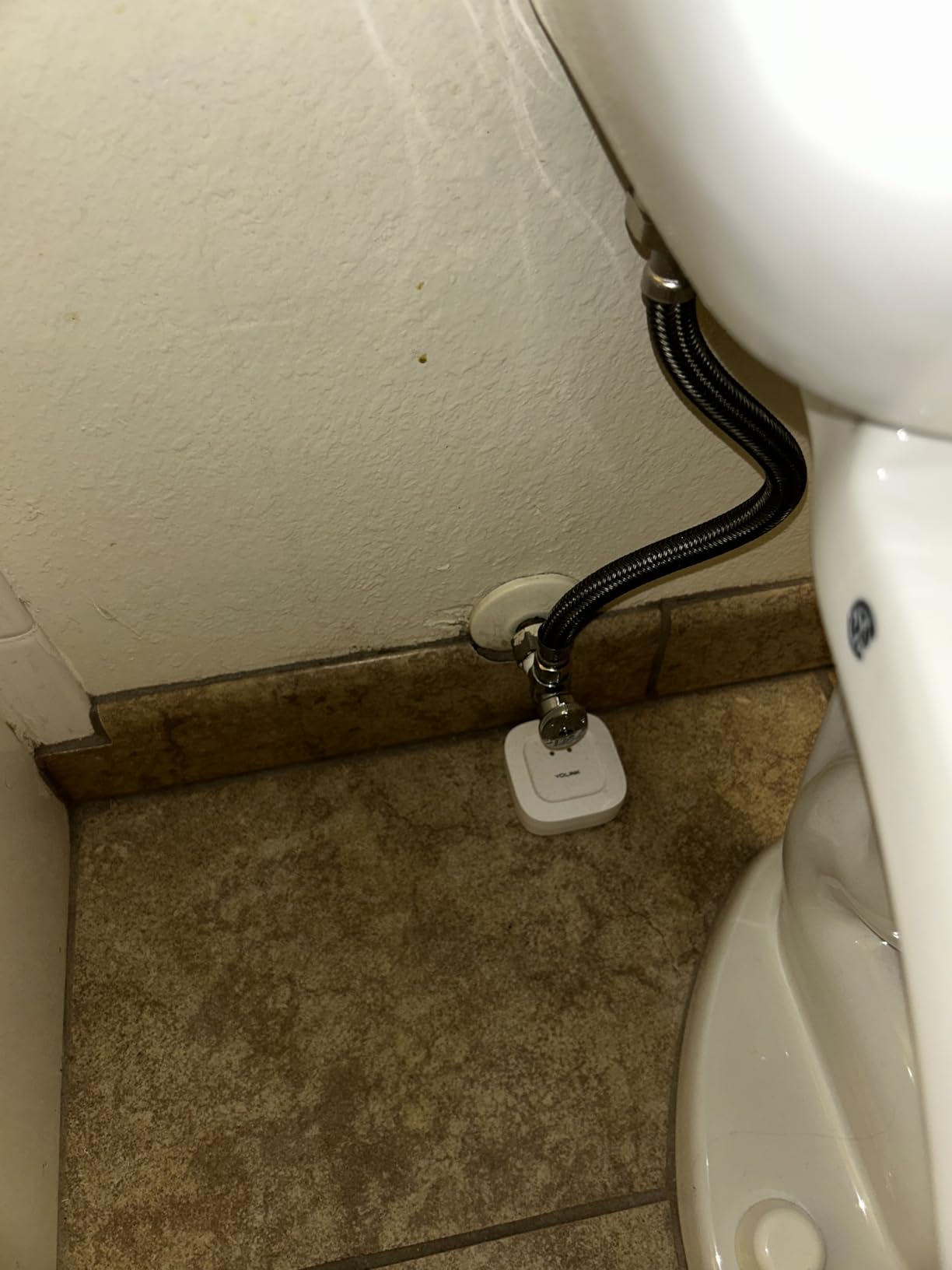
Everything you need is in one box: the valve controller, the EVO valve operator that mounts on your existing valve, the hub and three leak sensors. Nothing here requires cutting into a supply line, which is why this rated the highest overall in our scoring despite not being the most capable in-line unit on the list. Battery life is claimed at up to five years for the sensors and two years for the controller, with mains power as the primary source.
Alerting is thorough for a kit at this level. You get app notifications, email, SMS with a small monthly allowance, and iOS Critical Alerts that bypass silent mode on an iPhone. The same device works with Alexa, Google Assistant, IFTTT and Home Assistant, so it fits into an existing automation stack rather than demanding a new one.
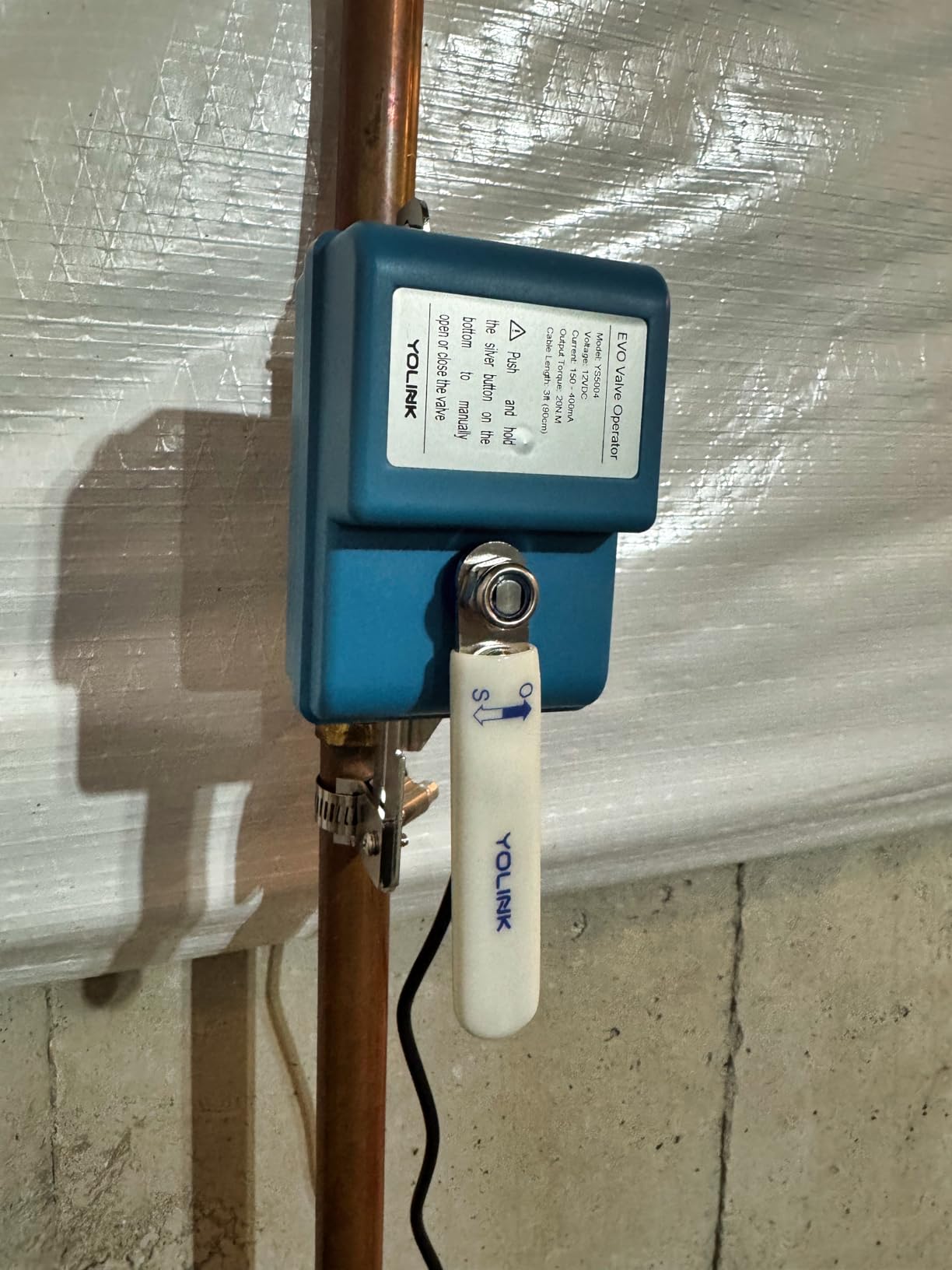
Where the quarter-mile range changes the answer
Buy this if your weak spots are distance, not complexity. Owners running the system across larger homes or outbuildings point to the sensors holding a link to the valve where Wi-Fi based competitors drop off. Three sensors are included, which covers a main mechanical area, a water heater closet and a laundry area, and the range headroom means you are not choosing placement based on where the router happens to sit.
The offline shutoff is the feature we would not give up. A home owner in a flood is often dealing with the same event that knocked out power or the internet connection, and a cloud-dependent valve can fail exactly when it is needed. Here the closing command is local.
Where this kit disappoints
The full system cost is higher than any single valve on this list, because you are buying a hub, three sensors and a controller rather than one device. Add the hub requirement to your planning: without it you have no remote control and no notifications, only local shutoff behavior.
The SMS allowance is a quota rather than an unlimited channel, which is a fair trade for keeping the subscription out of the equation. And the manufacturer note about avoiding excessive moisture, flooding and extreme temperatures is worth reading carefully if you plan to mount anything near a prone-to-flooding sump pit.
2. EcoNet Controls Bulldog Valve Robot – Best for Z-Wave Homes
EcoNet Controls EVC200-HCSML The Bulldog Valve Robot, Z-Wave Water Valve, Smart Home Controller Required, Easy to Install and No Plumbing Required, Valves up to 1.5″
Z-Wave Plus valve robot
Fits 3/4 to 1.5 inch ball valves
18 second high-torque motor
Auxiliary power included
Pros
- No plumbing work or pipe cutting
- Strong motor handles stubborn ball valves
- Works with SmartThings Hubitat and Ring
- Expandable for multi-property setups
Cons
- Needs a Z-Wave hub or controller
- Adds a hub cost to a first install
- Won't suit homes without a Z-Wave network
The Bulldog is the oldest idea in this category done well: clamp a motor housing onto a ball valve you already have and turn the handle. The mounting kit, AC adapter and controller are included, and the whole thing sits on top of a standard quarter-turn valve. If cutting into a supply line makes you nervous or your plumber quotes you heavily for it, this is the way to get automatic shutoff without touching copper, PEX or CPVC.
Torque is the number that matters on a retrofit actuator, and this one is rated to open or close in approximately 18 seconds using a high-torque motor. It fits 3/4 inch, 1 inch, 1.25 inch and 1.5 inch ball valves, which covers the overwhelming majority of residential mains and, unusually, goes wider than most competitors in this group. Owners running it on older homes report it turning valves that cheaper actuators have given up on.
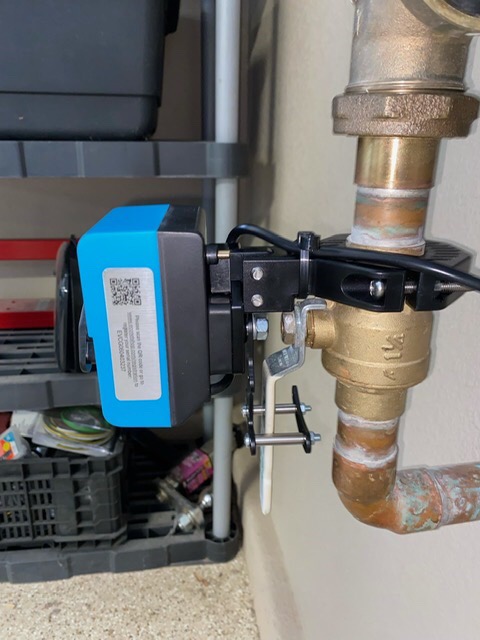
Radio side, it is Z-Wave Plus certified with roughly 30 meters of reach, and the compatibility list is long: SmartThings, Wink, Hubitat, Nexia, Control4, Universal Devices, Honeywell and Ring. Owners running it in smart home communities call the Bulldog highly recommended, and a separate owner of this category of device specifically preferred a motor you can reason about over a box full of circuit boards. That matches what we see in the review set.
It also expands. An optional slave valve robot lets one controller handle more than one valve, which is how a landlord or property manager covers a boiler room and a riser without buying two full control panels.
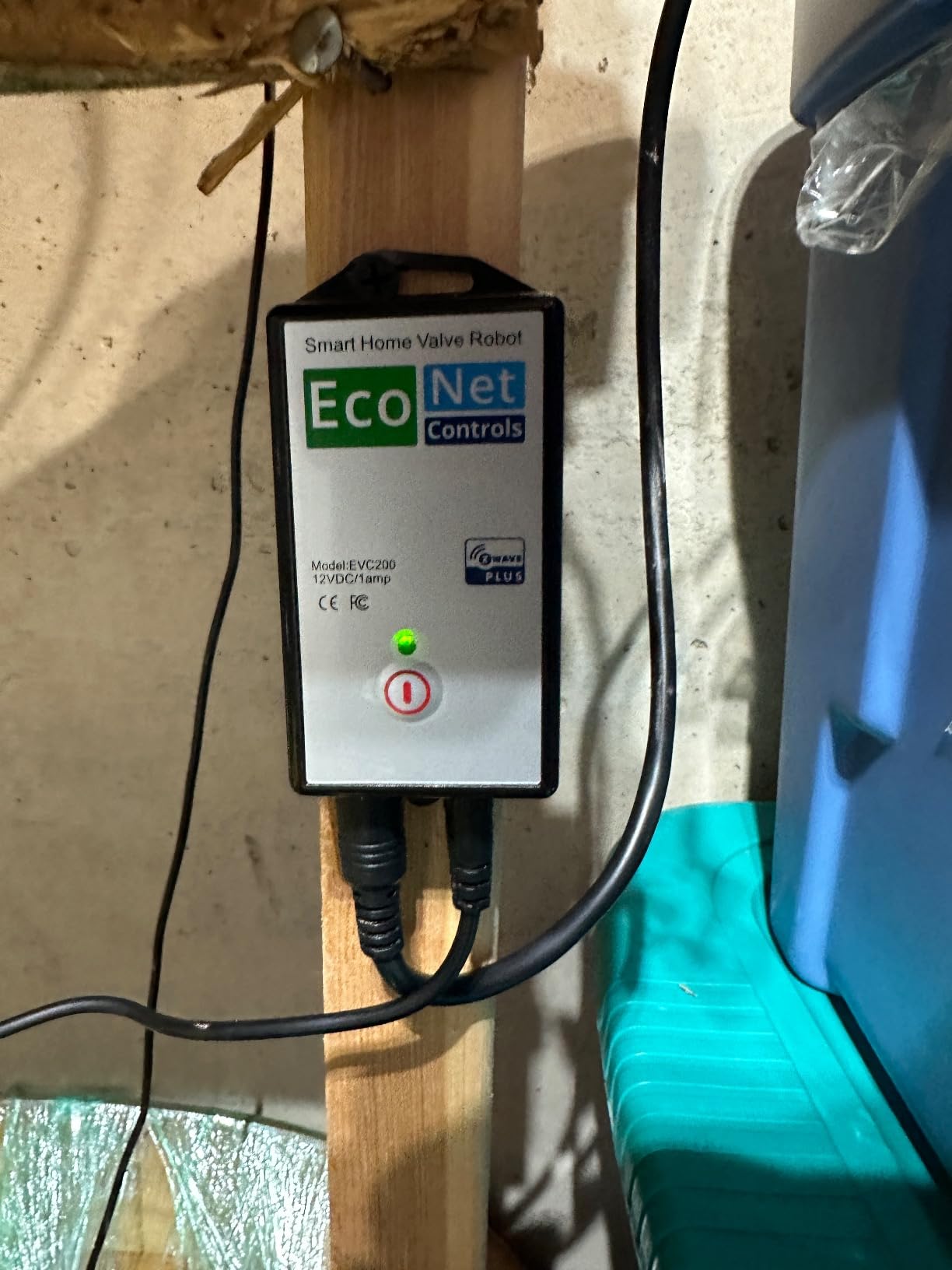
What the 18-second motor actually handles
Ball valves that have sat closed for years, or that sit in a house with hard water and mineral buildup, need real torque. The complaints we see on cheaper strap-on actuators are almost always torque related: the device reports success, the valve never moved, and nobody finds out until there is water on the floor. A motor rated to close in about 18 seconds at these valve sizes is built for that failure mode rather than around it.
Because the housing is a one-time addition over an existing valve, you also keep your manual shutoff. If the controller electronics ever fail, the physical handle is still there and still turns. That is a meaningful advantage over an in-line motorized valve with no override, and a reason some owners deliberately choose a retrofit even where an in-line unit would fit.
The hub tax and the missed fittings
The obvious cost is the ecosystem requirement. There is no remote control, automation or notification without a Z-Wave hub or controller, and for a first-time buyer that hardware is part of the budget. If you have no Z-Wave network and no plans for one, this is the wrong pick no matter how good the motor is.
The second gap is smaller but real: the fittings list starts at 3/4 inch. Homes on a 1/2 inch line, and some condo stubs, are outside it. Measure the pipe and the existing valve before ordering rather than after.
3. Frizzlife LP365 – Best for Micro-Leak Detection on a Main Line
Frizzlife LP365 Smart Water Monitor and Automatic Shutoff Valve – 0.01GPM Ultrasonic Micro Leak Detection, APP Wi-Fi Remote Control, Real-Time Flow/Temp Alarm, 24/7 Water Usage Reports, 3/4″ and 1″
In-line ultrasonic flow meter
Detects down to 0.01 GPM
Fits 1 inch and 3/4 inch
Lithium-ion backup battery
Pros
- Ultrasonic sensing with no moving parts to wear out
- Catches micro-leaks as small as 0.01 GPM
- Thresholds adjustable to household usage
- Keeps working on battery backup
- Works with Home Assistant via the Tuya ecosystem
Cons
- Included brass adapters lack wrench flats
- Box manual is confusing
- Needs a plumber and usually a manual bypass
- Cannot see leaks under roughly 0.001 GPM
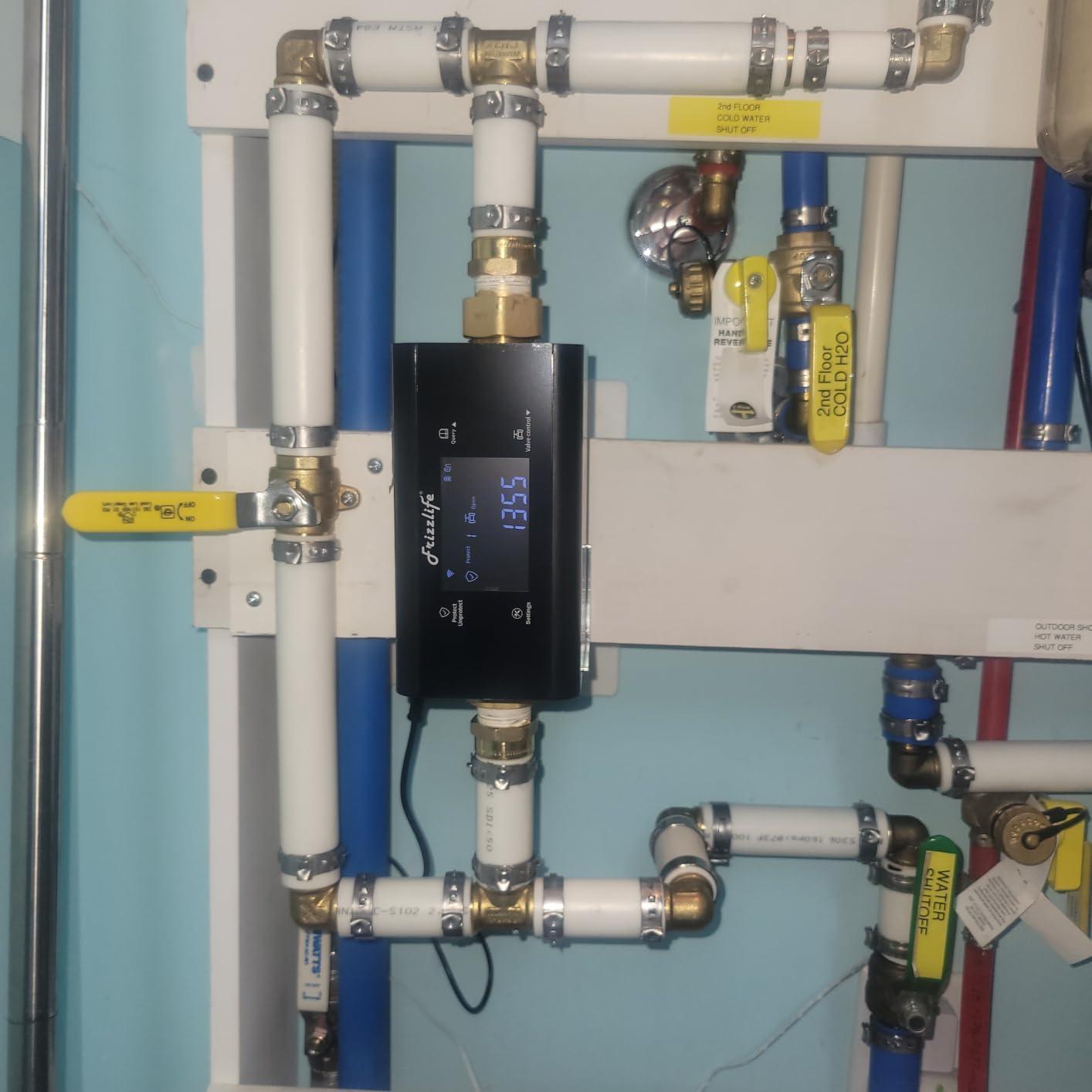
This is the pick for a homeowner who wants to know not just that water is running but how much, and where. It is an in-line unit with a motorized ball valve and an ultrasonic flow meter, mounted where the main enters the home. Flow rate, temperature and pressure are reported in real time, with daily and monthly usage reports, and alerts arrive by SMS, phone call and app notification around the clock.
Ultrasonic measurement is the technical decision that separates it from most of the category. Rather than spinning an impeller in the water path, it measures transit time of a signal through moving water, which means no moving parts to jam or break apart. A Home Assistant owner explained the preference neatly: they like ultrasonic for detection instead of an impeller in the pipe that could break apart sooner or later. The same owner has run a Zigbee smart valve for years without issue, and that sentiment tracks with the wider owner reports on this model.
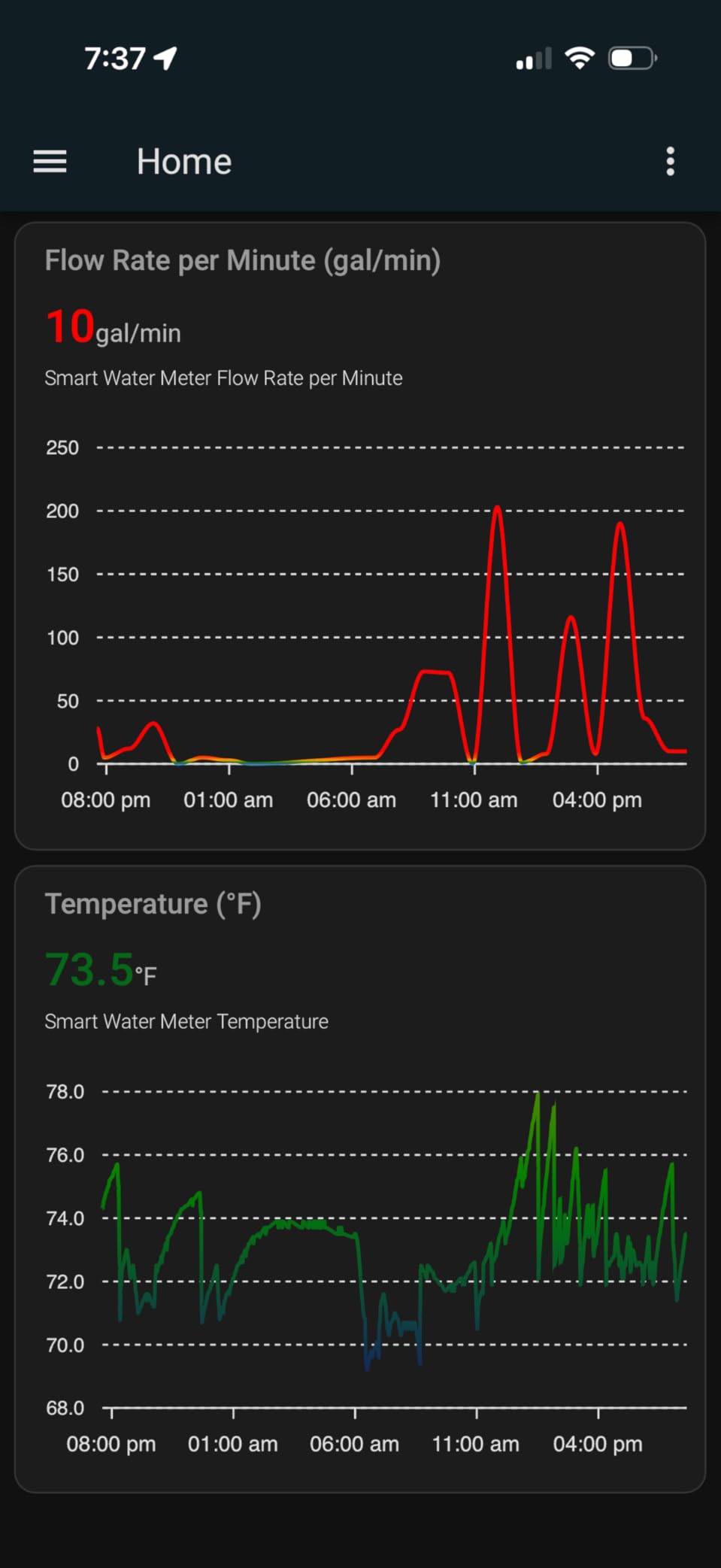
The threshold is the number that makes the difference. This unit sees flow changes down to 0.01 GPM, which is where a supply line weeping into a wall stops being a guess. Thresholds are customizable to your household’s usage pattern, which is how you avoid a system that closes every time someone runs the dishwasher. Owner tests comparing its readings against utility meter data found the numbers close, and several owners report the unit catching sprinkler, filtration and supply line leaks within days of install.
It also works with Alexa, Google Assistant, SmartThings and Tuya-based apps including Home Assistant, and it carries NSF/ANSI 61 and 372 certification for drinking water contact. A rechargeable lithium-ion backup battery keeps protection live during an outage, which matters more than it sounds: the power going out is frequently part of the same event as the leak.
Why ultrasonic sensing beats an impeller
An impeller turbine meter is simple, cheap and has a failure mode that appears exactly when you are not looking. Sediment and scale coat the impeller, the reading drifts, and eventually a fragment breaks into the supply. Ultrasonic meters have no such part. They also tend to hold accuracy at very low flow, which is the range that matters for a slow leak and the range where cheap meters go blind.
The practical payoff is fewer false alarms and fewer missed ones. A system that closes the valve on every toilet flush trains you to ignore it, and a system that never sees the small leak trains you to trust it too much. Adjustable thresholds plus a sensor with no moving parts is the combination we like best here.
The install and app friction to expect
Plan on a plumber, and plan on a manual bypass valve. The unit must be plugged in to be networked, professional installation is recommended, and it weighs just under 4 pounds with a body roughly 5.7 by 3.9 by 3.1 inches, so it needs real space in the plumbing area. Two smaller annoyances: the included brass NPT adapters have no wrench flats, which makes tightening them harder than it should be, and the manual in the box is confusing enough that most owners end up using the emailed documentation instead.
Two limits to know in advance. It cannot detect leaks below roughly 0.001 GPM, so a single slow faucet drip will not register. And the app lacks usage data download and pressure history storage, which matters more than it sounds if you are trying to prove a pattern to an adjuster.
4. iSpring LS43 – Best Budget In-Line Shutoff for Sensor-Fed Homes
iSpring LS43 Water Leak Detector Alarm System, Automatic Shut-Off Valve and 2 Detection Sensors, Connects Up to 8 Sensor to Prevent Flooding, 3/4″ NPT
In-line 3/4 inch NPT ball valve
Controller links up to 8 sensors
Sound and light alarm
1 year warranty
Pros
- Very few false alarms from humidity or rain
- Shuts the supply within seconds of standing water
- Expandable to 8 sensors
- Loud alarm audible from a basement
- Responsive support with lifetime contact
Cons
- Requires pipe cutting and plumber work
- Valve fixed at 3/4 inch NPT
- Power indicator color is confusing
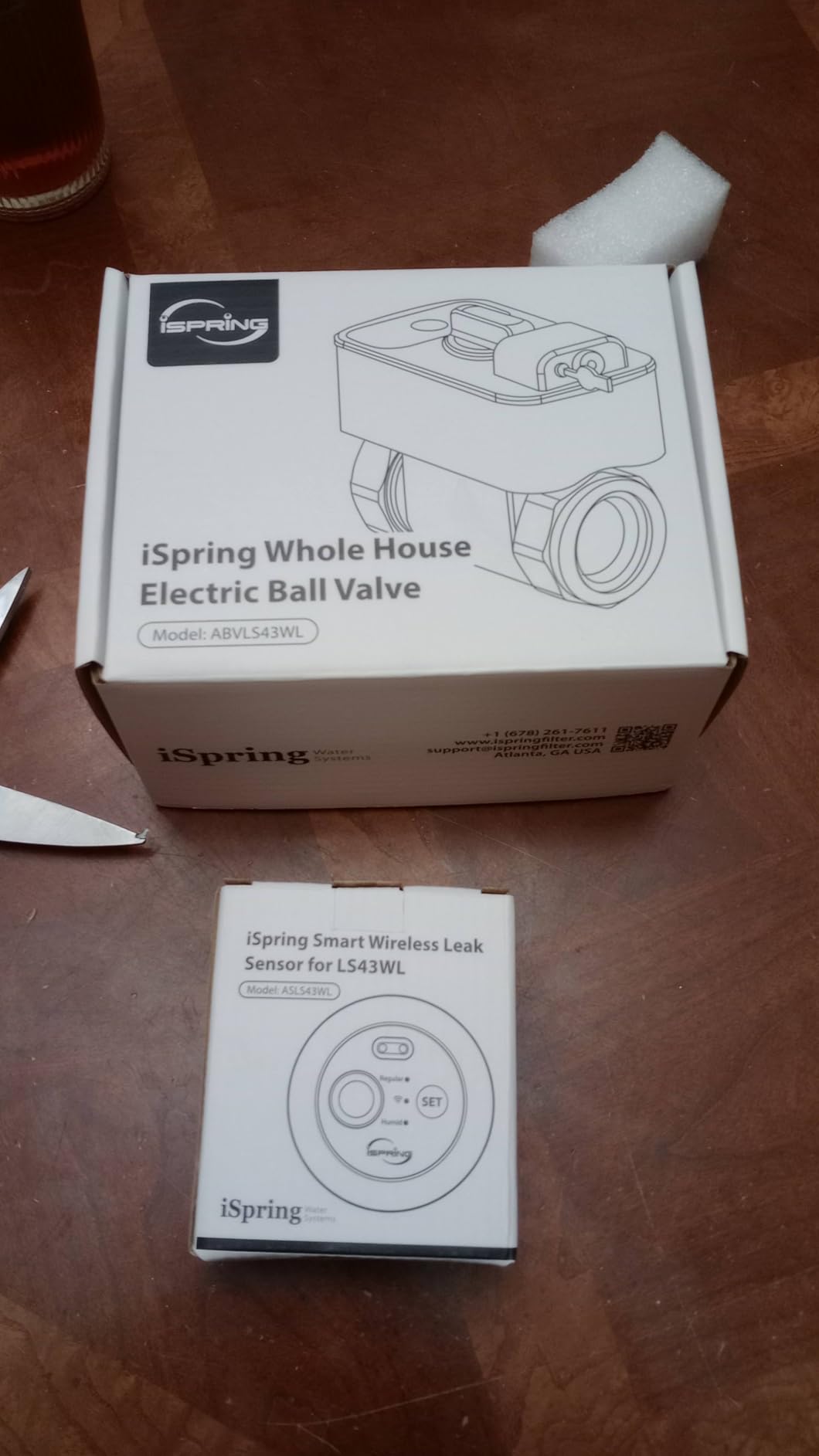
The iSpring LS43 is the straightforward version of the mainline idea: an automatic 3/4 inch NPT shutoff ball valve, a controller, a transformer and two water detection sensors in the box. The controller links up to eight sensors total, so the coverage grows from two points to a whole-house layout without a second purchase. The valve and the controller both have sound and light alarms, and owners note the alarm carries from a basement.
The reason it earns a place despite a modest review count is the false alarm behavior. Buyers who came from cheaper wireless detectors report near-zero false alarms, and the calibration holds up against humidity and rain rather than reacting to every downpour. That sounds like a small thing until you consider that a valve system which cries wolf gets muted, and a muted valve is a valve you paid a plumber to install for nothing.
The shutoff itself is quick. Owners report the supply being cut within seconds of standing water being detected at a sensor, and the system covers the classic failure points well: water heater relief lines, washing machine supply hoses, dishwasher connections and a water heater pan. Support is a 1-year warranty with lifetime contact, and reviewers single out responsive service that resolves setup questions and sends replacement parts.
Everything about the sensing approach here is passive contact detection, which is a different architecture from the flow-based units above. That means it will catch a puddle at a sensor and ignore a leak happening between sensors, which is the trade you make for a much simpler system.
Why owners moved off cheap humidity-prone sensors
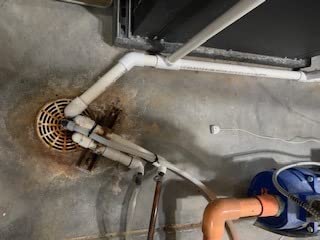
The recurring story in the reviews is a correction, not a first purchase. People bought inexpensive pucks, got constant nuisance alarms in humid months, and eventually found a system calibrated tightly enough to ignore weather. A flooded dishwasher supply line behind a closed cabinet is exactly the event these owners were trying to catch, and a valve that is alert but frequently ignored does not catch it.
Sensor capacity is the other practical argument. Eight sensor capacity means one controller can cover a water heater, a laundry closet, a kitchen sink area, a water heater pan, a basement mechanical room and a couple of laundry supply points. That is a full property layout on a single install, and it is the reason the extra sensors cost so little relative to the plumbing work.
The 3/4 inch limit and the plumbing bill
Two real constraints. The valve is fixed at 3/4 inch NPT, so a 1 inch or 1/2 inch main is out of scope without additional fittings, and fitting that around a fixed valve is where installs get expensive. And this is genuine pipe work: the unit installs on the whole-house water pipe, which means cutting supply line and adding a tee. Budget for a plumber rather than attempting it.
There is also a small quality-of-life issue that shows up in support contacts: the wireless unit’s power indicator shows white rather than green, and owners read that as a fault. iSpring confirms it is the normal state, but it is a bad first impression.
5. Zooz Titan ZAC36 – Best for Stubborn Old Ball Valves
Zooz Z-Wave Long Range 700 Series Titan Water Valve Actuator ZAC36 | Compatible with Z-Box, SmartThings, Works with Ring Alarm
Clamp-on Z-Wave Long Range actuator
Fits 0.5 to 1.25 inch ball valves
Calibrates torque on setup
5 year warranty with registration
Pros
- Strong motor handles hard and old ball valves
- Tool-free install with no pipe cutting
- Works with SmartThings Hubitat Ring and Home Assistant
- Calibrates to the installed valve
- Usable outdoors
Cons
- Leak probe cord is short for high-mounted valves
- Strict clearance requirements
- Pairs to only one Z-Wave hub
- Support and factory reset reported as unreliable
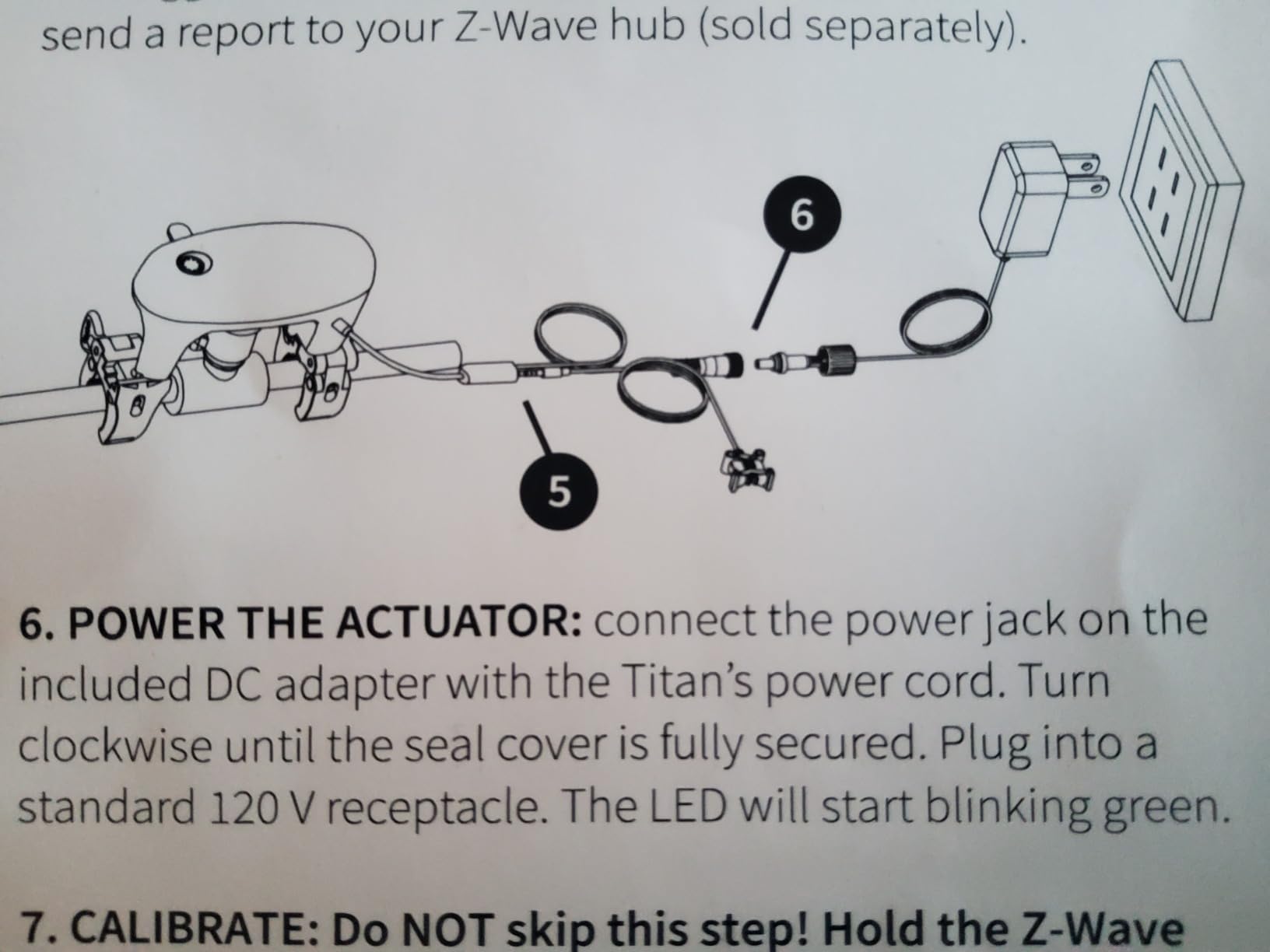
The Titan is the actuator we would trust on a house with an old main and a ball valve nobody has turned in a decade. It clamps over a standard 0.5 inch to 1.25 inch ball valve, mounts tool-free in roughly 15 minutes, and calibrates itself on setup to work out how much torque your specific valve needs. That calibration step is the feature other actuators in this category skip, and it is the reason this one reports closing on valves that cheaper units have quietly failed to move.
Owners in the reviews call the motor unusually strong, and they contrast it with weaker retrofit actuators that fail within a year or two. The other praise is consistent: clean pairing with SmartThings, Hubitat, Ring Alarm and Home Assistant, and a stable connection at a distance thanks to Z-Wave Long Range with S2 Security and SmartStart.
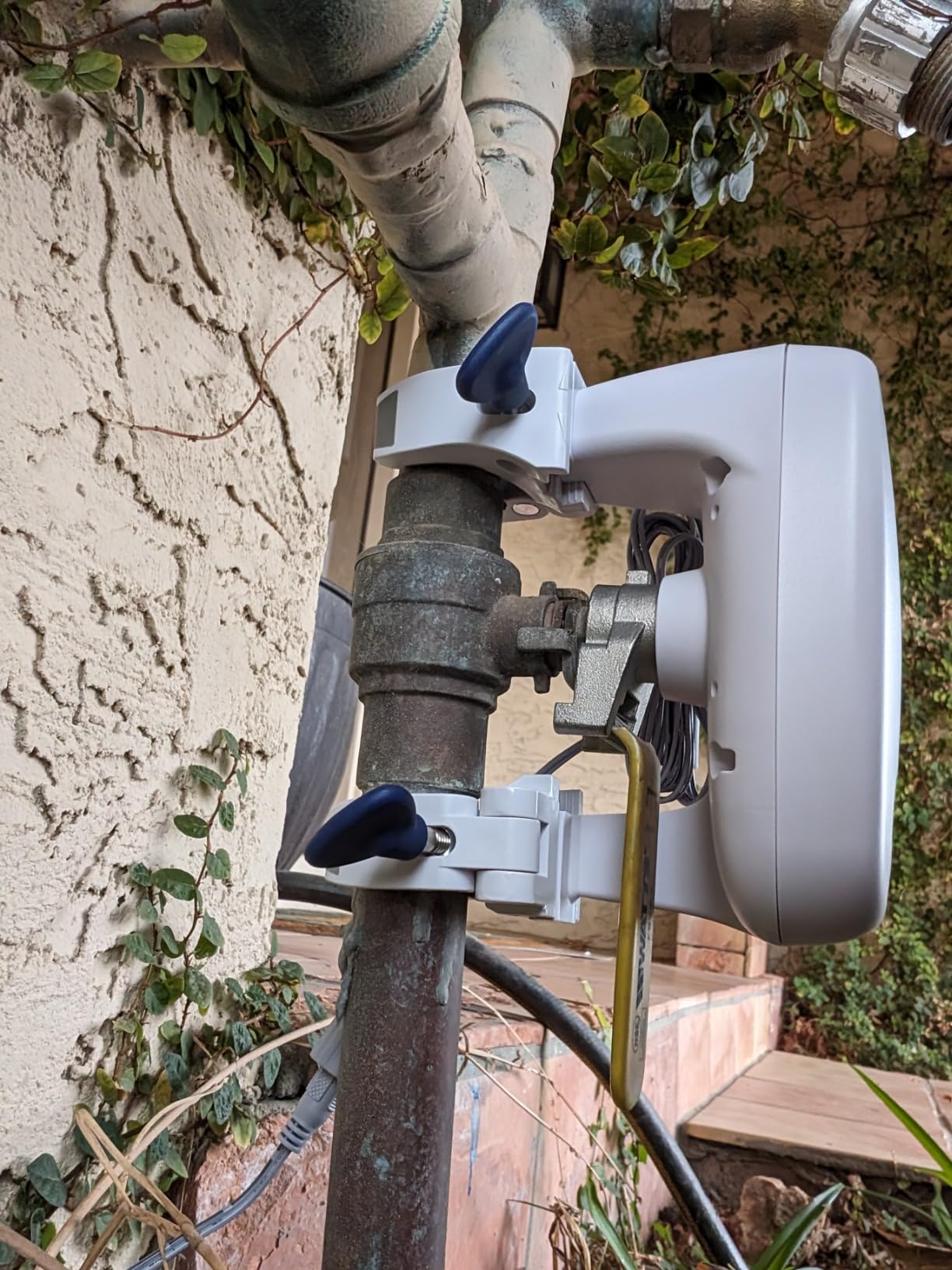
The most useful owner report we found describes running it on a 1 inch ball valve in a house that is empty for weeks at a time, with the valve reopening normally after long periods closed. That is the real test of an actuator, and it is also the reason to schedule a routine exercise so the valve does not seize from disuse.
It ships with a power supply and an external water probe, works offline with that probe when the hub is unreachable, and registers for a 5-year extended manufacturer warranty if you do it within 30 days. For someone who wants a manual remote shutoff to hand a plumber, or to use from a hotel room, that alone justifies the purchase.
Measure these clearances before you buy
This is where purchases get returned, so the numbers matter. The Titan needs 3 inches of clearance on each side of the valve center, 1.25 inches between the valve handle and the pipe, and 1 inch between the pipe and the wall. That is a real footprint. In a tight crawlspace between a joist and a foundation wall, an actuator that fits every valve size can still fail to fit the space.
Second, the included leak probe cord is short. Owners with valves mounted more than a couple of feet off the floor report the cord is not long enough for the socket position, and the socket itself is tight to work with. Budget for a longer probe or a better-mounted valve if you are installing high.
Where the Titan falls short
Pairing is limited to a single Z-Wave hub, which is fine for most homes and awkward for anyone running two. There is no physical lock to deter someone removing it from the pipe, which matters in a rental or a house with curious children. And Zooz web support and the factory reset process are reported as unreliable, which is a real problem for a device whose job is to work when everything else has stopped working.
The Z-Wave Long Range protocol also means your hub must support ZWLR. If you already know your hub does not, this is out before you start.
6. Frizzlife LPG365 – Best Dual Detection with Included Long-Range Sensors
Frizzlife LPG365 Smart Water Auto Shutoff Valve W/ 3 Leak Sensors, 100% Dual Detection- 0.01GPM Ultrasonic Micro Leak Detector & Sensor-Triggered Shutoff, App Control, Flow & Temp Monitor,Fits 3/4″&1″
In-line valve plus 3 LoRa sensors
Ultrasonic flow to 0.01 GPM
Battery backup operation
Fits 1 inch and 3/4 inch
Pros
- Flow monitoring and puck sensors catch both leak types
- LR80 sensors reach 1/3 mile without internet or power
- Continues protecting during a power outage
- Home Assistant integration supported
- Owners cite a lower insurance premium
Cons
- Highest cost in this group and a basic app
- No built-in manual override
- PEX plumbing needs an extra adapter
Every leak detection architecture has a blind spot. Flow monitoring catches a pipe weeping inside a wall, but a small puddle under a dishwasher may never register as unusual main-line flow, and it may never grow to the point where the threshold trips. Contact sensors catch a puddle instantly but only where they are physically placed. The LPG365 runs both, which is why it is the most complete system in this roundup.
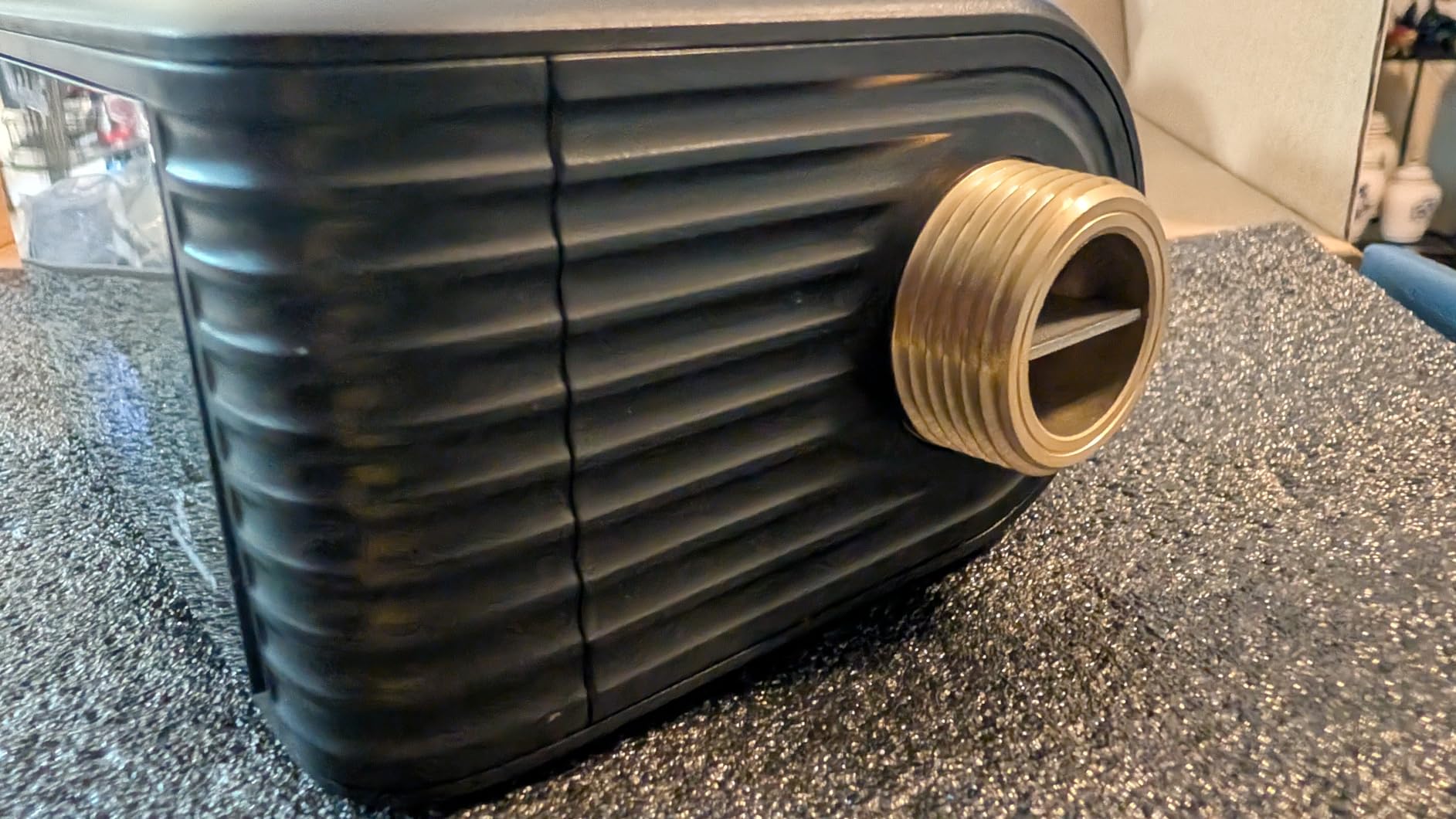
The in-line half is an ultrasonic meter rated to see flow changes as small as 0.01 GPM with no moving parts, and it adds flow, temperature and usage history to a touch display and app. The other half is three LR80 wireless leak sensors using 1/3-mile LoRa, and those sensors work without internet or power and trigger the valve shutoff directly.
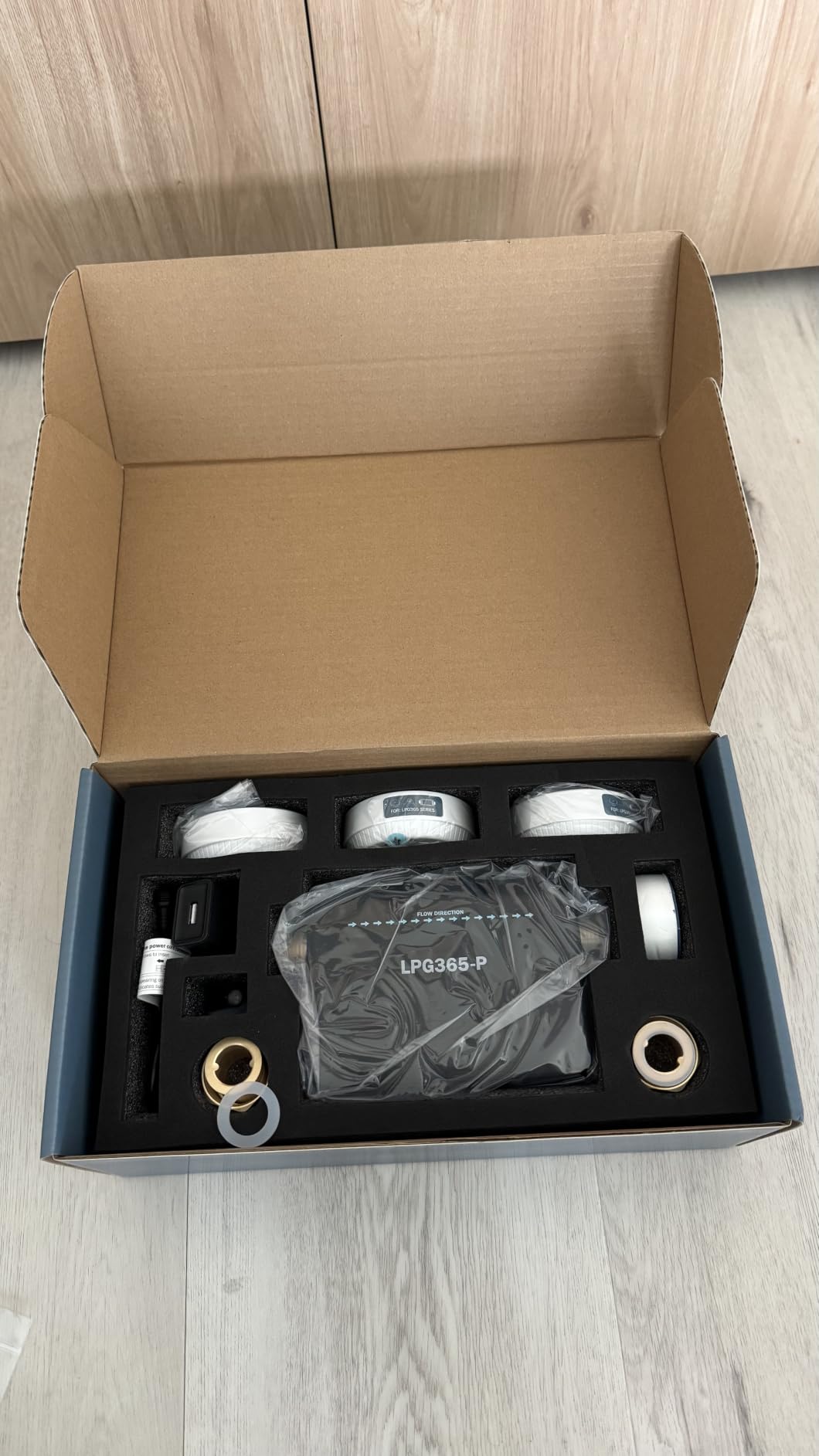
That range figure matters more than it sounds. Owners report the sensors-to-valve link holding across larger homes, and the ability to work with no power or no connection means the shutdown path does not run through a cloud server. The valve also has corded power plus a rechargeable lithium-ion battery, so an outage does not open your supply line by default.
Buyers overwhelmingly came to this system after a leak incident, and they describe it catching slow, low-volume leaks that other sensors had missed, including a sprinkler vacuum breaker, an RO canister and NPT fittings within days of install. Several cite a lower homeowners insurance premium after installation, which is worth asking your own carrier about rather than assuming.
Why pairing flow monitoring with pucks matters
Consider the two most common residential failures. A supply hose behind a washing machine fails fast and loudly, and a puck on the floor catches it instantly. A pinhole in a copper line inside a wall or under a slab drips at a rate the household pattern absorbs, and only flow monitoring sees it, because the water is disappearing before it ever becomes a puddle. One method covers the first case, the other covers the second.
This is also the argument for the LoRa sensors specifically. A wireless puck on 2.4GHz that depends on the hub being alive is only as good as your router. These sensors talk to the valve over a 1/3-mile link and keep working with the internet and the mains both down, which is the failure state that matters.
The premium is real and the app is basic
Two honest caveats. This is the most expensive kit in the group, and the app is largely on-off control plus usage data, which is a step down from the analytics on simpler flow meters. You are paying for the sensor bundle and the dual detection architecture.
There is no built-in manual override, so a manual bypass valve should be part of the install plan, and PEX plumbing requires an additional adapter that is not in the box. A few buyers have also questioned the certification markings given this brand’s history with such claims, which is a fair thing to verify in the documentation your plumber receives. Professional installation is recommended, and the body is around 7 by 4.7 by 2.7 inches.
7. U.S. Solid Auto Shut-Off Kit – Best for Water Heater and Laundry Rooms
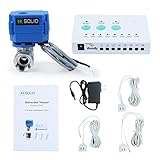
U.S. Solid Water Leak Detector with Auto Shut-Off Valve & Sound Alarm, 3/4″ NSF Certified 304SS Motorized Ball Valve with 3 Sensors, Smart Sensor System for Water Heaters, Laundry & Flood Prevention
NSF certified 304 stainless ball valve
Three sensors with 20 ft cables
Shuts off in 4 to 5 seconds
IP65 rated valve
Pros
- Isolates supply within 4 to 5 seconds of a leak
- Controller identifies which sensor alarmed
- Rugged sensors with 20 ft cables
- Reported insurance premium reduction
- Available in 1/2
- 3/4 and 1 inch sizes
Cons
- Only three sensors included
- Extra sensors costly to ship outside the US
- Non-leak water events can trigger the alarm
- Corded 5V power supply
The U.S. Solid is a point-of-use system built for the places leaks actually start in most homes: the water heater, the laundry closet and the washing machine supply area. The valve is a lead-free 304 stainless steel ball valve with NSF certification and an IP65 waterproof rating, rated for a 50,000-hour lifespan, and it is motorized. On a detected leak it isolates the supply in four to five seconds.
The feature that owners single out is diagnostic. The controller identifies which specific sensor is alarming, so instead of crawling through a laundry closet in the dark testing each cable, you know where to look. That is a small engineering decision with a real effect on how quickly you find and fix the actual problem.
Sensor hardware is where this holds up against the wireless competition. The three included sensors are contact type with 20 ft cables, roughly 6 meters, and owners who moved over from wireless systems rate them as noticeably more rugged. Buyers also report a homeowners insurance premium reduction after installation, which again is a question for your own carrier.
Size choice is better than most kits at this level: 1/2 inch, 3/4 inch and 1 inch valve options, so you are not forced into a 3/4 inch compromise.
Point shutoff versus main-line shutoff
Understand what this does before you assume it does something more. A point-of-use system protects the appliance zone it is installed in. It will not stop a burst line in a wall, a leaking upstairs bathroom or a failed riser, because the valve is downstream of those. If you want whole-home protection, this is the wrong architecture and you want an in-line unit such as the Frizzlife LP365 or the iSpring LS43 instead.
Where it genuinely wins is cost and disruption. Installing a motorized valve at a water heater is a short plumbing job rather than a main-line cut, and for many households the water heater plus the laundry closet accounts for most of the realistic loss in a typical year.
Sensor count and the kettle problem
Three sensors is the limit in the box, and additional sensors can be costly to ship outside the United States, which matters for anyone outside the market where this was priced. The cables are long, but the count is the constraint. Plan your three points carefully: water heater pan, washing machine supply and the nearest likely failure point.
The other recurring gripe is that the alarm can trip on water that is not a leak, with filling a brewing kettle named specifically. The integrated audible alarm continues until the leak is cleared and the system is reset, which is good for a real event and irritating for a false one. Placement away from where you actually use water matters more here than with a flow-based system.
8. FRANKEVER DN20 Smart Water Valve – Best for Irrigation, Pools and RVs
DN20 Smart Water Valve 3/4 Inch Smart Water Shutoff Valve Management System
3/4 inch NPT remote shutoff valve
2.4GHz Wi-Fi via Smart Life app
0 to 100 percent flow adjustment
Power-failure mode selectable
Pros
- Lowest cost remote shutoff in this group
- Adjustable flow percentage and schedules
- SS304 stainless steel with ABS housing
- Alexa control
- Useful for isolating outdoor irrigation lines
Cons
- No leak detection built in
- Needs a separate leak sensor
- No manual override if electronics fail
- Wi-Fi only with no Bluetooth option
Be clear about what this device is, because it is sold next to the others and it does not do the same job. The FRANKEVER DN20 is a remote smart valve with no sensing whatsoever. It cannot tell you there is a leak and it cannot decide to close. What it does is let you open and close a 3/4 inch line from your phone, adjust flow from 0 to 100 percent in 10 percent steps, and run on a schedule, which makes it a flow controller rather than a safety device.
Used properly that is genuinely useful. Isolate an outdoor irrigation line so timers do not run during a power loss, fill a pool, run a hose timer circuit, or control the water in an RV or motorhome where the plumbing is already localized. The body is SS304 food-grade stainless steel with an ABS engineering plastic housing, powered over USB at 5V and under 2 amps.
The control side is 2.4GHz Wi-Fi through the Smart Life app on Android and iOS, with scheduling and a selectable power-failure mode that can be set to default open. Owners using it in RVs and motorhomes call it rock solid once paired, and Alexa control for on and off is highlighted as working well. For the specific job of remote irrigation and travel shutoff, it is the least expensive way into this category.
What this valve does and does not do
Pair it with a leak sensor and it becomes useful. Without one, it is a remote switch, and the safety expectation should be set accordingly. That distinction is the single most common source of disappointment in this category, and it is worth restating: a valve with no sensor cannot protect your home, it can only let you act faster once something else has told you there is a problem.
Because the flow percentage is adjustable, it also does a job the dedicated shutoff valves cannot. Running an irrigation zone at a lower flow, or shutting off a hose spigot line on a schedule to stop a freeze-damaged line drawing water overnight, is a control problem rather than a leak problem.
Mixed reliability reports and no manual override
The review volume here is small, and the reliability reports inside it are mixed. Several owners report durability or self-closing incidents, including one unit that closed on its own within 48 hours even when set to default open, which would make it unusable as a constant-on valve, and one report of a unit that shorted and smoked. That is a small sample, and the average rating still sits well above four, but this is the pick to buy only if you can check on it.
Two structural limits. There is no manual override if the electronics fail while the valve is in the line, which is a genuine problem for an always-on installation. And it is Wi-Fi only, with no Bluetooth option, so an RV parked away from a network needs a different approach.
Do Smart Water Valves Still Work Without Wi-Fi or Power?
It depends entirely on the architecture, and this is the question most roundups skip. A valve that routes every decision through a vendor’s cloud is a keypad with a motor attached. If the internet is down, it may not know a leak happened, and if the power is out it may not know anything at all. The owners we heard from in smart home communities put it plainly: they prefer local control, because even if the internet is out they know the house is protected, and they trust simple hardware, a motor and a relay, over a stack of circuit boards that can go bad.
Two products in this roundup answer that concern at the hardware level. The YoLink kit uses a device-to-device link, so the sensor commands the valve to close without any route through the hub or the internet, and the manufacturer states this works during power loss or network disruption. The Frizzlife LPG365 takes the same approach with its LR80 sensors, which work without internet or power and still trigger shutoff across a 1/3-mile link.
Power is a separate axis from connectivity. The Frizzlife LP365 runs on corded power with a lithium-ion backup battery, and the LPG365 pairs corded power with a rechargeable lithium-ion battery so it keeps protecting during an outage. The Zooz Titan and EcoNet Bulldog both run on an AC adapter and can be configured for battery backup, which is worth asking about for a house that loses power often. The FRANKEVER valve lets you select a power-failure mode with a default-open setting, which is the right choice for a constant supply line and the wrong one if you want the opposite behavior.
Our rule of thumb after looking at all eight: if the vendor cannot tell you what the valve physically does when power is gone, assume the worst and ask for a manual handle or a manual bypass. The devices that survive an outage are the ones that never needed the outage to be survivable.
Reliability and What Owners Report After Years of Use
The gap in almost every competitor roundup on this topic is that nobody reports how these things hold up. Owners do, and the picture is worth reading before you buy.
Reliability splits the category cleanly. Retrofit valve hardware has a good long-term record. A Home Assistant and HomeKit community thread describes a Zooz Titan on a 1 inch ball valve working very well, integrating cleanly into Hubitat, with enough torque to turn a 1 inch valve, and reopening without trouble after being closed for longer periods during weeks-away trips. That same owner preferred it over other strap-on devices for three reasons: optional battery backup, a wired water sensor, and the ability to schedule a routine test. A Zigbee smart valve owner reports one working flawlessly for years, preferring it because the device and the valve have a solid connection that does not pull on the pipes. An EcoNet Bulldog owner calls it highly recommended, and another owner describes the valve quality as comparable to higher end industrial valves with a simple motor and drive system.
Mainline flow-based systems have a noisier record. In r/askaplumber, a poster notes Moen Flo gets okay reviews but that 2 Flo units failed within 6 months of installing them, and an r/Plumbing thread opens on having seen many reviews that they stop working after a year. Retailer review data points the same way: a Home Depot Moen Flo detector listing sits at 3.5 stars from 257 reviews, with recurring issues around battery life, Wi-Fi connectivity and false alarms, plus a phone app described as clunky. We did not include that unit in this roundup, but the reports are why we weighted reliability at 35 percent and why we favor products that show sustained ownership reports over products that show recent launch enthusiasm.
Valve seizing is the failure nobody warns you about. Hubitat owners prefer actuators with a scheduled routine testing check that helps make sure the valve does not get stuck, precisely because a valve that never gets actuated can seize from disuse, and one owner reports having to help the device open and close the valve after being away for a couple of months. If your valve has a scheduled self-test, turn it on. If it does not, cycling it manually every few weeks is cheap insurance.
Finally, watch for category churn. One dome shut-off unit, praised by owners as 100 percent reliable over 8 years and as the device that never fell off the mesh and once saved them from an actual flood under the kitchen sink, is no longer being made. Another smart water assistant, widely bought on the belief that it shuts off water, does not close the supply; only the Plus version does, according to the manufacturer itself. Buying into a hardware category means buying into a company, and some of these companies change their product lines.
How to Choose a Smart Water Shutoff Valve
There are three valve architectures, and picking the wrong one is the most expensive mistake in this category.
1. In-line motorized ball valve on the main. Replaces or tees into the main supply where it enters the home. It measures flow continuously, learns your household’s normal usage, and closes the water itself when flow stays abnormal. This is the only architecture that gives true whole-home protection against a pipe leaking inside a wall or under a slab. It requires cutting supply pipe, which means a licensed plumber in most jurisdictions and typically a few hundred dollars of labor on top of the hardware. A DIY error here may not be covered as an insured escape of water.
2. Clamp-on retrofit valve actuator. Also called a valve robot. It clamps onto a ball valve you already have and physically turns it, usually in under 20 seconds. No pipe cutting, genuine DIY territory, and your manual handle stays available as a backup. The trade-off is that it has no sensing of its own, so it needs a paired leak sensor, and it only covers the line it is installed on. If you already have an automation platform, this is the cheapest real protection available.
3. Under-sink and point-of-use shutoff. A small motorized valve at a water heater, a laundry closet or a specific appliance. Fast to install, inexpensive, and targeted at the places leaks actually start. It does not protect the rest of the house, and it is easy to place where a routine activity triggers the sensor.
Before you buy anything, run this checklist. Measure the main pipe diameter and the existing valve size, since 3/4 inch, 1 inch and 1.25 inch are not interchangeable and a few actuators start at 1/2 inch. Confirm the pipe material, because PEX, copper, CPVC and galvanized lines each need different adapters and some kits do not include the PEX one. Check the clearance around the valve if you are buying a clamp-on unit, since the Zooz Titan alone needs 3 inches on each side plus wall and handle gaps. Check the Wi-Fi signal where the unit will actually mount, not where your router is. Decide how you feel about a subscription, and whether a battery backup for the valve matters in your power history. Get a plumber quote before you buy, because labor can exceed the hardware. And confirm whether your local code requires a secondary shutoff valve, which changes the install calculation entirely.
On ecosystem matching, the pattern is straightforward. Wi-Fi units such as the Frizzlife LP365 and FRANKEVER DN20 need only a phone and a 2.4GHz or dual-band connection, and the LP365 works with Tuya-based apps including Home Assistant. Z-Wave units such as the EcoNet Bulldog and Zooz Titan need a hub and pay off if you already run SmartThings, Hubitat, Ring or Home Assistant, and are wasted otherwise. LoRa systems such as the YoLink kit and the LR80 sensors are the answer for basements, crawlspaces, outbuildings and properties where range is the problem. Matter compatibility is still rare across smart water valves, so do not assume it just because your other devices have it.
On cost, think in three columns rather than one: hardware, installation labor, and any recurring fee. Hardware for a clamp-on actuator is the smallest line item. In-line systems with flow monitoring cost several times more, and a plumber adds hundreds of dollars to any mainline install. Sensor bundles and hubs add their own line. We have deliberately kept figures off this page because they move daily, so use the buttons to check current pricing, and get the labor number from a local plumber before you commit.
One last piece of advice from a remodeler, and it is the best rule in this guide: if you are already in the walls, avoid add-on devices that sit on top of a ball valve and install an integrated valve instead. Retrofitting a strap-on actuator to a valve you can reach is easy. Reaching it in five years is not.
Pair this guide with our smart sprinkler controllers for water saving if the main thing you are trying to control is outdoor consumption rather than leak damage, and see our well water softener picks if hardness is part of the same plumbing conversation.
Frequently Asked Questions
Are automatic water shut off valves worth it?
For most single-family homes, yes. An automatic water shutoff valve closes your supply line when it detects an abnormal flow pattern or a tripped sensor, turning what would be a five-figure water damage claim into a cleanup. The two caveats are that most devices sold as smart water leak detectors cannot close anything, and a mainline install usually needs a licensed plumber.
Which smart water leak detector has an automatic shut-off valve?
Most do not. The EcoNet Bulldog and Zooz Titan are valve actuators with no sensing built in, and the FRANKEVER DN20 is a remote shutoff with no leak detection at all. The units that detect and close on their own are the in-line flow systems such as the Frizzlife LP365, iSpring LS43 and Frizzlife LPG365, plus sensor-fed kits like the U.S. Solid and YoLink systems.
Do smart water shutoff valves need a plumber?
In-line valves on the main water line do. They require cutting into supply pipe, which is licensed work in most jurisdictions, and a DIY mistake may not be covered as an insured escape of water. Clamp-on retrofit actuators and under-sink units are genuine DIY jobs that need only an adjustable wrench and about 15 minutes. Get a plumber quote before buying an in-line unit, because labor can exceed the hardware cost.
What happens to a smart water valve during a power outage?
It depends on the design. Some valves route every decision through a cloud server, so losing the internet can also lose protection. The YoLink kit and the Frizzlife LPG365 use a direct device-to-device link, so the sensor still commands the valve to close with power and internet down. For power loss specifically, look for a lithium-ion or battery backup, and always keep a manual handle or bypass valve as a last resort.
Which smart water shutoff valve is best for an apartment or condo?
An in-line valve on the building main is usually out of your control, so target the specific risks instead. A clamp-on actuator such as the EcoNet Bulldog fits an existing quarter-turn ball valve with no plumbing work, and the iSpring LS43 covers a small 3/4 inch line fed by up to eight sensors. For landlords managing several properties, a valve that expands with a slave unit is worth the extra planning.
The Best Smart Water Valves for Leak Shutoff
After testing eight systems against reliability, detection, installation burden, value and ecosystem fit, the YoLink Water Shutoff Kit takes the top spot for one reason above all others: it keeps working when everything else stops. A device-to-device link and a quarter-mile of LoRa range mean the valve closes without a cloud server, without a healthy router and without power at the install location. If you already run Z-Wave, the EcoNet Bulldog adds 18-second shutoff on valves up to 1.5 inch without touching a pipe. For a mainline install where a plumber is already involved, the Frizzlife LP365 gives the sharpest micro-leak detection in this group, catching flow changes down to 0.01 GPM with ultrasonic sensing and no moving parts.
Check the current price on any of these before you buy, get a plumber quote for in-line work, and add a handful of contact sensors in the rooms your valve cannot see. Our guides to water leak detectors for home and water filter pitchers for tap water cover the rest of the system.