
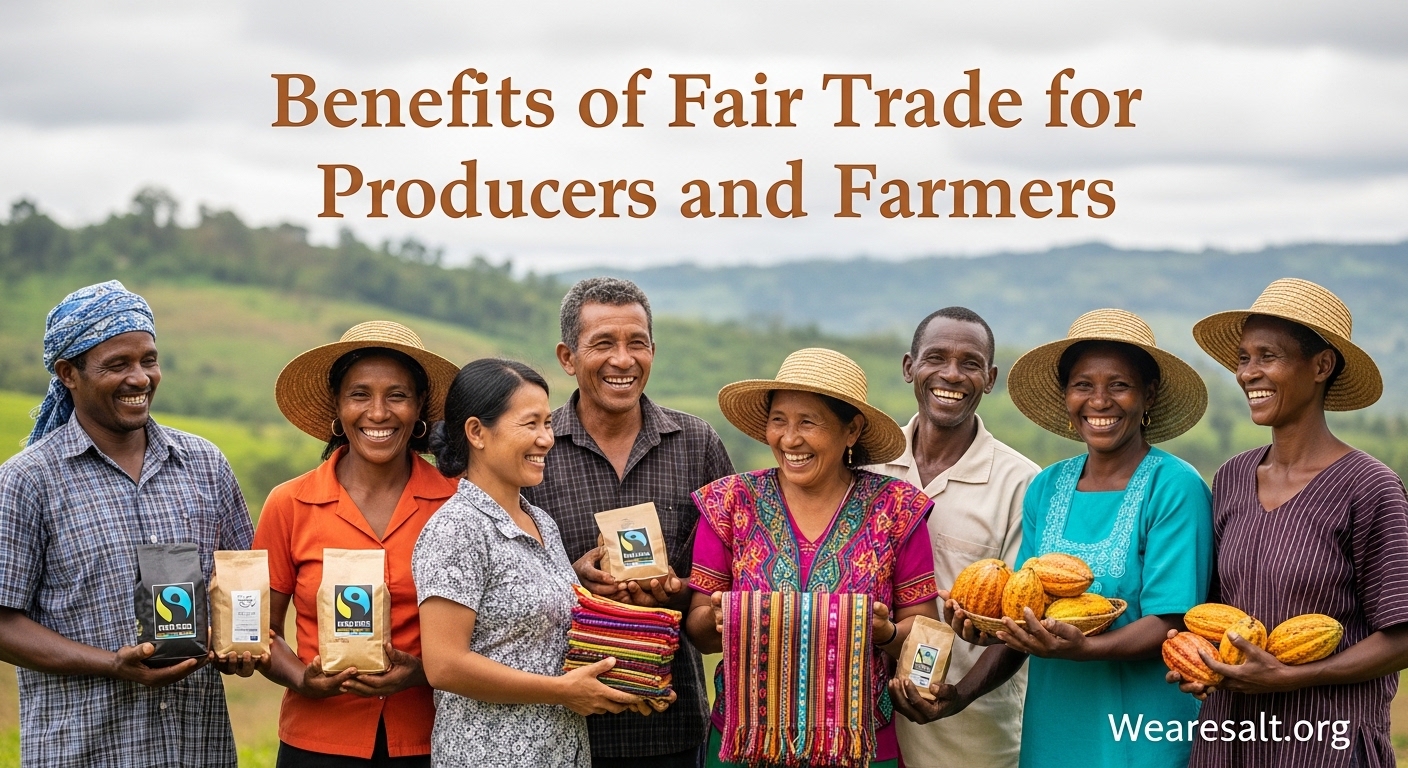
Small-scale farmers and producers in developing countries face a stark reality. Global commodity prices swing wildly, leaving families without enough income to cover basic needs. I have seen how the benefits of fair trade for producers and farmers create a lifeline for communities that have historically been exploited by conventional trading systems.
In this guide, I will explain exactly how Fairtrade certification transforms lives. You will learn about the Fairtrade Minimum Price that acts as a safety net when markets crash. I will break down how the Fairtrade Premium funds community schools, healthcare clinics, and clean water projects. By the end, you will understand why over 2 million farmers and workers across 70 countries choose Fairtrade.
Our team has researched producer testimonials, certification standards, and impact reports to give you the complete picture. Whether you are a conscious consumer wanting to understand your impact or a student researching ethical trade, this guide answers your questions with facts and real stories.
Table of Contents
What Is Fair Trade
Fair Trade is a trading partnership that aims for greater equity in international commerce. It creates opportunities for producers who have been economically disadvantaged or marginalized by the conventional trading system. The core principle is simple: farmers and workers should earn enough to support their families and invest in their futures.
The movement began in the 1940s and 1950s when progressive groups in North America and Europe started buying handicrafts from impoverished communities. The first Fairtrade label, Max Havelaar, launched in the Netherlands in 1988. This marked the beginning of the certification system we recognize today.
Organizations like Fairtrade International and Fair Trade USA now set rigorous standards that certified producers must meet. These standards cover everything from environmental practices to worker rights. When you see the Fairtrade Mark on a product, it means the farmers or workers behind it received fair compensation and worked under safe conditions.
How Fairtrade Certification Works
Producers apply for certification through accredited organizations. Auditors visit farms and facilities to verify compliance with standards. Once certified, producers can sell their goods at Fairtrade terms to registered buyers. The system works across coffee, cocoa, bananas, tea, cotton, sugar, and many other commodities.
4 Key Benefits of Fair Trade for Producers
Here are the four main benefits that Fairtrade delivers to farmers and producers:
- Price Stability: The Fairtrade Minimum Price guarantees farmers receive a fair price even when global markets collapse.
- Community Investment: The Fairtrade Premium provides extra funds that communities democratically decide how to spend.
- Worker Protection: Strict standards ensure safe working conditions, ban child labor, and protect workers’ rights.
- Market Access: Small-scale farmers gain access to international buyers they could never reach alone.
These benefits work together to create lasting change. A coffee farmer in Colombia not only receives a fair price for her beans. She also votes on how her cooperative spends the Premium on local schools. Her children learn in better classrooms while she works under dignified conditions.
Fairtrade Minimum Price: A Safety Net for Farmers
The Fairtrade Minimum Price is a price floor set above production costs for major commodities. It guarantees that farmers receive enough to cover their sustainable production costs even when world market prices fall below sustainable levels. This mechanism prevents the catastrophic income losses that push farming families into poverty.
Let me give you concrete examples. The Fairtrade Minimum Price for washed arabica coffee is set at $1.40 per pound, or $1.70 per pound for organic. When global coffee prices crashed to $0.90 per pound in 2019, Fairtrade farmers still received the guaranteed minimum. For conventional farmers, such price drops often mean choosing between feeding their families or harvesting their crops.
How the Minimum Price Works in Practice
When market prices rise above the minimum, farmers sell at the higher market rate. When markets crash, the minimum price kicks in as a safety net. The system applies to coffee, cocoa, tea, bananas, sugar, cotton, and other key crops. Each commodity has its own minimum price based on actual production costs in growing regions.
This stability allows farmers to plan for the future. They can invest in better equipment, improve their farms, and send their children to school. Without this guarantee, small-scale producers remain trapped in cycles of debt and poverty whenever commodity markets fluctuate.
Fairtrade Premium: Community Investment Fund
The Fairtrade Premium is an additional sum paid on top of the selling price that goes directly to producer organizations. It is typically 10% above the contract price for most products, though rates vary by commodity. Unlike the Minimum Price, which goes to individual farmers, the Premium is a collective fund for community development.
Democratic decision-making defines how Premium funds get spent. Members of producer cooperatives vote on projects that matter most to their communities. This process ensures investments address actual local needs rather than external priorities.
Real Examples of Premium Investments
Cooperatives have used Premium funds to build schools in remote villages. Some have invested in healthcare clinics that previously required days of travel to reach. Others have funded clean water systems, agricultural training programs, and business development initiatives. In Cote d’Ivoire, cocoa cooperatives have used Premiums to build over 200 schools serving thousands of children.
The Premium also supports environmental projects. Farmers have invested in reforestation, renewable energy, and organic certification. These investments improve both local ecosystems and long-term farm productivity. Every Premium dollar represents a choice made by the people who know their community’s needs best.
Economic Benefits for Farmers and Producers
Fairtrade delivers measurable economic advantages beyond the Minimum Price and Premium. Income stability allows farmers to escape debt cycles that have trapped rural communities for generations. With predictable revenue, families can budget for education, healthcare, and farm improvements.
Long-term contracts with Fairtrade buyers reduce the uncertainty that plagues conventional commodity trading. Farmers know they have buyers before they plant their crops. This security encourages investment in quality improvements and sustainable practices that increase long-term profitability.
Market Access for Small-Scale Farmers
Individual small-scale farmers often lack the resources to reach international markets. They cannot afford export licenses, shipping logistics, or the marketing required to attract foreign buyers. Fairtrade cooperatives aggregate production from hundreds or thousands of farmers, creating the scale needed for direct export.
This collective approach transforms farmers from price-takers into market participants with negotiating power. Cooperatives can secure better terms, invest in processing facilities, and capture more value from their crops. The living income focus now being integrated into Fairtrade standards aims to ensure farmers earn enough for a decent standard of living, not just survival.
Worker Rights and Protection Standards
Fairtrade standards mandate safe working conditions that protect health and dignity. Workers on certified plantations and in processing facilities must have access to protective equipment, clean drinking water, and proper sanitation. Hazardous child labor is strictly prohibited, and young workers cannot perform dangerous tasks.
Freedom of association ensures workers can organize and bargain collectively. This right empowers employees to negotiate fair wages and working conditions without fear of retaliation. Many certified operations have established worker committees that participate in decision-making alongside management.
Gender Equality Initiatives
Fairtrade actively promotes gender equality in traditionally male-dominated agricultural sectors. Women must have equal voting rights in cooperative governance. Maternity protections, equal pay for equal work, and leadership opportunities for women are all required by certification standards.
These policies create ripple effects beyond certified farms. When women earn fair wages and participate in cooperative leadership, they invest more in family nutrition, education, and health. Research consistently shows that empowering women farmers accelerates community development faster than any single intervention.
Community Development Impact
The benefits of fair trade for producers and farmers extend throughout entire communities. Premium-funded schools give children opportunities their parents never had. Healthcare investments reduce mortality and improve productivity. Infrastructure projects like roads and electricity connect isolated regions to broader economies.
A banana cooperative in Ecuador used Premium funds to build a medical clinic that serves 1,200 families. Before this investment, workers traveled three hours to reach the nearest hospital. Now they receive preventative care, maternity services, and emergency treatment within their own community.
Producer Voices
Maria Elena, a coffee farmer in Guatemala, describes the transformation: “Before Fairtrade, we sold to local buyers who paid whatever they wanted. We could not plan beyond the next harvest. Now our cooperative exports directly to Europe and North America. We decide how to spend our Premium on schools and healthcare. My daughter is the first in our family to attend university.”
These stories repeat across continents. In Kenya, tea cooperatives have used Fairtrade revenues to establish scholarship programs. In India, cotton farmers have invested in organic certification that commands premium prices. The pattern is consistent: fair compensation enables investment, and investment creates opportunity.
Environmental Sustainability Benefits
Fairtrade standards require environmentally sustainable production practices that protect ecosystems for future generations. Farmers must minimize pesticide use, conserve water resources, and protect biodiversity. These requirements align economic incentives with ecological stewardship.
Climate change poses existential threats to agricultural communities worldwide. Fairtrade’s environmental standards help farmers build resilience through sustainable practices. Agroforestry, soil conservation, and water management techniques required by certification improve both short-term yields and long-term farm viability.
Organic Certification Support
Many Fairtrade farmers transition to organic production with support from their cooperatives. Organic premiums provide additional income while eliminating chemical exposure for farmers and their families. The Premium fund often covers the costs of organic certification and the transition period when yields temporarily decline.
Environmental investments funded by the Premium include reforestation, renewable energy installations, and biodiversity conservation. These projects benefit not just certified farmers but entire regions. The connection between fair compensation and environmental protection demonstrates that economic justice and ecological sustainability are inseparable.
Frequently Asked Questions
How does Fairtrade benefit farmers and producers?
Fairtrade benefits farmers through guaranteed minimum prices that act as safety nets during market crashes, additional Premium funds for community development projects, improved market access through cooperative structures, and strict standards protecting worker rights and environmental sustainability.
Do producers actually benefit from Fairtrade?
Yes, producers benefit measurably from Fairtrade. Over 2 million farmers and workers across 70 countries participate voluntarily because they receive better prices, community investment funds, and improved working conditions. Producer cooperatives democratically decide how to spend Premium funds on local priorities like schools, healthcare, and infrastructure.
What are four benefits of Fairtrade?
The four key benefits are: 1) Price stability through the Fairtrade Minimum Price, 2) Community investment via the Fairtrade Premium, 3) Worker protection through rigorous safety and rights standards, and 4) Market access that connects small-scale farmers to international buyers.
How does Fairtrade help local producers and consumers?
Fairtrade helps local producers by providing fair compensation, stable income, and community development funds. Consumers benefit by knowing their purchases support ethical production, and communities gain from investments in education, healthcare, and environmental protection that Premium funds enable.
Conclusion
The benefits of fair trade for producers and farmers create transformational change in some of the world’s most vulnerable communities. The Fairtrade Minimum Price provides stability when markets crash. The Fairtrade Premium funds schools, clinics, and clean water through democratic community decisions. Worker protections ensure dignity and safety. Market access empowers small-scale farmers to compete globally.
Our team believes that understanding these benefits helps consumers make informed choices. Every Fairtrade purchase supports a system that has helped over 2 million farmers and workers build better futures. The evidence from producer testimonials, community projects, and impact studies consistently shows that Fairtrade delivers on its promises.
You can support this movement by choosing Fairtrade-certified products. Look for the Fairtrade Mark when you buy coffee, chocolate, bananas, or cotton. Ask your local stores to stock Fairtrade options. Share what you have learned about how these systems help farming communities worldwide. Small choices create significant impact when millions of consumers act together.