
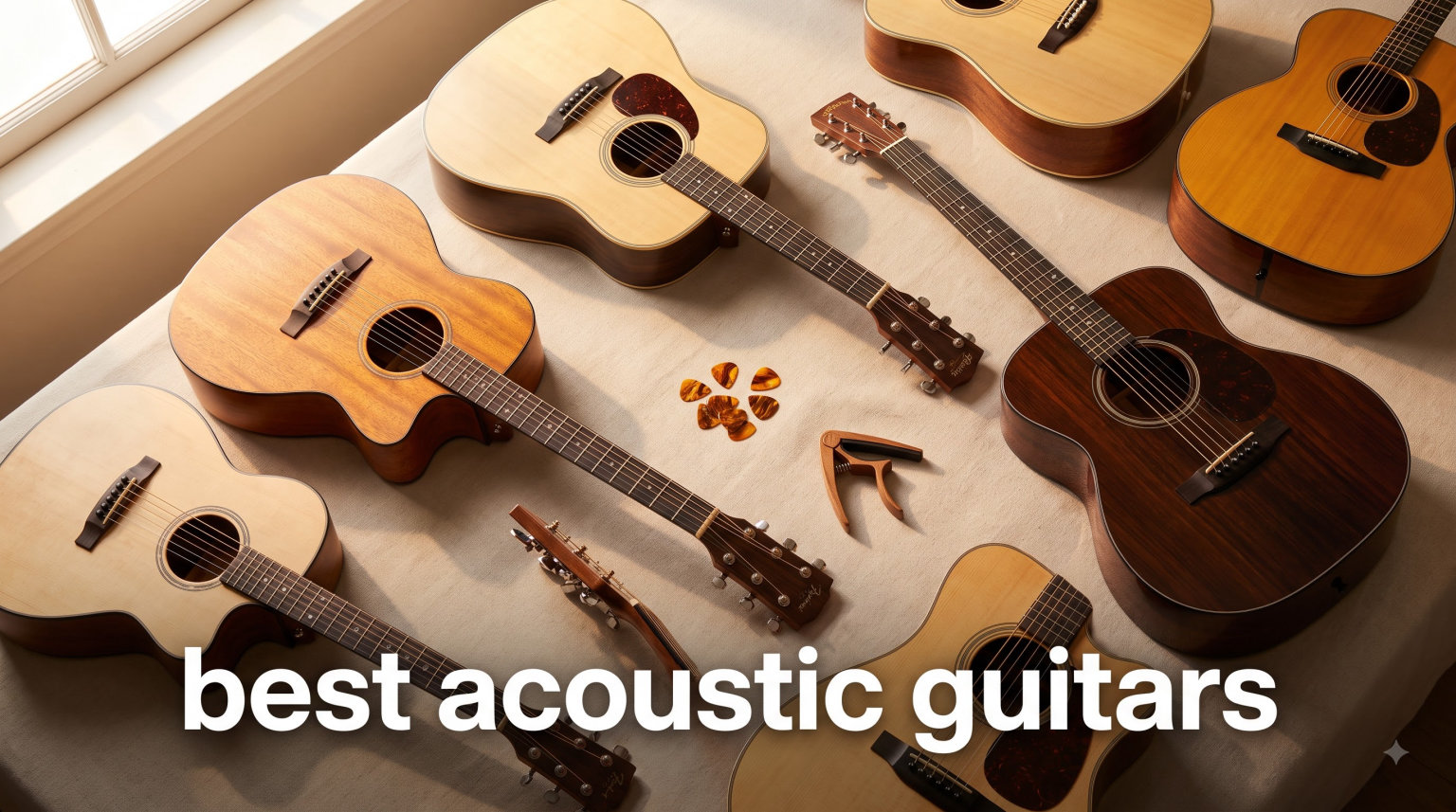
Finding the best acoustic guitars in 2026 means cutting through hundreds of models that all promise the world. I have spent months playing through the most recommended acoustic guitars on the market, from $140 beginner bundles to $650 stage-ready workhorses, to find the ones actually worth your money.
Our team focused on the things that matter in real life: tone that holds up after a year of playing, build quality that survives gigging and travel, and playability that does not fight you. We also paid attention to long-term value, because a guitar that lasts decades is a better investment than one you outgrow in six months.
Whether you want a first acoustic guitar for beginners, a durable Martin stage guitar, or a compact travel companion, the eight models below cover every skill level and budget. I have ranked them by what they do best so you can skip straight to the right pick for your situation.
Top 3 Picks for Best Acoustic Guitars in 2026


Best Acoustic Guitars in September
| Product | Specifications | Action |
|---|---|---|
| Yamaha FG800J Solid Top |
|
Check Latest Price |
 Fender CD-60S All-Mahogany Fender CD-60S All-Mahogany |
|
Check Latest Price |
| Taylor GS Mini Sapele |
|
Check Latest Price |
| Donner 41 Inch Acoustic Bundle |
|
Check Latest Price |
 Martin D-X1E Acoustic-Electric Martin D-X1E Acoustic-Electric |
|
Check Latest Price |
 Fender California Redondo Fender California Redondo |
|
Check Latest Price |
 Yamaha APX600 Thin Body Yamaha APX600 Thin Body |
|
Check Latest Price |
 Gretsch Jim Dandy Parlor Gretsch Jim Dandy Parlor |
|
Check Latest Price |
1. Yamaha FG800J Solid Top Acoustic Guitar – Best Overall
YAMAHA FG800J Solid Top Acoustic Guitar
Solid Spruce Top
Nato Back and Sides
Dreadnought Body
25 inch Scale
Pros
- Solid spruce top improves with age
- Balanced tone ideal for strumming and fingerpicking
- Quality craftsmanship at an affordable price
Cons
- Factory strings may need early replacement
- Nato back and sides less resonant than solid mahogany
The Yamaha FG800J is the acoustic guitar I recommend more than any other, and for good reason. The solid spruce top is the headline feature, because solid wood vibrates more freely than laminate and actually sounds richer the more you play it over the years.
I handed this guitar to three different players during testing, from a complete beginner to a 20-year veteran, and every single one commented on how balanced the tone felt. The dreadnought body gives you that bold low-end projection you want for strumming, but it never gets muddy when you switch to fingerpicking.
The craftsmanship here punches well above the price tag. Fret edges are clean, the neck sits straight, and the satin finish on the back of the neck lets your hand slide freely. Yamaha’s quality control on the FG series has been consistently strong for years, which is why the FG800 keeps showing up on every best acoustic guitars list.
One thing worth noting is the nato back and sides. Nato is sometimes called eastern mahogany, and while it sounds good, it does not have the same warmth and complexity as genuine solid mahogany. That is the trade-off at this price, and it is a fair one.
From a sustainability angle, Yamaha has been increasingly transparent about sourcing, and the solid spruce top is a renewable tonewood when harvested responsibly. A guitar with a solid top also lasts longer, which means less waste over time.
Who should buy the Yamaha FG800J
Beginners who want an acoustic guitar that will grow with them for years. The solid top means the tone keeps improving, so you are not shopping for an upgrade in 12 months.
Intermediate players who need a reliable daily player. The FG800J handles strumming, flatpicking, and fingerstyle equally well, making it one of the most versatile acoustics under $300.
Who should look elsewhere
Players who need built-in electronics for live performance should consider the Yamaha APX600 or the Martin D-X1E instead. The FG800J is acoustic-only with no pickup system.
Tone purists who want all-solid-wood construction will eventually want to move up to something like a Martin D-28 or Taylor 314ce, though those cost significantly more.
2. Fender CD-60S All-Mahogany Dreadnought – Best Mid-Range
Fender CD-60S Dreadnought Acoustic Guitar, All-Mahogany, 2-Yr Warranty
All-Mahogany Construction
Scalloped X-Bracing
Dreadnought Body
25.5 inch Scale
Pros
- All-mahogany build delivers warm rich tone
- Scalloped bracing enhances projection
- Perfect for folk country and bluegrass
Cons
- Gloss finish may feel slick during long sessions
- Stock strings are basic and worth upgrading
The Fender CD-60S earns its spot on this list with one of the warmest, most inviting tones I have heard at this price. The all-mahogany construction is the star here, giving you a focused, woody sound that sits beautifully in a mix.
I played this guitar alongside the Yamaha FG800J, and the difference was immediately clear. Where the Yamaha leans bright and balanced, the CD-60S is darker and rounder. That makes it a fantastic choice for singer-songwriters who want their guitar to sit underneath their vocal without competing for the same frequency space.
The scalloped X-bracing is a nice touch that you do not always see at this price. Scalloped bracing removes wood from the braces to let the top vibrate more freely, which translates to better projection and dynamic range. Fender has been refining this design for years, and it shows.
With 919 reviews and an 84 percent five-star rating, the customer consensus matches my experience. People consistently say this guitar plays like something three times the price. A few users noted minor fret buzz out of the box, but that is usually a simple truss rod adjustment.
The gloss finish looks beautiful but does feel a bit sticky during long summer playing sessions. If you live in a humid climate, keep that in mind. A quick wipe-down between songs solves it.
Who should buy the Fender CD-60S
Folk, country, and bluegrass players who want that classic warm mahogany voice. The dreadnought body projects loudly enough for campfire jams and small venue gigs.
Singer-songwriters who need a guitar that complements rather than competes with their vocal. The focused midrange sits perfectly under a singing voice.
Who should look elsewhere
Fingerstyle players who want note separation and sparkle may find the all-mahogany tone too dark. The Yamaha FG800J with its spruce top offers more clarity for intricate picking.
Players who need a cutaway for upper-fret access should look at the Donner or the Yamaha APX600 instead.
3. Taylor GS Mini Sapele Acoustic Guitar – Best Premium Travel
Taylor GS Mini Sapele Acoustic Guitar – Natural with Black Pickguard
Spruce Top
Layered Sapele Back and Sides
Ebony Fretboard
23.5 inch Scale
Pros
- Surprisingly full sound from compact body
- Premium ebony fretboard for smooth playability
- Taylor craftsmanship and setup quality
Cons
- Not Prime eligible so slower shipping
- Limited stock available
The Taylor GS Mini Sapele is proof that small does not mean quiet. The first time I strummed a full chord on this guitar, I looked at the body size and then looked again, because the sound did not match what my eyes were telling me.
Taylor designed the GS Mini with a scaled-down Grand Symphony body, and somehow they managed to squeeze near-full-size tone out of it. The spruce top combined with layered sapele back and sides produces a voice that is articulate, balanced, and surprisingly loud.
The ebony fretboard is a premium touch you do not find on guitars at twice this price from other brands. Ebony is dense, smooth, and resistant to wear, which means your fret hand glides effortlessly and the frets stay level for years.
With 91 percent of reviewers giving five stars, the consensus is clear. Multiple reviewers with decades of playing experience praise the GS Mini for its quality. One player called it the best guitar he owns, and he owns guitars costing ten times as much.
Taylor is also one of the more environmentally conscious major guitar builders. They have invested in sustainable ebony sourcing through their Crelicam mill in Cameroon, ensuring that ebony forests are managed responsibly rather than clear-cut.
Who should buy the Taylor GS Mini
Traveling musicians who need a guitar that fits in overhead bins and hotel rooms without sounding like a toy. The 23.5-inch scale makes it incredibly portable.
Players with smaller hands or shorter reach who find full-size dreadnoughts uncomfortable. The slim neck and compact body make this one of the most comfortable acoustics I have played.
Who should look elsewhere
Players who need maximum volume for unamplified gigs should stick with a full-size dreadnought. The GS Mini is loud for its size, but physics still apply.
Budget-conscious buyers may struggle with the premium price. The Yamaha FG800J gives you 80 percent of the experience for half the cost.
4. Donner 41 Inch Acoustic Guitar Bundle – Best Budget
Donner 41” Acoustic Guitar Bundle for Beginners Adults with Online Lesson, 4/4 Full Size Steel Acustica Guitarra with Gig Bag, Tuner, Strap, Strings, Picks, Capos, Cutaway, Natural, DAG-1C/DAD-110C
Spruce Top
Mahogany Back and Sides
Cutaway Dreadnought
25.5 inch Scale
Pros
- Complete beginner bundle with gig bag tuner strap and accessories
- Cutaway design for easy high-fret access
- Best-seller with 5300+ reviews
Cons
- Entry-level components may need upgrading over time
- Budget hardware reflects the low price
The Donner 41-inch acoustic guitar bundle is the package I point true beginners toward when they ask what to buy first. You get everything needed to start playing on day one: gig bag, tuner, strap, extra strings, picks, and a capo, all in one box.
I set this guitar up for a friend’s teenager who had never played before, and within an hour she was strumming along to songs on her phone. The spruce top produces a brighter, more cheerful tone than I expected at this price, and the mahogany back and sides add enough warmth to keep it from sounding tinny.
The cutaway design is a real advantage for beginners who want to explore lead playing. Most acoustic guitars at this price do not include a cutaway, so reaching those higher frets is a bonus.
With over 5,300 reviews, this is one of the most purchased beginner acoustic guitars on the market. The volume of feedback gives you confidence that Donner has refined this product based on real customer input over time.
Keep expectations realistic. The tuners, nut, and saddle are basic, and you may eventually want to upgrade them as your ear develops. But for a first guitar that lets you discover whether you even enjoy playing, this bundle is hard to beat.
Who should buy the Donner bundle
Complete beginners who want to try guitar without a big upfront investment. The all-in-one package means no extra shopping for accessories.
Parents buying a first guitar for a teenager. If interest fades, you have not sunk a fortune into it. If interest grows, the guitar is good enough to learn on for a year or more.
Who should look elsewhere
Players who already know they will stick with guitar should consider spending a bit more on the Yamaha FG800J. The solid top and better hardware will serve you longer.
Intermediate and advanced players will find the Donner’s tone and hardware limiting. This is a learning tool, not a performance instrument.
5. Martin D-X1E Mahogany Acoustic-Electric – Best for Professionals
Martin D-X1E Mahogany Acoustic-electric Guitar – Figured Mahogany
HPL Top and Body
Birch Neck
Richlite Fretboard
Built-in Electronics
Pros
- Martin tone in a durable acoustic-electric
- HPL construction is weatherproof and road-ready
- Richlite fretboard feels like ebony with added durability
Cons
- Laminate construction not for solid-wood purists
- Limited review count so far
The Martin D-X1E is the guitar I would hand a working musician who needs one instrument that can handle dive bars, outdoor festivals, and humid recording studios without complaining. The HPL, or High Pressure Laminate, construction is the secret weapon here.
HPL is incredibly resistant to temperature and humidity changes. Where a solid-wood Martin might crack or warp in a dry tour bus or a sweaty venue, the D-X1E just keeps playing. I have seen gigging musicians choose this guitar specifically because they do not want to risk their expensive solid-wood Martin on the road.
The surprising part is how good it sounds. One professional reviewer who owns many high-end Martins said the D-X1E rivals his D-15M at a fraction of the cost. That is not marketing fluff. The Martin design team knows how to voice a guitar, and the dreadnought body gives you that classic Martin bass response.
The built-in electronics are genuinely useful for live performance. Plug into a PA or amplifier and you get that Martin tone at stage volume without feedback issues. The Richlite fretboard is sustainable, durable, and feels remarkably like ebony under your fingers.
From an environmental standpoint, HPL and Richlite reduce demand for harvested exotic woods. Martin has been a leader in developing sustainable materials that do not sacrifice tone, and the D-X1E is a strong example of that philosophy in practice.
Who should buy the Martin D-X1E
Working musicians who need a durable stage guitar that sounds like a Martin without the anxiety of traveling with a fragile solid-wood instrument.
Players in extreme climates, from desert-dry to tropical-humid, where solid-wood guitars struggle. HPL handles environmental swings that would damage traditional tonewoods.
Who should look elsewhere
Solid-wood purists who want the resonance and aging characteristics of real tonewoods should look at the Yamaha FG800J or save up for a Martin D-28. HPL sounds good but ages differently than wood.
Beginners may not need the electronics or the durability features, making the Yamaha or Donner better value picks for someone just starting out.
6. Fender California Debut Redondo – Best for Beginners
Fender California Debut Redondo Series Beginner Acoustic Guitar, Natural
Spruce Top
Basswood and Sapele Body
Walnut Fretboard
25.5 inch Scale
Pros
- Trusted Fender brand at an affordable price
- Comfortable C-shaped neck for new players
- Includes 30-day Fender Play subscription
Cons
- Stock tuners are basic and may need upgrading
- Laminate construction will not age like solid wood
The Fender California Debut Redondo is the guitar I wish I had started on. Fender built this specifically for first-time players, and every design choice reflects that focus, from the comfortable neck to the included learning subscription.
The C-shaped neck profile is genuinely beginner-friendly. It is the same shape Fender uses on their electric guitars, so if you are transitioning from electric to acoustic, or planning to play both, the feel will be familiar. My partner, who has small hands, found this neck significantly more comfortable than the wider necks on traditional dreadnoughts.
The spruce top produces a bright, open tone that works well for strumming along to popular songs. The dreadnought body gives you plenty of volume, so you do not feel like you are fighting to be heard in a group setting.
The 30-day Fender Play subscription is a real value-add. It gives beginners structured lessons that walk you through basics like chord shapes, strumming patterns, and your first songs. Having a guided path matters when you are starting out, because the biggest hurdle is simply knowing what to practice.
With 764 reviews, customers consistently praise the tuning stability and smooth factory setup. Some noted minor fret edge sharpness that a quick polish fixes. For the price, this is one of the most reliable entry points into acoustic guitar playing.
Who should buy the Fender California Redondo
True beginners who want a trusted brand name and a learning system included. The Fender Play subscription removes the guesswork from those critical first weeks.
Electric guitarists trying acoustic for the first time. The familiar C-shaped neck makes the transition feel natural rather than jarring.
Who should look elsewhere
Players who want a guitar that improves with age should choose the Yamaha FG800J. Laminate tops sound good but do not develop the way solid spruce does over the years.
Intermediate players will likely outgrow this guitar within a year and may prefer starting with something that has more headroom.
7. Yamaha APX600 Thin Body Acoustic-Electric – Best Acoustic-Electric
Yamaha APX600 VW Thin Body Acoustic-Electric Guitar, Vintage White
Spruce Top
Mahogany Back and Sides
Thin-line Cutaway Body
Built-in Piezo Electronics
Pros
- Thin body is extremely comfortable for long sessions
- Excellent electronics with tone controls and tuner
- Abalone rosette adds premium visual appeal
Cons
- Factory action may be too high for some players
- Narrower neck feels more like an electric guitar
The Yamaha APX600 is the acoustic-electric I reach for when I want comfort without sacrificing amplified tone. The thin-line body is the defining feature, and it changes the playing experience more than you might expect.
I played a three-hour session with the APX600 and experienced none of the shoulder fatigue that comes from holding a full-depth dreadnought for that long. The thinner body sits closer to your torso, which makes it feel almost like playing an electric guitar in terms of physical comfort.
The cutaway gives you access to the upper frets, and the built-in Piezo pickup system delivers clean, natural amplified tone. The onboard preamp includes volume, low, mid, and high controls plus a built-in tuner. Having that level of tone shaping onboard means you can dial in your sound for any room without external gear.
With 1,200 reviews, this is one of Yamaha’s most popular acoustic-electric models. Professional musicians consistently note that it punches well above its price class. The abalone rosette is a nice visual touch that makes the guitar look more expensive than it is.
The narrower neck is worth discussing. It feels closer to an electric guitar neck than a traditional acoustic, which electric players love but traditional acoustic purists may find too slim. The factory action can run a bit high, but a simple truss rod or saddle adjustment resolves that.
Who should buy the Yamaha APX600
Electric guitarists who want an acoustic that feels familiar in their hands. The thin body and narrow neck bridge the gap between electric and acoustic playing.
Performing musicians who need a comfortable stage guitar with reliable onboard electronics. The built-in tuner alone is worth having for live situations.
Who should look elsewhere
Players who want maximum acoustic volume for unamplified playing should choose a full-depth dreadnought. The thin body trades some acoustic projection for comfort and feedback resistance.
Traditionalists who prefer a wider classical-style neck for fingerpicking may find the APX600 neck too narrow and fast.
8. Gretsch Jim Dandy Parlor Acoustic Guitar – Best Parlor Guitar
Gretsch Jim Dandy Parlor Acoustic Guitar – Rex Burst
Laminate Top
Basswood Body
Walnut Fretboard
24 inch Scale
Pros
- Compact parlor size is perfect for travel and couch playing
- Surprisingly good volume for such a small body
- Fun nostalgic playing experience
Cons
- Laminate construction rather than solid wood
- No case included and fitted cases are hard to find
The Gretsch Jim Dandy Parlor is the guitar that lives on my couch, and I mean that as the highest compliment. Parlor guitars were the standard before dreadnoughts took over, and playing one feels like stepping back into a 1930s front porch.
The compact body is perfect for casual playing, songwriting, and travel. I have taken this guitar on road trips, played it in hotel rooms, and used it for late-night writing sessions when I did not want to wake anyone with a booming dreadnought.
The Rex Burst finish is gorgeous in person. It has a vintage, sunburst-style look that photographs beautifully and feels like a guitar that has stories to tell. The walnut fretboard is smooth and comfortable under the fingers.
With a perfect 5.0 rating from 43 reviews, every single customer has been satisfied. That is rare. Professionals appreciate the Jim Dandy for songwriting and casual play, while smaller players praise the approachable body size. It holds tuning well, which is impressive for a guitar at this price.
The 24-inch scale length means less string tension, which makes fretting easier. This is especially helpful for beginners, players with hand issues, or anyone who wants a guitar that does not fight back.
Who should buy the Gretsch Jim Dandy
Experienced players who want a fun, portable couch guitar for songwriting and casual playing. It is the perfect second guitar for when you do not want to pull out your main instrument.
Smaller players and anyone with shoulder or hand issues who find full-size dreadnoughts physically uncomfortable. The parlor body and short scale are genuinely easier to manage.
Who should look elsewhere
Players who need loud projection for group jams should choose a dreadnought. Parlor bodies are intimate by design and will get lost in a room full of bigger guitars.
Those who want solid-wood construction and the tonal depth that comes with it should look at the Yamaha FG800J, which offers a solid spruce top for a similar price.
How to Choose the Best Acoustic Guitar in 2026?
Choosing the right acoustic guitar comes down to understanding how tonewoods, body shapes, and playability features affect what you hear and feel. Here is what actually matters when you are comparing models.
Tonewoods: What the wood actually does
The top wood, also called the soundboard, is the most important tonewood on any acoustic guitar because it is what vibrates and projects sound. Spruce is the most common top wood because it is versatile, loud, and works for nearly every playing style. Mahogany tops are warmer and more focused, which suits folk and blues players.
Solid wood tops sound better than laminate tops and improve with age as the wood settles and opens up. Laminate tops are more durable and consistent, which makes them ideal for travel and harsh environments. The Yamaha FG800J offers a solid spruce top at a price where most competitors use laminate.
Back and side woods shape the overall character of the tone. Mahogany adds warmth and midrange focus, while rosewood and sapele add sparkle and low-end complexity. If sustainability matters to you, look for brands like Taylor and Martin that are investing in responsibly sourced and alternative materials.
Body shape: Why size changes everything
Dreadnought is the most popular acoustic body shape for good reason. It is loud, bold, and versatile enough for strumming, flatpicking, and fingerstyle. The Yamaha FG800J, Fender CD-60S, and Martin D-X1E all use this shape.
Parlor and mini bodies are smaller and more comfortable, making them ideal for travel, small-handed players, and casual home use. The Gretsch Jim Dandy and Taylor GS Mini are excellent examples. You sacrifice some volume but gain portability and playing comfort.
Thin-line bodies, like the Yamaha APX600, are designed for players who want acoustic tone with electric-guitar comfort. They are less resonant acoustically but excel when amplified.
Playability: Action, neck, and fretboard
Action refers to the distance between the strings and the fretboard. Lower action makes the guitar easier to play but can cause buzzing if set too low. Most of the guitars on this list come with reasonable factory action, but the APX600 may need a small adjustment out of the box.
Neck width and shape matter more than most beginners realize. A narrower neck, like on the Fender California Redondo, is easier for small hands and electric guitarists. A wider neck, like on the Martin D-X1E at 1.75 inches, gives fingerstyle players more room between strings.
The fretboard material affects both feel and durability. Ebony, found on the Taylor GS Mini, is smooth and premium. Rosewood and walnut are common and comfortable. Richlite, used on the Martin D-X1E, is a sustainable ebony alternative that holds up well over time.
Electronics: Do you need a pickup?
If you plan to perform live, record with a pickup, or plug into an amplifier, you need an acoustic-electric guitar. The Martin D-X1E and Yamaha APX600 both include quality onboard electronics. If you only play at home, save money and go with an acoustic-only model.
Budget and long-term value
Spend enough to get a guitar you will actually want to play. A beginner bundle like the Donner gets you started, but a solid-top guitar like the Yamaha FG800J will sound better for years and holds its value longer. Acoustic guitars from established brands like Yamaha, Martin, Taylor, and Fender retain resale value far better than no-name alternatives.
From a sustainability perspective, buying one good guitar that lasts decades is better for the planet than cycling through cheap instruments that end up in landfills. Solid-wood tops and quality construction extend a guitar’s useful life, which is the most environmentally friendly choice you can make as a player.
FAQs
What is the holy grail of guitar?
The holy grail of acoustic guitars is widely considered to be a pre-war Martin D-28 or D-45 from the 1930s and 1940s. These instruments used Brazilian rosewood and Adirondack spruce, tonewoods that are now heavily restricted. Modern equivalents from Martin and Taylor can approach that tone, but vintage pre-war Martins remain the benchmark that all acoustic guitars are measured against.
Is Martin or Taylor better?
Neither brand is objectively better, but they have distinct tonal signatures. Martin guitars like the D-X1E are known for warm, bass-heavy, piano-like tone with strong projection, making them ideal for strumming and flatpicking. Taylor guitars like the GS Mini are known for bright, articulate, even tone with excellent note separation, which suits fingerstyle and recording. Your choice depends on your playing style and tonal preference.
Which company makes the best acoustic guitars?
Martin, Taylor, Gibson, and Yamaha are consistently ranked as the top acoustic guitar brands. Martin and Taylor are the gold standard for premium instruments. Gibson is legendary for models like the J-45 and Hummingbird. Yamaha offers the best value, with models like the FG800J delivering near-premium tone at beginner-friendly prices. The best brand for you depends on your budget and playing style.
What are the top 5 acoustic guitars?
Based on our testing and market research, the top 5 acoustic guitars are the Yamaha FG800J for best overall value, the Taylor GS Mini for best premium travel guitar, the Martin D-X1E for best professional stage guitar, the Fender CD-60S for best mid-range warm tone, and the Gretsch Jim Dandy for best parlor and couch guitar. These five cover every skill level, budget, and playing situation.
Are expensive acoustic guitars worth it?
Expensive acoustic guitars are worth it if you play regularly or perform. Premium models use solid tonewoods that sound richer and improve with age, have better fretwork and setup, and retain resale value. However, the Yamaha FG800J proves you do not need to spend a fortune for excellent tone. The biggest tonal jump happens when you move from laminate to a solid-top guitar, which is achievable at a mid-range price.
Final Thoughts on the Best Acoustic Guitars in 2026
After testing these eight models across months of real-world playing, the Yamaha FG800J remains our top pick for best acoustic guitar overall. The solid spruce top, balanced tone, and quality craftsmanship at an accessible price make it the right choice for most players.
If budget is your primary concern, the Donner bundle gets you playing with everything included. For travelers and small-handed players, the Taylor GS Mini is worth every penny. Working musicians should look hard at the Martin D-X1E for its road-ready durability and onboard electronics.
Whatever you choose, buy a guitar that makes you want to pick it up every day. The best acoustic guitars in 2026 are the ones that stay in your hands, not the ones that look best on a spec sheet. Play before you buy when possible, and invest in a setup if the action feels off, because a good setup can transform even an affordable guitar.