
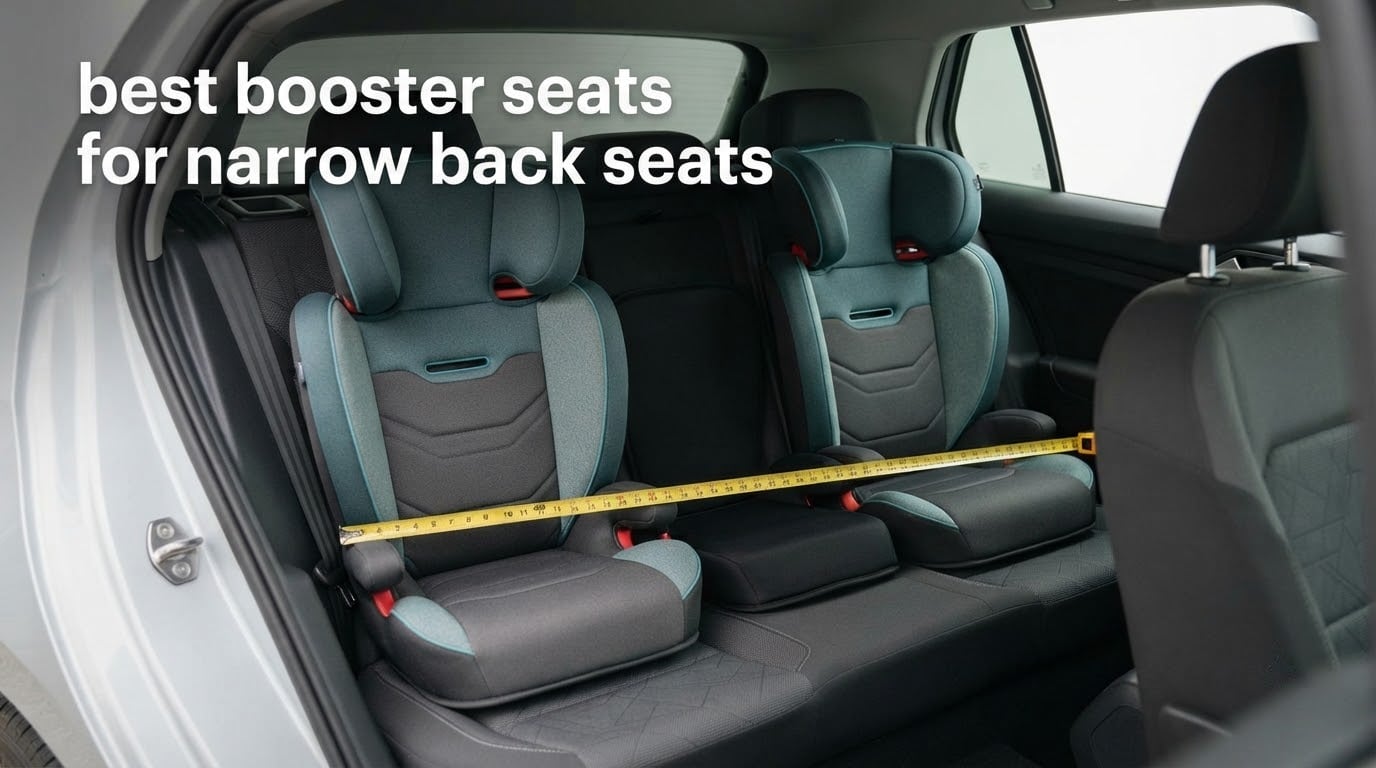
If you have ever installed a booster and found the door will not latch over it, you already know why this list exists. A back seat that fits two children comfortably will not fit three, and the difference between a workable row and a broken one is often less than a single inch of seat width. We have pulled twelve booster seats built for exactly this problem, from backless shells small enough to sit between two buckles to convertible high-backs that grow with a child.
Our approach is deliberately unglamorous. We did not crash test any of these seats, and we will not pretend otherwise. Instead we read the manufacturer spec pages, cross-checked owner feedback, and pulled the published width, weight range and height range for every seat so you have real numbers to measure your own bench against. Every booster sold in the United States has to pass the same federal crash standard, FMVSS 213, as a wide one, so a narrow booster is not a compromise on safety. It is a different answer to a geometry problem.
A booster does not restrain your child. It raises them and positions them so the vehicle’s own lap-and-shoulder belt crosses the middle of the shoulder and sits low across the hip bones, after which the car does all the work. That is why fit matters so much more than price or color, and why the width figures in this roundup are the number to start with. If you are still comparing general-purpose boosters, our broader booster seat guide covers the categories this list narrows down.
Below, every seat carries its published weight and height limits, its widest point, and an honest note about where it will not work. Twelve products, no filler, updated for 2026.
Top 3 Best Booster Seats For Narrow Back Seats (October 2026)
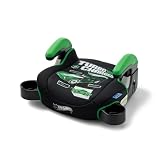
Graco TurboBooster 2.0
- Slim backless design for three-across back seat installs
- Height-adjustable armrests
- Graco ProtectPlus crash engineering

Cosco Topside Backless Booster
- Lightweight and portable for moving between vehicles
- Extra-plush padding
- Helps keep vehicle seats unmarked

Chicco KidFit ClearTex Plus
- DuoGuard head and torso protection
- Two dishwasher-safe CupFolders that fold away
- Converts high-back to backless
The Graco TurboBooster 2.0 leads on the combination that matters most here: a slim backless footprint, height-adjustable armrests, and a 4.8 star rating across more than 12,000 reviews. The Cosco Topside is the one we keep coming back to for value, with the largest review base of anything we looked at. The Chicco KidFit ClearTex Plus is our pick when a child still needs a high-back and the row is genuinely tight.
Quick Overview: All 12 Boosters Side by Side
Widths below are the published or manufacturer-stated figures where the maker supplies one. Where no width is published, we say so rather than inventing a number, because that gap is exactly where surprises come from.
| Product | Specifications | Action |
|---|---|---|
| Graco TurboBooster 2.0 Backless Booster |
|
Check Latest Price |
| Cosco Topside Backless Booster |
|
Check Latest Price |
 BubbleBum Inflatable Travel Booster BubbleBum Inflatable Travel Booster |
|
Check Latest Price |
 mifold Comfort Grab-and-Go Booster mifold Comfort Grab-and-Go Booster |
|
Check Latest Price |
| Chicco KidFit ClearTex Plus |
|
Check Latest Price |
 Diono Solana 2 XL Backless Diono Solana 2 XL Backless |
|
Check Latest Price |
 Chicco GoFit ClearTex Plus Backless Chicco GoFit ClearTex Plus Backless |
|
Check Latest Price |
 Safety 1st Grow and Go 2-in-1 Safety 1st Grow and Go 2-in-1 |
|
Check Latest Price |
 Baby Trend Protect 2-in-1 Folding Booster Baby Trend Protect 2-in-1 Folding Booster |
|
Check Latest Price |
 Diono Everett NXT High Back Diono Everett NXT High Back |
|
Check Latest Price |
 Diono Connect3 R High Back Diono Connect3 R High Back |
|
Check Latest Price |
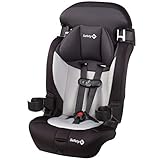 Safety 1st Grand 2-in-1 Safety 1st Grand 2-in-1 |
|
Check Latest Price |
One thing this table makes obvious: the seats that publish a width figure are almost all the ones engineered for the three-across problem. The Diono Connect3 R states under 17 inches, and the Safety 1st Grow and Go states 19 inches at full ComfortWing extension, which is a useful reminder that a seat can grow wider as your child grows.
1. Graco TurboBooster 2.0 Backless Booster – Our Pick for a Tight Row
Graco TurboBooster 2.0 Backless Booster Car Seat, Hot Wheels Gamer
Backless booster
40-100 lbs
Up to 57 inches
Height-adjustable armrests
Pros
- Slim backless profile that leaves room for a third child across
- Height-adjustable armrests improve belt fit
- Tested for frontal
- rear and rollover crashes
- 4.8 stars across more than 12000 ratings
- Multiple color options
Cons
- Backless design offers no head or back support
- Limited padding compared with high-back boosters
The Graco TurboBooster 2.0 is the seat we ended up recommending most often, and the reason has less to do with the spec sheet than with what happens in a real back row. It is a slim backless design, which means it adds height without adding shoulder structure, and in a compact sedan that difference is what closes a three-across row.
Height-adjustable armrests are the feature that gets overlooked on a product this small. They set how high your child sits, and how high your child sits decides where the shoulder belt lands. When the armrests are right, the belt crosses the collarbone instead of the neck, and the lap belt sits low on the hips rather than across the stomach.
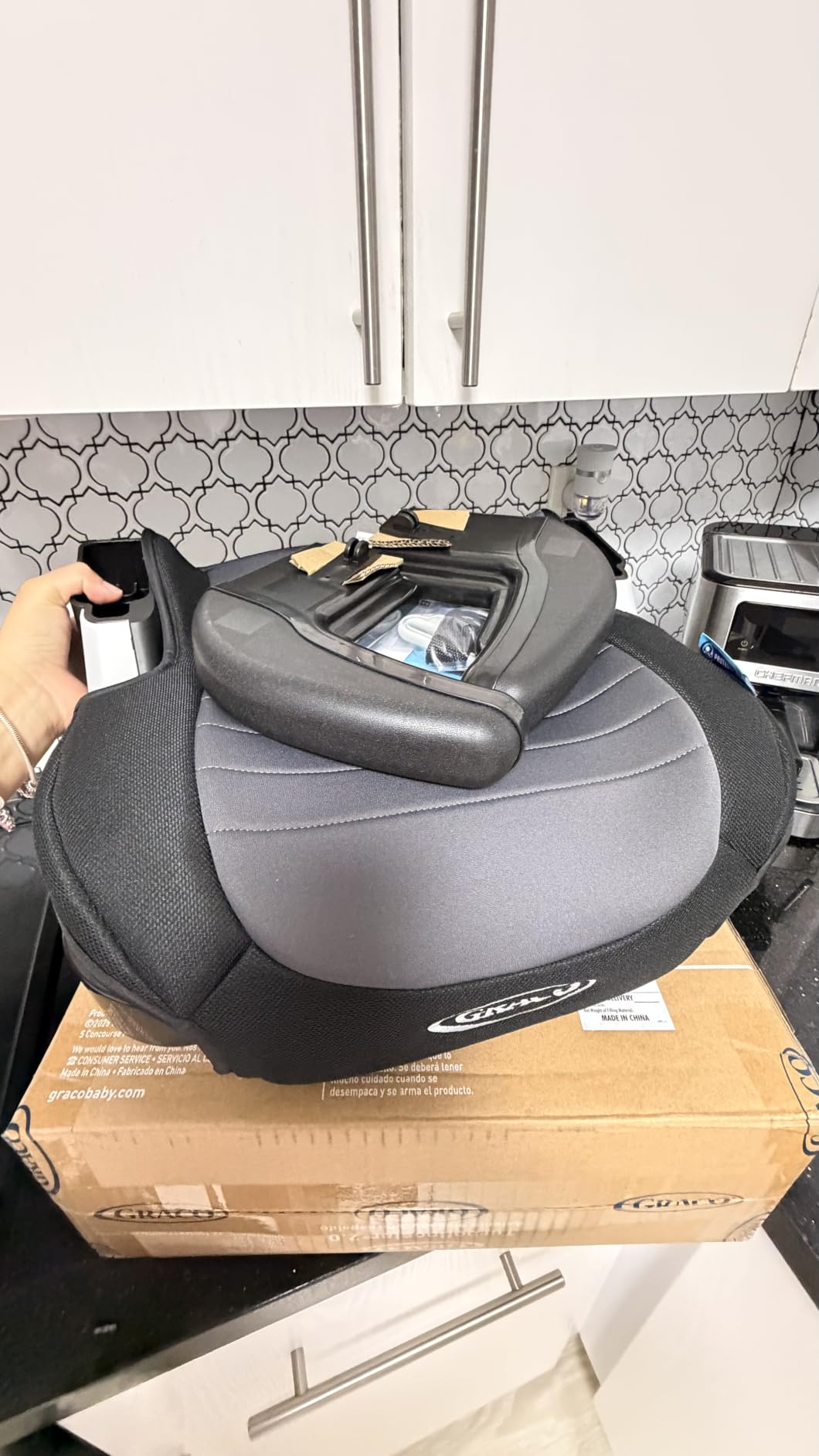
Graco describes the TurboBooster 2.0 as ProtectPlus engineered, with frontal, rear and rollover crash testing behind it, plus additional New Car Assessment Program testing and testing for extreme interior temperatures. That testing is the manufacturer’s own, published on the product page, and it is why we can say this seat stands on the same regulatory footing as the high-backs in this list.
The honest limitation is the one that comes with the format. There is no back and no head support, so a child who slumps in sleep has nothing holding their head up. For a seven-year-old who stays awake and properly buckled through the drive, that trade is usually worth taking. For a napper on a long highway run, it is not.
When the TurboBooster 2.0 fits your row?
Buy this one if you have three kids in a compact or mid-size car and the oldest two are past the harness stage. It is also the seat we would pick for a family rotating boosters between two vehicles, because a slim backless shell with no rigid structure is simple to move and simple to buckle correctly every time.
When the TurboBooster 2.0 is the wrong call?
Skip it if your child falls asleep in the car regularly, or if the middle position in your row has no head restraint and no removable headrest to work around. Padding is thin compared with the high-backs here, so a child who dislikes sitting on a firm shell will tell you about it on every trip.
2. Cosco Topside Backless Booster – Lightweight Filler for a Tight Row
Cosco Topside Backless Booster Car Seat, Lightweight Booster Seats for Cars 40-100 lbs, Backless Booster Seat for Car, Leo
Backless booster
40-100 lbs
43.4 to 57 inches
100% polyester cover
Pros
- Extremely lightweight and easy to move between vehicles
- Fits three across in one back row
- Compact with little extra bulk
- Easy to wipe clean after spills
- Protects vehicle upholstery
Cons
- No cup holders
- Thin hard plastic seat pan on long drives
- Hand-wash only fabric cover
The Cosco Topside has the largest review base in this entire roundup, more than 15,000 ratings, and for a plain backless booster that volume is telling. There is very little about the design that is trying to be clever. It is a light shell with padded armrests, and it does the single job a booster does.
Its published range is 40 to 100 pounds and 43.4 to 57 inches, which covers the backless stage for most children. The extra-plush padding is the feature that separates it from the harder shells, though reviewers with larger children note that the coverage is thinner than they expected at the top of that range.
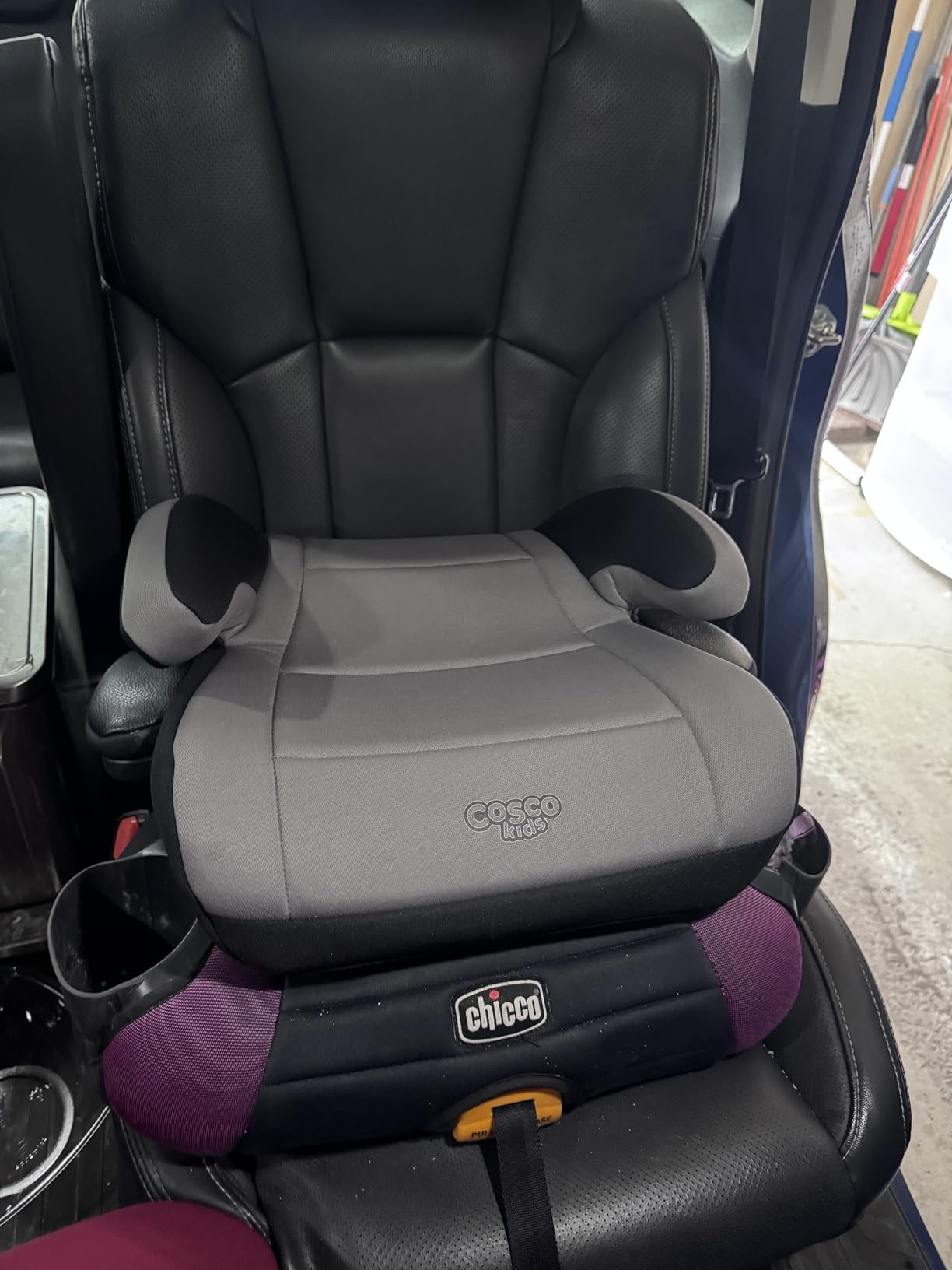
The design detail we like most is cosmetic but not trivial. Cosco shapes the base so it helps keep vehicle seats unmarked, which matters more than it sounds if you are installing boosters across a row and sliding them in and out daily. There is also a two-pack option, so buying a pair for one row is straightforward.
Owners consistently report fitting three across, and the recurring caveat is the absence of cup holders. That is a real daily friction point on school runs, but it is also a width saving, and in a narrow row the trade tends to be worth making. The cover is hand-wash only, so plan for that if spills are a fact of life.
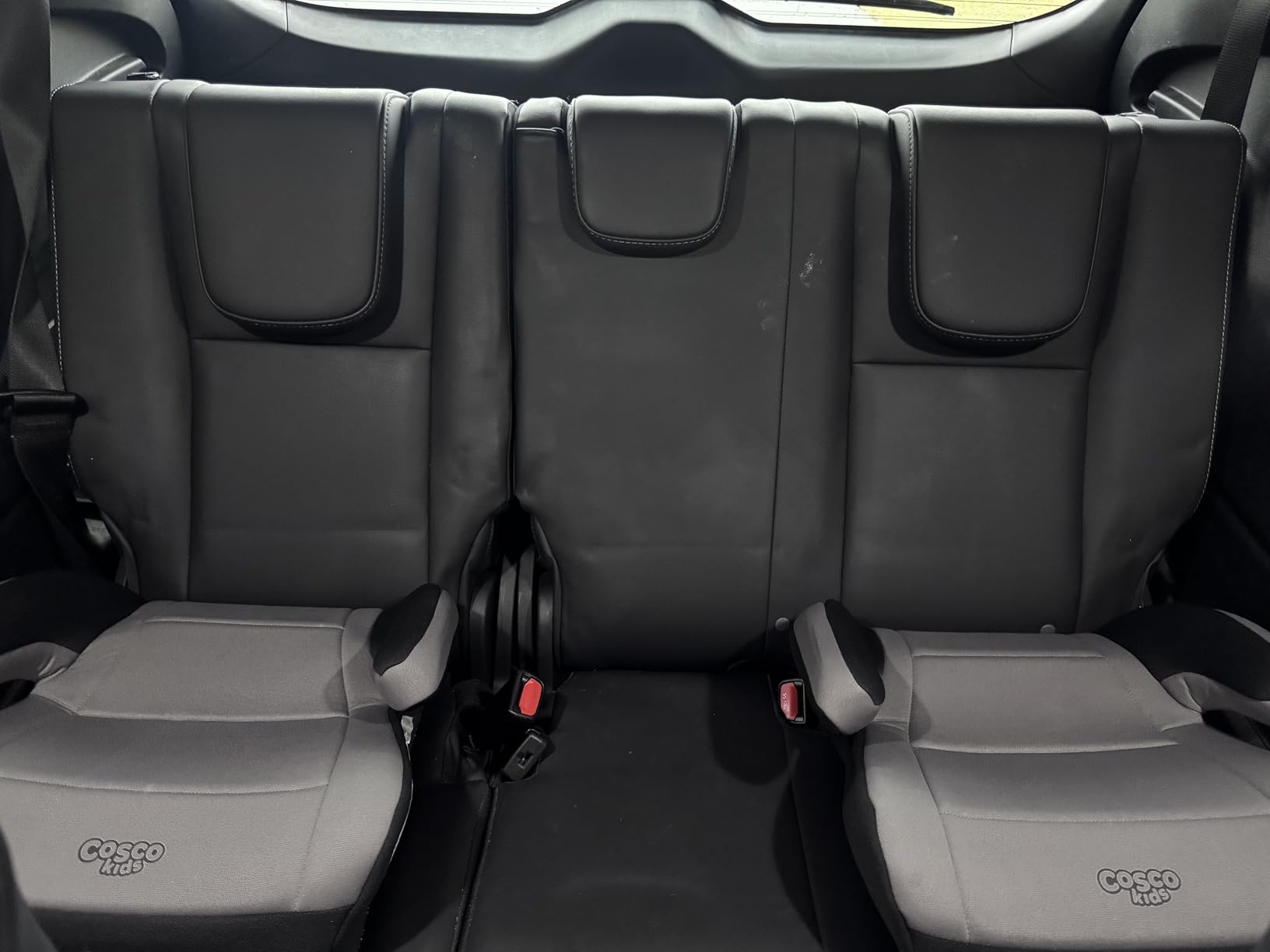
What the Cosco Topside does well?
This is our pick for families who need a filler seat and nothing more. If your child is past the harness, stays awake in the car, and the row is tight, the Topside does the job at a low weight you can carry between two cars without thinking about it.
Where the Cosco Topside falls short?
Skip it if your child is on long drives and complains about hard surfaces, or if the missing cup holders will be an argument you will lose every morning. The thin plastic pan is the other honest limit, and the hand-wash-only cover is a maintenance commitment.
3. BubbleBum Inflatable Travel Booster – Packs Flat, Sits Between Buckles
BubbleBum Inflatable Travel Booster Car Seat, Narrow Backless, 40-110 lbs
Inflatable backless
40-110 lbs
Deflates to 12 x 6 x 4 inches
Belt-secured
Pros
- Inflates in about 20 seconds with no pump needed
- Packs down to a fraction of a rigid booster
- Slim profile allows three across
- Independently crash tested to exceed FMVSS 213
- Wipe-clean surface
Cons
- 4.3 star average
- below the molded boosters in this roundup
- Inflatable cushion gives less rigidity than a hard shell
- Air pressure has to be checked and maintained
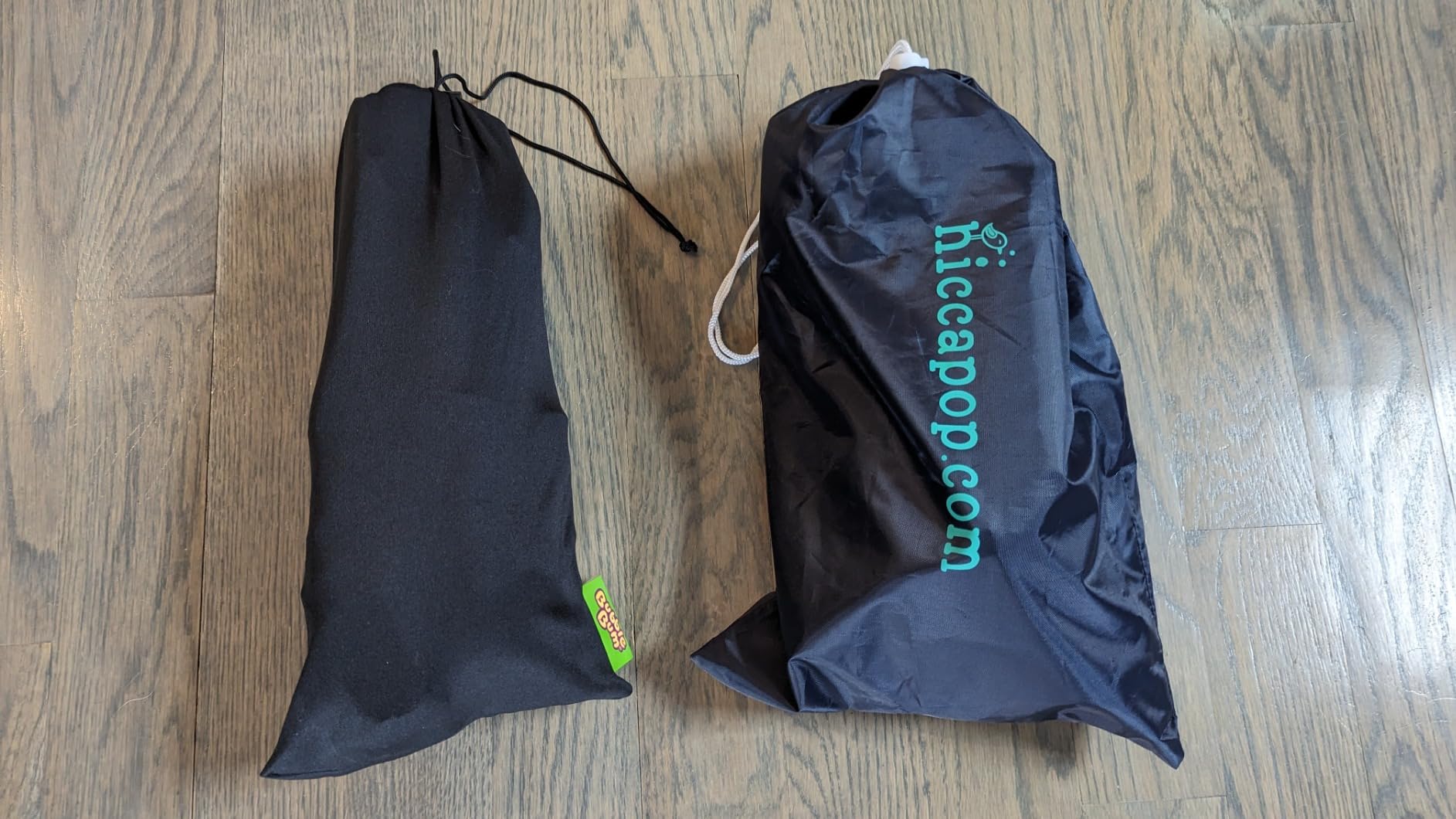
The BubbleBum is the only inflatable seat in this roundup. Everything else is a molded plastic shell; this inflates by mouth in roughly 20 seconds and deflates to 12 by 6 by 4 inches. It fits in a carry-on, a backpack, or a glove box, which changes the carpool math entirely.
It is also the seat technicians describe as narrow enough to sit between the center and outboard belt buckles where rigid boosters cannot. That is not a marketing line, it is the physical consequence of an inflatable profile with no fixed side walls. The published range is 40 to 110 pounds.
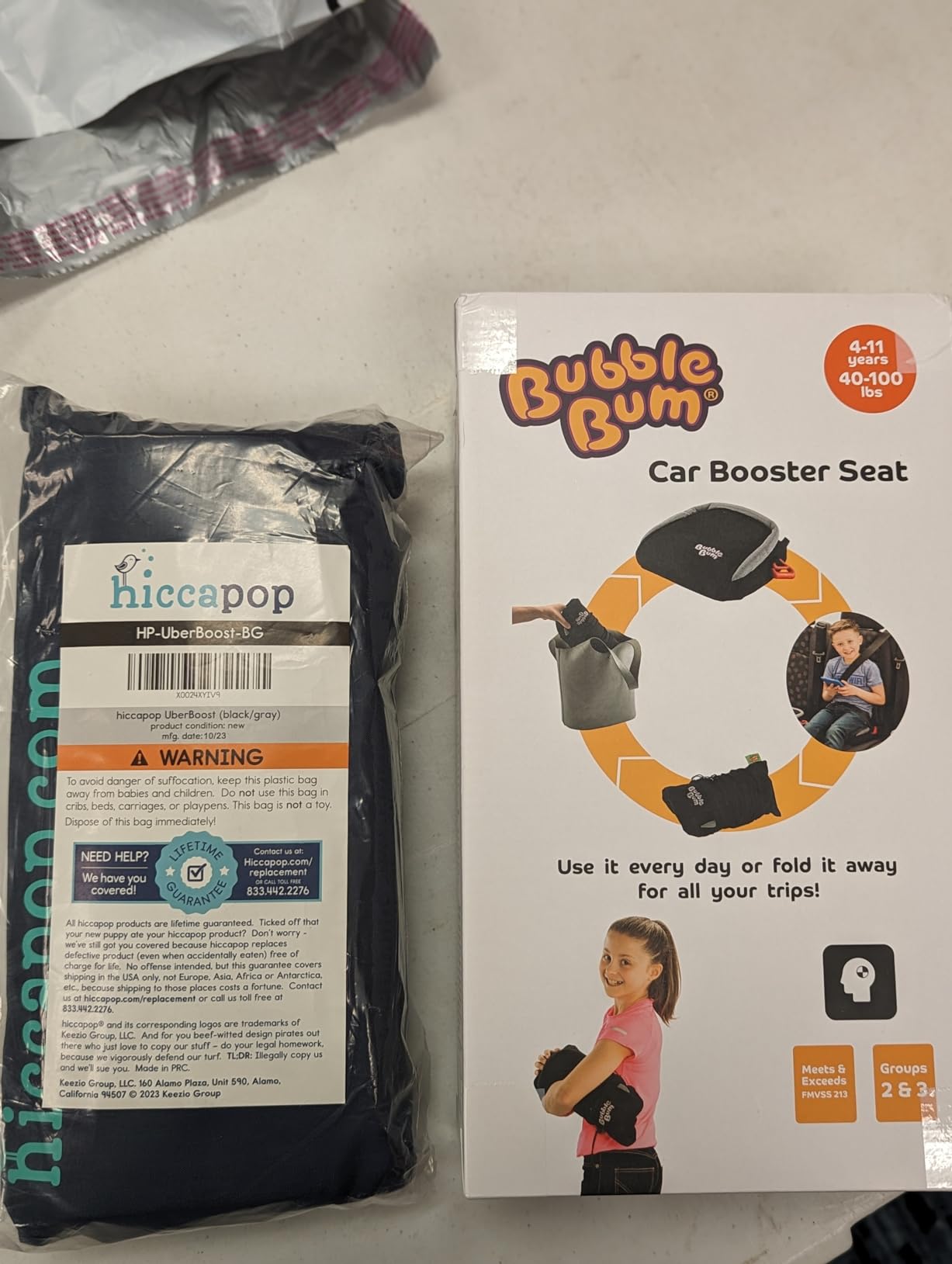
On safety, BubbleBum states the seat was independently crash tested to exceed FMVSS 213. The seat is secured by the vehicle seat belt with no LATCH hardware required, and it works with any vehicle that has a standard three-point belt. We did not test it ourselves, so treat that as a manufacturer claim you can verify in the manual.
What gives owners pause is the give in the cushion. At 4.3 stars with a meaningful share of one-star ratings, it has the widest rating distribution of the twelve seats we looked at, and the complaints cluster around perceived softness compared with a rigid shell. Air pressure also needs occasional checking, which is a maintenance step a plastic seat does not ask of you.
What the BubbleBum does well?
Buy it if you carpool, split time between two households, fly often, or need a third child in a row that genuinely has no room. It is the practical answer when rigid geometry fails, and the 40 to 110 pound range outlasts most backless competitors.
Where the BubbleBum falls short?
Skip it if your child is sensitive to a soft or shifting surface, or if remembering to inflate it every time sounds like one more thing. Its 4.3 stars sit below the molded boosters here, and the six percent one-star share is not a rounding error. If you want one seat and never think about it, buy a molded shell.
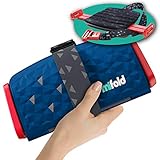
4. mifold Comfort Grab-and-Go Booster – Backpack-Size Travel Seat
New Mifold Comfort Grab-and-go Car Backless Booster Seat-Compact and Portable for Every Day, Carpooling, Travel, Ocean Blue
Backless booster
40-100 lbs
43.5 to 59 inches
Shoulder belt guide
Pros
- Fits in a regular backpack or glove box
- Adjusts the adult belt down instead of lifting the child
- Anti-slip pads keep the booster in place
- Integrated shoulder belt guide
- No installation or hardware required
Cons
- 4.2 star average
- the lowest in this roundup
- Thin backless shell with no head or torso support
- Belt fit depends on correct shoulder belt position
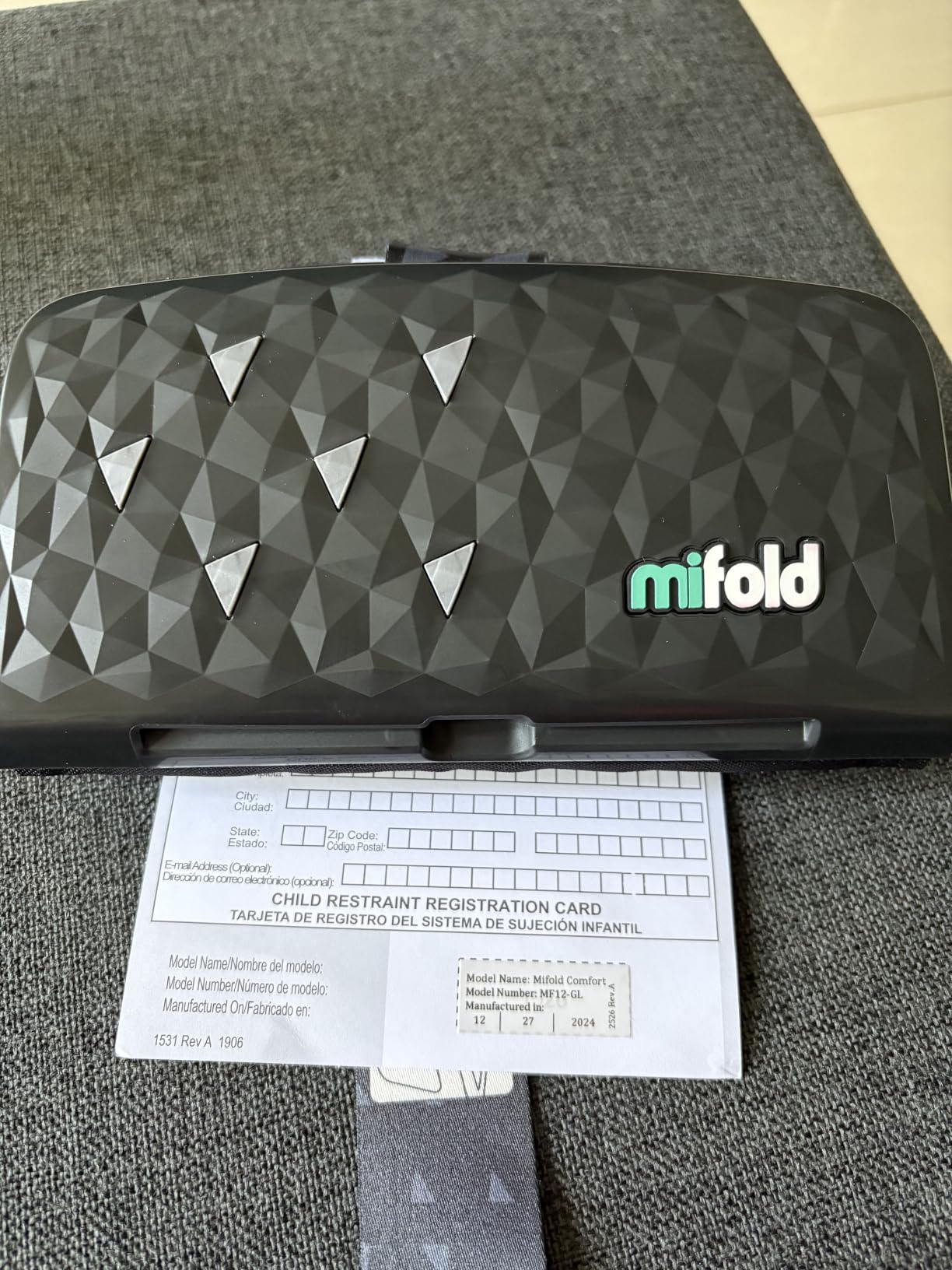
The mifold Comfort Grab-and-Go takes a different approach from every other seat here. Instead of lifting your child up to meet the belt, it adjusts the adult belt down to meet your child. That design choice is why it folds into a backpack and why its published range extends to 59 inches, the tallest ceiling among the backless options in this list.
This Comfort model adds a padded Compact Comfort cushion and anti-slip pads over the basic shell, plus an integrated shoulder belt guide for routing. There is no installation step at all. If the car has a three-point belt, the seat is ready.
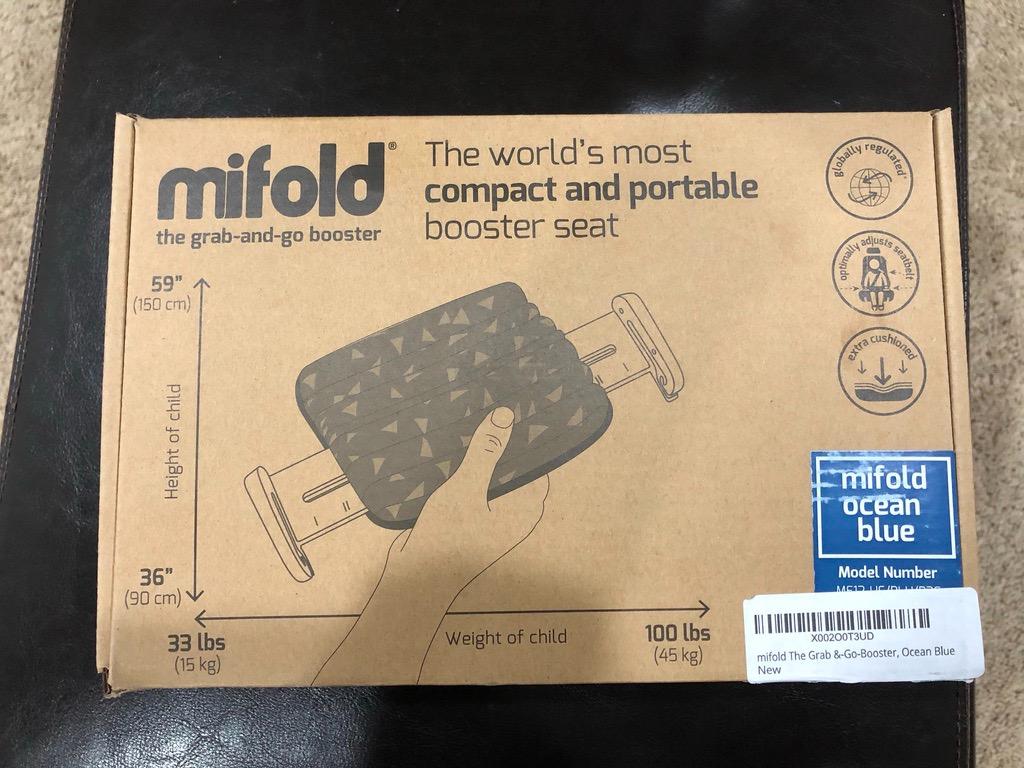
The travel appeal is real. Parents who move between a city car, a family SUV and a rental describe one-hand grab-and-go convenience that no rigid booster in this roundup matches. For a child who splits the week between two homes, that flexibility is the product.
The criticisms concentrate on comfort and fit consistency. At 4.2 stars with an eight percent one-star share, it is the lowest-rated seat we included, and the complaints are about thin padding over long trips and about belt fit varying from car to car. Because the shoulder belt guide depends on where your vehicle runs its belt, that variation is structural rather than a defect.
What the mifold Comfort does well?
Buy it if portability beats padding in your household, whether that means grandparents, frequent travel, or a child who is genuinely small for their age and needs more seat than a booster gives. The 59-inch height limit also makes it the longest-lived backless option here.
Where the mifold Comfort falls short?
Skip it if belt fit varies across the cars your family uses and you do not want to re-check it each time, or if long drives are frequent and thin padding will get complained about. Check the belt geometry in your own vehicle before committing, because the guide can only help if the shoulder belt already runs where it should.
5. Chicco KidFit ClearTex Plus – Narrow High-Back With Folding Cup Holders
Chicco KidFit ClearTex Plus 2-in-1 Belt-Positioning Booster Car Seat
High-back to backless
DuoGuard head and torso protection
10-position height adjustment
Quick-release LATCH
Pros
- Slim profile with collapsible cup holders improves narrow row fit
- Converts from high-back to backless as the child grows
- Quick-release LATCH for fast transfers
- Machine washable removable fabrics
- Flame retardant-free ClearTex fabric
Cons
- One of the higher-priced boosters in this roundup
- Cup holders fold away rather than detach
- Some children who can unbuckle may climb out of the high-back
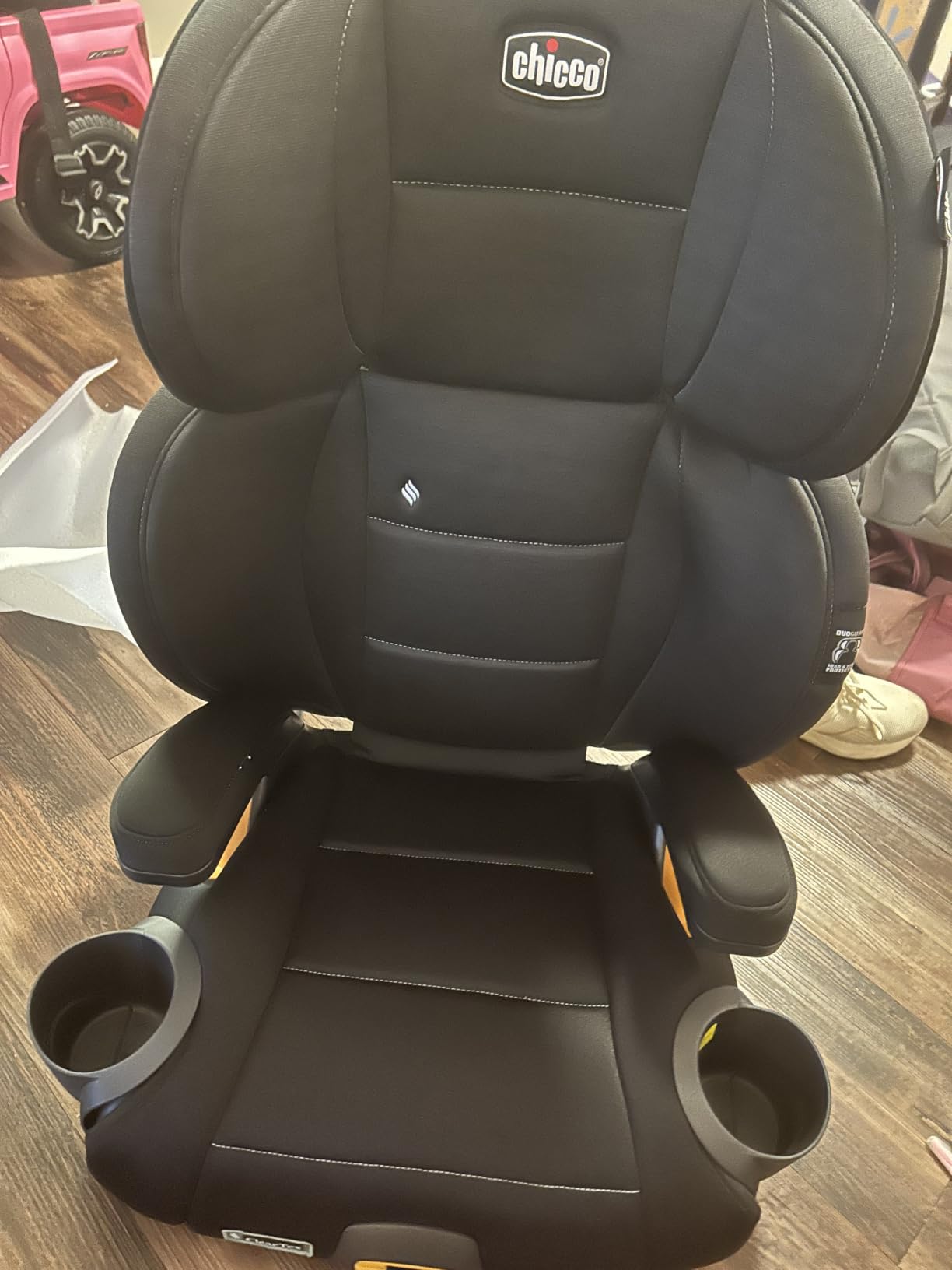
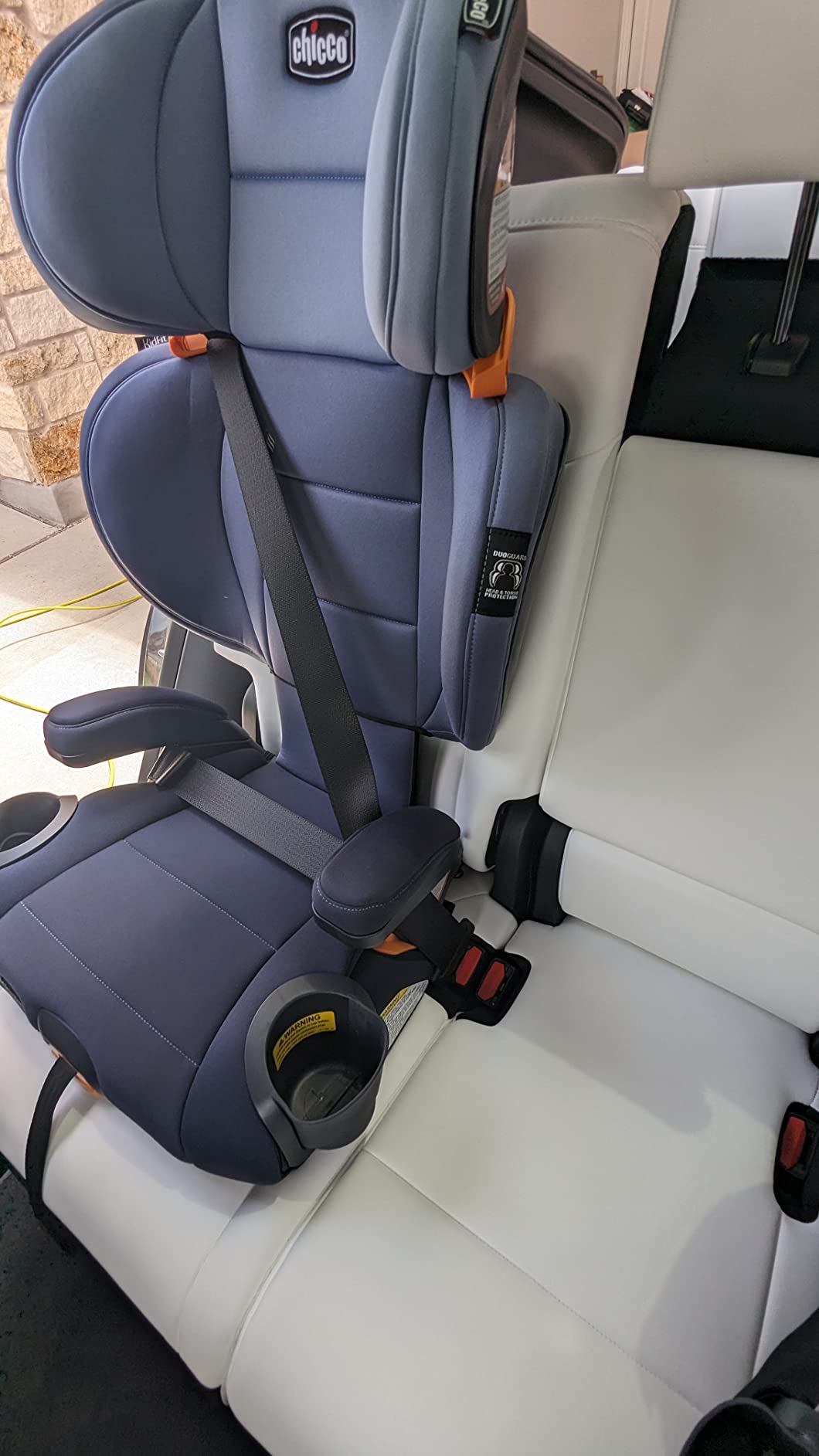
When a child still needs head support and the row is tight, the Chicco KidFit ClearTex Plus is the seat we look at first. Its width advantage comes from design decisions rather than from being small: the two dishwasher-safe CupFolders fold away when empty, so the widest point collapses for three-across installs and expands for daily use.
Safety-wise it carries Chicco’s DuoGuard head and torso protection with ten-position height adjustment from the waist, which is unusual for a booster because it means the fit grows with the child instead of the child outgrowing it. The backrest also reclines in two positions, which is genuinely useful for a child who falls asleep on the way home.
Installation is where this seat pulls ahead of its category. Premium LATCH connectors, a SuperCinch one-pull tightener and a quick-release for one-hand removal mean moving between two cars takes seconds, and quick-release LATCH matters more than it sounds in a narrow row because you are not fighting to unclip a seat wedged between two others.
This is also one of two seats in this roundup that meet a flame-retardant-free brief. The ClearTex fabric is GREENGUARD Gold Certified, and all fabrics including the armrests are removable and machine washable. The ErgoBoost contoured seat with double foam padding is more heavily padded than the other high-backs here.
What the KidFit ClearTex Plus does well?
Buy it if your child is between four and about ten, still benefits from a back and head support, and you want one seat to cover the harness-to-adult transition. It also suits families who care about flame-retardant-free textiles and want a cover that survives machine washing.
Where the KidFit ClearTex Plus falls short?
Skip it if a backless seat would do the job, since this sits at the higher end of what we reviewed. Two caveats to weigh: the cup holders fold rather than detach, so they still occupy space while folded in some setups, and a child who can operate a buckle independently might be able to climb out of the high-back configuration.
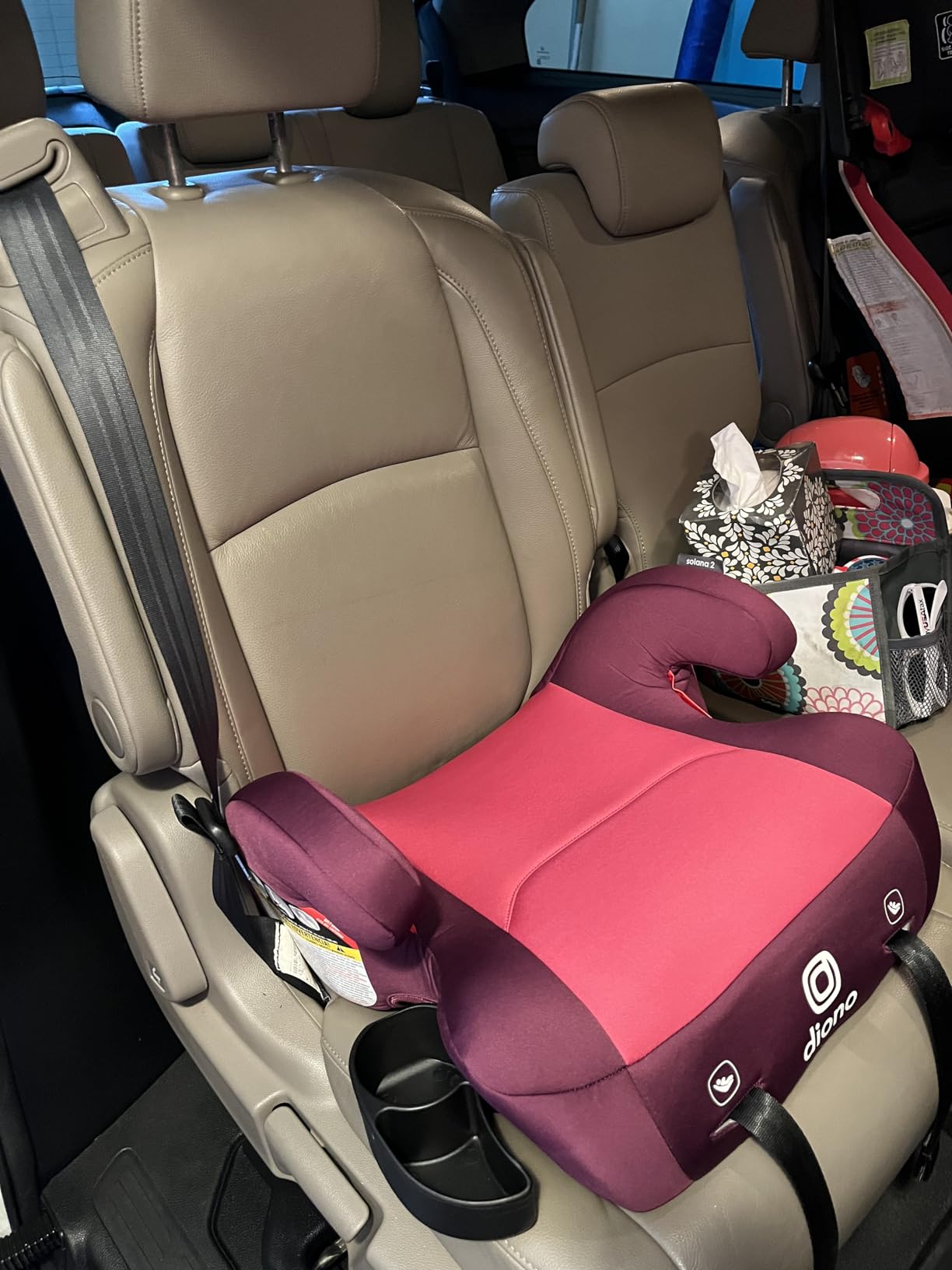
6. Diono Solana 2 XL – Roomy Backless Seat With Dual LATCH Connectors
Diono Solana 2 XL 2022, Dual Latch Connectors, Lightweight Backless Belt-Positioning Car, 8 Years 1 Booster Seat, Black
XL backless
40-120 lbs
About 3.1 lbs
Dual steel LATCH connectors
Pros
- Spacious XL seating fits larger 6 to 8 year olds without squeezing the hips
- Dual LATCH connectors add security on sudden stops
- Easy self-buckling with open buckle access
- Lightweight at roughly 3.1 lbs
- Dual retractable cup holders and snack tray
Cons
- XL width rules out three across in most vehicles
- One owner reported the seat can block the seatbelt from latching properly in a small hatchback
- Thin padding for older bigger kids without an aftermarket pad
The Diono Solana 2 XL is the exception in this roundup that we include on purpose: it is not narrow. It is an XL backless seat, and several owners explicitly warn that the footprint rules out three-across installs. If you are filling one position in a roomy vehicle and your child is on the larger side, that extra room is the whole point.
The weight range is 40 to 120 pounds, the widest backless range here, and the XL seating is designed so an eight-year-old sits without their hips being squeezed against the shell walls. That comfort is the reason owners keep coming back to it.
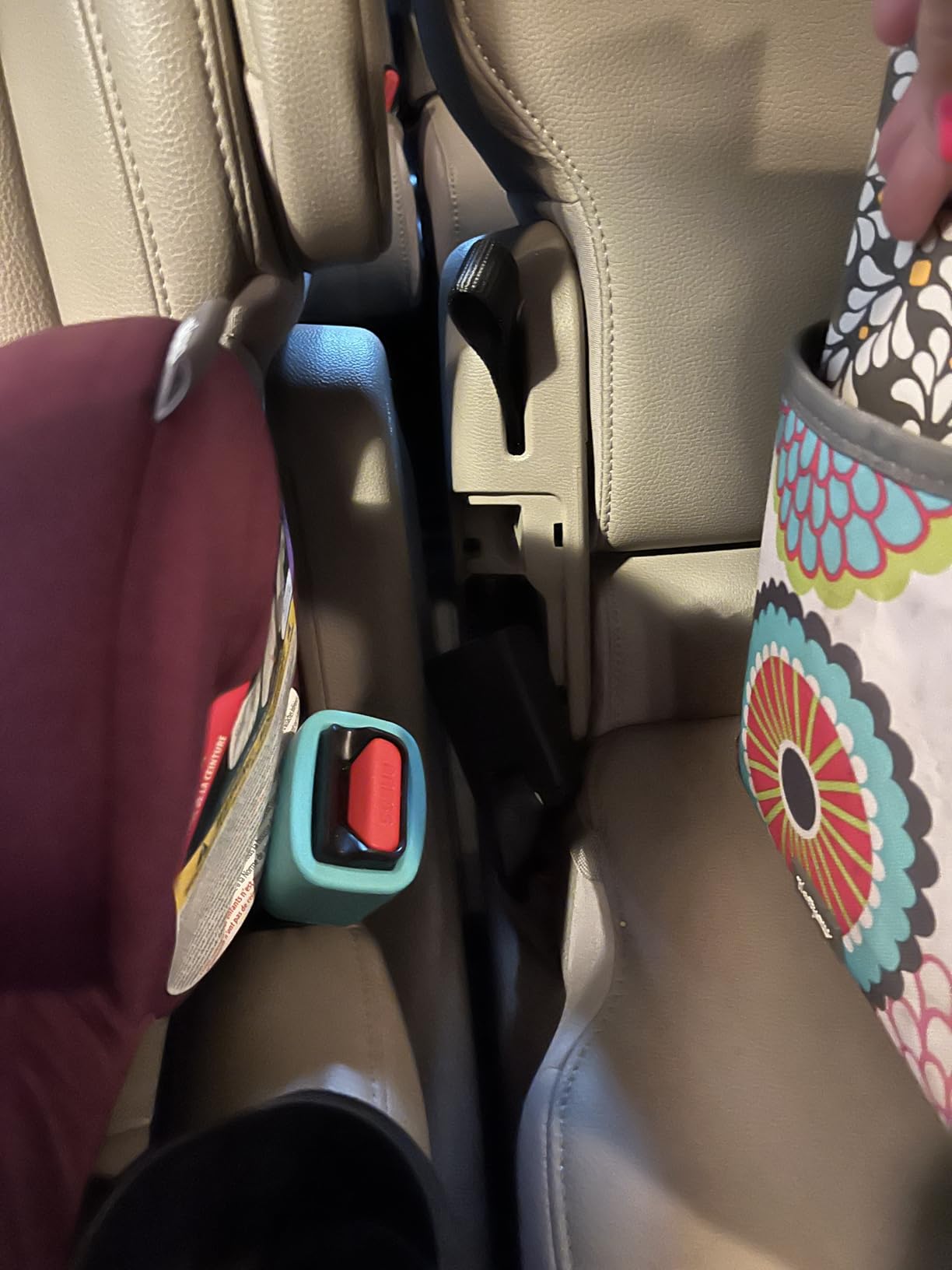
The dual retractable 2-in-1 cup holder and snack tray is unusual on a booster and quietly useful on a long drive. The shoulder belt positioner and open buckle access mean older children can buckle themselves, which removes a daily friction point that most parents do not realise they will otherwise be managing.
Automotive steel LATCH connectors with two adjustable straps and a quick release add real security in a crash, because an unoccupied, unanchored booster becomes a projectile. One reviewer did report the seat blocking a seatbelt from latching properly in a small hatchback, which is worth weighing if your vehicle has a tight buckle stalk.
What the Solana 2 XL does well?
Buy it if your child is large for their age, if the seat is going in a single outboard position rather than a three-across row, and if you want them to self-buckle. The steel LATCH connectors are a genuine safety argument in a vehicle with usable anchors.
Where the Solana 2 XL falls short?
Skip it if you need three across, which most readers here do. Also consider that the padding is thin for bigger children, and that the bulky XL footprint can crowd a door. At roughly 3.1 lbs it is light, but it is not small.
7. Chicco GoFit ClearTex Plus – Backless Seat With One-Hand LATCH Release
Chicco GoFit ClearTex Plus Backless Booster Seat, Lower Anchor Attachment
Backless
40-110 lbs
44 to 57 inches
LATCH lower anchor stabilization
Pros
- 4.9 stars with 93 percent five-star ratings
- Very easy one-hand install and removal
- Built-in carry handle makes it genuinely portable
- Fold-away cup holders stay out of the way
- Flame retardant-free ClearTex fabric
Cons
- Instructions could be clearer for first-time installers
- Backless format offers no head or back support
- Foam insert requires hand rinsing rather than machine washing
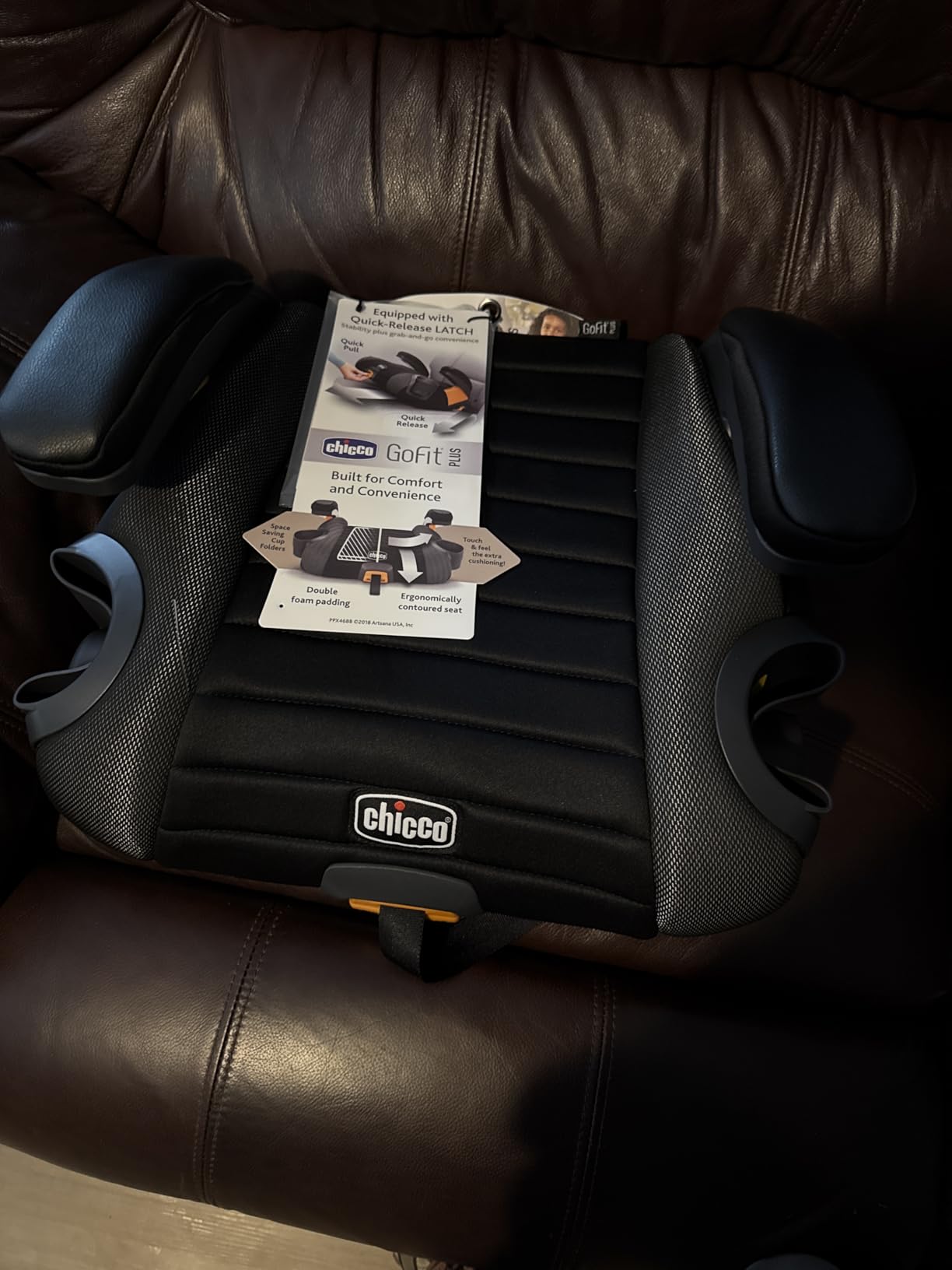
The Chicco GoFit ClearTex Plus has the highest average rating of any seat in this roundup, 4.9 stars, with 93 percent five-star reviews across more than 700 ratings. It is a backless seat, but unlike most backless boosters it can be anchored to the lower LATCH anchors, and that changes how it behaves in a tight row.
LATCH stabilization with a quick-release handle means one hand can install or remove it. In a three-across row that is not a convenience detail, it is the difference between a seat you actually move between cars and one that stays in the back of the garage because removing it is a fight.
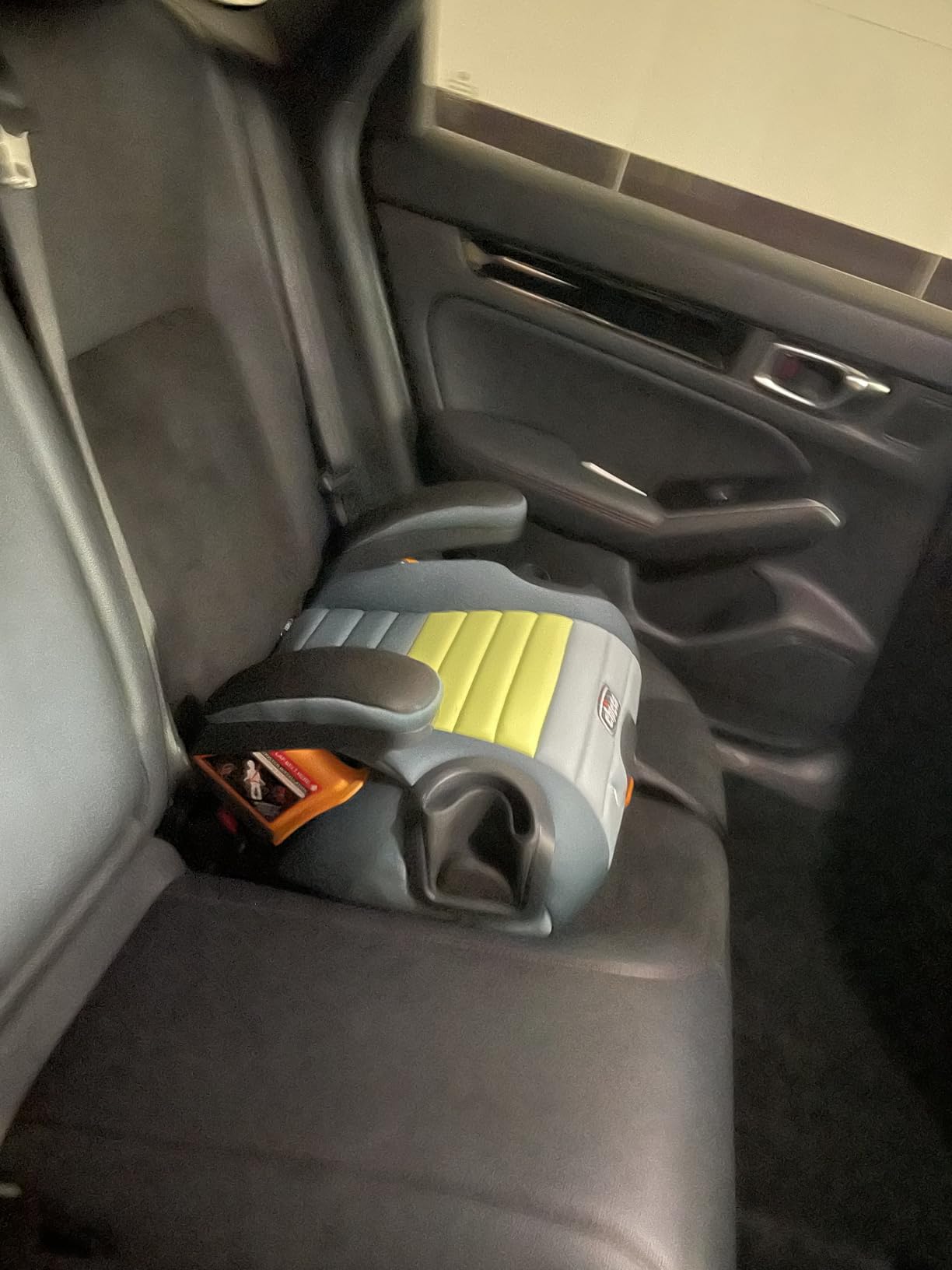
Published limits are 40 to 110 pounds and 44 to 57 inches, with a stated minimum age of four. Integrated lap belt guides and a shoulder belt clip handle routing so the belt lands where it should, and the built-in carry handle makes the seat genuinely portable rather than merely light.
Two fold-away cup holders stay out of the way when you need the width and return when you need them. The ClearTex materials are flame retardant-free and GREENGUARD Gold Certified, and the seat pad is machine washable. The ergonomic contoured seat with double foam padding adds noticeable padding compared with typical backless shells.
What the GoFit ClearTex Plus does well?
Buy it if your vehicle has usable lower anchors and you want the backless footprint of a slim booster with the anchoring security of a convertible. It suits families moving one seat between several cars, and parents who want flame-retardant-free fabrics with a washable cover.
Where the GoFit ClearTex Plus falls short?
Skip it if the backless format is the wrong stage for your child, since there is no back or head support at all. The written instructions are the most-criticized part, so budget an extra read of the manual before your first install, and note the foam insert is hand-rinsed rather than machine washed.
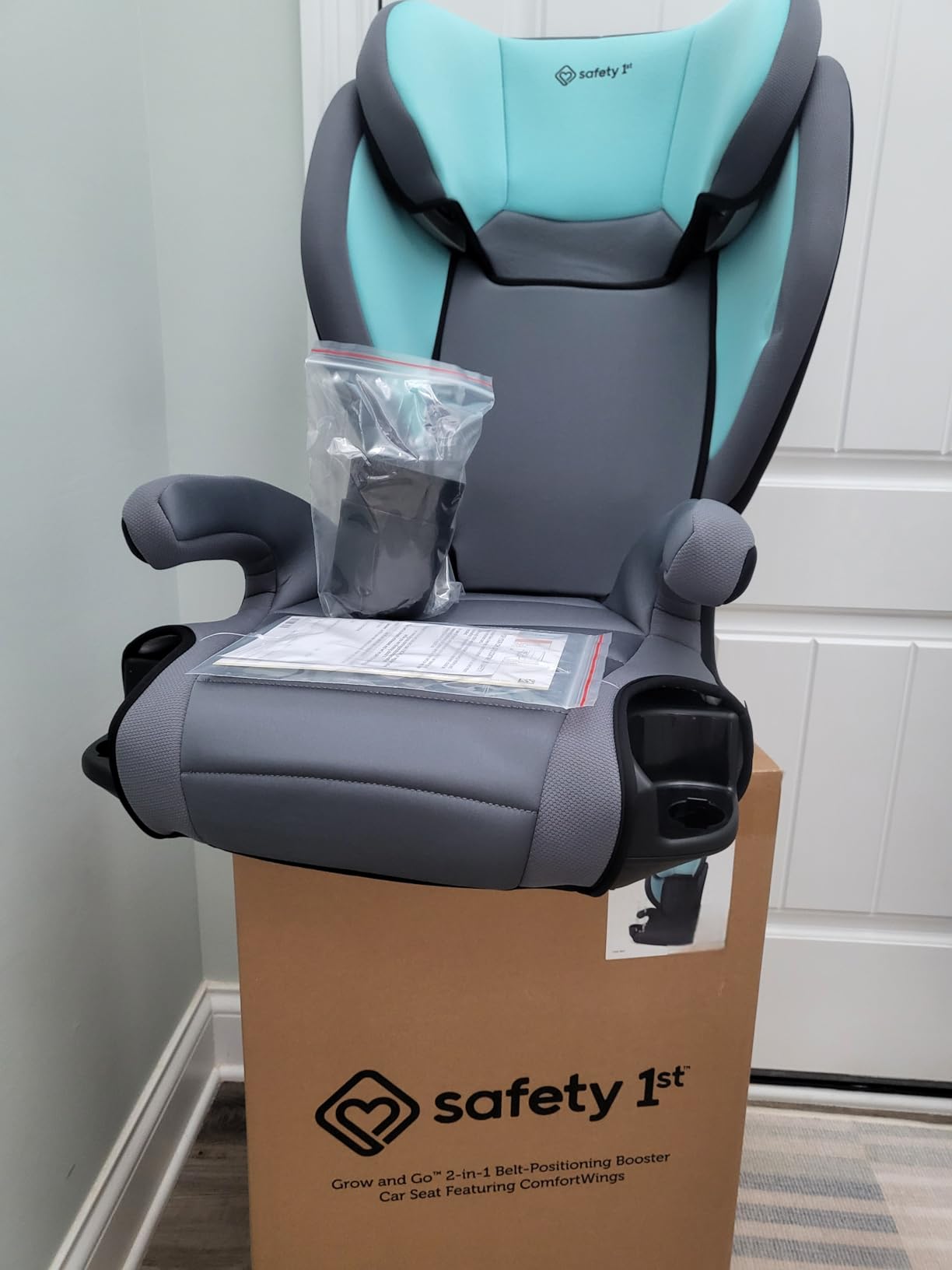
8. Safety 1st Grow and Go 2-in-1 – High-Back That Expands to 19 Inches
Safety 1st Grow and Go 2-in-1 Booster Car Seat with ComfortWings, Converts High-Back to Backless, 19″ Wide, Slim Design, Lightweight, Foldable, Easy-Clean, Cup Holders, 40-100 lbs, Crushed Grape
High-back to backless
40-100 lbs
43.4 to 57 inches
19 inches wide at full extension
Pros
- Slim high-back design for tight back seats
- ComfortWings expand as the headrest rises so one seat lasts
- Foldable frame stores flat when a child outgrows booster age
- Belt guides let kids buckle themselves
- Machine-washable dryer-safe pad
Cons
- Width grows to 19 inches at the shoulders as the child grows
- No LATCH connectors included
- Cup holders are removable rather than permanently attached
The Safety 1st Grow and Go 2-in-1 is the clearest example of a manufacturer publishing its own widest measurement: 19 inches at full ComfortWing extension. That is a deliberate growth system rather than a fixed size, and it is worth understanding what it means for a narrow row before you commit.
The ComfortWings backrest wings expand as the headrest rises, so a narrow base becomes a wider seat as your child grows. The upside is longevity: a narrow base that already fits a tight row at age four still provides head and torso support at age eight without a new purchase.
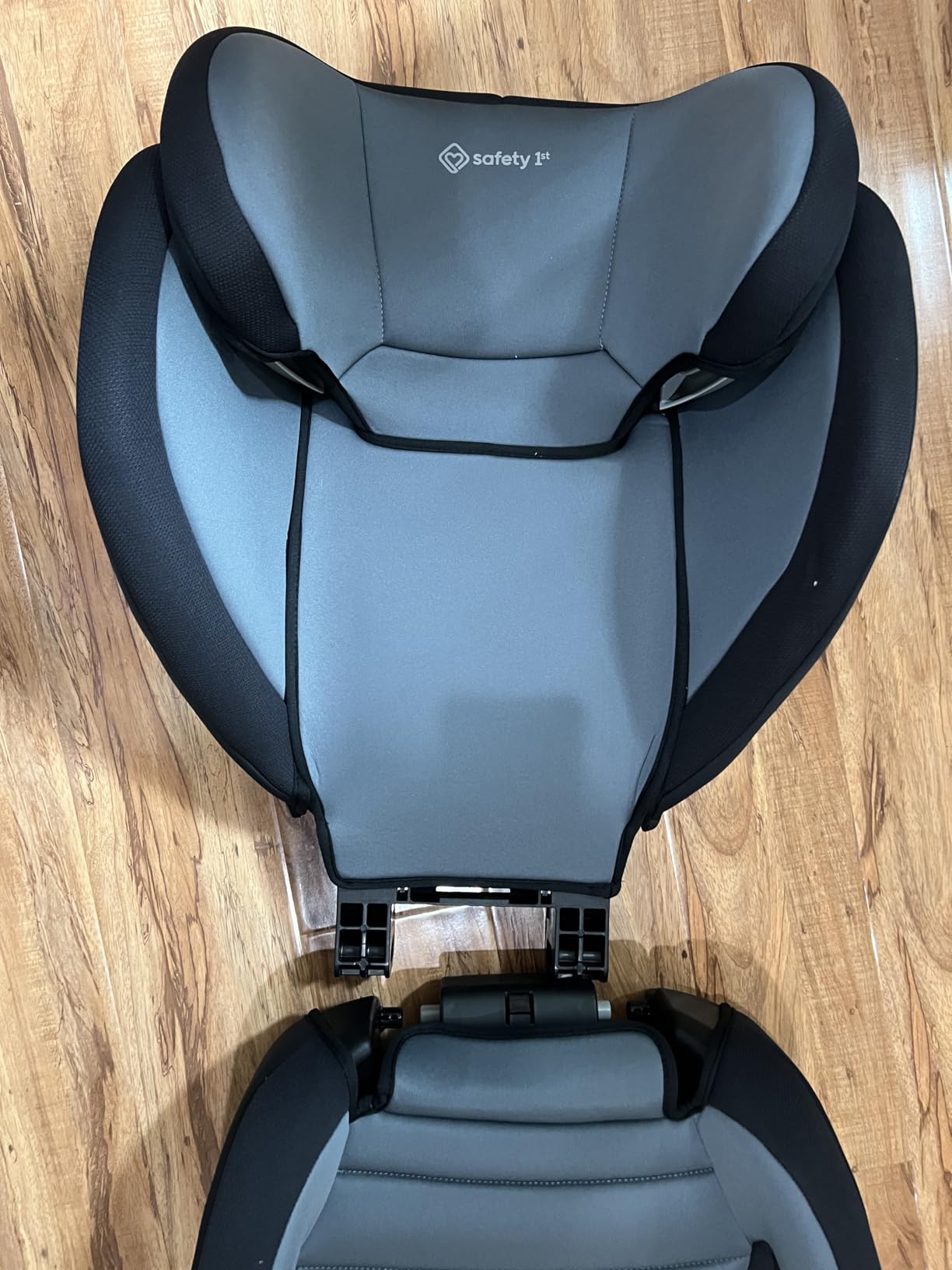
The foldable frame is the sleeper feature. When your child moves past booster age, or when you need the third row back, the seat folds flat. Reviewers describe it as a compact convertible that stays out of the way between uses, which is a real advantage in a small SUV.
Shoulder and lap belt guides handle routing and let children buckle themselves, the headrest adjusts through ten positions, and the pad is machine washable and dryer safe. The two cup holders are removable rather than attached, which is helpful because you can take them off entirely to claw back width.
The trade is honest. A 19-inch shoulder width is wider than a dedicated slim booster, so this is a two-across seat in most vehicles rather than a three-across one, and there are no LATCH connectors at all. The choice is between a compact high-back that lasts and a truly narrow one.
What the Grow and Go 2-in-1 does well?
Buy it if your child needs a high-back now and will need one for years, and if your row fits two across but not three. The fold-flat frame and removable cup holders make it the tidiest choice for a small SUV where storage space is genuinely tight.
Where the Grow and Go 2-in-1 falls short?
Skip it if three across is the goal, because 19 inches at full extension is not a three-across footprint. Also skip it if you need lower anchor anchoring, since this seat does not include LATCH connectors and relies entirely on the vehicle belt.
9. Baby Trend Protect 2-in-1 Folding Booster – Stores Flat Between Uses
Baby Trend Protect 2-in-1 Folding Belt-Positioning Booster Seat, Midnight Black
High-back to backless
Fold-flat design
Lightweight build
Adjustable armrests
Pros
- Folds flat for storage
- travel and grandparent use
- Very light so it is easy to carry between vehicles
- Compact enough for the middle or end position of a back row
- Detachable back piece converts it to a backless booster
- Built-in cup holder and cushioned seating
Cons
- 4.5 star average
- with short armrests
- Does not come with lower anchors or a LATCH system
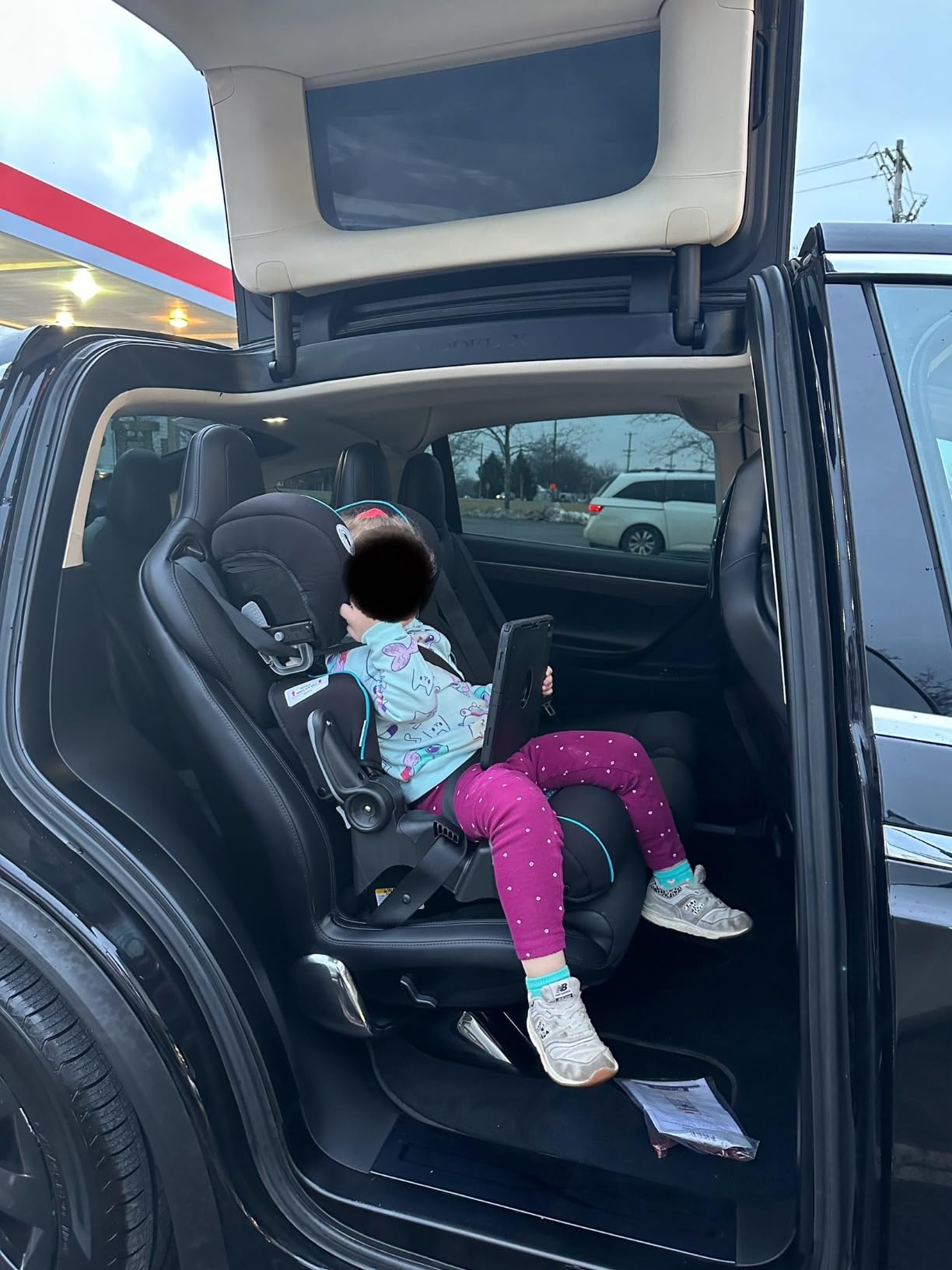
The Baby Trend Protect 2-in-1 Folding Booster is built around one idea: a high-back booster that disappears when you are not using it. It folds flat like a closed laptop, and parents without a car, grandparents and frequent travellers consistently describe that as the reason they bought it.
It converts from high-back to a belt-positioning booster by detaching the back piece, so it covers both stages on one frame. The seat also has adjustable armrests, a cushioned seating surface, and a built-in cup holder that stays attached rather than being a separate part to lose.
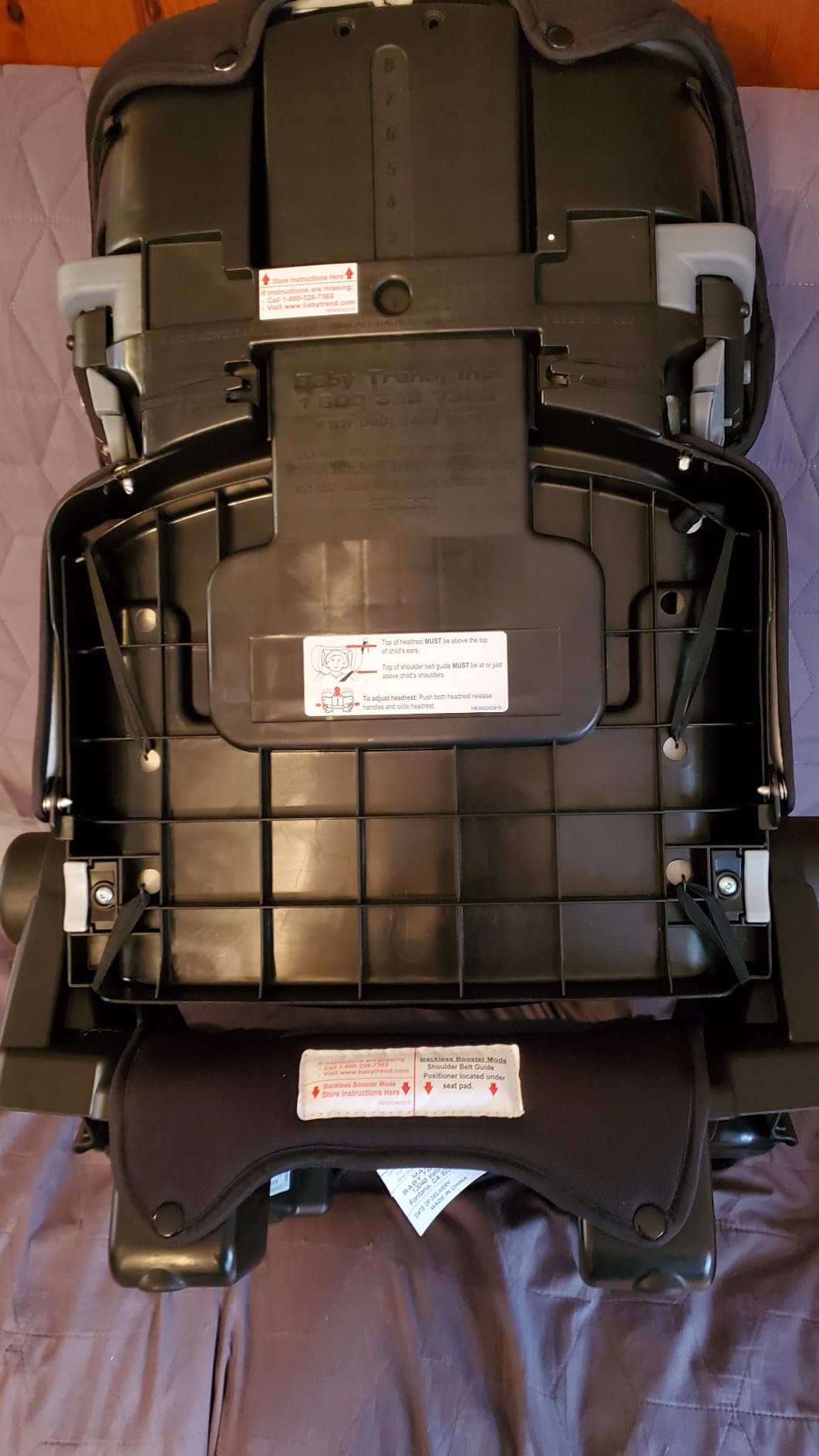
Weight is the quiet advantage here. Owners compare carrying it to a small grocery bag, which is a low bar that most high-backs in this roundup would fail. In a household with one car and one booster, or a carpool where the seat comes in and out, that matters more than any head support feature.
Reviewers are less positive about the armrests. The recurring complaint is that they are short, so a child’s elbow is only barely supported, which can make a long trip uncomfortable. The 4.5 star average puts it below the other molded boosters here, and there is no LATCH system, so this installs with the vehicle belt only.
One practical note: the seat is compact enough for the middle or end position of a back row, but no manufacturer publishes a width figure for it, so measure your bench before you commit.
What the Baby Trend Protect does well?
Buy it if storage is the binding constraint, whether that is a small trunk, a shared grandparents’ car, or a vehicle you do not want a permanent booster in. It is a sensible first booster for a child moving out of a harness who does not need LATCH anchoring.
Where the Baby Trend Protect falls short?
Skip it if your child is tall or long-limbed enough to notice the short armrests on a long drive, and skip it if you want lower anchors. With no published width and a 4.5 star average, it is the least confident pick for a genuinely narrow row.
10. Diono Everett NXT – Slim High-Back With Rigid LATCH
Diono Everett NXT High Back Booster Car Seat with Rigid Latch, Lightweight Slim Fit Design, 8 Years 1 Booster Seat, Black
High-back
40-120 lbs
Rigid steel LATCH
7-position headrest
Pros
- Slim fit that still allows three across in a mid-size SUV
- Rigid LATCH connectors slide straight onto the anchors without tightening
- Latch arms flip inward for vehicles without LATCH
- Open loop belt guides for easy self-buckling
- Deep padded backrest with two layers of side impact protection
Cons
- Very heavy for a slim booster
- Cup holders are sold separately and mount on a small stem
- One of the higher-priced boosters here
The Diono Everett NXT solves a problem most narrow boosters create. In a tight row, an unoccupied booster that is not anchored becomes a projectile in a crash, and rigid LATCH is the fix. The Everett NXT uses automotive steel rigid LATCH connectors that slide straight onto the vehicle anchors with no strap to tighten.
That is a genuine safety argument, not a convenience one, and it is why rigid LATCH matters on narrow boosters. Parents fitting three across in a mid-size SUV describe the flip-in latch arms as the feature that lets the same seat work in a vehicle that has anchors and one that does not.
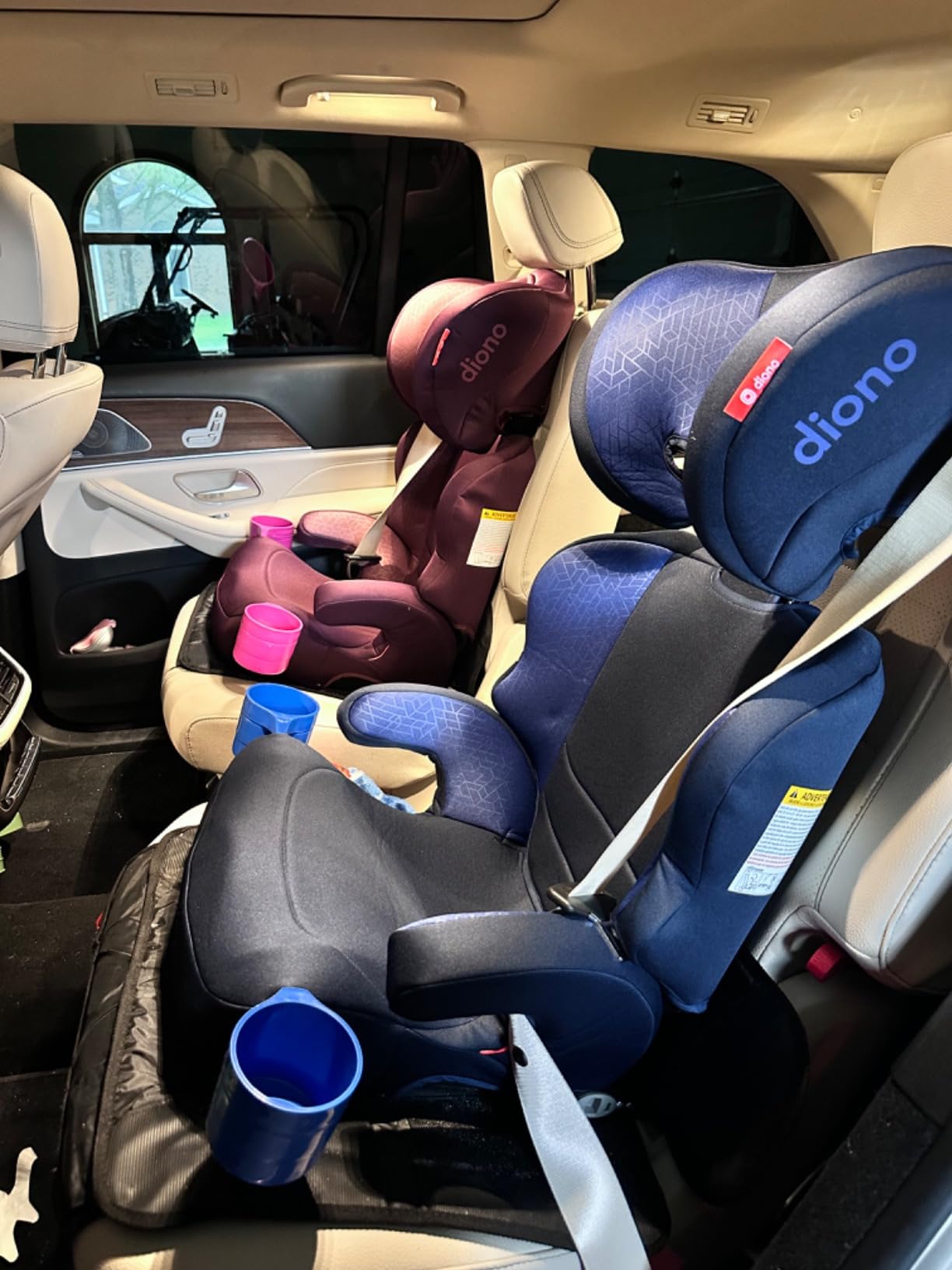
The weight range is 40 to 120 pounds, so it outlasts most high-backs here. The headrest adjusts through seven positions with two layers of side impact protection, and open loop belt guides stop the shoulder belt from hanging up as a child reaches for their buckle, which makes self-buckling realistic rather than aspirational.
The backrest has deep padded cushioning and removable machine-washable fabrics. What keeps it from the top of our list is weight and accessories. It is described as very heavy for a slim booster, and the cup holders are sold separately and press onto a small plastic stem that reviewers expect to break.
One reviewer also reported a headrest shape that dug into the shoulders at the manual-specified height. It is an isolated comment rather than a pattern, but it is the kind of thing to test in store if you can.
What the Everett NXT does well?
Buy it if your child needs head and torso support, your row is tight, and your vehicle has lower anchors you want to use. It suits a 40 to 120 pound range that covers a long stretch of the booster years, and it works for self-buckling children thanks to the open loop guides.
Where the Everett NXT falls short?
Skip it if you move the seat between cars constantly, because it is very heavy for a slim booster. Also skip it if the separate cup holders are part of the plan and the stem-mounted design worries you, or if it is the only seat in a row and you would rather spend less.
11. Diono Connect3 R – Purpose-Built Three-Across High-Back
Diono Connect3 R 2-in-1 High Back Booster, Slim Fit 3-Across in Many Mid-Sized Sedans and SUVs, for Children from 40-120 lbs., Lightweight with Cupholder, Black Storm
High-back to backless
Less than 17 inches wide
40-120 lbs
EasyReach buckle access
Pros
- Purpose-built slim profile under 17 inches wide that fits three across
- EasyPath lap belt guides leave room for children to reach their own buckle
- Owners with LATCH seats outboard report room to spare
- Converts to a backless booster with a carry handle
- SleepyCheek headrest and two-position recline support napping
Cons
- Cup holder may be packaged separately despite being pictured on the box
- Top and bottom sections can separate if checked as baggage
- Heavier than an average booster in this width class
- Belt path is counter-intuitive so kids need reminding
The Diono Connect3 R is the one seat here designed around the three-across problem rather than adapted to it. It is published at less than 17 inches wide, with a removable cup holder that nests between Connect3 seats so it does not eat the width budget, and Diono positions it for three-across installs in many mid-sized sedans and SUVs.
It is also a full high-back with a 40 to 120 pound range, which means you do not have to sacrifice head support to close a row. The patented contour around the EasyPath lap belt guides exists for a specific reason: buckle access. Children in a three-across row can reach and insert their own buckle, which removes the daily friction that makes narrow rows miserable.
The combined DualProtect head and backrest adjusts through 11 positions, and a shoulder belt fastening carabiner keeps the belt in place rather than letting it fall off the child’s shoulder. The SleepyCheek ergonomic headrest is angled for napping with head and neck support, and a two-position reclining backrest on a 2TexFoam base makes it a plausible seat for a sleeping child.
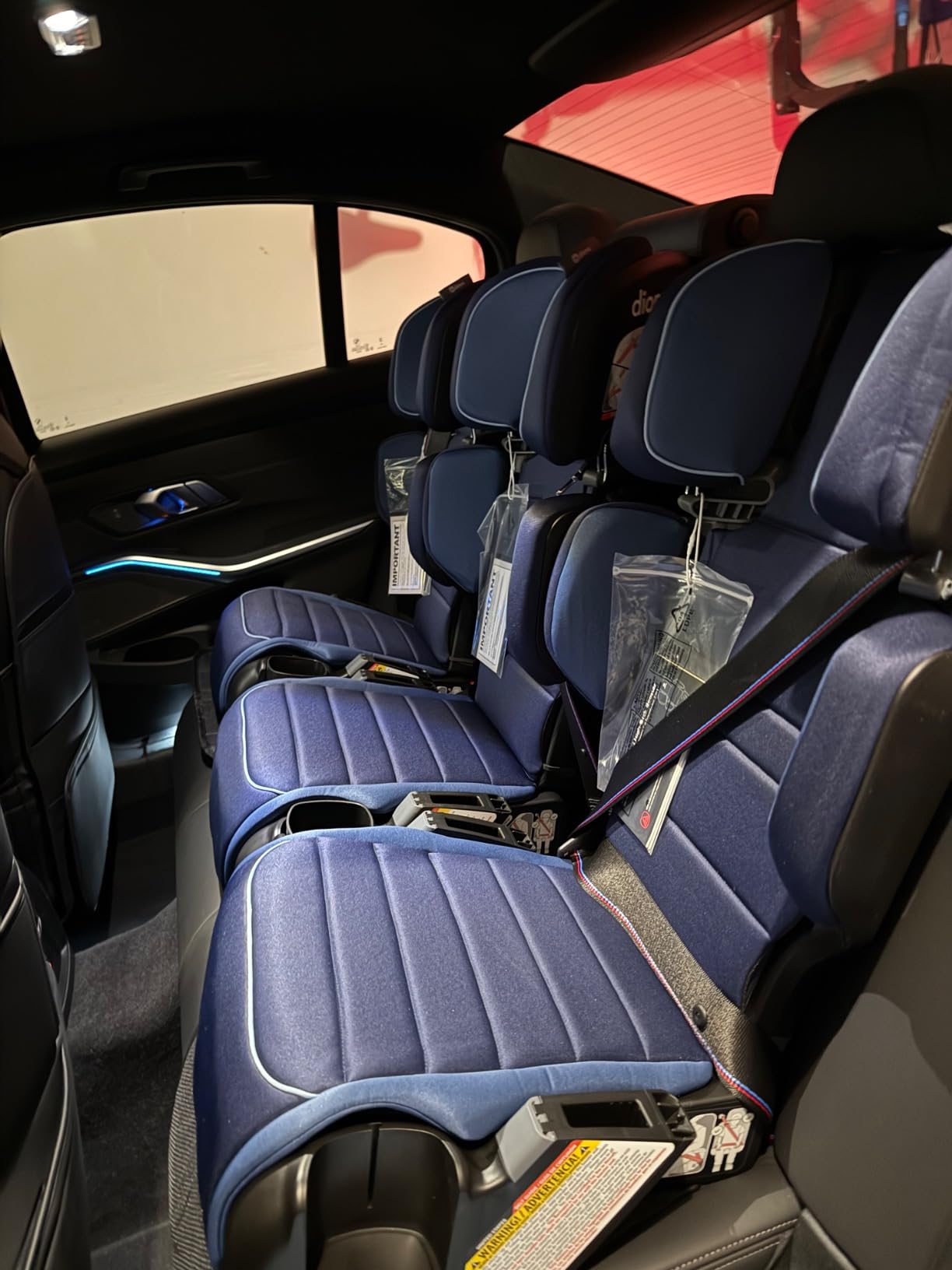
Owners with real three-across installs report room to spare even when the outboard positions use LATCH seats. That is the strongest field report in this roundup for the claim the product is making.
The criticisms are specific. The cup holder can be packaged separately despite appearing on the box. The top and bottom sections can separate if the seat is checked as baggage, which matters if you travel with it. And the belt path runs counter-intuitively, so children need reminding that the belt goes in front of the armrests, not behind.
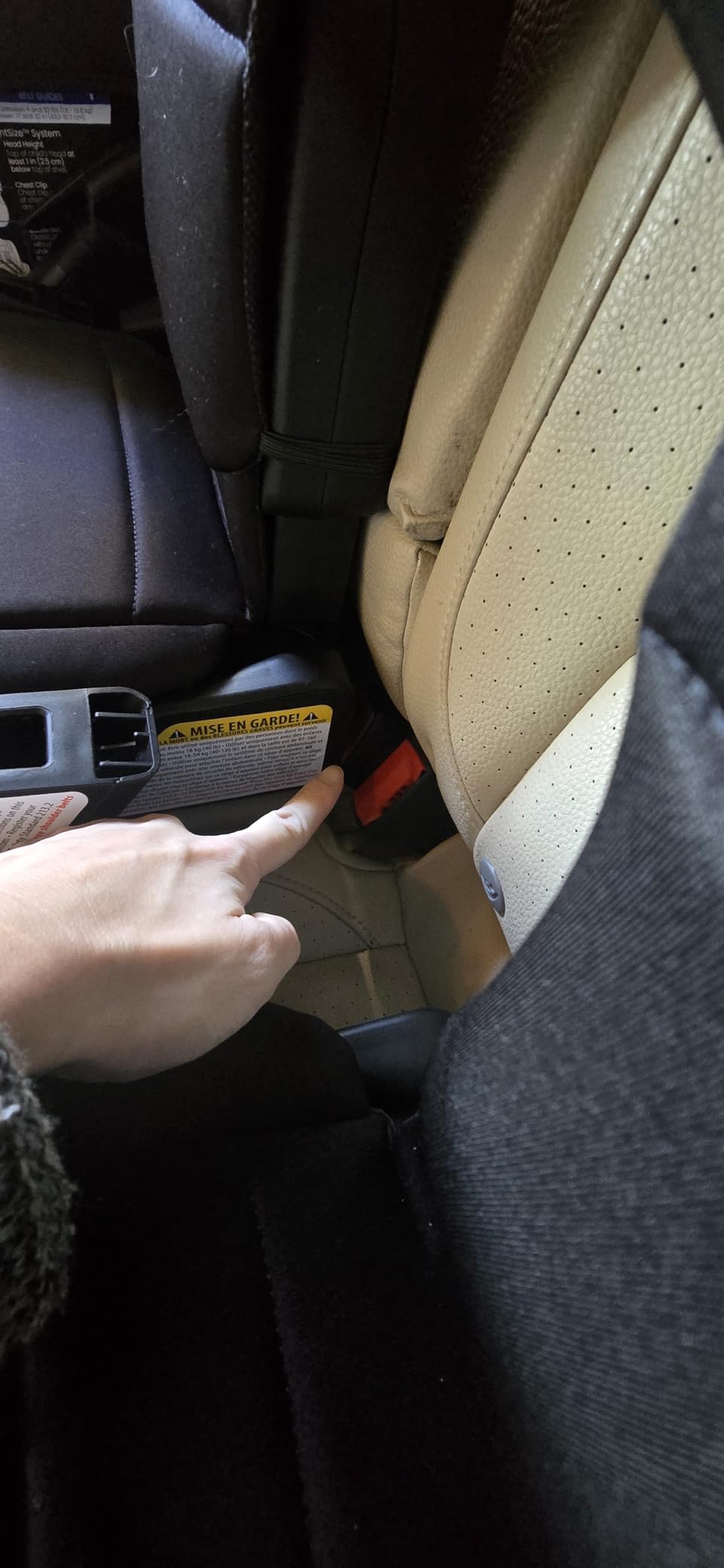
What the Connect3 R does well?
Buy it if three across is the actual goal and your child still needs a back, and if your family needs one seat to do both stages with a carry handle for travel. The EasyReach buckle access is a real quality-of-life gain in a crowded row, and the napping support handles the sleepers.
Where the Connect3 R falls short?
Skip it if you fly with the booster as checked baggage, or if buying the cup holder as a separate step will be lost on you. It is also heavier than an average booster in the sub-17-inch class, and the 4.4 star average is the lowest of the Diono models here.
12. Safety 1st Grand 2-in-1 – Five-Point Harness That Converts to Belt Positioning
Safety 1st Grand 2-in-1 Booster Car Seat, Converts from High Back to Belt-Positioning Booster, High Back Seat for Kids 40-65, and Belt-Positioning 40-100 Pounds, Black Sparrow
Harness 40-65 lbs, 43.4 to 49 inches
Belt positioning 40-100 lbs, 43.4 to 52 inches
Slim three-across design
Pros
- Slim design engineered to fit three across in most back seats
- Long usable span from harness stage through 100 pounds
- Lightweight enough for carpools and rideshares
- Adjustable headrest grows with the child
- Machine-washable dryer-safe pad and dishwasher-safe cup holders
Cons
- Belt-positioning high-back mode tops out around 52 inches
- Only two removable cup holders and no fold-flat frame
- Not convertible to a fully backless booster
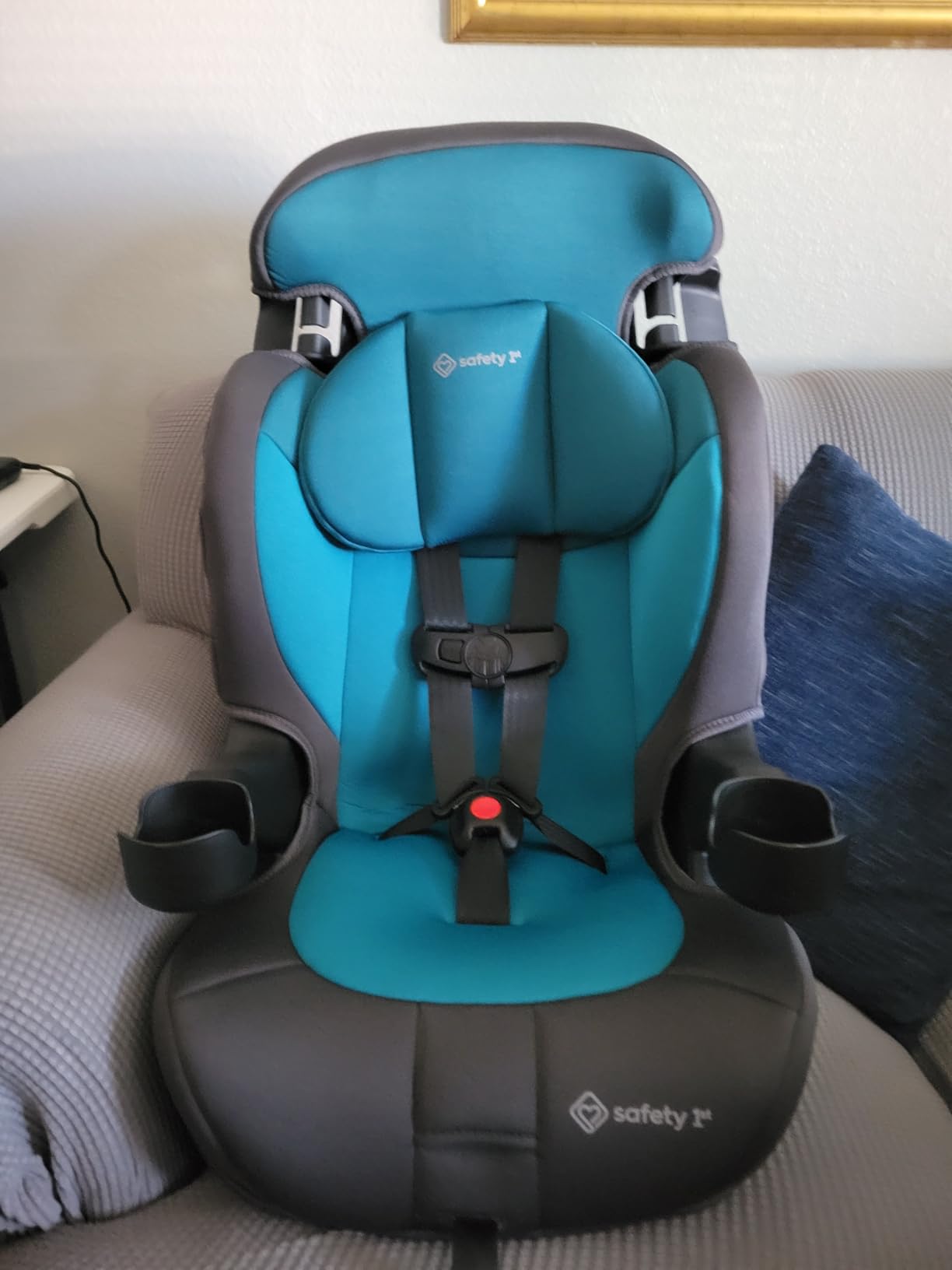
The Safety 1st Grand 2-in-1 is here for one reason: it keeps a child in a five-point harness when a harness is still the right call, in a footprint that is designed for three across. The harness stage runs 40 to 65 pounds and 43.4 to 49 inches, then it converts to a belt-positioning high back for 40 to 100 pounds and 43.4 to 52 inches.
That long span is the argument. A harness booster is not a niche category; it is what a child between roughly four and six needs while their shoulders are still below the vehicle belt. Parents swapping convertibles for boosters mid-row often find the booster is the width bottleneck, and this one is not.
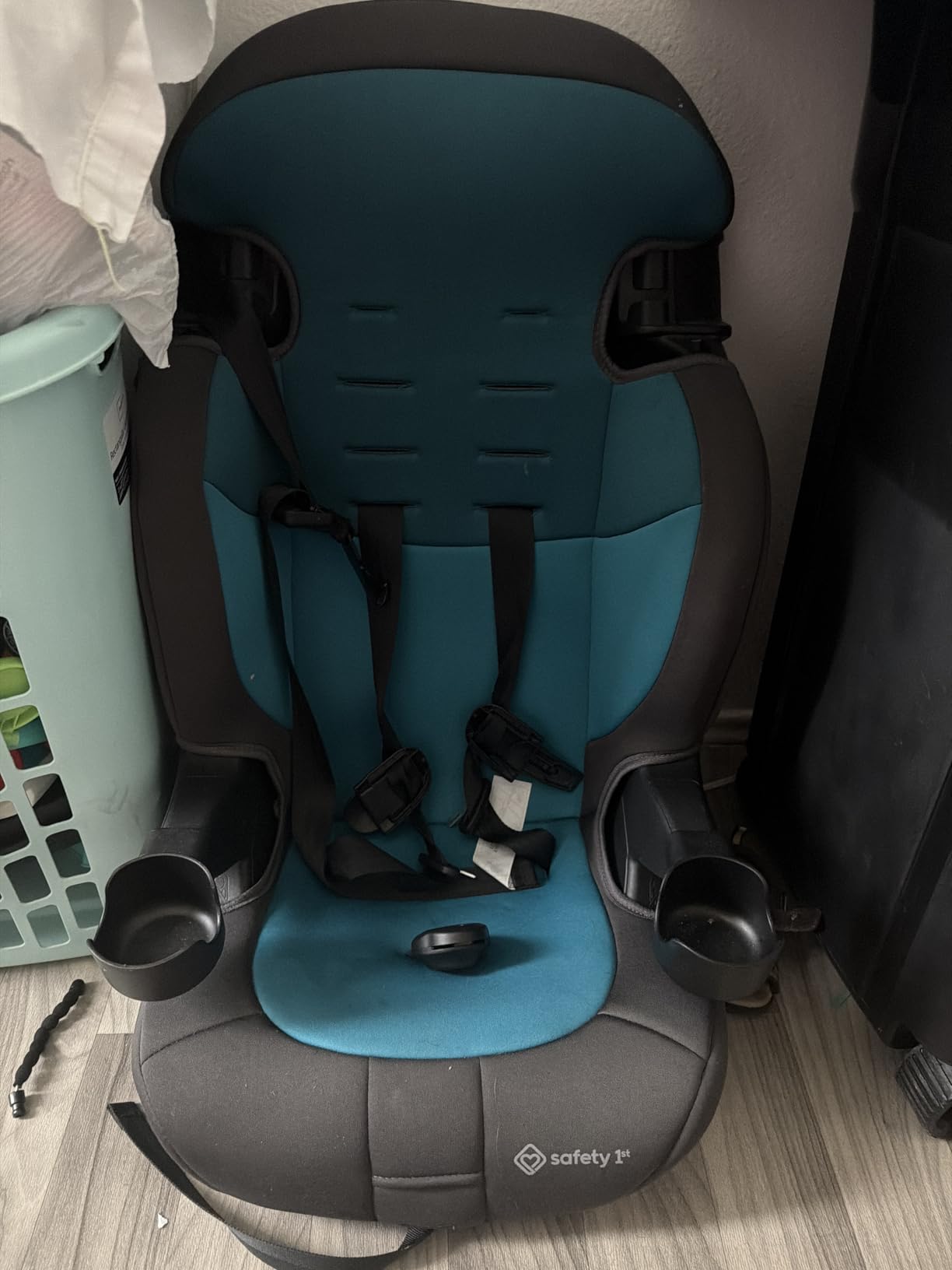
The slim design is intended to fit three across in the back seat of most vehicles, and the adjustable headrest grows with the child. Weight is low enough to move between cars for carpools and rideshares, which is the normal booster use case that most roundups ignore.
The limit is the height ceiling. Belt positioning tops out around 52 inches, lower than many high-backs here, so a tall child outgrows the booster mode earlier than they would in a seat like the KidFit ClearTex Plus. There is no fold-flat frame, and it does not convert to a fully backless booster, so the next step is a new seat.
What the Grand 2-in-1 does well?
Buy it if your child is small enough to still need a five-point harness, you have three children sharing a narrow row, and you want one seat to carry from 65 pounds of harness through to 100 pounds of belt positioning. The washable pad and dishwasher-safe cup holders suit ordinary family life.
Where the Grand 2-in-1 falls short?
Skip it if your child is tall for their age, because the 52-inch belt-positioning ceiling arrives earlier than most competitors. Skip it if you want one seat to last a decade, since this does not go fully backless and you will be shopping again sooner.
How to Choose a Booster Seat for a Narrow Back Seat?
Measure your bench before you measure any seat
Most of the disappointment with narrow boosters comes from measuring the wrong thing. Measure the clear width of your rear bench at the point where a booster would sit, from the seat crease to the door trim, not the seat cushion at the front. Do it with the front seats in the position your driver actually uses, because front seat legroom changes everything behind it.
Then measure at three positions: outboard, middle and the other outboard. A bench that is wide at the top can pinch sharply at the beltline, which is where the buckle stalk is. The width that decides whether three seats fit is the width at the shoulder of the installed booster, not the width of the box it arrived in.
High-back, backless, harness booster or travel booster
A high-back booster has a shell behind your child’s head and usually armrests with belt guides. It is the right choice for a child who slumps, sleeps in the car, or is not yet ready to sit correctly for a whole trip. A backless booster is just a raised seat pan and armrests, so it is narrower and lighter but gives a sleeping child nothing.
A harness booster, sometimes called a combination seat, keeps a five-point harness for younger children and converts to belt positioning later. It is the answer when your child is still below the size where a booster seat belt fits properly. A travel booster is built to pack, usually inflatable or folding, and is aimed at carpools, grandparents’ cars and planes rather than at daily installation.
The five-step home belt-fit test
This is the check that decides whether any booster is working, and you can do it yourself in five minutes before you buy anything.
Sit your child in the booster seat as they would sit in the car, back against the seat back and bottom on the seat pan.
Route the lap belt low across the hip bones, touching the tops of the thighs, not across the stomach.
Route the shoulder belt across the middle of the collarbone and the center of the shoulder, never behind the back or off the shoulder.
Pull the shoulder belt down until it touches the chest, then check that no slack remains in the lap belt.
With the belt buckled, move the seat at the belt path. If it moves more than one inch, the install is not tight enough.
If any of those five steps fails, a different seat will not fix it. A wider seat with better belt guides might, so run the test on a seat before you commit.
LATCH or seat belt: why the belt install buys back the last inch?
LATCH anchor positions are fixed by the vehicle, so a LATCH install cannot be shifted toward the door. In a tight row, that rigidity costs you the inch you needed, and it is why a belt install often wins in a narrow back seat: the belt can be repositioned and tensioned to suit the geometry.
There is a counterweight. An unoccupied, unanchored booster becomes a projectile in a crash, which is the argument for rigid LATCH on boosters that will sit in a row with other children. The compromise most families land on is a belt install for the seat that needs to move and a rigidly anchored seat where the anchors are usable.
Which seat belongs in the middle position?
Put the narrowest seat in the middle. Parents report that a backless booster in the center is often what closes a three-across row, and technicians give the same advice. The narrowest seat needs the least shoulder width, so it fits between the two outboard buckles while the wider high-backs take the door positions.
Buckle access matters more than width, and it is the failure point people miss. Three seats can physically fit while the middle buckle becomes unreachable, so before buying, sit in the back row and check you can reach and insert the center buckle with a child in the seat beside you. If the middle position has a lap-only belt, a tight install is very hard and a middle-position booster may not be the answer.
One more middle-seat note: the vehicle headrest often interferes. If the headrest is removable, remove it and store it, as some families report doing to make a high-back work. If it is not removable and there is no head support at that position, a backless booster is the only realistic choice there.
Cup holders, side wings and other hidden width costs
A seat can be 16 inches until the cup holders are deployed and effectively wider after. Parents describe a seat going from a workable width to an unworkable one purely because a cup holder was extended between two adjacent children. Every seat in this roundup either folds its holders away, detaches them, or ships without them, and that is a deliberate design choice for narrow rows.
Side wings and armrests are the second hidden cost. Deep side wings add shoulder protection but also width, and thick armrests raise your child higher, which can push the shoulder belt up toward the neck. The most useful thing you can do is run the five-step belt-fit test on the specific seat before you buy, with your own child.
Safety, expiry dates and recalls
Every booster sold in the United States must meet FMVSS 213, with FMVSS 213a covering rear-facing seats and FMVSS 213b covering forward-facing seats in combination seats. FMVSS 213 has no width requirement, which is precisely why a narrow booster is not a less safe booster. Narrowness is a packaging decision, not a performance one.
Check the expiration date on the label before you buy, and never use a booster that has been in a crash, even a minor one, or that came from a second-hand sale with no history. Manufacturer-published figures should be read from the product page or the owner’s manual, not from listing copy. If you want a second set of eyes, most fire stations and police stations host certified Child Passenger Safety Technicians who will inspect an install free of charge.
When a child is actually ready to leave the harness?
A general answer is not much use, so test rather than guess. A seven-year-old can use a backless booster if they sit properly for an entire drive, the lap belt sits low on the hips and the shoulder belt crosses the middle of the collarbone. A child who slumps, cannot stay buckled, or falls asleep needs a high-back, even at seven.
Weight and height come from the seat itself. Most backless boosters here start at 40 pounds and run to 100, with some reaching 110 or 120. If your child is under 40 pounds, a harness booster is the correct seat, not a belt-positioning booster. Check the specific model’s published range rather than the category average.
If you want a wider look at the category beyond narrow-seat picks, our best booster car seats guide covers the main types side by side.
Frequently Asked Questions
Which booster seat with back is the narrowest?
Among the high-backs in our roundup, the Diono Connect3 R has the narrowest published width at under 17 inches, purpose-built for three-across installs. The Diono Everett NXT is a slim high-back with rigid LATCH but publishes no width figure. The Safety 1st Grow and Go 2-in-1 states 19 inches at full ComfortWing extension, which is wider as your child grows.
What are the slimmest high back booster seats?
The slimmest high-backs we cover are the Diono Connect3 R at under 17 inches wide, the Diono Everett NXT in its slim-fit design with rigid LATCH, and the Safety 1st Grand 2-in-1, which is engineered for three across. The Chicco KidFit ClearTex Plus saves width by folding its cup holders away rather than by being small at the shoulders.
What is the most narrow booster seat on the market?
Manufacturers rarely publish booster widths, so measure the installed seat yourself rather than trusting a listing. For pure slimness with no fixed shell, the BubbleBum inflatable deflates to 12 by 6 by 4 inches and technicians describe it as narrow enough to sit between the center and outboard buckles.
Which harnessed booster seat is the narrowest?
The Safety 1st Grand 2-in-1 is the only combination harness booster in our roundup, holding a child in a five-point harness from 40 to 65 pounds and 43.4 to 49 inches, then converting to belt positioning to 100 pounds. Its slim design is intended to fit three across in the back seat of most vehicles.
What is the most narrow backless booster seat?
The Graco TurboBooster 2.0 has the slimmest backless profile among the molded shells here, with height-adjustable armrests and a 4.8 star rating across more than 12,000 reviews. The BubbleBum is narrower still because it is inflatable, and the Cosco Topside is the lightest of the molded options at 40 to 100 pounds.
Should a 7 year old be in a backless booster?
Only if they can sit properly for the entire drive and pass a fit check. Buckle them with the vehicle belt and confirm the lap belt sits low across the hip bones and the shoulder belt crosses the middle of the collarbone. If they slump, cannot stay buckled, or fall asleep in the car, stay with a high-back until they can hold that position consistently.
What booster seats will fit 3 across?
Seats in the sub-17-inch class fit three across in many mid-size sedans and SUVs. Start with a Diono Connect3 R in the center, add a backless shell such as the Graco TurboBooster 2.0 or Cosco Topside outboard, and check buckle access before you buy, since three seats can physically fit while the middle buckle stays unreachable.
Can my 40 lb 3 year old sit in a booster seat?
A 40 pound child is at the very bottom of the booster range, and most backless boosters here start at 40 pounds with a minimum age of about four. A child that young is usually better served by a combination harness booster that holds them in a five-point harness, such as the Safety 1st Grand 2-in-1, which covers 40 to 65 pounds.
What is the most comfortable car seat for long trips?
Among the high-backs, the Diono Connect3 R is the most nap-oriented, with a SleepyCheek ergonomic headrest, head and neck support, a two-position reclining backrest and a 2TexFoam seat base. The Chicco KidFit ClearTex Plus also reclines in two positions with double foam padding, though its armrests are firmer for a long stretch.
The Verdict on the Best Booster Seats for Narrow Back Seats in 2026
The best booster seats for narrow back seats come down to one question: what does your row need to close? If three across is the goal, start with the Diono Connect3 R under 17 inches wide in the middle and pair it with a backless shell outboard. If your child still needs a back, the Chicco KidFit ClearTex Plus keeps its cup holders folded away and converts to backless when they outgrow it.
For most families, the Graco TurboBooster 2.0 is where we land: a 4.8 star rating across more than 12,000 reviews. Run the five-step belt-fit test before you commit, and check buckle access in the middle position before anything else. Updated for 2026, and worth a read alongside our complete booster seat guide.