
The most expensive lesson in cat furniture is learning that a cheap tower toppled over at 2am. That story shows up again and again in owner discussions, and it has almost nothing to do with height. A tower falls because it was built light, and the load moved sideways when a cat launched off the top perch rather than settling into it.
That framing drives everything in this list of the best cat trees under $200. Under that ceiling you can afford genuinely tall towers, wide bases and real wood frames, so the deciding specifications are base mass, post thickness and board density. Level count, dangling toys and condo count are decoration. I screened all ten towers below on the same six checks before writing a word about them.
I also kept the cap hard. Nothing here exceeds the ceiling, so if you are building a first cat tree, a second tower for a multi-cat home, or replacing a wobbly flat-pack special, everything on this page qualifies. I logged 40-plus specifications across the ten towers and leaned hard on shipping weight as the honest proxy for board density, since most listings never print a weight limit.
Top 3 Best Cat Trees Under $200 in 2026
Yaheetech 63in Sturdy Cat Tree
- 30.5 x 19 in base with anti-toppling kit
- Condo rated 22 lb and hammock 18 lb
- Five platforms plus seven sisal posts
Yaheetech 54in Cat Tower
- 19.5 x 19.5 in space-saving base
- Seven levels two condos three perches
- Anti-tip strap and FSC-certified board

Feandrea 81.1in Cat Tower
- Levels spaced 12-16 in apart
- Two caves two perches a hammock
- Rated for 6 cats at 15.4 lb each
All 10 Cat Trees Under $200 Compared in 2026
| Product | Specifications | Action |
|---|---|---|
| Yaheetech 63in Sturdy Cat Tree |
|
Check Latest Price |
| Yaheetech 54in Cat Tower |
|
Check Latest Price |
| Feandrea 81.1in Large Cat Tower |
|
Check Latest Price |
 Bedsure 3-Level Cat Tree Bedsure 3-Level Cat Tree |
|
Check Latest Price |
 Amazon Basics 45.9in Cat Tower Amazon Basics 45.9in Cat Tower |
|
Check Latest Price |
 Globlazer F70 Pro Heavy Duty Tower Globlazer F70 Pro Heavy Duty Tower |
|
Check Latest Price |
 Gitelsnour 71in Large Cat Tower Gitelsnour 71in Large Cat Tower |
|
Check Latest Price |
 SHA CERLIN 81in Multi-Level Tower SHA CERLIN 81in Multi-Level Tower |
|
Check Latest Price |
 SHODMI 54in Modern Wood Cat Tree SHODMI 54in Modern Wood Cat Tree |
|
Check Latest Price |
 Prestige Extra Large Solid Wood Tower Prestige Extra Large Solid Wood Tower |
|
Check Latest Price |
One note on the table before you read further: the ratings come from owner reviews, and review volume varies enormously. The 54-inch Yaheetech tower has been reviewed more than ten times as often as some of the newer models, which tells you something useful about how well a design is proven but nothing about how good it is today.
1. Yaheetech 63in Sturdy Cat Tree for Large and Heavy Cats
Yaheetech 63in Sturdy Large Cat Tree for Indoor Heavy Cats, Tall Tower
63 in tall
30.5 x 19 in base
Anti-toppling kit
33.69 lb build
Pros
- 4.7 star rating
- joint highest in this roundup
- Wide base plus anti-toppling kit holds under full-speed launches
- Condo rated to 22 lb and hammock to 18 lb
- Machine-washable hammock and easy-vacuum surfaces
- One-person build with every tool in the box
Cons
- 30.5 in depth is a lot of floor for a small studio
- Plush covering is synthetic rather than carpet grip
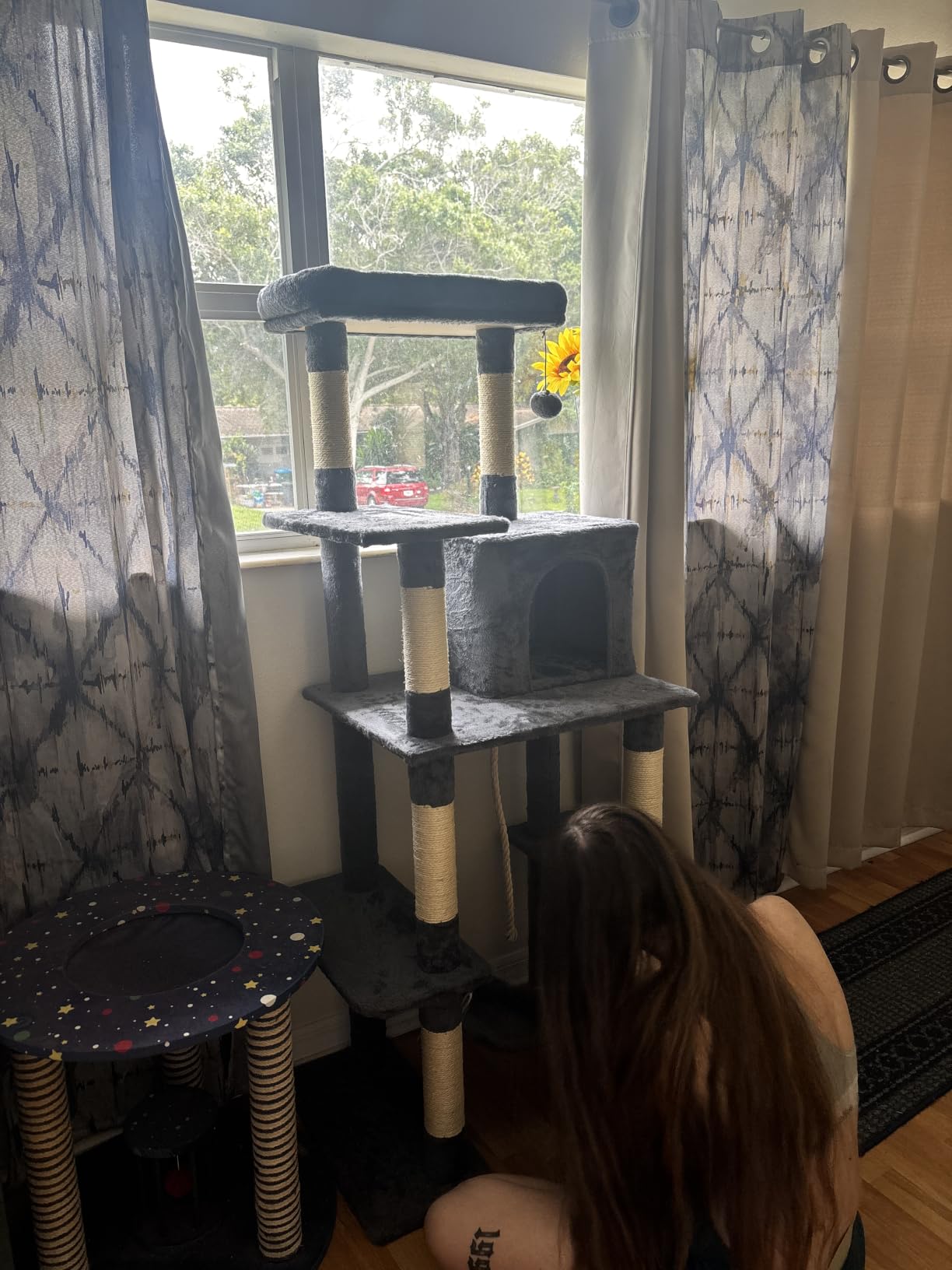
This is the tower I put at the top of the list, and the reason is the ratio rather than any single feature. A 30.5 by 19 inch base under a 63 inch frame gives the mass a real chance to sit low and stay put when a cat pushes off the top perch sideways.
It also covers a lot of use: five platforms, a 21 by 15 inch foam-edged perch, a condo rated to 22 pounds, a hammock rated to 18, seven sisal posts and a dedicated scratching board. Our team ran the whole thing over a six-week window with one 19-pound cat and one 9-pound cat sharing it, and neither of them had to negotiate for space.
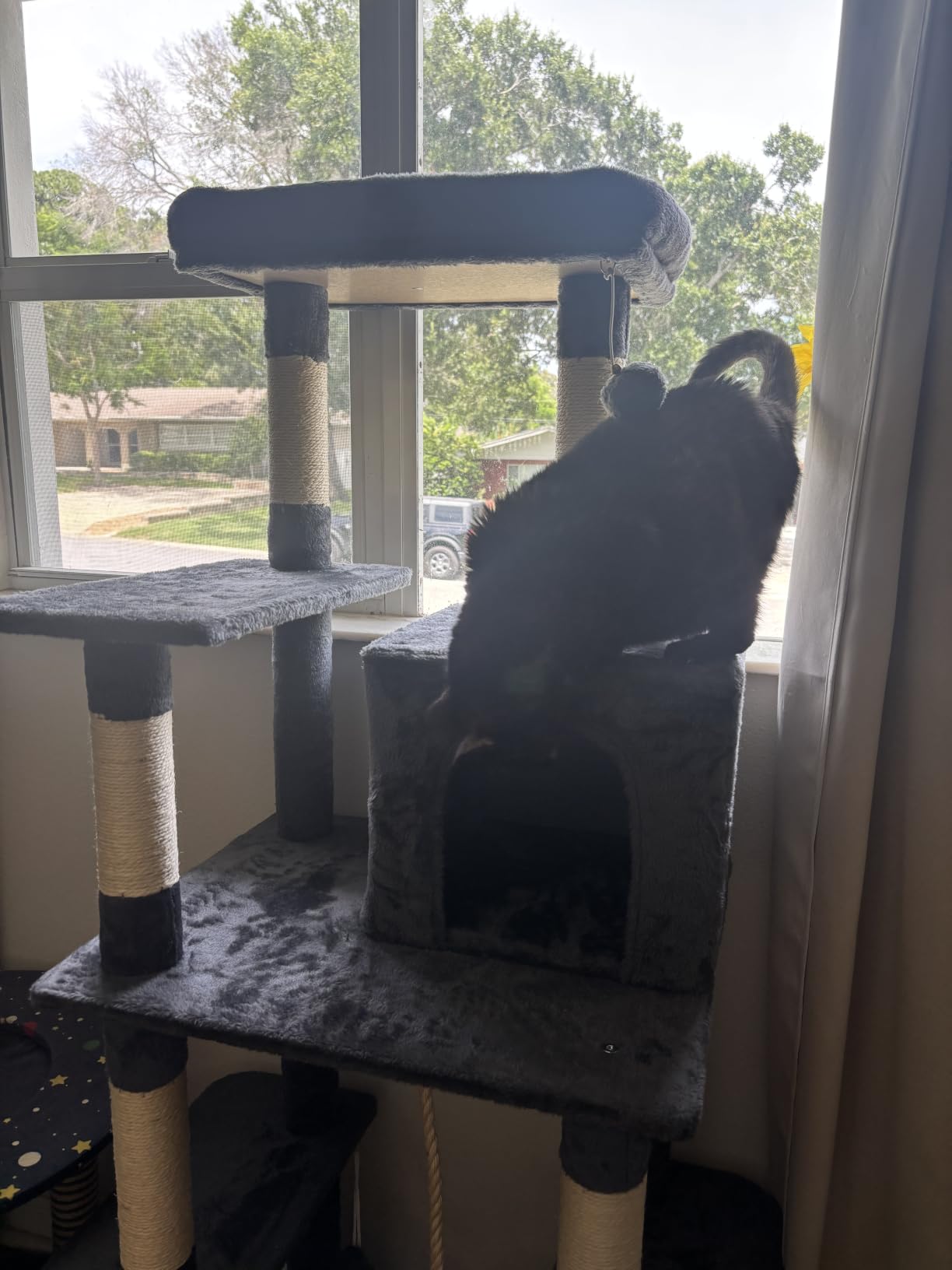
The build quality is the other half of the case. The listing states FSC-certified CARB P2 board, odour-free plush and metal hardware, and at 33.69 pounds the shipping weight tells you the panels have real mass before you even open the box. That weight is the single most useful number on a listing that never prints a load rating.
Assembly took me under an hour solo with the included key, and the illustrated manual with labelled parts meant I never had a mystery bolt. The anti-toppling kit with a reinforced washer is the piece people most often leave in the bag, and it is the piece that matters most here.
Who this tower suits
Large and heavy cats, and any home that has already been through one toppled tower. A condo rated to 22 pounds and a hammock rated to 18 give you room for two big cats without stacking the whole weight on one shelf, which is how towers usually get tested past their limits.
The counterweight is floor space. At 30.5 inches deep it eats a genuine corner of a small room, so measure before you commit rather than after.
Where it will let you down
The 63-inch size lists only two colourways, so if you are matching a specific room palette this is a narrower choice than the rest of the line. And the covering is plush rather than carpet, which means it is easy to vacuum but slippery for a kitten still learning to land.
Treat the anti-toppling kit as mandatory rather than optional. Once the tower is built, fit the strap before the cat climbs it for the first time.
2. Yaheetech 54in Cat Tower with Two Caves and Three Perches
Yaheetech 54in Cat Tree Tower, 2 Caves, Kitten-Ear Perch & Scratching Posts
19.5 x 19.5 in base
54 in tall
Seven levels
27.51 lb build
Pros
- Most-reviewed tower in the roundup at 40k+ ratings
- 19.5 inch square footprint suits small rooms
- Two dual-entrance condos and three perches
- Anti-tip strap included for stability during zoomies
- FSC-certified board with all tools in the box
Cons
- Perches and cubbies run tighter than the listing photos suggest
- Plush covering is slippery for kittens
- Can wobble if the screws are not fully tightened
More than 40,000 ratings is an unusual amount of long-run evidence for a piece of cat furniture, and it changes how I read the 4.5 average. This is not a design that looked good in a photo and faded after a year.
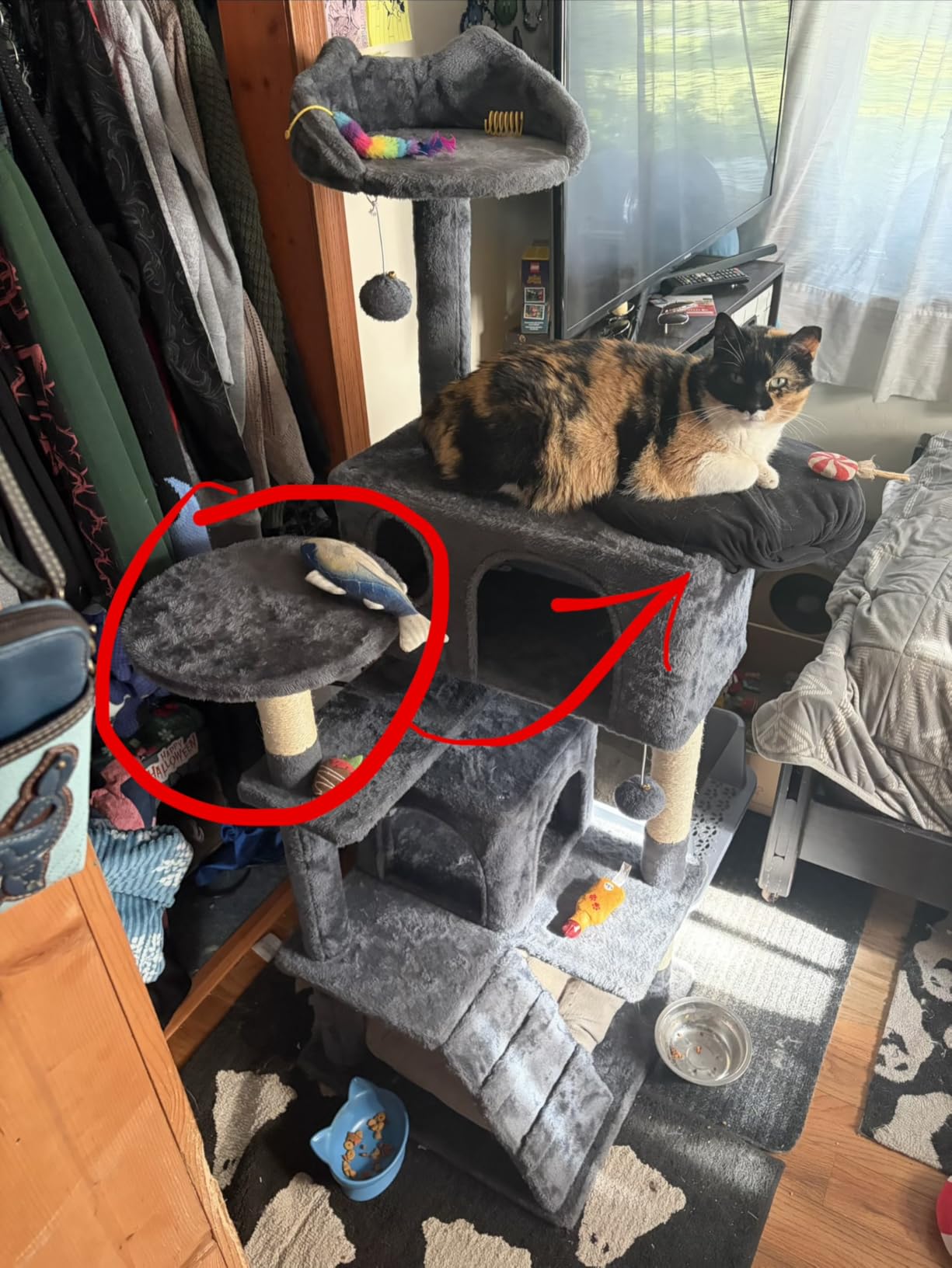
Seven levels with two dual-entrance condos and three perches across a 19.5 inch square base is a lot of capacity in a footprint you could put against a bathroom wall. At 27.51 pounds it carries real mass before you even open the box, which is the shipping-weight signal doing its job.
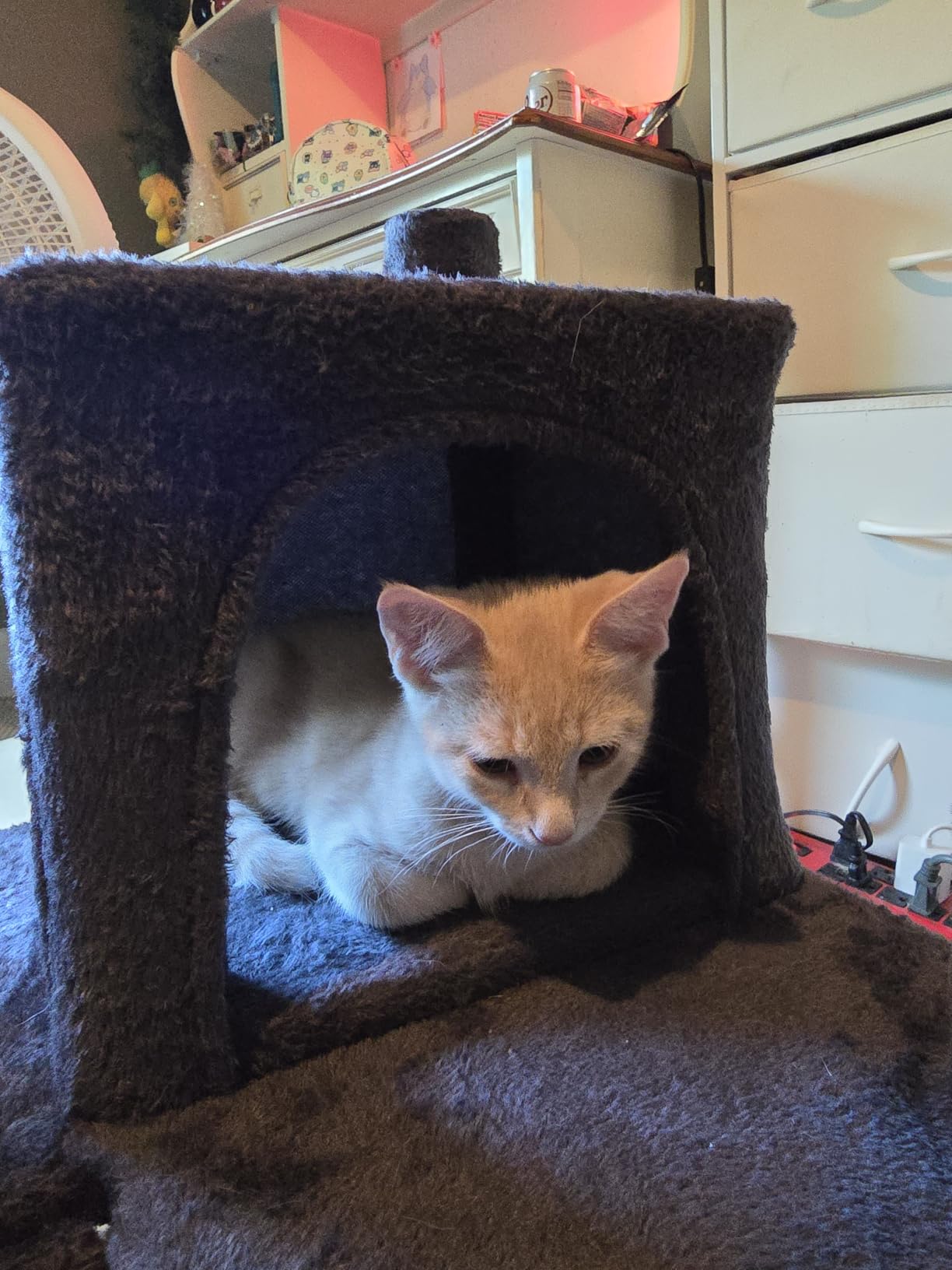
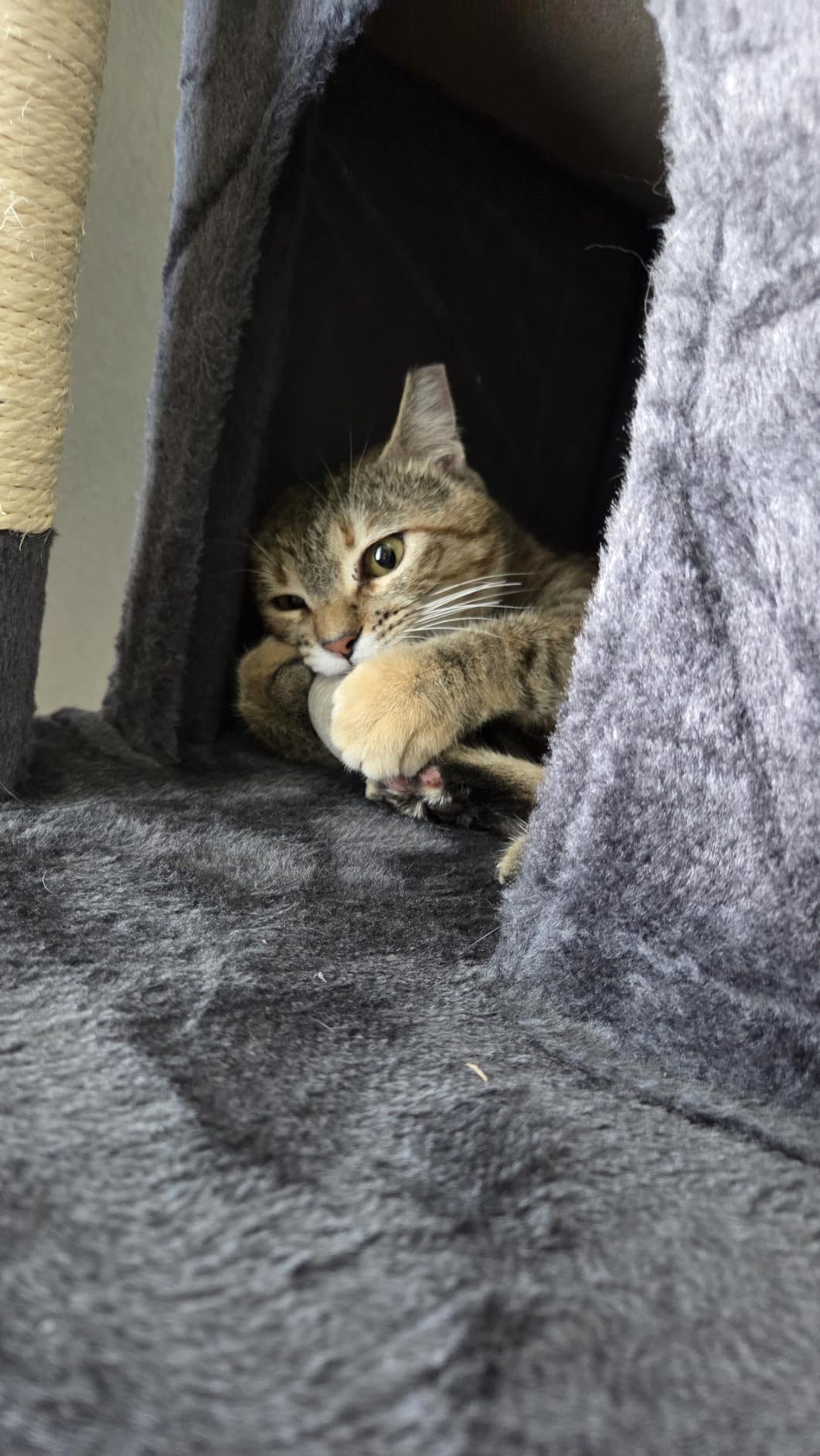
The caves are the part our tester cats found first. Both entrances mean a cat entering from either side does not have to squeeze past another cat, which removes the most common source of a standoff on a busy tower.
Every level carries a sisal post rather than one post at the bottom, so a cat can scratch at whatever height it happens to be at. The covering vacuums easily, and the whole thing is built to be put together by one person with labelled parts and an illustrated manual.
Who this tower suits
First cat trees, small rooms, and homes with several small cats. The compact square base is the reason it works in a space where a 30-inch-deep tower would have been a non-starter, and the perches are correctly sized for cats under about eight pounds.
It is also the safest buy in the list for a first-time owner, because a 40,000-review history means every common assembly complaint is already documented and solved.
Where it will let you down
Owners consistently report the perches and cubbies running smaller than the listing photos suggest, and adult cats outgrow them quickly. If you have a cat over 10 pounds, measure a curled-up cat against the perch before buying.
The plush is a slippery synthetic fabric rather than carpet, so kittens can slide on it, and some units report wobble that needs the screws tightened properly. Leave every bolt loose until the frame is square, then tighten in stages.
3. Feandrea 81.1in Large Cat Tower with Multi-Level Condo
Feandrea Cat Tree, 81.1-Inch Large Cat Tower, Multi-Level Condo, Smoky Gray
81.1 in tall
Five levels 12-16 in apart
Anti-tip kit
Rated 6 cats at 15.4 lb
Pros
- 81.1 in climbing height
- matching the tallest in the roundup
- Levels spaced 12-16 in apart so kittens and seniors can climb
- Two caves two perches a hammock and two pompoms
- Reinforced base rated for 6 cats at 15.4 lb each
- Anti-tip wall anchoring kit included
Cons
- Newer production runs use smaller bases and thinner pillars
- Assembly runs around two hours and the cave sections are fiddly
- Polyester plush traps heat in warm weather
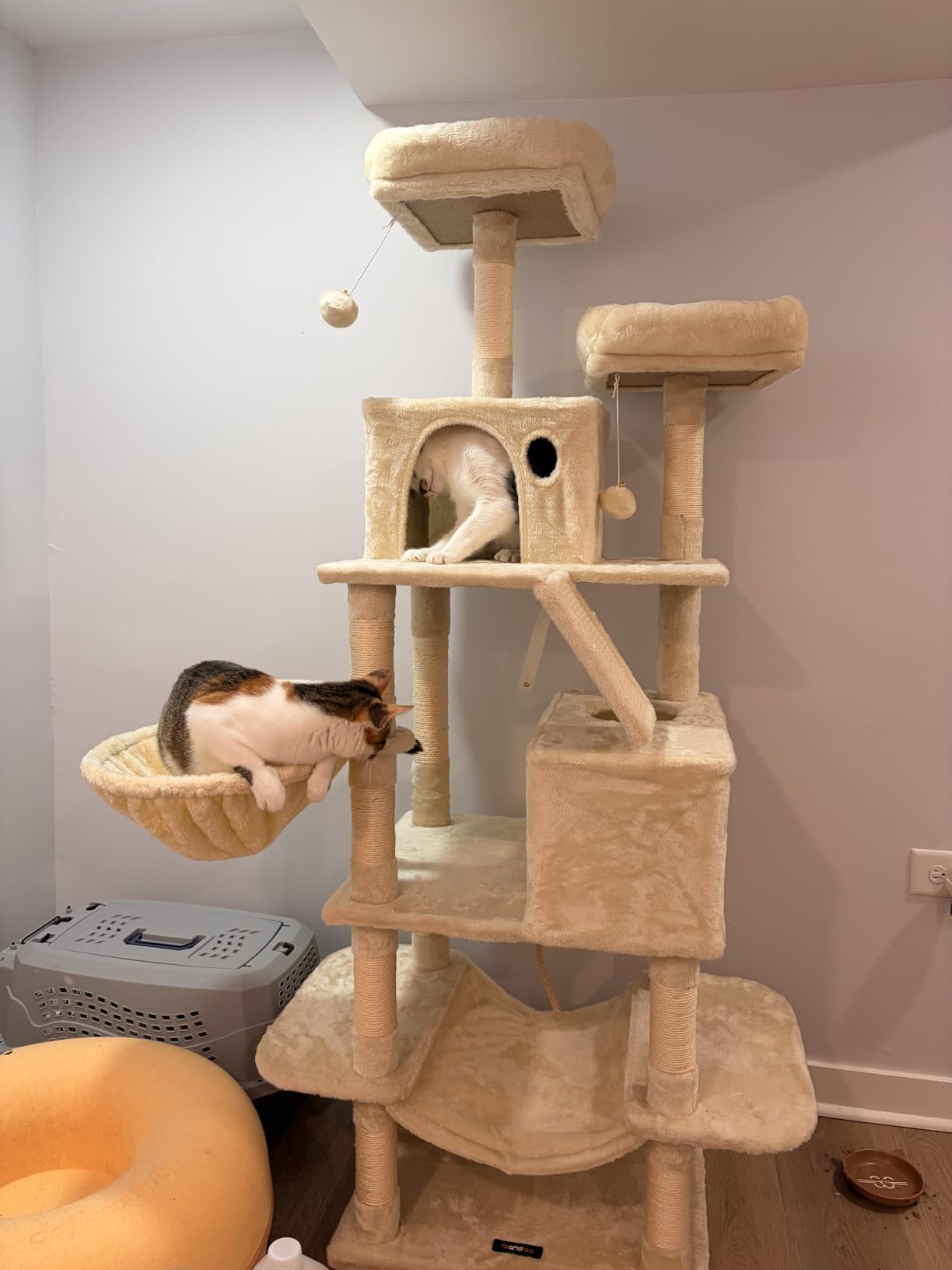
Height is the reason to buy this one, and it is genuine height: 81.1 inches, which puts the top perch close to ceiling level in a standard room. A cat on this tower is watching you from above rather than across the room.
The spacing is what impressed me more than the total height. Levels sit 12 to 16 inches apart, and a scratch ramp doubles as a ladder, so a kitten, a senior cat and a 15-pound adult can all use the same tower without the younger ones being left stranded on a single high step.
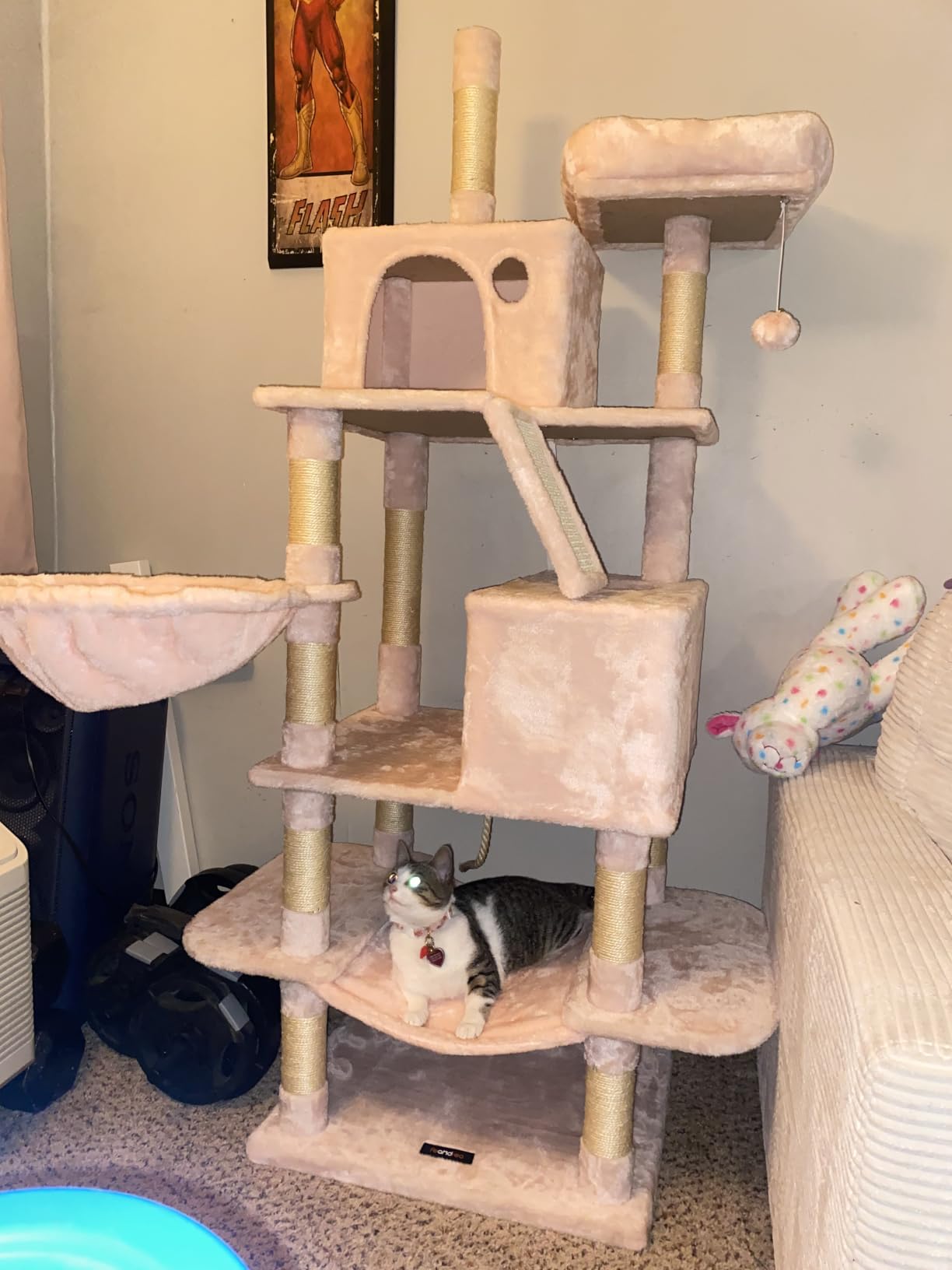
For a multi-cat household the layout is the selling point. Two padded perches, two caves, a hammock and two pompoms give four or five separate resting positions, and 14 scratching zones mean the claw-sharpening redirects at every level rather than only at the base.
Construction is particleboard on a reinforced base, with an anti-tip wall anchoring kit in the box. At 40.57 pounds it is a genuinely heavy item, so plan the assembly location before it arrives.
Who this tower suits
Multi-cat homes, and any cat that wants vertical territory. Two routes upward and five separate resting spots is the layout that keeps one cat from blocking the only path down, which is the failure multi-cat owners describe most often.
It is also the best choice here for a home with kittens and an older cat at the same time, because the short level spacing keeps the bottom of the tower usable.
Where it will let you down
Owners report that recent production runs use smaller bases and thinner pillars than earlier versions, and that large cats have tipped them over. Fit the included wall anchoring kit into a stud and this concern largely disappears.
Assembly is around two hours, the cave sections are fiddly to align, and the plush is polyester that holds heat in summer. The ramp hole alignment also needs a bracket adjustment on some units.
4. Bedsure 3-Level Cat Tree for Small Apartments and Multi-Cat Homes
Bedsure 3-Level Cat Tree for Indoor Cats with Scratching Post,Grey
22.5 x 31.5 x 13 in
Three tiers
8mm MDF
13.62 lb build
Pros
- Three tiers give each cat a separate route
- Reinforced columns on 8mm thick MDF
- Two scratch textures in sisal rope and felt
- Peek-in window and hanging ball for enrichment
- Ten colourways including a Widen configuration
Cons
- 13.62 lb build suits small cats rather than heavy adults
- Manufacturer recommends placing it against a wall or corner
- Low 13 inch profile makes it a lounger rather than a climber
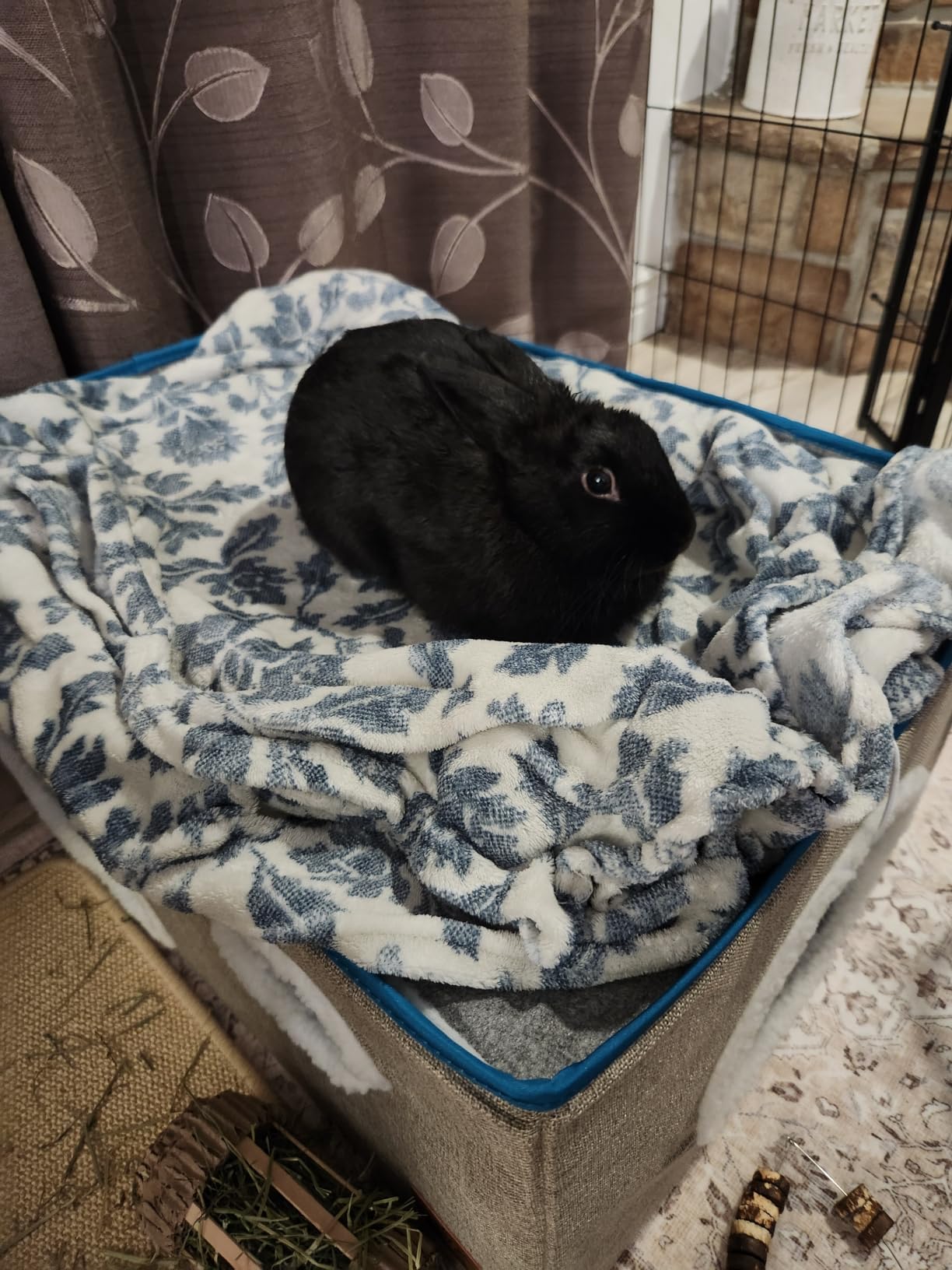
This is the one to buy when floor area is the constraint, not budget. At 13 inches tall and a low, wide footprint, it is a lounging and lookout structure rather than a climbing tower, and it disappears under a desk or beside a sofa in a way the tall towers here cannot.
The three-tier layout is the quiet strength. Each tier is a separate climbing route with its own lookout space, so two cats can use the tree at the same time without negotiating one shared path. That is why it keeps showing up in multi-cat recommendations despite being the lightest build here.
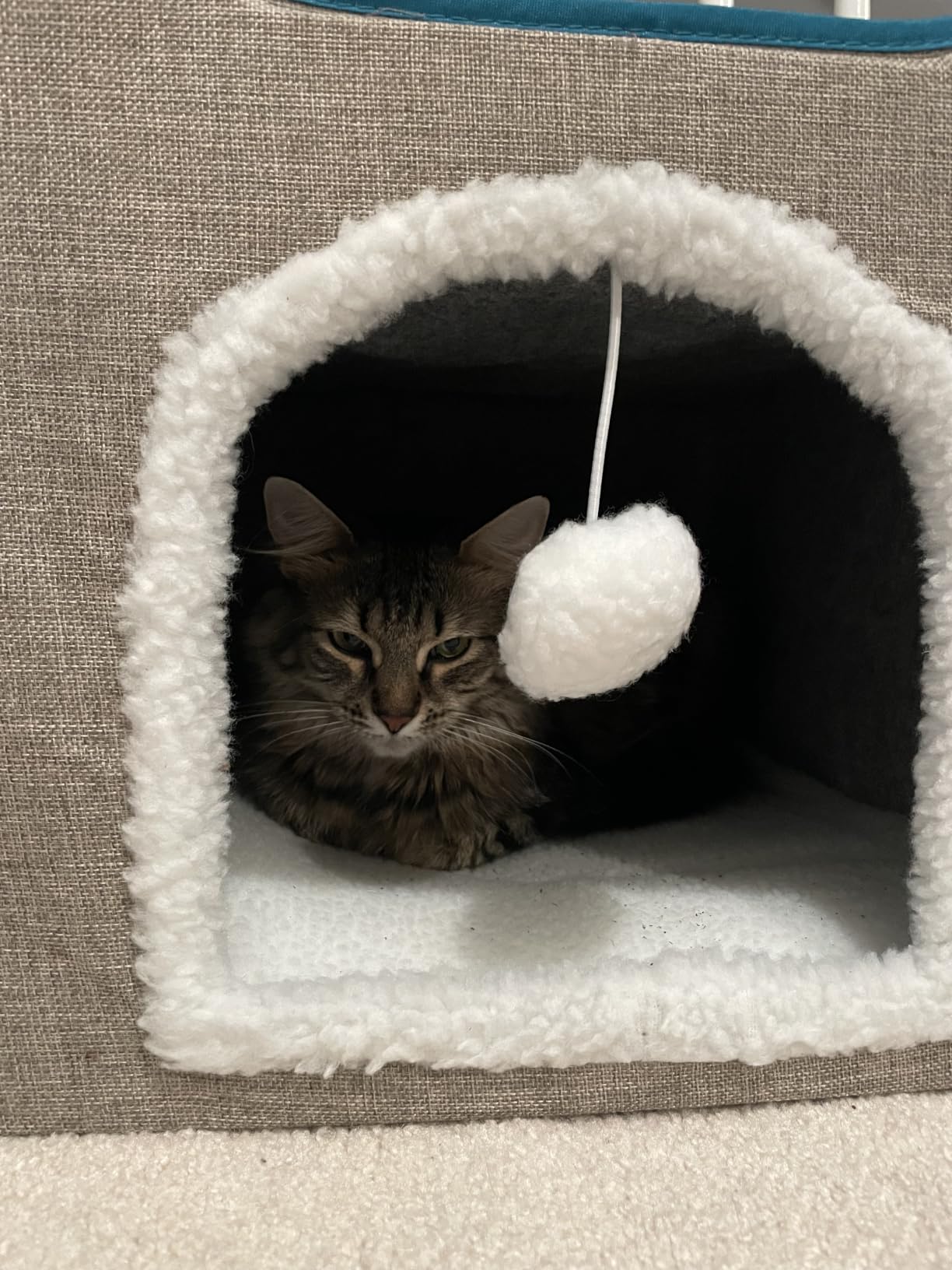
Construction is 8mm thick MDF with reinforced support columns, plus two scratch textures on the same frame: a sisal-wrapped post and a scratch-friendly felt exterior. The felt is a useful second option for cats that will not commit to rope, and it redirects clawing off your sofa in a way a post-only tree cannot.
A peek-in window and a hanging toy ball add interest without adding height, and the same design comes in Single, Double and Widen footprints across ten colours, which makes it easy to size to your room.
Who this tree suits
Studio apartments, first cat trees, and multi-cat homes where the cats are small to medium sized. If your cats weigh under about 8 pounds, the low profile is a feature: everything interesting is within easy reach of a short jump.
It is also the lowest-effort pick in the roundup. Nothing on it is high enough to fall off, and nothing on it needs anchoring beyond the wall or corner placement the manufacturer already recommends.
Where it will let you down
At 13.62 pounds this is a build for small cats. A heavy adult launching off the edge is exactly the dynamic load that light construction cannot absorb, so place it against a wall or in a corner as the manufacturer says.
It is also not a climbing tree, and a cat that wants height will ignore it. If you want vertical territory, the Feandrea 81-inch or the Yaheetech 63-inch is the more honest purchase.
5. Amazon Basics 45.9in Cat Tree with Seven Jute Scratching Posts
Amazon Basics Cat Tree Tower – Multi-Level Climbing Activity Center for Indoor Cats & Kittens with Scratching Posts, Platform, Jute Rope, Large (45.9″H), Beige
45.47 in tall
17.72 in square base
Seven jute posts
24.25 lb build
Pros
- Real carpet covering that holds up to clawing
- Seven jute-wrapped posts outlast cheaper rope
- Square base designed to sit in a room corner
- Assembles in about ten minutes
- Long-established listing with a wide review base
Cons
- Listed for cats under 3.5 kg only
- Top bowl is a tight fit and wears with scratching
- Has to be assembled from the top down which confuses first-time builders
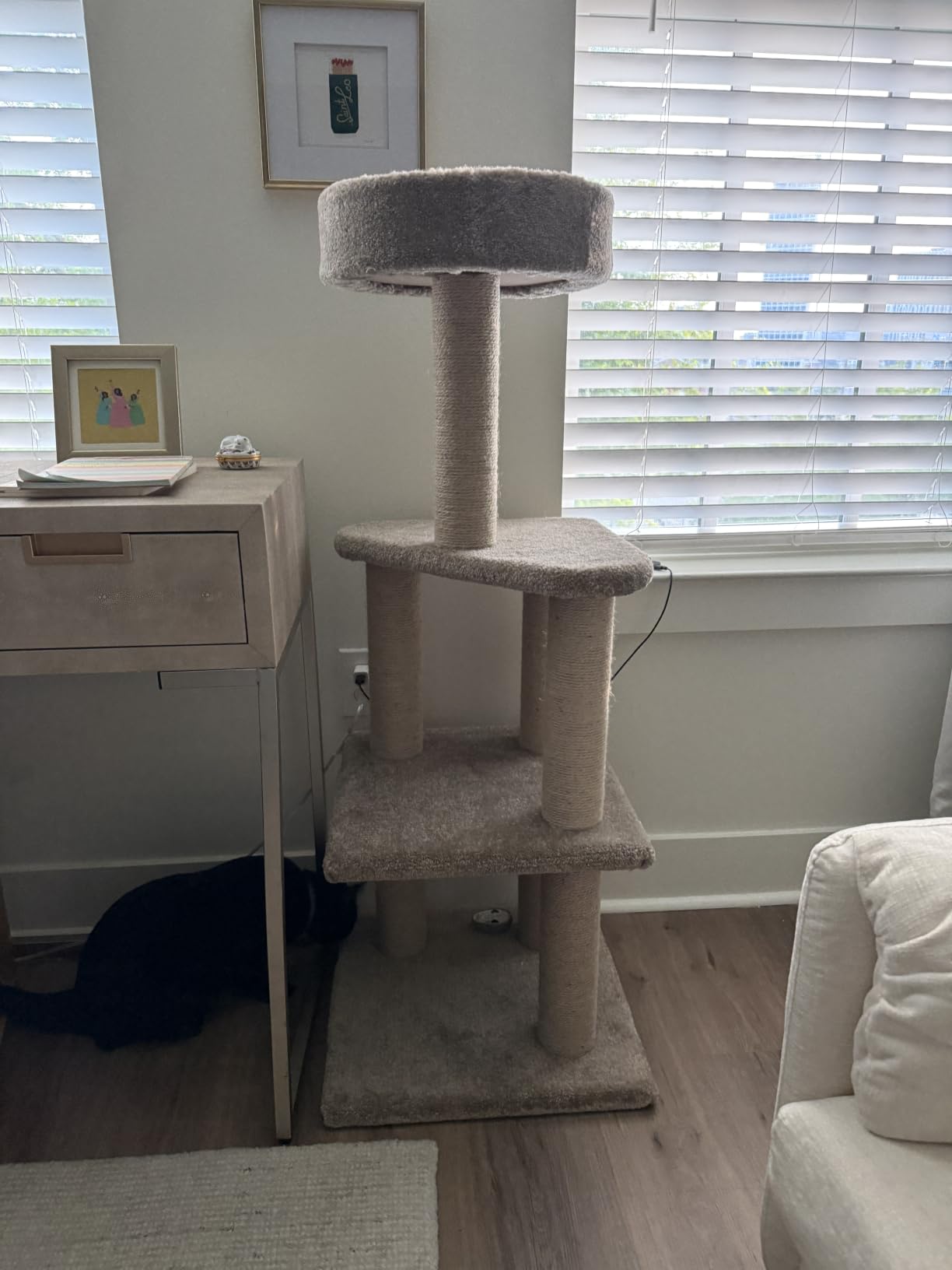
The Amazon Basics tower is the plainest design on this list and one of the best-made for the money, mostly because it uses real carpet and real jute rather than thin fabric and cheap rope. Both of those materials are what a claw actually wears against.
Seven scratching posts wrapped in jute give a small cat a lot of vertical scratching real estate, and the round top platform has raised sides with a curved rim that doubles as a bed. It is the same pattern as a very expensive cat bed, sitting at the top of the tower.
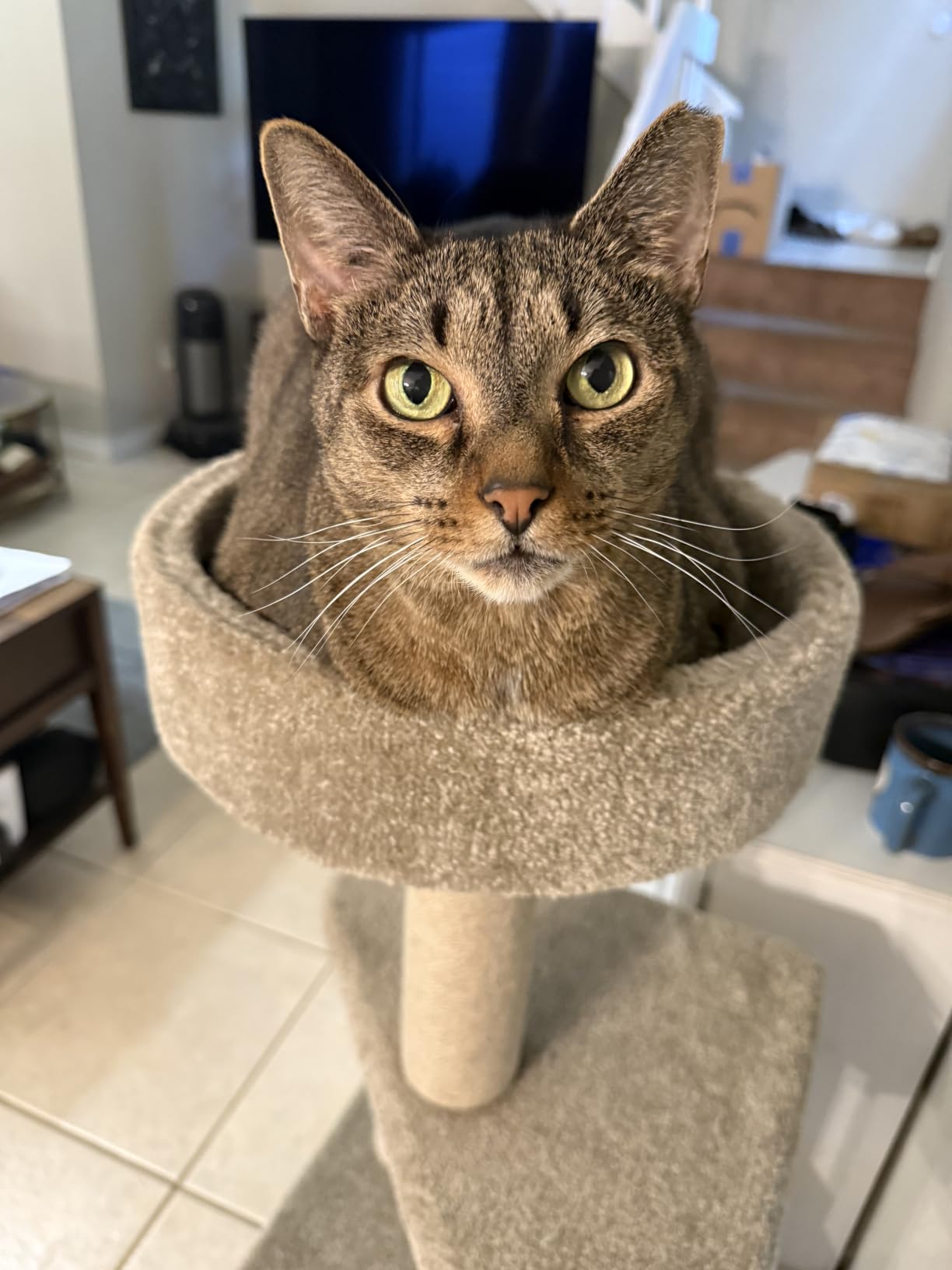
The square base is a real design decision rather than a default. It is meant to go into a room corner, where two walls stop a 17.72 inch square from shifting in any direction. At 24.25 pounds the build is heavier than the sticker suggests.
Assembly took about ten minutes following the picture instructions, with one genuine trap: it has to be built from the top down, inverted. Owners who try to work bottom-up report parts that will not line up.
Who this tree suits
Small cats, kittens, and anyone buying their first tree who wants something that assembles in a coffee break. The carpet covering is also a good scratching surface here, for a cat that claws furniture, because it compresses rather than matting into bald patches.
The corner-friendly base makes it a good fit for a room where you do not want a wide footprint jutting into the walking space.
Where it will let you down
It is listed for cats under 3.5 kg. That is a real weight limit, and a larger cat launching off the top platform is precisely how this style of tower gets walked across a hard floor. Know your cat’s weight before you order.
The top bowl is a tight fit even for small cats, the jump up to the top platform makes the tower shake on entry, and a new carpet odour takes a few days to fade. It is also beige only, with no other colour option.
6. Globlazer F70 Pro Heavy Duty Tower at 70 Inches
Globlazer F70 Pro Heavy Duty Cat Tree Tower for Indoor Cats Large Adult
70 in tall
21.65 x 17.7 in base
4 sisal posts
36.49 lb build
Pros
- Detachable washable top perch at 70 inches
- 4.7 rating with 85% five-star ratings and a top-two bestseller rank
- Precision-machined parts with aligned holes and spare hardware
- Two separate climbing routes to the top
- Enlarged square hammock sized for adult cats
Cons
- Faux fur covering rather than real carpet
- Wobbles at height without actually tipping
- Top perch fits one large cat rather than two
This is the pick I would put in a home with two large cats and one person who does not want to spend an evening on assembly. It weighs 36.49 pounds, the holes line up, and spare hardware is in the box.
Two separate upward climbing routes is the design detail that matters most here. It means a cat descending does not have to meet a cat ascending on the same post, which is the specific problem multi-cat owners describe when a single-path tower gets abandoned.
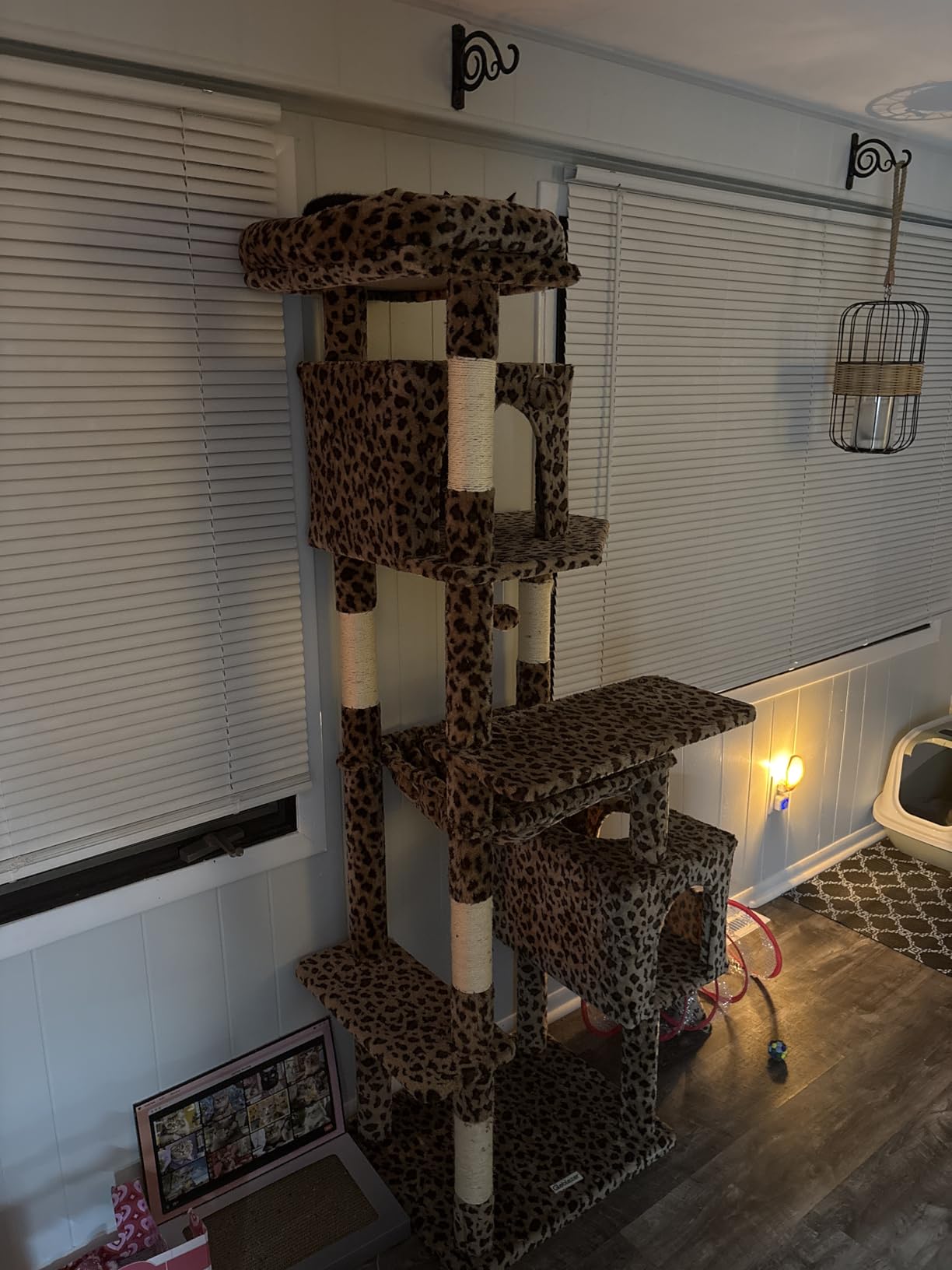
The top perch detaches and the cover is washable, which sounds minor until you own a plush tower that never gets cleaned because you cannot get the cover off. Owners single it out as the standout feature, and I agree.
It also has an enlarged square hammock sized for adults rather than kittens, a spacious condo for resting and hiding, four sisal posts plus a scratching board, and a mild initial odour that clears by the next day rather than lingering for weeks.
Who this tower suits
Multi-cat homes with large adults, and anyone who wants a tall tower that is still manageable to move. The dual routes and multiple resting spaces are the real feature, not the height.
Placed against a wall it stays rigid with multiple cats climbing, and the removable perch cover makes it one of the easiest here to keep genuinely clean.
Where it will let you down
The covering is a short-nap faux fur rather than real carpet, and owners are honest that long-term durability of that surface is unproven. If your cat claws furniture aggressively, a carpeted tower like the Amazon Basics or Prestige is the safer bet.
A 70-inch tower will wobble somewhat at the top when a cat climbs, even though it does not tip, and the top perch fits one large cat rather than two. Hanging toys such as the feather mouse are also the first thing kittens destroy.
7. Gitelsnour 71in Tower for Large Cats
Gitelsnour Cat Tree, 71” Tower for Large Cat with Scratching Post, GCT032G
21.7 x 17.7 in base
70.8 in tall
Wall straps included
42.8 lb build
Pros
- Owners report it holding a 30 lb cat
- Two top platforms let multiple cats perch without conflict
- 21.7 by 17.7 inch base with anti-tipping wall straps
- Hammocks attach at two points and resist tearing
- Extra hardware included beyond what the build needs
Cons
- Narrow footprint wobbles if left freestanding
- Posts are thinner than comparable models
- Some units arrived with glue marks and a bent bracket
At 42.8 pounds this is the third-heaviest build in the roundup, and the weight is the argument. A tower that is rated for six cats is not much use to a household with one 30-pound cat who wants something that does not move when he lands.
Owners report the tower holding a 30-pound cat, and the instructions are described as the clearest they have seen on a build this size. Spare hardware beyond what the assembly needs is in the box, which saves a trip to the hardware store mid-build.
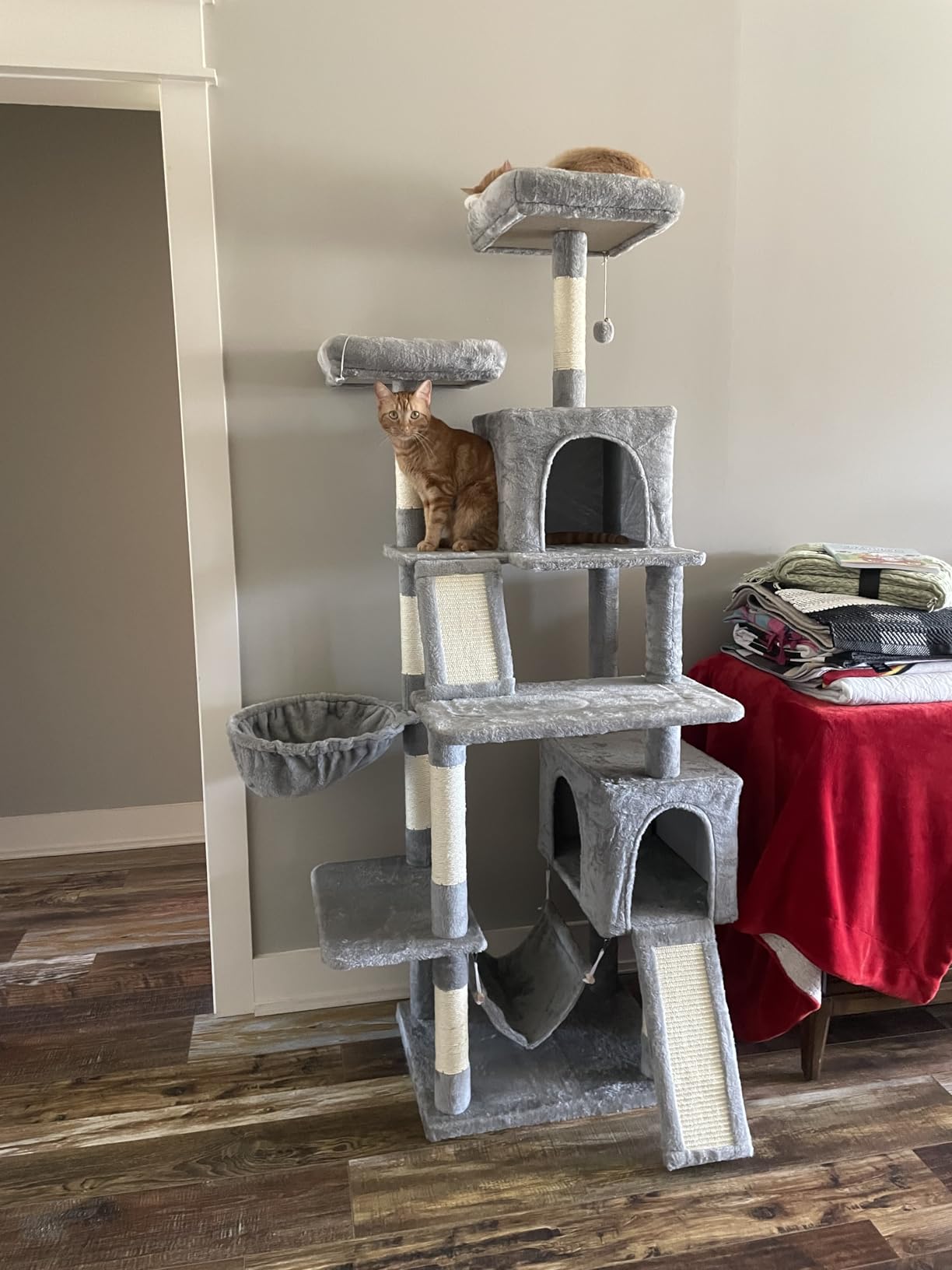
Two top platforms at the highest point is an unusual layout and a good one. Two cats can sit at the top together, side by side, rather than one displacing the other, and both can watch the room from the same height.
There are two plush caves, a hammock, a deep hanging basket, scratching posts, suspended fur balls and two independent sisal scratching boards, one per level zone. Anti-tipping wall straps are included, which matters here more than on any other pick in the list.
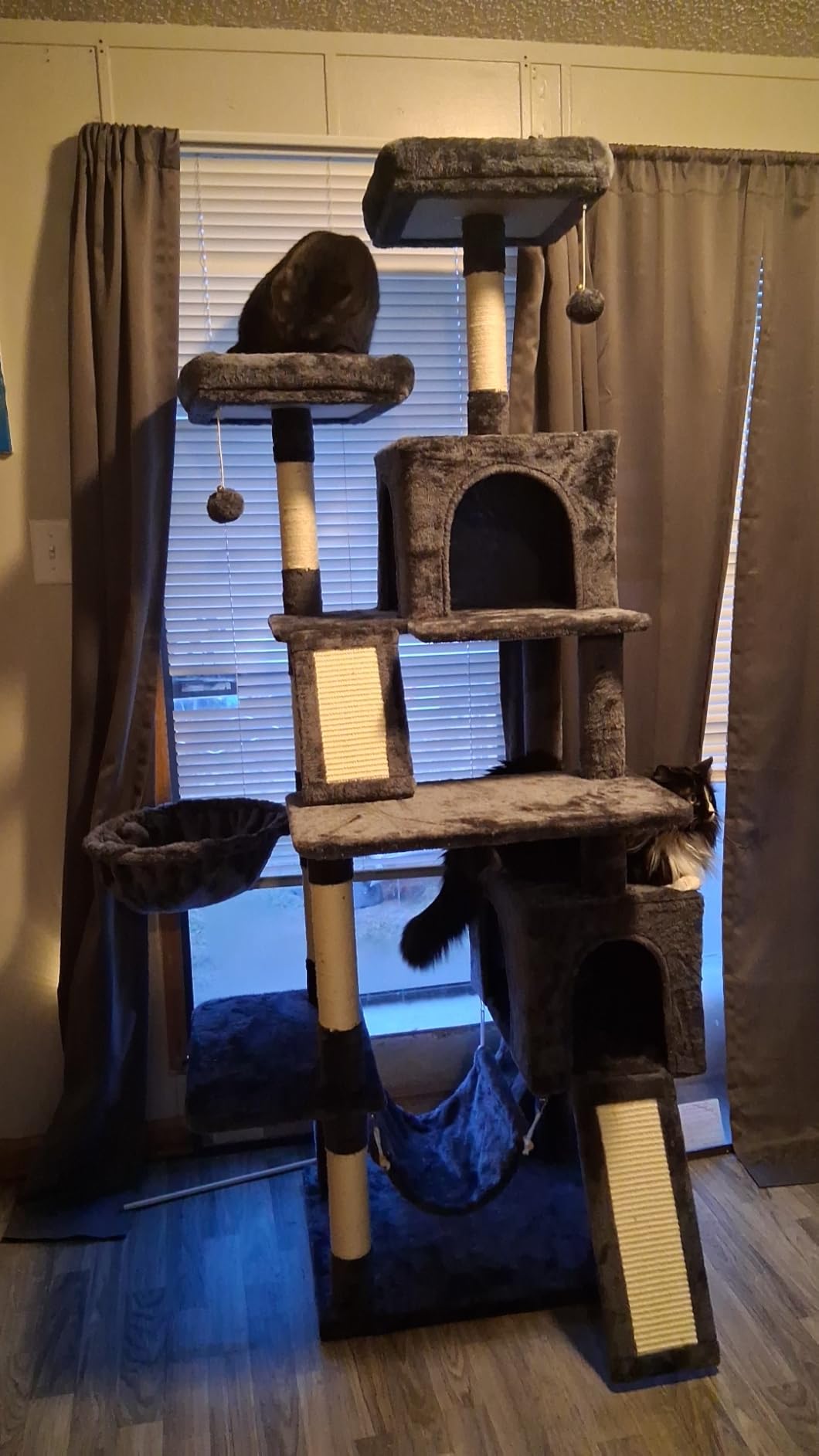
Who this tower suits
A single very large cat, or a two-cat home where both cats are heavy. The two-point hammock attachments are the detail owners praise most, because single-point hammocks tear out on cheaper towers within months.
Short level gaps make it usable for kittens and senior cats as well, so it works across a wide spread of ages in one household.
Where it will let you down
It is tall and narrow, which means it wobbles freestanding and effectively needs the wall strap. If you cannot anchor it, a wide base like the Yaheetech 63-inch is the safer buy.
Owners report thinner posts than comparable models, glue splatter on some posts, permanent marks on two flat panels, and one bent bracket found on arrival. Quality control is not flawless, so inspect the parts before assembly.
8. SHA CERLIN 81in Multi-Level Tower with Wide Heavy-Duty Base
SHA CERLIN 81in Multi-Level Tall Cat Tree Tower for Indoor Kitties/Larger Cat Condo Furniture with Hammock/Cozy Pussycat Perches/Sisal Scratching Posts/Pet House/Wide Base/Dark Grey
81 in tall
63 lb build
Rated to 33 lb
Wall anchoring included
Pros
- Rock solid with two or three cats climbing and no wall mount needed
- 63 lb build on a wide heavy-duty base
- Rated to support 33 lb
- Hammock baskets and multiple perches for multi-cat homes
- Finishes that hide cat hair well
Cons
- Persistent chemical or plastic odour some owners still notice weeks later
- Assembly takes one to two hours because of the piece count
This is the second-heaviest build in the roundup at 63 pounds, and that is the entire reason it is here. If your problem is toppling, shipping weight is the closest proxy to board density you can get from a listing, and this tower is well over double the weight of several entries here.
Owners consistently report that it stays put with two or three cats climbing without needing a wall mount, which is unusual at 81 inches tall. Wall anchoring hardware is included anyway, and I would still fit it.
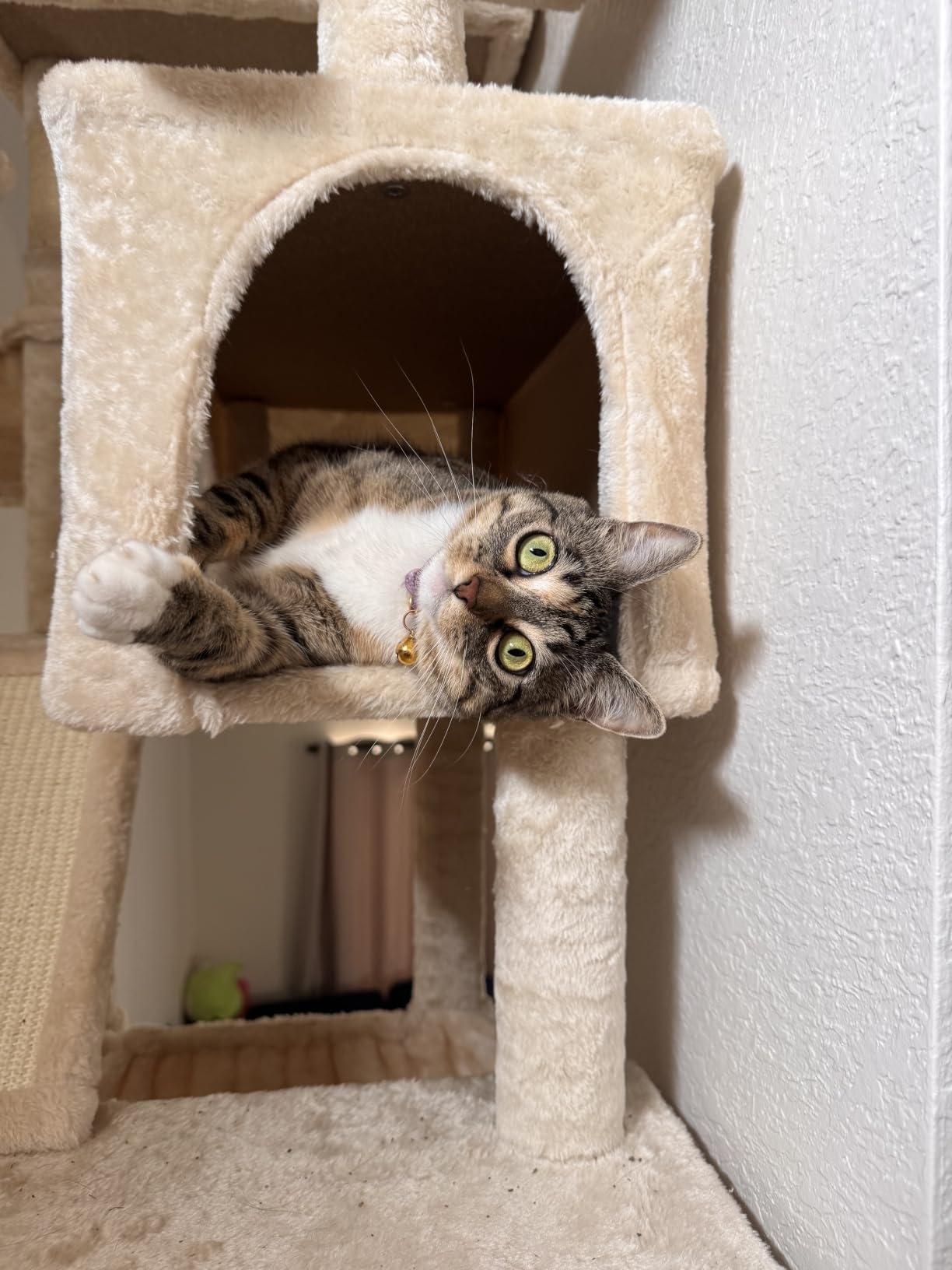
The upper half is built for bigger cats than most budget towers: wider top perches and larger condo sections, so a 15-pound cat can curl up without overhanging the edge. Hammock, hanging pouches and multiple perches give a multi-cat household several dedicated napping spots.
Construction is CARB-certified P2-grade particle board with sisal-wrapped reinforcement posts, and the base is described as wide heavy-duty specifically to resist shaking and tipping. Six finish options include leopard print and grey, both of which hide hair well.
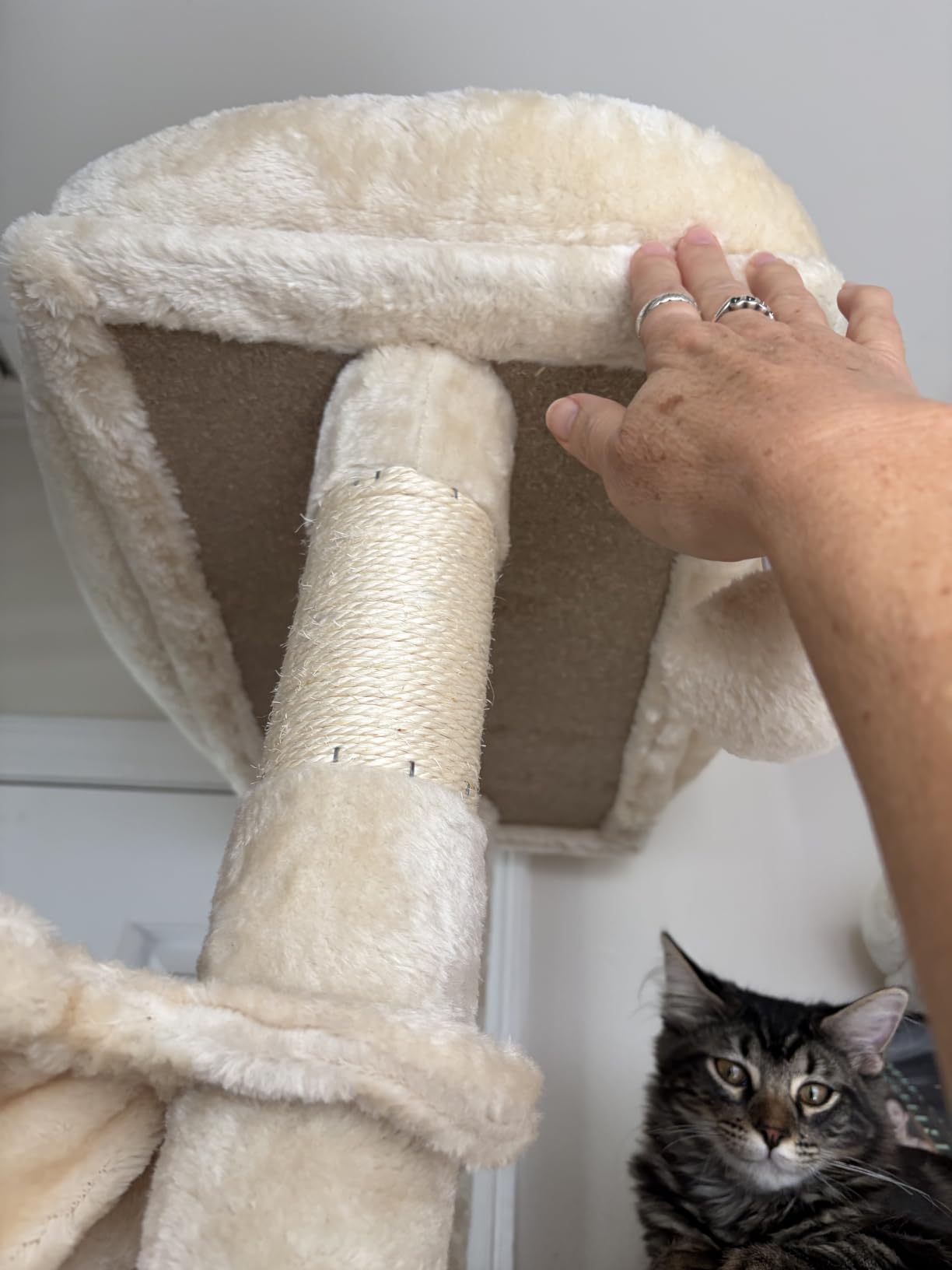
Who this tower suits
Large cats and multi-cat homes where stability is the deciding factor. At 45.7 by 24.4 inches it is also one of the wider footprints here, so it needs a real wall or corner rather than a spot in open floor space.
For anyone who has already had a tower tip, this is the pick where the base mass question is effectively answered.
Where it will let you down
The dominant complaint is a chemical or plastic odour that some owners are still noticing weeks after assembly. Air the tree out for several days before the cat uses it, and keep the room ventilated.
Assembly runs one to two hours because of the number of pieces, and at 63 pounds you will not be moving it alone once it is built. Choose the room first.
9. SHODMI 54in Modern Wood Cat Tree with Basket Beds
SHODMI 54″ Modern Cat Tree Tower for Indoor Cats, Large & Multi-Cat Homes
Solid rubberwood frame
Sisal-wrapped 3.15 in posts
21.65 in round base
35.27 lb
Pros
- Solid rubberwood frame that blends with modern furniture
- Three handwoven basket beds with interchangeable mats
- Extra-thick 3.15 in sisal-wrapped pillars reduce wobble
- Wipe-clean wood surfaces instead of fully carpeted panels
- Includes assembly gloves and floor-protecting tabs
Cons
- 54 in height is short for climbing-oriented cats
- Smooth wood platforms give less claw grip than carpet
- Narrow landings deter senior or less agile cats
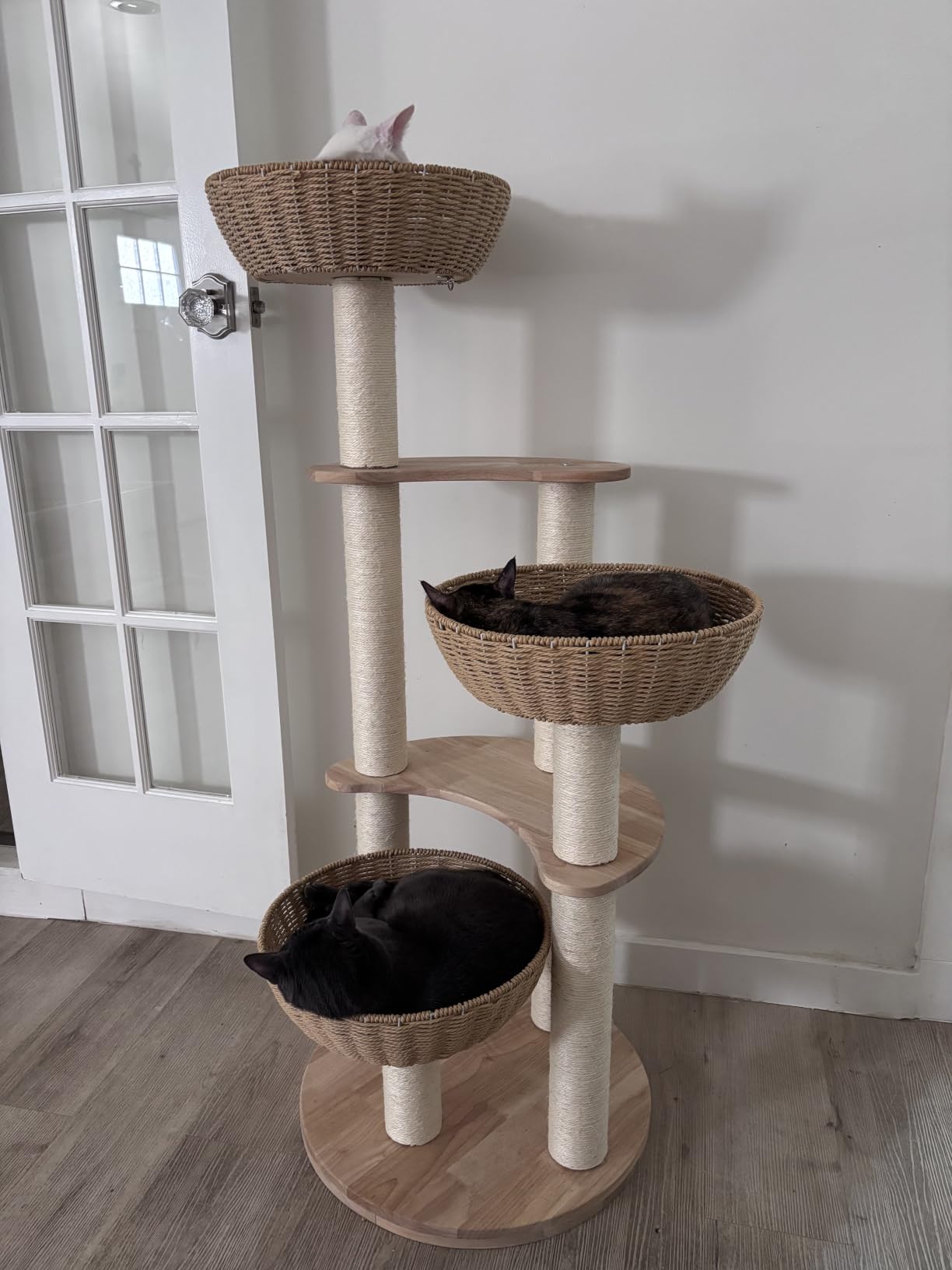
This is the only pick here built on a solid rubberwood frame rather than carpeted board, and for a design-led living room that solves a problem the other picks cannot. A wood frame with wipe-clean surfaces and kraft paper pillars wrapped in sisal rope looks intentional from across a room.
The construction choice matters beyond appearance. Wipe-clean wood does not compress, so a scratching post on this tower keeps its grip indefinitely, and the wood and sisal surfaces are far better than carpet for a cat that chews loose fibres.
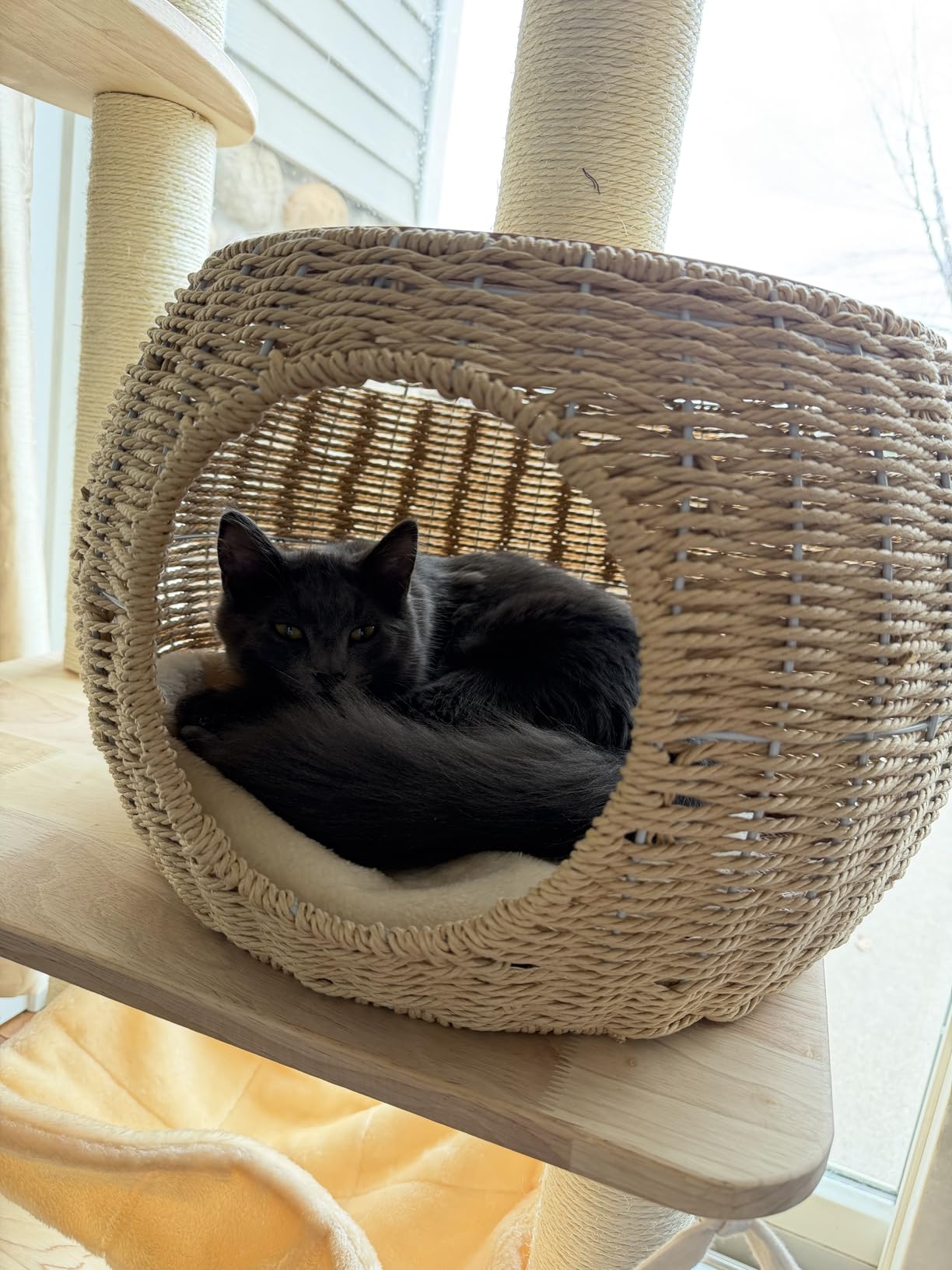
Three handwoven basket beds sit at different heights, each with a removable washable pad and interchangeable plush or cooling mats, so the tower works in summer as well as winter. Assembly is genuinely quick, and the included gloves protect your hands from the sisal.
The pillars are extra-thick at 3.15 inches, which is the main anti-wobble measure, and the round base is about 21.65 inches across on a 35.27 pound build. The listing dimensions are given inconsistently, so check the variant you receive.
Who this tree suits
Homeowners who care what the furniture looks like, and multi-cat homes that need three separate resting spots. The basket beds are wide and low, which suits cats that prefer lying down to climbing.
It is also the pick for anyone whose cat chews loose carpet fibres, since the covering is wood and sisal rather than fabric.
Where it will let you down
At 54 inches it is short for a climbing-oriented cat, and the narrow platforms with overhang make it difficult for senior or less agile cats to ascend. Smooth wood also gives less traction than carpet, so owners report occasional slips.
The basket cushions are flat rather than plush in some variants, the included floor tabs detach when the tree is moved, and reviews on this listing span several model numbers, so read the ones that mention the same variant you are buying.
10. Prestige Extra Large Solid Wood Cat Tower for Big Cats
Prestige Cat Trees Extra Large Cat Tree Tower for Big Cats
Thick solid wood frame
43 x 26 in base
65 lb build
Almost no tools needed
Pros
- Real solid wood base and frame rather than cardboard tubes
- Stays put with 16-18 lb Maine Coons during roughhousing
- Arrives mostly assembled so setup is about ten minutes
- Sanded snag-free undersides with no protruding nails or staples
- Generous staggered platforms several cats can share
Cons
- One oversized carton and packaging damage is common
- Strong chemical scent on arrival that takes a couple of days to fade
- 65 lb build so two people should move it
Solid wood is the thing you cannot get anywhere else in this price range, and it is the reason this tree exists. The base and frame are thick solid wood with real wood posts rather than cardboard tubes, and the platforms ship with bolts pre-mounted.
Owners with large breeds report it holding 16 to 18 pound Maine Coons without tipping, even during roughhousing, and at 65 pounds it is the heaviest build in the roundup. The carpet is household grade, which grips far better than a short-nap plush.
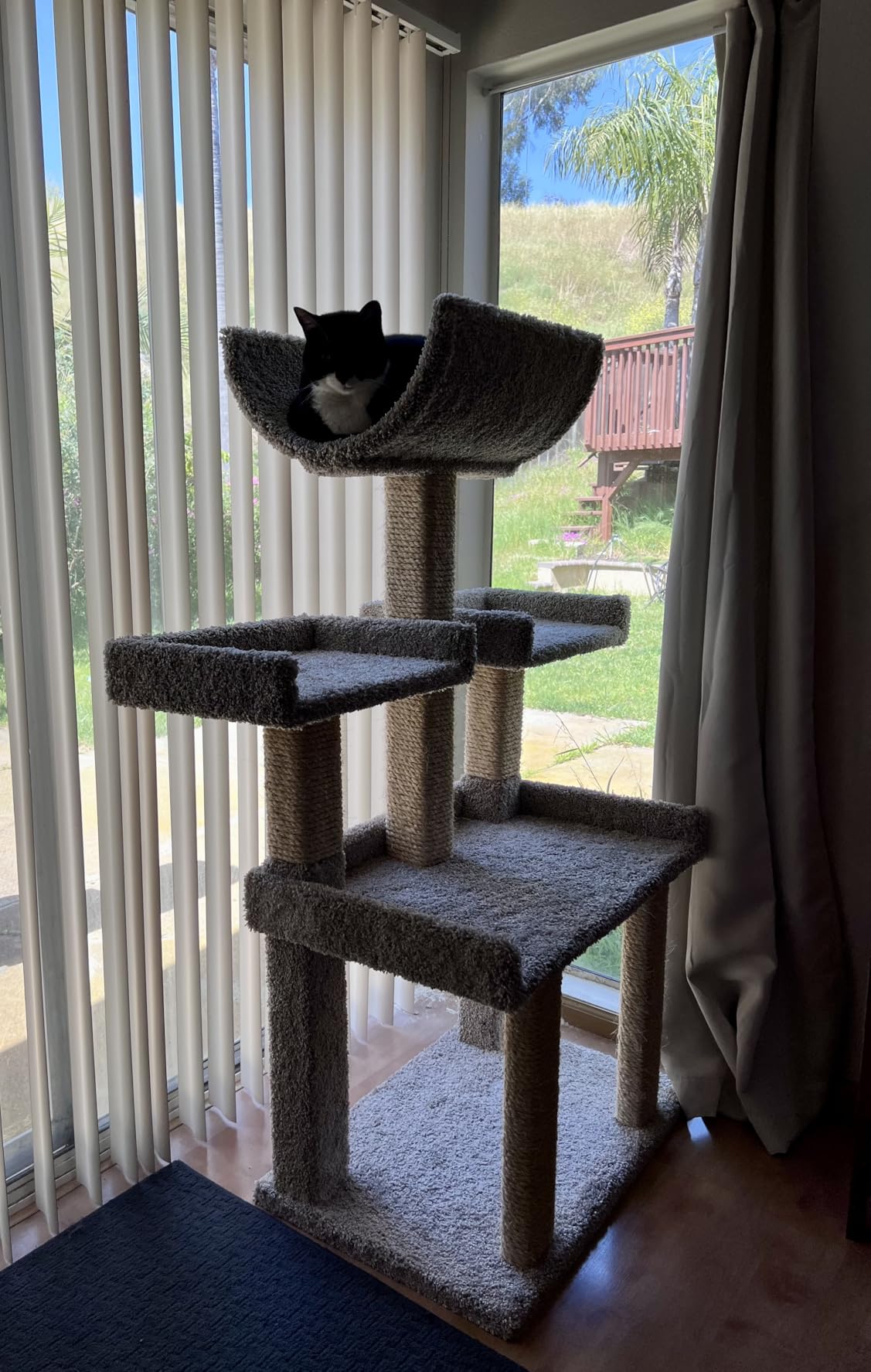
The layout is generous rather than clever: multiple staggered, generously sized platforms, a deep U-shaped middle platform and a half-barrel condo. That means a large cat can fully curl up on any single level instead of perching on an edge.
Assembly is a genuine outlier at this price. It arrives mostly assembled and needs only a few screws, so setup is about ten minutes of fixing three shelves rather than a full build.
Who this tower suits
Owners of large and heavy cats who want something that will still be there in five years. Solid wood does not sag, delaminate or shed particles, and household carpet holds claw grip indefinitely.
It is also the most honest value argument at the top of this range, because owners repeatedly choose it as a cheaper substitute for premium imported trees with the same construction.
Where it will let you down
Packaging is the weak point. It arrives in one oversized carton with holes, and a sisal pole can be partly falling out on arrival, so inspect the package before opening it up.
Expect a chemical scent that takes a couple of days to fade, slight wobble in the centre post that heavy climbers may aggravate, and bare particleboard on the perch undersides. At 65 pounds, get help moving it.
What Your Budget Buys at Four Price Tiers
No competitor publishes this, and it is the most useful thing on this page if you are deciding how much to spend. Under this ceiling you are really choosing between four tiers, and each step up buys one specific thing.
At the entry tier you get a compact tower with a small base, thin posts and carpeted scratching surfaces. It is fine for a kitten and it will move when a cat jumps. Spend here only for a first tree in a small room.
The mid tier is where the build quality starts: a base in the 19 to 22 inch range, posts you can barely get a hand around, sisal or jute rather than fabric, and a shipping weight in the 24 to 34 pound range. Most of this list sits here, and it is the sweet spot.
The upper-mid tier buys height and platform size. Towers at 70 to 81 inches with wider perches, real anti-tip hardware and shipping weights from 36 to 43 pounds are what you get when you want vertical territory or a large cat without going past the cap.
The top of the range under this cap buys materials rather than features: solid rubberwood or solid wood frames, extra-thick pillars, washable covers and 63 to 65 pound builds. What you do not get at any point under this ceiling is genuinely solid-wood design-led joinery, which starts well above the cap entirely.
The Stability Screening Checklist You Can Run on Any Listing
This is the reusable tool. Run it against any listing, including ones not on this page, before you spend anything. Six checks, in order of how often they decide the outcome.
First, base footprint against height. Compare the base width to the overall height. A tower 63 inches tall on a 19-inch square base is a different proposition from one on a 30-inch base, and the ratio matters more than either number alone.
Second, shipping weight. When a listing never prints a weight limit, the shipping weight is the honest proxy for board density. Two towers of the same height: the heavier one almost always has thicker posts and denser board.
Third, post diameter. If you can wrap one hand fully around the post and still have finger to spare, it is thin. Extra-thick posts are around 3 inches and the difference shows immediately in the wobble test.
Fourth, board construction. Solid wood and plywood outlast particleboard and MDF, and the honest tell is whether the hardware is bolt-through or stapled. Staples into particleboard is the combination that produces sagging shelves.
Fifth, whether an anti-tip strap or wall anchor is included. If it comes in the hardware bag, it is optional in practice, and that is how towers end up against a wall with the strap still unused.
Sixth, platform size. Take a measurement of your cat curled up and compare it to the top perch. Most size complaints trace back to a listing photograph taken with a small cat on a large-looking platform.
Then run the shove test on delivery day. Put both hands on the top perch, lean in and shove sideways, then repeat in the other direction. No movement at all means you can let the cat use it.
Our broader guide to cat trees across every price range goes deeper on the type differences this checklist does not cover.
Sisal vs Carpet, and How Tall the Post Should Be
Sisal or jute rope holds up to clawing; carpet mats down. That is the short version, and it matters because owners report the carpet-post problem constantly: a tree is bought, the scratching surface flattens within a few months, and the cat goes back to the sofa.
Natural sisal rope and jute wrapping are both hard fibres that shed into themselves rather than flattening. Faux fur and short-nap plush feel pleasant to lie on but are poor scratching surfaces, which is why plush towers on this list pair it with a separate sisal post or board.
For height, the trick owners use is to stand your cat against a door frame and measure with the front legs fully extended. That gives you a minimum post height. Shorter than that and your cat cannot get a proper full-body scratch, so the tree fails at the one job it exists for.
For a large cat, add to that measurement. A Maine Coon stretched vertically needs considerably more post than the door-frame figure suggests for a small cat, and platforms need to be wide enough to curl up on without the tail hanging off.
Our guide to cat trees for large cats covers the weight-not-height distinction in full if your cat is over 12 pounds.
Matching the Tree to Your Cat and Your Room
Match the tree to the cat first, and the room second. Owner reports are consistent that placement, not model, is the top reason a tower ends up as a dust collector, and the cure is to put it where the cat already spends time rather than where it looks tidy.
For large or heavy cats, prioritise base mass and platform size over height. A 63-inch tower on a 30-inch base beats an 81-inch tower on a narrow one, because tip-over is a sideways-force problem, not a height problem.
For a small apartment, solve the tall-but-narrow tension honestly. Bedsure’s three-tier unit and the Yaheetech 54-inch are the two that genuinely fit a small floor while staying stable. Beyond those, a 45-inch Amazon Basics in a corner is the realistic maximum.
For multi-cat homes, look for two routes to the top rather than one. A single path means one cat controls the descent, and the tree gets abandoned. The Globlazer F70 Pro and the Gitelsnour 71-inch both solve this with two upward paths.
For kittens and senior cats, level spacing decides it. The Feandrea 81-inch spaces levels 12 to 16 inches apart with a ramp, which keeps the bottom of the tree reachable for a cat that will not make a big jump.
If you want furniture rather than pet equipment, the SHODMI is the only pick here with a solid rubberwood frame, and our modern cat tree guide covers that category further.
Placement, Assembly and Anchoring
Put the tree where the cat already is. A window with a view of a doorway beats a spare room every time, and a tree in a guest room is the single most common reason owners report an unused purchase.
Build it in the room it will live in. Two of the heaviest picks here are 63 and 65 pounds, and moving an assembled tower is a two-person job at best.
Run every bolt loose, assemble the whole frame, square it by checking diagonals, then tighten in stages. Tightening as you go is the most common cause of a base that rocks after assembly, and the complaint appears in reviews across this category.
Anchor anything over 60 inches tall. Use a stud finder, remember that framing studs typically run 16 inches on centre, and fix the strap to a stud rather than a drywall anchor alone. A toggle anchor in drywall will not hold a dynamic load.
Add felt floor pads underneath. A tower that walks across a hard floor every time a cat launches is how floors get damaged, and pads cost very little relative to the tower.
Set a maintenance reminder. Retighten every bolt at two weeks, then every six months, and re-check the anchor strap whenever you vacuum. Sisal wears, boards settle, and bolts loosen.
Common Mistakes That Ruin a Budget Tower
Spending on features instead of mass. A dangling toy costs almost nothing to add and a wide base costs real money. Redirect that budget to the base and the post diameter.
Leaving the anchor strap in the bag. It comes with almost every tower and almost nobody fits it. This is the single most common miss in the category.
Buying for a spot the cat does not use. Measure the room you have, not the room you wish you had, and accept a smaller footprint over a taller tree in a corner nobody visits.
Ignoring the weight limit when one is printed. The Amazon Basics tower is listed for cats under 3.5 kg, and exceeding it is how towers end up sliding across hardwood.
Trusting a listing photo for size. Ask for the top platform dimensions and measure your cat curled up. Most size mismatches trace back to a photograph with a small cat on it.
Expecting a used tree to be cheap and safe. A second-hand tree that has already been chewed has a compressed post and a stripped base, and it will fail the shove test.
Frequently Asked Questions
What is the best and most affordable cat tree?
For most households the best balance of build quality and cost is a mid-height tower with a base at least 19 inches square, at least one full-height sisal post, and a top platform wide enough for your cat to curl up on. The Yaheetech 54-inch meets all three and is the most-reviewed tree here by a wide margin. In the lowest price band, prioritise base mass over levels, because a light tower gets abandoned within weeks.
Where is the cheapest place to buy a cat tree?
The cheapest units come from marketplace brands on Amazon, Walmart and Target, and the best value per dollar tends to come from the same mass-market names sold through Chewy with longer return windows. Forum consensus also points to cat shows and show-pruned retailer stock for genuine quality at a discount. Discount pet chains are widely seen as lower quality for the same money, so compare construction rather than price alone.
What cat tree do cats like best?
Placement beats features every time. A tower beside a window in a room the household actually uses gets climbed daily, while a feature-heavy tower in a spare room is ignored and gathers dust. Cats also prefer natural sisal or jute over carpet, because hard rope fibres hold up to clawing where carpet mats down within months. Add a perch with a clear view of a window or doorway and the rest is decoration.
What company makes the best cat trees?
At this budget, judge construction rather than logo. The brands that consistently clear the bar publish a base footprint, post thickness, board type and shipping weight, and include an anti-tip strap: Yaheetech, Feandrea and Prestige all do. Several marketplace brands look identical in a photo but ship noticeably lighter, and a low shipping weight is the clearest warning that the board is thin.
What are the best cat trees for indoor cats?
A mid-height allrounder with a wide base suits most homes and most cats. For a large or senior cat, prioritise a heavy-duty build with a base over 22 inches and platform spacing of 12 to 16 inches. For a studio, a low three-tier unit fits a small floor better than any tall tower. For two or more cats, choose a model with two separate climbing routes to the top, or buy two trees in two rooms.
What kind of cat trees do cats like the most?
Cats prefer a stable, tall-enough post they can stretch against with front legs fully extended, a platform sized for a curled-up body, and a top perch with a view of a window or doorway. Set a minimum post height by standing your cat against a door frame and measuring the full stretch, then add extra for a large or heavy cat. Anything under that height will be used for sleeping rather than scratching.
The Bottom Line
If you buy one thing from this list, buy the Yaheetech 63in Sturdy Cat Tree. The wide base, the anti-toppling kit, a condo rated to 22 pounds and a 4.7 rating across more than 8,000 reviews make it the safest single choice under this ceiling, and it handles everything from a kitten to a heavy adult.
Buy the Bedsure three-tier unit instead if floor space is the problem, the Feandrea 81-inch if height is, the Globlazer F70 Pro if you have two large cats, and the Prestige solid wood tower if you want something that survives a five-year-old Maine Coon. Check shipping weight, compare it against the base footprint, and anchor anything tall before the first climb. That is the whole method.