
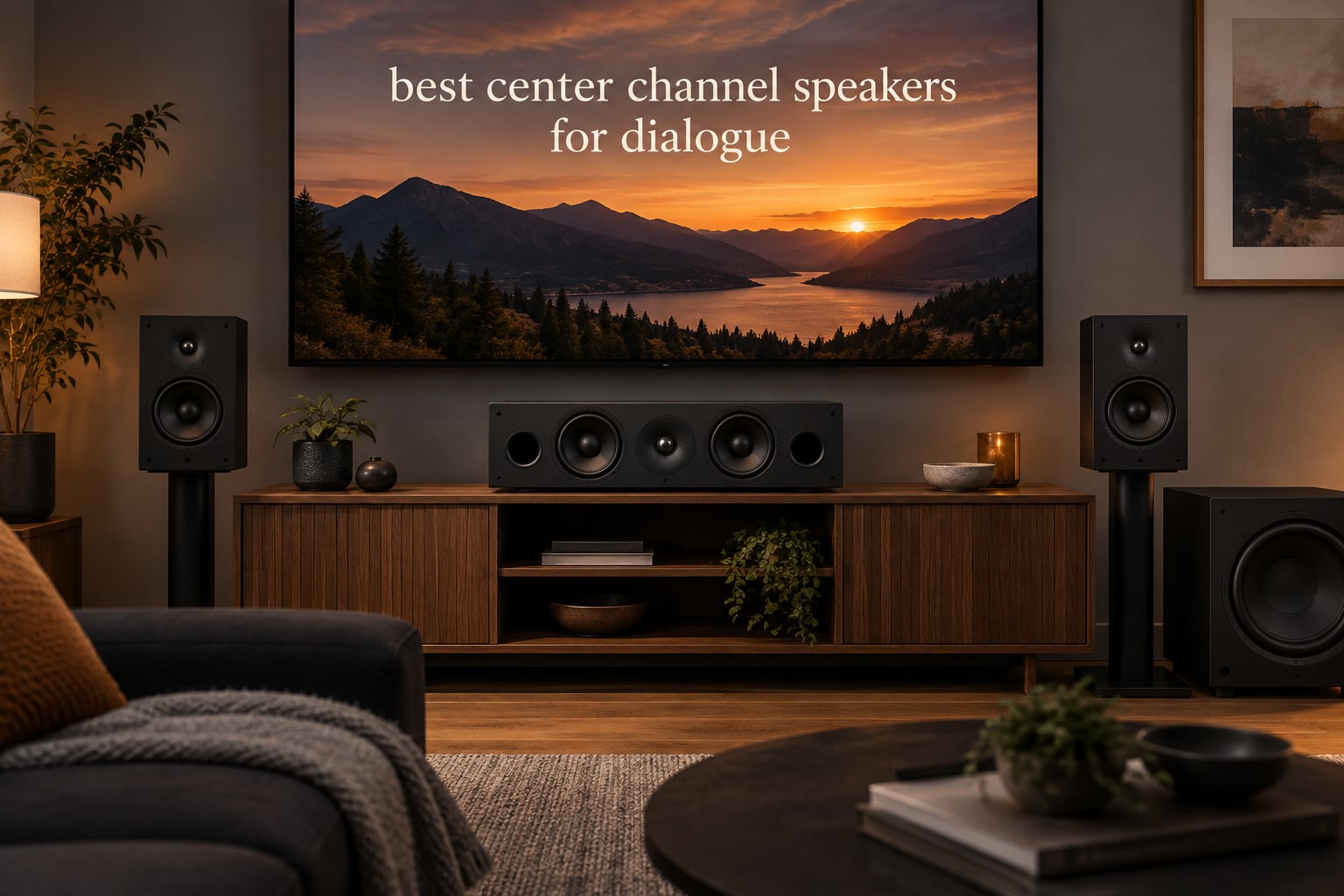
Dialogue lives in the midrange, roughly 200 Hz to 2 kHz, and a center channel speaker is the only speaker in a home theater system asked to reproduce that whole band on its own, all day, at movie levels. A good center for dialogue is a wide, usually horizontal cabinet with a symmetric driver layout, two midrange-capable woofers flanking a tweeter, so voices arrive from the screen instead of from a speaker off to one side of the room.
That last detail is why center speakers behave differently from bookshelf speakers. Film and TV mixers send the entire dialogue track to a single center channel, which means the center is not a supporting actor. When it is thin, boxy, or level-matched too low, the most important content in the film becomes the hardest to hear, and no amount of subwoofer budget fixes it.
We spent weeks comparing the ten speakers below, checking driver layouts against published specifications and weighing owner feedback for pattern problems, placement limits and long-term durability. If you are starting from scratch, we covered the ideas that matter most in the best center channel speakers for dialogue roundup. Every model here is a current-generation design with a symmetric horizontal layout, a real midrange driver section, and documentation good enough to match against your receiver.
Two quick notes before the list. First, we flag measured specs versus manufacturer-claimed specs honestly, since a number of center channels ship with impressive on-paper figures that no independent lab has confirmed. Second, none of the picks below is a dedicated height speaker; they are voice-band LCR speakers that you place at the front of the room, which is a different job from an Atmos height layer.
Top 3 Center Channel Speakers for Dialogue in 2026
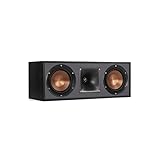
Klipsch R-52C
- Dual 5.25 inch spun-copper IMG woofers
- 1 inch aluminum LTS tweeter in a 90x90 Tractrix horn
- 95dB sensitivity at 2.83V/1m
Polk Audio T30
- Dual 5.25 inch Dynamic Balance woofers
- 1 inch silk dome tweeter
- Timbre matched to the Polk T-Series
Polk Audio TL1
- Dual 2.5 inch Dynamic Balance mids/woofers
- 1/2 inch silk dome tweeter
- Time Lens driver alignment
The R-52C takes the overall spot because it combines the highest owner satisfaction in this group with enough efficiency to be driven by almost any surround receiver. The T30 is the value pick for anyone building around Polk T-Series speakers, and the TL1 handles the smallest rooms and the tightest shelves for the least money.
All 10 Picks at a Glance in 2026
| Product | Specifications | Action |
|---|---|---|
| Klipsch R-52C |
|
Check Latest Price |
| Polk Audio TL1 |
|
Check Latest Price |
| Polk Audio T30 |
|
Check Latest Price |
 Micca MB42-C Micca MB42-C |
|
Check Latest Price |
 Klipsch R-25C Klipsch R-25C |
|
Check Latest Price |
 Klipsch RP-504C Klipsch RP-504C |
|
Check Latest Price |
 Polk Audio ES35 Polk Audio ES35 |
|
Check Latest Price |
 Yamaha NS-C210BL Yamaha NS-C210BL |
|
Check Latest Price |
 BIC America DV-62CLRS BIC America DV-62CLRS |
|
Check Latest Price |
 SVS Prime Center SVS Prime Center |
|
Check Latest Price |
1. Klipsch R-52C – Horn-Loaded Clarity With Very High Sensitivity
Klipsch R-52C Powerful Detailed Center Channel Home Speaker – Black
Dual 5.25 inch spun-copper woofers
1 inch LTS tweeter in a Tractrix horn
95dB sensitivity
Pros
- Horn-loaded LTS tweeter keeps dialogue crisp and articulate
- Dual spun-copper woofers give solid midrange and upper bass
- 95dB sensitivity is easy to drive with modest amplification
- Timbre-matches other Klipsch Reference speakers
Cons
- 18.75 inch cabinet is wide for smaller shelves
- At 13.5 lb it is bulkier than most entry-level centers
The R-52C is the speaker I recommend to people who are done fighting with their dialogue. Two 5.25 inch spun-copper IMG woofers straddle a 1 inch aluminum LTS tweeter loaded into a 90 by 90 degree square Tractrix horn, and that horn is the reason voices cut through a busy soundtrack without sounding strained.
Horn loading controls how much energy leaves the tweeter and spreads it across the listening area, which means the speaker plays with less excursion for the same perceived loudness. Owners report that this matters most in the second half of a film, when the amplifier is working hard and music and effects are stacked under the dialogue.
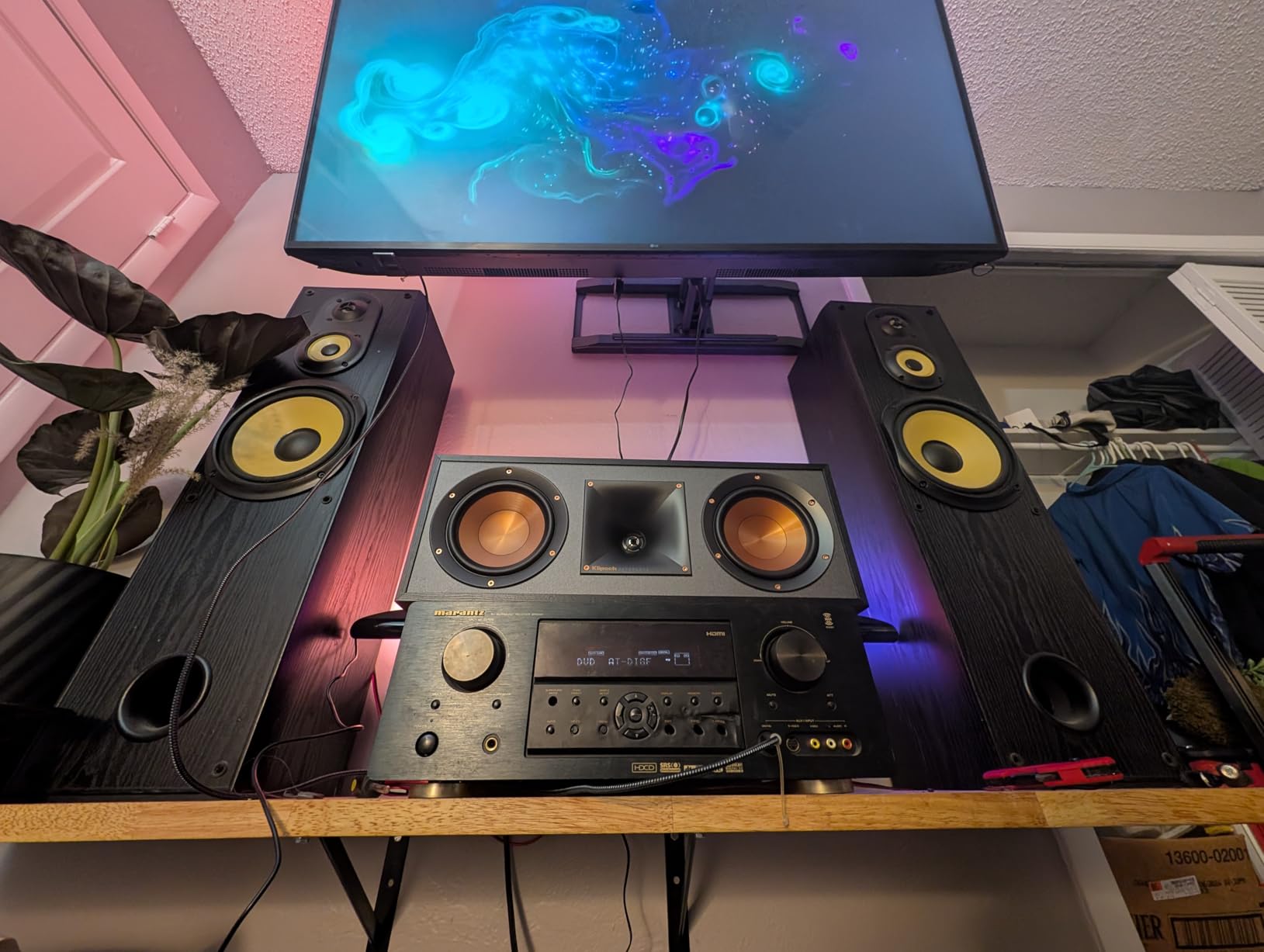
On paper this is the most efficient design in the group, with a stated 95dB sensitivity at 2.83V/1m and 400 watts of power handling. That sensitivity figure is a manufacturer claim rather than an independent measurement, but the direction of it matches what owners hear: the R-52C reaches comfortable dialogue levels without straining a modest receiver.
Frequency response is quoted as 89Hz to 21kHz plus or minus 3dB, which is a sensible range for a center whose low end you will mostly be filtering through bass management anyway. The 18.75 inch width and 13.5 lb weight are the practical constraints, and they are the reason a few owners had to move furniture.
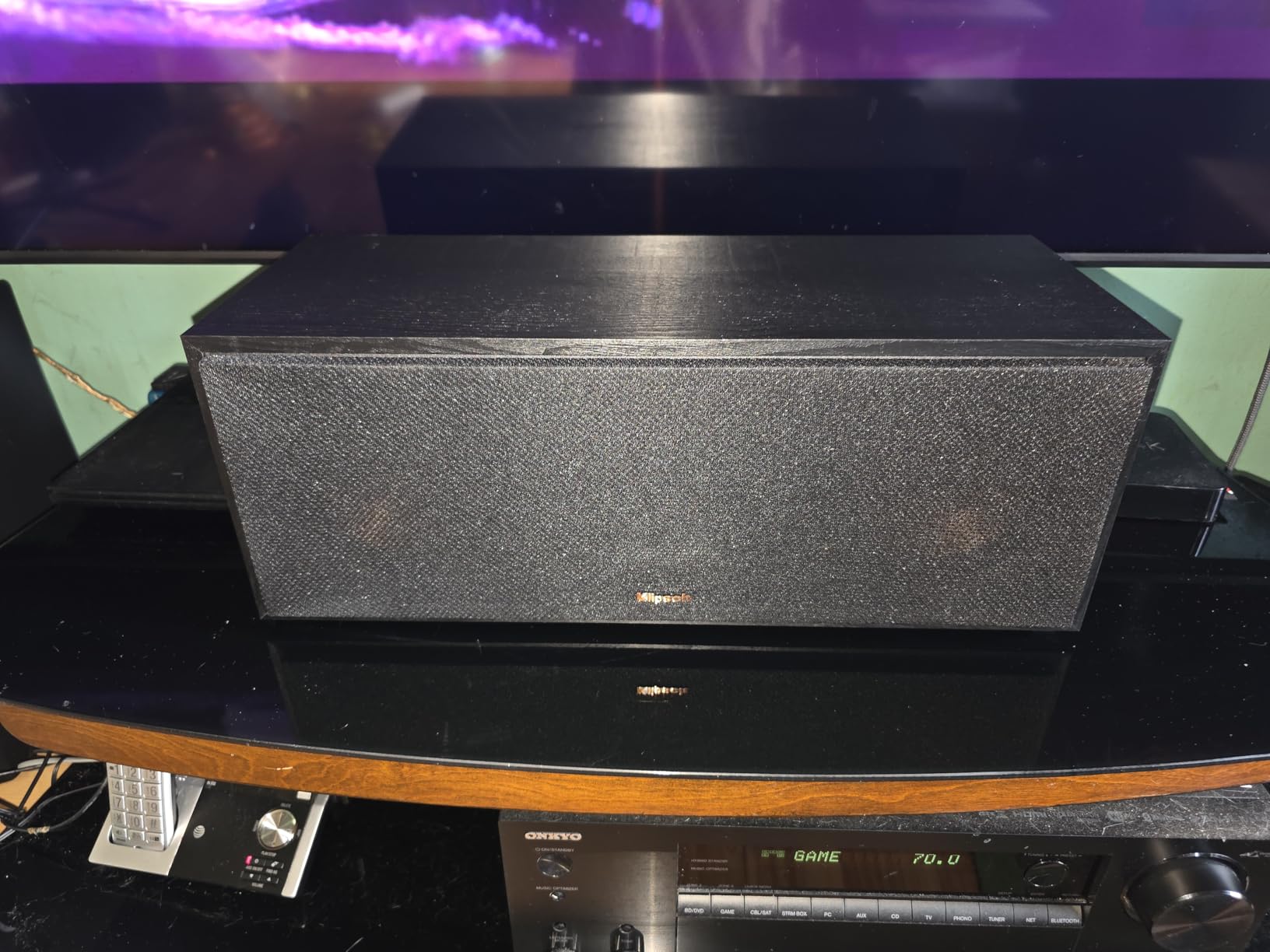
What dialogue-focused listeners will notice first
Consonants separate cleanly from background effects in a way that most two-way designs at this size do not manage. Sibilance is present but controlled, and at low listening levels for late-night viewing the horn still projects without turning thin.
If your system has Klipsch Reference towers or bookshelves already, this is the center that will not fight them. The tonal character is a deliberate match, so panning dialogue across the front stage does not shift color.
Where it falls short
Sibilance-sensitive listeners sometimes find the horn edge exciting after a couple of hours, particularly without room correction. A receiver with a usable dialogue or treble adjustment setting solves this quickly.
The cabinet is wide enough that a narrow media console is out. Measure first, and note that the rear port needs breathing room behind the cabinet.
2. Polk Audio TL1 – The Smallest Cabinet That Still Voices Clearly
Polk Audio Blackstone TL1 Center Channel Speaker, Hi-Gloss Finish
Dual 2.5 inch Dynamic Balance mids
1/2 inch silk dome tweeter
Time Lens alignment
Pros
- Time Lens alignment makes dialogue and vocals jump out clearly
- Extremely compact and light at 3.4 lb
- Curved high-gloss cabinet suits modern flat-panel TVs
- Warm and full for its size
Cons
- Little real bass output from the 2.5 inch drivers
- Will not fill a large room on its own
- 125 watts maximum output
The TL1 solves a specific problem: you want intelligible speech and you have 15 inches of shelf. At 3.4 lb and 4 inches tall, it is the easiest speaker on this list to place in front of a television, and owners replacing a muffled or failed center report speech becoming audible almost immediately.
The driver array is a 1/2 inch silk dome tweeter between dual 2.5 inch Dynamic Balance mids, shaped by Polk Time Lens technology that aims the drivers toward a common listening point. That geometry is doing the work that a dedicated midrange driver would do in a larger cabinet, just on a smaller scale.
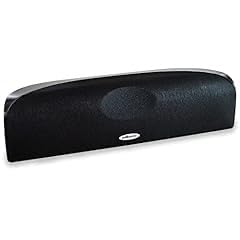
The curved high-gloss enclosure is a deliberate visual match for flat-panel displays, and recessed terminals let it sit flush on a wall. Output is listed at 125 watts maximum, which is fine for apartment rooms and modest receivers but not a system that plays reference levels in an open plan space.
Frequency response and sensitivity figures are not published for this model in the materials we reviewed, so treat any claim you see online as unverified. What we can say from owner accounts is that the character is warm and full, and that the low end is genuinely limited.
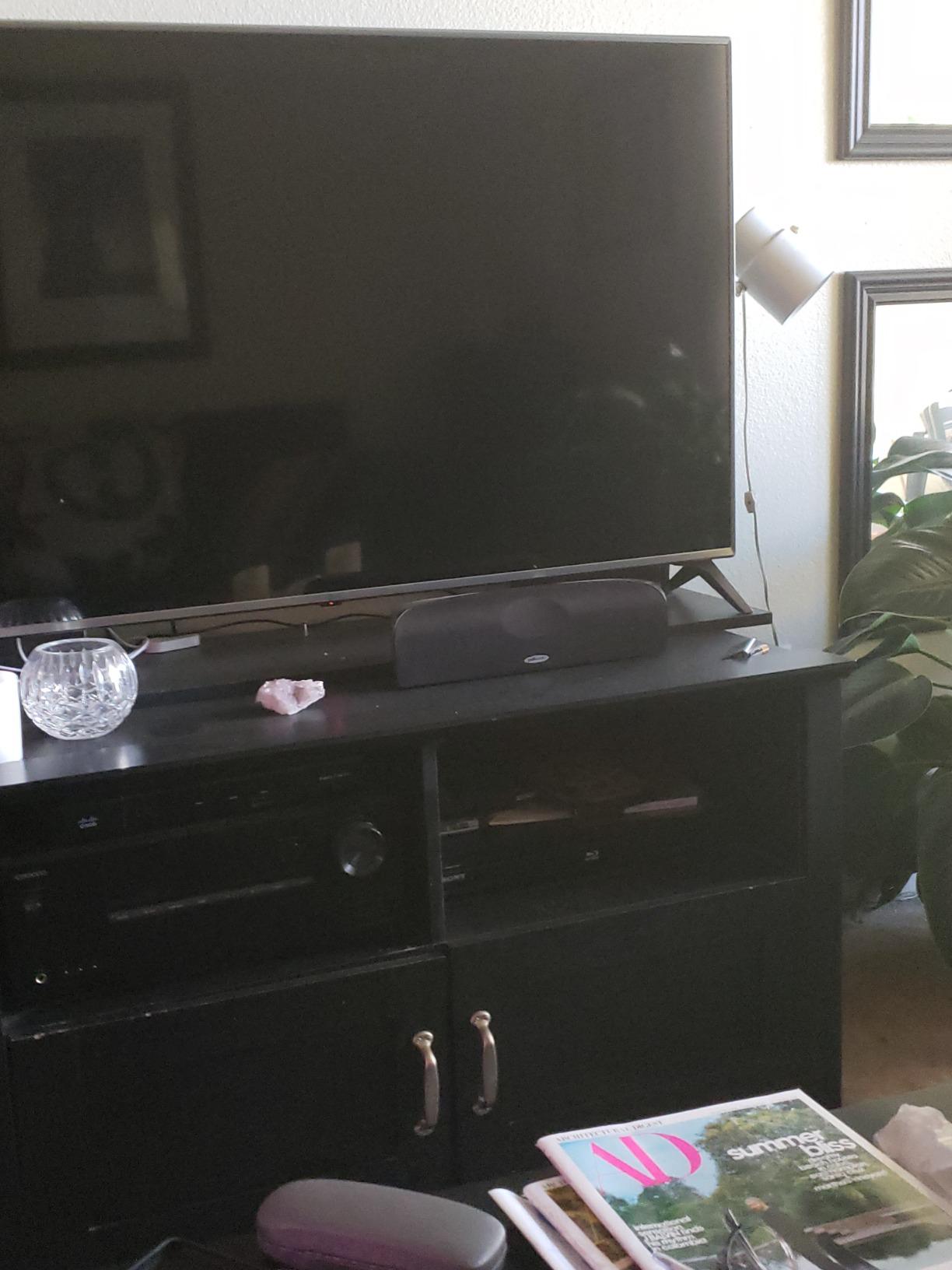
Best use case: a small apartment media console
This is the right speaker when the room is small, the shelf is shallow, and dialogue is the priority. At this size you can put it just under the screen without blocking the picture, which is often the difference between a usable center and a decorative one.
It also works well as a stand-alone center in a bedroom or office system, or as a supplement to a soundbar that lacks a discrete center output.
Where it falls short
The 2.5 inch drivers cannot produce real midbass, so anything below the voice band leans on your subwoofer. In a large room the system runs out of output well before it runs out of clarity.
Expect to re-run your receiver calibration after adding it, because a small center can change the perceived center level noticeably from where the old speaker sat.
3. Polk Audio T30 – The Consensus Budget Upgrade for Muffled Dialogue
Polk Audio T30 Home Theater Center Channel Speaker, 100W Single, Black
Dual 5.25 inch Dynamic Balance woofers
1 inch silk dome tweeter
Tuned rear port
Pros
- Crisp vocals stay intelligible at low listening volume
- Timbre-matches the Polk T-Series so L/C/R blend seamlessly
- Dual 5.25 inch woofers add surprising upper bass
- Easy single-pair wiring to any AV receiver
Cons
- Slightly brighter than Klipsch centers when seated in the sweet spot
- Some owners with mid-level receivers report reaching the power handling limit
- 19 inch wide
Across forum threads and roundups, the T30 is the model that comes up most often as the first real upgrade for a budget home theater. It is not exotic, and that is exactly why it works: dual 5.25 inch Dynamic Balance woofers and a 1 inch silk dome tweeter in a conventional, well-executed horizontal cabinet.
The voices are full-bodied rather than thin, and owners frequently describe it as the change that made quiet scenes finally legible. At 11.5 lb and 19 inches wide it needs a proper shelf, not a narrow console top.
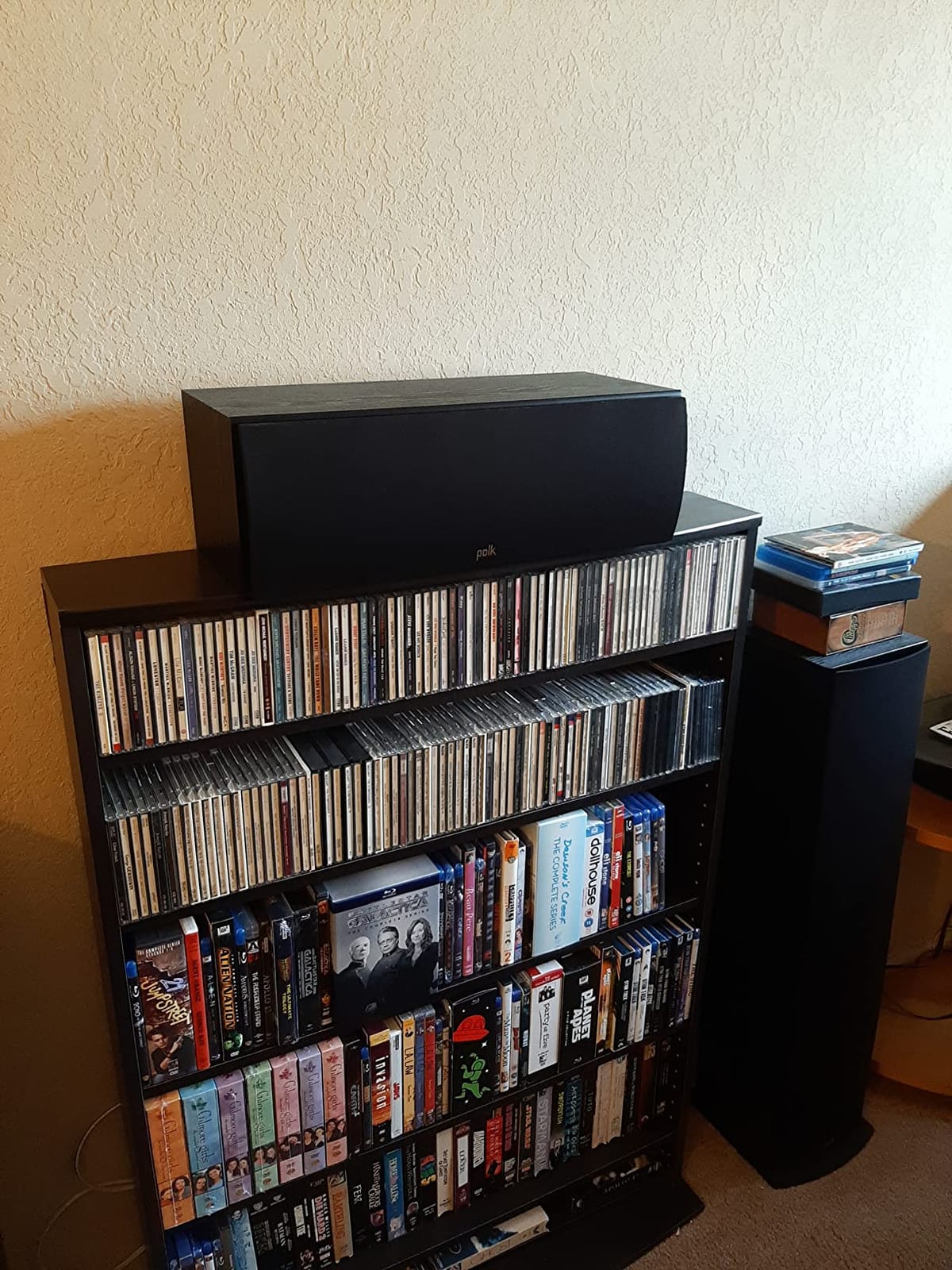
Output is rated at 200 watts with 6 ohm nominal impedance, so it is easy to drive but worth matching to a receiver that delivers real current if you listen loudly. The tuned rear port adds upper bass that most centers this size cannot manage.
The only recurring critique across reviews is a touch of brightness in the treble. That is largely a taste and room issue, and a two dB cut at the first treble step usually resolves it without touching the midrange where dialogue lives.
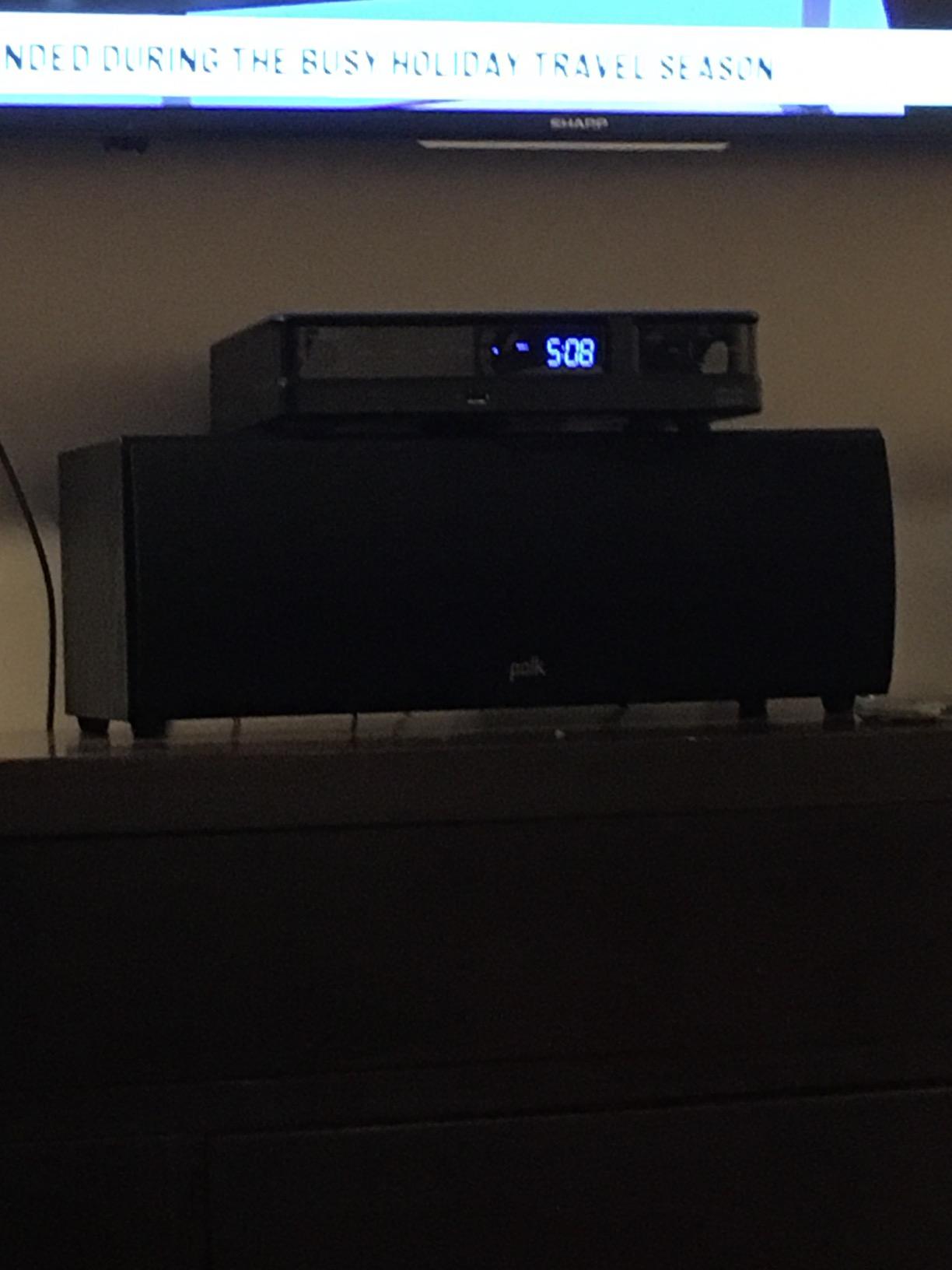
Best use case: a first 5.1 build on Polk surrounds
Polk designed the T30 to match the T-Series, and the tonal continuity across the front stage is obvious when dialogue pans between the center and the surrounds. That matching matters more for perceived quality than most buyers expect going in.
It is also a sensible upgrade path if you already own Polk bookshelf speakers and want a center rather than a third bookshelf acting as one.
Where it falls short
Owners driving it hard from a modest receiver report it reaching its limits before the front speakers do. If your system is small and loud rather than large and loud, keep that in mind.
Because it is a 2-way design, the crossover sits between the midrange and the tweeter, so it will not give you the seamless transition of a true 3-way cabinet.
4. Micca MB42-C – Accurate and Neutral on a Modest Budget
Micca MB42-C 2-Way Passive Center Channel Speaker Home Theater, Each, Black
Dual 4 inch carbon fiber woofers
0.75 inch silk dome tweeter
Ported to 60Hz
Pros
- Neutral
- accurate signature praised for vocal clarity
- Carbon fiber woofers deliver more bass than typical budget centers
- 15 inch width fits most TV cabinets
- Strong value in a matched Micca system
Cons
- Only a 1 year warranty
- Passive design needs a capable external amplifier to reach full potential
- 100 watts maximum output
The MB42-C is the pick for anyone who wants an accurate signature instead of a flavored one. Two 4 inch woven carbon fiber woofers and a 0.75 inch silk dome tweeter sit in a ported cabinet tuned down to 60Hz, and owners describe the result as neutral with vocals reproduced cleanly.
Carbon fiber cones are stiffer and lighter than conventional paper drivers, which helps transient response. In practice that means consonants start and stop rather than smear, which is what you want when dialogue is sitting under effects.
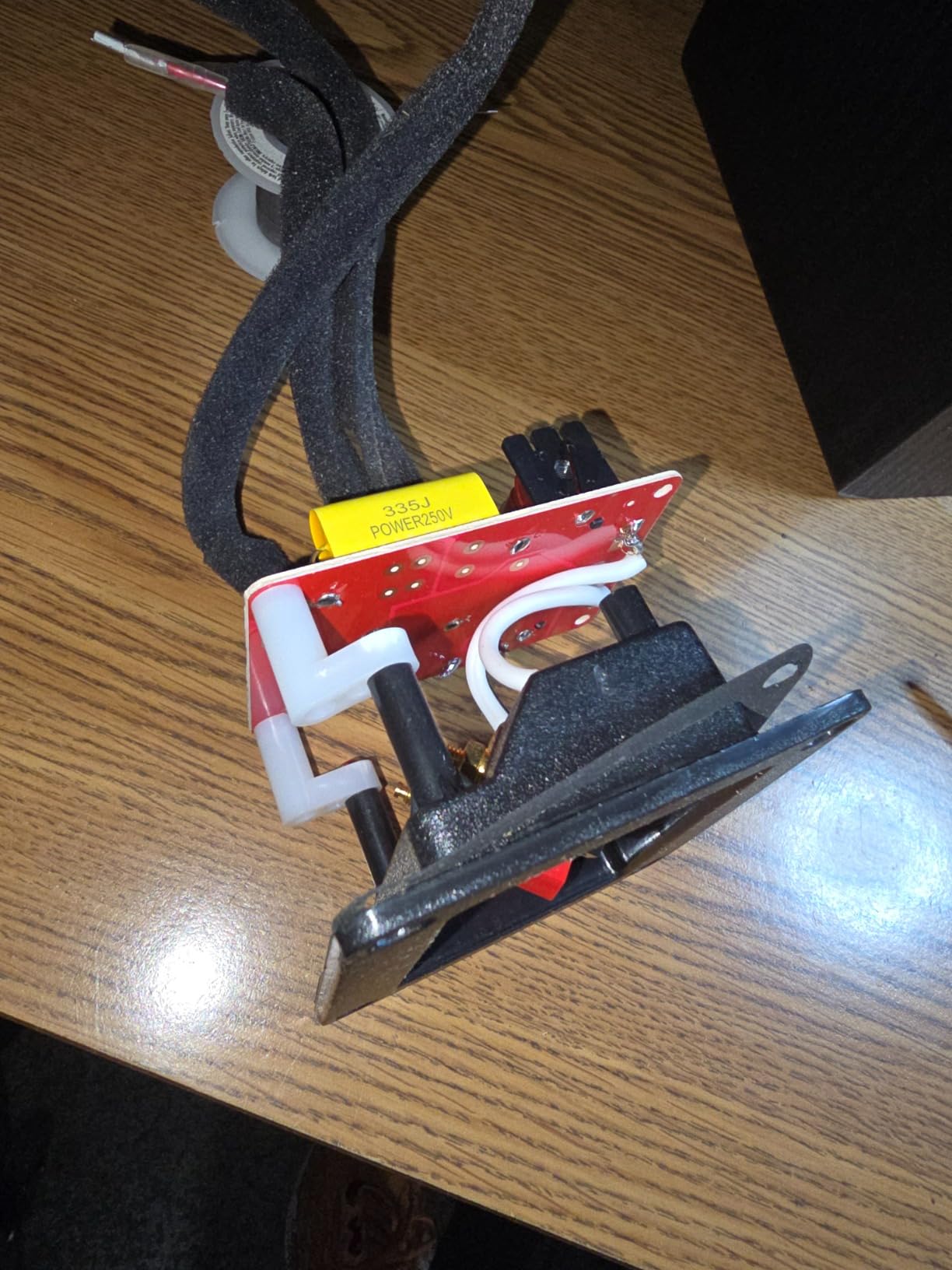
It is a passive 8 ohm design, so it needs an amplifier with real current behind it. Output is listed at 100 watts, which is adequate for a living room but modest if you play movies at reference levels.
The one year warranty is the shortest in this group and the most common reservation in reviews. Budget for the possibility of a driver replacement being harder to source than it would be with a five or six year brand warranty.

Best use case: matching an existing Micca bookshelf system
If the rest of your speakers are Micca, this integrates without any EQ guesswork. If they are not, the neutral character makes it easier to blend with a different brand than a heavily voiced center.
At 5 lb and 15 inches wide, it is also one of the easier cabinets to wall-mount or to hide behind a television.
Where it falls short
Pairing a passive center with an entry-level receiver is the classic mistake here. Underpowered amplification is what makes cheap centers sound thin, and that is a wiring problem rather than a speaker problem.
Owners also note that the silk dome tweeter is smooth rather than sparkling. If you want sparkle in the top octave, this is not the speaker that delivers it.
5. Klipsch R-25C – The Reference Match for Klipsch Towers
Klipsch – R-25C Center Speaker
Two-way Reference center channel
400W peak power handling
Matches Klipsch Reference series
Pros
- Reference-series horn design prized for vocal and dialogue clarity
- 400W peak handling gives real headroom
- Timbre-matches widely deployed Klipsch R-series fronts
- 4.8 average owner rating across 1250 reviews
Cons
- 18.75 inch width and 14.8 lb weight limit placement
- Published specification detail is thinner than newer Klipsch models
If you already own Klipsch Reference towers, the R-25C is the center that was designed alongside them. It is a two-way Reference design rated at 400 watts peak, and owners buying it to complete a system report a front stage that holds together as dialogue moves across it.
The horn-loaded treble has the same character as the Reference speakers many people already have on stands or in cabinets, which is the entire point of buying within a series. Mixing a center from a different voice family produces a color shift that is easy to hear once you know what to listen for.
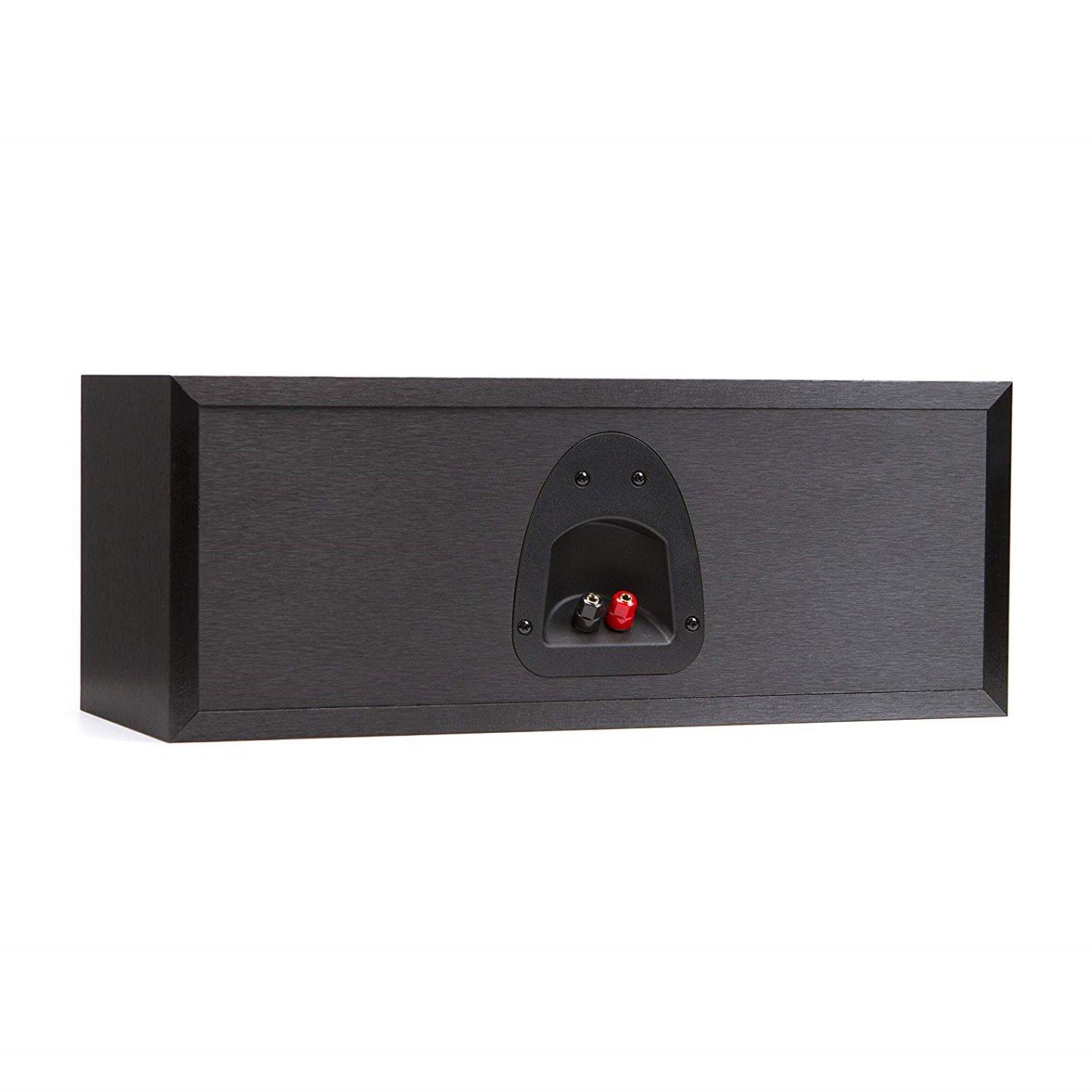
What we like most here is how predictable the fit is. Within the Reference line, dialogue levels across the front three channels stay consistent without corrective EQ, which is the opposite of the experience people report when they mix brands.
The documentation is thinner than newer models, so if you are buying without a matching system you should expect to rely on measurements rather than published response data. Driver size and crossover point are not published in the materials we reviewed.

Best use case: completing a Klipsch Reference front stage
This is the recommendation for anyone whose front speakers are already Klipsch Reference. Timbre matching, in our experience reading owner feedback, is the single factor that most improves perceived dialogue quality after the speaker choice itself.
It also makes sense for LCR use, where the same design runs as three fronts, since Klipsch sells matching Reference bookshelf speakers for that purpose.
Where it falls short
At 18.75 inches wide and nearly 15 lb, placement is the constraint. It needs a real shelf and rear clearance for the port, and it is not a candidate for a narrow console.
Buyers shopping purely on specification should know that this listing carries less published detail than the R-52C. We rate it on owner experience rather than on a datasheet here.
6. Klipsch RP-504C – Maximum Scale for Large Rooms
Klipsch RP-504C Reference Premiere Center Channel Speaker (Ebony)
Five Cerametallic woofers
Vented titanium dome tweeter
2.5-way dual crossover, 90x90 horn
Pros
- Crystal-clear dialogue with a rich midrange even at low levels
- 31 inch baffle keeps the soundstage coherent off to the side
- High sensitivity makes it easy to drive with an AVR
- Premium ebony finish matches Reference Premiere towers
Cons
- Exceptionally large at nearly 40 lb and needs dedicated shelf space
- Treble can read sibilant without EQ in a 3-channel setup
- 31.13 inch width suits only wide furniture
The RP-504C is the largest speaker in this roundup and the one that changes a room. A 31 inch baffle with five Cerametallic woofers, a vented titanium-dome tweeter on a Linear Travel Suspension, and a 90 by 90 degree Tractrix horn with computer-modeled phase plugs produces a front stage that stays coherent well off the central seat.
That wide dispersion is the practical advantage. On a wide sofa, listeners at the outer seats hear dialogue at close to the same level and tone as the person in the middle, which is the complaint that drives most center upgrades.
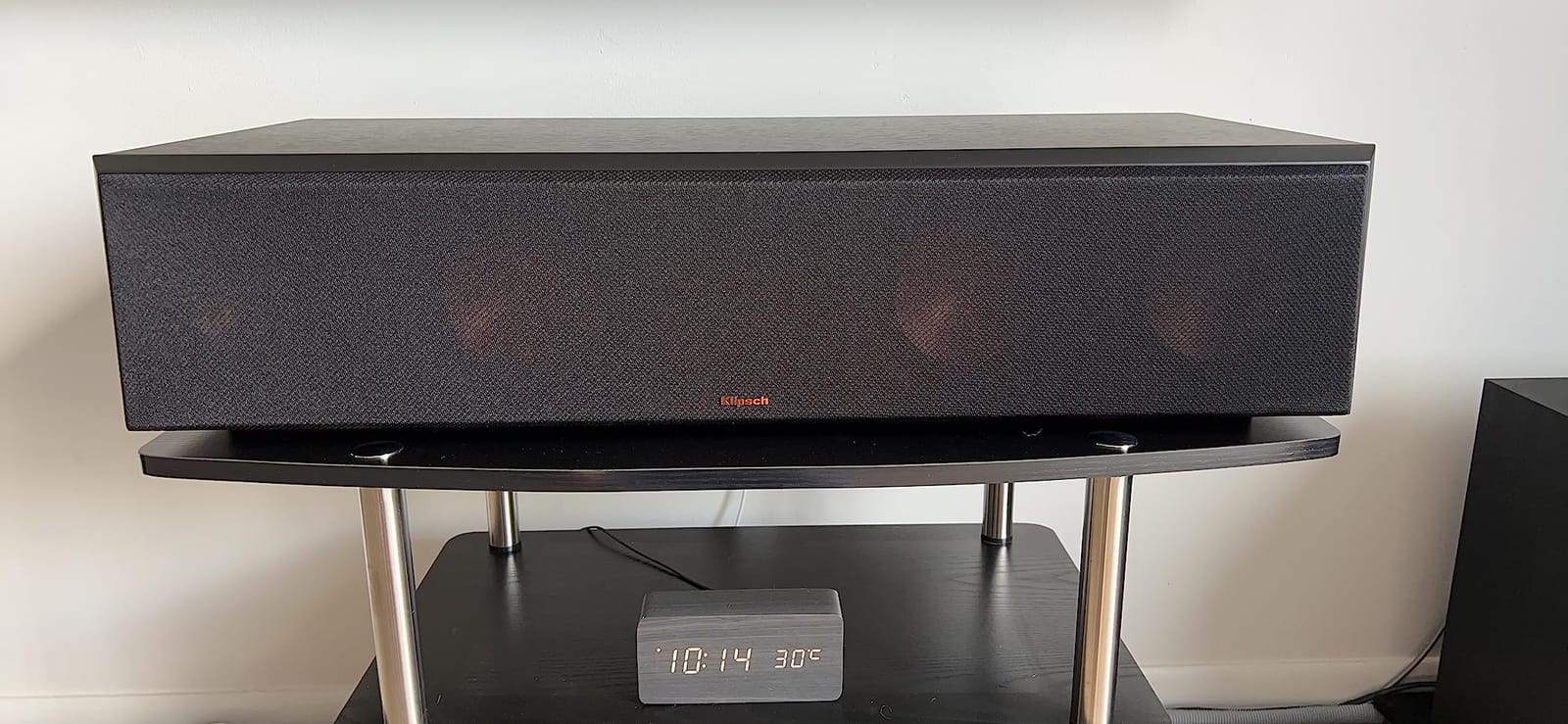
The 2.5-way dual-crossover design is worth understanding. It lets the outer woofer pair roll off differently from the inner pair, which extends midrange output without the lobing you get from a simple two-way layout.
Owners report a step change in intelligibility, particularly in mixed-content material where dialogue shares the screen with music. The caveat, raised almost universally in reviews, is the footprint at nearly 40 lb and just over 31 inches wide.
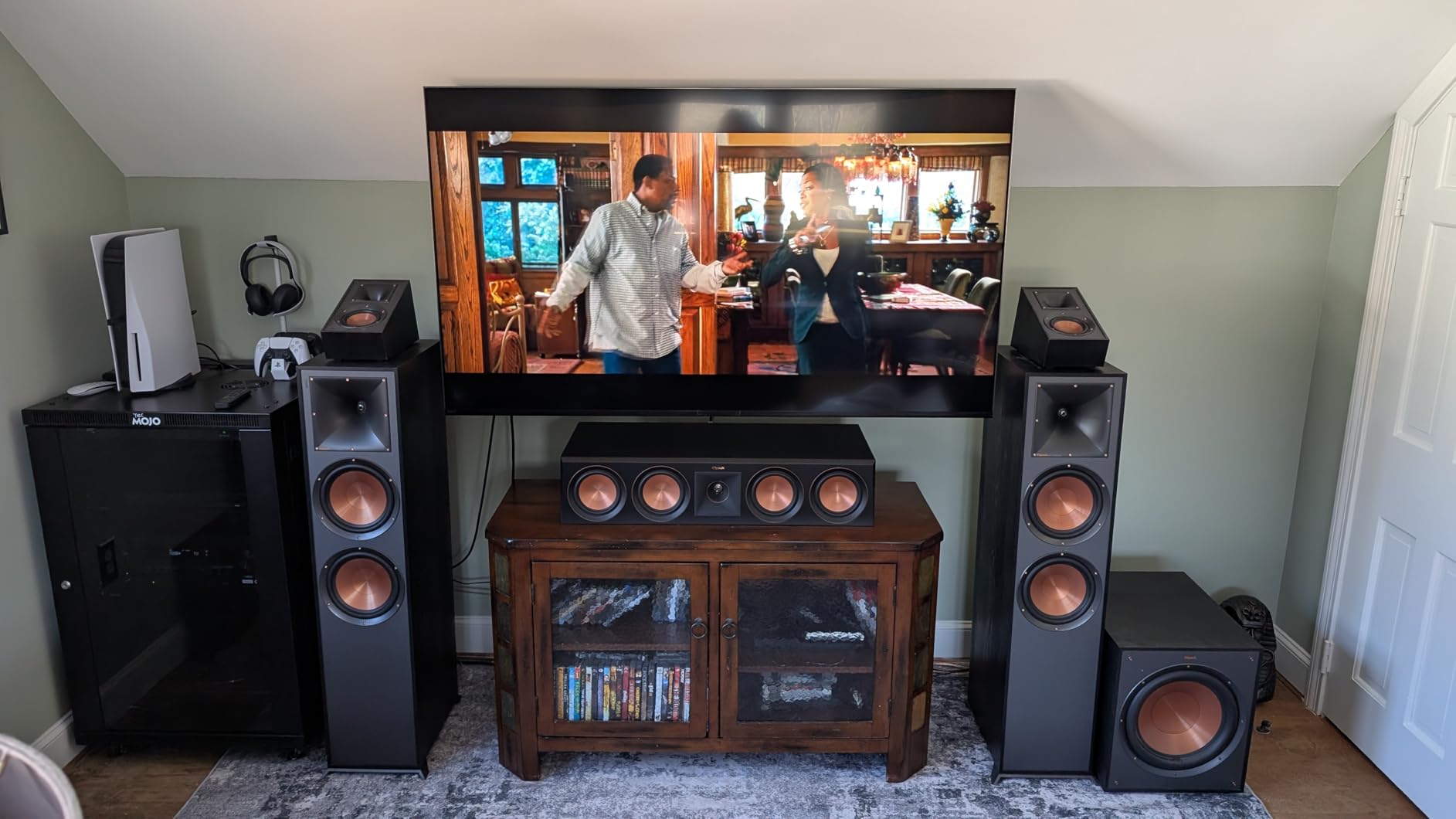
Best use case: a large room or a very wide seating area
If your sofa is wide, your room is open plan, or you regularly host movie nights with people spread across the seating, the extra baffle width buys real intelligibility for the whole group rather than just the middle seat.
It also pairs naturally with Reference Premiere towers, which are the speakers most owners in this category already own.
Where it falls short
Several owners report that the addition forced a furniture change. If you have not measured the console, do not assume it fits; the depth is over 14 inches before any port clearance.
Treble energy is high out of the box. Without EQ in a three-channel setup it can read sibilant, and the phase-plug design is unforgiving of a badly positioned cabinet.
7. Polk Audio ES35 – Slim Profile, Six Drivers, Flexible Roles
Polk Audio Signature Elite ES35 Slim Center Channel Speaker, Stunning Black
Six 3 inch woofers, 1 inch Terylene tweeter
Dynamically Balanced Acoustic Array
Power Port bass
Pros
- Slim cabinet with a wide faceplate for room-filling dialogue
- Six 3 inch drivers plus Power Port deliver impressive bass for a center
- Works as a center or as surrounds for a flexible 5.1 setup
- Modern styling suits contemporary furniture
Cons
- Cascading crossover is less revealing than a dedicated horn-loaded center
- A small minority of owners find the bass ported at high volume
- 20 inch wide
The ES35 solves the furniture problem. Six 3 inch woofers sit behind a wide, slim faceplate, and the cabinet is shallow enough to tuck under a television or mount on a wall without pushing the screen forward.
Output is listed at 150 watts with 8 ohm nominal impedance, and Polk states compatibility with both 4 ohm and 8 ohm amplifiers, which widens the range of receivers it will work with. The patented Power Port is claimed to deliver cleaner and deeper bass than a conventionally ported cabinet of the same size.
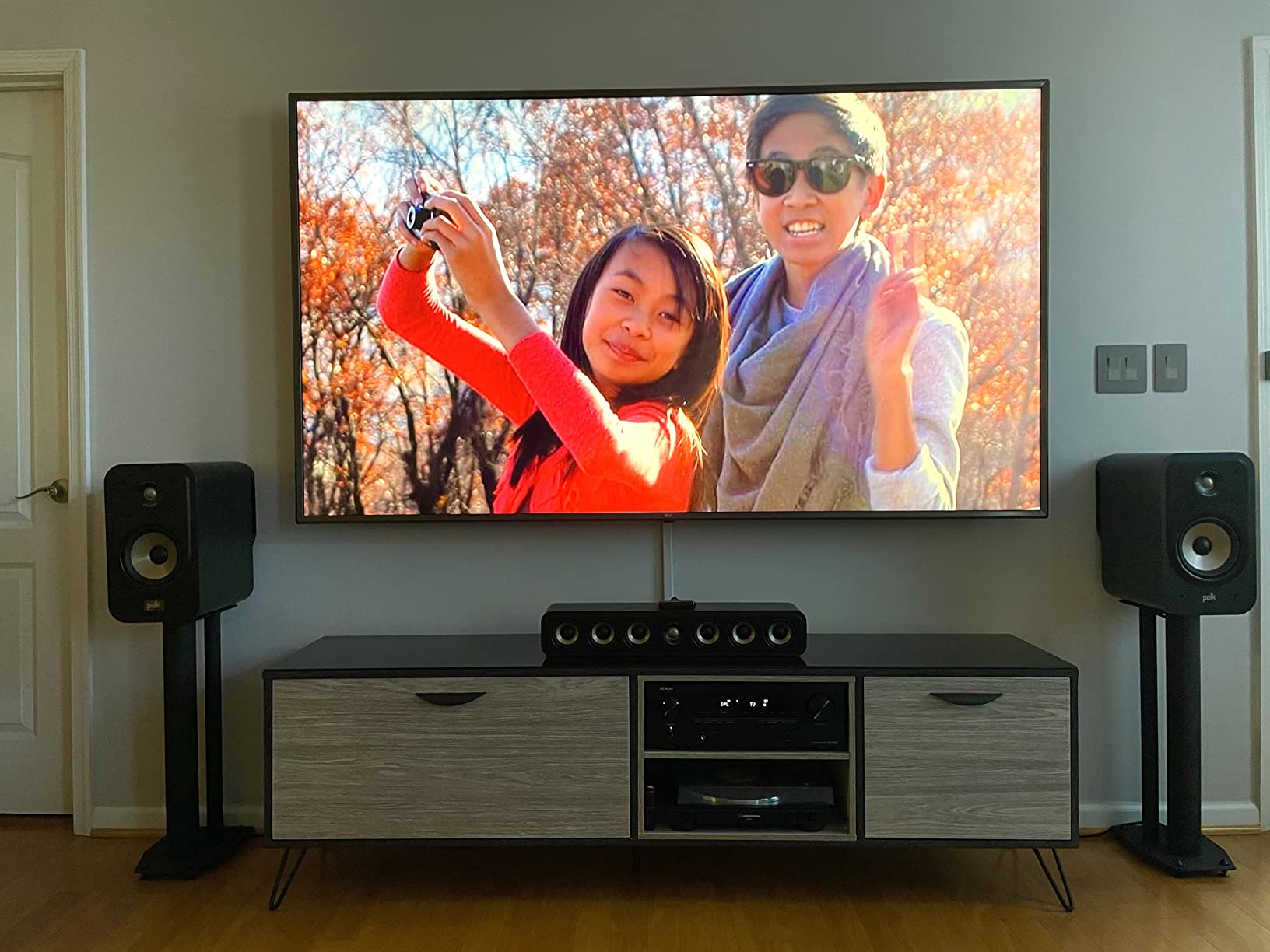
What we like is the flexibility. Because the design works as a center or as a pair of surrounds, it is a reasonable option for someone building a 5.1 system on a limited channel budget who does not want to mix brands.
The cascade of crossovers across the driver array is the one design choice that shows in listening. It produces a wide, even sound but not the pinpoint detail of a dedicated horn-loaded tweeter working alone in the midrange.
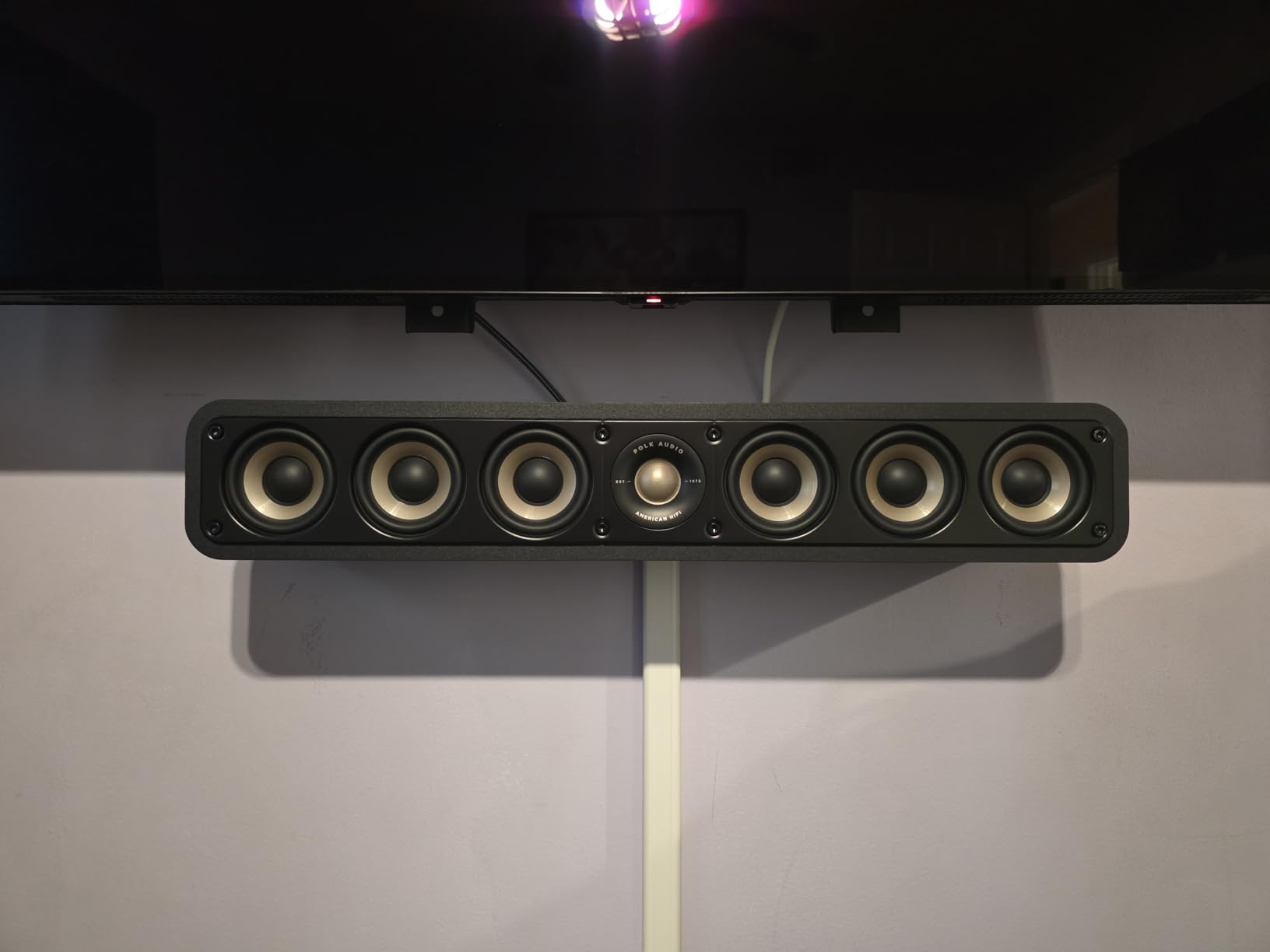
Best use case: shallow cabinets and wall-mounted TVs
The slim profile and wall-mount capability make this the pick for anyone whose television is mounted and whose media unit has no shelf depth to spare. It reads as part of the furniture rather than as a speaker parked in front of it.
Using two as surrounds alongside one center keeps the tonal character consistent across the front and rear of the room at a modest channel count.
Where it falls short
Owners who listen at high volume report occasional port noise, so bass management settings matter. Keep the crossover point for the center a little higher than you think you need.
If your priority is maximum detail on consonants in a large room, a horn-loaded alternative with a single dedicated midrange path will outperform this on that specific goal.
8. Yamaha NS-C210BL – Compact Aluminum-Cone Design With Elegant Finish
YAMAHA Audio NS-C210BL Center Channel Speaker – Each (Black)
Dual 4 inch aluminum cone woofers
7/8 inch balanced dome tweeter
2-way bass reflex, 4.4 lb
Pros
- Light aluminum cones give fast clean response for dialogue
- Compact 13.4 inch footprint and 4.4 lb weight are easy to place
- Elegant Piano Black finish that matches AV hardware
- Includes a 4 meter speaker cable
Cons
- Modest 80W maximum output for the category
- Only 2 year warranty coverage
- 13.4 inch width limits stereo spread slightly
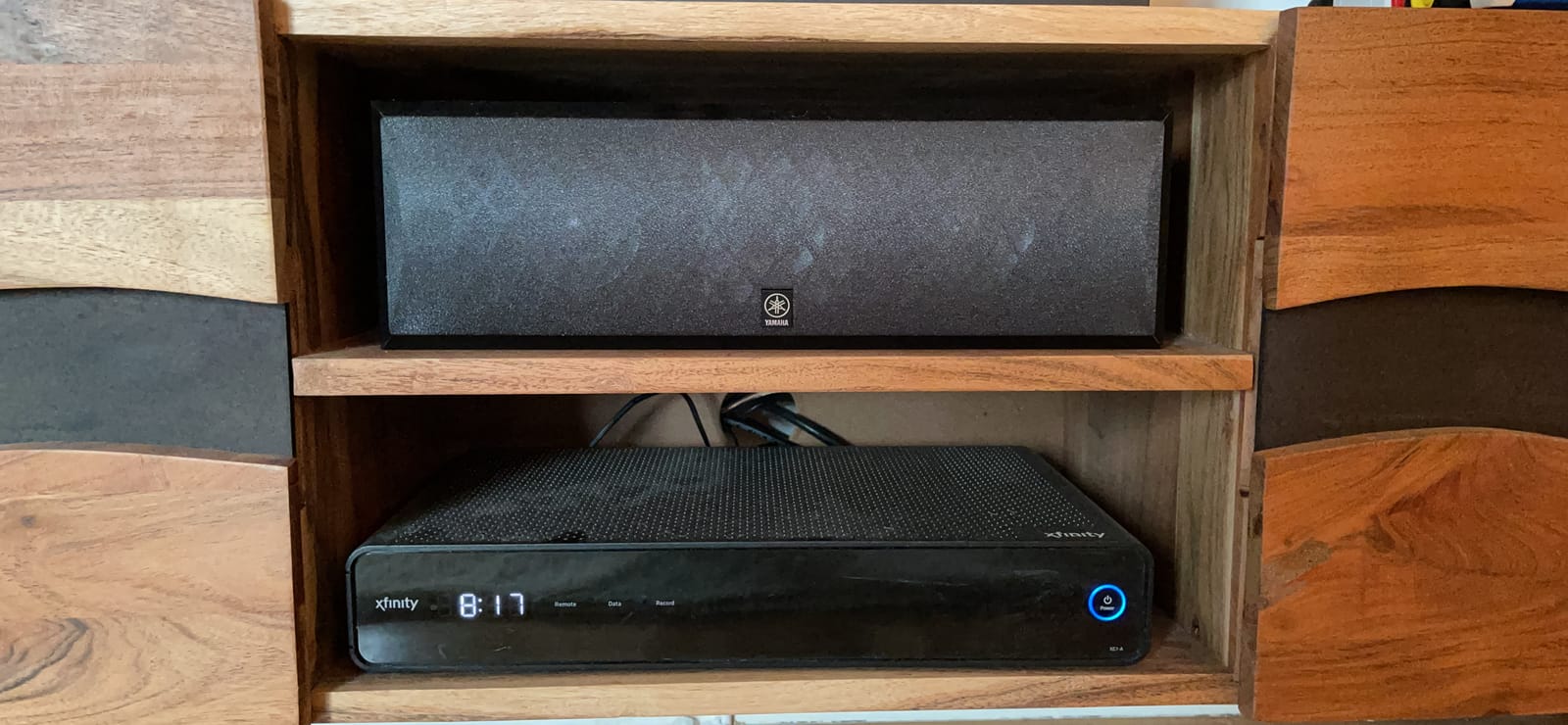
The NS-C210BL is a small, elegant 2-way bass reflex center with dual light aluminum cone woofers and a 7/8 inch balanced dome tweeter. Aluminum cones move quickly, and fast transient response is exactly what consonants need to stay distinct against a dense soundtrack.
At 4.4 lb and 13.4 inches wide, it is one of the easiest cabinets here to place in a living room, and the Piano Black finish was designed to sit visually alongside AV equipment rather than fight it.
Nominal impedance is 6 ohm with 80 watts of maximum output, which is the lowest power figure in this group. In a small room driven by a modest receiver that is not a real limitation, but it is not a speaker you will push to reference levels.
The two year warranty is shorter than most competitors here, and frequency response is quoted only to 45kHz rather than with a lower frequency figure, so the low end is not the selling point. Dialogue is.
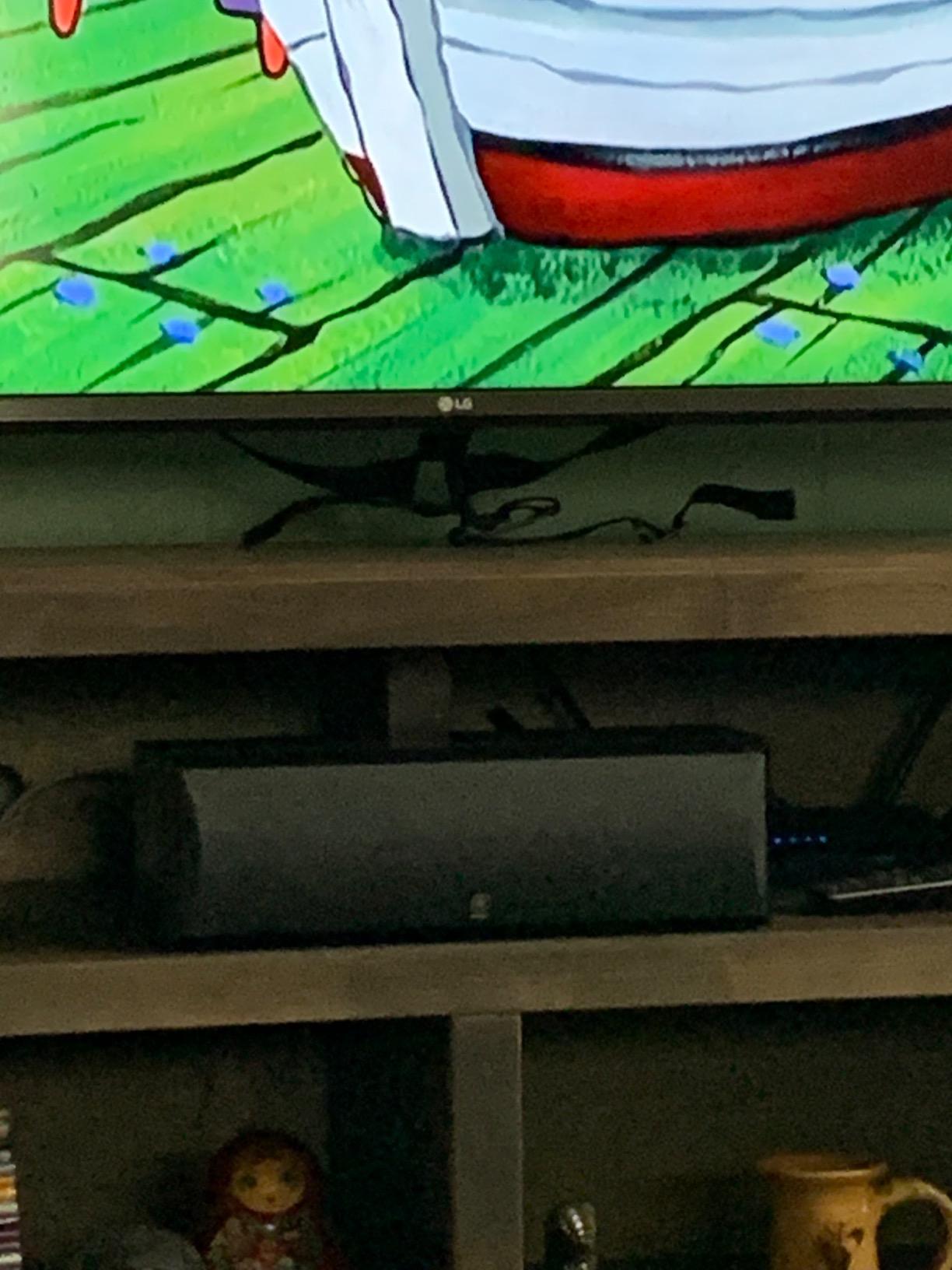
Best use case: compact rooms and mixed-brand systems
The restrained tonal character makes this a safe addition to a system whose main speakers come from another maker. It is not trying to be the loudest or the most colored speaker on the shelf.
If your Yamaha system is a natural fit, the matching finish is an underrated reason to pick it. Sound quality alone would narrow your options far more.
Where it falls short
Output is the honest limitation. In a larger room or with a low-powered receiver, dialogue will not have the headroom that a high-sensitivity horn design provides.
Owners who upgraded from larger centers sometimes find the soundstage narrower, which is the natural trade for a cabinet this compact.
9. BIC America DV-62CLRS – Deepest Midbass and the Longest Warranty
BIC America DV-62CLRS 6-Inch 2-Way Center Channel Speaker
Dual 6.5 inch poly graphite woofers
Centered 0.75 inch soft dome tweeter
7 year warranty
Pros
- Centered tweeter between dual 6.5 inch woofers gives point-source dialogue
- High power handling stays clean at reference volume
- Large surface area delivers genuinely deep midbass for a center
- 7 year warranty is among the longest in the category
Cons
- Tone is on the bright side and can fatigue some listeners
- Needs roughly 40 to 60 hours of break-in
- 19.3 lb weight and 20 inch width limit shelf options
The DV-62CLRS is the odd one out in this list and that is why we like it. Most centers use 4 inch or 5.25 inch drivers; this one uses dual 6.5 inch poly graphite woofers flanking a centered 0.75 inch soft dome tweeter in a proper MTM array, and the extra surface area delivers real midbass.
That larger cone area means the speaker has output well below the voice band, which matters if you are running a center-heavy bass management profile or if your subwoofer is not asked to carry the 80 to 120 Hz region with the rest of the front stage.
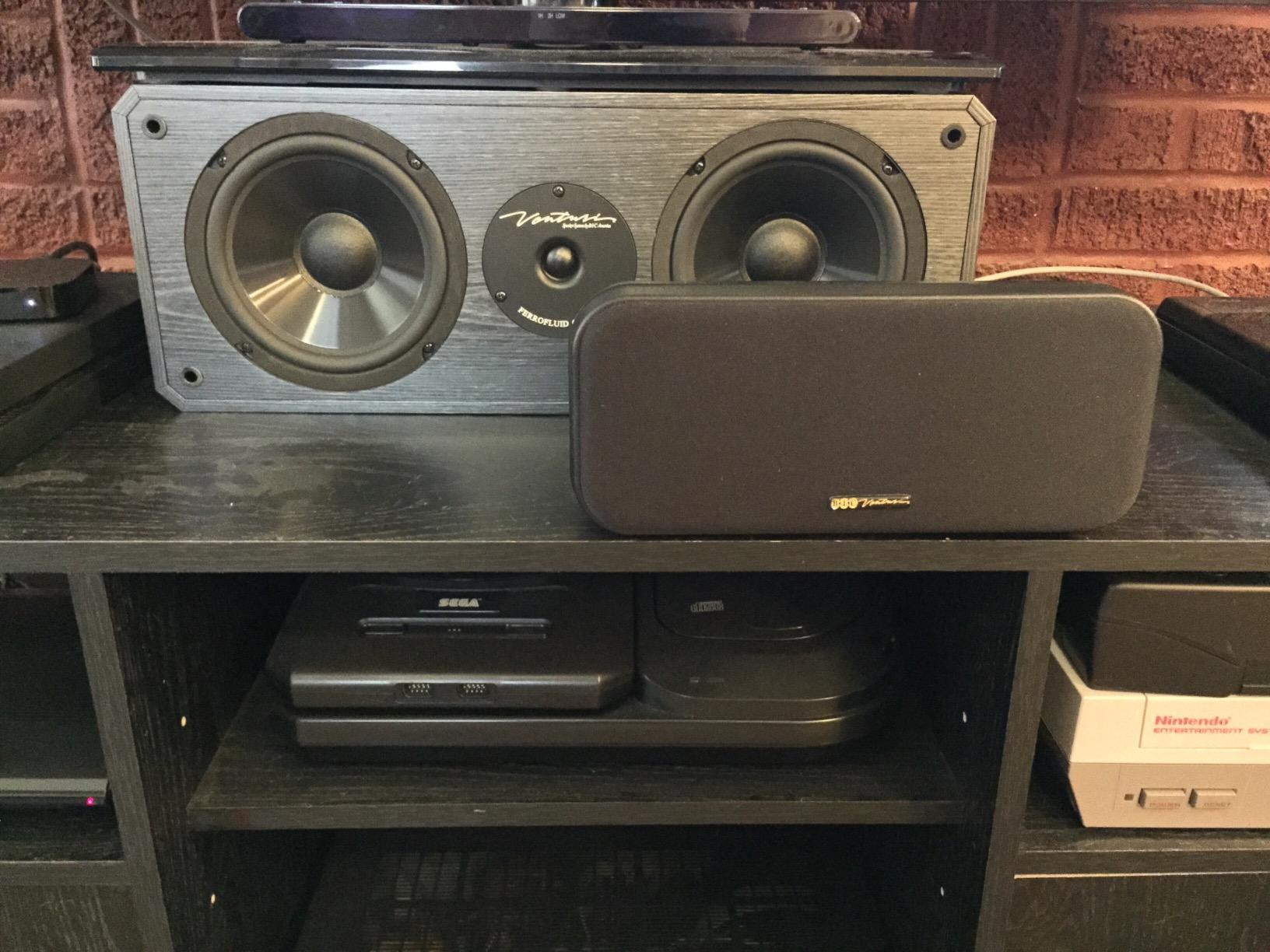
Recommended amplifier power runs from 10 to 175 watts per channel, 8 ohm nominal, so it is flexible across a wide range of receivers. The 3.5 kHz crossover sits higher than many competitors, which is a deliberate choice that keeps the midrange clean and away from the woofer breakup region.
Owners consistently note the need for break-in, describing the first month as brighter and thinner than the speaker eventually becomes. If you judge it in week one you may reject a speaker that most owners rate very highly.
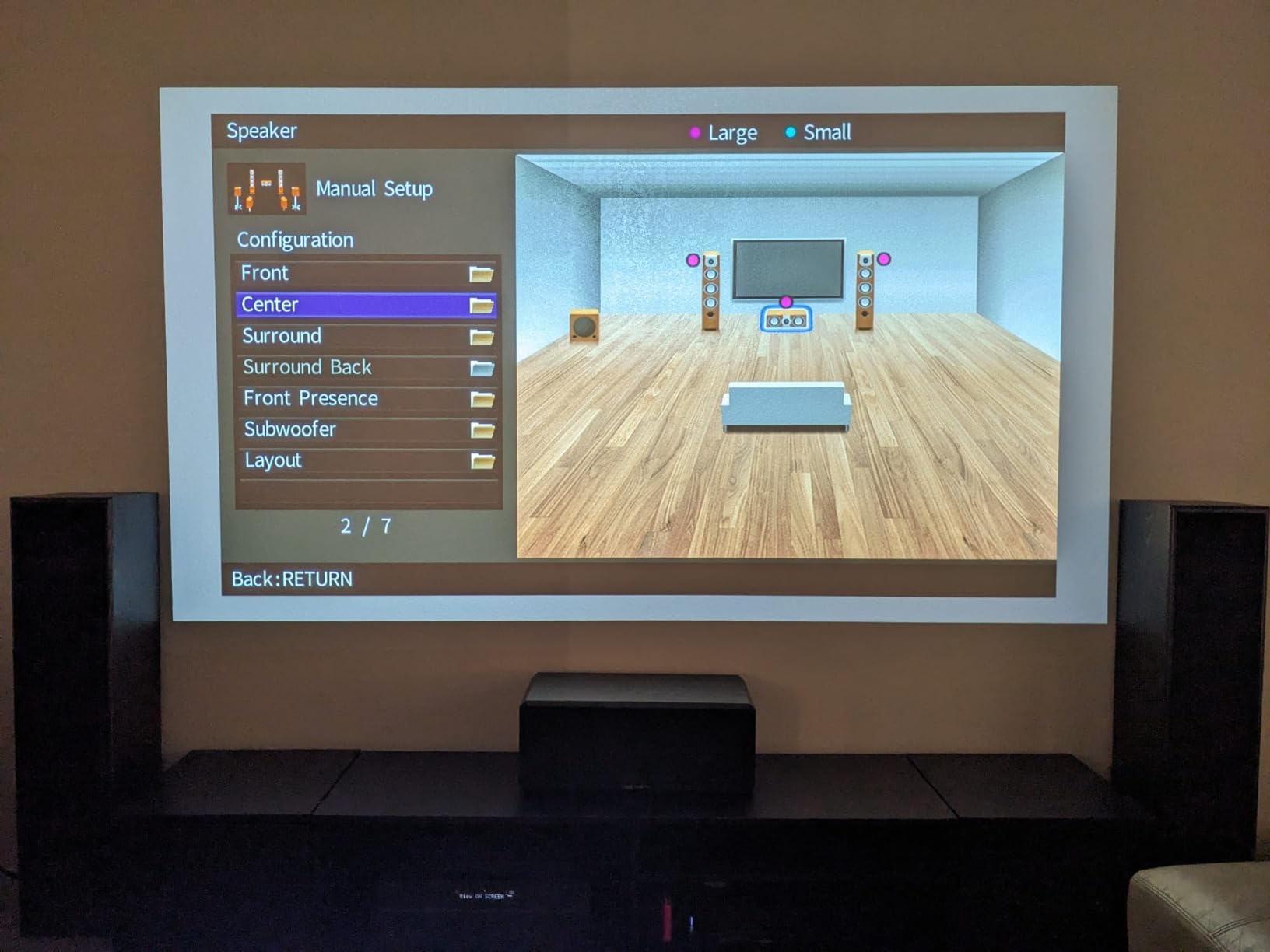
Best use case: midrange-heavy systems and reference-level volume
This is the pick when you want a center with genuine weight under the voice, either because your subwoofer is modest or because you prefer to keep dialog-supporting midbass in the center rather than the LFE channel.
High power handling also makes it a safe choice for a system played loudly, which is the opposite of the weakness that shows up in several smaller centers here.
Where it falls short
The top end is bright. Owners who are sensitive to sibilance should audition it carefully, and a treble adjustment in the receiver usually resolves the issue.
At 19.3 lb and 20 inches wide, this is not a small-room or furniture-friendly option, and the break-in period requires patience before you judge it.
10. SVS Prime Center – A True 3-Way Design for Seamless Transitions
SVS Prime Center Speaker – Premium Black Ash
True 3-way SoundMatch crossover
1 inch aluminum dome tweeter
Twin 5.25 inch composite woofers
Pros
- True 3-way design anchors vocals with pinpoint imaging and seamless transitions
- Wide off-axis dispersion keeps dialogue clear from side seats
- Handles high listening volumes without strain
- Substantial resonance-free build with a Black Ash veneer
Cons
- Bright in-your-face presentation that needs EQ or break-in
- Rear port limits placement against a back wall
- Included speaker feet are considered sub-par by some owners
The Prime Center is a genuine three-way design, and that distinction is the whole conversation in this category. A dedicated midrange section handles the band where human voices live, the 1 inch aluminum dome tweeter takes the top octave, and the twin 5.25 inch composite woofers cover the bass. No single driver is asked to do two jobs at once.
Owners credit that layout with the tightest vocal imaging of any three-way design we recommend at this level, and with dialogue that stays intelligible from seats well off the central axis.
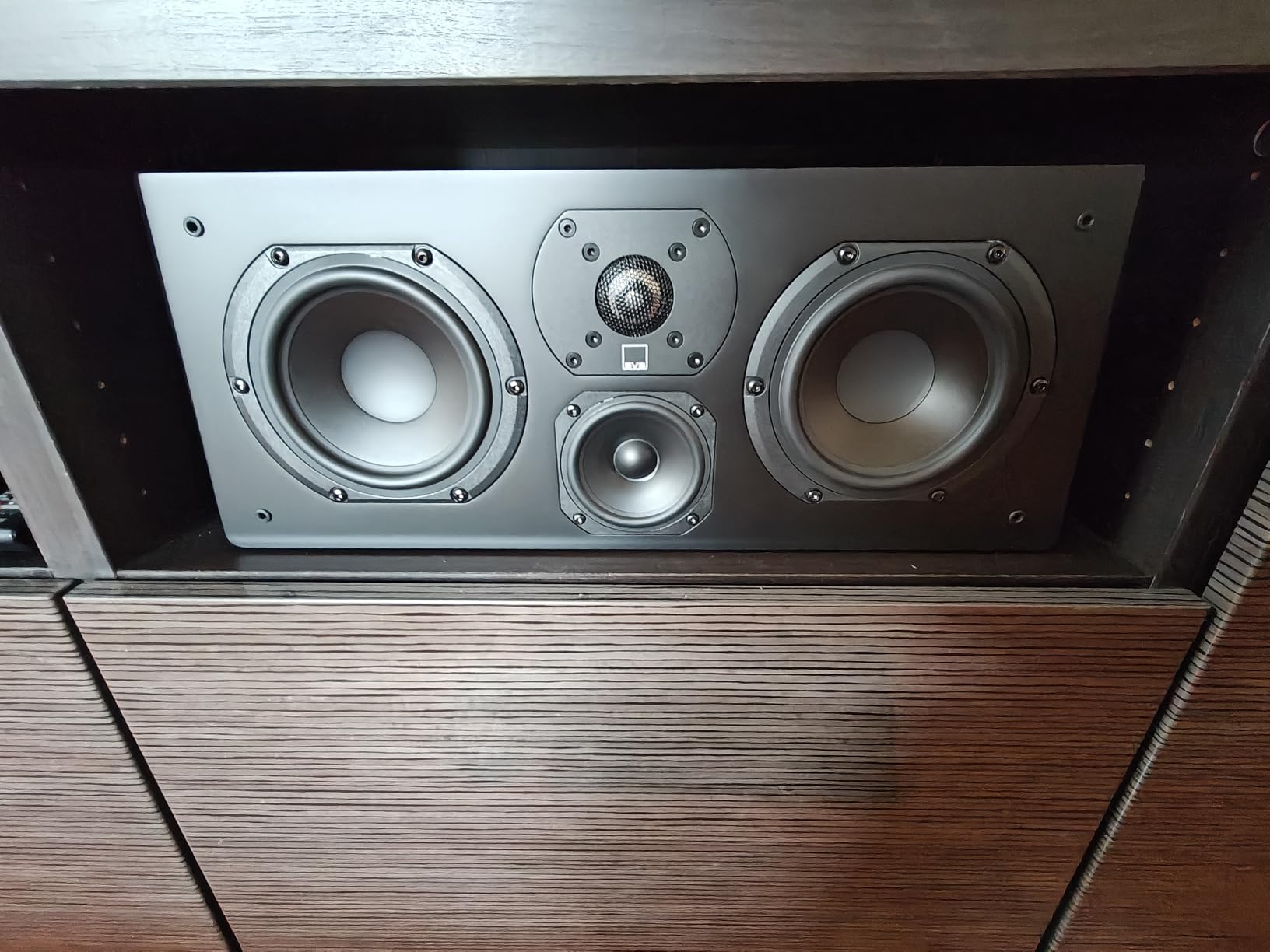
Sensitivity is stated at 96dB, which is among the highest figures in this roundup and makes it easy to drive hard from a receiver. Power handling is rated at 200 watts with 8 ohm nominal impedance.
The common theme across reviews is that it arrives slightly bright and forward, and that a few movies of listening, or a modest dip in the upper midrange through your receiver, settles it into a neutral presentation. Several owners report it as a clear step up from a soundbar-based system.
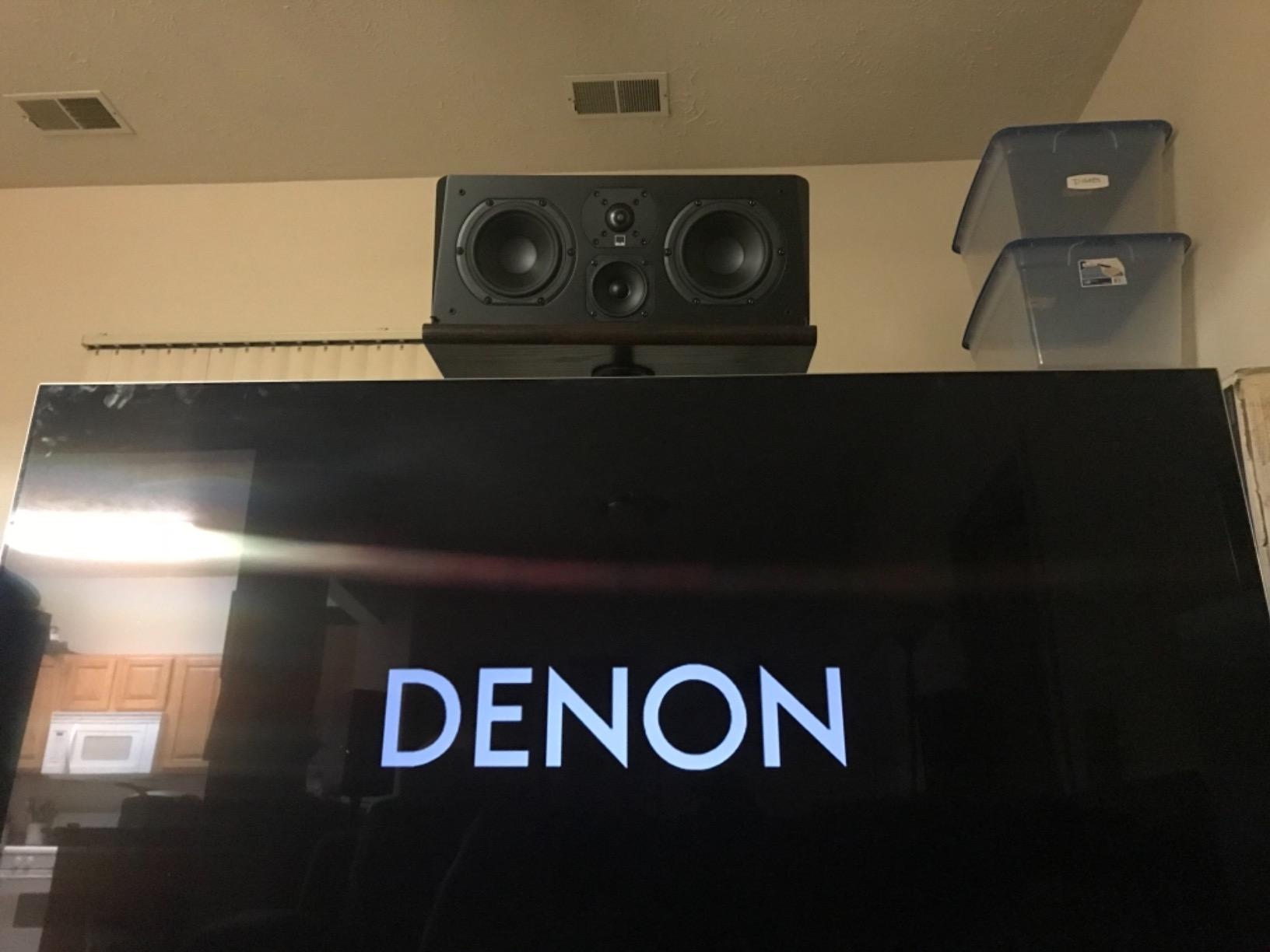
Best use case: buyers who want a dedicated midrange driver
If you have heard three-way centers and noticed that two-way designs sound thin or boxy on voices, this is the direct answer. The dedicated midrange path is the single architectural difference that explains most of what you would hear.
It is also a strong match for wide seating, since the three-way layout distributes output more evenly across the room than a typical two-way cabinet.
Where it falls short
The rear port needs real clearance, so this is a poor choice for a shallow cabinet set against a back wall unless you leave a gap. That is the single most common placement complaint in reviews.
The presentation is forward out of the box and the included feet are considered basic by some owners. Budget for a pair of proper isolation pads if the cabinet is on a resonant surface.
How to Improve Dialogue Clarity Without Buying a Speaker
Before spending money, run through these five steps in order. Each one costs nothing, and forum regulars consistently report that placement fixes outperform speaker upgrades in the first month of ownership.
1. Raise the center to ear height. A speaker on the floor sends dialogue toward your knees. A center channel riser under the television fixes this in minutes, and owners describe the clarity change as dramatic.
2. Aim the tweeter at the listening position rather than straight ahead. A downward tilt on a riser or a slight toe-in on a shelf keeps the horn or dome pointed where you actually sit.
3. Open up rear-firing ports. A center pushed into a media cabinet with its port blocked will sound boomy and will lose output. Leave several inches behind the cabinet or rotate it to face forward.
4. Adjust the center level trim. Most receivers let you shift the center channel in steps. Moving it up two or three steps while dropping the subwoofer a matching amount is often the fastest fix for dialogue buried under effects.
5. Use dialogue enhancement and dynamic range controls carefully. These help at low volume, but heavy use removes the impact that makes a scene land. A light touch late at night is more useful than an aggressive setting all day.
After the free changes, the next lever is calibration. Run your receiver auto-calibration with the center at its final position and final volume, because measurement results shift when a cabinet moves closer to a wall.
Buying Guide: 2-Way vs 3-Way vs Horn-Loaded Designs
There are three architectural approaches in this roundup, and understanding the difference makes the buying decision much faster. Each one trades cabinet size against midrange precision, and none is universally better.
Two-way designs
A 2-way center uses woofers that handle both bass and midrange, crossed over to a single tweeter. It is the most compact and least expensive approach, and it works well when a subwoofer is carrying everything below roughly 80 Hz. The tradeoff is that each woofer is asked to cover a wider band, so voices can sound slightly boxy or thin at the crossover.
The Klipsch R-52C, Polk T30, Micca MB42-C, Yamaha NS-C210BL and BIC DV-62CLRS are all two-way designs. The BIC stands out because its 6.5 inch woofers have enough cone area to handle the crossover cleanly.
Three-way designs
A 3-way center adds a dedicated midrange driver so the woofer, mid and tweeter each work in a narrower band. That is the architecture most forum members point to when they say voices sound natural rather than thin, and it is why the SVS Prime Center is on this list despite a smaller owner base than some competitors.
The cost is cabinet size and weight. Three-way centers are physically larger, which pushes them out of shallow media furniture and into dedicated shelf space.
Horn-loaded designs
A horn-loaded center mounts a compression driver in a waveguide, typically a square Tractrix horn on Klipsch models. The horn controls dispersion and increases efficiency, which is why the R-52C and R-25C publish sensitivity figures above 94 dB. In a small room driven by a modest receiver, that efficiency is worth more than any amount of bass extension.
The honest caveat, raised in nearly every owner thread, is that horns can read as forward or fatiguing for sibilance-sensitive listeners, especially without room correction. If you are sensitive to high frequencies, audition before committing.
Matching, power and placement
Timbre matching is the factor buyers underestimate most. When a scene pans from the center speaker to a front speaker, any tonal difference becomes obvious as a change of color on the voice. Members on home theater forums consistently recommend buying the center first and choosing the rest of the system around it, rather than the reverse.
A matched LCR speaker, where the same design runs as all three fronts, solves this cleanly. If your system is already built, buy the center from the same brand and series as your front speakers whenever that option exists.
On power, match sensitivity to your amplifier rather than buying on wattage. A 95 dB center driven by a 70 watt receiver will produce cleaner dialogue than an 88 dB center driven by 150 watts, because the efficient design asks less of the amplifier at the same listening level.
Finally, measure the cabinet before you order. Center channels are wider than people expect, and rear-firing ports need clearance behind the cabinet. Every model here is a front-firing or sealed-forward design that still breathes better with air behind it. If you want a guide to how the rest of a system should be chosen, our bookshelf speaker guide covers the matching process, and if your setup doubles as a multi-room audio system, the powered PA speaker picks are worth a look.
On durability, we favor brands with long published warranty terms and replacement parts that stay available for years. The seven year warranty on the BIC DV-62CLRS and the five and six year terms from Klipsch and Polk reflect that, while the one year term on the Micca MB42-C is the clearest example of where longevity support varies. If any of your listening happens away from a climate-controlled room, our marine speaker picks cover the weatherproof side of the same decisions.
Frequently Asked Questions
What is the best center speaker for dialogue?
The Klipsch R-52C is our pick for dialogue clarity. Its horn-loaded 1 inch LTS tweeter delivers crisp consonants, its dual 5.25 inch woofers supply a full midrange, and 95dB sensitivity means it stays clear without straining a modest receiver. If your room is small or your shelf is shallow, the Polk Audio TL1 is the compact alternative.
What is the best center channel speaker of all time?
Without a fixed budget the enthusiast answer is a true three-way center, and the SVS Prime Center is the strongest example in this roundup. A dedicated midrange driver means no single driver covers both bass and voice frequencies, which is what separates natural-sounding dialogue from thin or boxy vocals.
How do I improve dialogue clarity on my TV?
Raise the center to ear height and tilt the tweeter toward your seat, make sure a rear-firing port is not blocked by a media cabinet, then raise the center level trim on your receiver by two or three steps while dropping the subwoofer to match. Run auto-calibration again after moving anything.
Are center channel speakers worth it?
Yes, for anyone with a surround receiver or a soundbar that has a discrete center output. Dialogue is mixed to a single center channel, so a weak or low-level center buries the most important content in a film. Fixing the center is usually cheaper and more effective than upgrading the subwoofer.
What are the differences between 2-way and 3-way center channel speakers?
A 2-way center crosses woofers over directly to a single tweeter, so each woofer covers bass and midrange at once. A 3-way center adds a dedicated midrange driver, so each driver works in a narrower band and voices sound more natural. Three-way cabinets are physically larger and cost more.
Final Verdict for 2026
The Klipsch R-52C is the best center channel speaker for dialogue in this group, pairing a horn-loaded tweeter with 95 dB sensitivity and an owner rating that reflects long-term satisfaction rather than first impressions. The Polk T30 is the value pick and the easiest upgrade for a budget 5.1 system, while the Polk TL1 covers small rooms and shallow shelves.
For larger spaces, the Klipsch RP-504C holds a coherent soundstage across a wide seating area. The Polk ES35 handles slim furniture and flexible channel counts, the Yamaha NS-C210BL suits compact living rooms, and the BIC DV-62CLRS delivers the deepest midbass with the longest warranty in the roundup.
If you want a dedicated midrange driver and nothing else, the SVS Prime Center is the one to audition. Before buying anything, though, check your receiver’s dialogue settings and raise the center to ear height, because placement still beats hardware more often than not.