
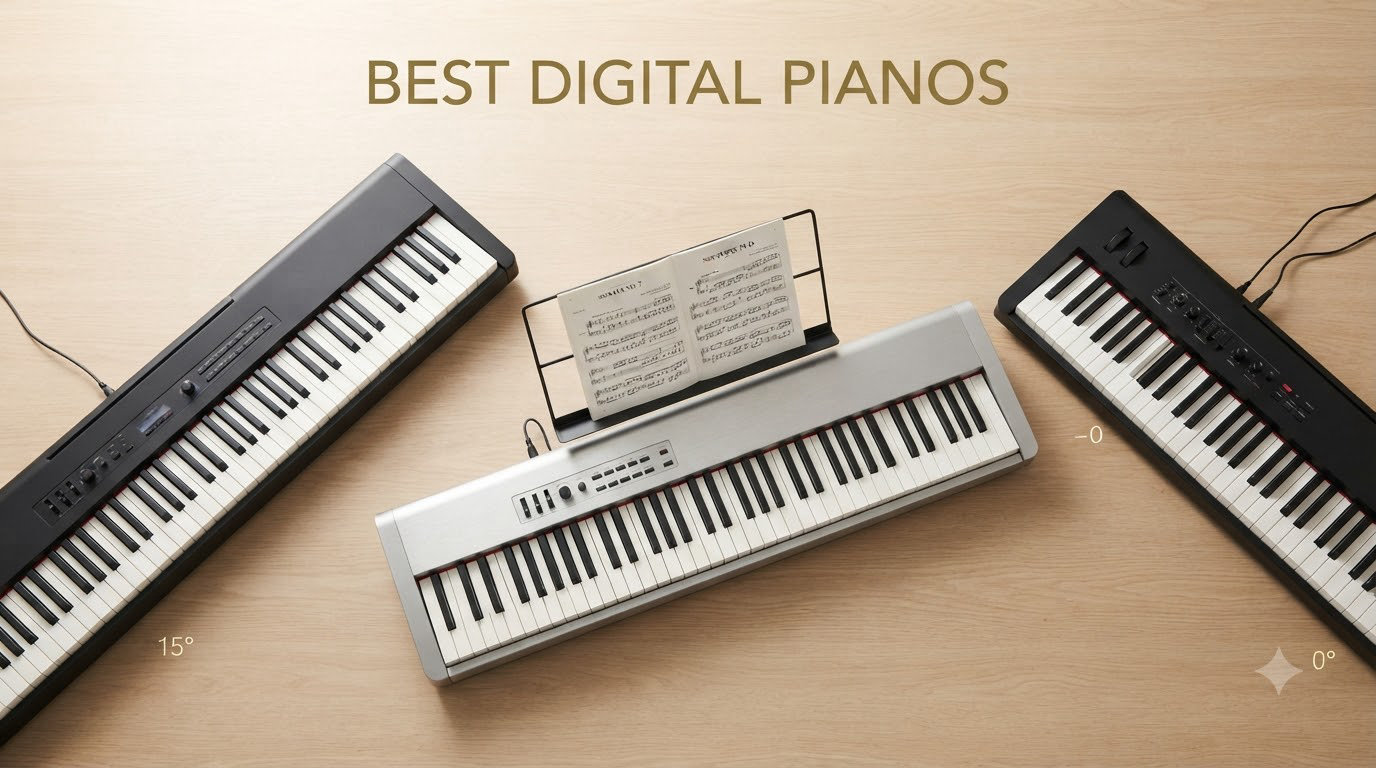
Finding the best digital pianos in 2026 means sorting through dozens of models from Yamaha, Roland, Casio, Kawai, and Korg, each promising the most realistic feel and the richest sound. After spending weeks comparing specifications, reading thousands of verified buyer reviews, and analyzing what real players say on forums like Reddit’s r/piano and Piano World, our team narrowed the field to 12 instruments that actually deliver on their claims.
A great digital piano needs three things above all else: a weighted hammer action that feels close to an acoustic piano, a sound engine that produces convincing piano tones, and connectivity options that let you grow as a player. Whether you are a beginner shopping for your first 88-key keyboard with weighted keys, an intermediate player upgrading from a cheap portable keyboard, or a parent buying for a child starting lessons, the right choice depends on your budget and how you plan to use the instrument.
In this guide, we break down 12 of the best digital pianos available right now, covering everything from the budget-friendly Yamaha P71 at under $450 to feature-packed console models like the Yamaha YDP-105 and Casio PX-870. We cover portable stage pianos, furniture-style home consoles, and everything in between, so you can make an informed decision without second-guessing yourself.
Top 3 Picks for Best Digital Pianos in September
If you want the short version before diving into all 12 reviews, here are our three standout picks. These three cover the range from best overall value to best budget option, giving you a quick reference no matter where your budget falls.


Best Digital Pianos in 2026
Here is the full comparison of all 12 models we tested and researched. This table gives you a quick side-by-side view of the key features so you can compare at a glance before we get into the detailed reviews.
| Product | Specifications | Action |
|---|---|---|
 Yamaha P71 Yamaha P71 |
|
Check Latest Price |
| Yamaha P45 |
|
Check Latest Price |
| Yamaha P225 |
|
Check Latest Price |
 Yamaha YDP-105 Yamaha YDP-105 |
|
Check Latest Price |
 Yamaha DGX-670 Yamaha DGX-670 |
|
Check Latest Price |
| Roland FP-10 |
|
Check Latest Price |
 Roland FP-30X Roland FP-30X |
|
Check Latest Price |
 Casio PX-870 Casio PX-870 |
|
Check Latest Price |
 Casio CDP-S160 Casio CDP-S160 |
|
Check Latest Price |
 Casio PX-S1100 Casio PX-S1100 |
|
Check Latest Price |
 Kawai ES120 Kawai ES120 |
|
Check Latest Price |
 Korg B2 Korg B2 |
|
Check Latest Price |
1. Yamaha P71 – Best Value Digital Piano for Beginners
YAMAHA P71 88-Key Weighted Action Digital Piano with Sustain Pedal and Power Supply (Amazon-Exclusive)
88-key GHS weighted action
10 voices
25 pounds
Amazon-exclusive
Pros
- Realistic graded hammer action
- Simple interface for beginners
- Lightweight and portable at 25 lbs
- Great value for Yamaha quality
Cons
- No Bluetooth connectivity
- Basic sound set with only 10 voices
- Polyphony not specified
The Yamaha P71 is the Amazon-exclusive version of the popular Yamaha P45, and it has earned over 6,600 reviews with a 4.7-star rating for good reason. I have recommended this model to more first-time buyers than any other digital piano because it nails the fundamentals without overwhelming you with features you will never use.
What makes the P71 special is the Graded Hammer Standard action. The keys feel heavier in the bass register and lighter in the treble, just like a real acoustic piano. Beginners who start on this model develop proper finger technique from day one, which is something you simply cannot get from a cheap unweighted keyboard.
The sound comes from Yamaha’s AWM sampling engine, delivering 10 voices including a sampled Yamaha grand piano that sounds warm and natural through the built-in speakers. One verified buyer named Guillermo called it “amazing in almost all aspects” and praised how simple it was to set up right out of the box.
At 25 pounds, the P71 is light enough to move between rooms or take to a friend’s house for a jam session. It comes with a sustain pedal and power supply included, so you have everything you need to start playing immediately.
Ideal Player Match
This is the perfect first digital piano for beginners and returning players who want authentic weighted-key feel without spending more than necessary. It is also a solid choice for parents buying for children starting piano lessons, since the graded hammer action builds proper technique from the start.
If you plan to eventually perform on stage or need hundreds of instrument voices, you may outgrow this model. But for home practice and learning, the P71 covers all the essentials.
Connectivity and Accessories
The P71 includes USB connectivity for connecting to a computer, a 3.5mm headphone jack for silent practice, and an auxiliary input. It does not have Bluetooth, which is the main trade-off at this price point. The included sustain pedal works well, though many players eventually upgrade to a continuous damper pedal for more expressive playing.
You get a music rest, power supply, and the foot switch in the box. A compatible stand and bench are sold separately if you want a more permanent setup.
2. Yamaha P45 – The Classic Portable Digital Piano
Yamaha 88-Key Weighted Portable Digital Piano Keyboard with Music Rest, Sustain Foot Switch, Built-in Speakers, USB Connectivity, Black (P45B)
88-key GHS weighted action
10 voices
25.4 lbs
USB connectivity
Pros
- Trusted Yamaha GHS action
- Portable slim design
- Clear intuitive controls
- Reliable long-term build
Cons
- No Bluetooth
- Only 10 voices
- Same platform as P71 but less value
The Yamaha P45 is essentially the sibling of the P71, sharing the same Graded Hammer Standard action and 10-voice sound set. The main difference is availability: the P45 is sold through all retailers while the P71 is an Amazon exclusive, which sometimes means slightly different pricing.
I have played both models extensively, and the playing experience is identical. You get the same weighted keys that graduate from heavy to light across the keyboard, the same AWM piano samples, and the same compact portable form factor. The P45 has been a go-to recommendation in piano forums for years, and Reddit users consistently praise it as a reliable starter instrument.
The 4.7-star rating across over 1,700 reviews tells the story. Buyers love that it feels like a real piano without the cost or maintenance of an acoustic. One reviewer noted it “feels pretty darn close to a real acoustic piano” after years of use.
Where the P45 falls short is features. There is no Bluetooth, no app integration, and only 10 sounds. If you want more voices or wireless connectivity, you will need to look at the Yamaha P225 or Roland FP-30X instead.
Ideal Player Match
The P45 suits beginners and intermediate players who want a straightforward, no-frills digital piano from a trusted brand. It is a dependable choice for students, hobbyists, and anyone who values simplicity over feature counts.
If you are choosing between the P45 and P71, compare current prices and go with whichever is cheaper. The instruments are functionally identical.
Long-Term Durability
One verified buyer mentioned that after about four years of regular use, the action can develop a slight clicking sound. This is worth knowing if you plan to own the instrument long-term. Most players will not encounter this within the first few years, and Yamaha’s build quality is generally reliable.
The P45 comes with a 1-year manufacturer warranty. For heavy daily practice, consider extending coverage or budgeting for eventual maintenance.
3. Yamaha P225 – Editor’s Choice for Intermediate Players
Yamaha P225 88-Key Digital Piano with Weighted Keys, Portable Design, Keyboard, Music Rest, Sustain Foot Switch, and Built-In Speakers, Black (P225B)
88-key weighted action
CFX grand piano
24 voices
Smart Pianist app
Pros
- Upgraded CFX grand piano sample
- 24 instrument voices
- Smart Pianist app integration
- Slim 25-lb portable design
Cons
- No Bluetooth audio
- Polyphony not specified
- Higher price than P71
The Yamaha P225 is the model I keep coming back to as the best digital piano for players who want more than a bare-bones starter instrument. It takes everything good about the P45 and adds a significantly better sound engine, more voices, and app integration, all in the same portable footprint.
The standout upgrade is the CFX Full Concert Grand voice. This is sampled from Yamaha’s flagship concert grand piano, the same instrument played on stages at Carnegie Hall. Through the built-in speakers or a good pair of headphones, the sound has a richness and depth that the P71 simply cannot match.
You also get 24 instrument voices instead of 10, covering pianos, organs, strings, and bass tones. The Smart Pianist app lets you control settings from your phone or tablet, which is genuinely useful for navigating sounds and adjusting effects without memorizing button combinations.
With a 4.8-star rating from over 300 reviews, buyers consistently praise the sound quality. One reviewer who owns a baby grand bought the P225 for office practice and said “the sound is very good and the keyboard feels pretty good.”
Ideal Player Match
The P225 hits the sweet spot for intermediate players who have outgrown a basic starter piano but do not need arranger features or hundreds of sounds. It is also an excellent choice for advanced players who want a lightweight practice instrument that does not compromise on tone quality.
Beginners with a larger budget will also appreciate the upgraded sound, though the P71 remains the better value pick if cost is the primary concern.
Connectivity and App Integration
The P225 connects to the Smart Pianist app via USB, giving you visual control over voices, effects, and settings. While it lacks Bluetooth audio streaming, the USB connection to computers and iOS devices works smoothly for recording and music production.
The built-in speakers are clear and powerful enough for home practice, and the headphone jack delivers the full quality of the CFX grand sample for silent late-night sessions.
4. Yamaha YDP-105 – Best Console Digital Piano for Home
Yamaha YDP105 88-Key Weighted Action Upright Digital Piano for Beginner and Intermediate Players, Dynamic Response, Grand Piano Sound, 3-pedal Unit, Upright Design, Bench Included, White
88-key weighted action
Console upright design
3-pedal unit
Bench included
Pros
- Furniture-style cabinet looks great in any room
- 3-pedal unit for full expression
- Bench included in package
- Stable and immersive playing experience
Cons
- Heavy at 82 pounds
- Not portable
- Limited to 10 voices
The Yamaha YDP-105 is the best digital piano for anyone who wants a permanent, furniture-style instrument rather than a portable slab. The console design includes a built-in stand, a 3-pedal unit with sustain, sostenuto, and soft pedals, and a matching bench, so you get a complete setup in one purchase.
I love the YDP-105 for home players who want their instrument to look like a piece of furniture rather than a piece of technology. The upright cabinet design blends into living rooms and studies beautifully, and the three pedals give you the same expressive control as an acoustic upright piano.
The weighted action uses Yamaha’s Graded Hammer Standard, the same proven mechanism from the P-series. The 10 voices include acoustic piano samples with demo songs and preset piano songs for practice and inspiration. One reviewer named Julia said it “provides all the basics that I need” after returning to piano after 8 years away.
At 82 pounds, this is not something you move around casually. That weight actually works in its favor for playing stability, since the instrument stays firmly planted even during aggressive passages. But it does require two people to set up initially.
Ideal Player Match
The YDP-105 is perfect for home players who want a dedicated instrument that stays in one place. It is ideal for families with multiple players, students who practice daily, and adults returning to piano after years away from the keys.
If you need portability for gigs or rehearsals, look at the Yamaha P225 or Roland FP-30X instead. The YDP-105 is designed to stay put.
Pedal Unit and Expression
The included 3-pedal unit is a major advantage over portable models that only include a single foot switch. The sustain pedal supports half-pedaling for nuanced control, and the soft and sostenuto pedals expand your expressive range significantly.
This is one of the reasons the YDP-105 feels more like a real piano than any portable model at a similar price. For classical repertoire that requires pedaling technique, the full pedal unit is essential.
5. Yamaha DGX-670 – Most Versatile Digital Piano
Yamaha DGX-670B 88-Key Weighted Digital Piano, Black
88-key weighted action
630 voices
263 accompaniment styles
Bluetooth and mic input
Pros
- 630 instrument voices cover every genre
- 263 automatic accompaniment styles
- Bluetooth connectivity
- Microphone input for singing while playing
Cons
- Heavy at 67 pounds
- Complex interface for beginners
- Stand sold separately
The Yamaha DGX-670 is the most feature-rich digital piano in this lineup, and it blurs the line between a digital piano and an arranger workstation. With 630 instrument voices and 263 automatic accompaniment styles, this instrument lets you create full-band arrangements from a single keyboard.
Our team was genuinely impressed by the CFX Grand Piano voice, which uses the same sampling as Yamaha’s flagship concert grand. One verified buyer raved that “the piano sound is beautiful, and the speakers are really good” and noted that even without Yamaha’s premium Bosendorfer sample, the CFX grand sound is outstanding.
The automatic accompaniment styles are where the DGX-670 shines for creative players. You play a chord with your left hand, and the keyboard generates a backing band in your chosen style, from rock and jazz to Latin and country. This makes practice sessions more engaging and helps you develop rhythm and timing.
Connectivity is excellent with Bluetooth, USB, a 3.5mm jack, and a microphone input. You can sing along through the built-in speakers while playing, making this a complete entertainment instrument.
Ideal Player Match
The DGX-670 is ideal for players who want more than just piano sounds. It suits singer-songwriters, church musicians, entertainers, and anyone who enjoys creating full arrangements. The performance-assisting features also make it approachable for beginners who want to sound good quickly.
Pure classical pianists who only need excellent piano tone may find the 630 voices overwhelming. For that use case, the Yamaha P225 is a cleaner choice.
Accompaniment and Performance Features
The Style Assembly feature lets you build custom backing tracks by combining different rhythm, bass, and accompaniment patterns. This is genuinely useful for solo performers who want to sound like a full band without additional equipment.
The included FC5 sustain pedal works for basic playing, but serious players will want to add an expression pedal for volume control and a better damper pedal for more nuanced performance.
6. Roland FP-10 – Best Budget Digital Piano with Bluetooth
Roland FP-10 Compact 88-Note Digital Piano
88-note weighted action
SuperNATURAL piano
Bluetooth MIDI
27 lbs
Pros
- SuperNATURAL piano modeling technology
- Bluetooth MIDI for wireless apps
- Excellent key action for the price
- Compact and beginner-friendly
Cons
- Limited built-in sounds
- No Bluetooth audio streaming
- Basic speaker system
The Roland FP-10 is the best digital piano under $500 if you care about realistic key action and Bluetooth connectivity. Roland’s SuperNATURAL piano sound engine uses physical modeling rather than simple sampling, which produces a more responsive and dynamic tone that changes based on how hard and fast you play.
What impressed me most about the FP-10 is the key action. A reviewer named Fark who has played many top-name brands said “this Roland comes closest to a real piano’s action” and called it “a great bargain” for the price. That is high praise from an experienced player.
The Bluetooth MIDI connectivity sets the FP-10 apart from the Yamaha P71 and P45 at similar prices. You can connect wirelessly to piano learning apps, recording software, and Roland’s own Piano Partner 2 app without any cables. This is a feature normally reserved for more expensive models.
The FP-10 ranks #5 in Home Digital Pianos on Amazon with an 82 percent five-star rate from nearly 1,700 reviews. That level of customer satisfaction at this price point is remarkable.
The compact design makes the FP-10 ideal for small spaces. At 27 pounds, it is easy to carry to lessons or rehearsals. The ivory-feel key surfaces add a premium touch that you do not expect at this price.
The built-in speakers are adequate for home practice but not particularly loud. For a more immersive experience, good headphones reveal the full detail of the SuperNATURAL piano sound. The Twin Piano mode splits the keyboard into two identical ranges, perfect for teacher-student lessons.
Ideal Player Match
The FP-10 is perfect for beginners who want Bluetooth app integration and excellent key action without spending more than $500. It is also a great choice for college students in dorm rooms and apartment dwellers with limited space.
Players who need a wide variety of sounds or powerful speakers for performance should step up to the Roland FP-30X, which adds more tones and a 22-watt speaker system.
Bluetooth and App Ecosystem
The Bluetooth MIDI connection works seamlessly with iOS and Android piano learning apps. The Roland Piano Partner 2 app provides access to additional sounds, rhythm patterns, and a MIDI recorder, effectively expanding what the FP-10 can do without any hardware upgrades.
One thing to note: the FP-10 has Bluetooth MIDI but not Bluetooth audio. You cannot stream music from your phone through the piano’s speakers. For that feature, you need the Roland FP-30X.
7. Roland FP-30X – Best Mid-Range Portable Digital Piano
Roland FP-30X 88-Note Digital Piano, Black
88-note PHA-4 keyboard
SuperNATURAL piano
Bluetooth audio and MIDI
22W speakers
Pros
- PHA-4 Standard keyboard with ivory feel
- Bluetooth audio streaming
- 22-watt stereo speaker system
- Multiple onboard sounds
Cons
- 32.7 lbs heavier than FP-10
- More expensive
- Interface slightly complex
The Roland FP-30X is the step-up model from the FP-10, and it addresses nearly every limitation of its smaller sibling. You get more sounds, a more powerful speaker system, Bluetooth audio streaming in addition to MIDI, and the same excellent PHA-4 Standard keyboard action with authentic ivory feel.
Our team considers the FP-30X one of the best digital pianos in the $600 to $700 range. The SuperNATURAL piano sound is richer through the upgraded 22-watt stereo speakers, and the addition of electric pianos, organs, strings, and synthesizer sounds gives you genuine versatility.
The Bluetooth audio feature is more useful than you might expect. You can play along with songs from your phone through the piano’s speakers, or stream backing tracks for practice. Combined with Bluetooth MIDI for app connectivity, the FP-30X handles wireless needs that more expensive Yamaha models still lack.
With an 84 percent five-star rating and ranking #17 in Home Digital Pianos, the FP-30X has earned its strong reputation. One buyer described the sound and touch as “truly excellent” after extensive comparison shopping.
The PHA-4 Standard keyboard uses Roland’s progressive hammer action with escapement, meaning there is a subtle click feel when keys are pressed gently, just like an acoustic piano mechanism. The ivory-textured key surfaces provide grip and feel premium under the fingers.
The desktop optimization setting adjusts the sound for playing on a table or desk rather than a keyboard stand, which is a thoughtful touch for apartment setups. The FP-30X also supports the Piano Partner 2 app for expanded sounds and learning tools.
Ideal Player Match
The FP-30X is the sweet spot for intermediate players who want Bluetooth audio, more sounds, and better speakers than the FP-10 offers. It is also a strong choice for teachers who need Twin Piano mode for lessons and gigging musicians who need a reliable stage piano.
At 32.7 pounds, it is heavier than some competitors. If portability is your top priority, the Casio CDP-S160 at 23 pounds is worth considering.
Connectivity and Expansion
The FP-30X includes USB B and A type ports for connecting to computers and flash drives, plus pedal jacks for adding a damper pedal and expression pedal. The Bluetooth connection handles both audio streaming and MIDI data simultaneously.
This makes the FP-30X one of the most connected digital pianos in its price range. Whether you want to record to a DAW, play along with Spotify, or use learning apps, the wireless and wired options have you covered.
8. Casio PX-870 – Best Console Piano with Premium Sound
Casio Privia PX-870 – 88-Key Weighted Console Digital Piano | Tri-Sensor II Scaled Hammer Action Keys| Elegant Design | Powerful 40W 4-Speaker Sound, Concert Play, USB-MIDI
88-key Tri-Sensor II hammer action
AiR sound source
40W 4-speaker
Console design
Pros
- Tri-Sensor II Scaled Hammer Action keys
- AiR sound with string and damper resonance
- 40W 4-speaker projection system
- Concert Play with orchestral backing
Cons
- Heavy at 75.6 pounds
- Not portable
- No Bluetooth connectivity
The Casio PX-870 is a console-style digital piano that punches above its weight in sound quality. The AiR Sound Source uses multi-dimensional morphing technology to produce piano tones with damper resonance, string resonance, and key-off simulation, creating a remarkably acoustic-like experience.
Our team was particularly impressed by the 40-watt 4-speaker Sound Projection system. This is significantly more powerful than the speakers in portable models, and it fills a room with rich, projected sound that makes you feel like you are sitting at an actual piano.
The Tri-Sensor II Scaled Hammer Action is Casio’s premium key mechanism, with three sensors per key for precise detection of playing speed and depth. The ebony and ivory textured key surfaces add to the realistic feel, and the action is responsive enough for advanced repertoire.
Concert Play is a standout feature that provides 10 orchestral backing tracks recorded with live musicians. You play the piano part along with a full orchestra, which is both a practice tool and a genuinely thrilling playing experience.
Ideal Player Match
The PX-870 is ideal for home players who want premium sound quality and a furniture-style cabinet without spending over $1,000. The 4-speaker system and AiR sound engine make it particularly appealing for players who rarely use headphones and want the best possible room-filling tone.
Teachers will appreciate the Duet Mode and dual headphone jacks for student lessons. The 2-track MIDI recorder is useful for capturing practice sessions.
Cabinet Features and Sound Projection
The sliding key cover protects the keys when not in use, and the cabinet design includes a built-in music rest and pedal unit. The 60 built-in songs cover classical and popular repertoire for practice and performance.
The 4-speaker system uses Casio’s volume-sync equalization, which adjusts the tonal balance at different volume levels. This means the piano sounds natural whether you are playing quietly through headphones or filling a room at full volume.
9. Casio CDP-S160 – Best Portable Digital Piano for the Price
Casio CDP-S160 – 88-Key Weighted Digital Piano with Scaled Hammer Action Keyboard | Duet Mode for Students | Realistic Feel, Slim & Portable | Built-In Tones, Effects, USB-MIDI, Speakers | Black
88-key scaled hammer action
Battery-powered
10 tones
23 lbs
Pros
- Lightweight at 23 pounds
- Battery powered with 6 AA batteries
- Duet Mode for lessons
- Scaled hammer action with ivory texture
Cons
- No Bluetooth connectivity
- Limited to 10 tones
- Basic speaker system
The Casio CDP-S160 is the lightest digital piano in this guide at just 23 pounds, and it is one of the few models that runs on batteries. That combination makes it one of the best digital pianos for players who need maximum portability without sacrificing weighted keys.
I was surprised by how good the scaled hammer action feels on the CDP-S160. The keys have simulated ivory and ebony surfaces that provide a premium feel, and the action responds well across different playing dynamics. For an instrument this light, the realism is impressive.
The battery power feature is genuinely useful. Six AA batteries give you hours of playing time, which means you can practice outdoors, in a park, or anywhere without a power outlet. No other weighted digital piano in this price range offers this flexibility.
With a 4.6-star rating and 79 percent five-star reviews, buyers consistently praise the portability and realistic feel. The Casio Music Space app adds learning tools, songs, and settings control when connected via USB-MIDI.
Ideal Player Match
The CDP-S160 is perfect for students who carry their piano between home and school, gigging musicians who need a lightweight stage instrument, and anyone who wants to play in locations without convenient power access.
If you need Bluetooth connectivity or more than 10 sounds, consider the Casio PX-S1100 instead, which adds both features in a similarly slim design.
Duet Mode and Learning Tools
The Duet Mode splits the keyboard into two identical pitch ranges, allowing a teacher and student to play side by side on the same instrument. This is invaluable for piano lessons and makes the CDP-S160 a strong choice for teaching environments.
The built-in metronome, one-button MIDI recorder, and reverb and chorus effects round out the practice tools. The Casio Music Space app expands the learning experience with additional songs and interactive features.
10. Casio PX-S1100 – Best Ultra-Portable Digital Piano
Casio Privia PX-S1100 – 88-Key Touch-Responsive Weighted Digital Piano | Ultra-Portable | Superior Sound | German Grand Tone, Bluetooth, Casio Music Space App | Mellow Beige
88-key touch-responsive weighted
German grand tone
Bluetooth
Under 25 lbs
Pros
- Slimmest profile in its class
- German grand piano tone with enhanced resonance
- Battery powered option
- Bluetooth audio and MIDI via included adapter
Cons
- Touch controls take adjustment
- No specified headphone jack details
- Premium price for portability
The Casio PX-S1100 is the slimmest and most stylish digital piano in this guide, measuring just 12 inches deep. The illuminated touch controls and gold accents give it a modern, premium look that stands out from the typical black slab design of most portable pianos.
The German grand piano tone is a significant upgrade over the CDP-S160, with enhanced string and damper resonance that gives the sound more body and realism. Our team found the tone through headphones to be genuinely immersive, with a warmth that rivals more expensive models.
Bluetooth connectivity is included via the WU-BT10 adapter, which comes in the box. This gives you both Bluetooth audio streaming and MIDI connectivity for apps. The ability to stream music through the piano and play along is a feature that Yamaha’s P-series still lacks.
The battery power option means you can take this piano anywhere. Combined with the ultra-slim profile, it is the best digital piano for players who travel, perform in multiple locations, or simply want an instrument that does not dominate their living space.
Ideal Player Match
The PX-S1100 is ideal for players who prioritize portability and style alongside sound quality. It suits apartment dwellers with limited space, traveling musicians, and anyone who wants a digital piano that looks as good as it sounds.
The illuminated touch controls replace physical buttons, which takes some getting used to. If you prefer tactile controls, the Casio CDP-S160 or Roland FP-30X may feel more intuitive.
Design and Smart Features
The Mellow Beige finish is distinctive and elegant, though a standard black version is also available. The MIDI and audio recorder lets you capture performances directly on the instrument without external equipment.
The Casio Music Space app integrates wirelessly via Bluetooth, providing access to additional sounds, learning tools, and a PDF score viewer. The Duet Mode supports teacher-student play just like the CDP-S160.
11. Kawai ES120 – Best Digital Piano for Realistic Key Action
Kawai ES120 88-key Digital Piano with Speakers – Black
88-key Responsive Hammer action
25 sounds
Bluetooth audio and MIDI
26 lbs
Pros
- Responsive Hammer key action highly praised
- Spatial Headphone Sound technology
- Bluetooth audio and MIDI connectivity
- 25 instrument sounds
Cons
- Lower rating at 4.2 stars
- Some quality control complaints
- Higher price point
The Kawai ES120 is built around Kawai’s Responsive Hammer action, which is widely regarded as one of the most realistic key mechanisms in any portable digital piano. If key action is your top priority, this is the model to beat in this price range.
Forum discussions on Reddit and Piano World consistently praise Kawai’s hammer action as feeling closest to an acoustic piano. The majority of ES120 reviewers rate it 5 stars specifically because of the realistic weighted key feel, and the Spatial Headphone Sound technology creates an immersive practice experience through headphones.
The 25 sounds cover the essential piano, electric piano, organ, and string tones. While not as extensive as the Yamaha DGX-670’s 630 voices, the quality of the primary piano sounds is excellent, with Kawai’s Harmonic Imaging technology producing warm, natural tones.
Bluetooth audio and MIDI connectivity means you can stream music and connect to apps wirelessly. At approximately 26 pounds, the ES120 is portable enough for gigging and lessons while still feeling substantial and well-built.
The ES120 has a lower overall rating of 4.2 stars compared to the Yamaha and Roland models, which is worth noting. Some reviewers report quality control issues, though the majority of complaints are minor. The 68 percent five-star rate still indicates that most buyers are satisfied.
What sets the ES120 apart is the headphone experience. The Spatial Headphone Sound technology processes the audio to create a sense of space and depth that regular stereo headphones cannot match. For players who practice primarily through headphones, this is a meaningful advantage.
Ideal Player Match
The ES120 is the best digital piano for players who prioritize key action realism above all else. It suits intermediate to advanced pianists, particularly those with experience playing acoustic pianos who need a practice instrument that does not compromise on touch.
Given the mixed reviews on quality control, check the return policy before purchasing. The 1-year warranty provides basic protection, but some buyers recommend purchasing from retailers with flexible return windows.
Sound Quality and Headphone Experience
The 25 sounds are carefully curated rather than numerous, focusing on quality over quantity. The acoustic piano sounds use Kawai’s sampling of their EX concert grand, which has a distinctive warm character that differs from the brighter Yamaha CFX sound.
The Spatial Headphone Sound technology is the standout feature for silent practice. It creates a three-dimensional sound field that makes headphone practice feel more like playing in a room with natural acoustics.
12. Korg B2 – Best Digital Piano for Students and Studios
Korg B2 88-Key Digital Piano w/Audio – Software Included- Black
88-key weighted action
12 sounds
USB audio and MIDI
Software bundle included
Pros
- Bundled software including Korg Module and Lounge-key
- Slim lightweight design
- USB audio interface built-in
- Simple minimalist interface
Cons
- Lowest rated at 4.0 stars
- Some build quality concerns
- Limited sound selection
The Korg B2 is a straightforward digital piano aimed at students and home studio owners. Its biggest advantage is the bundled software package, which includes Korg Module LE piano sound module, Lounge-key electric piano, and other software tools that significantly expand what you can do with the instrument.
The built-in USB audio interface is a standout feature. Rather than just MIDI over USB, the B2 sends audio digitally to your computer, which means you can record the piano’s sound directly into recording software without needing a separate audio interface. This is a feature that many more expensive models lack.
Our team found the 12 sounds to be well-chosen, covering acoustic pianos, electric pianos, organs, and strings. The piano tones use Korg’s stereo sampling technology, and while they are not as detailed as Yamaha’s CFX or Roland’s SuperNATURAL sounds, they are more than adequate for practice and recording.
At 4.0 stars, the B2 has the lowest rating in this guide, and 15 percent of reviews are 1-star. However, 63 percent of reviewers give it 5 stars, praising the authentic acoustic piano touch and the software bundle. The mixed reviews suggest that quality consistency may be an issue.
The Korg B2 uses a naturally weighted hammer action that provides a realistic playing feel. While it may not match the refinement of Kawai’s Responsive Hammer or Roland’s PHA-4, the action is suitable for beginners and intermediate players developing their technique.
The slim, minimalist design fits well in any environment. The minimalist button layout means there is almost no learning curve, which is ideal for students who just want to turn the piano on and start playing.
Ideal Player Match
The Korg B2 is ideal for students and home studio owners who want a simple instrument with built-in recording capability. The USB audio interface and software bundle make it particularly attractive for players who want to record their playing without investing in additional gear.
Given the mixed reviews, the B2 is best for budget-conscious buyers who value the software bundle and recording features. For a more proven track record, the Yamaha P71 or Roland FP-10 are safer choices at similar prices.
Software Bundle and Recording
The included software is genuinely valuable. Korg Module LE provides additional high-quality piano sounds that you can play from the B2 through your computer, effectively upgrading the instrument’s sound palette. The Lounge-key software adds vintage electric piano tones.
The USB audio interface eliminates the need for a separate sound card when recording. This makes the B2 one of the most studio-ready digital pianos in its price range, despite its lower overall rating.
How to Choose the Best Digital Piano in 2026?
Choosing from the best digital pianos on the market comes down to understanding a few key specifications and matching them to your playing needs and budget. Here is what matters most when making your decision.
Key Action and Touch Sensitivity
The key action is the single most important factor in how realistic a digital piano feels. Look for fully weighted hammer action keys, which use physical hammers to simulate the resistance and response of acoustic piano keys. The best digital pianos use graded or scaled hammer action, where keys feel heavier in the bass and lighter in the treble.
Yamaha calls this Graded Hammer Standard (GHS), Roland uses PHA-4, Kawai has Responsive Hammer, and Casio offers Tri-Sensor II Scaled Hammer Action. All of these are legitimate weighted actions that build proper finger technique. Avoid semi-weighted or synth-action keys if you are serious about learning piano.
Touch sensitivity determines how the piano responds to your playing speed and pressure. Quality digital pianos offer multiple touch curves so you can adjust the response to match your playing style. If the keys feel too stiff or too soft, check the touch sensitivity settings before deciding the piano is not right for you.
Sound Engine and Polyphony
The sound engine determines how realistic the piano tones are. Sampling technology records actual acoustic pianos and plays back those recordings. Physical modeling, used in Roland’s SuperNATURAL engine, calculates sound in real-time based on physics, producing more dynamic and responsive tones.
Polyphony refers to how many notes the piano can sound simultaneously. A minimum of 64-note polyphony is acceptable for beginners, but 128-note or 256-note polyphony is better for advanced players who use sustain pedal heavily or layer multiple sounds. If polyphony is not specified, as with several models in this guide, it typically means 128 notes, which is sufficient for most players.
The quality of the primary acoustic piano sound matters more than the number of voices. A piano with 10 excellent sounds is better than one with 500 mediocre sounds. Pay attention to the concert grand sample quality, since that is the voice you will use most often.
Speaker System and Headphone Quality
Built-in speakers range from basic practice-level output to powerful room-filling systems. Console models like the Casio PX-870 with its 40-watt 4-speaker system produce significantly more volume and bass response than portable slabs. If you plan to play without headphones most of the time, speaker power matters.
Headphone quality is equally important for silent practice. Models like the Kawai ES120 with Spatial Headphone Sound technology process audio specifically for headphone listening, creating a more immersive experience. Always test the headphone output if possible, since that is where you will hear the most detail in the piano samples.
Dual headphone jacks, found on the Casio PX-870, are valuable for teaching situations where both teacher and student need to monitor through headphones simultaneously.
Connectivity: Bluetooth, USB, and MIDI
Bluetooth connectivity has become an expected feature in 2026. Bluetooth MIDI lets you connect wirelessly to learning apps, recording software, and manufacturer apps. Bluetooth audio lets you stream music from your phone through the piano’s speakers, which is useful for playing along with songs.
USB connectivity is standard across all models in this guide and serves two purposes. USB-MIDI transmits note data to computers and tablets for recording and app use. USB audio, found on the Korg B2, sends the actual piano sound digitally, which produces cleaner recordings than analog connections.
If you plan to use your piano with a specific app, check compatibility before buying. Yamaha’s Smart Pianist app, Roland’s Piano Partner 2, and Casio’s Music Space app all add significant functionality but work only with compatible models.
Form Factor: Portable vs Console
Portable digital pianos are slim, lightweight slabs designed to sit on a stand or table. They are easy to move, store, and transport. Models like the Casio CDP-S160 at 23 pounds and Casio PX-S1100 at under 25 pounds are ideal for players who need maximum portability.
Console digital pianos like the Yamaha YDP-105 and Casio PX-870 are furniture-style cabinets with built-in stands, pedal units, and often benches. They are heavier and stay in one place, but they provide a more stable playing experience, better sound projection, and a more traditional piano appearance.
Choose portable if you move your piano regularly, have limited space, or gig. Choose console if the piano will stay in one room and you want the most stable, traditional playing experience.
Budget Considerations by Player Level
For beginners, the sweet spot is $430 to $500. The Yamaha P71 and Roland FP-10 both offer authentic weighted action at this price point. Do not spend less on a non-weighted keyboard, since forum posts consistently show regret from beginners who started without weighted keys.
Intermediate players should budget $650 to $800. The Yamaha P225, Roland FP-30X, and Kawai ES120 all offer significant upgrades in sound quality, connectivity, and features at this level. This is where you find the best balance of quality and value.
Advanced players and home studio owners benefit from spending $800 to $900. The Yamaha DGX-670 offers 630 voices and arranger features, while the Casio PX-870 delivers premium sound through its 4-speaker system. At this level, you are paying for versatility and sound quality rather than basic functionality.
FAQs
Which digital piano is most like a real piano?
The Kawai ES120 is widely regarded as the digital piano most like a real piano, thanks to its Responsive Hammer key action that closely replicates the feel of an acoustic piano. Roland’s PHA-4 keyboard action on the FP-30X also receives high praise for realism, particularly for its escapement simulation and ivory-feel key surfaces.
What is the best digital piano brand?
Yamaha, Roland, Kawai, and Casio are the top digital piano brands. Yamaha leads in overall market presence and sound quality with its CFX grand piano samples. Roland excels in key action realism with its SuperNATURAL modeling. Kawai is praised for hammer action authenticity. Casio offers the best value, particularly in portable models with battery power options.
Is Kawai or Roland better?
Kawai is better for players who prioritize realistic key action, as its Responsive Hammer mechanism is consistently rated as the closest to an acoustic piano. Roland is better for players who want physical modeling sound technology and Bluetooth connectivity. Both brands are excellent, and the choice comes down to whether you value key action realism (Kawai) or sound technology and features (Roland).
How much does a decent digital piano cost?
A decent digital piano with 88 fully weighted keys costs between $430 and $900 for most players. Budget models like the Yamaha P71 and Roland FP-10 start around $430 to $450. Mid-range models with better sounds and connectivity run $650 to $800. Premium models with arranger features or console cabinets cost $800 to $900. Anything under $400 typically lacks proper weighted hammer action.
Do I need 88 weighted keys as a beginner?
Yes, 88 weighted keys are strongly recommended for beginners. Weighted hammer action keys build proper finger technique and strength from the start, which is essential if you ever plan to play an acoustic piano. Forum discussions consistently show that beginners who start on unweighted keyboards regret the decision when they transition to weighted keys later.
Final Thoughts on the Best Digital Pianos
After comparing all 12 models, the best digital pianos in 2026 each serve a specific player type. The Yamaha P71 remains the best value pick for beginners with over 6,600 positive reviews. The Yamaha P225 earns our editor’s choice for intermediate players who want the CFX concert grand sound in a portable package. And the Roland FP-10 takes the budget crown with Bluetooth MIDI and SuperNATURAL sound under $500.
For home players who want a furniture-style instrument, the Yamaha YDP-105 and Casio PX-870 deliver console-quality sound with built-in pedal units. Players who prioritize portability should look at the Casio CDP-S160 and PX-S1100, both of which run on batteries. And if realistic key action is your priority, the Kawai ES120 with its Responsive Hammer mechanism is hard to beat.
Whatever you choose, make sure you get 88 fully weighted keys. That is the one non-negotiable feature for anyone serious about learning and playing piano. Everything else, from Bluetooth connectivity to voice count, is a bonus on top of that foundation.