
A dresser with a changing top is a chest of drawers whose top surface carries a recessed lip or pairs with a removable tray, so a flat changing pad sits inside a shallow rim and cannot slide off while you lean on the edge. The drawers below hold diapers, wipes and clothing, so one piece replaces both a changing table and a separate storage chest. That is the whole appeal of the best dressers for nurseries with changing tops, and it is why most of the parents in the nursery-furniture threads we read are converting a plain dresser rather than buying a purpose-built changer.
We spent weeks going through twelve of these units, comparing drawer depth, weight, construction, safety hardware and how each one behaves once the changing top comes off. We found everything from a 28-pound mobile unit on wheels to a 112.5-pound four-drawer solid pine chest, and the honest answer is that the best dresser for a nursery is the one whose dimensions match your room and whose drawers are quiet enough not to wake a sleeping baby.
If your nursery needs a dedicated changer as well as storage, we have covered that separately in our guide to the best changing tables for nurseries. If you already own a dresser and just want a pad that sits safely on it, skip to the measurement section below, because two numbers decide whether a topper fits at all.
Top 3 Picks for Nursery Dressers With Changing Tops (October 2026)

Storkcraft Horizon 3 Drawer Chest
- Removable changing topper
- Interlocking drawer system
- Tip-over restraint kit included
- GREENGUARD Gold Certified

BOLUO 6 Drawer Changing Dresser
- 6 deep fabric drawers
- Removable changing top
- Assembles in about 30 minutes
- Adjustable feet

babyletto Lolly 3 Drawer Changer Dresser
- Removable tray fits a 31 x 16 inch pad
- Ball-bearing drawer glides
- Anti-tip kit
- GREENGUARD Gold Certified
The Storkcraft Horizon is the one we come back to. It carries GREENGUARD Gold certification, passes ASTM F2057 tip-over testing, includes an anti-tip kit, and has the largest body of owner feedback of any certified chest here, at 367 reviews. The BOLUO sits in the top rating tier at 4.6 stars with 324 reviews, and its six fabric drawers swallow more than a three-drawer chest can. The babyletto Lolly is the answer when the room is tight.
All 12 Dressers With Changing Tops Compared in 2026
| Product | Specifications | Action |
|---|---|---|
| Storkcraft Horizon 3 Drawer Chest |
|
Check Latest Price |
 Karl home 3 Drawer Changing Table Dresser Karl home 3 Drawer Changing Table Dresser |
|
Check Latest Price |
| babyletto Lolly 3 Drawer Changer Dresser |
|
Check Latest Price |
| BOLUO 6 Drawer Changing Table Dresser |
|
Check Latest Price |
 Graco Sasha 3 Drawer Chest Graco Sasha 3 Drawer Chest |
|
Check Latest Price |
 Delta Children Perry 3 Drawer Dresser Delta Children Perry 3 Drawer Dresser |
|
Check Latest Price |
 Delta Children Saint 4 Drawer Dresser Delta Children Saint 4 Drawer Dresser |
|
Check Latest Price |
 Vabches 7 Drawer Kids Dresser Vabches 7 Drawer Kids Dresser |
|
Check Latest Price |
 YeTom 6 Drawer Changing Table YeTom 6 Drawer Changing Table |
|
Check Latest Price |
 Graco Classic 3 Drawer Chest Graco Classic 3 Drawer Chest |
|
Check Latest Price |
 Graco Read-with-Me 3 Drawer Chest Graco Read-with-Me 3 Drawer Chest |
|
Check Latest Price |
 Costzon 3 Drawer Changing Table Costzon 3 Drawer Changing Table |
|
Check Latest Price |
1. Storkcraft Horizon 3 Drawer Chest – the certified all-rounder
Storkcraft Horizon 3 Drawer Chest with Removable Changing Topper, White
GREENGUARD Gold Certified
ASTM F2057 and CPSIA tested
Removable changing topper
Interlocking drawer system
Pros
- Sturdy wood composite construction
- Removable topper converts it to a plain dresser
- Interlocking drawers limit access to one at a time
- Tip-over restraint kit in the box
- Compact footprint suits small rooms
Cons
- Interlocking lock frustrates adults opening several drawers
- Drawers are loud with no soft-close
- Changing top does not take a standard pad
- Occasional transit damage to the top piece
This is the piece we recommend to anyone who asks a single question: which one would we buy. The construction is wood composite with a PU-coated laminated surface, and that laminate is the reason the finish still looks clean after a year of nappies and wipes. The white finish and replaceable metal knobs read as modern rather than nursery-themed, so the piece survives the move to a toddler room.
What sets it apart from the other budget-tier chests here is paperwork and hardware. It is GREENGUARD Gold Certified and tested to ASTM F2057 and CPSIA standards, and the tip-over restraint kit is included in the box rather than sold as an accessory. The drawer tracks arrive pre-installed, which cuts assembly to the frame itself.
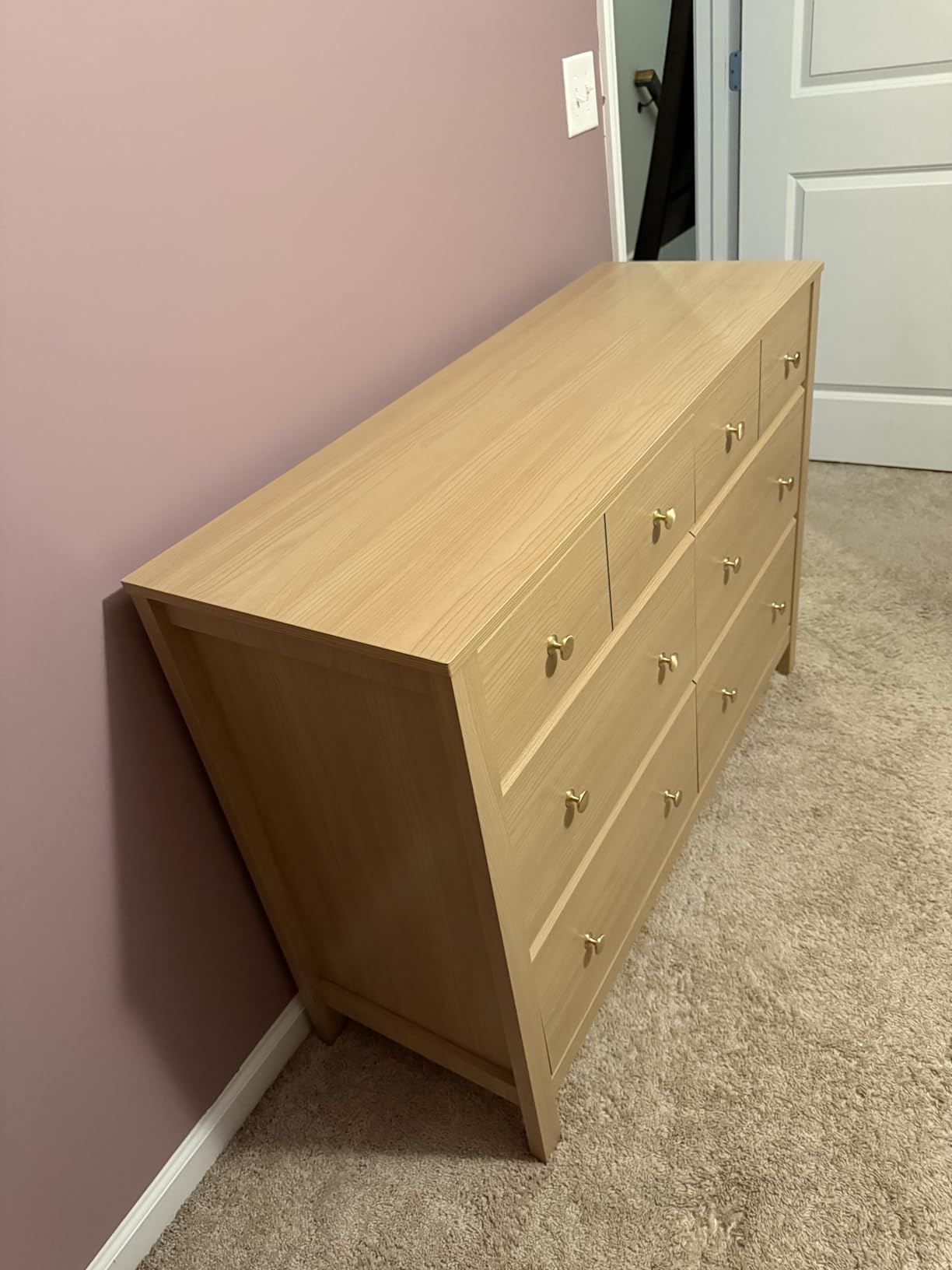
The interlocking drawer system is the feature parents argue about most. Only one drawer opens at a time, which stops a toddler from loading the whole chest open and tipping it. Parents on nursery furniture threads repeatedly single out sturdiness, storage volume and quiet drawer action as what makes a dresser hold up, and the lock answers the tip-over side of that while the laminated surface answers the wear side.
The compromise is the changing top itself. It is brand-specific, so a generic 32-inch pad will not drop into it without sitting proud of the lip, and that overhang is exactly the wobble parents complain about elsewhere. Drawer action is also unhushed, so a 2am nappy change comes with a clatter.
Who it suits
Parents who want a certified piece with safety hardware already in the box, and anyone outfitting a room where floor space is limited. The removable topper takes about a minute off, and the piece then works as a plain three-drawer dresser for the next decade. It is also a sensible choice for a shared nursery for twins, since one drawer open at a time still applies.
Where it falls short
If you already own a changing pad and want to reuse it, this topper will not take it and you will be buying a second pad. If quiet operation matters to you, note the drawers are loud, and buy felt runner tape or a soft-close upgrade kit. Assembly is straightforward but a few owners report unclear instructions and damage to the top piece on arrival.
2. Costzon 3-Drawer Changing Table – rails and strap built in
Costzon 3-Drawer Changing Table, Infant Diaper Changing Station with Drawers, Safety Rails & Strap, Baby Changing Table Dresser for Nursery, Easy Assembly (Brown)
35.5 inch L x 23 inch W x 39 inch H
Pine and rubber wood with MDF
Top rated to 176 lbs
Raised rails and safety belt
Pros
- Largest review count of any piece reviewed at 434
- Raised rails and strap keep baby contained
- Anti-slip pads on all four legs
- Customised height reduces bending
- Surface wipes clean easily
Cons
- Build feels lighter than a solid wood dresser of the same size
- Mixed pine and MDF is basic next to solid wood
- Fixed top with no removable tray option
At 35.5 by 23 by 39 inches, this is among the most thoroughly equipped changers here, and the 176-pound rating on the top tells you the structure underneath is meant to take weight. It carries raised safety rails on the surface plus a belt, and all four legs have anti-slip foot pads. Parents worried about a pad creeping during a change will notice those rails straight away.
The height is the quiet hero. At 39 inches it sits at the top of the comfortable band, so an adult changes a baby without the constant bending that a low dresser forces. That is the ergonomic difference between a unit you use happily for two years and one you come to avoid.
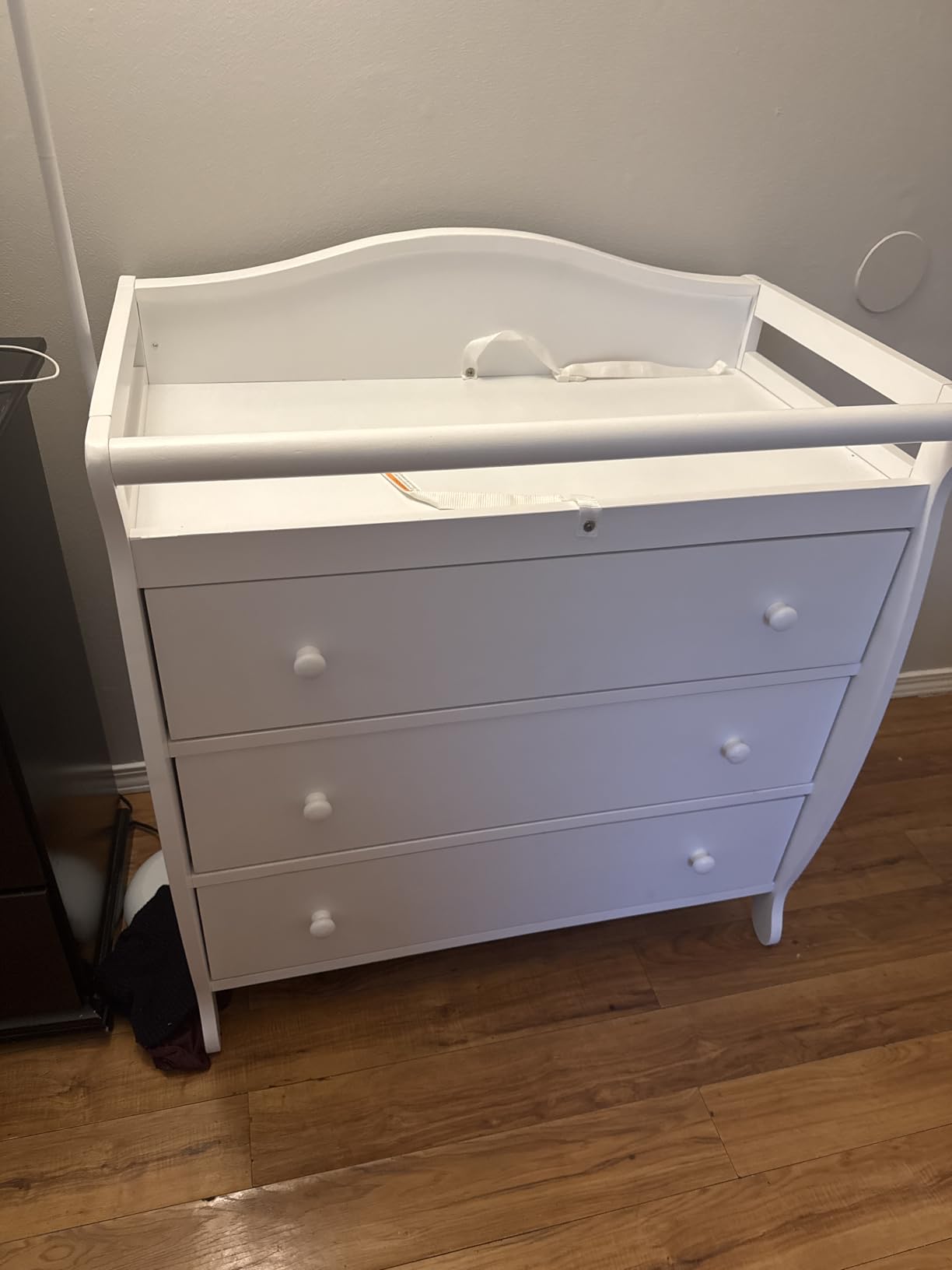
The drawback is honesty about materials. Pine and rubber wood with MDF is a competent frame and a painted surface that wipes clean, but it is not joinery you can sand back and oil in twenty years. If your plan is to hand the piece down, this is not the one. It is also a fixed top rather than a removable tray, so there is no later conversion step.
A useful comparison point is how it ends up. Parents who convert a dresser with a removable tray describe loving the fact that the changing part comes off and the piece becomes an ordinary dresser. With a built-in surface like this one, once the nappy years end you still have a decent three-drawer chest, you just have no way to reclaim the top for anything else.
Who it suits
Anyone who wants the rails, strap and stable feet already fitted rather than bolting them on later, and anyone who will be standing at this piece for two years of night changes and values a working height. It is also a good second-piece gift where the recipient has a dresser already.
Where it falls short
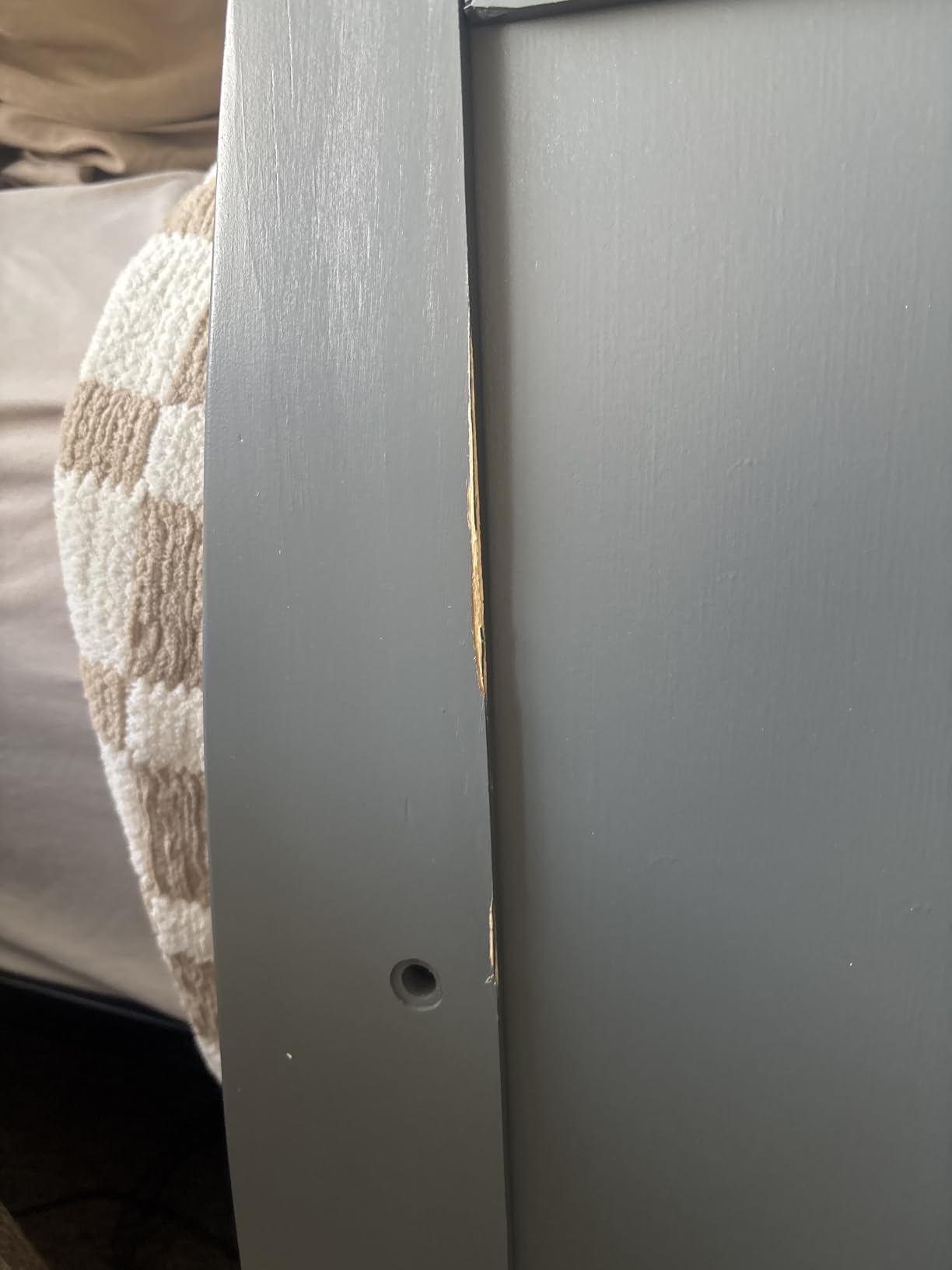
If you want a removable top or plan to pass the piece on, the fixed surface is a limitation. A minority of owners report that the build feels lighter than expected once assembled, and the pine and MDF mix will not be mistaken for solid wood later. Assembly is described as easy with clear, practical instructions.
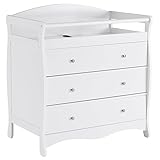
3. Karl home 3 Drawer Changing Table Dresser – the FSC-certified low-cost build
Karl home Changing Table Dresser Baby Diaper Changing Station, White
35.4 inch L x 22.8 inch W x 39 inch H
FSC-certified pine wood and MDF
55 pounds
Safety rail and strap included
Pros
- FSC-certified wood is unusual in a budget build
- Safety rail and strap on the changing surface
- Roomy drawers for diapers and clothes
- Solid wood legs with non-slip foot pads
- Parts are labelled for assembly
Cons
- Soft pine scratches and the finish wears quickly
- Prefit leaves gaps so drawer fronts sit unevenly
- Handles and drawer fronts feel cheap
- Assembly takes longer than the instructions suggest
The distinguishing detail here is the FSC certification. For a nursery, where a baby chews on rails for the first year of their life, knowing the wood came from a responsibly managed forest is a real checkmark that most pieces at this level of build simply do not carry. The frame is pine and MDF on solid wood legs, and the whole unit weighs 55 pounds, which is enough to feel planted rather than tippy.
Dimensions land at 35.4 by 22.8 by 39 inches, so it matches the Costzon almost exactly and clears the depth threshold we cover in the measurement section below. Drawers are genuinely roomy for a budget three-drawer layout, and there is a rail and strap on the changing surface.
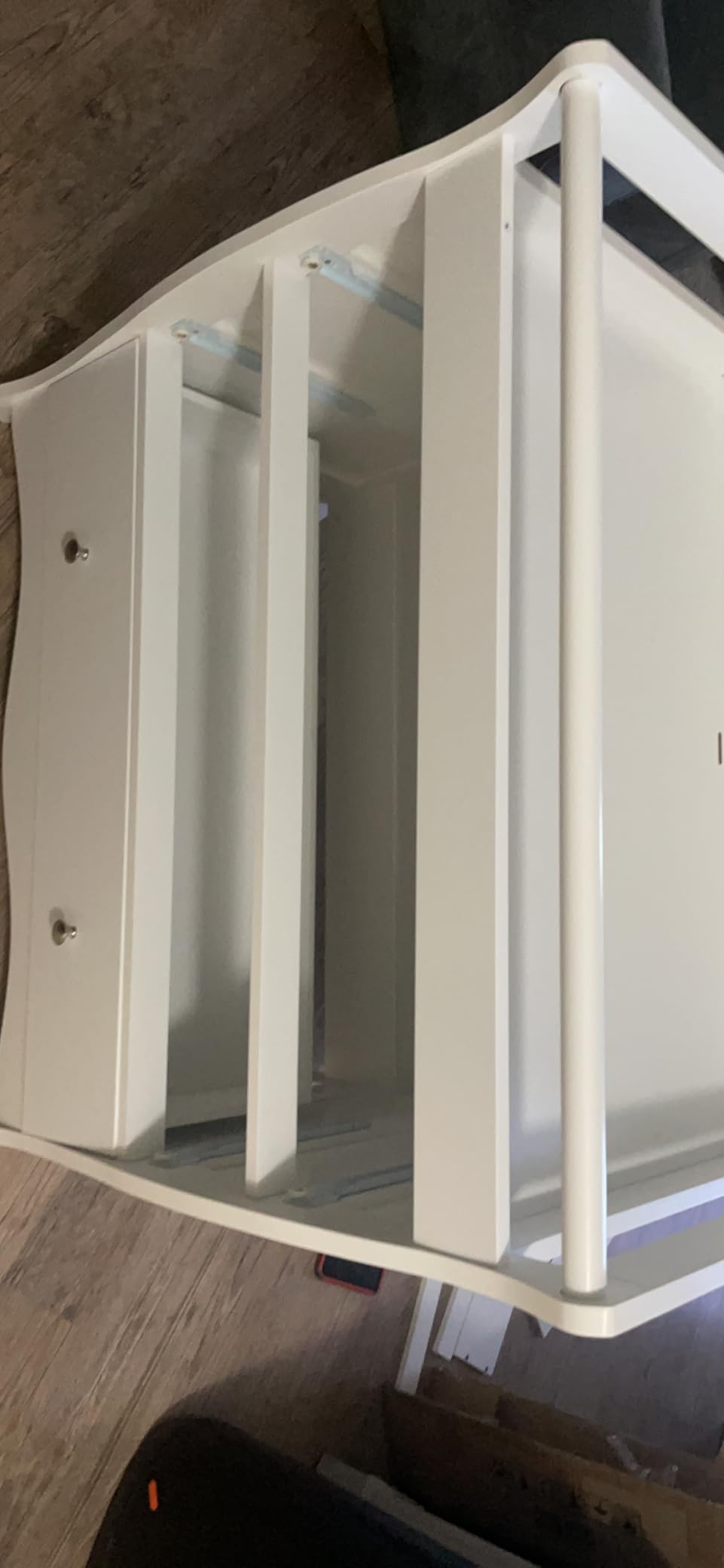
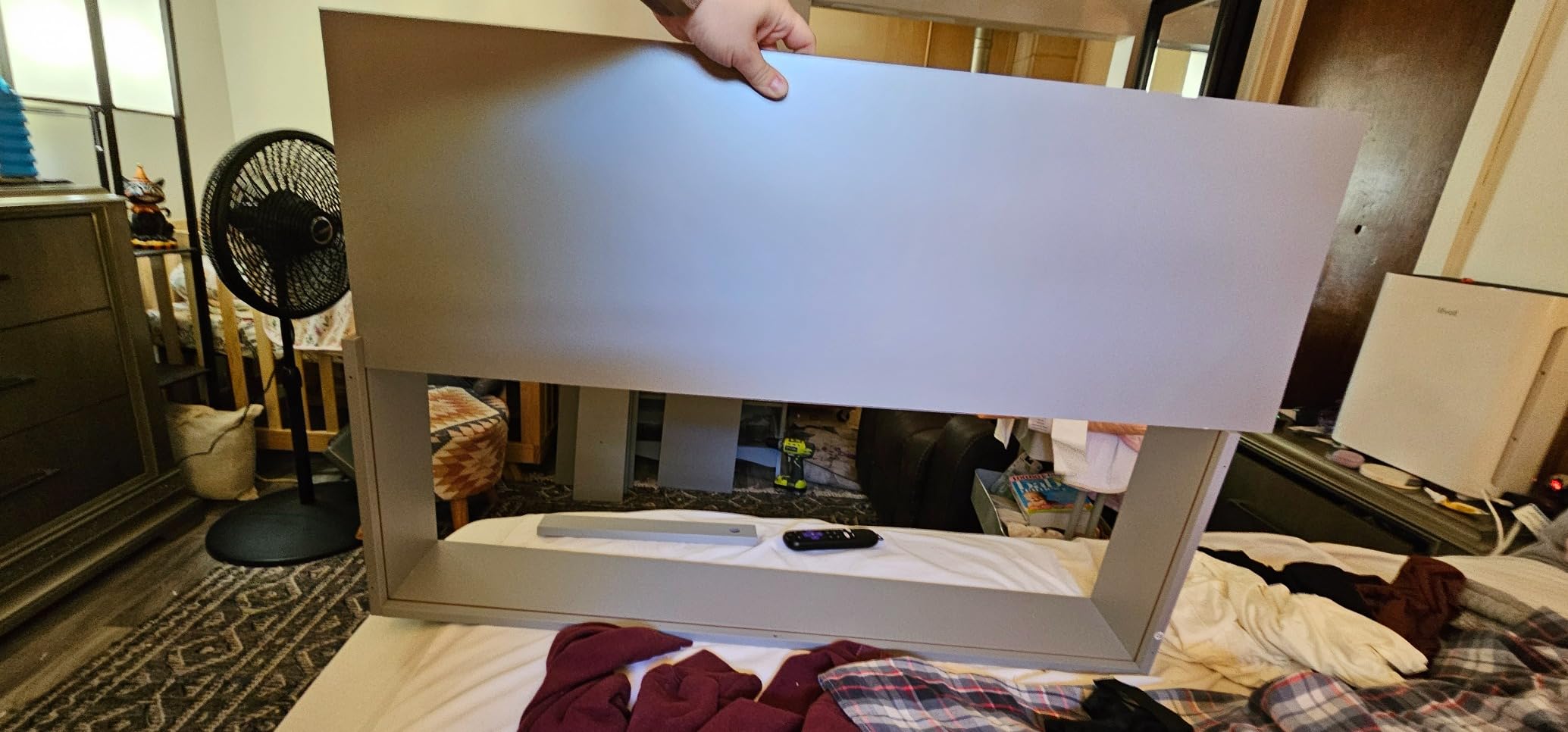
Where this one loses ground is the finish and the fit. Pine is a soft species, so it marks, and the painted surface wears at the edges and drawer fronts within a year of daily use. Prefit holes also do not always line up, which shows as uneven gaps between drawer fronts, and the handles read as inexpensive in the hand.
None of that affects function, and it is the reason this sits at a 4.0 average rather than higher. Buyers consistently name the price, the storage and the look as the reasons to keep it. If appearance after three years is not your priority and you want traceable wood without stepping up a tier, it holds up better than the rating suggests.
Who it suits
Eco-focused parents who want traceable wood without stepping up to a mid-tier price, and anyone outfitting a small apartment nursery where 39 inches of height is the whole ergonomic story. It is a good first dresser for a first child, or a spare unit in a second nursery.
Where it falls short
Not the choice for an heirloom piece or for a household with a toddler who treats furniture as a climbing surface, because the finish will show it. Build it with care and a helper, since the instructions undersell the time, and check the drawer fronts for alignment once assembled.
4. babyletto Lolly 3 Drawer Changer Dresser – the small-footprint pick
babyletto Lolly 3-Drawer Changer Dresser w/Tray – White & Natural
Removable tray fits a 31 x 16 inch pad
GREENGUARD Gold Certified
New Zealand pine base
Ball-bearing drawer glides
Pros
- Small footprint for compact rooms
- Drawers glide smoothly on ball-bearing hardware
- Removable tray converts the unit to a dresser
- Heavy solid feel with rounded edges
- Responsive service when parts arrive damaged
Cons
- Assembly runs about two hours and needs two people
- Drawer bottoms are thin particleboard
- Some reports of drawer or rail failure within months
- No pre-drilled holes so the tray can crack the back panel
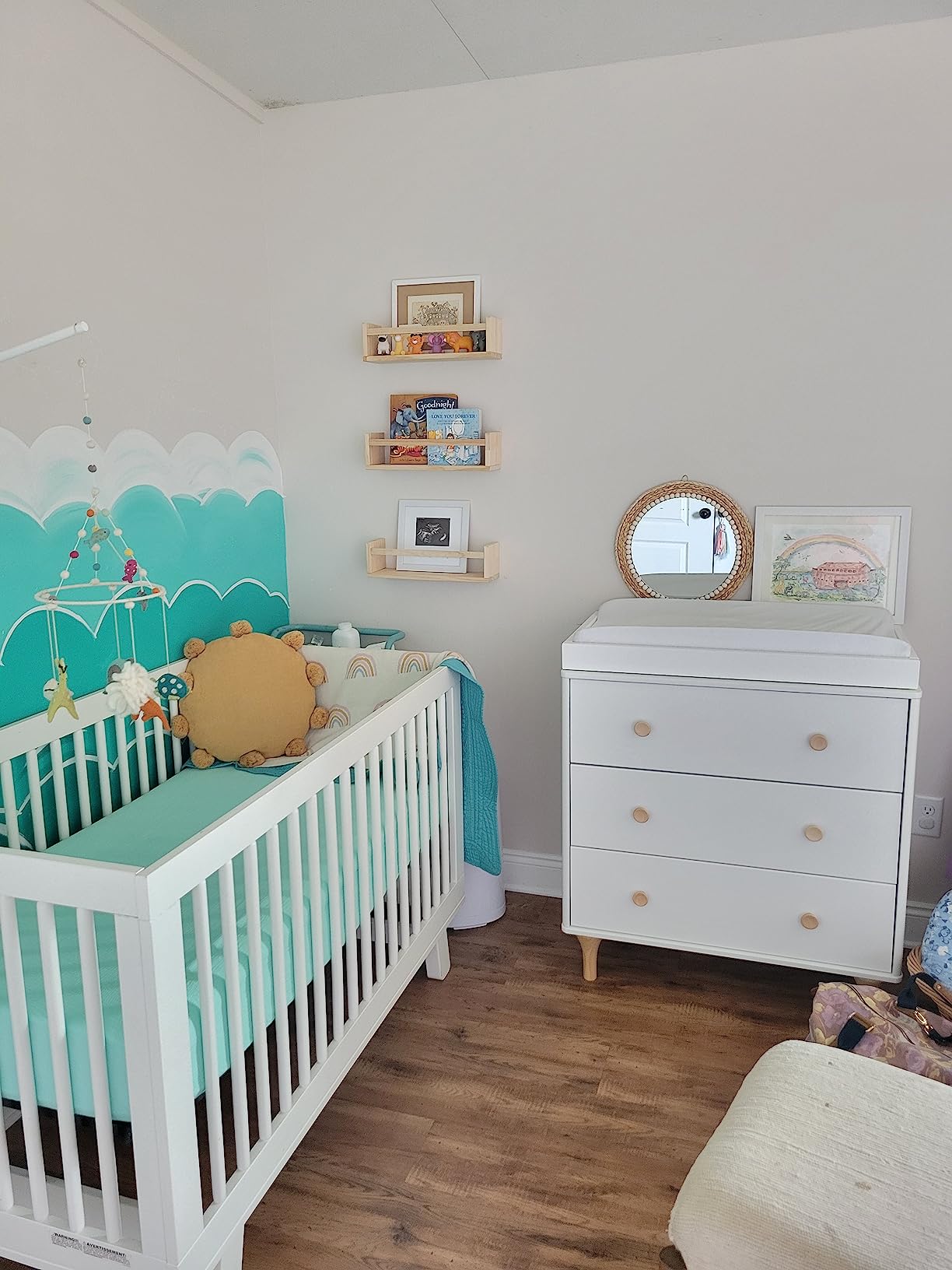
This is the piece we point at when the room is the constraint. The footprint is genuinely compact, and unlike the three-drawer budget units it is built on a New Zealand pine base with TSCA-compliant engineered wood drawer fronts and frame. It is also GREENGUARD Gold Certified and tested to ASTM F2057 with the anti-tip kit included.
The tray is the point of the design. It takes a 31 by 16 inch pad, and braces attach the tray to the dresser so it cannot lift or slide. Once the nappy years end you lift the tray off and the unit reads as a plain three-drawer dresser, which is the conversion parents in the buying threads keep calling the single best feature of this format.
Drawer action is where this separates from the wooden budget chests. Ball-bearing glides and drawer stop mechanisms mean the drawers glide and stay put instead of slamming or dropping out, and the piece has a solid, heavy feel with rounded edges that matter in a room where a newborn head is a regular occurrence.
Assembly is the honest drawback: owners put it at around two hours for two people, and the tray has no pre-drilled holes, so drilling into the back panel can crack it. A minority of owners report drawer or rail durability issues within months, and the drawer bottoms are thin particleboard rather than solid.
Who it suits
Small rooms and apartments, where a 3-drawer chest plus changer has to occupy one footprint. It also suits anyone buying a piece they want to keep, since a removable tray and a pine base both age better than a fixed top on a composite frame.
Where it falls short
Not for anyone without a second pair of hands or a free afternoon, and not ideal if thin drawer bottoms bother you under load. The tray drilling step needs care and a bit of masking, since the back panel is the part most likely to split.
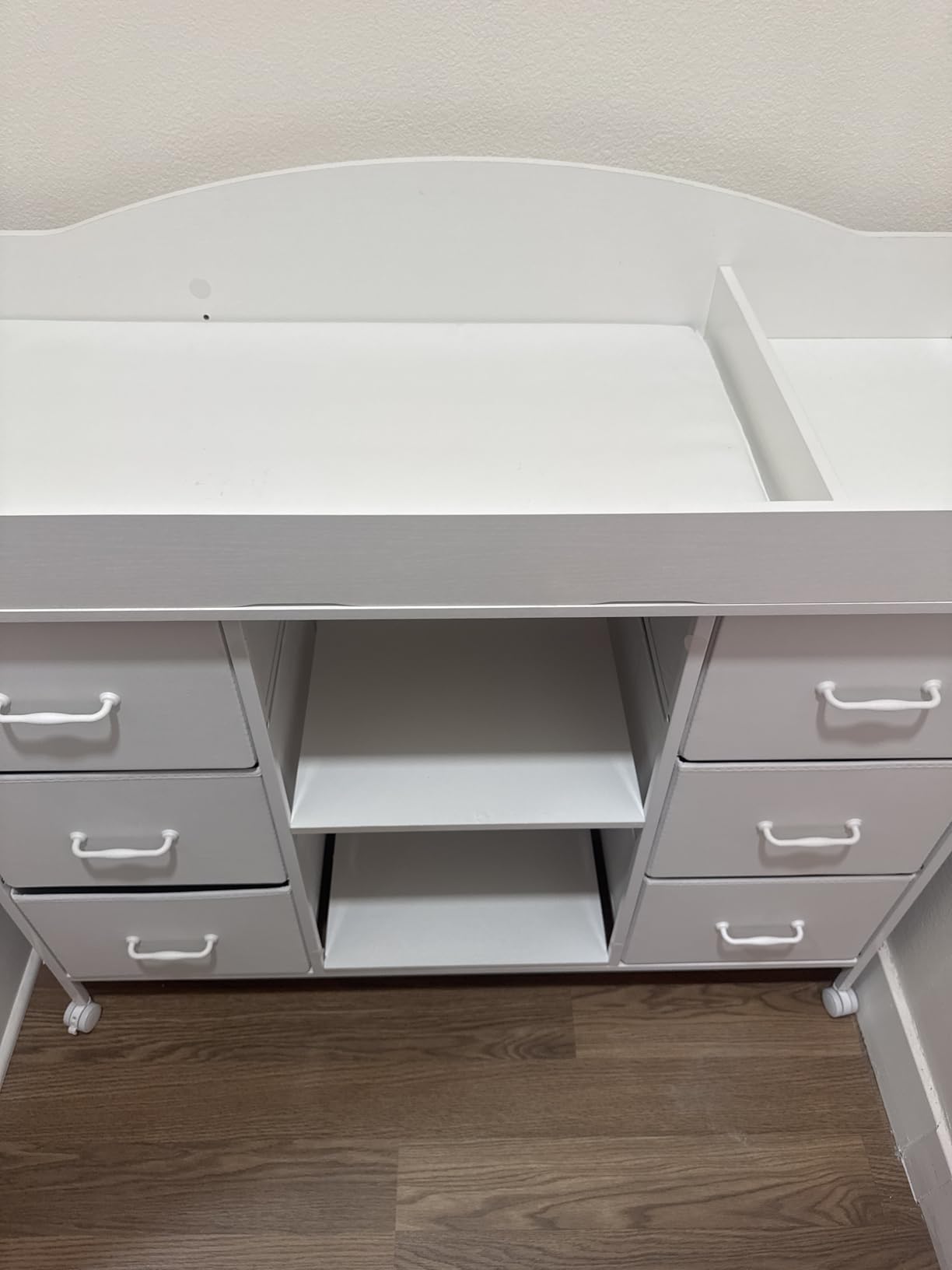
5. BOLUO 6 Drawer Changing Table Dresser – six drawers in one frame
BOLUO White Changing Table Dresser with 6 Drawers Baby Dresser with Changing Table Top Diaper Changing Station with Storage for Nursery Modern
32.7 inch W x 19.7 inch D x 37.2 inch H
6 fabric drawers at 12 x 16.9 x 9 inches
Removable changing top
40.3 pounds
Pros
- Deep wide drawers hold a full box of diapers
- Top fits standard-size changing pads
- Assembles in about 30 minutes
- Light enough to move between rooms
Cons
- Drawers are fabric rather than solid wood
- Changing pad not included
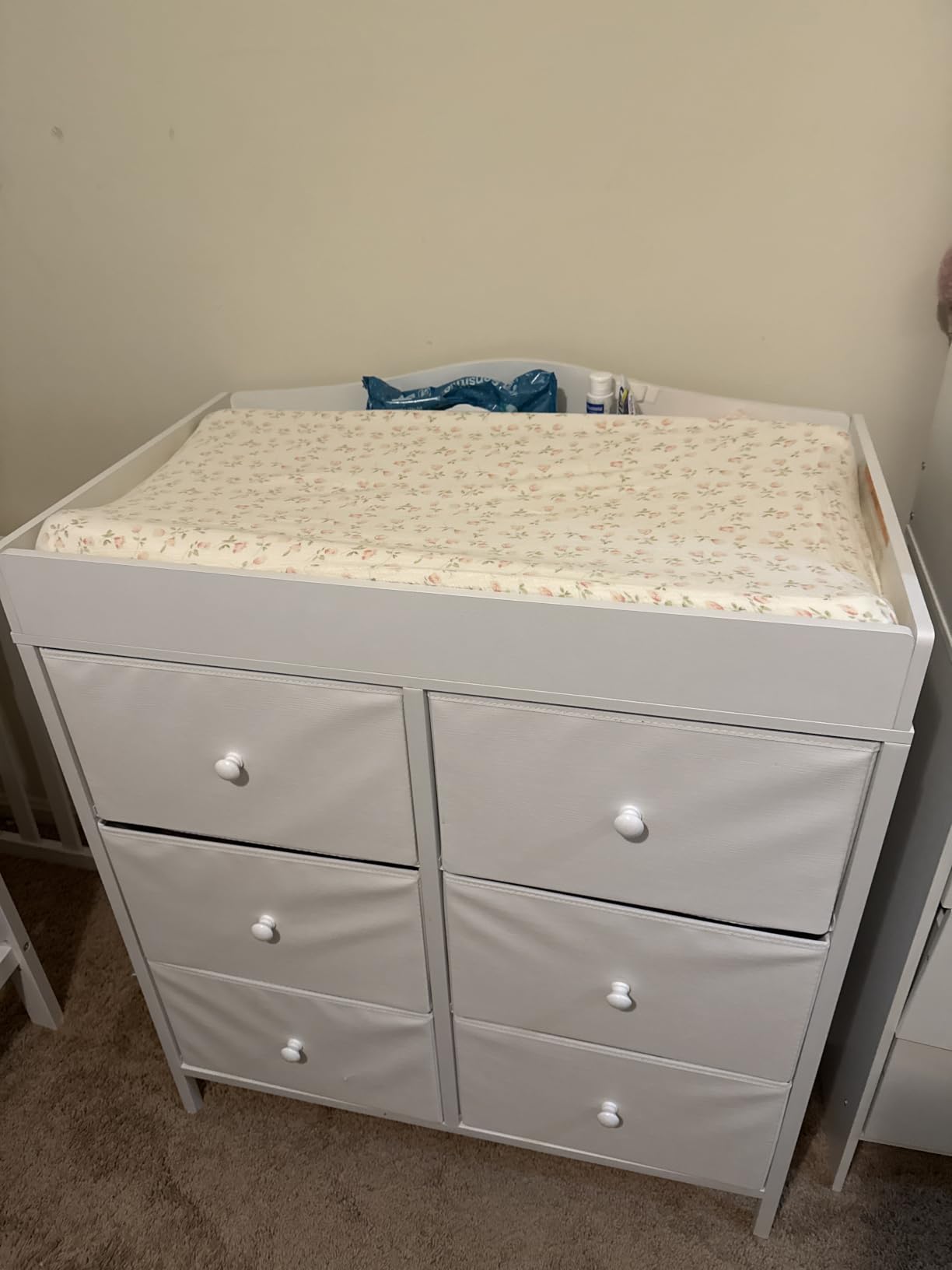
At 4.6 stars across 324 reviews, it sits in the top tier of the group, and the design explains why. Six drawers, each measuring 12 inches wide by 16.9 inches deep by 9 inches tall, is far more usable storage than three wide drawers of the same overall size, and a full box of diapers fits in one of them without crushing the stack.
The removable changing top takes standard-size pads, which removes the single most common complaint we saw across a dozen products, where brand-specific trays refuse generic pads. Four adjustable feet protect the floor and give you a little level on uneven carpet, and the piece assembles in about half an hour even if you have never assembled flat-pack furniture.
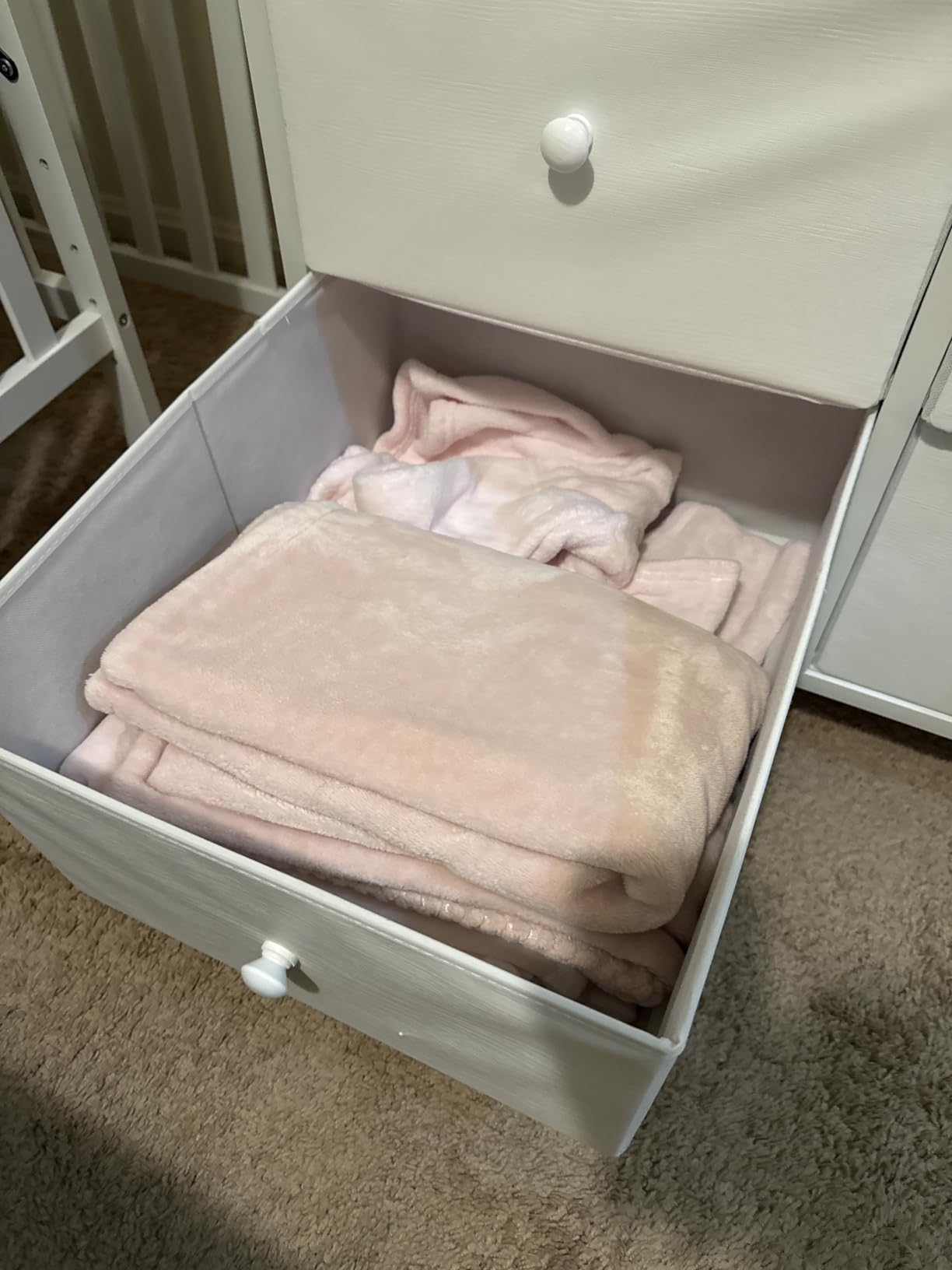
We would flag the honest trade-off immediately. These are fabric-fronted drawers, not wood, so they will not be refinished and the lining will wear faster than a hard surface. At 40.3 pounds the piece is also light enough to slide between rooms, which is convenient and is not the same thing as heavy.
Against that, 84 percent of ratings here are five star, and the recurring words in the feedback are deep drawers, a removable top that fits real pads, and a build that does not wobble. The design carries a USPTO patent number and third-party lab testing, which is reassuring for a piece whose top carries a baby.
Who it suits
Parents who want the most usable storage in the smallest frame and who already own a changing pad. The 37.2 inch height sits comfortably in the ergonomic band, and the low weight makes it among the easiest of the twelve to move when the room changes.
Where it falls short
If you want solid wood for a keepsake piece, fabric drawers rule it out. The pad is not included, and the adjustable feet that level the unit also mean it can rock slightly on a very uneven floor if all four are not set evenly.
6. Graco Sasha 3-Drawer Chest – rubberwood weight and a stained finish
Graco Sasha 3-Drawer Chest with Changing Table Topper, Sage
35.47 inch W x 18.66 inch D x 36.02 inch H
Rubberwood framing
94.8 pounds
GREENGUARD Gold Certified
Pros
- Stained sage finish looks less nursery-themed
- Removable topper converts to a dresser
- Interlocking drawers cut tip-over risk
- GREENGUARD Gold with VOC screening
- Substantial 94.8 pound build
Cons
- Two-person assembly recommended
- Changing pad not included
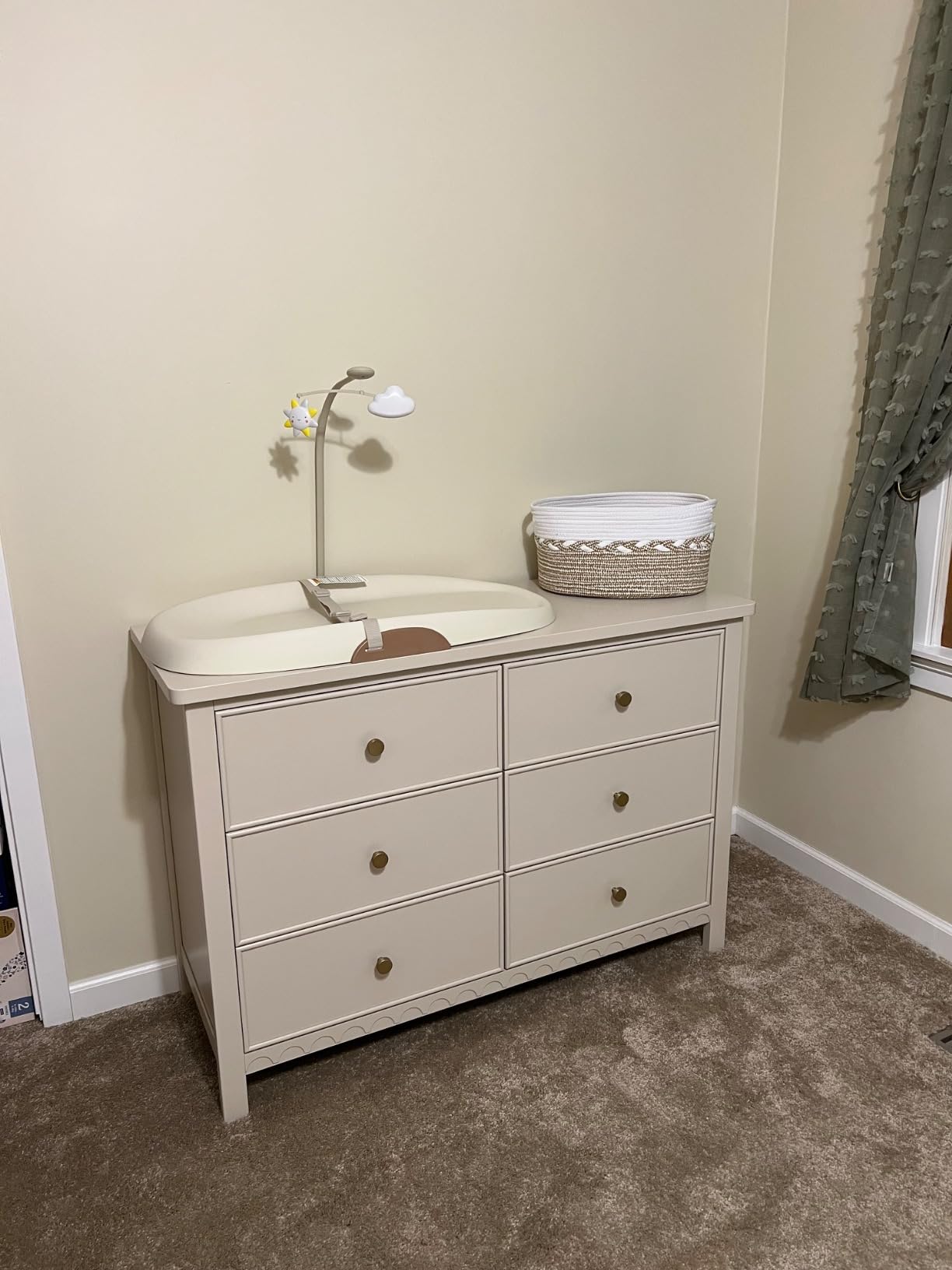
This unit is built under the Graco name by Storkcraft, and the difference from the budget composite chests shows up in the weight. At 94.8 pounds it has real rubberwood framing, and at 36 inches tall it sits high enough that most adults can change a baby without stooping. The sage stain is the least babyish finish of the three-drawer chests here.
Safety-wise it matches the Storkcraft Horizon, with an interlocking drawer system, a tip-over restraint kit in the box, and GREENGUARD Gold certification with screening for more than 15,000 VOCs. It is tested to CPSIA and ASTM F2057 and carries a one-year limited warranty.
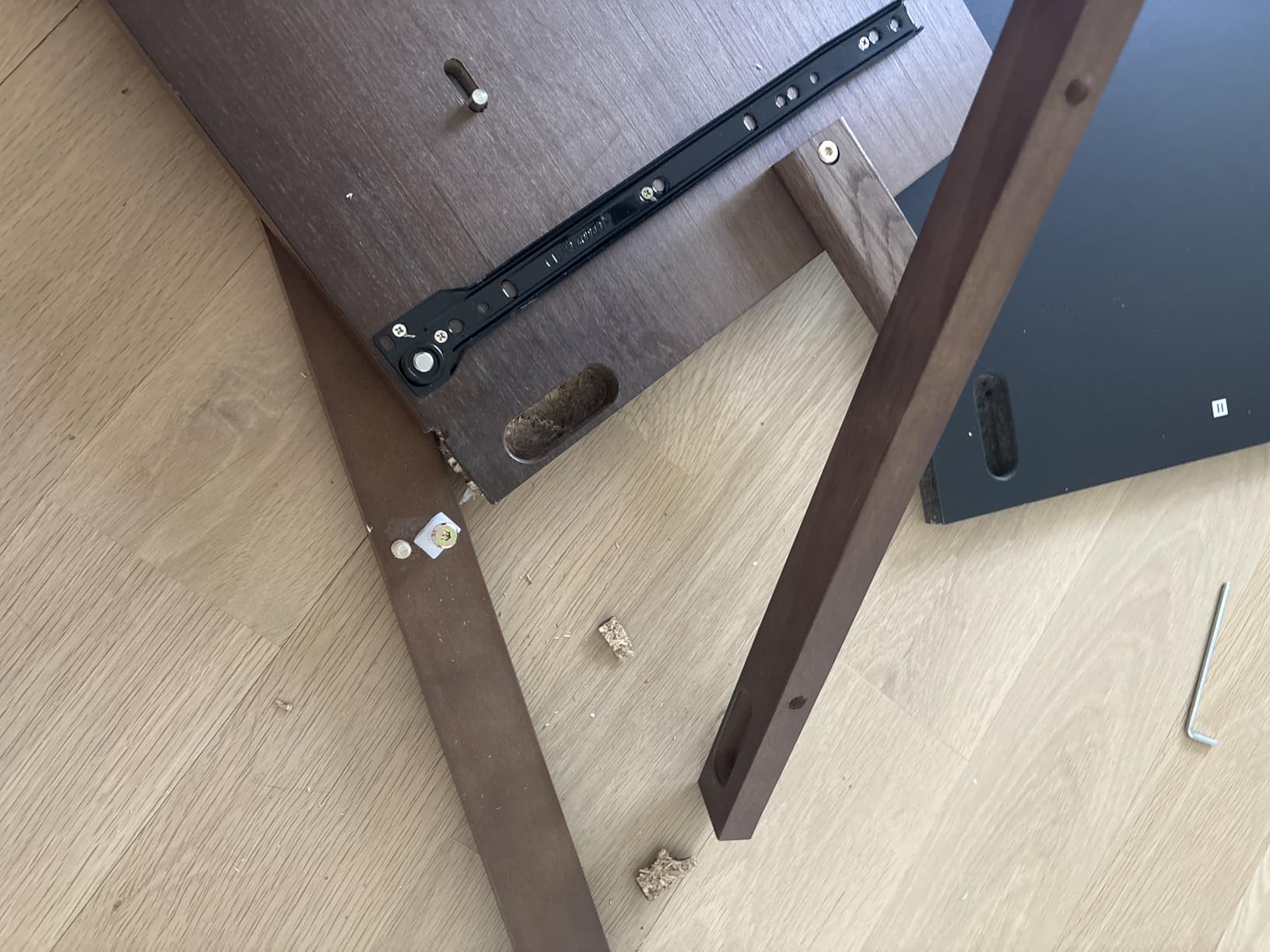
The 18.66 inch depth is worth checking against your pad, since it sits at the narrow end of the acceptable range. If you plan to use a generic pad rather than the one sized for this tray, measure before you buy. Drawer tracks arrive pre-installed, which offsets some of the assembly effort.
Feedback centres on the elegant design, the removable topper and the drawer lock. Assembly is the complaint that comes up most often, and owners flag it as a two-person job, so budget an evening rather than an hour. As with the other three-drawer chests here, the pad is not included.
Who it suits
Parents who want a stained wood look rather than painted white or grey, and who want a piece with enough mass that a toddler climbing on the base is less likely to move it. The removable topper gives you a plain dresser when the nappy years end.
Where it falls short
The narrow depth leaves less margin for pad compatibility than the wider models, so measure carefully. Plan for a second person during assembly, and plan on buying a pad separately, which is the detail buyers most often miss in this whole category.
7. Delta Children Perry 3 Drawer Dresser – interlocking drawers in a dark wood finish
Delta Children Perry 3 Drawer Dresser with Changing Top and Interlocking Drawers, Walnut Espresso
36.75 inch W x 20.25 inch D x 38.25 inch H
108 pounds
New Zealand pine construction
29.5 inch wide drawer interior
Pros
- 4.7 star average across 106 reviews
- Interlocking drawers and included wall anchor
- Colour matches the online photos closely
- Removable top allows a dresser look later
- Clear instructions with all parts included
Cons
- Assembly takes time especially on the drawers
- Drawers drift out of alignment over time
- Changing top held by two screws with slight movement
- Changing pad sold separately
This walnut espresso piece carries a 4.7 average, joint highest rating of the twelve, and the specification list explains why. It weighs 108 pounds, uses New Zealand pine with TSCA-compliant engineered wood, runs ball bearing slides, and the drawer interior measures 29.5 inches wide by 13.5 inches deep by 5.75 inches tall, which is a genuinely usable diaper drawer rather than a shallow tray.
Safety hardware is complete. The interlocking drawer system limits how many drawers open at once, the piece is tested to ASTM F2057, and the wall-mount tip-over restraint is included. Owners also note the colour matches the online photos closely, which is rarer than it should be in this category.
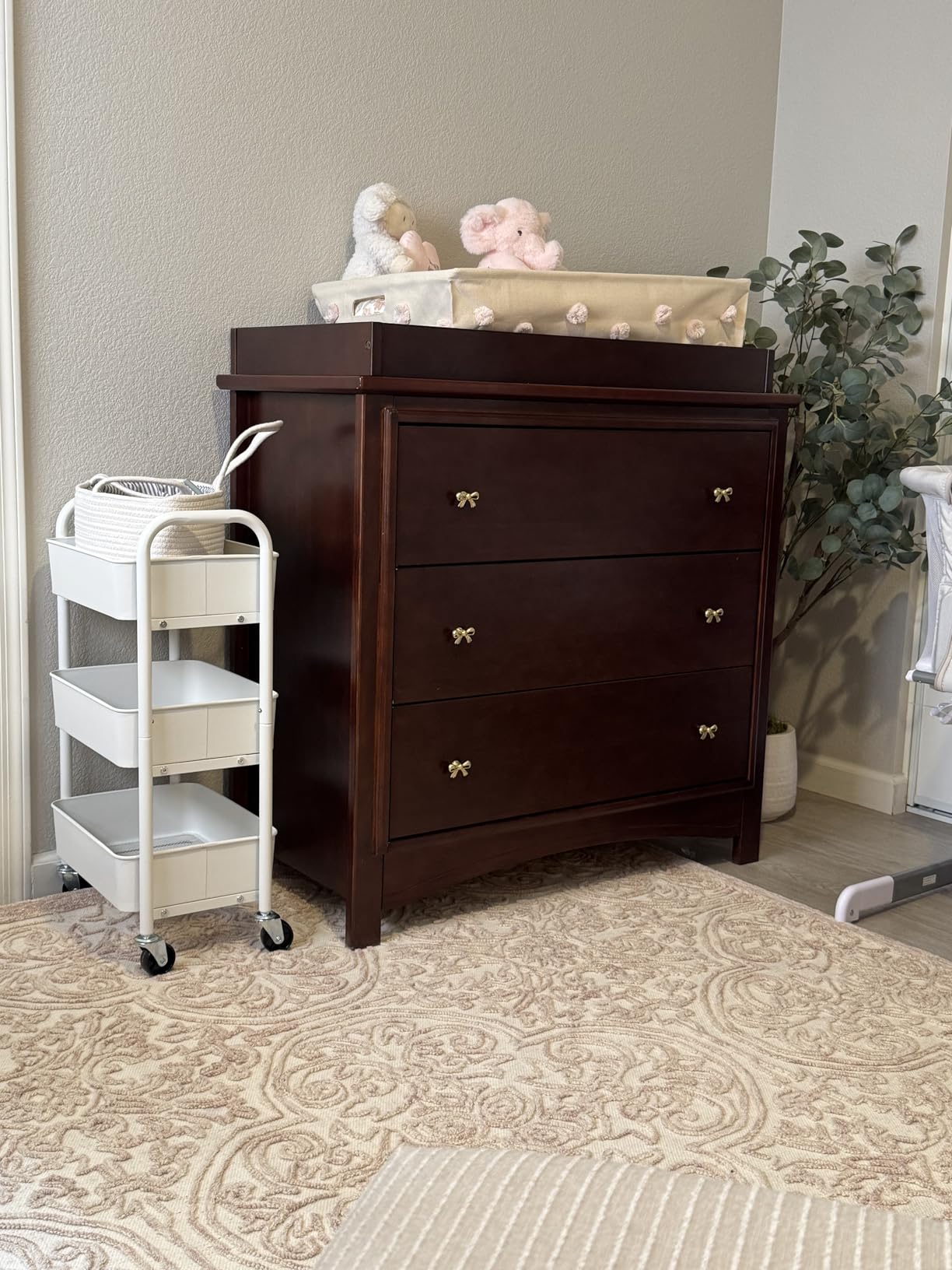
The recommended changing pad is a 32 by 16 inch unit, sold separately, so buy that pad before the piece arrives. Picture-frame molding trim on the drawer fronts gives it a slightly more traditional look than the flat-front units here, and the paint is lead and phthalate safe.
Two details catch us out. The changing top is held by two screws and does move slightly under load, which is worth knowing if you are fussy about wobble. And while owners praise straightforward assembly, they also report that the drawers themselves take the most time and that alignment drifts after months of use.
Who it suits
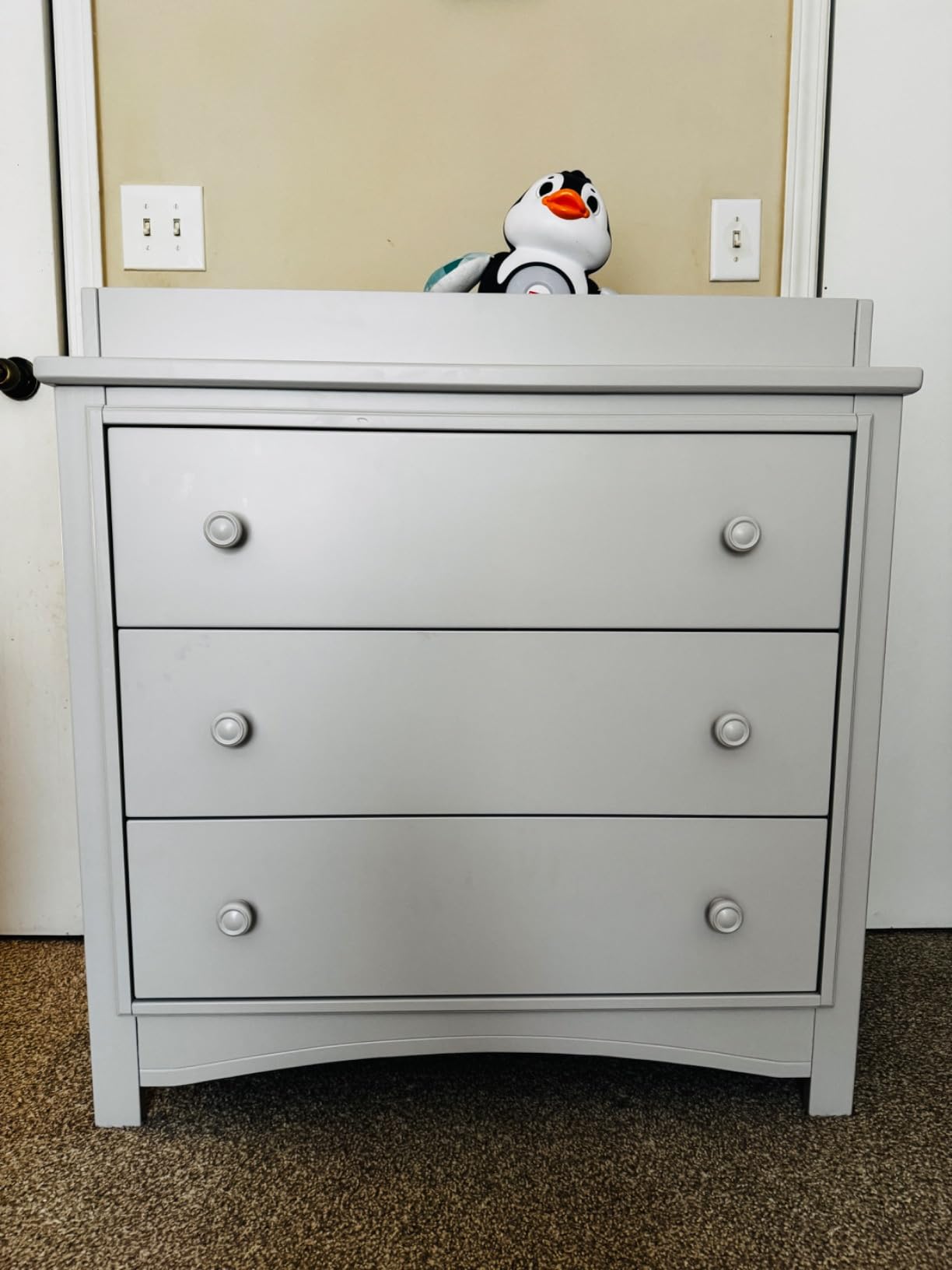
Anyone matching existing dark wood furniture, and anyone who wants real tip-over protection without a separate purchase. The dark walnut finish suits a nursery that is not trying to look like a nursery, and the removable top means the piece graduates with the child.
Where it falls short
If wobble bothers you, the two-screw top is not the tightest fit in this group. Drawer alignment may need adjusting after a year or two, and the pad is another separate purchase.
8. Delta Children Saint 4 Drawer Dresser – the heaviest build we reviewed
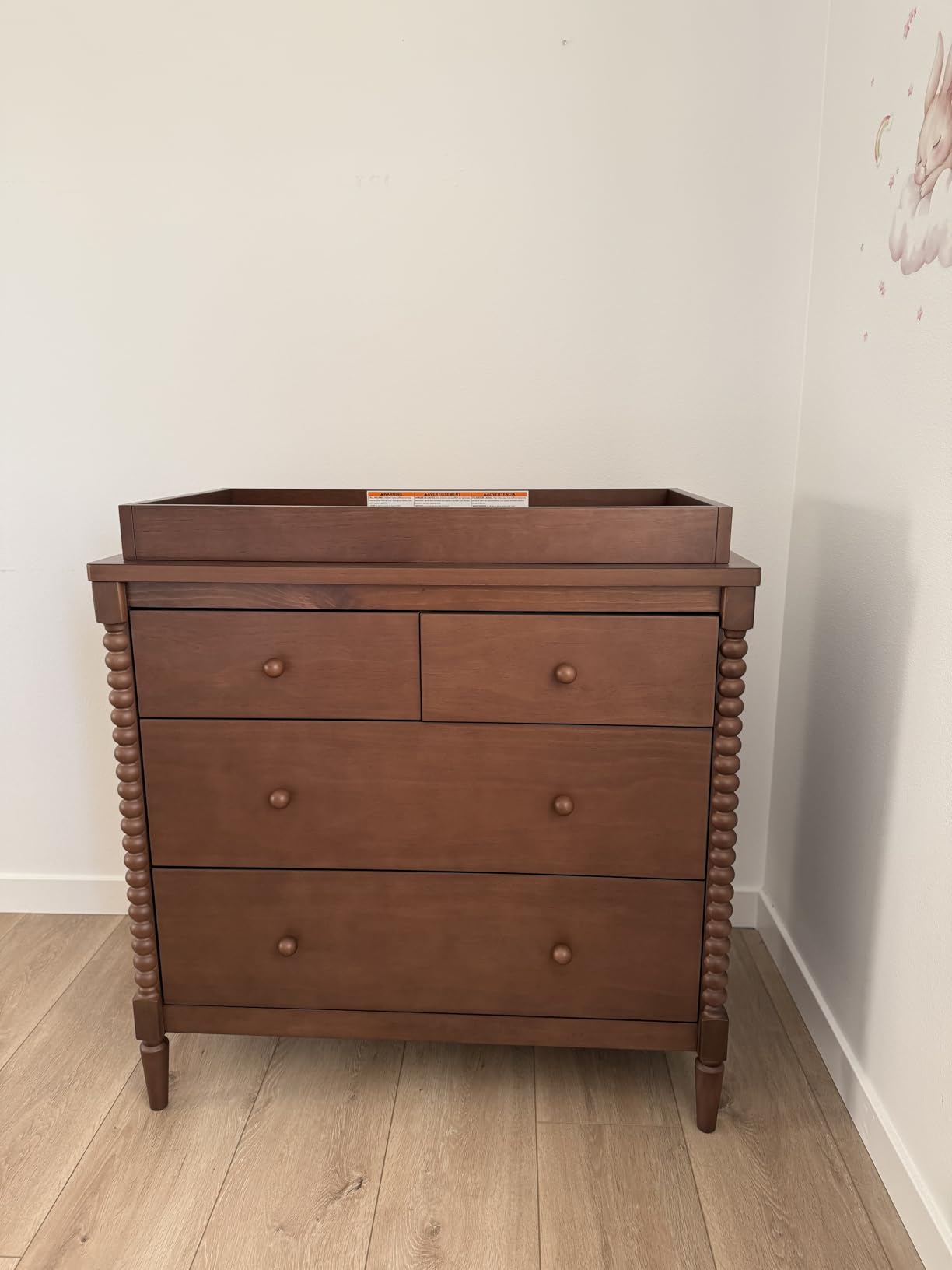
Delta Children Saint 4 Drawer Dresser with Changing Top and Interlocking Drawers, Teak Brown
36.75 inch W x 19.5 inch D x 38.25 inch H
112.5 pounds
Four drawers on ball bearing slides
Solid wood turned posts
Pros
- Heaviest build reviewed at 112.5 pounds
- Four drawers add storage over a three-drawer chest
- Solid wood turned posts for a classic look
- Interlocking drawers with wall restraint included
- Large drawers suit bedding and bulky items
Cons
- Higher cost than the rest of the dressers reviewed
- Small drawers are much shallower than the large pair
- Changing pad sold separately
- 63 percent five-star share suggests mixed experiences
This is the one to notice if you want a dresser that stays put. At 112.5 pounds it is the heaviest of the twelve, built on New Zealand pine and TSCA-compliant engineered wood with solid wood turned posts for a classic look. Four drawers means one more storage tier than a three-drawer chest gives you, which matters in a room where folded muslin blankets eat an entire drawer.
Safety is handled the same way as the Perry, with interlocking drawers, ASTM F2057 testing and an included wall-mount restraint. The large drawers measure 31.25 by 13.5 by 5.75 inches, which is the size you want for bedding and onesie stacks rather than nappies.
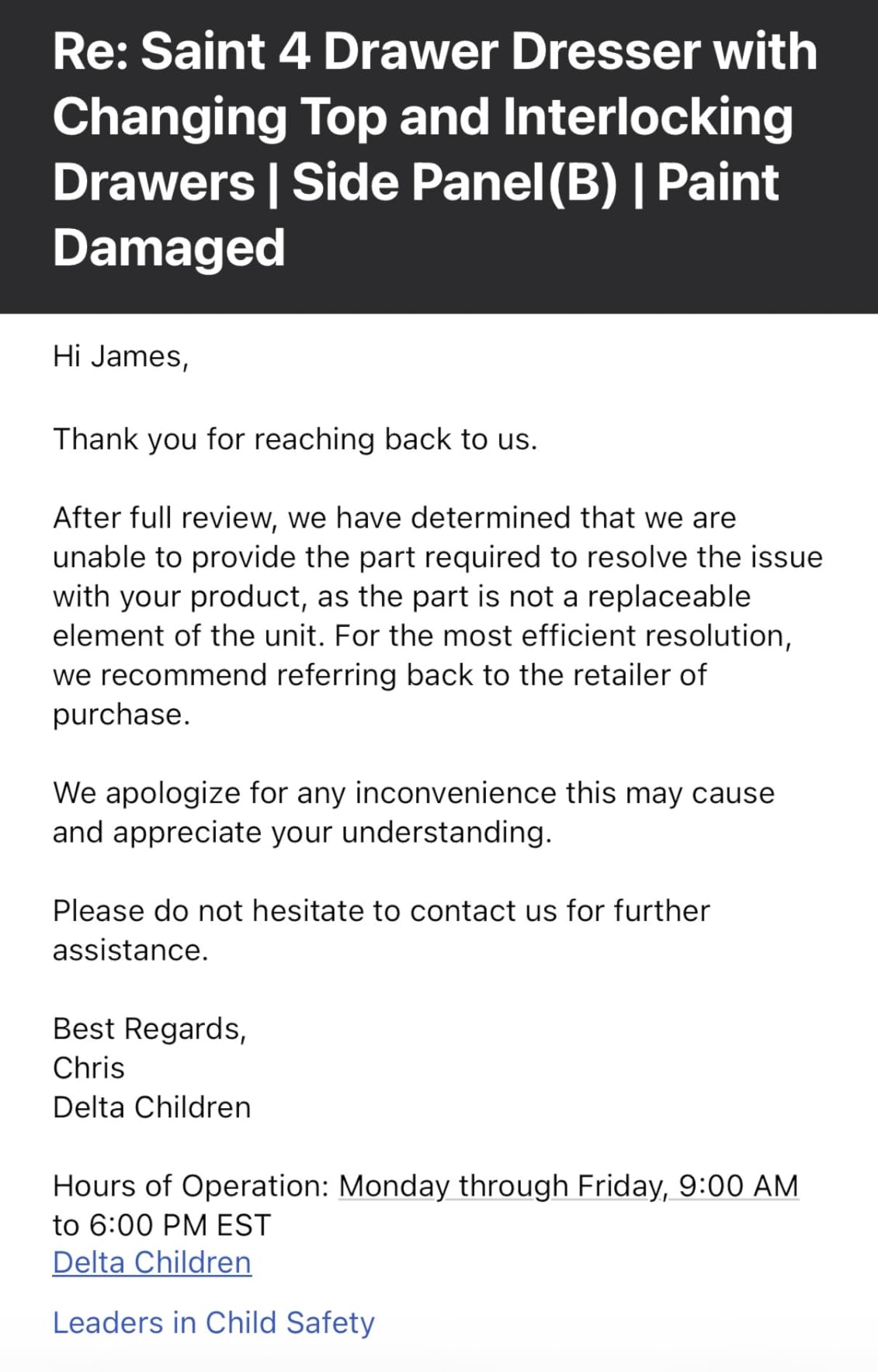
The honest catch is the small drawer. It measures 14 inches wide by 13.5 inches deep by just 4.25 inches tall, so it is shallow enough that you will reach for it for small items rather than supplies. Owners consistently flag that difference, and it is the reason the review spread is wider here than on the Perry.
Sixty-three percent of ratings are five star with a notable share of three-star feedback, which points to more varied experiences than the headline average suggests. The pad is sold separately, with a recommended size of 32 by 16 inches. This is also among the most expensive dressers in the group, so it is the piece where the higher cost has to be justified by longevity.
Who it suits
Parents who want the most storage volume and the most mass, in a room where the dresser will double as a toddler-room storage unit later. If your baby arrives with older siblings, the four-drawer layout handles the shared volume better than a three-drawer chest.
Where it falls short
The small drawer is genuinely shallow and you will notice it on day one. At this end of the range you should expect solid construction, not premium joinery or soft-close hardware, so make sure the mass and the drawer count are what you are actually paying for.
9. Vabches 7 Drawer Kids Dresser – the most drawer storage per footprint
Vabches Kids Dresser Cabinet with 7 Drawers, Changing Table for Nursery, White Chest of Drawers, Baby Dresser, Kids Bedroom Furniture, Nightstand for Child’s Room, White
47.2 inch W x 16.5 inch D x 32.95 inch H
Seven drawers on an FSC-certified frame
103.6 pounds
Secure top with raised edges
Pros
- Seven drawers in a wide footprint
- Three small top drawers for small items
- Two layers of large drawers for clothing and bedding
- Stable and sturdy base
- White finish suits any decor
Cons
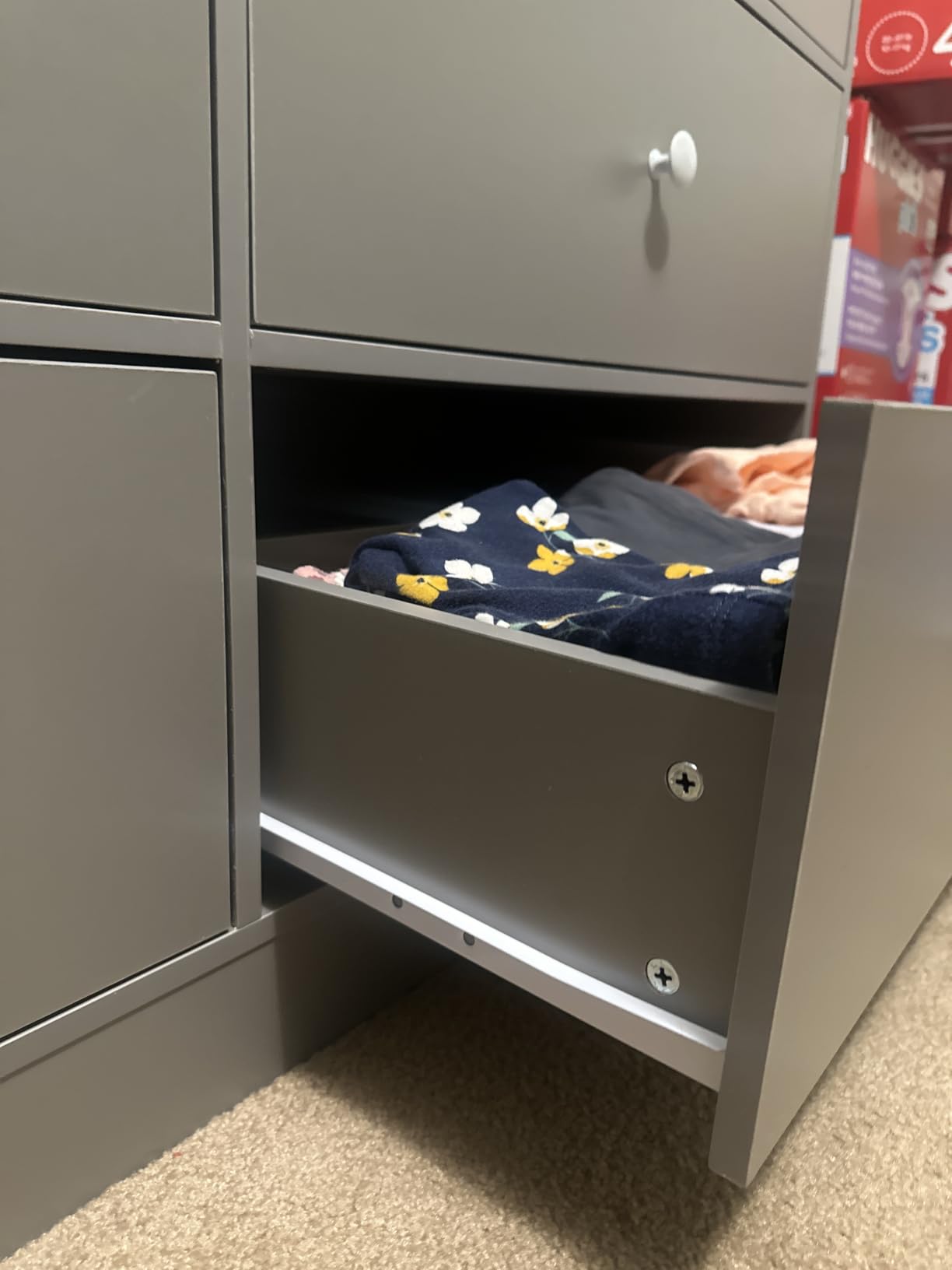
- Assembly takes more than two hours
- Some reports of misaligned holes and parts
- Drawers could be deeper for the size
- 16.5 inch depth is the narrowest here
This is the widest piece of the twelve at 47.2 inches, and it uses that width to pack in seven drawers where the others give you three or four. The layout is clever: three small drawers across the top for nappies, wipes and small clothes, then two layers of larger drawers below for bedding and bulkier items. At 103.6 pounds it is built on an FSC-certified frame with a stable base.
The changing surface has raised edges rather than a bolt-on tray, which is the permanent version of the containment lip. That means the top will never slide or be lifted away, so it is a safer bet if you expect a toddler to climb, and a less flexible one if you want the top back as furniture surface later.
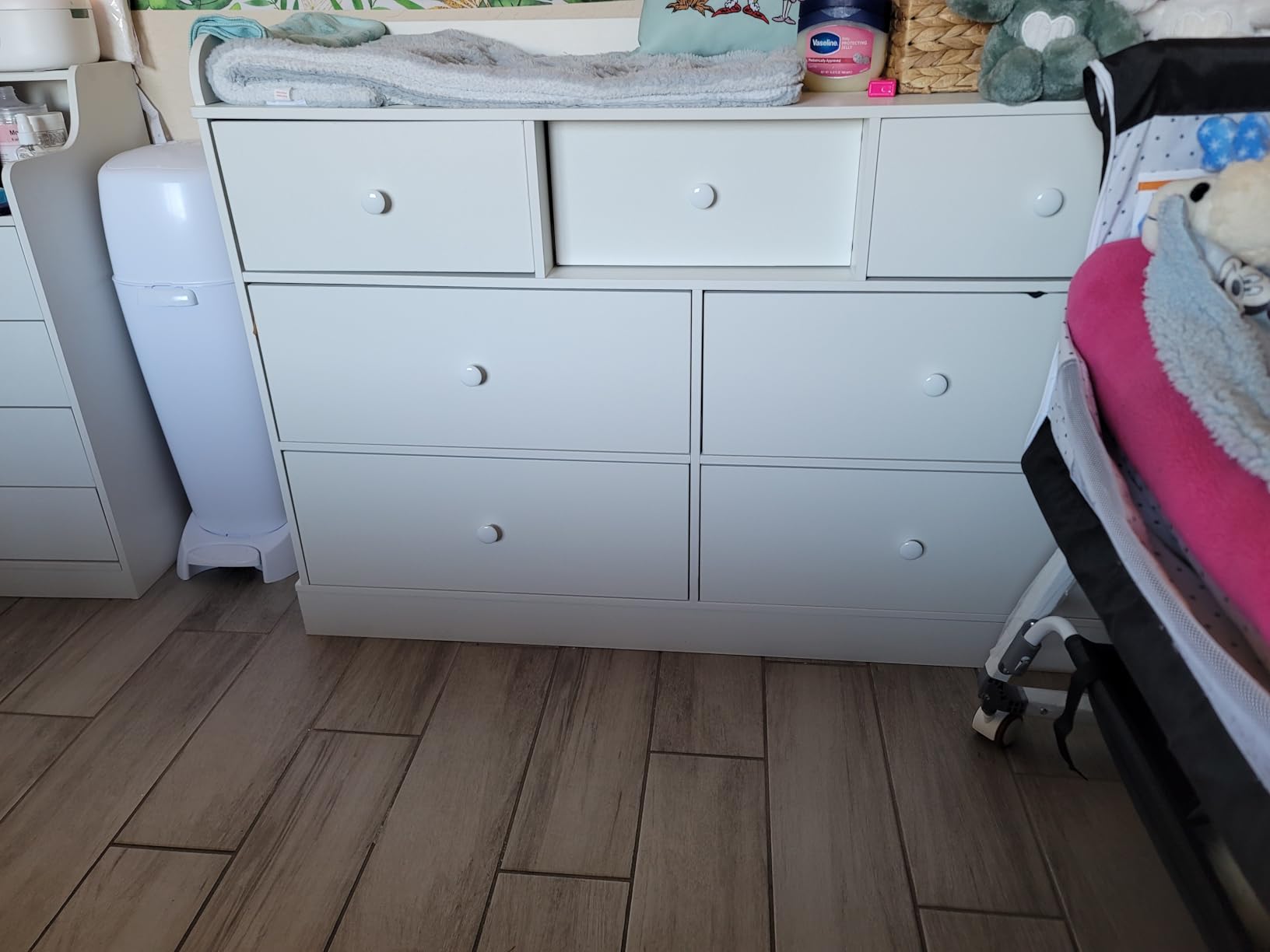
The depth is the thing to check. At 16.5 inches this is the shallowest top of the twelve, and shallow tops are where pads overhang and where parents report the tray feeling precarious. It also comes in oak, natural, black and white, which is unusual choice at this level.
Assembly is the main complaint and owners put it at more than two hours. Some buyers also report misaligned holes and parts arriving misaligned, so check the drawer fronts for square before you tighten everything down. The general verdict is good value with storage capacity doing the heavy lifting.
Who it suits
Bigger rooms, and anyone who has been outgrowing a three-drawer chest after the second child. The layered drawer layout suits a room that doubles as a play space, because everything small has one defined home.
Where it falls short
It is too shallow for comfortable use with many standard pads, and too wide for a small nursery. The raised-edge top is permanent, so unlike a removable topper it cannot be lifted off when the changing years end.
10. YeTom 6-Drawer Changing Table – the mobile option with a pad included
YeTom Changing Table, 6-Drawer Dresser, Adjustable Shelves, Mobile, White
43.3 inch W x 16.7 inch D x 40.5 inch H
Pad and wheels included
P2 grade particle board
28 pounds
Pros
- Changing pad and casters both included
- Four locking wheels make it mobile
- Assembles in 15 to 20 minutes
- Adjustable shelf fits a tall pail or wipe box
- Safety baffles and lanyard on all four sides
Cons
- Particle board construction
- Light at 28 pounds compared with solid wood pieces
- Changing pad could be thicker
- 16.7 inch depth is narrow
This is the only piece here that arrives as a complete changing station. The waterproof PVC pad is in the box, as are four removable universal wheels with safety locks, so you are not buying a tray, a pad and casters separately. Assembly is quoted at 15 to 20 minutes, which makes it the quickest build of the twelve.
The safety features are thorough for a piece at this level, with baffles on all four sides and a safety lanyard. It is tested for lead and toxic elements and meets CPSC and ASTM standards. There is also an adjustable open shelf that takes a tall diaper pail, which removes the awkward floor-standing bin from beside the dresser.
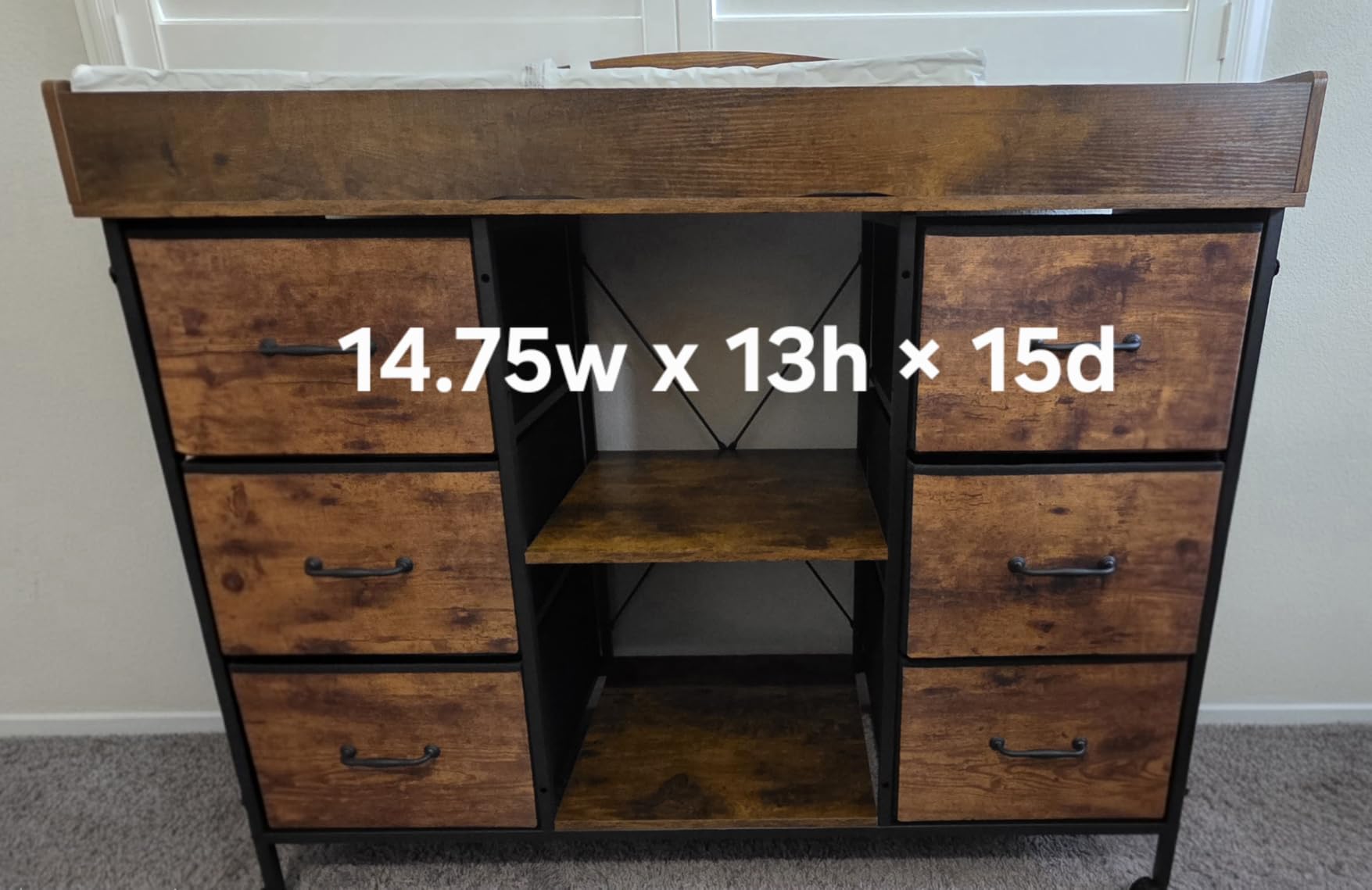
Owners consistently praise the value, the mobility and the storage, and the claim of storing more than 300 diapers in the drawers is borne out by the 4.6 average across 110 reviews. The locking wheels are the feature that changes daily life, because you can move the whole station out of the way to clean under it or to use the wall behind.
The trade-off is construction. At 28 pounds this is by some distance the lightest piece we reviewed, built in P2 grade particle board, and reviewers do compare it unfavourably with solid wood alternatives. The pad is also thin, and the 16.7 inch depth is narrow, so a thicker generic pad will overhang.
Who it suits
Apartment dwellers and anyone who wants a changing station that can be rolled into a corner and out again. It also suits anyone who does not want to source a pad, because it comes with one, and anyone who wants a diaper pail shelf built into the unit.
Where it falls short
Light particle board does not feel like furniture you will keep for twenty years, and a thin pad plus a narrow depth is a less comfortable surface than the wooden chests. It suits an apartment, not an heirloom plan.
11. Graco Classic 3 Drawer Chest – the widest colour range
Graco Classic 3 Drawer Chest with Removable Changing Topper (Hazelnut) – GREENGUARD Gold Certified Baby Dresser, Includes Changing Topper, Storage Chest with Interlocking Drawer System
35.51 inch W x 18.66 inch D x 36.02 inch H
GREENGUARD Gold Certified
98.1 pounds
Solid wood framing
Pros
- Seven colour and drawer-count combinations to choose from
- GREENGUARD Gold Certified for cleaner indoor air
- Interlocking drawers limit how many open at once
- Tip-over restraint kit included
- Solid wood framing with a one-year warranty
Cons
- Drawers are loud with no soft-close
- Interlocking mechanism annoys adults
- Picture-only assembly instructions
- Topper collects dust underneath and paint can rub onto a pad
If the finish is the thing holding you back, this is the one. It comes in hazelnut, white, blush and driftwood, in both three-drawer and six-drawer versions, which is seven combinations from one frame. On the sustainability side it is GREENGUARD Gold Certified and built on solid wood framing with wood composites.
The safety story matches the other Graco chests here: interlocking drawers that open one at a time, an included furniture tip-over restraint kit, and pre-installed drawer tracks. At 98.1 pounds it has real mass, and it measures 35.51 inches wide by 18.66 inches deep by 36.02 inches tall.
We would flag that this chest has only 52 reviews, the second-smallest feedback base here, so treat the 4.4 average as encouraging but less firm than the numbers behind the Storkcraft or the BOLUO. What the feedback does agree on is the safety hardware and the certification.
Who it suits
Parents with a colour scheme already decided, or who want the option to move from a three-drawer to a six-drawer layout without changing style. It also suits anyone who wants certified low-emission finish as a non-negotiable.
Where it falls short
There is no soft-close on the drawers, so this is a loud one, and picture-only instructions add friction to assembly. The removable topper collects dust underneath and some owners report paint rubbing onto a pad, which is worth checking with a cloth cover.
12. Graco Read-with-Me 3 Drawer Chest – built-in side bookshelves
Graco Read-with-Me 3 Drawer Chest with Removable Changing Topper, Hazelnut
42.87 inch W x 18.7 inch D x 36.02 inch H
GREENGUARD Gold Certified
108.8 pounds
Built-in bookshelves on both sides
Pros
- Built-in bookshelves on the sides for books and toys
- GREENGUARD Gold Certified finish
- Solid wood framing at 108.8 pounds
- Interlocking drawers and tip-over kit included
- Removable changing topper
Cons
- Difficult and time-consuming assembly
- Drawer alignment is fiddly to adjust
- Drawers are loud with no soft-close
- Finish dents and scratches easily
- Heavy enough to need two people to move
The Read-with-Me solves a problem the others ignore. Bookshelves are built into both sides of the carcass, so the chest does double duty as a low bookcase during the reading years, right at the height a toddler can reach. That makes it one piece serving three jobs: changer, dresser and library.
Construction is solid wood framing with wood composites at 108.8 pounds, GREENGUARD Gold Certified, with interlocking drawers, an included tip-over kit and a removable topper. It measures 42.87 inches wide, which makes it the third widest piece reviewed and a poor fit for a narrow nursery.
Who it suits
Families who read to their child from the first year, and anyone who wants to avoid adding a separate bookcase later. The side shelves also give you somewhere to stage the basket of books that otherwise ends up on the floor.
Where it falls short
Assembly is the clearest problem, with owners describing it as difficult and time-consuming, and drawer alignment needs adjusting afterwards. The finish dents and scratches easily, drawers are loud, and at 108.8 pounds it needs two people to move. Forty reviews is the smallest feedback base in the group.
How to Measure a Dresser So the Changing Top Actually Fits
Depth is the number that decides everything. A changing surface needs at least 20 inches of front-to-back depth so a standard pad sits inside the dresser outline rather than cantilevering over the edge, and the units reviewed here run from 16.5 inches at the shallowest to 20.25 inches at the deepest. Below 18 inches, a pad overhangs and the surface feels precarious exactly when you are leaning on it.
Height decides whether you will actually enjoy using it. The comfortable band is 30 to 34 inches of dresser height before the pad and topper are added, which puts most parents changing a baby without stooping. Anything at 39 to 40 inches is at the top of that range and works well for tall adults, but ask yourself who will be standing there at 3am before you commit.
Width is a room question rather than a safety one, and this is where most buying guides mislead. Anything from 30 to 36 inches fits an average nursery wall, and units above 40 inches need a room with a genuinely clear wall. Our general dresser guide covers sizes in more depth if you are furnishing the rest of the room.
Finally, allow roughly three times the dresser depth in free floor space in front of it so you can stand and kneel during a change, and check the door swing and any window treatment before you commit to a footprint. If you need more height than a standard chest gives you, our picks for tall dressers are worth a look, though most are too high for comfortable changing.
Built-In Top, Removable Topper, or a Separate Changing Pad?
There are three routes, and the choice determines what the piece becomes later.
A built-in raised-edge top, like the Vabches, never moves. It is the most stable option and the safest if a toddler climbs, and it costs you the ability to reclaim the surface as a shelf or dresser top when the nappy years end.
A removable tray, like the babyletto Lolly or the BOLUO, lifts off and turns the unit back into an ordinary dresser. Parents describe the removable top as the single feature they love most, because the piece does not carry a permanent reminder of the baby stage. The trade-off is that it needs securing, and on some models the fitting is not pre-drilled.
A separate changing pad placed straight on a dresser top is the cheapest route and, according to many parents in nursery furniture threads, entirely workable. It also means the pad can move to whichever room you are in that day, which parents with a shared nursery like. What you give up is containment, because a bare pad on a bare top has nothing to stop it sliding when you lean.
Safety: Anchoring the Dresser and Securing the Pad
Is it safe to put a changing pad on top of a dresser? Yes, with two conditions: the dresser must be anchored to the wall, and the pad must not be able to slide. A dresser is a much lower tip-over risk than a purpose-built changer on legs once it is fixed to a stud, which is why nearly every product in this roundup comes with a restraint kit and why we consider it a near-requirement rather than a nicety.
Anchor it in three steps. Find a stud, screw the restraint plate to the top rail of the dresser back, screw the strap into the stud, then tension it until the dresser cannot be pulled away from the wall by its top rail. Test it by pulling hard on the top edge; if it moves at all, retension it.
Securing the pad comes down to four options, in order of how well they work. Use a tray or topper with a recessed lip. Fit a non-slip mat or rubber shelf liner under the pad. Add corner stops or a strap clip designed for pads. Or accept a loose pad only if you keep one hand on it, which is the least safe version and the one we would avoid.
One more thing parents rarely hear: keep the changing surface clear. A dresser top that carries nappy cream, a small lamp and a phone is a dresser top with three things on it during a wriggling baby. Our single piece of advice for safety is to keep that surface empty except for the pad and a wipes container within reach.
Materials, Finishes, and Low-VOC Certifications
What to look for in a diaper-changing table or dresser starts with the certification label. GREENGUARD Gold means the product has been tested for a broad range of chemical emissions, and several pieces here carry it, including the Storkcraft Horizon, the babyletto Lolly, the Graco Sasha, the Graco Classic and the Graco Read-with-Me. The Graco Sasha is also screened for more than 15,000 VOCs, which is worth something in a closed room where a baby lies on their stomach for a few minutes at a time.
FSC certification is a different question and gets confused with the first one. It certifies where the wood came from, not what it emits, and just two of the pieces here carry it: the Karl home across the whole build, and the Vabches on its frame. Having both the emission certification and FSC on the list is uncommon, so it is a genuine differentiator when you are choosing between two similar three-drawer chests.
Solid wood and solid wood framing ages best and can be sanded and refinished. New Zealand pine and rubberwood sit in the middle, since they are real wood but still soft enough to dent. MDF and particle board, which several pieces here use in drawers and frames, are the least repairable, but they are also perfectly serviceable for a first nursery where the piece may move rooms rather than generations.
Our view is that durability is the sustainability argument. A composite chest that gets handed to a sibling and then to a friend has a smaller footprint than a solid wood piece that chips and gets replaced in three years. Repairability matters most at the drawer level, and ball bearing slides, as used on both Delta pieces here, outlast friction glides in a house with a toddler.
Using the Dresser After the Changing Years
Yes, and this is the strongest argument for buying a dresser rather than a changing table in the first place. Everything here with a removable topper converts directly, and parents consistently single that out as the reason the purchase felt worthwhile rather than disposable.
The practical steps are short. Lift the topper or tray off and store it flat in a closet, wipe the dresser top, and check the finish where the tray sat, since dust and paint rub collect at that seam. The piece becomes an ordinary three, four, six or seven-drawer dresser, which in a toddler room is exactly what you will want.
What changes is what goes in the drawers. Diaper stock gets replaced by folded clothing, blankets and books, and the shallow top drawers that held wipes and nappies become the jewellery and sock drawers. None of the pieces here needs modification for that, which is the point. A changing table has no second act; a dresser with a changing top simply stops being a changing station.
Frequently Asked Questions
Do you really need a changing table topper?
No, you do not. A separate changing pad on a flat dresser top works for many families, and parents on nursery furniture forums report using it successfully. A topper or tray is worth it if you want the pad contained so it cannot slide when you lean on the edge, or if you want the surface to be free again when the nappy years end.
What is better for my baby, a dresser or a changing table?
A dresser with a changing top is better for most rooms, because one piece covers changing and storage and keeps working as a dresser afterwards. A purpose-built changing table is better on safety margin and portability, since it has raised sides and legs you can place wherever the baby is. Many parents use both at different times.
Is it safe to put a changing pad on top of a dresser?
Yes, as long as two conditions are met. The dresser must be anchored to a wall stud with the tip-over restraint kit, and the pad must be unable to slide, either inside a recessed top or on a non-slip mat. Once anchored, a dresser is a lower tip-over risk than a standalone changer on legs.
How to secure a changing pad to a dresser?
Best options are, in order: a recessed tray or topper with a raised lip, a non-slip shelf liner under the pad, and corner stops or pad straps. Check the fit first, since most brand-specific trays do not take a generic pad. Avoid relying on weight alone, because a pad shifts when you lean on the edge.
How deep does a dresser need to be to fit a changing pad?
At least 20 inches deep, so a standard pad sits inside the dresser outline rather than overhanging the front edge. The pieces reviewed here range from 16.5 inches to 20.25 inches. Below about 18 inches the pad overhangs, which makes the surface feel unstable during a change.
How tall should a dresser be for a changing table?
Between 30 and 34 inches of dresser height before the pad and topper are added, which keeps an adult from stooping during a change. Units around 39 to 40 inches also work and suit taller adults. Choose based on who will be standing there most often, not on the child’s age.
Can a dresser and changer be used as a regular dresser afterwards?
Yes, if the topper is removable. Lift the tray off, store it flat, wipe the seam where it sat, and the unit becomes an ordinary dresser. Every product in this roundup with a removable topper is designed for exactly that, which is the main reason parents choose a dresser over a changing table.
Can you make any dresser a changing table?
Most dressers with at least 20 inches of depth and 30 inches of height can take a changing surface, provided the top is flat and stable. You then need a non-slip mat or strap system to stop the pad moving, and an anti-tip strap to anchor the dresser. Check the top can take the weight and does not flex.
Conclusion
If you want one decision rather than twelve, take the Storkcraft Horizon. It is the piece with the most owner feedback of any certified chest reviewed here at 367 reviews, it carries GREENGUARD Gold certification and ASTM F2057 testing, it includes the tip-over kit, and its removable topper converts cleanly into a plain dresser once your child outgrows it.
For a small room, the babyletto Lolly is the one that fits, and its tray takes a 31 by 16 inch pad. For the most usable storage in the smallest frame, the BOLUO posts the top rating at 4.6 stars with 324 reviews and its six fabric drawers beat a three-drawer chest for volume. For a narrow budget, the Graco Sasha or the Delta Perry give you interlocking drawers and a restraint kit at the lower end of the range, while the Costzon and Karl home pieces are the picks if you want rails, a strap and certified wood without stepping up a tier.
Whichever you choose, measure depth before you buy. Twenty inches minimum, 30 to 34 inches of height, and enough floor space in front to kneel. Get it anchored to a stud before the first change, keep the surface clear, and in 2026 you will have a piece that stops being a changing station and simply becomes the best dresser you own.