
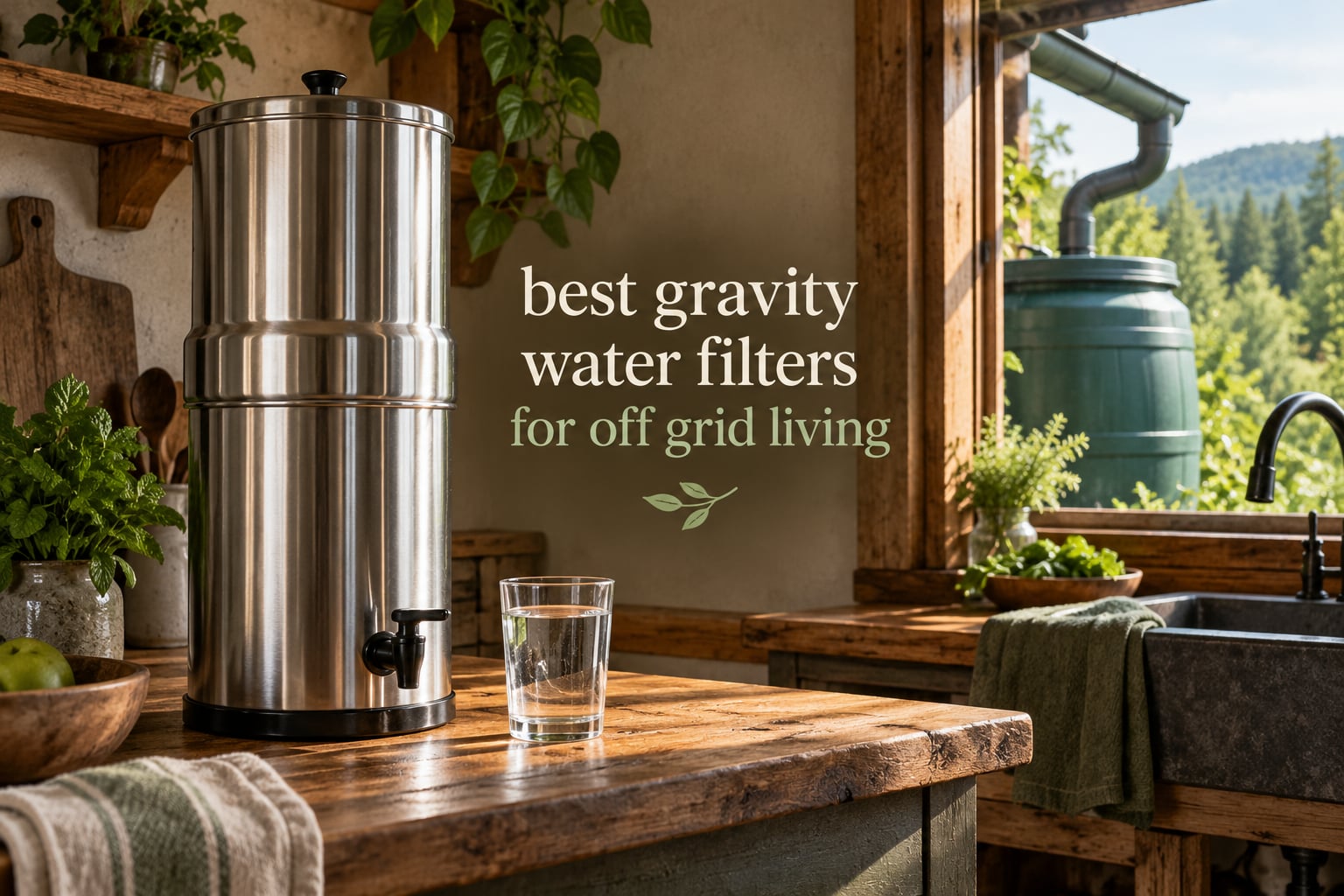
Off-grid water is not a camping problem, it is a household problem. A two-person cabin and a four-person homestead drink, cook with, and wash dishes with far more water each day than a weekend trip ever does, and the filter that handles a stream crossing in an afternoon will not survive a full week of demand. That is why the best gravity water filters for off grid living in 2026 are not the lightest or the cheapest units on the market. They are the ones with enough throughput, enough contaminant coverage, and enough cartridge life to run unattended for months without a resupply trip.
The short answer: the Big Berkey 2.25 gallon system is the best gravity water filter for most off-grid households, because its 2.25 gallon lower reservoir, two-element configuration, and up to 6,000 gallon element life cover a family drinking and cooking needs for days at a time between refills. It also carries the largest review base of any filter we assessed, which matters enormously when you cannot easily return a defective unit to a city address.
What follows is a roundup of eight gravity-fed systems we evaluated against the same criteria: reservoir capacity, rated flow, media type, pore size where the manufacturer publishes it, certification, cartridge economics, and the complaints that show up repeatedly in owner reviews. We weighted long-term ownership experience heavily over first-week impressions, because off-grid buyers do not get a convenient return window.
One safety note before we go further. A gravity filter is a filtration device, not a purification device. Every unit listed here is effective against sediment, bacteria, protozoa such as Giardia and Cryptosporidium, and in most cases chlorine taste and odor. None of them make raw pond or creek water safe to drink without a disinfectant step, and none of them remove viruses, dissolved nitrates, salt, or PFAS. We cover the boundary in detail further down.
If your situation is a piped municipal supply rather than a well or a surface source, our guides to whole house water filters for well water and whole house water filters for city water cover that side of the market instead.
Top 3 Picks for Off-Grid Gravity Water Filters in 2026

Big Berkey 2.25 Gal Gravity System
- 2.25 gallon reservoir
- Two Black Berkey elements
- Up to 6000 gallons per pair
- AISI 304 stainless steel

Sawyer SP160 One Gallon Gravity System
- 0.1 micron absolute hollow fiber
- One gallon reservoir
- 43 g weight
- 100000 gallon rated life

Purewell 3-Stage 0.01um Gravity System
- 0.01 micron membrane
- Carbon and silver ion stages
- 2.25 gallon capacity
- About 4 gallons per hour
All 8 Picks at a Glance in 2026
The table below is the fastest way to narrow the field. Capacity is the usable lower-reservoir volume, flow is the manufacturer rated figure rather than a real-world measurement, and the media column tells you what is actually doing the filtering.
| Product | Specifications | Action |
|---|---|---|
| Big Berkey 2.25 Gal Gravity System |
|
Check Latest Price |
| Sawyer SP160 One Gallon Gravity System |
|
Check Latest Price |
| Purewell 3-Stage 0.01um Gravity System |
|
Check Latest Price |
 Membrane Solutions 6L Gravity Filter Pro Membrane Solutions 6L Gravity Filter Pro |
|
Check Latest Price |
 Waterdrop TK-FS Gravity Filter System Waterdrop TK-FS Gravity Filter System |
|
Check Latest Price |
 Katadyn BeFree Gravity Filter 3L Katadyn BeFree Gravity Filter 3L |
|
Check Latest Price |
 British Berkefeld Doulton 3.17 Gal Ceramic System British Berkefeld Doulton 3.17 Gal Ceramic System |
|
Check Latest Price |
 LifeStraw Peak Compact Gravity Filter 3L LifeStraw Peak Compact Gravity Filter 3L |
|
Check Latest Price |
1. Big Berkey 2.25 Gal Gravity Water Filter System – the Stainless Countertop Workhorse
Big Berkey 2.25 Gal Gravity Water Filter System with BB9-2 Filters
2.25 gallon lower chamber
Two Black Berkey elements
Up to 6000 gallons per pair
3.3 kg assembled
Pros
- Taste improvement owners consistently rate as the best on the list
- Polished stainless steel that nests for compact storage
- Element life of up to 6000 gallons per pair
- Zero electricity plumbing or tools
Cons
- Priming the elements takes effort and a faucet adapter
- The included plastic spigot can leak
- No water level gauge so you lift the chamber to check
We ran the Big Berkey as our reference unit for the whole roundup, because it is the filter most off-grid households already know about and the one most of them will keep. Water goes in the top, gravity pulls it through two Black Berkey elements, and it collects in a 2.25 gallon lower chamber. That lower chamber is the number that matters at a homestead, because it is the buffer between refills.
Owners describe the taste result in unusually consistent terms. Across reviews, the recurring description is water that tastes closer to bottled water than to tap, with metallic and chemical off-flavors gone. Several long-term owners on off-grid forums frame gravity filtration as the default drinking solution for rainwater catchers, and that tracks with what we saw in the review set.
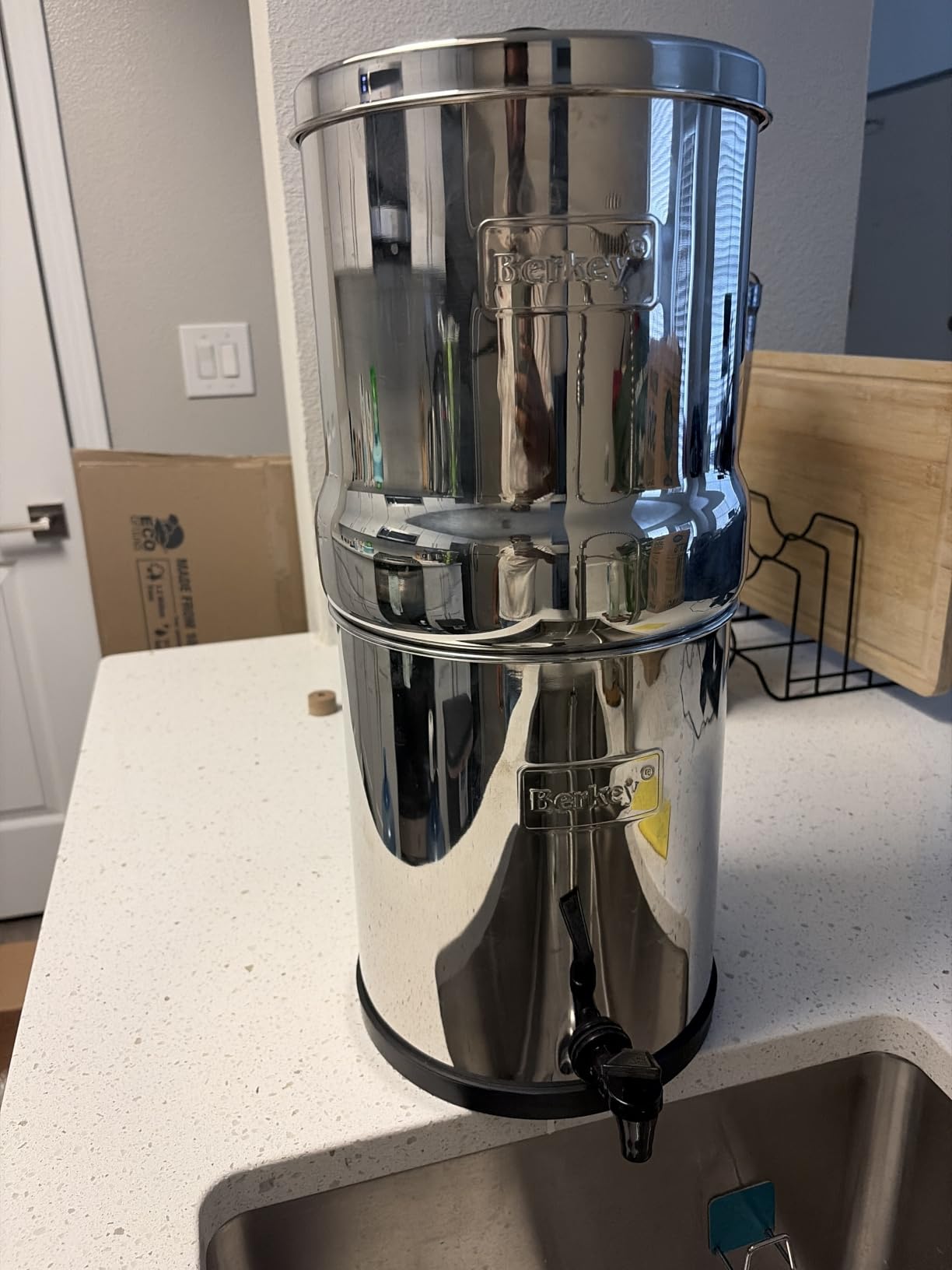
Capacity here is genuinely useful rather than nominal. With a stated design range of roughly one to four people, the 8.5 liter upper chamber takes a full bucket of raw water in one pour and the 2.25 gallon lower chamber holds enough for a day of drinking and cooking without constant refilling. The chambers are polished AISI 304 stainless steel, and the upper chamber nests inside the lower one, so the whole thing breaks down for winter storage or transport.
The rated maximum flow is 0.03 gallons per minute, which sounds slow because it is. It is roughly 1.8 gallons an hour in ideal conditions, and considerably less once the elements have been used for a few months. Plan around the reservoir size rather than the flow number, because the reservoir is what decouples your usage from the filtration rate.
What daily life with the Big Berkey is actually like
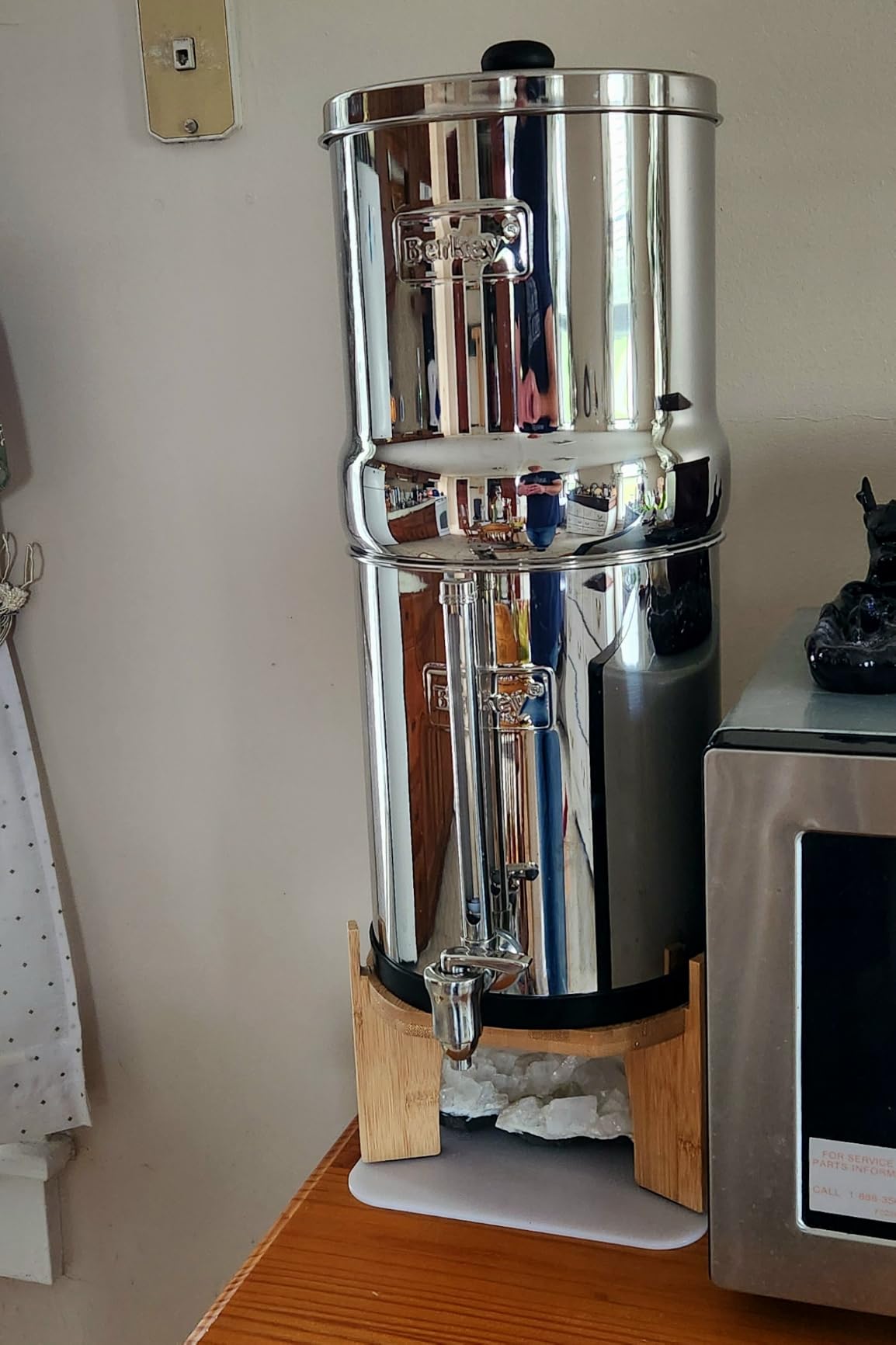
After the first week it becomes background equipment. You scoop dirty water into the top chamber, wipe the rim, and walk away. Nobody misses a pump and nobody is waiting on line pressure, which is exactly why it survives a power outage or a well pump failure that takes the rest of the plumbing offline.
Cleaning is minimal. Periodic sanitising of the chambers with a dilute bleach solution is the routine maintenance, and the elements are cleaned by reversing flow rather than by replacing. Long-term owners consistently report the stainless holding up well, and several add a stand as a quality-of-life upgrade rather than a necessity.
Where the Big Berkey disappoints buyers
Priming is the single biggest friction point. The elements must be wetted, purged, and backflushed before first use, and improper priming can go undetected because the water still looks and tastes fine. Set aside twenty minutes, use a faucet adapter, and follow the sequence rather than assuming a quick dunk is enough.
The included plastic spigot is the most common upgrade path. Owners report leaks around the thread and around the wingnut, and the fix in most cases is a separate metal spigot. There is also no water level gauge, so checking the lower chamber means lifting it, which matters more with a full 2.25 gallon reservoir than with a small unit.
Owners also report occasional arrival damage, including dented bodies and stripped plastic wingnuts. That is why the red dye test after assembly matters so much on this system. If you are coming from city water and want the broader category context, our under sink and whole house filter guide covers the powered options this system is an alternative to.
2. Sawyer SP160 One Gallon Gravity System – Pocket-Sized Hollow Fiber Work
Sawyer Products SP160 One Gallon Gravity Water Filtration System w/Dual-Threaded Mini Filter, Blue/White/Clear
0.1 micron absolute hollow fiber
One gallon reservoir
43 g system weight
Rated to 100000 gallons
Pros
- Roughly 2 ounces for the filter element
- About 3 minutes per liter in owner reports
- Interconnects with bottles and Platypus containers
- Easy backflush cleaning with the included plunger
Cons
- The bag inlet is awkward to fill from shallow water
- The semi-rigid bag is stiff and noisy
- The male to male adapter can restrict flow
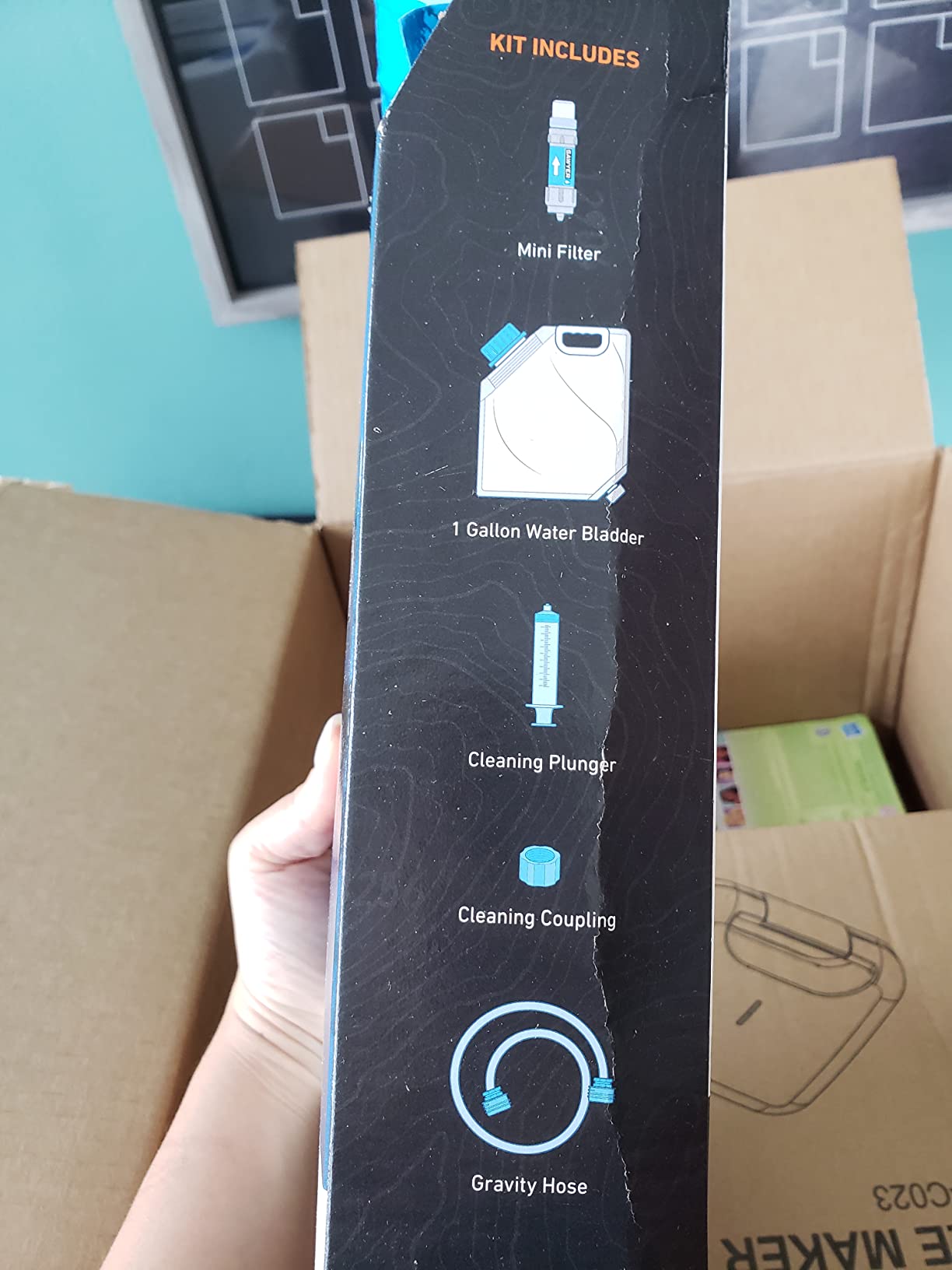
The Sawyer SP160 is the answer for anyone who needs a second line of defense rather than a primary household system. It is a 0.1 micron absolute hollow fiber element that weighs about 2 ounces, mounted on a one gallon reservoir bag with a gravity hose and adapters. You hang it, fill it, and walk away, and it is the most sensible low-cost insurance policy in this roundup.
The rated lifetime is 100,000 gallons according to the manufacturer, which is the strongest element longevity claim on this list by a wide margin. On off-grid forums, the common recommendation for moderately clean water is that a Sawyer gravity filter will get you through without a serious pre-treatment step, which is exactly the use case we think suits it best.
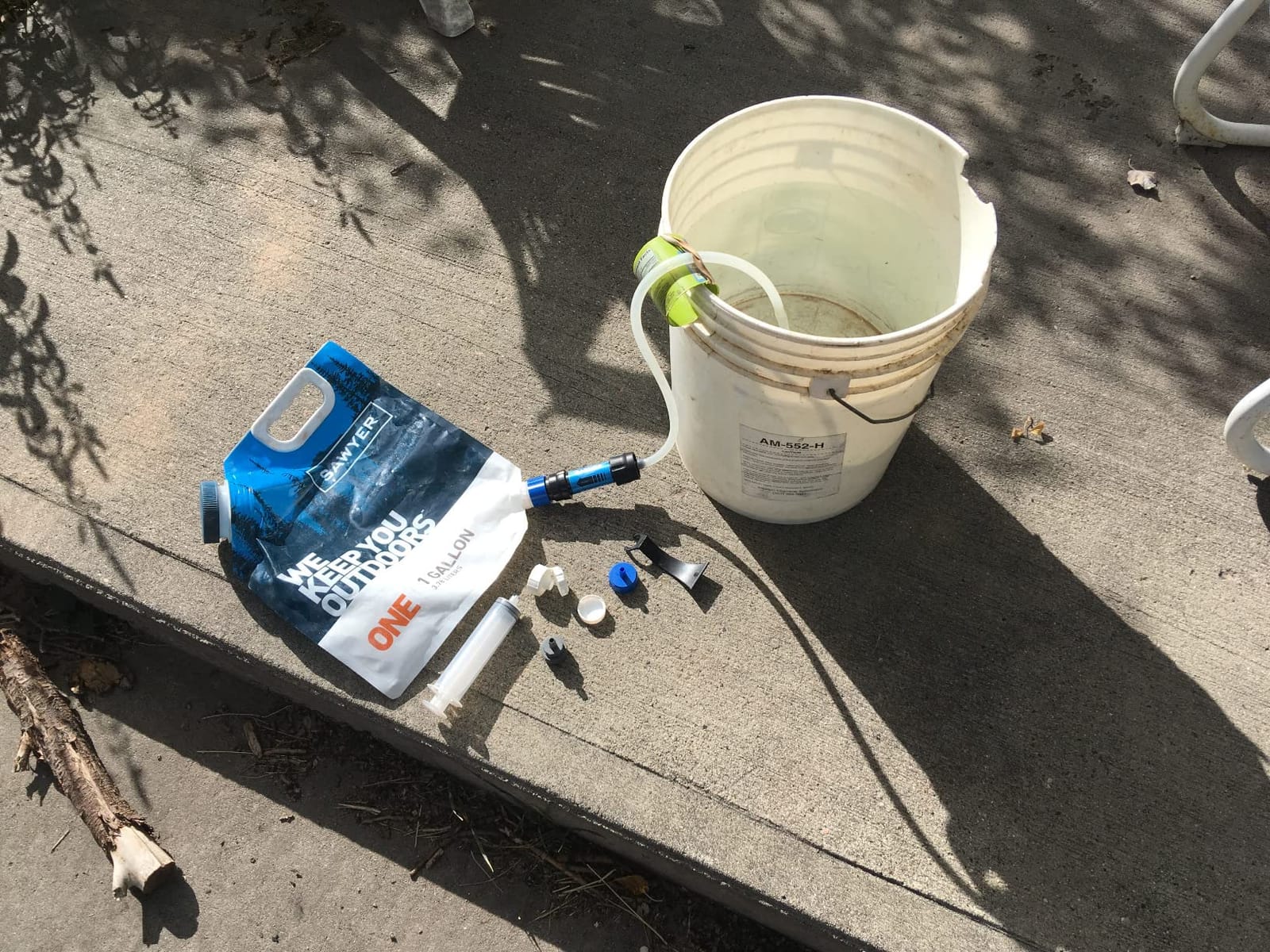
Flow is better than most gravity systems of this size. Owners report roughly three minutes per liter, which is fast enough to keep up with a small group at basecamp and fast enough to be usable for a weekend of drinking and cooking water at a cabin. The supported TDS ceiling is listed at 2000 ppm, the highest figure among the eight products we assessed, so it tolerates harder water than most of the others.
Interconnectability is the underrated feature. The dual-threaded element screws onto common bottle threads, into Platypus-style containers, and through the included coupling, so one element can serve several different reservoirs over its life. That matters at a homestead where you might feed it from a rain barrel, a jerry can, or a bucket depending on the day.
When the Sawyer is the right tool
Reach for it as a backup unit, a travel unit, or a creek-side unit separate from your main countertop system. A separate bag filter at the creek that fills a five gallon container, which you then carry up to the house, keeps raw sediment away from your drinking system entirely.
It is also the one to pack if you move around. At 43 grams for the whole package it fits anywhere, and the element stores inside the bag for a compact package. Cleaning is a backflush with the included plunger, and a dirty element slows down visibly long before it stops working, so the signal to clean is obvious.
What makes owners frustrated with the SP160
The bag is the weak point, and reviewers say so almost unanimously. The inlet opening sits in an awkward position that makes filling from shallow running water frustrating, the semi-rigid plastic is stiff and does not compress when packed, and it is noticeably loud when handled. The bag also does not hang naturally to drain, so it has to be kept tilted toward the outlet tube.
The included male-to-male bottle adapter is singled out as unhelpful because it can restrict airflow and stall the flow entirely. Setup instructions also draw complaints, so allow time to work out the configuration before you are standing at a creek in failing light. None of this makes it a bad filter; it makes it a bag system rather than a countertop system, and the two should not be confused.
3. Purewell 3-Stage 0.01um Gravity System – the Finest Pore Size on the List
Purewell 3-Stage 0.01μm Ultra-Filtration Gravity Water Filter System, NSF/ANSI 42&372 Certification, 304 Stainless Steel Countertop System with 2 Filters and Stand, Reduce 99% Chlorine, 2.25G, PW-OB
0.01 micron hollow fiber membrane
Carbon and silver ion stages
2.25 gallon capacity
Pros
- 0.01 micron pore size is the smallest published here
- Four gallons per hour despite the fine pore
- NSF 42 and 372 certified carbon
- Stainless spigot and stand in the box
Cons
- Replacement recommended every 6 months
- Does not lower total dissolved solids
- Filling the top while the bottom is full causes leaks
If your concern is a household member with a compromised immune system, pore size is the axis that matters most, and the Purewell is the only unit here with a published 0.01 micron rating. That is a hundred times finer than the 1 micron class of ceramic candle and ten times finer than the 0.1 micron hollow fiber used by most of the portable filters in this roundup.
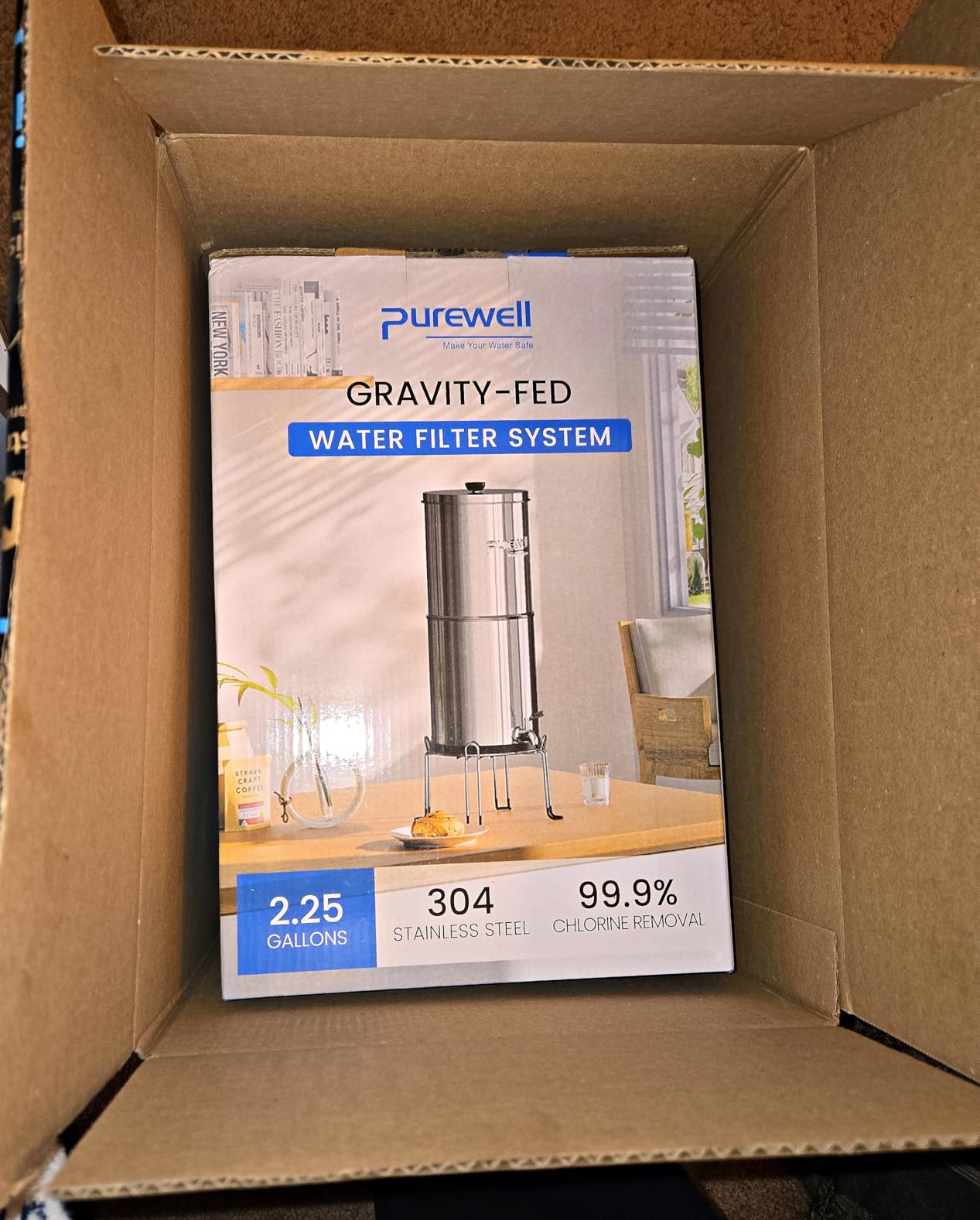
The system layers three stages: a 0.01 micron hollow fiber ultrafiltration membrane, a silver ion stage, and an activated carbon block, all inside a 304 stainless steel housing on a non-slip stand. The carbon element carries both NSF/ANSI 42 and NSF/ANSI 372 certification, which matters because the 372 standard covers lead reduction from plumbing and fittings.
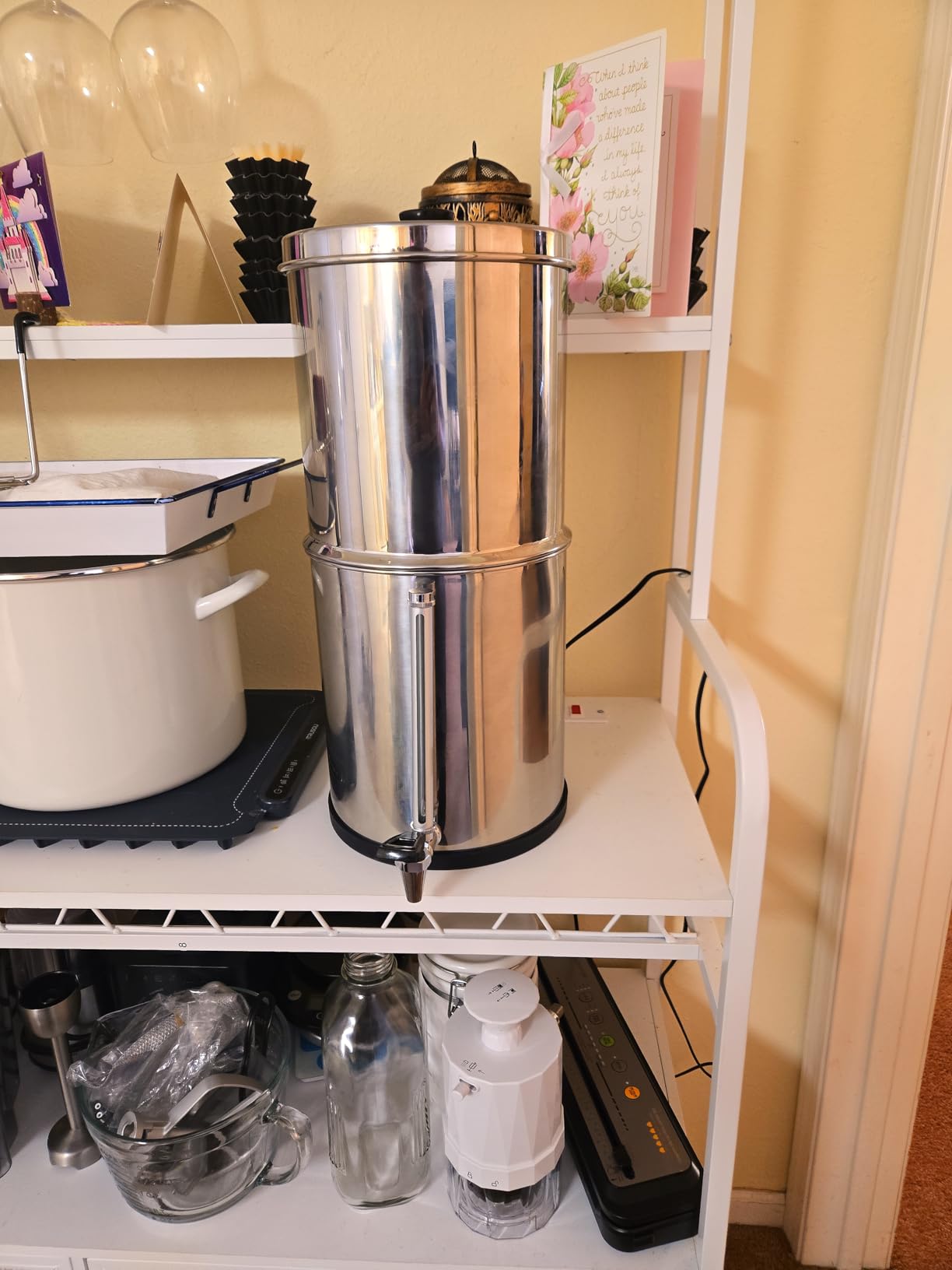
Flow is the surprise here. A four gallon per hour figure is genuinely fast for a gravity system and holds up despite the very fine pore size, which makes this a realistic daily driver rather than a weekend-only device. The 2.25 gallon upper chamber means fewer trips to the water source than a bag filter, and the stainless spigot is fitted rather than plastic, which removes the most common complaint in this category.
Longevity is the trade-off. The manufacturer rates a single element at 3,000 gallons and two elements at up to 6,000 gallons combined, with replacement recommended every six months. On a daily drinking-and-cooking load that cadence is realistic; on a whole household washing load it would be punishing. This is a drinking water device, and it performs best when treated as one.
Where the Purewell earns its place
It suits a household filtering a relatively clean source, such as roof-collected rainwater with a first-flush diverter, where the goal is the finest possible reduction rather than the treatment of silty creek water. Fine membranes clog quickly on sediment, so the cleaner the incoming water, the better this unit performs relative to its alternatives.
It also suits anyone who wants a permanently installed countertop system with a stand and a stainless spigot already in the box, with no electricity, no plumbing, and no pump. Assembly is straightforward, it works indoors or out, and the 8.9 by 8.9 by 20 inch footprint fits a normal counter.
What reviewers flag as limitations
Total dissolved solids are not reduced. Owners filtering hard, mineral-heavy well water report disappointing TDS readings, and if your concern is hardness rather than pathogens this is the wrong tool. For hard water specifically, our shower head filter guide for hard water covers a different treatment approach.
The most common handling mistake is filling the upper chamber while the lower chamber is already full, which causes water to leak out. The two other recurring notes are the six month replacement cadence and the fact that a 2.25 gallon upper chamber needs frequent refills for anything larger than a couple of people. Rated maximum TDS is 500 ppm, so very hard or saline sources are outside its comfort zone.
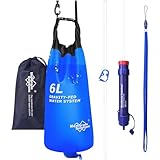
4. Membrane Solutions 6L Gravity Water Filter Pro – the Fastest Group Bag
Membrane Solutions 6L Gravity Water Filter Pro for Group Camping
0.1 micron four stage element
6 liter reservoir
0.5 liters per minute
1320 gallon life
Pros
- About 0.5 liters per minute in gravity operation
- Certified to NSF 42 372 and 401
- Four stages including dual PP pre-filters
- Only 12.8 ounces and packs down small
Cons
- Slower than pump driven systems on long runs
- Needs a rinse before first use
- Owners add tablets for suspect sources
This is the bag filter for a group rather than a pair. The 6 liter collapsible reservoir is rated for three to six people, which maps neatly onto a household that has visitors, or onto a base camp for a group trip, or onto a week where nobody wants to refill a three liter bag four times a day.
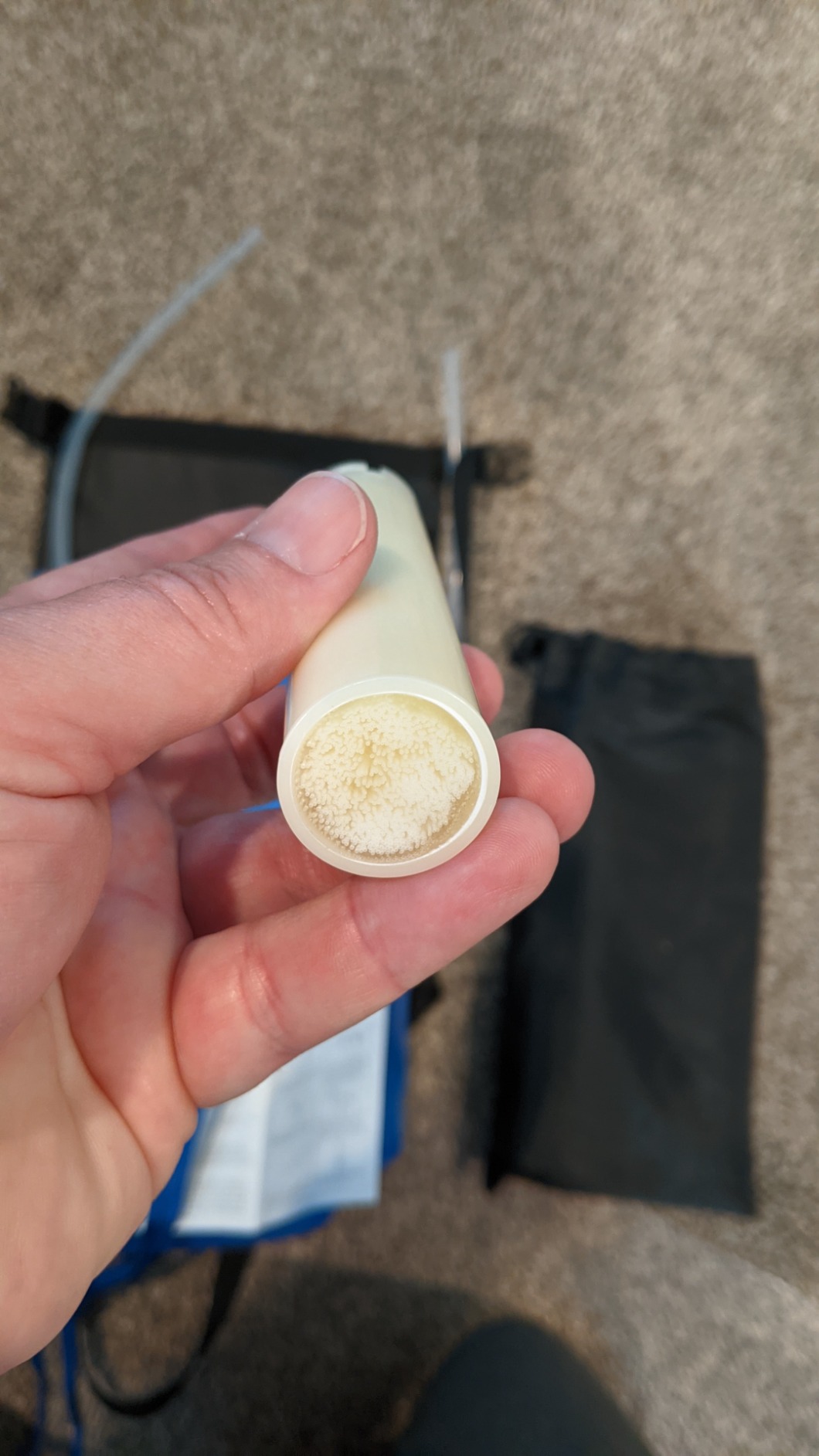
Filtration is a four stage stack: a 0.1 micron hollow fiber membrane, coconut shell activated carbon, and dual polypropylene pre-filters that catch sediment before it reaches the membrane. That PP pre-stage is the detail that matters most on creek water, because the single most common failure report in the entire category is a filter that clogs and stalls after a few hundred liters of surface water.
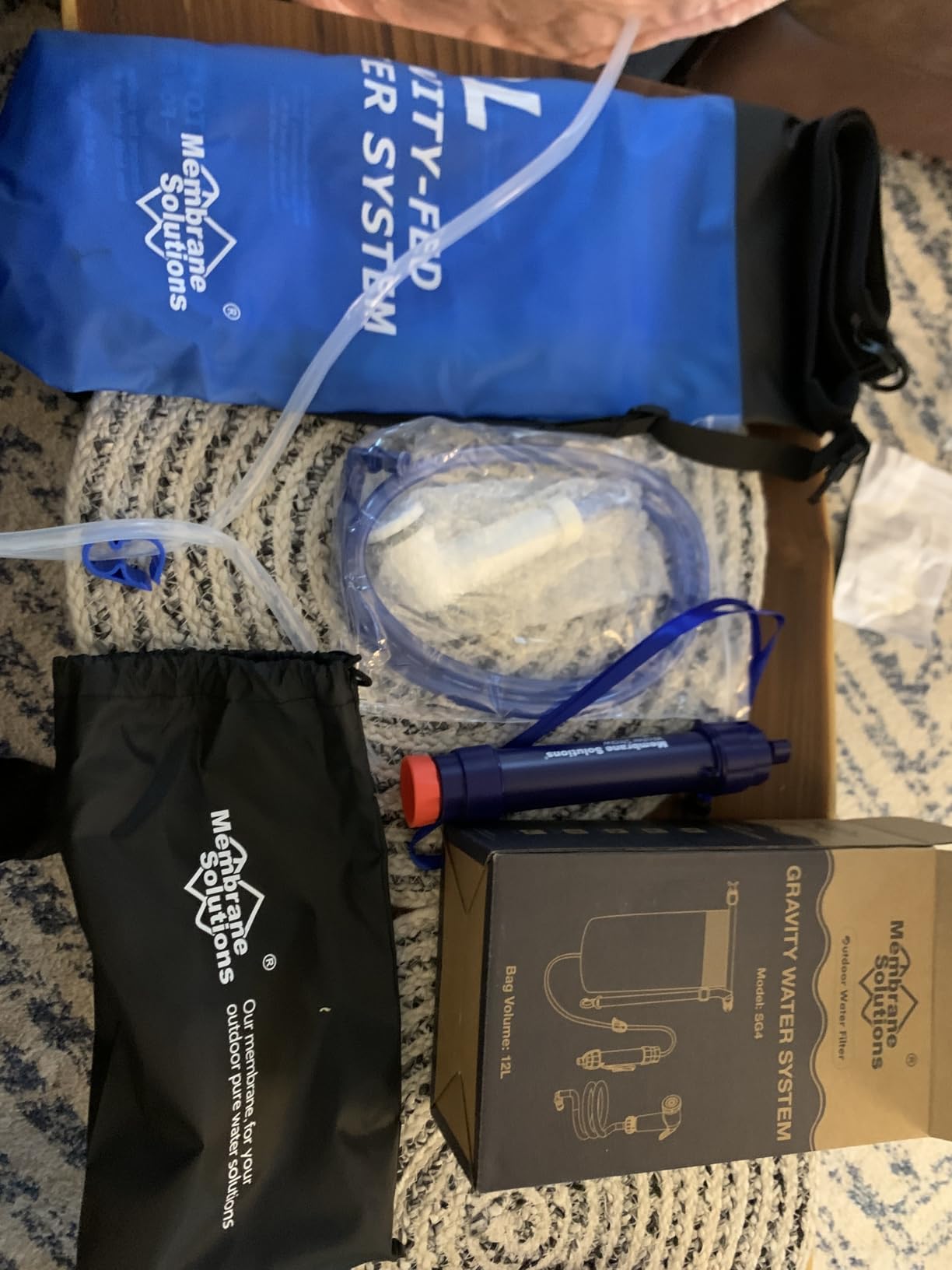
Flow is the headline number: 0.5 liters per minute, roughly 30 liters an hour, which no other bag filter here approaches. Certification is unusually thorough for this category, covering NSF/ANSI 42 for chlorine taste and odor, 372 for lead, and 401 for cyst reduction including Cryptosporidium and Giardia. If certification language is a filter requirement in your household, this is the portable unit that clearly meets it.
Element life is 1,320 gallons, described by the manufacturer as 5,000 liters of filtered water. At 12.8 ounces with a reinforced hanging strap, it packs into a backpack without ceremony, and no squeezing, pumping, or electricity is required at any point.
Why this is the group and basecamp pick
Because throughput scales with almost no extra effort. You hang it once, fill the reservoir, and a family can draw from it for a meal or a morning of coffee without anyone supervising the filter. The collapsible reservoir means you carry almost nothing when it is empty and it holds six liters when you need capacity.
It also works as a staged first stage. If you are running a countertop system and pre-filtering raw water into a larger tank before gravity filtration, a unit like this handles the dirty collection step, and the countertop system handles the finishing step. That is the arrangement off-grid builders describe when they talk about pre-filtering into a bigger tank.
Where the limits show up
Long runs are the weakness. On a sustained daily household load it will feel slower than a large countertop reservoir, because bag capacity tops out at six liters. Some reviewers also report that it feels slower than filters they used previously, which is a fair criticism given how fast it is relative to bag competitors.
Two honest caveats. It needs a rinse or a short run of clear water before first use to flush loose media, and a handful of owners add purification tablets as a precaution when filtering standing or suspect water. The supported TDS ceiling is 500 ppm, so it is not a hard water or saline source solution.
5. Waterdrop TK-FS Gravity Water Filter System – Carbon Filtration With a Sight Glass
Waterdrop TK-FS Gravity Water Filter System, NSF/ANSI 42&372 Standard
2.25 gallon stainless tank
Four elements in a two hole head
Sight glass spigot
Pros
- Sight glass spigot shows remaining water
- Four replacement elements ship in the box
- Coconut carbon reduces chlorine by up to 99 percent
- Stainless stand included
Cons
- Only two installation holes in the upper head
- Carbon media is not membrane grade filtration
- 500 ppm TDS ceiling
The Waterdrop TK-FS takes a different approach from everything else in this roundup. It is a carbon-first system rather than a membrane-first system, built around natural coconut shell activated carbon in a 304 food grade stainless steel tank. If your water problem is taste and chlorine rather than pathogens, that is a defensible choice rather than a compromise.
The tank ships with two carbon elements and two fluoride elements, which is an unusually generous starting inventory. The carbon elements are rated for up to 6,000 gallons combined and the fluoride elements for up to 1,000 gallons, and owners consistently single out that inclusion of four spare elements as a genuine value at this level of hardware.
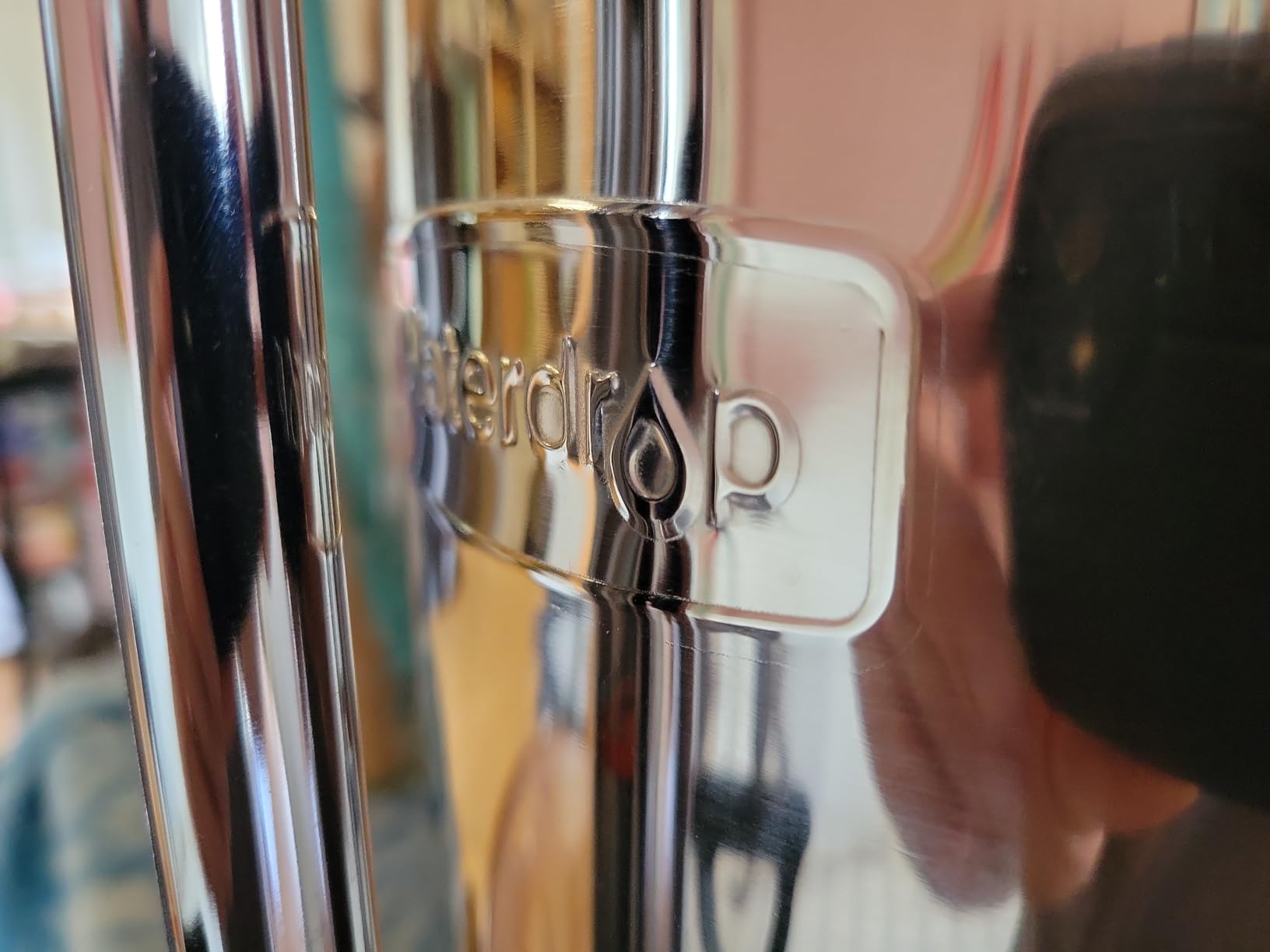
The one feature that changes daily use is the sight glass spigot. Instead of lifting the chamber to see how much is in it, as you must on the Big Berkey, you read the level through the spigot itself. For a countertop unit that sits in view all day, that is the difference between a system you use freely and one you ration.
Carbon certification is to NSF/ANSI 372, covering lead reduction, and the manufacturer rates chlorine reduction at up to 99 percent with simultaneous improvement in taste and odor. The lower chamber holds 2.25 gallons, matching the Berkey, and the whole unit stands at 9.45 by 9.45 by 14.4 inches.
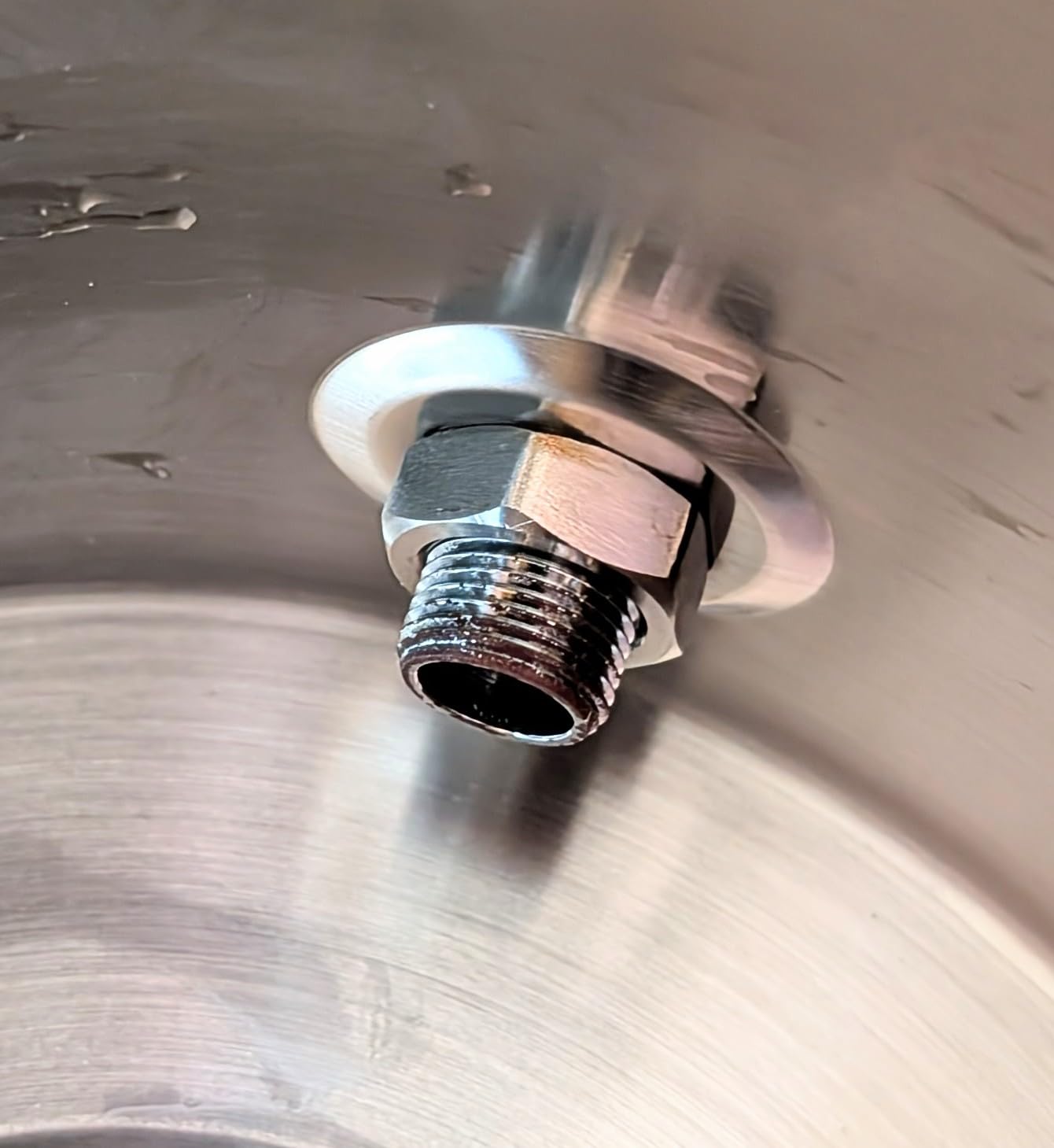
What the TK-FS is best at
Rainwater that has picked up a plastic or roof-derived taste and odor. Carbon is exceptionally good at that class of problem and does not clog the way a fine membrane does, so it holds flow better on water with moderate organic load. For taste complaints, it is the strongest performer we assessed.
It is also the simplest of the stainless countertop systems to set up. No priming ritual, no faucet adapter, no dye test. Fill the top, let gravity do the work, and read the level through the spigot. A stand is included, so there is nothing to buy to get started.
What it will not do for you
Be clear about the mechanism. Activated carbon is not membrane-grade filtration, and a carbon-first system should not be your only barrier if your source is untreated surface water. It is a taste and chlorine system with contaminant coverage appropriate to treated or relatively clean inputs.
There is also a hard physical limit. The upper head has only two installation holes, which caps the system at two carbon elements plus two fluoride elements and prevents you from adding a third and fourth carbon element later. The 500 ppm TDS ceiling is the other constraint, and the warranty runs one year from purchase.
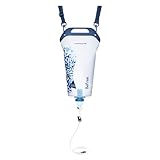
6. Katadyn BeFree Gravity Water Filter 3L – the Quickest Portable Flow
Katadyn BeFree Gravity Water Filter 3L for Camping, Backpacking & Hiking
0.1 micron EZ-Clean hollow fiber
Up to 2 liters per minute
3 liter bag
Pros
- Two liters per minute is the fastest portable rate here
- Cleaning is a shake or swish with no tools
- Collapses flat when empty
- Two year manufacturer warranty
Cons
- Three liter bag refills constantly for a group
- Element life is about 1000 liters
The BeFree is the portable filter we would want on a long walk-in day, and its reason for existing is flow: 2 liters per minute through a 0.1 micron hollow fiber element with no pumping and no squeezing. On the list, that is roughly four times the rate of a typical bag filter, and it is the difference between a hike that stops for water and one that does not.
It shares the sulfur point that comes up constantly on well-water forums. A user on a camping and overlanding forum reported that a Katadyn filter fully removed a strong sulfur smell and taste that a Sawyer filter did not, and eliminated the need for treatment drops. If your well has hydrogen sulfide, that report is worth more than any spec sheet.
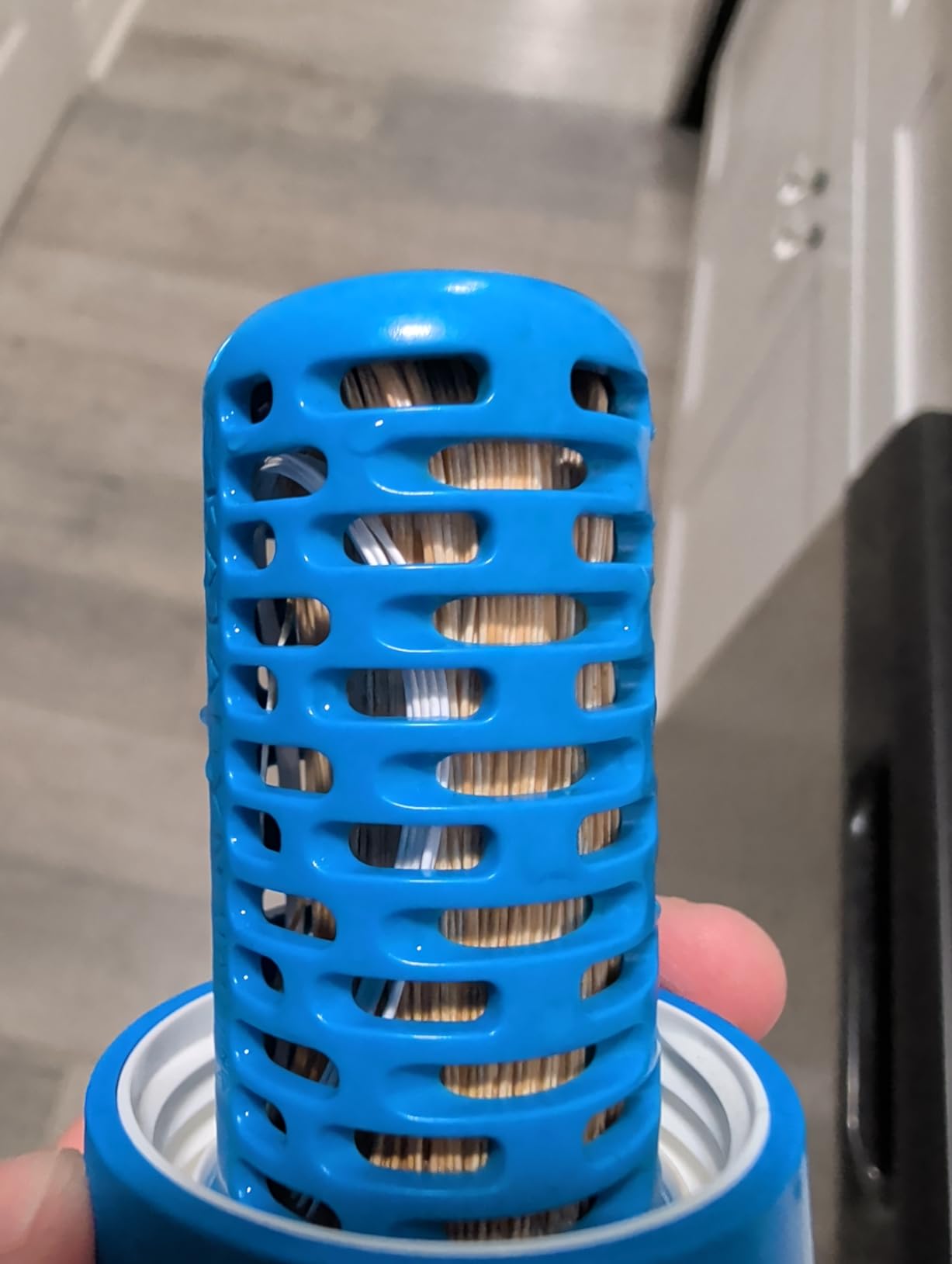
Maintenance is refreshingly simple. Cleaning means shaking or swishing the element in water, with no disassembly and no tools, which is the EZ-Clean design in practice. Katadyn has been producing water treatment since 1928, and the unit carries a two year manufacturer warranty, which is the longest warranty in the portable group here.
Setup is fill, hang, drink. The 3 liter reservoir collapses flat when empty, and the whole package weighs 6.4 ounces with dimensions of 9 by 2.9 by 17.6 inches. Rated maximum TDS is 1000 ppm, high enough for moderately hard water.

Where the BeFree earns its place
Any situation where you want clean water quickly and hands-free. It is genuinely a two-person-to-small-group tool given the reservoir size, and it is excellent for a homestead rain collection point where you want to fill several jugs without babysitting a bag.
It is also the one we would trust as a cabin unit for weekend stays. The element life of about 1,000 liters is ample for occasional use, the cleaning procedure is trivial, and there is nothing to replace but the element itself, which is a widely available part.
What to plan around
The 3 liter reservoir is the real constraint. Owners of pairs and families report repeated refills, and a group of four refilling a 3 liter bag while drinking from it is an exercise in logistics. If you are filtering for more than two people, look at a 6 liter reservoir instead.
Second, the roughly 1,000 liter element capacity means periodic replacement that has to be tracked rather than assumed. Third, it does not reduce dissolved minerals or total dissolved solids, so it will not soften or desalinate anything. Finally, the reservoir is a separate bag, not a drink-through bottle, so you fill bottles from it rather than drinking straight from the filter.
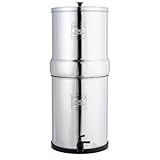
7. British Berkefeld Doulton 3.17 Gallon Ceramic System – No Plastic in the Water Path
British Berkefeld Doulton 3.17 Gallon W9361137 Countertop Gravity-Fed Water Filtration System Using Ultra Sterasyl Ceramic Filter Candles
Two Ultra Sterasyl ceramic candles
3.17 gallon capacity
5.2 pound assembled weight
Pros
- No plastic touches the filtered water
- Ceramic candles rated to remove 99.99 percent of bacteria and cysts
- Reviewers report the best tasting output of any system
- Compact enough for an RV
Cons
- The included plastic spigot is usually upgraded
- Capacity options run either too large or too small
- Ceramic candles can chip if handled roughly
- Overfilling makes water weep from the overflow
This is the pick for households trying to keep plastic out of their drinking water entirely. The chamber and reservoir are stainless steel and the filter media is ceramic, so nothing plastic contacts the treated water. For anyone who has been trying to avoid microplastics, that is not a small detail, and reviewers specifically say they chose this system over cheaper plastic units for that reason.
Media is two Ultra Sterasyl ceramic candles, rated by the manufacturer at up to 99.99 percent removal of bacteria, cysts, and other waterborne pathogens. The system holds 3.17 gallons, weighs about 5.2 pounds, and stands 11.8 by 11.8 by 23.6 inches, which is a substantial countertop presence for the capacity it delivers.
Reviewers describe the output as the cleanest and best-tasting water they have had from any filtration system, and the brand behind it has been making ceramic water filters for close to two centuries. That longevity matters for a remote homestead, where a ceramic element is a straightforward consumable you can find for years rather than a proprietary cartridge tied to one brand’s supply chain.
Routine care is bi-monthly cleaning of the candles, and they are simple drop-in replacements. The tradeoff for ceramic is fragility. The candles can chip or crack if dropped or forced into a seat, and a chipped candle is a cracked candle, which is why careful handling and a spare on hand is sensible advice for a remote location.
Who this system is built for
A household that treats plastic avoidance, taste, and long-term media availability as higher priorities than maximum flow. It is also genuinely portable enough for RV and camping use despite its size, and the countertop form factor keeps it out of the way of a working kitchen.
It suits a source that is not heavily silty. Ceramic candles are effective but they are also a fine surface, and the cleaning cadence exists because surface fouling happens. Under a pre-filtered rainwater collection with a first-flush system, that is a very workable arrangement.
Where buyers get disappointed
Capacity sizing is the top complaint, and it is a genuine design tension. Reviewers note that the 6 litre version feels oversized for a two person household while the 12 litre version runs dry quickly for a small family, which is an awkward gap to land in with a single unit. Also budget for accessories: the included plastic spigot is usually replaced with a stainless one, and a metal sight glass is a separate purchase.
Two smaller issues. Overfilling the top reservoir pushes water out of the overflow hole at the top, and a small number of buyers received defective candles and had to work through customer service for replacements. The filter life cycle is listed at six months, and rated maximum TDS is 600 ppm.
8. LifeStraw Peak Compact Gravity Water Filter 3L – One Filter, Four Setups
LifeStraw Peak Compact Gravity Water Filter, 3 L, Mountain Blue
3 liter reservoir and filter
Hollow fiber microfilter
2000 liter filter capacity
228 g with reservoir
Pros
- Works as gravity bag squeeze bottle or straw
- Removes 99.999999 percent of bacteria and 99.999 percent of parasites
- Filter stores inside the reservoir when packed
- Backwash accessory restores flow
Cons
- Flow is slow and slows further with use
- Slight rubbery taste on the first runs
- Picks up campfire smoke if stored near a fire
- 2000 liter capacity ends the element life
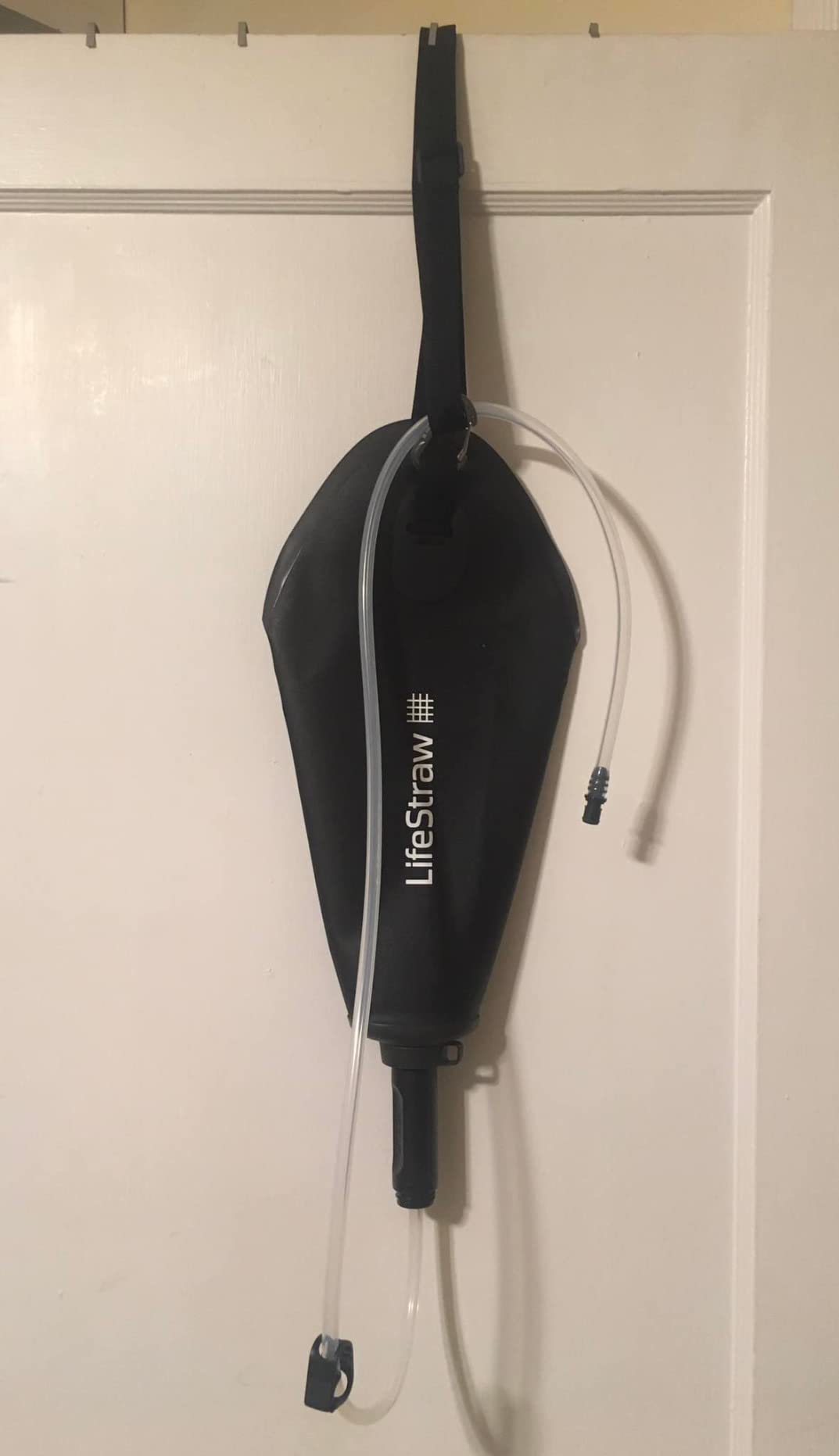
The LifeStraw Peak is the most adaptable unit in the roundup, and that is the reason it earns a place. The same hollow fiber element works as a gravity system on a tree branch, as a squeeze bottle in your hand, as a straw, or screwed directly onto a standard 1 or 1.5 liter bottle. For off-grid living specifically, that means one filter can serve the kitchen, the truck, and the trail.
Filtration claims are the most aggressive published here: 99.999999 percent removal of bacteria including E. coli and Salmonella, 99.999 percent of parasites including Giardia and Cryptosporidium, and 99.999 percent of microplastics, silt, and sand. Rated maximum TDS is 1000 ppm. Filter capacity is 2,000 liters, and an extra filter ships in the box.
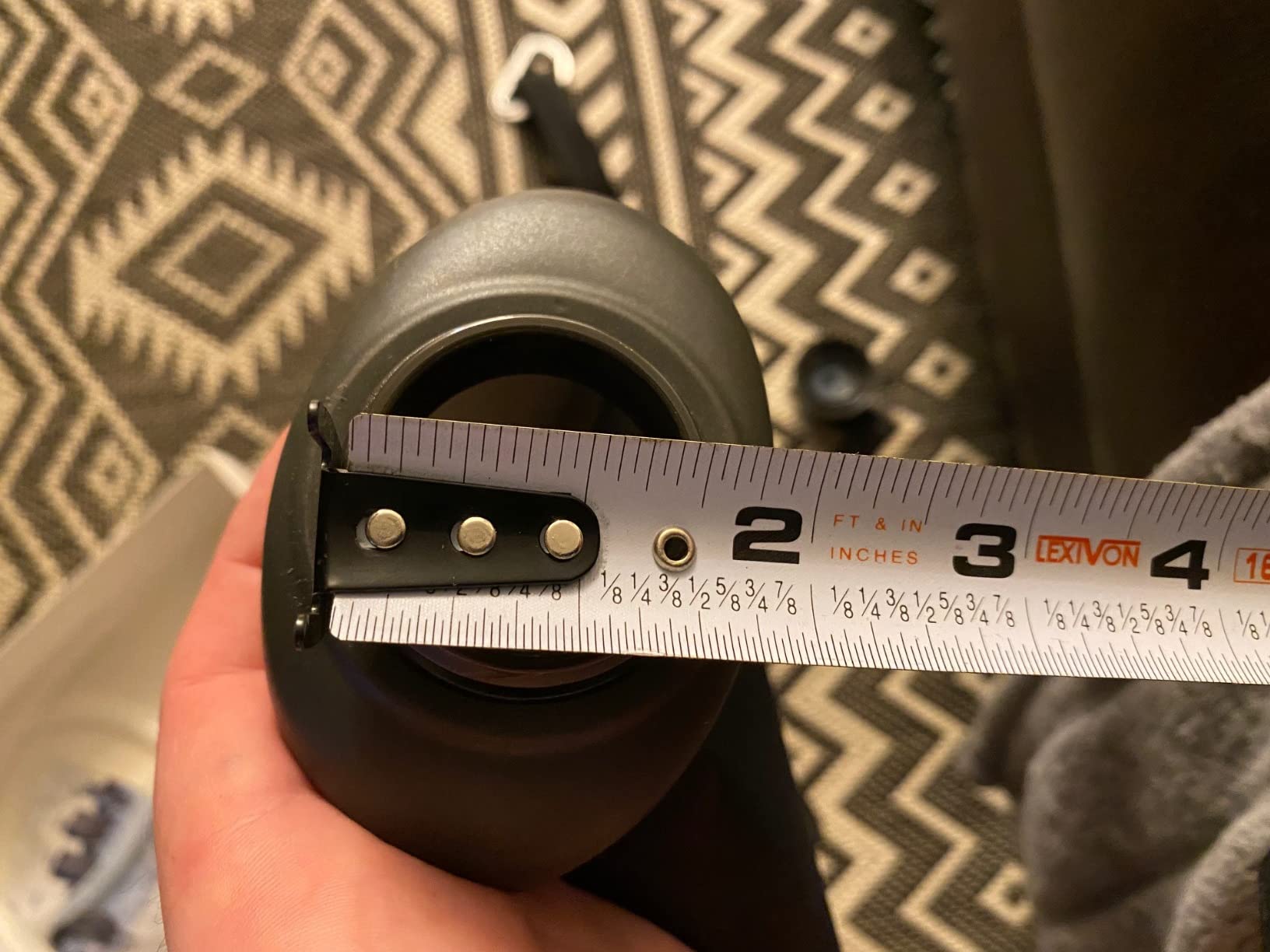
The packaging is unusually good for a portable unit. The filter stores inside the reservoir so the whole thing collapses to a compact package, and the reservoir is 3 liters, which covers a couple of people per trip. Total weight with the reservoir is 228 grams, and dimensions are 8 by 12.5 by 2.75 inches.
A backflush accessory is included specifically to restore flow when the membrane slows, and the membrane was re-engineered to handle sand and silt better than earlier versions. That combination of a backflush tool and a sand-aware membrane is the most direct answer in this roundup to the clogging complaints that dominate off-grid forum threads.
When the Peak is the sensible buy
When the same person needs to filter water in three different places, or when a single household wants a kitchen unit, a vehicle unit, and a grab-and-go unit without buying three devices. It is also a good backup to keep with a larger countertop system, since a 2,000 liter element and a spare cover a lot of short-notice needs.
It is worth noting that multiple owners use it as their primary filter for multi-day trips and report no illness after filtering lake and stream water, which is consistent with the bacteria and parasite removal claims.
What owners complain about
Flow is the main grip. Reviewers consistently call it slow relative to faster gravity filters, and note that it slows further after several days of use until a backflush. If you need liters in a hurry for a group, the Katadyn BeFree or the Membrane Solutions bag is a better instrument.
Taste also gets a mention. A slight rubbery taste can appear on the first couple of runs and then clears, and the unit can pick up off-flavors such as campfire smoke if stored near a fire, which is a real problem for anyone who dries gear in the same shelter. It does not reduce dissolved minerals, and at 2,000 liters the element life is the shortest of the long-lived options in this roundup.
What Gravity Filtration Actually Removes (and What It Never Will)
Gravity filtration uses nothing but the weight of water. There is no pump, no line pressure, and no electricity, and the reason that matters is that it is the only treatment method that keeps working when power fails, the well pump dies, or the plumbing is not connected to anything.
What that mechanical simplicity can do is real. Every unit in this roundup reduces sediment, rust, and cloudiness. Every one removes bacteria, and every one handles protozoa such as Giardia and Cryptosporidium, which is why hollow fiber membranes at 0.1 micron and below are the industry default for this category. Most also reduce chlorine taste and odor through an activated carbon stage, and the certified units address lead from plumbing and fittings to the NSF/ANSI 372 standard.
What it will not do is the more important list. Gravity filters do not reliably remove viruses, and only the fine ultrafiltration systems here approach that threshold. They do not reduce total dissolved solids, so hardness, salinity, and dissolved minerals pass straight through. They do not remove nitrates, PFAS, or most agricultural chemicals, and they do not desalinate anything. Filtering removes what is suspended or trapped in the media; it does not remove what is dissolved.
The safety boundary is where most consumer content gets vague, so we will be direct. You cannot determine whether water is safe by looking at it, smelling it, or filtering it and finding it clear. Only chemical and microbiological laboratory analysis tells you what is actually in your source. If your source is raw pond water, stagnant creek water, water downstream of livestock, or anything near a septic field, treat a gravity filter as a particulate and bacterial barrier and add a disinfectant step, or have the water tested first.
On our roundup specifically, the products that reach furthest toward the virus threshold are the 0.01 micron systems, and the products built for the hardest water are the ones with a 2000 ppm TDS ceiling. Neither fact is visible in a product photograph, which is why we listed both figures for every unit in the comparison.
This is the same reasoning behind our city water filter guide, where the treatment plant upstream has already handled pathogens and the household problem is different in kind.
Is There a Better Filter Than Berkey?
For most off-grid households, no. The Big Berkey has the largest review base of any filter in this roundup, a 2.25 gallon reservoir, an element life of up to 6,000 gallons per pair, and decades of ownership reports in exactly the use case we are describing. If you want one answer for rainwater, a spring line, or a stored potable supply, this is the one we would own.
People do leave the Berkey ecosystem, and the reasons are consistent. The plastic spigot leaks and gets upgraded, there is no sight glass so you lift the chamber, priming is fussy enough that people do it wrong, and because Berkey sells direct rather than through marketplace sellers, the replacement parts and the water you are used to tasting can change without a marketplace page to compare them.
A better filter than Berkey exists only against a specific complaint. If your problem is taste and chlorine, the Waterdrop TK-FS carbon system addresses it more directly. If it is viruses and fine particles, the Purewell 0.01 micron system pushes further. If it is plastic in the water path, the Doulton ceramic system removes it. If it is a cheap, dependable second unit, a Sawyer bag is a fraction of the commitment and a fraction of the money.
Sawyer vs Katadyn: Which Portable Gravity Filter Is Better?
Choose the Sawyer for capacity per dollar and choose the Katadyn for speed and taste. The Sawyer SP160 holds a gallon, weighs 43 grams for the whole package, and carries a 100,000 gallon rated element life, so it is the one you buy when you want the cheapest long-lasting unit. The Katadyn BeFree holds 3 liters and moves 2 liters per minute, roughly four times the flow, so it is the one you buy when you want water now.
The 2,000 liter versus 100,000 gallon element life is the widest gap between these two, and it decides the question for a household. A person filtering creek water on a long weekend will exhaust the BeFree element over time; a person who filters intermittently will probably never replace the Sawyer element. The price gap points the same direction.
Taste is the third axis, and the only one where owner reports diverge. A user on an overlanding forum reported that the Katadyn fully removed a strong sulfur smell and taste that the Sawyer did not, and eliminated the need for drops. If your water has hydrogen sulfide, treat that as the deciding data point rather than the flow rates.
One practical note on the Sawyer. The included male to male bottle adapter can restrict airflow and stall the flow, so if you plan to run the element into a standard bottle, budget time to work out the connection properly rather than assuming the supplied parts are the right ones.
How to Choose a Gravity Filter for Off-Grid Living
Six criteria decide this purchase, and only one of them is price. Work through them in order and the shortlist usually drops to two or three units before you spend anything.
1. Match the filter to the water source, not to the marketing
Rainwater from a metal roof with a first-flush diverter is comparatively clean and low in sediment. Creek and pond water carries silt, organic matter, and a real pathogen load. Spring water varies enormously by geology. Shallow well water is usually low in sediment but may be high in hardness, iron, or sulfur. Hauled water from a known source can be the cleanest option of all.
Match that profile to a media type. Fine hollow fiber membranes handle bacteria and protozoa but clog on sediment, so they belong on pre-filtered or low-silt water. Activated carbon systems handle taste, chlorine, and odor and tolerate moderate sediment, so they suit rainwater with off-flavors. Ceramic candles are effective and taste well but need a disciplined bi-monthly cleaning habit. Add a sediment pre-filter if you are pulling from moving water, and stage the system so the pre-filter sees the dirty water and the drinking filter sees clean water.
2. Size capacity and flow to real daily demand
Do the arithmetic before you shop. A single adult drinking and cooking at an off-grid home consumes on the order of one gallon of treated water a day for drinking and food preparation, and far more for washing, though washing does not need filtered water. A family of four therefore needs roughly four gallons of drinking and cooking water daily, and a 2.25 gallon lower reservoir means refilling roughly twice a day at the top of the upper chamber.
Now check flow. A system producing 1.8 gallons an hour means the reservoir fills steadily and you top it up whenever you pass by. A system producing 4 gallons an hour refills fast enough that you might have excess stored water, which matters if your source is intermittent. If guests double your household for a week, add reservoir capacity rather than assuming the flow rate will compensate.
One forum estimate worth keeping in mind puts a Katadyn gravity filter at roughly 1,000 liters of total output depending on water quality, which is a realistic frame for how much a portable system delivers over a season rather than a day.
3. Check contaminant scope and certification honestly
Read the pore rating and check whether it is absolute or nominal, because a nominal 0.2 micron rating can pass particles far larger than 0.2 microns and an absolute rating cannot. For bacteria and protozoa, 0.1 micron absolute hollow fiber is the proven standard. For finer reduction, 0.01 micron systems exist and are the right answer when immune status is the concern.
Certification tells you what has been independently tested. NSF/ANSI 42 covers chlorine taste and odor, 53 covers health contaminants, 372 covers lead reduction from plumbing, and 401 covers cyst reduction including Cryptosporidium and Giardia. The Membrane Solutions unit is the only one in this roundup certified across 42, 372, and 401, and the Purewell and Waterdrop units carry 42 and 372. Certification is a baseline credibility check and costs nothing to verify.
Also check the TDS ceiling, because it is a hard limit. The Sawyer and LifeStraw Peak are rated to 2000 ppm, the Berkey and Katadyn to 1000 ppm, the Doulton to 600 ppm, and the Purewell, Waterdrop, and Membrane Solutions units to 500 ppm. If you have hard water, anything below your water’s TDS reading is the wrong unit regardless of how good its membrane is.
4. Model the cartridge economics over five years
Element life is the real cost, and it is the number most roundups skip. The Sawyer carries a 100,000 gallon manufacturer rating, which over a household drinking load is effectively a lifetime part. The Big Berkey pair is rated at up to 6,000 gallons, the Waterdrop carbon pair at up to 6,000 gallons with fluoride elements at 1,000, the Purewell at 3,000 gallons per element with six month replacement recommended, the Membrane Solutions at 1,320 gallons, the LifeStraw Peak at 2,000 liters, and the BeFree at about 1,000 liters.
Now divide the element life by the total gallons your household will drink and cook with over five years, and compare the result to the cost of the replacement elements. A system that needs replacing every six months at a remote homestead is not a bargain at any upfront figure, because the cost is not the cartridge, it is the resupply trip or the mail order. Factor availability as much as price: a widely stocked element that arrives with your next grocery run is worth more than a cheaper element you have to order.
Sanitising is part of the same budget. Every countertop system needs periodic chamber cleaning, and skipping it is how people end up replacing a system that did not actually fail.
5. Plan pre-filtration if your water carries sediment
This is where most off-grid gravity setups fail, and the failure mode is consistent. One build documented on an overlanding forum reported the sediment filter completely blocked after about 500 liters, at which point gravity feed to the washing machine stopped. Other owners describe flow simply dying after a few hundred liters of creek water.
The solution is unglamorous. Put a dedicated sediment stage ahead of the drinking filter, sized well above your daily volume, and plumb it so you can see it and change it. If you are filtering surface water, plan to inspect that stage weekly in high-flow seasons. A five gallon bucket stage feeding a countertop unit, as off-grid builders describe, is a simple and effective version of this arrangement.
Remember that gravity filters waste water during cleaning and backflushing. Route the waste somewhere useful rather than onto the ground near your source, and never plumb a backflush line where the drain pressure can pull air into the upper chamber.
6. Design for winter and for freeze damage
A permanent off-grid installation faces a problem that camping gear never does: it is there in January. Any water left in the chambers, the spigot, or the tubing when temperatures drop will freeze, and a cracked ceramic candle or a split spigot body means a replacement part travelling to a remote location.
Four steps cover it. Drain the lower chamber fully before sustained freezing. Bring the upper chamber and elements indoors and store them dry, because a ceramic candle stored wet and frozen chips. Keep the spigot off the floor and insulated, or remove it for the season. And if the unit sits in a pump house or shed, run a drip trace of heat or keep the space above freezing rather than trying to insulate the plumbing itself.
Anywhere you install permanently, plan the stand height, the spigot clearance under a counter, and the path from the source to the upper chamber before the unit arrives. A 23 inch tall system like the Doulton and a 19 inch system like the Berkey need very different clearances, and moving a full 2.25 gallon reservoir is not trivial.
Frequently Asked Questions
What is the best water filter for off-grid water?
For most off-grid households the Big Berkey 2.25 gallon gravity system is the best choice, because its 2.25 gallon lower reservoir, two-element configuration, and up to 6,000 gallon element life cover drinking and cooking demand for days between refills. Add a dedicated sediment pre-filter if your source is creek or pond water, and pair it with a portable bag filter as backup.
Do gravity water filters actually work?
Yes, within a defined scope. Gravity filters reliably remove sediment, bacteria, and protozoa such as Giardia and Cryptosporidium, and carbon stages reduce chlorine taste and odor. They do not reliably remove viruses, do not reduce total dissolved solids, and do not remove nitrates, PFAS, or salt. They filter what is suspended; they do not remove what is dissolved.
What are the disadvantages of gravity filters?
The main drawbacks are slow flow compared with pump-driven systems, no reduction of dissolved solids or hardness, and limited virus removal except on the finest membranes. They waste water during backflushing, they need periodic chamber sanitising, and fine membranes clog quickly on sediment-heavy source water unless a sediment pre-filter is installed ahead of them.
Which is better, the Sawyer Squeeze or the Katadyn BeFree?
Choose the Sawyer for capacity per dollar and a 100,000 gallon rated element life, which suits intermittent household filtering. Choose the Katadyn BeFree for speed, since it moves up to 2 liters per minute versus roughly 0.5 liters per minute for a typical bag, and for taste, since one forum user reported it fully removed a sulfur smell and taste that the Sawyer did not.
How often do gravity filter cartridges need replacing?
It depends entirely on the element and your water. The Sawyer is rated to 100,000 gallons, the Big Berkey pair to 6,000 gallons, the Waterdrop carbon pair to 6,000 gallons, the Purewell element to 3,000 gallons with six month replacement recommended, the Membrane Solutions element to 1,320 gallons, the LifeStraw Peak to 2,000 liters, and the Katadyn BeFree to about 1,000 liters. Track gallons used, not calendar months.
Can a gravity filter make surface water safe to drink?
Not on its own. A gravity filter is a barrier for sediment, bacteria, and protozoa, not a purification device, and it does not inactivate viruses. If your source is raw pond water, stagnant creek water, or anything near livestock or a septic field, add a disinfectant step or have the water laboratory tested first. You cannot judge safety by clarity, smell, or taste.
Final Verdict on the Best Gravity Water Filters for Off-Grid Living
Our pick for the best gravity water filters for off grid living in 2026 starts with the Big Berkey 2.25 gallon system, which pairs the largest review base in the category with a reservoir that genuinely covers household drinking and cooking demand between refills. Its element life, stainless chambers, and complete lack of power requirements make it the default recommendation for a cabin, tiny home, or homestead filtering rainwater or stored potable water.
Match the rest of your setup to your source. Purewell for the finest pore size when immune status is the concern, Waterdrop when taste and chlorine are the problem, Doulton when plastic must stay out of the water path, and Membrane Solutions or Katadyn when you need a fast portable unit for a group. Add a sediment pre-filter whenever you are pulling from moving surface water, and drain the system before the first freeze.