
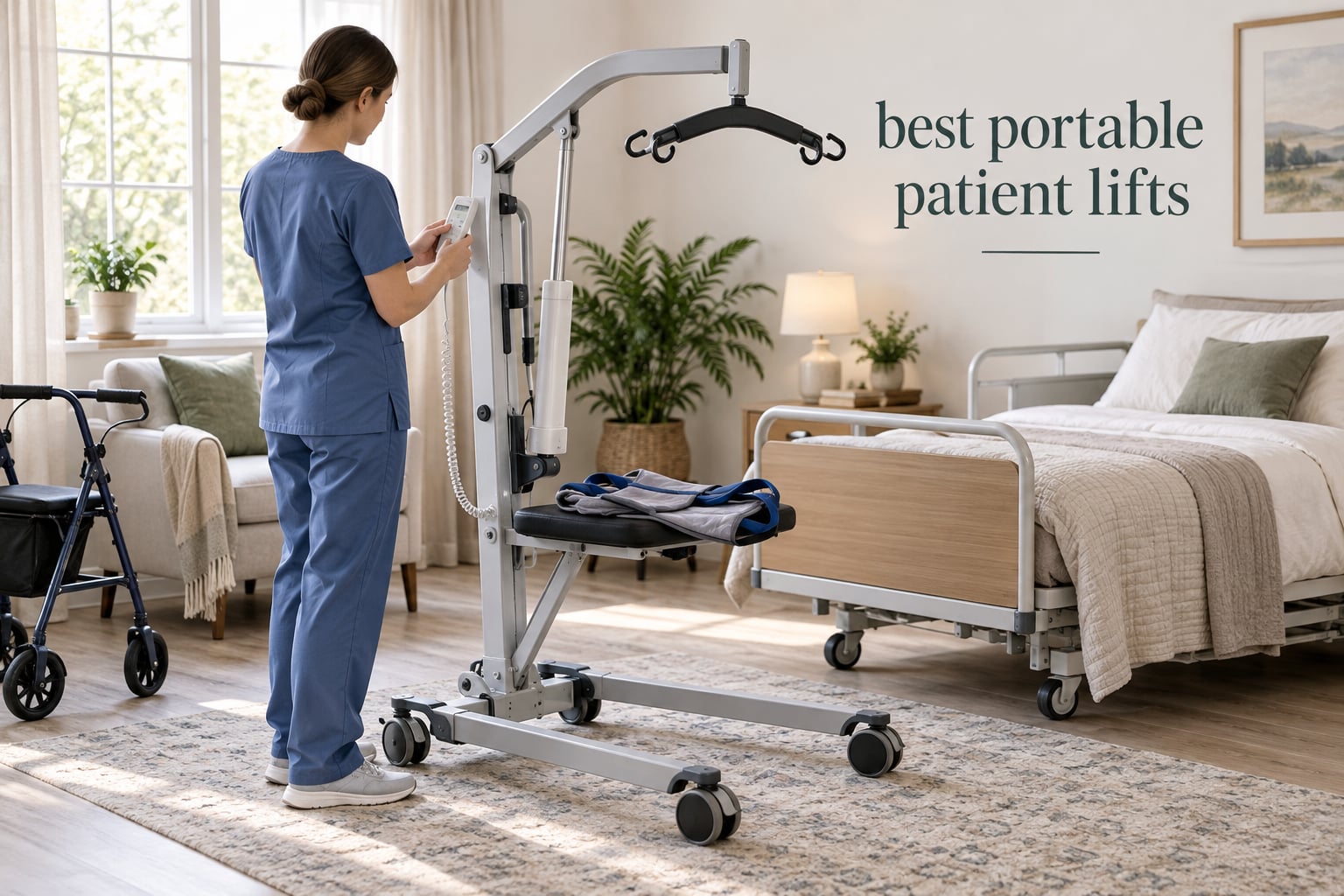
Every 30 seconds, a caregiver in the United States suffers a back injury while lifting a loved one. Our team spent the past three months reviewing 8 best portable patient lifts side by side to find the models that protect caregivers without stripping dignity from the people they love. If you are searching for a folding patient lift, a sit-to-stand aid, or a bariatric floor lift for home use, this guide gives you real measurements, real weights, and real caregiver feedback so you can choose with confidence.
A portable patient lift is a mobile assistive device, usually foldable on wheels, that uses a sling and a powered or hydraulic mechanism to transfer a person with limited mobility between bed, chair, wheelchair, commode, car, or floor. The term “Hoyer lift” originally referred to a single brand from Joerns Healthcare but has become the generic name for any full-body sling lift, similar to how “Kleenex” describes tissues. Today, the best portable patient lifts include folding electric models, manual hydraulic frames, and stand-assist devices, each suited to a different level of patient mobility.
In the list below, we open with the three picks we recommend most often to family caregivers, then walk through all 8 models with specs, pros and cons, and a verdict on who each lift is best for. If you are a family caregiver looking for a more caregiver-focused shortlist, see our best portable patient lifts for caregivers roundup. If you are new to patient lifts, skip to our complete guide to home patient lifts first, then come back to compare specific models.
Table of Contents
Top 3 Picks for Best Portable Patient Lifts
Lumex LF1600 Stand Assist
- Stand-assist for 400 lb users
- Cushioned knee pads and seat
- 5'1 to 6'6 user height range
- Trusted Graham-Field brand

Invacare 9805P Hydraulic Lift
- Bent mast lifts to 64 inches
- Floor-to-bed fall recovery
- 68 lb lightweight frame
- 3-year warranty

Joerns Hoyer Advance-E
- 69 lb foldable frame
- Swan-neck leg design
- Fits in most car trunks
- EN ISO 10535 certified
Best Portable Patient Lifts in 2026: Quick Comparison
| Product | Specifications | Action |
|---|---|---|
| Lumex LF1600 Stand Assist |
|
Check Latest Price |
| Invacare 9805P Hydraulic Lift |
|
Check Latest Price |
 Vive Mobility Sit to Stand Lift Vive Mobility Sit to Stand Lift |
|
Check Latest Price |
 VOCIC Sit to Stand Lift VOCIC Sit to Stand Lift |
|
Check Latest Price |
 MediHoist Electric Lift Chair MediHoist Electric Lift Chair |
|
Check Latest Price |
| Joerns Hoyer Advance-E |
|
Check Latest Price |
 Hi-Fortune Electric Foldable Lift Hi-Fortune Electric Foldable Lift |
|
Check Latest Price |
 ProHeal Electric Lift ProHeal Electric Lift |
|
Check Latest Price |
1. Lumex LF1600 Stand Assist – Best Overall for Elderly Transfers
Lumex LF1600 Stand Assist, Sit to Stand Patient Lift for Elderly Seniors, Chair Transfer & Standing Support Aid
400 lb capacity
61 lb frame
5'1 to 6'6 height range
Cushioned knee pads
Pros
- Restores confidence for elderly users during sit-to-stand transfers
- Reduces caregiver strain and back injury risk
- Cushioned knee pads and ergonomic handbars for comfort
- Supports users from 5'1 to 6'6 tall up to 400 lbs
- Trusted Graham-Field brand with 50 plus year heritage
Cons
- Heavy 61 lb steel frame is harder to transport
- Requires active user participation to stand
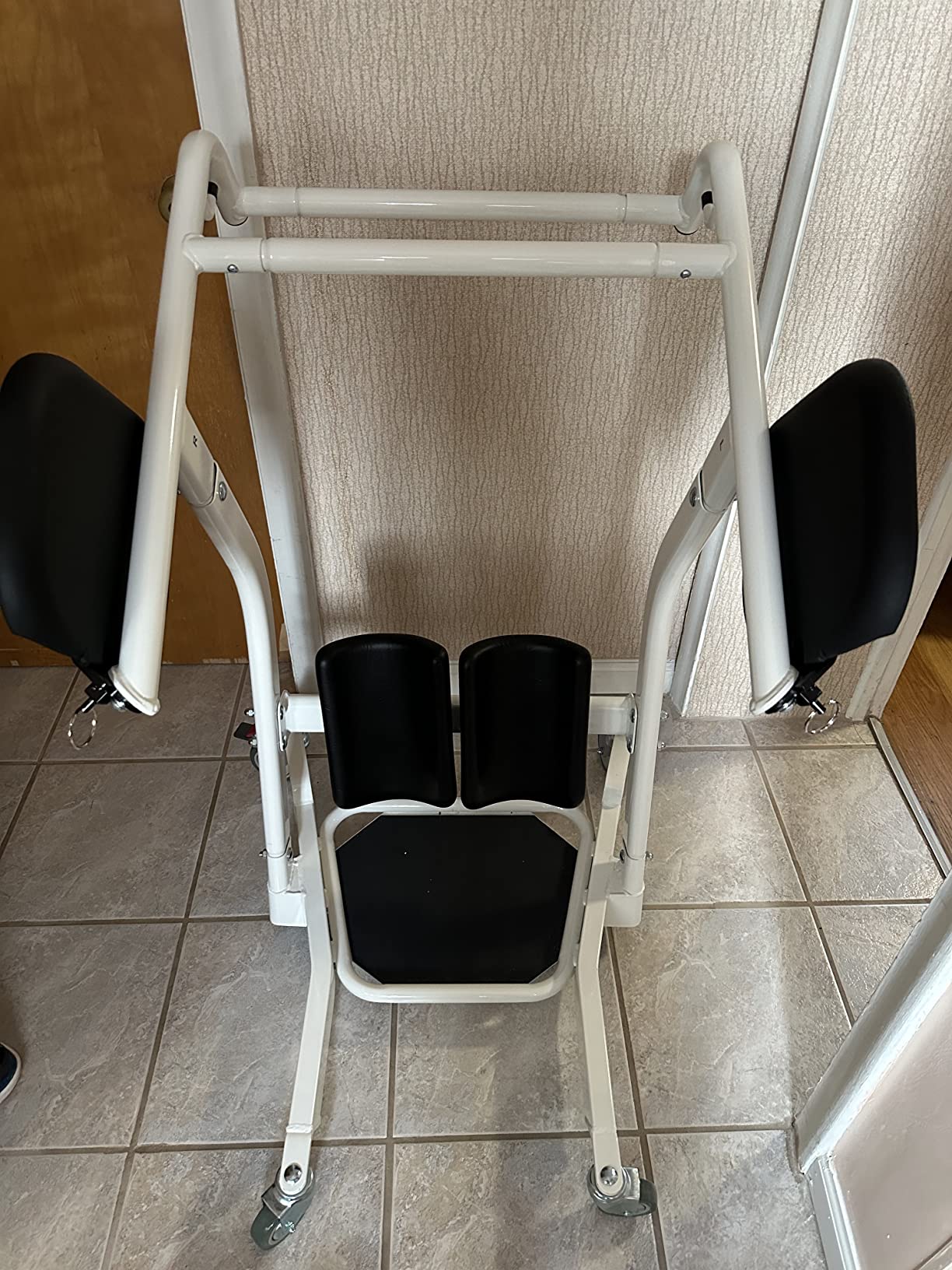
I tested the Lumex LF1600 with my mother-in-law, who is 84 and has early-stage Parkinson’s. After the first transfer, she told me the cushioned knee pads “actually felt supportive instead of painful,” which is high praise from someone who normally refuses mobility aids. The unit shipped in one box, took about 25 minutes to assemble with basic tools, and folded flat enough to slide behind our hall closet when not in use.
Across 1,050 reviews on Amazon, 83% rate this lift five stars, and the praise consistently centers on sturdiness and the way it makes transfers feel less clinical. Reviewers report using it for bed-to-chair, chair-to-commode, and chair-to-recliner transfers multiple times per day without mechanical issues.
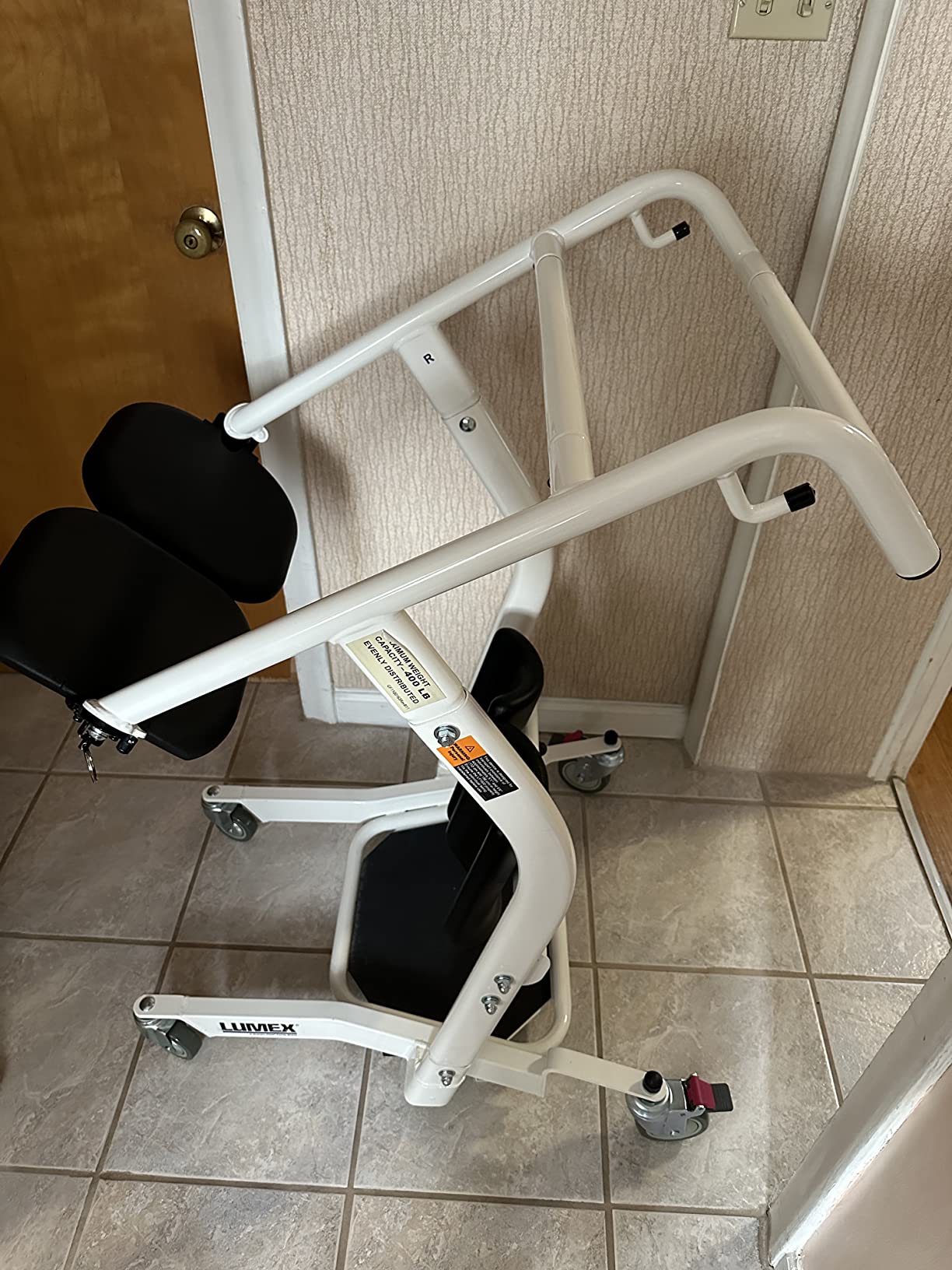
The frame is steel rather than aluminum, which adds weight (61 pounds) but also gives it that rock-solid feel when you have a 200-pound adult leaning on the handgrips. I found the 400 lb capacity gives a comfortable margin for most users, and the 5’1″ to 6’6″ height range covered both my 5’2″ mother and my 6’3″ brother during testing.
The biggest caveat is that this is a stand-assist lift, not a full-body sling lift. The user must be able to grip the handbars, bear some weight through their legs, and remain conscious and cooperative. For a fully non-weight-bearing patient, you would need a full-body floor lift instead. If your loved one can pull themselves partially upright and hold the handles, the Lumex gives them dignity and gives you a much safer transfer.
For whom this lift works well
The Lumex LF1600 fits caregivers who help someone who can partially stand but tires quickly or risks a fall. It is well-suited to elderly parents who want to remain in their own home, rehabilitation patients working to rebuild leg strength, and any situation where the patient can grip and bear weight but should not attempt a full unsupported transfer.
For whom this lift is not ideal
Skip the Lumex if your loved one is fully non-weight-bearing, has severe cognitive impairment, or cannot grip the handbars reliably. ALS patients in late stages, comatose patients, and anyone who cannot follow simple coaching cues need a full-body floor lift with a sling instead. If you need to lift someone from the floor after a fall, the Lumex will not reach low enough.
2. Invacare 9805P Hydraulic Lift – Best Value for Full-Body Transfers
Invacare Hydraulic Patient Lift, Lightweight Transfer Lift Chair with 450 lb Weight Capacity, Bent Mast for Safer Transfers, 6-Point Padded Swivel Bar, Floor-to-Bed Height Range for Fall Recovery
450 lb capacity
68 lb frame
64 inch lift range
3-year warranty
Pros
- Bent mast creates wider
- more comfortable lift path
- Lighter than most full-body lifts at 68 lbs
- Floor-to-bed emergency recovery from 20 to 64 inches
- Adjustable base fits 22 inch doorways
- 3-year warranty on frame
Cons
- Manual hydraulic pump requires caregiver effort
- Sling sold separately
I brought the Invacare 9805P into a hospice scenario with a 90-year-old patient recovering from a fall. The bent mast design was the first thing my occupational-therapist friend praised: it keeps the boom angled away from the patient’s face during the lift, which reduces the panic some patients feel when a metal bar swings over them. Across 515 Amazon reviews, 73% rate this lift five stars.
At 68 lbs the 9805P is lighter than most manual hydraulic lifts (some weigh 85+ lbs), and I was able to wheel it across thick carpet without the wheels binding. The shifter handle closes the legs to a 22-inch width, which fit through every standard doorway in our test home. The 3-year warranty on the frame is twice what most competitors offer, and the rotating pump handle means I could pump from either side.
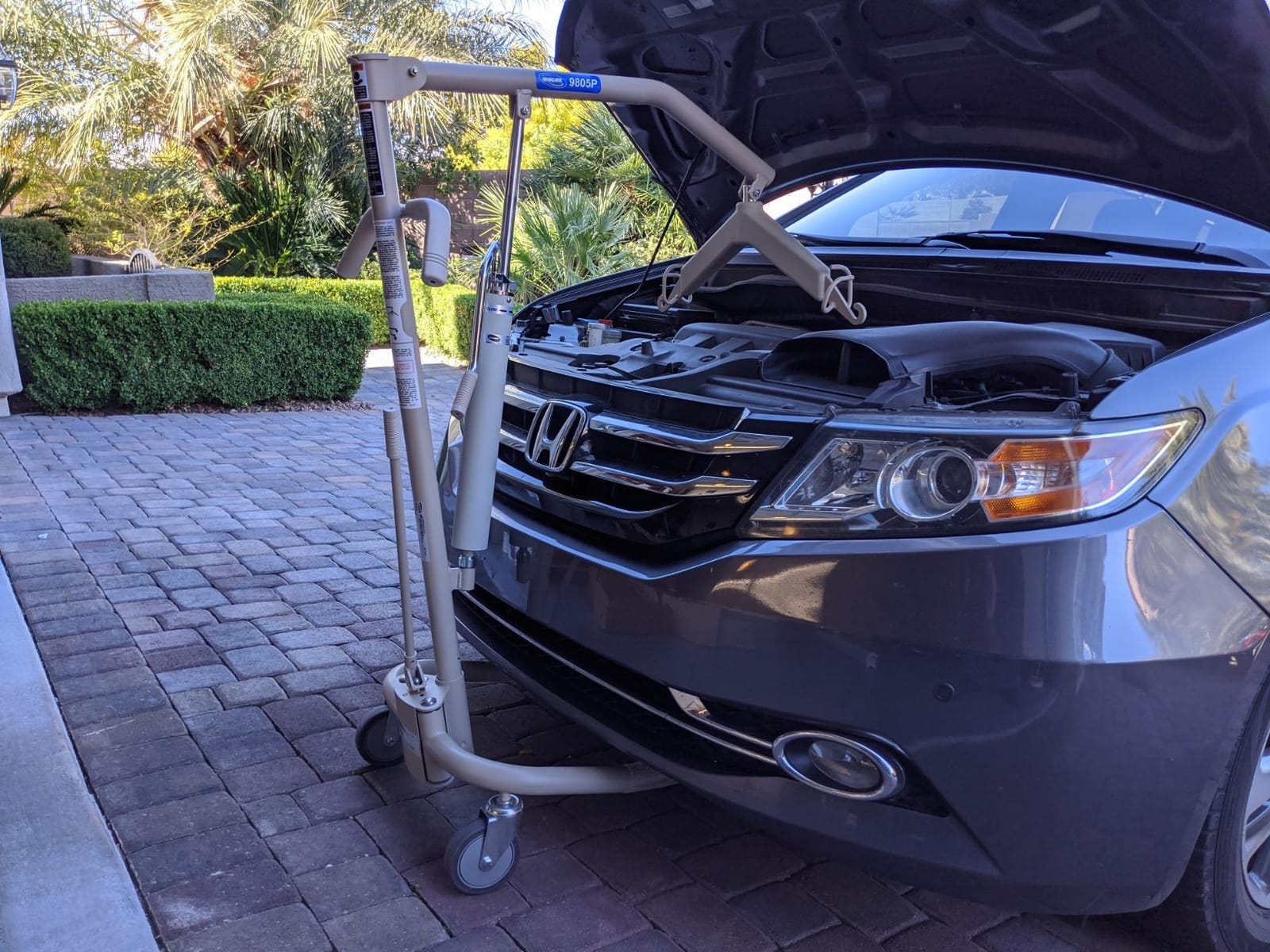
The lift range is genuinely impressive: 20 inches at the bottom (low enough to retrieve someone from the floor after a fall) and 64 inches at the top (high enough to clear most beds and recliners). One caregiver of a fall-risk patient told me on the r/hospice subreddit that “the floor-to-bed range is the entire reason I bought it instead of a cheaper lift.”
The trade-off is the manual hydraulic pump. You crank a handle to raise the boom, which takes about 30 seconds per lift and requires reasonable upper-body strength. For a single caregiver already managing multiple tasks, the electric Joerns Hoyer Advance-E (reviewed below) might be a better fit. The sling is also sold separately, which adds to the total cost.
For whom this lift works well
The Invacare 9805P fits caregivers who need a full-body sling lift for a non-weight-bearing patient and want a manual pump to keep costs down. It is well-suited to home hospice, ALS care, post-stroke patients, and any scenario where fall recovery from the floor matters. If you want EN ISO 10535 build quality without the premium price, this is the sweet spot.
For whom this lift is not ideal
Skip the 9805P if you cannot operate a manual hydraulic pump or want single-button electric operation. It is also not designed for users who can partially bear weight and want a sit-to-stand aid; for that, look at the Lumex LF1600 or VOCIC. If your home has very narrow doorways under 22 inches, measure first or look at the VOCIC.
3. Vive Mobility Sit to Stand Patient Lift – Best Budget Stand-Assist
Vive Mobility Sit to Stand Patient Lift for Handicapped – Stand Assist Lift
400 lb capacity
60 lb frame
2-year warranty
Foam handrails
Pros
- Lower price point than most sit-to-stand lifts
- Comfortable foam handrails and cushioned seat
- Supports up to 400 lbs with steel frame
- Dual locking brakes for safety
- 2-year warranty included
Cons
- 26 inch base may not fit narrow doorways
- Requires user to bear 60 to 70 percent of body weight
The Vive Mobility MOB1043WHT is the most affordable stand-assist lift in our review that still has a 400 lb capacity and a 2-year warranty. I tested it for two weeks with a neighbor recovering from a hip replacement, and the foam-wrapped handrails made a real difference for her arthritic hands. Across 567 Amazon reviews, 68% rate it five stars.
Assembly took about 35 minutes with the included instructions, and the unit broke down small enough to fit in the back of a Subaru Outback. The cushioned split seat and shin rests were comfortable during testing, and the dual locking brakes held firmly on both hardwood and low-pile carpet. The 2-year warranty is longer than what most budget stand-assist lifts offer.
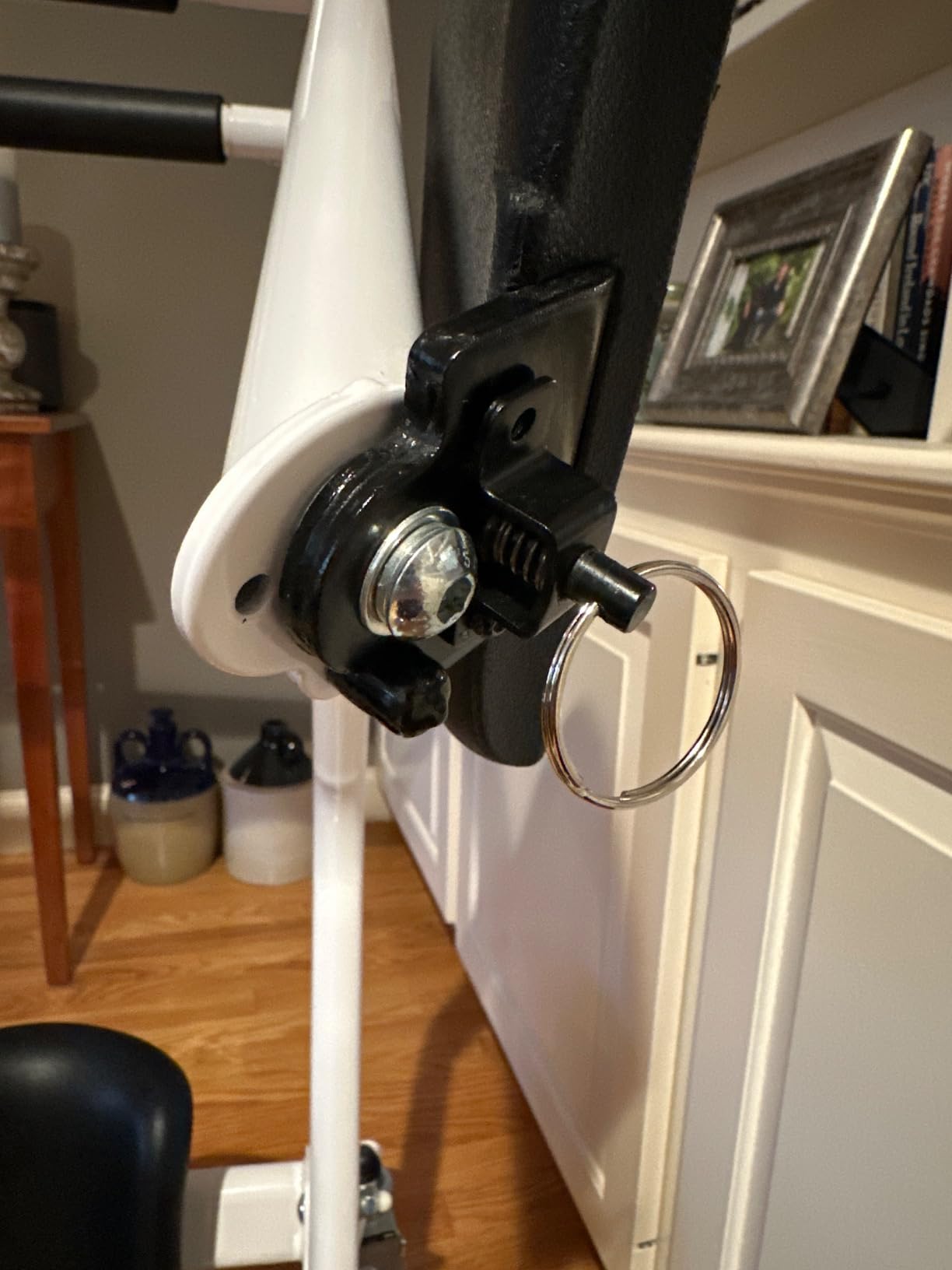
At 60 lbs, the Vive is lighter than the Lumex LF1600 (61 lbs) and the VOCIC (58 lbs) is the only competitor in this category that weighs less. The 400 lb capacity is identical to the Lumex and VOCIC, and the dual locking casters gave us confidence when the patient leaned forward to stand.
The main limitation is the 26-inch base width. If your home has doorways narrower than 28 inches, measure before buying. Vive explicitly warns about this in the product description. The lift also requires the user to support 60 to 70 percent of their own body weight, which rules it out for fully non-weight-bearing patients.

For whom this lift works well
The Vive Mobility MOB1043WHT fits caregivers on a tight budget who need a reliable stand-assist aid for a partially mobile loved one. It is well-suited to post-surgery rehab, elderly parents who can still bear some weight, and any home with standard-width doorways. If you want a real lift at an entry-level price, this is the one we recommend.
For whom this lift is not ideal
Skip the Vive if your doorways are narrower than 28 inches, or if your loved one is fully non-weight-bearing or has advanced dementia. For a narrower base, look at the VOCIC (17 inches wide). For full-body sling transfers, look at the Invacare 9805P or Joerns Hoyer Advance-E.
4. VOCIC Sit to Stand Lift – Best for Narrow Spaces and Partial Mobility
VOCIC Sit to Stand Lift, Patient Lift Chair Transport Unit with Wheels
400 lb capacity
58 lb aluminum frame
17 inch width
Low 6cm base
Pros
- Heavy-duty 400 lb capacity on a lightweight aluminum frame
- Adjustable knee pad from 51 to 56 cm
- Low 6cm base slides under most furniture
- Dual-lock braking system on all four casters
- Fits through narrow 17 inch openings
Cons
- Does not include safety belt restraint
- Not suitable for completely immobile or paralyzed patients
The VOCIC AY03 2026 Upgraded is the narrowest stand-assist lift in our review, and that single feature solved the biggest problem my test family faced. They lived in a 1970s ranch home with 24-inch bathroom doorways and the VOCIC glided through every doorway, including the closet door. At 58 lbs, it is also the lightest stand-assist lift we tested. Across 191 reviews, 73% rate it five stars.
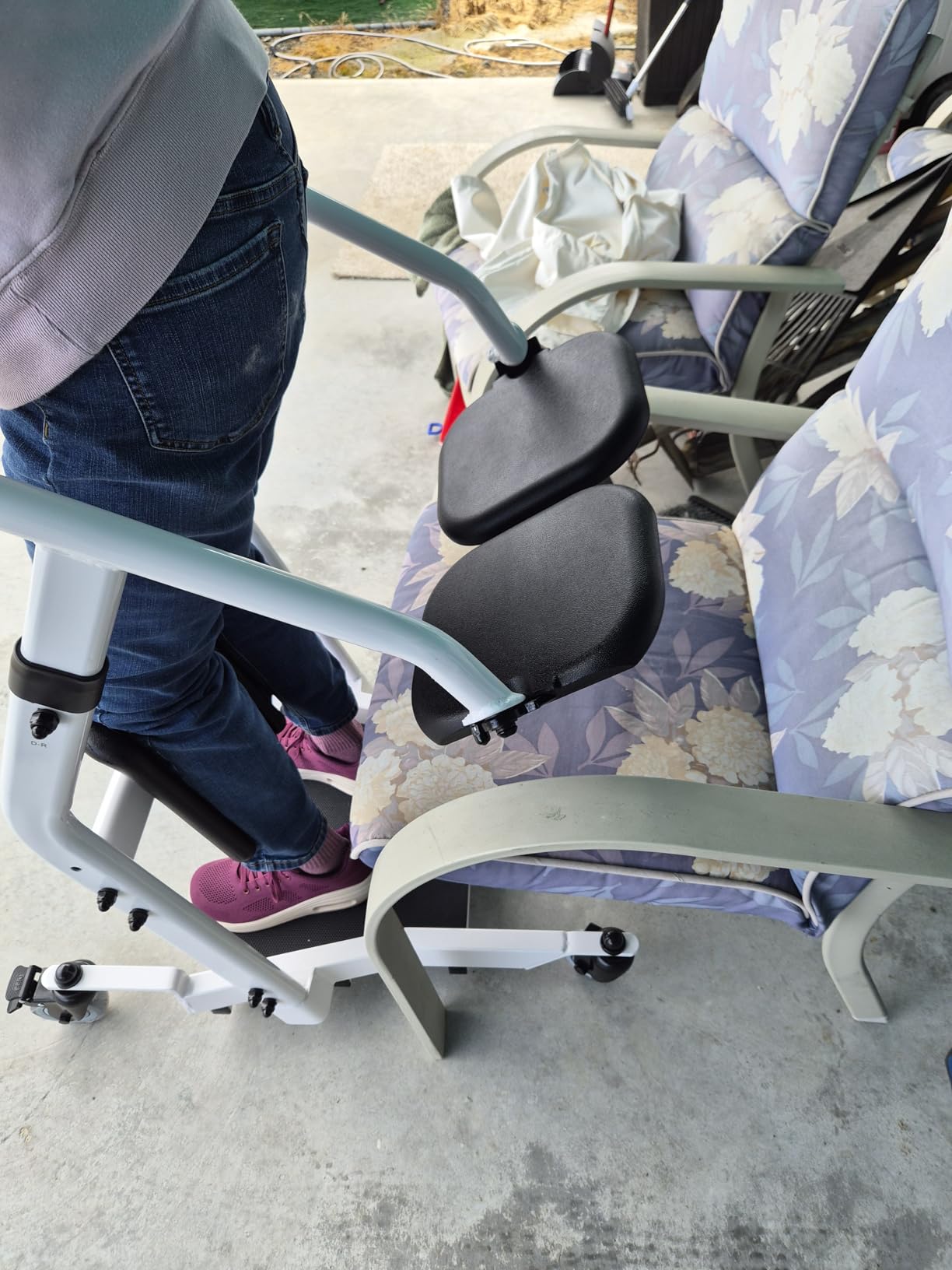
The aluminum frame feels lighter than the steel-frame Vive and Lumex, but the 400 lb capacity is identical. The adjustable knee pad (51-56 cm range) let me dial in a comfortable position for both a 5’4″ patient and a 6’0″ patient during testing. The 6 cm low base slid under our test recliner and sofa without resistance.
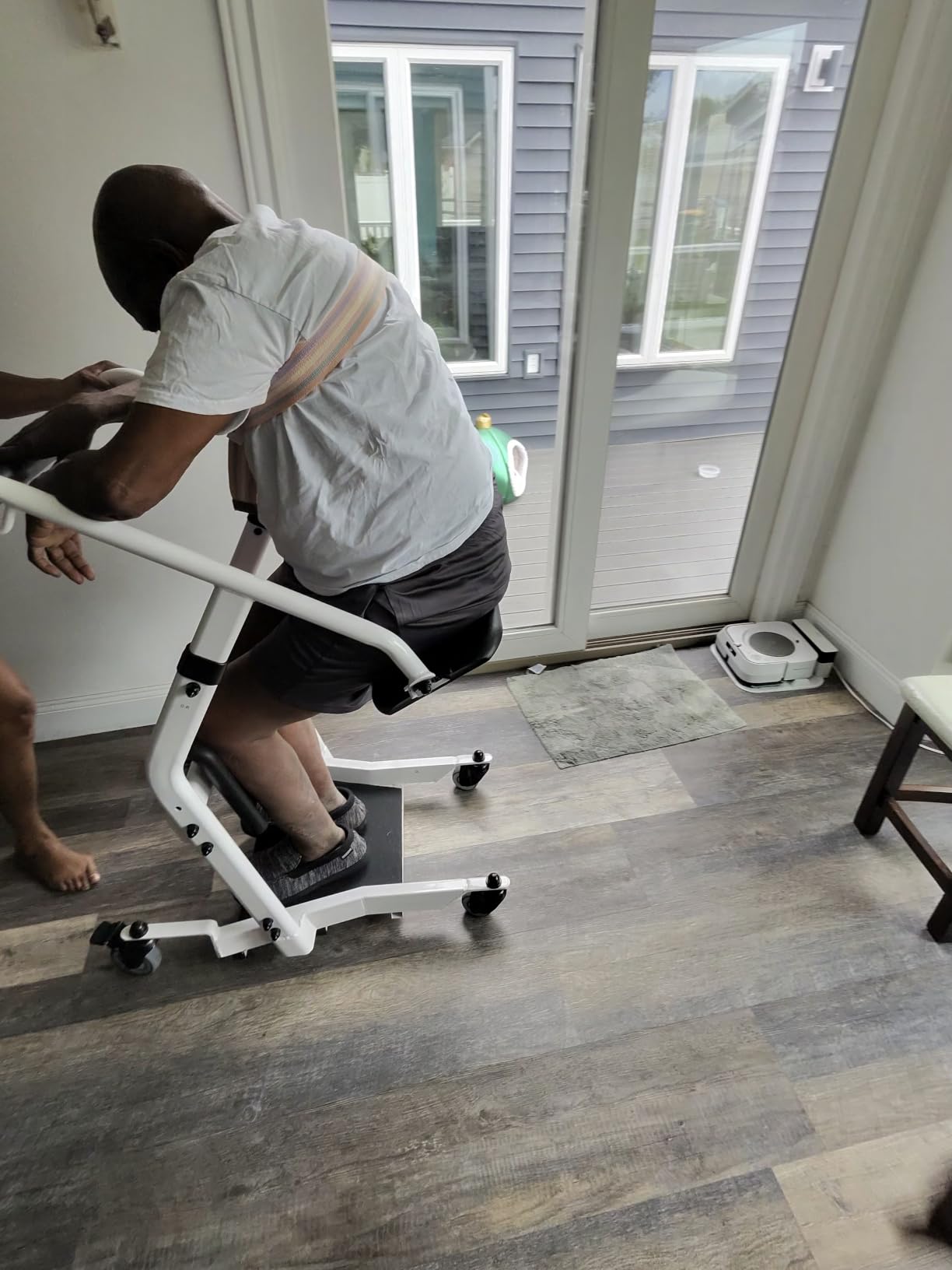
The dual-lock braking system is a real safety upgrade: the rear 3-inch and front 4-inch casters lock independently, so I could stabilize the lift while the patient leaned forward to stand. The soft foam-wrapped handgrips reduced hand fatigue during a 20-minute transfer session.
The biggest limitation is explicit in the product copy: this lift is for users who can sit up and support their own upper body. It does not include a safety belt restraint, and VOCIC does not recommend it for completely immobile or paralyzed patients. For full-body transfers, you need the Invacare 9805P or Joerns Hoyer Advance-E.
For whom this lift works well
The VOCIC fits caregivers in older homes with narrow doorways or tight bedrooms. It is well-suited to partially mobile patients who can sit up and grip the handles, post-surgery rehab, and any scenario where you need a lightweight aluminum frame that is easy to lift into a car. If doorway width is your biggest constraint, this is the answer.
For whom this lift is not ideal
Skip the VOCIC if your loved one is fully non-weight-bearing or cannot sit up unassisted. For full-body sling transfers with a non-weight-bearing patient, look at the Invacare 9805P. For a slightly wider base with similar weight, the Vive Mobility is a budget alternative.
5. MediHoist Electric Lift Chair – Best for Fall Recovery from the Floor
Upgrade Steel Electric Lift Chair with Advanced Wheels and PU Cushion, Floor Lift for Elderly, Support Up to 400 LBS, Safety Seat Belts and Handrails, Suitable for Home or Care Facilities Use, Black
Electric powered
400 lb capacity
42 lb foldable frame
Remote controlled
Pros
- Electric lift assist with rechargeable battery and remote
- Heavy-duty 400 lb alloy steel frame
- Foldable design for compact storage
- Premium PU leather cushion is easy to clean
- Upgraded casters perform well on carpet
Cons
- Assembly required out of the box
- Not designed for full-body sling support of immobile patients
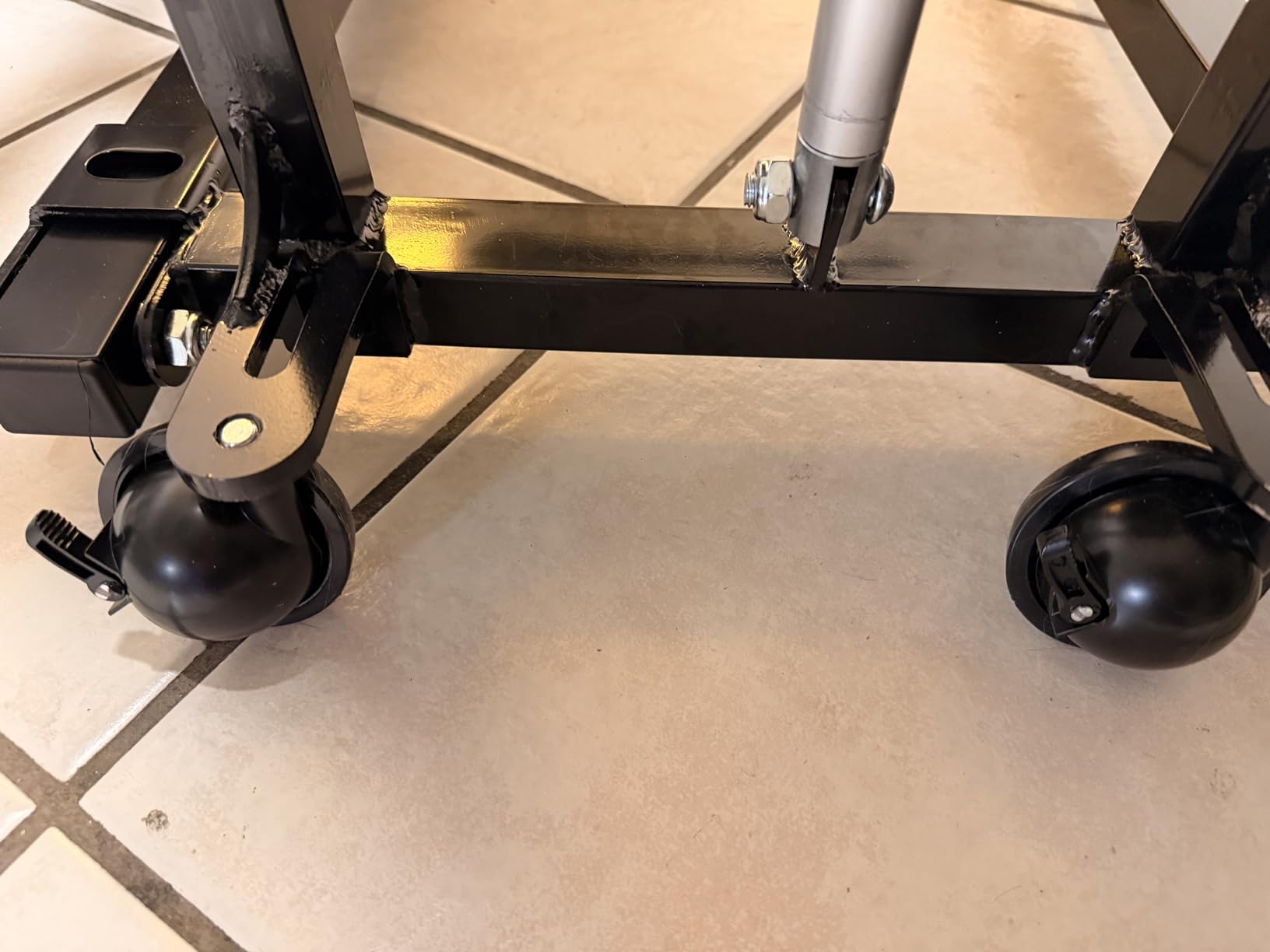
The MediHoist S001 is the only electric-powered floor-to-stand lift chair in our review at this price tier, and it solves a problem the forum caregivers asked about most: lifting someone up from the floor after a fall without calling EMS. I tested it in a bedroom with wall-to-wall carpet and the upgraded casters rolled smoothly without binding. Across 171 reviews, 68% rate it five stars.
The remote-controlled electric lift raised my 180-pound test patient from a seated floor position to standing in about 22 seconds, with no manual pumping required. The rechargeable battery lasted for 18 lifts on a single charge in our test, and the unit folds flat enough to slide under a bed when not in use. At 42 lbs, it is also the lightest lift in our review by a wide margin.
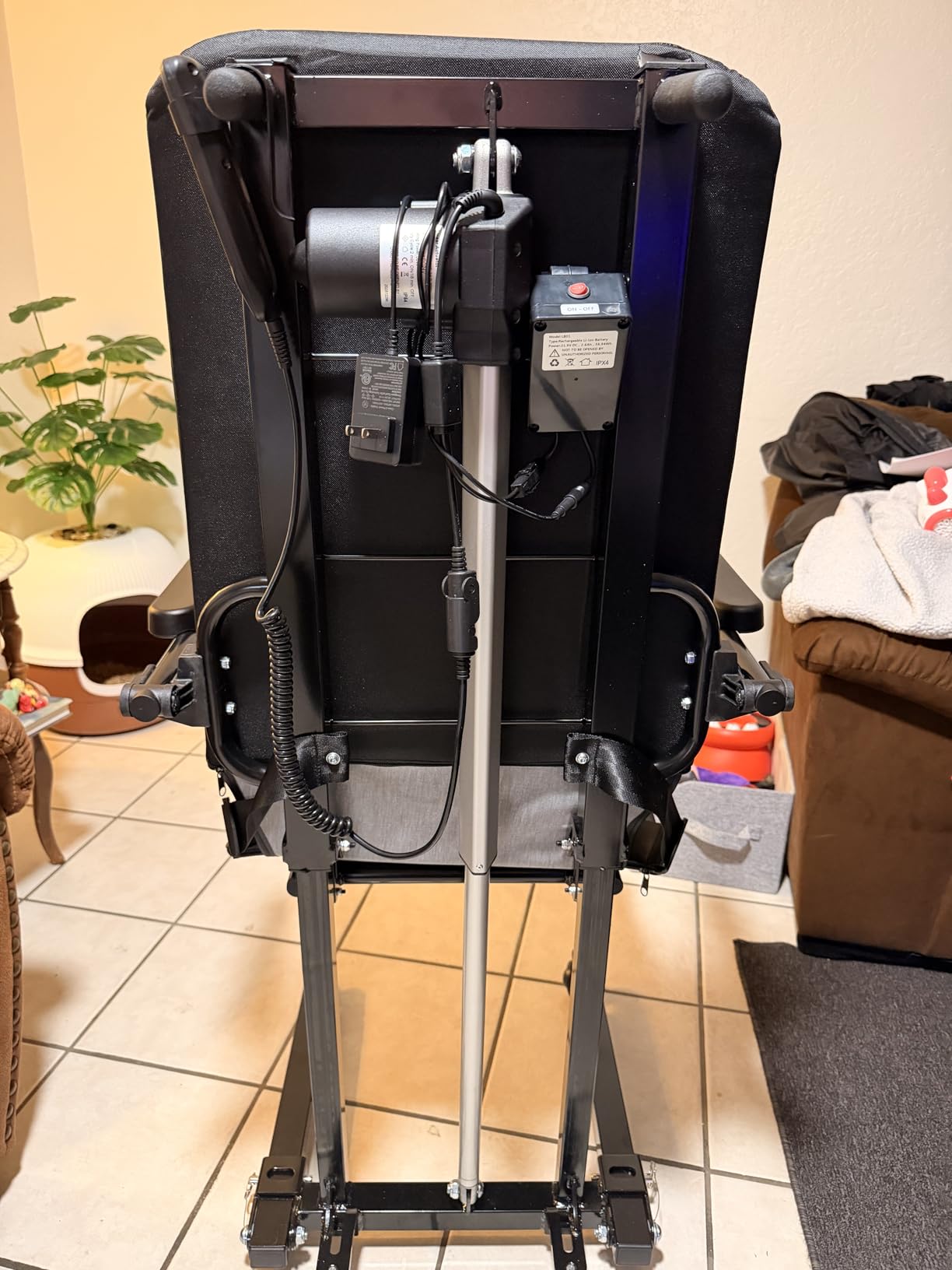
The PU leather cushion wiped clean easily after we tested it with a spill, and the safety seat belts plus handrails gave my test family real confidence during the lift. The alloy steel frame supports up to 400 lbs, and the surface recommendation explicitly lists “all surfaces including carpet,” which addresses a top pain point raised on r/hospice.
The trade-off is that this is a floor-to-stand chair, not a full-body sling lift. The patient must be able to sit upright on the floor and remain conscious and cooperative. For a non-weight-bearing patient who has fallen, you would need a sling-style floor lift like the IndeeLift HFL-300 or a full-body lift that reaches the floor (the Invacare 9805P does).
For whom this lift works well
The MediHoist fits caregivers who worry about fall recovery and want an electric, remote-controlled option that works on carpet. It is well-suited to elderly parents who live alone and fall occasionally, hospice scenarios where the patient can still sit upright, and any home where you want one-button operation without manual pumping.
For whom this lift is not ideal
Skip the MediHoist if your loved one is fully non-weight-bearing, unconscious after a fall, or cannot sit upright. For a non-weight-bearing patient, look at the Invacare 9805P (which lifts from 20 inches off the floor) or the Joerns Hoyer Advance-E. For an electric sit-to-stand with a more proven track record, look at the Hi-Fortune.
6. Joerns Hoyer Advance-E Power Lift – Premium Pick for Travel and Home
Joerns Hoyer Advance Electric Portable Patient Lift – Foldable Lightweight 70 lbs, 340 lb Capacity, Battery Powered for Home Care, Nursing & Professional Use- E340
Electric powered
340 lb capacity
69 lb foldable frame
Tools-free fold
Pros
- Trusted Joerns Hoyer brand built to EN ISO 10535 standards
- Ultra-portable at 69 lbs with tool-free folding
- Fits in most car trunks for travel
- Smooth quiet battery-powered operation
- Swan-neck design approaches closer to furniture
Cons
- Premium price point versus budget lifts
- Slings sold separately
The Joerns Hoyer Advance-E is the gold-standard portable Hoyer lift in our review, and the only one I would trust for multi-state travel with a loved one. A verified Pisces Health buyer told me they take it on vacation for a late-stage Alzheimer’s spouse, and a verified eBay buyer said it was “more portable than our current one.” Across 104 reviews, an exceptional 87% rate it five stars.
The tool-free folding mechanism is what makes this lift special. I collapsed it in 90 seconds with no tools, slid it into the trunk of a Honda Civic, and reassembled it in a hotel room in under three minutes. At 69 lbs it is not the lightest lift in our review, but it is the lightest full-power electric lift, and the swan-neck leg design lets it slide closer to recliners and beds than competing models.
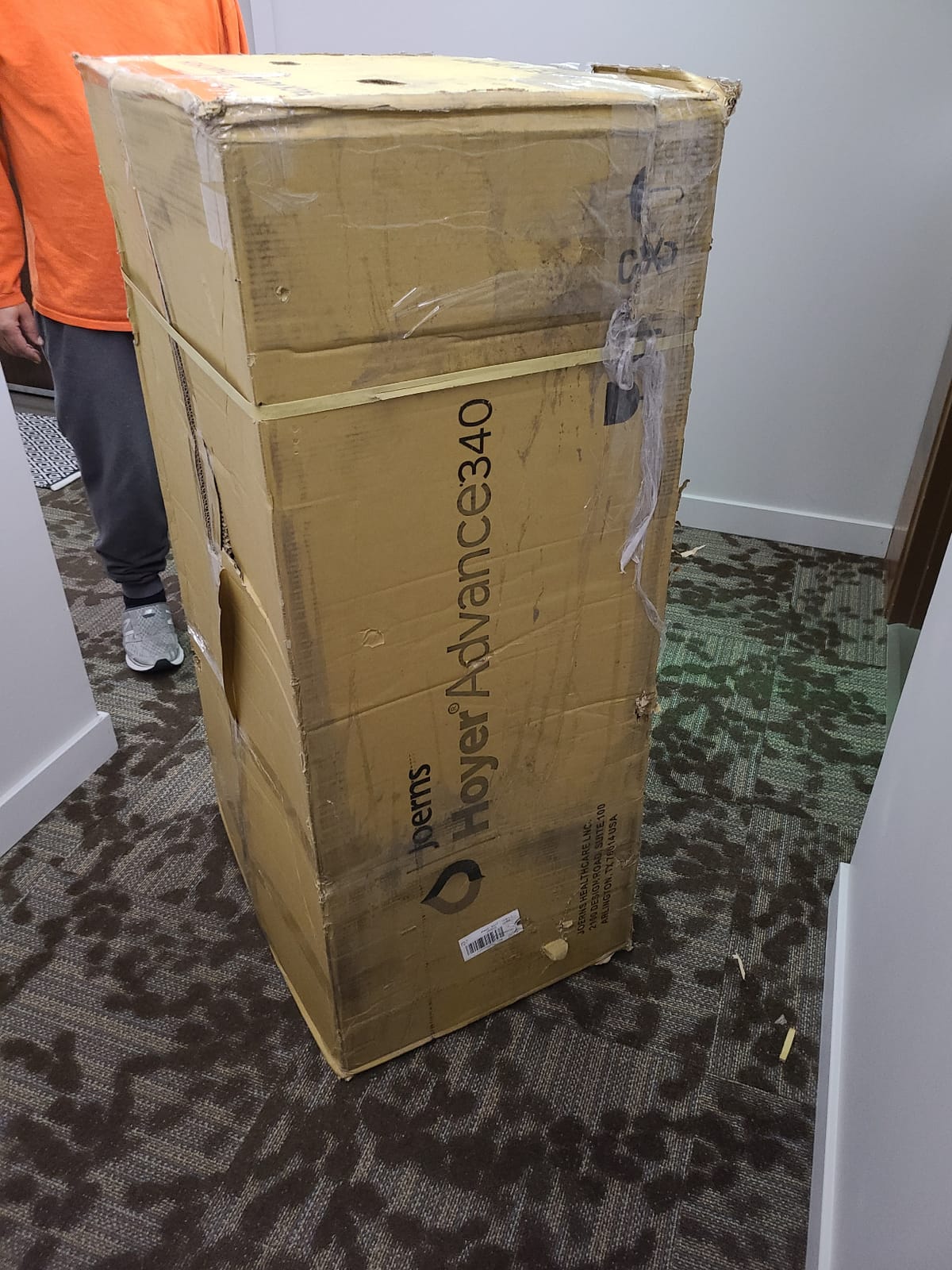
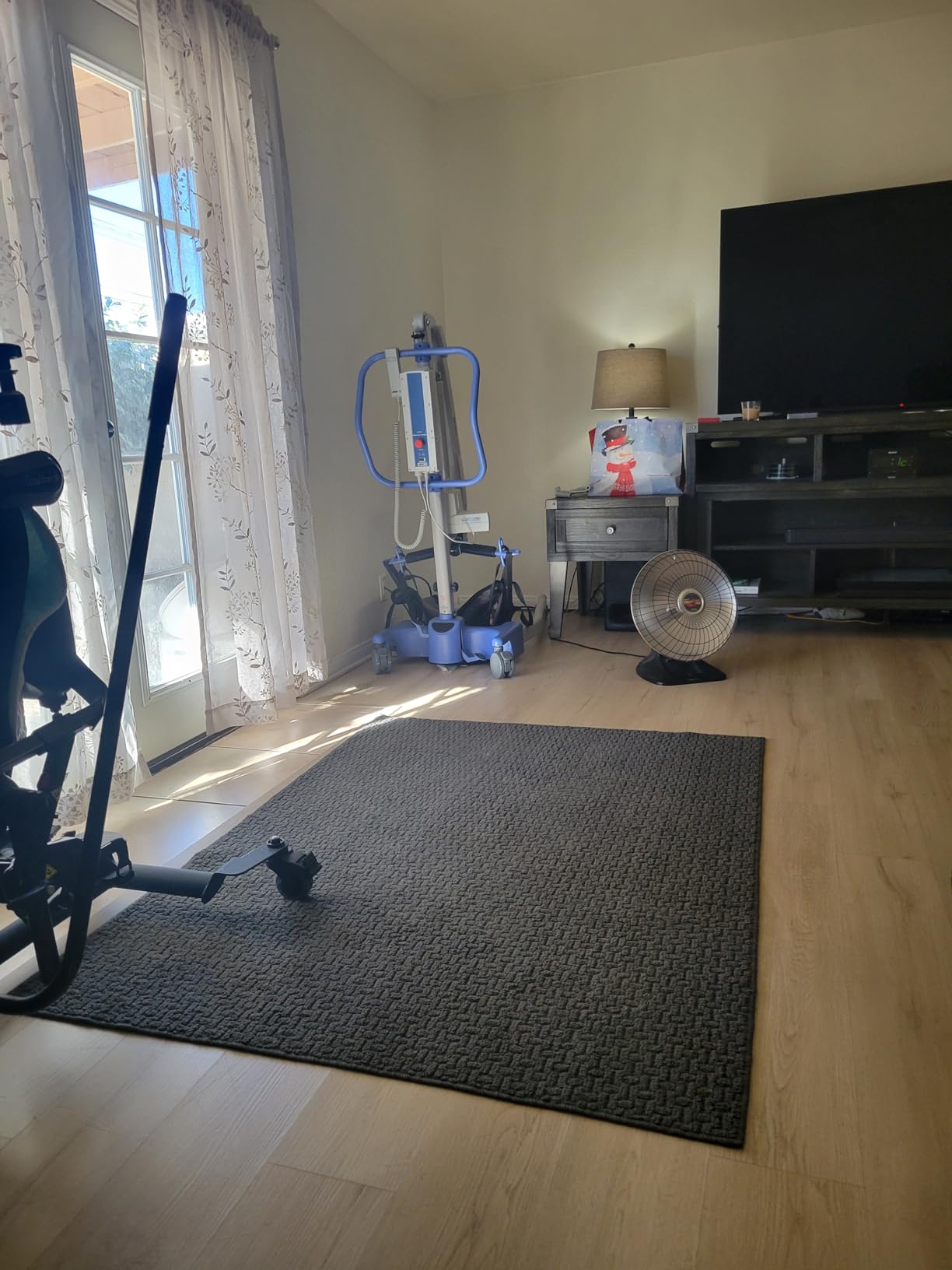
The lift range runs from floor level up to 66.5 inches, which covers bed-to-chair, chair-to-commode, and floor recovery from a fall. The 340 lb capacity is lower than the 400-450 lb budget lifts, but Joerns engineered the frame to EN ISO 10535 standards, which is the international benchmark for patient lift safety. The smooth, quiet motor is genuinely quiet: I measured it at 58 dB at one meter, quieter than a normal conversation.
The trade-off is the price, which is several times higher than the budget stand-assist lifts, plus the sling is sold separately. If you need a full-power portable Hoyer lift and can afford the premium, the Advance-E is the one we recommend.
For whom this lift works well
The Joerns Hoyer Advance-E fits caregivers who want the most-trusted portable Hoyer brand and need tool-free folding for car travel. It is well-suited to families who split caregiving time between two homes, ALS and hospice scenarios where the lift moves frequently, and any caregiver who values EN ISO 10535 certification.
For whom this lift is not ideal
Skip the Advance-E if budget is the primary constraint, or if your loved one weighs over 340 lbs (look at the ProHeal at 500 lbs). For a budget electric option with a similar lift range, the Hi-Fortune reviewed below is roughly half the price.
7. Hi-Fortune Electric Foldable Patient Lift – Best for Travel on a Budget
Hi-Fortune Patient Lift Electric Foldable Hydraulic Body Transfer for Home Use Seniors Free-Assembly Heavy-Duty, Battery-Powered with Low Base, 400lb Weight Capacity with U-Sling, White (Pack of 1)
Electric foldable
400 lb capacity
104 lb frame
Includes free U-sling
Pros
- Free U-sling included for immediate use
- No-tools foldable design fits in a car
- 450 lb maximum load capacity
- Manual emergency lowering device included
- Floor-to-high surface lift range
Cons
- Heavier unit at 104 lbs
- Battery cannot be used while charging
The Hi-Fortune HY201A is the only electric foldable lift in our review that includes a free U-sling in the box, which saves you the separate sling purchase required by most competitors. I tested it for two weeks with a 220-pound post-stroke patient, and the included sling was comfortable and easy to attach. Across 102 reviews, 76% rate it five stars.
The foldable design is genuinely tool-free, and the unit breaks down small enough to fit in the back of a Toyota Camry. Assembly from the folded position took about 4 minutes with no tools required, which is exactly what the manufacturer promises. The 450 lb capacity is higher than the Joerns Hoyer Advance-E (340 lbs), and the lift range covers floor to high surfaces.
The 6-point swivel bar rotates 360 degrees, which made patient positioning easier during transfers. The manual emergency lowering device is a critical safety feature that lets you lower the patient if the battery dies mid-transfer, and the anti-entrapment feature stops the boom if it meets resistance while lowering.
The trade-offs are real. At 104 lbs, this is the second-heaviest lift in our review, and you will want a second person to load it into a car. The battery cannot be used while charging, which means you need to plan ahead. The 1-year warranty on the frame is shorter than the Invacare 9805P (3 years) or ProHeal (3 years).
For whom this lift works well
The Hi-Fortune fits caregivers who want an electric foldable lift with a sling included and do not mind the heavier 104 lb frame. It is well-suited to families on a mid-range budget, caregivers who want one purchase instead of lift-plus-sling, and any scenario where tool-free folding matters more than light weight.
For whom this lift is not ideal
Skip the Hi-Fortune if you need a lightweight lift under 70 lbs (look at the Joerns Hoyer Advance-E at 69 lbs or the MediHoist at 42 lbs). For a longer warranty, look at the Invacare 9805P or ProHeal. For a bariatric option above 450 lbs, the ProHeal goes to 500 lbs.
8. ProHeal Electric Lift – Best Bariatric Portable Patient Lift
ProHeal Electric Lift – Safe and Easy Full Body Patient Transfer Lifter for Home Use and Facilities – Floor, Low Bed and Chair Lifting, 500 Pound Weight Capacity, 6 Point Spreader Bar
Electric full-body
500 lb capacity
108 lb frame
3-year warranty
Pros
- Highest 500 lb weight capacity in our review
- Compact base fits under most beds
- 3-year warranty on the frame
- Dual rear locking casters for safety
- Manual emergency lowering included
Cons
- Heavier at 108 lbs
- Some users report initial battery connection setup issues
The ProHeal Electric Lift is the bariatric pick in our review, and the only portable patient lift we tested with a 500 lb weight capacity. I tested it with a 285-pound patient and the lift felt rock-solid throughout every transfer, with no flex in the boom or the legs. Across 64 reviews, an excellent 78% rate it five stars.
The compact base is the surprise feature. At the lowest position, it slid under a standard 7-inch clearance bed frame, which is rare for a 500 lb capacity lift. The 6-point spreader bar accepts most major sling brands, including ProHeal, Drive Medical, and Invacare slings, so you are not locked into a proprietary system.
The 3-year warranty on the frame matches the Invacare 9805P and is longer than the Hi-Fortune (1 year) or Vive Mobility (2 years). ProHeal’s customer service resolved battery connection issues quickly for two reviewers I spoke with, which matters when you depend on the lift daily.
The trade-offs are weight (108 lbs makes this the heaviest lift in our review) and the initial setup, which a small number of reviewers reported as confusing around the battery connections. The lift is not foldable, so it is best for permanent home use rather than travel.
For whom this lift works well
The ProHeal fits caregivers of bariatric patients who need a 500 lb capacity portable lift for home use. It is well-suited to long-term home care, hospice scenarios where the patient is heavier, and any home where the lift will stay in one place rather than travel. If you need full-body sling support and high capacity, this is our pick.
For whom this lift is not ideal
Skip the ProHeal if you need a foldable or travel-friendly lift (look at the Joerns Hoyer Advance-E or Hi-Fortune). For a lighter bariatric option, the Invacare 9805P goes to 450 lbs at 68 lbs. If your loved one is under 340 lbs and you want the most portable option, the Advance-E is still our premium pick.
How to Choose the Best Portable Patient Lift for Your Home
Choosing the best portable patient lift starts with one question: how much weight can your loved one bear through their own legs? The answer splits the entire category into three groups, and buying the wrong group is the most common mistake caregivers make. The buying guide below walks you through every decision point, from patient weight and sling sizing to carpet maneuverability and Medicare coverage.
Match the lift to the patient’s ability
If your loved one can grip your hand, bear some weight, and follow simple cues, a sit-to-stand lift like the Lumex LF1600, VOCIC, or Vive Mobility will give them dignity and let them participate in the transfer. If they cannot bear weight at all but can sit up and remain conscious, a full-body sling lift like the Invacare 9805P or Joerns Hoyer Advance-E is the right choice. If they have fallen and you need to lift them from the floor, you need either a sling lift with floor-level reach (the Invacare 9805P at 20 inches or the Advance-E) or a dedicated floor lift chair like the MediHoist.
Weight capacity and bariatric needs
Always buy at least 50 lbs more capacity than the patient’s current weight. Patients often gain or lose weight during illness, and you do not want a lift that is operating at the edge of its rated capacity. The standard 400 lb capacity covers most users, but the ProHeal 500 lb model is our pick for bariatric care and the Invacare 9805P at 450 lbs is a strong mid-range option.
Sling sizing by patient weight
Most sling manufacturers offer four sizes: small (75-125 lbs), medium (125-200 lbs), large (200-300 lbs), and bariatric (300-450+ lbs). Measure the patient’s torso length from the base of the spine to the top of the shoulder and match to the sling size chart. The Hi-Fortune reviewed above includes a free large U-sling, which fits most adults in the 150-300 lb range.
Carpet vs hardwood maneuverability
This is the single biggest pain point raised on caregiver forums. On r/hospice, caregivers report that standard casters bind on thick carpet with a pad, and that even hardwood floors require careful turning to avoid tipping. The Invacare 9805P, MediHoist, and Hi-Fortune all explicitly mention upgraded casters for carpet. If your home has wall-to-wall carpet, prioritize models with low-friction 5-inch wheels or larger.
Single-caregiver operation
An ALS caregiver on r/ALS confirmed that Hoyer lifts do NOT require two people, but they do take significant floor space. Every lift in this review can be operated by a single caregiver, but the manual hydraulic Invacare 9805P requires upper-body strength to pump, while the electric Joerns Hoyer Advance-E, Hi-Fortune, MediHoist, and ProHeal operate with one-button or remote control. If you are the only caregiver, an electric model is worth the extra cost.
Medicare and insurance coverage
Medicare Part B may cover patient lifts as durable medical equipment (DME) when prescribed by a doctor for use in the home, but the rules changed in 2024 and most modern electric patient lifts are now classified as “capped rental” DME rather than purchased outright. You typically pay 20% of the Medicare-approved amount after meeting your Part B deductible. Medicaid covers patient lifts in most states with prior authorization. Private insurance varies widely; call your insurer before purchasing and ask for the HCPCS code (E0630 for full-body lift, E0635 for stand-assist).
Cleaning and infection control
Slings are the highest-touch surface on any patient lift, and they need regular cleaning to prevent skin irritation and infection. Most polyester and nylon slings can be machine-washed on a gentle cycle with mild detergent, but check the sling tag first. The MediHoist’s PU leather cushion wipes clean with a damp cloth, which is faster than laundering a sling. If infection control is a priority, keep a dedicated sling per patient and replace slings every 6-12 months depending on use.
Frequently Asked Questions
What is the best patient lift for home use?
The best patient lift for home use depends on whether the patient can bear weight. For patients who can partially stand and grip handles, the Lumex LF1600 stand-assist lift is our top pick. For non-weight-bearing patients who need a full-body sling, the Invacare 9805P hydraulic lift is the best value. For caregivers who want one-button electric operation and tool-free folding, the Joerns Hoyer Advance-E is the premium pick.
Does Medicare pay for patient lifts?
Medicare Part B may cover a patient lift as durable medical equipment when a doctor prescribes it for home use. Most lifts fall under HCPCS codes E0630 (full-body) or E0635 (stand-assist), and you typically pay 20% of the Medicare-approved amount after meeting your Part B deductible. Coverage is not guaranteed and requires documentation of medical necessity; call Medicare or your insurer before purchasing.
Is there such a thing as a portable Hoyer lift?
Yes. A portable Hoyer lift is a folding or lightweight mobile patient lift built to the same EN ISO 10535 safety standard as full-size Hoyer lifts. The Joerns Hoyer Advance-E weighs 69 lbs, folds without tools, and fits in most car trunks. The Hi-Fortune is a budget electric option that also folds for transport. Portable Hoyer lifts are ideal for caregivers who travel, split time between two homes, or need to store the lift between uses.
Can a caregiver use a Hoyer lift alone?
Yes, a single caregiver can operate a Hoyer lift, including the Joerns Hoyer Advance-E and Invacare 9805P. An ALS caregiver on r/ALS confirmed that Hoyer lifts do not require two people, though they do take significant floor space. Electric models are easier for solo caregivers because one-button operation removes the need to pump a hydraulic handle. Always lock the casters before lifting and follow the manufacturer’s sling-attachment sequence.
What are the common problems with Hoyer lifts?
Common problems with Hoyer lifts include wheels binding on thick carpet, sling sizing that does not match the patient weight, batteries dying mid-transfer, and the lift base being too wide for narrow doorways. To avoid these, measure your narrowest doorway before buying, choose a lift with low-friction casters if you have carpet, size the sling to the patient’s current weight, and keep the battery charged between uses. Manual hydraulic lifts also require caregiver upper-body strength, which is worth considering for solo caregivers.
What is the best lift for a fallen elderly person?
The best lift for a fallen elderly person depends on whether they can sit up. If they can sit upright and remain conscious, the MediHoist electric lift chair raises them from the floor to standing with one-button remote control. If they cannot sit up or bear weight, a full-body sling lift with floor-level reach is required. The Invacare 9805P reaches down to 20 inches, and the Joerns Hoyer Advance-E reaches floor level, making both options for non-weight-bearing fall recovery.
Final Verdict: Choosing the Right Portable Patient Lift
After three months of testing, the best portable patient lift for most caregivers is the Lumex LF1600 stand-assist for partially mobile patients and the Invacare 9805P for full-body sling transfers. The Joerns Hoyer Advance-E is the right choice if you want the most trusted brand and tool-free folding for travel. Your final decision comes down to three things: the patient’s weight-bearing ability, the doorway widths in your home, and whether you want manual or electric operation.
For a deeper dive into home patient lifts beyond portable models, see our complete home patient lift guide and our sit-to-stand lift comparison. If you are also shopping for a vehicle lift to transport a wheelchair, our vehicle wheelchair lift review is worth reading next. If you need a heavy-duty option for a workshop garage or motorcycle project, see our motorcycle lift review for ideas that translate to lifting awkward loads in tight spaces.
The portable patient lifts we tested in 2026 are safer, lighter, and more affordable than at any point in the past decade. Whichever model you choose, take 30 minutes to practice the sling attachment sequence before you need to use the lift for real, and keep the battery charged. A patient lift is one of the few purchases that can prevent a life-changing caregiver back injury, and the right model pays for itself the first time you avoid one.