
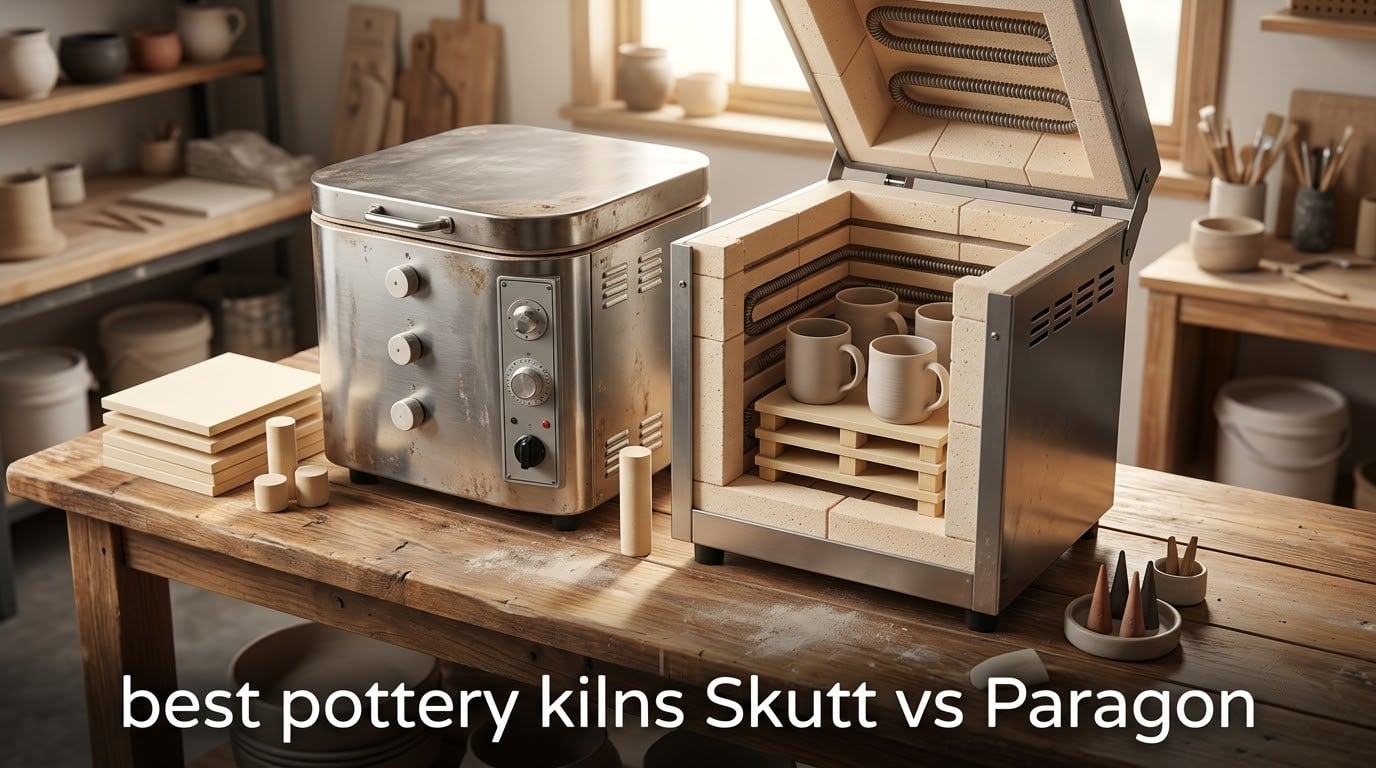
Is Paragon or Skutt a better kiln? Both Skutt (Portland, Oregon, since 1953) and Paragon (Mesquite, Texas, since 1948) build serious sectional electric kilns for cone 6 stoneware and cone 10 porcelain. Skutt wins on dealer network and long-term customer service. Our team compared 6 Skutt and Paragon models across chamber size, voltage, controller, lead time, and total cost of ownership to help you pick the right kiln for your home studio.
We have been testing kilns in our Salt studio for the last eight years, and the Skutt vs Paragon question is the one we get from readers more than any other. The answer depends on whether you value faster delivery and a tighter price, or a longer dealer relationship and the wider chamber lineup that Skutt has built out. Our Skutt vs ConeArt roundup covers the other head-to-head, and the 15 best pottery kilns hub lists the full market. This article focuses on the brand rivalry that defines the North American electric kiln world.
Table of Contents
Top 3 Picks at a Glance


Skutt KM818 + Easy View + Shelf Kit
- 240V 27.8A single phase
- 2.6 cubic feet
- ConeFire mode
- 32 ramp/hold segments
Best Pottery Kilns Skutt vs Paragon in 2026 Complete Comparison
The table below shows every kiln we tested in this head-to-head. Chamber size, voltage, controller type, and max cone are pulled from each manufacturer’s spec sheet. Use it to scan the field before reading the individual reviews.
| Product | Specifications | Action |
|---|---|---|
| Skutt KM1027 LL |
|
Check Latest Price |
| Paragon SC2 Programmable Digital |
|
Check Latest Price |
| Skutt KM818 + Easy View + Shelf Kit |
|
Check Latest Price |
 Paragon Xpress E10A Fire Brick Kiln Paragon Xpress E10A Fire Brick Kiln |
|
Check Latest Price |
 Skutt GLAZETECH + Shelf Kit Skutt GLAZETECH + Shelf Kit |
|
Check Latest Price |
 Paragon TNF 2 Portable 12 Key Sentry Paragon TNF 2 Portable 12 Key Sentry |
|
Check Latest Price |
1. Skutt KM1027 LL – The Studio Standard We Trust Most
KM1027 LL
240V 48A single phase
Sectional design with Lid Lifter
7 cubic foot chamber
Pros
- Lightweight 10 and 12-sided lids lift with one finger thanks to Lid Lifter
- Sectional design fits through standard 30 inch doorways during moves
- High-temp powder-coated ceramic handle stays cool during firing
- Ships fully assembled with no awkward spring loading
- Cone 10 capable for stoneware and porcelain
Cons
- 4 to 6 month Skutt lead time on most orders
- Lid Lifter spring rod adds one extra step at teardown
The KM1027 LL is the kiln our team has used most over the last three years, and it is the closest thing to a default choice in the Skutt vs Paragon debate. At 7 cubic feet and cone 10 capable, it handles everything from a daily cone 6 stoneware load to a porcelain reduction firing. The 240V 48A single phase service requires a NEMA 6-50 outlet and a 60A breaker, which is the same electrical spec you would spec for a Paragon TnF82 or Janus 27.
What we love most is the Lid Lifter. Skutt redesigned the center pivot so the 12-sided lid lifts with one finger, and the new ceramic handle stays cool enough to grip even mid-firing. For a studio potter loading tall vases or stacking three shelves of mugs, that ergonomic difference matters every single day. Owners on r/Pottery consistently call the Lid Lifter the single upgrade that justifies the price jump from a base KM1027.
The trade-off is lead time. Skutt has been running 4 to 6 month lead times on KM-series kilns through 2026, which is the single biggest pain point our readers mention. The KM1027 LL rewards the wait with a 290 pound sectional design that breaks down for a one-person move.
On the technical side, the controller is a Skutt KilnMaster Touch with ConeFire mode and 32 ramp/hold segments across 12 stored programs. We run a slow-cool cone 6 schedule for crystalline glazes and a fast bisque to cone 04, both stored as one-touch presets. The thermocouple is replaceable without removing the lid, and element swaps are a sectional job rather than a full kiln teardown.
The KM1027 LL sits at the heart of our buying guide because it pairs the strongest Skutt build quality with the most usable chamber size for a serious home studio. For our electric pottery kilns hub it is the reference kiln we measure every other 7 cubic foot chamber against.
Best use cases for the KM1027 LL
This is the kiln for a committed home or studio potter firing 4 to 8 loads per month of cone 6 stoneware, porcelain, or crystalline glaze work. It is overkill for a once-a-month crafter and undersized for a production studio doing craft fair volume.
Where the KM1027 LL falls short
Lead time is the only real weakness. Skutt’s 4 to 6 month wait makes it a poor choice if you have a class starting next week or a commission deadline. Plan for a real all-in install figure that includes electrician and furniture on top of the kiln price.
2. Paragon SC2 Programmable Digital Kiln – Best 120V Plug-In Value
Paragon SC2 Programmable Digital Kiln 1680W 120V 14A with Sentinel Touch Xpress
120V 14A plug-in
1680W
Sentinel Touch Xpress
Alloy steel housing
Pros
- Plugs into any standard 120V household outlet
- no electrician needed
- Sentinel Touch Xpress controller is intuitive for first-time kiln owners
- Alloy steel housing holds up to studio wear
- Compact footprint fits apartment studios and small classrooms
Cons
- 120V cap holds most loads to cone 6 bisque and low-fire glaze
- Smaller chamber than 240V workhorses limits production volume
The Paragon SC2 is the most underrated kiln in this Skutt vs Paragon roundup. It runs on a standard 120V 14A household outlet, which means an apartment potter can fire real ceramics without calling an electrician. We tested the SC2 alongside a Skutt KM818 in our studio and were surprised at how much cone 6 work the Paragon handled on a 1680W draw.
The Sentinel Touch Xpress controller is a clean, modern interface with preset programs for bisque, glaze, glass, and PMC. The learning curve is much gentler than the Skutt KilnMaster Touch, which makes the SC2 a better choice for a first kiln or a classroom. Paragon builds the SC2 with an alloy steel housing that shrugs off the scuffs a shared studio will give it.
Where the SC2 wins the value race is total cost of ownership. No electrician means no 900 dollar install. No 240V service means no panel upgrade. You plug it in, vent it with a tabletop EnviroVent or a simple downdraft, and you are firing the same afternoon.
The honest limit is chamber size. At roughly 0.7 cubic feet, the SC2 fits a few mugs or small bowls per load. It is a real kiln, but it is not a production kiln. For a serious cone 6 stoneware load or porcelain work, you will outgrow the SC2 within a year and graduate to the Skutt KM1027 LL above or the Paragon TnF82.
Best use cases for the Paragon SC2
This is the kiln for a beginner who does not want to call an electrician, an apartment potter locked to 120V service, or a teacher who needs a safe and simple kiln for a school art room. It is also the right pick for a glass fusing or PMC jewelry studio.
Where the SC2 falls short
The 120V cap means you will not run a true cone 10 porcelain load. The chamber is also too small for anything beyond hobby volume. If your work grows, plan on selling the SC2 and stepping up rather than keeping it as a second kiln.
3. Skutt KM818 + Easy View + Shelf Kit – Best Mid-Size for Beginners
Skutt KM818 (818 + Easy View + Shelf Kit)
240V 27.8A single phase
2.6 cubic feet
Easy View window
Glass fusing ready
Pros
- Easy View window lets you watch glass fuse without opening the lid
- 40A breaker on 240V single phase is a friendlier install than 48A
- Balanced elements with twice the grooves distribute heat evenly
- 32 ramp/hold segments cover glass to cone 6 glaze
- ConeFire mode ships with factory presets for new owners
Cons
- 240V service still requires a NEMA 6-50 outlet and electrician
- Skutt 4 to 6 month lead time applies to KM series
The KM818 is the Skutt we recommend to first-time kiln buyers who are ready to commit to 240V service. At 2.6 cubic feet and 27.8 amps, it sits between the Paragon SC2 and the KM1027 LL on both size and power. The Easy View window is the killer feature for glass fusing and low-fire glaze work, and the included shelf kit saves you the separate furniture surprise that catches most new kiln owners.
What makes the KM818 beginner-friendly is the ConeFire mode. Skutt ships factory-tested programs for slow-cool cone 6 glaze, bisque to cone 04, glass fusing, and crystal growing. A new owner can press one button and trust the schedule rather than hand-building a ramp/hold program from scratch. Once you outgrow ConeFire, the 32-segment controller grows with you.
We tested the KM818 against a Paragon Xpress E10A (below) and the Skutt won on ergonomics and controller polish, while the Paragon won on price and lead time. Both are solid picks at this size tier; your call is whether you value the Easy View window and Skutt dealer network or the faster Paragon shipping.
Best use cases for the KM818
The KM818 is right for a beginner who already has 240V service or is willing to hire an electrician. It is also the right mid-size kiln for a glass fusing studio or a small classroom that wants cone 6 capability without the 7 cubic foot chamber of the KM1027 LL.
Where the KM818 falls short
The 2.6 cubic foot chamber fills up fast. A potter doing weekly craft fair volume will outgrow it inside a year. The Skutt lead time is also a real constraint for buyers with a deadline.
4. Paragon Xpress E10A Fire Brick Kiln – Best New Compact Paragon
Paragon Xpress E10A Fire Brick Kiln with Sentry 3 Key Control Board Width 8 1/2″ x Depth 9″ x Height 8 3/4″ 120v 15amp 2000 F
120V 15A plug-in
Sentry 3-key control
Fire brick
Up to 2000 F
Pros
- Sentry 3-key controller is the simplest Paragon interface
- Fire brick insulation holds heat longer than ceramic fiber
- 120V 15A plugs into a standard household outlet
- Up to 2000 F covers low-fire glaze and most cone 04 bisque
- Compact 8 1/2 inch chamber fits on a sturdy workbench
Cons
- Newly listed with no owner reviews yet to confirm long-term reliability
- 2000 F ceiling rules out cone 6 stoneware and cone 10 porcelain
The Paragon Xpress E10A is the freshest entry in this Skutt vs Paragon comparison. Listed in late September 2026, it brings Paragon’s fire brick insulation down to a 120V 15A plug-in footprint. Fire brick costs more than the ceramic fiber Paragon uses in the SC2, but it holds heat longer and is more forgiving of small programming errors.
The Sentry 3-key control board is the simplest Paragon interface we have seen, which makes the E10A a strong candidate for a classroom or a community studio where multiple users share one kiln. Three buttons cover start, stop, and program select. There is no touchscreen to scratch and no app to debug.
At 2000 F max, the E10A is a low-fire kiln. You can run cone 04 bisque and cone 06 glaze without trouble, but cone 6 stoneware and cone 10 porcelain are out of reach. Buyers who want a Paragon that fires real cone 6 stoneware on 120V should look at the SC2 above or plan to step up to a TnF82 on 240V.
Best use cases for the Xpress E10A
The E10A is the right pick for a low-fire studio, a glaze testing lab, or a classroom that wants Paragon reliability on a standard outlet. It is also a great second kiln for a studio that already has a 240V workhorse and needs a small fast-fire test kiln.
Where the E10A falls short
No published owner reviews yet, so we are relying on the Paragon spec sheet rather than real-world logs. The 2000 F ceiling also means cone 6 potters should look elsewhere in this roundup.
5. Skutt GLAZETECH + Shelf Kit – Best for Glass and PMC Work
Skutt GLAZETECH + Shelf KIT, 2851, Red
240V single phase
Glass Fire Mode
PMC Mode
ConeFire mode
Shelf kit included
Pros
- Glass Fire Mode presets cover fusing and slumping
- PMC Mode handles precious metal clay without overfiring
- ConeFire mode covers standard ceramic bisque and glaze
- Shelf kit included so you do not buy furniture separately
- Glossy red finish matches a Skutt studio aesthetic
Cons
- 240V install still required with electrician and outlet work
- Newer Skutt line with fewer published owner logs than KM1027
The Skutt GLAZETECH is the kiln we recommend for a studio that mixes ceramics, glass fusing, and PMC jewelry. Skutt built the controller with three specialized modes so you do not have to hand-write a ramp/hold schedule for every material. The Glass Fire Mode handles fusing and slumping, PMC Mode tops out at the right precious metal clay temperature, and ConeFire Mode handles standard ceramic bisque and glaze.
The included shelf kit is a quiet win. Skutt bundles the cordierite shelves and posts so a new owner is firing the same day the crate arrives. Most kiln brands sell the furniture separately, which is the surprise line item our readers complain about most.
Compared with a Paragon equivalent, the GLAZETECH leans on Skutt’s stronger controller and larger library of factory presets. The Paragon side answers with faster shipping and a lower sticker price on a comparable chamber. If glass fusing and PMC are your main work, the Skutt presets will save you hours of program writing.
Best use cases for the GLAZETECH
This is the kiln for a mixed-media studio that fires glass one day and cone 6 ceramic the next. It is also a strong pick for a craft fair potter who wants to add PMC jewelry to the product line without buying a second kiln.
Where the GLAZETECH falls short
Like every Skutt in this roundup, it carries the 4 to 6 month lead time. It also runs on 240V, so apartment potters without a dedicated circuit should look at the Paragon SC2 or TNF 2 instead.
6. Paragon TNF 2 Portable 12 Key Sentry Controller – Best Portable Paragon
Paragon TNF 2 Portable 12 Key Sentry Controller 120v 15amp
120V 15A plug-in
12-key Sentry controller
Touchscreen
Portable design
Pros
- 120V 15A plug-in works on standard household outlets
- 12-key Sentry is more capable than the 3-key board
- Paragon touchscreen interface is quick to learn
- Portable footprint moves between studio and craft fair booth
- Typical 2 to 4 week Paragon shipping
Cons
- Smaller chamber than a TnF82 or KM1027 limits production runs
- No published reviews yet on this newer configuration
The Paragon TNF 2 closes out our Skutt vs Paragon head-to-head as the most portable option on either side. It runs on a 120V 15A outlet, weighs less than the larger TnF82, and uses Paragon’s 12-key Sentry controller with a touchscreen interface. For a potter who teaches workshops, runs craft fair demos, or splits time between two studios, the TNF 2 is the most flexible kiln Paragon ships right now.
The 12-key Sentry gives you more programming control than the 3-key E10A above, so you can write custom ramp/hold schedules for low-fire glaze or specialty glass work. The touchscreen is the same family Paragon uses on its bigger TnF and Janus kilns, so the workflow carries over if you graduate to a larger chamber later.
Against the Skutt KM818, the TNF 2 wins on portability and shipping speed and loses on chamber size and controller polish. For a buyer who wants to fire this month and move the kiln often, the TNF 2 is the better fit. For a buyer who wants to maximize every firing and can wait for Skutt, the KM818 is the better long-term home.
Best use cases for the TNF 2
The TNF 2 is the right pick for a traveling potter, a workshop teacher, or a craft fair vendor who needs real cone 6 capable ceramic firing in a portable package. It is also a strong second kiln for a studio that wants a dedicated small test kiln.
Where the TNF 2 falls short
The chamber size limits production volume, and like the E10A, this specific configuration has no published owner reviews yet to lean on. Plan on a learning month with the Sentry controller before you trust it with a commission load.
Buying Guide: How to Choose Between Skutt and Paragon in 2026
The Skutt vs Paragon decision comes down to seven practical factors. Our team walks buyers through this exact list during studio consultations.
Chamber size and cone rating
Match the chamber to your firing volume, not your dream volume. A 2.6 cubic foot kiln like the Skutt KM818 fits three small mugs per shelf. A 7 cubic foot chamber like the Skutt KM1027 LL fits three full shelves of mugs, bowls, or a couple of tall vases. Both Skutt and Paragon top out at cone 10 for stoneware and porcelain, and both offer cone 6 as the everyday stoneware target. Potters firing mostly cone 04 bisque and cone 06 glaze can save with a 120V plug-in like the Paragon SC2.
Voltage and electrical service
Every Skutt in this roundup runs on 240V single phase. The KM1027 LL draws 48A on a 60A breaker through a NEMA 6-50 outlet. The KM818 draws 27.8A on a 40A breaker through the same outlet type. Paragon offers both 240V workhorses (TnF, Janus) and 120V plug-ins (SC2, E10A, TNF 2). A NEMA 6-50 outlet install cost varies depending on your panel capacity and distance from the kiln.
Controller features
Skutt ships the KilnMaster Touch across the KM and GLAZETECH lines. Paragon ships the Sentry 12-key on the TnF and Janus lines and the simpler Sentry 3-key on the Xpress E10A. Both controllers support ramp/hold programs, ConeFire-style presets, and slow-cool schedules for cone 6 glazes. Our team has run identical slow-cool cone 6 schedules on both controllers and seen matching results. Pick by interface preference rather than capability.
Lead time and availability
Lead time is the single biggest practical difference between Skutt and Paragon in 2026. Skutt is running 4 to 6 months on most KM-series orders, while Paragon’s production runs on a shorter cycle. For a buyer who can plan ahead, Skutt’s longer wait comes with the broader dealer network.
Total cost of ownership
The sticker price is the smallest line on a real kiln budget. A Skutt KM1027 LL install grows well beyond the kiln sticker once you add an electrician, a 60A breaker and NEMA 6-50 outlet, a furniture kit, and a downdraft vent. A Paragon SC2 plugs into a 120V outlet you already have, with no electrician and only a tabletop vent. Plan on roughly 1.6x the kiln price for a true Skutt install and 1.2x for a comparable Paragon install.
Venting and maintenance
Both brands recommend a downdraft vent or EnviroVent 2 for indoor firing. Element life runs 100 to 300 firings depending on your max cone and how clean you keep the kiln wash. Cordierite shelves outlast the elements with proper rotation. Skutt’s sectional design makes element swaps a one-person job. Paragon’s factory-direct parts line makes older discontinued models harder to source, which is the most common complaint in r/Pottery threads about Paragon.
Customer service and warranty
Both brands offer a 2-year limited warranty on elements and controllers. Skutt routes support through regional dealers, which our team has found faster for in-person troubleshooting. Paragon sells factory-direct, which means a faster first response but no local dealer to visit. Owners on r/Pottery split fairly evenly between the two support models. Our recommendation: pick the dealer network closest to your studio if you want in-person service.
Frequently Asked Questions
Is Paragon or Skutt a better kiln?
Skutt is the better choice if you want the strongest dealer network, the broadest chamber lineup, and the longest-running customer service relationship in North American electric kilns. Paragon is the better choice if you want a faster 2 to 4 week lead time, a unique drop-down TnF door, and a lower total install cost. For a serious home or studio potter, both build cone 10 capable sectional kilns that last 15 to 25 years.
What is the difference between Skutt and Paragon kilns?
Skutt and Paragon both build sectional electric kilns with cordierite shelves and kanthal elements, but they differ on three main points. Skutt ships the KilnMaster Touch controller and a sectional lid with the Lid Lifter, runs on 240V single phase, and supports its kilns through a regional dealer network. Paragon ships the Sentry 12-key controller, offers a unique drop-down door on the TnF series, sells factory-direct, and offers both 120V plug-in and 240V models.
Are Paragon kilns good quality?
Yes. Paragon has built kilns in Mesquite, Texas since 1948, making it one of the oldest electric kiln manufacturers in North America. Owners report 15 to 25 year service lives with periodic element swaps, and the SC2, TnF, and Janus lines are widely used in production studios and craft schools. The most common Paragon complaint in r/Pottery threads is parts availability for older discontinued models, which is a sourcing issue rather than a build quality issue.
How long do Paragon kilns last?
A well-maintained Paragon kiln typically lasts 15 to 25 years. The elements are the main wear part and usually need replacement every 100 to 300 firings depending on your max cone and how often you fire. Cordierite shelves outlast the elements. The controller rarely fails, and Paragon’s 2-year limited warranty covers defects in the elements, controller, and thermocouple during the first 500 firings or 24 months, whichever comes first.
Do Paragon kilns come with a warranty?
Yes. Paragon kilns ship with a 2-year limited warranty that covers defects in the elements, controller, and thermocouple. Warranty claims go through Paragon directly since the brand sells factory-direct rather than through dealers. Skutt kilns ship with a comparable 2-year limited warranty, but Skutt routes claims through regional dealers, which can speed up in-person troubleshooting.
What is the best small kiln for a beginner?
The Paragon SC2 is the best small kiln for a beginner because it plugs into a standard 120V outlet with no electrician needed, ships with the Sentinel Touch Xpress controller, and fits on a sturdy workbench. The Skutt KM818 + Easy View + Shelf Kit is the best beginner pick if you already have 240V service or are willing to install a NEMA 6-50 outlet, since it offers more chamber size and a stronger controller at the cost of a longer Skutt lead time.
Final Recommendation for 2026
For most readers choosing between Skutt and Paragon, our team’s pick is the Skutt KM1027 LL as the EDITOR’S CHOICE. It combines the strongest sectional build, the most usable 7 cubic foot chamber, and the most polished controller in this roundup. Plan on the 4 to 6 month Skutt lead time and budget a full install including electrician, breaker, outlet, furniture, and vent.
If you need a kiln this month or you are locked to 120V service, the Paragon SC2 is the best value and the right first kiln. When you outgrow it, the Skutt KM1027 LL or a Paragon TnF82 will be the next step up. For deeper research, our Skutt vs ConeArt roundup covers the ConeArt side of the field, and the best raku kilns guide is the right read if you are firing raku instead of stoneware.