
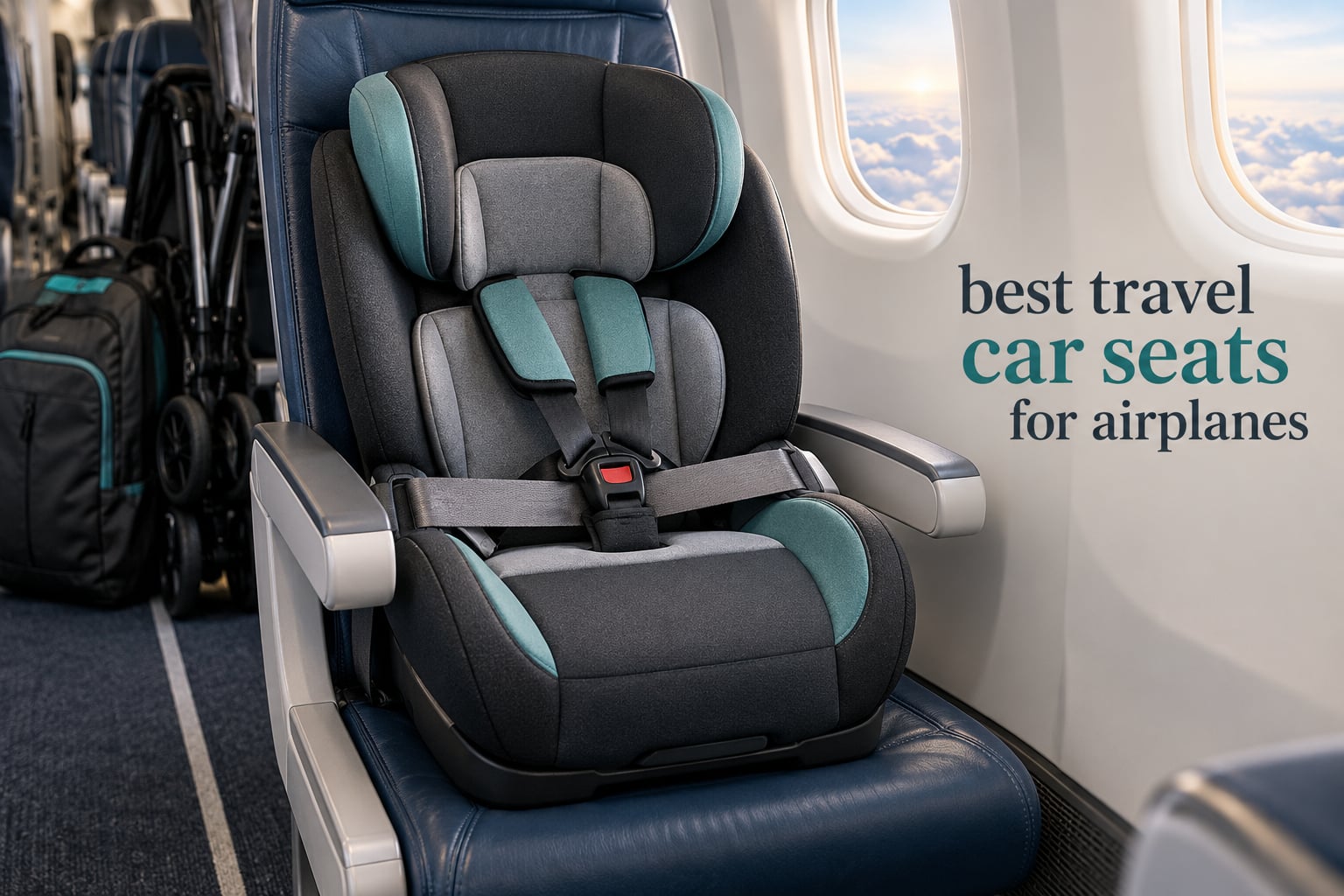
A car seat is legal on an airplane cabin only if it carries the red label that reads “This restraint is certified for use in motor vehicles and aircraft.” That label says nothing about width, and width is what actually decides whether your child sits down for the flight or gets bumped to a lap baby at the gate. Getting the best travel car seats for airplanes right means reading two numbers on the same seat: certification, then base width against the roughly 16 to 17 inch airplane row you are booking into.
I have carried infant carriers down jet bridges, folded boosters into overhead bins, and watched parents get stopped at the aisle because their seat was one inch too broad. The pattern repeated enough times that I stopped ranking these seats on rating alone and started ranking them on whether they fit, whether a solo parent can lift them, and whether the same seat still works in a taxi at the other end.
What follows is a full roundup covering babies under 30 pounds all the way to booster-seat-age kids, plus one harness option that is not a car seat at all. I flag which products state aircraft certification on their own spec sheets and which ones you need to verify by looking at the physical label. I also cover the lap-belt install, the gate-check decision, and how to inspect a seat if you buy one used rather than new.
If you are still building a full car seat setup, start with our infant car seat guide and our convertible car seat guide for the ground side of the equation.
Top 3 Best Travel Car Seats For Airplanes (October 2026)

Doona Car Seat and Stroller
- FAA and TUV aircraft approved
- Rear-facing 4-30 lbs
- 17.2 lbs seat and stroller combined
- Folds into a stroller in seconds

Diono Radian 3R
- FAA approved for airline use
- 5-120 lbs in one seat
- Folds flat
- Steel-reinforced core shell

Graco SlimFit3 LX
- 16.7 inch seat width
- Rear-facing 5-40 lbs then booster
- No-rethread 10-position harness
The Best Travel Car Seats for Airplanes in 2026 at a Glance
Every seat below is listed with what the manufacturer states about aircraft use, weight, and width. Where a listing does not spell out aircraft certification, the seat still needs the red label checked in person before you fly.
| Product | Specifications | Action |
|---|---|---|
| Doona Car Seat and Stroller |
|
Check Latest Price |
 Cosco Topside Leo Backless Booster Cosco Topside Leo Backless Booster |
|
Check Latest Price |
| Diono Radian 3R |
|
Check Latest Price |
 mifold Comfort Grab-and-Go Booster mifold Comfort Grab-and-Go Booster |
|
Check Latest Price |
 Safety 1st OnBoard FLX Safety 1st OnBoard FLX |
|
Check Latest Price |
 RideSafer Gen 5 Vest RideSafer Gen 5 Vest |
|
Check Latest Price |
 mifold Hifold High Back Booster mifold Hifold High Back Booster |
|
Check Latest Price |
| Graco SlimFit3 LX |
|
Check Latest Price |
 Safety 1st Ellaris Safety 1st Ellaris |
|
Check Latest Price |
 Graco Tranzitions Graco Tranzitions |
|
Check Latest Price |
 Safety 1st Grow and Go 2-in-1 Safety 1st Grow and Go 2-in-1 |
|
Check Latest Price |
 Baby Trend Protect 2-in-1 Baby Trend Protect 2-in-1 |
|
Check Latest Price |
How to Tell If a Car Seat Is OK for a Plane?
The fastest way to check is the red label stitched to the seat’s fabric, usually on the back or side of the shell. It reads “This restraint is certified for use in motor vehicles and aircraft.” FAA does not approve brands or models outright, it certifies that a restraint met the aircraft-use standard, and it never publishes a list of which seats you may bring. Your job on the ground is simply to confirm the label exists.
Here is the five-point check I run before any seat leaves the house:
Red label present. If there is no aircraft wording on the label, the seat is a vehicle-only seat and you will be gate-checking it.
Base width under about 17 inches. Measure the widest point of the base, not the headrest or the canopy, because that is what has to clear two armrests.
Weight you can carry for 400 feet. Gate-to-seat distance is longer than any airport map suggests, and a base that separates is worth more than one that does not.
Correct facing for the child’s age and size. The FAA recommends staying in a rear-facing seat for as long as the seat allows.
Fits between armrests at the base. A window seat is easier, because nothing blocks the aisle or the row behind.
Three things get confused constantly, so keep them separate. FAA-approved means the seat passed the aircraft crash standard. Airline-allowed means the carrier permits child restraints in the cabin, which in the US generally follows the FAA label but is set by each carrier’s own rules. Actually-fits means the base physically slides between your specific aircraft’s armrests, which the label cannot promise for you.
1. Doona Car Seat and Stroller – Best All-in-One for Airplanes
Doona Car Seat & Stroller, Nitro Black – All-in-One Travel System
17.2 lbs seat and stroller
9.7 lbs base
4-30 lbs rear-facing
FAA and TUV aircraft approved
Pros
- Converts from car seat to stroller in seconds without waking the child
- FAA and TUV aircraft approved
- Ergonomic near-flat infant insert for newborns
- Built-in three-layer side impact protection
Cons
- Rear-facing only so it cannot grow into forward-facing
- Heavier and bulkier than a dedicated booster seat
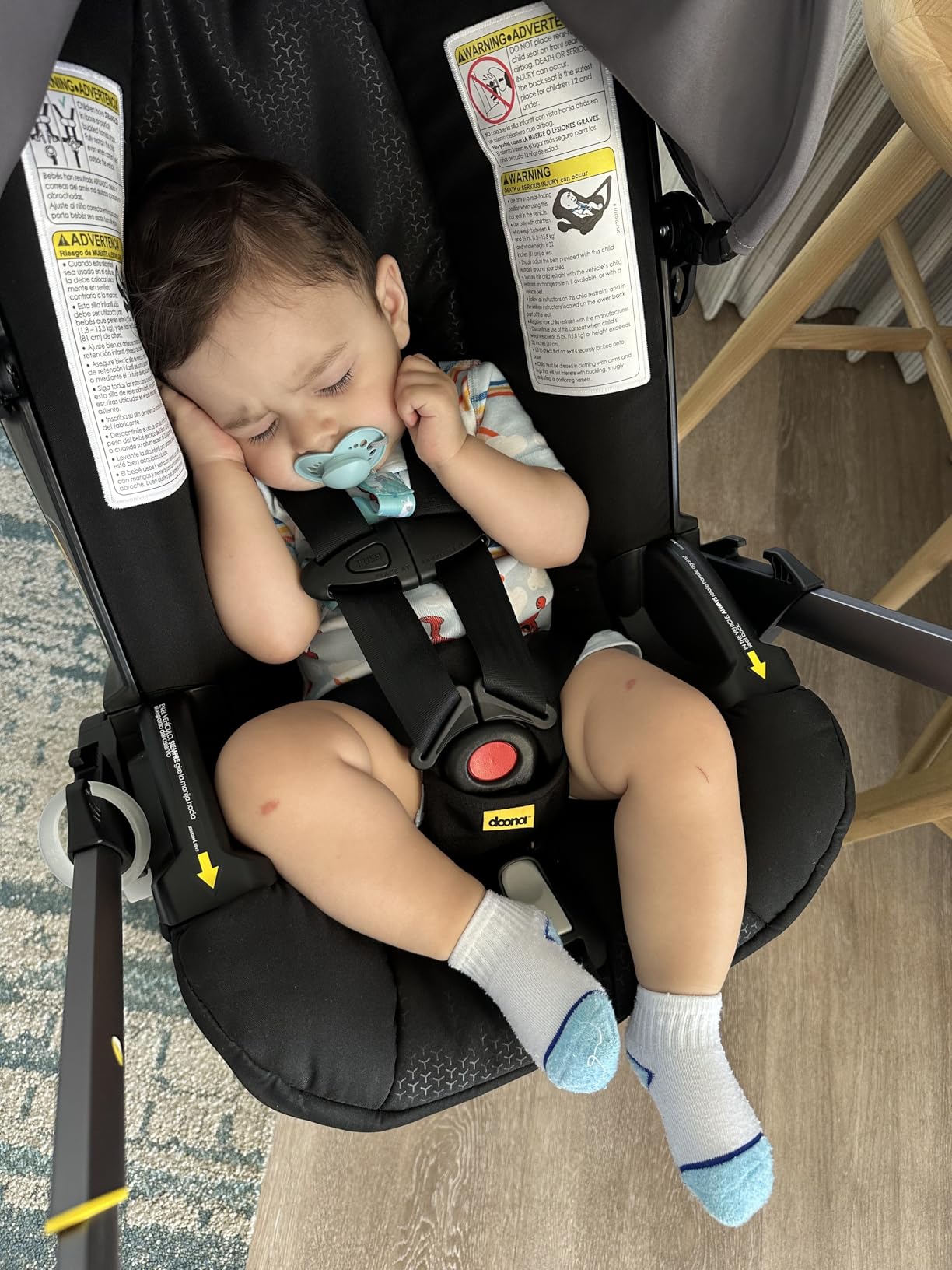
This is the seat I hand to a family leaving the airport gate with a sleeping baby and a stroller still needed. The Nitro folds from car seat to stroller in seconds with one hand, so nothing has to be stowed in a bin before you sit down. The one-click mechanism is what removes the install-error risk that makes ordinary belt paths hard to manage on a plane.
Owners rate it 4.8 out of 5 across more than 15k reviews, and the same praise repeats: the conversion, the certification, and the infant insert. The repeated complaint is weight, at 17.2 lbs for the seat and stroller together. On a long connection with a gate change, that is a real distance to cover.

The spec sheet lists 17.4 inches of folded width and TUV alongside FAA aircraft approval, which matters if your trip touches Europe where TUV aviation certification is the standard carriers look for. It is rear-facing only from 4 to 30 lbs, so this is an infant seat and nothing more. When your child outgrows 30 lbs you are shopping again.
The base weighs 9.7 lbs separately, which is the number to look at when a carrier will gate-check one piece and you want to keep the other. Construction is fiber-reinforced polymer with rust-free aluminum, plus a water-repellant canopy with UPF 50+ protection for the walk from the terminal to the shuttle.
Will the Doona fit a budget airline row?
At 17.4 inches wide it sits at the tight end of what a narrow economy row accepts, so I would check your airline’s stated width before committing. On a standard narrow-body it is a usable fit, on the tightest rows expect to be seated by a gate agent.
Is one seat enough if you are flying with two under 2?
No. Each child under two needs their own restraint, so a family with two under-twos travels with two of these or with a second seat from the rest of this list. Sitting a lap infant on your lap does not meet the airline requirement.
2. Cosco Topside Leo Backless Booster – Best Budget Seat That Disappears Into a Trunk
Cosco Topside Backless Booster Car Seat, Lightweight Booster Seats for Cars 40-100 lbs, Backless Booster Seat for Car, Leo
40-100 lbs
43.4 to 57 inches
Backless design
Hand-wash cover
Pros
- Very lightweight and compact for moving between vehicles
- Kids can buckle themselves in independently
- Easy to wipe clean after spills
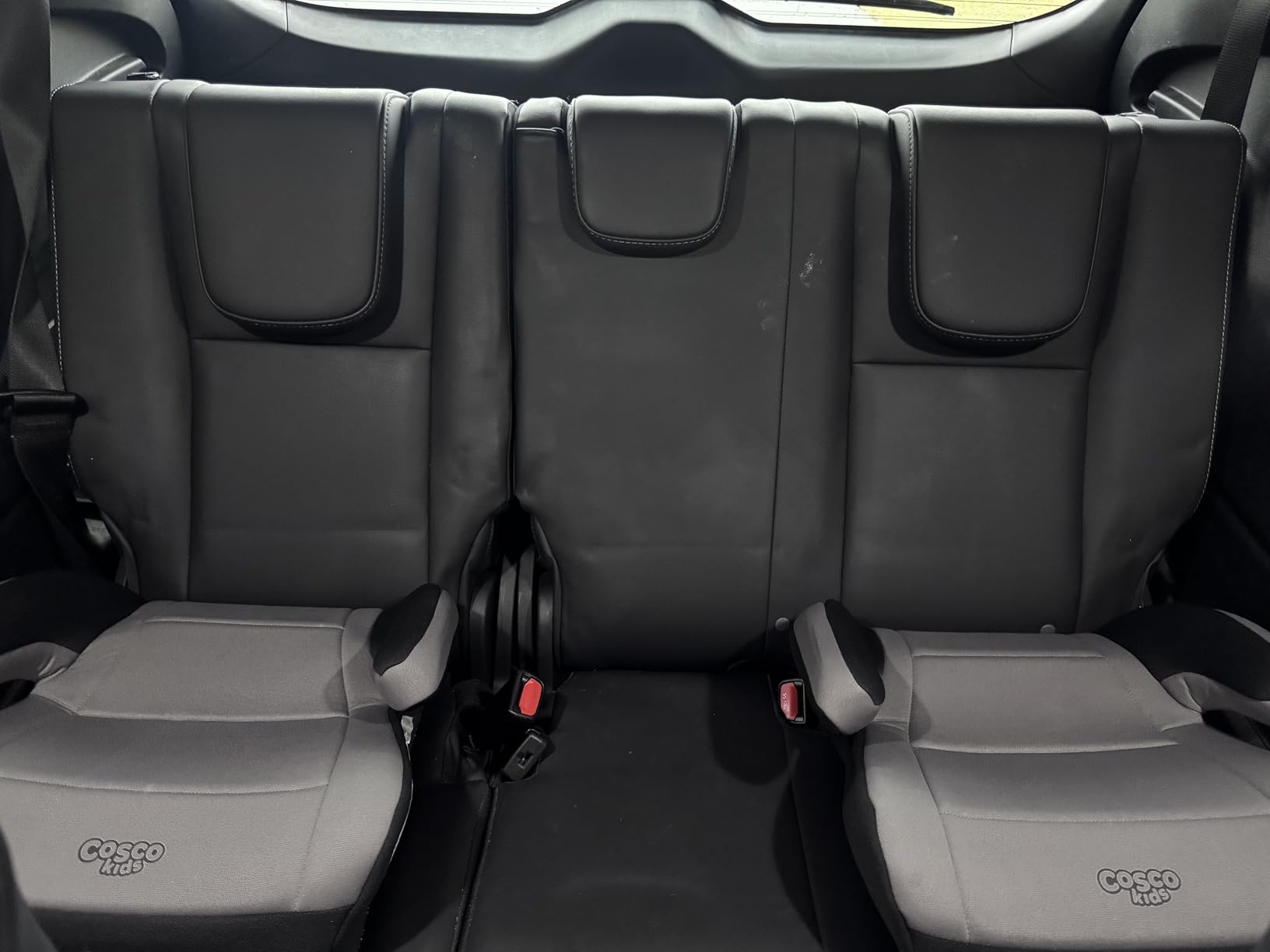
- Fits three across in one row
Cons
- No cup holders
- Minimal padding that some riders find uncomfortable
- Holds position only through the vehicle seat belt
The Leo is what I recommend to a parent who already handles a travel seat in the taxi and a rental car without ceremony. There is no installation step at all, the child sits on the cushion and routes the lap and shoulder belt through the guides. In an aircraft row the same logic applies, provided the child is old and heavy enough for a belt-positioning booster rather than a harness.
It carries more than 15k ratings, and travel-focused buyers describe it as dependable and inexpensive. The reason it works for flying is that it adds almost no bulk, which matters more than any feature when you are moving down a narrow aisle.
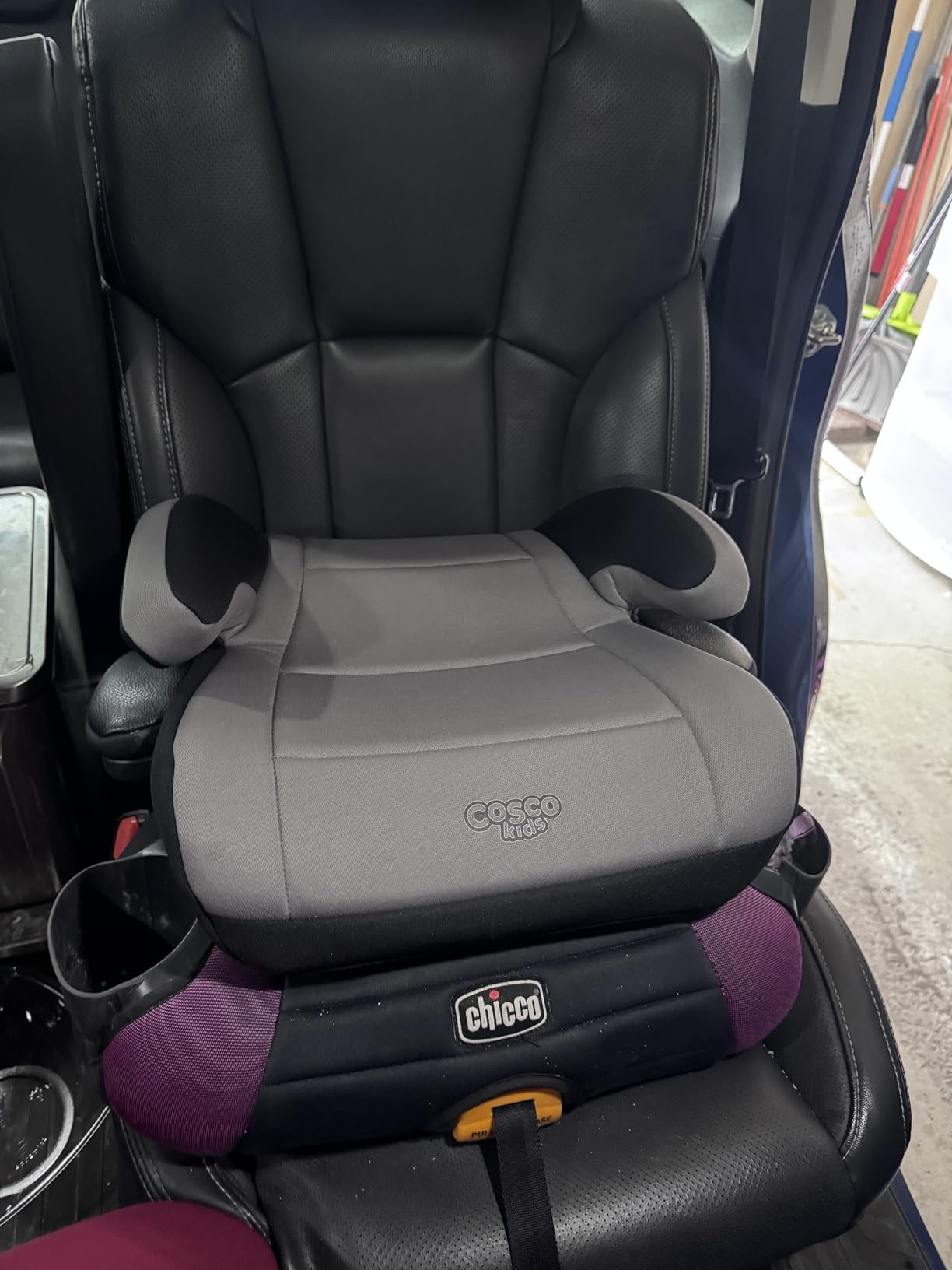
The listed range is 40 to 100 lbs and 43.4 to 57 inches, with 100 percent polyester fabric. Because it is backless, there is no head support, so a child who falls asleep on a long-haul has nothing to lean against. That is the single biggest gap between this seat and a high-back booster.
The cover is hand-wash only, which matters more than it sounds when a spilled drink happens at 30,000 feet. The design is also built to avoid marking the vehicle seat underneath, which is a small courtesy when you rent.
Should a 3 year old use this on a plane?
Not at that age. A child under about four and under 40 lbs still belongs in a harness seat, and this booster starts at 40 lbs. For younger children, look at the Graco SlimFit3 LX or the Diono Radian 3R instead.
Is a backless booster realistic for a long flight?
It works, and parents who fly long routes with older kids report it holds up fine, but the lack of a headrest is a genuine comfort loss over several hours. I would pair it with a cheap travel pillow for an overnight leg.
3. Diono Radian 3R – Best Premium Durable Seat for Frequent Flyers
Diono Radian 3R, 3-in-1 Convertible Car Seat, Rear Facing & Forward Facing, 10 Years 1 Car Seat, Slim Fit 3 Across, Blue Sky
5-120 lbs range
50 lb rear-facing max
FAA approved for airline use
Folds flat for travel
Pros
- One seat covers birth through booster for roughly ten years
- Fits three across in most vehicles
- Folds flat for travel or storage
- Automotive-grade steel core shell
Cons
- Heavy to carry for a grab-and-go seat
- Installation is unusually complex with multiple modes
- Rear-facing recline is steep and needs front-seat clearance
The Radian is the answer to the durability question. One shell covers birth, rear-facing, forward-facing, and booster, so a family that flies twice a year and also drives three kids buys once. That long service life is why it is the seat I suggest to anyone who hates the idea of replacing plastic car seats every stage.
It holds a 4.7 rating across nearly 7900 reviews, and families with three children consistently praise the three-across footprint. The dominant caveat in those reviews is weight: the steel-reinforced frame makes it impractical to move between cars frequently.
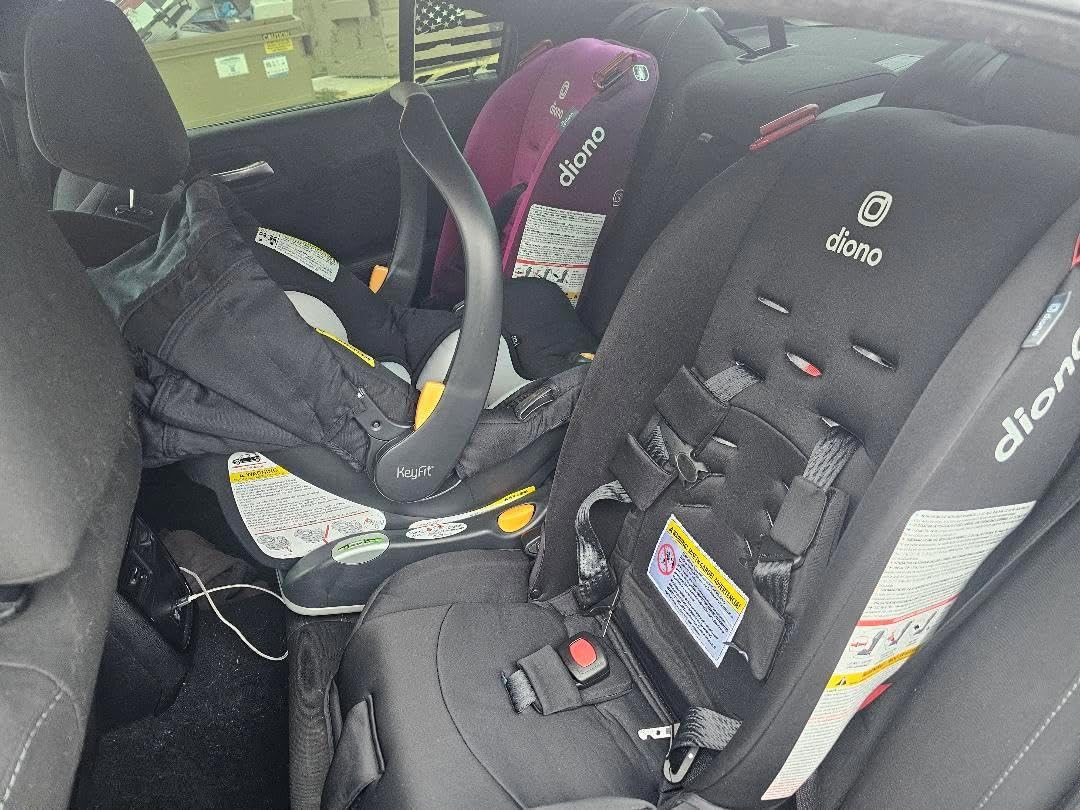
The spec sheet states FAA approval for airline use, rear-facing up to 50 lb, and a five-to-120 lb envelope across four modes. It folds flat, which helps in a trunk but does not make it a folding travel frame like a dedicated travel seat.
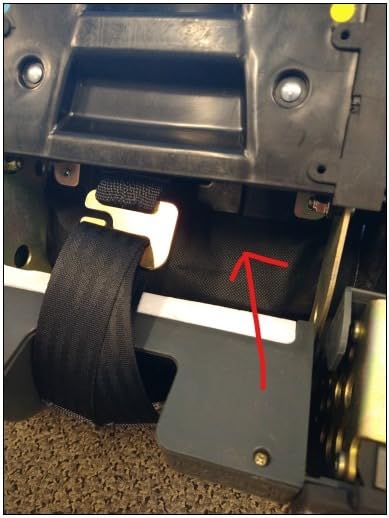
CPSTs caution that the mode-switching system is easy to misuse without careful setup, and the rear-facing recline is steep enough to need extra front-seat clearance. Read the manual before the first install rather than after.
Is the Diono Radian worth it for someone who flies rarely?
Probably not on travel grounds alone. Its value comes from the ten-year service span, so it pays off for families who buy once and pass it between children, not for a single cross-country trip.
Can a solo parent install this at the gate alone?
It is doable, but the belt path and the mode switches are more involved than a travel-specific seat. Give yourself a few extra minutes at the aircraft door and read the diagram printed on the shell.
4. mifold Comfort Grab-and-Go Booster – Best for Carrying in a Backpack
New Mifold Comfort Grab-and-go Car Backless Booster Seat-Compact and Portable for Every Day, Carpooling, Travel, Charcoal Grey
40-100 lbs
43.5 to 59 inches
Ages 4 and up
Packs into a backpack or glove box
Pros
- Fits into a backpack or glove box
- No installation and no re-installation between cars
- Padded Compact Comfort cushion
- Shoulder belt guide for correct fit
Cons
- Lowest rating in this group with a notable share of one-star reviews
- Backless design gives less support than a high-back booster
- Some users find it less secure for younger children
This is the smallest thing on the list by design. It compresses into a regular backpack or a glove box, so the child can be belted into an aircraft seat, a taxi, and a rental car without you ever unpacking anything. For a family that moves through three vehicles in one day, that simplicity is the product.
It is rated 4.2 across more than 3900 reviews, the lowest average in this group, with the widest spread of feedback. The newer cushion version improved comfort over earlier models, which is what most of the recent reviews reflect.
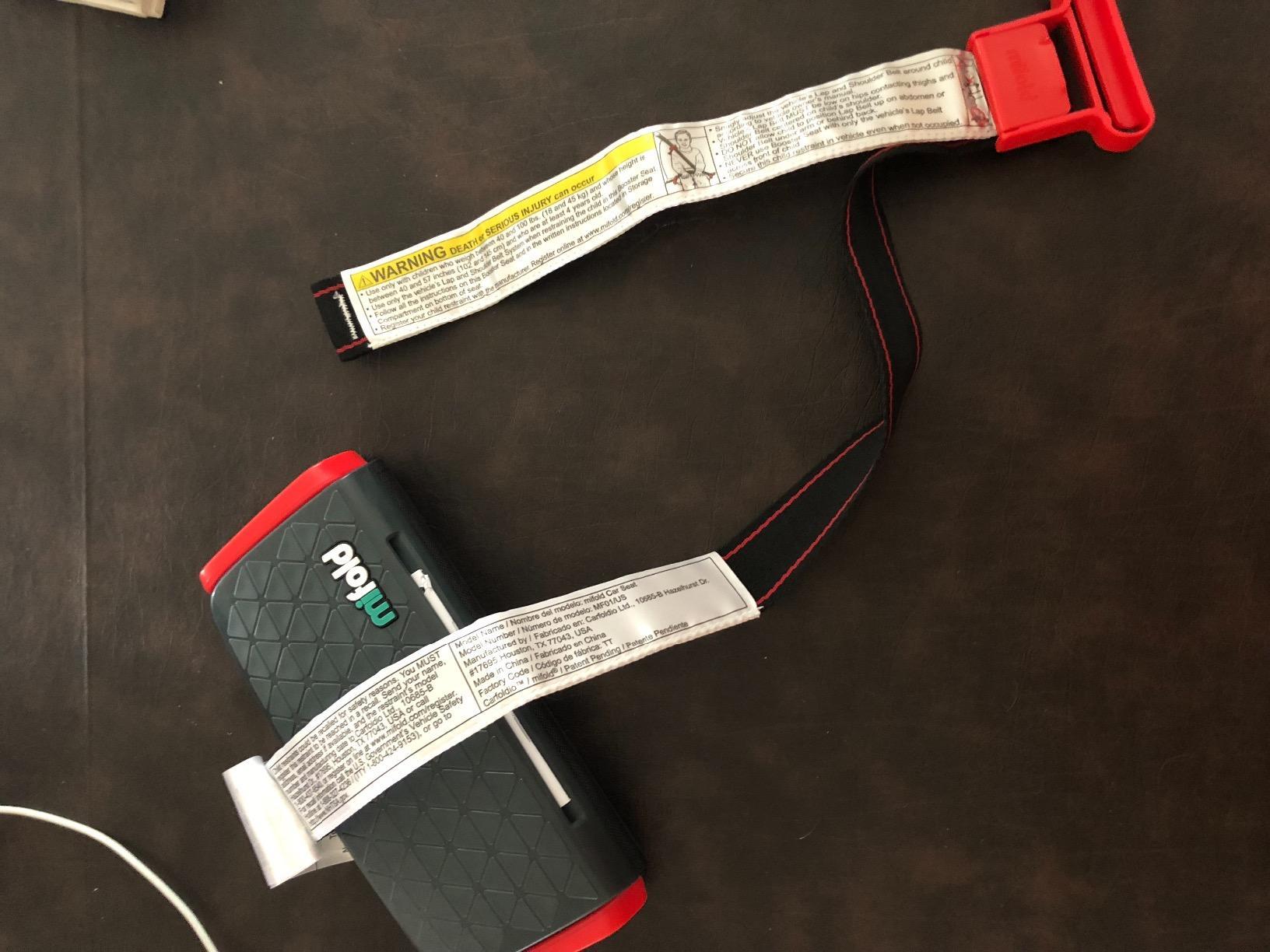
Specs list 40 to 100 lbs, 43.5 to 59 inches, and a recommended starting age of four. Anti-slip pads underneath keep it from sliding on a slick aircraft tray table or seat cushion, and there is no installation step at all, it just works with a standard three-point belt.
One-star feedback concentrates on fit and support for smaller children, at roughly eight percent of reviews. If your child is at the very bottom of the weight range, test the belt geometry before you commit to a long flight.
Is a backless booster allowed on a plane?
Booster seats are treated differently from infant seats and harnessed seats, and rules vary by carrier. The FAA aircraft label applies to infant and child restraints, so confirm your airline’s booster policy in writing before you fly with a child in this category.
Who should skip this seat?
Anyone flying with a child near the low end of the range, or anyone whose child sleeps hard and needs head support. Take the Hifold instead if a high back matters more than packed size.
5. Safety 1st OnBoard FLX – Best Lightweight Infant Seat to Carry
Safety 1st OnBoard FLX Infant Car Seat with Base, Lightweight Baby Car Seat for Travel, Wisteria Lane 2
Under 8 lbs carrier
4-30 lbs rear-facing
Up to 32 inches
QuickClick stroller attachment
Pros
- Extremely light at under eight pounds for airport walking
- QuickClick one-click stroller attachment
- Machine-washable and dryer-safe seat pad
- Four harness heights plus newborn inserts
Cons
- Some children outgrow it early if tall for their weight
- Not a full-size convertible with a limited rear-facing height range
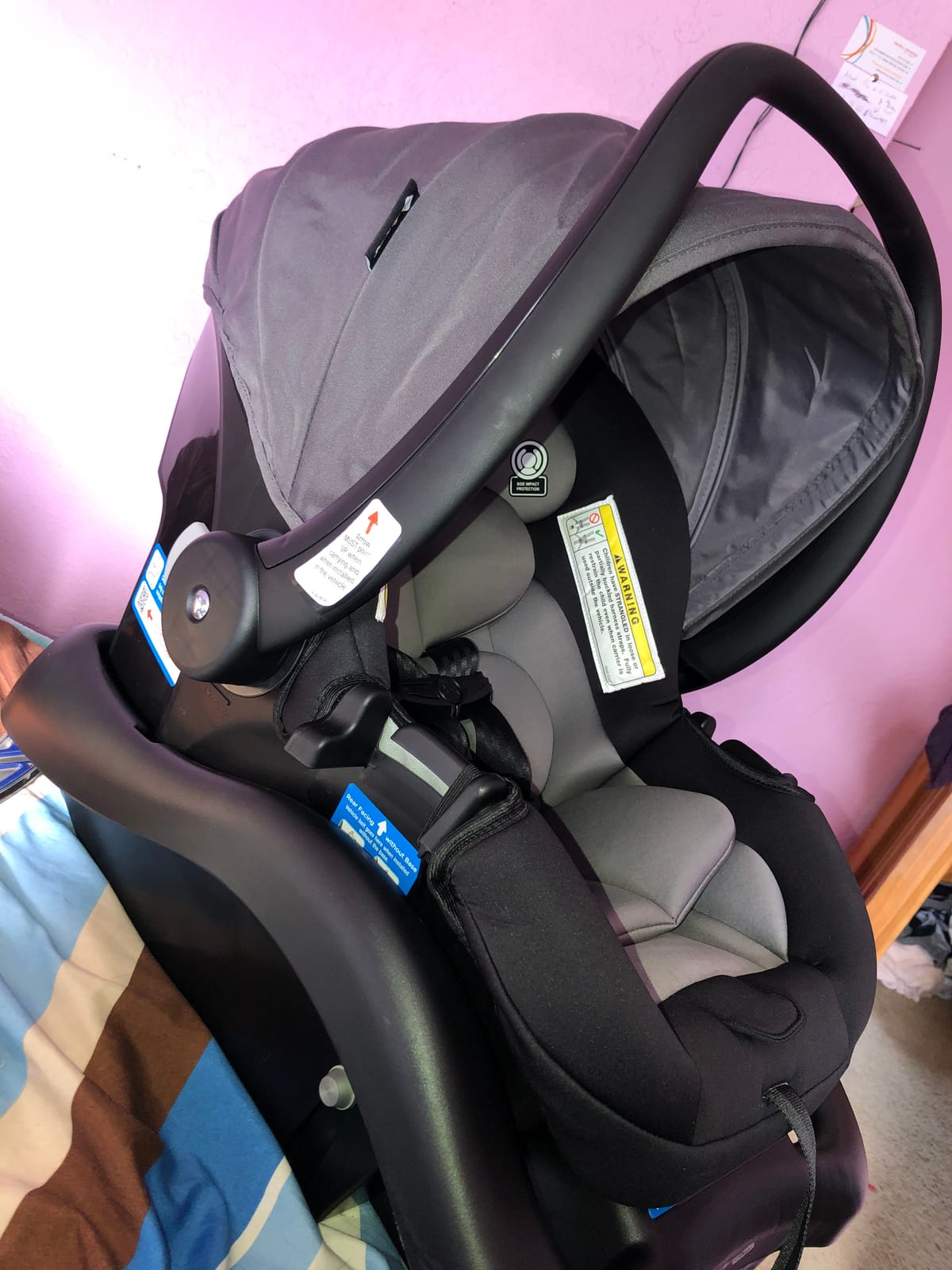
Weight is the whole argument here. At under eight pounds for the carrier, this is the seat I hand to a solo parent who is also managing a diaper bag and a boarding pass in one hand. It is a conventional rear-facing infant seat rather than a stroller combo, which keeps it lighter.
It earns 4.6 across more than 3500 reviews. Parents lead with the light weight and soft padding, and frequent travelers single out the machine-washable pad as the feature that saves them after a long flight.
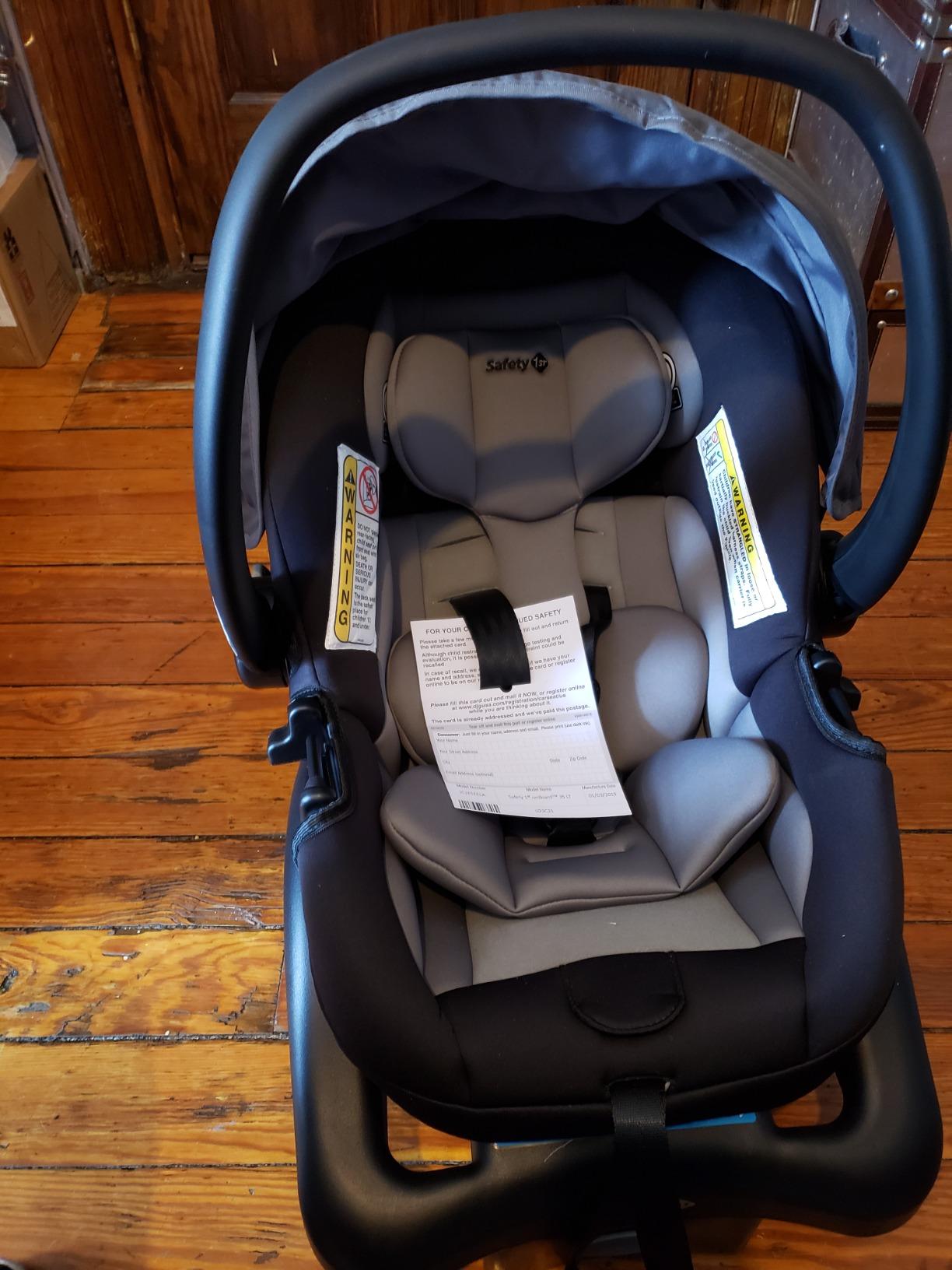
Specs list 4 to 30 lbs rear-facing and up to 32 inches, made in Columbus, Indiana. The QuickClick attachment drops it onto compatible strollers in one step, and LATCH plus a one-pull harness adjustment make the ground install quick.
The recurring caution is head clearance, since tall infants can reach the 32 inch limit sooner than their weight suggests. If your baby is tracking tall, measure the headroom before buying rather than after.
Does this need a separate base on the plane?
No. On an aircraft you install the carrier with the lap belt through the belt path, and the base stays at home or travels separately. That is a real advantage over seats where the base is needed for a secure angle.
Is it big enough for a long-haul flight?
It is a rear-facing seat for infants, so long-haul is exactly the use case it was built for. The limit is size of child, not duration of trip.
6. RideSafer Gen 5 Vest – Best Harness Option for Special-Needs Children
RideSafer Gen 5 – Extra Large Black, Lightweight, Compact, Portable Car Seat – Perfect for Travel and Everyday Child Safety
2.9 lbs vest weight
80-110 lbs extra large
17 by 11 by 4 inches
Pros
- Weighs only 2.9 lbs and fits in a backpack or under a seat
- Works in taxis and rental cars without installing a seat each time
- Children cannot slip out of the harness
- Three children fit in one row
Cons
- Not FAA approved for use in an airline seat
- Lap belt positioner is fiddly to lay flat
- Crotch strap can be annoying to secure
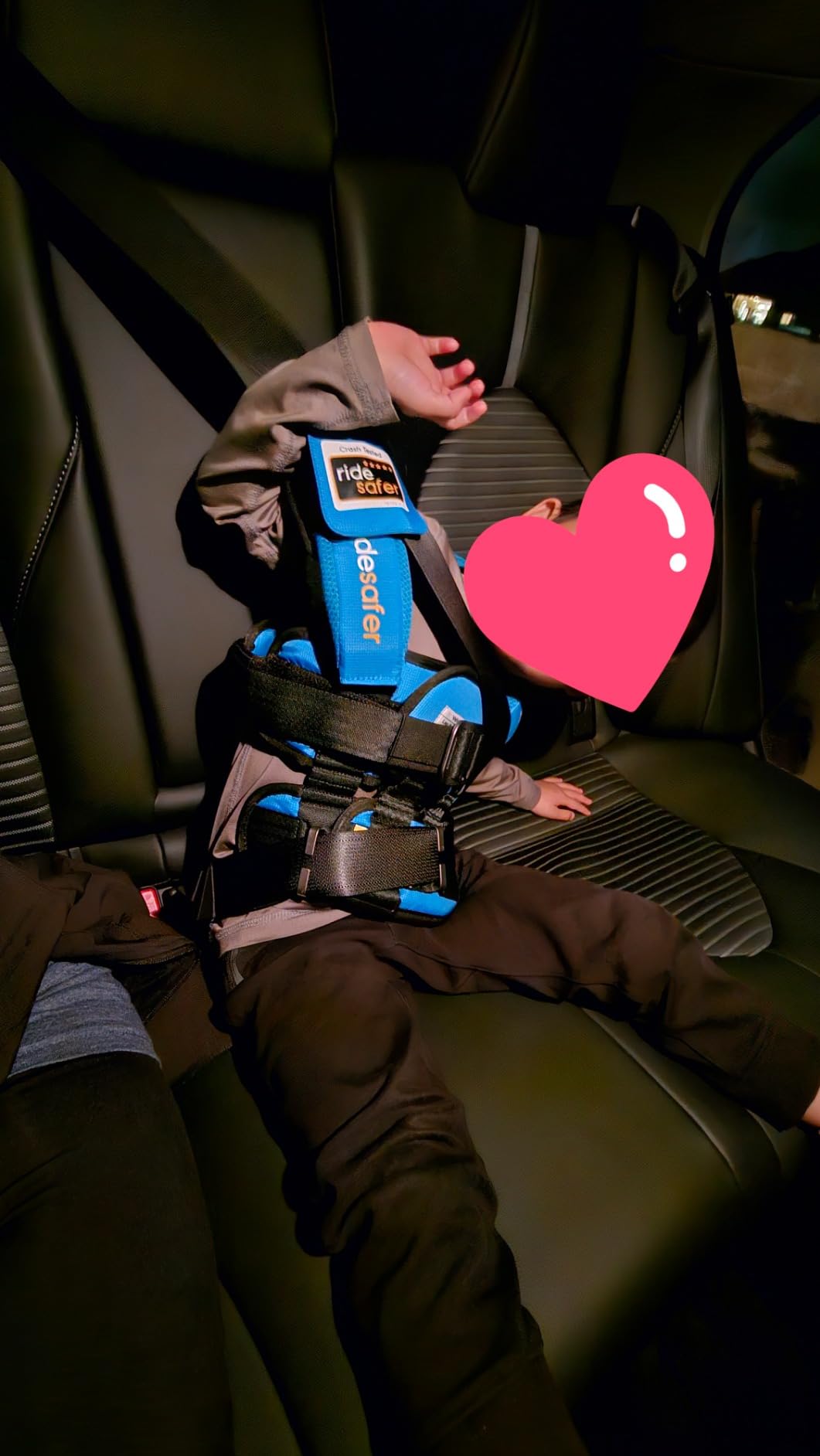
This is not a car seat and it does not pretend to be one. It is a vest-type restraint that uses the adult vehicle belt, worn by the child, which means there is no shell, no base, and no reinstall between vehicles. For a child who cannot reliably sit in a conventional booster, that is a completely different travel experience.
At 2.9 lbs and 17 by 11 by 4 inches it is by far the lightest and smallest item I carried on any of these trips. It holds a 4.5 rating across more than 2400 reviews, and parents of special-needs children praise that the child cannot slip out of the harness.
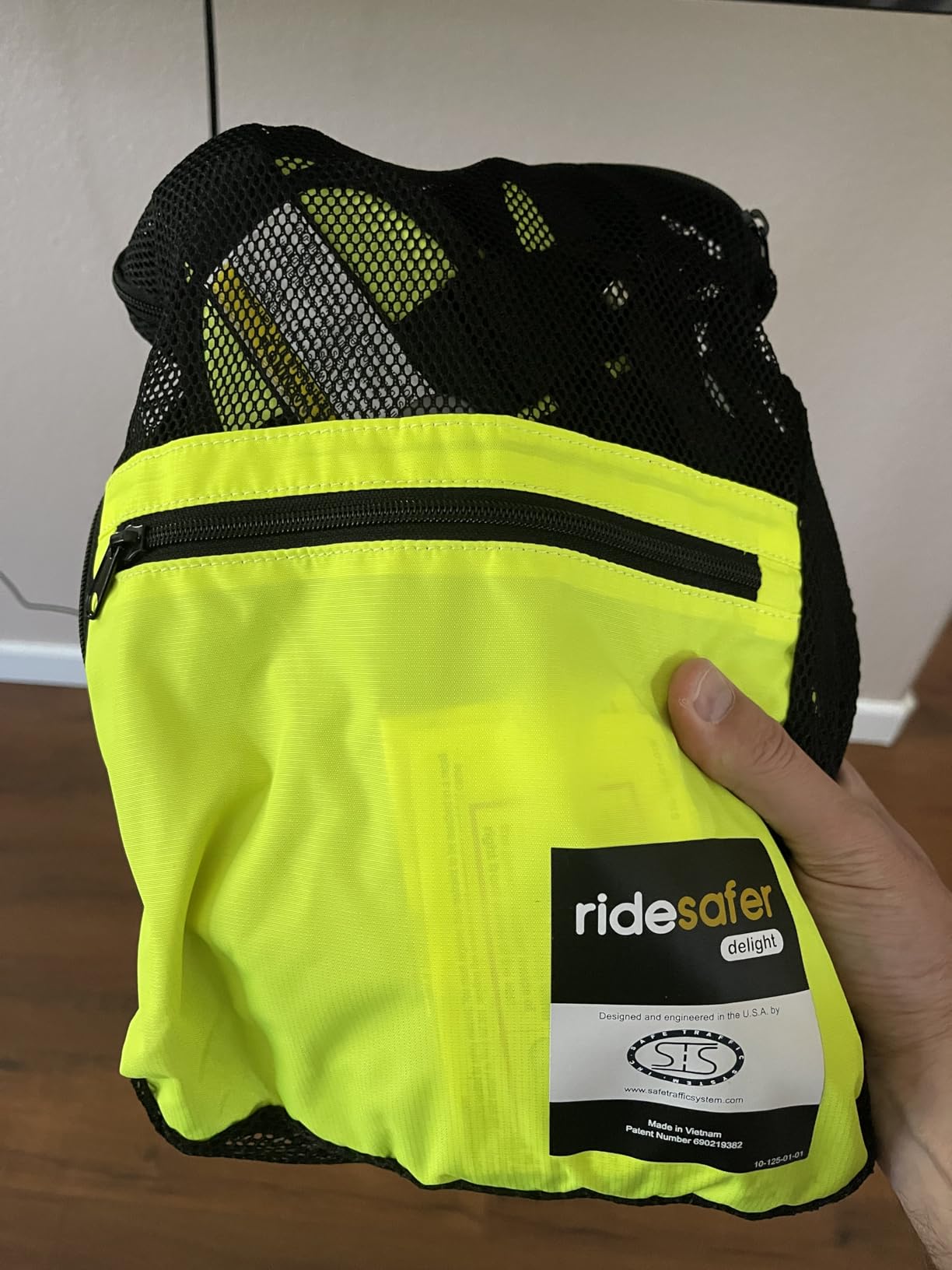
Important caveat: the listing states this vest is not FAA approved for use in an airline seat, so it must be checked or used alongside a car seat on a flight. On the ground it is excellent, using a lap belt plus top tether, or lap and shoulder belt only.
Sizing has varied between manufacturing batches, which is the most repeated complaint alongside the fiddly lap belt positioner. Size up early rather than relying on the packaging.
Can I fly with this instead of a car seat?
No. Because the aircraft approval is missing, you would fly with your child in a belt-positioning booster and use the vest only for taxis, rental cars, and ground travel. This is a destination and transfer solution, not a cabin solution.
Why do special-needs families choose it?
Because conventional harnesses rely on the child staying positioned, and a child with limited trunk control or sensory needs may not manage that. Reviewers describe the fit as secure in a way a cup of water is not.
7. mifold Hifold High Back Booster – Best for Four-Zone Adjustment on International Trips
Mifold Hifold Adjustable Kids High Back Booster Car Seat with Strap – Slate Grey
10 lbs with carry strap
243 adjustment settings
Folds to 10.7 by 13.5 inches
40-100 lbs
Pros
- Folds down small for travel and storage
- 243 adjustment settings for precise belt positioning
- Only ten pounds with a built-in carry strap
- Approved for use in most countries worldwide
Cons
- Highest price among the booster options here
- Requires manual reconfiguration as the child grows
- Ratings skew mixed with seven percent one-star feedback
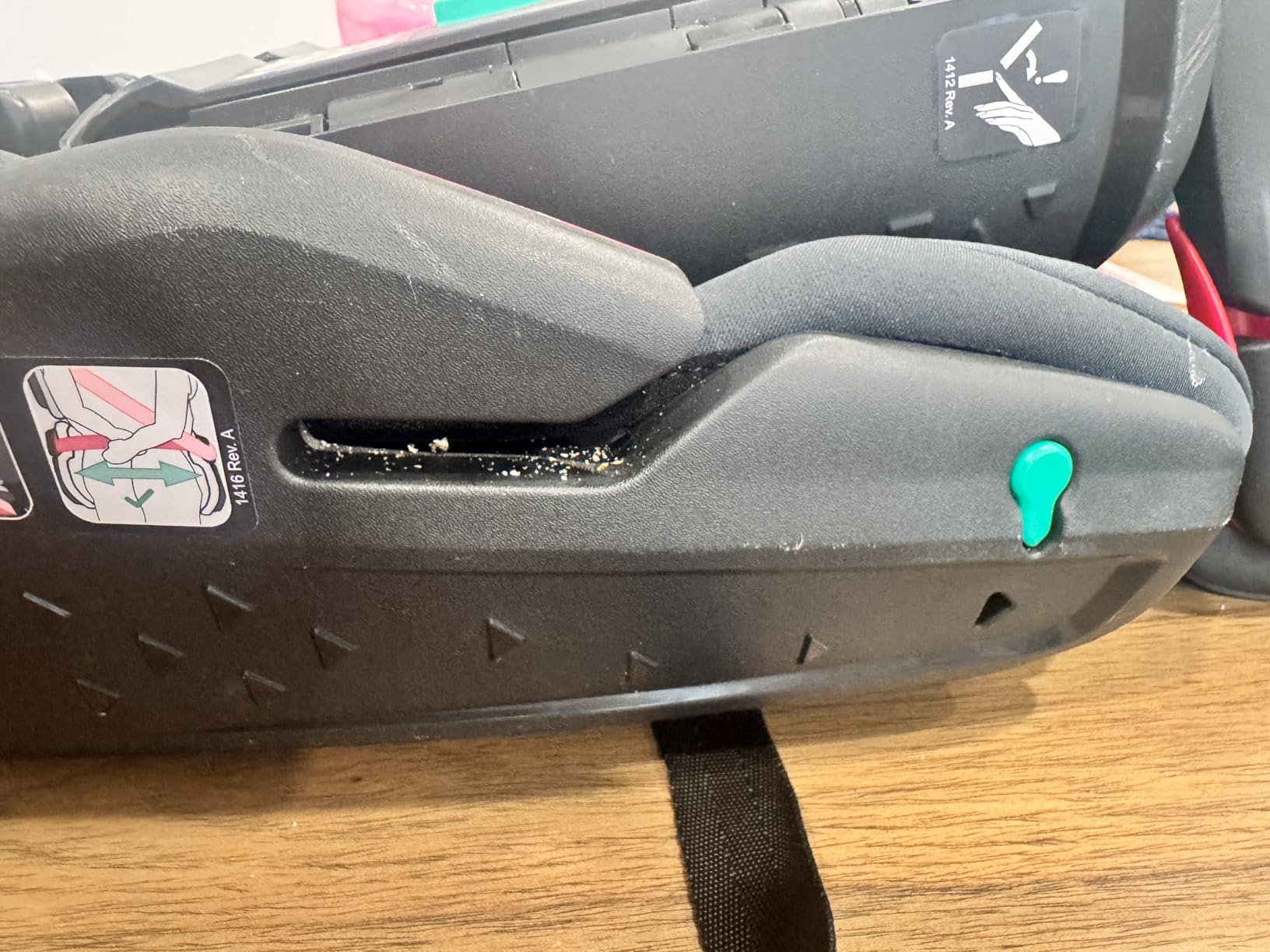
The Hifold is the seat I suggest when the trip is not only a flight. It adjusts in four areas, seat, body, head width, and height, with 243 individual settings, so the vehicle belt ends up in the right place in a rental car as well as an aircraft row.
It weighs ten pounds and folds to 10.7 by 13.5 inches with a built-in carry strap, and it is approved for use in most regions worldwide except Australia and Taiwan. That international approval is the reason to choose it over a domestic-only booster.
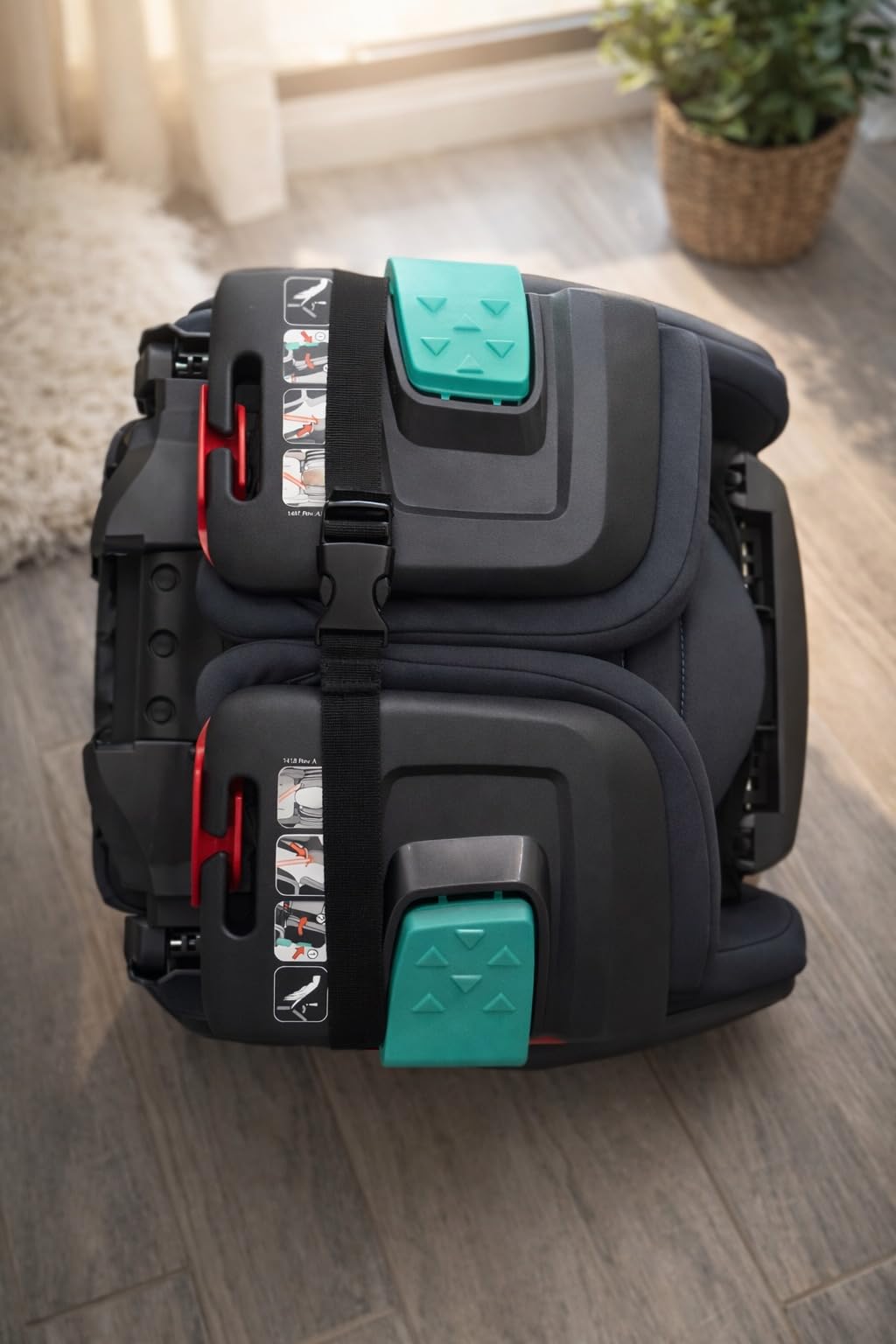
Specs list ages four to twelve by manufacturer recommendation, 40 to 100 lbs, and 43.5 to 59 inches, meeting or exceeding FMVSS 213b with lightweight EPE foam for impact resistance. It is a belt-positioning booster, not a harness car seat.
Feedback is mixed at a 4.3 rating across more than 2000 reviews, with seven percent one-star responses concentrated on reconfiguration effort and price. Expect to re-dial the four zones more than once as a child grows.
Is the Hifold worth the step up over a backless booster?
If you want head support and correct belt geometry, yes. If your child is already tall and rarely rides in the car, a backless booster at a fraction of the cost does the same job for a fraction of the bulk.
Will it fit in an airplane row?
Its folded footprint of 10.7 by 13.5 inches is among the smallest here, so packing is easy. Fit is still governed by your airline’s booster rules rather than an infant restraint certification.
8. Graco SlimFit3 LX – Best Narrow Convertible for Airplane Rows
Graco SlimFit3 LX 3-in-1 Convertible Car Seat, Katrina
16.7 inches wide
Rear-facing 5-40 lbs
Forward-facing 26.5-65 lbs
Booster 40-100 lbs
Pros
- Fits three across while keeping a spacious seat
- Grows from rear-facing harness through high-back booster
- Ten-position no-rethread headrest and harness adjust together
- Only one percent one-star ratings
Cons
- Heavier and larger than ultra-compact travel boosters
- Not as narrow as dedicated three-across slim seats
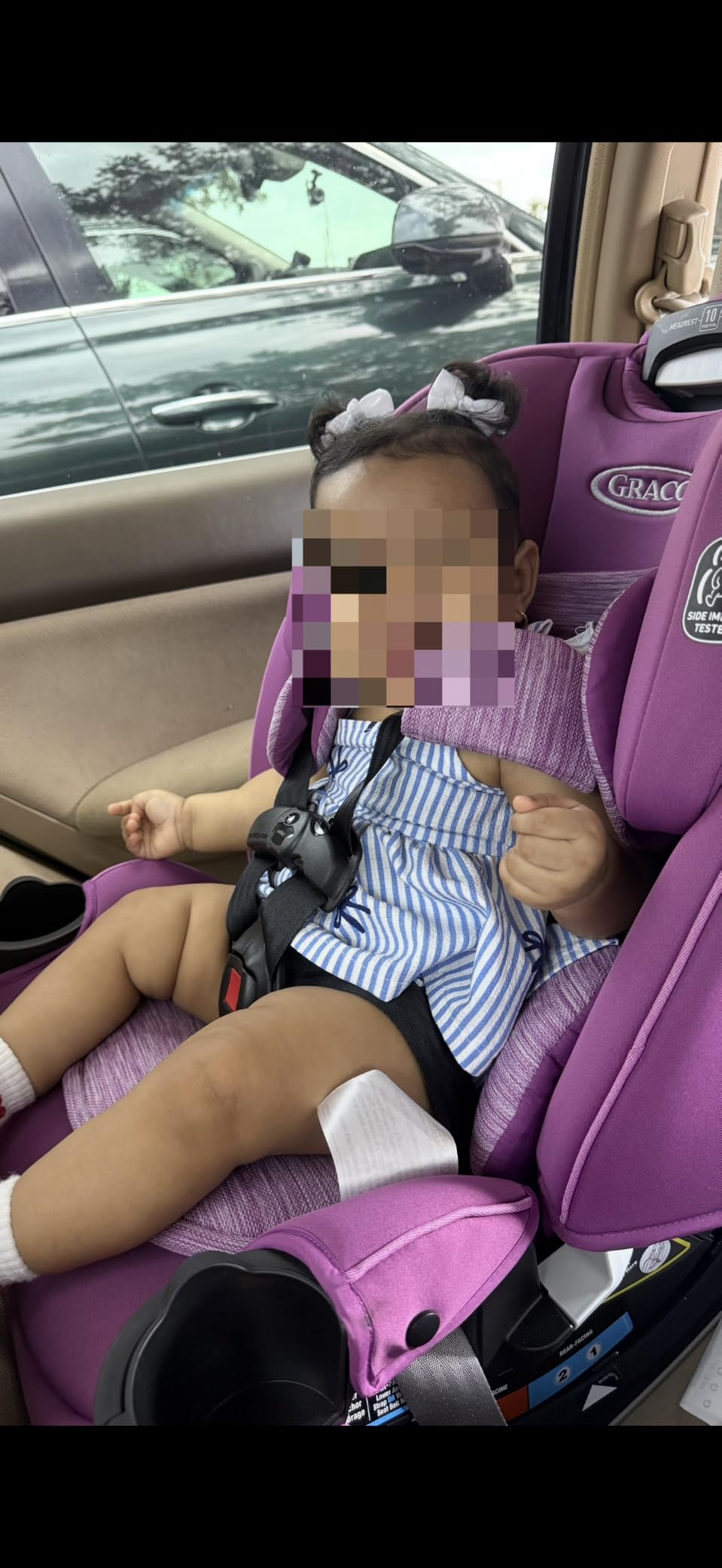
This is the seat I shortlist for a parent who wants one product that can rear-face a baby, forward-face a toddler, and then become a booster, without ever exceeding the width of a narrow aircraft seat. At 16.7 inches it is one of the few full convertibles here whose published width sits inside the airplane reality.
It holds a 4.8 across more than 2200 reviews, the joint-highest average in this group, with about ninety percent five-star feedback and one percent one-star. Owners point to the single-motion headrest and harness adjustment as the feature they notice every single day.
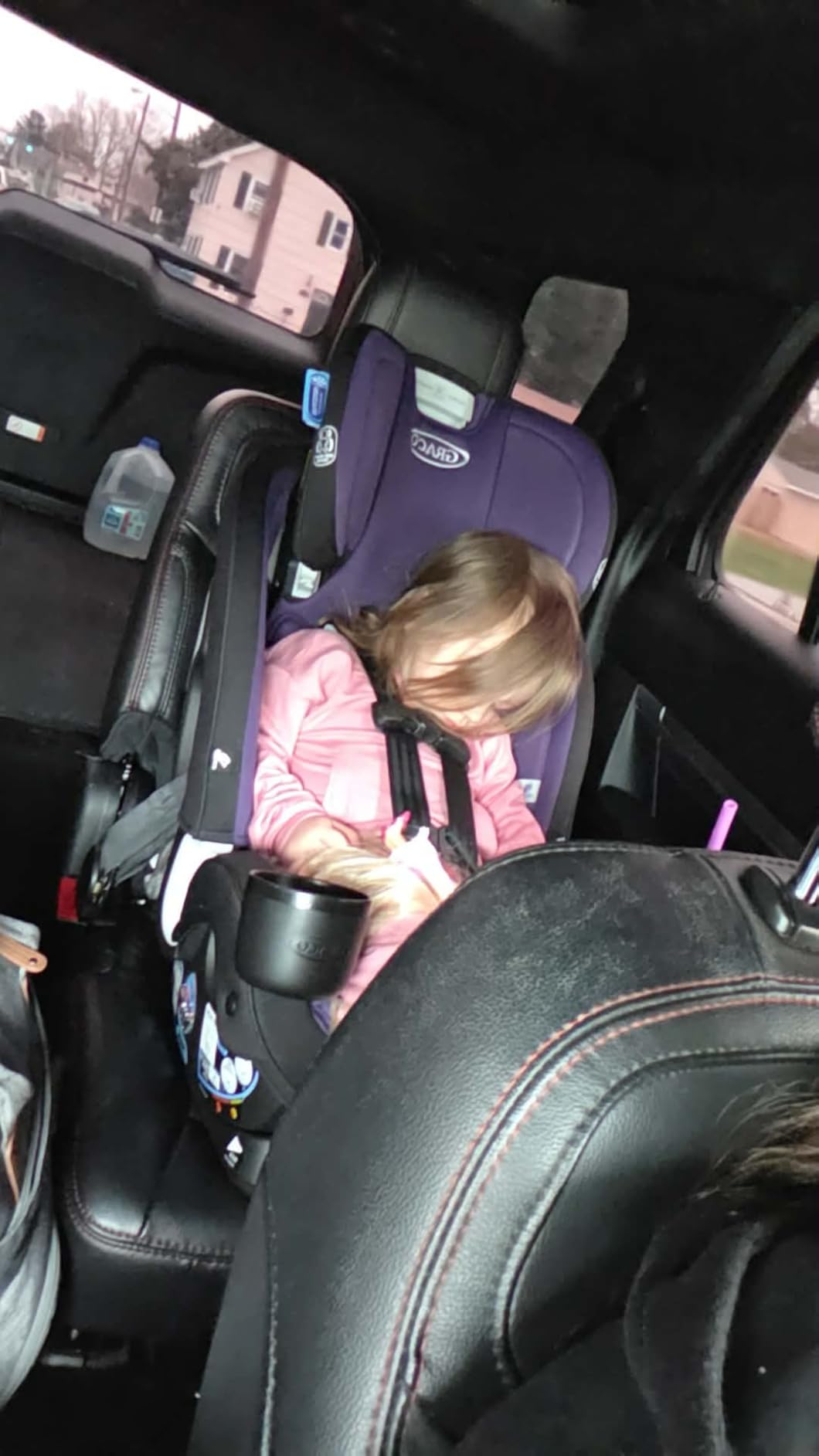
Specs cover rear-facing 5 to 40 lb, forward-facing 26.5 to 65 lb, and high-back booster 40 to 100 lb, with Graco ProtectPlus side impact engineering to the newest testing standards. The ten-position No-Rethread Simply Safe Adjust harness moves headrest and harness together.
The drawback in reviews is weight and bulk compared with folding travel boosters. It is a real convertible that happens to be narrow, not a seat designed to fold into a bin.
Is the Graco SlimFit3 FAA approved for airplane use?
Check the red aircraft label on the specific seat in front of you, because certification varies by model within a product line and this listing does not spell it out. The 16.7 inch width, however, is the number that decides whether it fits your row.
Can a rear-facing Graco SlimFit3 work in an economy row?
Rear-facing installs on a plane are tight because the shell sits behind the seat back in front. If your child is tall enough to be forward-facing, that is the mode I would use on a narrow row, within the 26.5 to 65 lb range.
9. Safety 1st Ellaris – Best Convertible for Rear-Facing Toddlers
Safety 1st Ellaris 3-in-1 Convertible Car Seat, Slim Fit Design, Rear & Forward-Facing, 5-Position Headrest, Travel-Friendly with Machine-Washable Seat Pad, Peacock Blue
Rear-facing to 40 lbs
Forward-facing 30-65 lbs
Just over 19 inches installed
5-position headrest
Pros
- Airplane ready compact design noted for travel
- Machine-washable seat pad and dishwasher-safe cup holders
- Headrest adjusts without rethreading straps
- Good value for a three-in-one convertible
Cons
- Wider than expected at just over 19 inches installed
- Headrest feels wiggly with more play than comparable seats
- Harness tension button is hard to reach
The Ellaris is listed as airplane ready, and its rear-facing toddler range to 40 lbs makes it a genuine option for a two-year-old who still needs to face backwards. That combination is rare, because most narrow convertibles cap out at 30 lbs rear-facing.
Owners generally feel they get more seat than the price suggests and like the easy hook-style LATCH install. The recurring criticism is that the slim profile is less slim than the name implies once installed.
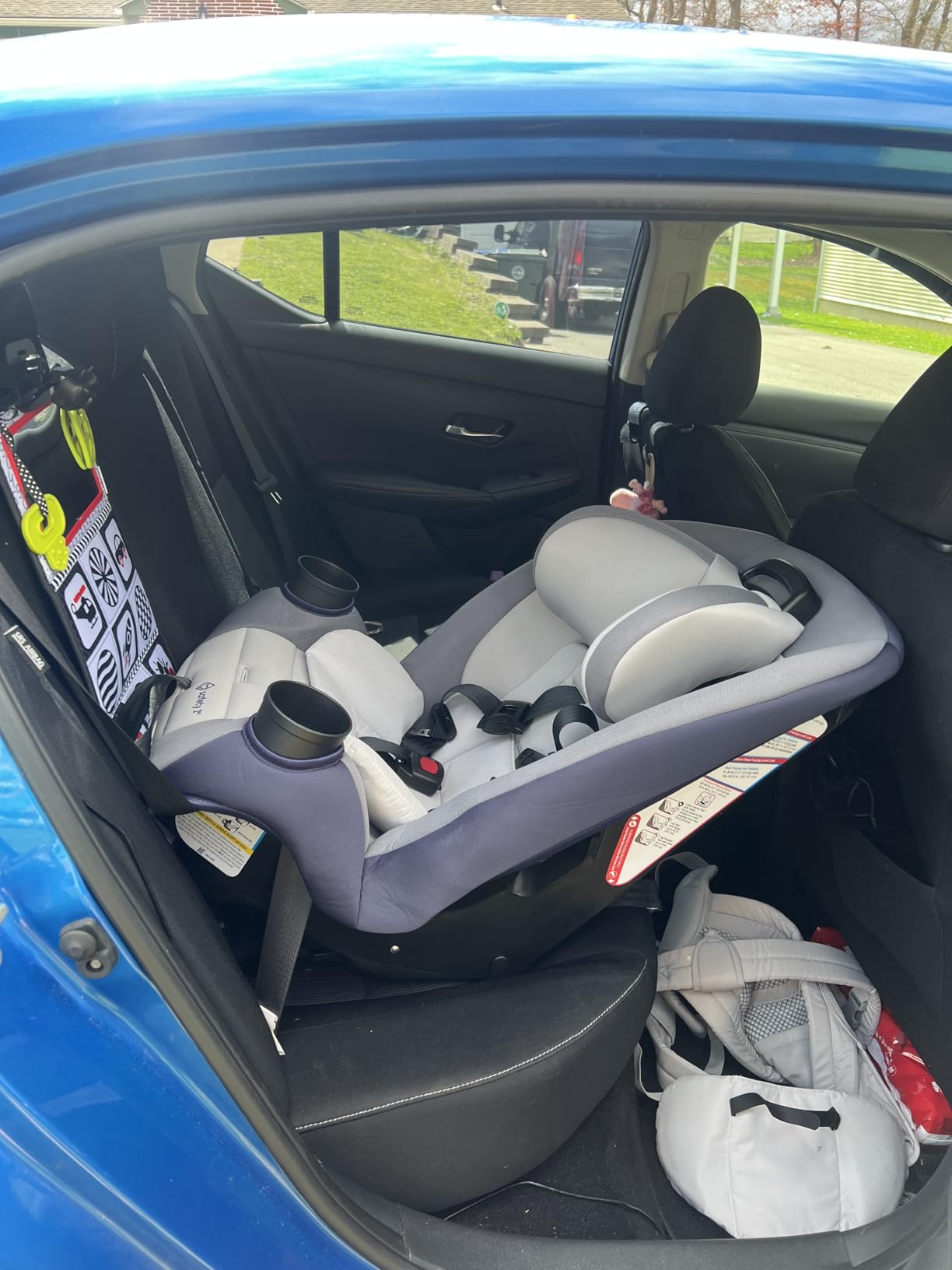
Specs list rear-facing infant 5 to 30 lbs, rear-facing toddler 30 to 40 lbs, and forward-facing 30 to 65 lbs. The five-position headrest adjusts without rethreading, and the seat pad is machine-washable and dryer-safe with two dishwasher-safe cup holders.
The width is the honest drawback here. Reviews put the installed width at just over 19 inches, which is wider than several seats on this list and wider than most economy armrests will comfortably accept.
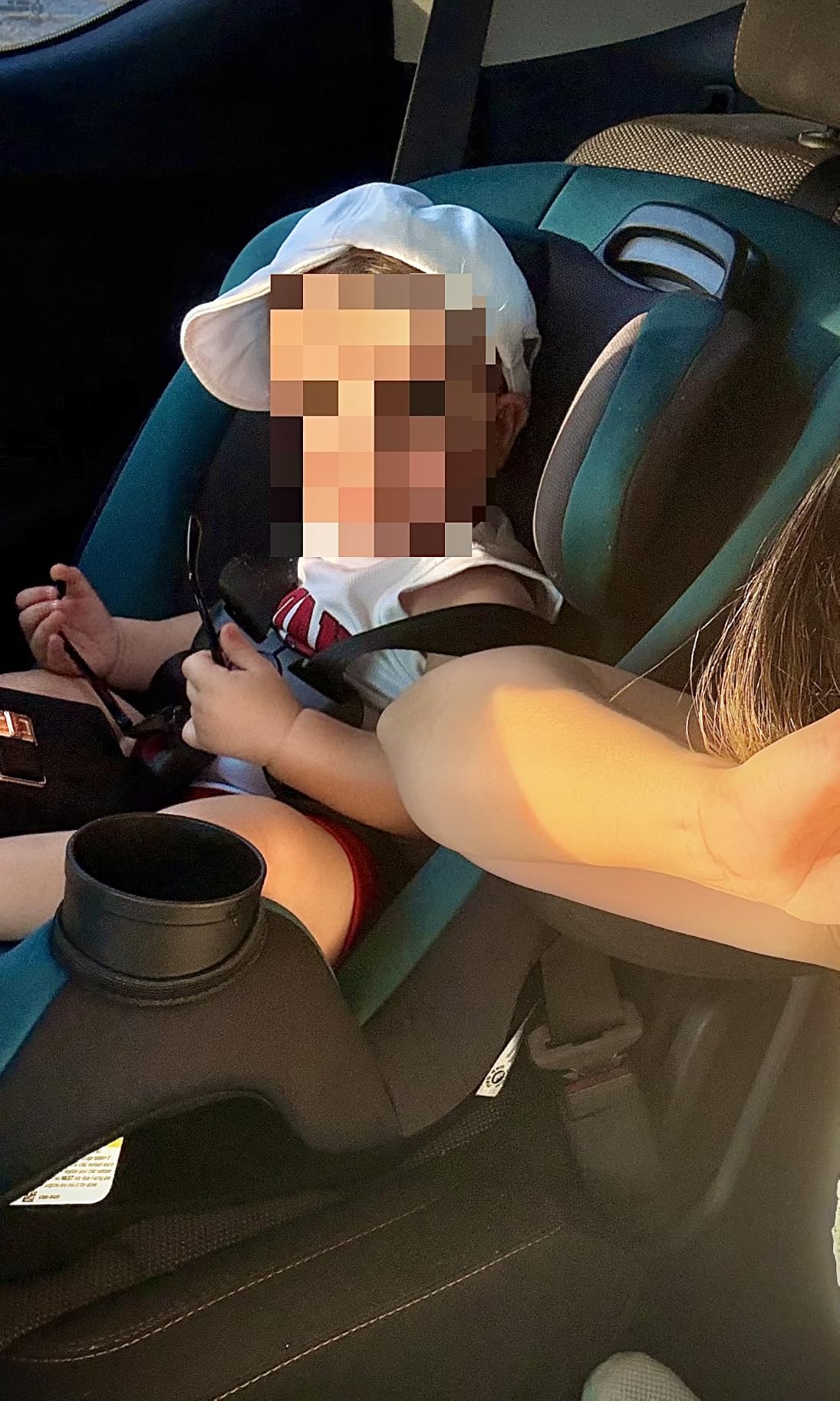
Will this fit between airplane armrests?
It is the widest convertible in this roundup by published measurement, so I would treat it as a gate-check candidate on narrow rows. Check your aircraft seat width before committing, and ask the gate agent early rather than at the door.
Is the wiggly headrest a safety concern?
Reviewers describe extra play in the headrest compared with seats that cost more. It is a comfort and fit complaint more than a structural one, but a headrest with visible slack in harness mode deserves a second look.
10. Graco Tranzitions – Best Lightweight Harness Seat for Growing Kids
Graco Tranzitions 3-in-1 Harness Booster Car Seat, Proof
Harness 26.5-65 lbs
Booster modes 40-100 lbs
One-hand 9-position headrest
Lightweight and portable
Pros
- Lightweight and portable for parents moving between vehicles
- One-hand nine-position headrest adjustment
- No-rethread harness that adjusts with the headrest
- Converts from harness to high-back to backless booster
Cons
- Belt-positioning booster mode has a raised 40 lb minimum
- Not FAA approved for cabin use in booster mode
The Tranzitions exists for the stage right after a forward-facing harness, which is exactly when a lot of families give up and put a booster on a plane instead. It keeps a five-point harness to 65 lbs, then converts to high-back and backless booster modes up to 100 lbs.
It earns 4.7 across more than 1100 reviews, and the recurring description is a light seat one parent can reposition between cars without fuss. The No-Rethread Simply Safe harness and one-hand nine-position headrest are the two features reviewers mention.
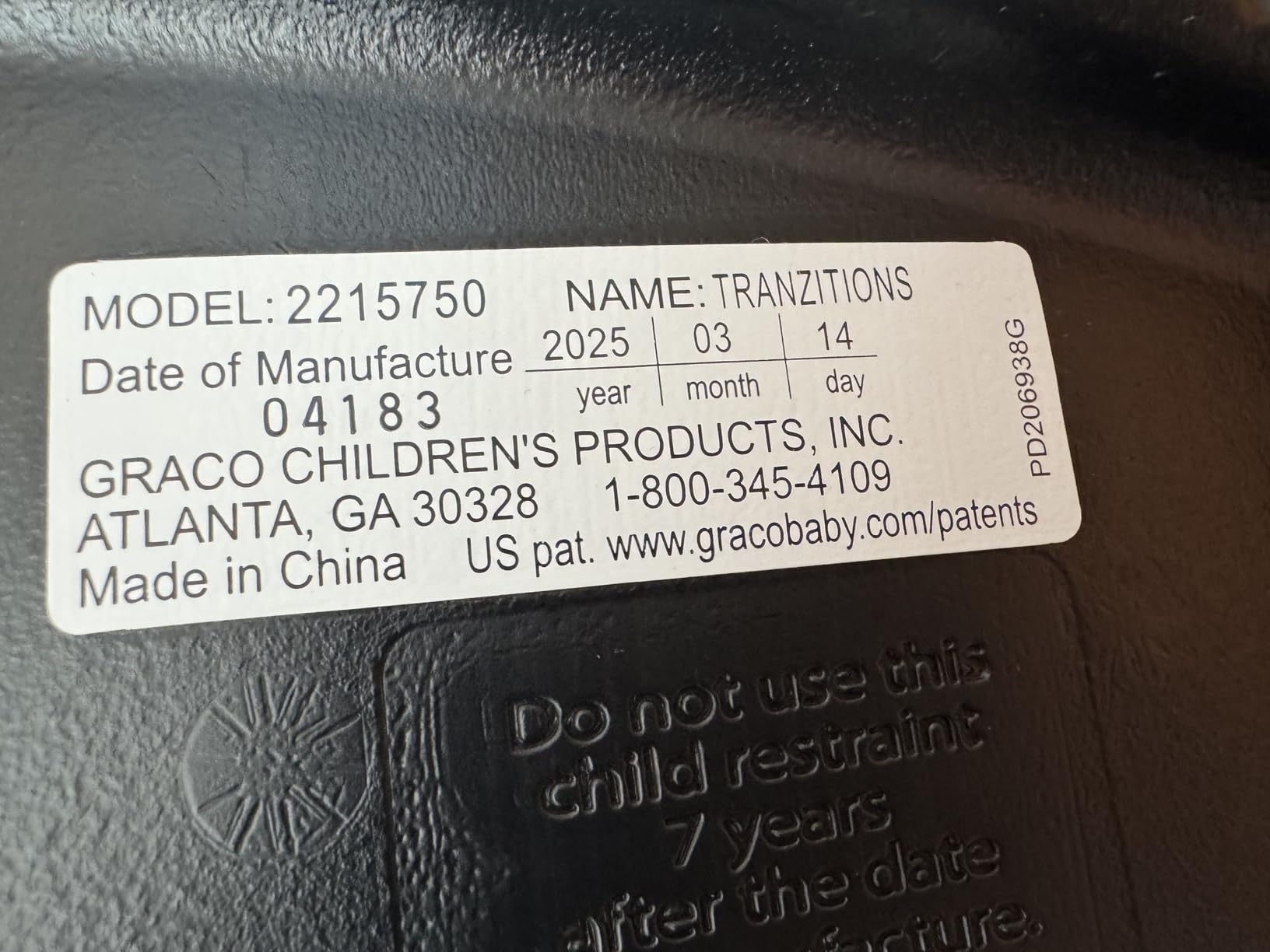
Specs give forward-facing harness 26.5 to 65 lbs, high-back booster 40 to 100 lbs, and backless booster 40 to 100 lbs, with headrest and harness adjusting together in one motion. That single-motion adjustment is genuinely useful in a dark cabin.
The listing states the seat is not FAA approved for cabin use in booster mode, which is a distinction worth reading twice. In harness mode, check the red aircraft label on the seat itself before you fly.
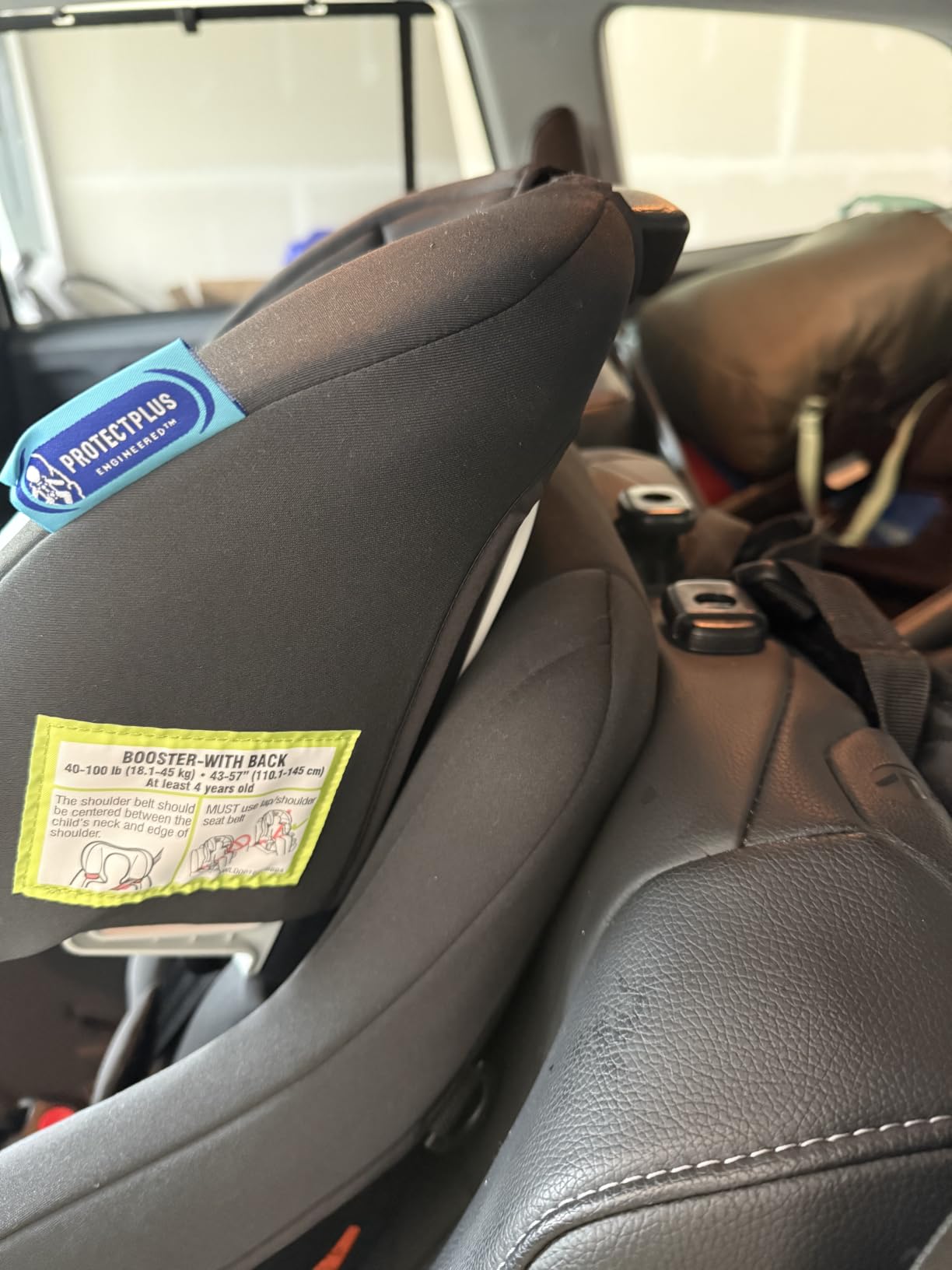
Can I use the Tranzitions in harness mode on a plane?
Harness mode is where the aircraft question applies, and you need to confirm the red label on your specific unit. Booster mode is for vehicle use, so plan on the airline seat belt for the booster stages.
Is the raised 40 lb booster minimum a problem?
Only if your child outgrows the harness early. A slim child between 40 and 45 lbs stays in harness mode for longer, which is the safer outcome anyway.
11. Safety 1st Grow and Go 2-in-1 – Best Booster That Converts to Backless
Safety 1st Grow and Go 2-in-1 Booster Car Seat with ComfortWings, Converts High-Back to Backless, 19″ Wide, Fits 3 Across, Lightweight, Foldable, Easy-Clean, Cup Holders, 40-100 lbs, Beach Wave
40-100 lbs
43.4 to 57 inches
19 inches wide with wings expanded
10-position headrest
Pros
- Folds for compact storage and is light enough to move between vehicles
- Fits three across despite the expanded width
- Cup holders fit large metal water bottles
- Machine-washable pad is easy to wipe clean
Cons
- Does not latch to the vehicle seat and can become a projectile when unoccupied
- Basic and dependable rather than plush
The Grow and Go is a high-back belt-positioning booster that converts to backless as your child grows, which means one booster covers the end of the harness stage through booster stage. ComfortWings expand as the headrest rises to keep a growing child contained.
Grandparents and traveling parents rate it well for being light and sturdier than expected, at 4.7 across 478 reviews. Cup holders that actually accept a large metal bottle come up often, and the seat pad is machine-washable and dryer-safe.
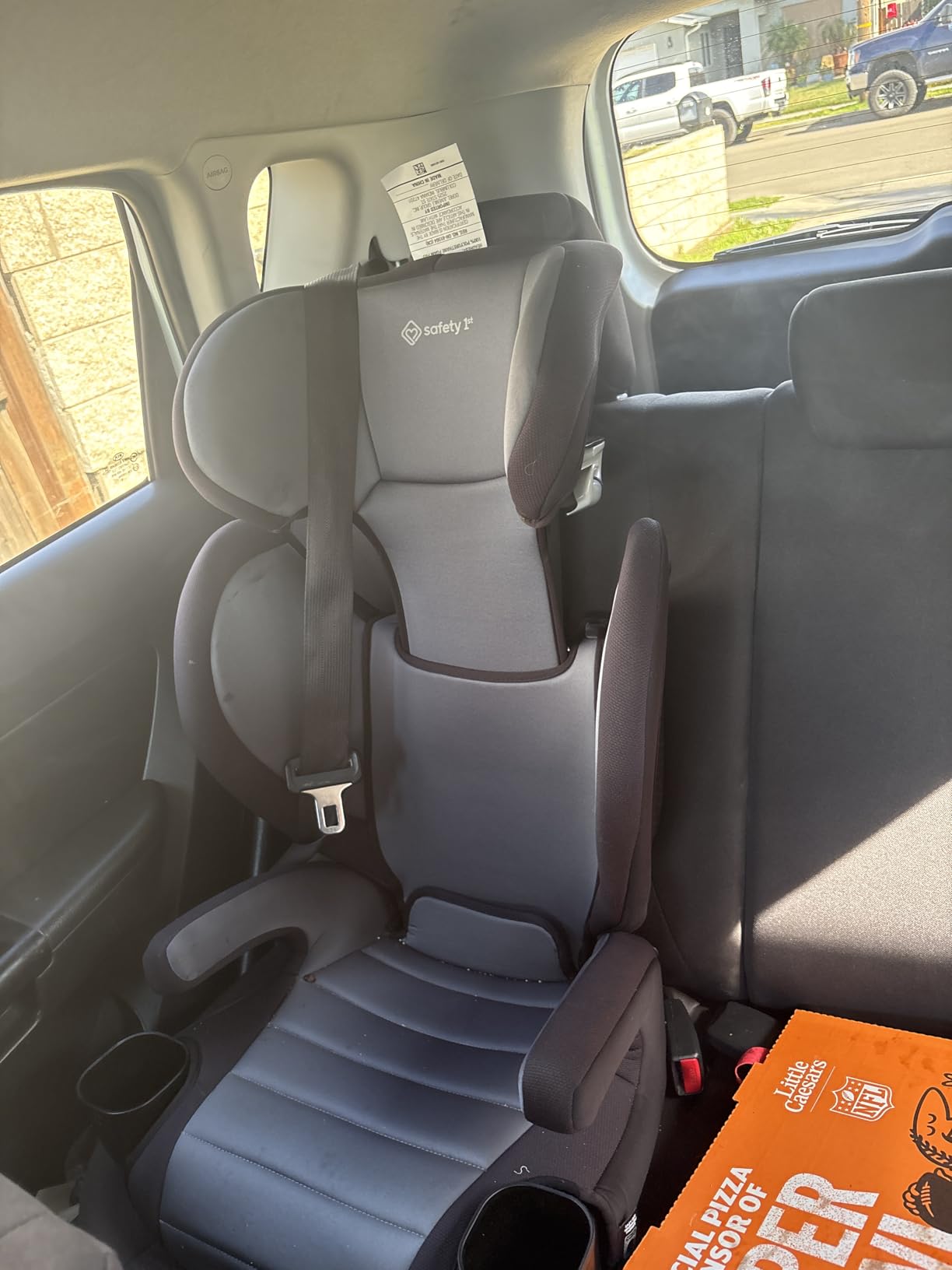
Specs list 40 to 100 lbs and 43.4 to 57 inches with a ten-position adjustable headrest, shoulder and lap belt guides, and two removable dishwasher-safe cup holders. It folds for compact storage, which is why it appears on travel lists at all.
The width is 19 inches with the wings expanded, and the seat does not latch to the vehicle cushion. One reviewer raises the obvious risk of an unsecured booster becoming a projectile when the cabin is empty.
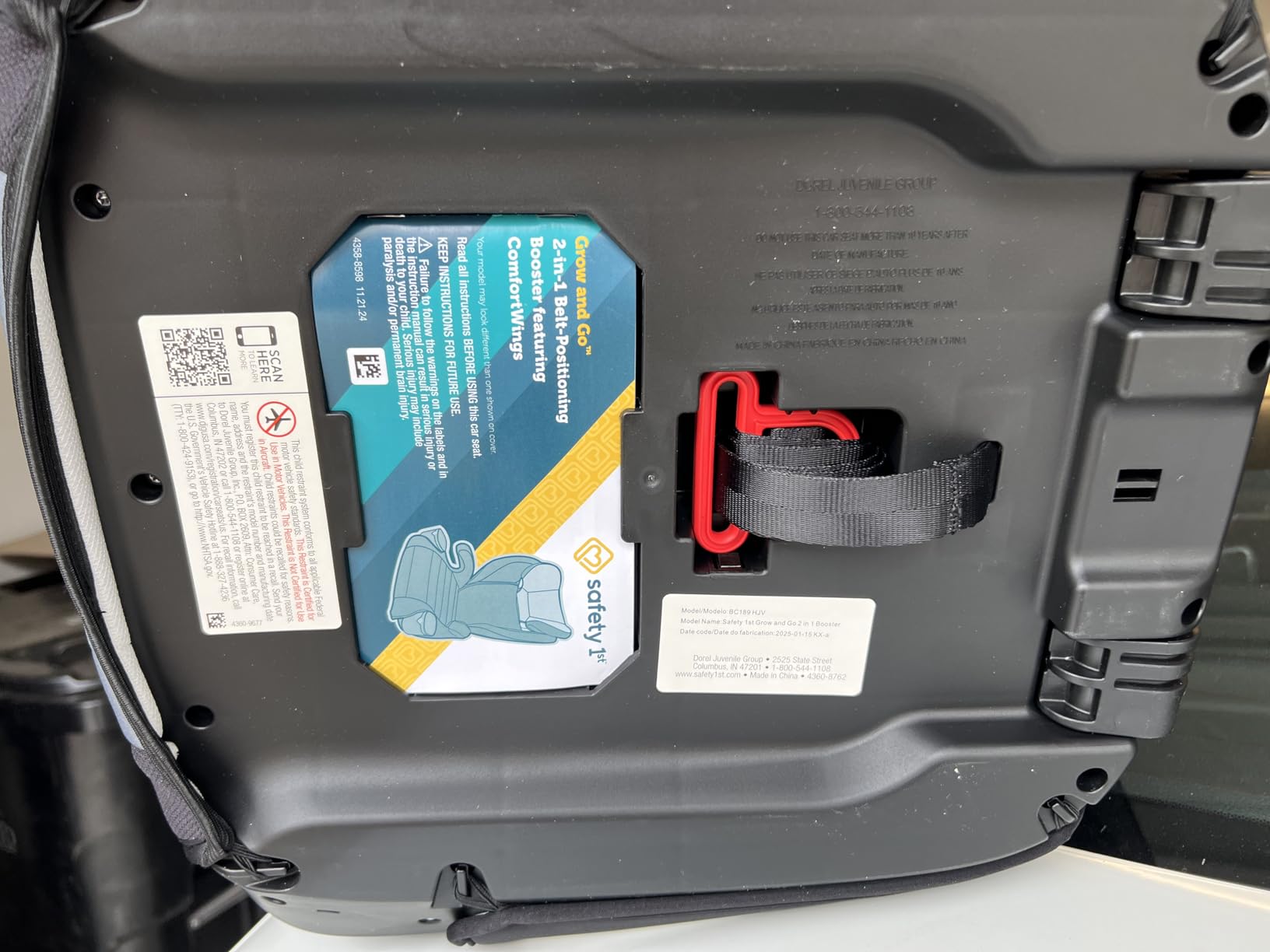
Is 19 inches too wide for a plane?
On many narrow economy rows, yes. I would treat this as a destination booster rather than a cabin seat, and confirm the aircraft seat width for your route before counting on it in flight.
Does the backless mode really save money over buying a separate booster?
It saves carrying a second seat and finding a second installation, which is the practical benefit. Just remove and stow the high-back portion between uses rather than leaving the assembled booster loose on the seat.
12. Baby Trend Protect 2-in-1 Folding Booster – Best Folding Booster for Big Kids
Baby Trend Protect 2-in-1 Folding Belt-Positioning Booster Seat, Aqua Tech
Folds flat for travel
Lightweight build
Built-in cup holder
Belt-positioning for 40-100 lbs
Pros
- Folds flat like a sandwich for compact travel and storage
- Very lightweight and easy to carry between vehicles
- Simple pop-in installation with the vehicle belt
- Built-in cup holders and adjustable armrests kids like
Cons
- Folded size is still a bit bulky for carry-on style travel
- Armrest is short and barely supports an elbow
- Does not include lower anchor connectors
The Protect folds flat like a sandwich, which is the feature that puts it on travel lists. It is built for a child who has outgrown a harnessed car seat and is ready for proper vehicle belt use, with cushioning intended for longer trips.
It holds a 4.5 across 572 reviews, with 77 percent five-star and four percent one-star. Owners call out the fold-flat design, the light weight, easy belt installation, and the cup holders.
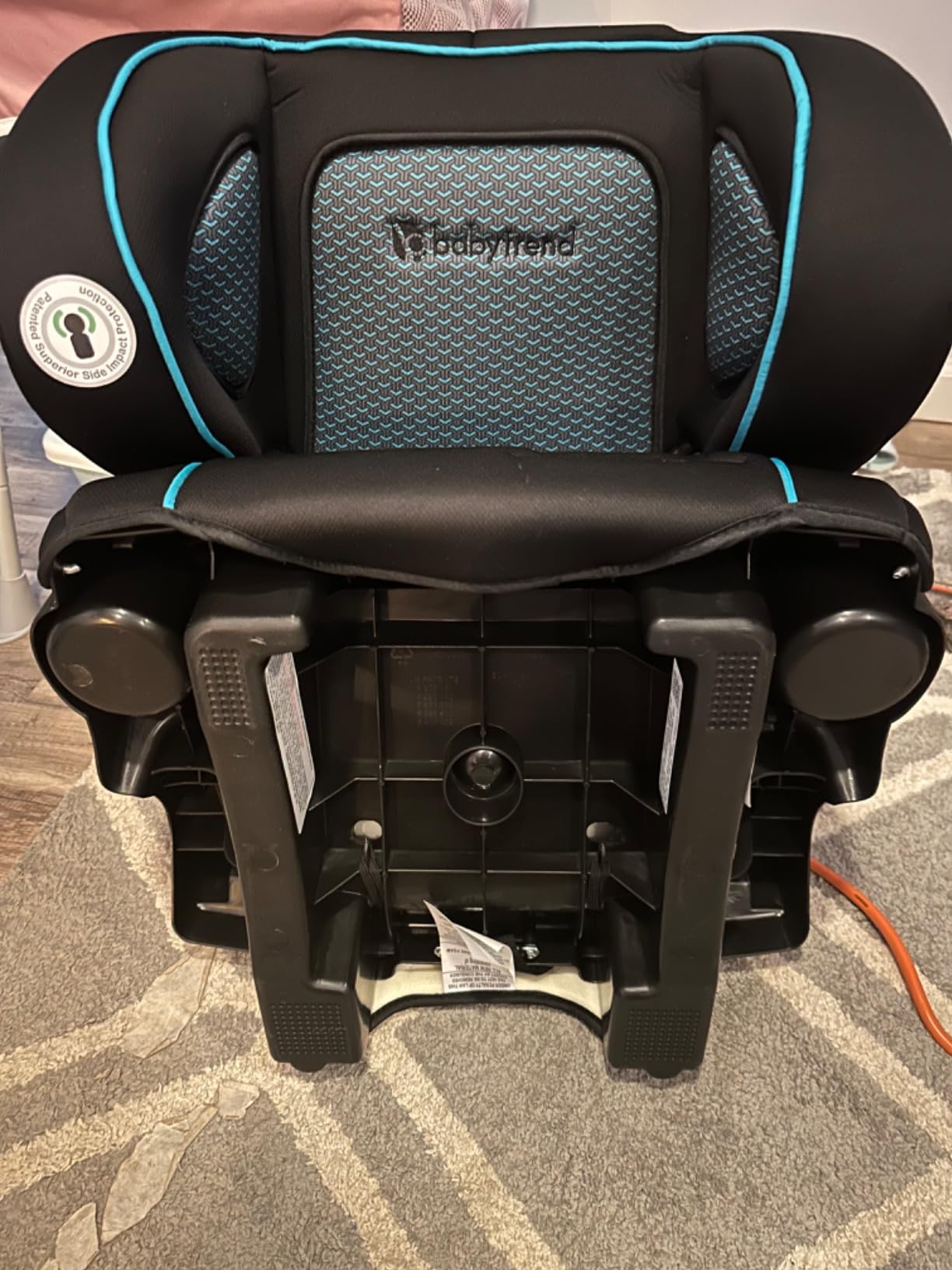
It is 100 percent polyester with a built-in cup holder, belt-positioning support, and a compact footprint that works in the middle or an outboard position. Colour options cover grey, tan, aqua, rose, and black, which helps when you are coordinating luggage.
The most common drawbacks are that the folded size is still somewhat bulky for carry-on style travel, the adjustable armrest is short, and there are no lower anchor connectors. On a plane the belt install is what matters, and that part is simple.
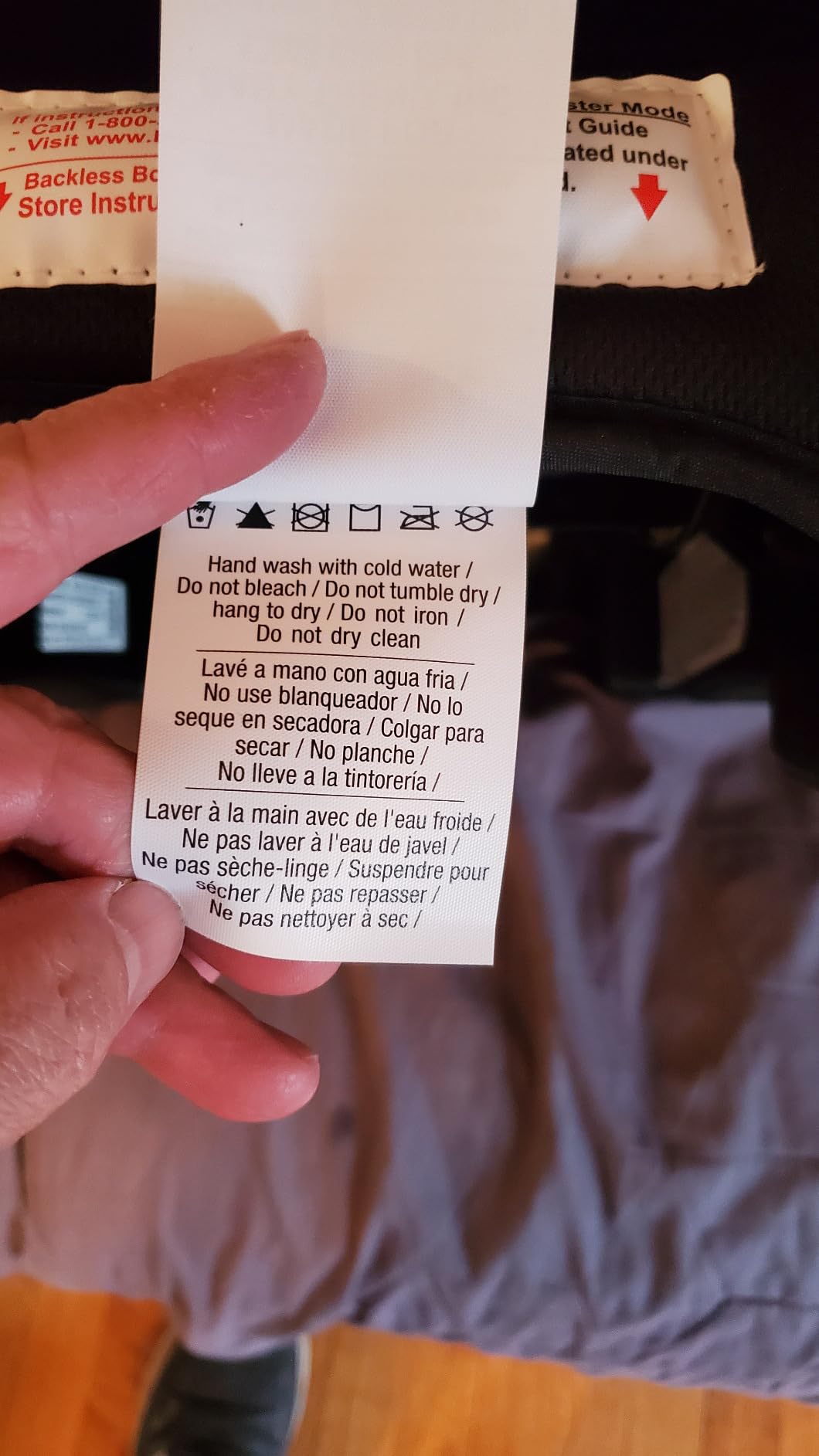
Is this seat comfortable enough for a long flight?
Cushioning is better than a bare backless booster, but it is not a padded travel seat. For an overnight leg with a big kid, add a travel pillow and expect to read to them.
Does the cup holder actually work on a plane?
The built-in cup holder is built for a vehicle cup well, not an aircraft armrest, so it mostly serves as something for your child to hold. I would still send a lidded bottle for a flight.
Airline Rules, Gate Checks, and Installing a Seat on the Aircraft
On a plane there is one installation method and only one. ISOFIX and LATCH lower anchors do not exist in aircraft cabins, so every seat here is installed with the lap belt alone. The FAA recommends, but does not legally require, an approved child restraint; infants may fly as lap children, which is precisely what most parents are trying to avoid.
The install itself takes a few minutes at the aircraft door:
Check that the seat is labeled for aircraft use and pick a window row if one is free.
Thread the aircraft lap belt through the belt path exactly as the seat’s manual shows, rear-facing or forward-facing.
Buckle the belt, then press down and back on the seat to take slack out of the strap.
Tighten the belt until firm, then re-check tightness after the seat settles.
In rear-facing mode, the buckle resting across your child’s legs is normal and is not a sign of a bad install.
Boarding with a car seat and a stroller is near-universal and rarely reflects anything about you. Families routinely board last and hold up an aisle, and gate agents know it. Build extra time into your connection if you are boarding at the back of the aircraft with a car seat.
If you would rather not carry the seat through the cabin, gate checking at the jet bridge is widely reported as the smoothest option and it protects the seat from the baggage belt. A padded travel bag is worth the small extra step. Counter-checking a car seat alongside fifty-pound suitcases is the approach most parents regret.
The uncomfortable truth about narrow travel seats is that the aircraft lap belt sometimes rides across a child’s back or chest instead of the lap, and parents on r/toddlers and r/Travelwithkids describe exactly that problem with a twenty-month-old on a US to Europe flight. A seat with side wings and a deeper shell absorbs this better than a flat backless cushion, which is one reason the convertible seats on this list outperform cheap boosters on long routes.
If your seat is refused at the gate because it will not fit, that is a width problem, not a safety problem. The fallback is a travel belt or an airline-approved child device for the flight, then the car seat in a taxi or rental car at your destination. Renting at the destination means trusting a seat you have never seen, which is why most parents on these forums bring their own when they can carry it.
How to Choose a Travel Car Seat That Actually Fits Your Flight?
Match the seat to the child’s stage
For an infant under 30 lbs rear-facing, the Doona and the Safety 1st OnBoard FLX are the two lightest, most carryable options here. For a toddler between 30 and 65 lbs who still needs a harness, the Graco SlimFit3 LX at 16.7 inches wide is the pick I would book with, because published width beats brand reputation. For a child over 40 lbs using a vehicle belt, the mifold Comfort packs smallest and the Baby Trend Protect folds flat.
Measure before you book
Ask the airline for the seat width on your specific aircraft and cabin class, then measure the widest point of the seat base you are considering. Do not measure the headrest or the canopy. Anything at or above 19 inches is a gate-check candidate on a narrow row.
Buying, renting, or borrowing at the destination
Buying wins on frequency and on control, since you know the install and the history of the seat. Renting at the destination costs you per day and puts an unfamiliar seat under your child. Borrowing from a friend or relative is free but requires the inspection below, and a borrowed seat with an unknown crash history is the option I would think hardest about.
A five-step inspection for a used travel seat
Check the manufacture and expiration date labels on the shell, and confirm it is inside its service life.
Look for cracks, fraying, or impact marks on the frame, especially around the belt path.
Confirm the harness straps pull snug and the adjuster clicks on both sides.
Verify the red aircraft label is still present and legible.
Check the manual for recall notices on that exact model before you fly.
Buy one durable seat rather than a disposable travel-only seat
The environmental cost of a car seat is in the plastic, so a seat built for ten years of use across two children beats a cheap travel shell that cracks after a season. That is the argument for the Diono Radian 3R, which covers birth through booster in one shell, and against buying a separate narrow travel seat every time a child enters a new stage.
Know the airline policies before you fly
US carriers follow the FAA label for infant and child restraints, and each sets its own rules on gate checking, boarding order, and whether lap children are permitted on your specific flight. International carriers work from different certification systems, and TÜV aviation certification is the standard to look for on seats sold in Europe. If you are crossing borders, check both ends before you leave.
If you are building out the rest of your setup, our booster car seat guide covers the vehicle side for children who have outgrown a harness.
Frequently Asked Questions
How to tell if a car seat is ok for a plane?
Look for the red label on the seat that reads This restraint is certified for use in motor vehicles and aircraft. Then measure the widest point of the base and confirm it sits under about 17 inches for a narrow economy row. The label certifies aircraft use but says nothing about width, so both checks are required.
What car seats are FAA-approved for use on airplanes?
Any infant or child restraint carrying the red FAA aircraft-approval label qualifies, including rear-facing carriers and forward-facing convertibles. The Doona and the Diono Radian 3R both state aircraft approval on their spec sheets. FAA does not publish an approved model list, so confirm the label on the individual seat in front of you.
Can you put a rear facing car seat on a plane?
Yes. Rear-facing seats install with the aircraft lap belt through the belt path, and the FAA recommends rear-facing travel for as long as the child and seat allow. The shell sits behind the seat in front, so in a narrow row a forward-facing harness install is often easier once the child is big enough for it.
How do you install a car seat on an airplane with a seatbelt?
Thread the aircraft lap belt through the belt path exactly as the manual shows, buckle it, press down and back on the seat to remove slack, then tighten until firm. ISOFIX and LATCH anchors do not exist in aircraft cabins, so the lap belt is the only option. In rear-facing mode the buckle across your child’s legs is normal.
What is the best car seat for a 3-year-old on a plane?
For a three-year-old who still needs a harness, the Graco SlimFit3 LX is the pick to book with, at a published width of 16.7 inches and a harness range up to 65 lbs. The Diono Radian 3R covers a wider weight span over a longer life. If your child already uses a vehicle belt, a backless booster packs far smaller.
Which Travel Car Seat Should You Book With?
For most families, the Doona Car Seat and Stroller wins the best travel car seats for airplanes comparison because it is the only seat here that solves the airport problem as well as the seat problem. It converts to a stroller in seconds, it states FAA and TUV aircraft approval, and it holds a 4.8 rating across more than 15k reviews. If your child is past 30 lbs, the Graco SlimFit3 LX is the narrowest full convertible at 16.7 inches, and the Diono Radian 3R is the one to buy if you want a single seat for two children.
For older kids who use a vehicle belt, a folding or backless booster is the practical answer, and for children who cannot sit reliably in a conventional restraint, a vest-style harness handles the ground. Whichever you pick, check the red aircraft label yourself, measure the base, and pack a padded bag for the gate check you may end up using anyway.