
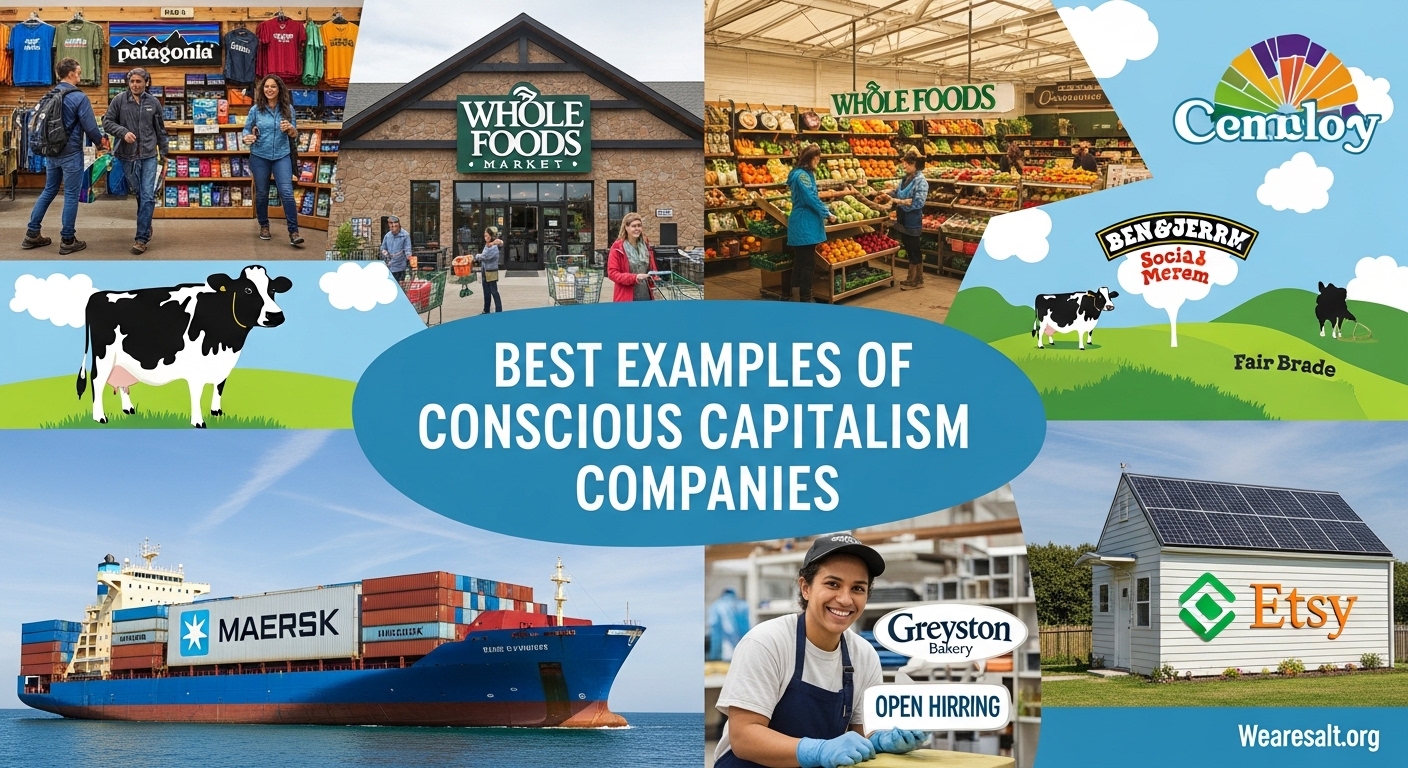
In 2026, businesses face growing pressure to do more than generate profits. Consumers, employees, and investors increasingly demand companies that balance financial success with genuine care for people and the planet. This shift explains why searches for examples of conscious capitalism companies have surged as people seek proof that profit and purpose can coexist.
This guide explains what conscious capitalism means in practice. You will learn the four pillars that define this business philosophy and discover how companies like Whole Foods, Costco, and Patagonia put these principles into action. We have researched specific practices, measurable commitments, and real outcomes to give you concrete examples rather than marketing claims.
Whether you run a business, invest in stocks, or simply want to support ethical companies, this article provides the information you need to identify and evaluate conscious capitalism in the real world.
Table of Contents
What Is Conscious Capitalism?
Conscious capitalism represents a business philosophy that operates on a simple premise. Companies can create financial value while also generating positive impact for all stakeholders affected by their operations.
John Mackey, co-founder of Whole Foods Market, and professor Raj Sisodia developed this framework. They co-authored the book Conscious Capitalism: Liberating the Heroic Spirit of Business in 2013, articulating principles many business leaders had already begun practicing. Their work gave structure to an emerging movement that rejected the idea that business success requires sacrificing social responsibility.
Traditional capitalism often focuses primarily on shareholder returns. The board answers to investors. Quarterly earnings drive decisions. Employee welfare, environmental impact, and community relationships become secondary concerns or costs to minimize.
Conscious capitalism flips this script. It argues that businesses thriving over decades treat employees as valued partners, customers as humans with needs, suppliers as collaborators, communities as neighbors, and the environment as a shared inheritance. The shareholders still matter, but they sit at a table with other stakeholders whose interests the business also serves.
The movement matters today because evidence suggests conscious companies outperform their peers financially. Research cited by the Conscious Capitalism organization shows companies adopting these principles achieve higher returns, better employee retention, and stronger customer loyalty than traditional competitors. This performance challenges the assumption that social responsibility comes at the expense of profit.
The Four Pillars of Conscious Capitalism
Conscious capitalism rests on four interconnected principles. Understanding each pillar helps you recognize genuine conscious capitalism and distinguish it from superficial marketing claims.
Higher Purpose
Every conscious company identifies a purpose beyond maximizing profit. This higher purpose answers why the business exists and what value it creates for the world.
Patagonia provides a clear example. The outdoor apparel company states its purpose as being in business to save our home planet. This mission drives decisions that sacrifice short-term revenue, such as encouraging customers to repair rather than replace products and donating 1% of sales to environmental causes since 1985.
A higher purpose differs from a mission statement. Many companies write inspiring statements that gather dust. Conscious companies embed purpose into daily operations, strategic decisions, and cultural norms. The purpose becomes a filter for choices large and small.
Stakeholder Orientation
Traditional business models prioritize shareholders above all other parties. Conscious capitalism recognizes multiple stakeholders whose interests all matter.
These stakeholders include customers who trust the brand, employees who create value, suppliers who provide materials, communities that host operations, and the environment that sustains everything. The business seeks win-win relationships with each group rather than extracting maximum value from any single source.
Costco demonstrates this orientation through its employee compensation strategy. While many retailers minimize wages to boost margins, Costco pays hourly workers an average of $24 per hour compared to the federal minimum wage of $7.25. The company accepts lower profit margins per transaction because it views employees as partners whose wellbeing drives long-term success. Employee turnover at Costco runs approximately 17% compared to industry averages above 60%.
Conscious Leadership
Leaders in conscious companies serve rather than command. They view their role as stewards of the company’s purpose and the people who bring it to life.
Conscious leaders demonstrate self-awareness and emotional intelligence. They make transparent decisions, admit mistakes, and prioritize the organization’s health over personal gain. This leadership style creates trust and empowers employees at every level to contribute meaningfully.
Herb Kelleher, co-founder of Southwest Airlines, embodied this approach. He famously prioritized employees first, reasoning that treated well, they would treat customers well, producing the profits shareholders wanted. He once settled a dispute over the airline’s logo by arm-wrestling a counterpart rather than litigating, demonstrating the humor and humanity that defined Southwest’s culture.
Conscious Culture
The final pillar involves building organizational cultures that support the other three principles. Conscious cultures operate on trust, transparency, and authentic care for people.
These cultures reject fear-based management. They encourage innovation by tolerating reasonable failure. They communicate openly about challenges and successes. They align policies, processes, and physical environments with stated values.
The Container Store illustrates conscious culture through its employee-first philosophy. The company invests 260 hours of training per new hire compared to the industry average of 8 hours. Employees understand products deeply and can genuinely help customers. This investment creates knowledgeable staff who stay longer and deliver better service, justifying higher wages that start at approximately $18 per hour.
Examples of Conscious Capitalism Companies
The following companies demonstrate conscious capitalism principles through specific, measurable practices. These are not perfect organizations, but they provide documented examples of how businesses can balance profit with broader responsibility.
Whole Foods Market
John Mackey built Whole Foods Market as a demonstration of conscious capitalism before the term existed. The company operates with transparency about product ingredients and sources that most grocers hide behind proprietary supply chains.
Whole Foods maintains a policy capping executive salaries at 19 times the average employee wage. Compare this to typical Fortune 500 companies where CEO compensation often exceeds 300 times worker pay. The company also distributes 5% of after-tax profits through team member benefits and community giving.
After Amazon acquired Whole Foods in 2017, some observers questioned whether conscious practices would survive. While changes occurred, core commitments to stakeholder balance and transparency remained central to operations as of 2026.
Costco
Costco Wholesale represents one of the clearest examples of stakeholder orientation in American retail. The company accepts lower profit margins on products, approximately 11% compared to typical retail markups of 25-50%, passing savings to members and maintaining reasonable prices.
The company’s employee treatment stands out in an industry notorious for precarious work. Costco offers health insurance to approximately 88% of employees, including many part-time workers. The average wage exceeds $24 per hour. These policies produce employee tenure averaging over 9 years compared to industry norms of approximately 2 years.
CEO Craig Jelinek has publicly stated that paying employees well makes good business sense. Lower turnover reduces training costs. Experienced staff provide better customer service. Satisfied employees create the experience that keeps members renewing subscriptions at rates above 90%.
Starbucks
Starbucks practices conscious capitalism through comprehensive employee benefits and ethical sourcing commitments. The company offers health insurance, stock options, and tuition reimbursement even to part-time employees working 20 or more hours weekly.
The Starbucks College Achievement Plan partners with Arizona State University to provide tuition coverage for eligible employees pursuing bachelor’s degrees. Over 20,000 employees have participated since the program launched in 2014, representing an investment exceeding $250 million.
On the sourcing side, Starbucks operates C.A.F.E. (Coffee and Farmer Equity) Practices, a program verifying that suppliers meet standards for economic transparency, social responsibility, and environmental leadership. The company reports that 99% of coffee purchases in 2026 meet these ethical sourcing criteria.
Patagonia
Patagonia demonstrates how higher purpose drives business decisions that sacrifice short-term revenue. The outdoor clothing company has donated over $140 million to environmental causes since 1985 through its 1% for the Planet commitment, pledging 1% of sales regardless of profitability.
The company’s Worn Wear program encourages customers to repair rather than replace products. Patagonia operates the largest clothing repair facility in North America, fixing over 100,000 items annually. They also sell used products alongside new ones, effectively competing with their own new merchandise sales to reduce environmental impact.
In 2022, founder Yvon Chouinard transferred ownership of Patagonia to a trust and nonprofit organization. All future profits, approximately $100 million annually, fund climate and environmental initiatives. This decision represents the ultimate expression of purpose over personal profit.
Southwest Airlines
Southwest Airlines built its business model on conscious leadership and culture. The company has never conducted layoffs or furloughs in its 50+ year history, even during industry crises that devastated competitors. During the COVID-19 pandemic, Southwest avoided layoffs while other airlines cut tens of thousands of jobs.
The airline maintains a profit-sharing program distributing significant portions of profits to employees. In strong years, profit-sharing bonuses can exceed 15% of annual compensation. This policy aligns employee interests directly with company performance.
Southwest also operates with a single aircraft type, the Boeing 737, simplifying operations and training. This operational choice reflects stakeholder thinking about employee capability development and reliable service delivery rather than squeezing maximum efficiency through fleet complexity.
Trader Joe’s
Trader Joe’s applies conscious capitalism through above-average wages, product curation, and community engagement. The company pays store captains (managers) salaries that can exceed $100,000 annually, well above grocery industry norms.
The private label strategy eliminates national brand markups while maintaining quality standards. Employees sample every product before it hits shelves, ensuring genuine enthusiasm for what they sell. This approach builds trust with customers who rely on Trader Joe’s curation to simplify shopping.
Trader Joe’s also donates 100% of unsold but edible food to local food banks and shelters. In 2026, the company reported donating over $345 million worth of products through this program, addressing food waste and community hunger simultaneously.
The Container Store
The Container Store bases its business model on the simple principle that taking care of employees first produces better outcomes for everyone else. The company pays sales staff approximately 50-100% above industry averages and provides benefits including health insurance, 401(k) matching, and employee discounts.
The training investment of 260 hours per new hire compares to retail industry averages below 10 hours. Employees learn organizational systems deeply enough to solve customer problems rather than simply process transactions. This expertise justifies higher prices while delivering genuine value.
The company publishes its employee-first philosophy openly, inviting accountability. Sales per square foot at The Container Store consistently rank among the highest in retail, suggesting that conscious practices produce financial results rather than hindering them.
Google (Alphabet)
Alphabet, Google’s parent company, demonstrates conscious capitalism through employee welfare investments, environmental commitments, and stakeholder-oriented governance structures. The company offers industry-leading benefits including comprehensive healthcare, parental leave, and wellness programs.
Google matches employee charitable donations up to $10,000 annually and provides 20 hours of paid volunteer time per employee each year. These programs encourage community engagement while supporting causes employees care about personally.
On the environmental front, Google achieved carbon neutrality in 2007 and has matched 100% of electricity consumption with renewable energy purchases since 2017. The company aims to operate on 24/7 carbon-free energy by 2030, investing in technologies and infrastructure to enable continuous clean power rather than annual offsetting.
Comparison of Companies by Practice
The following table summarizes how these conscious capitalism companies apply specific practices across key dimensions.
| Company | Key Employee Practice | Sustainability Focus | Higher Purpose Example |
|---|---|---|---|
| Whole Foods | Executive pay capped at 19x average wage | Transparent sourcing standards | Promoting healthy food systems |
| Costco | Average hourly wage $24+ | Sustainable seafood commitment | Providing quality goods at fair prices |
| Starbucks | Tuition reimbursement program | 99% ethically sourced coffee | Nurturing human connection |
| Patagonia | On-site childcare and flexible schedules | 1% for the Planet donations | Saving our home planet |
| Southwest | No layoffs in 50+ years | Fuel efficiency investments | Democratizing air travel |
| Trader Joe’s | Store captains earn $100k+ | Zero food waste to landfills | Making quality food accessible |
| The Container Store | 260 hours training per hire | Sustainable product selection | Helping people accomplish more |
| $10k charity match annually | 100% renewable energy matched | Organizing world’s information |
This comparison reveals patterns. Conscious companies consistently invest above industry norms in employee compensation and development. They set measurable environmental targets rather than vague commitments. Their stated purposes focus on creating value for others rather than maximizing returns for shareholders alone.
Benefits of Conscious Capitalism
Companies practicing conscious capitalism report tangible benefits that justify the investment in stakeholder welfare. These advantages challenge the assumption that social responsibility reduces competitiveness.
Financial performance data supports this model. Research by Raj Sisodia published in Harvard Business Review found that conscious companies outperformed the S&P 500 by a factor of 10.5 over 15 years. The Firms of Endearment study tracked companies selected for stakeholder-friendly practices and found they delivered returns of 1,646% compared to 157% for the S&P 500 during the same period.
Employee retention provides another measurable benefit. Costco’s 17% turnover rate compared to 60%+ industry averages saves millions in recruitment and training. Experienced staff deliver better customer service, creating loyalty that reduces marketing costs. Southwest’s no-layoff policy builds workforce stability that enables operational consistency.
Customer loyalty runs deeper at conscious companies. Patagonia customers pay premium prices partly because they trust the company’s environmental commitments. Whole Foods shoppers accept higher prices for products aligned with their values. This loyalty produces pricing power that purely transactional competitors cannot match.
Long-term sustainability improves when companies consider all stakeholders. Suppliers treated fairly maintain quality and reliability. Communities welcoming operations provide social license to operate. Environmental stewardship preserves resources for future business. Conscious capitalism builds resilience that purely profit-driven strategies often sacrifice for quarterly returns.
How to Identify Genuine Conscious Capitalism Companies
Not every company claiming social responsibility practices genuine conscious capitalism. Some engage in greenwashing, using marketing language to mask standard business practices. The following criteria help distinguish authentic commitment from superficial claims.
Look for specific measurable actions rather than vague promises. A company stating they care about employees means little. A company publishing starting wages, benefits details, and training investments provides evidence. Patagonia’s 1% for the Planet pledge specifies an exact percentage. Costco’s $24 average hourly wage offers a concrete benchmark. Specificity indicates accountability.
Examine the ratio of executive to worker compensation. Conscious companies typically maintain narrower gaps than industry norms. Whole Foods caps this ratio at 19:1. The Container Store limits executive pay to reasonable multiples of frontline wages. Ratios exceeding 100:1 suggest stakeholder imbalance even if the company publishes inspiring mission statements.
Assess consistency over time. Genuine conscious capitalism persists through leadership changes, economic downturns, and ownership transitions. Southwest’s no-layoff record spans decades and multiple CEOs. Patagonia’s environmental giving continued through periods of losses. One-time charitable initiatives or crisis-period concessions matter less than sustained practices.
Check for third-party verification. B Corp certification requires rigorous assessment of social and environmental performance. Companies like Patagonia and The Container Store have earned this designation, providing independent validation of their claims. While not all conscious companies pursue certification, its presence offers additional confidence.
Finally, trust signals from employees carry weight. Review sites like Glassdoor reveal how companies treat their people. High ratings, specific praise for culture, and long-tenured staff indicate conscious practices better than any press release. Companies treating employees well typically extend that care to other stakeholders.
FAQ
What companies practice conscious capitalism?
Companies practicing conscious capitalism include Whole Foods Market, Costco, Starbucks, Patagonia, Southwest Airlines, Trader Joe’s, The Container Store, and Google (Alphabet). These businesses demonstrate the four pillars through specific practices like living wages, stakeholder orientation, environmental commitments, and purpose-driven leadership. They provide documented examples of how businesses can balance profit with broader responsibility to employees, communities, and the environment.
What are examples of capitalism companies?
Examples of conscious capitalism companies span multiple industries. Whole Foods Market and Trader Joe’s represent retail grocery. Costco leads wholesale clubs. Patagonia demonstrates conscious practices in apparel. Southwest Airlines applies these principles in aviation. Starbucks practices conscious capitalism in food service. The Container Store shows how retail can prioritize employee development. Google (Alphabet) applies stakeholder orientation in technology. Each offers specific, measurable practices that distinguish them from traditional competitors.
How does Costco practice conscious capitalism?
Costco practices conscious capitalism primarily through stakeholder orientation toward employees. The company pays average hourly wages exceeding $24 compared to federal minimum wage of $7.25. Costco offers health insurance to approximately 88% of employees including part-time workers. Employee turnover runs 17% versus industry averages above 60%. The company accepts lower profit margins, approximately 11% versus typical 25-50% retail markups, to maintain fair pricing for members while compensating employees well. These practices demonstrate that stakeholder-friendly policies produce business success.
What is a conscious capitalist?
A conscious capitalist is a business leader who embraces the philosophy that companies should serve all stakeholders affected by their operations, not just shareholders. Conscious capitalists prioritize higher purpose beyond profit, practice stakeholder orientation, demonstrate conscious leadership through service and transparency, and build organizational cultures supporting these values. John Mackey of Whole Foods Market and Raj Sisodia formalized this concept, but leaders like Herb Kelleher of Southwest Airlines, Yvon Chouinard of Patagonia, and Kip Tindell of The Container Store exemplified conscious capitalist leadership before the term existed.
What are the four tenets of conscious capitalism?
The four tenets of conscious capitalism are higher purpose, stakeholder orientation, conscious leadership, and conscious culture. Higher purpose means identifying a reason for existence beyond maximizing profit. Stakeholder orientation involves balancing interests of customers, employees, suppliers, communities, and environment alongside shareholders. Conscious leadership requires serving the organization’s purpose and people rather than commanding from above. Conscious culture builds trust, transparency, and authentic care into organizational practices. These four pillars work together to create businesses that generate financial returns while producing positive social and environmental impact.
Is conscious capitalism just marketing?
Conscious capitalism differs from marketing when supported by specific measurable practices sustained over time. Genuine examples include Costco’s published wage rates, Patagonia’s 1% for the Planet donations exceeding $140 million, and Southwest’s 50-year no-layoff record. Red flags suggesting marketing rather than commitment include vague purpose statements without operational evidence, executive compensation ratios exceeding 100:1, third-party labor abuses in supply chains, and environmental claims without verified metrics. Conscious capitalism requires transparency and accountability that withstand scrutiny, distinguishing authentic practice from greenwashing.
How can I tell if a company truly practices conscious capitalism?
Identify genuine conscious capitalism companies by examining specific measurable actions, executive-to-worker pay ratios, consistency over time, third-party certifications, and employee feedback. Look for published wage data, benefit details, and training investments rather than vague promises. Narrow executive compensation gaps indicate stakeholder balance. Sustained practices through economic cycles suggest authentic commitment. B Corp certification provides independent verification. Employee reviews reveal how companies actually treat their people. Companies meeting these criteria demonstrate the four pillars of conscious capitalism through documented behavior rather than marketing language alone.
Conclusion
This exploration of examples of conscious capitalism companies demonstrates that business success and social responsibility can coexist. The eight companies profiled, Whole Foods Market, Costco, Starbucks, Patagonia, Southwest Airlines, Trader Joe’s, The Container Store, and Google, prove that profit and purpose are not opposing forces.
These organizations apply the four pillars, higher purpose, stakeholder orientation, conscious leadership, and conscious culture, through specific measurable practices. They pay living wages, maintain narrow executive compensation gaps, invest in employee development, commit to environmental targets, and serve communities beyond their customer base. The financial results validate this approach with research showing conscious companies outperforming traditional competitors over extended periods.
Whether you lead a business, invest capital, or make purchasing decisions, understanding conscious capitalism provides a framework for evaluating organizations. Look for specificity over vague promises, consistency over one-time gestures, and stakeholder balance over shareholder primacy. The companies featured here offer templates for how business can serve humanity while generating returns.
As you encounter businesses claiming social responsibility, apply the criteria discussed in this article. Demand evidence. Question ratios. Verify certifications. Support companies that document their commitments through sustained action. Conscious capitalism represents not a marketing trend but a tested business philosophy that produces better outcomes for all stakeholders including the businesses themselves.