
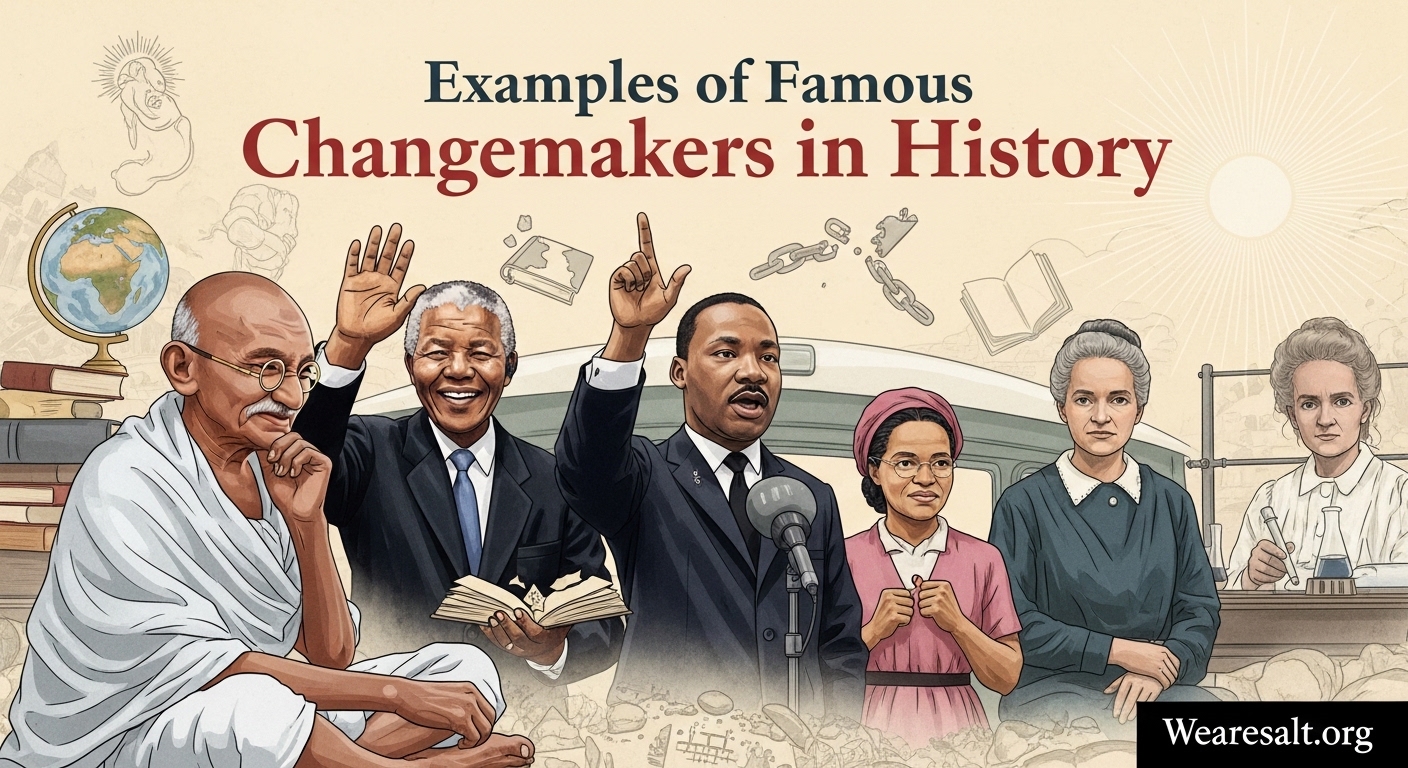
Throughout history, certain individuals have risen above their circumstances to reshape the world around them. These are the changemakers – people who saw what others accepted and dared to imagine something different. From the quiet courage of a woman refusing to give up her seat on a bus to the scientific brilliance that unlocked the secrets of radioactivity, changemakers come in many forms. They share one essential trait: the refusal to accept that things must stay as they are.
In this guide, we explore 15 examples of famous changemakers in history who transformed their fields and left lasting legacies. These figures span centuries, continents, and disciplines. They include activists and scientists, artists and political leaders, historical giants and modern pioneers. Each profile reveals what drove them to challenge the status quo and how their actions continue to influence our lives in 2026.
Whether you are a student researching historical figures, an educator building curriculum, or simply someone seeking inspiration, this collection demonstrates that meaningful change often begins with one person deciding to act.
Table of Contents
What Makes Someone a Changemaker?
A changemaker is anyone who creates positive transformation in society, culture, or their community through sustained action and vision. Unlike traditional leaders who may maintain existing systems, changemakers actively work to alter the trajectory of how things are done.
History’s most effective changemakers share several characteristics. They possess clarity of vision – the ability to see a better future when others see only obstacles. They demonstrate remarkable persistence, continuing their work despite setbacks, opposition, or personal sacrifice. They inspire others to join their cause, building movements that outlast their individual contributions. Most importantly, they challenge existing norms and systems, often at significant personal risk.
The changemakers featured here come from diverse backgrounds and pursued different paths to impact. Some worked through politics and legislation. Others advanced human knowledge through scientific discovery. Still others used art, writing, or direct activism to shift perspectives and create change. Their diversity proves that anyone, regardless of origin or field, can become a force for meaningful transformation.
Changemakers in Civil Rights and Social Justice
The fight for equality and human dignity has produced some of history’s most celebrated changemakers. These individuals confronted systems of oppression and inspired millions to demand justice.
Mahatma Gandhi (1869-1948)
Mohandas Karamchand Gandhi transformed the struggle for Indian independence from a political movement into a moral crusade. Born in Porbandar, India, Gandhi developed the philosophy of Satyagraha – non-violent resistance based on truth and firmness.
After studying law in London and experiencing racial discrimination in South Africa, Gandhi returned to India in 1915 and began leading campaigns against British colonial rule. His methods included boycotts, peaceful protests, and civil disobedience. Gandhi led the famous Salt March in 1930, walking 240 miles to the Arabian Sea to protest the British salt monopoly.
His influence extended far beyond India’s borders. Martin Luther King Jr., Nelson Mandela, and countless other activists drew inspiration from Gandhi’s commitment to non-violence. India gained independence in 1947, though Gandhi did not live to see the full fruits of his labor – he was assassinated in January 1948. His legacy as a pioneer of peaceful resistance remains deeply relevant in 2026.
Martin Luther King Jr. (1929-1968)
Born in Atlanta, Georgia, Martin Luther King Jr. became the voice and conscience of the American civil rights movement. A gifted orator and Baptist minister, King championed non-violent resistance as the path to racial equality in the United States.
His leadership of the Montgomery Bus Boycott in 1955, sparked by Rosa Parks’ arrest, thrust him into national prominence. Over the following decade, King organized marches, sit-ins, and voter registration drives across the segregated South. His 1963 “I Have a Dream” speech at the March on Washington remains one of the most powerful calls for equality in human history.
King’s efforts contributed to the passage of the Civil Rights Act of 1964 and the Voting Rights Act of 1965. He was awarded the Nobel Peace Prize in 1964 at age 35, making him the youngest recipient at that time. His assassination in Memphis, Tennessee in 1968 shocked the world but could not silence his message. King’s work fundamentally altered the legal and social landscape of America.
Nelson Mandela (1918-2013)
Nelson Rolihlahla Mandela spent 27 years in prison for his opposition to South Africa’s apartheid regime, yet emerged without bitterness to lead his country toward reconciliation. His journey from revolutionary to president demonstrated the transformative power of forgiveness.
After joining the African National Congress in 1944, Mandela helped launch armed resistance against the white minority government. Arrested in 1962 and sentenced to life imprisonment in 1964, he became the world’s most famous political prisoner. While incarcerated on Robben Island, Mandela studied Afrikaans to better understand his captors and began planning for a post-apartheid South Africa.
Released in 1990 amid mounting international pressure, Mandela negotiated with President F.W. de Klerk to dismantle apartheid and establish multiracial elections. Elected South Africa’s first Black president in 1994, he prioritized national unity over retribution. Mandela’s Truth and Reconciliation Commission offered amnesty in exchange for honest testimony about past crimes, a model later adopted by other countries dealing with historical injustice. He remains a symbol of peace and reconciliation in 2026.
Rosa Parks (1913-2005)
On December 1, 1955, Rosa Parks refused to give up her seat to a white passenger on a segregated bus in Montgomery, Alabama. This simple act of defiance sparked the Montgomery Bus Boycott and helped launch the modern civil rights movement.
Parks was not the first Black person to resist bus segregation, nor was she simply a tired seamstress as popular myth suggests. She was a trained activist and secretary of the local NAACP chapter who had been contemplating such an act for years. Her arrest triggered a 381-day boycott organized by a young Martin Luther King Jr. and the Montgomery Improvement Association.
The Supreme Court eventually ruled bus segregation unconstitutional. Parks continued her activism throughout her life, working for Congressman John Conyers and founding the Rosa and Raymond Parks Institute for Self-Development. Her courage proved that ordinary individuals can spark extraordinary change when they refuse to accept injustice.
Changemakers in Science and Innovation
Scientific changemakers expanded human understanding and solved problems that plagued generations. Their discoveries created technologies we depend on and opened doors to knowledge previously unimaginable.
Marie Curie (1867-1934)
Marie Sklodowska Curie shattered gender barriers in science while making discoveries that revolutionized medicine and physics. Born in Warsaw, Poland, she moved to Paris to study at the Sorbonne, where she met her husband and research partner Pierre Curie.
Curie’s investigation of uranium rays led her to coin the term radioactivity and discover two new elements – polonium and radium. She became the first woman to win a Nobel Prize in 1903 (Physics, shared with Pierre and Henri Becquerel) and the only person to win Nobel Prizes in two different scientific fields when she received the Chemistry Prize in 1911.
During World War I, Curie developed mobile radiography units to provide X-ray services to field hospitals, personally driving them to the front lines. Her research established the foundation for radiation therapy in cancer treatment. Curie’s notebooks remain too radioactive to handle safely even in 2026, a testament to the hands-on nature of her groundbreaking work.
Leonardo da Vinci (1452-1519)
The ultimate Renaissance polymath, Leonardo da Vinci exemplified the boundless potential of human curiosity. Painter, sculptor, architect, musician, mathematician, engineer, inventor, anatomist, and writer – Leonardo pursued knowledge across every field available in his era.
His artistic masterpieces including the Mona Lisa and The Last Supper demonstrated revolutionary techniques in perspective and sfumato. Yet his notebooks reveal a mind equally fascinated by flight, hydraulics, optics, and human anatomy. Leonardo’s detailed anatomical drawings, based on dissections he performed himself, advanced medical understanding centuries ahead of their time.
Though many of his engineering designs – flying machines, armored vehicles, concentrated solar power – could not be built with available technology, they anticipated inventions that would not materialize for centuries. Leonardo’s integration of art and science established a model for interdisciplinary thinking that remains valuable today.
Nikola Tesla (1856-1943)
Nikola Tesla immigrated to America with four cents in his pocket and a mind full of electrical innovations that would power the modern world. His alternating current (AC) system won the “War of Currents” against Thomas Edison’s direct current, establishing the foundation for global electrical distribution.
Born in Smiljan, in what is now Croatia, Tesla worked for Edison before striking out on his own. George Westinghouse purchased Tesla’s patents for AC induction motors and polyphase power transmission, using them to electrify the 1893 World’s Columbian Exposition in Chicago and later harness Niagara Falls for hydroelectric power.
Tesla held approximately 300 patents worldwide. He pioneered wireless communication, experimented with X-rays before their official discovery, and envisioned technologies including radar, radio, and remote control. His concepts for wireless power transmission and global communication networks anticipated the internet and wireless charging used daily in 2026. Though he died in relative obscurity, Tesla’s influence on modern civilization is immeasurable.
Tu Youyou (1930-present)
Tu Youyou’s discovery of a treatment for malaria has saved millions of lives, particularly in developing nations. Her journey from traditional Chinese medicine to Nobel Prize-winning pharmaceutical research represents a unique path to scientific impact.
During the Vietnam War, malaria was devastating soldiers on both sides. In 1969, Tu was appointed head of Project 523, a secret military project searching for antimalarial drugs. Reviewing ancient Chinese medical texts, she identified sweet wormwood (Artemisia annua) as a potential treatment source. After initial failures, she returned to traditional texts and discovered a low-temperature extraction method that preserved the active compound.
Tu tested the extract on herself to confirm its safety before human trials. The resulting drug, artemisinin, and its derivatives have become the standard treatment for malaria worldwide. Tu became the first Chinese woman to win a Nobel Prize in science in 2015, receiving the Physiology or Medicine award at age 85. Her work exemplifies how traditional knowledge and modern science can combine to solve global health challenges.
Changemakers in Politics and Governance
Political changemakers wielded state power to advance justice, preserve democracy, and protect human rights. They demonstrated that leadership in service of principle can alter the course of nations.
Abraham Lincoln (1809-1865)
Abraham Lincoln led the United States through its greatest moral, constitutional, and political crisis – the Civil War – while abolishing slavery and preserving the Union. His rise from log cabin to White House embodied the American promise of upward mobility.
Lincoln’s Emancipation Proclamation of 1863 transformed the Civil War from a struggle to preserve the Union into a moral crusade against slavery. Though his initial position focused on preventing slavery’s expansion rather than immediate abolition, Lincoln evolved toward full emancipation as the war progressed. His Gettysburg Address redefined the war’s purpose as securing “a new birth of freedom” for all Americans.
His assassination in April 1865, just days after the Confederate surrender, made him a martyr for the cause of Union and freedom. The Thirteenth Amendment, abolishing slavery throughout the United States, passed Congress before his death and was ratified shortly after. Lincoln’s leadership during America’s darkest hour established standards for presidential character and constitutional fidelity that continue to influence political discourse in 2026.
Winston Churchill (1874-1965)
When Britain stood alone against Nazi Germany in 1940, Winston Churchill’s leadership sustained national morale through the darkest days of World War II. His oratory and refusal to consider defeat or surrender proved decisive in the Allied victory.
Churchill’s political career spanned over six decades, including two terms as Prime Minister. He had warned about German rearmament throughout the 1930s when his warnings went largely unheeded. When Neville Chamberlain resigned in May 1940, King George VI asked Churchill to form a government. “I have nothing to offer but blood, toil, tears, and sweat,” he told Parliament in his first speech as Prime Minister.
His speeches – “We shall fight on the beaches,” “Their finest hour,” “Never in the field of human conflict” – became defining statements of democratic resistance. Beyond his wartime leadership, Churchill received the Nobel Prize in Literature in 1953 for his historical writings. His complex legacy includes imperialist views that modern critics find troubling, but his leadership during the existential threat of fascism remains his enduring contribution to history.
Eleanor Roosevelt (1884-1962)
As First Lady and later as a diplomat, Eleanor Roosevelt transformed the role of women in public life and became the driving force behind the Universal Declaration of Human Rights. She proved that influence does not require holding elected office.
During her husband Franklin D. Roosevelt’s four terms as president, Eleanor redefined the First Lady’s role by holding press conferences, writing newspaper columns, and advocating for civil rights, women’s rights, and the poor. She publicly opposed her husband’s policies on several occasions, particularly regarding racial discrimination, and arranged for Marian Anderson to sing at the Lincoln Memorial when the Daughters of the American Revolution refused to host the Black contralto.
After FDR’s death, President Truman appointed her to the United Nations General Assembly. She chaired the committee that drafted the Universal Declaration of Human Rights, adopted in 1948. Roosevelt called this her greatest achievement. The declaration remains the foundational document of international human rights law in 2026.
Changemakers in Arts and Culture
Artistic changemakers reshaped how we see the world and ourselves. Through literature, visual arts, and performance, they challenged conventions and opened new possibilities for human expression.
William Shakespeare (1564-1616)
William Shakespeare’s impact on the English language and world literature remains unmatched four centuries after his death. His exploration of human nature through drama created templates for storytelling still used across all media.
Writing during the Elizabethan and Jacobean eras, Shakespeare produced 39 plays and 154 sonnets that continue to be performed, studied, and adapted globally. Works like Hamlet, Macbeth, Romeo and Juliet, and King Lear probe the depths of love, power, ambition, and mortality with psychological insight that feels modern. He coined or popularized thousands of words and phrases still in use – from “break the ice” to “wild goose chase” to “love is blind.”
Shakespeare’s plays have been translated into every major language and adapted into countless films, operas, and reinterpretations. The Globe Theatre in London, reconstructed near the original site, draws millions of visitors annually. In 2026, Shakespeare remains the most performed playwright worldwide, demonstrating how artistic vision can transcend time, culture, and medium.
Frida Kahlo (1907-1954)
Frida Kahlo turned personal pain and Mexican cultural identity into powerful art that challenged gender norms and celebrated indigenous heritage. Her self-portraits created a new visual vocabulary for exploring female experience.
Born in Coyoacán, Mexico City, Kahlo contracted polio as a child and suffered catastrophic injuries in a bus accident at age 18. Confined to bed during her recovery, she began painting, using a specially made easel that allowed her to work while lying down. Her art drew from Mexican folk culture, Catholic and pre-Columbian symbolism, and surrealist influences, though she rejected the surrealist label.
Kahlo’s work gained international recognition during her lifetime, particularly in the United States and France. Her marriage to fellow artist Diego Rivera was tempestuous and politically engaged – both were Communist activists who gave refuge to Leon Trotsky. In 2026, Kahlo has become a global icon of Mexican culture, feminist strength, and artistic authenticity. Her image appears on currency, stamps, and merchandise worldwide, while her paintings command record prices and draw massive museum crowds.
Modern Changemakers
Change continues in our contemporary era. These living changemakers demonstrate that the tradition of transformative leadership remains vital and necessary.
Malala Yousafzai (1997-present)
Malala Yousafzai became the youngest Nobel Prize laureate by surviving an assassination attempt and turning that trauma into global advocacy for girls’ education. Her courage transformed a personal tragedy into worldwide impact.
As a young girl in Pakistan’s Swat Valley, Malala wrote an anonymous blog for the BBC about life under Taliban rule and her desire to attend school. As her public profile grew, she received Pakistan’s first National Youth Peace Prize and was nominated for the International Children’s Peace Prize. On October 9, 2012, a Taliban gunman boarded her school bus and shot her in the head for her advocacy.
After emergency treatment in Pakistan and intensive rehabilitation in England, Malala co-founded the Malala Fund with her father to support girls’ education worldwide. She addressed the United Nations on her 16th birthday and won the Nobel Peace Prize in 2014 alongside Indian activist Kailash Satyarthi. Her memoir, I Am Malala, became an international bestseller. In 2026, she continues advocating for the 130 million girls worldwide denied education.
Dr. Gladys West (1930-present)
Dr. Gladys West’s mathematical work formed the foundation for GPS technology that billions of people use daily. Despite her crucial contribution, she remained largely unknown until a brief biography in a 2018 retirement newsletter brought her story to light.
Born in rural Virginia to sharecropping parents, West worked her way through college and was hired by the Naval Surface Warfare Center in Dahlgren, Virginia in 1956. She was one of only four Black employees at the facility. West specialized in large-scale computer programming and satellite geodesy – measuring the Earth’s shape using satellite data.
In the 1970s and 1980s, West led a team that developed increasingly precise mathematical models of the Earth’s surface. Her work on the shape of the geoid enabled the accuracy needed for satellite-based navigation systems. Every time someone uses GPS for directions, tracks a run, or orders rideshare, they rely on West’s calculations. She was inducted into the Air Force Space and Missile Pioneers Hall of Fame in 2018. Her story highlights how many changemakers, particularly women and minorities, remain hidden despite their transformative impact.
Examples of Famous Changemakers in History: Key Lessons
These 15 changemakers share traits that enabled their impact despite their different fields and eras. Understanding these patterns offers guidance for anyone seeking to create positive change today.
First, changemakers typically combine deep expertise with broad vision. Marie Curie mastered physics and chemistry while seeing connections others missed. Leonardo da Vinci integrated art and engineering. Dr. Gladys West applied mathematics to real-world navigation problems. Their specialized knowledge enabled their general impact.
Second, most faced significant opposition. Gandhi endured imprisonment and assassination. Mandela spent 27 years in prison. Malala survived a shooting. Changemakers persist through hardship because their commitment to their cause exceeds their concern for personal comfort.
Third, changemakers build networks and movements. Martin Luther King Jr. organized coalitions. Eleanor Roosevelt built international consensus. Tu Youyou worked within a research team. Individual brilliance matters, but lasting change requires collective action.
Finally, these figures demonstrate that changemaking takes many forms. Some, like Lincoln and Churchill, wielded political power. Others, like Rosa Parks and Gandhi, used moral authority. Scientists like Curie and Tesla expanded knowledge. Artists like Kahlo and Shakespeare shifted culture. Anyone can become a changemaker by identifying their sphere of influence and committing to positive transformation within it.
FAQ
Who are some famous changemakers?
Famous changemakers include Mahatma Gandhi, Martin Luther King Jr., Nelson Mandela, Marie Curie, Abraham Lincoln, Winston Churchill, and modern figures like Malala Yousafzai. These individuals transformed their fields through civil rights activism, scientific discovery, political leadership, and advocacy for education and equality.
Who is an example of a change maker?
Rosa Parks is a powerful example of a changemaker. Her refusal to give up her seat on a segregated bus in Montgomery, Alabama in 1955 sparked the Montgomery Bus Boycott and helped launch the American civil rights movement. A trained NAACP activist, Parks demonstrated that ordinary individuals taking principled stands can trigger extraordinary historical change.
What makes someone a changemaker?
A changemaker possesses clarity of vision, remarkable persistence, and the courage to challenge existing systems. They identify problems, develop solutions, and inspire others to join their cause. Unlike traditional leaders who maintain systems, changemakers actively work to alter how things are done, often at significant personal risk.
How do changemakers change the world?
Changemakers change the world through various methods including scientific discovery, political reform, social activism, artistic innovation, and technological advancement. They challenge injustice, expand human knowledge, shift cultural perspectives, and create systems that outlast their individual involvement. Their impact often continues influencing society for generations.
Conclusion
The examples of famous changemakers in history featured here demonstrate that transformative impact comes in many forms. From Marie Curie’s laboratory discoveries to Nelson Mandela’s reconciliation leadership, from William Shakespeare’s immortal words to Dr. Gladys West’s mathematical precision – changemaking transcends discipline, era, and geography.
These figures share essential qualities: the vision to imagine a better future, the persistence to pursue it through obstacles, and the courage to challenge accepted norms. They remind us that progress depends not on waiting for perfect conditions but on acting with the resources and circumstances at hand.
In 2026, the need for changemakers remains as urgent as ever. Climate change, inequality, and technological disruption present challenges that require the same combination of vision, persistence, and courage these historical figures demonstrated. Their stories offer both inspiration and practical guidance: identify your sphere of influence, commit to positive transformation, and begin the work. As Rosa Parks proved, one person’s principled stand can change everything.