
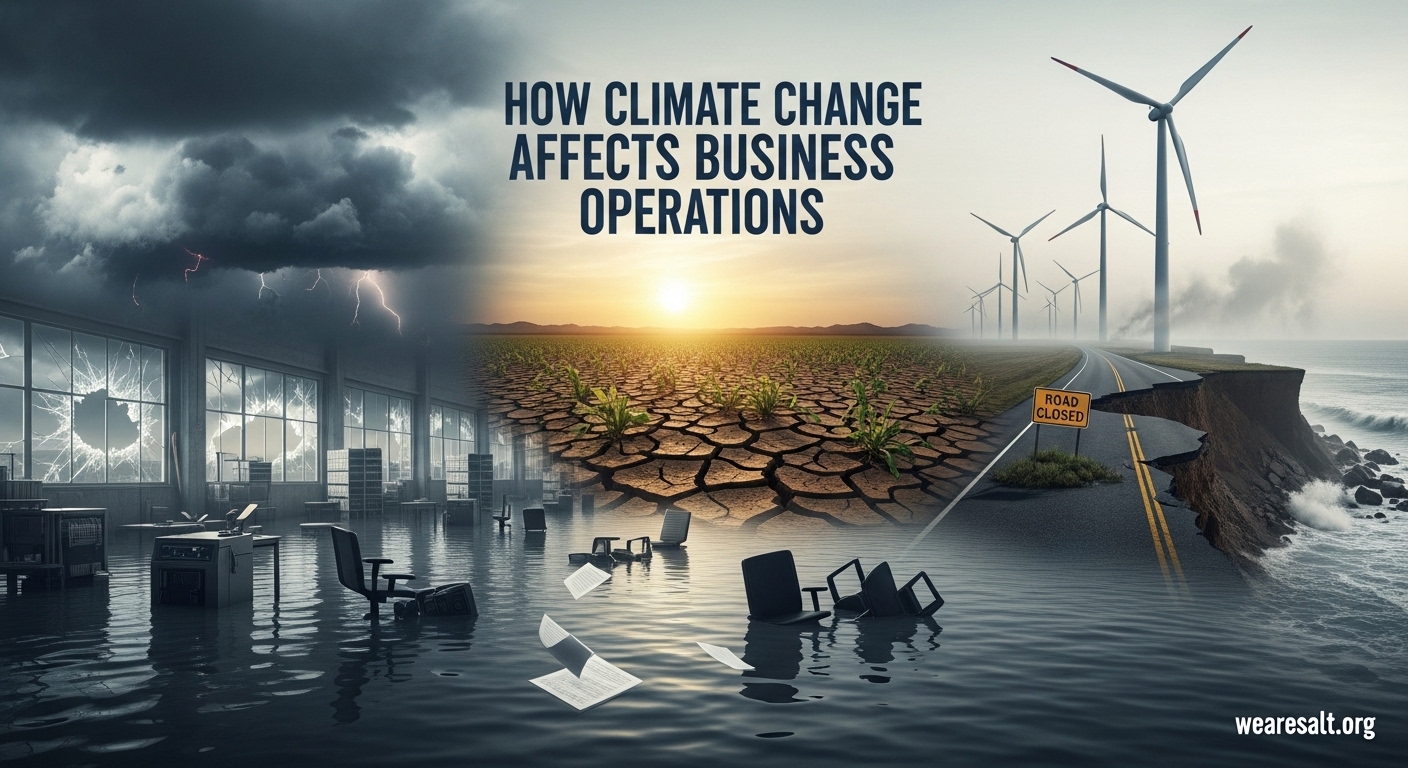
Climate change affects business operations through increased extreme weather events, supply chain disruptions, rising insurance costs, and regulatory pressures that impact 70% of economic sectors worldwide. Our team has analyzed data from the World Economic Forum, Deloitte, and government agencies to understand exactly how businesses are experiencing these challenges in 2026. The financial toll is substantial, with climate hazards driving up operational costs while reducing efficiency across industries.
This guide explains how climate change affects business operations across multiple dimensions. You will learn about direct physical impacts, indirect supply chain effects, financial implications, and practical adaptation strategies that companies of all sizes can implement.
Table of Contents
How Climate Change Affects Business Operations
Climate change is not a distant threat. It is reshaping business realities right now. The World Economic Forum identifies climate hazards as one of the top risks facing global commerce. Companies experience impacts ranging from flooded facilities to disrupted supply chains to unavailable insurance coverage.
Businesses face two primary categories of climate risk. Physical risks include direct damage from extreme weather events, water supply disruptions, and reduced worker productivity from heat stress. Transition risks involve regulatory changes, shifting consumer preferences, and new competitive pressures as markets move toward lower-carbon models.
According to Deloitte research, 80% of executives are concerned about climate change impacts on their operations. Yet many organizations still lack comprehensive adaptation strategies. This gap between awareness and action creates both vulnerability and opportunity.
Direct Impacts on Business Operations
Direct climate impacts affect your business immediately and visibly. These include physical damage to facilities, forced closures during extreme weather, and operational disruptions that halt production.
Extreme Weather Events and Facility Damage
Hurricanes, floods, wildfires, and droughts cause billions in business damages annually. A single flood can destroy inventory, equipment, and infrastructure while keeping doors closed for weeks. The Australian bushfires of 2019-2020 forced thousands of businesses to close, some permanently.
Sea level rise threatens coastal businesses with increasing regularity. Infrastructure damage from storms disrupts power, transportation, and communications networks that businesses depend on. Even businesses not directly hit by disasters suffer when critical infrastructure fails.
Water Supply Disruptions
Water scarcity affects manufacturing operations, agricultural production, and even office buildings. Drought conditions force water restrictions that limit industrial usage. Many businesses rely on consistent water access for cooling, cleaning, and production processes.
The semiconductor industry provides a stark example. Chip manufacturing requires enormous water volumes for cleaning silicon wafers. Drought-related water shortages in Taiwan have threatened global chip supply, demonstrating how climate factors cascade through supply chains.
Reduced Worker Productivity
Heat stress reduces employee productivity and increases health risks. Outdoor workers face the most direct impacts, but indoor environments suffer too when cooling systems strain under extreme temperatures. Research shows productivity drops significantly when temperatures exceed certain thresholds.
Psychological stress from climate events affects employee mental health and job performance. Workers displaced by wildfires or floods cannot simply return to normal operations. The uncertainty of living in climate-vulnerable areas creates ongoing anxiety that impacts workforce stability.
Supply Chain and Indirect Impacts
Indirect impacts flow through supply chains, vendor relationships, and market conditions. These effects can be harder to predict but equally damaging to business operations.
Supply Chain Disruptions
Climate change creates supply chain vulnerabilities at every link. Raw material shortages occur when droughts reduce agricultural output or floods shut down mining operations. Transportation networks face disruptions from extreme weather events that close ports, highways, and rail lines.
The 2021 Texas freeze demonstrated supply chain interconnection. Power failures shut down chemical plants, creating shortages of plastics and resins used across manufacturing sectors. Businesses far from Texas felt impacts weeks and months later.
Just-in-time manufacturing models amplify climate risks. With minimal inventory buffers, any supply interruption halts production immediately. Companies must now balance efficiency against resilience when designing supply chains.
Vendor and Partner Failures
When suppliers face climate impacts, their business customers suffer. Small suppliers may lack resources to recover from disasters, creating permanent gaps in supply chains. Even large vendors may prioritize certain customers when capacity is constrained by climate disruptions.
Cross-border pollution creates international business tensions. Emission instability in one country affects trading partners. Carbon border adjustments and tariffs are emerging tools that will reshape global commerce and operational costs.
Financial Implications for Businesses
Climate change drives up business costs across multiple categories. Understanding these financial impacts helps organizations plan and budget effectively.
Rising Insurance Costs and Availability
Property insurance premiums are rising dramatically in climate-vulnerable areas. Some businesses cannot obtain coverage at any price. Insurers are withdrawing from high-risk markets, leaving companies exposed to unrecoverable losses.
Business interruption insurance faces similar pressures. Traditional policies may not cover climate-related disruptions adequately. Organizations must carefully review coverage terms and consider self-insurance strategies for emerging risks.
Resource Scarcity and Price Volatility
Climate-affected commodity markets experience increased price volatility. Agricultural products, energy resources, and water all face supply uncertainty that drives cost fluctuations. Businesses must budget for higher and more variable input costs.
Energy price instability creates particular challenges. Extreme weather strains power grids, causing price spikes and outages. Renewable energy investments can provide price stability while reducing carbon exposure.
Capital Access and Investment Returns
Investors increasingly factor climate risk into capital allocation decisions. Companies with high carbon exposure face higher borrowing costs and reduced investment flows. Conversely, climate adaptation creates new revenue opportunities in emerging markets.
Research shows companies reducing carbon emissions experience less volatile stock prices. Climate risk management correlates with financial performance, making adaptation a business imperative, not just an environmental concern.
Regulatory and Compliance Considerations
Governments worldwide are implementing climate regulations that affect business operations. Compliance requirements create costs but also opportunities for early movers.
Emissions Reporting and Disclosure
Many jurisdictions now require businesses to report greenhouse gas emissions. The Task Force on Climate-related Financial Disclosures (TCFD) framework is becoming mandatory in major economies. Companies must invest in measurement systems and reporting processes.
Scope 3 emissions reporting covers supply chain impacts. This requirement forces businesses to understand and manage climate effects throughout their value chains. Smaller suppliers may need support to meet reporting obligations imposed by larger customers.
Carbon Pricing and Border Adjustments
Carbon taxes and cap-and-trade systems put prices on emissions. These mechanisms directly affect operational costs for carbon-intensive activities. Border carbon adjustments tax imports from jurisdictions with weaker climate policies, affecting international trade.
Regulatory uncertainty itself creates business challenges. Policies change with political cycles, making long-term planning difficult. Companies must build flexibility into operations to adapt as regulations evolve.
Reputational and Societal Factors
Climate performance increasingly affects how stakeholders view businesses. Reputational risks and opportunities accompany operational impacts.
Consumer Expectations
Customers prefer businesses with strong climate credentials. Sustainability claims influence purchasing decisions, especially among younger consumers. Greenwashing accusations damage brands that overstate environmental commitments.
Supply chain transparency expectations are rising. Consumers want to know that products are sourced responsibly. Businesses must verify and communicate climate performance throughout their value chains.
Investor and Employee Pressure
Institutional investors increasingly screen for climate risk. ESG funds direct capital toward companies with strong environmental performance. Employee recruitment and retention improve when companies demonstrate climate commitment.
The triple bottom line framework emphasizes people, planet, and profit together. Businesses that ignore any dimension face disadvantages in talent competition and capital access.
Climate Change Effects on Small Business Operations
Small businesses face unique climate challenges distinct from large enterprises. Limited resources, concentrated geographic exposure, and simpler supply chains create different risk profiles.
Small businesses often lack dedicated risk management staff. Climate planning falls to busy owners already managing multiple priorities. Yet climate impacts can be existential for small enterprises with limited financial reserves.
Recovery from climate events takes longer for small businesses. Large companies have redundant facilities and disaster response teams. Small businesses may rely on single locations and lack resources for rapid recovery.
Community connections provide both vulnerability and resilience. Small businesses depend on local customers who may also suffer climate impacts. However, community relationships enable mutual support during recovery efforts.
Employee Productivity and Wellbeing
Climate change affects workforce performance through physical and psychological pathways. Addressing these impacts is essential for maintaining operational capacity.
Physical Health and Heat Stress
Outdoor workers face direct heat exposure risks. Construction, agriculture, and logistics employees experience reduced productivity and increased injury rates during heat waves. Indoor workers suffer when cooling systems fail or prove inadequate.
Air quality degradation from wildfires creates respiratory hazards. Workers with asthma or other conditions face particular risks. Businesses must monitor air quality and adjust operations accordingly.
Mental Health and Climate Anxiety
Climate anxiety affects employee mental health and job performance. Workers worried about climate futures experience stress, distraction, and reduced engagement. Those directly affected by climate disasters may suffer trauma requiring support.
Businesses that acknowledge and address climate concerns build stronger workforce relationships. Employee assistance programs should include climate-related stress support. Flexible work arrangements help staff manage climate disruptions.
Industry-Specific Climate Risks
Different industries face distinct climate challenges. Understanding sector-specific risks helps businesses prepare appropriately.
Agriculture and Food Production
Agricultural businesses face the most direct climate impacts. Changing precipitation patterns, pest ranges, and growing seasons affect crop yields. Livestock operations suffer from heat stress and feed scarcity.
Food processing and distribution feel downstream effects. Quality and availability of agricultural inputs vary with climate conditions. Food security concerns create regulatory and reputational pressures throughout the industry.
Manufacturing
Manufacturing operations depend on reliable energy, water, and raw material supplies. Climate disruptions affect all these inputs. Facility locations may become unsuitable as climate conditions change.
Manufacturers face pressure to reduce emissions while maintaining competitiveness. Process innovations can improve both efficiency and climate performance. Supply chain redesign may be necessary to ensure resilience.
Tourism and Hospitality
Tourism destinations face climate threats to their attractions. Ski resorts lose snow cover. Beach destinations face erosion and extreme weather. Wildlife tourism suffers when species distributions shift.
Seasonal patterns are changing, affecting booking and staffing models. Insurance costs for tourism infrastructure are rising. Businesses must diversify offerings or relocate to remain viable.
Retail
Retail businesses face supply chain and consumer demand shifts. Product availability fluctuates with climate disruptions. Consumer preferences move toward sustainable options.
Physical retail locations face extreme weather risks. Flooding, storms, and heat waves affect store operations. Energy costs for climate control impact profitability.
Building Climate Resilience in Business Operations
Resilience is the ability to absorb climate impacts and recover quickly. Building resilience requires systematic assessment and investment.
Climate Risk Assessment
Businesses should conduct comprehensive climate risk assessments. Identify physical assets, supply chain links, and operations vulnerable to climate impacts. Consider multiple scenarios including high-emission and aggressive mitigation pathways.
Risk assessment should be ongoing, not one-time. Climate conditions change, and new vulnerabilities emerge. Regular review ensures adaptation strategies remain relevant.
Contingency Planning
Develop contingency plans for likely climate scenarios. Identify alternative suppliers, backup facilities, and emergency procedures. Test plans through exercises to identify gaps before real events occur.
Financial contingency planning is equally important. Maintain reserves for climate recovery. Understand insurance coverage limitations. Consider parametric insurance products that pay based on weather triggers rather than damage assessments.
Diversification Strategies
Diversification reduces concentration risk. Multiple suppliers, geographic locations, and product lines provide buffers against climate disruptions. Supply chain redundancy costs more but provides resilience value.
Product and service diversification spreads climate risk. Businesses dependent on single climate-sensitive offerings face existential threats. Portfolio approaches provide more stable revenue across varying conditions.
Steps to Reduce Climate Change Impact on Business Operations
Proactive steps can reduce climate vulnerability while creating business value. These strategies address both emissions reduction and adaptation.
Emissions Reduction and Efficiency
Reducing carbon emissions mitigates climate change while cutting costs. Energy efficiency improvements provide immediate returns. Renewable energy transitions stabilize costs and reduce exposure to fossil fuel price volatility.
The CO2 emissions formula provides a framework for reduction: emissions equal activity levels times energy intensity times carbon intensity. Businesses can reduce emissions by optimizing any factor.
Technology Solutions
Technology enables climate resilience in multiple ways. Predictive analytics help anticipate climate impacts. Remote work infrastructure maintains operations during disruptions. Automation reduces dependence on climate-vulnerable labor.
Climate modeling tools help businesses plan for future conditions. Early warning systems provide time to implement contingency plans. Smart building systems optimize energy use and maintain operations during grid stress.
Sustainable Business Practices
The 3 P’s of sustainable improvement provide a framework: People, Planet, and Profit. Balancing these dimensions creates lasting value. Short-term profit maximization often increases long-term climate vulnerability.
Circular economy approaches reduce resource dependence and waste. Local sourcing shortens supply chains and supports community resilience. Employee wellbeing investments maintain workforce capacity during climate stress.
Collaboration and Advocacy
Individual business action has limited impact on global climate. Collaboration multiplies effectiveness. Industry associations can coordinate adaptation standards and share best practices.
Policy advocacy helps shape regulatory environments. Businesses should support climate policies that create level playing fields and encourage investment. Government partnerships can fund infrastructure resilience that benefits multiple businesses.
Frequently Asked Questions
How does climate change affect business operations?
Climate change affects business operations through physical risks like facility damage from extreme weather, supply chain disruptions, rising insurance costs, regulatory changes, and workforce productivity impacts. These effects increase operational costs while reducing efficiency across industries.
What are the 3 P’s of sustainable improvement?
The 3 P’s of sustainable improvement are People, Planet, and Profit. This framework emphasizes that businesses must balance social responsibility, environmental stewardship, and financial performance to achieve lasting success.
How do environmental factors affect business operations?
Environmental factors affect business operations through resource availability, regulatory requirements, physical infrastructure risks, and stakeholder expectations. Climate factors like temperature, precipitation, and extreme weather directly impact production, supply chains, and costs.
How can businesses adapt to climate change?
Businesses can adapt through climate risk assessment, supply chain diversification, facility hardening, insurance review, energy efficiency improvements, and contingency planning. Technology investments and sustainable practices also build resilience while reducing emissions.
What are the financial risks of climate change for businesses?
Financial risks include rising insurance premiums and coverage gaps, commodity price volatility, supply chain disruption costs, stranded assets, regulatory compliance expenses, and reduced access to capital for carbon-intensive operations.
Why is climate change a risk for businesses?
Climate change is a business risk because it disrupts operations, increases costs, creates regulatory uncertainty, damages assets, affects workforce availability, and shifts market conditions. Climate impacts 70% of economic sectors and creates both physical and transition risks.
Conclusion
How climate change affects business operations is no longer a theoretical question. It is a daily reality for companies worldwide. Physical risks from extreme weather, indirect impacts through supply chains, financial pressures from rising costs, and regulatory requirements all demand attention.
The businesses that thrive in 2026 and beyond will be those that take climate change seriously. Risk assessment, resilience building, and sustainable practices are not costs but investments in long-term viability. Small businesses and large enterprises alike must adapt to changing conditions.
Start by assessing your specific climate vulnerabilities. Develop contingency plans for likely scenarios. Build relationships with suppliers, communities, and policymakers to share adaptation efforts. The time for climate action is now, and the businesses that move decisively will lead their industries into a more resilient future.