
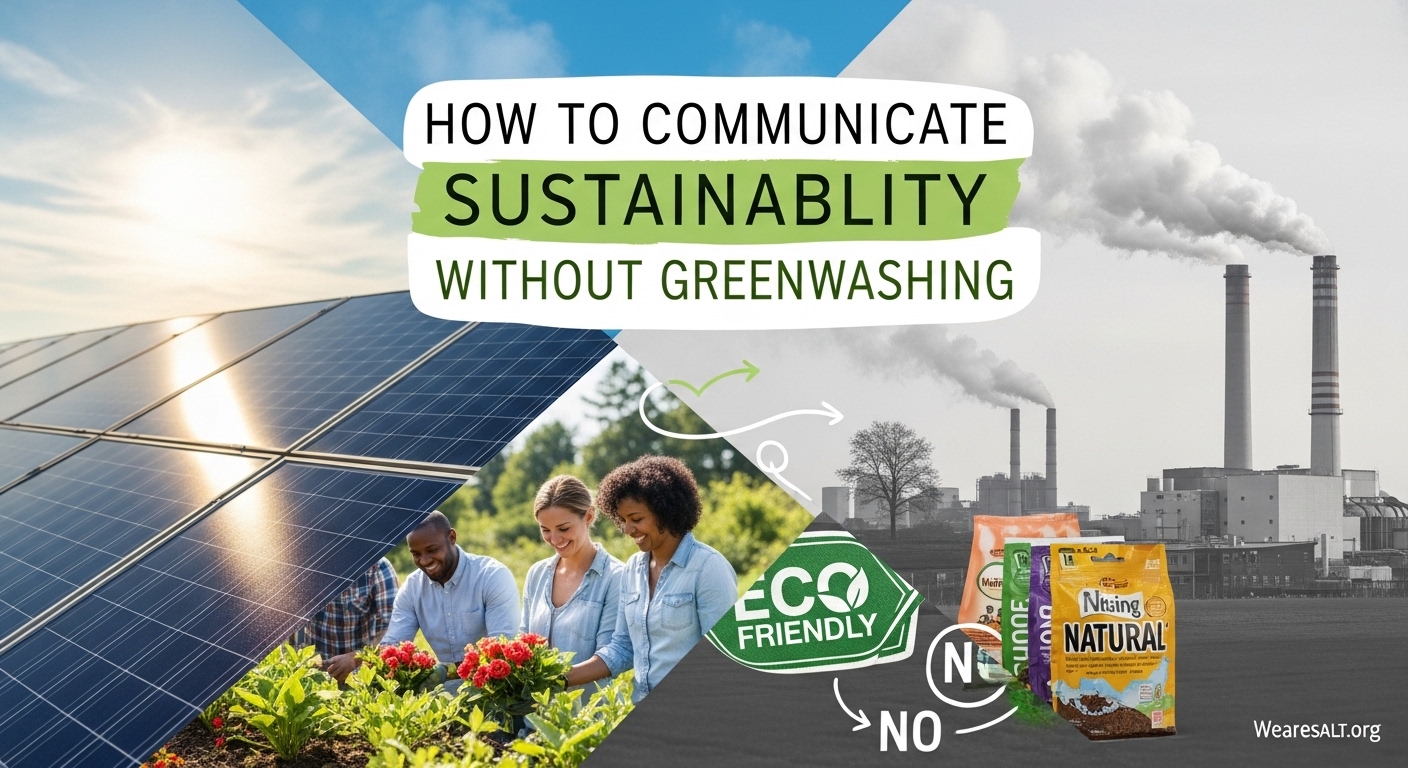
Communicating sustainability without greenwashing has become one of the most challenging aspects of modern business. I’ve watched countless companies struggle to share their environmental progress, only to face backlash when their claims don’t hold up to scrutiny. The fear of being called out for greenwashing has pushed some organizations into silence, while others continue making vague, unsubstantiated claims that erode public trust.
In this guide, I’ll walk you through a practical framework for authentic sustainability communication that builds credibility rather than destroying it. You’ll learn how to share your environmental journey honestly, back up your claims with verifiable data, and avoid the common pitfalls that trip up even well-intentioned companies. Whether you’re a small business owner with limited resources or part of a corporate sustainability team, these principles will help you communicate with confidence.
By the end of this article, you’ll have a clear understanding of what separates genuine sustainability messaging from greenwashing. You’ll also get a practical self-assessment checklist and specific strategies you can implement immediately to strengthen your sustainability communication.
Table of Contents
What Is Greenwashing and Why It Matters
Greenwashing is the practice of making exaggerated, misleading, or unsubstantiated claims about environmental benefits to appear more environmentally responsible than actual operations justify. The term was coined in the 1980s by environmentalist Jay Westerveld, and it has only become more relevant as consumer demand for sustainable products has grown.
I’ve seen greenwashing take many forms over the years. Some companies use vague language like “eco-friendly” or “natural” without any supporting evidence. Others highlight one minor green attribute while ignoring significant environmental harm elsewhere in their operations. Selective disclosure is another common tactic, where businesses showcase positive initiatives while conveniently omitting negative impacts.
The consequences of greenwashing extend far beyond bad publicity. When companies are caught making false environmental claims, they face regulatory fines, legal action, and lasting reputational damage. More importantly, greenwashing undermines the entire sustainability movement by making consumers cynical about all environmental claims, including legitimate ones.
Understanding Greenhushing
There’s an opposite problem that has emerged in recent years: greenhushing. This occurs when companies deliberately under-communicate or stay silent about their sustainability efforts due to fear of being accused of greenwashing. While this might seem like a safe approach, it actually hinders progress by preventing the sharing of best practices and reducing accountability.
Our team has worked with organizations that had impressive sustainability programs but were afraid to talk about them. They worried that any communication would be picked apart and criticized. This silence means that other companies miss opportunities to learn from their approaches, and consumers lose the ability to make informed choices based on environmental impact.
The Business Case for Authentic Communication
Research from 2026 shows that 78% of consumers want to buy from environmentally responsible companies, but 73% are skeptical of sustainability claims. This trust gap represents both a risk and an opportunity. Companies that can demonstrate authentic commitment through transparent communication gain a significant competitive advantage.
The regulatory environment is also tightening. The EU Green Claims Directive, updated FTC Green Guides, and various national regulations are making it harder to get away with vague or misleading environmental messaging. Companies that invest in authentic sustainability communication now are positioning themselves ahead of compliance requirements while building lasting stakeholder trust.
How to Communicate Sustainability Without Greenwashing
Authentic sustainability communication requires a structured approach that balances transparency with practical business realities. After analyzing hundreds of sustainability reports and marketing campaigns, our team has identified five core principles that separate genuine communication from greenwashing.
Lead With Data, Not Aspirations
The foundation of credible sustainability communication is verifiable data. Start with your actual metrics rather than your goals. If you’ve reduced carbon emissions by 15% over the past three years, lead with that number. Don’t promise to become carbon neutral by 2030 without showing the concrete steps you’re taking to get there.
Understanding your emissions data is essential for credible communication. Scope 1 emissions come from sources you own or control directly, like company vehicles and facilities. Scope 2 covers indirect emissions from purchased electricity, heating, and cooling. Scope 3 includes all other indirect emissions in your value chain, from supplier activities to product use and disposal.
Most companies focus only on Scope 1 and 2 because they’re easier to measure and control. However, Scope 3 often represents 70-90% of total emissions for many businesses. If you only report on the smaller portion while ignoring the larger impact, you’re engaging in selective disclosure, which is a form of greenwashing.
When presenting data, be specific about your methodology. Reference the GHG Protocol or other recognized standards you’re following. Explain your operational boundaries and any exclusions. This level of detail might seem technical, but it demonstrates that you understand your impact and are taking measurement seriously.
Get Third-Party Verification
Self-reported sustainability data carries limited credibility. Independent verification through recognized certifications and audits provides the external validation that stakeholders need to trust your claims. This is particularly important for carbon neutral and net zero claims, which require rigorous accounting.
B Corp certification has become a gold standard for companies wanting to demonstrate comprehensive social and environmental performance. The assessment covers governance, workers, community, environment, and customers. Fairtrade certification focuses specifically on supply chain ethics and environmental standards. ISO 14001 provides a framework for environmental management systems.
For carbon-specific claims, look for verification from organizations like the Carbon Trust, SCS Global Services, or Bureau Veritas. These bodies can validate your carbon footprint calculations, net zero pathways, and offset quality claims. Their endorsement signals that your data has survived independent scrutiny.
Lifecycle assessments (LCAs) provide another layer of credibility for product-level claims. An LCA evaluates environmental impacts across the entire product lifecycle from raw material extraction through manufacturing, distribution, use, and disposal. When you claim a product is more sustainable than alternatives, having LCA data to back it up makes that claim defensible.
Acknowledge Imperfection
One of the most powerful trust-building strategies in sustainability communication is honest acknowledgment of where you fall short. Companies that admit their challenges and limitations come across as more credible than those that present a polished, problem-free narrative.
Patagonia has built a loyal following partly through their willingness to be transparent about their environmental impact. Their “Don’t Buy This Jacket” campaign acknowledged that even their most sustainable products have environmental costs. This honesty paradoxically strengthened their credibility and customer loyalty.
When communicating about your sustainability journey, include information about what you haven’t achieved yet. If you’re working toward net zero but still rely heavily on fossil fuels, say so. Explain the transition plan and timeline. Share the obstacles you’re facing and how you’re trying to overcome them.
This approach does more than build trust. It creates space for meaningful engagement with stakeholders who might have solutions or suggestions. It also protects you from accusations of hiding information, since you’ve already disclosed the challenges voluntarily.
Use Specific Language
Vague sustainability claims are a hallmark of greenwashing. Terms like “eco-friendly,” “green,” “natural,” and “sustainable” are essentially meaningless without context and supporting evidence. Regulatory bodies increasingly view such undefined terms as potentially misleading.
Replace vague language with specific, measurable claims. Instead of saying your product is “environmentally friendly,” specify exactly how it reduces environmental impact. “Made with 85% recycled materials” is verifiable and meaningful. “Reduces water usage by 40% compared to conventional manufacturing” tells a concrete story.
The UK Green Claims Code specifically prohibits claims that are unclear or omit important information. The FTC Green Guides require that environmental claims be substantiated and that qualifications be clear and prominent. Following these standards not only keeps you compliant but also forces you to develop more credible messaging.
Be equally specific about your limitations. If a product is biodegradable only in industrial composting facilities, say so. Don’t let customers assume it will break down in their backyard compost or in landfill conditions. Specificity in limitations is just as important as specificity in benefits.
Align Internal and External Messaging
Perhaps the most overlooked aspect of authentic sustainability communication is internal alignment. Your external sustainability claims must match your internal priorities, governance structures, and employee understanding. When there’s a gap between what you say publicly and what you prioritize internally, it eventually becomes visible.
Our team worked with a company that had excellent external sustainability messaging but hadn’t engaged their operations team in the strategy. When customers asked detailed questions about manufacturing processes, frontline staff couldn’t answer because they hadn’t been included in the sustainability program. This disconnect undermined credibility.
Cross-functional governance frameworks help prevent these misalignments. Sustainability should be integrated into business strategy, not siloed in a corporate social responsibility department. Marketing teams need to work closely with operations, procurement, and sustainability officers to ensure claims reflect reality.
Employee advocacy can be one of your strongest assets in sustainability communication. When employees genuinely understand and support your environmental initiatives, they become authentic ambassadors. Their personal stories and behind-the-scenes perspectives add credibility that polished marketing copy cannot achieve.
Practical Strategies for Authentic Sustainability Communication
Understanding the principles is important, but implementation is where most companies struggle. Here are concrete strategies you can apply immediately, regardless of your organization’s size or resources.
Self-Assessment Checklist for Greenwashing Risks
Before publishing any sustainability communication, run through this checklist to identify potential greenwashing risks:
1. Can you substantiate every claim with data? If you make a claim, ensure you have evidence to support it. Remove any statements you cannot back up.
2. Are you being specific enough? Replace vague terms like “eco-friendly” with concrete, measurable statements.
3. Have you considered the full lifecycle? Don’t highlight one green attribute while ignoring significant impacts elsewhere.
4. Are you being honest about limitations? Include information about what you haven’t achieved and the challenges you’re still working on.
5. Do you have third-party verification? Where possible, get independent validation for your claims.
6. Is the visual presentation misleading? Ensure images, colors, and design elements don’t create false impressions about environmental benefits.
7. Can frontline staff explain your claims? If employees can’t articulate your sustainability initiatives, you need better internal communication.
8. Are you overstating the significance of small improvements? A 5% reduction is worth celebrating, but don’t present it as transformational change.
9. Are your comparisons fair? When comparing to competitors, ensure you’re using equivalent methodologies and boundaries.
10. Would you be comfortable if a journalist investigated this claim? If you’d be nervous about scrutiny, reconsider the messaging.
Small Business Sustainability Communication
Small companies often believe they need extensive resources and dedicated sustainability teams to communicate authentically. This isn’t true. In fact, smaller organizations often have advantages in sustainability communication because they can be more agile and personal in their approach.
Focus on storytelling rather than complex metrics. As a small business, you can share the personal journey of your sustainability efforts, including the specific decisions and trade-offs you’ve made. “We switched to local suppliers despite the 12% cost increase because it reduced our shipping emissions by 60%” is a compelling, authentic narrative.
Leverage your relationships. Small businesses often have direct relationships with suppliers and customers. Use these connections to tell the story of your supply chain. Share photos and stories from the farms, workshops, or facilities that produce your materials. This transparency builds trust in ways that large corporations struggle to match.
Start with what you can measure. You may not be able to afford a full lifecycle assessment, but you can track and communicate specific metrics like packaging reduction, energy usage, or local sourcing percentages. Don’t let perfect be the enemy of good when it comes to data.
Consider collaborative approaches. Partner with other small businesses to share resources for sustainability initiatives and communication. Joint purchasing of renewable energy, shared sustainability audits, or collective marketing can reduce costs while increasing credibility.
Visual and Design Communication Tips
Visual elements communicate just as much as text, and they can either support or undermine your sustainability messaging. Design choices that imply environmental benefits without substantiation constitute visual greenwashing.
Avoid the obvious clichés. Green color schemes, leaf motifs, and nature imagery don’t automatically make a product sustainable. If every element of your design screams “eco-friendly” but your claims are modest, the disconnect will trigger skepticism.
Use real imagery rather than stock photos. Authentic photos of your actual facilities, suppliers, and processes build more trust than generic images of forests and wind turbines. If you claim to use sustainable materials, show the actual materials, not a staged photo of hands holding a seedling.
Be careful with icons and symbols. Recycling symbols, organic certifications, and environmental badges should only appear when you have legitimate certifications to back them up. Invented icons that look official but mean nothing are a form of greenwashing.
Consider the entire visual hierarchy. Make sure that sustainability claims don’t overshadow important information about limitations. If your product has both environmental benefits and significant environmental costs, the design should present both honestly rather than burying the negative information.
Legal and Regulatory Considerations
The regulatory landscape for environmental claims has shifted dramatically in recent years. Understanding your legal obligations is essential not just for compliance, but for building communication strategies that will remain viable as regulations tighten.
The EU Green Claims Directive, enacted in 2026, establishes strict requirements for environmental claims made by companies operating in European markets. Claims must be based on recognized scientific evidence, consider the full lifecycle impact, and be verified by independent third parties before being communicated to consumers. Penalties for non-compliance can reach 4% of annual revenue.
In the United States, the FTC Green Guides provide guidance on how to make non-deceptive environmental marketing claims. While these are guidelines rather than regulations, the FTC has taken enforcement action against companies that violate them. The guides specifically address claims about carbon offsets, compostability, degradability, and recyclability.
The UK Green Claims Code, administered by the Competition and Markets Authority, sets six key principles for environmental claims. Claims must be truthful and accurate, clear and unambiguous, not omit or hide important information, make fair and meaningful comparisons, consider the full lifecycle, and be substantiated.
Beyond general advertising standards, some industries face specific regulations. The fashion industry is seeing increased scrutiny of environmental claims, with the EU’s proposed Digital Product Passports requiring detailed sustainability information. Food and agriculture face existing standards around organic, natural, and non-GMO claims that extend to sustainability marketing.
Compliance with these regulations is a minimum standard, not an aspirational goal. However, forward-thinking companies recognize that regulatory compliance and authentic sustainability communication are aligned. The same practices that keep you legal also build the trust and credibility that drive long-term business value.
Common Pitfalls to Avoid
Even with good intentions, companies frequently fall into common traps that undermine their sustainability communication. Recognizing these pitfalls can help you avoid them.
The hidden trade-off is one of the most common issues. A company highlights that its product is made from recycled materials while ignoring that the manufacturing process consumes enormous amounts of energy. This selective focus misrepresents the overall environmental impact.
No proof claims abound in sustainability marketing. Terms like “eco-safe,” “non-toxic,” and “planet-friendly” sound meaningful but lack standardized definitions. Without verification, these claims are essentially meaningless and potentially misleading.
Vagueness and irrelevance trip up many well-meaning companies. A product labeled “CFC-free” sounds impressive until you realize that CFCs have been banned for decades and no competing products contain them. This is technically true but essentially meaningless.
The lesser of two evils is another trap. A company markets its fuel-efficient SUV without acknowledging that SUVs inherently have higher environmental impact than smaller vehicles. While the improvement is real, the framing misleads consumers about the overall impact category.
Imaginary friends appear when companies invent certifications or endorsements that don’t exist. Creating a logo that looks like an official environmental seal when no such certification has been obtained is outright deceptive.
Frequently Asked Questions
What is greenwashing and why does authenticity matter?
Greenwashing is the practice of making exaggerated, misleading, or unsubstantiated claims about environmental benefits to appear more sustainable than actual operations justify. Authenticity matters because greenwashing damages consumer trust, invites regulatory scrutiny, and undermines genuine environmental progress. When companies are caught greenwashing, they face reputational damage that can take years to repair.
How can companies avoid being accused of greenwashing?
Companies can avoid greenwashing by leading with verifiable data rather than aspirations, obtaining third-party verification for environmental claims, acknowledging limitations and ongoing challenges, using specific measurable language instead of vague terms like eco-friendly, and ensuring internal practices align with external messaging. Following recognized frameworks like the GHG Protocol and obtaining certifications from bodies like B Corp or the Carbon Trust also strengthen credibility.
What role does third-party verification play in sustainability communication?
Third-party verification provides independent validation that gives stakeholders confidence in sustainability claims. Certifications like B Corp, Fairtrade, and ISO 14001 demonstrate that a company has survived rigorous external assessment. For carbon claims, verification from organizations like the Carbon Trust validates footprint calculations and offset quality. Independent auditing protects companies from accusations of self-interested reporting and provides credibility that internal claims cannot match.
How often should sustainability communication be updated?
Sustainability communication should be updated at least annually to reflect progress, new data, and changing circumstances. However, more frequent updates may be appropriate for rapidly evolving initiatives or when significant milestones are achieved. Regular updates demonstrate ongoing commitment and provide opportunities to address emerging challenges honestly. The key is maintaining a balance between keeping stakeholders informed and avoiding communication fatigue.
How do small companies communicate sustainability without extensive resources?
Small companies can focus on authentic storytelling rather than complex metrics, leveraging direct supplier and customer relationships for transparency. Start with specific measurable impacts you can track, like packaging reduction or local sourcing percentages. Partner with other small businesses to share resources for sustainability initiatives. Use real imagery from your actual operations rather than expensive productions. Personal stories and behind-the-scenes transparency often build more trust than polished corporate sustainability reports.
What is the difference between greenwashing and greenhushing?
Greenwashing involves making false or exaggerated environmental claims to appear more sustainable than you are. Greenhushing is the opposite problem where companies deliberately under-communicate or stay silent about genuine sustainability efforts due to fear of being accused of greenwashing. While greenhushing avoids the risk of being called out for false claims, it prevents sharing best practices, reduces accountability, and denies consumers information they need to make informed choices. Both issues undermine environmental progress.
Building Trust Through Honest Communication
Communicating sustainability without greenwashing comes down to one fundamental principle: honesty backed by evidence. The framework I’ve outlined in this guide, leading with data, obtaining third-party verification, acknowledging imperfection, using specific language, and aligning internal and external messaging, provides a structured approach to authentic communication.
The companies that will thrive in 2026 and beyond are those that embrace transparency as a competitive advantage rather than viewing it as a regulatory burden. When you communicate honestly about both your achievements and your challenges, you build the kind of trust that survives scrutiny and creates lasting stakeholder relationships.
Start by running your current sustainability messaging through the self-assessment checklist provided in this guide. Identify one area where you can improve specificity or transparency, and make that change this month. Small, authentic improvements accumulate into significant credibility over time. The journey toward authentic sustainability communication is ongoing, but every step you take builds the trust that greenwashing destroys.