
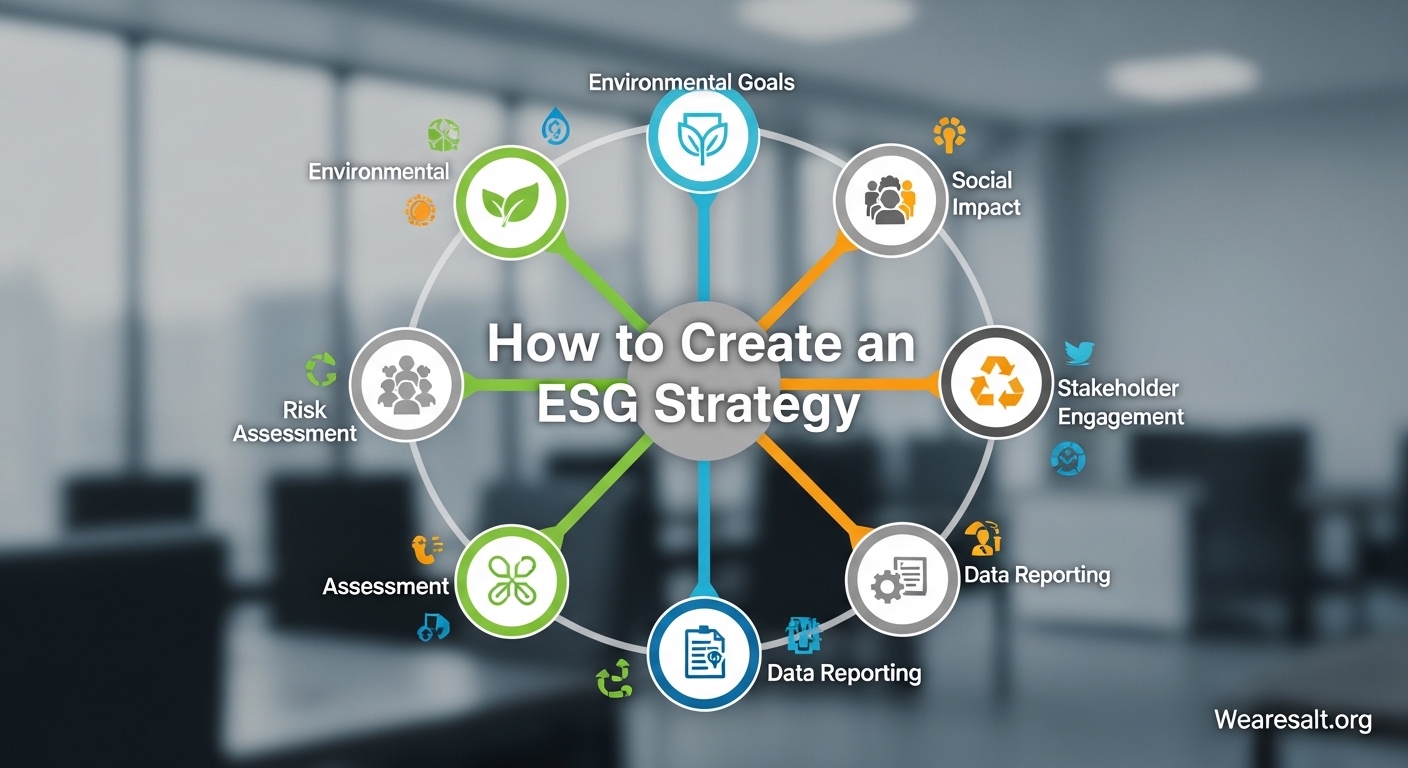
Creating an ESG strategy has become essential for organizations of every size in 2026. Whether you are a Fortune 500 company or a growing SME, stakeholders now expect transparent environmental, social, and governance practices that align with long-term value creation. The organizations developing robust ESG strategies today are building competitive advantage, reducing risk, attracting talent and capital, and positioning themselves for long-term success.
In this comprehensive guide, I will walk you through exactly how to create an ESG strategy from scratch. Our team has spent months researching frameworks, interviewing sustainability leaders, and analyzing implementation approaches across industries. This is the practical roadmap we wish we had when we started our ESG journey.
By the end of this article, you will have a complete step-by-step process for developing an ESG strategy, understand which frameworks apply to your situation, know how to avoid common pitfalls that derail implementation efforts, and have practical guidance whether you’re a large corporation or small business. Let’s dive into everything you need to know about how to create an ESG strategy that drives real business value.
Table of Contents
What Is an ESG Strategy?
An ESG strategy is a comprehensive framework that outlines how your company manages environmental, social, and governance responsibilities while integrating sustainability into core business operations. It goes beyond compliance to create measurable value for stakeholders through systematic approach to environmental impact, social responsibility, and ethical governance practices.
The environmental component addresses your company’s impact on the natural world. This includes carbon emissions and climate change mitigation, energy efficiency and renewable energy adoption, water consumption and conservation, waste generation and circular economy approaches, biodiversity protection, and pollution prevention. For manufacturing companies, this might involve reducing emissions through equipment upgrades and process optimization. For service businesses, it could mean addressing energy use in facilities and business travel emissions.
The social pillar covers relationships with people and communities. This encompasses labor practices and working conditions, diversity, equity and inclusion initiatives, employee health and safety programs, human rights protections across operations and supply chains, community engagement and social impact programs, customer privacy and data protection, and product responsibility. A strong social dimension ensures your organization creates value for all stakeholders, not just shareholders.
Governance encompasses the systems and processes guiding corporate decision-making and accountability. This includes board composition and diversity, executive compensation structures, shareholder rights and engagement, ethical business practices and anti-corruption measures, risk management and oversight, transparency in reporting and disclosure, and regulatory compliance. Robust governance ensures decisions consider long-term consequences and stakeholder interests, not just short-term profits.
ESG vs CSR: Understanding the Difference
Many companies confuse ESG with corporate social responsibility (CSR), but there are important distinctions that matter for strategy development. While CSR focuses on voluntary initiatives and philanthropic activities often separate from core operations, ESG embeds sustainability into business strategy with measurable targets, data-driven reporting, and integration into decision-making processes.
CSR asks what good your company can do through charitable giving, volunteer programs, and community initiatives. These are worthwhile efforts, but they often operate as add-ons to business activities rather than integral components. ESG asks how sustainability drives business value, mitigates risk, and creates competitive advantage. It considers environmental impacts, social responsibilities, and governance practices as fundamental to business success rather than optional extras.
CSR is typically marketing-driven and separate from operations, while ESG is data-driven, integrated into core business processes, and increasingly required by regulators and investors. In 2026, investors allocate capital based on ESG ratings and performance data, not CSR press releases. Customers make purchasing decisions based on verified ESG credentials rather than philanthropic activities. Employees choose employers based on values demonstrated through business practices, not just charitable donations.
Another key difference is measurement and reporting. CSR activities often lack standardized metrics and consistent reporting. ESG requires specific KPIs, baseline measurements, progress tracking, and third-party verification. This standardization enables comparison across companies and informs investment decisions, risk assessments, and stakeholder evaluations.
Why Does Your Company Need an ESG Strategy?
The business case for ESG has never been stronger. Based on my experience helping organizations across industries develop their sustainability strategies, here are the compelling reasons why organizations are prioritizing ESG strategy development in 2026:
Regulatory compliance is becoming mandatory, not optional. The regulatory landscape is evolving rapidly with expanding ESG disclosure requirements. The EU Corporate Sustainability Reporting Directive (CSRD) now requires detailed ESG disclosures from approximately 50,000 companies operating in Europe, including non-European subsidiaries. The SEC has proposed comprehensive climate disclosure rules in the United States that would require registered companies to report Scope 1, 2, and 3 emissions, climate-related risks, and governance processes. Similar regulations are emerging in Canada, the United Kingdom, Japan, Singapore, and other jurisdictions. Even if regulations do not yet apply to your organization, they likely will soon, and preparing now positions you ahead of requirements rather than scrambling to catch up.
Investors demand ESG transparency and performance. The sustainable investment landscape has grown exponentially, with ESG-focused funds now managing over $35 trillion globally, representing more than one-third of all professionally managed assets. Institutional investors use ESG ratings and data to screen investment opportunities, assess risk exposure, and engage with portfolio companies. Companies without robust ESG strategies and credible reporting may find capital more expensive or difficult to access. Private equity firms increasingly incorporate ESG criteria into due diligence and value creation strategies. Banks are linking lending terms to ESG performance indicators. The message is clear: capital flows to companies with strong ESG practices.
Risk mitigation protects and creates business value. Climate change, supply chain disruptions, social issues, and governance failures pose real financial risks that can materialize suddenly and severely. Companies with strong ESG practices identify and manage these risks before they become crises. Physical climate risks like extreme weather events can damage facilities, disrupt operations, and impact supply chains. Transition risks like changing regulations, evolving market preferences, and technological shifts can render business models obsolete. Social risks like labor disputes, community opposition, or employee relations issues can damage reputation and operations. Governance risks like corruption, regulatory fines, or executive misconduct can destroy value overnight. A comprehensive ESG strategy systematically addresses these risks before they impact your bottom line.
Talent attraction and retention depend on ESG credentials. The war for talent has intensified, and ESG performance has become a key differentiator. Studies consistently show that employees, particularly millennials and Gen Z, prefer to work for companies with strong ESG commitments and authentic sustainability practices. Organizations with credible ESG strategies experience 40% lower employee turnover, higher engagement scores, and stronger employer brand recognition. In my experience, companies that transparently communicate ESG progress attract more qualified candidates and retain top talent longer. One technology client I worked with saw job acceptance rates increase from 65% to 82% after implementing and communicating robust ESG initiatives.
Operational efficiency drives significant cost savings. Many ESG initiatives generate immediate financial returns through efficiency improvements. Energy efficiency measures typically reduce energy consumption by 15-30%, with rapid payback periods. Waste reduction and recycling programs lower disposal costs while generating revenue from recycled materials. Water conservation reduces utility bills and protects against future water scarcity risks. Supply chain optimization through ESG criteria reduces disruptions, improves quality, and often lowers costs through reduced waste and improved efficiency. One manufacturing client I worked with saved $2.7 million annually through ESG-driven operational improvements, paying for their entire sustainability program many times over.
Reputation and competitive advantage grow market share. Customers, both consumers and businesses, increasingly prefer brands that demonstrate genuine commitment to sustainability and ethical practices. B2B buyers routinely require ESG credentials from suppliers as a condition of doing business. Companies with strong ESG performance win more contracts, command premium pricing, and build customer loyalty that protects against market fluctuations. Conversely, ESG failures can cause severe reputation damage that takes years to repair. The organizations that build strong ESG brands today will be the market leaders of tomorrow.
How to Create an ESG Strategy: Step-by-Step Guide
Building an effective ESG strategy requires systematic effort across multiple dimensions and stakeholder groups. Based on implementations I’ve led across organizations ranging from startups to Fortune 500 companies, here’s the proven step-by-step process for creating an ESG strategy that drives real impact:
Step 1: Conduct a Baseline Assessment
Start by thoroughly understanding where your organization stands today across all ESG dimensions. A comprehensive baseline assessment reveals your current performance, identifies gaps requiring attention, and establishes the starting point for measuring future progress. Without this foundation, you cannot set meaningful targets or demonstrate improvement.
Begin with environmental baseline measurement. Review your energy consumption data across electricity, natural gas, fuel, and other energy sources. Calculate your greenhouse gas emissions starting with Scope 1 (direct emissions from owned or controlled sources) and Scope 2 (indirect emissions from purchased energy). If possible, begin assessing Scope 3 emissions from your value chain, including supply chain, transportation, product use, and end-of-life disposal. Examine water consumption patterns, waste generation and disposal methods, and any existing environmental management systems or certifications.
For social baseline assessment, inventory your current workforce demographics including gender, age, racial and ethnic diversity, and other relevant characteristics. Review compensation practices to ensure pay equity across demographic groups. Examine health and safety records including incident rates, workers’ compensation claims, and existing safety programs. Assess employee engagement through recent survey data or plan to conduct baseline surveys. Review existing HR policies related to diversity, inclusion, work-life balance, and professional development. Document any existing community engagement or philanthropic activities.
Governance baseline requires examining your board structure including composition, independence, diversity, and expertise. Review executive compensation practices including the structure of bonuses, stock awards, and other incentives. Examine existing ethics and compliance programs, including codes of conduct, anti-corruption policies, whistleblower protections, and training programs. Assess risk management frameworks to determine how ESG risks are currently identified and managed. Review existing disclosure practices to understand what information is currently reported to stakeholders.
Benchmark against industry peers where possible. Public companies often disclose ESG data in sustainability reports or SEC filings. Industry associations may provide aggregated benchmarking data. Understanding how you compare helps set realistic goals and identify priority areas where you lag behind or lead your peers. This external perspective is invaluable for prioritizing efforts and communicating with stakeholders who will inevitably compare your performance to competitors.
This baseline assessment typically takes 4-6 weeks and often reveals both strengths to build upon and significant gaps requiring attention. One technology client I worked with discovered they had strong governance practices and above-average diversity but virtually no environmental metrics or systematic social programs beyond basic HR compliance. This insight shaped their entire ESG strategy priorities and resource allocation.
Step 2: Perform a Materiality Assessment
Materiality assessment is arguably the most critical step in creating an ESG strategy that delivers real value. It identifies which ESG issues matter most to your business and your stakeholders, allowing you to prioritize resources effectively and focus on what will drive the most impact. Without materiality assessment, organizations waste effort on issues that don’t matter while neglecting critical topics.
Understanding double materiality is essential for modern ESG strategy. Traditional financial materiality asks how ESG issues affect your business financially. Impact materiality asks how your business affects people and the environment. The emerging standard, particularly under the EU CSRD, requires double materiality assessment that considers both perspectives. This comprehensive view ensures you address risks to your organization while reducing your negative impacts on the world, creating shared value.
Start by listing potential material topics relevant to your industry and business model. Review industry standards, regulatory requirements, peer disclosures, and stakeholder concerns. For a manufacturing company, this list might include energy efficiency, water management, emissions, waste, worker safety, supply chain labor standards, product safety, board diversity, executive compensation, and anti-corruption measures. For a technology company, data privacy, energy-efficient data centers, ethical AI, diversity in technical roles, supply chain due diligence, and intellectual property governance might appear on the list.
Engage stakeholders to rank these issues by importance. I recommend surveying or interviewing investors, customers, employees at various levels, suppliers, community members, regulators, and industry experts. Ask them to rate each issue’s importance to their decision-making and relationship with your organization. Their perspectives often surprise leadership teams and reveal disconnects between internal and external priorities. One retail client assumed packaging waste was their top environmental priority, but stakeholders ranked supply chain labor practices and data privacy as significantly more material.
Map internal perspectives on how each issue impacts business value. Consider financial impact, risk exposure, strategic importance, and operational relevance. Some issues may have minor stakeholder interest but significant business impact, while others may be hugely important to stakeholders but minimally impactful to your business. Both perspectives matter for double materiality.
Plot the results on a materiality matrix with stakeholder importance on one axis and business impact on the other. Issues scoring high on both dimensions become your strategic priorities and should form the core of your ESG strategy. This typically yields 5-10 priority topics. Issues with low scores on both dimensions can be monitored but don’t require focused attention. Issues with high stakeholder importance but low business impact may warrant basic response and communication. Issues with high business impact but low stakeholder awareness may require education and engagement.
Document your assessment methodology, data sources, and rationale thoroughly. This documentation demonstrates rigor to investors, regulators, and other stakeholders. It also provides the foundation for future assessments as your context and priorities evolve. Materiality is not static, so plan to reassess periodically as your business, industry, and stakeholder expectations change.
Step 3: Engage Stakeholders
ESG strategy development cannot happen effectively in isolation from the people affected by and responsible for its implementation. Effective stakeholder engagement ensures your strategy addresses real concerns, builds essential buy-in, creates accountability for implementation, and benefits from diverse perspectives. Skip this step and you risk developing a strategy that misses the mark, lacks support, and fails during implementation.
Internally, engage the C-suite and board early and consistently. ESG strategy requires executive sponsorship to secure resources, establish priority, and drive accountability across functions. I’ve seen well-intentioned initiatives fail when sustainability teams work in isolation without CEO or board support. Present the business case for ESG with specific examples relevant to your industry and organization. Involve key leaders in the materiality assessment process so they understand and own the priorities. Create an ESG steering committee with representatives from operations, finance, HR, legal, communications, and other relevant functions to ensure cross-functional ownership.
Engage employees at all levels, not just leadership. Frontline workers often identify practical solutions and implementation challenges that leadership misses. One manufacturing client’s assembly line workers suggested energy-saving process modifications that reduced consumption by 12% while improving working conditions and productivity. Another company’s customer service team identified product packaging concerns that became a priority ESG initiative. Create channels for employee input through surveys, focus groups, town halls, and sustainability champions programs. Recognize and reward contributions to build momentum and demonstrate that ESG is everyone’s responsibility.
External stakeholder engagement is equally important and often neglected. Survey your customers to understand their ESG expectations and how they evaluate suppliers. Talk to current and prospective investors about what metrics they track, what frameworks they prefer, and how they use ESG data in decisions. Engage suppliers about their capacity to meet your standards and collaborate on improvements. Consult with community organizations about local impacts and concerns. Meet with regulators to understand upcoming requirements and compliance expectations. This engagement not only informs your strategy but also builds the relationships essential for successful implementation.
Design engagement approaches appropriate to each stakeholder group. Large employee populations may require surveys combined with smaller focus groups for depth. Investors may prefer one-on-one interviews or small group discussions. Community stakeholders might benefit from public consultations or advisory boards. Suppliers may respond best to direct outreach through procurement teams. The key is matching the method to the stakeholder group while ensuring diverse perspectives are heard and considered.
Synthesize feedback from across stakeholder groups and integrate it into materiality assessment, goal-setting, and strategy development. Look for convergence and divergence between groups. Where perspectives align, you have clear priorities. Where they diverge, you may need to make trade-offs or find approaches that address multiple concerns. Close the loop by communicating how stakeholder input shaped your approach, which builds trust and credibility for ongoing engagement.
Step 4: Set Goals and KPIs
With priorities identified through materiality assessment and informed by stakeholder engagement, you need specific goals and key performance indicators to track progress and demonstrate accountability. Clear goals transform good intentions into actionable plans, while measurable KPIs enable tracking, communication, and continuous improvement.
Apply the SMART framework rigorously to your goal-setting. Goals should be Specific, Measurable, Achievable, Relevant, and Time-bound. Vague commitments like “reduce emissions” or “improve diversity” fail because they lack clarity and accountability. Instead, commit to “reduce Scope 1 and 2 greenhouse gas emissions 50% by 2030 from a 2024 baseline” or “achieve 40% women in leadership positions by 2027.” The specificity creates clarity on what success looks like, while measurability enables tracking progress and holding teams accountable.
Align environmental goals with climate science where applicable. The Science Based Targets initiative provides methodologies and validation for setting emissions goals consistent with the Paris Agreement’s goal of limiting warming to well-below 2°C. Having science-based targets approved by SBTi adds credibility, meets growing investor expectations, and positions your organization for regulatory compliance. Beyond emissions, consider goals for renewable energy adoption, water consumption reduction, waste diversion, circular economy implementation, and biodiversity protection.
Social goals should address your priority material topics. Common focus areas include diversity targets (gender, racial/ethnic representation, people with disabilities, veterans), employee safety (incident reduction, safety training completion), employee engagement (survey scores, retention rates), compensation equity (pay gap analysis and reduction), and community impact (local hiring, supplier diversity, community investment). One financial services client set goals for workforce representation that reflected their diverse customer base, leading to better customer connection and market growth.
Governance objectives might target board composition (diversity, independence, expertise), executive compensation linkage to ESG metrics (percentage of bonus tied to sustainability performance), ethics and compliance (training completion, audit findings), transparency (assurance coverage, reporting frequency), and risk management (ESG risk identification and mitigation processes). Linking executive compensation to ESG goals creates powerful accountability and signals strategic importance.
For each goal, define 2-3 specific KPIs to measure progress. If your goal is reducing emissions, KPIs might track absolute emissions, emissions per unit of production, percentage from renewable sources, and emissions per dollar of revenue. If diversity is the goal, track representation at different levels, hiring rates, promotion rates, and retention across demographic groups. Multiple KPIs provide a more complete picture than any single metric.
Establish baseline measurements for all KPIs. You can’t track progress without knowing where you started. Set interim targets on the path to long-term goals. If you’re committing to 50% emission reduction by 2030, set targets for 2027 and 2028 to maintain momentum and enable course correction. Define reporting cadence clearly—monthly for operational metrics, quarterly for goal tracking, annual for comprehensive reporting.
Step 5: Select Appropriate Frameworks
With goals and KPIs established, you need a reporting framework to structure your ESG strategy, ensure comprehensive coverage, and meet stakeholder expectations. The landscape of ESG frameworks can be overwhelming, but selecting the right ones ensures alignment with best practices, regulatory requirements, and stakeholder needs.
The Global Reporting Initiative (GRI) Standards represent the most widely used ESG framework globally, with over 10,000 organizations across all sectors reporting. GRI provides comprehensive standards covering economic, environmental, and social dimensions with detailed reporting guidance for each topic. GRI’s universal standards apply to all organizations, while sector standards address industry-specific topics. GRI is ideal if you want broad coverage of sustainability issues, global recognition, and alignment with multi-stakeholder expectations. GRI works particularly well as your primary framework, with others added for specific needs like investor communication or regulatory compliance.
The Sustainability Accounting Standards Board (SASB) Standards offer industry-specific standards focused on financially material sustainability topics. SASB has identified the ESG issues that materially affect financial performance in 77 industries, from accounting to utilities. If investor communication is your priority, SASB is essential because it speaks directly to financial materiality and enables comparison across companies in the same sector. Many companies use SASB alongside GRI—GRI for comprehensive coverage of stakeholder concerns, SASB for investor-focused disclosure of financially material issues.
The Task Force on Climate-related Financial Disclosures (TCFD) recommendations focus specifically on climate-related risks and opportunities. TCFD provides a structured framework for climate governance, strategy, risk management, and metrics and targets. Climate change is a material issue for most organizations, and TCFD alignment is increasingly expected by investors and regulators. Some jurisdictions are making TCFD reporting mandatory, and many others are strongly encouraging it. Even if not required, TCFD’s four-pillar structure (governance, strategy, risk management, metrics) provides an excellent framework for managing climate risks and opportunities.
The International Sustainability Standards Board (ISSB) standards, introduced in 2023 as IFRS S1 and S2, represent the next generation of ESG reporting. IFRS S1 sets general requirements for sustainability disclosures, while IFRS S2 specifically addresses climate-related disclosures. ISSB is consolidating various frameworks into a global baseline standard and gaining rapid regulatory adoption worldwide. While relatively new, ISSB is positioned to become the dominant framework over the next few years as jurisdictions incorporate it into regulations and investors require it for decision-making.
For European companies, the Corporate Sustainability Reporting Directive (CSRD) requires specific sustainability reporting using European Sustainability Reporting Standards (ESRS). CSRD significantly expands the number of companies required to report and introduces detailed requirements across environmental, social, and governance topics. If you operate in Europe or have European investors, understanding CSRD requirements is essential even if not yet directly regulated, as it represents the emerging global standard for comprehensive ESG reporting.
My recommendation for most organizations: start with GRI for comprehensive coverage of all material topics, add SASB for investor relevance and financial materiality, and incorporate TCFD for climate-specific disclosure. This combination addresses most stakeholder needs while building flexibility to adapt to emerging requirements like ISSB and CSRD. The key is understanding your stakeholder requirements and regulatory context, then selecting frameworks that efficiently meet those needs while avoiding unnecessary complexity and redundant reporting.
Step 6: Develop an Implementation Roadmap
With your priorities, goals, KPIs, and framework selected, you need a practical roadmap for implementation that transforms strategy into action. A phased approach prevents overwhelm, allows for learning and adjustment, and maintains momentum by delivering incremental progress. Without clear implementation plans, even the best strategies remain aspirational rather than achievable.
Phase 1 (0-6 months) focuses on foundation building and quick wins. This includes establishing governance structure with clear roles and responsibilities, conducting detailed baseline assessments, setting up initial data collection systems, updating policies, and launching 2-3 high-priority initiatives that can demonstrate early progress. One common mistake I see is companies trying to implement everything at once, which spreads resources thin and risks failure on multiple fronts. Start with foundational activities that enable everything else while identifying and implementing a few quick wins that build momentum and credibility.
Phase 2 (6-18 months) involves launching and scaling priority initiatives. Based on your materiality assessment and goal-setting, implement 3-5 significant initiatives addressing your most material issues. These might include renewable energy procurement, energy efficiency projects, diversity and inclusion programs, supply chain auditing and engagement, governance improvements, or enhanced reporting systems. Focus on initiatives with both business value and ESG impact to build the case for continued investment. Scale successful Phase 1 pilots across the organization and begin addressing more complex topics that require greater preparation.
Phase 3 (18-36 months) expands, integrates, and optimizes your programs. Scale successful initiatives to cover all relevant operations, set more ambitious targets as you demonstrate progress, integrate ESG into core business processes and decision-making, enhance data collection and reporting capabilities, and begin external reporting aligned with your chosen frameworks. This is when ESG transitions from project-based initiatives to embedded practices that shape how the company operates.
For each phase and initiative, define specific actions, responsible parties, timelines, resource requirements, dependencies, and success metrics. A Gantt chart or similar visual tool helps communicate the roadmap and track progress. Build in regular review points—monthly for operational initiatives, quarterly for strategic assessment—to assess progress, address challenges, and adjust plans based on lessons learned. The roadmap should be ambitious enough to drive meaningful change but realistic enough to maintain organizational commitment and credibility.
Assign clear ownership for each initiative with accountability for results. ESG is not just the sustainability team’s responsibility. Operations owns energy efficiency and emissions reduction. HR drives diversity, inclusion, and safety. Procurement manages supply chain standards. Finance oversees ESG data and reporting. Legal and compliance address governance issues. Clear accountability prevents initiatives from falling through cracks and ensures progress.
Allocate resources realistically. ESG implementation requires budget for technology, staff time, external expertise, and program investments. Underestimating resource needs leads to failed initiatives, damaged credibility, and internal resistance. Build business cases for significant investments showing both ESG impact and financial returns. One energy client I worked with secured $8 million for efficiency upgrades by demonstrating they would pay for themselves through savings within three years while delivering 40% emission reductions.
Step 7: Establish Data Collection and Monitoring Systems
You cannot manage what you do not measure, and you cannot report what you do not track. Effective ESG strategies require robust data collection and monitoring systems to track performance, inform decisions, support transparent reporting, and demonstrate progress to stakeholders. Many organizations struggle with this aspect, often because ESG data is scattered, inconsistent, or simply not collected.
Start by mapping data sources for each KPI. Where will the information come from? Who collects it currently? How frequently? What’s the quality and reliability of existing data? Many organizations discover significant gaps in their ESG data during this process. A financial services client I worked with realized they tracked almost no social metrics beyond basic headcount and demographics, forcing them to design new data collection systems for employee engagement, training, safety, and community impact.
Establish clear data governance with defined roles and responsibilities. Assign data owners for each metric who are accountable for collection, quality, and timely reporting. Provide training on collection protocols, definitions, and quality control processes. Implement validation checks to identify anomalies or errors. Document methodologies so data collection is consistent over time and across facilities or business units. This rigor is essential as ESG data increasingly receives the same scrutiny as financial data.
Consider investing in ESG software solutions for larger organizations or complex data needs. These platforms automate data collection, calculation, and reporting while ensuring consistency and reducing manual effort. Features typically include data ingestion from multiple sources, automated calculations, customizable dashboards, assurance readiness, and report generation. While these systems require investment, they significantly reduce manual effort, improve data quality, and scale more easily than spreadsheet-based approaches.
For smaller organizations or those starting their ESG journey, well-designed spreadsheets can provide adequate initial data collection. The key is consistency in definitions, regular collection cadence, and quality control processes. Plan to upgrade systems as data complexity grows and reporting requirements expand. Many organizations start with spreadsheets and transition to specialized software as their ESG programs mature.
Implement regular monitoring cadence appropriate to each metric. Operational metrics like energy use or waste generation may warrant monthly collection and review. Strategic metrics like diversity or governance might be tracked quarterly. Annual comprehensive assessment evaluates overall strategy effectiveness. Leading organizations review ESG metrics quarterly or even monthly for operational items, allowing for course correction and keeping ESG top of mind throughout the organization.
Create dashboards for different audiences. Operational teams need detailed, real-time data to manage day-to-day performance. Executives want summary metrics and trend analysis to guide strategic decisions. External audiences require assured, contextual information in reports and disclosures. Tailoring presentation to audience needs while maintaining consistent underlying data ensures everyone works from the same facts while accessing information in formats that support their decision-making.
Plan for third-party assurance as your program matures. Independent verification of ESG data enhances credibility, satisfies investor expectations, and is increasingly required by regulations. Start with assurance on a few priority metrics and expand coverage over time as your systems mature. Many organizations begin with limited assurance and progress to reasonable assurance as their data quality and processes improve. The assurance process itself strengthens data systems by identifying gaps and areas for improvement.
ESG Strategy for SMEs: A Practical Approach
Small and medium-sized enterprises face unique constraints when developing ESG strategies. Limited resources, smaller teams, and simpler operations require adapted approaches that acknowledge these realities while still delivering meaningful ESG performance. The good news is that SMEs can develop effective ESG strategies without dedicated sustainability teams or large budgets.
Start with a simplified materiality assessment focused on the 3-5 issues most relevant to your industry, operations, and stakeholder concerns. You may not need extensive stakeholder consultation or sophisticated analysis. Review industry standards, consider what your largest customers expect, and assess where your biggest impacts and risks lie. A small manufacturing company might prioritize energy efficiency, worker safety, and waste management. A professional services firm might focus on data privacy, diversity, and governance practices.
Leverage existing processes and resources rather than creating new structures. Many SMEs already have practices that count toward ESG performance without being labeled as such. Employee safety programs, energy efficiency efforts, diversity initiatives, and ethics policies often exist and just need documentation, measurement, and formal integration. One 50-person technology client discovered they had strong governance and social practices but no formal tracking or communication, so we simply documented what they were already doing and added systematic measurement.
Use technology to compensate for limited resources. ESG software solutions designed for SMEs automate data collection and reporting at affordable price points. Even basic tools like spreadsheets with automated calculations can establish reliable tracking without significant investment. Cloud-based collaboration tools enable small teams to manage ESG data efficiently. The key is consistent measurement rather than sophisticated systems. You can always upgrade systems as your program matures and resources allow.
Focus on quick wins that build momentum and demonstrate value. Energy efficiency upgrades often pay for themselves through cost savings within 1-3 years. Diversity and inclusion efforts improve hiring and retention while building stronger teams. Supply chain standards reduce risk and improve quality. These initiatives generate business returns while building ESG credibility and support for more ambitious efforts. One small manufacturing client saved $40,000 annually through simple energy improvements identified during their first ESG assessment, which funded their subsequent sustainability initiatives.
Consider phased implementation aligned with business cycles and resource availability. Start with foundational elements like governance structure, materiality assessment, and baseline data. Add goal-setting and initiatives in the second phase as you build capacity and understanding. Develop formal reporting in the third phase when you have meaningful progress to communicate. This staged approach spreads resource requirements over time while building toward comprehensive ESG strategy. Many SMEs find this approach more manageable than trying to do everything at once.
Don’t let perfection be the enemy of progress. SMEs often delay ESG efforts until they feel ready to do it comprehensively, which never happens because there’s always something more urgent. Starting with basic assessment and a few focused initiatives creates momentum, learning, and early wins. You can expand and formalize your approach over time as capacity builds and business value becomes clear. The SMEs making the most progress are those that start somewhere and continuously improve rather than waiting for perfect conditions or comprehensive resources.
Industry-Specific ESG Considerations
ESG priorities vary significantly by industry based on different environmental impacts, social relationships, and governance structures. Understanding your sector’s specific concerns helps focus your strategy on what matters most for your business context and stakeholder expectations.
Manufacturing companies should prioritize energy efficiency, emissions reduction, water management, and waste minimization as core environmental concerns. Worker safety is often a critical social issue given industrial equipment and processes. Supply chain labor practices receive increasing scrutiny as brands are held accountable for conditions throughout their value chains. Product lifecycle impacts, from raw material extraction through end-of-life disposal, represent both risk and opportunity for innovation. One chemical manufacturer I worked with focused on process safety, emissions reduction, and supply chain transparency, which addressed their biggest risks while meeting customer expectations.
Technology firms face growing pressure on data privacy and security as fundamental social responsibilities. Energy-efficient data centers and renewable energy procurement address significant environmental impacts from computing infrastructure. Ethical AI governance is emerging as a critical consideration as algorithms increasingly affect people’s lives. Supply chain due diligence for conflict minerals and labor practices in electronics manufacturing is essential. Diversity in technical roles remains a challenge and opportunity for the tech sector. Board expertise on technology and cybersecurity represents a growing governance consideration.
Financial services must address climate risk in lending and investment portfolios, both physical risk from climate change impacts and transition risk from the shift to low-carbon economy. ESG integration into investment decisions, credit analysis, and risk management is becoming standard practice. Sustainable finance products like green bonds and sustainability-linked loans represent growth opportunities. Transparent proxy voting policies that incorporate ESG considerations demonstrate stewardship. Data privacy and cybersecurity represent critical social responsibilities given the sensitive information financial institutions manage.
Retail and consumer goods companies face intense pressure on packaging waste, single-use plastics, and product end-of-life management. Supply chain transparency receives significant scrutiny regarding labor practices, environmental impacts, and raw material sourcing. Product safety and chemical content in products affect both customer health and reputation. Customer-facing ESG claims require robust substantiation to avoid greenwashing accusations. Fair labor practices in retail operations, including wages, scheduling, and working conditions, represent significant social considerations.
Healthcare organizations must address environmental impacts from energy-intensive facilities, medical waste generation, and pharmaceutical disposal. Patient safety and data privacy represent critical social responsibilities. Community health access and equity programs demonstrate social commitment. Ethical marketing practices and appropriate relationships with healthcare providers represent governance considerations. Diversity in clinical trials and healthcare access are emerging priorities for the sector.
Understanding these industry-specific priorities helps focus your ESG strategy on what matters most for your business context. While the framework for developing strategy remains consistent, the material topics, goals, and initiatives should reflect your industry’s unique ESG profile.
Common Implementation Challenges and Solutions
Even well-planned ESG strategies encounter obstacles during implementation. Based on my experience across dozens of ESG implementations, certain challenges appear consistently. Anticipating these obstacles and preparing for them significantly increases your likelihood of success.
Data collection difficulties are the most common challenge I encounter. ESG data is often scattered across departments, stored in incompatible systems, tracked inconsistently, or simply not collected at all. One manufacturing client had energy data in facilities, emissions data in environmental compliance, and safety data in HR, with no central coordination or consistent definitions. Solution: start early, map data sources comprehensively, assign clear ownership, establish consistent definitions, invest in systems that facilitate collection, and accept that initial data may be imperfect while committing to continuous improvement. Build data collection into existing processes rather than creating separate systems wherever possible.
Greenwashing concerns create legitimate fear for organizations wanting to communicate ESG progress. No one wants to be accused of exaggerating achievements or misleading stakeholders, which damages reputation and undermines legitimate efforts. Solution: focus on transparency over perfection, provide context for metrics to enable accurate interpretation, use third-party verification when possible, avoid vague or unsubstantiated claims, and communicate both successes and challenges honestly. It’s better to under-promise and over-deliver than the reverse. The companies most trusted on ESG are those who openly discuss both achievements and areas for improvement.
Resource constraints challenge organizations of all sizes, particularly SMEs. ESG initiatives compete for attention and budget with core business priorities, and it’s difficult to justify investment without demonstrated returns. Solution: start with initiatives that generate business returns (energy savings, risk reduction, efficiency improvements, quality improvements) to build the case for broader investment, leverage existing resources and processes, phase implementation to spread resource requirements, and build business cases showing both ESG impact and financial returns. Focus on material issues where modest investment generates significant impact rather than trying to address everything.
Stakeholder resistance can undermine ESG initiatives, particularly when the business case isn’t clear or when ESG is perceived as competing with core business objectives. Some leaders view ESG as distraction from profit generation. Employees fear additional work without clear purpose or support. Suppliers resist new requirements without understanding benefits or receiving support. Solution: build business case with specific examples and data relevant to your organization, engage stakeholders early in process to incorporate their perspectives and address concerns, communicate benefits clearly and consistently, celebrate quick wins that demonstrate value, and provide adequate support for implementation. One manufacturing client overcame significant leadership resistance by starting with energy efficiency projects that saved $2.7 million annually while reducing emissions, proving the business case.
Regulatory complexity overwhelms organizations trying to navigate evolving ESG requirements across jurisdictions. CSRD, SEC climate rules, ISSB standards, and various national requirements create confusion about what applies and how to comply. Solution: focus on frameworks that align with multiple requirements (GRI and SASB provide strong foundation for most reporting needs), monitor regulatory developments through membership in industry associations or engagement with policy organizations, and build flexibility into your strategy to adapt as requirements evolve. Requirements are converging around common standards, so investments in robust ESG strategy and reporting systems position you for emerging regulations rather than creating parallel systems.
Goal-setting challenges lead to targets that are either too ambitious (creating credibility problems when missed) or too timid (failing to drive meaningful change or stakeholder recognition). Solution: base targets on thorough baseline assessment, benchmark against peers to understand what’s achievable, build in stretch goals while ensuring primary targets are achievable, and adjust targets as you learn and capabilities improve. Be thoughtful about what you promise externally versus internal stretch goals. Public commitments create accountability but also pressure, so ensure you have reasonable confidence in achieving them before making them public.
Maintaining momentum becomes difficult as initial enthusiasm fades and operational realities set in. ESG initiatives often start strong but stall after 12-18 months as other priorities compete for attention. Solution: integrate ESG into core business processes and performance management rather than treating it as a special initiative or project, celebrate progress regularly to maintain engagement, refresh strategy annually with new goals and initiatives to maintain interest, maintain executive sponsorship and visibility, and link ESG performance to compensation and career progression. The organizations with sustained ESG progress are those that make it business-as-usual rather than a temporary initiative.
Understanding these challenges doesn’t eliminate them, but preparation and realistic expectations significantly increase your likelihood of successful ESG strategy implementation. The organizations that navigate these challenges effectively are those that acknowledge difficulties, learn from setbacks, adapt approaches based on experience, and persist through obstacles to achieve meaningful progress.
Frequently Asked Questions About Creating an ESG Strategy
How long does it take to develop an ESG strategy?
Developing a comprehensive ESG strategy typically takes 4-6 months for initial development and 12-24 months for full implementation across organizations. The timeline varies based on organization size, complexity, available resources, and starting point. Large multinationals with complex operations may require 6-12 months for strategy development alone. A phased approach allows for quick wins within 3 months while building toward comprehensive strategy over 18-24 months. Implementation is ongoing as strategies evolve and goals become more ambitious.
Do SMEs need an ESG strategy?
Yes, SMEs increasingly need ESG strategies as larger customers require supplier ESG credentials, banks incorporate ESG into lending decisions, employees choose employers based on values, and regulators expand requirements to smaller companies. SMEs can implement simplified approaches focused on 3-5 material issues without dedicated teams or large budgets. Many SMEs start with energy efficiency, worker safety, and governance practices, then expand their ESG programs over time as capacity builds and business value becomes clear. The key is starting somewhere and improving continuously.
What is the difference between ESG and CSR?
ESG (Environmental, Social, Governance) differs from CSR (Corporate Social Responsibility) in that ESG is integrated into core business strategy with data-driven metrics, investor focus, and risk management, while CSR typically operates as voluntary philanthropic initiatives separate from business operations. ESG considers how sustainability drives business value and mitigates risk, whereas CSR often focuses on charitable giving and community programs. ESG requires specific KPIs, baseline measurements, and third-party verification, while CSR often lacks standardized metrics. In 2026, investors allocate capital based on ESG ratings, not CSR press releases.
How do you measure ESG performance?
ESG performance is measured through specific KPIs aligned to material topics and selected frameworks like GRI, SASB, or TCFD. Environmental metrics include greenhouse gas emissions (Scope 1, 2, and 3), energy consumption, renewable energy percentage, water use, waste generation and diversion. Social metrics track diversity ratios, employee engagement and satisfaction, training hours, health and safety incident rates, turnover, and community investment. Governance metrics cover board composition and independence, executive compensation linkage to ESG, ethics training completion, audit findings, and assurance coverage. Establish baseline measurements, track consistently, and benchmark against peers.
Is ESG still relevant in 2026?
Yes, ESG remains highly relevant in 2026 despite some political backlash in certain regions. Regulatory requirements are expanding globally with frameworks like CSRD in Europe, SEC climate rules in the US, and similar regulations emerging worldwide. Sustainable investment continues growing, now exceeding $35 trillion globally. Consumer and employee preferences increasingly favor companies with strong ESG credentials. Climate risks intensify, making environmental management business-critical. While terminology may evolve and approaches adapt, the underlying factors of environmental impact, social responsibility, and governance practices are increasingly material to business success and regulatory compliance.
What is a materiality assessment in ESG?
A materiality assessment identifies which ESG issues matter most to your business and stakeholders through systematic analysis. It involves listing potential ESG topics relevant to your industry, surveying stakeholders to rank importance, assessing business impact of each issue, and plotting results on a materiality matrix. Double materiality considers both how ESG issues affect your business (financial materiality) and how your business affects people and environment (impact materiality). Issues scoring high on both dimensions become strategic priorities. This assessment ensures resource allocation focuses on what matters most, enabling efficient and effective ESG strategy.
Which ESG framework should I choose?
Most organizations benefit from using multiple frameworks to address different stakeholder needs: GRI for comprehensive coverage of all material topics and broad stakeholder communication, SASB for investor relevance and financially material issues, and TCFD for climate-specific disclosure. Framework selection depends on your stakeholders (investors prefer SASB, broad stakeholders want GRI), industry (SASB provides industry-specific standards), and regulatory requirements (CSRD in Europe, SEC rules in US). Many companies combine GRI, SASB, and TCFD for comprehensive coverage that addresses most needs while preparing for emerging standards like ISSB. The key is understanding your requirements and avoiding unnecessary complexity.
How much does it cost to implement an ESG strategy?
ESG strategy implementation costs vary widely based on organization size, ambition, and starting point, ranging from $50,000 for small SMEs to millions for large multinationals. Initial investment includes assessment, goal-setting, system development, and early initiatives. Ongoing costs cover data collection, reporting, program management, and continuous improvement. However, many ESG initiatives generate positive returns through energy savings (15-30% reduction), efficiency improvements, risk reduction, and enhanced reputation. One manufacturing client saved $2.7 million annually through ESG-driven operational improvements, paying for their entire sustainability program multiple times over. Focus on initiatives with both ESG impact and financial returns to build the business case.
Conclusion: Start Your ESG Strategy Journey Today
Learning how to create an ESG strategy is one of the most valuable investments you can make in your organization’s future. The companies developing robust ESG strategies today are building competitive advantage, reducing risk, attracting talent and capital, improving operational efficiency, and positioning themselves for long-term success in an increasingly sustainability-focused global economy. The organizations that wait will find themselves playing catch-up as regulations expand, investor expectations rise, and competitive pressure intensifies.
The step-by-step process outlined in this guide provides a proven framework for developing an ESG strategy that drives real business value. Start with a comprehensive baseline assessment to understand your current position. Conduct materiality assessment to identify priorities. Engage stakeholders to build buy-in and incorporate diverse perspectives. Set specific goals with measurable KPIs aligned with business objectives. Select appropriate frameworks that meet stakeholder needs. Develop implementation roadmap with clear phases and accountability. Establish robust data collection and monitoring systems. Address challenges proactively rather than reactively. And continuously improve as your capabilities grow and context evolves.
Remember that ESG strategy development is a journey, not a destination. The organizations making the most progress aren’t those with perfect strategies but those that start somewhere, learn from experience, adapt based on lessons learned, and persist through challenges. Whether you’re a large corporation or small business, the time to begin creating an ESG strategy is now. The regulatory landscape, investor expectations, and societal pressures driving ESG will only intensify in the coming years. Organizations that proactively develop robust ESG strategies will thrive in this environment, while those that delay will face increasing competitive disadvantages and mounting risks.
Use this guide as your roadmap for how to create an ESG strategy, and start building your organization’s sustainable future today. The best time to begin was yesterday. The second-best time is now. Your stakeholders, your business, and our planet will all benefit from your commitment to environmental, social, and governance excellence.