
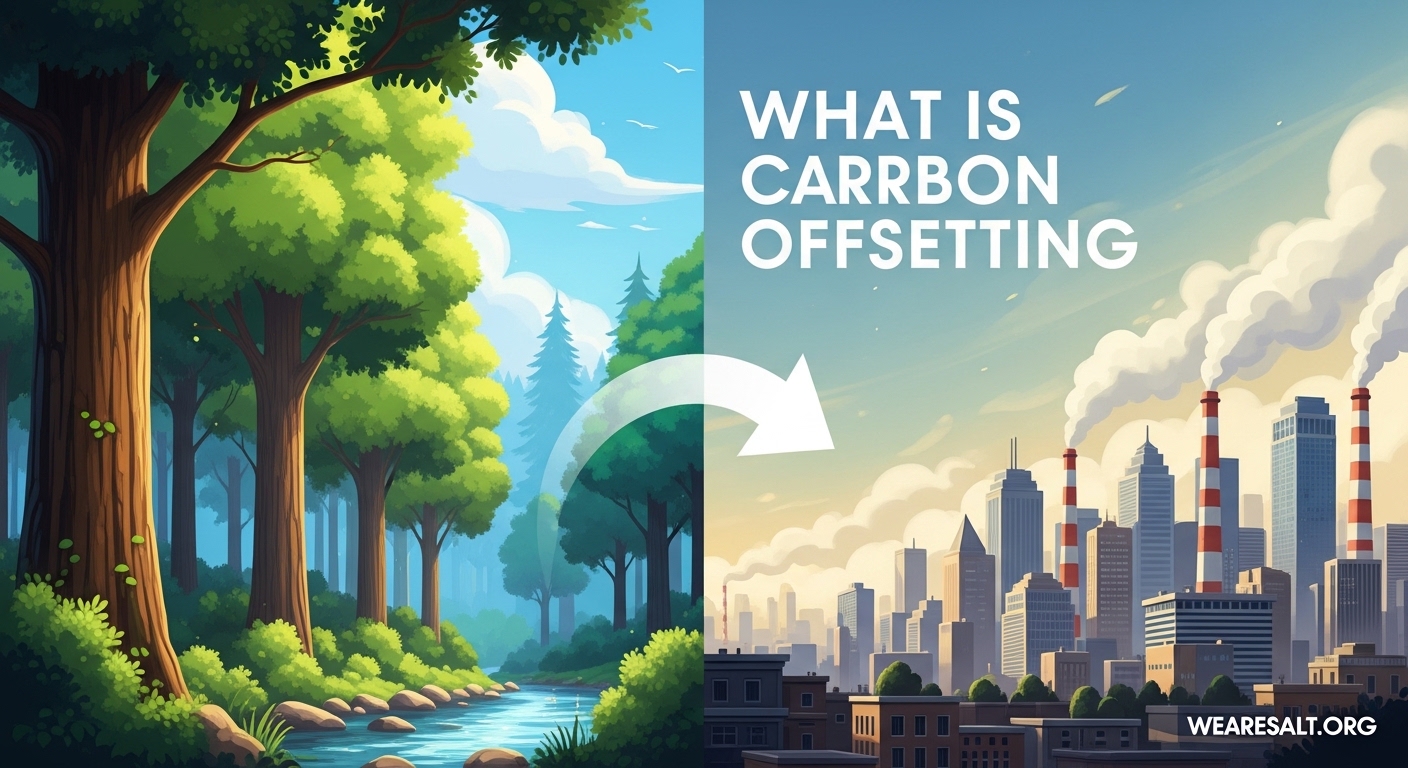
Carbon offsetting is a climate action strategy where individuals or organizations compensate for their greenhouse gas emissions by funding projects that reduce or remove an equivalent amount of CO2 from the atmosphere. Companies, travelers, and environmentally conscious consumers use this mechanism to balance out emissions they cannot yet eliminate from their operations or lifestyle. In 2026, as businesses face increasing pressure to address their environmental impact, understanding what is carbon offsetting has become essential for anyone interested in sustainability.
Our team has researched carbon markets extensively, analyzing how offset projects work and which standards deliver real environmental benefits. This guide breaks down everything you need to know about carbon offsetting in plain language, from the basic mechanism to the controversies surrounding it.
Table of Contents
What Is Carbon Offsetting?
Carbon offsetting is the practice of compensating for greenhouse gas emissions by investing in projects that either remove carbon dioxide from the atmosphere or prevent future emissions. One carbon offset typically represents one metric tonne of CO2 equivalent that has been reduced, avoided, or removed.
The concept emerged from the recognition that while we work toward eliminating emissions entirely, some activities still produce unavoidable greenhouse gases. Rather than simply accepting these emissions, carbon offsetting allows entities to take responsibility for their impact by funding verified environmental projects elsewhere.
The mechanism operates like an accounting system for emissions. When you purchase an offset, you are essentially paying for someone else to reduce or remove a tonne of CO2 on your behalf. This creates a marketplace where emission reductions can be traded, directing capital toward climate solutions that might otherwise lack funding.
Carbon Offsets vs Carbon Credits
People often use these terms interchangeably, but there is a subtle distinction. Carbon credits are the tradable certificates themselves, representing the right to emit one tonne of CO2. Carbon offsetting is the broader practice of using those credits to neutralize emissions. When you hear about buying carbon offsets, you are typically purchasing carbon credits and then retiring them so they cannot be used again.
How Do Carbon Offsets Work?
Understanding how carbon offsetting works requires looking at the step-by-step process from calculation to retirement. The system is designed to ensure that every offset represents a genuine, measurable climate benefit.
Step 1: Calculate Your Carbon Footprint
Before purchasing offsets, you must determine how much you need to offset. For individuals, this might involve calculating emissions from flights, home energy use, and transportation. For companies, this means conducting a full greenhouse gas inventory following protocols like the GHG Protocol, which categorizes emissions into Scope 1 (direct), Scope 2 (indirect from energy), and Scope 3 (value chain).
Step 2: Select an Offset Project
Once you know your emissions, you choose projects to support. These projects must be verified by third-party standards like Gold Standard, Verra, or the Clean Development Mechanism. Each project type has different characteristics, costs, and co-benefits for local communities.
Step 3: Purchase and Retire Credits
After selecting projects, you purchase the corresponding number of credits. The crucial final step is retirement, which means the credits are permanently removed from circulation and cannot be resold. This ensures the emission reduction is only counted once and prevents double counting.
Key Concepts: Additionality, Permanence, and Leakage
Three concepts determine whether an offset delivers real climate benefits. Additionality means the project would not have happened without the offset funding. If a forest would have been protected anyway, the offsets provide no additional climate benefit.
Permanence refers to how long the carbon stays out of the atmosphere. Tree planting projects face permanence risks if forests burn or are logged. Some projects now use buffers or insurance mechanisms to address this.
Leakage occurs when a project simply shifts emissions elsewhere. For example, protecting one forest might cause deforestation to increase in a neighboring area. Quality standards require projects to account for and minimize leakage.
Types of Carbon Offset Projects
Carbon offset projects fall into two main categories: removal projects that take CO2 out of the atmosphere, and avoidance projects that prevent emissions from occurring in the first place.
Removal Offsets
Removal offsets actually extract carbon dioxide from the atmosphere and store it securely. These projects address the carbon that has already been emitted.
Reforestation and Afforestation: Planting trees is the most common removal method. Trees absorb CO2 as they grow, storing carbon in their biomass and soil. Projects range from large-scale forest restoration in the Amazon to community tree-planting initiatives in Africa. The cost typically ranges from $5 to $50 per tonne of CO2 removed.
Direct Air Capture: This technology uses machines to pull CO2 directly from ambient air. While still expensive ($100-$600 per tonne), direct air capture offers permanent storage by injecting captured carbon into geological formations. Companies like Climeworks operate facilities in Iceland that store carbon in basalt rock, where it mineralizes into stone over time.
Soil Carbon Sequestration: Agricultural practices like cover cropping and reduced tillage can increase the amount of carbon stored in soils. These projects often provide additional benefits like improved soil health and crop resilience.
Avoidance Offsets
Avoidance offsets prevent greenhouse gases from entering the atmosphere by replacing high-emission activities with cleaner alternatives.
Renewable Energy Projects: Wind, solar, and hydroelectric projects displace fossil fuel power generation. When you fund a wind farm that replaces a coal plant, you are preventing the coal emissions that would have occurred. These projects are cost-effective, often priced between $1 and $15 per tonne.
Methane Capture: Landfills and agricultural operations produce methane, a greenhouse gas 25 times more potent than CO2. Methane capture projects collect this gas and either flare it (converting it to CO2) or use it to generate electricity. These projects can be highly effective at relatively low cost.
Energy Efficiency: Projects that distribute efficient cookstoves or improve industrial processes reduce fuel consumption and associated emissions. Many cookstove projects in developing countries also improve indoor air quality and reduce firewood collection time for women and children.
Real-World Examples of Carbon Offsetting
Understanding carbon offsetting becomes clearer when we look at specific projects making measurable impacts.
The Kariba REDD+ Project in Zimbabwe protects 784,000 hectares of forest that would otherwise face deforestation pressure. Since 2011, it has prevented over 10 million tonnes of CO2 emissions while creating jobs and funding community health clinics and schools. Verified by Verra, this project demonstrates how forest protection can deliver both climate and social benefits.
Climeworks Orca facility in Iceland represents the cutting edge of direct air capture. Opened in 2021, the facility captures 4,000 tonnes of CO2 annually and stores it permanently underground. While small compared to global emissions, it proves the technology works at scale. Companies like Microsoft and Shopify purchase these high-integrity offsets despite the premium price.
The Gola Forest Project in Sierra Leone protects one of West Africa’s most important remaining rainforests. Verified by the Gold Standard, it protects critical biodiversity habitat including pygmy hippos and forest elephants while preventing an estimated 500,000 tonnes of CO2 emissions annually.
Bhutan provides the most compelling national example of carbon leadership. This small Himalayan kingdom absorbs more carbon than it emits, making it the world’s only carbon negative country. Through constitutional protection of forests covering 70 percent of its land, Bhutan demonstrates that carbon negative status is achievable at the national level.
Carbon Neutral vs Net Zero vs Carbon Negative
These terms appear frequently in climate discussions but have distinct meanings.
Carbon Neutral: Achieved when an entity balances its emissions by purchasing an equivalent amount of offsets. A company might reduce what it can, then offset the remaining emissions to reach net-zero emissions on paper. This is the most common corporate commitment today.
Net Zero: Requires reducing emissions as close to zero as possible, using offsets only for truly unavoidable residual emissions. The Science Based Targets initiative defines net zero as reducing Scope 1, 2, and 3 emissions by at least 90% before 2050, with offsets handling the final 10%. This represents a more ambitious standard than simple carbon neutrality.
Carbon Negative: Means removing more carbon from the atmosphere than you emit. Microsoft has committed to becoming carbon negative by 2030, planning to remove all its historical emissions by 2050. At the national level, Bhutan remains the only carbon negative country, absorbing approximately 4 million tonnes more CO2 than it emits annually through its vast protected forests.
Benefits and Criticisms of Carbon Offsetting
Carbon offsetting generates passionate debate. Understanding both sides helps you evaluate whether offsets make sense for your situation.
Benefits of Carbon Offsetting
Carbon offsetting directs funding to projects that might otherwise lack capital. Many renewable energy and forest protection projects in developing countries rely on offset revenue to achieve financial viability. This market mechanism channels resources to regions that need investment while addressing global emissions.
Offsets provide a pathway for action while emissions reduction infrastructure is built. A company switching to renewable energy might take years to complete the transition. Offsets allow them to take immediate responsibility for emissions during the transition period.
Quality offset projects deliver co-benefits beyond carbon reduction. Reforestation projects restore wildlife habitat. Clean cookstove projects improve public health. Renewable energy projects create local jobs. These additional benefits matter for communities on the ground.
Criticisms and Limitations
The biggest criticism is that carbon offsetting enables business as usual. Companies might purchase cheap offsets rather than reducing their actual emissions. Critics argue this creates a moral hazard where polluters buy indulgences rather than changing behavior. Studies have found that companies purchasing offsets often show slower emission reduction rates than those focusing on direct decarbonization.
Quality varies enormously across the offset market. Some projects overstate their impact or fail to deliver promised emission reductions. The Guardian’s 2023 investigation found that many forest protection credits from Verra-certified projects likely represented phantom reductions that did not represent real climate benefits.
The permanence problem remains unresolved. Trees planted today might burn in a wildfire next year, releasing stored carbon back to the atmosphere. While some projects use buffer pools to compensate for losses, the risk of reversal makes biological offsets less certain than geological storage.
How to Choose Quality Carbon Offsets
Not all carbon offsets are created equal. Here is how to identify high-integrity options.
Look for third-party verification from established standards. Gold Standard, established by WWF, requires projects to demonstrate sustainable development benefits alongside emission reductions. Verra’s Verified Carbon Standard (VCS) is the most widely used program, though quality varies by project. The Climate Action Reserve focuses on North American projects with rigorous protocols.
Prioritize removal over avoidance where possible. While avoidance projects like renewable energy provide important benefits, removal projects that actually extract carbon from the atmosphere address the accumulated CO2 already in the atmosphere. Direct air capture and reforestation with long-term protection agreements offer more durable climate benefits.
Check for transparency and documentation. Quality providers disclose project locations, methodologies, and verification reports. Avoid offsets sold without clear information about what project they support or how calculations were performed.
Consider the price as a quality signal. Offsets priced below $5 per tonne likely cannot fund projects with rigorous monitoring and verification. While price alone does not guarantee quality, extremely cheap offsets should raise questions about additionality and permanence.
Frequently Asked Questions About Carbon Offsetting
What is the biggest problem with carbon offsetting?
The biggest problem is the risk of greenwashing, where companies use low-quality offsets to claim climate action without reducing their actual emissions. Many offset projects fail to deliver promised reductions due to issues with additionality (the project would have happened anyway), permanence (stored carbon gets released), or leakage (emissions shift to other locations). The 2023 Guardian investigation found that up to 90% of some rainforest offset credits may not represent real emission reductions.
What is an example of a carbon offset?
A common example is funding a verified reforestation project that plants trees to absorb CO2 from the atmosphere. For instance, you might pay $15 to offset one tonne of CO2 from a flight by supporting a project like the Kariba REDD+ Project in Zimbabwe, which protects existing forests from deforestation. Another example is funding direct air capture facilities that use machines to extract CO2 and store it underground permanently.
What is the only country that is carbon negative?
Bhutan is currently the only carbon negative country in the world. Through its constitutionally mandated forest protection covering over 70% of its land, Bhutan absorbs approximately 4 million tonnes more CO2 than it emits annually. The country generates substantial hydropower exports (which count as avoided emissions for importing countries) while maintaining vast carbon-absorbing forests that sequester significantly more carbon than the nation’s small population produces.
Is carbon offsetting just greenwashing?
Carbon offsetting becomes greenwashing when companies use it to claim environmental responsibility while continuing to increase their emissions. However, when used properly as part of a comprehensive decarbonization strategy, offsets serve a legitimate role in addressing unavoidable emissions and funding climate solutions. The key difference is whether offsets supplement genuine emission reduction efforts or substitute for them. High-quality verified offsets from removal projects with transparent monitoring represent real climate action, not greenwashing.
Conclusion: What Is Carbon Offsetting and Should You Use It?
Carbon offsetting is a mechanism for compensating greenhouse gas emissions by funding projects that reduce or remove an equivalent amount of CO2 from the atmosphere. When used responsibly, it channels capital toward climate solutions and helps address emissions that are currently difficult to eliminate entirely.
However, carbon offsetting is not a substitute for emission reduction. The most effective approach combines aggressive direct decarbonization with high-quality offsets for truly unavoidable emissions. Look for removal projects verified by Gold Standard or similar rigorous programs, and view offsetting as one tool in a broader climate strategy rather than a complete solution.
As carbon markets mature in 2026, expect greater transparency and higher standards. The shift toward direct air capture and other permanent removal technologies offers promise for more durable climate benefits. Whether you are an individual offsetting a flight or a company pursuing net zero, understanding what is carbon offsetting and its limitations helps you make informed choices that actually benefit the climate.