
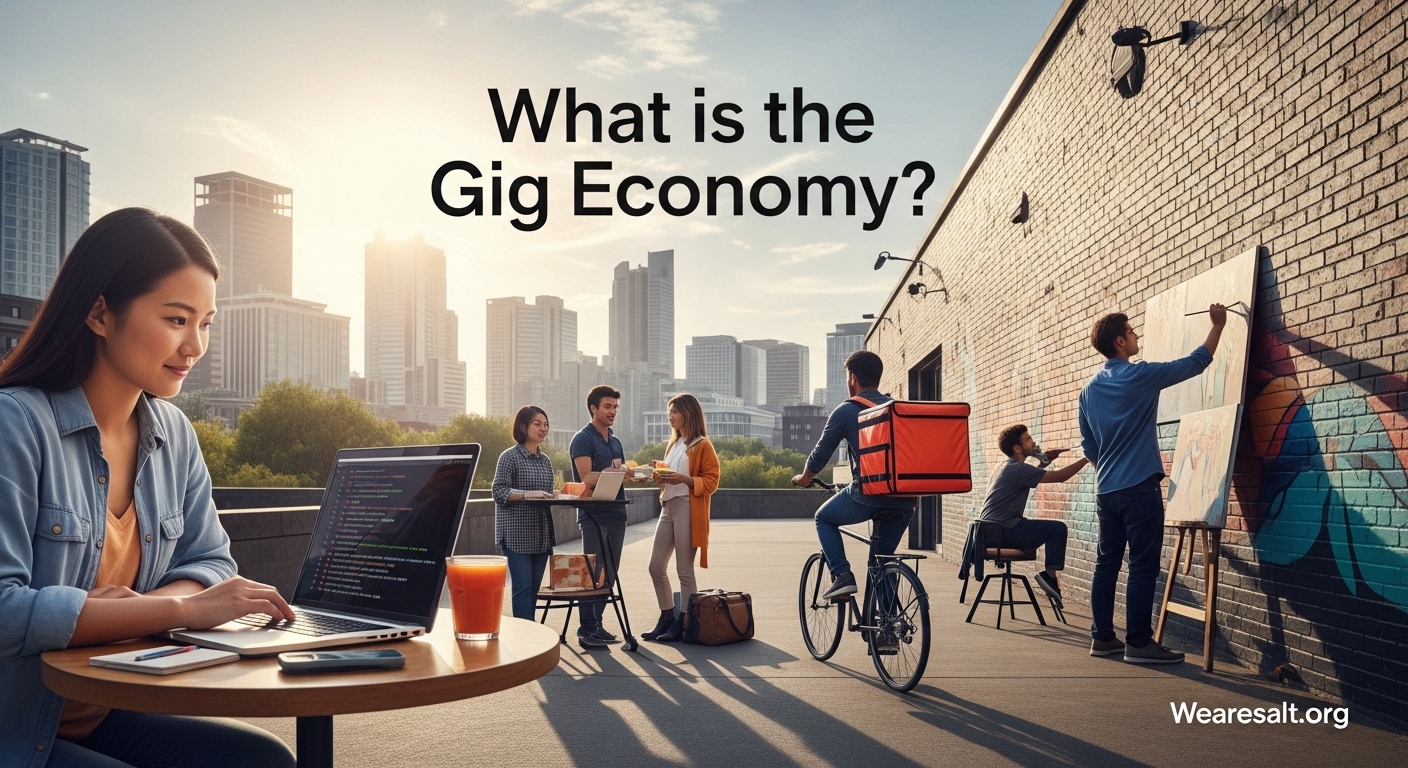
The gig economy is a labor market characterized by short-term, flexible, and freelance work engagements rather than traditional permanent employment. In 2026, approximately 64 million Americans participate in gig work, contributing an estimated $1.27 trillion to the economy annually. This represents a fundamental shift in how people work, earn income, and structure their careers.
The term “gig” actually comes from the music industry. Jazz musicians in the early 1900s called individual performances “gigs,” borrowing from the word “engagement.” When a musician booked a one-night performance at a club, that was a gig. The term eventually expanded to describe any temporary or project-based work arrangement.
I have spent years researching labor market trends, and the gig economy is one of the most significant economic transformations of our time. This guide explains exactly what the gig economy is, how it works, who participates, and what it means for workers and employers.
Table of Contents
What is the Gig Economy
The gig economy is an economic system where independent workers engage in short-term, task-based engagements with companies or clients, typically facilitated through digital platforms. Unlike traditional employment, gig workers are classified as independent contractors rather than employees.
Digital platforms serve as intermediaries connecting workers with customers who need services. These platforms handle matching, payment processing, ratings, and dispute resolution. The worker completes the task, receives payment, and moves on to the next opportunity.
Common examples include Uber and Lyft for transportation, DoorDash and Instacart for delivery, Fiverr and Upwork for freelance services, and TaskRabbit for household tasks. Each platform specializes in matching specific skills or assets with customer demand.
How the Gig Economy Works
The gig economy operates through a three-party system: the platform, the worker, and the customer. The platform develops technology that connects supply (workers) with demand (customers), earning revenue through transaction fees or service charges.
Workers sign up through apps or websites, complete background checks when required, and gain access to available gigs. They can typically choose when to work, which jobs to accept, and how much effort to invest. This flexibility is the primary attraction for many participants.
Customers benefit from on-demand access to services without the overhead of maintaining employees. Need a ride across town? Open Uber. Need furniture assembled? Book a TaskRabbit worker. Need a logo designed? Post on Fiverr. The friction of finding and hiring help has been reduced to a few taps on a smartphone.
Types of Gig Work
Gig work spans multiple industries and skill levels. Here are the major categories:
Transportation and Delivery: Ride-sharing through Uber and Lyft, food delivery via DoorDash and Grubhub, grocery delivery through Instacart, and package delivery for Amazon Flex. These are among the most visible and widely used gig services.
Creative and Professional Services: Freelance writing, graphic design, web development, photography, and consulting through platforms like Fiverr, Upwork, and 99designs. These gigs often require specialized skills and command higher rates.
Task-Based Services: Household chores, furniture assembly, moving help, and handyman services through TaskRabbit, Handy, and Thumbtack. These platforms connect people needing physical help with local workers.
Asset Sharing: Renting spare rooms through Airbnb, sharing vehicles through Turo, or even renting tools and equipment. This category turns idle assets into income generators.
Care and Wellness: Pet sitting through Rover, tutoring through Wyzant, and wellness services through various specialized platforms.
Research firm McKinsey categorizes independent workers into four segments: free agents who choose independent work and prefer it, casual earners who supplement income with occasional gigs, reluctants who would prefer traditional jobs but take gigs out of necessity, and the financially strapped who do gig work because they cannot find traditional employment.
Who Works in the Gig Economy
Gig workers represent a diverse cross-section of the population, though participation varies significantly by generation and circumstance.
Gen Z and millennials participate in gig work at higher rates than older generations. Many younger workers value flexibility and work-life balance over traditional job security. They are also more comfortable with technology-mediated employment relationships.
Supplemental income is the primary motivation for approximately 70% of gig workers. These individuals maintain traditional employment but use gig work to pay off debt, save for goals, or handle unexpected expenses. For the remaining 30%, gig work represents their primary or sole source of income.
Globally, China has the largest gig economy with over 200 million gig workers, representing a significant portion of their workforce. In the United States, gig work participation has grown steadily, accelerated by the pandemic which forced many to seek alternative income sources.
Advantages of the Gig Economy
The gig economy offers compelling benefits for both workers and businesses.
Schedule Flexibility: Workers control when they work and for how long. Parents can work around childcare schedules. Students can earn between classes. Caregivers can work when their responsibilities allow. This autonomy is the most frequently cited benefit in surveys.
Multiple Income Streams: Workers can combine multiple gig platforms or mix gig work with traditional employment. This diversification provides some protection if one income source declines.
Low Barriers to Entry: Most gig platforms require minimal qualifications beyond a background check and basic requirements like a driver’s license or smartphone. This accessibility helps people who might struggle to secure traditional employment.
Employer Cost Savings: Companies avoid the 1.25 to 1.4 times salary multiplier that comes with traditional employees. No health insurance, no retirement contributions, no paid leave, no payroll taxes. This makes gig labor significantly cheaper for businesses.
Access to Specialized Skills: Businesses can hire experts for specific projects without committing to long-term employment. A startup might hire a freelance designer for their logo, a developer for their website, and a copywriter for their content.
Challenges and Risks
Despite the benefits, gig work presents significant challenges that potential participants must understand.
Income Unpredictability: Earnings fluctuate based on demand, competition, seasonality, and platform algorithm changes. One week might bring strong earnings while the next barely covers gas expenses. This volatility makes budgeting extremely difficult.
No Traditional Benefits: Gig workers receive no health insurance, paid sick leave, vacation time, or retirement contributions. They must fund these entirely themselves, which many cannot afford. A medical emergency or car repair can devastate a gig worker’s finances.
Tax Burden: Self-employment tax adds 15.3% to income tax obligations, covering Social Security and Medicare that employers normally split with employees. Gig workers pay the full amount themselves, plus must make quarterly estimated tax payments.
Lower Effective Pay: Research shows gig workers earn 50-65% of what traditional employees make for similar work when accounting for expenses, unpaid time between gigs, and lack of benefits. Competition on platforms often drives rates down further as workers undercut each other.
Mental Health Impact: Studies indicate gig workers report lower mental health and life satisfaction than full-time employees. The lack of workplace community, constant hustle for the next gig, and financial stress take a significant toll.
No Career Progression: Gig work rarely offers advancement, skill development, or mentorship. Workers perform the same tasks repeatedly without building toward higher-paying opportunities or management roles.
Financial Considerations for Gig Workers
Gig workers must manage finances differently than traditional employees.
Tax Obligations: Unlike employees who have taxes withheld, gig workers must track income and expenses, calculate quarterly estimated taxes, and file Schedule C with their tax returns. Platforms issue Form 1099 when payments exceed $600 annually.
Expense Tracking: Vehicle expenses, phone bills, equipment, and supplies may be deductible. Workers should maintain detailed records including mileage logs, receipts, and business purpose documentation.
Budgeting Strategies: Financial advisors recommend gig workers maintain larger emergency funds, typically 6-12 months of expenses rather than the standard 3-6 months. Income averaging over several months helps establish realistic spending limits.
Retirement Savings: Without employer-sponsored plans, gig workers must fund retirement themselves through SEP-IRAs, Solo 401ks, or traditional IRAs. The tax advantages are substantial but require proactive planning.
Gig Economy vs Traditional Employment
Understanding the differences helps workers make informed decisions about their career paths.
| Factor | Gig Economy | Traditional Employment |
|---|---|---|
| Worker Classification | Independent contractor | Employee |
| Schedule Control | Worker sets hours | Employer sets hours |
| Income Stability | Variable and unpredictable | Fixed and predictable |
| Health Insurance | Self-funded or none | Employer-subsidized |
| Retirement Contributions | Self-funded only | Employer may match |
| Paid Leave | None | Sick days and vacation |
| Taxes | Self-employment tax (15.3%) | Split with employer |
| Career Development | Limited | Training and advancement |
| Job Security | None | Some protections |
Legal and Regulatory Landscape
The classification of gig workers as independent contractors rather than employees remains hotly contested.
California’s AB5 law, passed in 2019, established stricter criteria for classifying workers as independent contractors. The law aimed to force gig companies to treat workers as employees with benefits and protections. Gig companies responded with Proposition 22, a ballot measure that exempted app-based drivers from AB5 while providing some limited benefits.
In the United Kingdom, the Supreme Court ruled in 2021 that Uber drivers should be classified as workers entitled to minimum wage, holiday pay, and other protections. This ruling has influenced legal debates in other countries.
The fundamental tension persists: gig companies argue their platforms merely connect independent contractors with customers, while critics contend these companies exercise sufficient control over workers to constitute employment relationships. Legislative and court battles continue across jurisdictions.
FAQ: Common Questions About the Gig Economy
What does gig stand for?
The word gig in gig economy comes from the music industry slang for a live musical performance or engagement. Jazz musicians in the early 1900s used the term to describe one-night performances at clubs or venues. The term evolved to describe any temporary or project-based work arrangement.
Why do they call it the gig economy?
It is called the gig economy because work is organized around individual tasks or gigs rather than ongoing employment relationships. Each assignment is a separate gig with defined parameters, payment, and completion criteria. The term distinguishes this model from traditional jobs where workers have continuous employment with a single employer.
Is the gig economy good or bad?
The gig economy offers both benefits and drawbacks. It provides flexibility and income opportunities for people who need them, but it also lacks traditional employment protections and benefits. Whether it is good or bad depends on individual circumstances, needs, and alternatives available. For supplemental income, it can be beneficial. For primary income, the instability and lack of benefits create significant challenges.
Which country has the biggest gig economy?
China has the largest gig economy globally with over 200 million gig workers. In the United States, approximately 64 million people participate in gig work. India, the United Kingdom, and Brazil also have substantial gig economies, though accurate global comparisons are difficult due to varying definitions and measurement methods.
How do gig workers pay taxes?
Gig workers pay taxes as self-employed individuals. They must report all income, even without receiving a Form 1099. They pay self-employment tax of 15.3% covering Social Security and Medicare, plus regular income tax. Quarterly estimated tax payments are required to avoid penalties. Deductible business expenses can reduce taxable income.
What percentage of income do gig workers keep?
After accounting for expenses, self-employment taxes, lack of benefits, and unpaid time between gigs, research suggests gig workers effectively earn 50-65% of what traditional employees make for comparable work. Platform fees typically take 20-30% of gross earnings. Vehicle expenses, insurance, and phone costs further reduce take-home pay.
Conclusion
The gig economy represents a fundamental restructuring of the labor market toward flexible, task-based work arrangements. What is the gig economy? It is an economic system where 64 million Americans earn income through short-term engagements, digital platforms, and independent contractor relationships rather than traditional employment.
This model offers genuine benefits including schedule flexibility, low barriers to entry, and supplemental income opportunities. However, the trade-offs are substantial: income unpredictability, lack of benefits, higher tax burdens, and limited career progression.
Whether gig work makes sense depends entirely on individual circumstances. For someone seeking supplemental income with a stable primary job, the flexibility can be valuable. For someone relying on gig work as their sole income source, the instability and lack of protections create real hardship.
As technology continues evolving and regulatory frameworks adapt, the gig economy will likely remain a significant part of how work gets done. Understanding its mechanics, benefits, and risks helps workers make informed decisions about their participation.