
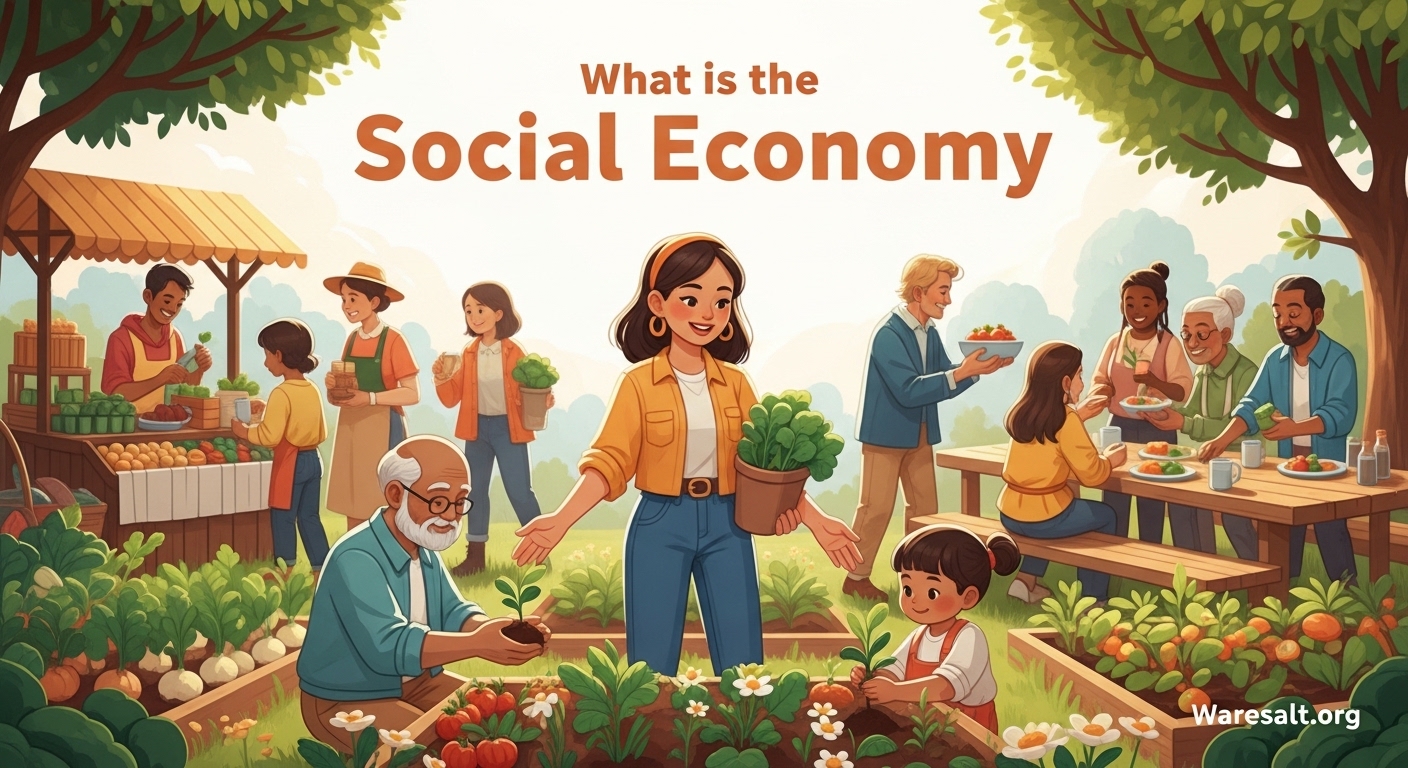
The social economy represents a different way of thinking about how we organize economic activity. It is a sector where organizations prioritize people and social purpose over maximizing profit for shareholders. I have spent years researching alternative economic models, and the social economy stands out as one of the most significant yet misunderstood concepts in modern economics.
At its core, the social economy consists of enterprises and organizations that put social and environmental goals at the center of their mission. These entities reinvest their profits to serve their members or society rather than distributing them to external investors. According to recent estimates, the social economy accounts for approximately 7% of global GDP and provides employment for over 12% of the world’s workforce.
In 2026, the United Nations passed a resolution recognizing the social economy as a key driver for achieving the Sustainable Development Goals. This marked a turning point in how governments and institutions view these organizations. Understanding the social economy matters because it offers proven alternatives to traditional capitalism and state control.
Table of Contents
What is the Social Economy?
The social economy refers to a diverse universe of enterprises and organizations that share common values and principles. These include cooperatives, mutual benefit societies, associations, foundations, and social enterprises. Each type serves different needs, but they all operate with a primary focus on people rather than capital.
The European Union defines the social economy through its Social Economy Action Plan as entities that meet specific criteria. These organizations must prioritize people over profit, demonstrate democratic governance, and maintain autonomy from public authorities. They must also practice voluntary cooperation and reinvest surpluses toward their social objectives.
The International Labour Organization (ILO) adds another dimension to this definition. It emphasizes that social economy organizations create jobs, provide goods and services, and contribute to social inclusion. The OECD similarly recognizes these entities as playing a vital role in building resilient and inclusive economies.
What makes the social economy distinct is not the legal form an organization takes. Rather, it is the combination of values, principles, and practices that guide how they operate. These organizations exist across all sectors, from agriculture and housing to finance and healthcare.
Key Principles of the Social Economy
Social economy organizations share five fundamental principles that distinguish them from traditional businesses. These principles shape their governance, operations, and relationships with stakeholders. Understanding these principles helps clarify what makes an organization part of the social economy.
Primacy of People Over Capital
The first and most important principle is that people take priority over capital. In traditional corporations, shareholder returns often drive decision-making. Social economy organizations flip this relationship. They exist to serve their members, employees, or the broader community rather than to maximize financial returns for external investors.
This principle manifests in practical ways. Worker cooperatives give employees ownership and control of their workplace. Consumer cooperatives focus on providing quality goods at fair prices to their members. Social enterprises hire people from disadvantaged backgrounds even when it might not maximize short-term profits.
Reinvestment of Surpluses
The second principle involves how these organizations handle profits or surpluses. Rather than distributing them to shareholders or owners, social economy entities reinvest the majority back into their social mission. This might mean expanding services, improving working conditions, or funding community projects.
Some social economy organizations do distribute limited returns to members. Credit unions, for example, may pay dividends to account holders. However, the primary purpose remains serving the collective interest rather than generating individual wealth.
Democratic Governance
The third principle centers on democratic participation in decision-making. Social economy organizations typically operate on a one-member, one-vote basis rather than one-share, one-vote. This ensures that control remains with the people who use, work for, or are served by the organization.
In a cooperative, for instance, each member has equal voting rights regardless of how much money they have invested. In an association, members elect the board of directors through democratic processes. This structure prevents any single individual or group from dominating the organization.
Autonomy and Independence
The fourth principle requires social economy organizations to maintain autonomy from both government and traditional private enterprise. They must be self-governing and independent in their operations. This does not mean they cannot receive public funding or form partnerships.
Rather, it means they control their own destiny. They set their own strategic direction, manage their own affairs, and remain accountable to their members rather than to external authorities. This independence allows them to pursue their social mission even when it conflicts with political or commercial pressures.
Voluntary Cooperation
The fifth principle emphasizes that membership and participation must be voluntary. No one can be forced to join a social economy organization or to remain a member against their will. This principle reflects the democratic ethos that underpins the entire sector.
Voluntary cooperation also extends to how organizations work together. Many social economy entities form networks, federations, and alliances to amplify their impact. These relationships are built on mutual support and shared values rather than competitive advantage.
Types of Social Economy Organizations
The social economy encompasses several distinct types of organizations, each with its own characteristics and legal structures. Understanding these different forms helps illustrate the diversity within the sector. Here are the five main types you will encounter.
Cooperatives
Cooperatives are businesses owned and democratically controlled by their members. Members can be workers, consumers, producers, or residents depending on the cooperative type. The cooperative model has proven successful across virtually every industry, from agriculture and retail to banking and housing.
The largest cooperatives rival traditional corporations in size and revenue. The Mondragon Corporation in Spain employs over 80,000 people across multiple industries. Credit unions in the United States serve over 120 million members. These examples demonstrate that cooperatives can compete at scale while maintaining their values.
Mutual Benefit Societies
Mutual benefit societies, also called mutuals or mutual organizations, are entities that provide insurance, pension, or other benefits to their members. They operate on a not-for-profit basis, with any surpluses returned to members or used to improve services.
These organizations have deep historical roots, particularly in Europe. Many modern insurance companies began as mutuals. While some have demutualized and converted to shareholder ownership, significant mutual sectors remain in countries like France, Germany, and the United Kingdom.
Associations
Associations are membership organizations formed to pursue shared interests or objectives. They range from small local clubs to large professional bodies and advocacy groups. Unlike cooperatives, associations typically do not engage in commercial activity as their primary purpose.
Trade unions, professional associations, hobby clubs, and advocacy groups all fall under this category. They serve important functions in civil society, providing representation, community, and collective voice for their members. Many associations also deliver services and undertake charitable activities.
Foundations
Foundations are organizations established to pursue charitable, educational, or social purposes. They are typically funded by endowments or donations rather than commercial activity. Foundations play a crucial role in philanthropy, research funding, and social innovation.
The foundation model allows wealthy individuals and corporations to dedicate resources to public benefit. However, foundations also exist that were created by social economy enterprises to manage their philanthropic activities. These corporate foundations extend the social mission of their parent organizations.
Social Enterprises
Social enterprises represent a hybrid category that combines commercial activity with explicit social objectives. They sell goods or services in the market but measure their success primarily by their social impact. Many social enterprises adopt cooperative or association legal forms, but they can also take other structures.
The social enterprise category has grown rapidly in recent decades. It includes businesses that employ people with disabilities, companies that reinvest profits into community development, and organizations that provide essential services in underserved areas. The key distinction is their commitment to social purpose as a primary rather than secondary goal.
Global Impact and Recognition
The social economy is not a fringe phenomenon. It represents a significant portion of economic activity worldwide and has gained increasing recognition from international institutions. In 2026, the global scale and importance of this sector became impossible to ignore.
The UN Resolution of 2023
In April 2023, the United Nations General Assembly adopted a resolution on promoting the social and solidarity economy for sustainable development. This resolution, co-sponsored by 37 countries, marked the first time the UN officially recognized the sector’s role in achieving the Sustainable Development Goals.
The resolution called on member states to create supportive policy environments for social economy development. It highlighted the sector’s contributions to decent work, social inclusion, and environmental sustainability. This international recognition has accelerated policy attention in countries that previously overlooked the social economy.
Global Statistics
The numbers demonstrate the social economy’s significance. Studies estimate that social economy organizations account for approximately 7% of global GDP. This represents trillions of dollars in economic activity. In terms of employment, the sector provides jobs for over 200 million people worldwide, roughly 12% of the global workforce.
These figures likely understate the true scale because many social economy organizations are not formally registered or measured. In some regions, informal cooperatives and associations operate below the radar of official statistics. The actual economic contribution may be substantially higher than current estimates suggest.
Regional Variations
The social economy takes different forms in different parts of the world. Europe has the most developed policy framework, with the EU Social Economy Action Plan providing coordinated support. Countries like France, Italy, and Spain have particularly strong traditions of cooperatives and mutuals.
In Latin America, the solidarity economy movement has deep roots in indigenous traditions of reciprocity and community organization. African countries have vibrant cooperative sectors, particularly in agriculture and finance. Asian nations like Japan and South Korea have significant cooperative and social enterprise presence.
Social Economy vs Related Terms
Confusion often arises between the social economy and related concepts. These terms sound similar but refer to different things. Clarifying these distinctions helps avoid misunderstanding.
Social Economy vs Socialism
The social economy is not the same as socialism. Socialism refers to a political and economic system where the state owns and controls the means of production. The social economy, by contrast, operates within mixed economies alongside traditional private enterprise and public services.
Social economy organizations are voluntary and autonomous. They are not state-controlled or centrally planned. While some socialist governments have supported cooperatives, the social economy concept transcends any single political ideology. Conservative, liberal, and socialist governments alike have implemented policies to support the sector.
Social Economy vs Socioeconomics
Socioeconomics is an academic field that studies the relationship between economic activity and social behavior. It is a discipline of study, not a type of organization or sector. The social economy is an actual sector of enterprises and organizations.
A researcher might study the social economy using socioeconomic methods. However, the terms are not interchangeable. One refers to a category of economic entities, the other to an analytical approach.
Social Economy vs Third Sector
The third sector traditionally refers to non-governmental organizations that are neither businesses nor government agencies. While there is significant overlap with the social economy, the concepts differ. Not all third sector organizations engage in economic activity, which is a defining feature of the social economy.
Similarly, not all social economy organizations fit neatly into the third sector category. Some cooperatives and mutuals compete directly with traditional businesses in commercial markets. The social economy blurs the boundaries between sectors rather than fitting entirely outside them.
Benefits to Society
The social economy delivers tangible benefits that traditional economic models often fail to provide. These benefits explain why governments and international organizations have increasingly embraced the sector. Here are the key contributions social economy organizations make.
Inclusive Growth
Social economy organizations create economic opportunities for people often excluded from traditional employment. Worker cooperatives provide ownership to employees who would never accumulate enough capital to buy a business. Social enterprises hire people with disabilities, long-term unemployment, or criminal records who face discrimination in the regular labor market.
This inclusive approach generates economic activity that might not otherwise occur. By bringing marginalized populations into productive work, the social economy expands the economic base and reduces social costs associated with exclusion.
Community Development
Many social economy organizations are rooted in specific communities and reinvest locally. Community-owned shops, cooperative housing, and local credit unions keep money circulating within the community. This creates multiplier effects that strengthen local economies.
During economic downturns, these community-based organizations often prove more resilient than external corporations. They are less likely to close facilities or relocate operations because their commitment extends beyond profit maximization to community well-being.
Sustainable Development
The social economy naturally aligns with sustainable development goals. Because these organizations do not face pressure to maximize short-term shareholder returns, they can prioritize long-term environmental and social outcomes. Many social economy organizations were early adopters of renewable energy, organic agriculture, and circular economy practices.
The UN recognition of the social economy explicitly links it to sustainable development. The sector provides models for how economic activity can contribute to environmental protection and social equity simultaneously.
Support for Vulnerable Populations
Social economy organizations often emerge to address needs that markets ignore and governments underfund. Housing cooperatives provide affordable homes in expensive cities. Healthcare cooperatives deliver services in underserved rural areas. Social enterprises create employment for people facing significant barriers to work.
This gap-filling role makes the social economy essential for social protection. Without these organizations, many vulnerable populations would lack access to basic services and economic opportunity.
Frequently Asked Questions
What does social economy mean?
The social economy refers to enterprises and organizations that prioritize people and social purpose over profit maximization. It includes cooperatives, mutual benefit societies, associations, foundations, and social enterprises that operate according to principles like democratic governance, reinvestment of surpluses, and voluntary cooperation.
What does social economic mean?
Social economic refers to the intersection of social and economic activity. It describes how economic decisions and systems affect social outcomes, or how social relationships and values shape economic behavior. The term relates to the study of socioeconomic factors and their impacts on society.
What is a socialist economy in simple terms?
A socialist economy is a system where the government or community owns and controls the means of production, distribution, and exchange. Unlike the social economy, which operates within mixed economies through voluntary organizations, socialism represents an alternative to capitalism where private property and market mechanisms are limited or eliminated.
What are examples of social economy organizations?
Examples include worker cooperatives like Mondragon Corporation, credit unions, mutual insurance companies, community foundations, fair trade organizations, social enterprises like Divine Chocolate, housing cooperatives, agricultural cooperatives, and nonprofit organizations that deliver social services through commercial activity.
Conclusion
The social economy offers a compelling alternative to the traditional dichotomy between profit-maximizing corporations and state-controlled enterprises. By prioritizing people over capital, practicing democratic governance, and reinvesting surpluses for social benefit, these organizations demonstrate that economic activity can serve broader societal goals.
With recognition from the United Nations in 2026 and representation of 7% of global GDP, the social economy has moved from the margins to the mainstream of economic discourse. Whether you are looking for ethical investment opportunities, considering employment with a values-driven organization, or simply seeking to understand how the economy can work differently, the social economy provides answers worth exploring.
As our global challenges become more complex, the social economy offers models for building resilient, inclusive, and sustainable communities. The question is no longer whether the social economy matters, but how we can support its growth and learn from its successes.