
Understanding equity vs equality in the workplace can feel like untangling two threads that look identical at first glance. I remember the first time a colleague asked me to explain the difference during a team training session. I fumbled through an answer that barely scratched the surface.
These terms get thrown around interchangeably in DEI conversations, HR policies, and LinkedIn posts. But treating them as synonyms creates confusion that hurts your team and your business. This guide cuts through the noise with clear definitions, real workplace examples, and practical steps to build a truly fair environment where every employee can succeed.
Table of Contents
What Is Equality in the Workplace?
Equality in the workplace means treating every employee the same way regardless of their individual circumstances. Your organization gives everyone identical access to resources, opportunities, and benefits using a one-size-fits-all approach.
The core principle behind equality centers on fairness through uniformity. Every person receives the same tools, follows identical processes, and gets measured against universal standards. Companies that prioritize equality believe that removing preferential treatment creates a level playing field.
Examples of workplace equality include offering the same salary band for a position regardless of who fills it, providing identical equipment to every team member, and applying consistent performance metrics across your organization. These practices aim to prevent favoritism and discrimination by treating cases identically.
However, equality alone fails to account for systemic barriers and individual needs. A new parent returning from leave faces different challenges than a recent graduate. A person with a disability requires different accommodations than someone without one. When you treat these employees identically, you often perpetuate inequities rather than solving them.
What Is Equity in the Workplace?
Equity in the workplace means providing customized support and resources based on individual circumstances to ensure everyone can succeed. Rather than treating everyone identically, equity recognizes that people start from different positions and need different tools to reach the same outcomes.
The foundation of workplace equity rests on fairness through customization. Your organization acknowledges that systemic barriers, personal circumstances, and historical disadvantages create uneven starting points. Equity addresses these imbalances by tailoring opportunities, removing barriers, and providing targeted support where needed.
Workplace equity definition extends beyond simple accommodations. It encompasses hiring practices that reach underrepresented candidates, promotion processes that account for caregiving gaps, and benefits packages that recognize diverse family structures. It means looking at your employee lifecycle through an intersectional lens that considers how race, gender, disability, age, and socioeconomic status interact to create unique experiences.
Companies practicing equity conduct regular audits of their policies and outcomes. They ask hard questions about who gets promoted, whose voices get heard in meetings, and which employees feel safe bringing their full selves to work. This ongoing examination reveals where invisible barriers persist despite good intentions.
Key Differences: Equity vs Equality in the Workplace
Understanding equity vs equality in the workplace requires looking at how these concepts play out in practice. The differences run deeper than simple definitions.
| Aspect | Equality | Equity |
|---|---|---|
| Core Approach | Same treatment for everyone | Customized support based on needs |
| Starting Point | Assumes everyone begins from same position | Acknowledges different starting points |
| Resource Distribution | Identical resources for all | Tailored resources based on circumstances |
| Focus Area | Processes and opportunities | Outcomes and barriers |
| Barrier Handling | Ignores or overlooks barriers | Actively identifies and removes barriers |
| Success Measurement | Equal access metrics | Outcome parity across groups |
Why Equality Falls Short
Equality focuses on giving everyone the same thing. This approach works fine when people share similar circumstances and face identical barriers. But in reality, your workforce includes people with vastly different backgrounds, responsibilities, and challenges.
A parent working remotely needs different scheduling flexibility than a single employee living downtown. Someone managing a chronic illness requires different healthcare coverage than a healthy twenty-something. When you apply identical policies to these different situations, you create advantages for some while leaving others behind.
How Equity Creates True Fairness
Equity acknowledges that fairness does not mean sameness. It recognizes the systemic barriers that prevent equal participation and actively works to dismantle them. This approach sits at the heart of modern DEIB initiatives.
Diversity, equity, inclusion, and belonging work together when equity addresses the structural imbalances that diversity alone cannot fix. You might hire a diverse workforce (diversity), but without equity, those employees face barriers that prevent their advancement. Without inclusion, they do not feel welcome. Without belonging, they never truly engage.
Real-World Examples of Equity vs Equality in the Workplace
Concrete scenarios help clarify how equity vs equality examples play out in actual workplace situations. These examples show why customized approaches often serve fairness better than identical treatment.
Example 1: Professional Development Opportunities
An equality approach gives every employee $1,000 annually for training and development. Everyone receives the same amount, selected through an identical application process.
An equity approach recognizes that some employees lack professional networks, prior educational advantages, or time outside work for self-directed learning. The company creates targeted mentorship programs for underrepresented groups, offers childcare during training sessions for working parents, and provides additional support for first-generation professionals navigating corporate culture.
Example 2: Workplace Accommodations
An equality approach provides every employee with the same standard desk, chair, and computer setup. No exceptions made for individual needs.
An equity approach asks employees what they need to do their best work. Someone with back problems receives an ergonomic chair. A person with visual impairments gets screen magnification software. An employee with ADHD receives noise-canceling headphones. The goal remains consistent productivity and comfort, but the path there varies based on individual requirements.
Example 3: Hiring and Recruitment
An equality approach posts job openings on the company website and standard job boards. Every applicant goes through the same screening process using identical criteria.
An equity approach recognizes that traditional hiring channels often exclude qualified candidates from underrepresented backgrounds. The company partners with historically black colleges and universities, attends community job fairs in diverse neighborhoods, and removes degree requirements from positions where skills matter more than credentials. Interview panels include diverse perspectives to reduce unconscious bias.
Example 4: Promotion Decisions
An equality approach promotes based strictly on years of service and performance metrics. Everyone competes using the same criteria regardless of life circumstances.
An equity approach examines how caregiving responsibilities, health challenges, or systemic barriers might have impacted an employee’s trajectory. The company creates sponsorship programs for women returning from maternity leave and ensures that part-time workers can access advancement opportunities. Performance evaluations account for the context behind results, not just raw numbers.
Example 5: Pay and Compensation
An equality approach sets salary bands based on job title and experience level alone. Everyone in the same role receives identical base pay.
An equity approach conducts regular pay equity analysis to identify and correct disparities. The company examines whether women and people of color receive equal compensation for equal work, adjusting for any unexplained gaps. Benefits packages offer choices that accommodate different family structures and healthcare needs rather than assuming a traditional nuclear family model.
Why Equity Matters More Than Equality at Work
The business case for equity extends far beyond moral arguments. Organizations that embrace workplace equity consistently outperform those clinging to equality-only frameworks.
Employee Retention and Satisfaction
Companies with strong equity practices see dramatically higher retention rates. Employees who feel their unique needs are recognized and supported stay longer and engage more deeply. Research from 2026 shows that inclusive workplaces with robust equity policies experience 22% lower turnover than their peers.
When employees know their organization will adapt to their circumstances, they bring their full energy and creativity to work. They do not waste mental bandwidth hiding aspects of their identity or managing barriers their colleagues never face.
Innovation and Problem-Solving
Diverse teams with equity support generate more innovative solutions. When people from different backgrounds feel genuinely included, they challenge assumptions and introduce perspectives that homogenous groups miss.
McKinsey’s research consistently shows that companies in the top quartile for ethnic and gender diversity outperform those in the bottom quartile by 25-36% on profitability metrics. But diversity alone does not drive these results. Equity ensures that diverse voices have power and influence, not just presence.
Competitive Advantage in Talent Markets
Job seekers increasingly prioritize employers with demonstrated equity commitments. Glassdoor reports that 76% of employees and job seekers consider diversity and inclusion important when evaluating companies and job offers.
Organizations known for equity attract talent that competitors cannot reach. They become employers of choice for high-performers who value environments where they can thrive authentically.
Common Misconceptions About Equity in the Workplace
Discussions about equity often encounter resistance rooted in misunderstandings. Addressing these misconceptions head-on helps build support for necessary changes.
“Equity Lowers the Bar”
This misconception suggests that accommodating different needs means accepting lower standards. Nothing could be further from the truth.
Equity maintains high standards while removing unnecessary barriers. A wheelchair ramp does not lower the entrance requirement; it removes a barrier that prevented some people from entering. Flexible hours for a parent do not reduce productivity expectations; they acknowledge that traditional 9-to-5 structures were designed around outdated family models.
“Equity Is Reverse Discrimination”
Some worry that focusing on underrepresented groups means discriminating against majority populations. This confusion stems from misunderstanding how systemic advantage works.
Equity does not take anything away from privileged groups. It simply ensures that everyone can access the same opportunities. When you provide additional mentorship to women in tech, you do not reduce opportunities for men. You correct an imbalance that previously favored men through unconscious networks and cultural assumptions.
“We Already Treat Everyone Fairly”
Many well-intentioned leaders believe their existing equality-focused policies create fair outcomes. Data often tells a different story.
Look at your promotion rates by demographic. Examine pay equity across gender and race lines. Survey employee satisfaction by department and identity group. The results often reveal patterns that equality-focused approaches fail to address. Equity requires looking at outcomes, not just intentions.
How to Create an Equitable Workplace
Moving from equality to equity requires intentional effort across multiple dimensions of your organization. These practical steps build the foundation for lasting change.
Step 1: Conduct an Equity Audit
Start by examining your current state with clear eyes. Analyze hiring, promotion, and pay data by demographic categories. Survey employees about their experiences with barriers and support. Review your policies for unintended impacts on different groups.
This audit establishes your baseline and reveals priority areas. Do women leave at higher rates after having children? Do people of color report feeling excluded from informal decision-making networks? The data points your equity efforts in the right direction.
Step 2: Examine Your Employee Lifecycle
Review each stage of employment through an equity lens. Recruitment practices might unintentionally exclude qualified candidates. Onboarding experiences may assume cultural knowledge that not everyone shares. Performance evaluations might reward styles more common among dominant demographic groups.
Map every touchpoint where employees interact with your systems and ask: Who might this exclude? Who needs additional support here? What barriers exist that we have normalized?
Step 3: Implement Flexible Policies
Rigid policies often create inequity by assuming identical circumstances. Replace fixed rules with flexible frameworks that accommodate different needs while maintaining standards.
Offer multiple benefit package options rather than one standard plan. Create various work arrangement possibilities instead of mandating office presence. Design performance metrics that capture results rather than processes, recognizing that different people achieve goals through different methods.
Step 4: Establish Clear Accommodation Processes
Make requesting and receiving accommodations straightforward and stigma-free. Train managers to respond supportively when employees express needs. Document common accommodations so future requests follow established precedent.
Normalize accommodation discussions by including them in onboarding and regular check-ins. When employees see that everyone has needs and receives support, requesting help becomes routine rather than exceptional.
Step 5: Measure Progress Regularly
Equity requires ongoing attention, not one-time fixes. Establish metrics that track representation at all levels, pay equity across groups, employee satisfaction by demographic, and retention rates.
Review these metrics quarterly and share results transparently with your organization. Accountability drives improvement when leaders know their progress gets tracked and communicated.
Step 6: Train Leaders on Equity Principles
Managers make daily decisions that either advance or undermine equity. Provide training that helps them recognize bias, support diverse team members, and advocate for individual needs.
Focus on practical skills: how to have conversations about accommodations, how to evaluate performance fairly across different working styles, how to ensure all voices get heard in meetings. Theory matters less than applied capability.
Frequently Asked Questions
Is workplace equity and equality the same thing?
No, workplace equity and equality are not the same thing. Equality means treating everyone identically regardless of their circumstances, while equity means providing customized support based on individual needs to ensure everyone can succeed. Equality offers the same resources to all; equity offers the specific resources each person needs to reach equal outcomes.
What are some examples of equity in the workplace?
Examples of workplace equity include providing flexible work arrangements for parents or caregivers, offering ergonomic equipment for employees with physical needs, creating targeted mentorship programs for underrepresented groups, conducting pay equity audits to correct compensation disparities, removing degree requirements from positions where skills matter more, and providing additional support during onboarding for first-generation professionals.
What are the 4 types of diversity in the workplace?
The four types of diversity in the workplace are: internal diversity (characteristics people are born with such as race, ethnicity, gender, and age), external diversity (characteristics shaped by experience and circumstances such as education, marital status, and socioeconomic background), organizational diversity (differences related to job function, seniority, and department), and world view diversity (variations in perspectives, beliefs, and cultural outlooks shaped by life experiences).
What is a good example of equity vs equality?
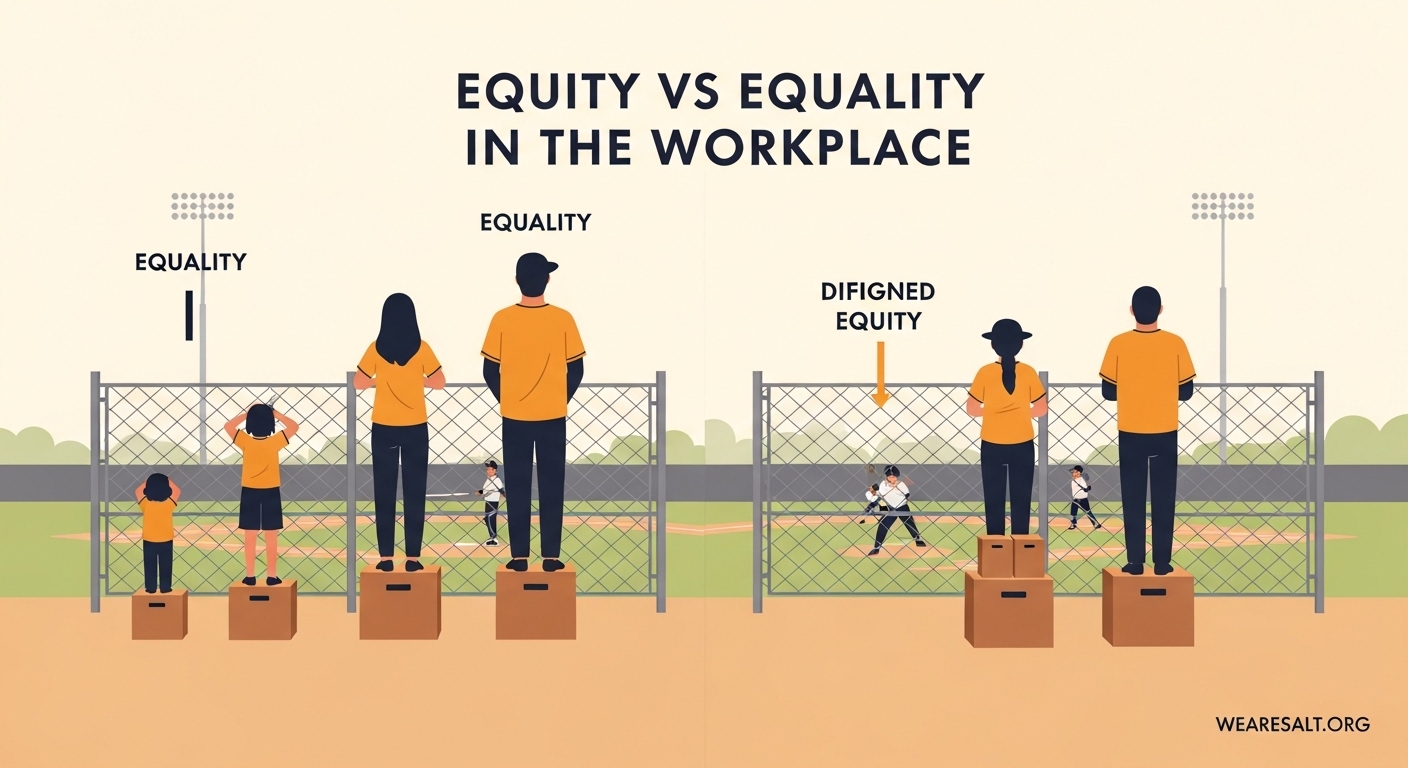
A classic example involves employees trying to see over a fence. Equality gives everyone the same size box to stand on, which helps tall people see but leaves short people still blocked. Equity gives each person the specific height of box they need based on their stature, so everyone can see over the fence. In workplace terms, equality offers the same training program to all employees; equity offers additional language support for non-native speakers so they can fully participate.
Conclusion
Understanding equity vs equality in the workplace transforms how you build teams, make decisions, and measure success. Equality offers a starting point by ensuring everyone receives baseline respect and opportunity. But equity completes the picture by recognizing that true fairness requires acknowledging our differences and addressing systemic barriers.
The organizations thriving in 2026 have moved beyond one-size-fits-all approaches. They recognize that their people bring unique strengths, face distinct challenges, and need personalized support to contribute fully. This shift from equality to equity does not happen overnight. It requires honest self-examination, willingness to change established practices, and commitment to measuring real outcomes rather than good intentions.
Start with one area where you can make immediate improvements. Audit your pay equity. Survey your team about unmet needs. Revise a single policy to allow more flexibility. Small steps build momentum toward a workplace where everyone genuinely has the opportunity to succeed.