
Our planet operates on finite resources, yet our economic systems have long behaved as if supplies were endless. The traditional model of production and consumption has created a crisis of waste, pollution, and resource depletion that threatens both our environment and our economic stability.
In this guide, I will walk you through the two dominant economic models shaping our world: the linear economy that has powered industrial growth for centuries, and the circular economy that offers a sustainable alternative. You will learn how these systems work, why the linear model is failing, and what steps businesses and individuals can take to support the transition to circularity.
Understanding linear vs circular economy is not just academic. It affects how products are designed, how businesses operate, how policies are made, and how each of us consumes. Whether you are a business leader, policymaker, student, or concerned citizen, this guide will give you the knowledge to make informed decisions about sustainability.
Table of Contents
What Is the Linear Economy?
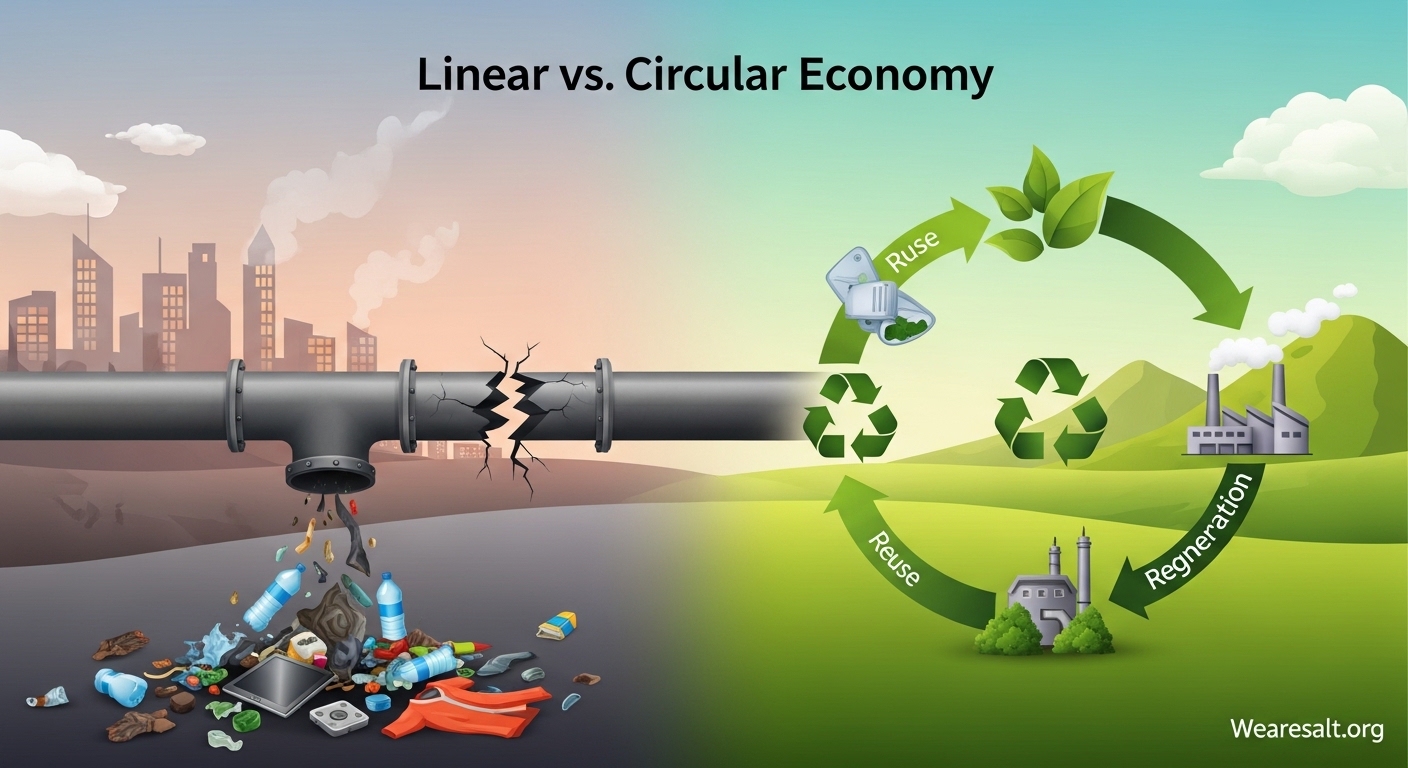
The linear economy follows a straight-line path from resource extraction to waste disposal. It is commonly described as the “take-make-dispose” model. Raw materials are extracted from the earth, transformed into products, sold to consumers, and eventually discarded as waste.
This model emerged during the Industrial Revolution and has dominated global economic activity for over 200 years. It prioritizes speed, scale, and low upfront costs. The faster a company can extract resources, manufacture products, and sell them, the more profitable it becomes. Little consideration is given to what happens after a product reaches the end of its short life.
Key characteristics define the linear economy. It relies heavily on virgin materials, with minimal recycling or reuse. Products are often designed for planned obsolescence, meaning they are intentionally made to break or become outdated quickly. The entire system assumes unlimited resources and unlimited capacity to absorb waste.
The process flow is simple: resources flow in one direction from extraction through production, distribution, consumption, and finally disposal. Once materials become waste, they rarely re-enter the economic cycle. This creates a constant demand for new raw materials while generating massive amounts of trash.
What Is the Circular Economy?
The circular economy represents a fundamental redesign of how we create and use products. Instead of a straight line ending in waste, it operates as a closed-loop system where materials continually cycle back into production. The core principle is simple: keep resources in use for as long as possible, extract maximum value from them, then recover and regenerate products and materials.
This model draws inspiration from natural systems. In nature, waste from one process becomes nutrients for another. Leaves fall and decompose, feeding the soil that grows new trees. The circular economy mimics this regenerative approach, designing out waste and pollution from the start.
The three R’s form the foundation of circular economy thinking: reduce, reuse, and recycle. Reduce means designing products that use fewer materials and last longer. Reuse involves finding new applications for products and components before discarding them. Recycle closes the loop by turning waste materials into new products.
But modern circular economy thinking goes further. It includes repair, refurbishment, remanufacturing, and sharing models. Companies might offer products as services rather than selling them outright. Materials are chosen for their ability to be disassembled and recycled. The goal is not just less waste, but actively regenerating natural systems.
Linear vs Circular Economy: The Key Differences
The main difference between linear and circular economy lies in their fundamental approach to resources. The linear economy treats resources as infinite and waste as acceptable. The circular economy recognizes resource limits and designs waste out of the system entirely.
Process flow distinguishes them most clearly. Linear economy follows: extract resources -> manufacture products -> sell to consumers -> dispose as waste. Circular economy follows: design for longevity -> manufacture sustainably -> use and reuse -> repair and refurbish -> recycle materials -> regenerate nature.
Goals also diverge significantly. Linear economy prioritizes profit maximization through volume and speed. Circular economy prioritizes value retention through durability and efficiency. One seeks to sell as many products as possible. The other seeks to deliver maximum utility with minimum resource use.
Design philosophy separates them too. Linear products are designed for obsolescence, difficult to repair, and made from mixed materials that resist recycling. Circular products are designed for disassembly, easy repair, and use pure materials that can be recycled repeatedly without quality loss.
Understanding the Waste Hierarchy
The waste hierarchy provides a framework for managing materials sustainably. It ranks options from most to least preferred: prevention, reuse, recycling, recovery, and disposal. This hierarchy directly supports circular economy principles.
Prevention sits at the top. This means designing products that use less material, last longer, and eliminate waste from the start. Refusing unnecessary products also falls here. Prevention delivers the greatest environmental benefit because it avoids resource use entirely.
Reuse comes next. Using products multiple times, buying second-hand, or repurposing items extends their lifespan without additional manufacturing. This preserves the embedded energy and materials in existing products.
Recycling follows reuse. Processing used materials into new products reduces the need for virgin resources. However, recycling requires energy and often degrades material quality, making it less preferable than reuse.
Recovery involves extracting energy from waste through incineration or other processes. While better than disposal, it still wastes the material value of products. Disposal at the bottom means landfilling or dumping, the least sustainable option that linear economies rely on heavily.
Environmental Impact: Why the Linear Economy Is Unsustainable
The linear economy creates environmental damage at every stage of its process. Resource extraction destroys habitats, depletes water supplies, and generates pollution. Mining, drilling, and logging leave lasting scars on ecosystems while releasing carbon into the atmosphere.
Manufacturing intensifies the impact. Factories consume enormous energy, often from fossil fuels, while releasing toxic chemicals into air and water. The linear model demands constant production of new goods, multiplying these effects.
Waste generation has reached crisis levels. Global waste production exceeds 2 billion tons annually, with much of it plastic that persists for centuries. Landfills leach toxins into soil and groundwater. Incineration releases harmful emissions. Oceans fill with plastic debris that enters food chains.
Climate change accelerates under linear systems. The constant extraction and production cycle burns fossil fuels at unsustainable rates. The Ellen MacArthur Foundation estimates that switching to circular economy principles could reduce global CO2 emissions by 39% by 2026. This alone demonstrates why the linear model cannot continue.
Biodiversity loss compounds these problems. Habitat destruction for resource extraction wipes out species. Pollution poisons ecosystems. Climate change shifts habitats faster than species can adapt. The linear economy treats nature as a limitless source of inputs and a limitless sink for waste, a assumption that has proven catastrophically false.
Real-World Examples of Linear and Circular Economy
Fast Fashion: A Linear Economy Problem
The fashion industry exemplifies linear economy excess. Clothing production doubled between 2000 and 2026, yet the average garment is worn only seven times before disposal. Fast fashion brands release new collections weekly, encouraging constant purchasing while garments fall apart after a few washes.
Textile waste has become one of the fastest-growing waste streams. Most discarded clothing ends in landfills or is incinerated. Less than 1% of textiles are recycled into new clothing due to mixed fibers and chemical treatments. The industry consumes massive water resources while releasing microplastics into waterways.
Single-Use Plastics: Peak Linearity
Single-use plastics represent the ultimate linear product. Made from fossil fuels, used for minutes, then discarded to persist for centuries. Packaging accounts for 40% of plastic production, with most designed for immediate disposal.
Only 9% of all plastic ever produced has been recycled. The rest sits in landfills, burns in incinerators, or pollutes natural environments. Microplastics now contaminate drinking water, food, and even human blood. This is the inevitable result of a system that prioritizes convenience over sustainability.
Electronics and E-Waste: Missed Circular Opportunities
Electronics demonstrate how circular principles could transform industries. Smartphones contain valuable materials including rare earth elements, gold, and copper. Yet most are designed with glued components and non-replaceable batteries that prevent repair.
E-waste is the world’s fastest-growing waste stream, with over 50 million tons generated annually. Much of this contains recoverable materials worth billions of dollars. Circular approaches like modular design, repair cafes, and take-back programs show how this waste stream could become a resource stream.
Circular Success Stories
Some companies have embraced circular models successfully. Interface, a carpet manufacturer, pioneered closed-loop recycling by taking back old carpet tiles and recycling them into new products. Their factories run on renewable energy, and they have achieved carbon neutrality.
Patagonia demonstrates circular principles in apparel. They repair products through their Worn Wear program, resell used items, and design clothing for durability. Their famous “Don’t Buy This Jacket” campaign encouraged customers to repair rather than replace, building brand loyalty while reducing waste.
Philips shifted from selling light bulbs to selling light as a service. They install and maintain lighting systems for businesses, retaining ownership of the equipment. When components need replacement, Philips recycles them into new products. Customers get reliable lighting without upfront capital costs, while materials stay in use.
How Businesses Can Transition to a Circular Economy
Transitioning from linear to circular requires systematic change across business operations. The process begins with redesigning products for circularity. This means using recyclable materials, designing for disassembly, and eliminating toxic substances that prevent safe recycling.
Business models must evolve. Instead of selling products, companies might lease them, offer subscriptions, or provide products as services. This aligns company incentives with product longevity. When Philips retains ownership of lighting equipment, they benefit from designing long-lasting, efficient products rather than pushing frequent replacements.
Reverse logistics networks enable circularity. Companies need systems to collect used products, sort them, and route them to appropriate next uses. Some items go to refurbishment, others to component harvesting, others to material recycling. Without this infrastructure, circular economy cannot function.
Partnerships extend circular value chains. No single company controls the entire lifecycle of most products. Collaboration between manufacturers, recyclers, retailers, and logistics providers creates closed loops. Industrial symbiosis, where one company’s waste becomes another’s input, exemplifies this approach.
Challenges exist. Circular products often cost more upfront due to better materials and design. Consumer habits favor convenience over sustainability. Existing regulations may not support new business models. Infrastructure for collection and recycling remains underdeveloped in many regions.
Yet benefits justify the effort. Circular businesses reduce exposure to volatile resource prices. They build customer loyalty through service relationships. They differentiate from competitors. They future-proof against regulations that increasingly penalize waste. The companies leading this transition will dominate their industries as resource constraints tighten.
Frequently Asked Questions
What is the main difference between a linear and circular economy?
The main difference is that the linear economy follows a take-make-dispose model where resources flow in one direction from extraction to waste, while the circular economy operates as a closed-loop system that keeps materials in use through reuse, repair, and recycling.
What is an example of a linear economy?
Fast fashion is a prime example of linear economy. Clothing is made quickly from virgin materials, sold cheaply, worn a few times, and then discarded. The industry produces massive waste while constantly extracting new resources, with less than 1% of textiles recycled into new clothing.
What are the 3 R’s of the environment?
The 3 R’s are Reduce, Reuse, and Recycle. Reduce means minimizing resource use and waste generation. Reuse involves using products multiple times or finding new purposes for them. Recycle converts waste materials into new products. These form the foundation of circular economy principles.
What are the disadvantages of a linear economy?
Linear economies deplete finite resources, generate massive waste, cause pollution, accelerate climate change, destroy biodiversity, and create economic vulnerability to resource price volatility. They assume unlimited resources and waste absorption capacity, which has proven environmentally and economically unsustainable.
Conclusion
Linear vs circular economy represents a choice between two fundamentally different ways of creating value. The linear model has delivered economic growth for centuries but at an environmental cost that can no longer be ignored. The circular model offers a path forward that maintains prosperity while respecting planetary boundaries.
The transition is already underway. Forward-thinking companies are proving that circular business models can be profitable. Consumers increasingly demand sustainable options. Policymakers are tightening regulations on waste and pollution. The question is not whether the circular economy will replace the linear model, but how quickly.
For businesses, the opportunity lies in redesigning products, shifting business models, and building circular supply chains. For consumers, it means choosing quality over quantity, repairing rather than replacing, and supporting companies embracing circularity. For everyone, understanding these economic models is the first step toward building a sustainable future. The shift from linear to circular is not just an environmental imperative. It is an economic opportunity that will define successful businesses and societies in the decades ahead.