
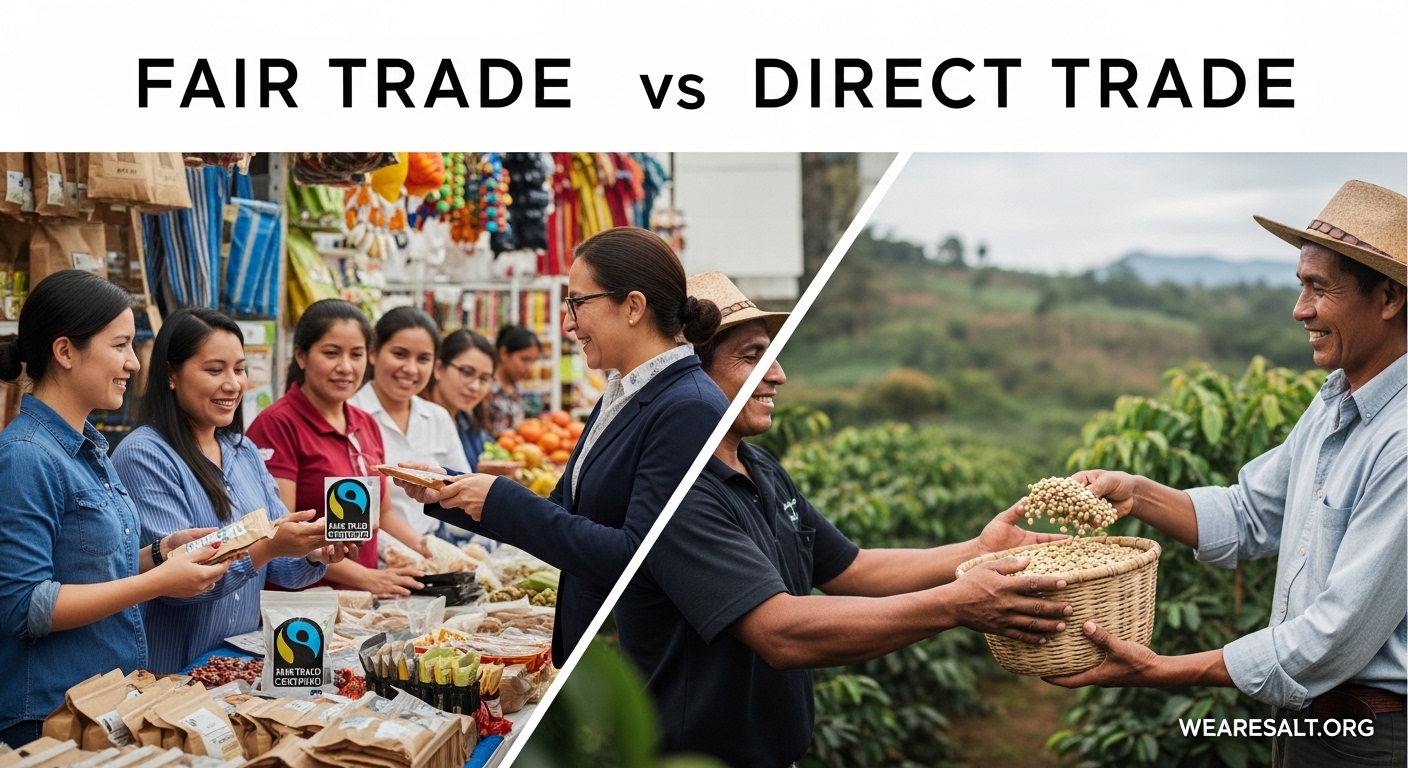
Standing in the coffee aisle, you stare at two bags. One claims “Fair Trade Certified.” The other boasts “Direct Trade.” Both promise ethical sourcing. Both cost more than standard coffee. But what do these labels actually mean for the farmers who grew the beans? Understanding fair trade vs direct trade can help you make purchases that genuinely support producer wellbeing.
Fair Trade and Direct Trade represent two different approaches to ethical sourcing. Fair Trade relies on third-party certification with standardized rules and minimum prices. Direct Trade builds direct relationships between buyers and farmers without formal certification. Neither system is perfect, and both have passionate supporters and vocal critics.
Our team spent weeks analyzing both models, interviewing industry professionals, and reviewing certification data. This guide breaks down exactly how each system works, who benefits most, and how to spot genuine ethical sourcing versus marketing fluff. By the end, you will know which claims to trust and which questions to ask before your next purchase.
Table of Contents
What Is Fair Trade?
Fair Trade is a certification system that ensures farmers and workers receive fair compensation while meeting social and environmental standards. The movement began in the 1980s as a response to exploitative commodity pricing that kept coffee, cocoa, and banana producers in poverty. Today, several organizations oversee Fair Trade certification, with Fairtrade International and Fair Trade USA being the most prominent.
The core mechanism works through certified cooperatives. Farmers organize into cooperatives that meet Fair Trade standards. These standards include democratic organization, fair labor practices, and environmental sustainability. An accredited third-party auditor, typically FLOCERT, inspects cooperatives regularly to verify compliance.
The Fair Trade pricing structure provides a safety net for farmers. Certified products earn a minimum price regardless of market fluctuations. When market prices rise above this floor, farmers receive the higher market rate. Additionally, a Fair Trade Premium goes to a community development fund controlled by cooperative members. Farmers vote on how to spend this money on projects like schools, healthcare, or farm improvements.
Certification covers multiple product categories. Coffee remains the most recognizable Fair Trade product, but certification also applies to cocoa, tea, bananas, sugar, and handicrafts. Each product category has specific standards adapted to its supply chain realities.
How Fair Trade Certification Works
The certification process begins when farmers form or join a registered cooperative. The cooperative applies for Fair Trade status and undergoes an initial audit. Auditors examine financial records, interview farmers, and inspect working conditions. Certification typically takes 6-12 months for initial approval.
Once certified, the cooperative can sell products with the Fair Trade label. Buyers pay the minimum price plus the premium directly to the cooperative. The cooperative then distributes payments to individual farmers according to their contribution. This structure keeps intermediaries transparent and ensures collective bargaining power.
Annual re-certification maintains standards compliance. Auditors return yearly to verify continued adherence to social, environmental, and economic criteria. Failed audits can result in suspension or decertification, creating accountability within the system.
What Is Direct Trade?
Direct Trade describes a sourcing model where buyers purchase directly from producers without traditional intermediaries or third-party certification. The term emerged from specialty coffee roasters in the early 2000s who wanted closer relationships with farmers than Fair Trade certification provided. Unlike Fair Trade, no single organization defines or oversees Direct Trade standards.
The defining characteristic is the direct relationship between buyer and farmer. Roasters visit farms personally, sometimes multiple times per year. They negotiate prices individually based on coffee quality rather than accepting standardized minimums. This relationship-focused approach allows for detailed feedback on growing and processing techniques.
Price negotiation in Direct Trade typically exceeds Fair Trade minimums. Because buyers seek exceptional quality, they pay premiums for superior beans. Cupping scores above 85 often command prices double or triple the commodity market rate. Farmers with excellent coffee can earn significantly more through Direct Trade relationships than through Fair Trade channels.
Transparency varies by company. Some Direct Trade advocates publish detailed information about payments to specific farms. Others use the term loosely without providing verification. This lack of standardization creates both opportunity for abuse and space for exceptional ethical commitment.
How Direct Trade Relationships Develop
Direct Trade relationships usually begin with an origin trip. A roaster visits coffee-producing regions, tastes samples from multiple farms, and identifies producers whose coffee matches their quality goals. Initial purchases may be small as both parties assess the partnership potential.
Successful relationships deepen over time. Roasters return annually, providing feedback on processing methods and varietal selection. Farmers invest in improvements knowing they have a committed buyer. Some Direct Trade partnerships span decades, creating stability without formal contracts or certification requirements.
Communication happens directly between buyer and farmer. Email, video calls, and messaging apps replace traditional export/import channels. This direct line allows for rapid problem-solving and collaborative planning. When a roaster needs specific processing for an experimental roast, they can discuss details immediately with the producer.
Fair Trade vs Direct Trade: Side-by-Side Comparison
Choosing between these models requires understanding their structural differences. Fair Trade emphasizes standardized protection through certification. Direct Trade prioritizes flexible relationships based on quality. Both aim to improve farmer welfare, but their methods create different outcomes.
| Aspect | Fair Trade | Direct Trade |
|---|---|---|
| Certification | Third-party audited (FLOCERT) | No formal certification |
| Price Structure | Minimum price floor + premium | Negotiated per contract |
| Who Sets Price | Certification organization | Buyer and farmer directly |
| Farmer Organization | Must join cooperative | Individual or cooperative |
| Quality Focus | Standard quality acceptable | Premium quality required |
| Relationship | Roaster deals with cooperative | Roaster deals with farmer |
| Transparency | Audited compliance reports | Varies by company |
| Traceability | Cooperative level | Specific farm or microlot |
| Costs for Farmers | Certification fees | Travel for relationship building |
| Best For | Small farmers needing stability | Farmers with excellent coffee |
The certification difference fundamentally shapes each model. Fair Trade certification provides external accountability through audits. Anyone can verify Fair Trade claims by checking certification databases. Direct Trade relies entirely on buyer integrity. Companies must voluntarily disclose their practices, and claims often go unverified.
Price outcomes differ significantly. Fair Trade guarantees a floor price that protects farmers during market crashes. Direct Trade offers no minimum but typically pays above Fair Trade levels for quality coffee. Farmers with exceptional crops benefit more from Direct Trade. Farmers with average quality gain more from Fair Trade stability.
Supply chain length affects both models. Fair Trade maintains some intermediaries like cooperatives and exporters. Direct Trade aims to minimize supply chain steps, though logistics companies usually remain necessary. Shorter chains can mean more money reaches farmers, but they also require more effort from both parties to manage.
Which Model Pays Farmers More?
The payment comparison has no universal answer. Fair Trade provides predictable income through minimum prices. In 2026, the Fair Trade minimum price for washed arabica coffee sits around $1.40 per pound plus a $0.30 premium. When commodity markets fall below this level, Fair Trade farmers earn significantly more than conventional market rates.
Direct Trade prices vary widely based on quality and relationship. Specialty roasters commonly pay $3-8 per pound for Direct Trade coffee with cupping scores above 85. Exceptional microlots can command $15-25 per pound. These prices far exceed Fair Trade minimums but only reach farmers producing premium-grade coffee.
The key variable is quality access. Not all farmers can produce specialty-grade coffee due to altitude, soil, climate, or infrastructure limitations. Fair Trade protects these farmers from market volatility. Direct Trade rewards farmers who can achieve exceptional quality with substantially higher payments.
Impact on Coffee and Chocolate Quality
Sourcing models influence product quality in distinct ways. Understanding these differences helps explain why some companies prefer one approach over the other.
How Fair Trade Affects Quality
Fair Trade certification does not emphasize quality premiums. The minimum price applies to standard-grade coffee meeting basic standards. This structure provides stability but creates limited incentive for farmers to invest in quality improvements beyond certification requirements.
However, Fair Trade indirectly supports quality through economic stability. When farmers receive reliable income, they can invest in better equipment and processing facilities. The community development fund often finances wet mills, drying beds, and storage improvements that raise overall quality.
Some Fair Trade cooperatives have developed quality-focused programs internally. By pooling resources, cooperatives hire agronomists and quality consultants. These investments can raise member coffee to specialty standards, creating opportunities for premium pricing within the Fair Trade framework.
How Direct Trade Affects Quality
Direct Trade inherently prioritizes quality. Buyers seek exceptional coffee and pay premiums commensurate with cupping scores. This creates direct financial incentives for farmers to improve every aspect of production.
Price negotiations often include specific quality metrics. Roasters may pay tiered rates based on SCA cupping scores. Score band 80-84 earns one price. Scores 85-87 earn a higher tier. Scores above 88 command top rates. This granular pricing motivates farmers to refine processing techniques.
Technical collaboration improves quality outcomes. Roasters visiting farms can identify processing improvements immediately. Adjustments to fermentation time, drying protocols, or varietal selection get implemented quickly with buyer encouragement. This rapid feedback loop accelerates quality development faster than cooperative training programs.
Direct Trade relationships often explore experimental processing. Natural processes, honey processes, and anaerobic fermentation create unique flavor profiles. Buyers seeking distinctive offerings fund these experiments and guarantee purchase of successful batches. Fair Trade structures rarely support such speculative innovation.
Criticisms and Limitations of Both Models
Neither Fair Trade nor Direct Trade has solved ethical sourcing challenges completely. Critics have identified significant limitations in both approaches that consumers should understand.
Fair Trade Criticisms
Certification costs burden small farmers significantly. Initial certification requires investment in cooperative infrastructure, record-keeping systems, and audit preparation. Annual fees continue regardless of sales volume. Farmers selling small quantities may see certification costs consume their Fair Trade Premium benefits.
The cooperative requirement excludes some farmers. Independent farmers or those in remote areas without cooperative access cannot participate. This structural limitation means Fair Trade helps organized farmers while leaving isolated producers without options.
Fair Trade does not guarantee living wages. The minimum price protects against commodity crashes but often falls below true living wage calculations. Studies suggest many Fair Trade farmers still struggle to meet basic needs despite certification. The system improves conditions without fully solving economic inequality.
Child labor remains a documented problem in Fair Trade supply chains. While standards prohibit child labor, enforcement challenges persist. A 2026 investigation found child labor in certified cocoa farms in West Africa. Certification creates standards without ensuring universal compliance across complex supply chains.
Direct Trade Criticisms
The lack of standardized definition allows marketing abuse. Any company can claim “Direct Trade” without meeting specific criteria. Without third-party verification, claims may describe minimal relationship efforts rather than genuine partnerships. Some companies use the term after a single farm visit or phone call.
Farmer isolation poses real risks. Direct Trade relationships depend on individual buyer commitment. If a roaster goes out of business, changes sourcing strategy, or faces quality complaints, farmers lose their market immediately. Fair Trade cooperatives provide some continuity if individual buyers disappear.
Access inequality limits Direct Trade benefits. Roasters seek exceptional coffee, which typically grows at specific altitudes with particular processing capabilities. Farmers without these advantages struggle to attract Direct Trade relationships. The model rewards quality without protecting average producers.
Documentation burden falls heavily on small operations. Direct Trade requires farmers to maintain detailed records, communicate in foreign languages, and manage international logistics. These requirements favor larger, more established farms over smallholders with limited administrative capacity.
How to Verify Ethical Sourcing Claims
Marketing language often obscures reality. Learning to verify claims protects you from spending premium prices on conventional sourcing.
Verifying Fair Trade Claims
Look for specific certification seals. Fairtrade International and Fair Trade USA maintain distinct but legitimate certification programs. The seal should display clearly on packaging with a license number you can verify.
Check certification databases. Both major Fair Trade organizations maintain online databases listing certified producers and products. Enter the brand or license number to confirm current certification status. Expired or fraudulent certifications appear in these searches.
Be wary of vague “fairly traded” language without certification. Companies sometimes use ethical-sounding terms without meeting standards. Only third-party certification provides external accountability.
Verifying Direct Trade Claims
Request specific farm information. Genuine Direct Trade companies know exactly which farms supply their coffee. They should provide farm names, locations, and ideally stories about their relationships.
Ask about payment transparency. Progressive Direct Trade companies publish prices paid to farmers. This documentation proves their commitment to fair compensation. Avoid companies unwilling to discuss payment details.
Look for visit documentation. Origin trips produce photos, videos, and stories. Companies serious about Direct Trade share this content regularly. Social media and blog posts should show ongoing relationships rather than one-time photo opportunities.
Check for relationship duration. Long-term partnerships indicate genuine commitment. Single-purchase “Direct Trade” claims may represent opportunistic buying rather than sustained ethical sourcing.
Red Flags to Avoid
Watch for origin trip marketing without substance. Visiting a farm does not constitute Direct Trade. Look for evidence of ongoing relationships, quality feedback, and fair pricing rather than vacation photos.
Question claims without documentation. Ethical sourcing deserves proof. Companies making bold claims should provide evidence backing them up.
Beware of price inconsistencies. Ethical sourcing costs more. Extremely cheap “Fair Trade” or “Direct Trade” products may indicate fraudulent claims.
FAQ
What is the difference between direct trade and fair trade?
Fair Trade is a third-party certified system with standardized minimum prices and audited compliance requirements. Direct Trade involves direct relationships between buyers and farmers without formal certification, with prices negotiated individually based on quality. Fair Trade emphasizes collective organization through cooperatives, while Direct Trade focuses on individual farm relationships.
What does direct trade mean?
Direct Trade means buyers purchase products directly from producers without traditional intermediaries. The term describes relationship-based sourcing where roasters or chocolate makers work closely with specific farms, often visiting in person and negotiating prices based on quality metrics. Unlike Fair Trade, Direct Trade has no standardized certification or oversight organization.
Is fair trade actually fair for farmers?
Fair Trade improves conditions for many farmers but has limitations. The minimum price provides protection during market downturns, and the premium funds community projects. However, certification costs burden small farmers, the minimum price often falls below true living wages, and enforcement of labor standards remains inconsistent. Fair Trade helps but does not fully solve economic inequality in supply chains.
Which pays farmers more – fair trade or direct trade?
Direct Trade typically pays more for high-quality coffee, with specialty grades commanding $3-8 per pound or higher. Fair Trade guarantees minimum prices around $1.70 per pound including premium, protecting farmers during market crashes. Farmers producing exceptional quality earn more through Direct Trade, while average-quality producers benefit more from Fair Trade stability.
How can I tell if coffee is truly ethically sourced?
For Fair Trade, look for certification seals from Fairtrade International or Fair Trade USA and verify license numbers in online databases. For Direct Trade, ask companies for specific farm names, payment transparency documentation, and evidence of ongoing relationships. Avoid vague ethical claims without specific proof or third-party verification.
Conclusion
Understanding fair trade vs direct trade requires looking beyond marketing claims to structural realities. Fair Trade certification provides standardized protection through minimum prices and third-party auditing, benefiting farmers who need stability and cooperative support. Direct Trade relationships reward exceptional quality with premium payments and direct collaboration, benefiting farmers who can produce specialty-grade products.
Neither model represents a complete solution to supply chain ethics. Fair Trade has documented gaps in living wage guarantees and child labor enforcement. Direct Trade lacks standardization and leaves average-quality farmers without options. Both improve upon conventional sourcing but require continued scrutiny and evolution.
As consumers, our role involves asking questions and demanding transparency. Verify Fair Trade certification through official databases. Press Direct Trade companies for specific farm information and payment documentation. Avoid vague ethical claims without evidence. Your purchasing decisions send signals about what values matter, and informed choices genuinely impact producer livelihoods around the world.