
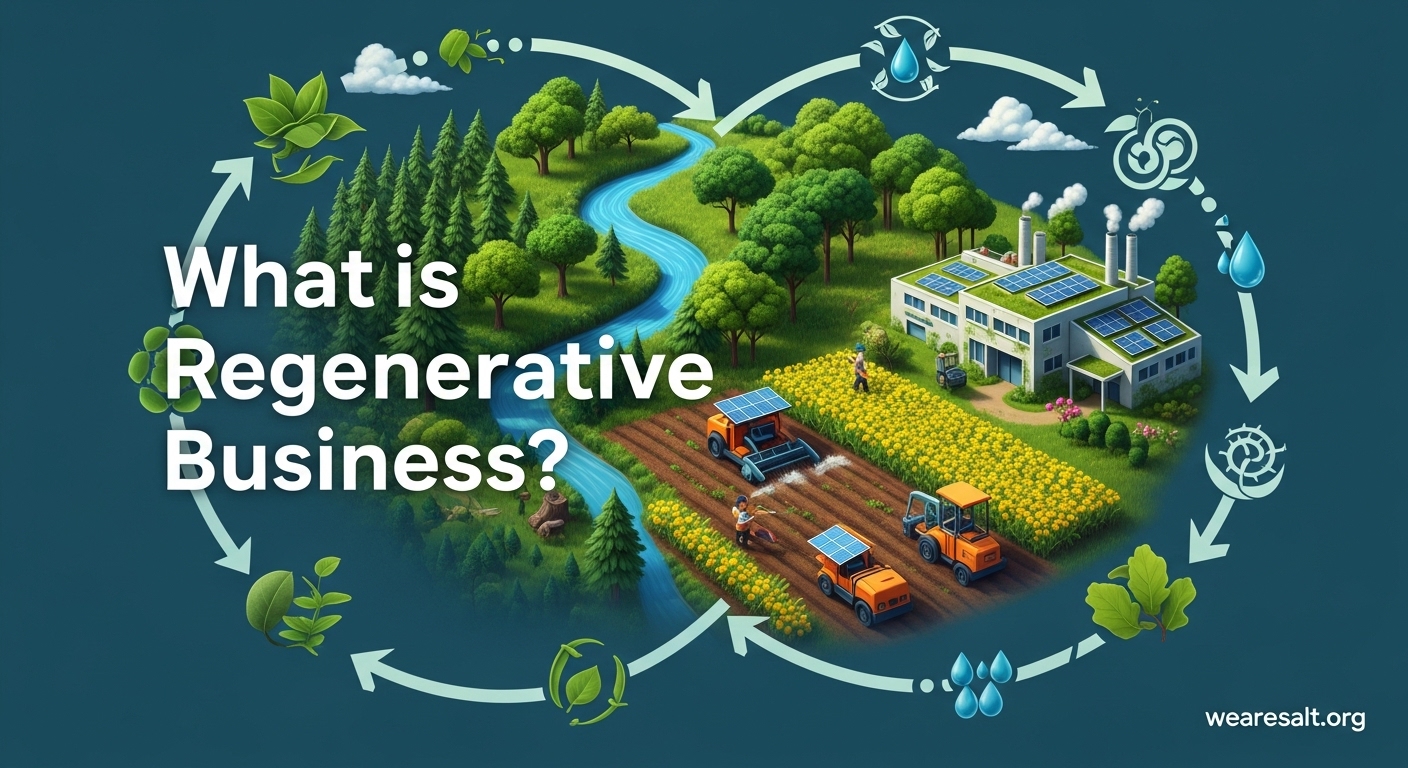
A regenerative business is a company that gives back more to the planet and society than it takes, actively restoring and regenerating natural resources and social systems rather than simply minimizing harm. Unlike traditional sustainability efforts that aim to do “less bad,” regenerative businesses pursue net positive impact across their entire value chain.
In 2026, Earth Overshoot Day arrives earlier than ever before. This marks the date when humanity has used up all the biological resources the Earth can regenerate in an entire year. For businesses, this reality demands a fundamental shift in thinking. Our team has spent months analyzing how leading companies are moving beyond carbon neutrality to create genuine, measurable restoration.
By the end of this guide, you will understand exactly what makes a business regenerative, why sustainability alone is insufficient, the seven core principles that guide regenerative organizations, and practical steps to begin your own regenerative journey.
Table of Contents
What is Regenerative Business?
A regenerative business operates on a simple but powerful premise: commerce should strengthen rather than deplete the communities and ecosystems it touches. This approach evaluates impacts across the entire value chain and temporal system, then actively contributes to restoration and regeneration of people, places, and planet.
The concept emerged from regenerative design principles developed by thought leaders at the Regenesis Group and Forum for the Future. These organizations recognized that traditional corporate social responsibility and sustainability programs, while well-intentioned, merely slow down destruction. They do not reverse it.
Think of it this way. A sustainable business asks: “How can we reduce our carbon footprint?” A regenerative business asks: “How can we sequester more carbon than we emit while improving soil health and community wellbeing?” The shift is from damage limitation to active healing.
The Net Positive Framework
At the heart of regenerative business lies the net positive framework. This means creating a “socio-ecological handprint” that exceeds your ecological footprint. While footprint measures the harm you cause, handprint measures the good you create.
Our research shows companies adopting this framework report three key benefits. First, they build resilience against climate and supply chain disruptions. Second, they attract increasingly values-driven consumers and employees. Third, they discover new revenue streams through circular and restorative business models.
Regenerative Business vs Sustainability: Why ‘Doing Less Harm’ Is No Longer Enough
Most businesses today operate somewhere on a spectrum. On one end sits traditional extractive commerce. In the middle, sustainable business aims to minimize negative impact. On the far end, regenerative business creates positive impact. Understanding this progression matters because where you position yourself determines your long-term viability.
Sustainability emerged as a response to growing environmental awareness in the 1990s and 2000s. Companies began measuring carbon footprints, reducing waste, and sourcing materials responsibly. These efforts were necessary and important. But they share a fundamental limitation. They assume business must inevitably harm the environment, so the goal becomes harm reduction.
Regenerative business rejects this premise entirely. It asks a different question. What if business could be a force for ecological and social restoration? What if commerce could leave the world better than we found it?
The Planetary Boundaries Context
The Stockholm Resilience Centre identified nine planetary boundaries that humanity must respect to maintain stable Earth conditions. As of 2026, we have crossed six of them. Climate change, biodiversity loss, and nitrogen pollution have already entered dangerous zones.
This scientific reality makes clear why incremental improvements are insufficient. When you are driving toward a cliff at 80 miles per hour, slowing to 60 miles per hour does not solve the problem. You need to turn the car around. Regenerative business is that turn.
Earth Overshoot Day: The Urgency Indicator
Earth Overshoot Day marks the date when humanity’s demand for ecological resources exceeds what Earth can regenerate in that year. In 2026, this date arrives earlier than ever. For the remaining months of the year, we operate in ecological deficit, drawing down reserves and accumulating carbon in the atmosphere.
Businesses contribute significantly to this overshoot. But they also hold the power to reverse it. Regenerative companies actively restore ecosystems, regenerate soil, and build community resilience. They do not merely slow down the damage. They help repair it.
What Are the 7 Principles of Regeneration?
Regenerative business draws from seven core principles originally developed for regenerative design. These principles provide a framework for thinking about systems, relationships, and potential rather than problems and limitations.
Understanding these principles helps leaders shift from reactive problem-solving to proactive potential-seeking. Here are the seven principles that guide regenerative organizations:
1. Work in whole systems. Regenerative thinking examines entire ecosystems rather than isolated parts. A business does not exist in a vacuum. It connects to suppliers, communities, watersheds, and global climate patterns. Solutions must address these interconnections.
2. Design for harmony with nature. Rather than dominating or extracting from nature, regenerative businesses align with natural processes. This means working with seasonal cycles, mimicking biological patterns, and respecting carrying capacity.
3. Create reciprocal relationships. Traditional business often treats stakeholders as resources to extract value from. Regenerative business builds mutual benefit into every relationship. Suppliers thrive, employees grow, communities prosper, and ecosystems regenerate.
4. Develop potential rather than solve problems. Problem-solving keeps you stuck in the past. Potential development moves you toward the future. Regenerative leaders ask “what is possible here?” rather than “what is broken here?”
5. Think in terms of nested scales. Every action ripples across scales from local to global. A decision made in a boardroom affects workers, neighborhoods, watersheds, and ultimately the climate. Regenerative thinking considers these nested impacts.
6. Align with place. Regenerative businesses understand that every location has unique ecological and cultural characteristics. Solutions must be adapted to place rather than imposed universally. This principle especially applies to supply chains and facility management.
7. Focus on essence and distinctiveness. Every organization has unique potential based on its history, location, and relationships. Regenerative development amplifies this distinctiveness rather than copying generic best practices.
What is an Example of a Regenerative Business?
Understanding theory matters, but seeing practice brings clarity. Several companies across different industries demonstrate regenerative principles in action. These examples illustrate how diverse businesses apply regeneration to their specific contexts.
Patagonia: Activating Supply Chain Regeneration
Patagonia pioneered regenerative organic agriculture for cotton and food products. Their Regenerative Organic Certification goes beyond organic standards to require soil health, animal welfare, and social fairness. The company reports measurable improvements in soil carbon, water retention, and farmer livelihoods across participating farms.
Patagonia also demonstrates regeneration through its Worn Wear program. By repairing and reselling used gear, they extend product lifecycles and reduce demand for virgin materials. This circular approach transforms consumption patterns.
Interface: Carbon Negative Flooring
Interface, a global modular flooring manufacturer, achieved carbon negative status for its carpet tiles. They accomplished this through bio-based materials, renewable energy, and verified carbon offsets that fund ecosystem restoration. The company actively removes more carbon than it emits.
Their Climate Take Back initiative commits to running their business in a way that reverses global warming. This includes creating products with recycled content, operating on renewable energy, and transforming their supply chain to be carbon negative.
Seventh Generation: Systems-Level Thinking
Seventh Generation, a household cleaning products company, applies regenerative principles through ingredient transparency, packaging innovation, and advocacy. They have eliminated virgin petroleum from bottles, using 100% recycled plastic instead.
The company also engages in policy advocacy that extends beyond their direct business interests. They support regulations that would benefit the entire industry and planet, even if compliance creates short-term costs. This demonstrates the principle of working in whole systems.
Indigenous-Led Regenerative Enterprises
Many indigenous communities have practiced regenerative economics for generations. Companies like Sakara Life, which sources from regenerative farms, and First Nations Development Institute, which supports native food systems, demonstrate how traditional ecological knowledge integrates with modern business.
These enterprises often lead with community benefit rather than shareholder return. The result is resilient businesses that strengthen cultural and ecological systems simultaneously.
The Business Case for Regeneration
Some leaders worry that regeneration conflicts with profitability. Our analysis and forum discussions with sustainability professionals reveal the opposite. Regenerative approaches strengthen long-term business performance while creating positive impact.
Consumer expectations have shifted dramatically. Post-pandemic research shows buyers increasingly expect companies to do active good, not merely less harm. Regenerative businesses meet this expectation authentically, building trust and loyalty that translates to market share.
Risk mitigation represents another major benefit. Climate disruption, resource scarcity, and social instability threaten supply chains and operations. Regenerative businesses build resilience by restoring the systems they depend on. Healthy soil produces reliable crops. Thriving communities provide stable workforces. Intact ecosystems buffer extreme weather.
Stakeholder value creation extends beyond customers and shareholders. Regenerative businesses recognize employees, suppliers, communities, and the environment as essential stakeholders deserving returns. This inclusive approach attracts talent, strengthens partnerships, and builds social license to operate.
Finally, innovation opportunities emerge when businesses pursue net positive goals. The constraints of regeneration spark creativity. Companies discover new markets, products, and business models they would never have found through conventional optimization.
How to Build a Regenerative Business: 5 Steps to Get Started
Transitioning to regenerative business does not require immediate transformation. Most successful companies evolve through deliberate steps. Here is a practical framework based on our research and the World Economic Forum’s recommendations for building regenerative enterprises.
Step 1: Assess Your Current State
Begin by honestly evaluating your current impact across environmental and social dimensions. Map your value chain from raw materials to end-of-life. Identify where you create harm, where you maintain status quo, and where you already create positive impact. This baseline guides all subsequent efforts.
Engage external expertise for this assessment. Third-party verification lends credibility and often reveals blind spots internal teams miss. Consider frameworks like the B Corp Impact Assessment or Science Based Targets initiative.
Step 2: Identify Your Leverage Points
Not every aspect of your business offers equal opportunity for regenerative impact. Systems thinking teaches us that small changes in leverage points can transform entire systems. Identify where your actions create the greatest ripple effects.
For a food company, this might mean shifting to regenerative agriculture in your supply chain. For a technology company, it might involve designing products for longevity and repairability. Focus resources where they generate the most positive change.
Step 3: Engage Stakeholders in Co-Creation
Regeneration cannot be imposed. It requires participation from everyone affected. Engage employees, suppliers, customers, and communities in designing your regenerative strategy. This co-creation process builds commitment and surfaces insights no single perspective could provide.
Forum discussions among sustainability practitioners consistently emphasize stakeholder engagement as the most critical factor in successful implementation. Without genuine participation, initiatives become performative rather than transformative.
Step 4: Pilot Regenerative Practices
Start small and learn. Choose one product line, one facility, or one supply chain segment for pilot implementation. This reduces risk while generating learning and proof points. Document results rigorously. Success in pilots builds internal support for broader rollout.
Consider joining existing initiatives like the Regenerative Organic Alliance or participating in industry coalitions. Learning from peers accelerates progress and avoids common pitfalls.
Step 5: Measure, Iterate, and Scale
Measurement challenges many regenerative businesses. Unlike carbon footprint, which has established protocols, regenerative impact requires new metrics. Develop indicators that capture ecological and social regeneration. Soil health, biodiversity, community wellbeing, and livelihood improvement all matter alongside traditional financial metrics.
Use these measurements to iterate your approach. Regeneration is not a destination but a continuous process of improvement. As you learn, scale successful practices across your organization and influence your industry to follow.
Common Challenges and How to Overcome Them
Our research and forum discussions reveal several recurring challenges that businesses face when pursuing regeneration. Understanding these obstacles helps you prepare for and navigate them.
Upfront investment costs deter many companies. Regenerative practices often require initial capital for supply chain changes, certifications, or technology shifts. Overcome this by building a clear business case showing long-term returns. Many regenerative investments pay back through reduced input costs, premium pricing, or risk mitigation.
Lack of clear metrics frustrates managers accustomed to precise measurement. Regenerative impact involves complex systems that resist simple quantification. Address this by developing robust monitoring frameworks and being transparent about uncertainty. Partner with academic institutions or nonprofits conducting relevant research.
Scaling difficulties emerge when pilot successes prove hard to replicate. What works in one location may not transfer directly. Maintain principles while adapting practices to local contexts. Build learning systems that capture and spread insights.
Skepticism and greenwashing concerns require authentic commitment. Critics rightly note that some companies claim regeneration while continuing harmful practices. Avoid this by setting public, science-based targets. Submit to third-party verification. Report transparently on progress and setbacks.
Regarding farmer skepticism mentioned in search data, some agricultural producers resist regenerative transitions due to perceived risk, knowledge gaps, or financial constraints. Successful regenerative businesses address this through training programs, financial support during transition periods, and guaranteed market access. Partnership matters more than prescription.
Regenerative Business vs Circular Economy: Understanding the Distinction
Many people conflate regenerative and circular approaches. While related, they differ significantly. Understanding this distinction helps you choose appropriate strategies.
Circular economy focuses on eliminating waste through closed-loop material flows. Products are designed for reuse, repair, and recycling. Materials circulate rather than becoming waste. This is valuable and necessary, but it maintains existing systems. A circular plastic bottle never becomes soil.
Regenerative business goes further. It seeks to restore and renew the systems that produce materials in the first place. Regenerative agriculture rebuilds soil. Regenerative forestry restores watersheds. Regenerative manufacturing improves air quality. The goal is not just eliminating waste but actively healing living systems.
These approaches work best together. Circular design reduces pressure on ecosystems. Regenerative practices restore ecosystem health. Businesses should pursue both, recognizing that circularity alone cannot address the full scope of ecological crisis.
FAQ
What is an example of a regenerative business?
Patagonia, Interface, and Seventh Generation are leading examples. Patagonia uses regenerative organic agriculture for cotton and operates a Worn Wear program for circularity. Interface produces carbon-negative carpet tiles. Seventh Generation eliminates virgin petroleum from packaging and engages in systems-level advocacy. Indigenous-led enterprises like those supported by First Nations Development Institute also demonstrate regenerative principles.
What are the 7 principles of regeneration?
The 7 principles are: 1) Work in whole systems, 2) Design for harmony with nature, 3) Create reciprocal relationships, 4) Develop potential rather than solve problems, 5) Think in terms of nested scales, 6) Align with place, and 7) Focus on essence and distinctiveness. These principles guide regenerative businesses to create net positive impact rather than merely reducing harm.
Why are farmers against regenerative farming?
Not all farmers oppose regenerative practices, but some express skepticism due to transition risks, knowledge gaps, and financial constraints. Shifting from conventional to regenerative agriculture often requires 3-5 years before yields stabilize, creating income uncertainty. Successful regenerative businesses address this through training programs, financial support during transition periods, and guaranteed market access for regenerative products.
How is regenerative business different from sustainability?
Sustainability aims to do less harm by minimizing negative impact. Regenerative business pursues net positive impact by actively restoring and regenerating natural and social systems. While sustainability seeks to maintain the status quo, regeneration works to improve conditions. The shift is from ‘doing less bad’ to ‘doing active good’ across the entire value chain.
Why is regenerative business important?
Regenerative business matters because sustainability alone cannot address the scale of ecological crisis. With Earth Overshoot Day arriving earlier each year and six of nine planetary boundaries already crossed, incremental improvements are insufficient. Regenerative approaches actively restore ecosystems, build community resilience, and create long-term business viability.
Conclusion
What is regenerative business? It is the evolution of commerce from extraction to restoration. From minimizing harm to maximizing good. From isolated optimization to systemic regeneration.
In 2026, the choice facing every business is clear. Continue with approaches that deplete the systems you depend on, or pivot toward practices that restore them. The companies we have profiled prove that regeneration strengthens rather than weakens business performance. They build resilience, attract talent, discover innovation, and earn trust.
The seven principles provide a framework. The five steps offer a path. Real examples demonstrate possibility. Your business can join this movement. The planet demands it. Your stakeholders expect it. And your long-term success depends on it.