
Our economic system faces a fundamental contradiction. We are simultaneously failing to meet basic human needs for billions of people while pushing Earth’s life-supporting systems toward collapse.
I first encountered doughnut economics while researching alternatives to GDP-focused growth models. The framework immediately clicked because it names the problem we have all been struggling to articulate: growth alone cannot fix poverty if it destroys the planet in the process.
In this guide, you will learn exactly what doughnut economics is, how the visual framework works, why the 12 social foundations and 9 planetary boundaries matter, and how cities like Amsterdam are putting these ideas into practice.
Table of Contents
What Is Doughnut Economics?
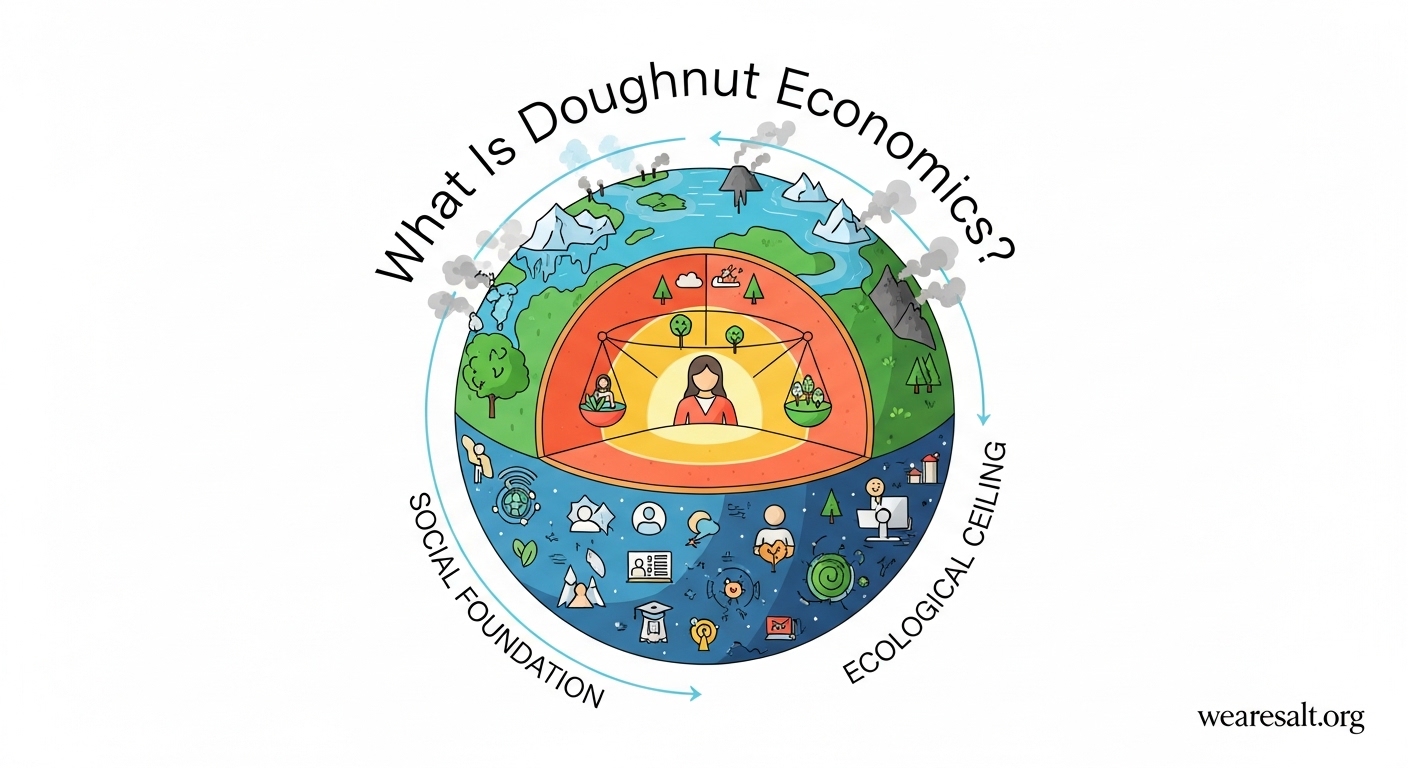
Doughnut economics is a visual framework for sustainable development that combines planetary boundaries with social foundations. Economist Kate Raworth developed the concept in 2012 while working at Oxford University’s Environmental Change Institute.
The model is shaped like a doughnut or lifebelt. An inner ring represents the social foundation that no one should fall below. An outer ring represents the ecological ceiling that humanity should not overshoot. The space between these rings, the doughnut itself, defines a safe and just space where both people and planet can thrive.
Unlike traditional economics that measures success primarily through GDP growth, doughnut economics asks a different question: are we meeting the needs of all people within the means of the living planet?
The Social Foundation: 12 Basic Needs
The inner ring of the doughnut consists of 12 dimensions of human well-being derived from the UN Sustainable Development Goals. These represent the minimum standards everyone deserves.
Here are the 12 social foundations:
- Water: Access to sufficient clean water for drinking, sanitation, and washing
- Food: Sufficient caloric and nutritional intake for health
- Health: Access to healthcare services and achieving good health status
- Education: Access to primary and secondary education for all children
- Housing: Adequate shelter with basic amenities
- Networks: Access to energy and communications infrastructure
- Income: Sufficient income and work for material security
- Peace and Justice: Freedom from violence and access to legal systems
- Political Voice: Democratic participation and civil liberties
- Social Equity: Fair distribution of resources and opportunities
- Gender Equality: Equal rights and opportunities regardless of gender
- Knowledge: Access to knowledge and learning opportunities
When people fall short on any of these dimensions, they live in the hole of the doughnut. Billions of people globally experience shortfalls in multiple areas.
The Ecological Ceiling: 9 Planetary Boundaries
The outer ring of the doughnut consists of nine planetary boundaries identified by Earth system scientists. These represent the environmental limits humanity must respect to maintain a stable climate and healthy ecosystems.
The nine planetary boundaries are:
- Climate Change: Atmospheric CO2 concentration and energy imbalance
- Ocean Acidification: Aragonite saturation state in surface oceans
- Nitrogen and Phosphorus Loading: Industrial and agricultural inputs to ecosystems
- Freshwater Use: Global human consumption of blue water
- Land Conversion: Percentage of global ice-free land converted to cropland
- Biodiversity Loss: Rate of extinction and genetic diversity
- Air Pollution: Aerosol loading and atmospheric particulates
- Ozone Depletion: Stratospheric ozone concentration
- Chemical Pollution: Release of novel entities including plastics and toxins
When we overshoot these boundaries, we damage Earth’s life-supporting systems. Currently, humanity has crossed at least six of these nine boundaries.
The Safe and Just Space
The doughnut itself, the space between the social foundation and the ecological ceiling, represents humanity’s sweet spot. This is where we can meet the needs of all people within the means of the living planet.
Think of it like this: falling below the inner ring means people are deprived of basic needs. Pushing beyond the outer ring means we are destroying the very systems that sustain life. The goal is to live within the doughnut.
Measuring success here requires new metrics. Instead of GDP growth, we track social indicators against environmental impacts. The Doughnut Economics Action Lab (DEAL) has developed tools to help organizations visualize their position within the doughnut.
How Doughnut Economics Differs from Traditional Economics
Traditional economics treats GDP growth as the primary measure of success. More growth equals more jobs, higher incomes, and better living standards. The assumption is that a rising tide lifts all boats.
But this model has two major flaws. First, growth does not automatically eliminate poverty or inequality. Second, growth requires extracting resources and emitting waste, which pushes against planetary boundaries.
Doughnut economics flips the script. Instead of asking “how do we grow GDP,” it asks “how do we ensure everyone has enough without taking too much from the planet?”
The framework also challenges the idea of rational economic man (homo economicus). It recognizes that humans are social, interdependent beings embedded in communities and nature, not isolated agents maximizing individual utility.
Real-World Applications
Cities and organizations are already putting doughnut economics into practice. The most prominent example is Amsterdam.
Amsterdam became the first city to formally adopt the doughnut framework in 2020. The city worked with Kate Raworth’s team to create a “City Portrait” that mapped local social needs and environmental impacts. This portrait guides urban planning decisions, from housing policy to circular economy initiatives.
Other cities following suit include:
- Brussels, Belgium: Using the framework to guide post-pandemic recovery
- Cornwall, UK: Developing a region-wide doughnut assessment
- Portland, USA: Exploring community-level applications
Businesses are also applying these principles. Some companies use the doughnut to assess their social and environmental impact, aiming to be regenerative and distributive by design rather than extractive.
Critiques and Limitations
No economic framework is perfect, and doughnut economics has its critics. Understanding these limitations helps us apply the model more effectively.
Some economists argue the framework lacks quantitative rigor. While it identifies boundaries, critics say it does not provide clear mechanisms for how to stay within them.
Others question whether developed nations can maintain living standards while staying within planetary boundaries. The model implies significant lifestyle changes in wealthy countries, which faces political resistance.
Measurement remains a challenge. While we can track GDP with a single number, assessing progress across 12 social dimensions and 9 environmental boundaries requires complex dashboards.
Despite these critiques, the framework offers something valuable: a clear visual metaphor that communicates the scale of our challenge and the need for transformation.
How to Apply Doughnut Economics Principles
You do not need to be a policymaker to apply doughnut thinking. Here is how different groups can use these principles.
For Businesses:
- Assess your supply chain for social and environmental impact
- Set targets to become regenerative rather than extractive
- Measure success using broader metrics than just profit
- Consider how your operations affect the 12 social foundations
For Communities and Cities:
- Conduct a local doughnut assessment using DEAL’s tools
- Identify where residents fall short on social needs
- Map local environmental impacts and pressures
- Develop policies that improve well-being while reducing pressure
For Individuals:
- Consider how your consumption affects planetary boundaries
- Support businesses and policies aligned with doughnut principles
- Engage in community initiatives that build social foundations
- Advocate for new economic metrics beyond GDP
Frequently Asked Questions
Is doughnut economics still relevant in 2026?
Doughnut economics is more relevant than ever. With climate change accelerating, biodiversity loss continuing, and inequality rising, the framework offers a timely alternative to growth-first thinking. The model has gained significant traction since its 2012 introduction, with cities like Amsterdam formally adopting it and the UN referencing similar principles in sustainable development goals.
What is the main goal of doughnut economics?
The main goal is to meet the needs of all people within the means of the living planet. Specifically, this means ensuring everyone has access to the 12 social foundations while not overshooting the 9 planetary boundaries. The framework seeks a safe and just space for humanity.
What does doughnut economics mean for business?
Businesses using doughnut principles aim to be regenerative and distributive rather than extractive. This means considering social and environmental impact alongside profit, designing products and services that restore rather than deplete natural systems, and ensuring fair distribution of value created.
What are some real-world examples of doughnut economics?
Amsterdam became the first city to formally adopt the framework in 2020, creating a City Portrait to guide policy. Brussels uses it for post-pandemic recovery planning. Businesses like Patagonia and Interface apply similar principles. The Doughnut Economics Action Lab supports communities worldwide in implementing the model.
How is doughnut economics different from GDP?
GDP measures market activity and assumes growth equals progress. Doughnut economics measures success by whether people meet basic needs within environmental limits. GDP counts pollution cleanup as positive growth; doughnut economics recognizes pollution as overshooting planetary boundaries. GDP ignores inequality; doughnut economics centers social foundations.
Who created doughnut economics?
Economist Kate Raworth created the framework in 2012 while a senior researcher at Oxford University’s Environmental Change Institute. She developed it as part of Oxfam research on planetary boundaries and social boundaries. Raworth published the bestselling book Doughnut Economics: Seven Ways to Think Like a 21st-Century Economist in 2017.
Conclusion
Doughnut economics gives us a new way to think about what an economy is for. Instead of endless growth, it asks us to create an economy that helps everyone thrive while respecting planetary boundaries.
The framework is simple enough to explain in minutes yet powerful enough to reshape policy at the city level. Whether you are a business leader, policymaker, or concerned citizen, doughnut economics offers practical principles for building a sustainable future.
I encourage you to explore the resources at the Doughnut Economics Action Lab and consider how these ideas might apply to your community. In 2026 and beyond, we need economic thinking that serves both people and planet.