
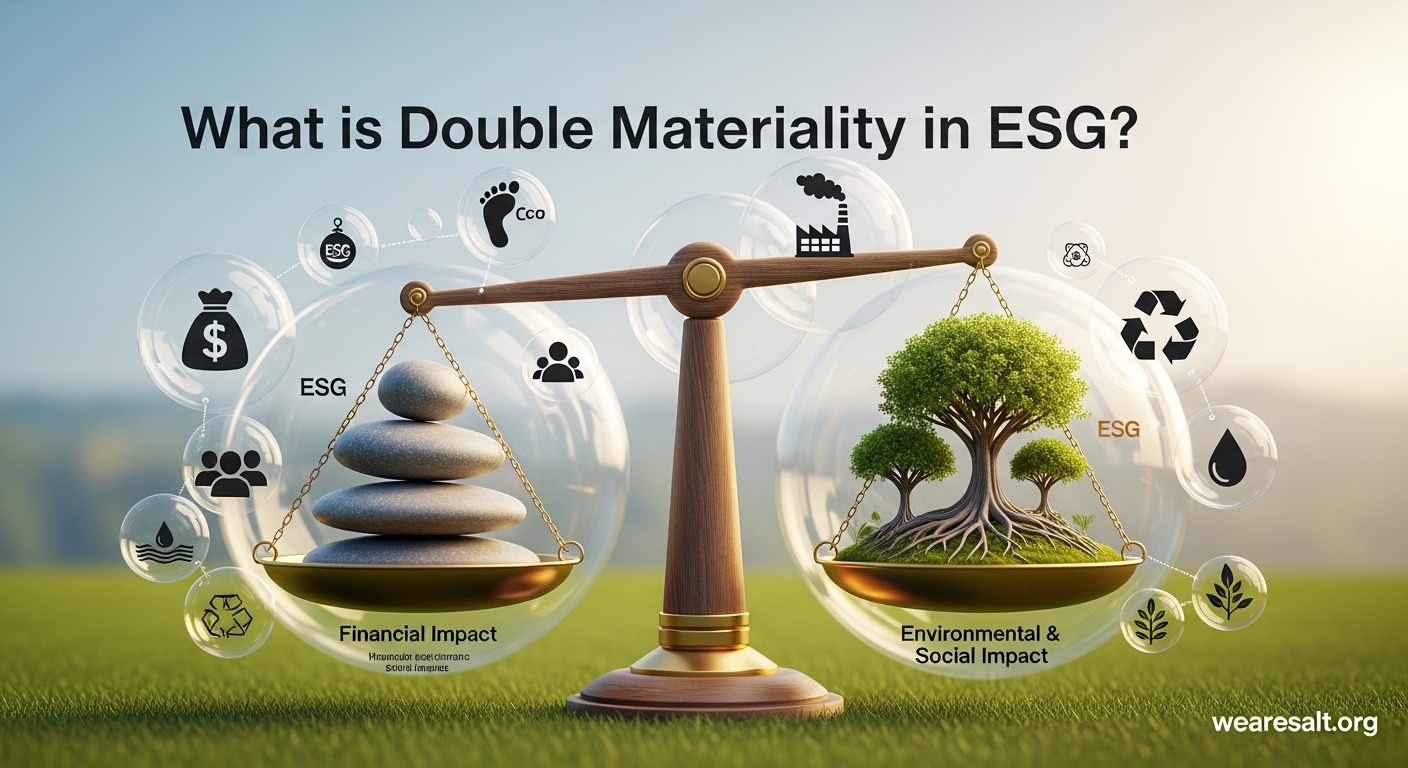
Double materiality in ESG is a concept that analyzes sustainability issues from two distinct perspectives: how sustainability matters affect a company’s financial performance, and how the company’s operations impact society and the environment. It expands traditional materiality assessments to include both the outside-in view (financial materiality) and the inside-out view (impact materiality).
Understanding double materiality has become essential for businesses preparing for the Corporate Sustainability Reporting Directive (CSRD) requirements in 2026. This guide explains what double materiality means, why it matters, and how organizations can conduct effective assessments.
I have spent time researching sustainability reporting frameworks and talking with compliance teams about their CSRD preparation. The most common question they ask is how to make sense of double materiality without getting overwhelmed by regulatory jargon.
Table of Contents
What is Materiality
Materiality is a concept borrowed from financial reporting that determines which information is important enough to influence decisions. In traditional accounting, a matter is material if omitting or misstating it could affect the economic decisions of users.
For decades, companies have applied materiality to decide what financial information to disclose. An item is material when its magnitude or nature makes it probable that its omission would change or influence the judgment of a reasonable person relying on the report.
The traditional approach only considers materiality from one angle: how external factors affect the business financially. This is called single materiality or financial materiality.
How Materiality Works in Financial Reporting
In financial contexts, companies apply quantitative and qualitative thresholds. The commonly referenced 5% rule suggests that amounts exceeding 5% of net income are generally considered material.
However, materiality is not just about numbers. A smaller amount can still be material if it involves fraud, illegal acts, or related party transactions. Context matters as much as calculation.
What is Double Materiality in ESG
Double materiality in ESG expands the traditional concept by requiring companies to assess sustainability matters from two directions simultaneously. It recognizes that sustainability issues are not just risks to business, but also impacts that businesses have on the world around them.
The concept gained prominence with the European Commission’s Non-Financial Reporting Directive and was strengthened under the Corporate Sustainability Reporting Directive (CSRD). It represents a fundamental shift in how companies think about their relationship with sustainability.
Under double materiality, a sustainability topic is considered material if it is significant from either a financial perspective or an impact perspective. Some topics may be material from both angles, while others may only matter from one.
Why Double Materiality Matters
Double materiality matters because it creates a more complete picture of corporate sustainability performance. Investors want to understand both the financial risks of climate change and how companies contribute to environmental problems.
Companies that embrace double materiality often discover strategic opportunities they would have missed under a single-materiality approach. Understanding your impacts on society can reveal areas for innovation and efficiency.
For 2026, CSRD compliance requires double materiality assessments for thousands of European companies. Organizations that start early have a competitive advantage in understanding their sustainability landscape.
The Two Perspectives: Financial vs Impact Materiality
Double materiality assessment involves evaluating sustainability topics from two complementary perspectives. These are often called the outside-in view and the inside-out view.
Financial Materiality: The Outside-In View
Financial materiality examines how sustainability matters affect the company’s financial position, performance, and cash flows. This is the traditional view that asks: what sustainability risks and opportunities could impact our business financially?
Examples of financially material topics include climate-related physical risks damaging assets, carbon pricing affecting operational costs, and changing consumer preferences impacting revenue.
The time horizon matters here. Some financial effects appear in the short term, while others may take years to materialize. CSRD requires consideration of short, medium, and long-term time horizons.
Impact Materiality: The Inside-Out View
Impact materiality examines how the company’s activities affect people and the environment. This perspective asks: what actual and potential impacts does our business have on society and the planet?
Impact materiality considers effects across the entire value chain, including upstream (suppliers) and downstream (customers) activities. A company’s impacts extend far beyond its direct operations.
Examples include greenhouse gas emissions contributing to climate change, labor practices in the supply chain affecting workers, and product end-of-life impacts on waste and pollution.
Comparing Financial and Impact Materiality
Here is how the two perspectives differ:
Financial Materiality:
- Focus: Effects on company value
- Question: How do ESG factors affect us financially?
- Users: Investors, lenders, creditors
- Timeframe: Short to long-term financial effects
Impact Materiality:
- Focus: Effects on people and planet
- Question: How do we affect society and environment?
- Users: Affected communities, civil society, regulators
- Timeframe: Actual and potential impacts
Some topics appear on both sides. Climate change is both a financial risk to businesses and an impact businesses contribute to through emissions. Other topics may be material from only one perspective.
CSRD and the Regulatory Framework
The Corporate Sustainability Reporting Directive (CSRD) makes double materiality assessment mandatory for many companies operating in the European Union. Understanding the regulatory context helps organizations prepare effectively.
The Shift from NFRD to CSRD
The Non-Financial Reporting Directive (NFRD) previously required large companies to report on sustainability matters. CSRD significantly expands these requirements with more detailed standards and broader scope.
CSRD introduces the European Sustainability Reporting Standards (ESRS), which specify exactly what companies must report. The first set of ESRS standards includes general requirements and ten topical standards covering environment, social, and governance matters.
The directive came into effect in stages starting in 2024, with full implementation continuing through 2028 depending on company size and type.
Who Must Comply with CSRD
CSRD applies to:
- Large EU companies meeting size criteria (employees, revenue, assets)
- Listed SMEs on EU regulated markets
- Non-EU companies with significant EU operations (over 150 million EUR revenue in EU)
Approximately 50,000 companies will eventually fall under CSRD requirements. This represents a massive expansion from the roughly 11,000 companies covered by NFRD.
ESRS Requirements for Double Materiality
The ESRS require companies to conduct a double materiality assessment to determine which sustainability topics they must report on. Not every company reports on every topic, only those deemed material through the assessment process.
The assessment must consider impacts, risks, and opportunities (IROs) across the value chain. Companies must engage stakeholders and document their materiality determination process.
Disclosures must follow specific formats and include quantitative metrics where standards prescribe them. The requirements are detailed and prescriptive compared to previous voluntary frameworks.
How to Conduct a Double Materiality Assessment
Conducting a double materiality assessment involves systematic steps to identify, evaluate, and prioritize sustainability matters. While each organization adapts the process to its circumstances, core elements remain consistent.
Step 1: Identify Sustainability Topics
Start by creating a comprehensive list of potential sustainability topics relevant to your business. The ESRS provides a list of topics to consider as a starting point.
Include environmental topics like climate change, pollution, water use, and biodiversity. Cover social topics such as workforce conditions, human rights, and community impacts. Consider governance matters including business conduct and risk management.
Look beyond your direct operations to include upstream and downstream value chain activities. Your impacts and risks extend throughout your supply chain and customer base.
Step 2: Assess Financial Materiality
For each topic, evaluate whether it could generate risks or opportunities that affect your financial performance. Consider the likelihood and magnitude of financial effects.
Ask questions like: Could this topic affect our revenue, costs, assets, or liabilities? Would it influence access to capital or insurance? Could it change our enterprise value?
Apply time horizons appropriate to your business and industry. Some topics have immediate financial implications while others develop over decades.
Step 3: Assess Impact Materiality
Evaluate the actual and potential impacts your business has on people and environment for each topic. Consider both positive and negative impacts.
Assess scale, scope, and irremediability of impacts. A large-scale impact affecting many people over a long duration is more material than a small, temporary effect.
Engage with stakeholders who experience or observe these impacts. Their perspectives help identify impacts you might not recognize from inside the organization.
Step 4: Engage Stakeholders
Stakeholder engagement is required under CSRD and essential for a robust assessment. Different stakeholders see different aspects of your sustainability performance.
Key stakeholder groups include employees, investors, customers, suppliers, local communities, regulators, and civil society organizations. Each group has unique insights into your material topics.
Engagement methods range from surveys and interviews to focus groups and formal consultations. Document your engagement process and how feedback influenced your assessment.
Step 5: Determine Materiality and Prioritize
Consolidate your findings to identify which topics are material from a financial perspective, impact perspective, or both. Create a materiality matrix to visualize the results.
Set thresholds for what counts as material. There is no universal standard, thresholds should be appropriate to your organization’s size, sector, and stakeholder expectations.
Document your methodology, assumptions, and judgments. CSRD requires disclosure of the assessment process and significant changes from prior periods.
Common Challenges and Best Practices
Organizations conducting their first double materiality assessment often encounter similar challenges. Learning from others’ experiences can smooth the process.
Challenge: Setting Materiality Thresholds
Determining where to draw the line between material and non-material topics involves judgment. There are no bright-line rules.
Best practice is to develop clear criteria based on quantitative and qualitative factors. Document your rationale for stakeholders and auditors. Review thresholds periodically as your business and context evolve.
Challenge: Data Availability
Impact assessment often lacks the precise data available for financial analysis. Companies struggle to quantify their effects on biodiversity or human rights.
Best practice is to use available proxies and estimation techniques while working to improve data quality over time. Document data limitations transparently. Engage suppliers and partners to expand data access.
Challenge: Stakeholder Engagement
Reaching representative stakeholders and interpreting diverse perspectives can be difficult. Some stakeholders may have conflicting views on what matters most.
Best practice is to design engagement processes that capture diverse perspectives systematically. Use multiple channels to reach different stakeholder groups. Be transparent about how you weight different inputs.
Challenge: Resource Constraints
Double materiality assessment requires time, expertise, and coordination across functions. Many organizations underestimate the resources needed.
Best practice is to start early and allocate dedicated resources. Build cross-functional teams combining sustainability, finance, risk, and operations expertise. Consider external support for first-time assessments.
Frequently Asked Questions
What does double materiality mean in ESG?
Double materiality means evaluating sustainability topics from two perspectives: how they affect the company’s finances (financial materiality) and how the company affects people and planet (impact materiality). It is required under the EU’s CSRD for sustainability reporting.
What is the difference between materiality and double materiality?
Single materiality only considers how external factors affect company finances. Double materiality adds the inside-out view of how company activities affect society and environment. CSRD requires the double materiality approach.
What is the 5% materiality rule?
The 5% rule is a guideline from financial reporting suggesting amounts exceeding 5% of net income are generally material. However, qualitative factors also matter, smaller amounts can be material if they involve fraud or illegal acts.
What are the 4 pillars of corporate sustainability?
The four pillars are human, social, economic, and environmental sustainability. These dimensions cover workforce wellbeing, community relations, financial viability, and environmental stewardship. Double materiality assessments typically address topics across all four pillars.
How often should double materiality assessments be updated?
CSRD requires annual sustainability reporting, so materiality assessments should be reviewed at least yearly. Significant changes in business operations, stakeholder expectations, or regulatory requirements may trigger more frequent updates.
Conclusion
Double materiality in ESG represents a fundamental evolution in how companies understand and report their relationship with sustainability. By examining both financial and impact perspectives, organizations develop a more complete picture of their sustainability performance.
For companies preparing for CSRD compliance in 2026, mastering double materiality assessment is not optional. The good news is that the process often reveals strategic insights and opportunities beyond mere compliance.
Start your assessment early, engage stakeholders meaningfully, and document your process thoroughly. Double materiality is not just a reporting requirement, it is a framework for building more sustainable and resilient businesses.