
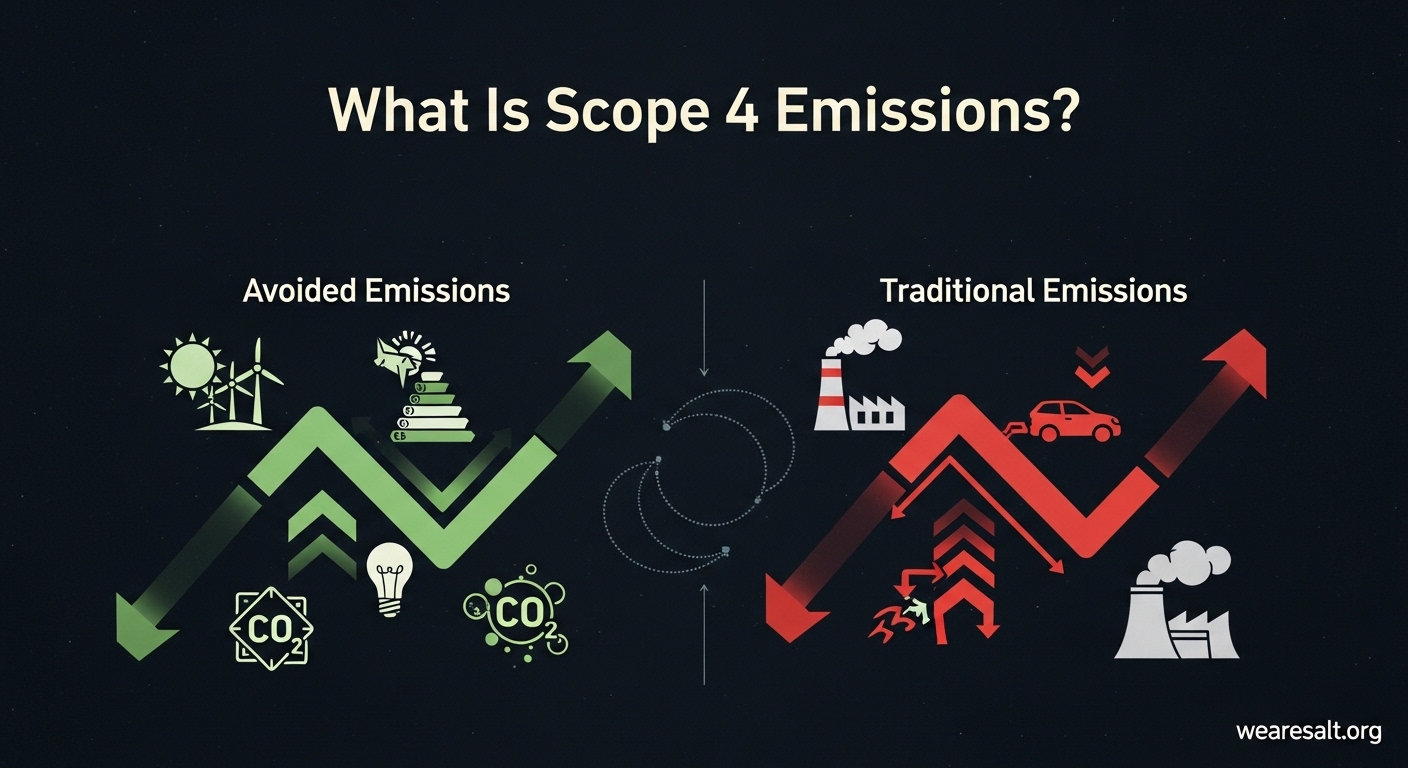
Scope 4 emissions are the greenhouse gas reductions that happen outside a product’s direct life cycle or value chain, but occur specifically because someone uses that product. Also called “avoided emissions,” this concept was introduced by the World Resources Institute in 2013 as a voluntary way to measure the positive environmental impact of efficient products and services.
I first encountered Scope 4 when researching how companies report their full environmental impact. Most people know about Scope 1, 2, and 3 emissions from the GHG Protocol. But Scope 4 fills a gap that many sustainability professionals initially overlook.
In this guide, I will explain what Scope 4 emissions are, how they differ from other emission scopes, real-world examples you can relate to, and why this matters for sustainability reporting in 2026. Whether you are a sustainability professional, business leader, or simply curious about corporate environmental impact, this article will give you a clear understanding of avoided emissions.
Table of Contents
What Are Scope 4 Emissions?
Scope 4 emissions represent the emissions prevented when a more efficient product replaces a less efficient alternative. These reductions occur outside the company’s own operations and supply chain, which makes them distinct from Scopes 1 through 3.
The easiest way to understand this is through the toaster analogy that sustainability professionals use.
The Toaster Analogy
Imagine you own a company that manufactures toasters. Your standard 2-slice toaster consumes 100 kilowatt-hours of electricity per year. You then develop a new energy-efficient model that uses only 50 kilowatt-hours per year for the same amount of toast.
When a customer buys your efficient toaster instead of a standard one, they save 50 kilowatt-hours annually. Those saved kilowatt-hours translate to avoided greenhouse gas emissions from power plants. Those avoided emissions are your Scope 4 emissions.
The key insight here is that these emissions were never released into the atmosphere. They represent a positive environmental impact that happens because of your product’s superior efficiency. This is fundamentally different from measuring the emissions created during manufacturing, which would fall under Scope 1, 2, or 3.
Key Characteristics of Avoided Emissions
Scope 4 emissions have three defining characteristics. First, they occur outside the product life cycle. Second, they result directly from using the product. Third, they represent a comparison between your product and a baseline alternative.
This comparison element is crucial. You cannot claim avoided emissions without establishing what would have happened if the customer chose a different product. This baseline selection is where much of the complexity and controversy around Scope 4 arises.
How Scope 4 Compares to Scope 1, 2, and 3 Emissions
Understanding Scope 4 requires knowing how it fits alongside the official GHG Protocol scopes. The GHG Protocol Corporate Standard defines Scopes 1, 2, and 3, but Scope 4 exists outside this framework as a voluntary metric.
The Four Scopes Defined
Scope 1 covers direct emissions from sources a company owns or controls. This includes fuel burned in company vehicles, emissions from manufacturing processes, and on-site power generation.
Scope 2 accounts for indirect emissions from purchased electricity, heat, or steam. When you buy power from the grid, the emissions from generating that power count as Scope 2.
Scope 3 encompasses all other indirect emissions in a company’s value chain. This includes upstream emissions from suppliers making your raw materials, and downstream emissions from customers using and disposing of your products.
Scope 4 captures the emissions prevented when efficient products replace less efficient alternatives. It measures the positive impact your products enable customers to achieve.
| Scope | Type | Description | Example |
|---|---|---|---|
| Scope 1 | Direct | Emissions from owned or controlled sources | Factory emissions, company vehicle fuel |
| Scope 2 | Indirect | Emissions from purchased electricity, heat, steam | Power purchased from the grid |
| Scope 3 | Value Chain | All other indirect emissions in the value chain | Supplier emissions, product use by customers |
| Scope 4 | Avoided | Emissions prevented by using efficient products | Savings from an efficient appliance vs standard model |
Why Scope 4 Is Not Official
The GHG Protocol has not officially recognized Scope 4 as part of its corporate standard. This voluntary status means companies can choose whether to report these emissions, and there is no standardized methodology enforced across industries.
However, the World Resources Institute published guidance on calculating and reporting avoided emissions in 2013. While not mandatory, this guidance provides a framework for companies wanting to communicate their positive environmental impacts credibly.
Real-World Examples of Scope 4 Emissions
Scope 4 emissions appear across many industries where efficiency improvements create measurable savings. Here are concrete examples that illustrate how this concept works in practice.
Energy-Efficient Appliances
When a customer buys an ENERGY STAR certified refrigerator instead of a standard model, the electricity savings over the appliance lifetime represent Scope 4 emissions. The manufacturer can calculate the avoided emissions by comparing their efficient model against the baseline energy consumption of an average refrigerator.
LED lighting provides another clear example. An LED bulb uses approximately 75% less energy than an incandescent bulb for the same light output. When commercial buildings install LED lighting systems, the accumulated energy savings create significant avoided emissions that the lighting manufacturer can potentially claim.
Teleconferencing Solutions
Video conferencing platforms enable Scope 4 emissions through avoided business travel. When a company replaces a cross-country flight with a video meeting, the emissions from that flight are avoided.
The teleconferencing company can potentially claim a portion of these avoided emissions, though the calculation becomes complex when determining what portion of the decision belongs to their platform versus company policy changes.
Transportation Efficiency
Electric vehicles create Scope 4 emissions when they replace gasoline-powered cars. The difference in emissions per mile driven, multiplied over the vehicle lifetime, represents the avoided emissions that an EV manufacturer could report.
Fuel-saving tires offer another transportation example. Low-rolling-resistance tires improve fuel economy by 3-5% compared to standard tires. For a fleet of delivery trucks driving millions of miles annually, these savings accumulate into measurable Scope 4 emissions.
Industrial and Commercial Solutions
Low-temperature detergents allow washing machines to clean effectively in cold water rather than hot water. The natural gas or electricity saved by eliminating hot water cycles creates avoided emissions that detergent manufacturers can quantify.
Cloud computing services can claim Scope 4 emissions when companies move from on-premises data centers to more efficient cloud infrastructure. Major cloud providers operate data centers with significantly better power usage effectiveness than typical corporate facilities.
How to Calculate Scope 4 Emissions
Calculating avoided emissions requires establishing a credible baseline and measuring the difference your product creates. The World Resources Institute outlines two main approaches for this calculation.
The Basic Formula
At its simplest, Scope 4 calculation follows this formula: Baseline Emissions minus Solution Emissions equals Avoided Emissions. The challenge lies in defining an appropriate baseline and accounting for all relevant factors.
For example, if a standard data center server consumes 500 watts and your efficient model consumes 350 watts for the same computing output, the 150-watt difference represents potential avoided emissions. Multiply this by operating hours and the local grid carbon intensity to get the actual greenhouse gas savings.
The Consequential Approach
The consequential approach uses life cycle assessment (LCA) methodology. This method examines the broader system effects of using your product. It asks what happens throughout the economy when customers adopt your solution.
This approach captures indirect effects but becomes highly complex. It requires modeling economic responses, market shifts, and potential rebound effects where efficiency gains get offset by increased consumption. Most companies find this approach too resource-intensive for regular reporting.
The Attributional Approach
The attributional approach uses comparative product lifecycle assessment. This method compares your product’s emissions against a clearly defined reference product performing the same function.
This approach is more straightforward and widely used. It focuses on the direct replacement scenario without attempting to model broader economic effects. The key is selecting an appropriate and defensible reference product.
Calculation Challenges
Forum discussions among sustainability professionals reveal consistent challenges with Scope 4 calculations. Baseline selection generates the most debate. Should you compare against the market average, the product being replaced, or a theoretical minimum standard?
Attribution questions also complicate calculations. When multiple factors contribute to an efficiency improvement, how do you allocate the avoided emissions? If a customer saves energy through both your efficient equipment and their own behavioral changes, who claims the savings?
Double-counting risks emerge when multiple parties in a value chain attempt to claim the same avoided emissions. Clear agreements and transparent methodology documentation help prevent this issue.
Why Scope 4 Matters for Sustainability
Despite its voluntary status and calculation challenges, Scope 4 reporting offers genuine value for companies and stakeholders. It provides a more complete picture of environmental impact that complements traditional emissions accounting.
Recognizing Positive Impact
Traditional emissions scopes focus entirely on negative impacts. They measure what a company puts into the environment. Scope 4 acknowledges that companies can also create positive environmental outcomes through innovation and efficiency.
This recognition matters for companies whose core business involves helping customers reduce their own emissions. A renewable energy company, for example, creates far more environmental benefit through the clean electricity it generates than the emissions from its operations.
Connection to Net-Zero Goals
Scope 4 emissions connect directly to global net-zero objectives. When companies develop products that help customers reduce their carbon footprints, they enable economy-wide decarbonization that extends beyond their own operations.
Microsoft, for example, has explored Scope 4 reporting to capture the emissions avoided through its cloud services. The company recognizes that helping customers operate more efficiently contributes to overall climate goals.
ESG Investment and Reporting
Investors increasingly want to understand the full environmental impact of their portfolio companies. Scope 4 provides an additional metric for evaluating companies developing climate solutions.
However, investors also scrutinize Scope 4 claims carefully. They look for transparent methodology and third-party verification to distinguish credible reporting from greenwashing attempts.
Not a Substitute for Scope 1-3
An important limitation to understand: Scope 4 never replaces the need to reduce Scope 1, 2, and 3 emissions. A company cannot claim climate leadership solely through avoided emissions while continuing to pollute heavily in its direct operations.
Best practice involves mastering Scope 1-3 reporting first, establishing credible reduction targets, and only then adding Scope 4 as supplementary information. The World Resources Institute guidance emphasizes this hierarchy.
Greenwashing Risks and How to Avoid Them
Scope 4 emissions are particularly susceptible to greenwashing because of their voluntary status and flexible calculation methods. Forum discussions among sustainability professionals show widespread concern about misleading claims in this space.
Why Scope 4 Is Prone to Greenwashing
The lack of standardized methodology allows companies to choose baselines that maximize their claimed avoided emissions. An unscrupulous company might compare their product against an unrealistically inefficient baseline to inflate their Scope 4 numbers.
Attribution problems create another greenwashing risk. Companies may claim avoided emissions that actually result from customer behavior changes, regulatory requirements, or other factors unrelated to their product.
Warning Signs of Misleading Claims
Be skeptical of Scope 4 claims that lack transparent baseline documentation. Credible reports clearly explain what product or standard they used for comparison and why that choice is appropriate.
Vague or unverifiable numbers should raise red flags. Claims like “our product saves millions of tons of CO2” without supporting methodology or boundaries indicate potential greenwashing.
Watch for companies using Scope 4 to distract from poor Scope 1-3 performance. If a company heavily promotes avoided emissions while showing minimal progress on their direct carbon footprint, question their priorities.
Best Practices for Credible Reporting
Follow the World Resources Institute guidance as the foundation for credible Scope 4 reporting. This guidance emphasizes transparency, appropriate baseline selection, and clear boundaries.
Obtain third-party verification for Scope 4 calculations. Independent assurance adds credibility and helps catch methodological errors or unjustified assumptions.
Report Scope 4 separately from official GHG inventory numbers. Never combine avoided emissions with Scope 1-3 totals in ways that suggest your company has zero or negative emissions.
Be transparent about limitations and uncertainties. Acknowledge the challenges in establishing baselines and attributing avoided emissions. This honesty builds trust with stakeholders.
Companies Already Reporting Scope 4 Emissions
Several major companies have pioneered Scope 4 reporting, providing models for others considering this approach. These early adopters demonstrate both the potential and the pitfalls of avoided emissions reporting.
Schneider Electric
Schneider Electric has been among the most prominent reporters of avoided emissions. The company quantifies the emissions its energy management and automation solutions help customers avoid. They emphasize that these savings come alongside their own aggressive Scope 1-3 reduction targets.
Volvo Group
Volvo reports avoided emissions from its fuel-efficient vehicles and electrification solutions. The company focuses on comparing their latest models against both previous generations and industry averages to provide context for their claims.
Microsoft
Microsoft has explored Scope 4 reporting for its cloud and productivity services. The company examines the efficiency gains customers achieve by moving from on-premises infrastructure to Microsoft Azure cloud services.
Growing Adoption Trends
More companies are considering Scope 4 reporting as ESG expectations increase. The trend appears strongest among technology companies, clean energy providers, and efficiency-focused manufacturers.
However, adoption remains cautious. Most companies wait for clearer guidance or standardization before fully embracing Scope 4 reporting in their official disclosures.
The Future of Scope 4 Emissions Reporting
Scope 4 emissions currently exist in a voluntary, unstandardized space. But the landscape is evolving as more companies and stakeholders engage with this concept.
Current Voluntary Status
The GHG Protocol has not incorporated Scope 4 into its official standards as of 2026. The World Resources Institute guidance remains the primary reference document, but it does not carry the same authority as official protocol requirements.
This voluntary status means companies can choose their own approaches, which creates inconsistency across reports. One company’s Scope 4 calculation may not be comparable to another’s due to different baseline assumptions.
Potential for Standardization
Industry groups have discussed the possibility of developing standardized Scope 4 methodologies. Any standardization would need to address baseline selection, attribution rules, and reporting boundaries.
The GHG Protocol may eventually address avoided emissions more formally. Until then, companies following WRI guidance with third-party verification offer the most credible approaches.
Growing Importance
Despite standardization challenges, interest in Scope 4 continues growing. Companies developing climate solutions want recognition for the positive impacts they enable. Investors want metrics for evaluating these solution providers.
The concept will likely remain relevant even if the terminology or framework evolves. Measuring and communicating the positive environmental impacts of efficient products serves a legitimate purpose in sustainability discourse.
FAQ
What are Scope 4 emissions?
Scope 4 emissions are greenhouse gas reductions that occur outside a product’s life cycle or value chain but as a direct result of using that product. Also called ‘avoided emissions,’ this voluntary reporting category was introduced by the World Resources Institute in 2013 to measure the positive environmental impact of efficient products and services.
What is the avoided emissions definition?
Avoided emissions refer to the greenhouse gases prevented from entering the atmosphere when a more efficient product replaces a less efficient alternative. The calculation requires establishing a baseline (what would have been emitted) and comparing it against the emissions from the new solution. The difference represents the avoided emissions.
Is Scope 4 emissions reporting mandatory?
No, Scope 4 emissions reporting is completely voluntary. The GHG Protocol has not officially recognized Scope 4 as part of its corporate standard. Companies can choose whether to report these emissions, and there is currently no standardized methodology enforced across industries.
How does Scope 4 differ from Scope 3 emissions?
Scope 3 covers all indirect emissions in a company’s value chain, including upstream and downstream activities. Scope 4 captures emissions prevented when efficient products replace less efficient alternatives. While Scope 3 measures what happens within the value chain, Scope 4 measures positive impacts that happen outside it due to product efficiency.
Can Scope 4 replace Scope 1-3 reporting?
No, Scope 4 can never substitute for Scope 1, 2, and 3 emissions reporting and reduction. Best practice requires companies to master their direct emissions accounting first, establish credible reduction targets, and only then add Scope 4 as supplementary information showing positive impact beyond their own operations.
Conclusion
Scope 4 emissions explained in simple terms are the greenhouse gases prevented when efficient products replace less efficient alternatives. This concept, also known as avoided emissions, provides a way to measure and communicate the positive environmental impacts that products create for their users.
Understanding Scope 4 emissions matters because it completes the picture of corporate environmental impact. While Scopes 1, 2, and 3 tell us what companies put into the atmosphere, Scope 4 recognizes what they help keep out of it. However, this voluntary metric comes with significant challenges around calculation methodology and greenwashing risks that require careful attention.
If you are considering Scope 4 reporting for your organization, start by mastering your Scope 1-3 emissions first. Follow the World Resources Institute guidance, choose defensible baselines, obtain third-party verification, and maintain transparency about your methodology and limitations. When done correctly, Scope 4 reporting can credibly showcase the positive environmental impact your products enable in 2026 and beyond.