
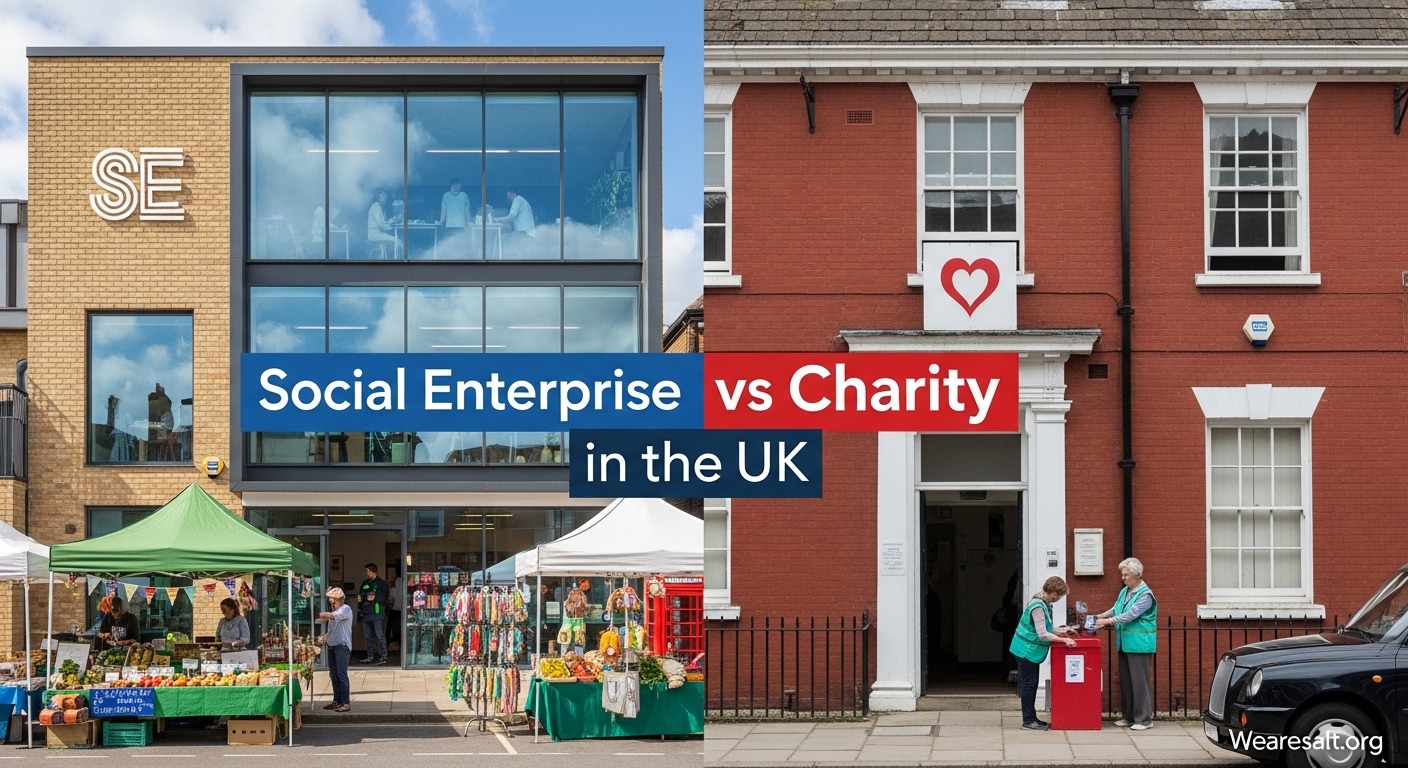
Starting a mission-driven organisation in the UK? You have probably asked yourself whether to set up as a social enterprise vs charity. I have worked with dozens of founders facing this exact question, and the confusion is completely understandable. The UK third sector has overlapping terms, multiple legal structures, and rules that vary depending on where you register.
Here is the key thing most guides do not make clear upfront: “social enterprise” is not a legal structure at all. It is a way of doing business. A charity, on the other hand, is a specific legal concept regulated by the Charity Commission. Your organisation could technically be both, or neither, depending on the choices you make.
In this guide, I will walk you through the real differences between social enterprises and charities in the UK. You will learn about legal structures like CICs and CIOs, understand funding implications, and get a clear framework for deciding which path fits your mission. Whether you are just starting out or considering restructuring, this article will give you the clarity you need to move forward with confidence.
Table of Contents
What is a Social Enterprise in the UK?
A social enterprise is a business that trades goods or services with a primary purpose of creating positive social or environmental impact. Unlike traditional companies that exist to maximise profit for shareholders, social enterprises exist to serve a social mission. They reinvest the majority of their profits back into that mission rather than distributing them to owners.
The UK government defines a social enterprise as “a business with primarily social objectives whose surpluses are principally reinvested for that purpose in the business or the community.” This definition captures the dual nature of these organisations: they operate commercially but exist socially.
Key Characteristics of Social Enterprises
Social enterprises share several defining characteristics that set them apart from both traditional businesses and charities:
- Trading income: They generate most or all of their income through selling products or services, not donations
- Social mission: Their primary purpose is social or environmental impact, not profit maximisation
- Reinvestment: The majority of profits are reinvested into the social mission
- Asset lock: Many have restrictions preventing assets from being distributed to shareholders
Well-known UK social enterprises include the Big Issue, Divine Chocolate, and the Eden Project. These organisations prove that trading commercially and serving social goals can go hand in hand.
Legal Structures for Social Enterprises
Because “social enterprise” is not a legal structure itself, you must choose a legal form to operate under. The most common options in the UK include:
- Community Interest Company (CIC): The most popular structure, designed specifically for social enterprises with built-in asset lock
- Company limited by shares: Standard limited company with social purpose written into articles
- Company limited by guarantee: No shareholders, suitable for membership-based organisations
- Co-operative or Community Benefit Society: Democratic member-owned structure
Registration happens at Companies House for most of these structures. CICs have additional requirements and must demonstrate their community benefit to the CIC Regulator.
What is a Charity in the UK?
A charity is a legal entity established exclusively for charitable purposes that provides public benefit. Unlike social enterprises, charities must register with and are regulated by the Charity Commission for England and Wales (or OSCHR in Scotland, CCNI in Northern Ireland).
To be a charity, your organisation must meet the Charity Commission’s definition: it must have purposes that are exclusively charitable according to law, and it must demonstrate public benefit. These are not optional extras. They are strict legal requirements that affect everything from your governing document to your tax status.
Charitable Purposes Defined
UK charity law recognises 13 categories of charitable purposes. Your organisation’s mission must fall within one or more of these:
- Prevention or relief of poverty
- Advancement of education
- Advancement of religion
- Advancement of health or saving of lives
- Advancement of citizenship or community development
- Advancement of the arts, culture, heritage or science
- Advancement of amateur sport
- Advancement of human rights, conflict resolution or reconciliation
- Advancement of environmental protection or improvement
- Relief of those in need due to youth, age, ill-health, disability, financial hardship or other disadvantage
- Advancement of animal welfare
- Promotion of the efficiency of the armed forces, police, fire or ambulance services
- Other purposes currently recognised as charitable or analogous to other charitable purposes
Your governing document must clearly state which of these purposes your organisation serves. The Charity Commission will assess this when you apply for registration.
The Public Benefit Requirement
Every charity must demonstrate that it operates for the public benefit. This is a legal requirement, not just a nice-to-have. The benefit must be:
- Recognisable: Identifiable and capable of being evidenced
- Available to the public or a section of it: Not restricted to private individuals or closed groups
- Related to the charitable aims: Directly connected to your stated purposes
This public benefit requirement shapes how charities can operate. For example, a charity cannot restrict its services to members only unless membership itself is a means of delivering public benefit.
Legal Structures for Charities
Charities can take several legal forms, each with different implications:
- CIO (Charitable Incorporated Organisation): The most popular modern structure, offering corporate status without needing to register with both Companies House and the Charity Commission
- Charitable company limited by guarantee: Corporate body registered with both Companies House and Charity Commission
- Trust: Traditional structure with trustees holding assets for charitable purposes, no corporate status
- Unincorporated association: Simple structure for smaller organisations, but no separate legal identity
Most new charities choose the CIO structure because it offers limited liability for trustees while simplifying registration and reporting requirements.
Key Differences: Social Enterprise vs Charity
Understanding the practical differences between these two organisational types will help you make the right choice. Here is how they compare across the factors that matter most to founders.
Profit Distribution
Charities cannot distribute profits to individuals. All surplus must be reinvested into charitable activities. Trustees cannot be paid from profits except in limited circumstances and with Charity Commission approval.
Social enterprises, particularly CICs, can distribute limited profits. CICs face a dividend cap: they can only pay dividends up to 35% of accumulated profits, with additional restrictions on the rate. Other social enterprise structures like standard limited companies have no such restrictions but may include social purpose clauses in their articles.
Funding Sources
This is where the distinction becomes most practical. Charities can access:
- Tax-effective donations from individuals (Gift Aid)
- Charitable grants and foundations
- Trading income (with some restrictions)
- Legacies and charitable trusts
- Tax exemptions on most income
Social enterprises primarily rely on:
- Trading income from goods and services
- Social investment (repayable finance)
- Some grants (though fewer than charities)
- Commercial loans and equity
Charities have access to more grant funding. Social enterprises have more flexibility in accessing investment and loans.
Regulation and Reporting
Charities face stricter regulation. Registered charities must:
- File annual reports with the Charity Commission
- Maintain public registers of trustees
- Demonstrate public benefit in annual reports
- Seek permission for certain activities (like trustee payments)
- Follow Charity Commission guidance on governance
Social enterprises registered as CICs must file community interest reports but face lighter touch regulation. Standard companies have the least regulatory burden but lack the credibility markers that charity status provides.
Comparison Table: Social Enterprise vs Charity
| Factor | Charity | Social Enterprise (CIC) |
|---|---|---|
| Primary purpose | Charitable purposes only | Social/community benefit |
| Legal regulator | Charity Commission | CIC Regulator |
| Profit distribution | Prohibited | Limited (35% cap for CICs) |
| Asset lock | Yes – permanent | Yes – but can be removed |
| Tax benefits | Full charity tax reliefs | Standard business rates |
| Grant funding | Wide access | Limited access |
| Investment | Restricted | More flexible |
| Registration fee | Free | £35-£150 |
| Public credibility | High | Medium |
Legal Structures Explained: CIC vs CIO vs Others
The acronyms can get confusing. CIC, CIO, CLG – what do they actually mean, and which one should you choose? Let me break down the most common structures for mission-driven organisations in the UK.
Community Interest Company (CIC)
A CIC is a special type of limited company designed for social enterprises. Introduced in 2005, it provides a legal identity with built-in asset lock and community interest requirements.
Advantages:
- Clear social purpose requirement
- Asset lock prevents private benefit
- Limited liability for directors
- More flexible than charities on activities and investment
- Recognition as social enterprise
Disadvantages:
- No charitable tax reliefs
- Limited access to charitable grants
- Reporting requirements to CIC Regulator
- Dividend restrictions (35% cap)
CICs work best for organisations that want to trade commercially while maintaining social commitment, without the restrictions of charitable status.
Charitable Incorporated Organisation (CIO)
The CIO structure was introduced in 2013 specifically to make charity registration simpler. It gives charities corporate status without requiring dual registration at Companies House.
Advantages:
- Single registration with Charity Commission only
- Limited liability for trustees
- Simpler reporting than charitable companies
- Full charitable tax benefits
- Strong public recognition
Disadvantages:
- Stricter regulation than CICs
- No private benefit allowed
- Activities restricted to charitable purposes
- Fundraising restrictions apply
CIOs are ideal for organisations focused purely on charitable work that need the credibility and tax advantages of registered charity status.
Company Limited by Guarantee (CLG)
CLGs have no shareholders. Instead, members guarantee a nominal amount (usually £1-£10) if the company winds up. This structure works for both charities and social enterprises.
Charitable CLGs must register with both Companies House and the Charity Commission. Non-charitable CLGs often form the basis of social enterprises when combined with social purpose clauses.
Scotland and Northern Ireland Differences
If you are registering in Scotland or Northern Ireland, the rules differ slightly from England and Wales:
Scotland: Regulated by OSCR (Office of the Scottish Charity Regulator). The legal forms are similar, but Scottish charities follow Scottish charity law. Community Interest Companies exist UK-wide, but Scottish CICs register with Companies House in Edinburgh.
Northern Ireland: Regulated by CCNI (Charity Commission for Northern Ireland). CIOs are available but were introduced later than in England and Wales. Registration requirements can be more stringent due to historical issues with charity regulation.
Always check the specific regulator guidance for your jurisdiction before proceeding with registration.
How to Choose: Decision Framework
After working through the differences, how do you actually decide? Here is a practical framework based on the questions I ask founders when they come to me for advice.
Choose a Charity If:
- Your activities clearly fit within the 13 charitable purposes
- You need access to charitable grants and Gift Aid
- Tax exemptions are important to your financial model
- You do not need to distribute profits to founders or investors
- Public credibility and trust are paramount
- You are comfortable with Charity Commission regulation
Choose a Social Enterprise (CIC) If:
- You plan to generate most income through trading
- You need flexibility to access investment or loans
- Your activities might not strictly fit charitable purposes
- You want some ability to distribute limited profits
- You prefer lighter regulation than charities face
- You want to mix commercial and social activities
Decision Checklist
Ask yourself these questions:
- Does your mission clearly fit within charitable purposes? If yes, charity may work. If no, social enterprise.
- Will you rely heavily on grants and donations? If yes, charity structure recommended.
- Do you need to attract investment or repayable finance? If yes, social enterprise offers more flexibility.
- Is charitable credibility essential for your work? If yes, register as charity.
- Do you need to pay founders or directors from profits? If yes, CIC or standard company structure.
- Are you comfortable with Charity Commission oversight? If no, consider CIC instead.
Remember, you can change structure later, though it requires careful legal process. Several organisations start as CICs and convert to CIOs as they grow and their funding mix changes.
Hybrid Approaches
Some organisations use both structures. A charity might set up a trading subsidiary (often a CIC or limited company) to conduct commercial activities. This separates the charitable assets from trading risk while allowing both types of work.
For example, a homeless charity might operate as a CIO for its core support work, with a trading subsidiary that runs charity shops and cafes. The trading income comes into the subsidiary, then gets donated to the parent charity after covering costs.
Frequently Asked Questions
What is the difference between a social enterprise and a charity in the UK?
The key difference is that a charity is a legal structure regulated by the Charity Commission with strict rules about profit distribution and public benefit. A social enterprise is a way of doing business focused on social impact, not a legal structure itself. Social enterprises can take various legal forms like CICs or limited companies. Charities get tax benefits and access to grants but face stricter regulation. Social enterprises have more flexibility on funding and profit but miss out on charitable tax reliefs.
What is the 30 70 rule for charities?
The 30 70 rule refers to guidance about trading by charities. While not a strict legal rule, it suggests that charities should generally earn at least 70% of their income from donations, grants, and charitable activities, with no more than 30% from non-charitable trading. Excessive trading can threaten charitable status. However, primary purpose trading (directly furthering the charity’s objects) does not count toward this limit.
What is a social enterprise in the UK?
A social enterprise is a business that trades goods or services with a primary purpose of creating positive social or environmental impact. It reinvests the majority of profits into its mission rather than distributing them to shareholders. Common legal structures include Community Interest Companies (CICs), companies limited by guarantee, and co-operatives. Unlike charities, social enterprises are not regulated by the Charity Commission and do not get charitable tax benefits.
Why is a CIC better than a charity?
A CIC is not necessarily better, but it suits different circumstances. CICs offer more flexibility than charities: they can access investment more easily, have lighter regulation, and can distribute limited profits. However, they miss out on charitable tax reliefs and have less access to grants. Choose a CIC if you plan to trade commercially and want operational flexibility. Choose charity status if you need grant funding and tax benefits.
What is a disadvantage of a social enterprise?
Social enterprises face several disadvantages compared to charities: they cannot access most charitable grants, they do not get charity tax reliefs like Gift Aid, they may struggle to compete with charities for public trust and donations, and they face the commercial risks of trading. CICs specifically have dividend caps that limit returns to investors. The social enterprise model works best when you have a viable commercial proposition, not when you rely on philanthropic funding.
Can a nonprofit be a social enterprise?
Yes, charities (which are nonprofits) can operate as social enterprises. Many charities trade goods and services to generate income. However, a charity cannot be a CIC, as these are mutually exclusive legal forms in the UK. An organisation is either a registered charity or a CIC, not both. The key is whether your legal structure is charitable (regulated by Charity Commission) or commercial with social purpose (CIC or standard company).
Conclusion
Choosing between a social enterprise vs charity in the UK comes down to your mission, funding model, and appetite for regulation. Charities offer credibility, tax benefits, and grant access but require strict compliance with charitable purposes and public benefit rules. Social enterprises provide flexibility, investment access, and lighter regulation but miss out on charitable tax reliefs.
The most important thing is alignment. Choose the structure that lets you deliver your mission effectively. A badly chosen structure creates friction. The right one becomes invisible, letting you focus on impact.
If you are still unsure, speak to a solicitor specialising in third sector law or contact the Charity Commission or CIC Regulator directly. The time spent getting this decision right at the start will save you significant hassle down the road. Your mission matters too much to let administrative confusion slow you down.