
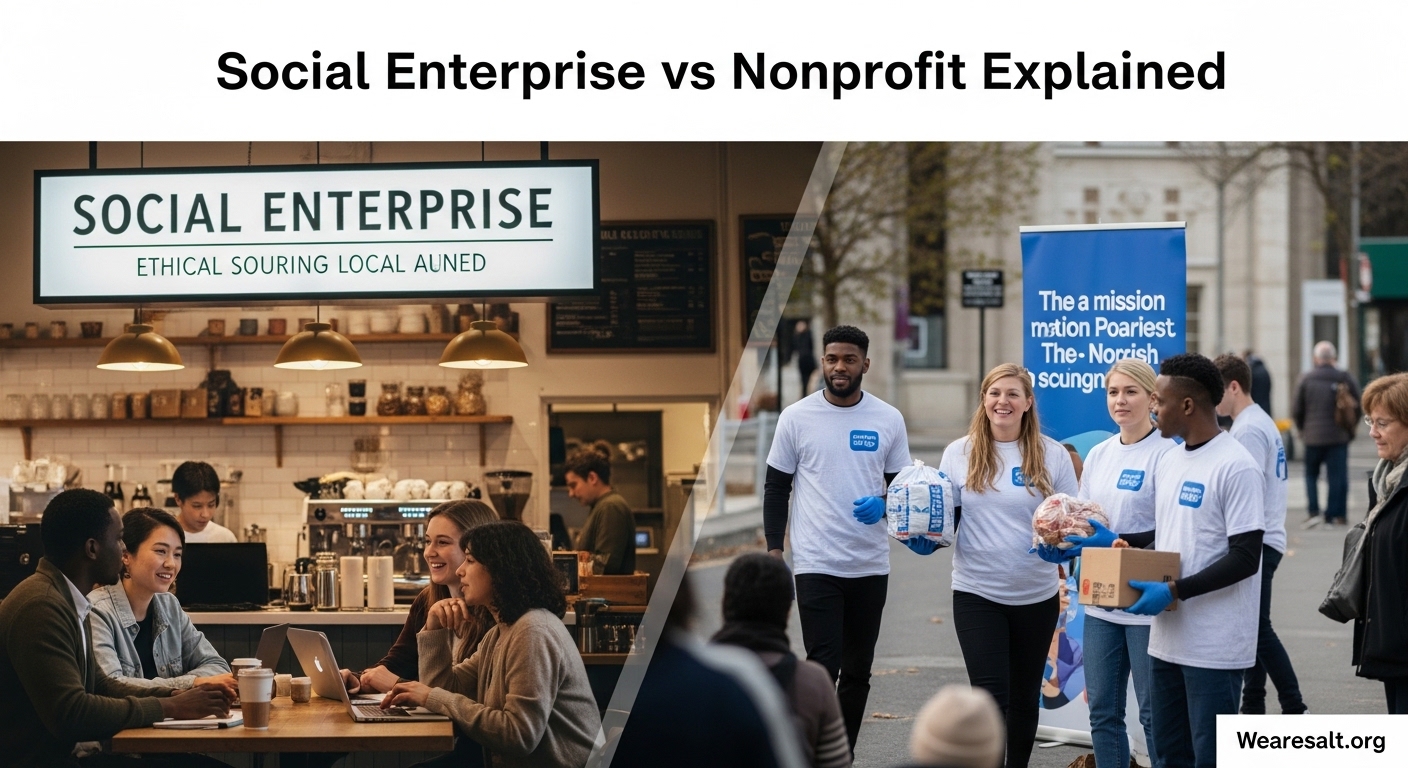
When you’re passionate about creating social impact, choosing the right organizational structure becomes one of your most important decisions. Understanding the social enterprise vs nonprofit distinction determines everything from how you’ll fund your operations to how you’ll measure success. While both models exist to serve social missions, they operate under fundamentally different principles that affect sustainability, growth potential, and long-term viability.
I’ve spent years working with mission-driven organizations, and I’ve seen how this single choice shapes everything that follows. A social enterprise uses traditional business strategies like selling products or services to generate revenue for charitable causes. A nonprofit organization operates primarily to serve social benefit without a profit motive, relying on donations and grants rather than earned income. The right structure depends on your specific mission, funding strategy, and operational preferences.
Table of Contents
What Is a Social Enterprise?
A social enterprise is an organization that advances a social mission through market-based strategies. Unlike traditional charities, social enterprises generate revenue by selling products or services just like conventional businesses. The crucial difference is that profits get reinvested into the social mission rather than distributed to owners or shareholders.
Think of organizations like TOMS Shoes or Warby Parker. They operate as profitable businesses but build their models around social impact. TOMS donates a pair of shoes for every pair sold. Warby Parker provides glasses to people in need through their “Buy a Pair, Give a Pair” program. These companies prove that market-based approaches can drive substantial social change.
The social entrepreneurship movement has grown significantly in recent years. Entrepreneurs increasingly recognize that business models can solve social problems while achieving financial sustainability. This approach appeals to founders who want autonomy over their operations and don’t want to depend entirely on donor generosity.
What Is a Nonprofit Organization?
A nonprofit organization is an entity formed for purposes other than generating profit. These organizations serve charitable, educational, religious, or other public service missions. In the United States, most nonprofits seek 501(c)(3) tax-exempt status, which means they don’t pay federal income tax and donors can deduct contributions from their taxes.
Nonprofits rely heavily on donations, grants, and volunteer support rather than earned income from sales. Organizations like the Red Cross, United Way, and local food banks operate under this model. They exist to serve needs that markets don’t adequately address, such as disaster relief, poverty alleviation, and community development.
One important concept in the nonprofit world is the 33% rule. The IRS generally expects that at least one-third of a nonprofit’s support should come from the general public or governmental units to maintain public charity status. This rule prevents private foundations from operating under the guise of public charities and ensures genuine community support.
Social Enterprise vs Nonprofit: Key Differences Explained
Understanding the social enterprise vs nonprofit comparison requires examining several critical dimensions. These differences affect everything from daily operations to long-term strategic planning.
Revenue Model Comparison
Revenue generation represents the most visible difference between these models. Social enterprises prioritize earned income through selling goods and services. This creates financial independence from donor cycles and economic downturns that often reduce charitable giving. The market-based approach forces organizations to deliver genuine value that customers willingly pay for.
Nonprofits depend on fundraising, grants, and donations. This model works well for causes where beneficiaries can’t pay for services, such as disaster relief or services for extremely low-income populations. However, it creates vulnerability to funding fluctuations and requires significant administrative effort dedicated to donor cultivation rather than direct service delivery.
Tax Status and Legal Structure
Tax status creates significant operational differences. Nonprofits with 501(c)(3) status receive substantial tax benefits including exemption from federal income tax and eligibility to receive tax-deductible donations. This status also opens doors to grant funding unavailable to for-profit entities. However, maintaining this status requires strict compliance with IRS regulations regarding lobbying, political activity, and unrelated business income.
Social enterprises typically operate as regular businesses for tax purposes. They pay corporate taxes like any other company. However, they gain flexibility in revenue generation, political engagement, and operational decision-making that tax-exempt organizations lack. Some social enterprises pursue B Corporation certification to signal their social commitment without sacrificing business flexibility.
Ownership and Governance Structure
Ownership structure fundamentally differs between these models. Social enterprises can have individual owners, shareholders, or investors who expect returns on their investment. This creates accountability to financial stakeholders alongside social mission commitments. The dual bottom line of profit and impact requires careful balance.
Nonprofits have no owners. Instead, a board of directors governs the organization, typically composed of volunteers who don’t receive compensation for their service. This structure emphasizes mission fidelity over financial return but can sometimes create governance challenges when board members lack operational expertise or fundraising experience.
Pros and Cons of Each Model
Both organizational structures offer distinct advantages and face unique challenges. Your specific circumstances, mission, and resources should guide your choice.
Social Enterprise Advantages
Financial sustainability stands out as the primary advantage. Revenue generation through sales creates independence from donor generosity and economic cycles. When markets recognize value in your solution, you gain predictable income streams that scale with demand. This stability attracts impact investors who seek both financial returns and social outcomes.
Operational autonomy represents another benefit. Without the restrictions that come with tax-exempt status, social enterprises can engage in political advocacy, pay competitive salaries to attract talent, and pivot quickly in response to market feedback. The business discipline enforced by market competition often drives efficiency and innovation that purely donation-funded models struggle to achieve.
Social Enterprise Disadvantages
The profit-purpose balance creates genuine tension. Pressure to generate returns can compromise social mission, especially during financial stress. Accessing startup capital proves challenging because traditional investors want higher returns than social enterprises typically generate, while impact investors remain relatively scarce.
Marketing complexity also increases. You must simultaneously attract paying customers and communicate social impact. This dual messaging requires sophisticated marketing that many founders underestimate. Additionally, some consumers distrust organizations that blend profit motives with charitable claims, requiring transparency that builds credibility over time.
Nonprofit Advantages
Tax benefits provide substantial value. Exemption from income tax plus the ability to offer donors tax deductions significantly reduces operational costs and expands fundraising appeal. Grant funding unavailable to for-profits creates additional revenue streams for projects that wouldn’t attract commercial investment.
Public trust generally runs higher for established nonprofits. Donors feel confident that their contributions directly support mission work rather than enriching owners. This trust proves especially valuable for causes serving vulnerable populations who cannot pay market rates for essential services.
Nonprofit Disadvantages
Funding instability creates constant stress. Organizations cycle through periods of abundance and scarcity based on donor priorities, economic conditions, and competition for limited grant dollars. This instability makes long-term planning difficult and can force mission compromises during financial downturns.
Administrative burden also weighs heavily. Maintaining tax-exempt status requires extensive documentation, board oversight, and regulatory compliance. Fundraising itself becomes a major activity that diverts resources from direct service delivery. The “nonprofit starvation cycle” often leaves organizations unable to invest in infrastructure, technology, or staff development necessary for effectiveness.
Hybrid Models: When Worlds Collide
The distinction between social enterprise and nonprofit isn’t always binary. Many organizations blend elements of both approaches, creating hybrid structures that maximize advantages while minimizing weaknesses.
Nonprofit Social Enterprises
A growing number of nonprofits launch earned-income ventures that function as social enterprises within their larger charitable structure. A job training nonprofit might operate a catering business staffed by program participants. An environmental organization might sell recycled products. These ventures generate unrestricted revenue while advancing mission goals.
This model requires careful attention to IRS regulations about unrelated business income. Revenue from activities substantially related to the organization’s exempt purpose remains tax-exempt. However, income from truly commercial ventures may trigger unrelated business income tax. Smart nonprofits design enterprises that directly connect to their core mission.
B Corporation Certification
B Corps represent a middle ground for social entrepreneurs who want for-profit flexibility with nonprofit-level accountability. B Lab certifies companies that meet rigorous standards of social and environmental performance, transparency, and legal accountability. Unlike traditional corporations, B Corps legally commit to considering stakeholder impact alongside shareholder returns.
This certification signals social commitment without sacrificing access to capital markets. It attracts customers who want to support responsible businesses and employees who want meaningful work. Over 2026 B Corps now operate worldwide, demonstrating that this hybrid approach resonates with modern consumers and workers.
How to Choose the Right Structure
Selecting between social enterprise and nonprofit requires honest assessment of your mission, market opportunity, and operational preferences. Ask yourself these critical questions:
Who will pay for your services? If beneficiaries can afford market rates or third parties (like employers or insurers) will pay on their behalf, a social enterprise model likely works. If your target population cannot pay and no intermediary exists, nonprofit structure better serves your mission.
What funding sources appeal to you? Some founders find donor fundraising energizing and enjoy building relationships with philanthropic supporters. Others prefer the challenge of product development and sales. Your personal strengths should influence this choice because you’ll spend significant time on funding activities regardless of structure.
How important is operational flexibility? If you anticipate needing to pivot significantly, advocate politically, or compensate team members at market rates, social enterprise offers fewer restrictions. If your work fits clearly within charitable purposes and you value public trust over operational autonomy, nonprofit status provides advantages.
What’s your long-term vision? Consider whether you hope to eventually sell the organization, scale globally, or operate locally for decades. Social enterprises can access equity financing that enables rapid scaling. Nonprofits can endure for generations with community support but face governance complexity that complicates rapid growth.
Frequently Asked Questions
What is the difference between a nonprofit and a social enterprise?
The primary difference lies in revenue generation and profit distribution. A social enterprise generates revenue by selling products or services and can distribute profits to owners or reinvest them in the social mission. A nonprofit relies on donations and grants, has no owners, and must reinvest all surplus revenue into the charitable mission.
What is the 33% rule for nonprofits?
The 33% rule is an IRS guideline stating that public charities should receive at least one-third of their support from the general public or governmental units to maintain their public charity status. This ensures the organization genuinely serves public rather than private interests.
What is the difference between social enterprise and not for-profit?
Not-for-profit is often used interchangeably with nonprofit, though technically it can describe any organization not operating to make a profit, including clubs and associations. Social enterprise specifically refers to organizations using business strategies to advance social missions. While many social enterprises are for-profit entities, some operate as nonprofits with earned-income strategies.
What is a disadvantage of a social enterprise?
The main disadvantages include the tension between profit and purpose, difficulty accessing startup capital from traditional investors, and the complexity of marketing both products and social impact simultaneously. Additionally, some consumers distrust organizations that blend commercial and charitable activities, requiring significant effort to build credibility.
Can a nonprofit be a social enterprise?
Yes, many nonprofits operate social enterprises as part of their activities. These ventures generate earned income while advancing the organization’s mission. Examples include job training programs running businesses, museums operating gift shops, or environmental organizations selling eco-friendly products. The key is ensuring the business activity substantially relates to the nonprofit’s exempt purpose.
Conclusion
The social enterprise vs nonprofit decision isn’t about choosing the “better” model. It’s about selecting the structure that best serves your specific mission and operational context. Both approaches have created tremendous social impact worldwide. Your choice should reflect your funding strategy, target beneficiaries, personal strengths, and long-term vision.
Remember that structure isn’t permanent. Organizations evolve, and some transition between models as they grow. The most important step is simply starting. Choose the structure that makes sense today, build something meaningful, and let your impact guide future decisions. The world needs more mission-driven organizations, regardless of which legal structure carries that mission forward.