
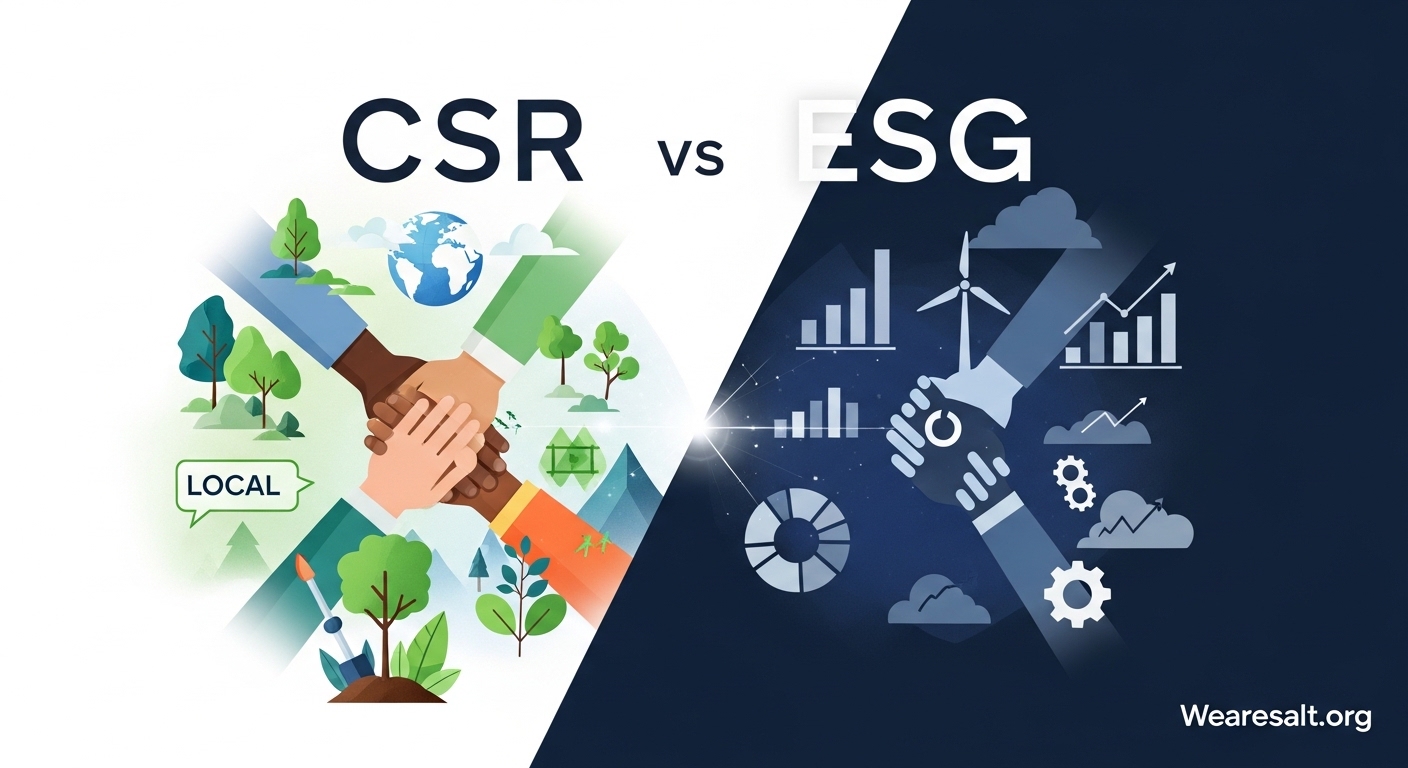
If you have ever searched for guidance on corporate responsibility, you have probably stumbled across two acronyms that seem interchangeable: CSR and ESG. I spent months confused about whether they were the same thing or completely different concepts. After digging into research, speaking with sustainability professionals, and analyzing how companies actually use these terms, I can tell you they are related but distinctly different approaches to responsible business.
CSR vs ESG is not a matter of choosing one over the other. Corporate Social Responsibility represents a company’s voluntary commitment to ethical operations and community impact. ESG provides measurable criteria that investors and regulators use to evaluate those commitments. In this guide, you will learn exactly how these frameworks differ, when to use each one, and how smart organizations integrate both into their strategy.
Table of Contents
What Is CSR?
Corporate Social Responsibility refers to a company’s self-regulated approach to operating ethically and contributing positively to society. It is a broad concept that covers how businesses interact with employees, communities, and the environment beyond what laws require.
Companies practicing CSR often focus on initiatives like corporate volunteering programs, charitable donations, reducing their carbon footprint, and improving labor practices. The key word here is voluntary. CSR is driven by a company’s values, culture, and desire to be a good corporate citizen rather than external requirements.
The 4 Types of CSR
When people ask what are the 4 types of CSR, they are referring to the four main categories that define corporate social responsibility initiatives. Understanding these helps clarify the scope of CSR activities.
Environmental responsibility focuses on minimizing a company’s ecological footprint. This includes waste management, renewable energy adoption, sustainable sourcing, and carbon footprint reduction. Microsoft has invested heavily in this area, committing to become carbon negative by 2030 through renewable energy purchases and carbon removal initiatives.
Ethical responsibility covers fair labor practices, diversity and inclusion efforts, and ethical sourcing throughout supply chains. Companies like Patagonia have built their brand around ethical manufacturing and transparent supply chain practices.
Philanthropic responsibility involves charitable giving, community engagement, and corporate volunteering programs. Verizon’s foundation donated over $45 million to nonprofits in 2026, supporting education and digital inclusion programs across communities.
Economic responsibility means making financial decisions that balance profit with positive social impact. This includes paying living wages, supporting local suppliers, and investing in community development alongside shareholder returns.
Characteristics of CSR
CSR initiatives share several defining characteristics. They are typically qualitative rather than quantitative, focusing on storytelling and impact narratives rather than strict metrics.
CSR programs are internally driven by company leadership and culture. They reflect what the organization believes is right rather than what external stakeholders demand. This self-regulated nature gives companies flexibility but can also lead to skepticism about genuine impact versus marketing spin.
What Is ESG?
ESG stands for Environmental, Social, and Governance. It is a framework for measuring and evaluating a company’s performance across these three specific pillars using quantifiable metrics and standardized criteria.
While CSR asks whether a company is trying to do good, ESG asks how effectively it is performing against measurable sustainability standards. This data-driven approach has made ESG essential for investors who want to assess risk, compare companies, and make informed decisions about where to allocate capital.
The Three Pillars of ESG
Environmental factors measure how a company impacts the natural world. This includes carbon emissions, energy efficiency, water usage, waste management, and biodiversity impact. Unlike CSR’s general environmental commitments, ESG requires specific metrics like tons of CO2 emitted per million dollars of revenue.
Social factors evaluate how a company treats people. This covers labor practices, employee health and safety, diversity metrics, community relations, and customer data protection. ESG reporting might track the percentage of women in leadership positions or employee turnover rates.
Governance factors assess how a company is run. This includes board composition, executive compensation alignment, shareholder rights, anti-corruption policies, and transparency in financial reporting. Good governance ensures accountability and reduces risk for investors.
ESG Standards and Frameworks
What makes ESG distinct from CSR is the existence of established frameworks that standardize measurement. The Global Reporting Initiative (GRI) provides comprehensive sustainability reporting standards used by thousands of companies worldwide.
The Sustainability Accounting Standards Board (SASB) focuses on financially material sustainability issues specific to different industries. For financial sector companies, SASB might emphasize data security metrics. For manufacturing, it might focus on supply chain labor practices.
The Task Force on Climate-related Financial Disclosures (TCFD) provides guidance on reporting climate-related risks and opportunities. These frameworks make ESG data comparable, auditable, and useful for investment decisions in ways that CSR reporting rarely achieves.
CSR vs ESG: Key Differences
Are CSR and ESG the same thing? No, they are not. While both address corporate responsibility and sustainability, they differ fundamentally in scope, measurement, audience, and regulatory context.
How does ESG compare to CSR? Think of CSR as the philosophy and ESG as the measurement system. CSR represents a company’s voluntary commitment to doing good. ESG provides the metrics that prove whether those commitments translate into real performance.
Side-by-Side Comparison
| Aspect | CSR | ESG |
|---|---|---|
| Focus | Voluntary social and environmental initiatives | Measurable sustainability performance |
| Nature | Qualitative, narrative-driven | Quantitative, data-driven |
| Regulation | Self-regulated | Externally regulated and standardized |
| Primary Audience | Communities, employees, general public | Investors, regulators, financial analysts |
| Reporting | Flexible, company-defined metrics | Standardized frameworks (GRI, SASB, TCFD) |
| Scope | Broader social impact initiatives | Specific environmental, social, governance criteria |
| Measurement | Stories, case studies, volunteer hours | KPIs, scores, ratings, percentages |
| Integration | Often separate from core business strategy | Integrated into risk management and valuation |
Qualitative vs Quantitative
The most significant difference between CSR and ESG lies in how success is measured. CSR reports might highlight volunteer events, charity partnerships, and community programs using photos and testimonials. ESG reports present carbon emission figures, diversity percentages, and governance compliance scores.
This quantitative nature makes ESG particularly valuable for investors who need comparable data. You cannot easily compare two companies’ CSR programs because they define success differently. ESG scores allow direct comparison because both companies report the same standardized metrics.
Voluntary vs Regulated
CSR remains largely voluntary. Companies choose their initiatives, set their own goals, and report what they want. This flexibility allows for creative, culture-specific programs but also enables greenwashing, where companies exaggerate their environmental credentials.
ESG is increasingly regulated. The European Union’s Corporate Sustainability Reporting Directive requires large companies to report detailed ESG information using standardized formats. In the United States, the SEC has proposed rules requiring public companies to disclose climate-related risks and greenhouse gas emissions.
Audience and Purpose
CSR primarily addresses communities, employees, and customers. It builds brand reputation, improves employee engagement, and strengthens community relationships. The goal is being seen as a good corporate citizen.
ESG primarily serves investors and regulators. It helps assess business risk, identify investment opportunities, and ensure compliance with emerging regulations. A company with poor ESG performance may face higher borrowing costs, investment exclusion, or regulatory penalties.
How CSR Evolved Into ESG
Understanding the historical progression helps explain why both frameworks exist today. CSR emerged in the 1950s and 1960s as a concept of corporate citizenship, gained momentum in the 1990s with the rise of cause marketing and corporate philanthropy.
The term ESG was coined in 2004 when the United Nations Global Compact published a report titled “Who Cares Wins.” This connected environmental, social, and governance factors to financial performance and investment decisions. The 2008 financial crisis accelerated ESG adoption as investors sought better ways to assess risk beyond traditional financial metrics.
By the 2020s, ESG had moved from niche interest to mainstream investment criteria. Major asset managers like BlackRock began requiring ESG disclosures. Regulatory bodies worldwide started mandating ESG reporting. What started as voluntary CSR had evolved into a structured, regulated framework for measuring corporate sustainability.
Why the Shift Happened
Three forces drove the evolution from CSR to ESG. First, investors needed comparable data to make informed decisions. Second, regulators recognized that voluntary reporting failed to prevent environmental and social harms. Third, stakeholders grew skeptical of CSR marketing without proof of impact.
Does this mean CSR is dead? Absolutely not. Smart companies maintain robust CSR programs while building ESG reporting capabilities. The relationship is complementary rather than competitive.
How to Implement CSR and ESG in Your Organization
Understanding CSR vs ESG matters only if you can apply both frameworks practically. Implementation differs based on company size, industry, and stakeholder expectations, but certain principles apply universally.
Starting with CSR
Begin by assessing your current social and environmental impact. Identify what matters to your employees, customers, and communities. Develop initiatives that align with your company values and capabilities.
Set qualitative goals focused on engagement and impact. Track volunteer hours, charitable contributions, and community partnership outcomes. Communicate these efforts through storytelling that highlights real people and tangible results.
Remember that authentic CSR comes from genuine commitment rather than marketing needs. Employees and communities quickly detect performative gestures. Focus on initiatives you can sustain long-term.
Building ESG Capabilities
ESG implementation requires more structure. Start by identifying which ESG frameworks apply to your industry and stakeholder requirements. Materiality assessments help determine which ESG factors are most relevant to your business.
Establish baseline measurements for key metrics like carbon emissions, diversity ratios, and governance practices. Set quantitative targets with specific timelines. Implement data collection systems that can produce auditable reports.
Consider ESG reporting software that integrates with existing business systems. Many companies hire dedicated sustainability officers or work with consultants to ensure compliance with evolving standards.
Integrating Both Approaches
The most effective organizations do not choose between CSR and ESG. They use CSR to drive culture, engagement, and community impact while using ESG to measure performance, manage risk, and satisfy investor requirements.
Unilever exemplifies this integration. Their Sustainable Living Plan includes ambitious CSR goals like improving health and hygiene for billions of people. Simultaneously, they report detailed ESG metrics through GRI standards, tracking everything from sustainable sourcing percentages to carbon intensity per product.
Why Both CSR and ESG Matter for Business
Some commentators frame CSR vs ESG as an either-or choice. This misses the point entirely. Both frameworks serve different but complementary purposes that matter for modern business success.
The Business Case for CSR
Strong CSR programs improve employee engagement and retention. Workers increasingly want to feel their labor contributes to positive outcomes. Companies with robust volunteering and community programs report higher job satisfaction and lower turnover.
CSR builds brand reputation and customer loyalty. Consumers prefer brands that demonstrate social responsibility. In competitive markets, ethical positioning can differentiate products and justify premium pricing.
CSR strengthens community relationships that enable business operations. Companies viewed positively in their communities face fewer regulatory hurdles, attract better talent, and maintain social license to operate.
The Business Case for ESG
ESG performance increasingly affects access to capital. Major investors screen portfolios using ESG criteria. Companies with strong ESG ratings attract more investment and often enjoy lower borrowing costs.
ESG metrics help identify and manage risks that traditional financial analysis misses. Climate change, labor disputes, and governance failures can devastate business value. ESG reporting provides early warning systems.
Regulatory compliance represents another driver. The European Union, United States, and other jurisdictions increasingly mandate ESG disclosures. Companies that fail to report or perform poorly face regulatory action and reputational damage.
Which Is Better: CSR or ESG?
This question misunderstands the relationship. Neither is inherently better. CSR without ESG risks becoming meaningless marketing without measurable impact. ESG without CSR risks becoming a box-checking exercise disconnected from genuine commitment.
The question businesses should ask is not which to choose but how to integrate both effectively. Use CSR to build culture and community. Use ESG to measure performance and satisfy stakeholders who demand data-driven accountability.
Frequently Asked Questions
Are CSR and ESG the same thing?
No, CSR and ESG are not the same thing, though they are related. CSR (Corporate Social Responsibility) refers to voluntary initiatives companies undertake to benefit society, often driven by values and culture. ESG (Environmental, Social, and Governance) is a measurable framework used to evaluate and compare corporate sustainability performance using standardized metrics and criteria. While CSR focuses on doing good, ESG focuses on measuring how well companies perform against specific sustainability standards.
How does ESG compare to CSR?
ESG provides a quantitative, standardized approach to measuring sustainability compared to CSR’s qualitative, voluntary nature. ESG uses specific metrics and frameworks like GRI and SASB to enable comparison between companies. CSR focuses on broad social impact initiatives like volunteering and charity. ESG addresses environmental factors, social practices, and governance structures with measurable KPIs. While CSR builds community relationships, ESG primarily serves investors and regulators who need comparable data for decision-making.
What are the 4 types of CSR?
The four types of CSR are: (1) Environmental responsibility – minimizing ecological footprint through waste management, renewable energy, and sustainable sourcing. (2) Ethical responsibility – ensuring fair labor practices, diversity and inclusion, and ethical supply chains. (3) Philanthropic responsibility – charitable giving, community engagement, and corporate volunteering programs. (4) Economic responsibility – making financial decisions that balance profit with positive social impact, including fair wages and local supplier support.
Is ESG replacing CSR?
No, ESG is not replacing CSR. Both frameworks serve different but complementary purposes. CSR drives company culture, employee engagement, and community impact through voluntary initiatives. ESG provides the measurement and reporting structures that investors and regulators require. Leading companies integrate both approaches, using CSR for qualitative impact and ESG for quantitative accountability. The evolution from CSR to ESG reflects growing demand for measurable proof of sustainability claims, not the abandonment of social responsibility principles.
Which is better: CSR or ESG?
Neither CSR nor ESG is inherently better. They serve different stakeholders and purposes. CSR excels at building culture, engaging employees, and creating community impact through voluntary initiatives. ESG excels at providing measurable, comparable data for investors and ensuring regulatory compliance. The most effective organizations integrate both frameworks, using CSR to drive genuine commitment while using ESG to demonstrate that commitment through standardized metrics. Choosing between them creates false opposition where synergy exists.
What does Trump think about ESG?
Donald Trump has been critical of ESG investing, calling it a distraction from maximizing shareholder returns. During his presidency, the Department of Labor issued rules making it harder for retirement plan managers to consider ESG factors in investment decisions. These rules were later reversed by the Biden administration. Trump’s position reflects a broader debate about whether ESG considerations represent prudent risk management or inappropriate political influence on investment decisions. This controversy highlights how ESG has become politically charged in ways that CSR typically is not.
Conclusion
Understanding CSR vs ESG helps clarify two distinct but related approaches to responsible business. CSR represents voluntary commitments to social and environmental good, driven by values and culture. ESG provides measurable frameworks that investors and regulators use to evaluate sustainability performance.
The question is not which framework to choose but how to integrate both effectively. Start with CSR to build authentic commitment and community relationships. Add ESG to measure performance, manage risk, and satisfy stakeholders who demand data-driven accountability.
In 2026, businesses face increasing pressure to demonstrate both genuine commitment and measurable results. Companies that master both CSR and ESG will attract talent, satisfy investors, and build resilient operations prepared for a sustainable future.