
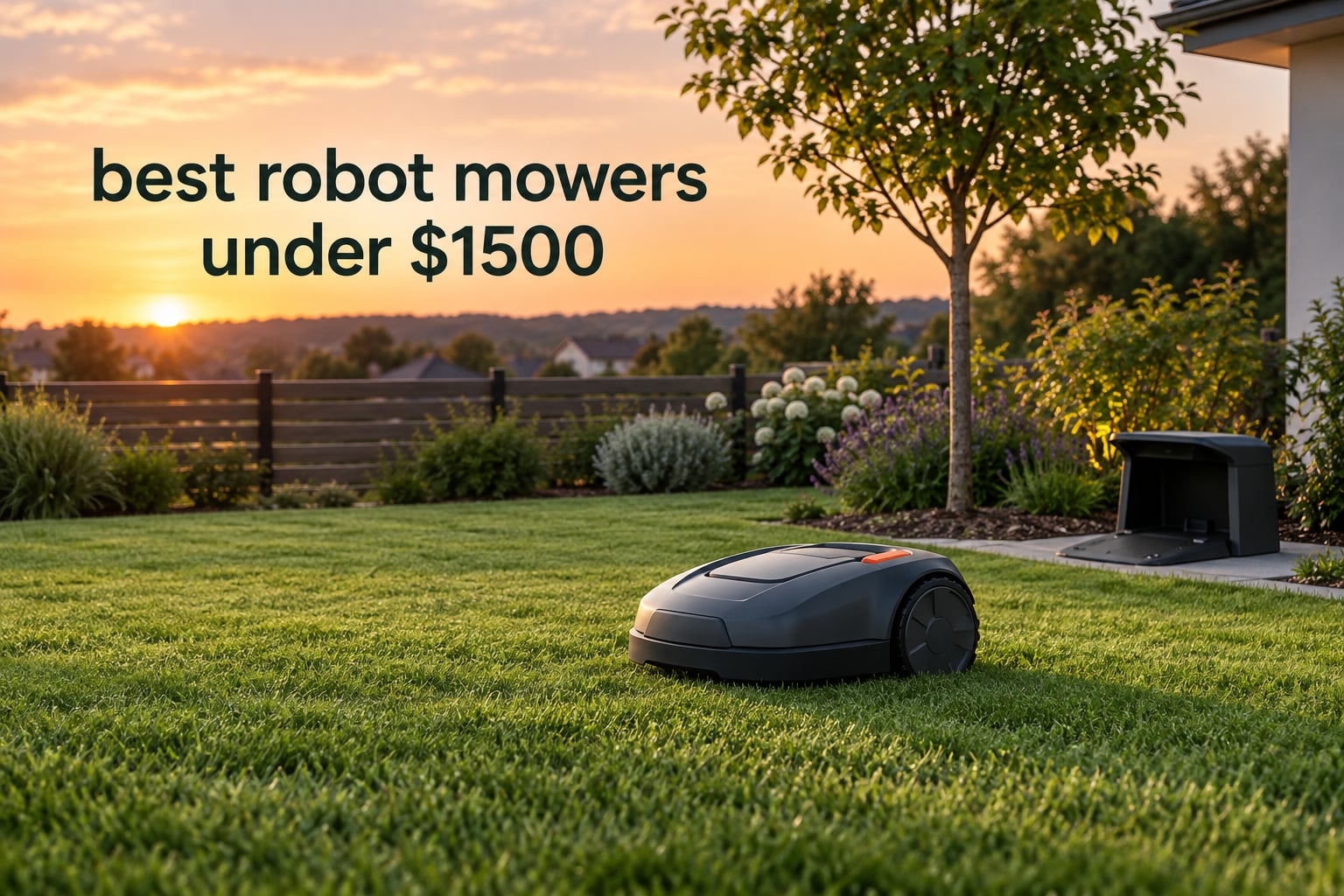
The best robot mowers under 1,500 dollars in 2026 are almost all wire-free machines that find their own way using RTK satellite positioning, LiDAR, or a combination of cameras and visual SLAM. Six or seven years ago the features those machines rely on started well above this ceiling, so the real question today is not whether the money stretches far enough. It is which navigation type your yard suits, what the coverage number on the box really means, and which brands still have replacement parts when something fails in your second season.
We spent weeks reading owner reviews across twelve models in this price band, comparing published coverage, slope ratings, cutting widths and battery runtimes, and we flagged the complaints that show up again and again in the long reviews rather than the five-star novelty ones. What surfaced is a category with genuinely excellent machines and a real gap between them. The leaders cut clean, near-edge lines quietly and map themselves in under an hour. The laggards still need rescuing mid-lawn, arrive with app bugs that owners work around by reinstalling software, and ship with the fine print hidden in the setup menu.
Two things shape every recommendation below. First, a review count matters: a mower with four reviews tells you almost nothing about season three, and we say so where it applies. Second, the headline acreage on the box is a marketing number, not a guarantee, and we explain the difference in a dedicated section. Our broader guide to robot lawn mowers covers the category at every price point if you are not locked to this budget.
Top 3 Best Robot Mowers Under $1500 for 2026

ANTHBOT M9 Robot Lawn Mower
- NRTK plus dual 150 degree HDR cameras
- 45% slope rating
- Handles up to 0.3 acre
- Garage included

Segway Navimow i105N
- RTK plus Vision with EFLS 2.0
- Mows up to 0.125 acre
- 58 dB(A) operation
- Up to 12 app zones

ECOVACS GOAT O1000 LiDAR PRO
- Dual-LiDAR navigation with no RTK antenna
- Fits 31.5 inch passages
- Built-in TruEdge trimming
- Up to 1/4 acre
Best Robot Mowers Under $1500 2026 Quick Comparison
All twelve models below sit inside the same price band, but they are not interchangeable. The table is ordered the same way as the reviews that follow, so the first row is the one we would buy.
| Product | Specifications | Action |
|---|---|---|
| ANTHBOT M9 |
|
Check Latest Price |
| Segway Navimow i105N |
|
Check Latest Price |
| ECOVACS GOAT O1000 LiDAR PRO |
|
Check Latest Price |
 ECOVACS GOAT O1000 RTK CARE ECOVACS GOAT O1000 RTK CARE |
|
Check Latest Price |
 MOVA LiDAX Ultra 1000 MOVA LiDAX Ultra 1000 |
|
Check Latest Price |
 Segway Navimow i206 AWD Segway Navimow i206 AWD |
|
Check Latest Price |
 ANTHBOT Genie 0.9 Acre ANTHBOT Genie 0.9 Acre |
|
Check Latest Price |
 WORX Landroid Vision Cloud WORX Landroid Vision Cloud |
|
Check Latest Price |
 Sunseeker X3 Plus Sunseeker X3 Plus |
|
Check Latest Price |
 Roborock RockNeo Q110H Roborock RockNeo Q110H |
|
Check Latest Price |
 YARDCARE V100 YARDCARE V100 |
|
Check Latest Price |
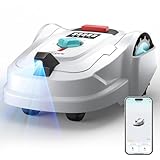 YARDCARE M800Plus YARDCARE M800Plus |
|
Check Latest Price |
1. ANTHBOT M9 Robot Lawn Mower: Our Best Overall Pick
ANTHBOT M9 Robotic Lawn Mower with Garage, 1/4 Acre Wire-Free NRTK & Vision
Up to 0.3 acre
45% slope rating
58 dB or quieter
Garage included
Pros
- Maps a virtual boundary in about 10 minutes
- Dual 150 degree HDR cameras recognise 1000 plus obstacle types
- Handles 45% gradients
- Cutting height 1.2-2.7 inches from the app
- Garage shelter in the box
Cons
- Can need several passes for an even cut
- RTK station needs a clear view of the sky
- App-based support replies can take up to 48 hours
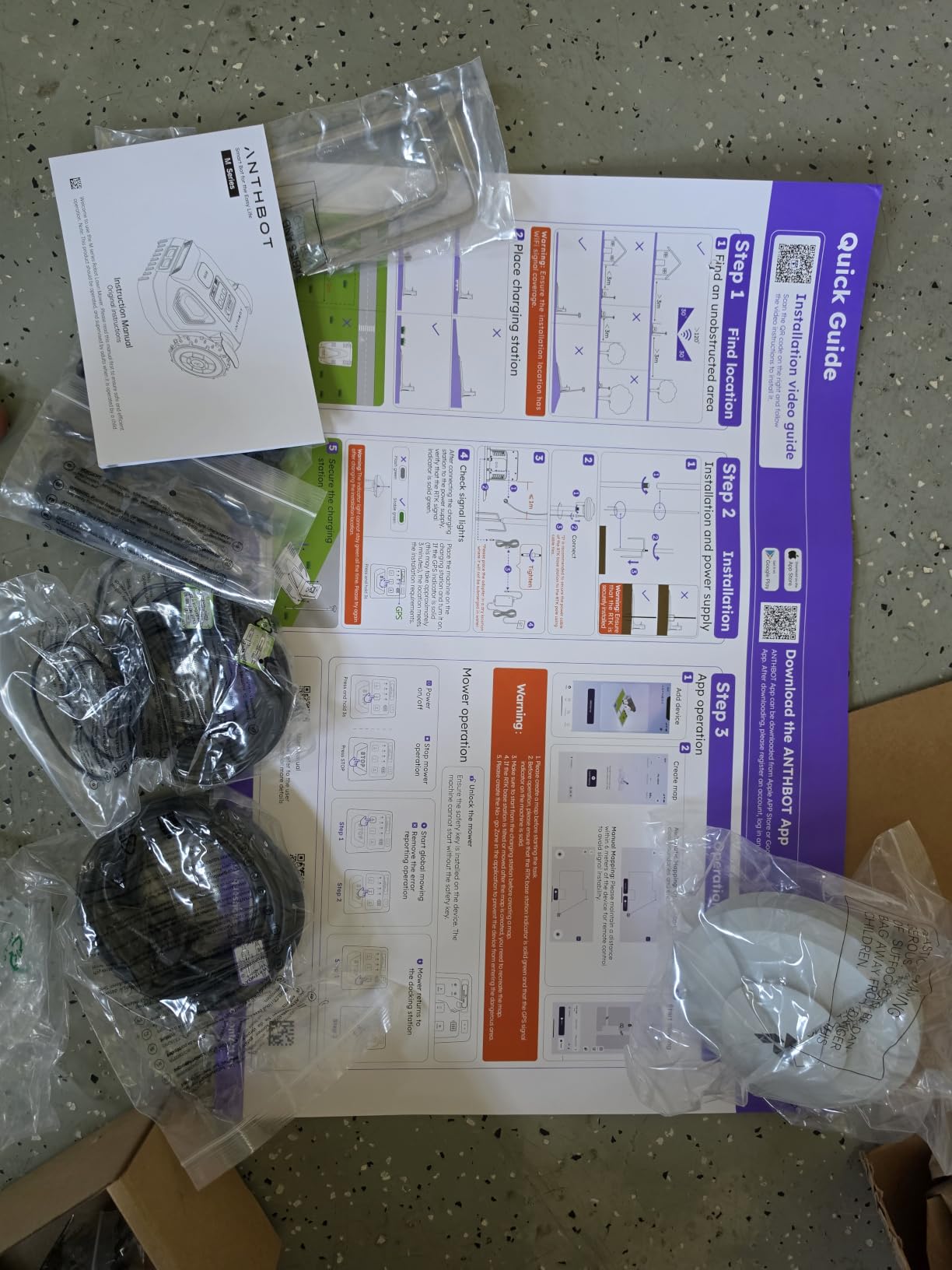
Of the twelve machines here, the M9 is the one that made the fewest compromises. It arrives with an RTK reference station, a charging base, five blades and a garage, which is more hardware in the box than most competitors at this level. Setup is the part owners consistently praise: the app generates a virtual map in roughly ten minutes, and there is no wire to trench and no antenna to fight with.
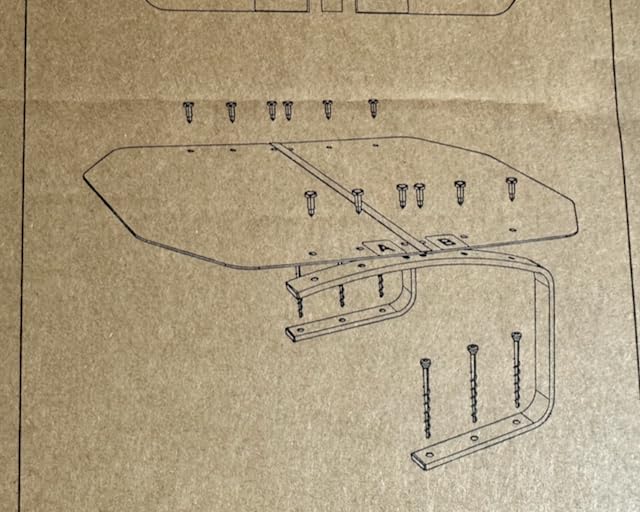
It is a 7.9 inch cut with a six-zone-friendly zone system that supports up to 30 work channels and custom no-go areas, and its two 150 degree HDR cameras classify more than 1,000 object types, which is a big jump over the 150-object systems on entry models. Cutting height runs from 1.2 to 2.7 inches and is adjusted in the app rather than by hand.
Owners on quarter-acre lots report the mower handles genuinely sloped ground without spinning, and the 45% gradient rating is a real number rather than a lab claim. Owners of smaller, flatter yards should still read the reviews mentioning slower cut cycles: on a lawn that has grown tall between visits, this mower sometimes needs a second pass to look uniform.
Who the ANTHBOT M9 suits best
It suits sloped lots, yards with a lot of scattered objects, and anyone who wants a garage in the box rather than as an add-on. If your lawn is a quarter acre or smaller and you want the mower running before dinner, the ten-minute mapping claim is the reason to pick it.
The limitation worth planning around is satellite visibility. The RTK reference station needs an unobstructed view of the sky, and owners in heavily wooded yards report better results after mounting it carefully rather than leaving it in the box position.
Where the M9 falls short
Documentation is the weak spot. Owners trying to add a second mowing zone say the manual does not explain it clearly, and that meant calling support, and support replies through the app can take up to 48 hours. Plan your zones during the first week while you still have the manual open.
The other honest drawback is the cut path. Seven point nine inches is narrower than the 17 inch deck on the Navimow AWD or the 8.7 inch decks on the WORX and Roborock, so a full yard takes longer to finish and the narrow path means more overlap passes on uneven ground.
2. Segway Navimow i105N: The Best Value Pick
Segway Navimow i105N Robot Lawn Mower Perimeter Wire Free 1/8 Acre RTK+Vision Robotic Lawnmower, AI-Assisted Mapping, Virtual Boundary, APP Control, 58dB(A) Quiet, Multi-Zone Management
Up to 0.125 acre
58 dB(A)
24 pounds
3 year warranty
Pros
- Largest review pool in this roundup at 391 ratings
- RTK plus Vision holds position under trees
- Very quiet enough to mow at night
- App supports up to 12 zones
- Good dock-finding and self-unwound turning
Cons
- Included wheels lack traction on mulch and uneven ground
- VisionFence misses gates
- mailboxes and hoses
- Map editing requires driving the mower to the boundary
- Clippings are left on the surface rather than mulched
The i105N is the safest pick in this list for a small suburban lot, and the reason is the review pool. At 391 ratings it has roughly ten times the evidence behind it than most of the field, which means the 4.1 average reflects real seasons of use rather than first-week impressions.
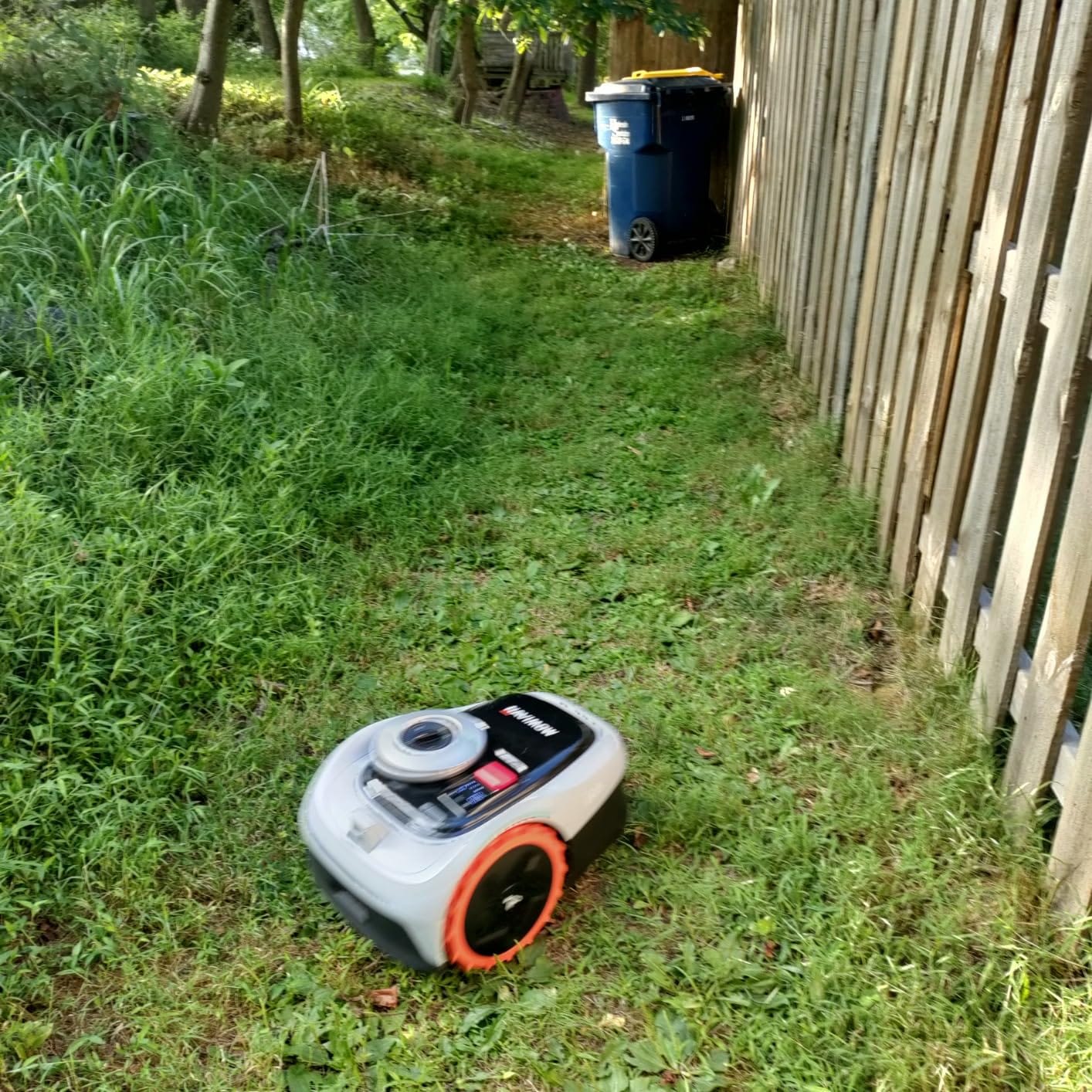
Owners on r/roboticLawnmowers confirm what the listing claims: no boundary wire, straightforward setup, and a mower that works well once the map is done properly. At 58 dB(A) it is the quietest machine here alongside the M9, which matters if you plan to run it before the neighbours are up.
The RTK and vision combination holds centimetre-level positioning under tree cover and in narrow corridors better than vision-only units, and the 140 degree camera classifies 150 plus obstacle types. Twelve app zones with schedules, remote control and theft location cover most households on a quarter acre or less.
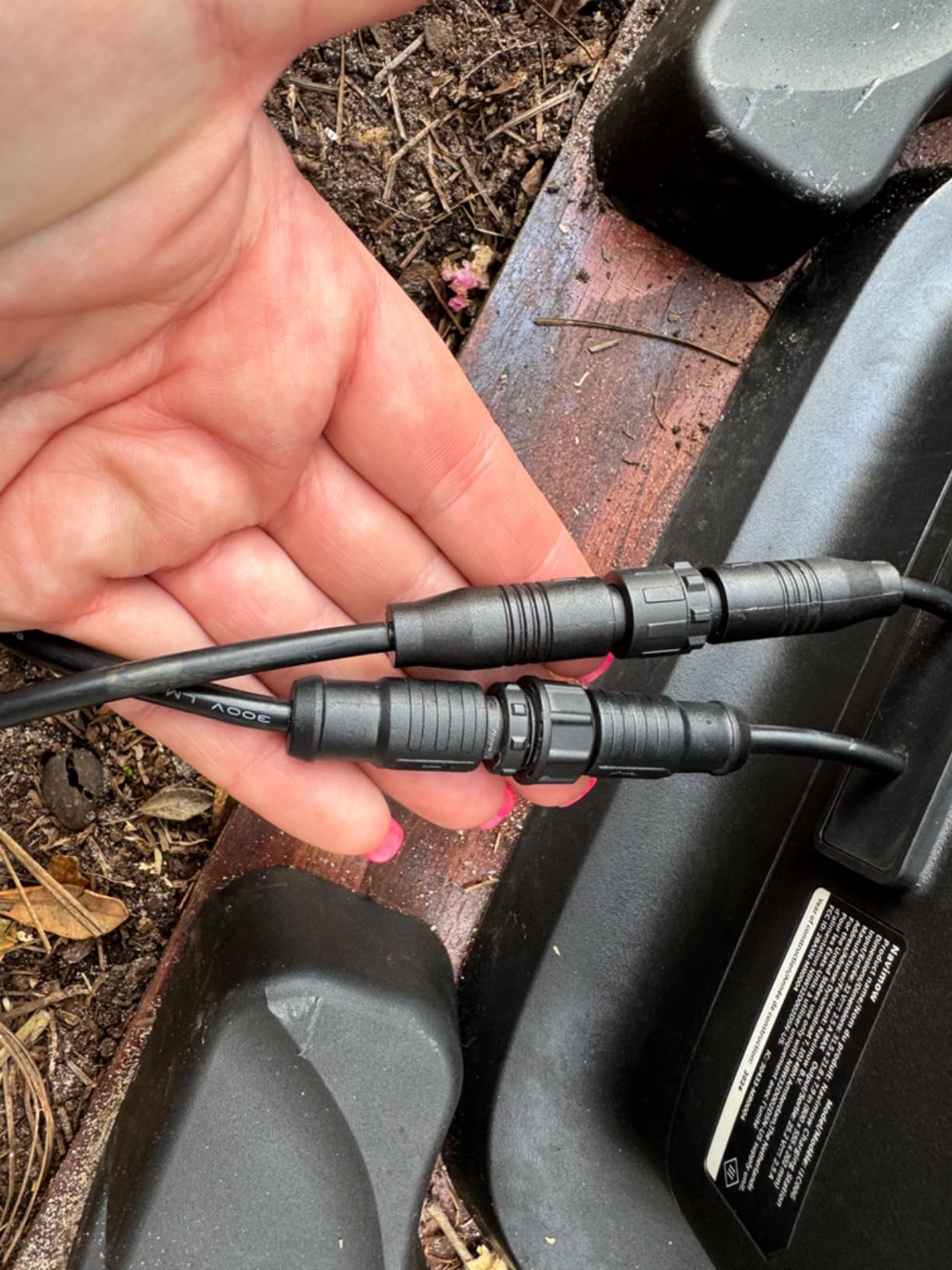
Where the i105N earns its slot
Choose this if your lot is flat or gently sloped, up to about an eighth of an acre, and you want proven reliability with the quietest operation in the group. The 24 pound weight also makes it the easiest machine here to lift into a truck bed or carry between a front and back lawn.
For a yard with real incline, look at the Navimow i206 AWD further down this list instead. Its all-wheel drivetrain is a different class of hardware and it is built for ground that would stop a two-wheel-drive unit.
The flaws that are not dealbreakers
The stock wheels are the most common complaint. On mulched beds, uneven ground or soft shoulders after rain, the i105N can leave ruts; several owners report that off-road wheels fix the problem, and that is a small extra part rather than a reason to skip the machine.
VisionFence misses some obstacles, including gates, mailboxes, hoses and sprinklers, and can also invent obstacles that are not there. Map editing is clunky because you physically drive the mower to adjust a boundary. It also does not mulch, so clippings stay on the lawn and you will want to decide early whether that bothers you.
3. ECOVACS GOAT O1000 LiDAR PRO: The Most Versatile
ECOVACS Goat O1000 LiDAR PRO Robot Lawn Mower, Wire-Free Robotic Lawn Mower with Dual-LiDAR Navigation, Built-in Edge Trimming, AI Obstacle Avoidance, App Control, for Lawns Up to 1/4 Acre
Dual-LiDAR navigation
1/4 acre
31.5 inch minimum passage
Built-in edge trimming
Pros
- No RTK antenna
- wire or complex installation
- Setup reported complete in under an hour
- Very quiet and works at night
- Body fits passages as narrow as 31.5 inches
- Handles multiple mapped sections in sequence
Cons
- Edge trimming is hesitant and leaves grass at boundaries
- Single-joystick app control makes manual mapping difficult
- Fences register as obstacles so it will not trim along them
- Small front casters limit curb and tall-grass climbing
This is the machine we recommend to anyone whose yard has heavy tree cover, tight side-yard passages, or both. Dual-LiDAR navigation through a 360 degree sensor array means no RTK antenna, no reference station to mount, and no dependence on satellite visibility, which is the single most common reason wire-free mowers get returned.
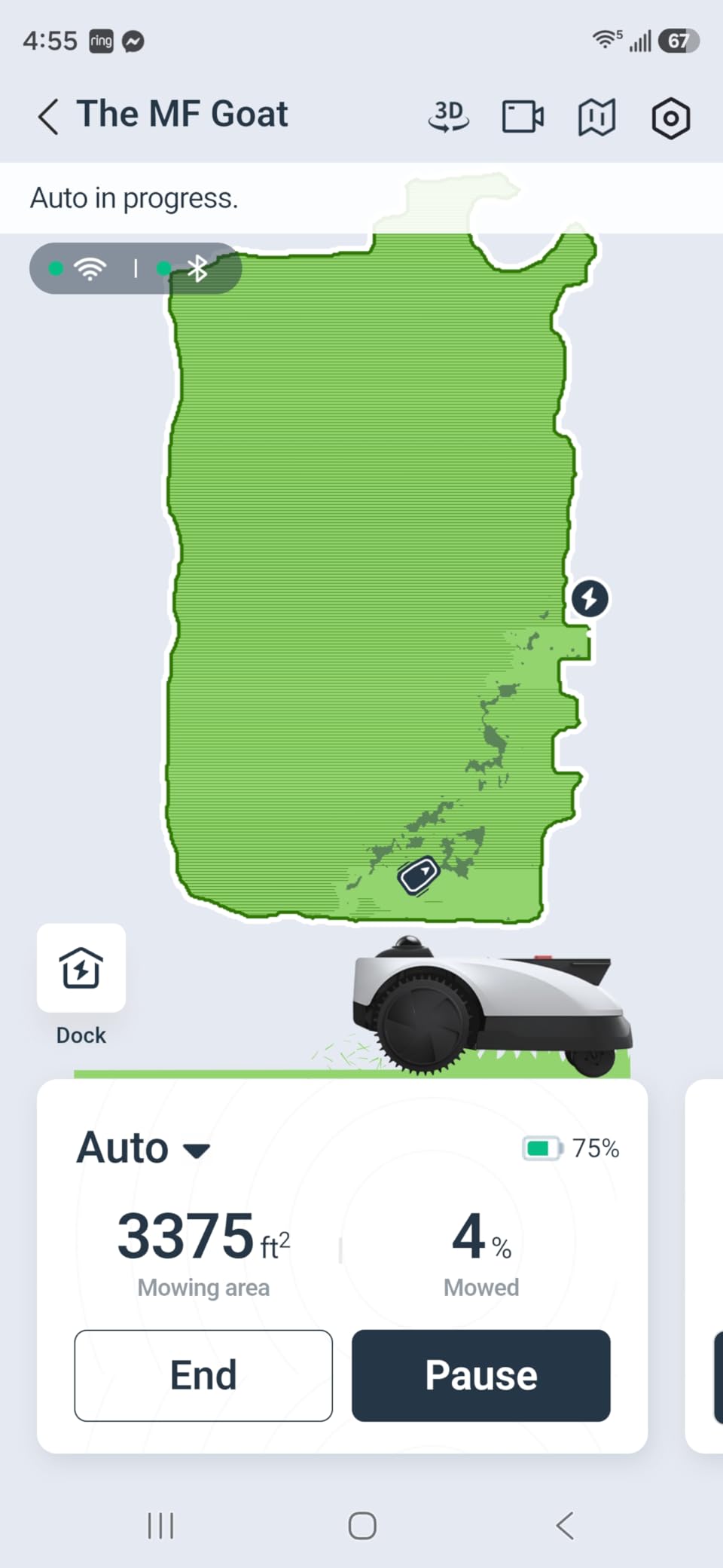
Owners consistently report setup in under an hour and near-silent running, and the LiDAR holds position under trees and close to fences where RTK models wobble. The body is narrow enough to pass through a 31.5 inch gap, which opens up side-yard routes that block wider machines.
Obstacle detection combines AI vision with 3D time-of-flight LiDAR across 200 plus outdoor object types, and it handles multiple mapped sections one after another. Coverage is up to a quarter acre, which matches the segment it is aimed at.
Why this one earns the premium slot
If your property has obstacles that satellites cannot see, LiDAR is simply the more reliable technology, and this is the only dual-LiDAR machine in the group. It also suits anyone who refuses to install an antenna in the yard, since the navigation hardware is entirely internal.
The honest catch is that the LiDAR is not used for boundary mapping in the way you might expect. Owners expecting mapping precision comparable to an RTK unit report being disappointed, because the sensor is doing obstacle work and positioning work, not fine-grained boundary capture.
The edge-trimming problem
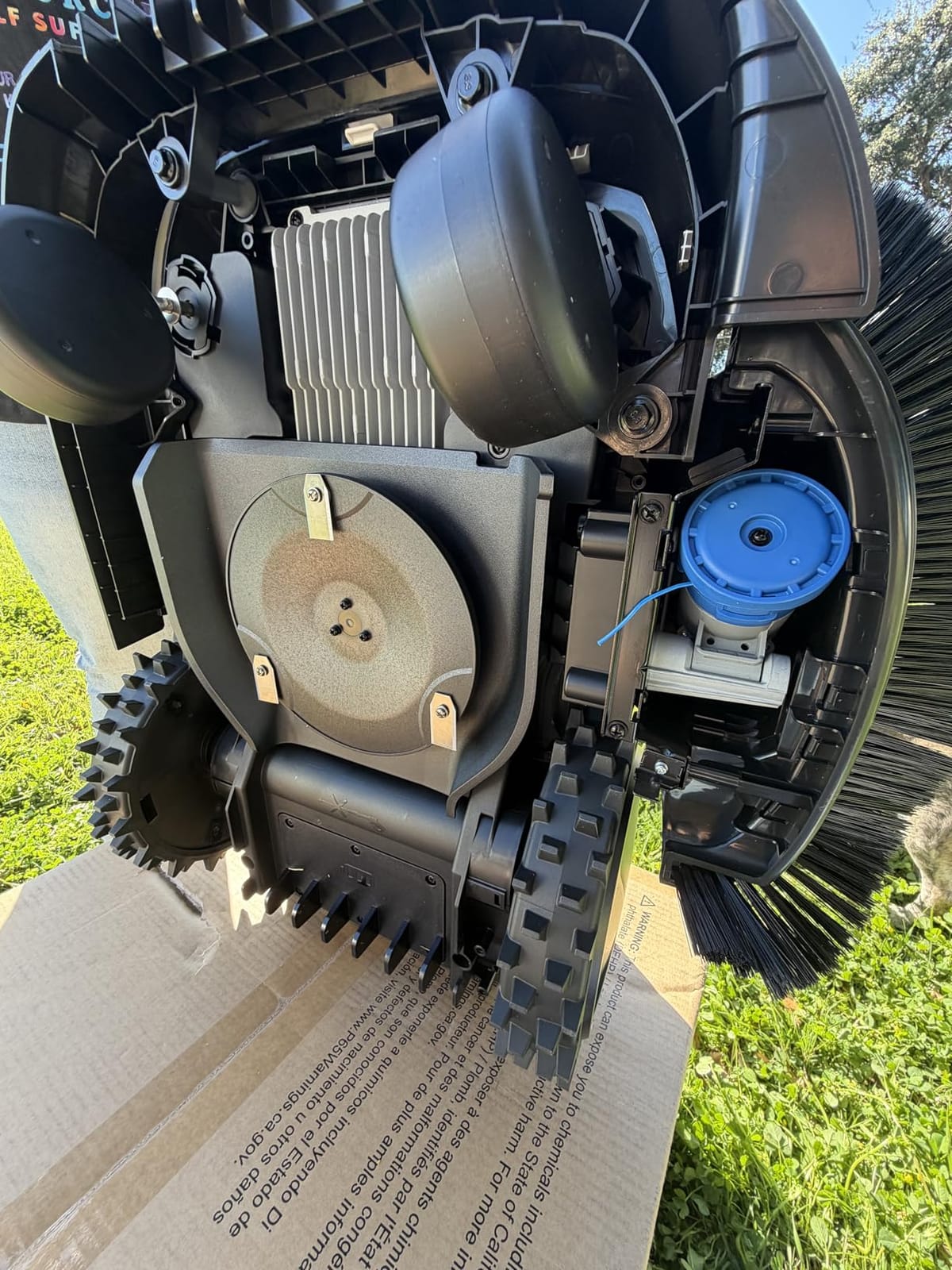
TruEdge border trimming is the flagship feature and the biggest source of complaints. Owners say it is hesitant and still leaves grass along boundaries, and the edge height cannot be adjusted. It also will not trim along a fence, because the fence registers as an obstacle to avoid, which is frustrating on the exact edges the feature exists to solve.
Two smaller notes: the single-joystick app control makes straight-line manual mapping difficult, and the small front casters limit climbing over curbs and high grass. Spare-part availability is uneven too, so check that a local distributor lists parts for your model before you buy.
4. ECOVACS GOAT O1000 RTK CARE: Best for Fast Setup
ECOVACS Goat O1000 RTK Care Robot Lawn Mower, RTK Navigation, 1/4 Acre
1/4 acre
About 90 minutes per charge
62 dB
36 spare blades included
Pros
- Owners report 20-30 minutes from unboxing to first mapped run
- Centimetre-level RTK positioning with striped patterns
- Long runtime relative to the price
- 36 spare blades and an RTK extension cable in the kit
- Anti-theft alarm and PIN lockout
Cons
- App and navigation software are the main weakness
- Mower can report out of range or stuck and need retrieval
- No way to carry it manually between zones
- Cannot draw out-of-bounds areas directly on the map
- Clippings are not collected or mulched
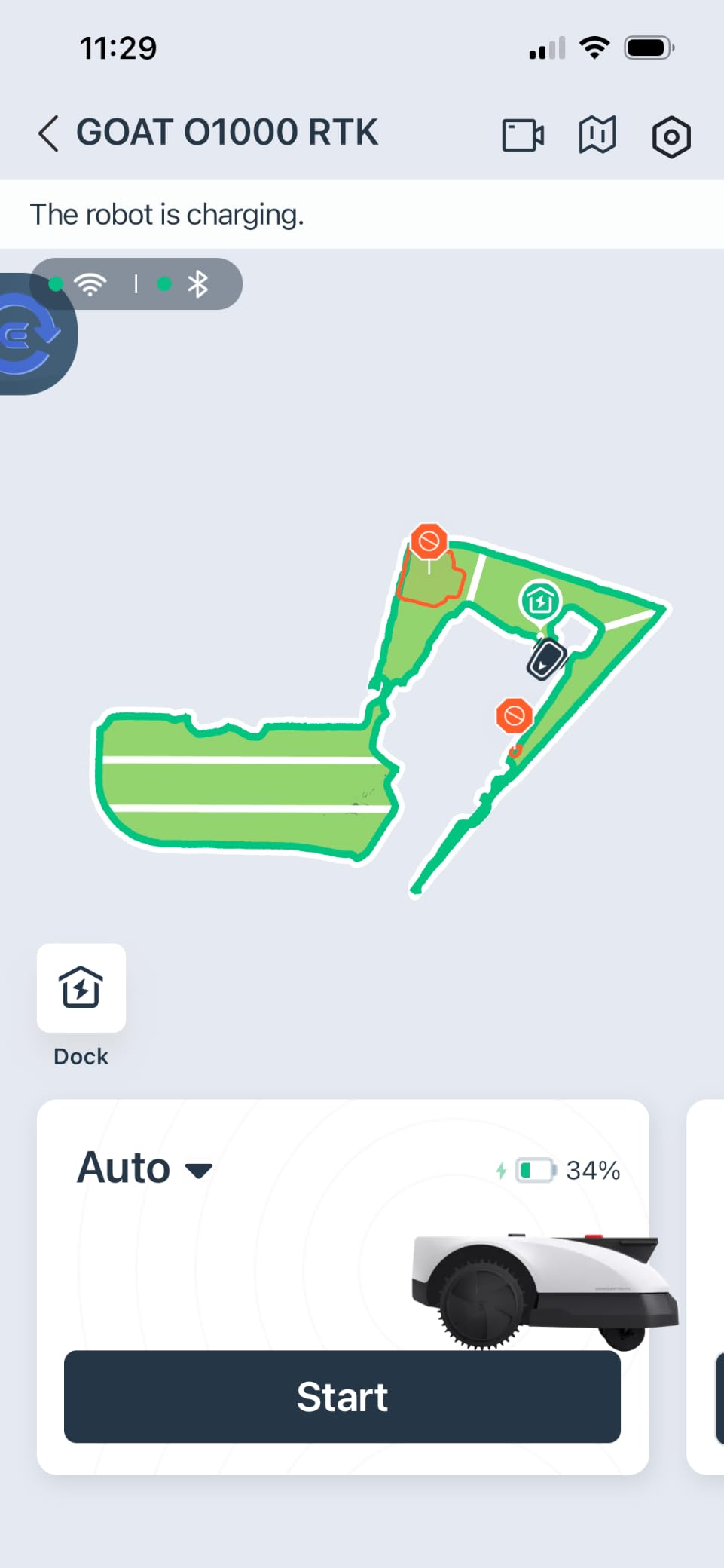
The CARE bundle is the practical version of this mower, and the extras are what justify it. You get 36 additional replacement blades and an RTK extension cable, which matters more over five years than the headline price gap, since blades are the consumable every robot mower owner replaces on a schedule.
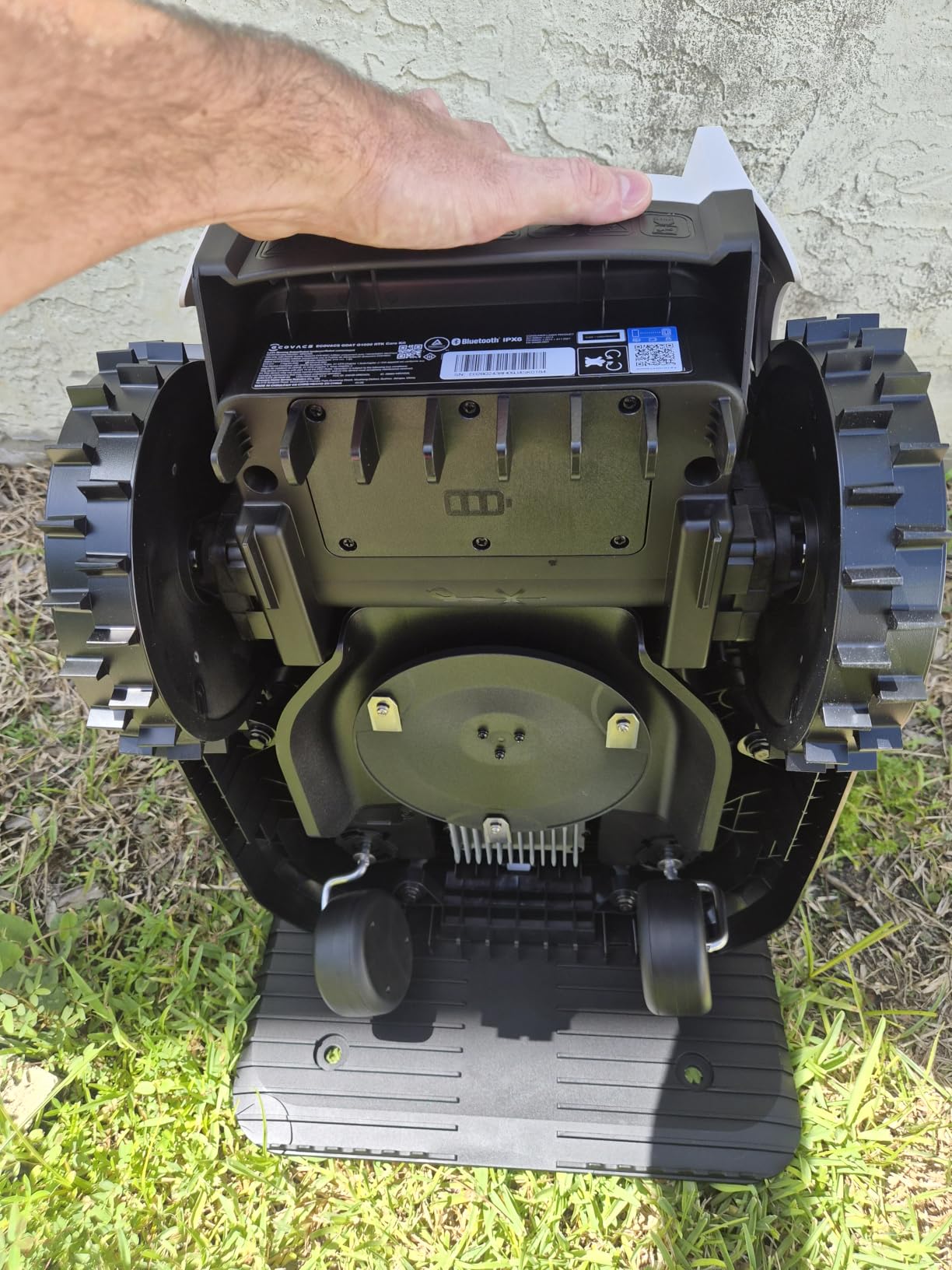
Setup speed is the standout: owners report 20 to 30 minutes from opening the box to the first automatic mapping run. Battery life of about 90 minutes per charge means many owners finish a whole quarter-acre yard on a single charge, and 62 dB is quiet enough for evening schedules.
Cutting width is 8.66 inches, cutting height adjusts from 1.2 to 3.2 inches, and the deck produces systematic striped patterns that owners consistently call clean. The RTK extension cable helps when the antenna station is mounted away from open sky.
Who should buy the RTK CARE version
Pick it if setup speed matters to you, if you want a spare blade supply on hand from day one, and if your yard is a straightforward quarter acre. Owners who compare it to LiDAR-based alternatives and like the straight, repeatable stripe pattern tend to rate it highly.
It is also the better ECOVACS choice if your lawn is open with good satellite visibility. The extension cable exists precisely for the cases where it is not.
Where the software holds it back
This mower’s reviews split cleanly in two. The positive half praises mowing output, quietness and value. The negative half, and it is a large half, is about the app: satellite calibration failures, imprecise manual joystick control, and the mower declaring itself out of range or stuck in a spot it should have driven out of.
Two more specifics worth knowing. You cannot carry the mower manually between zones even though the app implies you can, and you cannot draw out-of-bounds or no-go areas directly on the map, which makes split front-and-back lawns awkward. AI mapping can also merge separate lawn areas across fences and driveways. For a mower sold on navigation, the navigation software is the flaw, not the hardware.
5. MOVA LiDAX Ultra 1000: Best for Zone Control and Edges
MOVA LiDAX Ultra 1000 Robot Lawn Mower Wire Free for 1/4 Acre, RTK-Free+360° 3D LiDAR+AI Vision Auto Mapping, Zero-Edge Cutting, Cutting Height 1.2″-3.9″, 45% Slope, Up to 150 Managed Zones Dual Maps
RTK-free 360 degree 3D LiDAR
1/4 acre
45% slope
3 year warranty
Pros
- RTK-free setup with no antenna or wire
- Cuts within 2 inches of walls
- hedges and raised edges
- Rear-wheel drive with off-road wheels handles 45% slopes
- Dual maps with up to 150 managed zones
- Cutting height 1.2-3.9 inches from the app
Cons
- About 60 minutes of run time per charge means more recharge cycles
- No written owner review text was returned for this listing
- Coverage is a quarter acre with two maps rather than one large lawn
The LiDAX Ultra 1000 is the most capable zone manager in this group. It stores two independent maps and up to 150 managed zones, so a property with a front lawn, a back lawn and a separate side area can be handled by one machine without merging areas across a fence.
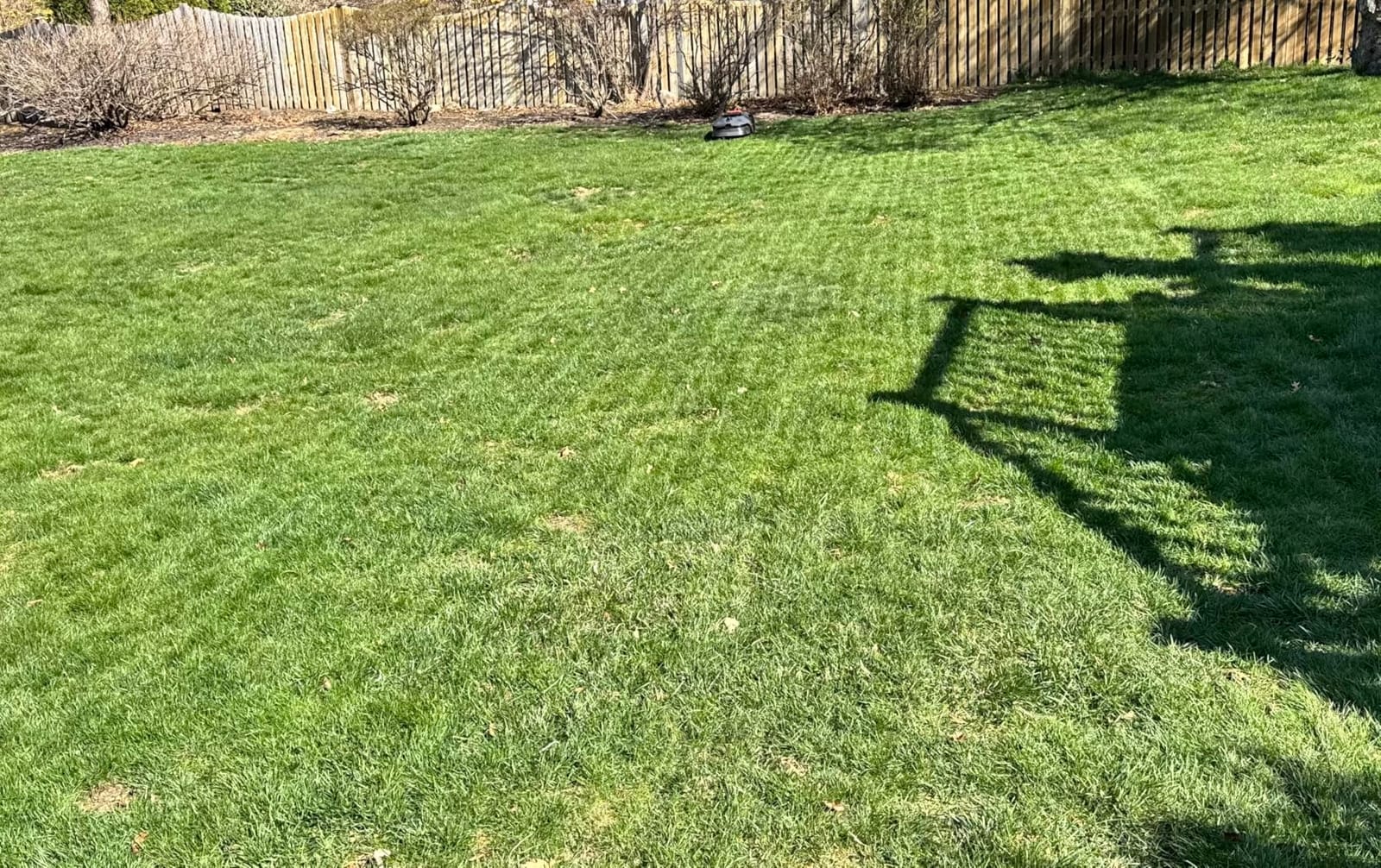
Navigation is RTK-free 360 degree 3D LiDAR combined with AI vision, so there is no antenna at all, and obstacle detection covers 300 plus object types through a 3D point cloud. It works in dim light and in complicated layouts, which is where camera-only mowers tend to struggle.
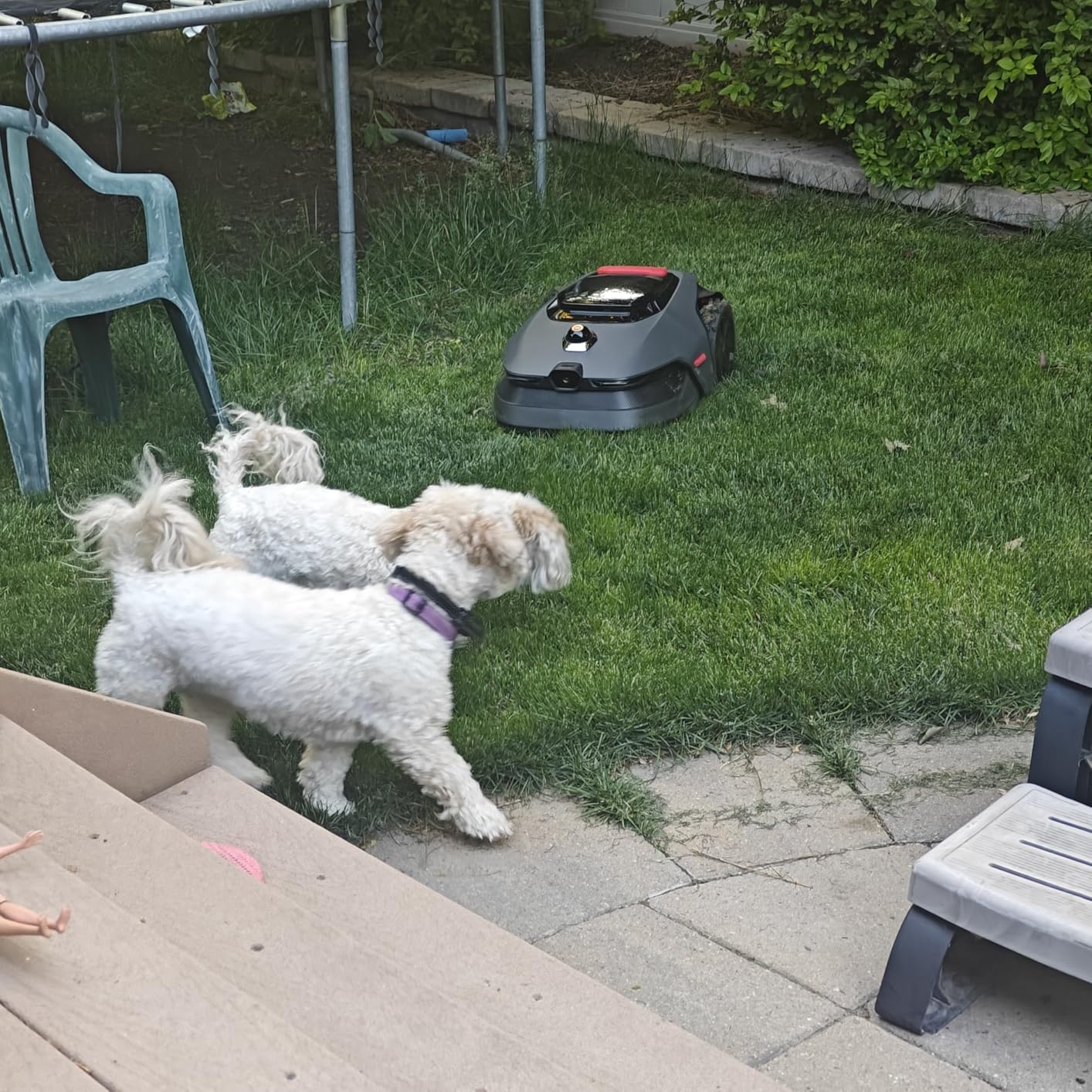
Edge handling is the feature owners write about most. The UltraTrim 1.0 movable disc cuts within 2 inches of walls, hedges and raised edges, which is the closest approach of any machine here. Rear-wheel drive with off-road wheels covers 45% slopes and 1.6 inch obstacles, and a 3-year warranty with 24/7 after-sales service backs it up.
Where the LiDAX earns its place
It suits multi-area properties and owners who care about finished edges more than raw coverage. The adjustable height range of 1.2 to 3.9 inches is the widest in this roundup, so it handles both a fine manicure look and taller summer growth without a manual change.
If you have satellite-blocked areas, this is the second machine here worth a look alongside the ECOVACS LiDAR PRO, because the same no-antenna logic applies.
What to weigh before buying
Battery run time of about 60 minutes per charge is the notable drawback. On a quarter acre that means more frequent charging than the 90-minute ECOVACS or the 130-minute Roborock, and over a season that adds up in both time and charging cycles.
Be aware of the evidence here. The listing returned 74 ratings with a strong four and five-star share, but no individual written owner reviews came back with the data, so our read on reliability rests on specification and rating distribution rather than owner narrative. The 3-year warranty is the strongest published coverage in this group, which partly offsets that thinness.
6. Segway Navimow i206 AWD: Best for Steep Slopes
Segway Navimow i206 AWD Robot Lawn Mower, New i105N, 0.15 Acre, 45% Slopes
Up to 0.15 acre
All-wheel drive
45% slope
17 inch cutting width
Pros
- All-wheel drive handles 45% slopes and rough ground
- Zero-turn steering pivots without tearing turf
- Very quiet
- quiet enough not to disturb dogs
- Large obstacles avoided reliably once mapped
- Free replacement parts and garage supplied when issues arose
Cons
- Auto mapping frequently fails and forces manual zone mapping
- Maps can be lost or corrupted after lifting or tilting the mower
- Leaves an unmowed swath between itself and fences
- About 1350 sq ft of coverage per charge
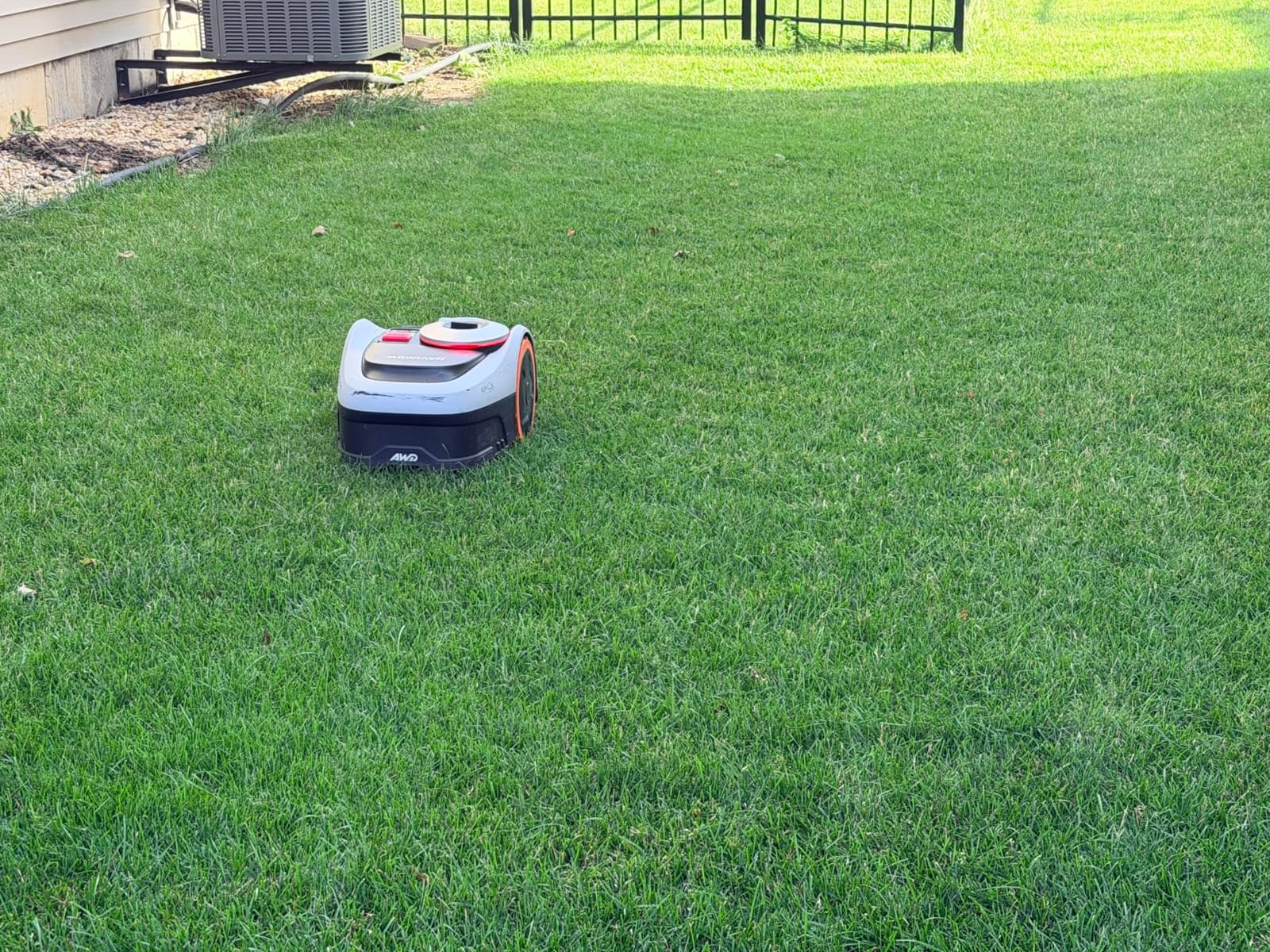
Nothing else in this price band has a 17 inch cutting width on an all-wheel-drive chassis with automotive-grade stability control. On a rough or steep property, the i206 AWD is simply a different machine, and it is the one we would choose for ground that would stop a two-wheel-drive unit halfway up the hill.
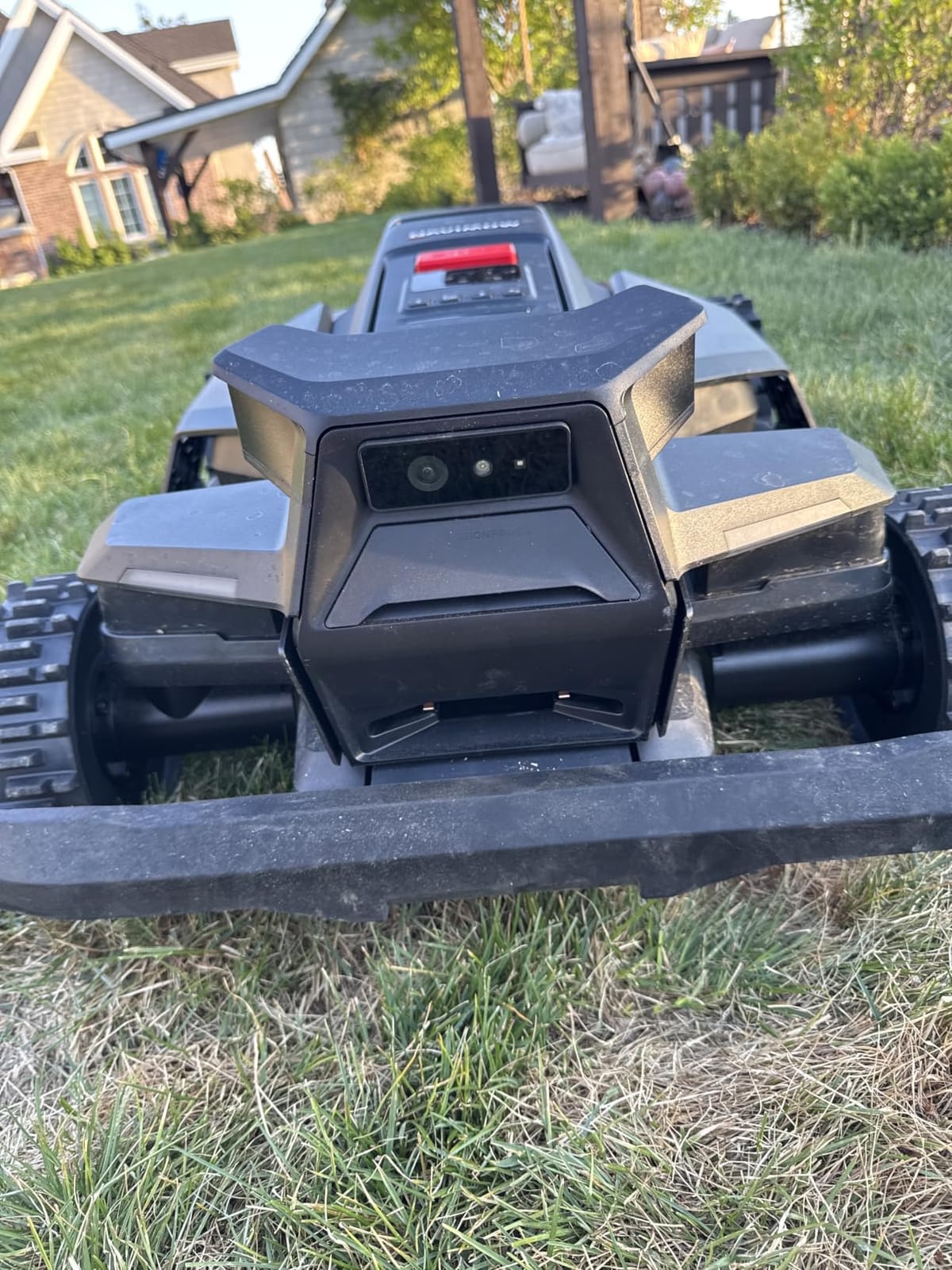
Users on Reddit describe it as the standout for rough-terrain handling, and owners consistently praise the quietness, with dogs reportedly unbothered. Zero-turn steering pivots on the spot rather than turning with the wheels, which protects turf on tight corners. Alternating mowing patterns produce visible striping.
Navigation is the EFLS Network RTK plus Vision with one-tap auto mapping, up to 20 zones with auto-resume charging, real-time GPS alerts for lifting or off-course movement, and cutting height adjustable from 2 to 3.6 inches.
Why the AWD platform is worth the extra money
If your yard has a meaningful grade, traction is the whole game. All-wheel drive with adaptive torque output is what lets this machine hold a line on a 45% slope rather than carving ruts and getting stuck. The wide 17 inch deck also finishes a yard faster than any other machine here.
Support is worth noting too. Owners describe free replacement parts and a garage being supplied when issues arose, which is exactly the after-sales behaviour that separates a brand you can depend on from one you cannot.
The mapping weakness you must plan around
Mapping is the dominant negative theme on this model, and it is not minor. Auto mapping frequently fails, forcing tedious manual zone mapping, and maps can be lost or corrupted after the mower is lifted or tilted even briefly. The 19% share of one-star ratings in the reviews reflects units returned after mapping failures.
Two more practical limits: the mower leaves an unmowed swath between itself and fences even after manual boundary mapping, and a 2.5Ah battery covers only about 1,350 sq ft per charge, so it needs several cycles even in a 0.15 acre yard. The 17 inch deck offsets the extra trips, but plan the schedule around them.
7. ANTHBOT Genie 0.9 Acre Mower: Best for Large Yards
Robot Lawn Mower NO Wire – 0.9 Acre, Full Band RTK+4-Eye Vision Robotic Lawnmower, Automatic Mapping, 30 Multi-Zone Management, Accurate Obstacle Avoidance, Intelligent Anti-Theft, APP Control
Up to 0.9 acre
Full Band RTK plus 4-eye vision
46 pounds
30 plus zones
Pros
- Largest coverage in this roundup at up to 0.9 acre
- Full Band RTK plus 4-eye vision stays stable where GPS is weak
- Quiet with a bright LED headlight
- Climbs steep slopes with laser-straight lines
- Six-blade deck with long run time
Cons
- Battery capacity degrades noticeably after about a year
- Some units leave uncut strips or stop and spin in place
- Will not pass through an open gate between zones without help
- Supplied RTK antenna pole is fragile at the spike base
If your lawn is larger than a quarter acre, this is the only machine in the group rated for it. At up to 0.9 acre the Genie does in one charge what several others here need a full day of cycles to finish, and the 46 pound body and six-blade deck are built for that workload.
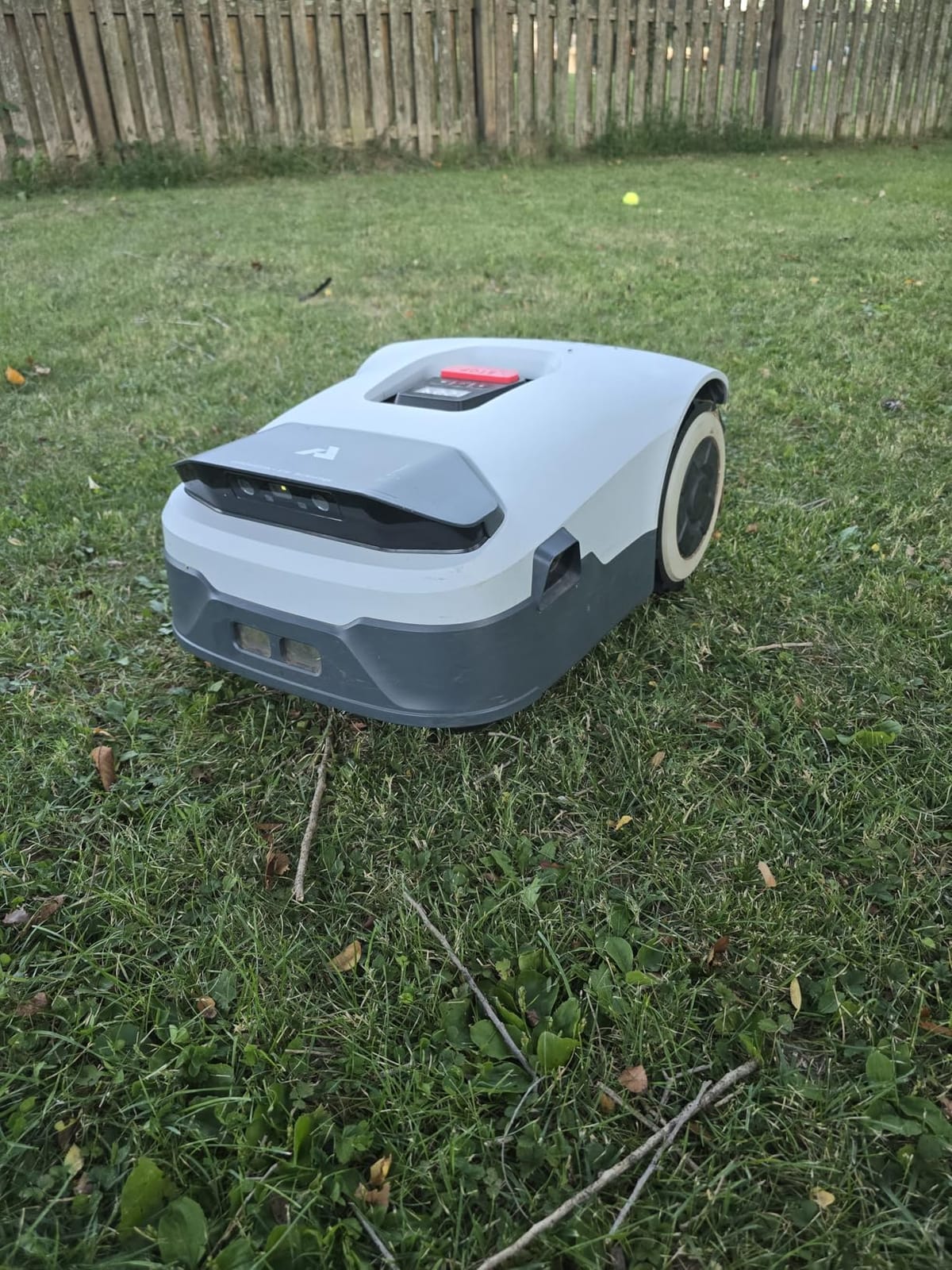
Positioning is Full Band RTK combined with 4-eye 3D vision across a 300 degree field of view, and owners say it stays stable where plain GPS struggles. The ACC hands-free auto mapping with AI boundary recognition gets you moving without a boundary wire, and the 300 degree camera classifies 1,000 plus object types.
Zone support runs past 30 customisable mowing zones with no-go areas, and anti-theft monitoring works through the app with 4G connectivity. Owners praise the quiet operation and the LED headlight, which makes night mowing practical.
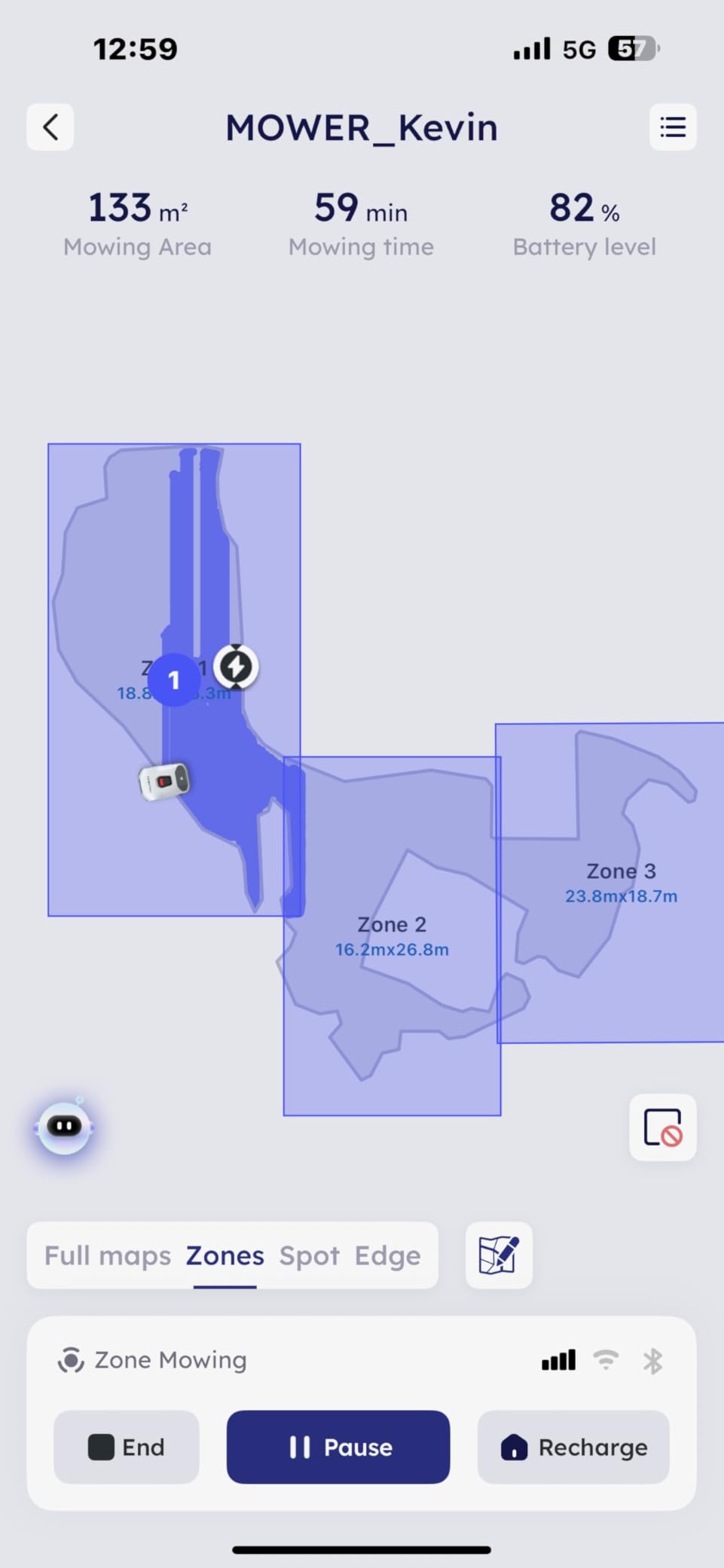
Where the coverage claim holds up
For a genuinely large, open yard with mixed grass, this mower delivers the straight laser lines owners report, and it climbs steep ground. Setup is close to unbox-and-go once the RTK station and charging pad are in position.
That capacity is the reason to buy it despite the mixed reviews. Nothing else at this price point will handle a large lot without long multi-cycle days.
The reliability picture is polarised
This listing has the widest spread of sentiment in the roundup. The one-star share is roughly double the four-star share, which tells you the failures are real and not a rounding error. The most reported issue is battery capacity degrading noticeably after about a year, forcing more charge cycles as the season goes on.
Owners also report uncut strips of grass and the mower stopping or spinning in place mid-lawn. It will not pass through an open gate between zones without manual assistance, and the supplied RTK antenna pole is fragile where the spike meets the mast. In-app support has been unresponsive for some users, so plan on phone contact rather than app contact for problems.
8. WORX Landroid Vision Cloud: Best for Mowing Patterns
WORX Robot Lawn Mower for 1/4 Acre, Wire-Free with Brushes
1/4 acre
RTK Cloud navigation
30% slope
3 year warranty
Pros
- RTK Cloud with no local antenna and no cloud subscription fees
- Four mowing patterns including parallel
- checkerboard and diamond
- Reported to cover a 0.15 acre yard in about 3.5 hours
- Navigates a tiered yard with a ramp and 45 feet of lakeside frontage
- V-SLAM fallback keeps it accurate in shade
- 3 year manufacturer warranty
Cons
- Will not cut tall grass or handle weedy overgrown areas
- Cut-to-zero edge module and headlights sold separately
- Some units arrive used with unverified firmware state
- App and manual zone mapping need practice
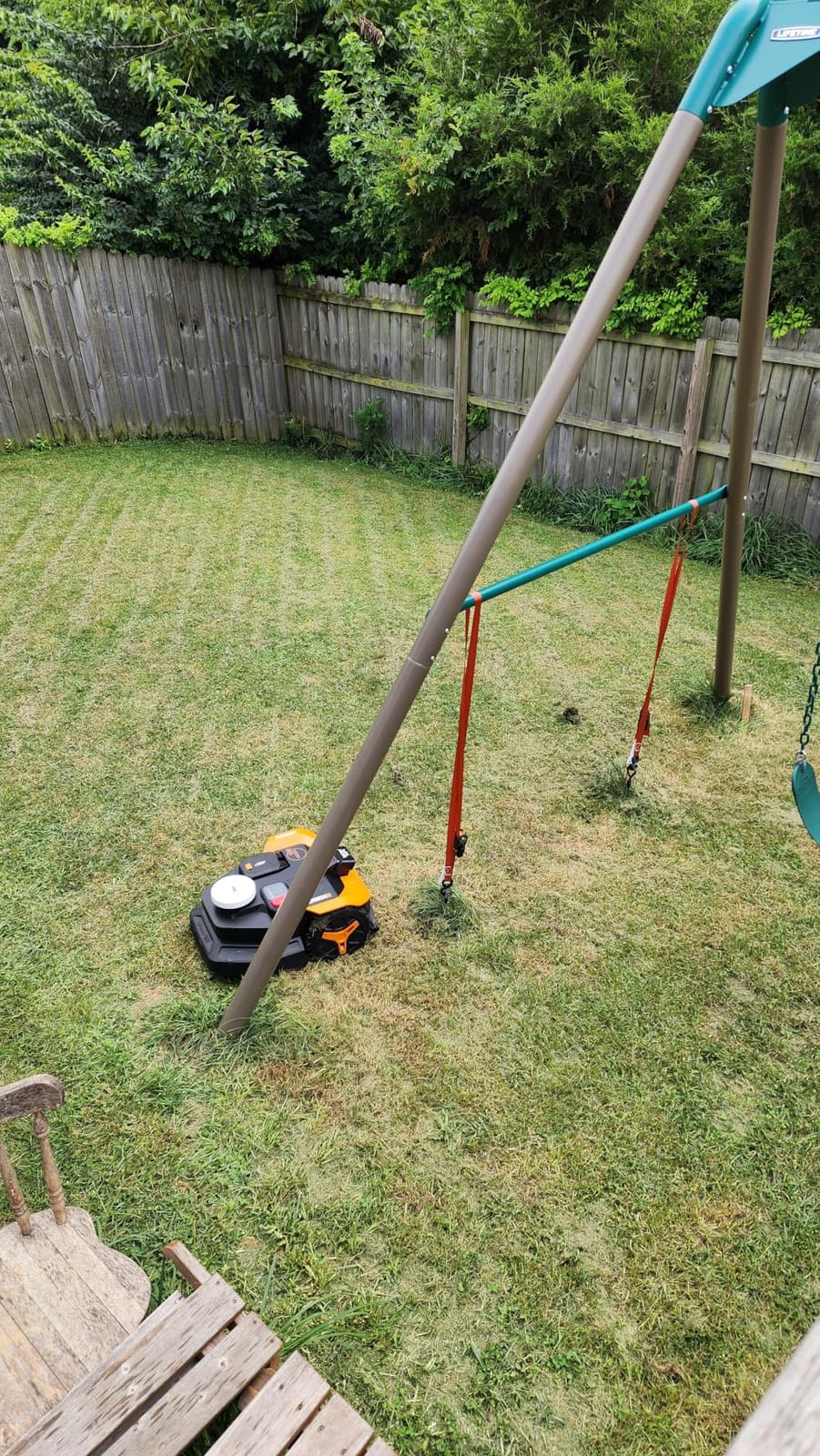
WORX runs the only subscription-free cloud navigation in this group. RTK Cloud gives centimetre-level positioning without a local antenna to install and with no cloud fees attached to mapping or scheduling, and that answers the single most common subscription worry owners raise in robot mower forums.
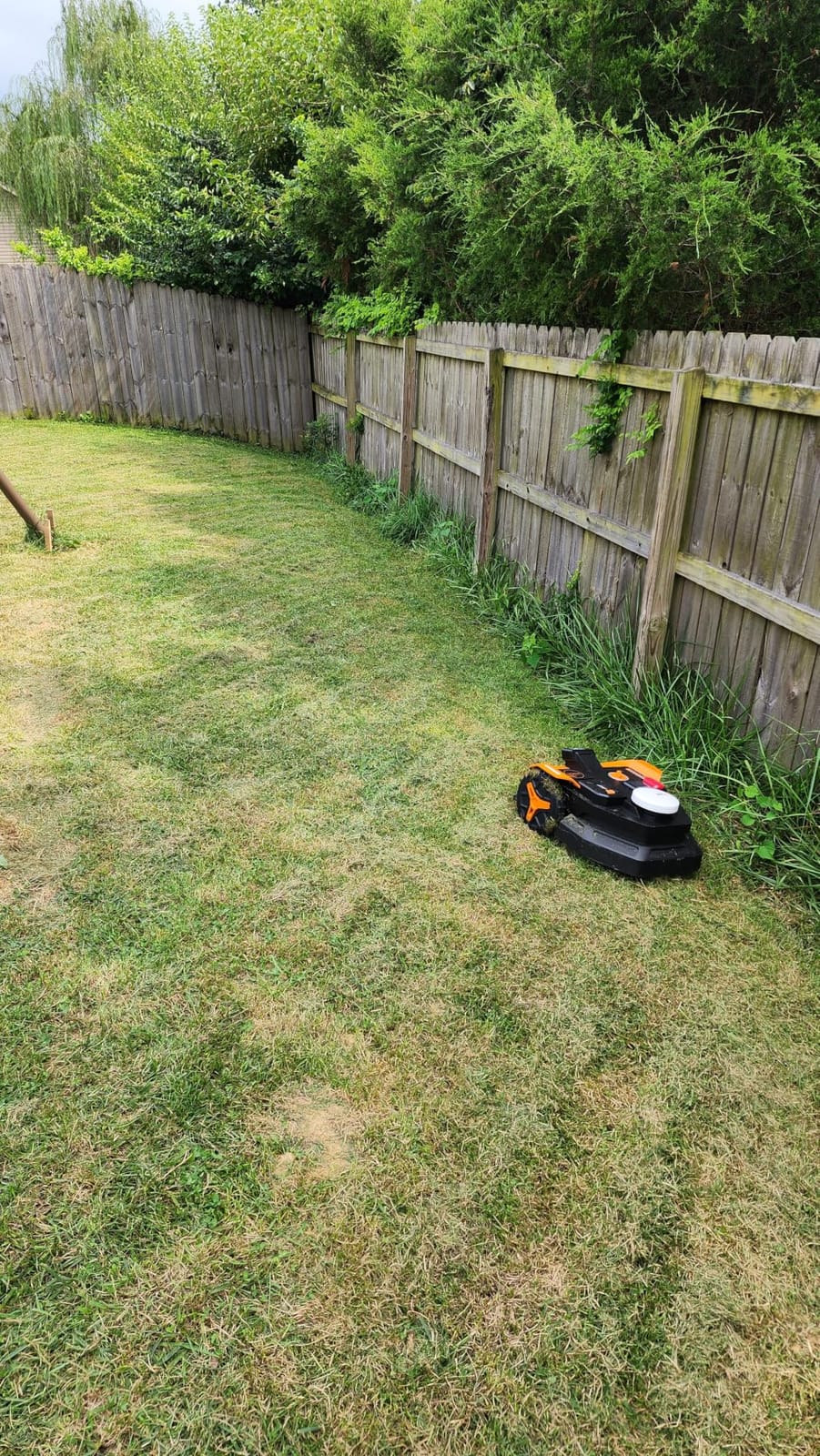
Where it wins is pattern choice. Parallel, checkerboard, diamond and natural patterns give you a deliberate finish, and one owner reports mowing a 0.15 acre tiered yard with a ramp and 45 feet of lakeside frontage in about three and a half hours including recharging. V-SLAM sensor fusion takes over when shade defeats the satellite signal.
The box includes the unit, wheel brushes, six spare blades and a charging station, with a 3-year manufacturer warranty behind it. RadioLink connectivity extends range beyond ordinary Wi-Fi reach, which helps on larger properties.
Why WORX owners stay loyal
Reviews for this model come heavily from repeat Landroid buyers, and the 4.4 average with a 73% five-star share reflects that. The pattern precision and the absence of a monthly fee are the two reasons owners recommend it to other people.
It is also comfortable in shade and on mixed terrain thanks to the V-SLAM fallback, which is a real advantage over vision-only mowers that lose all orientation in low light.
Know exactly what it will not do
Set the expectation clearly: this is a maintenance mower. It keeps an existing lawn tidy and it will not cut tall grass or handle weed eating, so an overgrown spring yard needs a walk-behind first.
The cut-to-zero edge module and headlights are not included, and the edge module is a meaningful add-on cost. Some units have also arrived used with unverified firmware state, so inspect on arrival. The app takes some getting used to, and a 1,610 sq ft yard may need a battery change or a second cycle to complete.
9. Sunseeker X3 Plus: Best for a Light, Carryable Mower
Sunseeker X3 Plus Robot Lawn Mower, RTK, Vision AI, 0.3 Acre, Wire-Free
Up to 0.3 acre
RTK plus VSLAM
60 dB
Under 20 pounds
Pros
- Clean edge cutting close to fences and hardscape with the offset blade
- Light at under 20 pounds and easy to carry between areas
- Holds course under trees and near fence lines
- Cuts evenly across mixed native grass and ground cover
- 2 year warranty with US-based service
Cons
- App and software reliability is the dominant complaint
- Cannot be carried between zones and must navigate a suspended cord
- Loses connection and misses the charging station on some yards
- Deep or two-day growth triggers navigation failure
- Satellite mounting hardware advertised but not sold
At under 20 pounds the X3 Plus is the only machine here you can comfortably lift with one hand, and that changes who it suits. If your lawn is split by a gate, a step or a wall, or you plan to move the mower between a garage and a side yard, weight matters more than most spec sheets suggest.
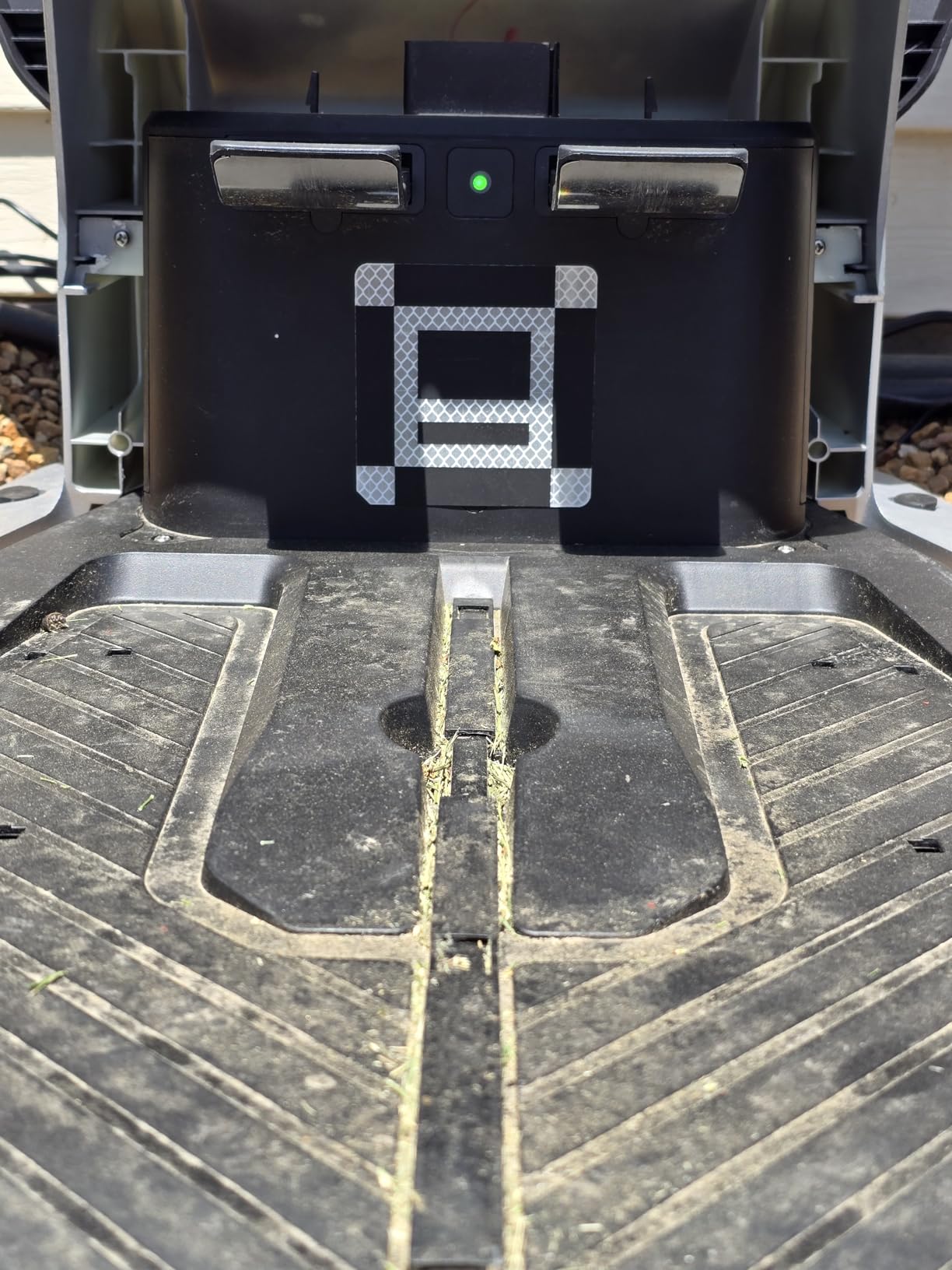
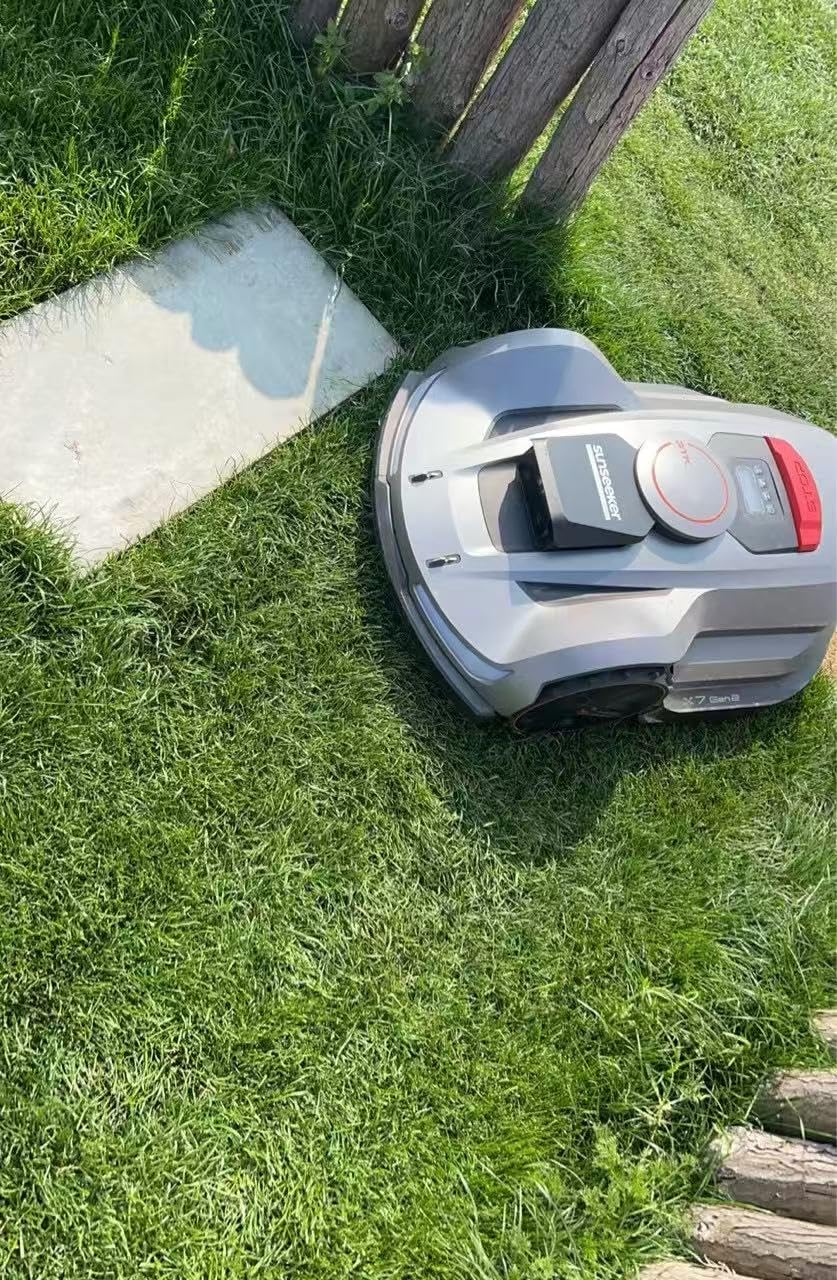
Cutting quality is genuinely good. The 8 inch floating deck with a ride-on-edge offset blade produces the cleanest edge work we found in owner reports on this model, cutting close to fences, walkways and hardscape, and it cuts evenly across mixed native grass and ground cover. Operation is a quiet 60 dB.
Navigation is AONavi RTK plus VSLAM with planned routes, coverage runs to about 0.3 acre or 13,000 sq ft, and slope handling is rated at 17 degrees or 30%. Six saved maps, multi-zone control and no-go zones are all included, with a 2-year warranty and US-based support.
Where the X3 Plus works well
It suits small to midsize suburban yards with defined borders, a preference for edge quality, and a household that wants a 2-year warranty backed by US-based service rather than an overseas call centre. The 30% slope rating is adequate for typical front lawns and gentle side yards.
Owners who get it running report steady navigation that holds course under trees and near fence lines, and more recent reviews show better app support response than earlier ones.
The software is the reason to hesitate
This listing carries a joint-lowest average rating of the twelve at 3.8, and the cause is not the hardware. Reviews document satellite calibration failures, phantom rain detection, the mower self-locking, and hazard zones you deleted reappearing in the map. Some owners report a daily check of the app to keep it working.
There are physical limits too. It cannot be carried between zones, so a split lawn means routing a suspended cord across the grass. It loses connection and fails to return to the charging station on some yards, and deep or two-day grass growth triggers navigation failure. The app also surfaces error messages in Chinese for some users, and the satellite mounting hardware advertised in listings is reportedly not offered by the company, so budget for a separate way to mount the antenna.
10. Roborock RockNeo Q110H: Best If You Already Use the Roborock App
Roborock RockNeo Q110H Robot Lawn Mower, Wire-Free Robotic Lawn Mower with Full-Band RTK + VSLAM Navigation, Auto Mapping, AI Vision Obstacle Avoidance, App Control, 45% Slope, Covers Up to 1/4 Acre
1/4 acre
Full-Band RTK plus VSLAM
About 130 minutes per charge
27 pounds
Pros
- Excellent navigation for a non-LiDAR unit
- Very quiet with a headlight for night mowing
- Cuts straight clean lines on slopes and bumpy ground
- Intuitive app for existing Roborock vacuum owners
- About 130 minutes of run time per charge
- PIN lockout and high-decibel alarm included
Cons
- Leaves a 1-1.5 foot unmowed band along fences and trees
- The edge cutting module is not sold in the US
- Maps cannot be edited without physically walking the mower
- No spot or partial zone mowing so missed patches stay missed
- Traction wheels struggle in thick St Augustine grass
The RockNeo Q110H runs the longest battery in this group at about 130 minutes per charge, and the reason is simple: it covers a quarter acre on one cycle. For an open yard that means one pass a day instead of three, and the 27 pound body is manageable when you do need to move it.
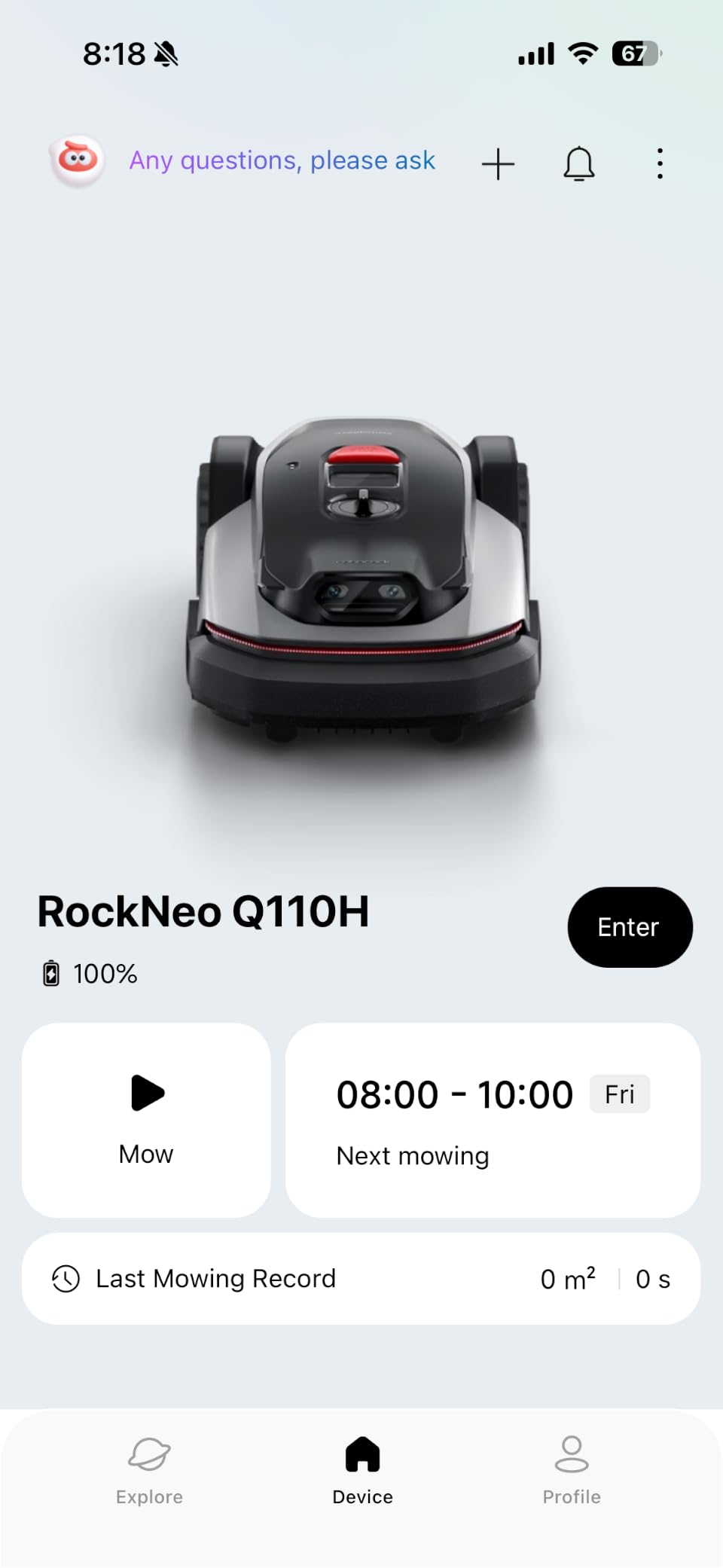
Owners credit Roborock’s robotics pedigree for the navigation. Full-Band RTK combined with VSLAM holds signal under trees and near fences, and the floating cutting deck with large-diameter wheels handles 45% slopes and 1.57 inch obstacles. Stereo vision AI with depth perception steers around people and pets and rolls over low obstacles. PIN lockout and a high-decibel alarm are included with no extra cost.
Mapping offers both routes: Sentisphere AI auto-mapping, or app-controlled manual mapping if you want to define the lawn yourself. The app includes multi-zone schedules, a real-time progress dashboard and a wildlife-friendly mode.
Who should choose the RockNeo
If you already run Roborock vacuums, the app transfer is the deciding factor. The controls and mental model are the same, and owners describe it as familiar and intuitive. For simple, flat, open yards with a quarter acre of grass, it does the job quietly and cleanly.
The 45% slope rating and floating deck also make it more capable on ground than the two-wheel-drive competition suggests, and it will roll over a 1.57 inch obstacle rather than stopping dead.
Where it leaves grass behind
Edge handling is poor, and this is the flaw buyers are most surprised by. It leaves a band of 1 to 1.5 feet unmowed along fences, trees and its own antenna pole, and the optional edge cutting module is not sold in the US, so there is no fix available here.
It is also overly cautious at boundaries and will refuse narrow but genuinely passable openings such as gates. Maps cannot be edited without physically walking the mower, there is no spot or partial zone mowing, so any missed patch stays missed. In thick St Augustine grass the traction wheels struggle and the mower can throw false lifted-unit errors over bumps. The app does not segment maps into room-style zones the way the vacuums do.
11. YARDCARE V100: The Budget Pick for Small Yards
YARDCARE V100 Automatic Robot Lawn Mower HD Vision for Lawn Max 1600 sq ft
Up to 1600 sq ft
HD vision
20 degree slope
4Ah battery
Pros
- Lowest entry point of any wire-free mower we covered
- 4.8 average rating with a 95% five-star share
- 32 foot magnetic strip creates no-go zones with no digging
- Includes 3 spare blade sets and a 4Ah battery
- No boundary wire installation required
Cons
- 1600 sq ft is the smallest coverage in this roundup
- Random mowing path instead of systematic stripes
- No-go zones need the magnetic strip rather than app-drawn boundaries
- No RTK or LiDAR so it suits simple open lawns only
The V100 has the best-rated customer feedback in this roundup at 4.8 across 58 ratings, with a 95% five-star share and no one-star reviews. That is unusual for a machine at this entry level, and it is worth taking seriously for a genuinely small lawn.
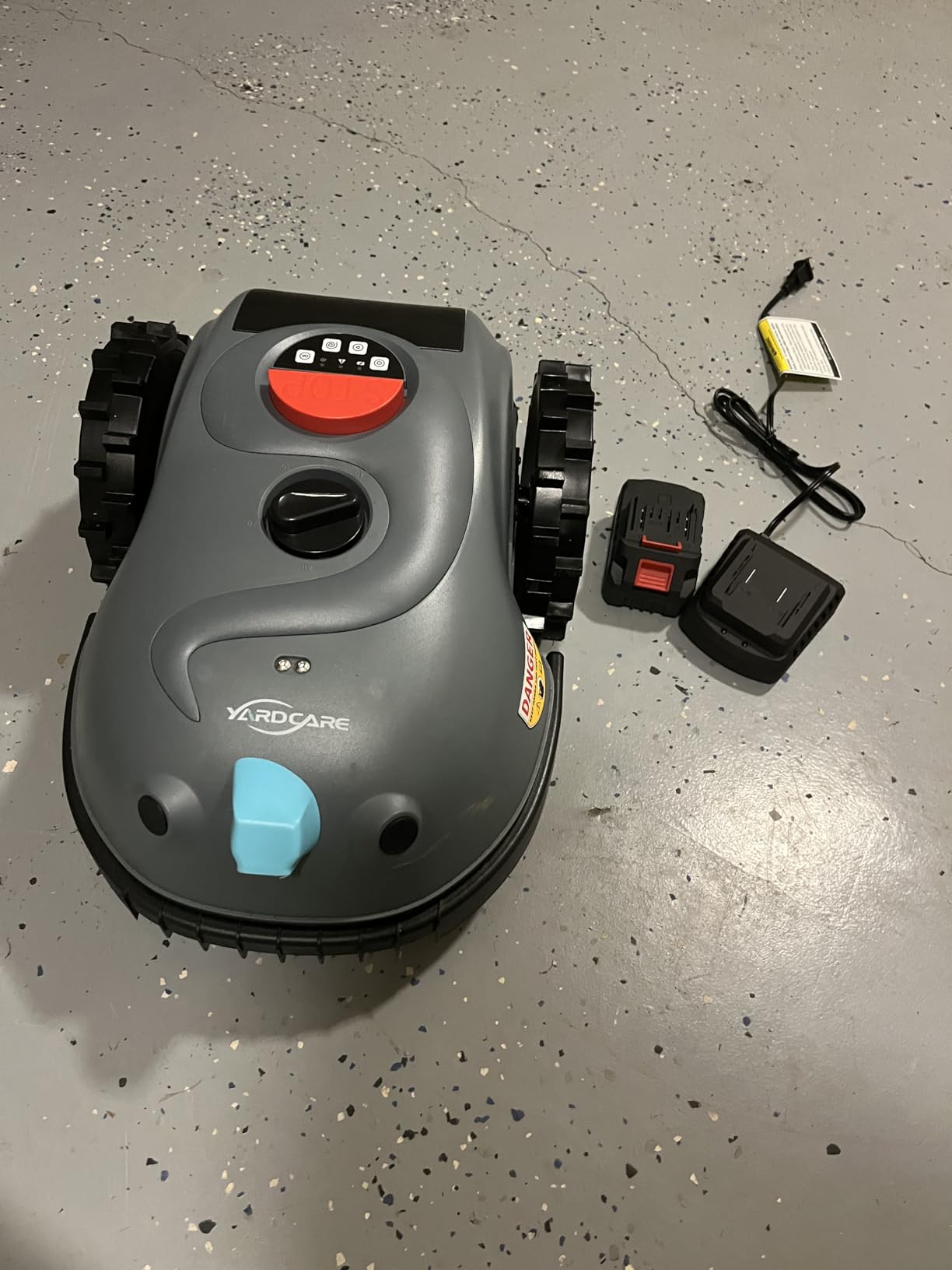
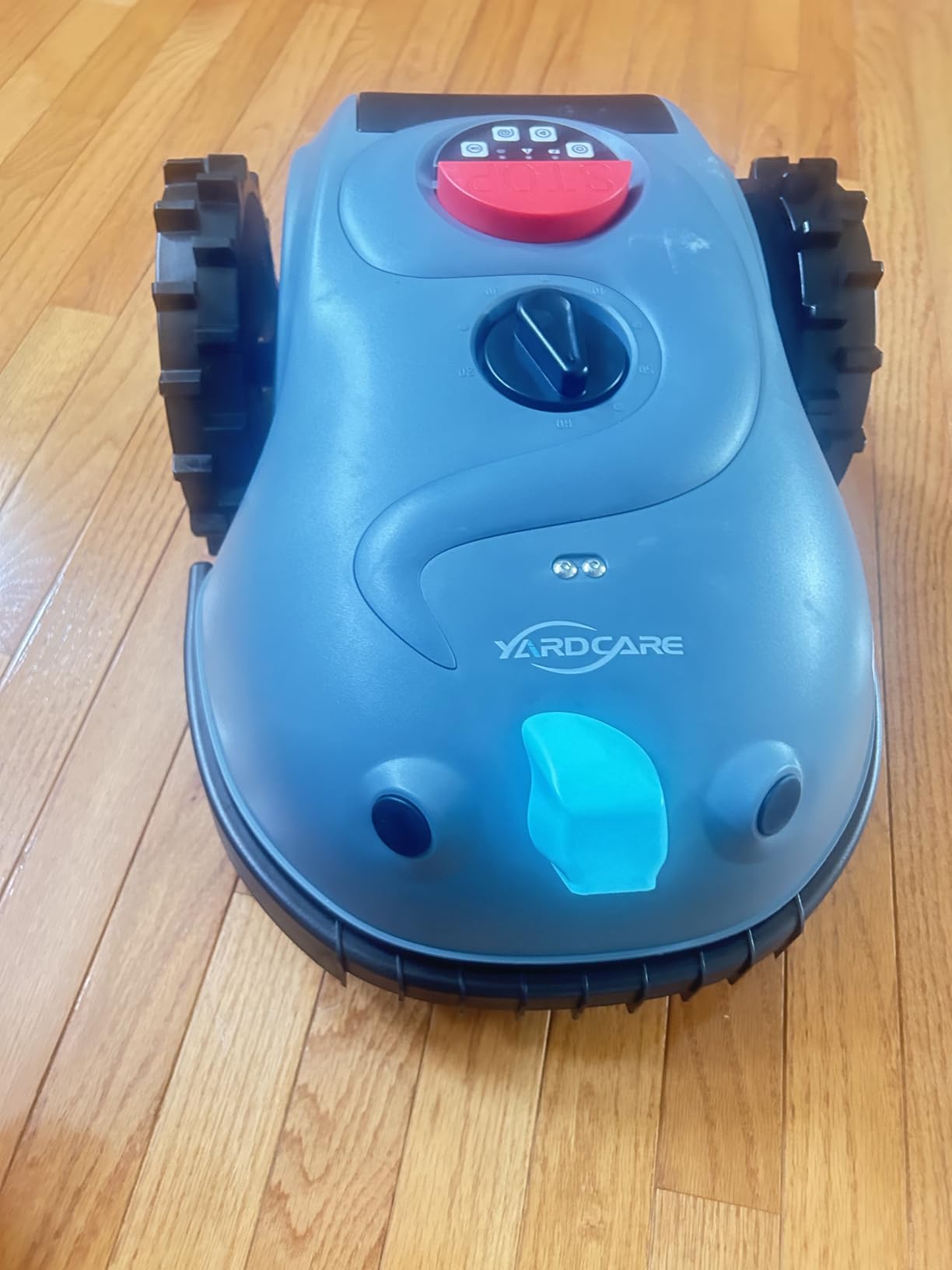
Navigation is an HD vision camera with bumper and visual sensors detecting up to 150 obstacle types, including automatic path recovery after a collision. The clever bit is the 32 foot magnetic strip with 20 pegs, which lets you define no-go zones with no digging, no power supply and no app-drawing, and the mower also stops on tilt and carries a rain sensor.
Coverage is up to 1,600 sq ft with a 6.3 inch cutting width and cutting height adjustable from 0.8 to 2.4 inches, slope capability up to 20 degrees, and the box includes an 18V battery charger plus three spare blade sets.
Where the V100 makes sense
It suits a small front lawn, a flat city lot, or anyone who wants a second mower for a corner of a larger property without a full installation. There is no wire, the setup is simple, and the included blade sets mean you are not ordering parts in your first month.
It also suits anyone who wants a mower that stops in the rain and cuts the blade when it is tipped, which matters in a household with children.
The limits are size, not quality
1,600 sq ft is the smallest coverage figure in this roundup, so if you have a quarter acre you will be disappointed. The mower follows a random path rather than systematic stripes, so the finished look is a uniform green rather than a deliberate pattern.
No-go zones require laying the magnetic strip rather than drawing boundaries in the app, and there is no RTK or LiDAR navigation, so it works best on simple open lawns with clear edges. Anything with heavy tree cover, narrow passages or a real slope is a poor match, and we would look at one of the RTK or LiDAR machines instead.
12. YARDCARE M800Plus: A Promising Small-Yard Option With Thin Proof
YARDCARE M800Plus Cordless Robot Lawn Mower with GPS + Visual Navigation, Bow-Shaped Path Mowing, APP Control, 4.0Ah Automatic Robotic Lawnmower for 1/5 Acre, Obstacle Avoidance, Height Adjustment
Up to 1/5 acre
GPS plus 3D vision
35% slope
4.0Ah battery
Pros
- No boundary wires with grass and non-grass discrimination
- Mixed row and random logic fills gaps effectively
- Handles 35% slopes without slipping
- Spot spiral mode for denser patches
- Automatic charging and resume works reliably
Cons
- Only 4 reviews on record so the reliability picture is thin
- Grass taller than 2.6 inches should be cut manually first
- Listed operation mode is listed as Manual rather than autonomous
We include this one with a clear caveat. The M800Plus carries a 5.0 average, the highest number in this roundup, and that figure comes from exactly four reviews dated the same day. It is not evidence of long-term satisfaction, and we will not pretend otherwise.
What the specification does show is a capable small-yard machine. Coverage runs to about 8,611 sq ft or a fifth of an acre, the camera distinguishes grass from non-grass areas without a boundary wire, and the 135 degree AI camera recognises 150 plus obstacle types while rerouting in real time. The 4.0Ah battery delivers about 90 minutes per charge.
What makes it different from the rest
The mowing logic is unusual and genuinely useful. It runs 40 minutes of orderly row mowing followed by 60 minutes of random gap-filling, which is a practical answer to the patchy results many robot mowers give on irregular lawns. A spot spiral mode handles denser growth in defined areas, and slope handling to 35% is among the better numbers here for a body this light.
Cutting height adjusts from 0.8 to 2.4 inches with a 7 inch disc, and app scheduling, path customisation and OTA updates are all supported. Automatic charging and resume reportedly work reliably.
Why we would not hang a purchase on four reviews
Four same-day reviews cannot tell you what happens in month eight. Every other machine here has between 26 and 391 ratings, and most of the reliability problems owners report show up well after the novelty period.
There is one operational note in the data worth repeating: grass taller than 2.6 inches should be trimmed manually before the first run, and the listing describes the operation mode as manual rather than fully autonomous, which is unusual for this category. If you want the spot spiral feature and accept the uncertainty, it is a reasonable experiment. If you want proven reliability, choose a machine with a few hundred reviews behind it.
RTK vs LiDAR vs Vision AI: How Each Mower Finds Its Lawn
Every mower in this roundup replaces the boundary wire with some way of knowing where the lawn ends. The three technologies do it differently, and the right one depends on your property more than on the model name.
RTK satellite positioning is the most precise option and the one that produces the straightest stripes. A base station or antenna receives correction signals, giving centimetre-level accuracy. The catch is sky visibility: dense tree cover, tall buildings and heavy overcast signal loss can leave the mower unsure where it is, and when it cannot tell it usually stops and waits. The ANTHBOT M9, the ANTHBOT Genie, the ECOVACS RTK CARE, the WORX, the Sunseeker and both Navimow models all use RTK to some degree.
LiDAR builds a 3D point cloud of the space around the machine and works entirely indoors or under trees, with no satellite dependency at all. It is heavier and more expensive, which is why only the ECOVACS O1000 LiDAR PRO and the MOVA LiDAX Ultra 1000 carry it at this price. Neither needs an antenna mounted in your yard.
Vision AI and V-SLAM use cameras to identify grass, edges and objects, and build a map through sensor fusion as the mower moves. It is the lightest and cheapest approach and it is what the YARDCARE models use. It struggles in low light and can confuse shadows, tall grass or mulch for obstacles, so it suits simple, open lawns best.
Most good mowers here combine two of the three. RTK plus vision gives you satellite precision with a camera fallback under shade, which is the pattern on the Navimow i105N, the Sunseeker X3 Plus, the Roborock and the WORX.
On signal loss specifically: an RTK mower that loses correction will usually park and wait rather than wander, an RTK plus vision combination will fall back to its cameras, and a vision-only mower will keep going but with less certainty. None of them should be expected to leave your yard, but a mower in an unfamiliar area is worth locating from the app before you go to bed.
Coverage Map Cap vs Daily Mow Area: Reading the Numbers
Manufacturers advertise two different numbers and buyers routinely confuse them. The first is the maximum mowable area, which is the headline acreage on the box. The second is the size of a single mapped lawn the software will accept.
Where those two diverge, you get an owner who bought a quarter-acre mower for a quarter-acre yard and then found the app would not let them map it in one pass. If your property is two separate lawns, you may need the mower to handle two maps rather than one large map, which is exactly why the MOVA LiDAX Ultra 1000 stands out, with two independent maps and up to 150 managed zones.
Two more numbers to read carefully. Per-charge coverage is not the same as total coverage: the Navimow i206 AWD covers about 1,350 sq ft per charge, and the MOVA averages about 60 minutes, so both need several cycles on a larger lot. And published slope ratings assume even ground, so a 30% rated mower on uneven terrain will do worse than the number suggests.
If you want the wider context on sizing and terrain, our lawn mower buying guide covers ground conditions and grass types in more detail.
Match Your Yard Size and Slope to the Right Mower
Work out your lawn area before you shop, then match it against the smallest mower that covers it. Overbuying on coverage wastes money on capability you will not use, and the smallest mower in this group covers 1,600 sq ft while the largest is rated to 0.9 acre.
For a quarter acre or smaller on flat ground, the Navimow i105N, the ECOVACS RTK CARE, the ECOVACS LiDAR PRO, the WORX and the MOVA LiDAX all fit. For a small lot under 2,000 sq ft, the YARDCARE V100 is the efficient choice. For a third of an acre or more, the Sunseeker X3 Plus, the ANTHBOT M9 and the ANTHBOT Genie are the relevant names.
Slope changes the answer more than area does. Anything up to 20 degrees is manageable for most of this group, 30% to 35% covers most gentle suburban grades, and above that you want the all-wheel-drive Navimow i206 AWD, the MOVA LiDAX, the ANTHBOT M9 or the Genie, all rated to 45%. The Sunseeker at 30% and the YARDCARE V100 at 20 degrees are for flatter lots.
Tree cover is the third filter. If your lawn sits under heavy canopy or beside tall buildings, put the LiDAR machines at the top of your list, or choose an RTK plus vision model with a V-SLAM fallback. Satellite-blocked yards are where most return requests originate.
Grass type matters too. All of these maintain an existing lawn; none of them handle neglected growth. If you have thick Bermuda, Zoysia or St Augustine, mow manually until the lawn is under control, and shorten the mowing interval in peak season so the machine never faces a two-day growth spurt. Grass that grows out faster than the mower can cut is the most common cause of the navigation failures owners report.
What a Robot Mower Really Costs Over Five Years
The purchase price is the smallest part of the bill. Blades are a consumable on every model, batteries degrade, and the accessories that make a mower pleasant to own are usually sold separately.
Blades. Almost every machine here uses a small rotating disc with three or more replaceable blades, and blades dull or bend every few months depending on grass and stones. The ECOVACS RTK CARE is the outlier that includes 36 spare blades in the box, and the YARDCARE V100 ships with three spare blade sets. On other models, budget for a multi-pack from the manufacturer rather than a single blade.
Battery degradation. Owners of the ANTHBOT Genie report noticeable capacity decline after about a year, which is the clearest field data we have on this. Plan for a pack change somewhere in year three or four, and check that the brand sells one before you buy rather than after.
Garages and shelters. Rain sensors are standard, but a housing extends life and keeps the unit cleaner. The ANTHBOT M9 includes one, and the YARDCARE V100 includes none. Buying one later often costs meaningfully more than buying the mower with it.
4G and anti-theft modules. Several RTK machines offer an optional 4G module for tracking and theft alerts, and the Roborock sells one separately alongside its edge module. Decide at purchase whether you want these, because retrofitting is not always possible.
Edge modules. The Roborock’s optional edge module is not sold in the US at all, and the WORX cut-to-zero module is a significant add-on. If close edge cutting matters to you, buy a machine that does it natively.
The question worth asking a shop is simple: can I buy a blade, a battery and a wheel set for this exact model in five years, and does a US distributor carry them. On parts availability alone, established names such as WORX, ECOVACS and Segway are safer bets than the newest listings, and that is a real reason to pay a little more within this budget.
Reliability, Warranty and the Thin Review Count Problem
Long-term reliability is the part of this category nobody advertises, and the owner reviews are the only honest source. The pattern is consistent: most machines work well for three to six months, and the failures cluster in the first full season of heavy use.
Reported long-term issues include the ECOVACS GOAT O1000 RTK owner arc documented on MowerBench, where an initially excellent machine began throwing help errors and stopping mid-task until the battery died, with a warranty replacement eventually solving it at the cost of a summer without a mower. The workaround that owner found, uninstalling and reinstalling the app, restored function without any hardware fix, which tells you the problem is often software rather than mechanical.
App stability is the most common failure mode across the whole list. Satellite calibration failures, phantom rain detection, self-locking and lost connections appear on the Sunseeker, the ECOVACS RTK, the Navimow AWD and the WORX in various combinations. A YUKA Mini owner on Reddit reports an app that loses connection constantly, which is a warning that applies to any Wi-Fi-dependent machine in this class.
Warranty length varies meaningfully. The MOVA LiDAX carries 3 years with 24/7 after-sales service, the WORX carries 3 years, the Sunseeker carries 2 years with US-based support, and the Navimow i105N carries 3 years. Longer is better, but US-based support and a real parts catalogue matter more than the year count.
Finally, the thin review count problem. Several products topping shopping carousels in this category have between five and eight reviews, and one in this roundup has four. That is not enough to judge season-three reliability, and competitors routinely award badges to machines with no owner history. We have flagged every case here, and we would treat a sub-10 review count as a reason to expect the unexpected rather than as a reason to trust a perfect rating.
When a Robot Mower Is the Wrong Purchase
A robot mower is the wrong purchase in a few real situations, and being honest about them saves people a lot of frustration.
If your lawn is mostly weeds, ground cover or brush, a robot mower will not cut it down. These machines maintain an existing lawn, and owners who bought one to rescue a neglected property report it stalling on overgrown patches. If the yard is under 2,000 sq ft and simple, the YARDCARE V100 class of machine may be enough, but a full manual cut may cost less effort than the setup.
If your lawn is under heavy tree cover and you have ruled out LiDAR models, a robot mower will frustrate you. If the yard has narrow passages narrower than about 30 inches, check the passage width before buying, since several machines here need more room than that.
And if you have a very small area or a large property with serious slope and rough ground, the money is often better spent elsewhere. Our field mower guide covers large acreage, and for genuinely rough, brushy ground a brush mower is the right tool. A robot mower maintains a lawn, and it does not clear land.
Frequently Asked Questions
What is the best robot mower for the money?
The best robot mower for the money in this price range is the ANTHBOT M9, which combines NRTK plus dual camera vision, a 45% slope rating, coverage up to about 0.3 acre and an included garage, backed by several hundred owner reviews. For a smaller lot the Segway Navimow i105N is the proven value choice, and for yards with heavy tree cover the ECOVACS GOAT O1000 LiDAR PRO avoids the satellite dependency that causes most return requests.
What is the best budget robot mower?
The best budget robot mower here is the YARDCARE V100, which holds a 4.8 average rating across 58 reviews, covers up to 1,600 sq ft, needs no boundary wire and uses a 32 foot magnetic strip to set no-go zones without digging. It suits small flat lawns. If your yard is larger than about 2,000 sq ft, move up to an RTK or LiDAR model rather than trying to stretch it.
What is the average lifespan of a robot lawn mower?
Owners commonly get three to five years of good service from a robot mower in this price band, with the main change during that period being battery capacity rather than the drive system. A field report on the ANTHBOT Genie describes noticeable battery decline after about a year. Blades are a far more frequent consumable, needing replacement every few months depending on grass and stones, so factor spare blades into your ownership cost.
What is the most reliable robot lawn mower?
Within this budget the most reliable machines are the ones with the deepest review evidence and the longest warranty: the Segway Navimow i105N with 391 ratings and a 3-year warranty, the WORX Landroid Vision Cloud with a 3-year warranty, and the MOVA LiDAX Ultra 1000 with 3 years and 24/7 after-sales service. Reliability risk in this category clusters in app and navigation software rather than in the motors.
Do wire-free robot mowers work without an internet connection?
It depends on the navigation type. RTK and LiDAR mowers keep working without internet because positioning comes from satellites and sensors, not servers, though you lose remote control and theft tracking. Vision-only mowers such as the YARDCARE models map on the mower itself and also run offline. Cloud-dependent features such as the WORX RTK Cloud service may need connectivity to add or edit zones, and any 4G anti-theft module requires a cellular plan.
Can wire-free mowers handle slopes and uneven terrain?
Yes, within their rated limits. Most of these machines are rated to 30% to 35% gradient, and the strongest, including the ANTHBOT M9, the MOVA LiDAX Ultra 1000, the ANTHBOT Genie and the Segway Navimow i206 AWD, claim 45%. Uneven ground is a different matter: traction is often the limiting factor, and owners report ruts from the stock wheels on the Navimow i105N until they fit off-road wheels.
Do robot mowers work in the rain?
Yes, most do. Rain sensors are standard across this group, including the tilt sensor blade stop and emergency stop switch on the YARDCARE V100, and mowers generally return to the charging dock when rain is detected. Owners do report false rain detection on the Sunseeker X3 Plus, so if a mower parks for no apparent reason, check the app before assuming the weather caused it.
How long does it take to set up a wire-free robot mower?
Most owners finish in under an hour. The ANTHBOT M9 generates a virtual map in about 10 minutes, the ECOVACS RTK CARE reports 20 to 30 minutes from unboxing to the first automatic mapping run, and the ECOVACS LiDAR PRO is commonly set up in under an hour with no antenna at all. Allow extra time for RTK models because the base station needs a clear view of the sky.
Which robotic lawn mower did Consumer Reports recommend?
Consumer Reports does not publish free, citable recommendations for robot mowers, and we have not based any pick here on their testing. Our rankings come from published specifications, warranty length and the pattern of owner reviews, and we weight long reviews far above short novelty reviews. If you want a second opinion, treat a testing organisation’s pick as a complement to the owner data rather than a substitute for it.
Do robot mower apps require a subscription?
Most do not. The WORX Landroid Vision Cloud is the clearest example, with RTK Cloud centimetre-level positioning and no cloud fees attached to mapping or scheduling, and most competitors in this roundup run mapping and scheduling locally on the mower. The exceptions are optional rather than mandatory: 4G anti-theft modules and extended remote access features are sold separately, and the Segway Navimow i105N lists an optional 4G module.
Final Verdict: The Best Robot Mowers Under 1,500
The best robot mowers under 1,500 dollars in 2026 are wire-free machines, and the choice comes down to your yard rather than the spec sheet. The ANTHBOT M9 is the one we would buy first: it maps in about ten minutes, handles a 45% slope, recognises more than 1,000 obstacle types and comes with a garage and five blades in the box.
For a small flat lot, the Segway Navimow i105N is the proven buy, with the deepest review pool in the category and the quietest operation at 58 dB(A). Where trees block the sky, go straight to the ECOVACS GOAT O1000 LiDAR PRO or the MOVA LiDAX Ultra 1000, since both skip the satellite dependency that causes most return requests. For a large lot, the ANTHBOT Genie is the only machine here rated past a third of an acre, though its battery degradation reports are real.
Whatever you choose, buy a spare blade set in your first order, check that the brand sells parts in your country, and keep the mowing interval short enough that the lawn never presents two days of growth. Those three habits do more for your experience than any feature on the box.