
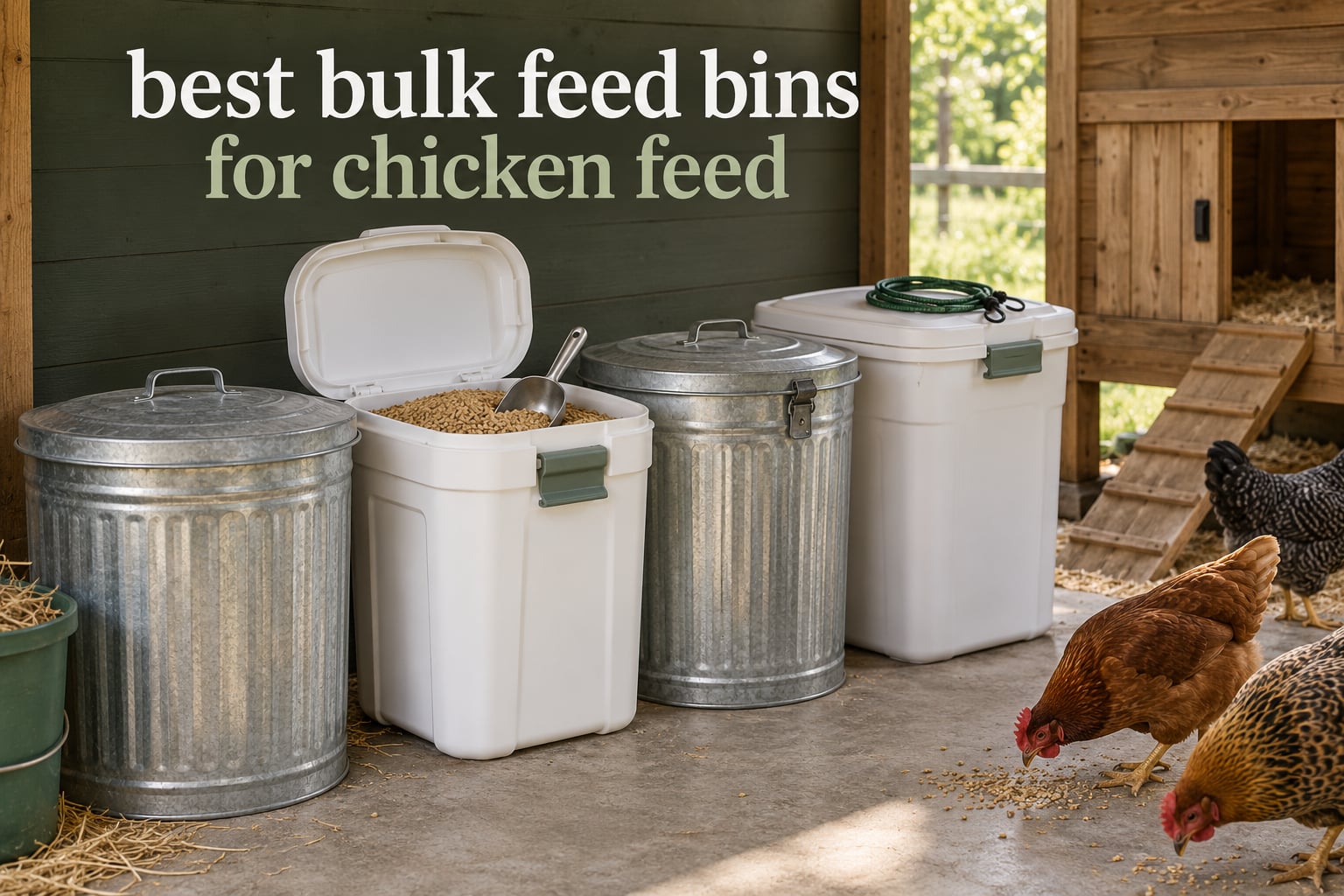
Most backyard flock owners buy the same 40 to 50 pound paper bag, carry it from the garage to the coop, and deal with the fallout. Rodents find the torn bag, wild birds scatter what drops, and a humid summer turns the bottom of the bag into a science project.
Bulk buying fixes the economics. A mill will sell you feed by the ton or in 500 pound bags, and the cost per pound drops sharply once you are past the small-buyer minimum. The storage problem is what stops people, which is exactly what a good bulk chicken feed storage bin solves. We compared the ten most useful containers we could find, weighed the steel against the plastic, and looked hard at lids, gaskets and capacity.
The short version: buy one galvanized steel can if you have any pressure from rats, and one airtight food-grade plastic bin if your storage space is indoors and dry. Keep both away from the coop, and make sure the lid is positively latched rather than resting in place.
If you also need to move feed around a property, our guide to the best feed carts covers rolling options, and our feed storage bins guide goes deeper on smaller poultry setups.
Top 3 Best Bulk Chicken Feed Bins (October 2026)

Buddeez 50 Quart Rolling Bin
- 50 quart / 50 lb capacity
- Airtight snap-on lid with flip top
- Rolling wheels and bag-in design

Mighty Tuff 13 Gallon Airtight
- 13 gallon / 54 lb capacity
- Twist-lock airtight seal
- BPA-free with side handles

Behrens 6 Gallon Steel Can 2-Pack
- 6 gallon per can
- Locking lid with rod handle
- Rustproof alloy steel
- Made in USA
The Buddeez 50 quart rolling bin earns the top spot on evidence: a 4.7 average across more than thirteen thousand reviews, a genuine airtight seal and a footprint narrow enough to line up several bins in one corner. The Mighty Tuff container is the pick for anyone who wants a true seal and does not care that the lid is stubborn once tightened. The Behrens pair is the value pick, and the most heavily reviewed steel option in the roundup.
All 10 Bulk Feed Bins Compared in 2026
| Product | Specifications | Action |
|---|---|---|
| Buddeez 50 Quart Rolling Bin |
|
Check Latest Price |
| Mighty Tuff 13 Gallon Airtight |
|
Check Latest Price |
| Behrens 6 Gallon Steel Can 2-Pack |
|
Check Latest Price |
 VEVOR 27 Gallon Ingredient Bin VEVOR 27 Gallon Ingredient Bin |
|
Check Latest Price |
 YITAHOME 11.4 Gallon Ingredient Bin YITAHOME 11.4 Gallon Ingredient Bin |
|
Check Latest Price |
 Buddeez 80 Quart Roll-Away Dispenser Buddeez 80 Quart Roll-Away Dispenser |
|
Check Latest Price |
 Woodlink Galvanized Seed Locking Bucket Woodlink Galvanized Seed Locking Bucket |
|
Check Latest Price |
 Plexon 6 Gallon Metal Can 2-Pack Plexon 6 Gallon Metal Can 2-Pack |
|
Check Latest Price |
 FCMP Outdoor 37 Gallon Storage Bin FCMP Outdoor 37 Gallon Storage Bin |
|
Check Latest Price |
 Amazon Basics 50 lb Rolling Container Amazon Basics 50 lb Rolling Container |
|
Check Latest Price |
1. Buddeez 50 Quart Airtight Rolling Bin: Best Overall Bulk Feed Bin
Buddeez Airtight Rolling Pet Food Storage Container, 50 Quart, with Scoop
50 quart / 50 lb
Airtight snap-on lid with flip top
Rolling wheels
Side-grip handle
Pros
- Whole bag drops in without pouring
- Flip top and spout dispense without removing the lid
- Rubber gasket helps keep feed dry
- Narrow profile fits tight corners
- Wheels beat carrying a full bin
Cons
- Included measuring cup is inaccurately marked
- Wheels can be tough to seat
- Some users say the snap seal is not truly airtight
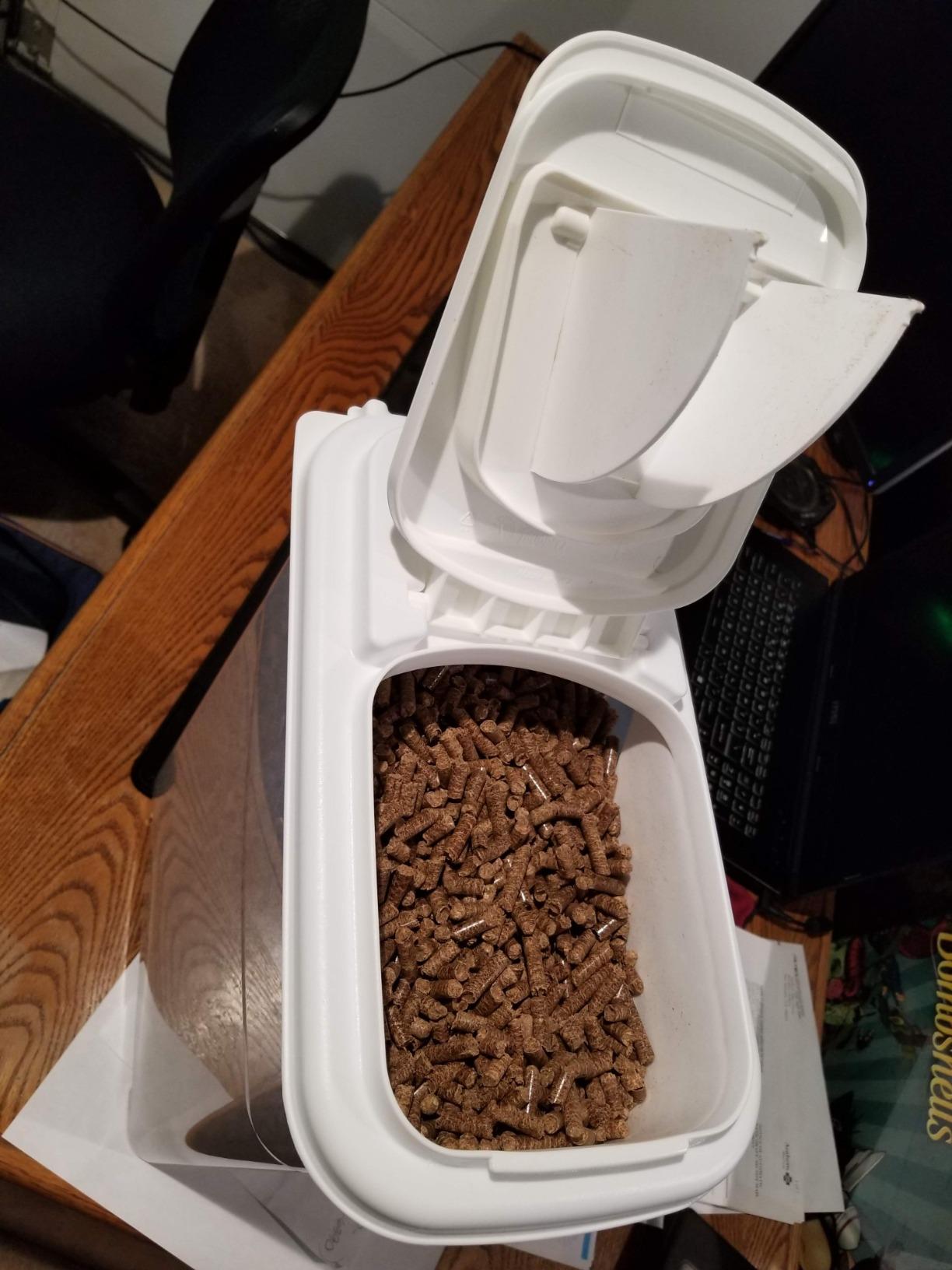
We used this bin for a layer flock and never poured a single scoop twice. The bag goes straight in, liner and all, which matters more than it sounds like it should because feed that never touches the bin walls cannot pick up old flavours or moisture residue.
The flip top is the feature we did not expect to care about. You lift the lid and pour through the spout without removing anything, so the airtight seal is broken for seconds rather than for the minute you would spend on a traditional lift-off lid. On a dark morning that is the difference between a tidy coop and feed scattered across the floor.
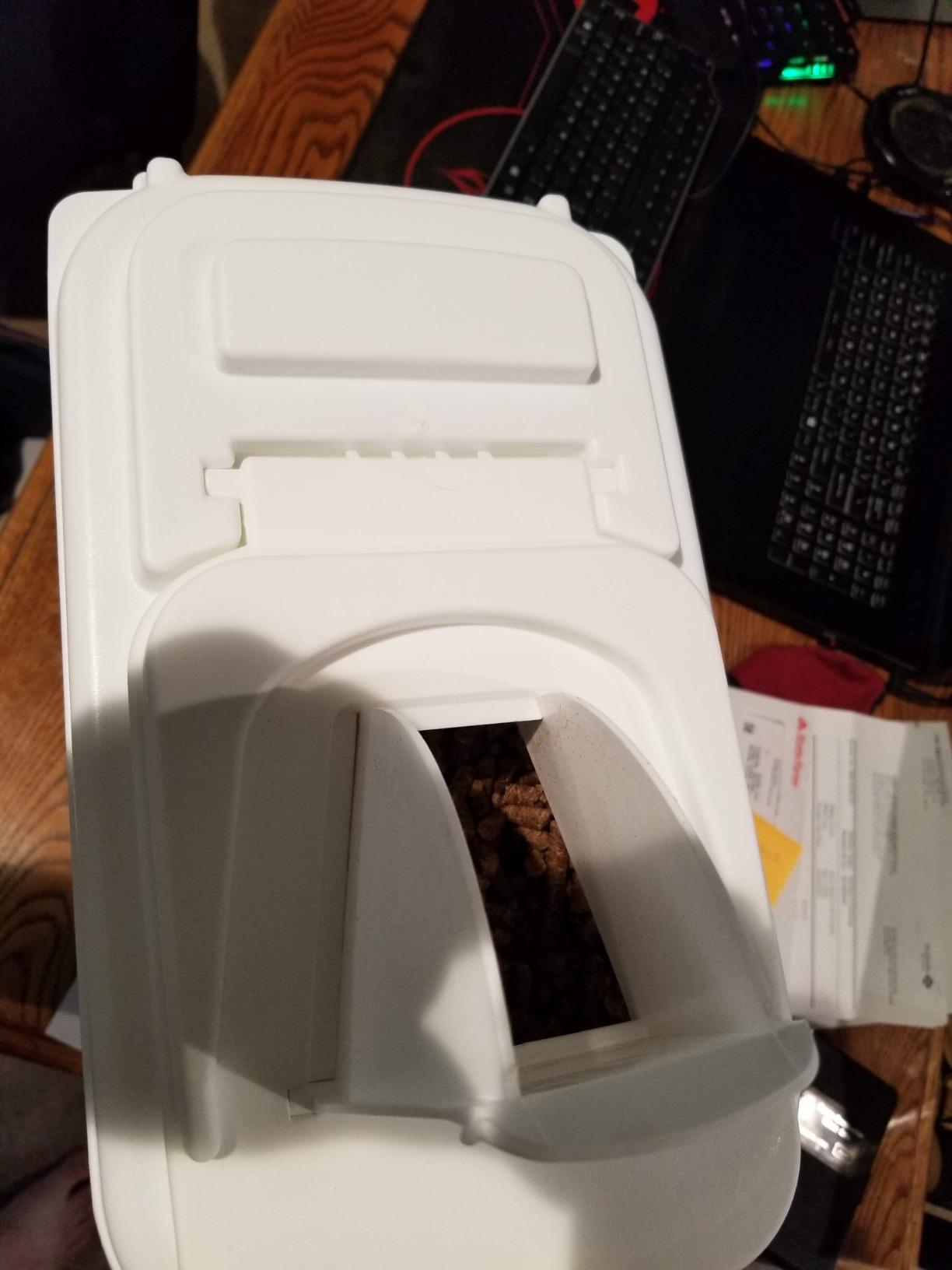
This is also the most heavily reviewed bin in our roundup by a wide margin, with a 4.7 average across more than thirteen thousand ratings. The complaint that repeats itself most is the included scoop, whose one-cup marking does not actually hold a cup. Bring your own measure and the problem disappears.
The wheels are worth calling out for anyone moving 50 pounds of feed across a garage floor. They are built into the base rather than clipped on, so nothing pops loose halfway across a floor.
Who This Bin Suits Best
Anyone keeping ten to forty hens who already has mice in the garage. A gasket-sealed plastic bin with a working latch stops rodents that would chew through an open bag overnight, and it holds smell in so a stale feed odour does not draw more pests across the yard.
It also suits anyone running a colour-coded system, since several bins stand side by side and keep starter crumble separate from layer pellets.
Who Should Buy Something Else
If you have active rat pressure rather than mouse pressure, this is plastic and a determined rat will eventually find a way in. The lid also has no provision for a padlock.
2. Mighty Tuff 13 Gallon Airtight Container: Best True-Seal Storage
Mighty Tuff Airtight Dog Food Storage Container – 13 Gal, up to 54 lb Capacity – Cat and Dog Food Container with Twist Lid & Handles – BPA-Free, Made in USA
13 gallon / 54 lb
Twist lock airtight lid
BPA-free plastic
Built-in side handles
Pros
- Genuinely airtight twist seal
- Holds a full 50 lb bag with the scoop inside
- Tall narrow shape tucks under shelves
- Works for grain and treats
- Built-in handles for carrying
Cons
- Twist lid can be extremely hard to open once sealed
- Very heavy to lift when full
- Included plastic scoop is not durable
- Awkward for smaller users to move
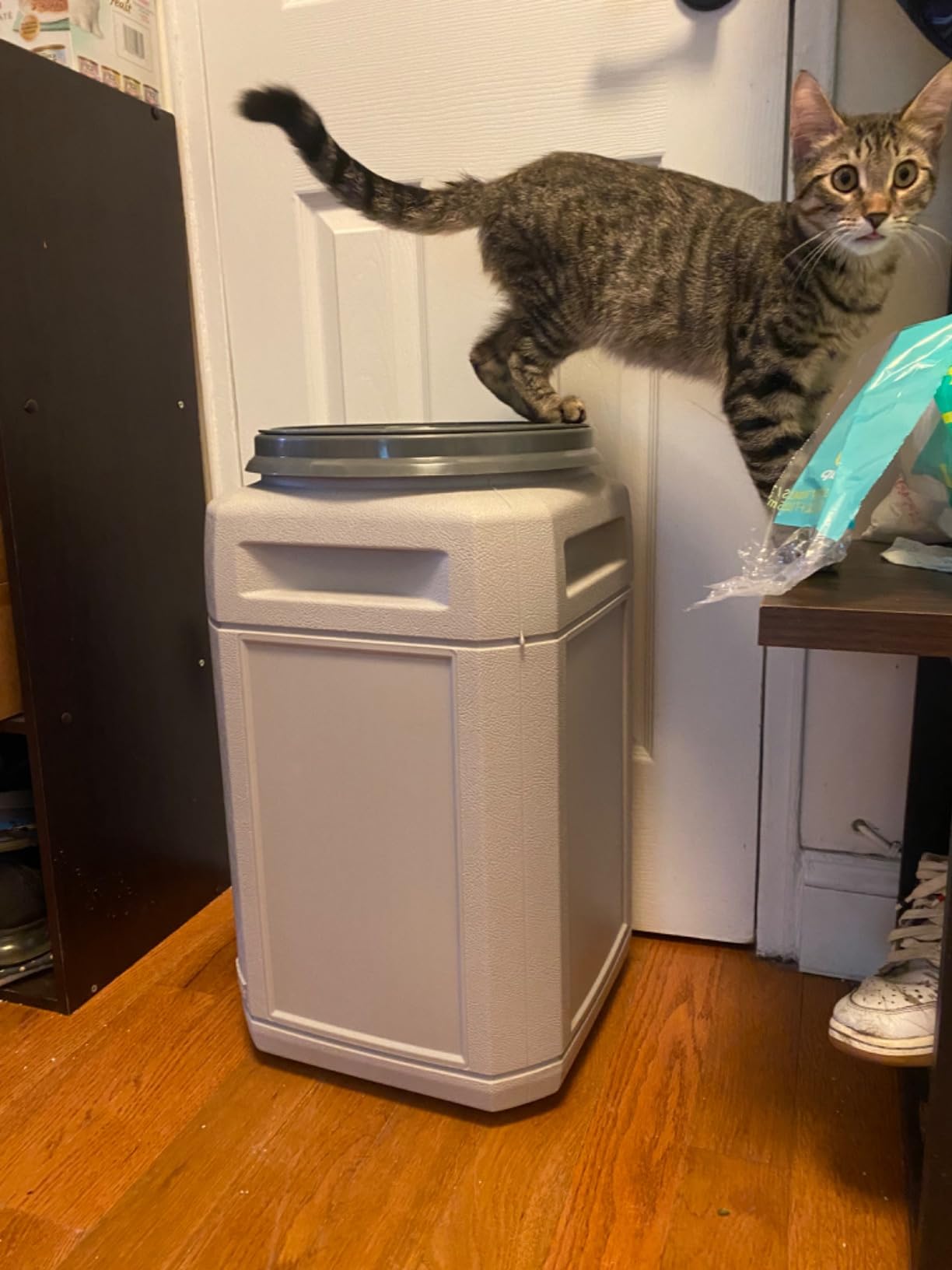
This is the bin to buy when the problem is moisture rather than teeth. The twist seal compresses onto the rim all the way around, and owners consistently report that feed stays dry and smells fresh long after the paper bag would have gone musty.
It handles a full 50 pound bag with the scoop stored inside, and the tall rectangular shape is easy to stack against a wall. Made in the USA from heavy-duty BPA-free plastic, it is built for dog food and works just as well for layer pellets or scratch.
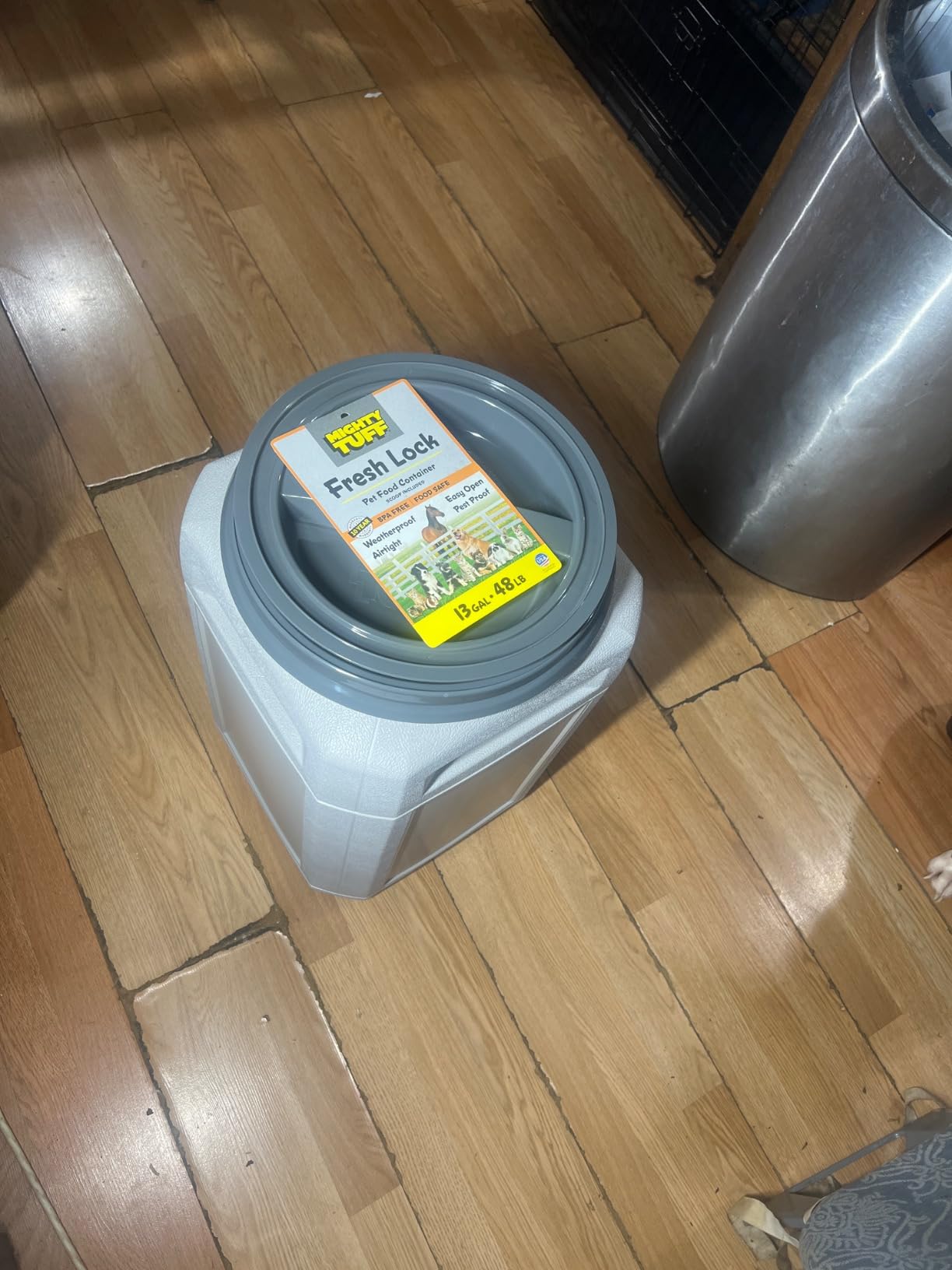
The honest drawback is the lid. Owners repeatedly warn that once the twist seal has really tightened, it can be close to impossible to open, especially with damp or cold hands. Budget for that every morning rather than discovering it at six in the morning on a frosty day.
Rust-resistant plastic also means rust-free in practice, so it suits a damp shed floor without the slow corrosion you get with bare steel.
Who This Bin Suits Best
Humid climates and unheated sheds, where condensation rather than rodents are the main threat. A twisting seal is more reliable against damp air than a snap-fit lid that depends on even pressure around the rim.
It also suits keepers storing several feed types at once, since a fully sealed bin keeps starter crumble dust out of layer pellets.
Who Should Buy Something Else
Treat this as rodent-resistant rather than rodent-proof, and expect a two-person lift once 54 pounds of feed is in it.
3. Behrens 6 Gallon Galvanized Steel Can, 2-Pack: Best Value Steel
Behrens 6 Gallon Galvanized Steel Storage Can or Waste Bin w/Locking Lid & Handle (2 Cans, No Grip)
6 gallon per can
Locking lid with handle rod
Rustproof alloy steel
Made in USA
Pros
- Galvanized steel walls that rodents cannot chew
- Locking rod keeps the lid shut against raccoons
- Room for a full bag plus scoop space
- Sold as a pair for colour-coded feeds
- American-made construction
Cons
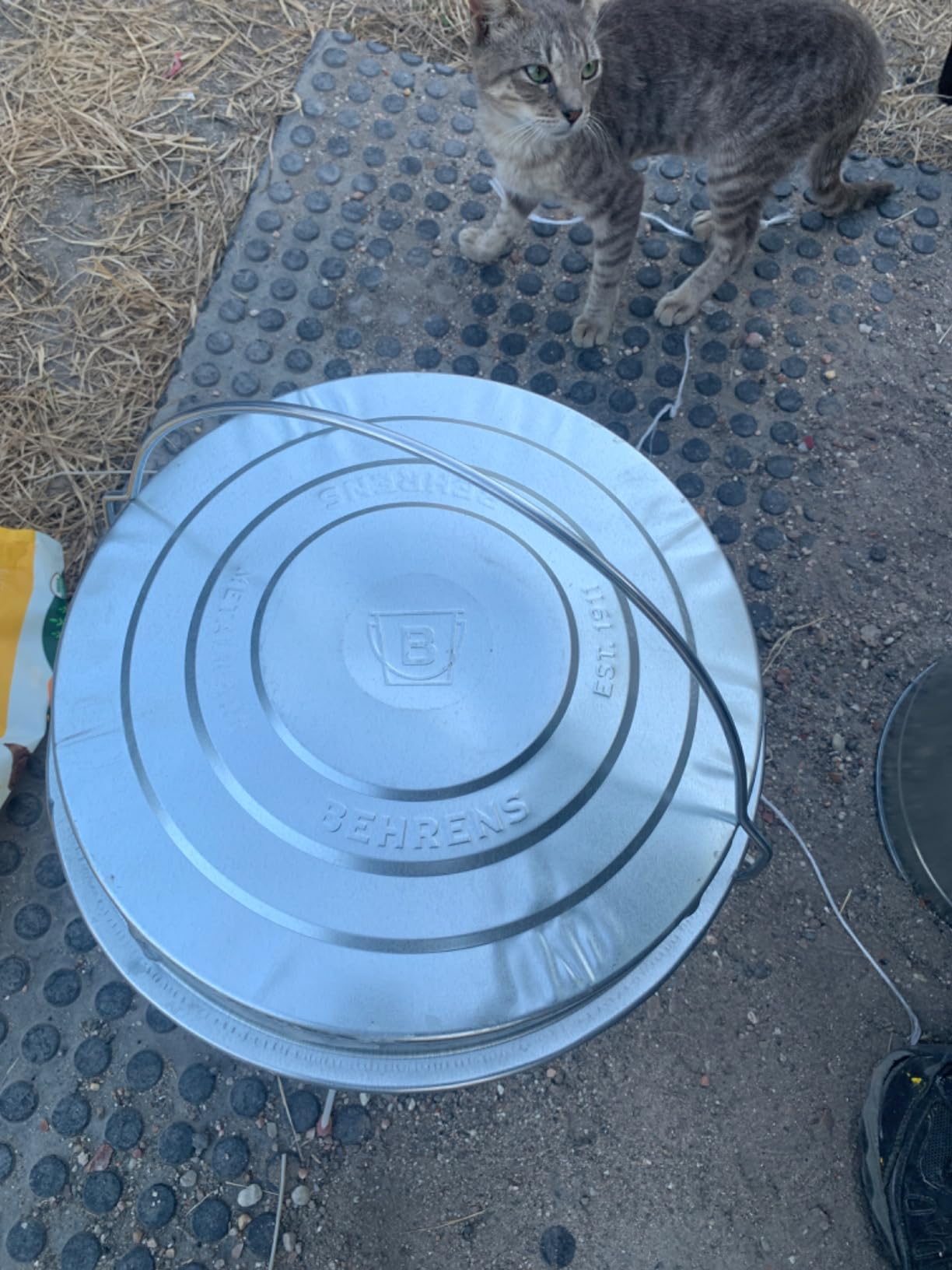
- Redesigned lid dropped the top carry handle
- Flared rim makes the locking rod harder to seat
- Not leak proof for liquids
- Heavy when full
This is the can we would put in a coop yard where rats are already established. Alloy steel does not care about incisors, and the locking rod on the lid turns a friction-fit lid into something a raccoon has to work at rather than lift with one paw.
Owners use them for birdseed, pet food and garden potatoes, but the same construction works for chicken feed. At 6 gallons each and sold as a pair, you get two bins that fit side by side and let you separate starter from layer.
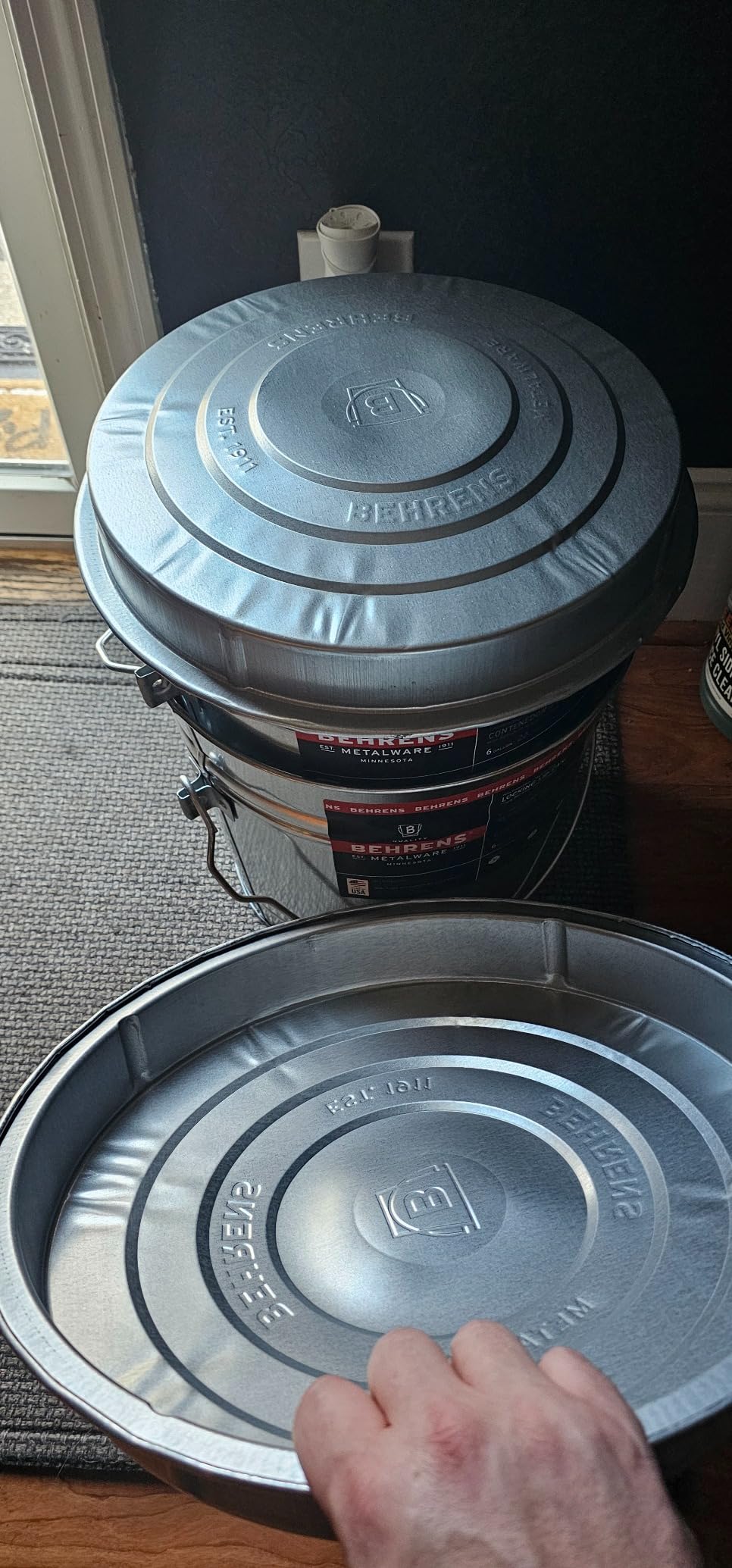
The most common criticism targets a redesign rather than the steel. Older versions had a top carry handle, and the current lid drops it, so you lift a full can from the rim. The new flared rim also makes the locking rod fiddlier to seat than it used to be.
At 9 pounds empty, these are not friendly for older keepers. Plan the lift before you fill one rather than after.
Who This Bin Suits Best
Anyone in a yard with confirmed rodent damage who wants two separate bins on a modest budget. The pair also gives you a clean way to keep treats or grit away from the main ration.
Who Should Buy Something Else
If you need to hold 500 pounds at once, six gallons will not get you there.
4. VEVOR 27 Gallon Food Storage Container: Best for Bulk Buys
VEVOR 27 Gallon Food Storage Container, 500 Cup Commercial Ingredient Bin
27 gallon / 500 cup
Food-grade PP plastic
Buckle closure
Clear sliding lid
Pros
- Very large capacity in one footprint
- Clear lid shows levels without opening
- Four casters move a loaded bin
- Buckle closures seal tightly on grain
- BPA-free food-grade plastic
Cons
- Large footprint for a small shed
- Empty bin is heavy to position
- Sliding lid must be fully opened for a scoop
When a mill delivers several hundred pounds, one bin that holds it all changes how you operate. This 27 gallon container is rated for 132 pounds of flour or 176 pounds of rice, and chicken ration sits in a comparable weight range, so a single fill covers weeks for a mid-size flock.
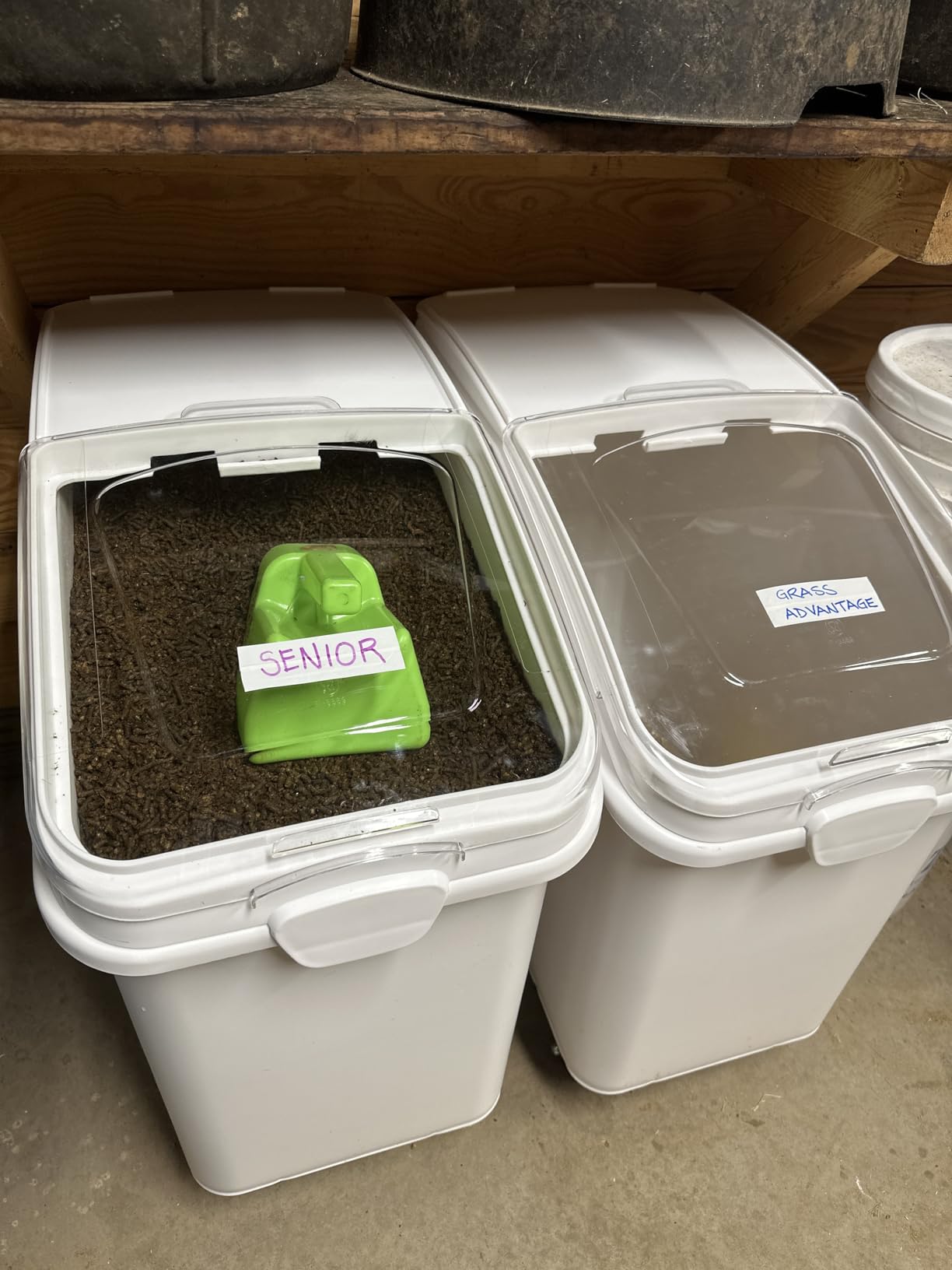
The clear sliding lid is genuinely useful during a bulk delivery. You can watch the level drop as you scoop instead of lifting a heavy lid in a dim shed and trying to judge depth by eye.
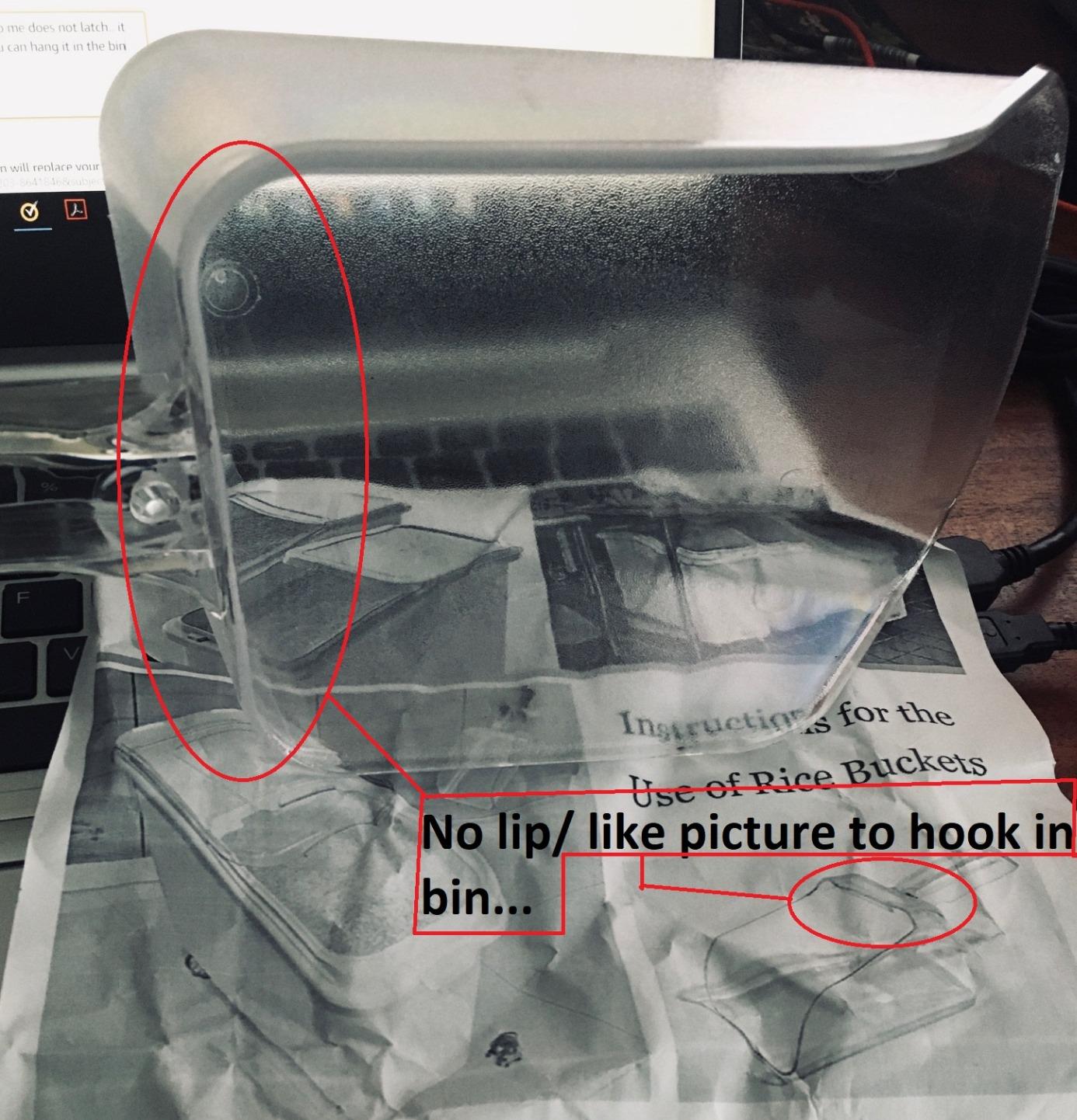
Buckle closures on the front of the bin pull the lid down evenly, which is how you get a real seal out of plastic. Buyers running bakeries report that the buckles hold through heavy daily use, and the food-grade scoop hangs inside the lid.
Be realistic about the footprint. At 29.5 by 29.5 inches with a 20.6 pound empty weight, it needs a corner, not a shelf, and you will want the casters to get it into position at all.
Who This Bin Suits Best
Flock owners who genuinely buy in bulk and have a shed, garage or mudroom floor to dedicate. Moving one loaded bin beats carrying ten bags from the pallet to a small can every single week.
The commercial-style build also suits anyone mixing their own ration, since the clear body shows you the blend and the wide opening makes it easy to pour from a bucket.
Who Should Buy Something Else
Anyone with a cramped space or a mobility limit. Twenty pounds empty before a single scoop goes in is not a bin you want to reposition on your own.
This is plastic, so it belongs indoors. In a yard with rat pressure it is a large, expensive target, and the sliding lid offers no way to bolt it down.
5. YITAHOME 11.4 Gallon Ingredient Bin: Best for Measured Feed
YITAHOME 50L/90lb Large Ingredient Flour Storage Bin, Commercial 11.4-Gallon Rice Storage Container 280 Cups Bulk Flour storage Bins with Wheels,Scoop,Lid and scale, Rice Bin for Kitchen, White
11.4 gallon / 50L
Rated to 90 lb of flour
Six buckles plus magnetic latch
Built-in scale and window
Pros
- Holds a full 50 lb bag with room for the scoop
- Built-in measuring scale on the barrel
- Large viewing window for level checks
- Wheels roll under load
- Bakery owners report heavy-duty performance
Cons
- Scoop can detach if the lid closes hard
- Window screw can be knocked out in shipping
- Some buyers say the seal loosens over time
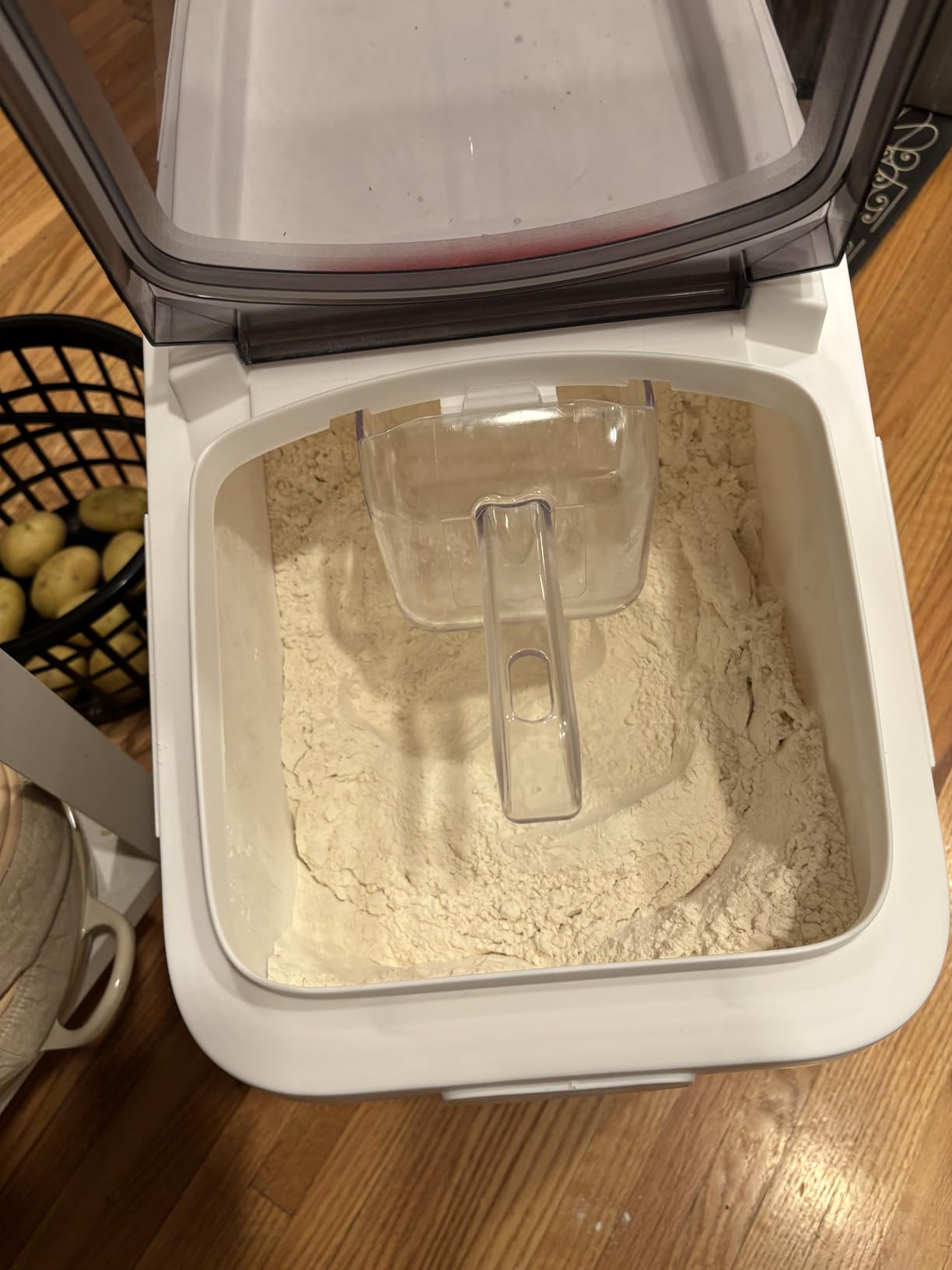
The built-in measuring scale is the feature that separates this from every other plastic bin here. When you are working out how many weeks a bin should hold for your flock, reading the level off the side beats a bigger capacity number on a listing.
It is rated for 90 pounds of flour or 70 pounds of dry pet food, so a layer ration fills roughly two-thirds of the barrel. That leaves headroom for a scoop and a small bag of scratch.
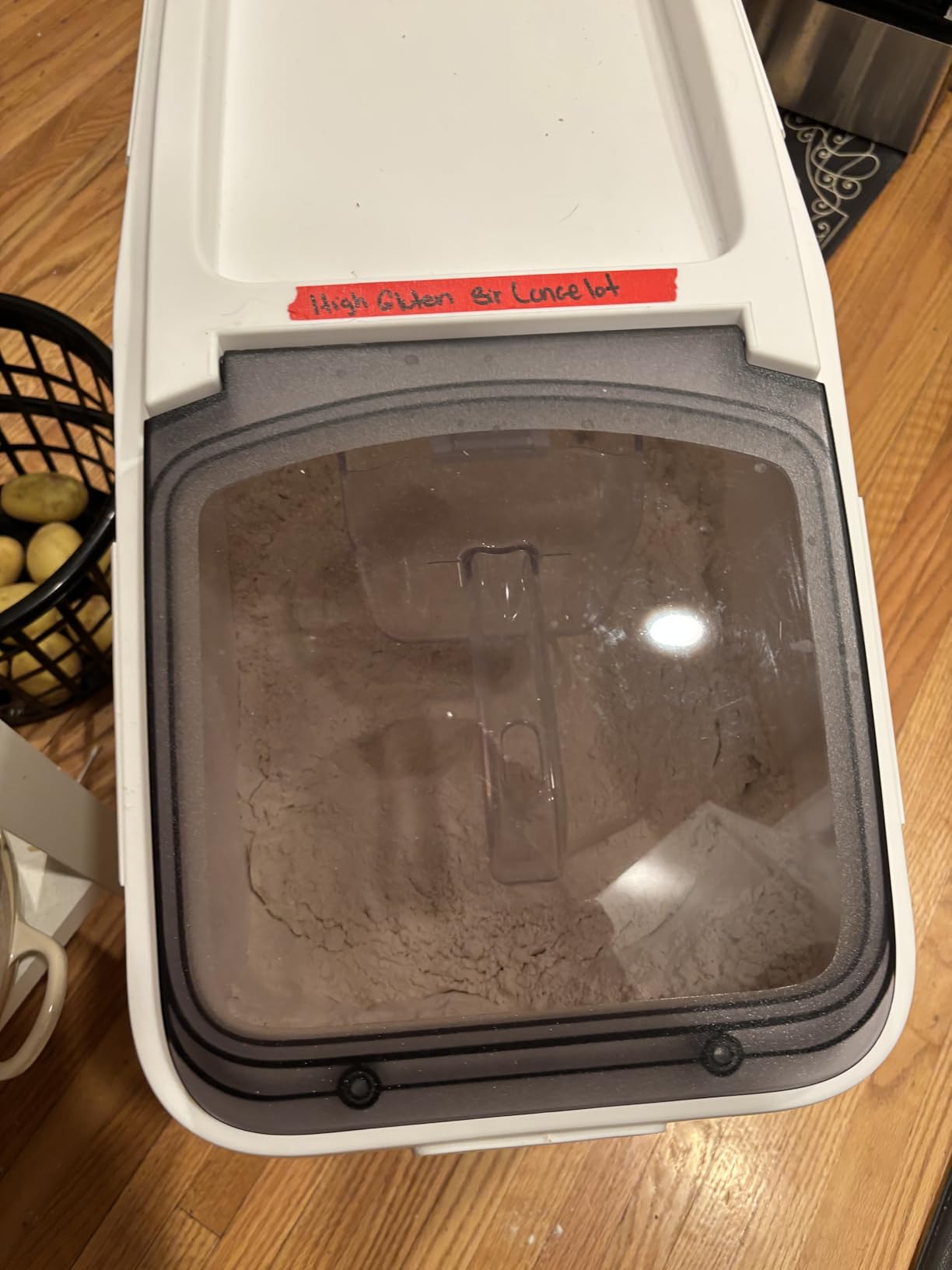
Six sealing buckles plus a magnetic suction latch and a rubber gasket strip in the lid add up to a close that stays shut. The concave lid can hold a cup or bowl, which saves you finding a clean flat spot in the dust.
A detachable moisture-proof box in the lid takes a deoxidizer packet, and four detachable 360 degree casters let you move the bin when it is part full.
Who This Bin Suits Best
Keepers who track feed intake or who mix a scratch and pellet blend and want to know the ratio as it drops. The window means you can also use it for a second feed type without opening it.
It is a good match for a garage shelf arrangement because the footprint is narrow at 11.2 inches. Two of them side by side take very little floor space.
Who Should Buy Something Else
Anyone expecting a lifetime seal. A minority of buyers report that the closure is not fully airtight after extended storage, so if damp shed air is your main worry, test it in place first.
It is indoor storage only. Plastic in a yard with rats is a container with a countdown on it, however good the buckles look.
6. Buddeez 80 Quart Roll-Away Dispenser: Best for Narrow Spaces
Buddeez 80-Quart Roll-Away Pet and Large Animal Food Dispenser with Scoop
80 quart capacity
Dispenses from the original bag
Locking seal clasps with gaskets
Wheels and scoop included
Pros
- Holds two 27 to 30 lb bags with room to spare
- Slim vertical profile stacks in small spaces
- Recessed wheels keep a full bin stable
- Bag-in design keeps labelling visible
- Seals tightly against mice and ants
Cons
- Side handles add width beyond the listed size
- Needs 4 to 6 inches of overhead clearance to open
- Occasional cracked bottom on arrival
- Not impervious to determined rats
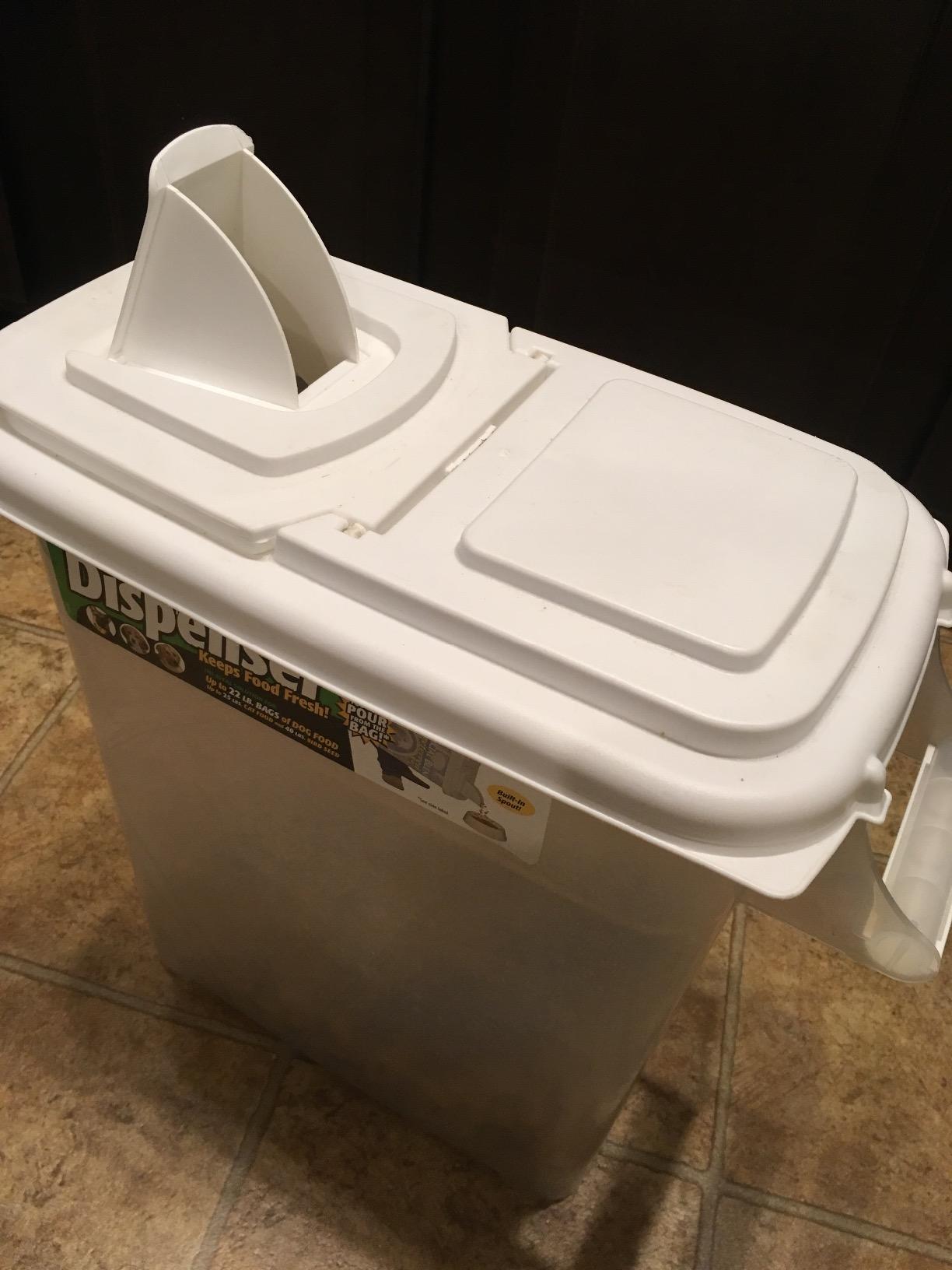
This is the answer when floor space, not capacity, is the problem. Eighty quarts of capacity sounds large until you see it is a tall narrow column rather than a wide box, and several owners report running multiple units along one garage wall.
The bag-in dispensing is the quiet hero. Feed comes out of the original bag inside the bin, so there is no second container to wash and no pouring funnel to lose.
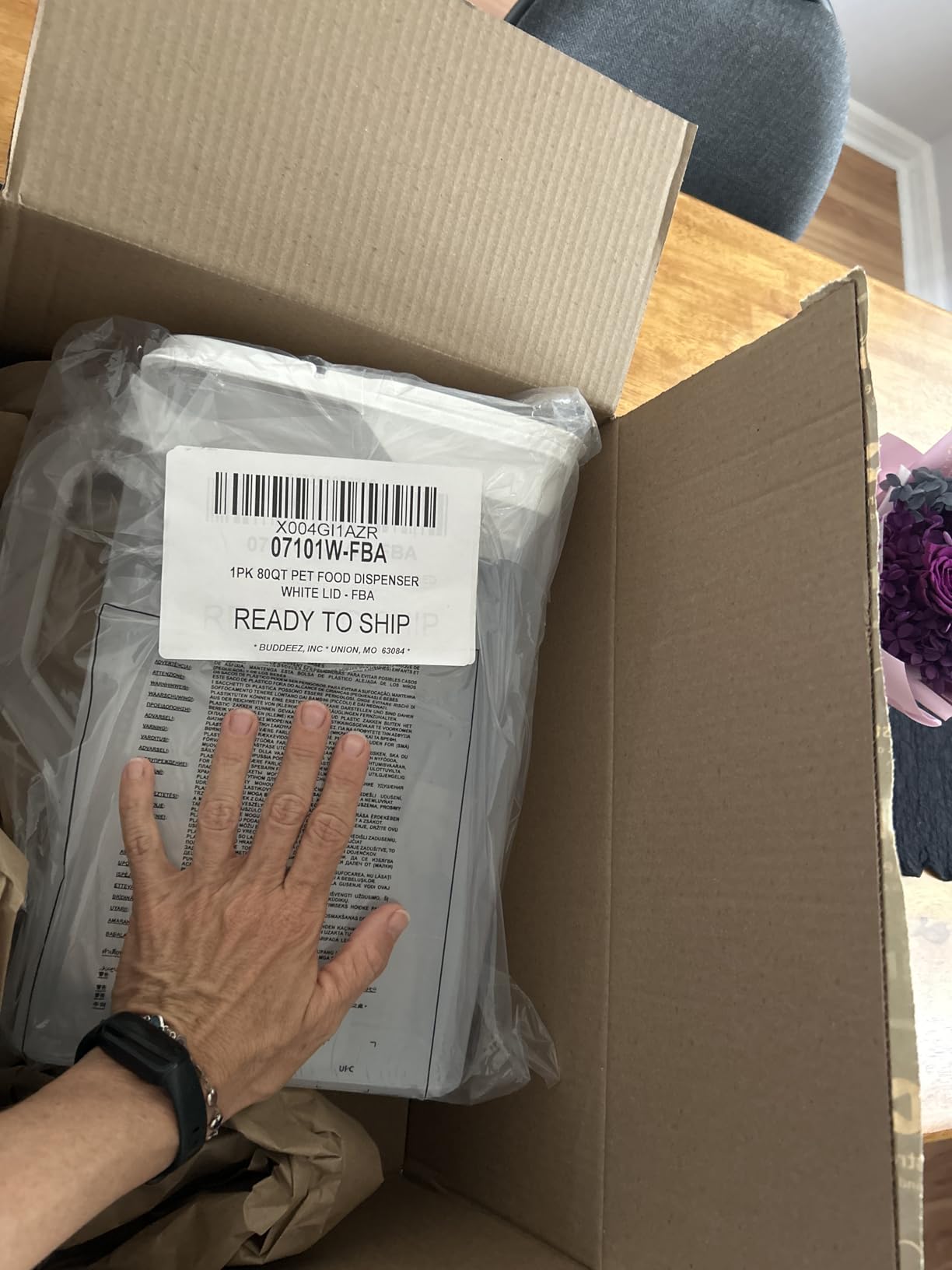
Seal clasps and gaskets keep food fresh and seal out mice and ants in a garage. Recessed wheels roll the bin when it is heavy and stay tucked under the base rather than catching on the floor.
Long-term owners tend to describe this as the best food storage bin they have owned, and the repeated small gripes are dimensional. Side handles make it wider than the listed inches suggest, and you need clearance above to open the lid.
Who This Bin Suits Best
Anyone with a narrow garage gap or a mudroom corner and a flock large enough to need two bags at a time. The tall format is also the easiest of these to leave on a bare floor.
It works well indoors where the main pests are mice and ants rather than rats. Gasketed clasps handle that job without any steel involved.
Who Should Buy Something Else
Anyone in heavy rat territory, since one isolated owner reported a rat chewing through the lid. That is rare, but it is the failure mode that matters if you already have rats.
If you need to reach in often, the lid clearance is a daily annoyance. We would pair it with a small scoop rather than trying to lift it repeatedly.
7. Woodlink Galvanized Locking Seed Bucket: Best for Small Flocks
Audubon Woodlink Galvanized Steel Rustic Farmhouse Bird Food and Seed Locking Storage Bucket Bin with Scoop, Holds up to 16.5 Quarts or 25 Pounds
16.5 quarts / 25 pounds
Galvanized steel
Locking side tabs
Scoop with storage pocket
Pros
- Locking latches keep squirrels
- mice and raccoons out
- Metal is far more chew-resistant than plastic
- Integrated side pocket keeps the scoop found
- Looks good on a porch or in a mudroom
Cons
- Scoop handle is reported to rust and detach
- Price is high for what is a bucket
- Galvanized steel develops surface rust if left exposed
Twenty-five pounds is about right for a flock of six to eight hens, and this bucket is one of the few steel options small yards can actually carry. At 4.7 pounds empty and 14 inches across, it moves with one hand even when loaded.
The locking side tabs are the reason it beats a plain galvanized pail. Clamping tabs hold the lid shut against squirrels and raccoons rather than simply resting on the rim.
The side pocket for the scoop is a small detail that saves a search every morning. Style-wise, the hammered steel reads as intentional garden furniture, which matters if the bin sits on a porch rather than in a shed.
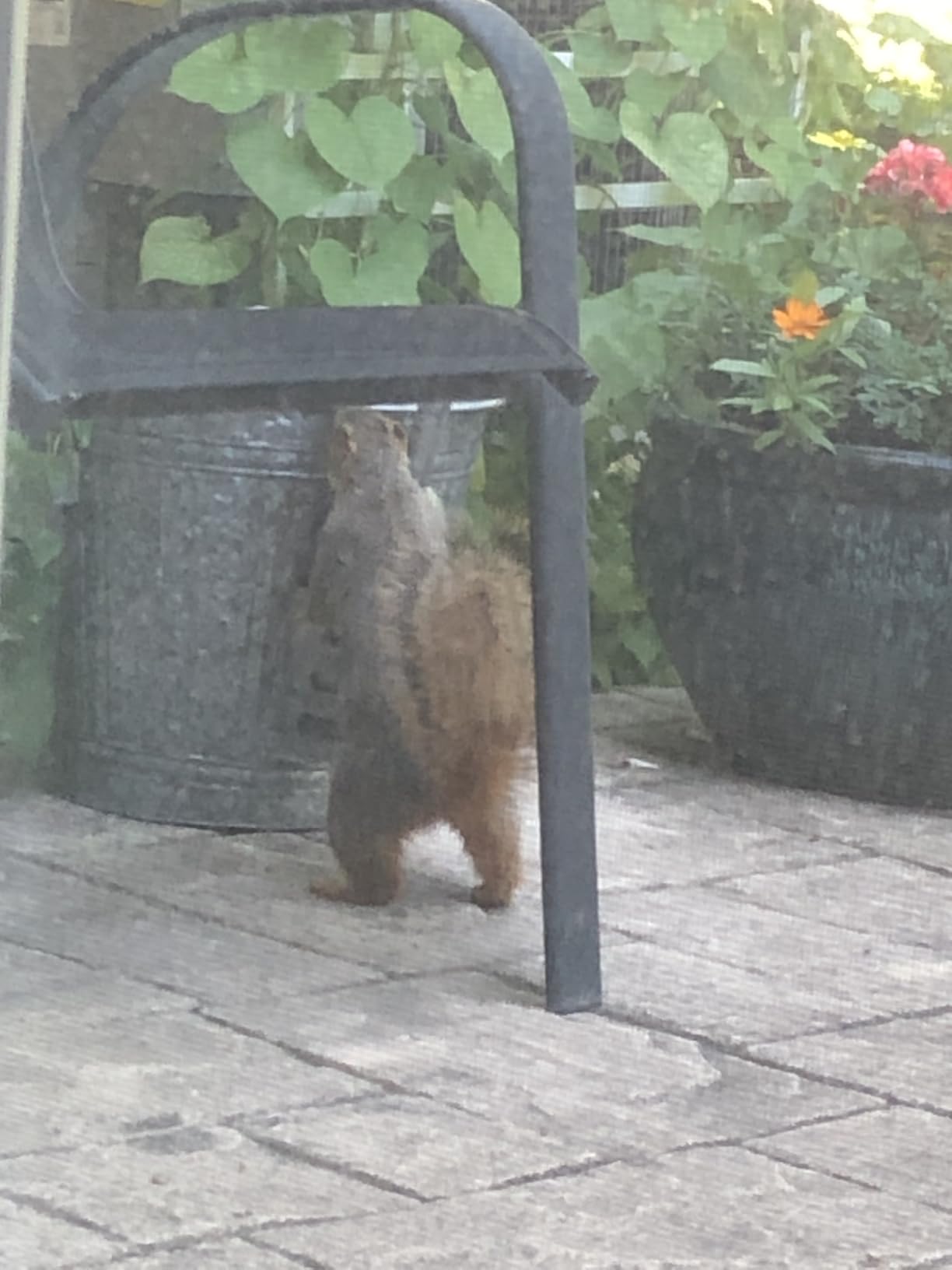
Two drawbacks get repeated. The scoop handle can rust and detach if it stays out in the weather, and galvanized steel eventually develops surface rust when it is exposed permanently, so store it under cover.
Who This Bin Suits Best
Small flocks, mixed flocks with a few birds of different ages, and anyone who wants a second bin for scratch grains or treats without buying a full-size can.
It also suits keepers who dislike the look of a plastic tote in a tidy yard. Metal with a rustic finish disappears into a garden setting in a way that moulded plastic does not.
Who Should Buy Something Else
Anyone storing more than about 30 pounds. You will be refilling this more often than the big bins, which partly defeats the point of buying in bulk.
If your problem is rats rather than squirrels, note the limit again: this is a 16.5 quart bucket. Steel is the right material, but capacity is what makes it convenient rather than annoying.
8. Plexon 6 Gallon Metal Can, 2-Pack: Best Dual-Use Can
Plexon 6 Gallon Small Metal Trash Can with Locking Lid Galvanized Metal Bucket with Lid for Poultry Feed Bird Seed Storage Ash Outdoor Garbage Trash Bin 2 Pack
6 gallon per can
Galvanized alloy steel
Locking lid
Indoor and outdoor rated
Pros
- Galvanized shell far tougher than plastic
- Locking lid blocks animals and pests
- Listed as fire resistant and leakproof
- Doubles as an ash bucket or waste can
- Classic galvanized utility styling
Cons
- Manual lift lid rather than a clamped lid
- Alloy steel is heavier than plastic equivalents
- 6 gallon capacity limits bulk storage
This pair earns its place by doing two jobs. Buyers use one for poultry feed and birdseed and the other for ash from a fire pit, which is a sensible way to justify two steel cans if you only need one for feed.
The locking lid is listed as keeping odours in and animals out, and the cans are rated for indoor and outdoor use. Galvanized alloy steel resists both rust and dents, which is the combination you want beside a coop door.
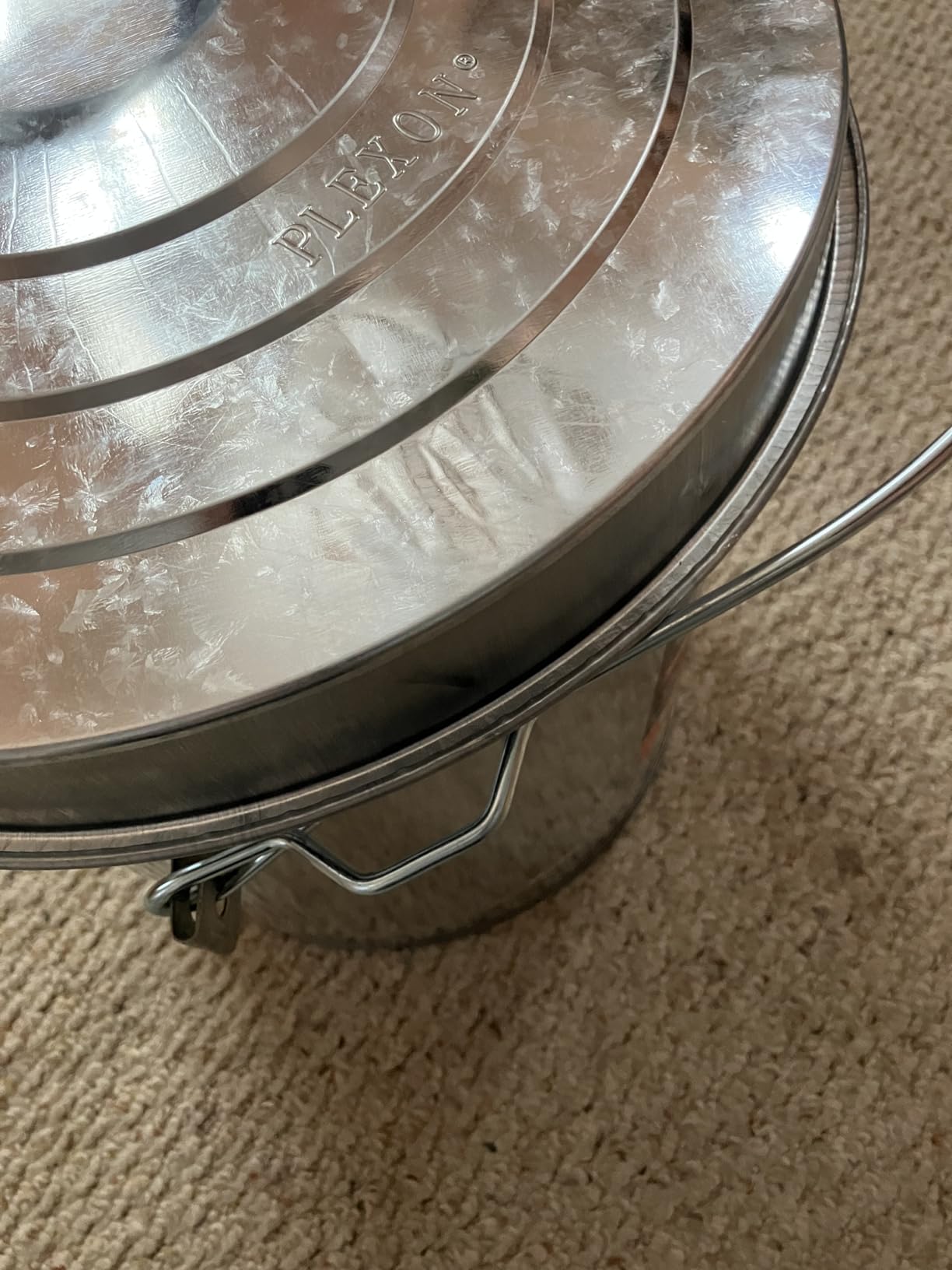
Ratings sit mid-pack for the category at 4.2, and the reasons are structural rather than quality. The lid is a manual lift design rather than a clamped or hinged one, so it is easier to knock loose than the Behrens rod design.
Weight and size are the other limits. Each can is 13.5 inches across, and at 6 gallons they work as a weekly refill bin rather than as the main bulk store.
Who This Bin Suits Best
Yards where you want steel but also need a proper waste or ash container. Having two identical cans stops you storing feed next to rubbish, which is an invitation to pests.
They also suit anyone putting feed outdoors for wild birds near the coop, since the same can holds both and neither is easy to knock over.
Who Should Buy Something Else
Anyone with raccoons. A manual lift lid on a lightweight-feeling steel can is exactly the setup those animals enjoy prying open, so add a strap or a bungee cord.
Anyone storing more than about 60 pounds of feed will fill these faster than they expect. Pair them with a larger bin rather than buying four cans.
9. FCMP Outdoor 37 Gallon Storage Bin: Best for Exposed Outdoor Spots
FCMP Outdoor 37-Gallon Salt and Sand Storage Bin – Multipurpose Deck Box for Patio, Porch or Shed – Industrial Large Container for Outdoor Storage, Grey
37 gallon / 5 cubic feet
Double-walled polyethylene
Overlapping water-resistant lid
Forklift pockets
Pros
- Holds five to six 50 lb bags at once
- Lid overlaps the base so water stays out
- Assembly takes under a minute
- Built-in forklift pockets for a loaded bin
- Rated to hold 300 lb
Cons
- No latch or provision for a padlock
- Hinge pins can snap when forced
- Larger than buyers expect from photos
This is the only bin here listed as water resistant, and that changes which problems it solves. UV-protected double-walled polyethylene with a lid that overlaps the base means it can sit against the side of a coop in driving rain without becoming a mold risk.
It holds up to six 50 pound bags and is rated to 300 pounds of load. Forklift pockets on the base mean you can move it empty-handed once it is filled, which nothing else here offers at this capacity.
Owners use it for driveway salt, sand and ice melter as well as general patio and farm storage, and the 4.6 average reflects how well the lid keeps moisture out in exposed locations.
Who This Bin Suits Best
Keepers whose only dry space is outdoors or under an open shelter. The overlapping lid is the single best rain protection among these ten options, and 37 gallons covers a large flock’s monthly needs.
It also suits anyone dealing with a 500 pound bulk delivery who wants the bags to stay off the ground. The forklift pockets turn a two-person lift into a five-minute job.
Who Should Buy Something Else
Anyone facing raccoons, wild birds or determined rodents. There is no latch and no provision for a padlock, which is the wrong combination in a yard with wildlife pressure.
It is also a big box. At 30 by 22 by 29 inches it needs real floor space, and owners report it being larger than the photos suggest.
10. Amazon Basics 50 lb Rolling Container: Best See-Through Value
Amazon Basics Pet Food Storage Container with Rolling Wheels, BPA-Free, Detachable Scoop, 50lbs Capacity
55 quart / up to 50 lb
Locking latch with foam gasket
Clear BPA-free body
Four wheels, two braked
Pros
- Clear body shows how much feed is left
- Foam gasket and locking clamp seal well
- Clear body suits a colour check on feed level
- Clip-in scoop stores in the lid
- Tool-free wheel and lid assembly
Cons
- Wheels can drag or pop out of their slots
- Locking latch is stiff until the foam compresses
- Capacity falls short for very large kibble size
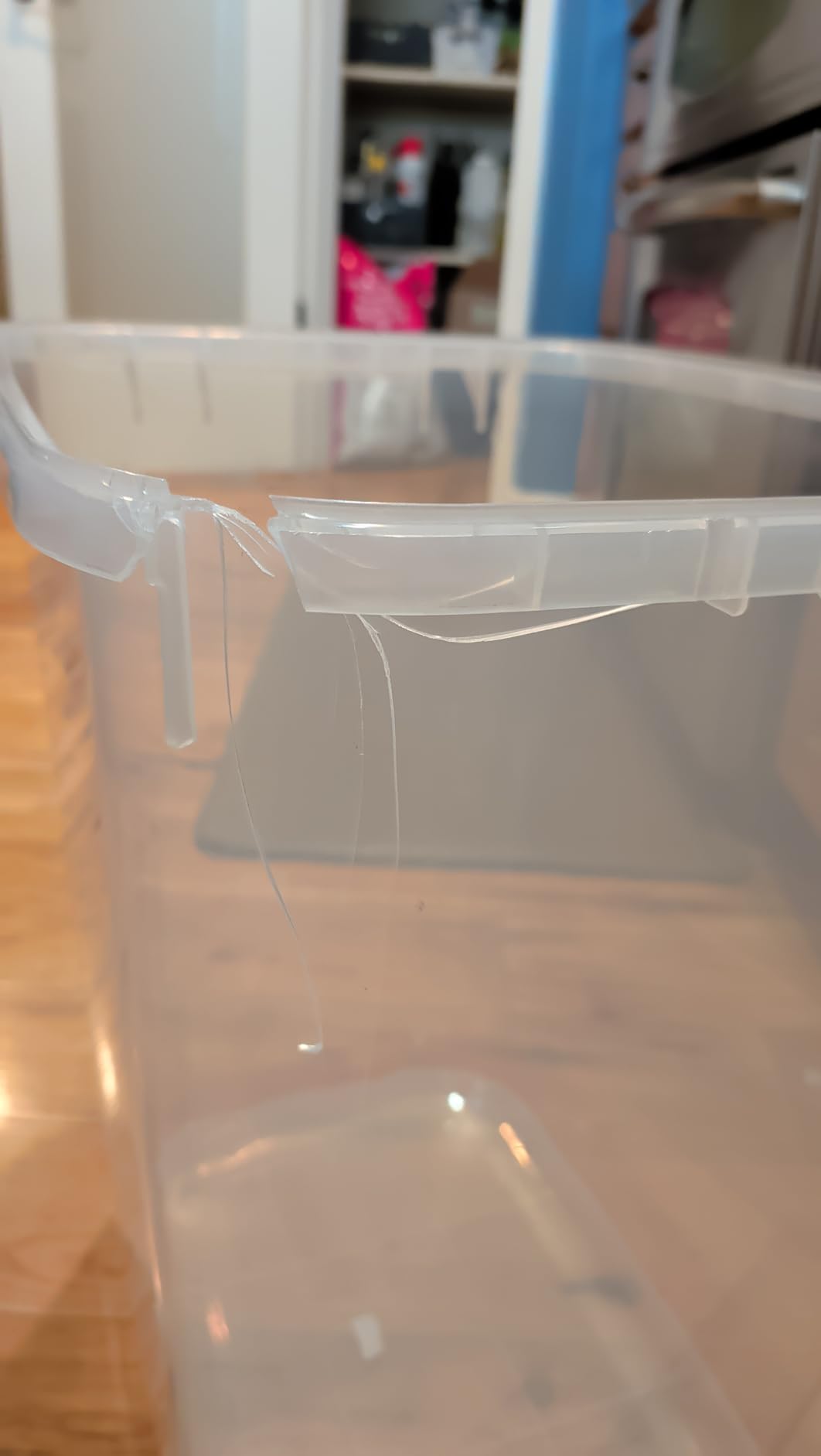
- Occasional cracked bottom in shipments
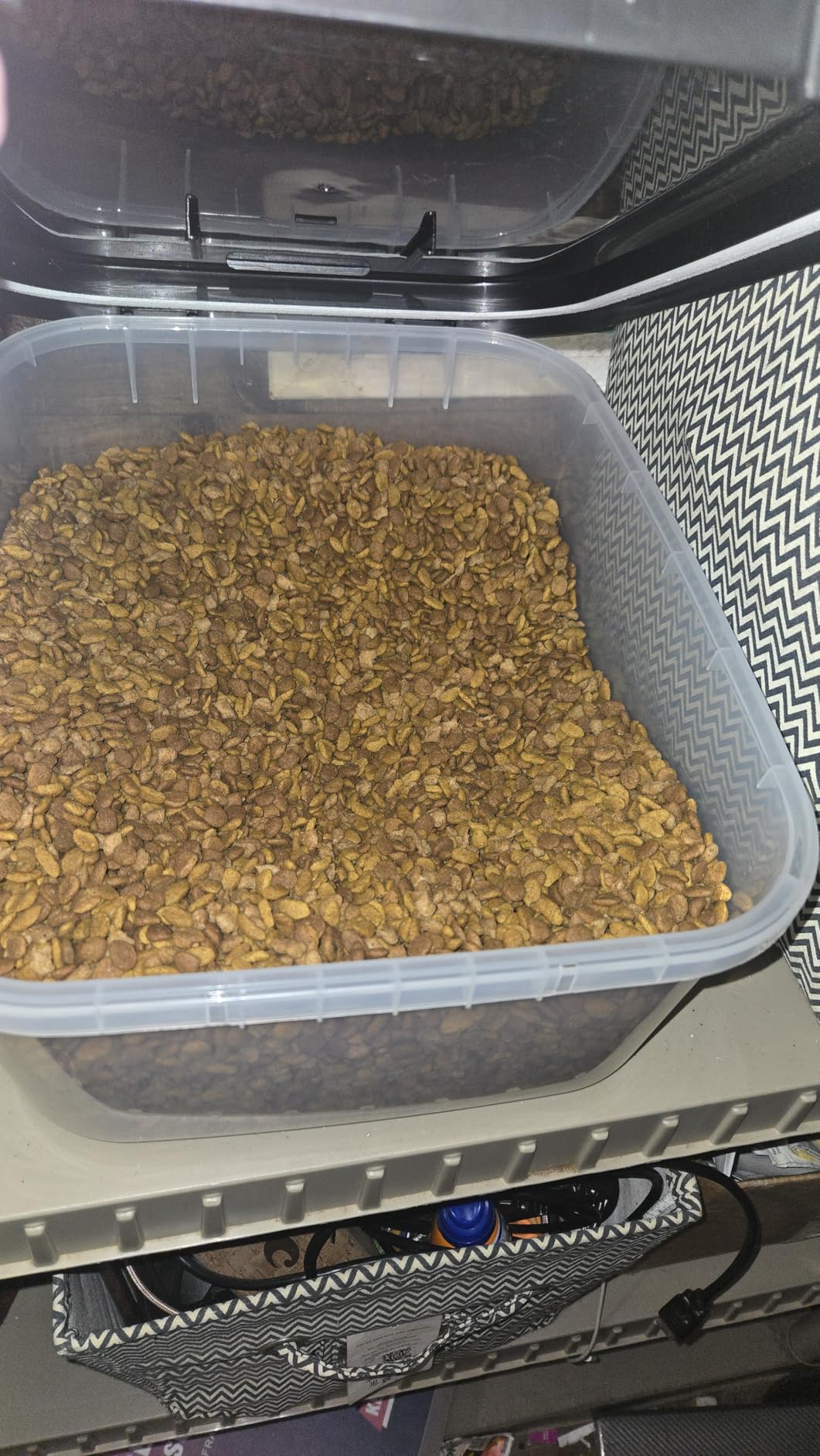
The clear body is the reason to pick this one. With two or three bins in a shared shed, you can see which container is empty without opening anything.
Seal quality is better than the rating suggests. Lid-seal technology with a foam gasket strip and a locking clamp forms a real barrier against odours and pests, and the scoop clips into a slot in the lid so it cannot go missing.
The single issue dragging this down is the wheels. Multiple reviews describe a caster that drags, wheels popping out of their slots during use, and brakes that still slide on hard floors. If you plan to move it often, check them after the first week.
The latch also starts stiff and needs a few closures before the foam compresses into its seal. That is normal rather than a fault, and it settles down quickly.
Who This Bin Suits Best
People who run several bins and want to see levels at a glance, especially anyone monitoring how fast a flock eats through feed before ordering the next bulk load.
Two of the four wheels have brakes, which matters on a sloped garage floor. At 55 quarts it holds up to 50 pounds for most layer rations, with less compression for very coarse feed.
Who Should Buy Something Else
Anyone with heavy rat pressure. Plastic again, and 4.2 reflects how well it works in milder conditions rather than a flaw in the lid seal.
Anyone needing a bin for outdoor storage will find it better suited to a shed. Clear plastic in direct sun will yellow and weaken over time, and the wheels will not like gravel.
How Big a Feed Bin Do You Need?
Work from a simple rule. A layer hen eats roughly 1.5 pounds of feed a week, so flock size multiplied by 1.5 gives you the pounds you need per week. Multiply that by the number of weeks you want the bin to cover, usually two to four, and you have your target capacity in pounds.
A 20 hen flock at 1.5 pounds each eats about 30 pounds a week, so four weeks means a bin that holds 120 pounds. Add scratch grains and you will want noticeably more, because scratch is a bulklier feed and birds eat more of it than the 1.5 pound figure accounts for.
Two weeks of cover is the better target for most keepers. It gives you room to order in advance while keeping feed fresh.
Metal vs. Plastic: Which Material Wins and When
Metal wins when teeth are the threat. Rats and mice chew through plastic totes and paper bags overnight, as keepers on r/homestead and r/farming keep reporting, and a galvanized can simply does not present a surface they can work on. No material makes a bin rodent-proof on its own, though. Rodents get in through the lid and around the base, not through the walls.
Plastic wins when moisture and space are the threat. A gasket-sealed food-grade container keeps humidity out far better than a steel can with a friction-fit lid, and it does not rust. It is also lighter, which matters if you are moving feed on your own.
Placement decides it more often than material. Keepers split on whether feed belongs inside the coop, and treating any feed near the coop floor as the original mistake is the more common position. Outdoors, steel wins. Indoors in a dry garage, plastic wins on seal quality.
The Lid Is the Weak Point
Most lost bins are not chewed through. They are opened. A raccoon will lever a loose galvanized lid off with very little effort, and a latch that does not click is no latch at all.
Look for three things. A locking rod or clamp, a gasket or seal strip that compresses around the rim, and a lid that overlaps the bin body rather than sitting inside it. The FCMP design scores well on the third point, the Buddeez 50 quart on the second, and the Behrens can on the first.
Whatever you buy, add a physical restraint. A bungee cord across the lid, a strap over a handle, or a padlock on a hasp is the difference between a bin that is closed and a bin that is merely shut. Backyard keepers report the cord-and-cinder-block combination as the most reliable method they have found.
Where to Put the Bin and How to Rodent-Proof It
Put the bin in a shed, garage or mudroom, off the ground, and away from the coop door. Hardware cloth or a pallet under it closes the most overlooked entry point, which is the floor.
Step one is placement, step two is a sealed container, step three is a restrained lid. Then close the feed itself down. Rats and mice are attracted by spilled grain and scratching, and feed scattered around any container creates a buffet no bin can fix.
Step four is a hardware cloth floor in the coop. The combination keepers describe is hardware-cloth-lined floors plus galvanized cans for all feed, which removes the digging route as well as the food route.
Step five is denying the feed itself. Locked lids, no loose bags, and a treadle feeder that closes when nobody is standing on it all reduce the hours per day that feed is available. The community view is realistic: you manage rodents in your yard, you do not eliminate them.
Feed Freshness, Rotation and Cleaning
Feed stays good longer in a sealed bin because the two things that spoil it are moisture and oxidation. Storing more feed than you use in a month works against you, so size for rotation rather than for impressiveness.
Keep starter crumble, layer pellets and scratch in separate bins. Crumble dust gets everywhere, and shared scoops transfer moisture between feeds. Washing a plastic bin with warm soapy water is quick; scrubbing dried crumble out of a steel can is not.
Keep a smaller working bin in the coop and the main bulk bin in the shed. You carry 20 pounds to the birds rather than 100, and the main seal stays shut for weeks at a time.
Storage Bin or Treadle Feeder?
For most flocks you need both. The bin solves the overnight problem, when feed sits accessible all night. A treadle feeder solves the daytime problem, because the feed is only exposed while a bird is standing on the pedal.
Keepers report treadle feeders ending a daylight rat issue faster than any storage change. The catch is that they are not raccoon-proof, since a determined raccoon will learn to stand on or beside the pedal. Store bulk feed in steel, feed the flock from a treadle feeder, and you close both windows.
Frequently Asked Questions
What are the best containers for storing chicken feed?
The best containers for chicken feed are galvanized steel cans with a locking lid if you have rodent pressure, and airtight food-grade plastic bins with a gasketed seal if you are storing indoors in a dry garage. Steel resists chewing, plastic resists humidity and odour. Either way, keep the container sealed, strapped and away from the coop.
Is it better to store chicken feed in plastic or metal?
Metal is better when rats and mice are the problem, because rodents chew through plastic totes and paper bags overnight. Plastic is better when moisture and odor are the problem, because a gasket seal keeps humidity out and it never rusts. Placement decides it more than material: outdoors choose steel, in a dry shed choose plastic.
How do you keep mice out of chicken feed storage?
Use a container with a locking or clamping lid and a seal strip, then add a bungee cord or strap so the lid cannot be lifted. Store the bin in a shed rather than inside the coop, keep it off the ground on a pallet, and clean up every spilled grain. A hardware cloth floor in the coop removes the digging route.
How long can you store chicken feed for?
In a sealed, airtight container kept in a dry location, dry layer ration generally stays usable for many months, but freshness of the fats declines first. Store what you will use in four to six weeks and keep older bags behind newer ones. Buy in bulk only if you can rotate it, rather than filling a bin you will not empty for a year.
Can I just throw chicken feed on the ground?
You can, but it is the fastest way to attract rodents and wild birds, and spilled feed is what keeps them coming back. Scattered feed also pulls parasites and wet droppings into the ration. A trough feeder or a treadle feeder keeps feed contained and available in a controlled way.
The Verdict on Bulk Chicken Feed Storage Bins
Our pick for the best bulk chicken feed bin overall is the Buddeez 50 quart rolling bin: a 4.7 average across more than thirteen thousand reviews, a real airtight seal and a footprint narrow enough to line several bins up in one corner. The Mighty Tuff 13 gallon container sits just behind it when you want the hardest seal possible, and the Behrens galvanized 6 gallon pair is the budget steel answer if rats are already in your yard. For genuine bulk buying, the VEVOR 27 gallon bin holds the delivery in one place.
Whichever bin you choose, the pattern is the same: sealed container, restrained lid, off the floor, away from the coop, and a treadle feeder on the other side of the flock. If you also buy feed at volume, our feed mill guide covers where bulk pricing usually kicks in.