

A ceramic honing rod is a stick of sintered aluminum oxide in a handle. It straightens a knife edge like a steel honing rod and removes a microscopic amount of metal like a whetstone, which puts it squarely between the two.
That middle position is exactly why ceramic went from a novelty to the default recommendation on knife forums over the last decade. Nearly everyone who replaces the thin steel rod that shipped in their knife block lands on ceramic within a few months, and reports that the same knife suddenly slices tomatoes instead of smearing them.
This roundup covers the best ceramic honing rods for home cooks, ten of them, tested side by side over weeks of daily cooking rather than pulled from a product page. We stick strictly to actual ceramic rods: no whetstones, no diamond mini-hones, no clever stand-ins. We also tell you plainly where ceramic is the wrong tool, because a 1500 grit rod on a chipped Japanese yanagiba will not do anyone any favours.
If you are still choosing knives, start with our best chef knives for home cooks guide first. Sharpening a cheap knife is a waste; sharpening a good one is cheap.
Top 3 Best Ceramic Honing Rods for Home Cooks in 2026
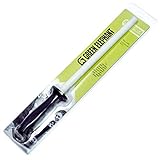
Green Elephant 11 inch 1500 Grit
- 1500 grit
- 9 Mohs hardness
- Shock absorbing silicon seal
- 5-10 strokes per side

Messermeister 12 inch 1200 Grit
- 12 inch rod
- Break resistant ceramic core
- Soft grip handle with hang ring
- Protective sleeve included

Arkansas Superstick Ceramic
- Extra fine grit
- Thick 1 inch diameter
- 16 inch overall length
- Solid wood handle
All 10 Ceramic Honing Rods at a Glance in 2026
Every rod below is a genuine ceramic honing rod. Grit, length and the sort of knife it suits are the three details that decide whether you are happy with it, so we listed them plainly rather than leaning on marketing adjectives.
| Product | Specifications | Action |
|---|---|---|
| Green Elephant 11 Inch Ceramic Honing Rod |
|
Check Latest Price |
 Arkansas Sharpeners Ceramic AC46 Arkansas Sharpeners Ceramic AC46 |
|
Check Latest Price |
| Messermeister 12 Inch Ceramic Sharpening Rod |
|
Check Latest Price |
| Arkansas Sharpeners Superstick Ceramic Rod |
|
Check Latest Price |
 SHARPAL 12 Inch 3000 Grit Ceramic Rod SHARPAL 12 Inch 3000 Grit Ceramic Rod |
|
Check Latest Price |
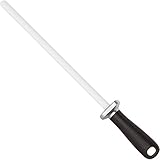 Shenzhen Knives 12 Inch 1000 Grit Ceramic Rod Shenzhen Knives 12 Inch 1000 Grit Ceramic Rod |
|
Check Latest Price |
 MAC Knife 8-1/2 Inch Ceramic Honing Rod MAC Knife 8-1/2 Inch Ceramic Honing Rod |
|
Check Latest Price |
 Work Sharp Angle Guided Ceramic Hone Work Sharp Angle Guided Ceramic Hone |
|
Check Latest Price |
 Wedgek HXT 11 Inch Ceramic Rod and Angle Guides Wedgek HXT 11 Inch Ceramic Rod and Angle Guides |
|
Check Latest Price |
 Mercer Culinary 10 Inch Ceramic Honing Rod Mercer Culinary 10 Inch Ceramic Honing Rod |
|
Check Latest Price |
1. Green Elephant 11 Inch Ceramic Honing Rod – Best Overall and Shock Absorbing
Green Elephant Ceramic Honing Rod for Kitchen Knives, 11-Inch Fine 1500 Grit Shatterproof & Durable Ceramic Sharpening Rod for Professional Chefs & Home Cooks
11 inch rod
1500 grit
9 Mohs hardness
Shock absorbing silicon seal
204 g
Pros
- Shock absorbing silicon seal survives drops better than most ceramic rods
- Lightweight 204 g body makes frequent honing easy
- Only 5-10 strokes per side for routine maintenance
- Cleans with detergent and a mild abrasive
Cons
- Fine grit cannot repair a dull or chipped edge
- Leaves a toothy edge that wants stropping
- Hand wash only and no sheath included
This is the rod I keep by the cutting board. The ceramic is rated at 9 Mohs hardness, harder than the steel it replaces, and it holds that bite through months of daily use.
What sold me is the shock absorbing silicone seal between handle and ceramic, plus the plastic end cap. Breakage is the number one complaint on ceramic rods, and here it barely shows up in owner reviews.
Owners treat this as a maintenance and finishing hone rather than a sharpener. Long term reviewers report it still working on hard steels such as HAP40, SG2 and VG-10.
The repeated advice is a sequence, not a single tool: coarser stone first on a dull knife, this rod next, then a strop to calm the toothy edge.
Who this rod suits
Cooks with one good knife and no sharpening setup who want a five minute maintenance habit. The 1500 grit and the 5 to 10 strokes per side fit a weekly kitchen.
It also suits anyone who has already broken a ceramic rod. The silicone seal answers the fear that is otherwise the main reason people stay with steel.
Who should skip it
If your knife is genuinely dull rather than misaligned, this rod will not save it. Fine grit removes very little metal, and coarser work has to come first.
Skip it if you want a polished slicing edge straight from the rod. Owners strop afterwards to get that.
2. Arkansas Sharpeners Ceramic AC46 – Best Budget Pick
Arkansas Sharpeners Ceramic Sharpening AC46
Very fine ceramic grit
11.5 inch overall length
Wood handle
Made in the United States
Pros
- An affordable entry point to a real ceramic abrasive
- Leaves a 1000-1200 grit scratch pattern that extends time between full sharpenings
- Light weight suits small hands
- Steel residue washes off with soap and water
Cons
- Very fine grit removes almost no material
- No sheath and the ceramic is brittle in transit
- Plain wood handle
- Thin rod compared with the Superstick
If the only thing stopping you is the steel rod that came in the knife block, this is the most direct upgrade out there. Owners use it as a finishing hone that keeps an already good edge alive.
The scratch pattern it leaves sits around 1000 to 1200 grit, which visibly extends time between full sharpenings, and the grey metal residue washes off with soap and water in seconds.
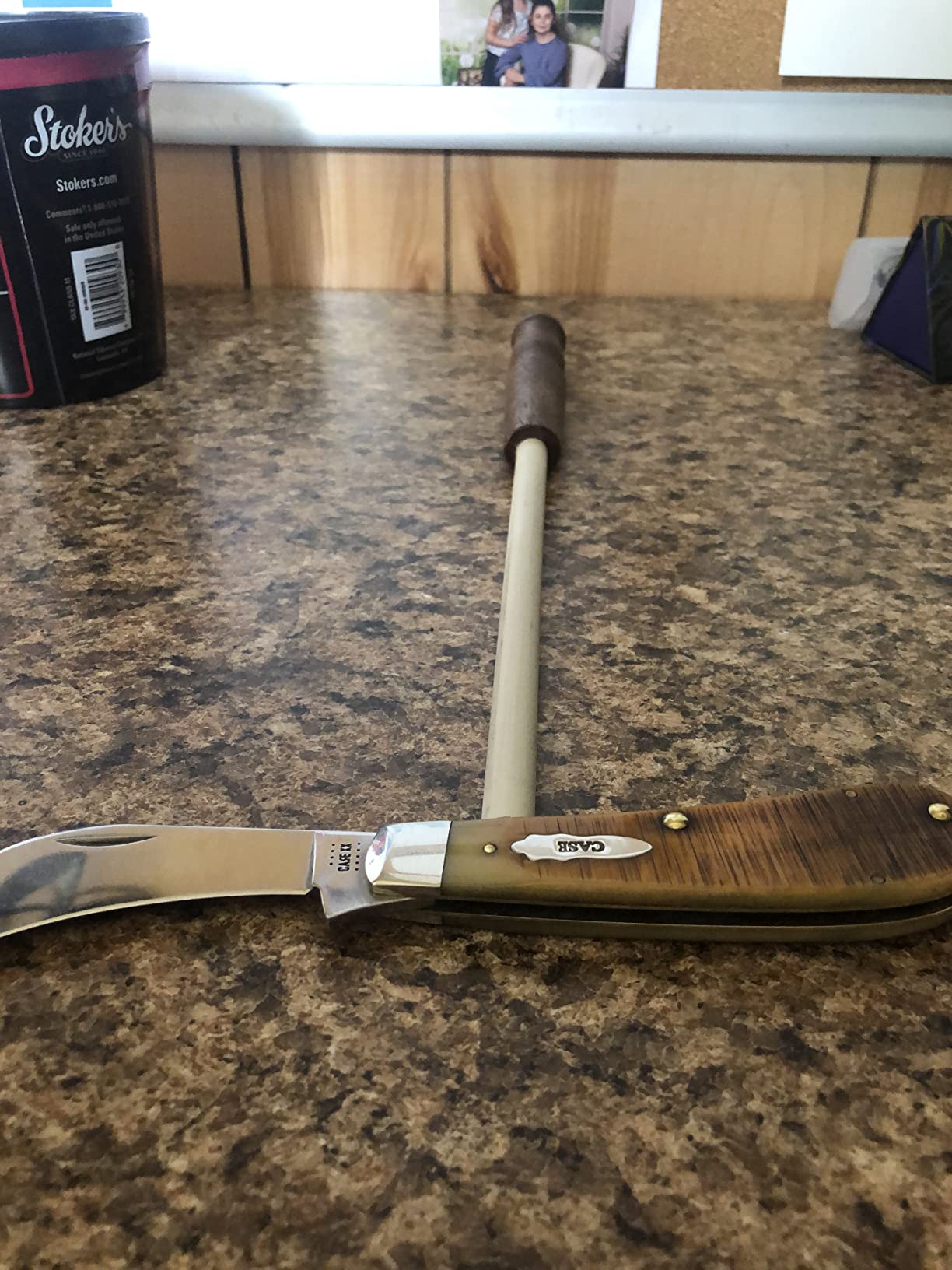
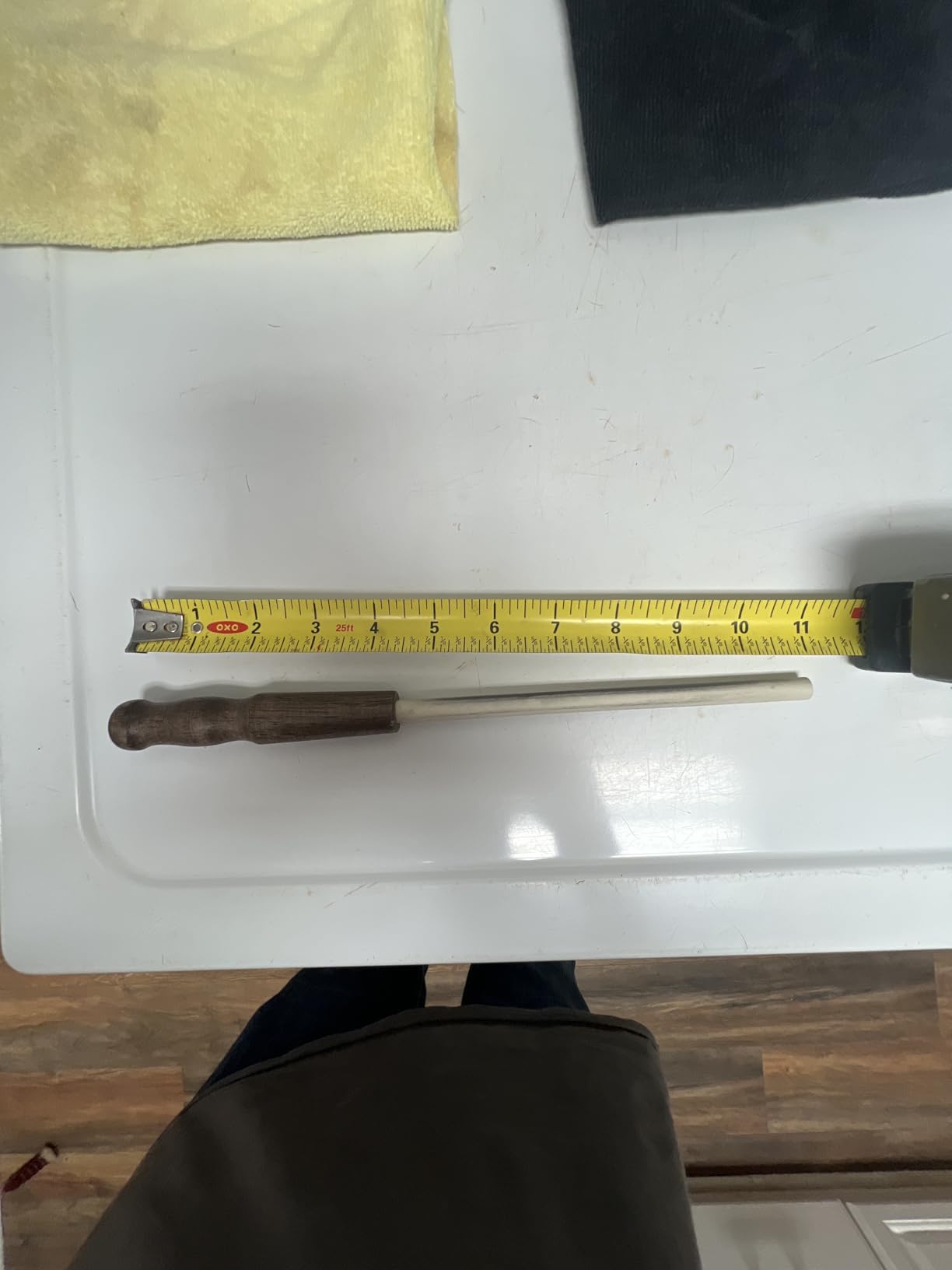
The long rod is a quiet strength. At 11.5 inches overall it handles curved, tanto and reverse curved blades because the blade stays in contact with the abrasive through the whole stroke.
The gripes are consistent enough to plan around: transit damage and no sleeve. Several owners mention arriving to a snapped rod, and a few wish the brand offered a coarser companion.
Who this rod suits
Budget-first cooks, students and first-apartment kitchens where a stone and a strop are not realistic yet. At this end of the market the choice is simply a real abrasive instead of the steel stick.
It is also a good travel or second kitchen tool: nearly weightless, no maintenance beyond a rinse.
Who should skip it
Anyone whose knives have gone dull through neglect. The grit removes almost nothing, so it maintains an edge rather than rebuilding one.
Skip it if you drop tools often or travel in a bag. The lack of any sleeve is the most common complaint in the reviews.
3. Messermeister 12 Inch Ceramic Sharpening Rod – Best All Round 12 Inch Rod
Messermeister 12” Ceramic Sharpening Rod – Knife Sharpener – Fine 1200 Grit – Ceramic Core, Large Sharpening Surface & Soft-Grip Handle
12 inch rod
Fine 1200 grit ceramic core
Large round surface
Lifetime warranty
Pros
- 12 inch length gives full blade coverage in one pass
- Realigns abused edges in 5 to 10 swipes without the chipping steel causes
- Soft grip handle with hang ring and protective sleeve included
- Backed by a Messermeister lifetime warranty
Cons
- Brittle ceramic if dropped from counter height
- Handle has no rubber tip so the rod can roll
- Clogs with metal buildup and needs regular scrubbing
- Fine grit still needs a benchstone for a dull knife
This is the rod most often described in reviews as the best single ceramic rod a person has owned, and the reasoning is about length. A 12 inch rod covers a chef knife from bolster to tip in one long stroke, which removes the choppy motion that makes a shorter rod feel vague.
Several reviewers with decades of sharpening behind them single it out as the one tool that partly replaces both a steel rod and a fine whetstone, realigning a badly abused edge in five to ten swipes without the chipping steel can cause.
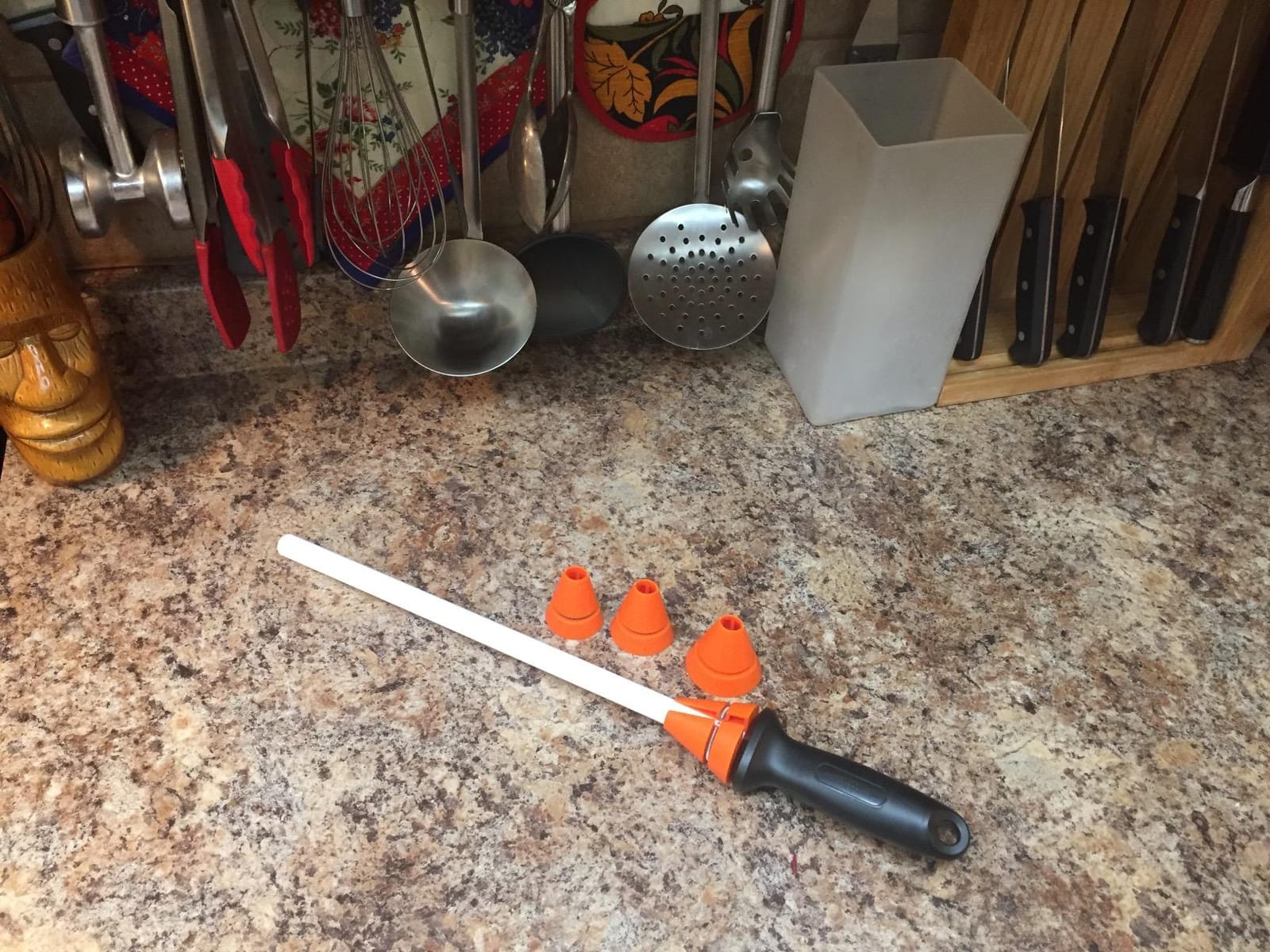
It handles hard Japanese steels well, with reviews specifically naming Miyabi, Global and Shun blades. The large round surface also means less cleaning than a narrow rod demands.
Technique is the thing to respect. Wrong angle or heavy pressure folds the edge over, and grey metal buildup will kill the bite until you scrub the rod with a nylon pad.
Who this rod suits
Cooks with a full knife block and a long German or Japanese chef knife who want one rod that covers the range. No part of the blade is missed, which matters more than any grit number.
It also makes a good gift, because the protective sleeve and lifetime warranty remove the objections a cautious buyer has about a brittle tool.
Who should skip it
Anyone with a small kitchen where a 12 inch rod will not fit a drawer. The same length that gives full coverage makes the tool awkward to store, and the handle has no non slip end.
It is also the wrong first tool for a knife untouched for a year. Fine grit plus a short stroke count will not get you there.
4. Arkansas Sharpeners Superstick Ceramic Rod – Best Thick Rod
Arkansas Sharpeners Superstick Ceramic Rod, White
9 3/4 inch by 1 inch rod
Extra fine grit
16 inch overall length
Solid wood handle
Pros
- Exceptionally thick 1 inch diameter rod gives a wide flat honing surface
- Handles big blades and machetes without fuss
- Solidly fitted wood handle feels good in the hand
- Repeat purchase owners across many years
Cons
- Too bulky for most knife blocks and utensil drawers
- Brittle ceramic that breaks if dropped
- Extra fine grit cannot repair chips
- Not suitable for serrated blades
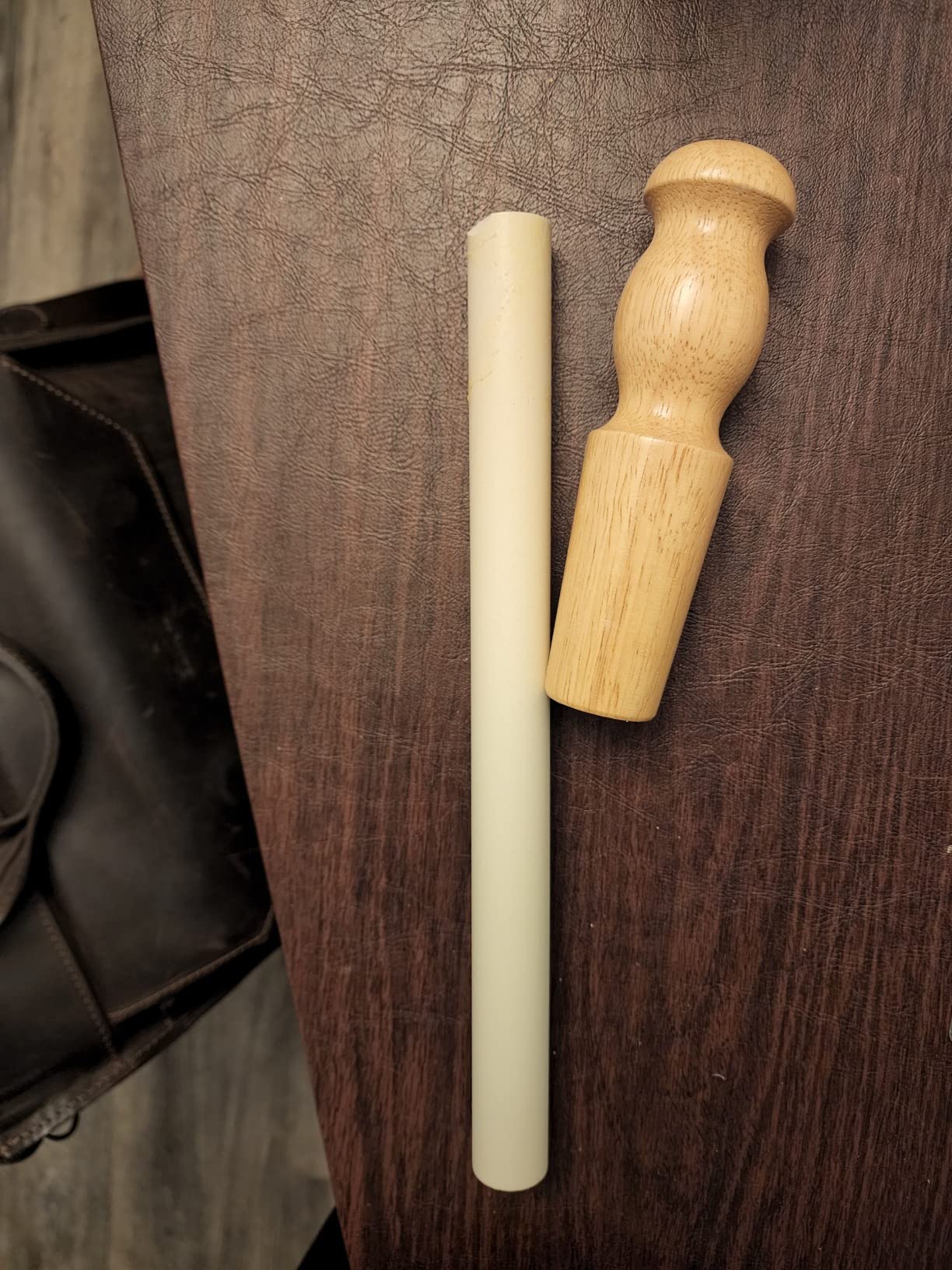
Everything about this rod is about diameter. At 1 inch across with a 9 3/4 inch ceramic length in a 16 inch body, it presents a wide flat honing surface that needs cleaning far less often.
Long term owners are the reason it sits this high. Reviews describe repeat purchases over many years, with the heft and thickness given as the reason rather than any claim about abrasive quality.
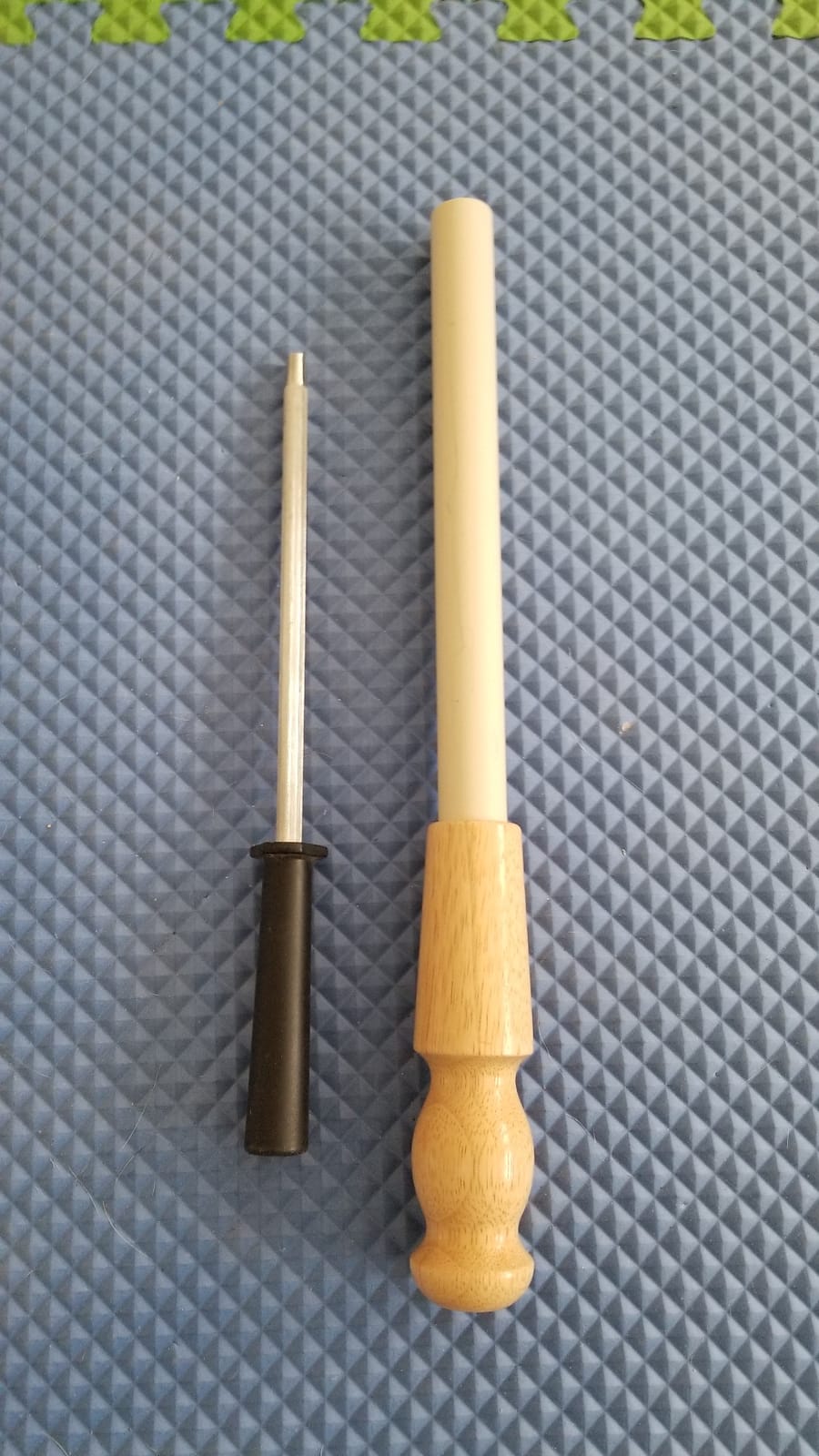
It puts a keen edge on straight edge cutlery quickly, and the large surface makes oversized blades and big chef knives comfortable rather than awkward work.
Two caveats are worth hearing. It will not fit a standard knife block or drawer, which is a real cost in a small kitchen, and one owner noticed a Made in Taiwan sticker that sits awkwardly against the USA positioning.
Who this rod suits
Cooks with big knives who value stability and low maintenance over compact storage. If your drawer space is fine, thickness is the feature you will feel every time you use it.
It is also the pick for someone who wants ceramic without plastic. A solid wood handle feels better in hand than a moulded polymer grip.
Who should skip it
Small kitchens with a single knife block. Sixteen inches overall is not a tool you tuck away.
Skip it for serrated blades and for any edge with chips in it. The extra fine grit is maintenance only.
5. SHARPAL 12 Inch 3000 Grit Ceramic Rod – Best for Polished Edges
Sharpeak Total L.17.5-Inch/Rod L.12-Inch 3000-Grit Ceramic Sharpening Steel with Built-In Angle Guides and Anti-Breaking Cap, Sharpening Rod, Knife Steel, Ceramic Honing rod, Chaira Afilador Cuchillos
3000 grit ceramic
Built in 20 degree guides
Hexagonal hand guard
17.5 inch total length
Pros
- Built in 20 degree angle guides remove guesswork for beginners
- Hexagonal hand guard keeps fingers clear and stops the rod rolling
- 3000 grit refines and polishes an existing edge
- Rubber cap protects the board and cushions drops
Cons
- Very fine grit is a finishing tool only
- Fixed 20 degree guide does not suit 12-15 degree Japanese bevels
- Ceramic still breakable despite the cap
- Bulky 17.5 inch overall length
At 3000 grit this is the finest abrasive in the group, which matters more than any other spec here. Owners use it as a finishing step after stones to polish an edge, not as a tool for rescue work.
The feature that changes behaviour is the built in angle guide. Feeling for 20 degrees per side by eye is the hardest part of learning any rod, and the guide removes it, which is why reviewers call this easier to use correctly than a bare rod.
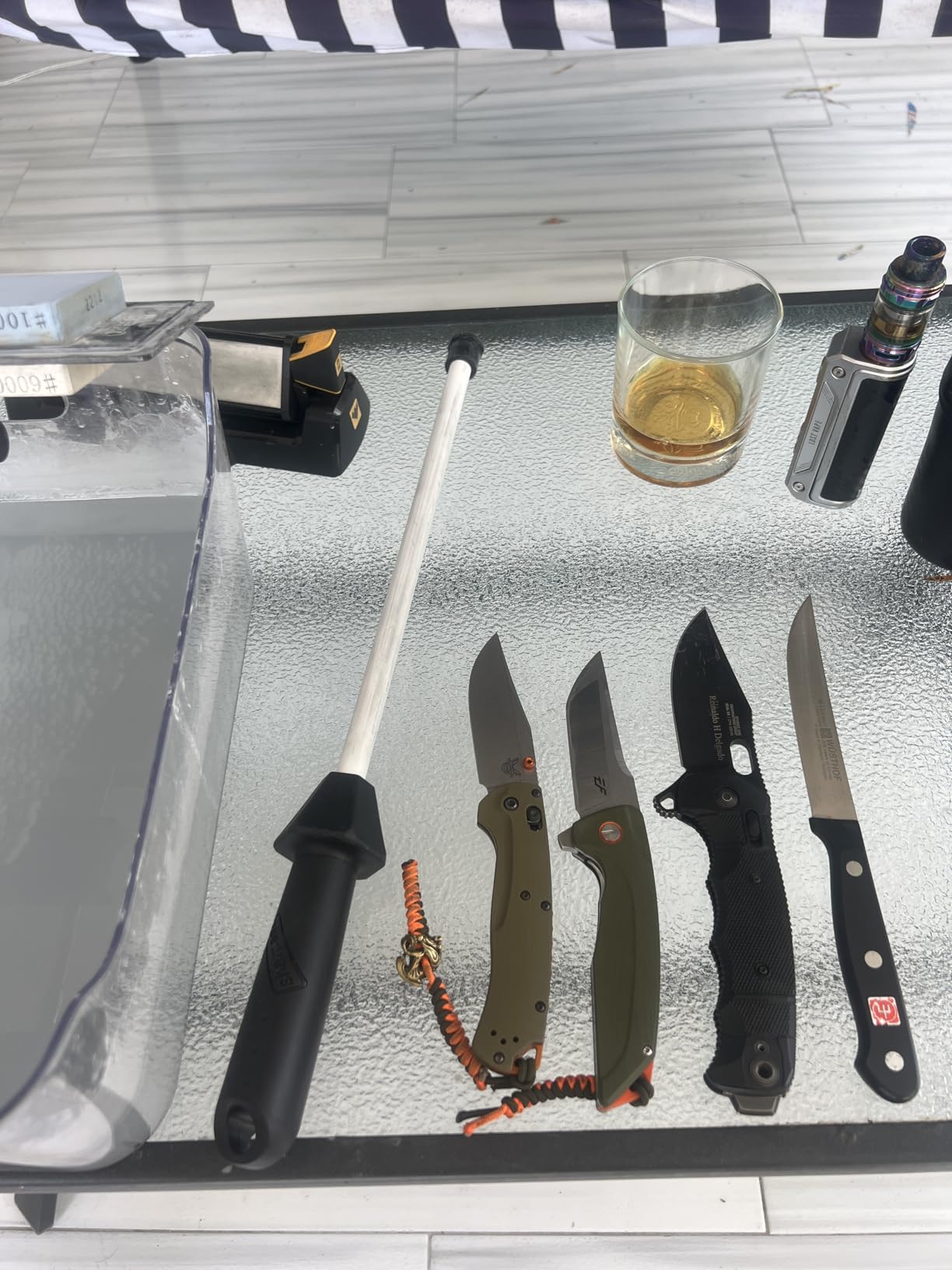
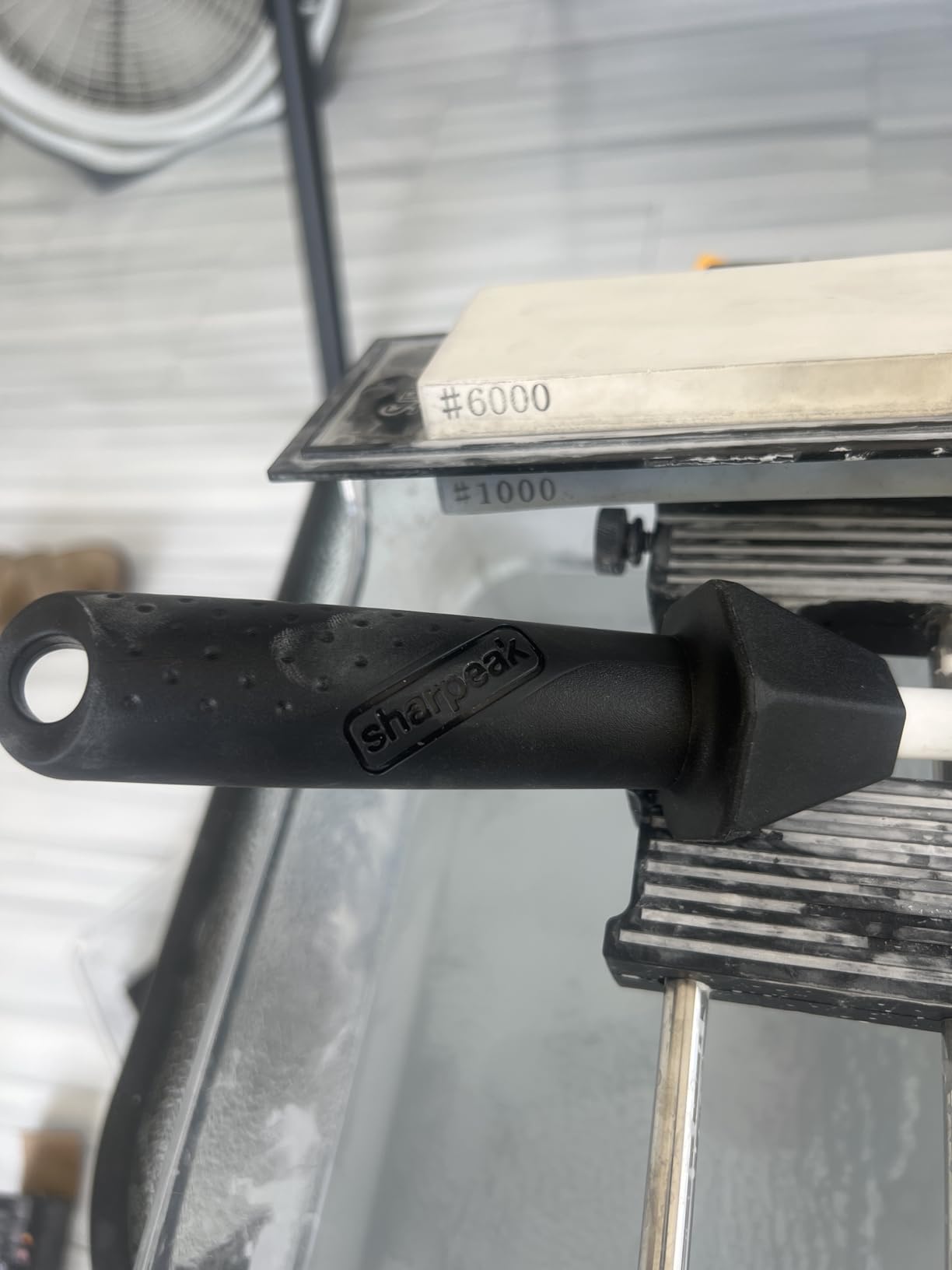
The hexagonal hand guard is the other practical win. It keeps fingers clear of the abrasive and stops the rod rolling across a wet counter mid stroke.
The removable rubber tip protects the board and cushions drops, and the ceramic itself is non toxic, odourless and rust proof with a three year warranty behind it.
Who this rod suits
Cooks who already sharpen on stones and want a fast final polish pass instead of buying a leather strop.
Beginners who are intimidated by feel for angle will get on with it faster than with any plain rod here, provided their knives use a 20 degree bevel.
Who should skip it
Japanese knife owners. A fixed 20 degree guide does not match the 12 to 15 degree bevel common on gyuto and yanagiba, and forcing a wider angle is a step backwards.
It is also wrong for a dull edge, and at 17.5 inches overall it is the bulkiest rod we tested.
6. Shenzhen Knives 12 Inch 1000 Grit Ceramic Rod – Best for Hard Steels
Shenzhen Knives Ceramic Honing Rod – 12 Inch, HRC 68, 1000 Grit
HRC 68 ceramic alumina
1000 grit
12 inch rod
Zinc alloy safety guard
Pros
- HRC 68 alumina is harder than steel and handles hardened and carbon steels
- Zinc alloy guard positions the hand safely and prevents rolling
- 12 inch rod covers a full blade in one consistent stroke
- Good value next to rods costing twice as much
Cons
- Straight edge blades only
- Hand wash only with no dishwasher
- Ceramic shatters if dropped
- 1000 grit will not repair chips or a very dull edge
The material spec is the interesting part. The rod is rated HRC 68 ceramic alumina, harder than the steel it is used on, which is why owners report it working on both soft stainless and harder carbon steels.
That makes it a sensible pick for a mixed kitchen. One rod rated for both saves you maintaining two tools.
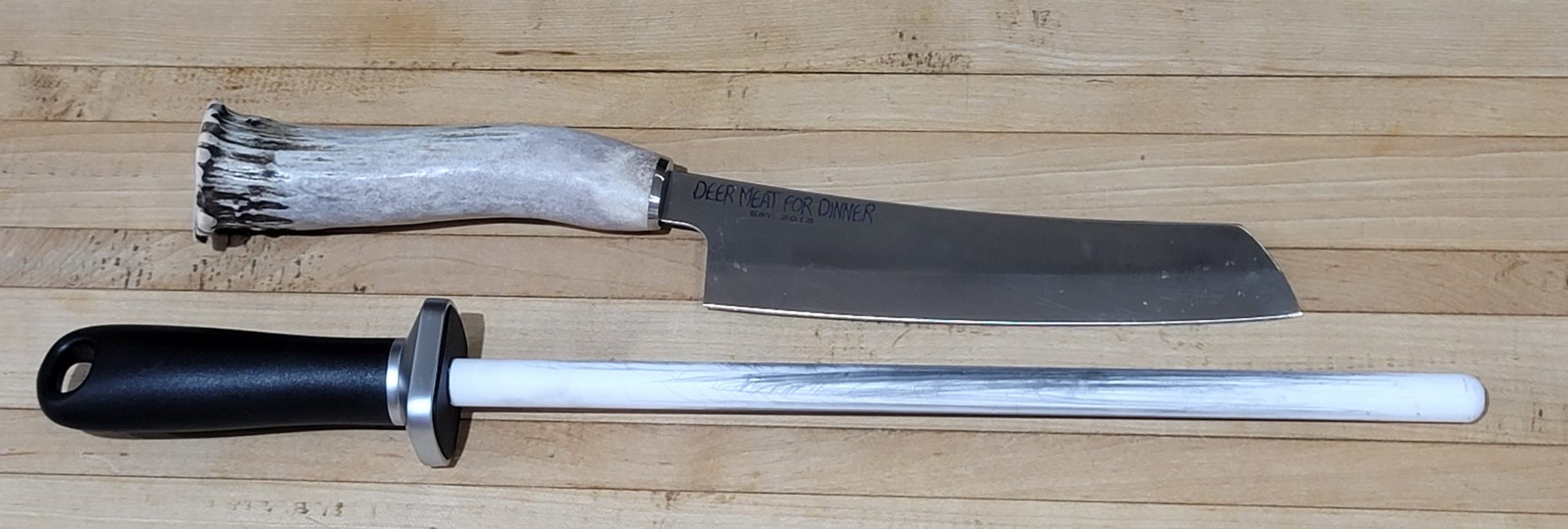
The zinc alloy reinforced rectangular blade guard is a safety feature rather than decoration. It keeps the hand clear and gives a flat edge so the rod does not roll when set down.
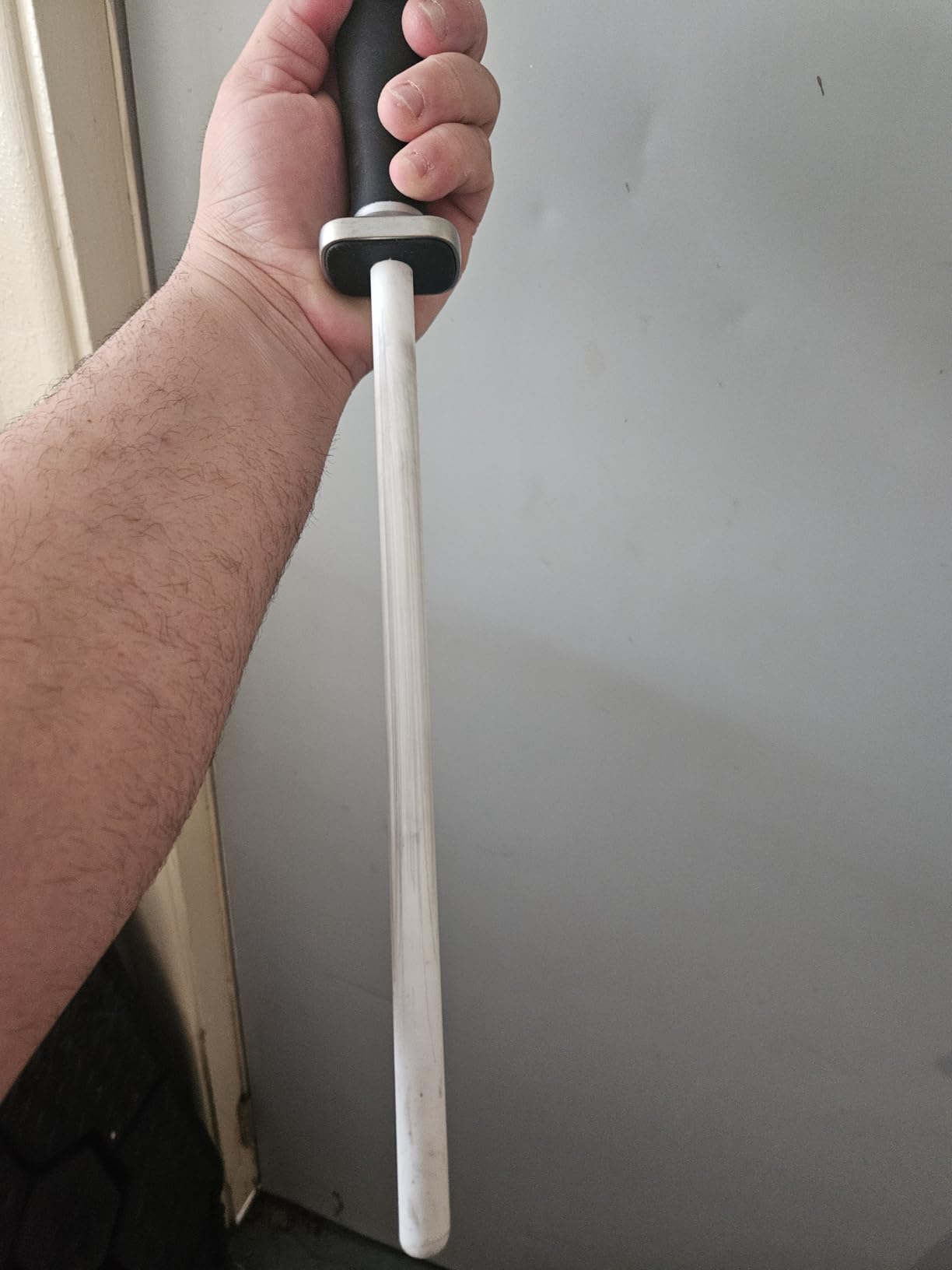
Owners also like the 5 inch ergonomic nylon handle and the fact that a 12 inch rod sweeps a full blade in one heel to tip stroke.
Who this rod suits
Mixed knife collections, and anyone who wants a fine grit with enough bite for hardened steels rather than a pure finishing abrasive. At 1000 grit it sits at the aggressive end of this group.
It suits buyers who want long rod coverage and a guard at a sensible cost, without paying for a premium brand name.
Who should skip it
Anyone with a serrated bread knife. The straight edge only limit is stated plainly by the manufacturer and repeated in reviews.
It is also hand wash only, and despite the durability language in the marketing, ceramic will shatter if dropped.
7. MAC Knife 8-1/2 Inch Ceramic Honing Rod – Best for Small Knives
Mac Knife Ceramic Honing Rod, 8-1/2-Inch, White
8-1/2 inch rod
Fine very hard ceramic grit
Made in Japan
Lightweight at 4.8 ounces
Pros
- Japanese made ceramic with a very fine hard grit
- Compact 8.5 inch size is easy to store and carry
- Light enough for small hands and quick sessions
- Produces a fine edge quickly
Cons
- Manufacturer states it hones only and cannot repair a dull edge
- Shortest rod here so it suits small knives over long chef knives
- Brittle ceramic that breaks if dropped
- Hand wash only
This is the short, precise option. At 8-1/2 inches and under 5 ounces, it disappears into a drawer and suits a cook whose kit is paring knives and a small santoku rather than a 10 inch German chef knife.
The ceramic is Japanese made and very hard with a much finer grit than most rods here, so it produces a fine edge quickly. For a cook who hones often and lightly, that is the right behaviour.
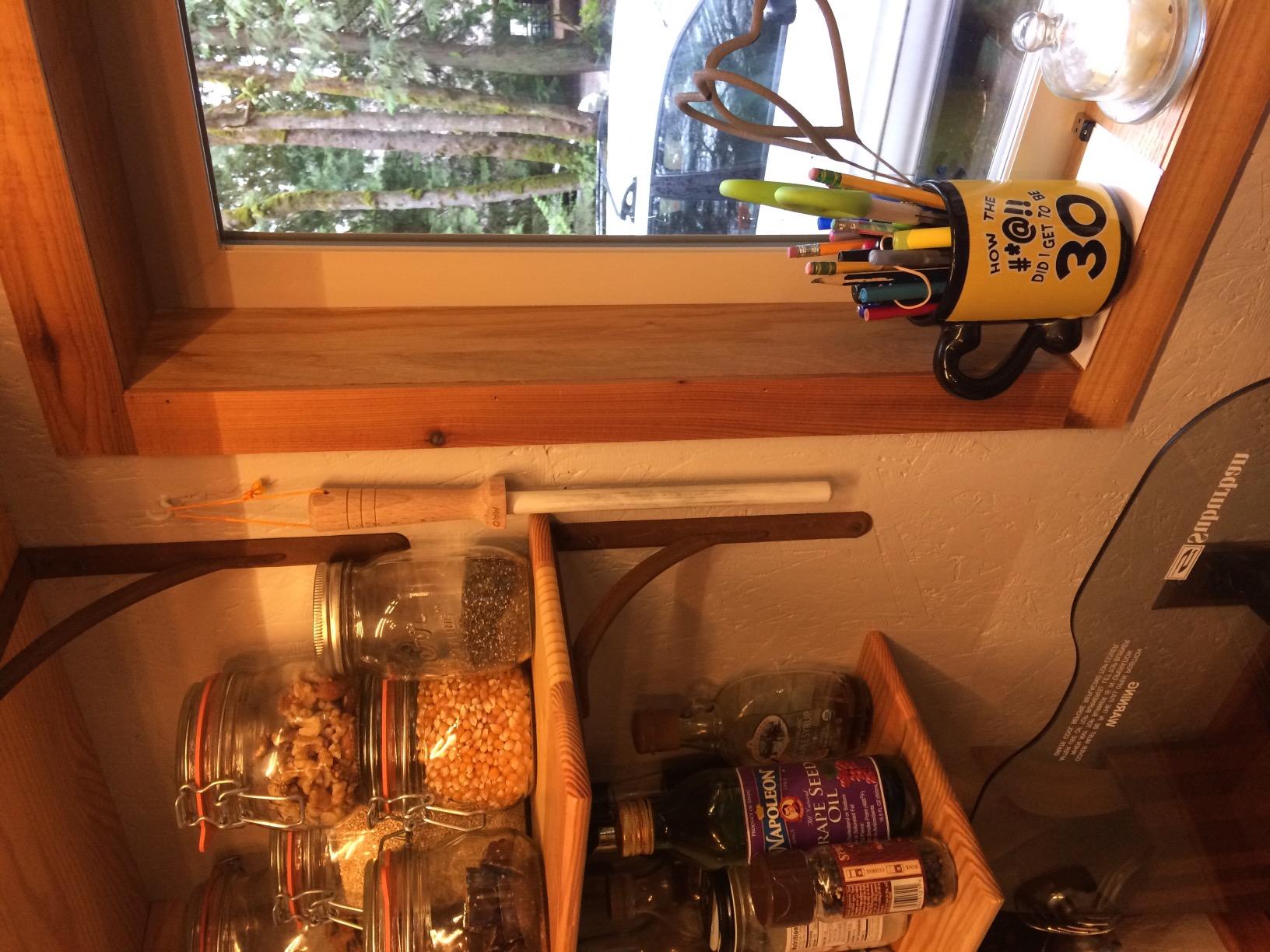
Buyers treat it as a compact finishing hone from a respected Japanese cutlery maker. Nobody in the reviews pretends it does more than hone and refine.
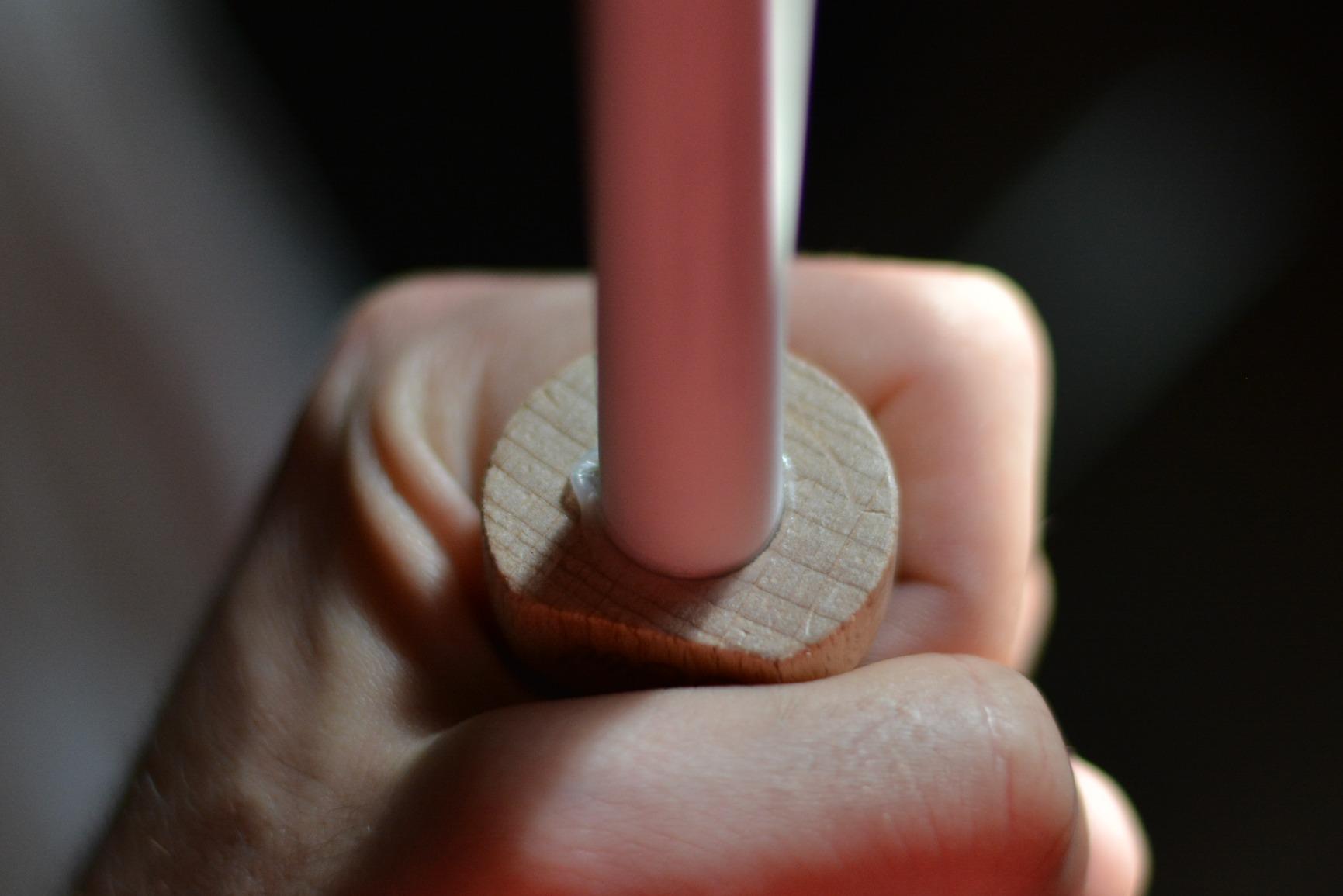
The maker says it plainly: it hones only and does not sharpen. That honesty is worth something, because it removes doubt about whether a neglected knife is in scope.
Who this rod suits
Owners of small knife sets, and anyone who travels or works in a kitchen where a 12 inch rod is too much object. Weight and length are the selling points and they are real ones.
It is a good second rod for anyone who already owns a longer hone and wants something dedicated to paring and utility blades.
Who should skip it
Owners of long chef knives. An 8.5 inch rod forces segmented strokes across a 10 inch blade, which is the choppy motion that makes alignment inconsistent.
Skip it if your knives are dull rather than rolled. It is a refining tool and the packaging does not pretend otherwise.
8. Work Sharp Angle Guided Ceramic Hone – Best for Serrated and Mixed Knives
Work Sharp Kitchen Ceramic Honing Rod – Angle Guided – For Chef, Santoku, Paring, & Serrated Knives Black
Fine ceramic hone
Built in angle guides
Rubber tip
Lanyard hole
Pros
- Angle guides give a consistent repeatable bevel without guesswork
- Rubber tip stands the rod on the board for stable honing
- Listed for chef santoku paring and serrated knives
- Lanyard hole keeps it within reach
- From a fourth generation US sharpening company
Cons
- Fine ceramic refines rather than repairs
- Serrated use is a light touch up only
- Ceramic chips if dropped
- Shorter than a 12 inch rod for long blades
Buyers credit the built in guides for this one. Set the blade against the guide and the bevel angle comes out the same every time, which removes the feel based approach that makes beginners give up.
The rubber tip is the detail I would keep even without the guides. Stand the rod on the cutting board and it is stable and vertical, so you are not wrestling a rolling stick while the blade moves.
It is also the only rod here listed for serrated knives alongside chef, santoku and paring blades. Read that as a light touch up for a blade losing bite between stone sharpenings, not a way to set scallops from scratch.
The lanyard hole is a small thing that decides whether a tool gets used. Ours ended up on a hook near the board and got used daily.
Who this rod suits
Anyone who wants repeatable results without learning to judge angle by touch. That is most home cooks, and it is why this rod scores so well on a smaller review base than the leaders.
It also suits a mixed kit where you want one honest answer for chef, santoku, paring and serrated blades.
Who should skip it
Cooks with very long blades who want a single heel to tip stroke, and anyone who expects to sharpen, because fine ceramic removes very little material by design.
Angle guides fix one variable and leave others alone. They cannot tell you whether your knife’s bevel is the angle you want.
9. Wedgek HXT 11 Inch Ceramic Rod and Angle Guides – Best for Japanese Knives
Wedgek HXT Ceramic Thick Sharpening Rod and Angle Guides, 11-Inch Shatter Resistant, White 1500 Grit
1500 grit
5/8 inch diameter rod
Four angle guide cones
Patented steel core construction
Pros
- Four guide cones cover 12 to 30 degrees for European Japanese and Asian bevels
- Patented shock absorbing build with a steel core inside the ceramic
- Thick 5/8 inch rod gives a wide flat honing surface
- Only 3 light strokes per side needed
Cons
- 1500 grit refines and will not fix a dull edge
- Four separate guides must be matched to each knife and get mixed up
- Instructions depend on the manufacturers own online tutorial
- Ceramic core remains breakable
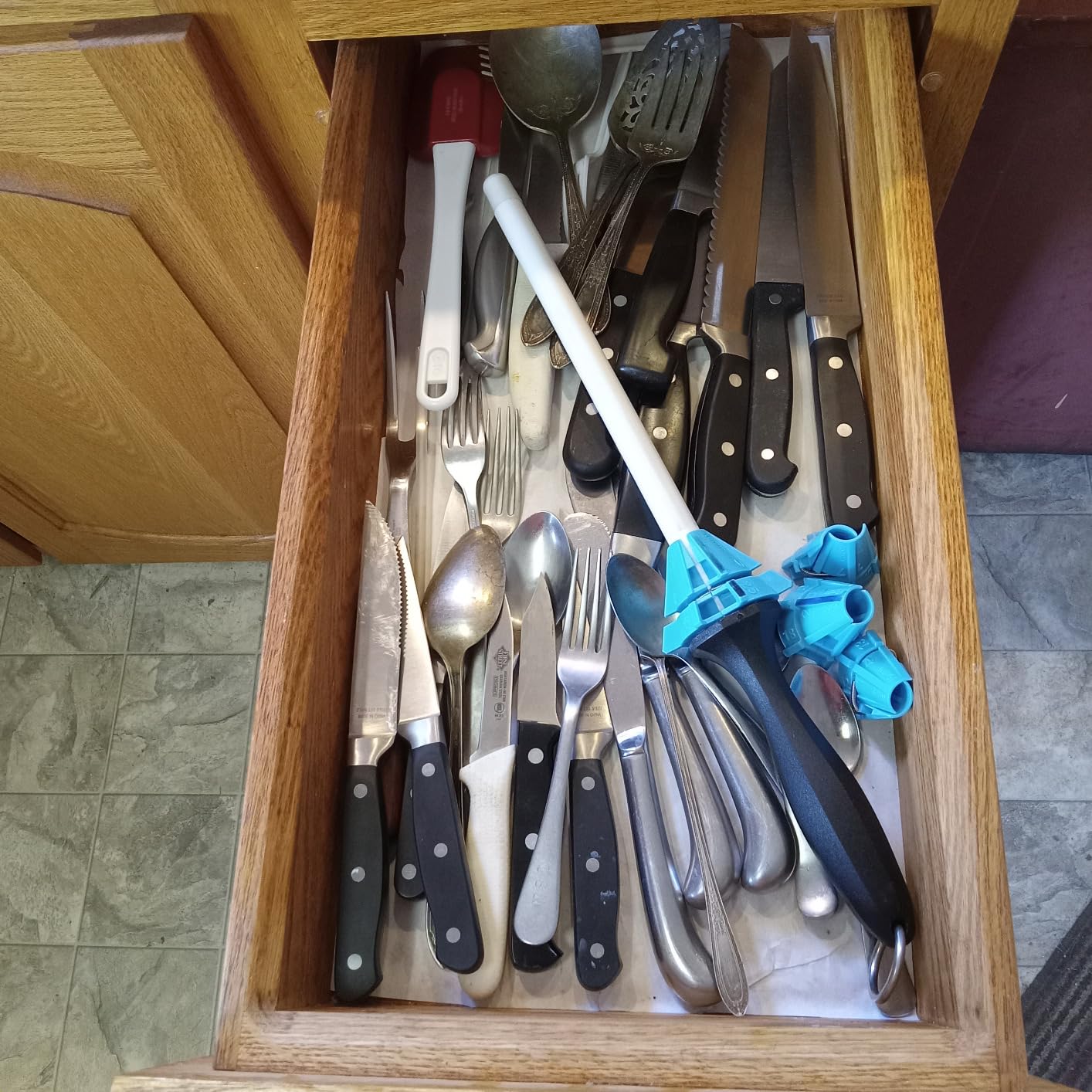
Nothing else here handles bevel angles as thoroughly. The four plastic cones cover 12, 13 and 14 degrees, then 15 to 17, then 18 to 20, then 23, 25 and 30, the widest range in this group and the only one that reaches a yanagiba angle.
That makes it the pick for a Japanese knife collection. Match the guide to the blade rather than guessing, and the 1500 grit is gentle enough for those steels.
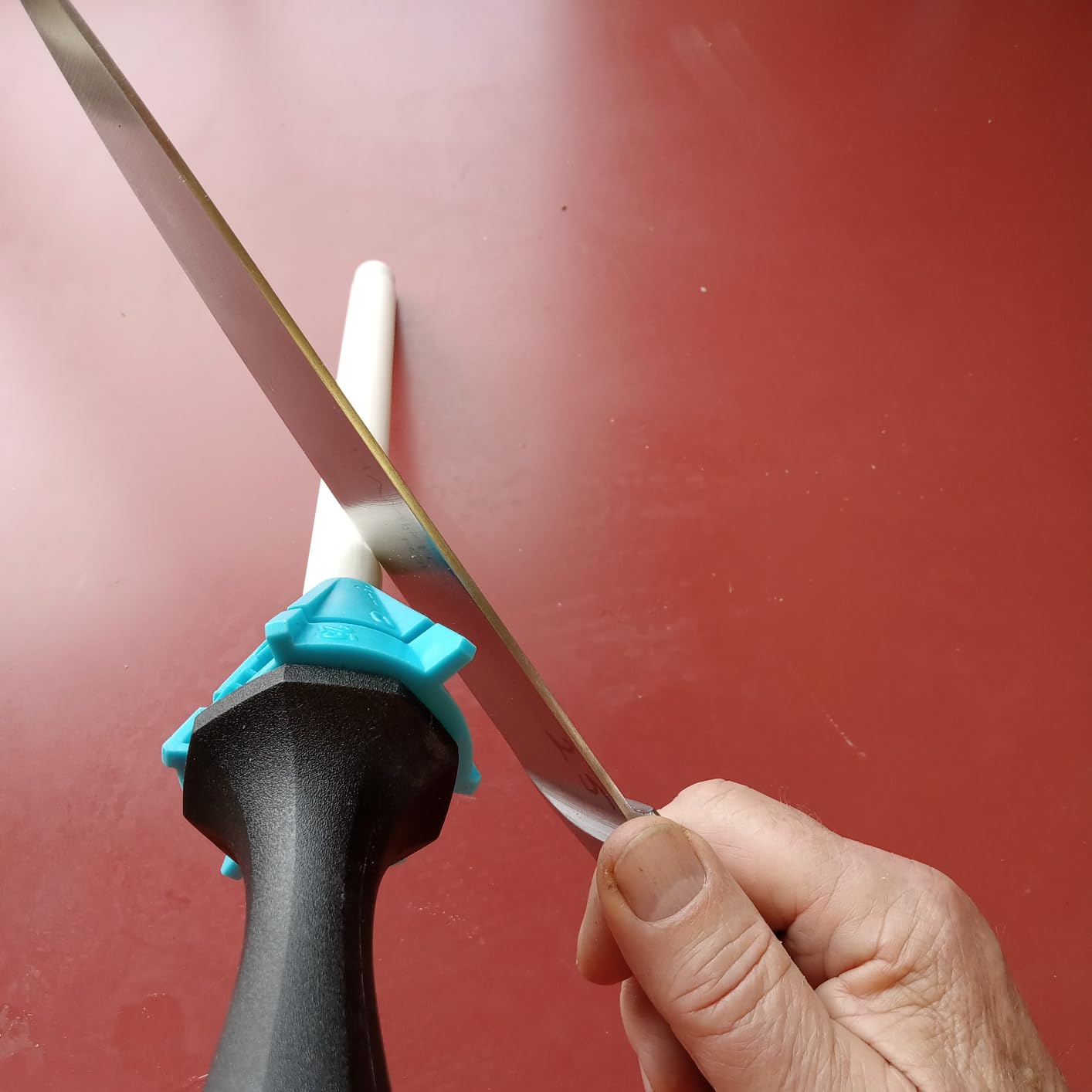
The construction is the other story. A steel rod sits inside the ceramic, an elastic wrap inside the handle and a non removable shatter protection tip, all of which reduce the drop risk that dominates reviews of other ceramic rods.
Owners report that three light strokes per side keep knives sharper far longer than longer sessions with a conventional rod, and the 5/8 inch diameter gives a wide flat surface.
Who this rod suits
Owners of Japanese knives, and anyone who wants a kit rather than a single tool. The guides and the large metal hanging loop make it a system you set up once and then use without thinking.
It is also the best choice here for someone who has already broken a ceramic rod. The steel core and non removable tip are the closest thing to unbreakable.
Who should skip it
Minimalists. Four loose plastic cones have to be stored, matched to each knife and kept from being mixed up, which is real friction if you own two knives.
The 1500 grit also remains a refining abrasive. A chipped edge still needs a coarser tool first.
10. Mercer Culinary 10 Inch Ceramic Honing Rod – Best for Wet Hands
Mercer Culinary Ceramic Rod Knife Honing Steel,Black/White 10 Inch
10 inch rod
Extra fine 1200 grit
Nylon handle with hand guard
Non slip when wet
Pros
- 1200 grit aligns an edge with less time and less edge damage than steel
- Hand guard and non slip grip hold securely with wet hands
- Solid build from an established foodservice maker
- Light at about half a pound for longer sessions
Cons
- Extra fine 1200 grit is maintenance only
- Hand wash only with no dishwasher
- No angle guide included so angle is judged by eye
- Smallest review base of the rods here
The handle is the reason to look at this one. A nylon grip with a hand guard that stays put with wet hands changes how the tool feels at the sink or in a humid kitchen where a slick handle is a real problem.
On the abrasive side it is an extra fine 1200 grit that aligns an edge in less time with less edge damage than a steel rod would, which matters most on thinner blades.
It comes from a foodservice tool maker, so the construction is more substantial than the rating count suggests and it is light enough at roughly half a pound for extended sessions.
The trade is straightforward. It is the least reviewed rod here, there are no angle guides, and the extra fine grit means it refines rather than rescues. You are buying grip and build, not features.
Who this rod suits
Cooks with thinner or more delicate blades who want the gentlest option on the list, and anyone who works with wet hands often enough that grip matters more than features.
If you like the idea of a rod that just sits in the drawer and works, this is the version of that idea we would pick.
Who should skip it
Anyone who needs help with angle. With no guide of any kind, the technique has to come from practice.
It is also maintenance only. Extra fine 1200 grit will not repair a dull or damaged edge no matter how well you use it.
What Is a Ceramic Honing Rod?
A ceramic honing rod is a rod of sintered aluminum oxide, usually about 9 Mohs hardness, mounted in a handle. It both straightens a knife edge by realigning the micro bevel and removes a microscopic amount of metal, which is what separates it from a steel honing rod that only straightens.
Honing and sharpening are not the same job. Honing corrects an edge that has rolled sideways from use, and you can do it in seconds before cooking. Sharpening removes metal to create a new edge, takes longer, and happens far less often. A ceramic rod sits between the two, so it does a small amount of sharpening as a side effect of honing.
White versus black ceramic is a grit difference, not a quality difference. A finer white ceramic usually means a lower grit number around 1000 to 1500, while black ceramic is typically finer still around 2500 to 4000. For a home cook, a fine white or mid grit rod handles routine maintenance and black is for polishing after a stone sharpening.
Ceramic Rod vs Steel Rod vs Diamond Rod vs Whetstone
All four remove or realign metal, but by very different amounts. A steel honing rod only straightens and leaves a scratch pattern that has no effect on cutting. A ceramic rod straightens and removes a very small amount. A diamond rod is genuinely abrasive and removes a moderate amount. A whetstone removes the most metal and creates a new bevel.
The practical consequence is cadence. Hone with a ceramic rod every one or two cooking sessions and sharpen on a stone every three to six months. Push the ceramic harder than that and you are grinding away edge geometry you did not mean to lose.
Diamond rods are worth knowing about but they are a different category of tool. They cut faster than ceramic and are more forgiving on a neglected edge, at the cost of a more aggressive scratch pattern that usually wants a finer step afterwards. If your knife is truly dull, a diamond rod or a stone is the right first step, and the ceramic rod comes after.
How to Hone With a Ceramic Rod
Wash and dry the blade. Ceramic collects metal filings from the previous session and drags them straight back across the edge. A rinse takes five seconds and prevents most of the scratching people complain about.
Stand the rod on your cutting board or a damp folded towel. Stability matters more than grip. If the rod slides, the angle changes and the stroke does nothing useful.
Set the angle at 15 to 20 degrees per side. A paper guide or an angle guide cone handles this if you have no feel for it. Japanese knives normally sit at 12 to 15 degrees, Western knives usually 20.
Hold the handle near the blade end rather than the far end. Shortening the lever arm makes a light stroke easier and keeps your hand out of the way of the rod tip.
Use about half the pressure you think you need. Draw the blade down the full length of the rod in one smooth stroke, from heel to tip, with no sawing motion.
Alternate sides for 5 to 10 strokes per side. Count the passes, not the effort. Most owners who ruin an edge on ceramic do it by leaning on it for dozens of passes instead of a light touch.
If your knife still will not slice after honing, the problem is almost always angle or pressure rather than the rod. Watch the scratch pattern on the blade in raking light: it should sit evenly along both sides, and a pattern that is dark on one side means you are not alternating evenly or you are off angle.
When a Ceramic Rod Is the Wrong Tool
A ceramic rod cannot set a serrated edge. Scallops need a tapered rod or a dedicated serrated sharpener, and running a straight ceramic rod across a bread knife does very little beyond light touch up work.
It is also the wrong answer to chips and cracks. A nick out of the edge needs a coarser abrasive to reprofile the apex before any fine rod is useful, and a crack near the spine is a sharpening problem that no rod should be asked to solve.
Hardened steels at 62 RC and above, including D2 and SG2, are the other caution zone. Forum discussion on this is lively and the recurring advice is to keep passes to roughly three per side with very light pressure on those steels. Plenty of owners use ceramic on hard Japanese steel without trouble; they simply do not treat it as an aggressive tool.
Finally, ceramic knives are a different product entirely. A ceramic blade is far harder than a ceramic honing rod and will dull it, so the two never meet.
How to Choose a Ceramic Honing Rod
Match the rod to the knife, not the other way around. The rod should be at least as long as the blade you use most. A longer rod gives you one clean heel to tip stroke; a shorter rod forces segmented strokes and less consistent alignment. For a 10 inch German chef knife that means a 12 inch rod.
Pick grit by how dull your knives actually are. Around 1000 to 1500 grit is the home cook sweet spot: enough bite to realign an edge and knock off a burr, fine enough to be gentle. 3000 to 4000 grit is for polishing after stone work and will not rescue a neglected knife. Under 1000 grit on a rod starts behaving like a sharpener, which is a commitment you may not want.
Weight and diameter matter more than any spec sheet. A thicker rod gives a wider, flatter honing surface that is more stable and needs cleaning less often. The Arkansas Superstick is 1 inch in diameter and owners notice the difference immediately. A rod that feels substantial in the hand is a rod you will use.
Treat breakage protection as a feature, not a marketing line. A non removable tip, a shock absorbing silicone seal, a steel core inside the ceramic or a hand guard all reduce the single most common failure. The Green Elephant and the Wedgek are the two designs here where breakage barely shows up in reviews.
Check the storage story. A protective sleeve, a hang loop and a rubber tip that stops the rod rolling matter more than they look like they should. The Green Elephant, SHARPAL, Work Sharp and Wedgek rods all solve at least part of this.
Look for a non slip end or a guard. A rod that rolls across a wet counter mid stroke is the most common way people gouge an edge and then blame the rod.
Buy one rod, not three. A single fine ceramic rod handles daily maintenance for most home kitchens. A second coarser stone only becomes worth it once you decide you enjoy sharpening properly, and nothing above replaces the need for a stone on a badly neglected knife.
One last practical point. Every ceramic rod here needs hand washing, not a dishwasher. The heat cycle is what kills them, and it is avoidable.
Sharpening is only one half of a working kitchen. If your prep side needs attention too, our best food processors for home cooks picks cover the rest of the setup.
Frequently Asked Questions
Are ceramic honing rods better than steel ones?
For most home cooks, yes. A ceramic rod does everything a steel honing rod does and also removes a small amount of metal, so it fixes a dull-but-not-damaged edge instead of only straightening it. A steel rod only corrects alignment and leaves a scratch pattern that never cuts anything off. Steel wins only on durability, since it will not shatter if dropped.
What is the best type of honing rod for a home cook?
A ceramic rod in the 1000 to 1500 grit range, at least as long as your longest knife, with a handle that stops it rolling. That combination realigns an edge, removes a burr and covers a full blade in one stroke. Add angle guides if you have no feel for bevel angle, and a shock absorbing or non removable tip if you drop tools.
Why does my knife not slice after I hone it?
Almost always angle or pressure rather than the rod. Hold the handle near the blade, keep the angle at 15 to 20 degrees per side, alternate sides for 5 to 10 light strokes, and stop. Also check the blade is clean, because metal filings left on the rod drag back across the edge and undo the work. If the edge has chips, a ceramic rod is not the right tool.
Can honing rods go bad?
Yes. A steel rod wears smooth on its ribs and stops correcting alignment. A ceramic rod clogs with metal filings, loses bite and then starts scratching the blade it is meant to protect. Clean ceramic with hot water, detergent and a nylon pad or mild abrasive cleanser, and hand wash only, never a dishwasher.
Is honing better than sharpening?
Neither replaces the other. Honing realigns an existing edge and takes seconds, so you can do it before most cooking sessions. Sharpening removes metal to create a new edge and is needed only every three to six months for a home cook. A ceramic rod does a little of both, which makes it a good bridge but not a full replacement for a stone.
Final Verdict
The Green Elephant is our pick for the best ceramic honing rods overall, because the shock absorbing silicone seal and plastic end cap answer the breakage fear that stops most people switching, and its 1500 grit sits in the range that handles daily maintenance on almost any knife. It also carries a 4.7 rating across more than 2,000 reviews, the deepest owner history in this group.
Pick the Messermeister if you want a 12 inch rod for long blades and a protective sleeve. Pick the Arkansas Superstick if thickness and a wood handle matter more than drawer space. Pick the Wedgek if you own Japanese knives or want angle guides for 12 to 30 degree bevels.
Whatever you choose, keep it near the cutting board, clean it after a few sessions and use about three light strokes per side on hard steels. Pair it with one of our kitchen-tested picks for the rest of your cooking setup and you will have everything you need in 2026.