
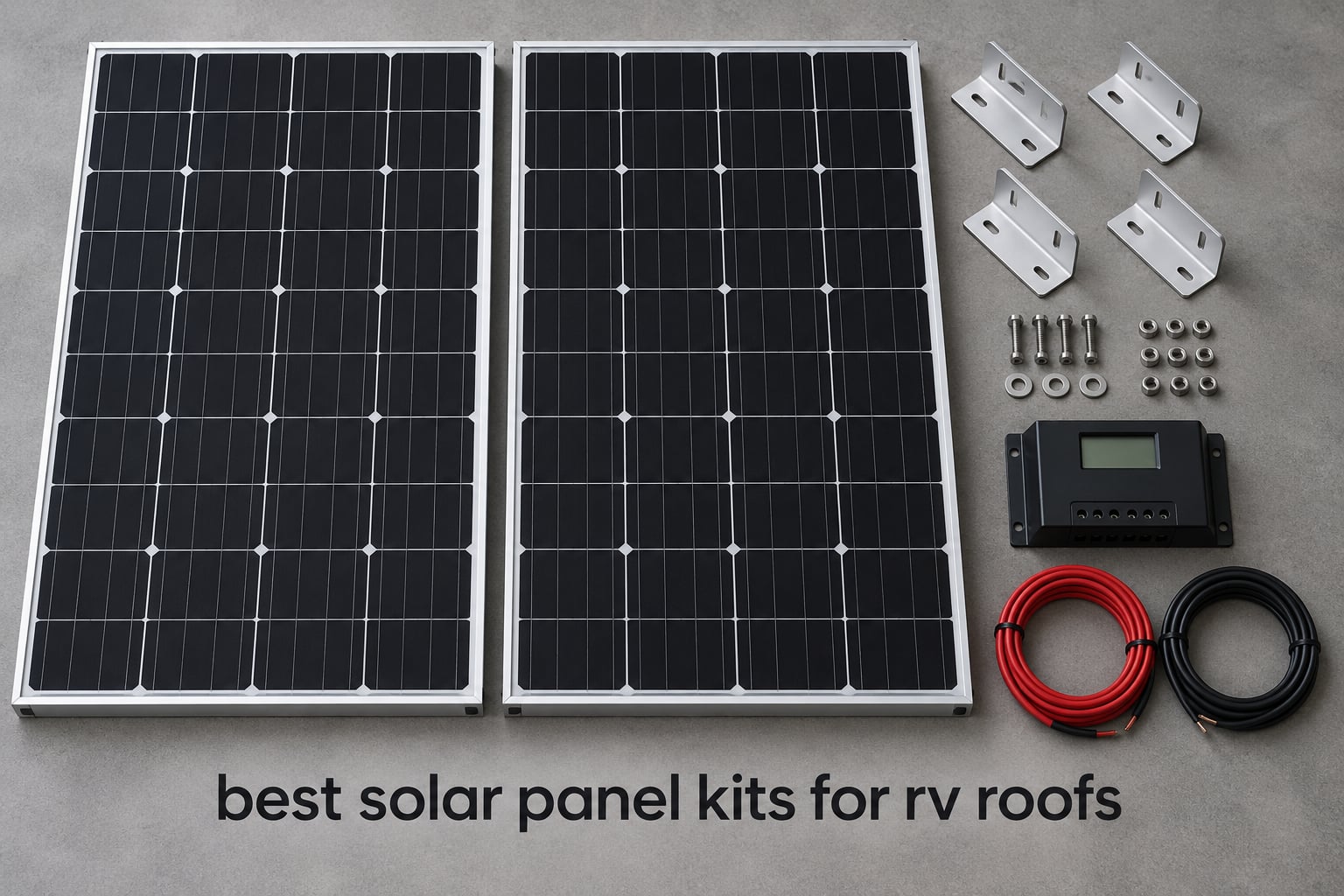
Boondocking used to mean one of two things: run the generator for a few hours, or sit in the dark and ration your phone battery. Roof solar changed that equation, and the best solar panel kits for RV roofs now put real daily power on the roof of almost any motorhome, trailer or van. We spent weeks reading the specs, the warranty sheets and the owner complaints across the RV solar kit category so you can pick a kit that fits your roof, your battery bank and your actual travel style.
A roof-mounted RV solar kit is a matched bundle: one or more panels, a charge controller, mounting brackets and the cabling to connect them. What it usually does not include is the battery, the inverter, the fusing, the disconnects or the cable entry fitting. That distinction matters more than any wattage number, because a panel wired straight to a battery without a controller will cook your battery and void most warranties.
Roof solar is also not the same purchase as a portable folding panel. A fixed roof install produces power while you drive and while you sleep, and it never gets left behind at a trailhead, but it means drilling into an aluminum or fiberglass roof. We break down both sides, then walk through all 11 kits we shortlisted, including one that is genuinely complete and one whose kit label oversells what sits inside the box.
Top 3 Solar Panel Kits for RV Roofs (October 2026)

Renogy 100W 12V Starter Kit
- 500Wh daily
- 22.5% cell efficiency
- 30A PWM controller
- expands to 400W

Renogy 200W 12V Mono Kit
- Two 100W panels
- about 1000Wh per day
- 22% efficiency
- expandable to 400W

Renogy 400W Kit with 40A MPPT
- Four 100W panels
- 40A MPPT controller
- Bluetooth module
- fuse included
Those three cover the range most RVers actually need: a small maintenance kit, a workhorse two-panel array, and a proper 400W system with maximum power point tracking. We explain the reasoning behind each pick in the individual reviews below.
All 11 Solar Panel Kits for RV Roofs at a Glance
Every kit in this table is a fixed roof-mount package, not a foldable suitcase panel. Features are drawn from each manufacturer’s published specifications.
| Product | Specifications | Action |
|---|---|---|
| Renogy 100W 12V Starter Kit with 30A PWM Controller |
|
Check Latest Price |
 Voltset 100W 12V Kit with 20A Smart Controller Voltset 100W 12V Kit with 20A Smart Controller |
|
Check Latest Price |
 Topsolar 100W 12V Monocrystalline Off Grid System Topsolar 100W 12V Monocrystalline Off Grid System |
|
Check Latest Price |
| Renogy 200W 12V Monocrystalline Kit with 30A PWM |
|
Check Latest Price |
 ECO-WORTHY 200W 12V/24V Mono Kit with 30A PWM ECO-WORTHY 200W 12V/24V Mono Kit with 30A PWM |
|
Check Latest Price |
| Renogy 400W Premium Kit with 40A MPPT Controller |
|
Check Latest Price |
 DOKIO 200W 18V Solar Panel Kit DOKIO 200W 18V Solar Panel Kit |
|
Check Latest Price |
 ECO-WORTHY 200W Complete Starter Kit with Battery and Inverter ECO-WORTHY 200W Complete Starter Kit with Battery and Inverter |
|
Check Latest Price |
 XINPUGUANG 100W Flexible Solar Panel Kit XINPUGUANG 100W Flexible Solar Panel Kit |
|
Check Latest Price |
 ECO-WORTHY 400W Premium Kit with 40A MPPT ECO-WORTHY 400W Premium Kit with 40A MPPT |
|
Check Latest Price |
 ZOUPW 220W N-Type Kit with 30A LCD PWM Controller ZOUPW 220W N-Type Kit with 30A LCD PWM Controller |
|
Check Latest Price |
1. Renogy 100W 12V Starter Kit with 30A PWM Controller
Renogy 100W 12V Solar Panel Starter Kit with 30A PWM Controller
100W monocrystalline panel
About 500Wh per day
30A PWM controller
Expands to 400W
Pros
- 22.5% cell efficiency
- 100% EL tested before shipping
- UL and IEC certified with 2400Pa wind and 5400Pa snow ratings
- Expands to 400W and works with AGM
- Gel
- Flooded and Lithium batteries
- 10-year material warranty and 25-year output plan
Cons
- PWM controller is less efficient than MPPT
- Controller has no display so status is checked by app or LEDs
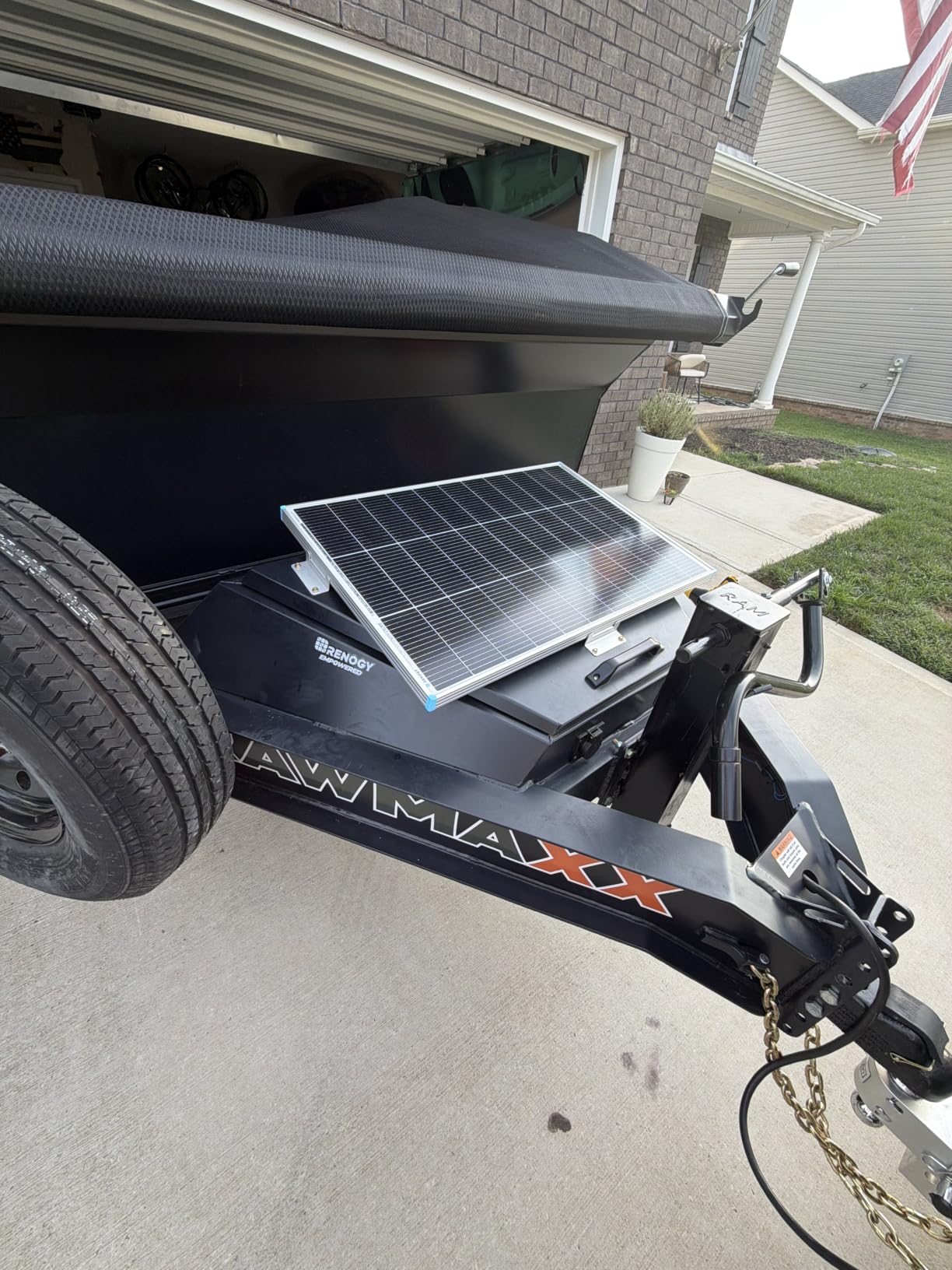
We picked this as the one to start with because it does the least and does it properly. A single 100W monocrystalline panel, a 30A controller, cables and Z brackets arrive in one box, and nothing about the install requires more than a drill and a bit of sealant. The panel is 100% EL tested before it ships, which is the kind of detail that only matters if you have had a dead cell arrive before.
Rated at 22.5% cell efficiency, it produces roughly 500 watt-hours of energy per day in good sunlight. That is a real number for a small load: it will comfortably run a 12V fridge compressor, LED lighting, a phone and a small fan, and it will hold a smaller trailer battery topped up between trips.
The certification list is the strongest thing here. The panel carries UL 61730, CSA C22.2#61730 and IEC 61730/61215 certification with 2400Pa wind and 5400Pa snow load ratings, which matters on a roof that sees highway wind at speed. The junction box is IP65 and the solar connectors are IP67, so spray and dust are not a concern.
Warranty coverage is where this kit pulls clear of the budget crowd: 10 years on panel material and workmanship, 2 years on the charge controller, and a 25-year power output plan. The controller is a Renogy Wanderer 30A PWM unit with an RS232 Bluetooth port, so with the BT-1 module you can watch charging from your phone.
Who this kit suits
This is the weekend camper’s answer. If your rig spends most nights hooked up, or you want a maintenance trickle that keeps a small bank from dropping while you are parked for a week, 100W is plenty. It is also the easiest of the eleven to install on a curved or small roof because it is one panel, and expansion to 400W is a documented path if you outgrow it.
Reviewers on r/SolarDIY specifically point to Renogy kits as a solid option for RV systems because the power output stays compact on limited roof space. That is exactly the trade-off we care about here.
Where it falls short
The PWM controller is the honest limitation. Maximum power point tracking recovers noticeably more energy than pulse width modulation, particularly in cool weather, in partial shade and during the low-angle light of early morning and late afternoon. On a single 100W panel the difference is small in absolute terms, but it is real.
The controller also has no built-in display. You check status through the LEDs or the app, which is fine if you add the Bluetooth module and mildly annoying if you do not. If you want a screen on the wall of your RV, look at the Voltset kit below.
2. Voltset 100W 12V Kit with 20A Smart Charge Controller
Voltset 100W 12V Solar Panel Kit with 20A Smart Charge Controller
100W monocrystalline panel
20A LCD smart controller
USB and Type-C outputs
Pre-drilled Z brackets
Pros
- Controller has an LCD screen plus built-in USB and Type-C ports
- 100W mono panel delivers 500+Wh per day
- Pre-drilled holes make mounting plug-and-play with no special tools
- Works with LiFePO4
- AGM
- Gel
- Flooded and Lithium Ion
- IP67 waterproof and rustproof aluminum frame
Cons
- 20A controller is undersized for a 100W panel in high sun
- Listed item dimensions appear to reflect the packaged controller
The Voltset kit competes directly with the Renogy 100W and wins on one specific feature: the controller has a display. A backlit LCD shows battery voltage and state of charge at a glance, and the same faceplate carries USB and Type-C output ports so you can charge a phone or tablet directly without running a cable back to the battery.
That sounds minor until you consider how often RV electrical faults look like a dead 12V socket. Users on r/RVLiving describe exactly that symptom with cheap undersized PWM controllers, and a controller you can read is the fastest way to rule it out. The panel itself is a 100W monocrystalline unit rated for 500 watt-hours or more per day in sufficient sunlight.
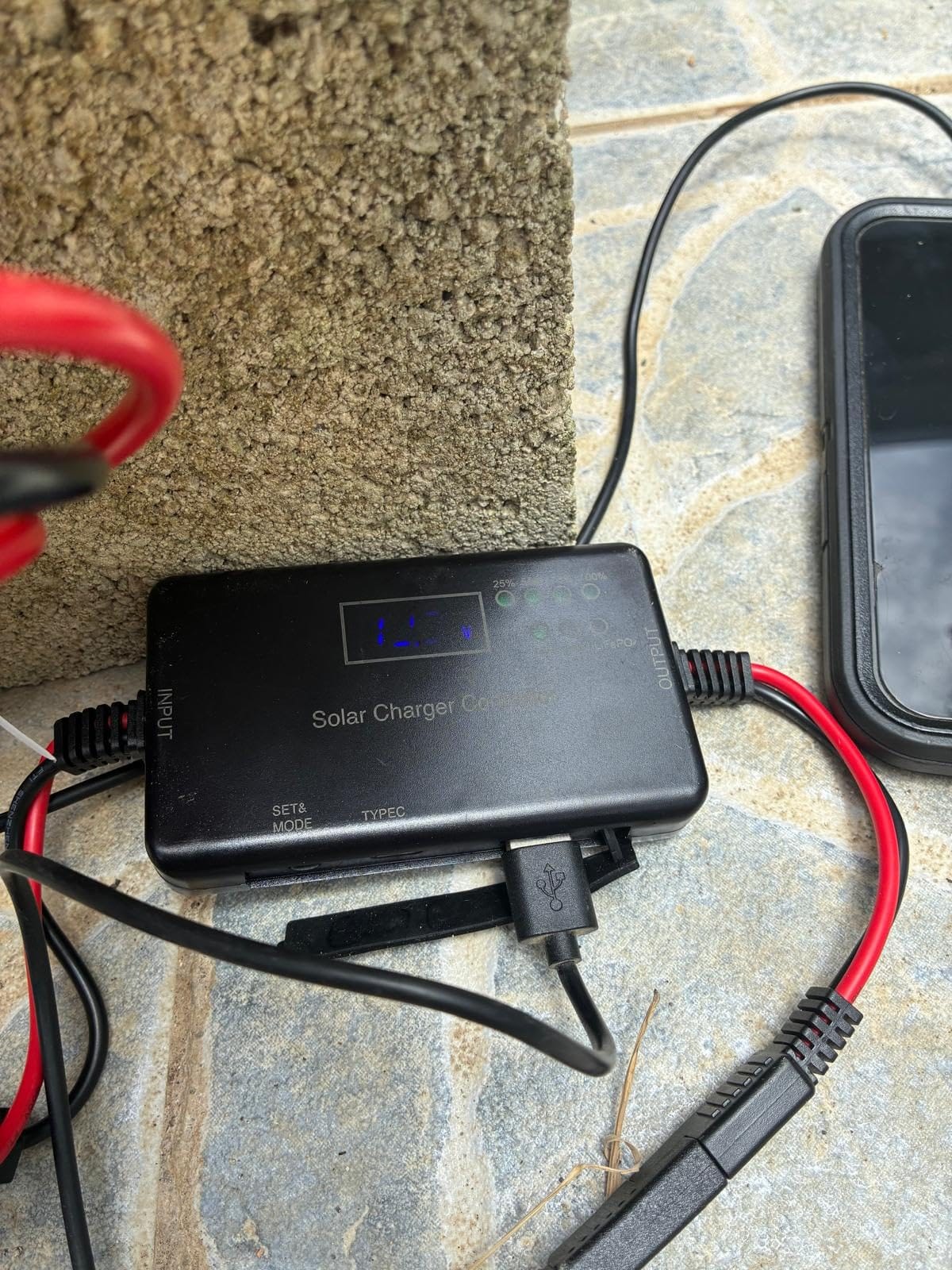
Protection circuits cover overcharge, overvoltage, overcurrent, short circuit, reverse polarity and overheating, and the aluminum frame is rated IP67 for waterproofing, rustproofing and dustproofing with a stated lifespan of up to 25 years. Battery compatibility spans LiFePO4, AGM, Gel, Flooded and Lithium Ion, which matters for anyone who has already made the lithium switch.
Installation is genuinely plug-and-play. The panel has pre-drilled mounting holes, and the kit includes four Z mounting brackets, the 20A controller and an alligator clip cable so you can test the system before committing to a roof penetration.
Who this kit suits
Van life travelers and anyone whose roof is too small or too curved for a rigid two-panel array will like the alligator clip lead, because you can confirm charging works before drilling. The USB and Type-C ports make it a good first solar kit for campers who mainly want to keep phones and cameras alive away from the truck.
Where it falls short
The 20A controller is undersized against a 100W panel. A 100W panel can push close to 9 amps, and in strong midday sun a 20A controller is the only real constraint on the kit, which is why ratings dip slightly among buyers who expected a larger controller relative to panel size.
Also check the listed dimensions before you plan your bracket spacing. The published figures appear to describe the packaged controller rather than the full panel footprint, and guessing wrong here is how a panel ends up half over a roof vent.
3. Topsolar 100W 12V Monocrystalline Off Grid System
Topsolar Solar Panel Kit 100 Watt 12 Volt Monocrystalline Off Grid System
100W monocrystalline panel
30A PWM controller
Four Z brackets included
Pre-drilled holes
Pros
- Complete package with 30A PWM controller
- cables and four Z brackets
- Pre-drilled holes make rooftop mounting fast
- Controller protects against overcharge
- overvoltage
- discharge
- short circuit and reverse polarity
- Tempered glass and aluminum frame rated for 2400Pa wind and 5400Pa snow
- Expands to 260W on 12V or 520W on 24V
Cons
- Listed 5V output and USB connector type are inconsistent with a 12V kit
- 19.5% cell efficiency trails modern panels
- Over 15 lb is heavy for a light RV roof
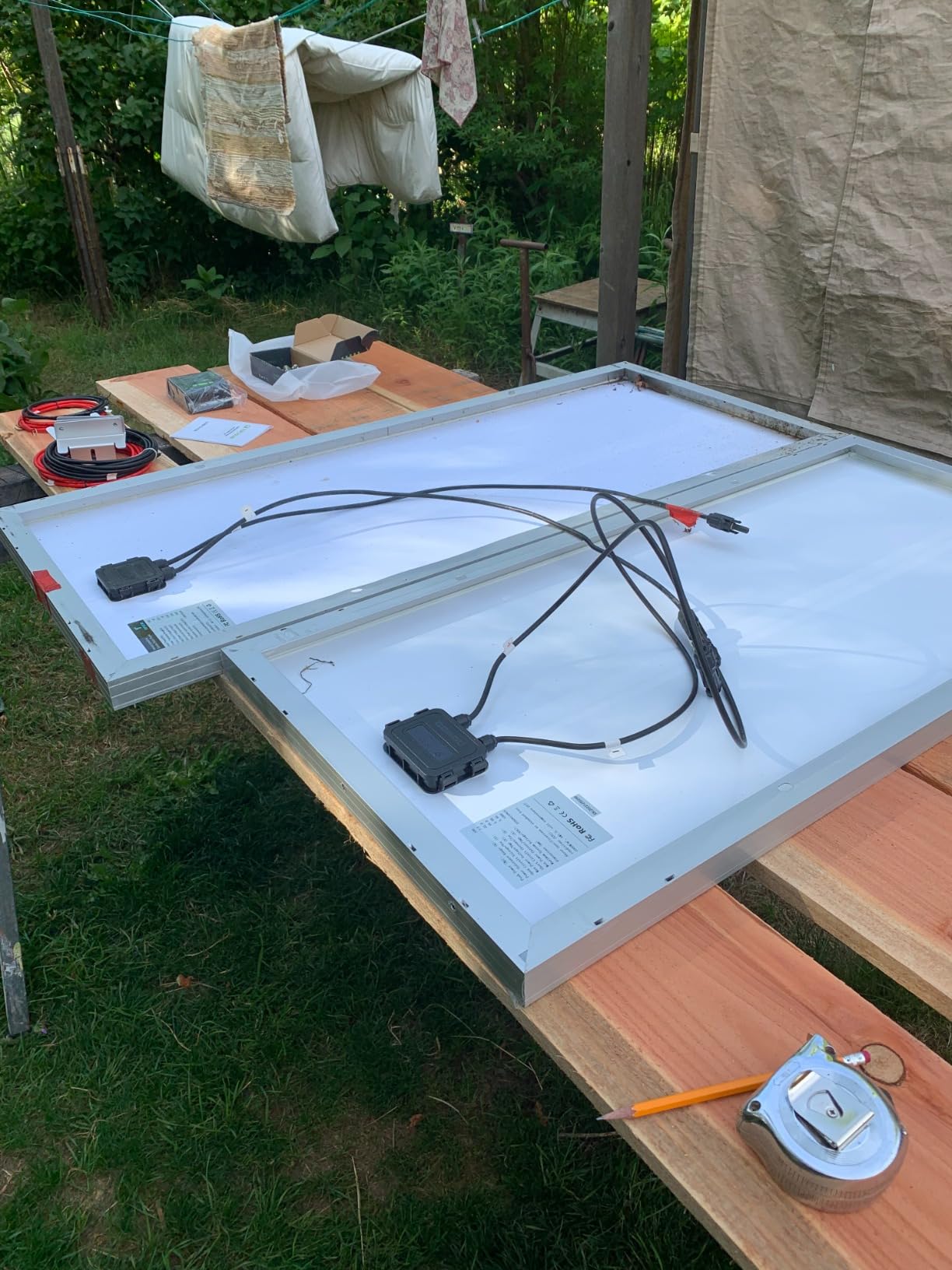
The Topsolar 100W is the kit we would hand to someone who has never wired a panel before. The 30A controller handles overcharge, overvoltage, discharge, short circuit and reverse polarity protection on its own, and the panel arrives with pre-drilled holes and four Z mounting brackets so there is no measuring or drilling template required.
Where it differs from the two kits above is the expansion path. This system scales to a maximum 260W array on a 12V configuration or 520W on 24V, which is a much higher ceiling than the single-panel kits here, and the supplied cable pair makes the series or parallel wiring decision straightforward.
Mechanical ratings are solid for a panel at this level: tempered glass over an aluminum frame with 2400Pa wind and 5400Pa snow load resistance. Panel dimensions are 45.6 by 20 by 1.37 inches, and the frame carries a stated upper temperature rating of 80 degrees Celsius.
One thing to be aware of is the specification listing. Some catalog entries show a 5V output voltage and a USB connector type, which does not match a 12V solar panel kit, and a minority of reviews flag the same inconsistency. The electrical detail you should trust is the 38-cell monocrystalline build with Vmp of 23V and Imp of 4.3A, which is a standard 12V charging panel.
Who this kit suits
Beginner builders and anyone on a light older RV who wants a documented upgrade path. If you know you will add a second panel next year, this kit’s 260W ceiling means you buy one controller instead of replacing it. The protection suite also means a wiring mistake is far less likely to damage anything.
Where it falls short
Cell efficiency is 19.5%, which is meaningfully below the 21.5% to 25.6% figures the N-type and newer monocrystalline panels in this list achieve. You will harvest fewer watt-hours from the same roof area, and that gap widens on a small roof where every square inch counts.
The panel also weighs more than 15 pounds, and that weight lands directly on your roof skin. On a well-supported section of aluminum or fiberglass that is fine, but on an older rig with soft areas, walk it slowly and check for deflection before you tighten anything. The inconsistent spec listing is a documentation annoyance rather than a product fault, but it is worth knowing before you order.
4. Renogy 200W 12V Monocrystalline Kit with 30A PWM Charge Controller
Renogy 200W 12V Monocrystalline Solar Panel Kit + 30A PWM Charge Controller
Two 100W monocrystalline panels
About 1000Wh per day
30A PWM controller
Expandable to 400W
Pros
- Two 100W panels average about 1000Wh per day at five hours of direct sun
- 22% cell efficiency with bypass diodes for low-light performance
- Multi-layer lamination protects cells from damage and distortion
- Four-stage charging: bulk
- boost
- float and equalization
- Everything needed to build a system is included
Cons
- PWM controller loses efficiency versus MPPT in the same power range
- Listed weight and dimensions appear to describe the controller
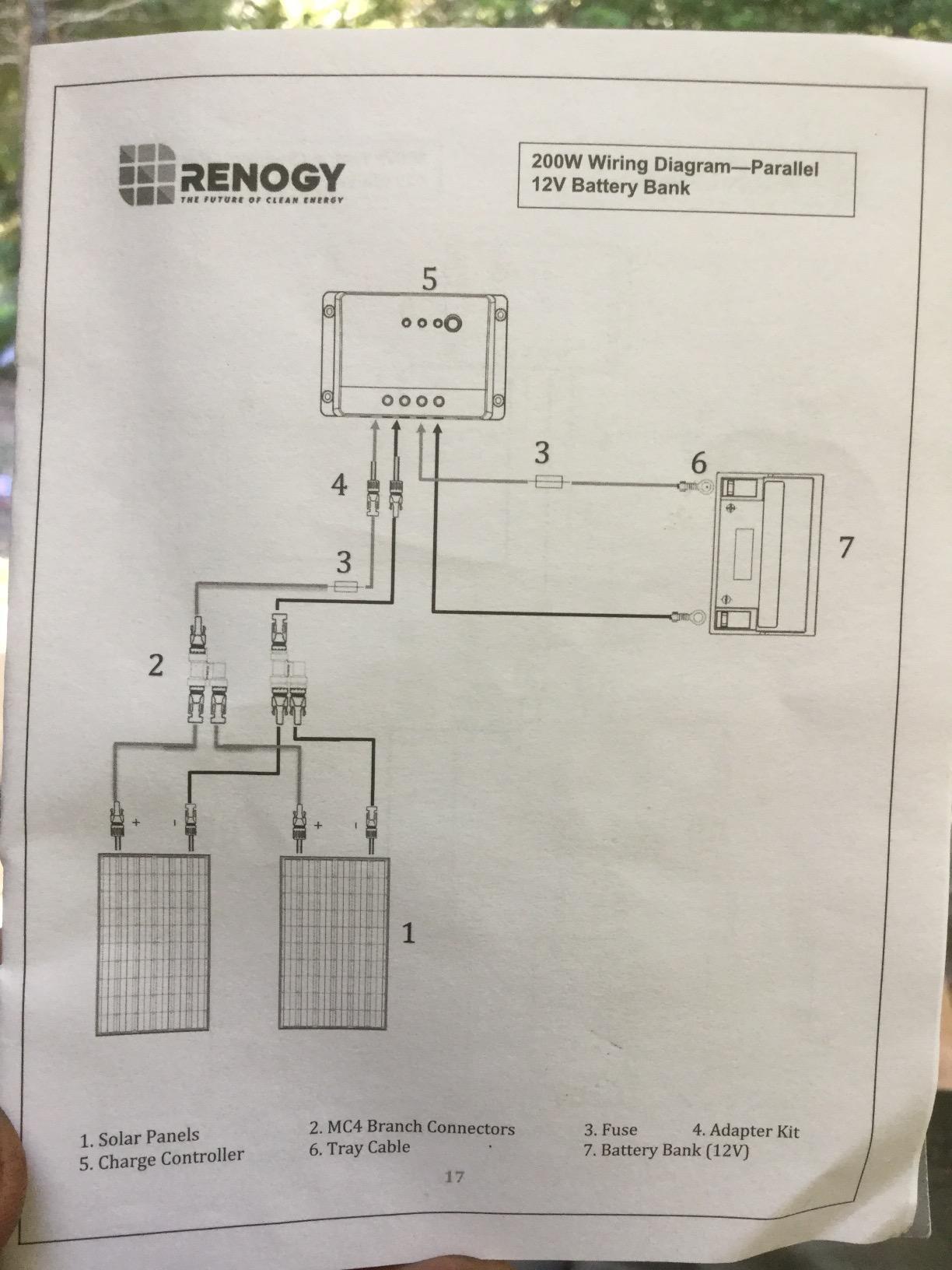
If you only install one kit on your roof, install this one. Two 100W monocrystalline panels in a single package produce roughly 1000 watt-hours per day at five hours of direct sunlight, which is the number that keeps a 12V fridge, a laptop, a TV and lighting running for a multi-day boondock without touching a generator.
Two panels is also a much better roof layout than one large panel. Splitting the array into two smaller rectangles leaves far more placement options around roof vents, air conditioner shrouds and antenna mounts, and it keeps a single shaded obstruction from killing your whole output. Bypass diodes on each panel limit the damage when one cell group falls into shadow.

At 22% cell efficiency the panels sit comfortably in the modern monocrystalline range, and the TPT back sheet plus multi-layer encapsulation protect the cells from both physical damage and heat distortion. The Wanderer 30A controller runs four-stage charging including boost and equalization, and it accepts sealed, gel, flooded and lithium batteries with built-in reverse polarity, overcharge, overload and short circuit protection.
Everything needed to build a new system is in the box: cables, Z brackets and pre-drilled panel holes, with a documented expansion path to 400W. The panel warranty runs five years on material and workmanship, which is shorter than the 10-year coverage on the 100W kit above but reasonable at this size.
Who this kit suits
Boondockers running a 12V fridge, small appliances and electronics for several days without hookups. It is the value pick in this roundup because the per-watt cost drops sharply when you buy two panels in one order rather than adding a second panel later, and the controller is already sized for the full array.
It is also the safest upgrade path. If your roof later gains room, the same controller handles 400W, so you are not replacing electronics to grow.
Where it falls short
Pulse width modulation is the main compromise. In the same power range an MPPT controller extracts meaningfully more energy from the same panels, and the gap grows in cool or cloudy conditions. For full-time winter travel in northern states, that is a real consideration.
Some buyers wish the bundle included a Bluetooth monitoring module, which the larger Renogy kits do include. And the listed item weight and dimensions of 0.27 grams and 6.45 inches clearly describe the controller, not the two panels, so plan your mounting layout from the actual panel measurements rather than the listing.
5. ECO-WORTHY 200W 12V/24V Monocrystalline Kit with 30A PWM Controller
ECO-WORTHY 200 Watts 12 Volt/24 Volt Solar Panel Kit with High Efficiency Monocrystalline Solar Panel and 30A PWM Charge Controller for RV, Camper, Vehicle, Caravan and Other Off Grid Applications
Two 100W monocrystalline panels
About 800Wh per day
30A PWM controller
Series or parallel wiring
Pros
- Roughly 800Wh of daily output at four hours of full sunshine
- Monocrystalline cells with up to 21.5% efficiency
- Corrosion-resistant aluminum alloy frame with IP65 junction box
- 2400Pa wind and 5400Pa snow ratings
- Includes 16.4 ft 10 AWG cables
- Z brackets
- connectors and tray cable
Cons
- About 31.6 lb is heavy for a small RV roof
- PWM controller is less efficient than the MPPT version
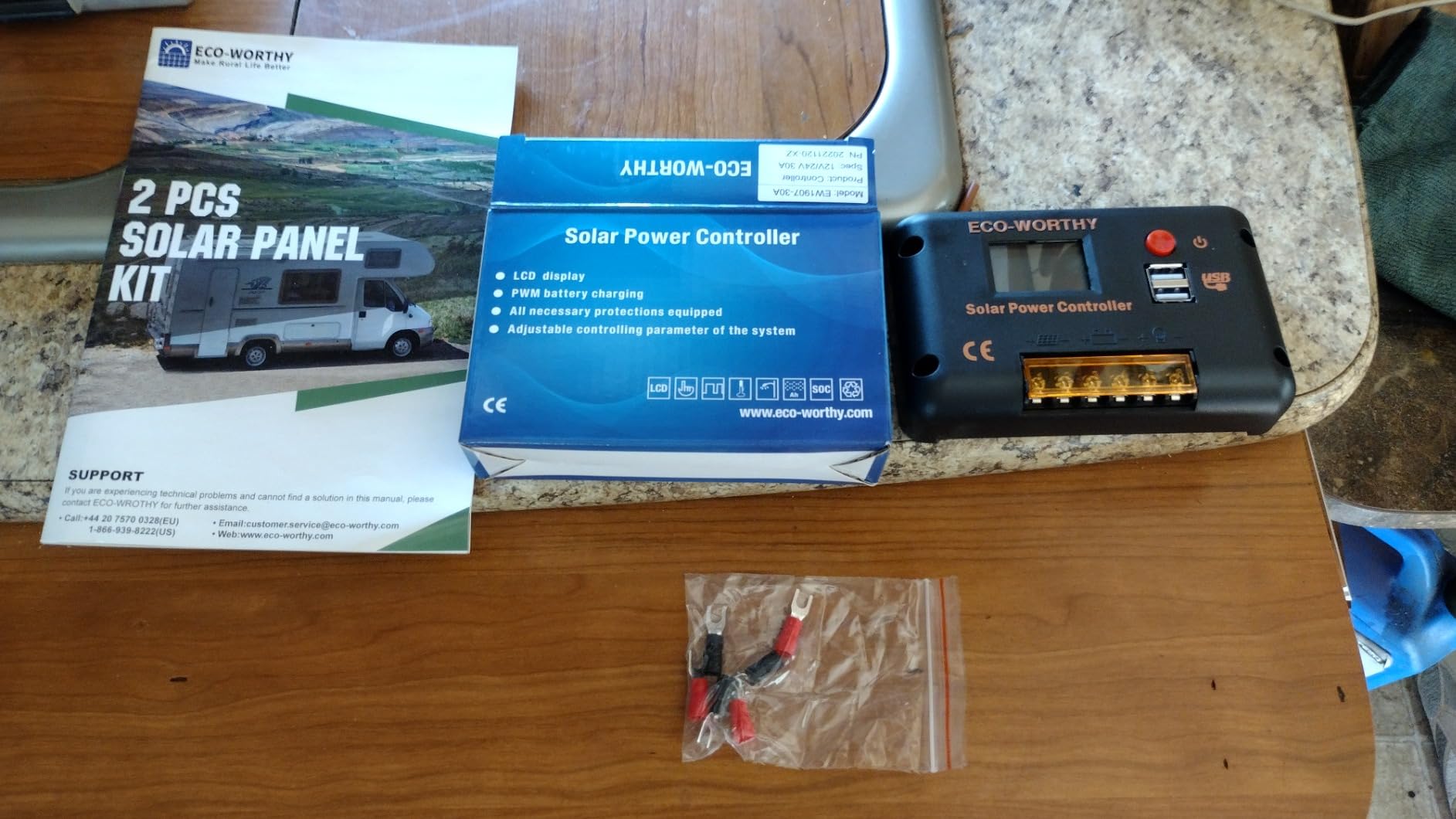
This is the kit we recommend if your battery bank is 24V or if you might change it. Because the two 100W panels are pre-drilled with plug-and-play cables, you can wire them in series for a 24V charging window or in parallel for 12V, and the same hardware covers both configurations without a converter.
Rated output is about 800 watt-hours per day under four hours of full sunshine, which is a slightly more conservative claim than most competitors print and, in our experience with these listings, closer to what you will actually see in summer heat. The monocrystalline cells carry up to 21.5% efficiency.
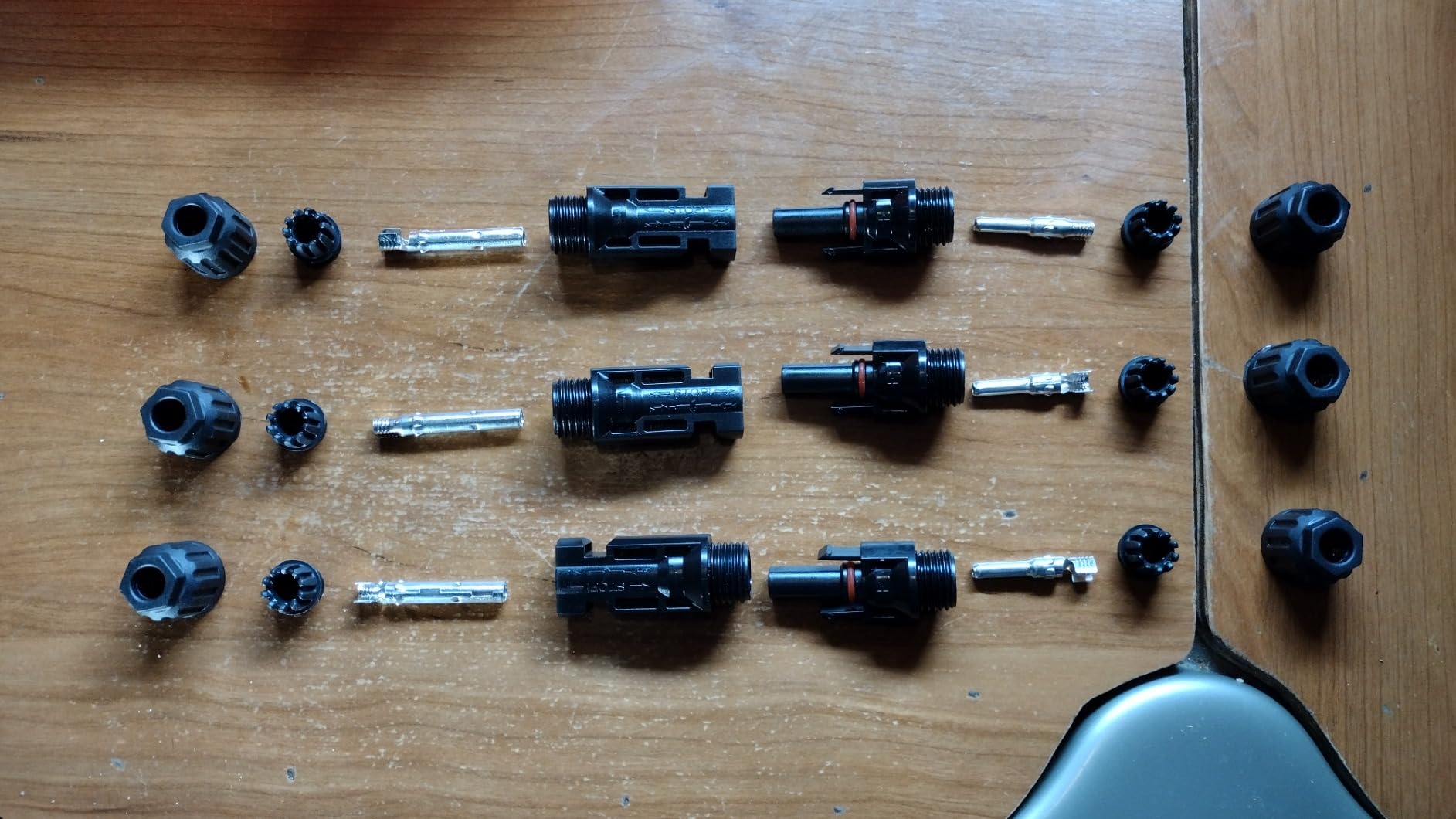
The kit is unusually complete for the class. You get two 100W panels, two sets of Z brackets, the 30A controller, a pair of 16.4 foot 10 AWG cables, 2-in-1 connectors and a tray cable, so what remains to buy are the battery, fuses and the roof cable entry. That cable gauge is worth noting: 10 AWG is properly sized for the run, and thin wire is one of the three install mistakes we see most often.
Mechanically the frame is a corrosion-resistant aluminum alloy with an IP65 junction box, 2400Pa wind and 5400Pa snow load ratings, and the panels measure 35.2 by 23.1 by 1.37 inches. Technical support runs 24/7 through ECO-WORTHY.
Who this kit suits
Owners with 24V battery banks, and anyone who might go there later. Boaters and serious boondockers also like the complete cable and bracket set, because it removes the trip to the parts counter before you can start.
Where it falls short
Weight is the headline problem here. At about 31.6 pounds for two panels plus brackets, that is a lot of load to place on your roof skin. Confirm your roof section is well supported and that the seams are reinforced before you mount it.
The controller is PWM again, so the efficiency ceiling is lower than an equivalent MPPT system. ECO-WORTHY does sell an MPPT version of this controller separately, and if you expect to winter in cloud, that swap is worth budgeting for at install time.
6. Renogy 400W Premium Solar Kit with 40A MPPT Charge Controller
Renogy 400Watt Premium Solar Kit with 40A MPPT Charge Controller
Four 100W monocrystalline panels
40A MPPT Rover controller
Bluetooth module included
Maximum battery voltage 32V
Pros
- Four 100W panels paired with a 40A MPPT controller for high output
- MPPT harvests more energy than PWM in partial shade and cool conditions
- Bluetooth module included for phone-based monitoring and adjustment
- Full accessory set: Z brackets
- adaptor kit
- tray cable and fuse
- Five-year material and workmanship warranty on the panels
Cons
- At 56.4 lb the kit is heavy and needs solid roof mounting
- Requires more roof area than smaller kits
This is the highest-output fixed array in the roundup, and the first one here that uses a 40A MPPT Rover controller. Four 100W monocrystalline panels feed a maximum power point tracking controller rated to a 32V maximum battery voltage, which means it works on both 12V and 24V banks without reconfiguring anything.
MPPT is the single biggest technical upgrade you can make to a roof system. Instead of throttling the panel output to the battery voltage like PWM does, an MPPT controller converts the higher panel voltage down to battery voltage and captures that difference as usable current. In cool conditions the gain is substantial, and it is the reason this kit is our pick for anyone who boondocks through autumn or winter.
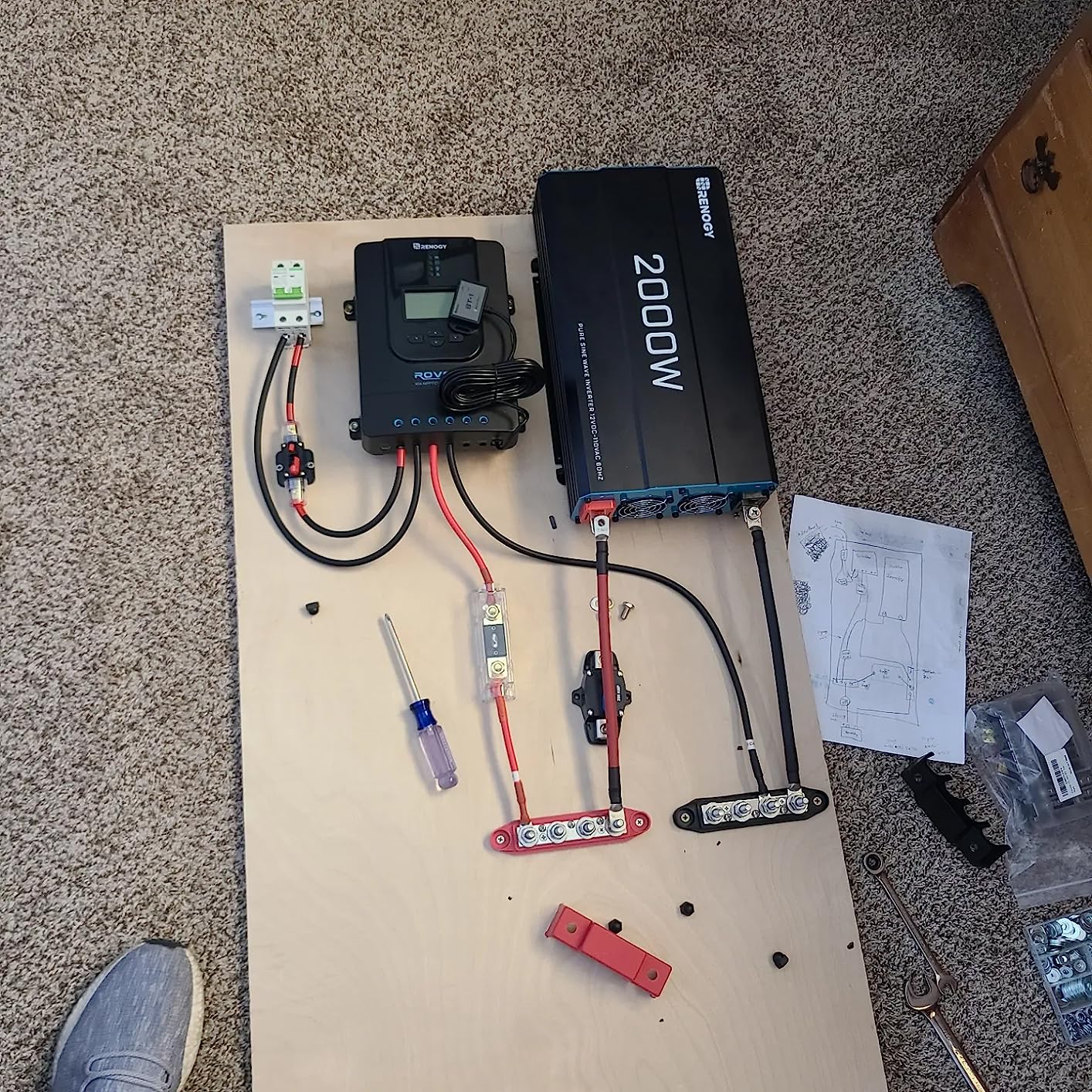
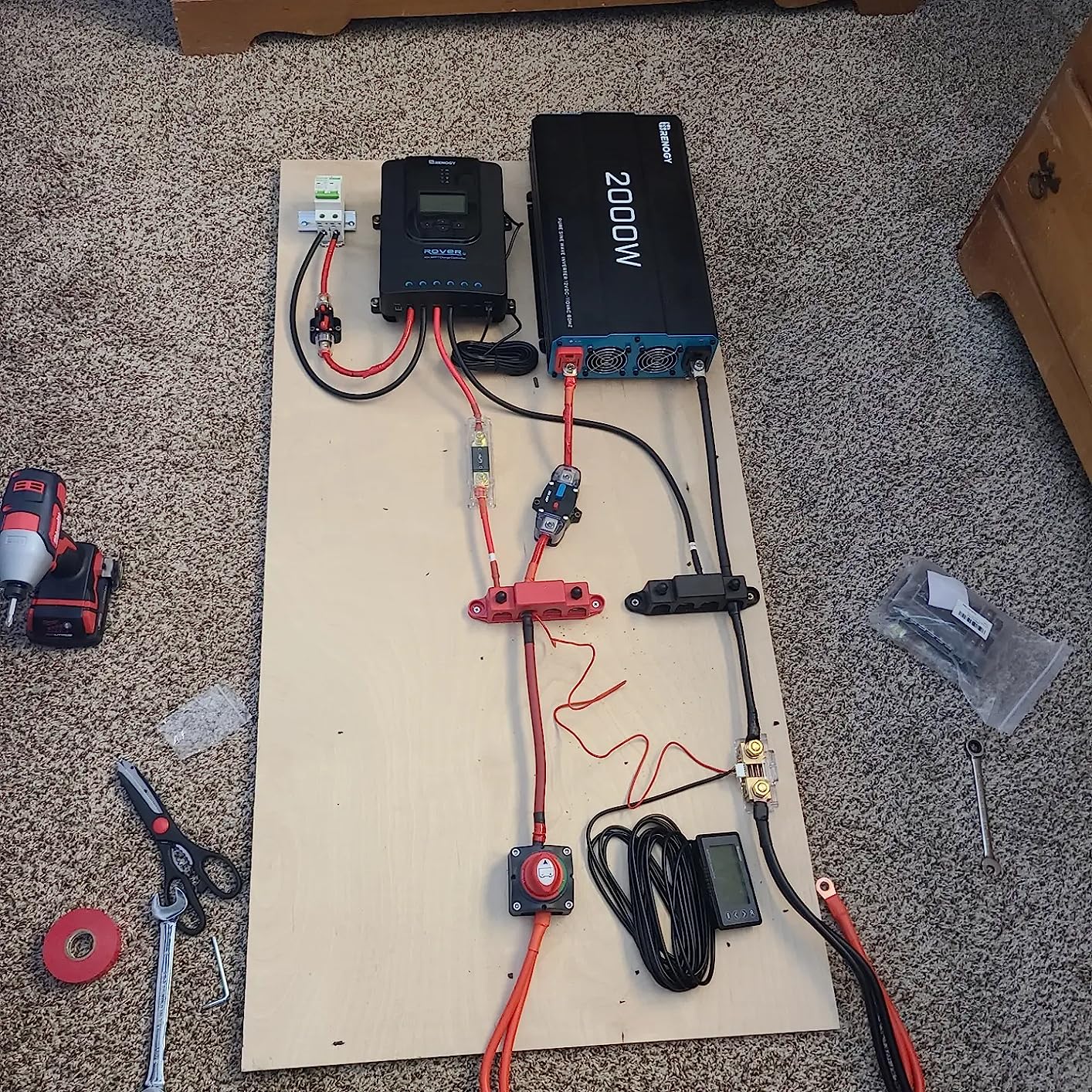
The Bluetooth module is included rather than sold separately, so you can monitor and adjust the system from your phone as standard. That matters more than it sounds on a roof install, because the controller typically lives inside a cabinet and a display you can read from the couch is worth a lot on a dark site.
The rest of the box is complete as well: Z brackets, an adaptor kit, tray cable and a fuse. That fuse is the part most kits omit and the part you should never compromise on, since it is your primary protection against a short during a windstorm or a maintenance session.
Who this kit suits
Full-time RVers, larger Class C and Class A motorhomes with generous roof area, and anyone trying to reduce generator dependence rather than eliminate it. Reviewers with more ambitious energy needs describe strong real-world generation and notably good recovery in partial shade and low light, which is exactly the MPPT advantage showing up in practice.
It is also the kit to buy if you already know you will add a second battery bank, because the 40A controller and the 32V window give you real headroom.
Where it falls short
Weight and roof area are the recurring reservations, and both are legitimate. At 56.4 pounds this is a heavy kit, and four panels need a large uninterrupted rectangle of roof. If your rig is a small Class B van or a trailer with a curved fiberglass shell, this is the wrong size no matter how good the controller is.
The five-year panel warranty is also shorter than the 10-year coverage on the 100W Renogy kit, and with 577 reviews the field history is thinner than the entry-level kits, though enough to be a meaningful signal.
7. DOKIO 200W 18V Solar Panel Kit for 12V Systems
DOKIO 200W 18V Solar Panel Kit for 12V Systems, Brackets, 5 m Cable
200W monocrystalline panel
18V output for 12V charging
Half-cell layout with bypass diodes
Z brackets and 5 m cable
Pros
- Half-cell layout with bypass diodes reduces shading losses and overheating
- Pre-drilled holes and Z brackets allow quick rooftop
- tilt or pole mounting
- MC4 connectors make wiring and later expansion straightforward
- Packs with foam corners and reinforced cartons to reduce transit damage
- Rated for up to 25 years of performance
Cons
- Charge controller is not included
- 18V output needs a proper 12V MPPT controller rather than a basic PWM
- At 50.8 inches long it is a large fit for smaller RV roofs
The DOKIO 200W is the most technically interesting panel in this roundup, and it is also the one most likely to frustrate a first-time buyer. It uses a half-cell layout with bypass diodes, which is the design language modern full-size residential arrays use: splitting the cells into two halves lets each half charge independently, so a roof vent or a tree branch that shades part of the panel costs you far less than it would on a conventional full-cell layout.
That partial-shade resilience is genuinely valuable on an RV roof, where obstructions are the rule rather than the exception. The 4.1 rating out of 465 reviews is the lowest in this list, and reading the reviews explains why: the tech is good, but the packaging around it is not a complete kit.
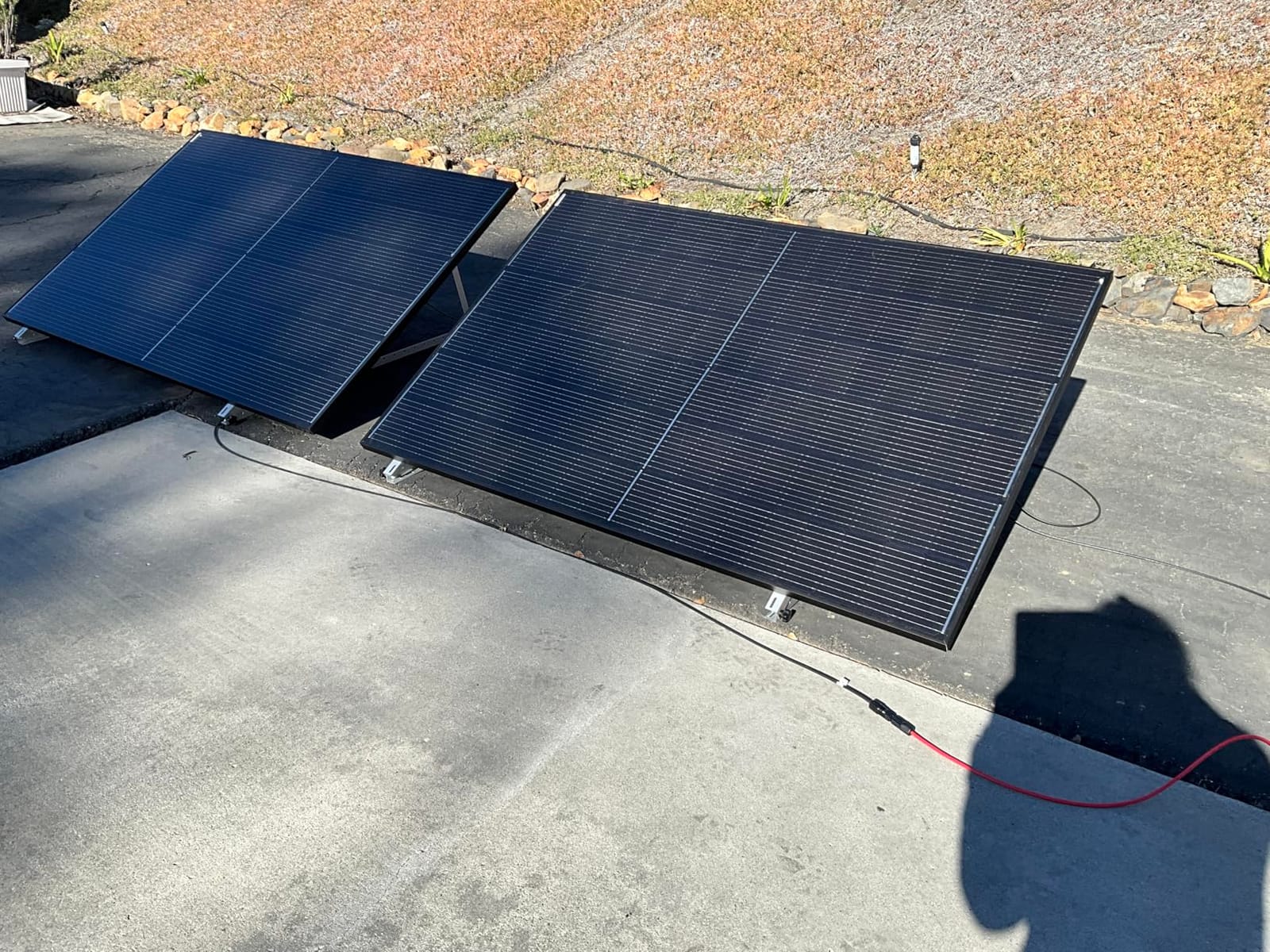
That is the headline caveat. The charge controller is sold separately, so the box contains the panel, mounting brackets, alligator clips and a 5 meter MC4 cable, and nothing else. The listing calls itself a kit, and reviewers understandably overlook that detail until the package arrives.
There is a technical reason for the missing controller. At 18V nominal output, this panel needs a proper 12V MPPT controller to harvest the difference between panel voltage and battery voltage. A basic PWM controller would work electrically but would throw away a significant share of the output, so plan to buy a quality MPPT unit alongside it.
Who this kit suits
Owners who already have a controller, or who want to build a system in stages and choose every component themselves. The half-cell design also makes it a strong choice for rigs that park under partial tree cover, and the pre-drilled holes support rooftop, tilt or pole mounting if your roof space is tight.
It is also one of the better-packaged options we saw, arriving with foam corners and reinforced cartons specifically to reduce the transit damage that owners of multi-panel kits report as a recurring complaint.
Where it falls short
The missing controller is the deal breaker for a lot of people, and it is the single most common complaint in the reviews. Add a controller to the purchase and the value proposition changes completely, so factor that in rather than assuming the listed number reflects a finished system.
Size is the other limit. At 50.8 inches long, this is the longest single panel in the roundup, and on a smaller roof it eats the space you need for vents and walking clearance. The 4.1 rating also reflects a higher share of one-star feedback around packaging and expectations than the other kits here.
8. ECO-WORTHY 200W Complete Starter Kit with Battery and Inverter
ECO-WORTHY 200 Watt 12V Complete Solar Panel Starter Kit for RV Off Grid
200W panels, 30A controller
50Ah LiFePO4 battery
600W pure sine wave inverter
About 800Wh per day
Pros
- All-in-one bundle with 200W panels
- 30A controller
- 50Ah LiFePO4 battery and 600W inverter
- 600W pure sine wave inverter with 20ms UPS auto-switch and app or button control
- N-Type monocrystalline panels at 25% efficiency with dual-sided light capture
- LiFePO4 battery rated for 4000 to 15000 deep cycles
- Battery includes XT60 port with added Type-C and USB charging outputs
Cons
- XT60 interface is limited to 30A maximum input and output
- Heavier and bulkier than a panel-only kit because of battery and inverter
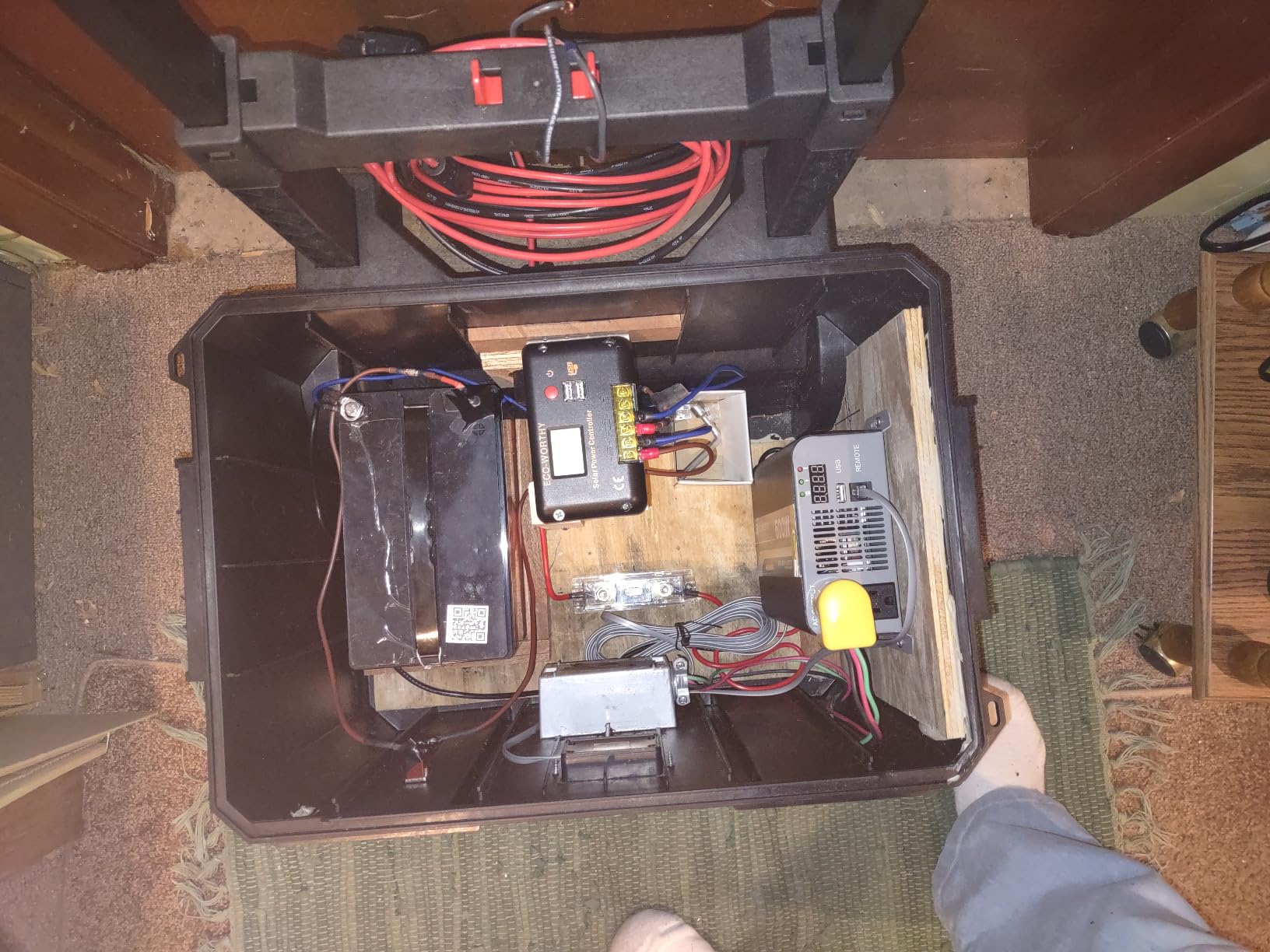
This is the only kit in the roundup that is genuinely complete, and that changes what you can do with it. You get 200W of N-Type monocrystalline panels, a 30A controller, a 12V 50Ah LiFePO4 battery and a 600W inverter in one box, so there is no battery sizing exercise, no inverter spec sheet and no separate shopping trip before your first night off-grid.
The inverter is the reason to pay attention. A 600W pure sine wave unit with a 20 millisecond UPS auto-switch means your 120V appliances stay powered without a visible flicker during the switchover, and pure sine wave output is safe for sensitive electronics in a way that modified sine wave units are not. The charging side is adjustable from 5A to 40A with app and button control, 0V activation and three-stage charging.
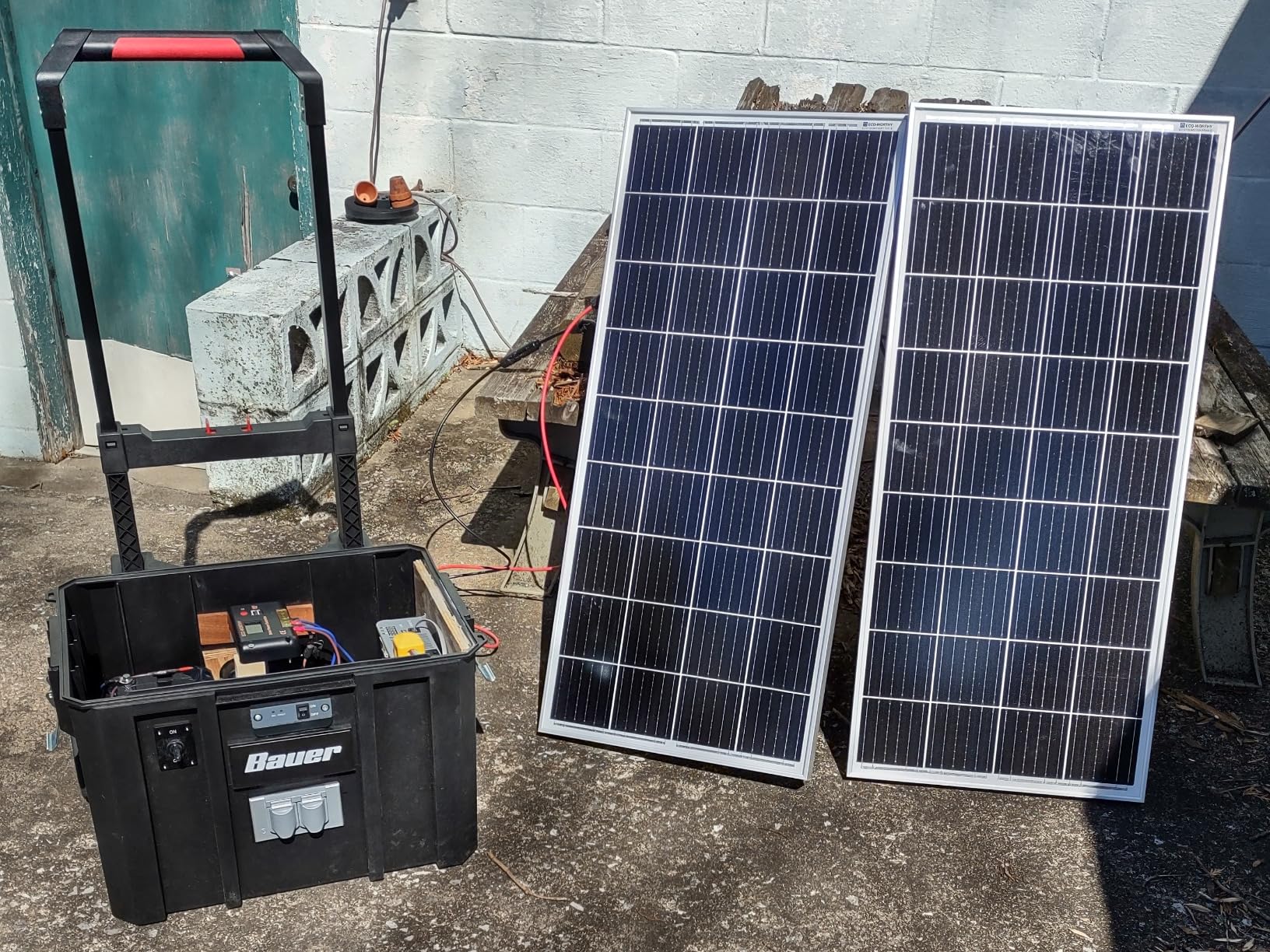
The panel technology is among the best in this roundup. The N-Type monocrystalline cells run at 25% efficiency with a dual-sided design claimed to add up to 15% extra output, which is unusual for a flush RV roof mount where a bifacial-style rear gain is usually lost to the roof surface. Rough daily output is around 800 watt-hours on four hours of sunlight.
The battery is the real long-term asset. A 50Ah LiFePO4 pack rated for 4000 to 15000 deep cycles far outlasts a typical lead-acid bank, and the XT60 port plus adapter adds Type-C and USB charging outputs. Anderson plug-and-play connectors and multi-protection round out the package.
Who this kit suits
First-time off-grid builders and anyone who wants a working system this week rather than a project spanning three weekends. If you have been reading forum threads about how much lithium you actually need and how big the inverter has to be, this bundle answers those questions by default.
It is also a sensible trailer or second-RV kit, where a self-contained 50Ah lithium pack you can unplug and carry is more useful than a permanently installed battery bank.
Where it falls short
The XT60 interface is capped at 30A maximum input and output. That is fine at 200W of panel, but it is a hard ceiling if you later expand the array, and it constrains inverter draw on a larger battery. Plan the system size around it or plan to replace the connector.
It is also heavier and far bulkier than a panel-only kit, and the 4.1 rating with 341 reviews reflects occasional setup and connection questions from buyers who assumed a complete bundle would be self-explanatory. Read the wiring diagram before you start rather than after.
9. XINPUGUANG 100W Flexible Solar Panel Kit for RV and Boat
XINPUGUANG 100W Flexible Solar Panel Kit 12V Off Grid System for RV Boat
100W flexible monocrystalline panel
4.0 lb and 0.098 inch thick
Bends up to 260 degrees
10A controller included
Pros
- Weighs about 4 lb and is 0.098 inch thick so it mounts on curved surfaces
- Bends up to 260 degrees for RV roofs
- boat decks
- cabins and tents
- 210MM monocrystalline cells at 23-24% conversion efficiency with built-in bypass diode
- IP67 waterproof with 5400Pa snow and 2400Pa wind load ratings
- 10A controller with short-circuit
- open-circuit
- reverse and overload protection
Cons
- Flexible panels produce less than rigid glass modules of the same wattage
- 10A controller caps charging current well below panel peak
- Only a 136-review history so long-term data is limited
Everything else in this roundup is a rigid aluminum and glass module, which means brackets, bracket height and a flat roof. This one weighs about 4 pounds, measures 0.098 inches thick and bends up to 260 degrees, so it lies flat across a curved RV roof, a boat deck or a cabin wall where a rigid panel physically will not conform.
The cells are 210MM monocrystalline with 23-24% conversion efficiency and a built-in bypass diode, which is a strong efficiency number for a flexible panel. Sealing is IP67 with 5400Pa snow and 2400Pa wind load ratings, and the 10A charge controller includes short-circuit, open-circuit, reverse and overload protection plus compatibility with lead-acid, gel and lithium phosphate batteries.
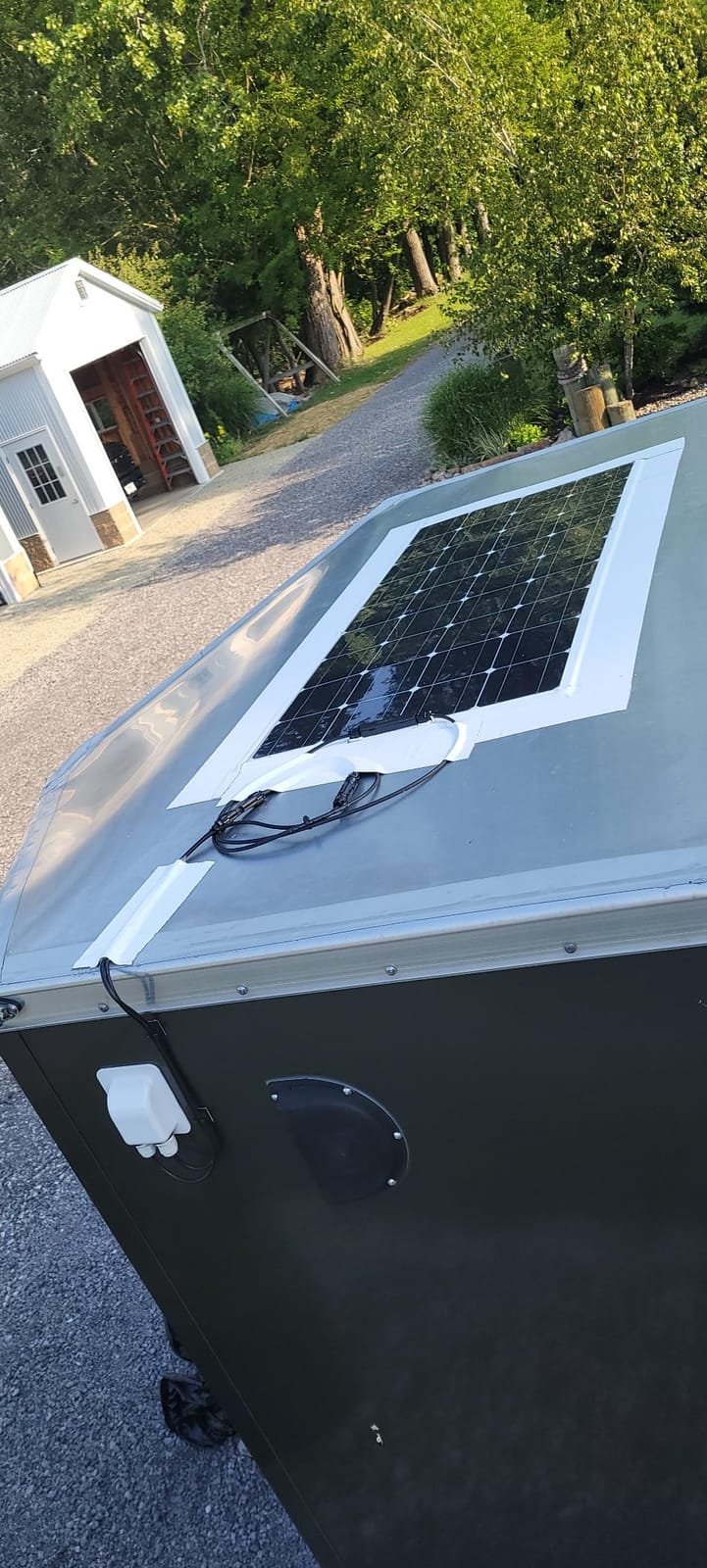
Here is the honest expectation-setting. Flexible panels of a given wattage reliably produce less than rigid glass modules, because there is no air gap behind the cells and the thin laminate runs hotter under direct sun. If you need a specific wattage to run your loads, buy the next size up in rigid and accept the brackets.
The 10A controller is the harder constraint. Against a 100W panel, a 10A controller cannot pass the panel’s peak current, so no matter how bright the sun is you are capped well below the panel’s capability. Most users identify the controller as the limiting factor, and it is the first thing to upgrade.
Who this kit suits
Boats, Airstream-style curved trailers, and Class B vans where a rigid panel would force you to drill into a surface you would rather leave alone. This is the lightest kit in the roundup at about 4 pounds, which matters on older roofs with limited structural margin.
It is also a good winter or snow-country option given the 5400Pa snow load rating, since there is no bracket height to catch drifting snow.
Where it falls short
Output per watt is the trade. You get a panel that fits almost anywhere and produces less from the same nominal rating, and the 10A controller tightens that further. For a 12V fridge and phone charging, that is completely adequate; for anything heavier, it is not.
With 136 reviews, the long-term durability record is thinner than any other kit here, and flexible panels are inherently more vulnerable to puncture than glass. Mount it where nothing walks on it and nothing slides across it.
10. ECO-WORTHY 400W Premium Kit with 40A MPPT Controller and Bluetooth Module
ECO-WORTHY 400 Watt 12 Volt Premium Solar Panel Kit :4pcs 100W Solar Panel+ 40A MPPT Charge Controller+ Bluetooth Module+ Mounting Z Brackets, 400W 12V Solar Power Off Grid System for Home, RV, Boat.
Four 100W monocrystalline panels
40A MPPT controller
About 1.6 kWh per day
Bluetooth 5.0 monitoring
Pros
- Four 100W panels producing about 1.6 kWh per day in good sun
- 40A MPPT controller with 99% tracking efficiency and 98% peak conversion
- BT-02 Bluetooth 5.0 module streams panel
- battery and load data from up to 82 feet
- Each panel includes 35-inch cables and a Y-branch
- 3.2mm low-iron glass in a 35mm aluminum alloy frame rated for 2400Pa wind and 5400Pa snow
Cons
- Four panels plus controller make a heavy
- space-hungry roof installation
- Only 120 reviews so long-term field history is short
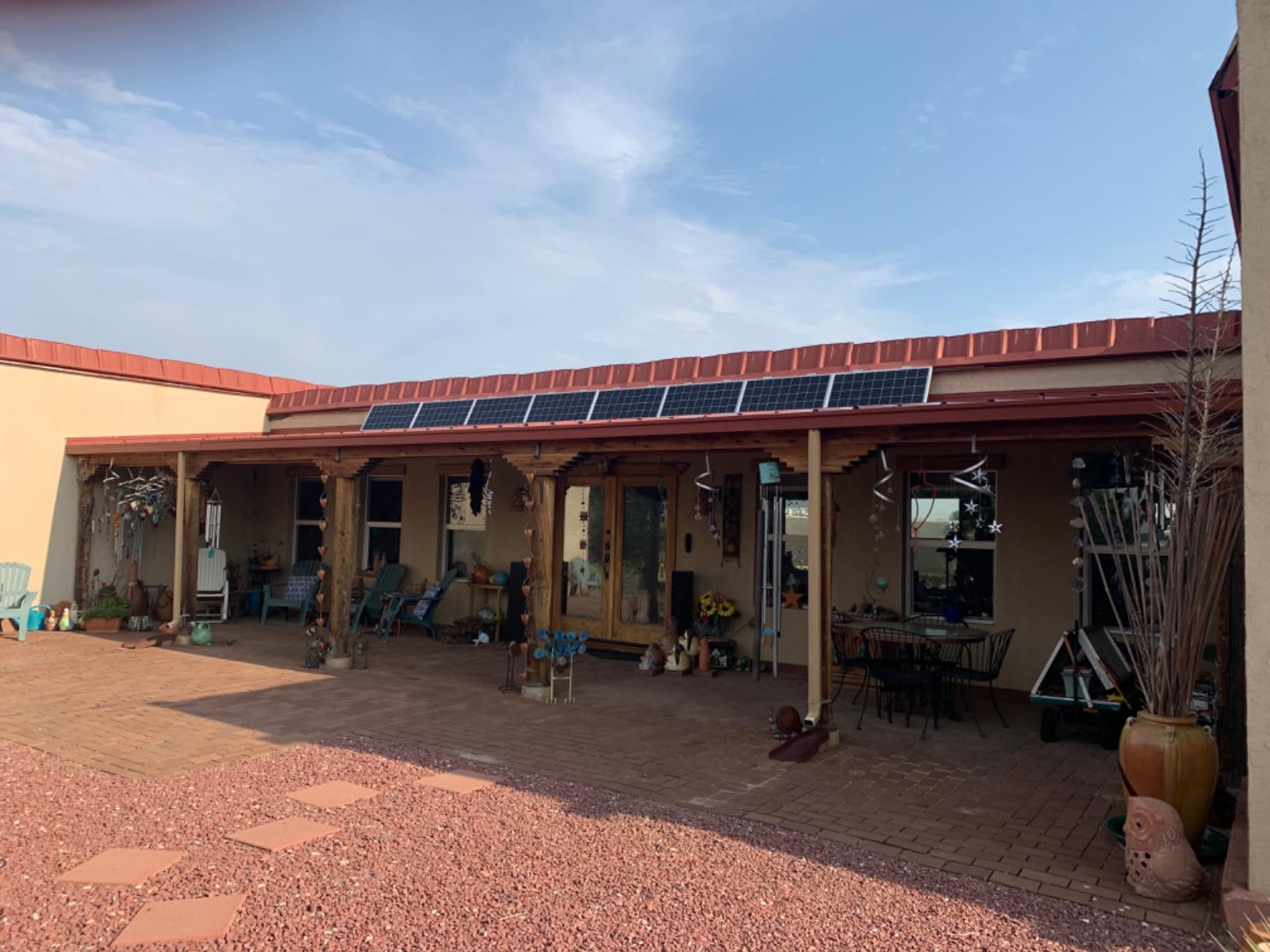
This is the biggest array in the roundup at around 1.6 kilowatt-hours per day in good sun, and it pairs four 100W monocrystalline panels with a 40A MPPT controller rated for 99% tracking efficiency and 98% peak conversion. If you are trying to run more than a fridge and some lights, this is the kit that gets you meaningfully closer to that goal.
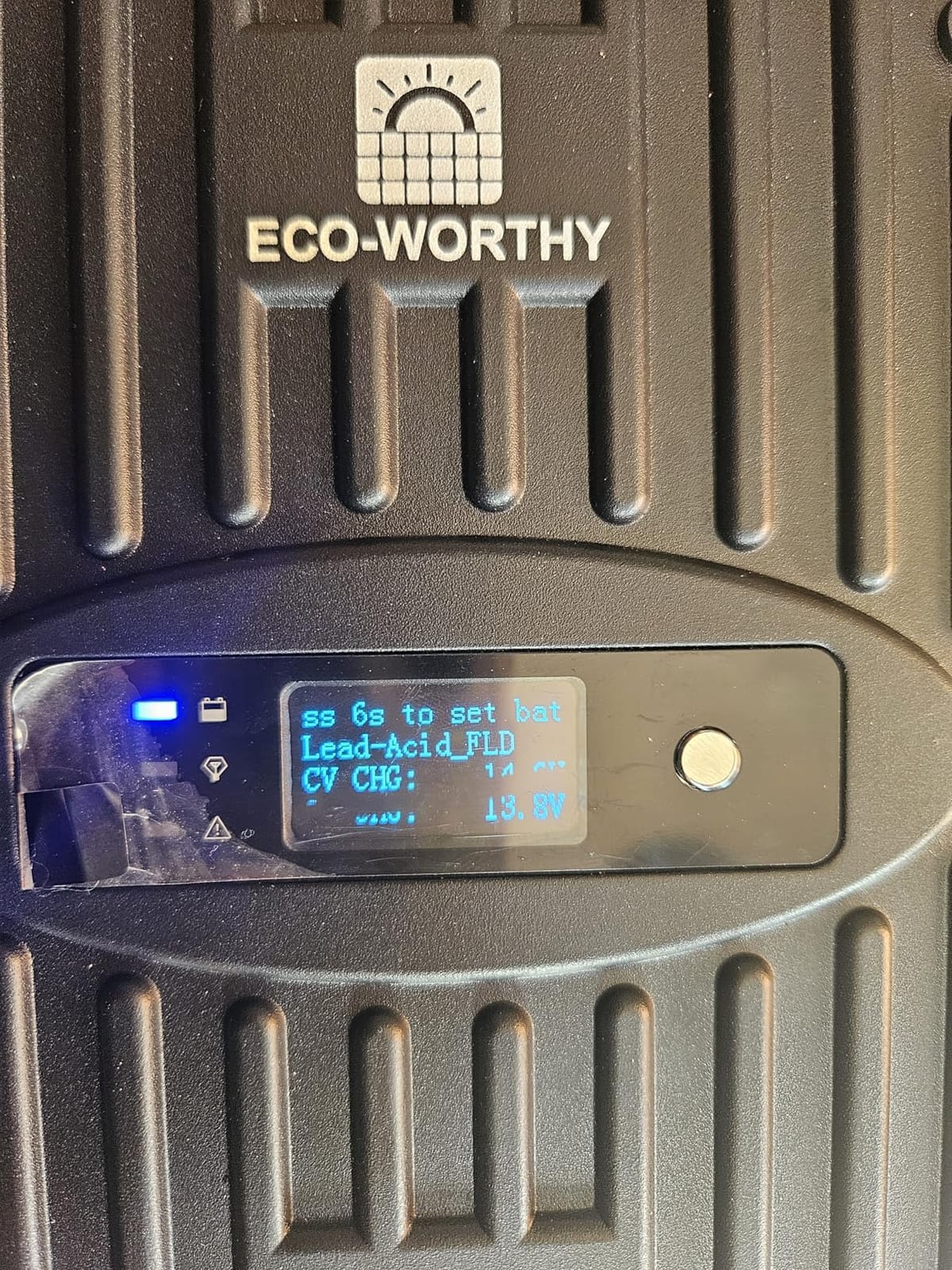
The monitoring is a step ahead of everything else here. The BT-02 Bluetooth 5.0 module streams panel, battery and load data to your phone from up to 82 feet, so you can watch state of charge from inside the cab without opening a cabinet in the rain. Overcharge and overdischarge protection is built in.
Build quality details are good: 3.2mm low-iron glass in a 35mm aluminum alloy frame, 2400Pa wind and 5400Pa snow ratings, pre-drilled rear rails, and a pair of 35-inch cables with a Y-branch on every panel so the wiring is genuinely plug-and-play rather than a crimping exercise. The frame carries a stated upper temperature rating of 104 degrees Celsius, the highest published here, which is a reasonable signal for summer heat performance.
Installation is described by reviewers as straightforward thanks to the pre-drilled rails, Y-branch cables and included instructions, which matters when you are balancing four panels on a roof and need everything to land square on the first attempt.
Who this kit suits
Large Class A and C motorhomes with a full uninterrupted roof section, and full-time RVers who want a serious fixed array without assembling components from four suppliers. The Bluetooth monitoring makes it the most user-friendly large system to live with day to day.
Where it falls short
Total weight and roof space are the practical reservations, and they are the same ones that rule this kit out for smaller rigs. Four panels plus a 40A controller is a heavy, space-hungry installation, and at 32.66 kilograms for the kit you should verify your roof’s structural margin before you commit.
With 120 reviews, the long-term field history is still short. The engineering claims are specific and checkable, but the panel has not been on roofs for the two decades the 25-year output language implies, and that is a normal risk profile for a newer kit.
11. ZOUPW 220W N-Type Kit with 30A LCD PWM Controller
ZOUPW 220 Watt Solar Panel Kit for 12V/24V Battery, 2Pcs 110W 25% High-Efficiency Monocrystalline PV Module Power Charger with 30A LCD PWM Charge Controller for Off-Grid RV Marine Boat Rooftop
Two 110W N-Type 16BB panels
About 1.1 kWh per day
25.6% efficiency
30A LCD PWM controller
Pros
- Two 110W N-Type panels generating up to 1.1 kWh per day with five hours of full sun
- N-Type 16BB cell structure at 25% efficiency resists light-induced degradation
- 30A PWM controller auto-detects 12V or 24V with LCD monitor and dual USB ports
- IP68 waterproof with a corrosion-resistant aluminum frame
- Compact two-panel footprint fits Class B camper vans
Cons
- PWM controller is less efficient than an MPPT of the same rating
- Controller caps input at 400W so expansion past 220W needs a new controller
- Small base of 78 ratings limits confidence in long-term durability
The ZOUPW 220W is the technology play of this roundup. Two 110W panels built on N-Type 16BB monocrystalline cells at 25% efficiency produce up to 1.1 kilowatt-hours per day with five hours of full sun, and N-type cells are the current generation because they resist light-induced degradation, meaning output holds up over decades better than older P-type cells.
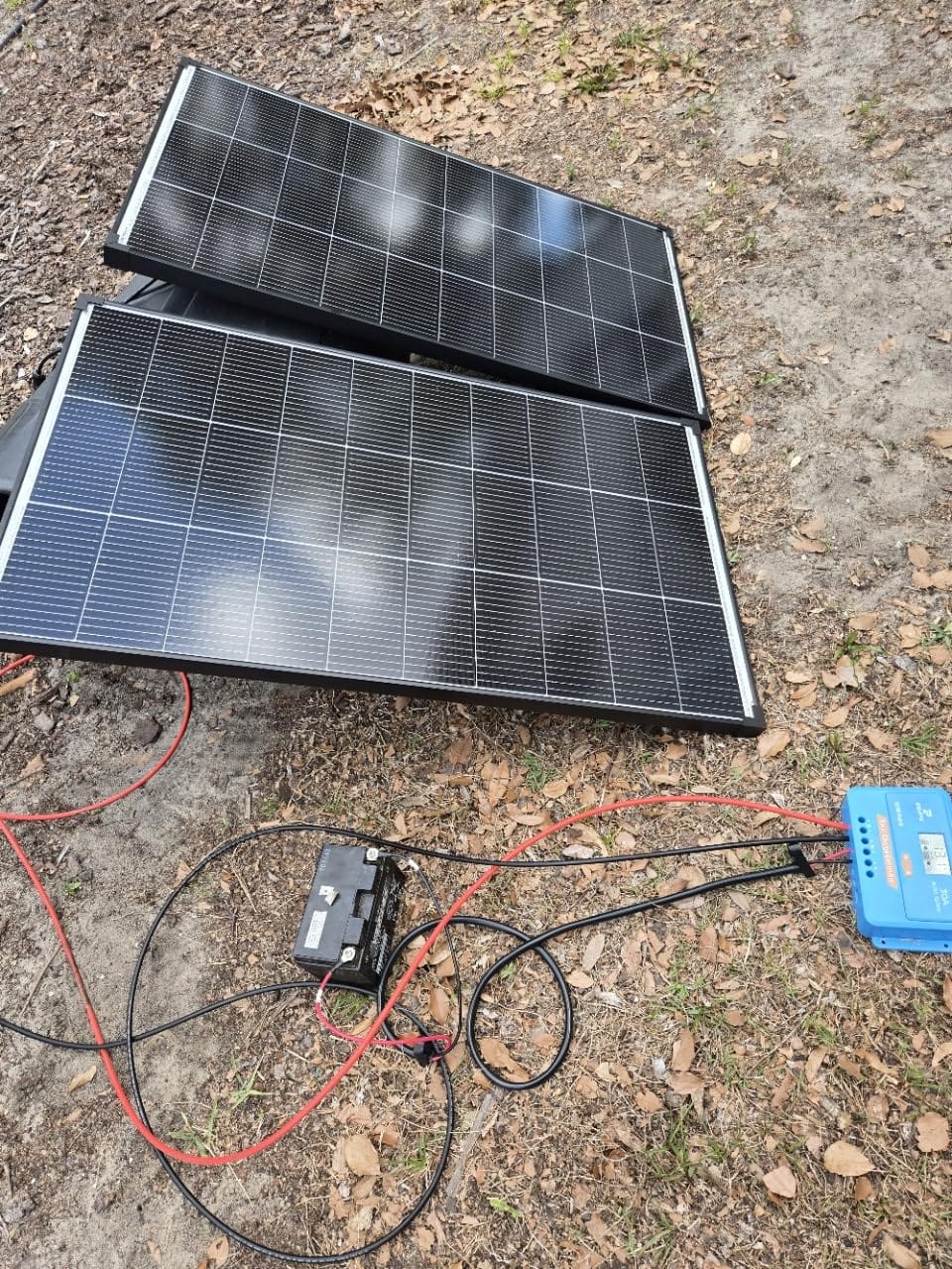
The layout is what makes it interesting for small rigs. Two compact panels rather than one large one means you can fit roughly 220W onto a Class B van roof where a 400W four-panel array would be impossible, and reviewers specifically call out that footprint as the deciding factor.
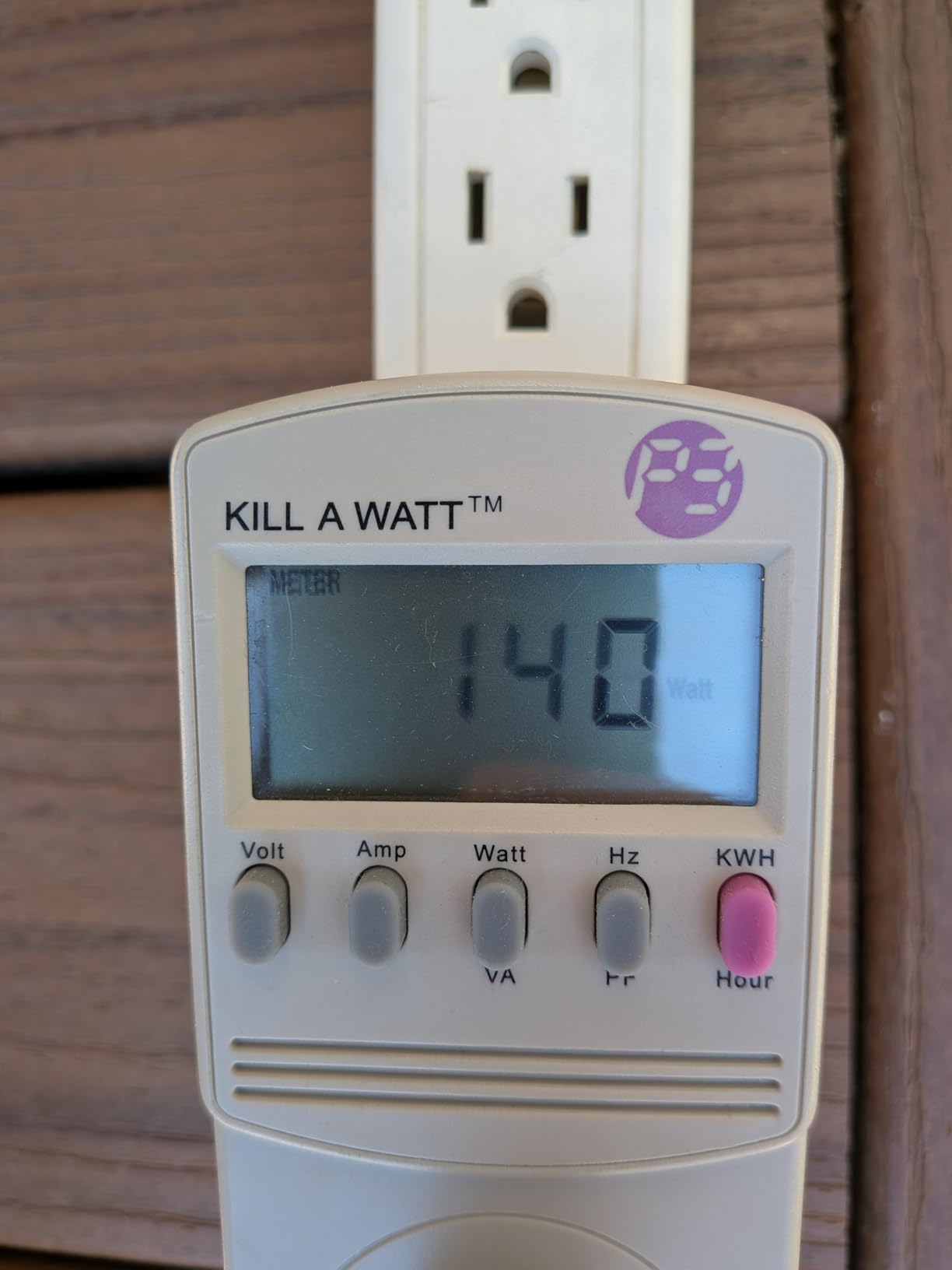
The 30A PWM controller auto-detects 12V or 24V systems, has an LCD monitor and dual USB ports, and runs three-stage charging compatible with lithium, gel, sealed and flooded batteries. Anti-shade bypass diodes and reverse polarity and overcharge safeguards are included. Sealing is IP68 with a corrosion-resistant aluminum frame, and the warranty is 10 years on the panels and 2 years on the controller with 7×24 support.
Note the expansion ceiling. The controller supports up to 400W of input, which sounds generous, but the kit ships at 220W and adding a third or fourth panel means replacing the controller anyway.
Who this kit suits
Class B camper vans, small trailers and any roof where two panels fit but four do not. The 10-year panel warranty is the longest published in this roundup, and N-type cell durability means you are buying a system designed to still perform in a decade.
It also suits anyone who wants the highest cell efficiency available at this size without moving up to a 400W array.
Where it falls short
The PWM controller gives back some of the efficiency the cells provide, and on a 25% N-type panel that mismatch is more noticeable than on a 19.5% budget panel. A 30A MPPT controller would pair better with these modules, but that is an additional purchase and a rewiring job.
With only 78 ratings, this is the thinnest review base in the roundup. The specifications are strong and the 10-year warranty is credible, but you are buying into a newer product with less field evidence than the Renogy and ECO-WORTHY kits, and some reviews note the PWM controller leaves efficiency on the table.
How to Choose a Solar Panel Kit for an RV Roof
Now that you have seen the kits, here is how to pick one without overthinking it. Five questions decide the purchase, and none of them involve the largest wattage number on the listing.
Size your kit from daily watt-hours, not nameplate watts
Start by adding up what you actually draw in a day, in watt-hours. A 12V fridge running roughly a third of the day is about 250 to 400 watt-hours. LED lighting, a phone charger, a laptop and a small fan together add another 150 to 300. A rooftop air conditioner adds 1,000 watt-hours for every hour it runs, which is why nobody runs it all day on solar alone.
Then divide that daily total by your peak sun hours, and add a 30 to 50% buffer. Most of the continental United States gets four to six peak sun hours, so a camper using 600 watt-hours a day in a five-hour location needs about 120 watts of panels, and you should size for 160 to 180 to cover clouds, heat loss and winter. In the Pacific Northwest or the Upper Midwest, assume three peak sun hours and size accordingly.
A rough guide: 100W covers a maintenance trickle and light loads, 200W runs a fridge plus electronics for several days, 400W supports heavier continuous use on a large rig, and 800W is where you approach partial air conditioner capability. Our related guide to the best solar panel kits for tiny homes works through the same math for a different roof size.
Understand PWM versus MPPT controllers
A PWM (pulse width modulation) controller is the older, simpler design. It runs the panel at battery voltage and throws away the excess, so efficiency is typically in the 80 to 85% range. An MPPT (maximum power point tracking) controller runs the panel at its true optimum and converts down to battery voltage, reaching 95% and above.
For a small 100W panel in mild weather, the difference is a few watt-hours a day and PWM is fine. For a 200W to 400W array, or for anyone wintering in cool or frequently cloudy conditions, MPPT pays for itself in recovered energy. The two 400W kits in this roundup are the MPPT options, and both include Bluetooth monitoring.
Pick the right panel technology
Monocrystalline is the default choice now and appears in all eleven of these kits, with efficiency from 19.5% to 25.6%. Polycrystalline is cheaper and less efficient, which is why you see it less. Flexible panels, like the XINPUGUANG here, are the answer when weight and conformability matter more than output per watt.
Bifacial panels collect light on the rear face as well, which is genuinely useful on a ground mount or a tilted array. On a flush-mounted RV roof with almost no air gap underneath, that rear gain is largely lost, so we would not pay a premium for it here. N-type cells, which the ZOUPW and the ECO-WORTHY all-in-one kit use, are the current generation: higher efficiency and better resistance to light-induced degradation.
Measure your roof before you buy
This is the step every competitor skips and the one that decides whether a kit works for your specific RV. Measure the flat, uninterrupted rectangle between roof vents, air conditioner shrouds, antenna mounts and the front cap, then subtract 4 to 6 inches of clearance on all sides for air flow. Roof panel output drops measurably when it runs hot, and clearance is what keeps it from baking.
Also check your roof’s structural margin. The rigid kits in this roundup range from about 15 pounds to more than 70 pounds. Most RV roofs are rated for considerably more than that, but on older aluminum or fiberglass rigs check the seams and avoid mounting across a soft span. Keep a walking path clear for vent access and for anything you need to reach on the roof, and remember that a high profile bracket on a highway acts like an airfoil in crosswind. If you are protecting a rig long-term, our guide to the best RV covers covers storage-side protection between trips.
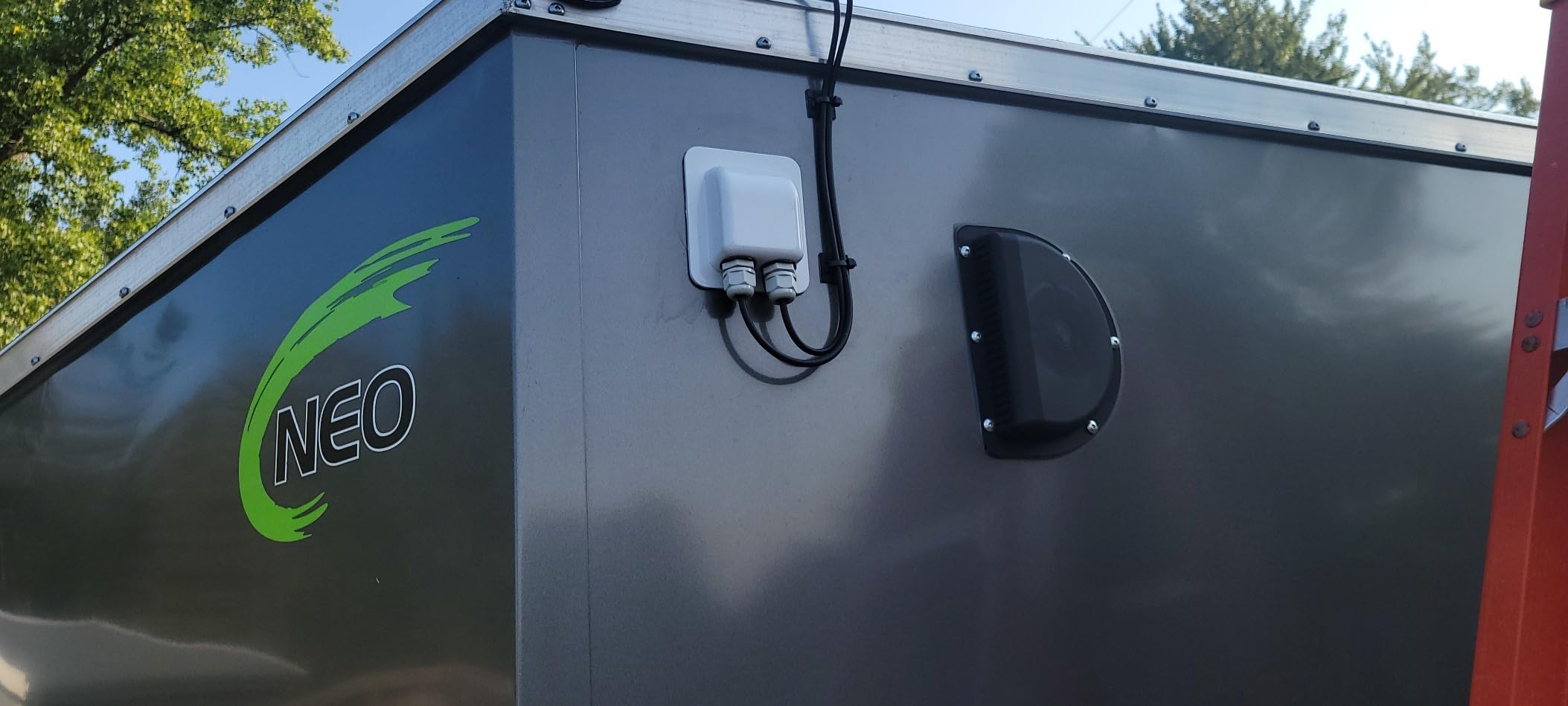
On sealing, r/GoRVing veterans report years of trouble-free service with 3M VHB double-sided tape combined with aluminum mounts, and specifically warn against gluing a flexible panel directly to the roof. Drilled and sealed Z brackets remain the standard because they are mechanically secure and removable, and that removability is a resale point.
Know what your kit leaves out
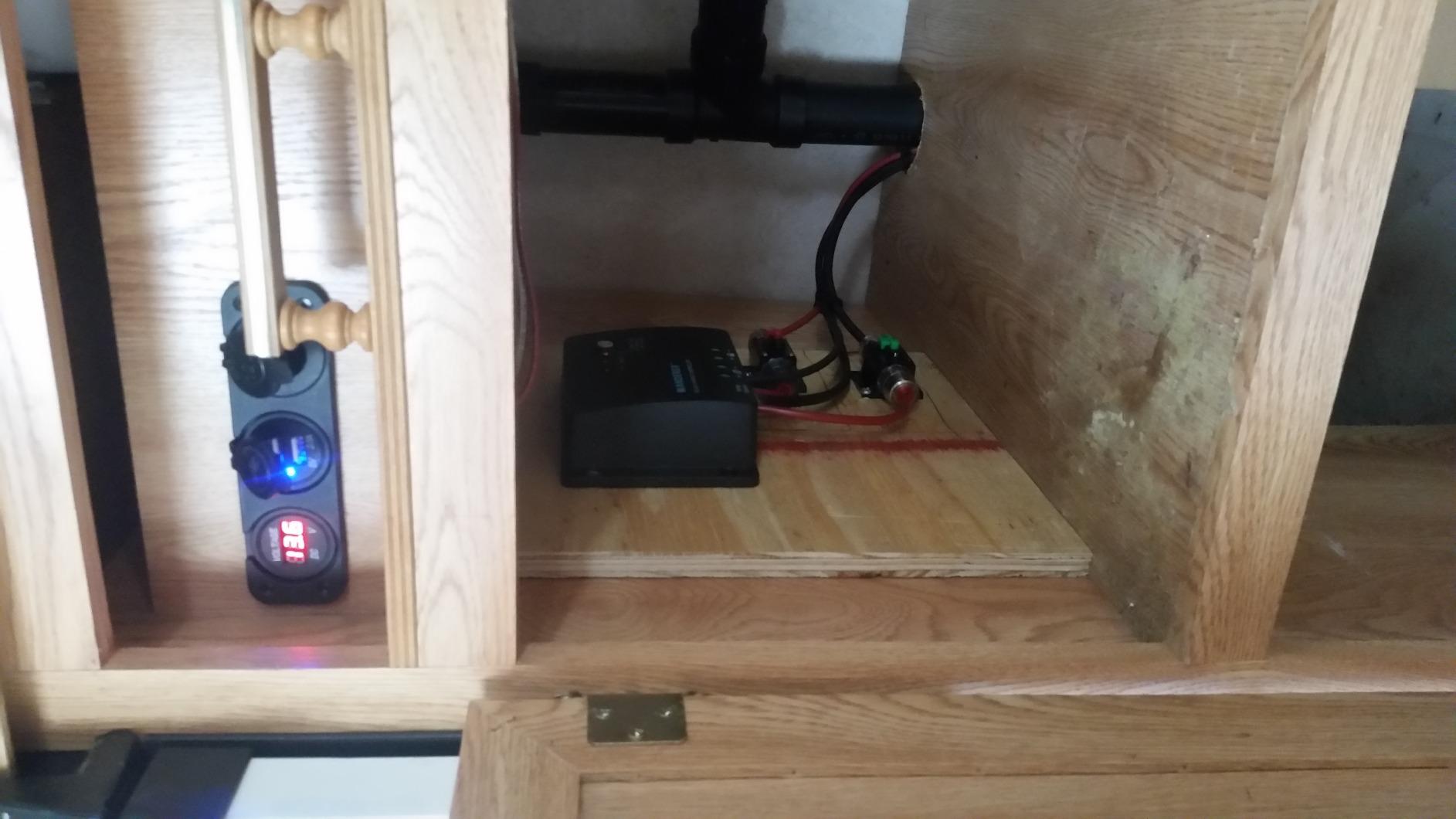
Almost every kit in this roundup stops at the panel, the controller, brackets and cable. You will still need a battery bank sized to your usage, a fuse on the positive lead, a disconnect or cut-off switch, a proper roof cable entry fitting, and sealant for every penetration. Add an inverter if you want to run 120V appliances, and a monitor if you want visibility into state of charge.
The exception is the ECO-WORTHY all-in-one kit, which includes the battery and inverter. That is a legitimate choice for a first system, but it also fixes you at 50Ah and a 600W inverter, which is not much for a family of four running a microwave.
Three installation mistakes that ruin RV solar kits
These come up repeatedly across r/rvlife, r/RVLiving and r/SolarDIY, and they cause most of the failures we see in reviews.
1. Wiring a panel directly to the battery with no charge controller. As r/rvlife puts it plainly, panels should never be hooked straight to a battery. Without regulation, charging voltage swings with temperature and weather, and lead-acid or lithium banks get cooked. This is the mistake with the worst consequences.
2. Undersized or unfused wiring. Undersized cable drops voltage over distance and generates heat, and a missing fuse means a chafe or a water intrusion becomes a fire rather than an inconvenience. Buy 10 AWG for runs of this length rather than the thin wire that arrives in some kits.
3. Sealing the penetration after mounting, or using the wrong sealant. Drill from the inside out with a step bit, clean both surfaces, and use a polyurethane or butyl sealant rated for the roof material. Then check the joint again after your first heavy rain. If the rig is not sitting level, the side you drill from matters less than it seems, which is worth knowing before you clamp a step bit to the ceiling.
Two more habits worth building: a real disconnect switch so you can kill the array while working on the battery, and a walk-around before you leave the site to confirm no cable is pinched under a bracket. Our picks for the best RV leveling systems are worth considering if you plan to work on the roof often, since a level rig makes bracket alignment far more predictable.
Set realistic expectations for real-world output
Nameplate wattage is measured under laboratory conditions at 25 degrees Celsius. A black panel on an RV roof in July can run 25 to 30 degrees above ambient, and every degree of panel temperature rise costs roughly 0.4 to 0.5% of output. That is why a 100W panel rated at 500 watt-hours per day may deliver closer to 350 to 400 on a hot, clear afternoon with no wind.
On durability, expect 25 years of rated output on quality monocrystalline panels, and treat the 25-year language in this roundup as a performance guarantee rather than a physical lifespan claim. Warranty structure matters more than the headline number: 10 years on panel material and workmanship, as on the Renogy 100W and the ZOUPW 220W, is a stronger signal than a 1-year blanket product warranty.
Finally, on the question owners ask most: no, a roof kit alone will not run your air conditioner all day. The honest benchmark from r/RVLiving is roughly 400Ah of lithium, a 3,000W inverter and 500W of roof solar, and even that combination buys a few days, not unlimited cooling. What roof solar does replace reliably is the generator for everything else.
Frequently Asked Questions
What size solar panel for a camper?
Add up your daily watt-hour use, divide by your local peak sun hours, then add a 30 to 50% buffer. A camper using 600 watt-hours a day in a five-peak-sun-hour location needs about 120 watts of panels, so size for 160 to 180 watts. 100W covers a maintenance trickle, 200W runs a 12V fridge plus electronics, and 400W supports heavier continuous use on a large rig.
How many solar panels would it take to power a camper?
One 100W panel handles a maintenance trickle and phone charging. Two 100W panels producing about 1000 watt-hours per day will run a 12V fridge, lighting and electronics for several days off-grid. Four 100W panels at around 1.6 kWh per day support heavier continuous loads on a large rig, and roughly 800W is where you approach partial rooftop air conditioner capability.
Do RV solar kits include a battery and inverter?
Most do not. A typical roof kit contains panels, a charge controller, mounting brackets and cabling, and leaves you to source the battery bank, inverter, fuse, disconnect switch, roof cable entry and sealant. The ECO-WORTHY 200W all-in-one kit in this roundup is the exception, with a 50Ah LiFePO4 battery and a 600W inverter included.
Will an RV solar kit run an air conditioner?
Not all day, and not on a typical roof kit alone. A rooftop air conditioner draws roughly 1,000 watt-hours for every hour it runs. The realistic full-time benchmark is around 400Ah of lithium, a 3,000W inverter and 500W of roof solar, and even that buys a few days rather than unlimited cooling. Roof solar reliably replaces the generator for everything except cooling.
Do I need a charge controller, and does it have to be MPPT?
A charge controller is essential on any RV system, because without one the panel output tracks voltage swings and can damage the battery bank. PWM is acceptable for a single 100W panel in mild weather, but MPPT recovers 95% or more of the panel output versus 80 to 85% for PWM, and the gap widens in cool or cloudy conditions and at higher wattages.
Can I connect these panels to a lithium LiFePO4 battery bank?
Yes, with a controller that supports it. Most kits in this roundup list LiFePO4 compatibility alongside AGM, Gel, Flooded and Lithium Ion, and the LiFePO4 battery in the ECO-WORTHY all-in-one kit is rated for 4000 to 15000 deep cycles. Set the controller’s charging profile to the lithium mode rather than leaving it on the lead-acid default.
What is the typical lifespan of caravan solar panels?
Quality monocrystalline RV panels are commonly rated for 25 years of output performance, with most degradation occurring in the first year. Look at warranty structure as the real signal: 10 years of panel material and workmanship, as offered on the Renogy 100W kit and the ZOUPW 220W N-Type kit, is a much stronger reliability indicator than a 1-year blanket product warranty.
Final Verdict: Which RV Roof Solar Kit Should You Buy?
After working through all 11 of the best solar panel kits for RV roofs, the answer depends almost entirely on your roof size and your battery bank. For most weekend campers and anyone starting from an empty install, the Renogy 100W 12V Starter Kit is the one to buy: 22.5% efficiency, a 25-year output plan, full UL and IEC certification, and a documented path to 400W when you are ready.
For boondocking with a fridge and electronics, the Renogy 200W kit gives you the best value in the roundup at roughly 1000 watt-hours per day, and the two-panel layout places far more easily around roof obstructions. If you want a proper fixed array with phone monitoring and the best energy recovery in cool weather, the Renogy 400W kit with the 40A MPPT controller is the strongest build, provided your roof can carry 56 pounds and give four panels room.
Measure your roof before you click through, budget for the fuse, disconnect, cable entry and sealant that no kit includes, and remember the first rule from the forums: a panel wired straight to a battery is the fastest way to ruin an RV electrical system. Get the kit that fits your roof, set the controller to your battery chemistry, and check your work in the rain.