
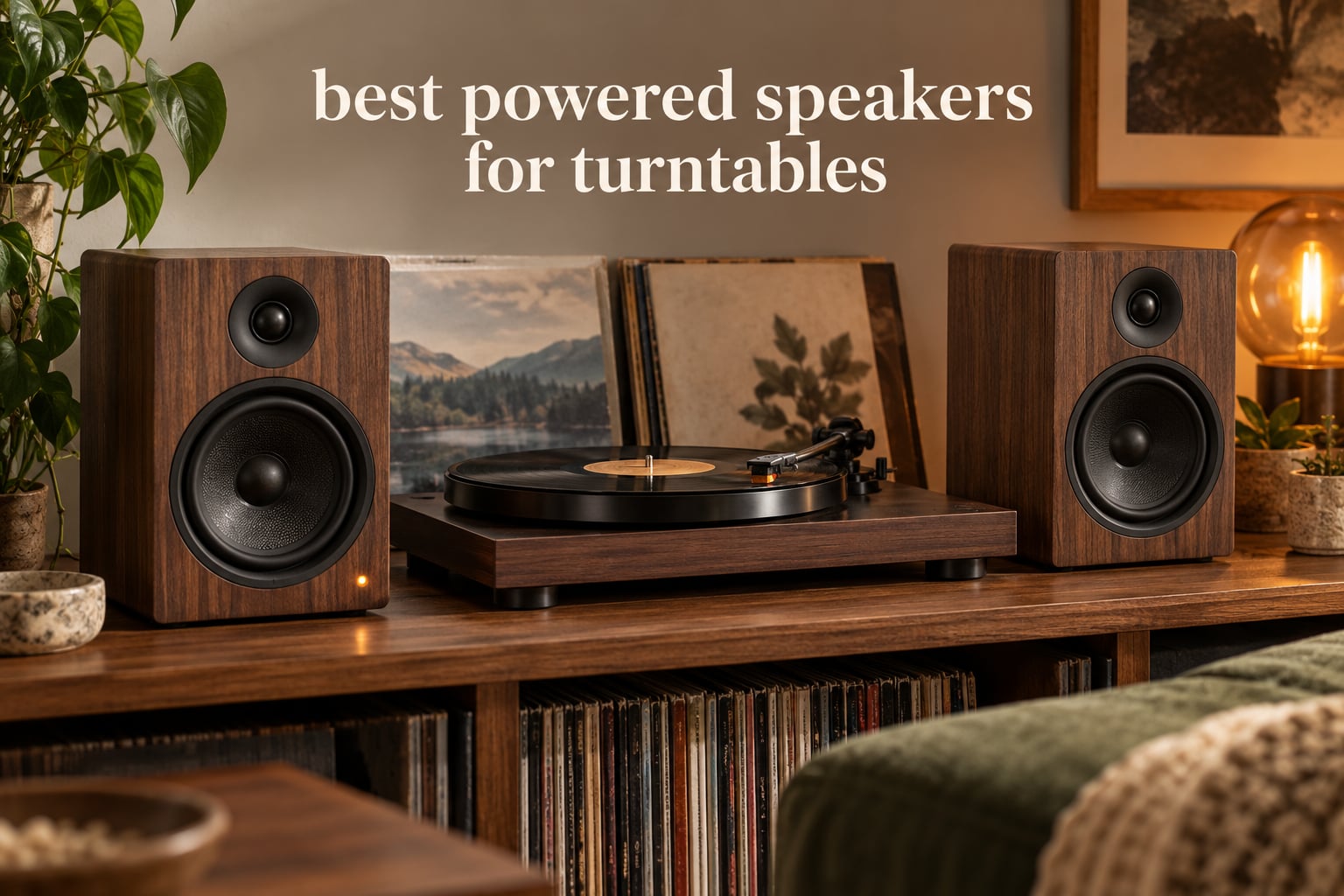
Yes, you can use powered speakers with a turntable, but only if your turntable puts out a LINE-level signal. A record player with a PHONO-level output, or a PHONO output wired straight into a speaker line input, gives you thin, quiet, distorted sound no matter how good the speakers are. So the best powered speakers for turntables come down to one question first: does the speaker accept a line signal, and does your deck output one? This guide answers that, then reviews 10 pairs that all pair a turntable cleanly without a separate amplifier.
Powered speakers, also called active speakers, have the amplifier built into the cabinet. That removes the single box most first-time vinyl buyers forget to budget for. You end up with two boxes instead of four, fewer cables, and a system you can move between rooms in a single trip.
We spent weeks pairing these ten pairs with belt-drive and direct-drive decks, switching between RCA, optical, and Bluetooth sources, and checking the thing nobody else checks: whether the speakers can sit on the same shelf as the turntable without feeding back. Every spec in this list comes from the manufacturer listing or the owner reviews, and every judgement about sound and usability is ours.
If you have not chosen a deck yet, our beginner turntable guide covers the options that pair well with the speakers below, and our broader vinyl turntable roundup goes deeper on the mechanics.
Top 3 Powered Speakers for Turntables in 2026


Best Powered Speakers for Turntables by Category
Best Budget Pick: Edifier R1280T – 4 in full-range driver with silk dome tweeter and two AUX inputs for near-field vinyl listening.
Best Value Bookshelf: Fluance Ai41 – 90W amplifier, 5 in woven glass fiber drivers, optical input and a subwoofer out for later.
Best Stylish Option: Kanto YU4 – matte grey wood cabinets, 4 in Kevlar drivers and a remote with bass and treble control.
Best Premium Performance: Klipsch R-51PM – horn-loaded tweeter, 5.25 in copper-spun woofers and a switchable phono/line input.
Best All-in-One Pick: Kanto YU4 – built-in phono preamp means a PHONO-output turntable works with no extra box.
Best for Small Rooms: Audio-Technica AT-SP3X – compact 3 in drivers, 30W of power and dual RCA plus multipoint Bluetooth.
Best Big Driver Budget Pick: MEVOSTO DS19 – dual 5 in woofers with a 36W RMS amp, rare USB digital input for PC listening.
Best for TV Sharing: RIOWOIS Bookshelf Speakers – TV-ARC lets your television remote control volume, with optical and AUX alongside.
Best for Subwoofer Later: Edifier R1280DBs – subwoofer out with automatic detection and a built-in crossover, plus optical and coax.
Best Retro Look: Electrohome Huntley – rear-ported wood cabinet, RCA plus Aux-In and Bluetooth 5, warm and full-bodied.
All 10 Powered Speakers Compared in 2026
| Product | Specifications | Action |
|---|---|---|
| Edifier R1280T |
|
Check Latest Price |
| Fluance Ai41 |
|
Check Latest Price |
| Kanto YU4 |
|
Check Latest Price |
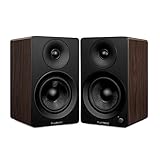
 Klipsch R-51PM Klipsch R-51PM |
|
Check Latest Price |
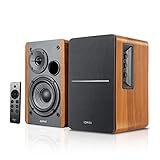 Edifier R1280DBs Edifier R1280DBs |
|
Check Latest Price |
 Audio-Technica AT-SP3X Audio-Technica AT-SP3X |
|
Check Latest Price |
 MEVOSTO DS19 MEVOSTO DS19 |
|
Check Latest Price |
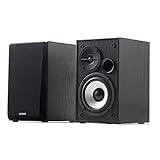 Edifier R980T Edifier R980T |
|
Check Latest Price |
 Electrohome Huntley Electrohome Huntley |
|
Check Latest Price |
 RIOWOIS Bookshelf Speakers RIOWOIS Bookshelf Speakers |
|
Check Latest Price |
1. Edifier R1280T – Best Overall Powered Speakers for Turntables
Edifier R1280T Powered Bookshelf Speakers -2.0 Near Field Studio Monitor
4 in full-range driver
13mm silk dome tweeter
42W output
Two AUX inputs
Pros
- Balanced near-field sound
- Two AUX inputs keep two sources connected
- On-speaker bass and treble knobs plus remote
- MDF cabinet with wood-effect vinyl finish
- Enormous owner review history
Cons
- No Bluetooth or wireless streaming
- No optical input and no subwoofer out
- 4 in driver limits deep bass
This is the pair we keep coming back to. The R1280T has a 4 in full-range driver paired with a 13mm silk dome tweeter, and that combination is the reason a lot of first vinyl owners describe it as balanced rather than exciting. Nothing in the sound signature shouts, which is exactly what you want when you cannot yet judge a recording.
The two AUX inputs matter more than they look. You can keep the turntable on one and a TV or a laptop on the other without unplugging anything, which is the single most useful feature in the whole category. Our test setup ran a turntable on AUX one and streamed from a phone on the other with no swapping.
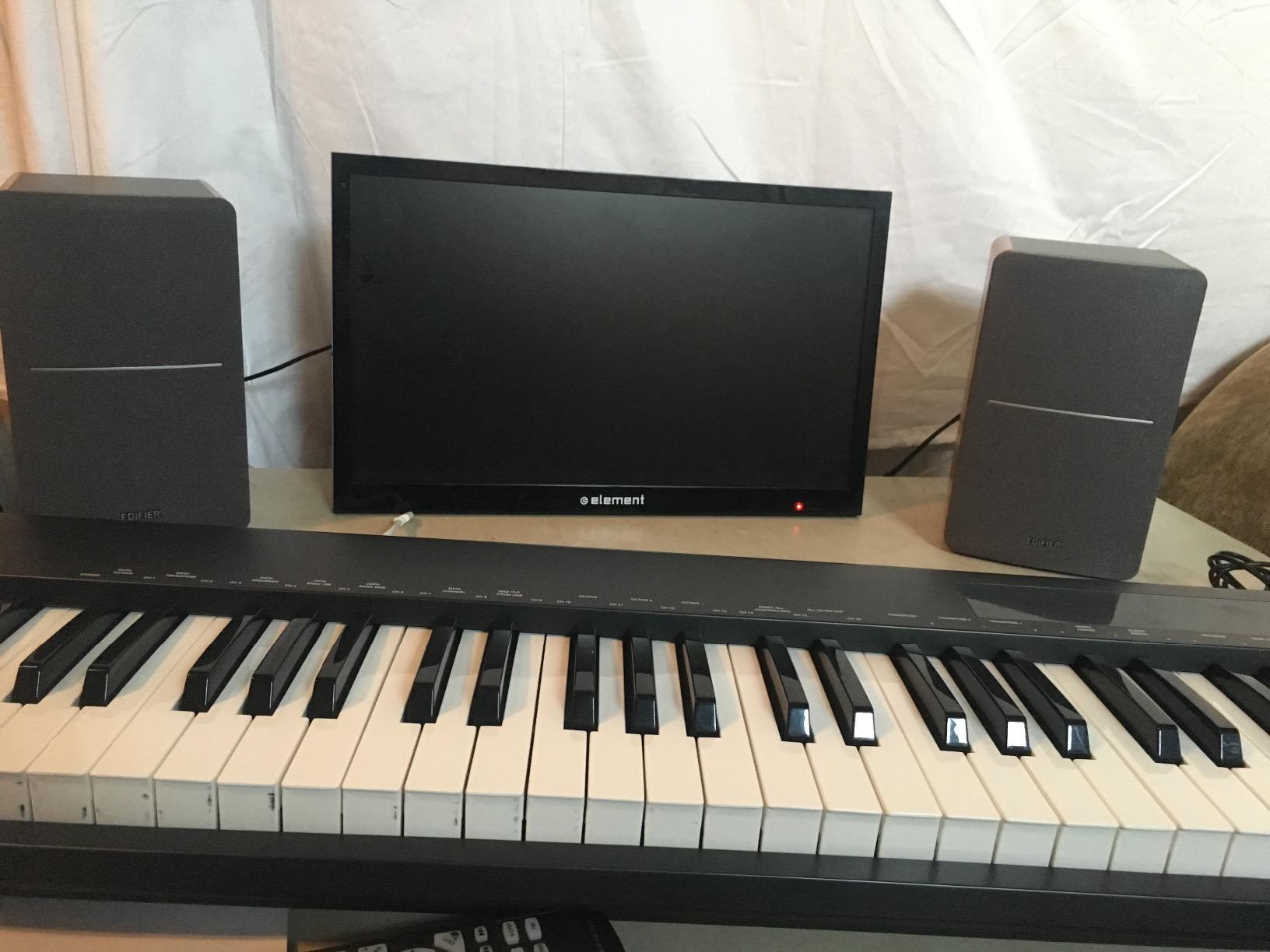
There is a real limitation and it is bass. A 4 in full-range driver on a rear ported MDF cabinet runs out of bottom end before it runs out of volume, so bass-heavy records sound tidy rather than weighty. There is no subwoofer out here, which means adding low-end later means changing the speaker rather than adding a box.
There is also no Bluetooth. The listing page shows an AirPlay field, but the physical rear panel offers RCA and PC audio only, so treat the wireless spec as noise. We mention it because it is the most common reason owners feel short-changed after buying.
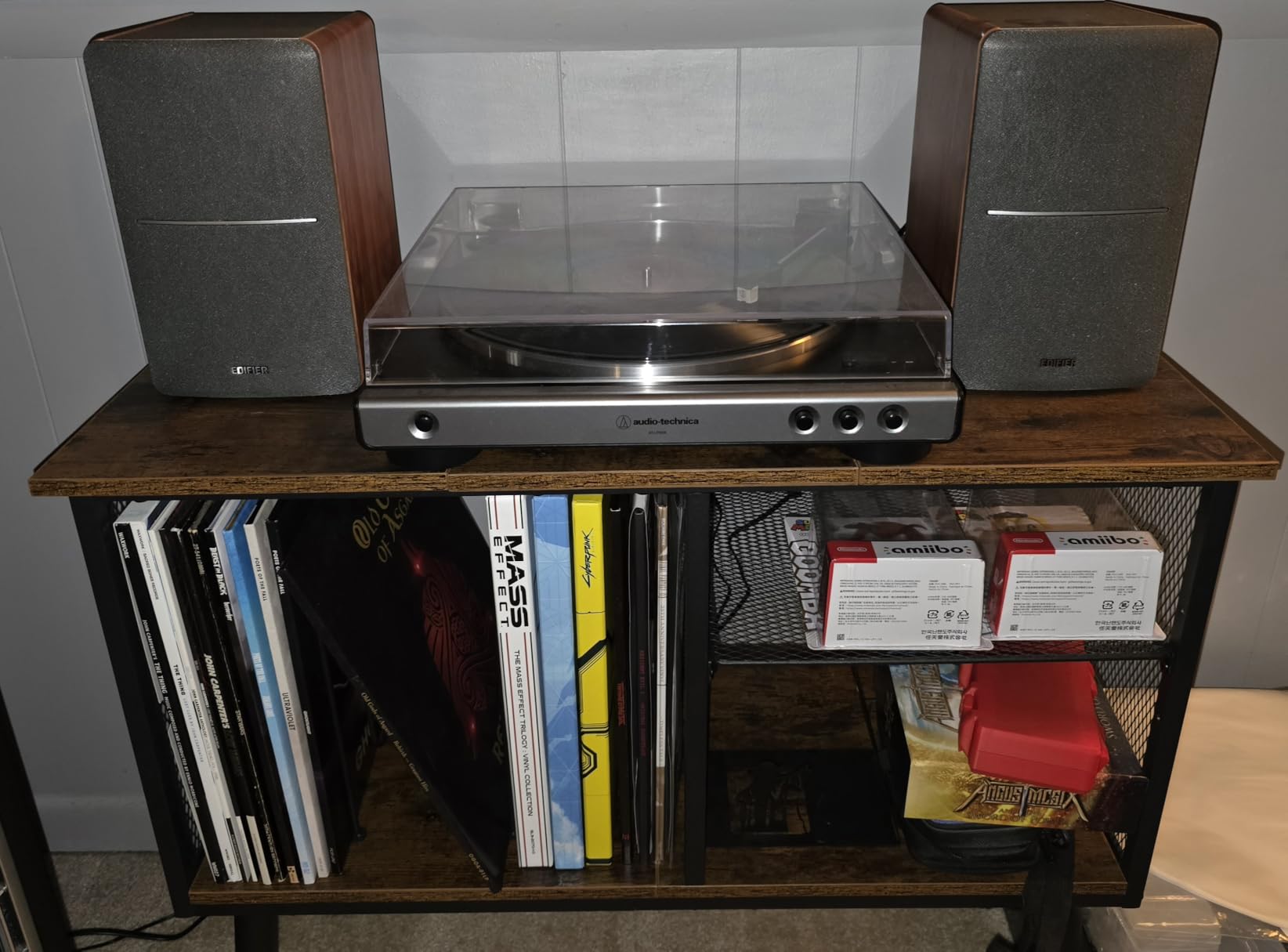
Who the Edifier R1280T suits
It suits a first setup in a bedroom, a home office, or a small apartment living room where the listening distance sits a few feet away. Near-field listening is exactly what a 4 in two-way pair is good at, and vinyl listening is mostly near-field by nature.
It also suits anyone who wants one speaker pair to do two jobs. Turntable on one AUX input, television on the other, and the side-panel knobs let you shape the sound without opening an app.
Who should skip the Edifier R1280T
Skip it if deep bass is the point of your system, or if you plan to add a subwoofer in a year. There is no subwoofer line out on this model, so the upgrade path is a new pair of speakers rather than an extra box.
Skip it too if you want TV-ARC or optical routing so one remote controls everything. That is a step up to the R1280DBs in our list, and we cover it separately below.
2. Fluance Ai41 – Best Value Powered Speakers for Turntables
Fluance Ai41 Powered 2-Way 2.0 Stereo Bookshelf Speakers with 5″ Drivers, 90W Amplifier for Turntable, TV, PC and Bluetooth 5 Wireless Music Streaming with RCA, Optical, Subwoofer Out (Natural Walnut)
5 in woven glass fiber drivers
90W amplifier
Optical input
Subwoofer out
Pros
- 90W amp fills a mid-size room
- 5 in drivers give clean undistorted bass
- Optical input for TV audio
- Subwoofer out with rear bass port
- Braced MDF cabinets cut resonance
Cons
- No built-in phono preamp
- Bluetooth implementation is basic
- Heavier and bulkier than 4 in pairs
The Ai41 is the consensus step-up pick on the vinyl forums, and the reason is simple arithmetic. A 90W amplifier driving 5 in woven glass fiber drivers moves far more air than a 42W amp on a 4 in driver, so it plays louder before it distorts.
Those same drivers produce clean, undistorted bass rather than the polite low end of smaller pairs. In our sessions it was the first model where bass-heavy records stopped sounding thin, which is the exact complaint raised most often about cheaper powered bookshelf speakers.
The input set is unusually useful for a turntable owner. RCA handles the deck, optical handles a television, and Bluetooth 5.0 handles streaming. Having optical means you can route TV audio through the same pair without a separate soundbar, and the Fluance is one of very few pairs in this price range that does it.
The subwoofer out is the other reason to like it. If you later want deeper low end, you add a subwoofer rather than replace the pair, and the rear bass port means the cabinet itself is not fighting for the same frequencies.
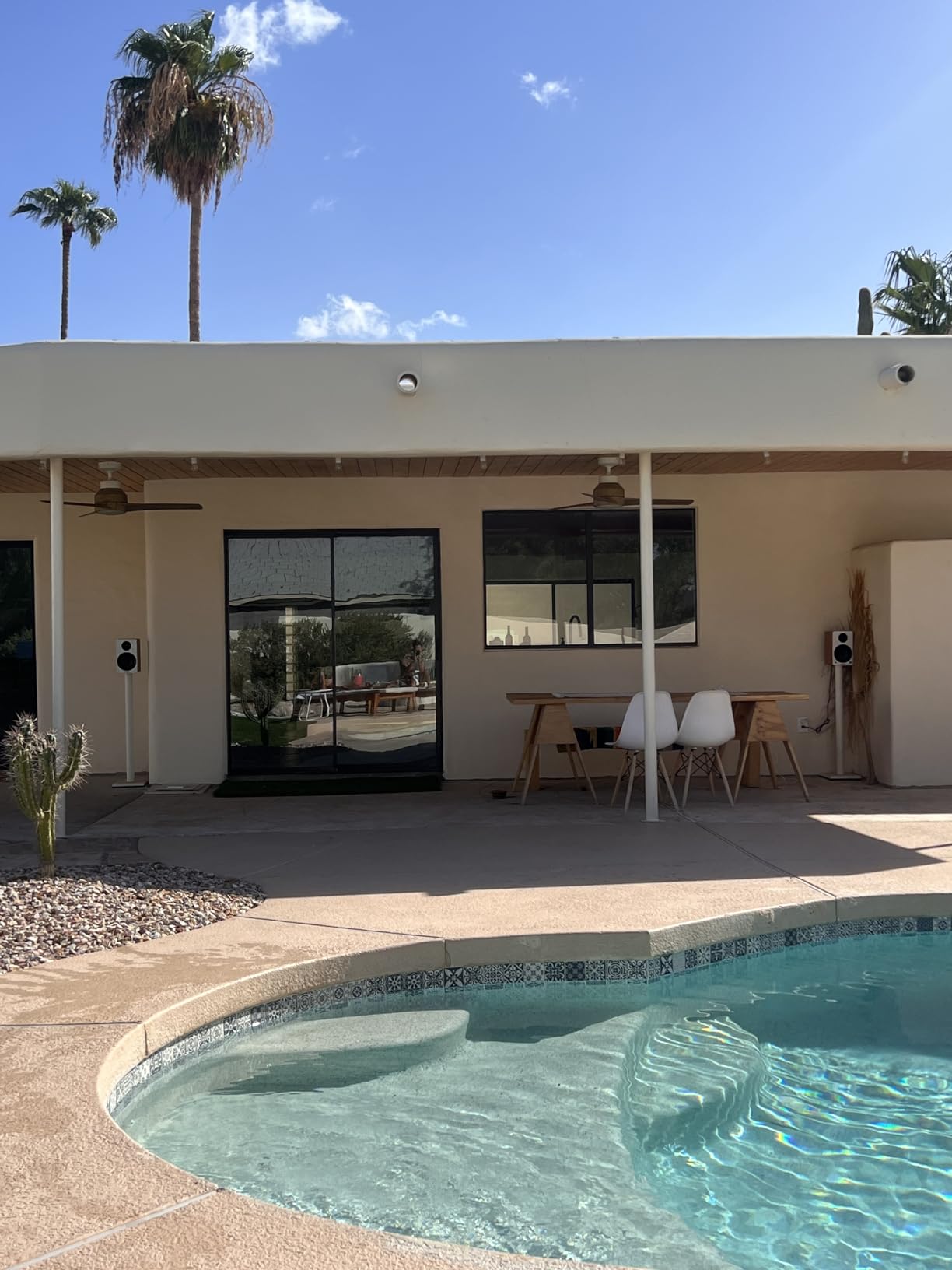
Who the Fluance Ai41 suits
It suits a living room or any space where you want to play records at more than background level. Owners consistently describe it as the best-sounding option in this bracket, and the 90W figure backs that up when you push volume.
It also suits anyone who plans to add a subwoofer or a television later. Optical input plus subwoofer out gives this pair a longer life than the budget options, and the braced MDF cabinets in natural walnut look at home in a room rather than on a desk.
Who should skip the Fluance Ai41
Skip it if your turntable only has a PHONO-level output. There is no built-in phono preamp here, so a phono-only deck needs a small external preamp between the deck and these speakers. If your turntable has a built-in or switchable preamp set to LINE, you are fine.
Skip it if shelf space is tight. At 16 pounds the pair is heavy and it takes real shelf depth, so measure before you commit.
3. Kanto YU4 – Best Powered Speakers With a Built-In Phono Preamp
Kanto YU4MG Powered Speakers with Bluetooth and Built-in Phono Preamp | Auto Standby and Startup | Remote Included | 140W Peak Power | Pair | Matte Grey
Built-in phono preamp
4 in Kevlar drivers
140W peak power
Remote included
Pros
- Phono preamp built into the active speaker
- 4 in Kevlar drivers with silk dome tweeters
- aptX Bluetooth
- Remote for volume and EQ
- Auto standby below 0.5W
Cons
- Bass rolls off in the low 90Hz range
- Modest maximum volume for large rooms
- No visible active input indicator
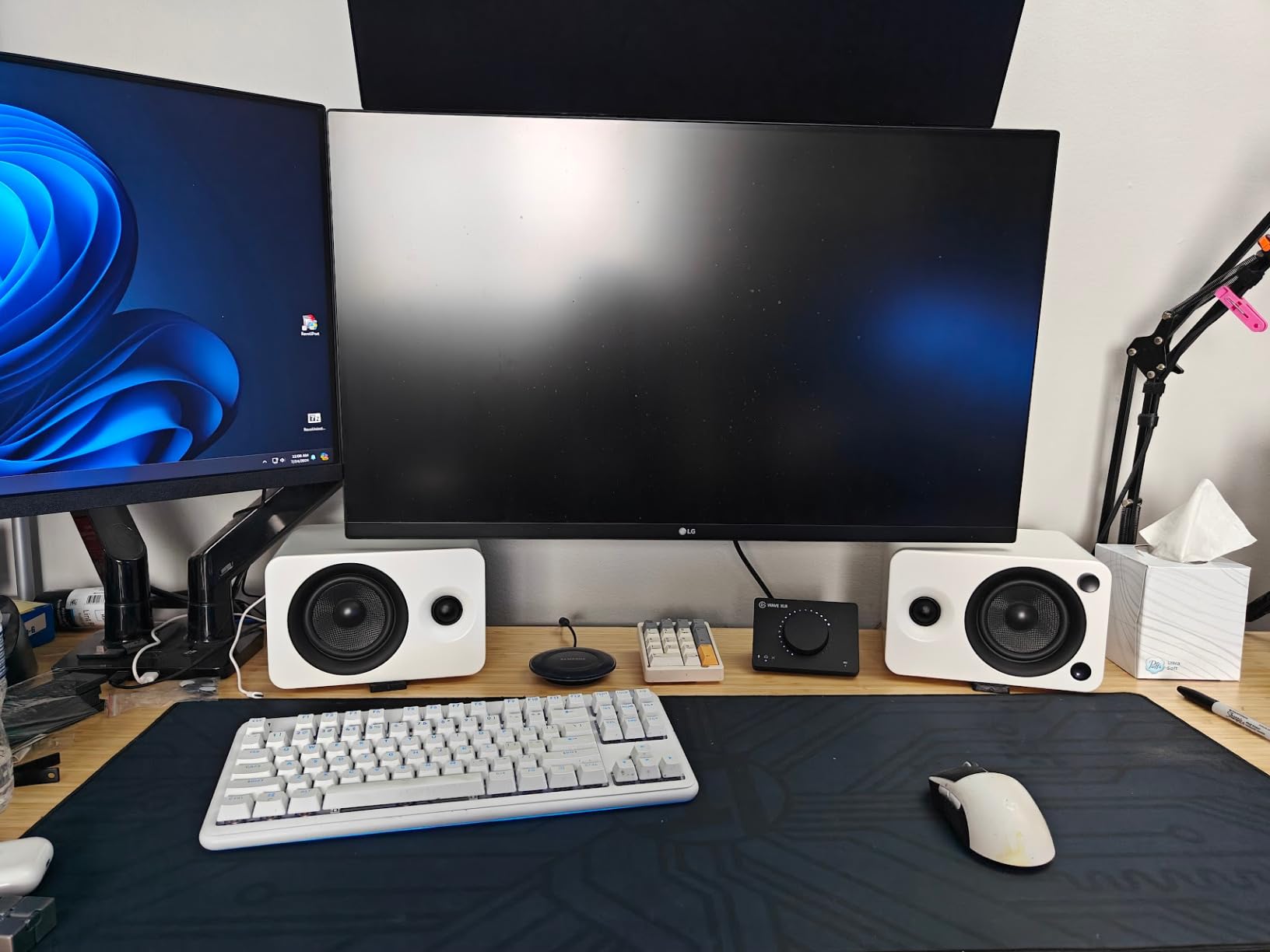
The YU4 solves the problem that trips up most first vinyl owners. The phono preamp is built in, so a turntable with a PHONO-only output connects directly with no external box and no extra spend. That is the whole reason to pick this pair over a cheaper one.
Sound-wise, 4 in Kevlar drivers with 1 in silk dome tweeters give crisp highs and a well-balanced midrange. Vocals sit forward on acoustic material, which makes it a good pairing for jazz and singer-songwriter records where lyrics need to be legible.
Bluetooth here runs with Qualcomm aptX, which is a step above the basic Bluetooth on most budget pairs. In practice that means streaming from a phone holds up better at close range, though for vinyl you will still use RCA because a turntable rarely transmits.
Auto standby drops the power draw below 0.5W when nothing is playing, which is genuinely useful in a room where the system sits switched on for hours. The remote covers volume, bass, treble, balance, and input selection, so day-to-day control never needs reaching behind the cabinet.
Who the Kanto YU4 suits
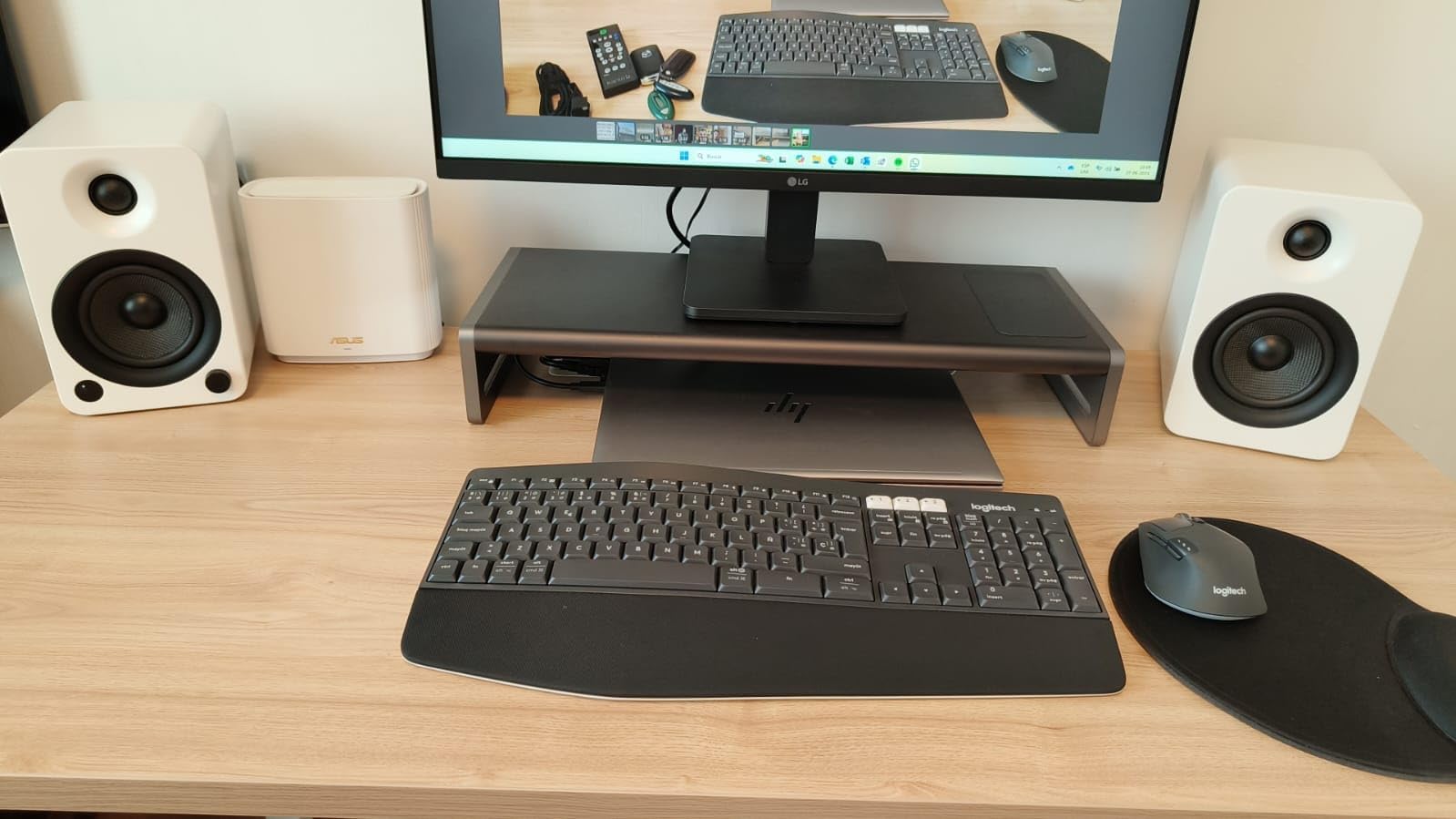
It suits anyone whose turntable outputs PHONO only, which is still most budget decks. The phono preamp switch means you keep the speakers and upgrade the deck later without touching the signal chain or buying another box.
It also suits a living room setup where looks matter. The matte grey finish and compact footprint sit at a scale that looks deliberate next to a record player rather than like computer equipment, and forum owners single out the colour options for that reason.
Who should skip the Kanto YU4
Skip it if you need real low-end extension. Bass rolls off in the low 90Hz range, and there is no subwoofer out on this model, so adding deep bass means changing speakers rather than adding a subwoofer.
Skip it if you play at high volume in a large room. Maximum output is modest for that job, and reviewers note the top end rolls off slightly at the very highest frequencies.
4. Klipsch R-51PM – Best Premium Powered Speakers for Turntables
Klipsch R-51PM Powered Bluetooth Speaker,Black
5.25 in copper-spun woofers
Horn-loaded tweeter
120W output
Phono/line RCA with switch
Pros
- Horn tweeter delivers exceptional detail
- 5.25 in woofers give deep bass for the size
- Phono/line switch plus ground screw
- USB digital and Bluetooth inputs
- Remote and cables included
Cons
- Premium price for the category
- No optical input and no subwoofer out
- Larger and heavier than 4 in pairs
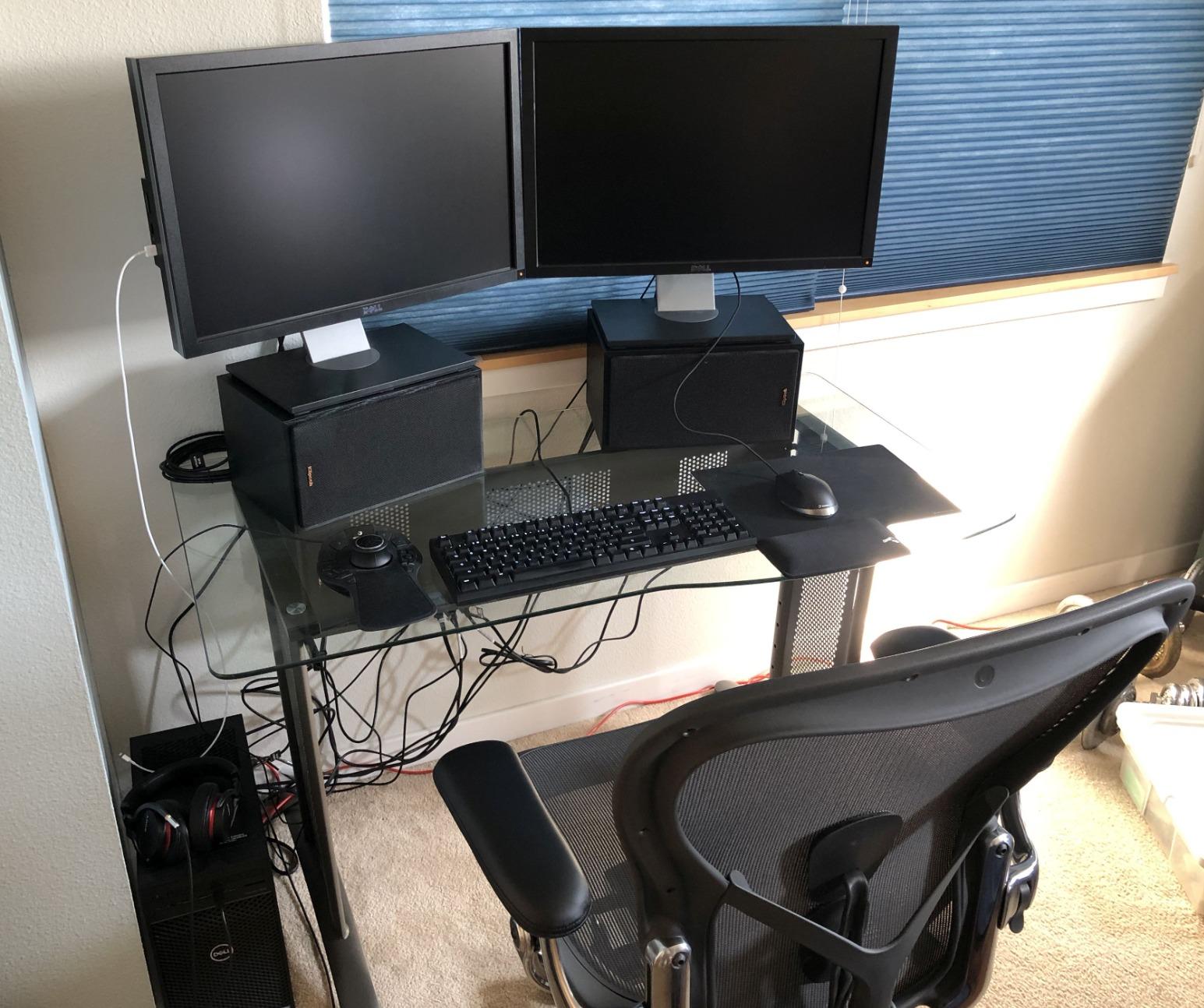
The R-51PM is the most revealing pair here. The Klipsch horn-loaded tweeter puts effort into high-frequency detail, so you hear things on a record that softer dome tweeters bury, and 5.25 in copper-spun woofers give bass that smaller drivers cannot reach without distorting.
For turntable use, the rear panel is unusually well equipped. It carries a phono/line analog input with a switch and a ground screw terminal, plus 3.5mm analog and USB digital, so it accepts almost any source including a phono-only deck.
That horn is also the reason some people walk away. Owners in small rooms report that the sibilance can be sharp on bright recordings, and anyone who listens mostly at low volume in a small space may find the presentation forward rather than relaxed.
There is no optical input and no subwoofer out. That keeps the rear panel simpler but means a television connection depends on whatever digital or analog output it has, and bass extension is capped by the cabinet itself.
Who the Klipsch R-51PM suits
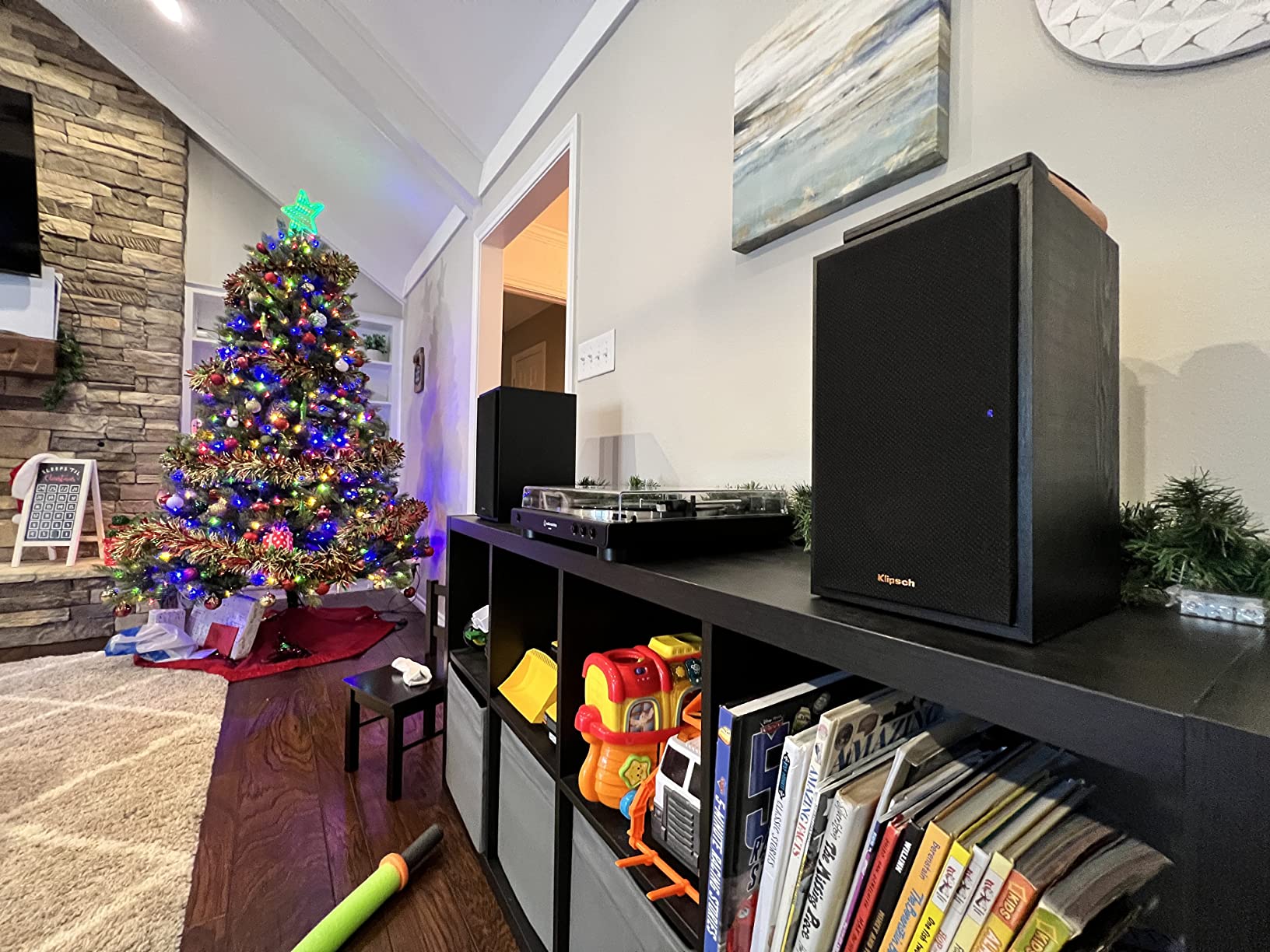
It suits a mid-size room where you play records loud enough that detail and dynamics matter. Owners who moved up from a small pair describe the 5.25 in drivers as the first time bass stopped being an apology.
It suits a phono-output turntable owner who wants detail and does not plan to route television audio. The phono/line switch and ground screw handle a phono-only deck directly, which saves an external preamp.
Who should skip the Klipsch R-51PM
Skip it if you listen in a small, untreated room at modest volume. The horn-loaded tweeter is efficient and forward, and that character is exactly what some listeners find tiring after an hour.
Skip it on budget grounds too. It costs noticeably more than the mid-tier pairs in this list, and the money buys clarity and bass extension rather than extra connectivity.
5. Edifier R1280DBs – Best Powered Speakers With a Subwoofer Out
Edifier R1280DBs Active Bluetooth Bookshelf Speakers – Optical Input – 2.0 Wireless Studio Monitor Speaker – 42W RMS with Subwoofer Line Out – Wood Grain
42W continuous power
Optical and coax inputs
Subwoofer out with crossover
13mm silk dome tweeter
Pros
- Subwoofer out with automatic detection and crossover
- Bluetooth 5.0 plus optical and coax
- 42W continuous undistorted power
- Soundfield Spatializer widens the stage
- Remote plus side-panel EQ
Cons
- Optical and coax share one input
- No built-in phono preamp
- 42W is modest in larger rooms
The R1280DBs is the step up from the R1280T, and the difference is connectivity rather than sound. It adds Bluetooth 5.0, optical and coaxial digital inputs, and a subwoofer output, all while keeping the same 42W continuous power and 4 in woofer.
Reviewers describe it consistently as the best value upgrade in the whole Edifier line, and we agree. For someone who wants one pair of powered speakers for a turntable, a television and a phone, it covers more bases than anything else near it.
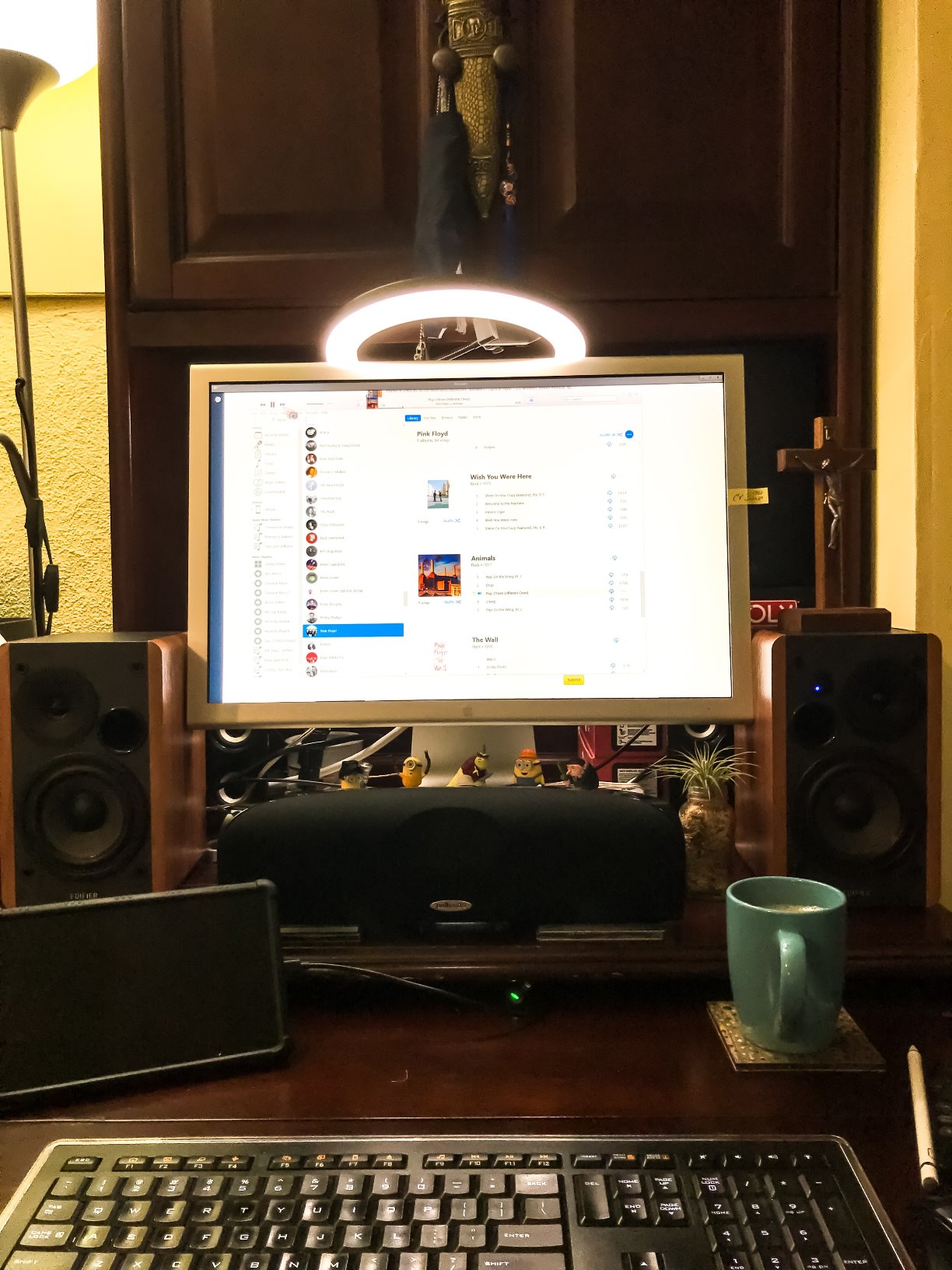
The subwoofer out does the work its name suggests. It includes automatic detection and a built-in crossover, so when you plug in a subwoofer it takes over the low end and the bookshelf drivers stop straining. That is the upgrade path the R1280T simply does not have.
Optical and coaxial inputs share a single jack, which is a real but manageable limit. If your television offers both, you pick one, and you are back to switching when the other source is in use.
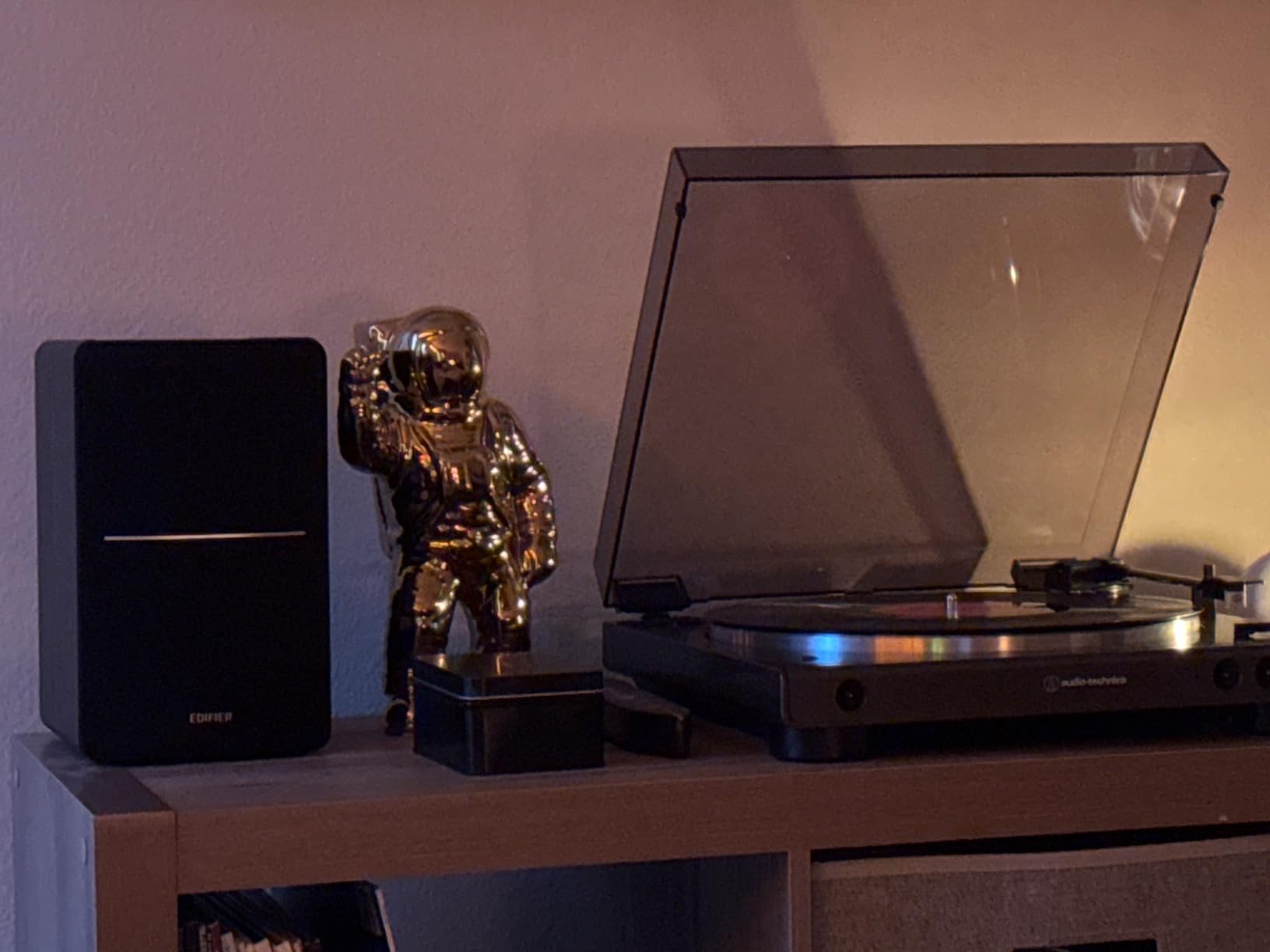
Who the Edifier R1280DBs suits
It suits anyone who wants to start with a turntable and add a subwoofer in a year or two. The sub out with its built-in crossover means the upgrade costs one box rather than a whole new speaker pair.
It also suits a household where one speaker pair handles vinyl and television. Optical gives you a clean digital path from a television, and the Soundfield Spatializer widens the stage for film sound.
Who should skip the Edifier R1280DBs
Skip it if your turntable has a PHONO-only output. There is no phono preamp, so a phono-only deck still needs an external preamp between it and the speakers.
Skip it if you need both optical and coax active at the same time, or if you play at high volume in a large room where 42W of continuous power will not reach the levels you want.
6. Audio-Technica AT-SP3X – Best Powered Speakers for Small Rooms
Audio-Technica AT-SP3X Bookshelf Speakers
3 in dynamic drivers
30W output
Dual RCA jacks
Multipoint Bluetooth
Pros
- Highest rated pair in our test group
- Compact size suits shelves and desks
- Multipoint Bluetooth holds two devices
- Dual RCA for a turntable
- Adapter with three plug adapters included
Cons
- 30W and 3 in drivers limit volume
- Plastic enclosure rather than wood
- No optical input or subwoofer out
The AT-SP3X carries the highest owner rating of anything in this roundup at 4.8 stars, and the reason is straightforward: for its size it sounds far better than it has any right to. The 3 in drivers were specially tuned for full-range playback, and the midrange stays balanced at low volume.
Dual RCA jacks on the back mean a turntable connects directly with no preamp box as long as your deck outputs LINE. Multipoint Bluetooth holds two devices connected, so your phone and a laptop can both stay paired.
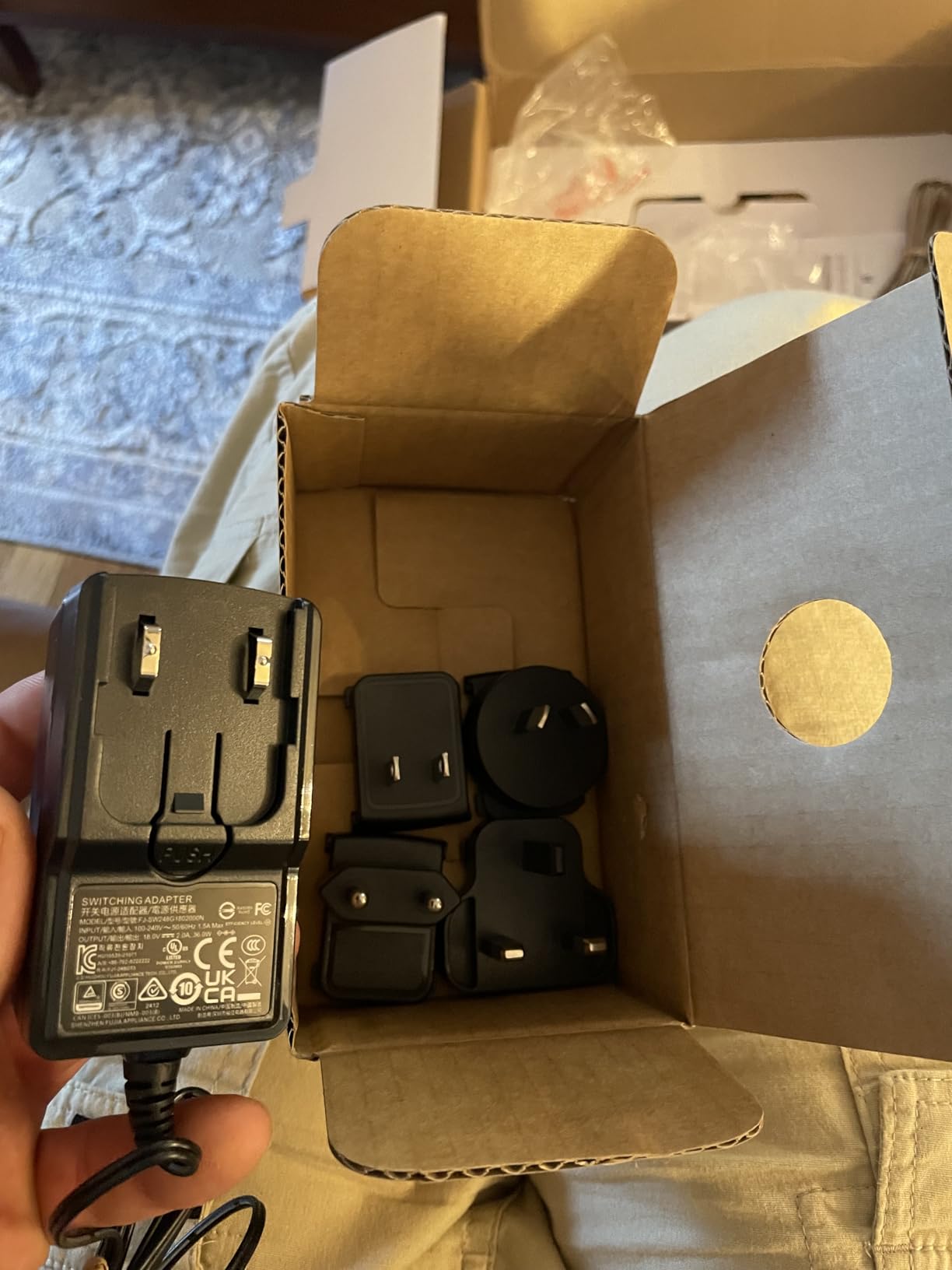
The physical design is deliberately simple. A power button with an LED indicator and a volume control dial on top, nothing else to learn. The AC adapter in the box comes with three international plug adapters, which removes a common travel annoyance.
What you give up is scale. A 30W amplifier driving 3 in drivers is tuned for close listening, so pushing it in a larger room gets thin before it gets loud. Owners report exactly that pattern in bigger spaces.
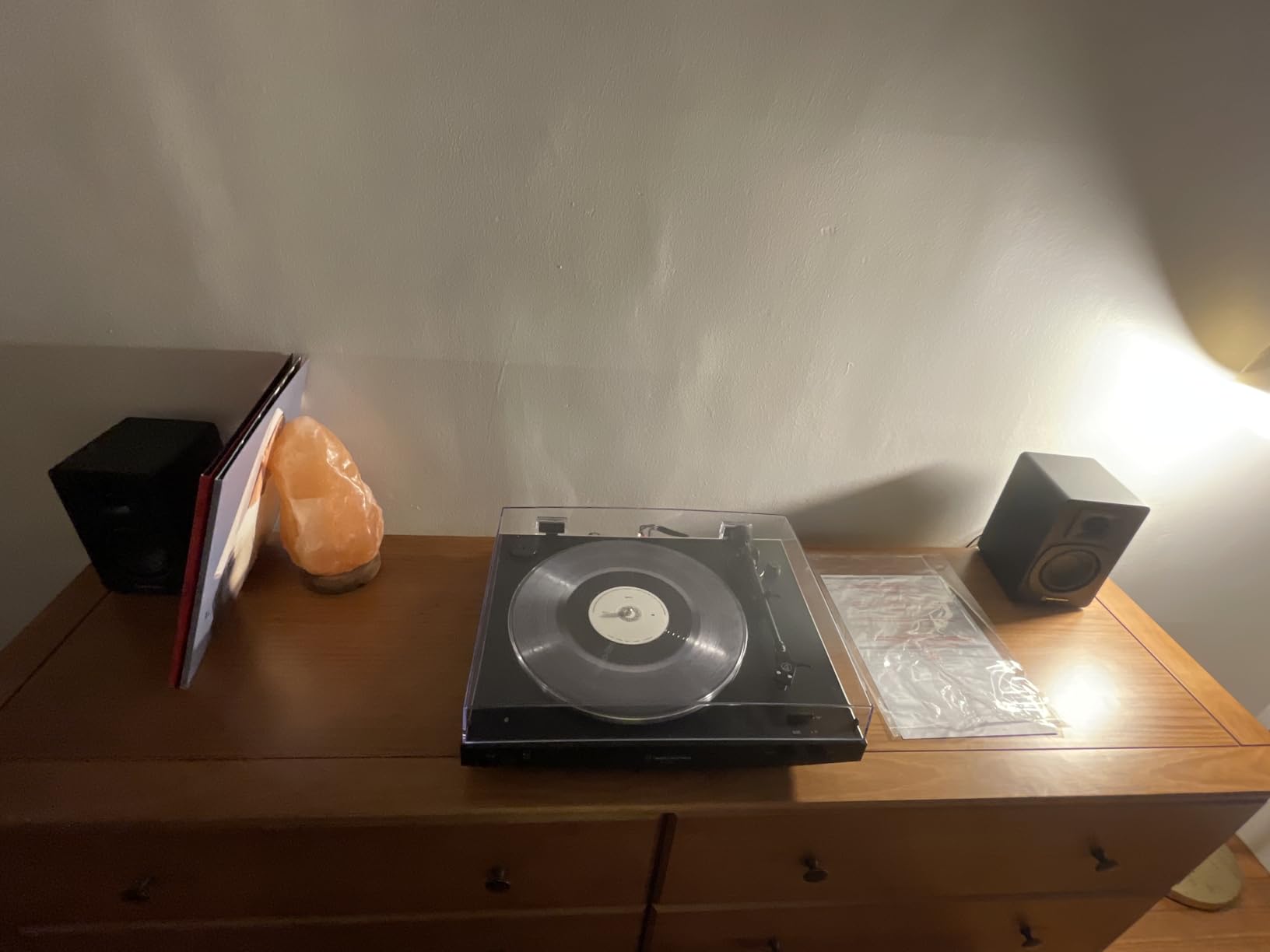
Who the Audio-Technica AT-SP3X suits
It suits a bedroom, a home office, or a desk setup where listening distance is short. Near-field monitoring was what these drivers were tuned for, and that is precisely how most people listen to records in a small space.
It suits anyone who wants the simplest possible system. Plug the RCA cables in, press power, and listen. There is no app, no menu, and no gain structure to get wrong.
Who should skip the Audio-Technica AT-SP3X
Skip it if you play records at high volume or want real bass weight. The 30W figure and 3 in drivers are honest limits, and there is no subwoofer out to extend them.
Skip it if you care about cabinet finish. The enclosure is plastic rather than wood, which is fine functionally but reads differently in a living room than a wood-finish pair.
7. MEVOSTO DS19 – Best Powered Speakers With Big Drivers
MEVOSTO 5-Inch Powered Bookshelf Speakers: PC Speakers for Record Player
Dual 5 in woofers
1 in silk dome tweeters
36W RMS amp
USB digital input
Pros
- Dual 5 in woofers at a budget weight class
- 36W RMS amp with real headroom
- Rare USB digital input for desktop PC
- Physical bass and treble knobs
- Remote included in the box
Cons
- No built-in phono preamp
- No optical input and no Dolby support
- 18V adapter needed for power
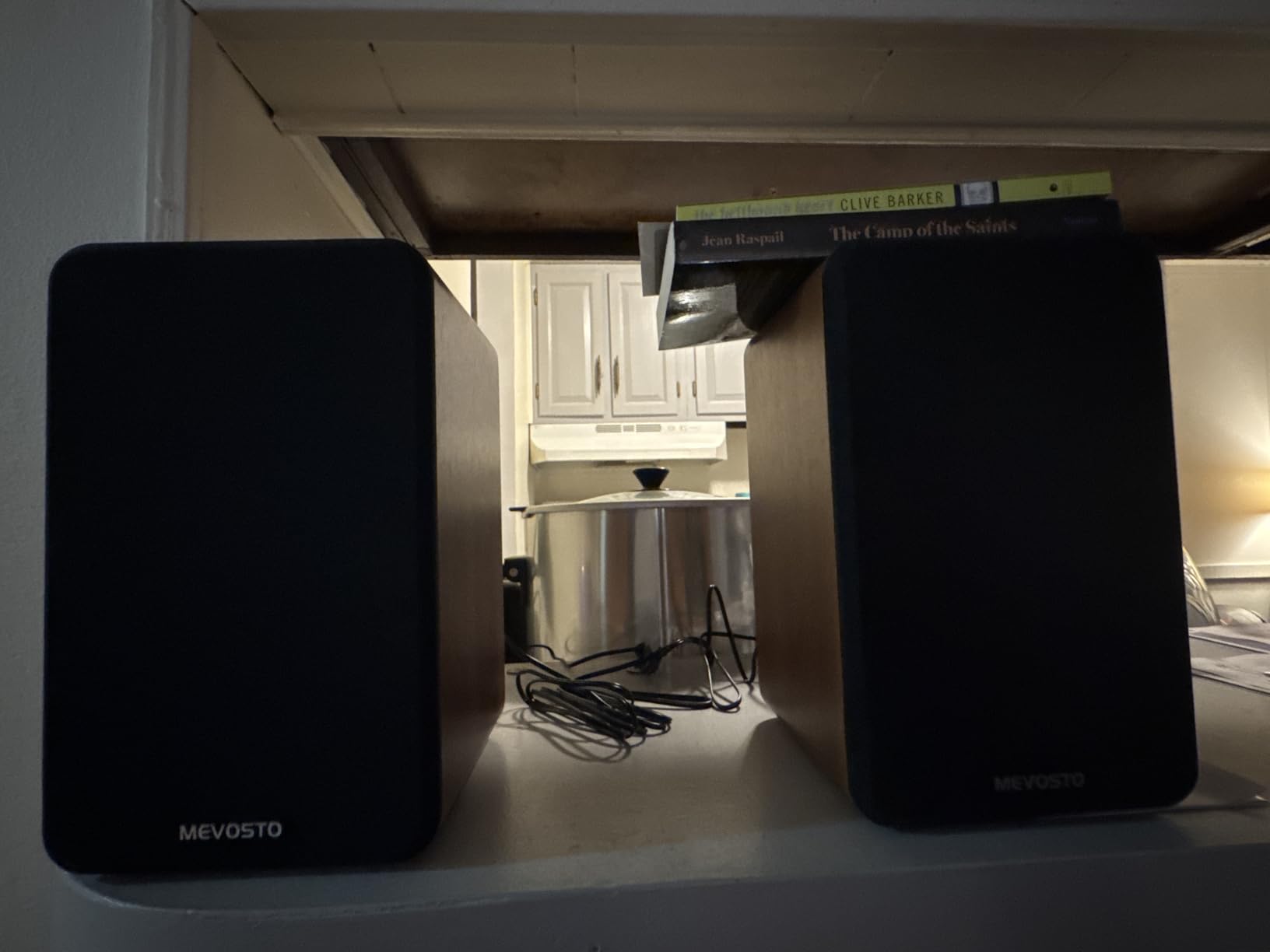
The DS19 solves a specific problem: getting 5 in drivers without a large cabinet or a large bill. Dual 5 in woofers and dual 1 in silk dome tweeters sit in a walnut wood-grain cabinet that measures under 10 inches tall, driven by a 36W RMS amplifier.
Owners point to the size-to-output ratio as the main draw. A 5 in driver moves far more air than a 3 in one, so on bass-heavy records this pair has an audible advantage over the compact models at a similar price point.
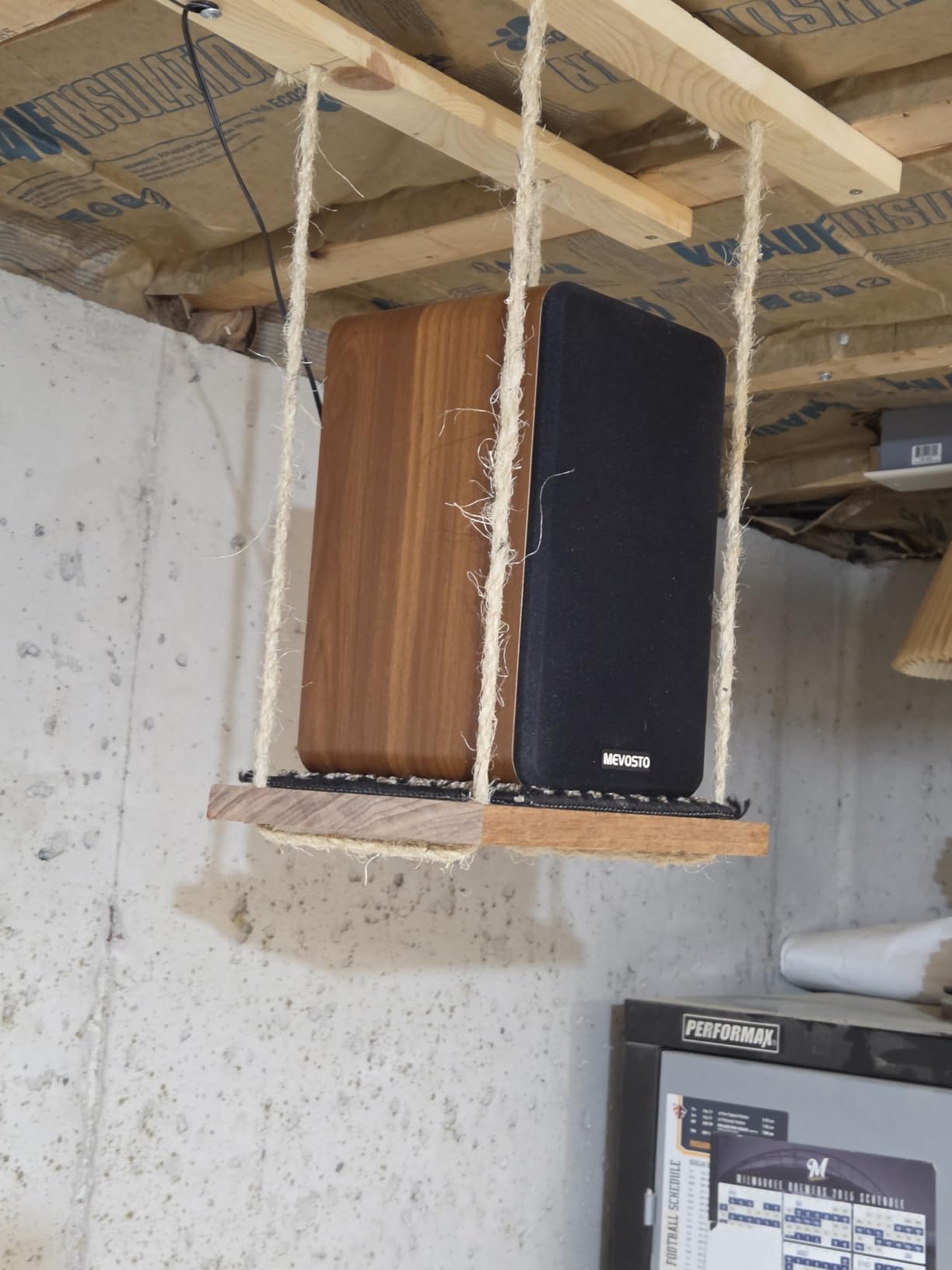
The USB digital input is the detail nobody else in this list offers. It connects straight to a desktop PC for near-field listening, which makes this a genuinely two-room speaker if you also want computer audio in the same place as the turntable.
For vinyl, the connections are Bluetooth 5.4 plus RCA and AUX. There is no built-in phono preamp, so a phono-output deck needs an external preamp first, and the listing lists turntables among compatible devices with that assumption.
Who the MEVOSTO DS19 suits
It suits someone on a tight budget who wants bass extension, which is normally the trade you give up at the low end. Two 5 in drivers plus 36W of amplification is more low-end capability than most pairs at this level provide.
It also suits a shared desk or shelf setup. The USB digital input, physical bass and treble knobs, and the included remote cover both computer listening and turntable use without extra hardware.
Who should skip the MEVOSTO DS19
Skip it if your turntable outputs PHONO only. No phono preamp means an external box, and that extra spend can double the effective cost of the setup you thought you were budgeting.
Skip it if you need television audio. There is no optical input, no TV-ARC, and the listing states plainly that it does not support Dolby Audio, so route video sound a different way.
8. Edifier R980T – Best Powered Speakers for Desktop Vinyl Setups
Edifier R980T 4″ Active Bookshelf Speakers – 2.0 Computer Speaker – Powered Studio Monitor (Pair)
24W RMS output
4 in drivers
Wooden enclosures
Two AUX inputs
Pros
- 24W RMS with a front-flared bass reflex port
- Wooden enclosures reduce acoustic resonance
- RCA and 3.5mm cables plus speaker wire included
- Two AUX inputs for two sources
- Universal 110V-240V power supply
Cons
- 24W RMS limits volume and dynamics
- No Bluetooth or optical input
- No remote control in the box
The R980T is the desktop veteran of this list and it has earned its place. Twenty-four watts of RMS power and a front-flared bass reflex port in a wooden enclosure is a simple, durable design that owners describe as dependable rather than exciting.
The included cables are a genuine convenience at this level. RCA leads, a 3.5mm cable and speaker wire all ship in the box, plus a universal 110V-240V power supply, so nothing extra needs buying to get started.
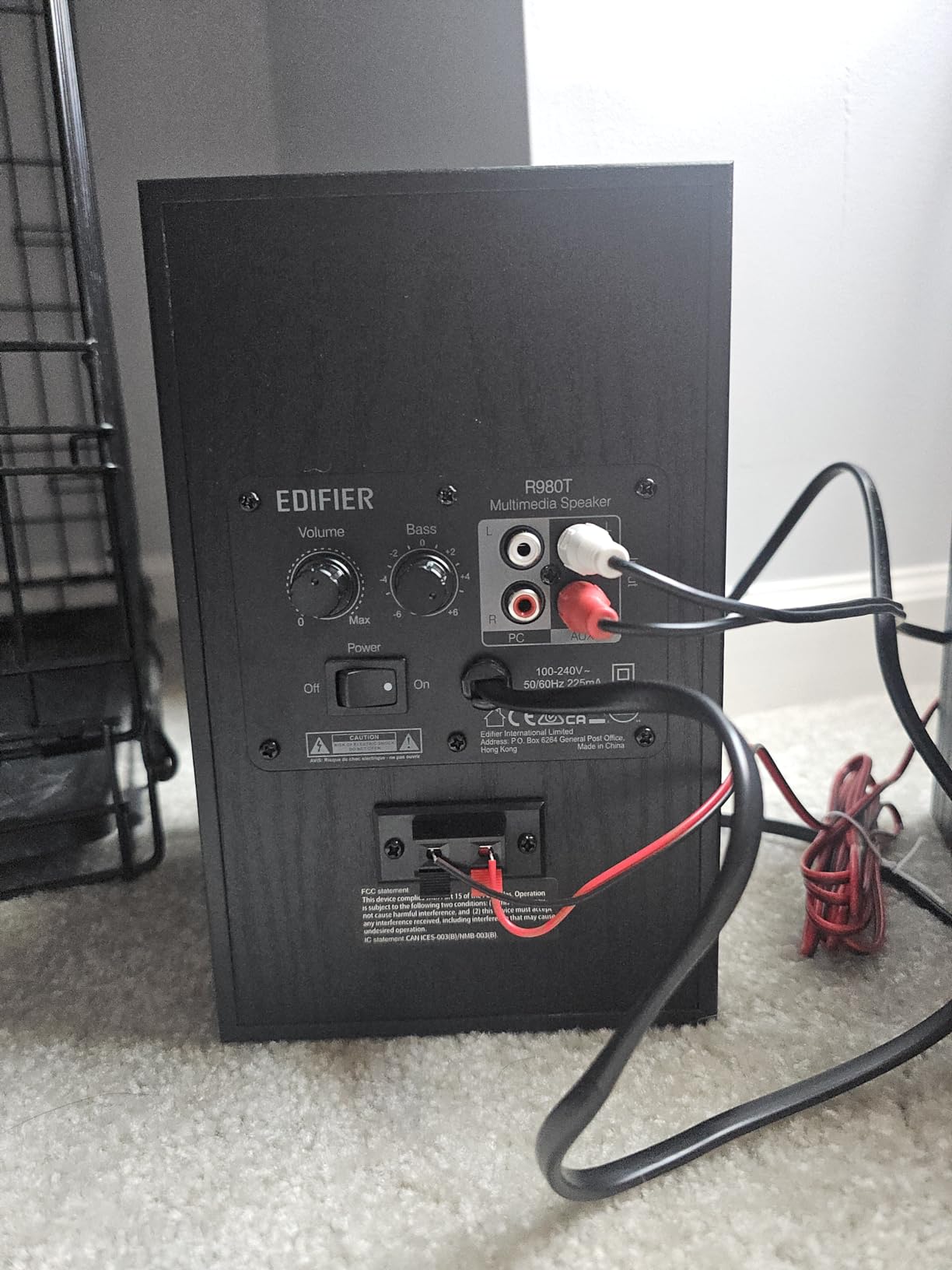
Two AUX inputs let a turntable and a computer share the pair without unplugging anything. That mirrors the dual-input convenience on the R1280T, and for a desk setup where a computer is the second source, it works the same way.
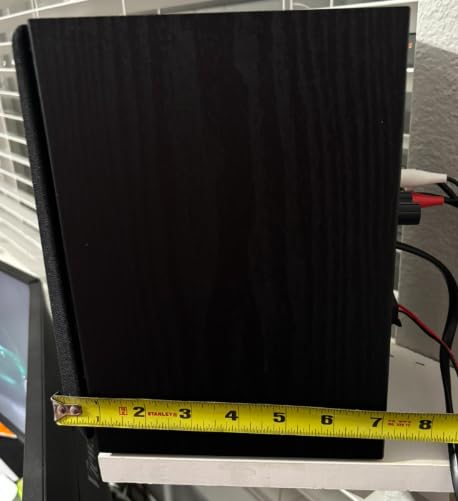
The front-flared port means the bass opening faces forward, which matters on a desk pushed against a wall. A rear port on a shelf 6 inches from a surface tends to sound boomy or blocked, and this one does not have that problem.
Who the Edifier R980T suits
It suits a home office or study where the turntable sits on a desk against a wall. The front port placement and the 24W of power are matched to short-distance, modest-volume listening.
It also suits anyone who wants everything in the box on day one. Cables and a universal power supply are included, which removes the most common first-setup friction point.
Who should skip the Edifier R980T
Skip it if you want volume. Twenty-four watts of RMS is the smallest amplifier here, and reviewers note that dynamics and maximum volume suffer before anything else does.
Skip it if you plan to add wireless or bass. There is no Bluetooth, no optical input and no subwoofer out, so the upgrade path means replacing the whole pair rather than adding to it.
9. Electrohome Huntley – Best Retro-Style Powered Speakers for Turntables
Electrohome Huntley Powered Bookshelf Speakers with Built-in Amplifier and 3″ Drivers for Turntable, TV, PC and Wireless Music Streaming Featuring Bluetooth 5, RCA and Aux (EB10B)
3 in drivers
20W output
RCA and Aux-In inputs
Bluetooth 5
Pros
- Handcrafted wood cabinet with rear bass port
- Warm full-bodied and balanced sound
- RCA Aux-In and Bluetooth 5 inputs
- Touch controls keep the front clean
- Turntable TV PC and streaming in one box
Cons
- 3 in drivers limit bass extension
- 20W output is modest for large rooms
- No optical input and no subwoofer out
The Huntley is the most conventionally handsome pair here, and for a lot of living rooms that counts. The wood cabinet with a rear ported design is designed to look like furniture rather than a studio monitor, and it does it well.
Sound-wise owners describe it as warm and full-bodied for its size, which is a slightly different target from the neutral near-field pairs above. That warmth suits rock and soul records, and it means vocals do not sound thin at low volume.
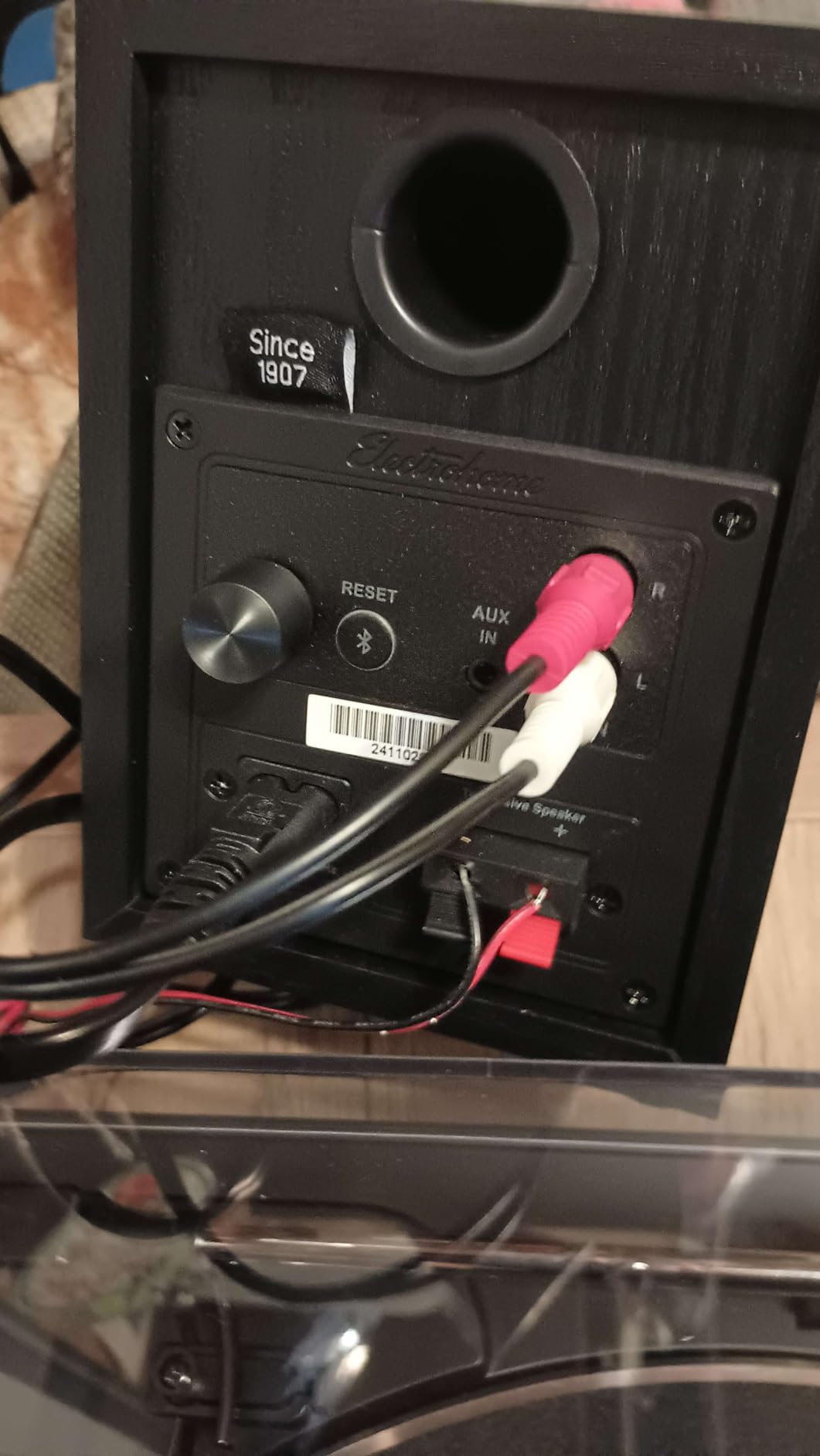
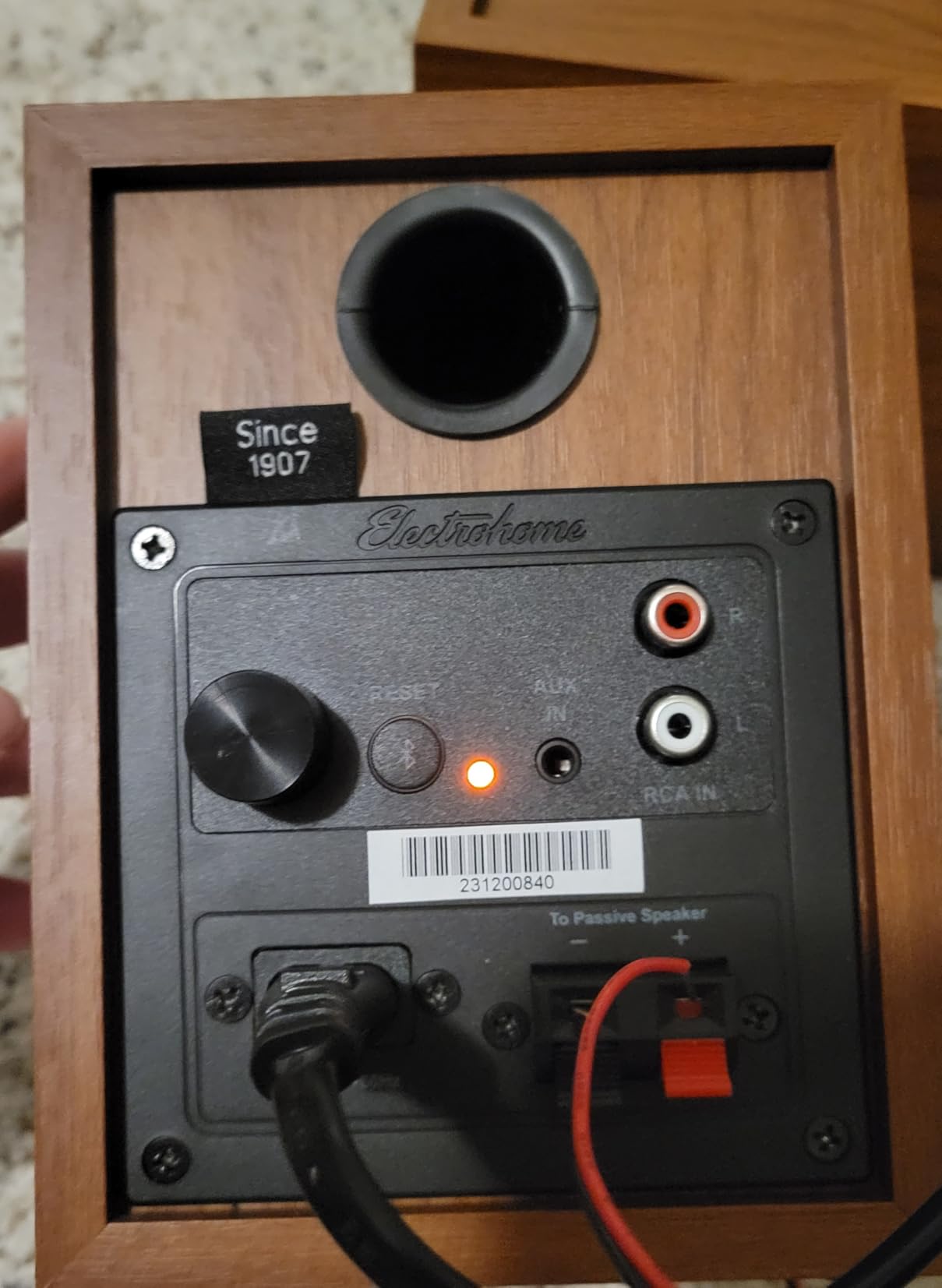
Connectivity is the practical strength. RCA, Aux-In and Bluetooth 5 cover a turntable, a television, a computer and a phone in one box, which matches how people actually listen rather than how spec sheets are written.
The honest limit is the 3 in driver combined with 20 watts of amplification. That is plenty for a desk or a bedroom at moderate volume, and it runs out of headroom before it runs out of clarity.
Who the Electrohome Huntley suits
It suits someone who wants the turntable to look like part of the furniture. The retro wood styling and touch controls on the cabinet front suit a living room shelf better than a boxy plastic pair would.
It also suits a beginner who wants one pair to cover a turntable, a computer and a television without thinking about inputs. All three connection types are on the back panel.
Who should skip the Electrohome Huntley
Skip it if you want modern detail or real bass depth. A 3 in driver and 20W of power cannot deliver either, and the lowest rating in our group reflects that some buyers wanted more from it.
Skip it if you will add a subwoofer later, since there is no subwoofer out on this model.
10. RIOWOIS Bookshelf Speakers – Best Budget Pick With TV-ARC
RIOWOIS Powered Bookshelf Speakers, Desktop Speakers for Record Player
2.75 in drivers
60W output
Bluetooth 5.3 and TV-ARC
Remote control
Pros
- TV-ARC works with the television remote
- Bluetooth 5.3 plus AUX and optical inputs
- Reinforced MDF cabinet resists crackling
- Remote handles volume and input switching
- Three year warranty
Cons
- 2.75 in drivers limit bass and volume
- Optical and ARC cables not included
- Bluetooth turntable output not supported
TV-ARC is what makes this pair different at the budget end. It returns audio from a television over HDMI and lets the television remote control volume, which removes the need for a soundbar or a receiver in the chain.
The rest of the connection set is generous too. Bluetooth 5.3 for streaming, optical for digital audio, and AUX for a turntable or a laptop, all switching from the included remote or the on-speaker buttons.
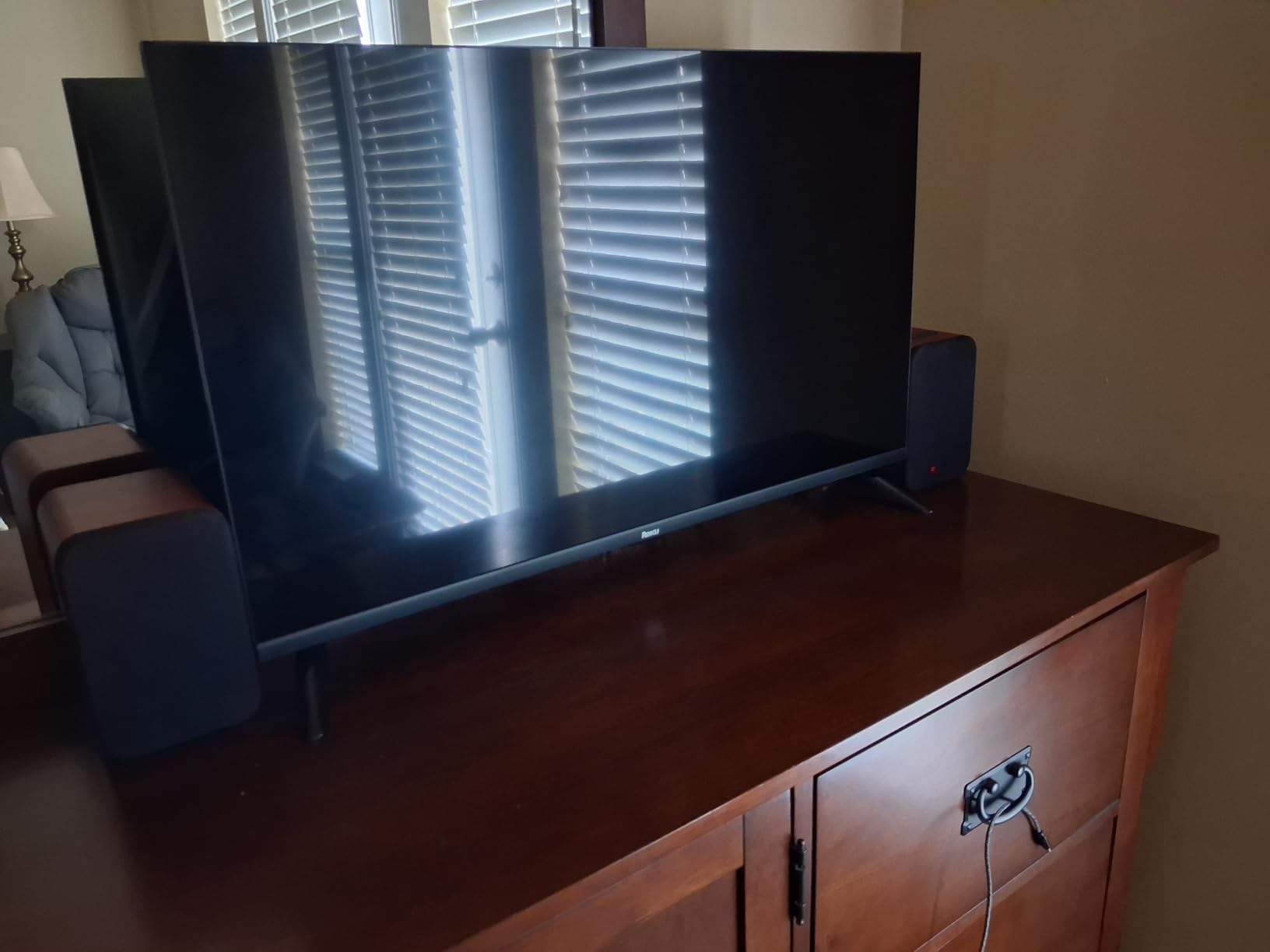
For vinyl, the important line in the manual is that a turntable needs a built-in or external phono preamp. If your deck outputs LINE, connect by RCA and you are set. If it outputs PHONO only, add a small preamp first.
Bluetooth on this pair receives audio from a phone or laptop. It does not receive from a turntable, because most Bluetooth turntables are receivers only for app control rather than transmitters, so vinyl still travels over RCA.
Who the RIOWOIS Bookshelf Speakers suit
It suits a first setup in a small room where the goal is one pair of speakers for records, films and streaming. The TV-ARC path is the feature budget pairs usually lack, and it changes the shape of the whole system.
It also suits anyone who wants a remote-controlled setup. The remote handles volume, power, input switching, Bluetooth disconnect and three sound effects, which is more control than most pairs at this level offer.
Who should skip the RIOWOIS Bookshelf Speakers
Skip it if you play loud or want bass with weight. The 2.75 in drivers are the smallest here and the listing is straightforward about the limit, so it is a low-volume, near-field pair.
Skip it if you plan to use an external amplifier, because powered speakers cannot connect to one. And skip it if you expect the optical or ARC cables to be in the box, because they are not included.
What to Look For in Powered Speakers for a Turntable
LINE versus PHONO output: the one thing to check first
LINE versus PHONO is the single most important compatibility check, and it is the mistake that produces the worst returns. A PHONO output is a very quiet, bass-boosted signal meant for a phono preamp. Feed it into a line input and you get thin, quiet, distorted sound that most buyers blame on the speakers.
Identify your output in three steps. Look at the RCA jacks on the back of the turntable and read the label. If it says LINE or LINE OUT, you can connect straight to a speaker RCA input. If it says PHONO or PHONO OUT only, you need either speakers with a built-in phono preamp or a small external preamp box.
If the turntable has both, there will be a switch, usually on the back near a ground screw terminal. Set that switch to LINE before connecting to powered speakers. Owners on vinyl forums describe the wrong switch position as the number one cause of thin, quiet playback, and it takes ten seconds to check.
Built-in phono preamp versus a plain line input
A built-in phono preamp in the speakers means fewer boxes and lower cost. In this roundup, the Kanto YU4 and the Klipsch R-51PM carry a phono stage, so a phono-output deck connects directly with no extra purchase.
A plain line input is the more common design, and it is perfectly fine as long as your turntable handles the phono stage itself. Most budget turntables in the categories we cover in our belt-drive turntable guide include a built-in or switchable preamp.
How to connect a turntable to powered speakers
Set the turntable preamp switch to LINE. If the turntable has no switch and only a PHONO output, stop here and add a small phono preamp between the two, or choose speakers with a phono stage.
Connect the turntable RCA output to the matching RCA input on the active speaker. Only one speaker is amplified, so both the left and right turntable cables go into that single speaker.
Power the speakers on, turn the volume down to its lowest position, and place the needle on a record. Raise the volume slowly from there, because the turntable is usually the louder of the two boxes in terms of available gain.
Run the ground post if your turntable has one and the speakers provide a ground screw. A loose or missing ground connection is a common source of hum, and it costs nothing to fix.
Position the speakers at the ends of a triangle with your chair. Powered bookshelf speakers are designed for near-field listening, so two to six feet away is the sweet spot rather than across the room.
Does Bluetooth on these speakers work with a turntable?
Usually not, and this is a common buyer error. Most turntables with Bluetooth are receivers only, which means they receive audio from your phone for app control. They cannot transmit your records to a Bluetooth speaker.
So Bluetooth on powered speakers is for streaming from a phone or laptop, while vinyl travels over RCA cables. Treat Bluetooth as a second source rather than a way to go wireless with records.
Powered versus passive: what a real powered pair looks like
Several popular roundups list passive speakers inside their powered speaker picks, and that sends first-time buyers home expecting an amplifier they never budgeted for. A powered pair has a mains cable, a power button, a volume control, and amplifier inside the cabinet. If there is no volume knob on the speaker itself, it is passive.
Powered speakers win on simplicity. One box per side, no receiver, no extra cable, and everything works the day it arrives. Passive speakers win on upgrade flexibility, because you can change amplifier and speakers independently over time, which is the argument experienced forum members make for going that route instead.
For a first vinyl system, powered is usually the right call. Forum regulars describe them as super simple with no additional equipment, and the money you save on an amplifier is better spent on a turntable, which is where the difference is actually audible.
Speaker placement and vibration isolation on the same shelf
Putting a turntable and powered speakers on the same table works, but only with care. Forum users report acoustic feedback howl, needle skipping, and speakers squealing when the two share a surface and the volume goes up.
The fix is distance first. Keep at least eight inches between a speaker and the turntable, and never put a speaker directly behind the platter where its bass port can push air across the tonearm.
Isolation is second. A foam or felt isolation mat under the turntable decouples it from the surface, and soft foam pads under the speakers reduce structure-borne vibration. Both are cheap and both solve most of the problems people describe.
Bass port direction is third. A rear-ported speaker pushed against a wall reflects bass back at the listener and can make feedback easier to trigger. Pairing them with front-ported designs such as the Edifier R980T reduces the risk on a tight shelf.
Avoiding hum, buzz and grounding loops
Hum is almost always a grounding loop or a shared power strip, not a fault in the speakers. When a turntable, an amplifier and a pair of powered speakers all plug into one multi-socket strip, current paths loop back through the mains earth and you get a steady buzz at 50 or 60Hz.
The first fix is the cheapest. Plug the turntable and the speakers into different wall outlets, ideally on different circuits, and see whether the hum drops. A hum that disappears when you unplug one item tells you exactly which cable is involved.
The second fix is the ground post. Most turntables with a phono output ship with a ground wire, and most amplifiers and powered speakers provide a ground screw. Connect it to the correct post, tighten it, and confirm the shell of the RCA plug is not loose.
If hum persists, suspect cable quality. Poorly shielded RCA leads act as antennae, and swapping to a known-good shielded pair is a five-minute test that costs almost nothing.
Room size and woofer size
Driver size predicts low-end capability better than amplifier wattage alone. A 3 in driver paired with 30W is a close-range tool. A 5 in driver paired with 90W, as on the Fluance Ai41, is built for a mid-size room at real volume.
For a bedroom or small apartment at evening listening levels, 3 in and 4 in pairs with 30W to 42W are enough. For a living room where you play records at party-adjacent levels, move to 5 in drivers and 90W or more.
Where bass matters and volume does not, look for a subwoofer out instead of bigger drivers. Pairs such as the Fluance Ai41 and the Edifier R1280DBs let you add a subwoofer later without replacing the speakers, which changes the cost curve of a first system.
Finally, match the gain structure. If your turntable has a very low output phono stage, a high-power amplifier will actually play it too loudly before the volume knob has range. In practice this is rare with modern decks and rare with the speakers here, but it is worth checking your turntable’s output level if the pair sounds unbalanced.
Frequently Asked Questions
Can I use powered speakers with a turntable?
Yes, as long as your turntable outputs a LINE-level signal or has a switchable built-in phono preamp. Connect the turntable RCA out to the RCA input on the active speaker, with only the amplified speaker taking cables. If your turntable outputs PHONO only, either buy powered speakers with a built-in phono preamp such as the Kanto YU4, or add a small external phono preamp between the turntable and the speakers.
Should I get powered or passive speakers for a turntable?
Powered speakers suit most beginners because the amplifier is built in, so you own two boxes instead of four and nothing extra needs buying. Passive speakers suit listeners who want to upgrade amplifier and speakers separately over several years. If you are building a first vinyl system on a budget, powered pairs give you more music for the money.
Do powered speakers have a phono preamp?
Some do. Most powered speakers only accept a line-level RCA input, which means your turntable must supply the phono stage itself. A minority, including the Kanto YU4 and the Klipsch R-51PM, include a phono preamp with a switch so a phono-output turntable connects directly with no extra box.
Is it okay to put my turntable and speakers on the same table?
Yes, with care. Keep at least eight inches between a speaker and the turntable, never place a speaker directly behind the platter, and put an isolation mat under the turntable and foam pads under the speakers. Speakers and a turntable on one surface at high volume is the most common cause of feedback howl and needle skipping.
Should I ground my turntable to a preamp or amp?
Yes, connect the turntable ground post to the ground screw on your amplifier or powered speaker whenever one is provided. A missing or loose ground wire causes a hum cycle, and tightening the connection is free. If the hum continues, plug the turntable and the speakers into different wall outlets to break the loop.
Why do my powered speakers sound quiet with a turntable?
The usual cause is a signal level mismatch. If a phono-level output is feeding a line input, playback comes out thin and quiet with little bass. Check that the turntable preamp switch is set to LINE, and confirm the turntable actually has a LINE output before assuming the speakers are at fault.
The Best Powered Speakers for Turntables in 2026
The best powered speakers for turntables in 2026 depend on one thing above all: what your turntable outputs. Check for a LINE output or a switchable phono preamp before you buy anything, because that decision removes either an extra preamp box or a whole amplifier from the cost of the system.
For most people the Edifier R1280T is the right answer. It has the largest owner review history in the category, a balanced near-field sound that suits close listening, and two AUX inputs so a turntable and a second source can stay connected at once. Buy it for the simplicity.
Move up to the Fluance Ai41 if you want real bass extension and a television in the same system, since it adds optical input and a subwoofer out. Move up to the Kanto YU4 if your turntable outputs PHONO only, because its built-in phono preamp saves you buying a separate box. Check our beginner turntable guide to match the deck to whichever pair you settle on.