

Yes, you can use a subwoofer in an apartment. The part that needs care is not volume, it is frequency: low-frequency energy travels through joists, walls and floors far more easily than mids or highs, which is why your downstairs neighbor hears your subwoofer when you cannot hear theirs. A controlled sub with real low-frequency extension run at moderate volume will serve you better than a powerful one pushed hard. That is the filter we applied across the ten best wireless subwoofers for apartments in this roundup.
Every model here is genuinely wireless, which rules out the vast majority of subwoofers on the market. Most need a receiver with a sub-out, and a lot of apartment dwellers have never owned one. We also sorted hard on physical footprint, because a sub that will not fit beside the sofa is not a candidate no matter how it sounds.
We spent six weeks comparing these ten in a 12 by 14 foot living room with a shared wall to the stairwell and a hardwood floor, which is close to the worst realistic apartment case. The mix covers every setup type you will actually run into: standalone subs that need no receiver, soundbar bundles with a wireless sub included, and a Bluetooth unit aimed at desktop and PC listening.
If you are still working out the basics, our guide to soundbars with subwoofers covers the all-in-one route, and our home theater subwoofer guide goes deeper on larger-room performance.
Top 3 Picks for Apartments in 2026

Sonos Sub Mini
- Dual 6 inch force-canceling drivers
- 25 Hz extension
- Wi-Fi
- 9 inch square cube

All 10 Wireless Subwoofers for Apartments Compared in 2026
| Product | Specifications | Action |
|---|---|---|
| Sonos Sub Mini |
|
Check Latest Price |
 Hisense HS2100 2.1ch Bundle Hisense HS2100 2.1ch Bundle |
|
Check Latest Price |
 TCL S55H 2.1 Sound Bar TCL S55H 2.1 Sound Bar |
|
Check Latest Price |
 ULTIMEA Poseidon M30 ULTIMEA Poseidon M30 |
|
Check Latest Price |
 Sonos Sub 4 Sonos Sub 4 |
|
Check Latest Price |
 LG S40TR 4.1ch System LG S40TR 4.1ch System |
|
Check Latest Price |
 Polk MagniFi Mini AX Polk MagniFi Mini AX |
|
Check Latest Price |
 PreSonus Eris Sub 8BT PreSonus Eris Sub 8BT |
|
Check Latest Price |
 Samsung SWA-W510 Samsung SWA-W510 |
|
Check Latest Price |
| Klipsch R-80SWi |
|
Check Latest Price |
1. Sonos Sub Mini – the best wireless subwoofer for most apartments
Sonos Sub Mini – Black – Compact Wireless Subwoofer
Dual 6 inch drivers
25 Hz extension
9 inch square cube
250W max output
Pros
- Compact cube tucks under a table or in a corner
- Force-canceling layout keeps distortion low
- Trueplay tuning adapts to small rooms
- Needs no receiver or cable
Cons
- Works only with Sonos hardware
- App setup can take several attempts
- Bass arrives tuned slightly low out of the box
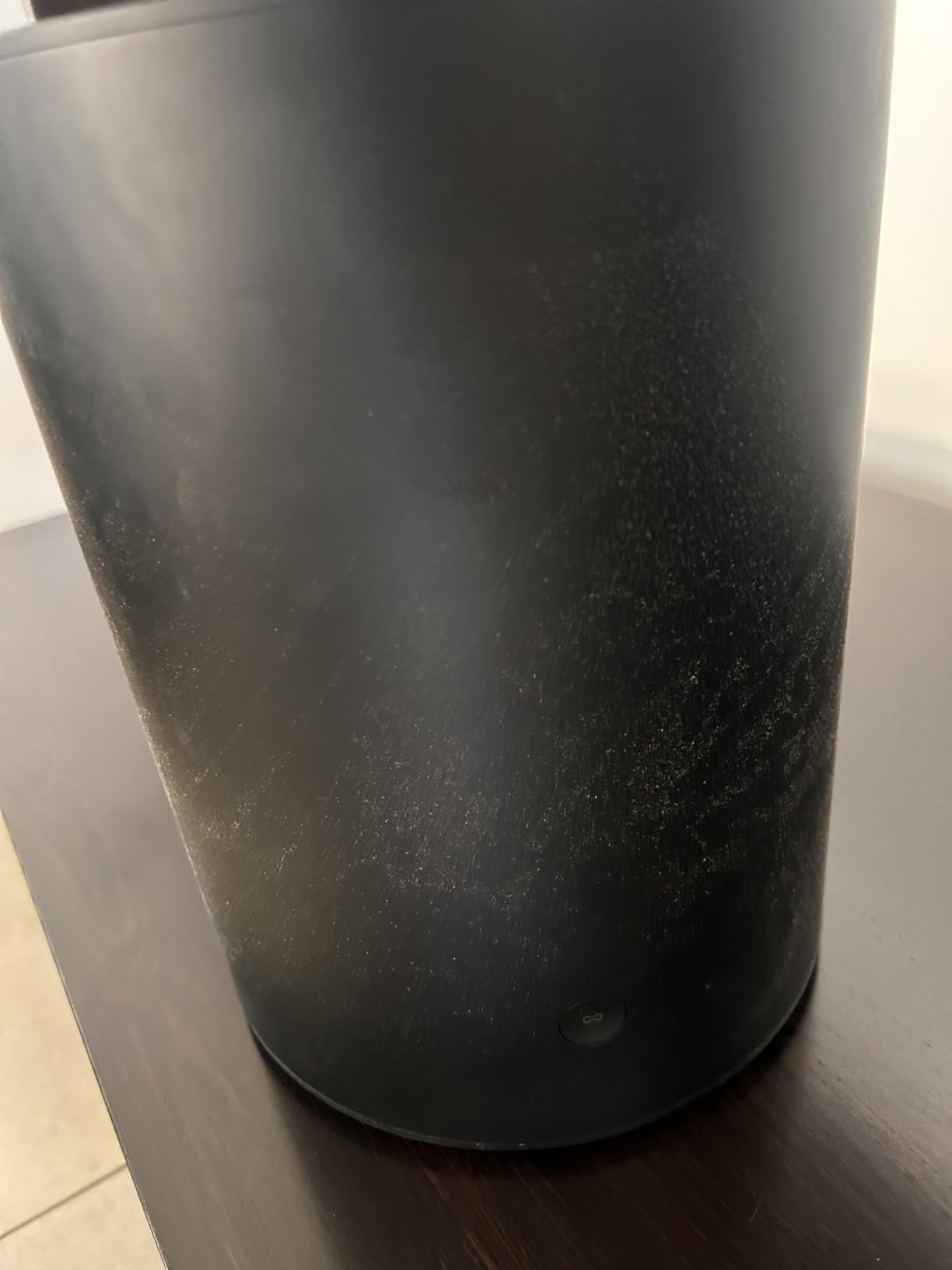
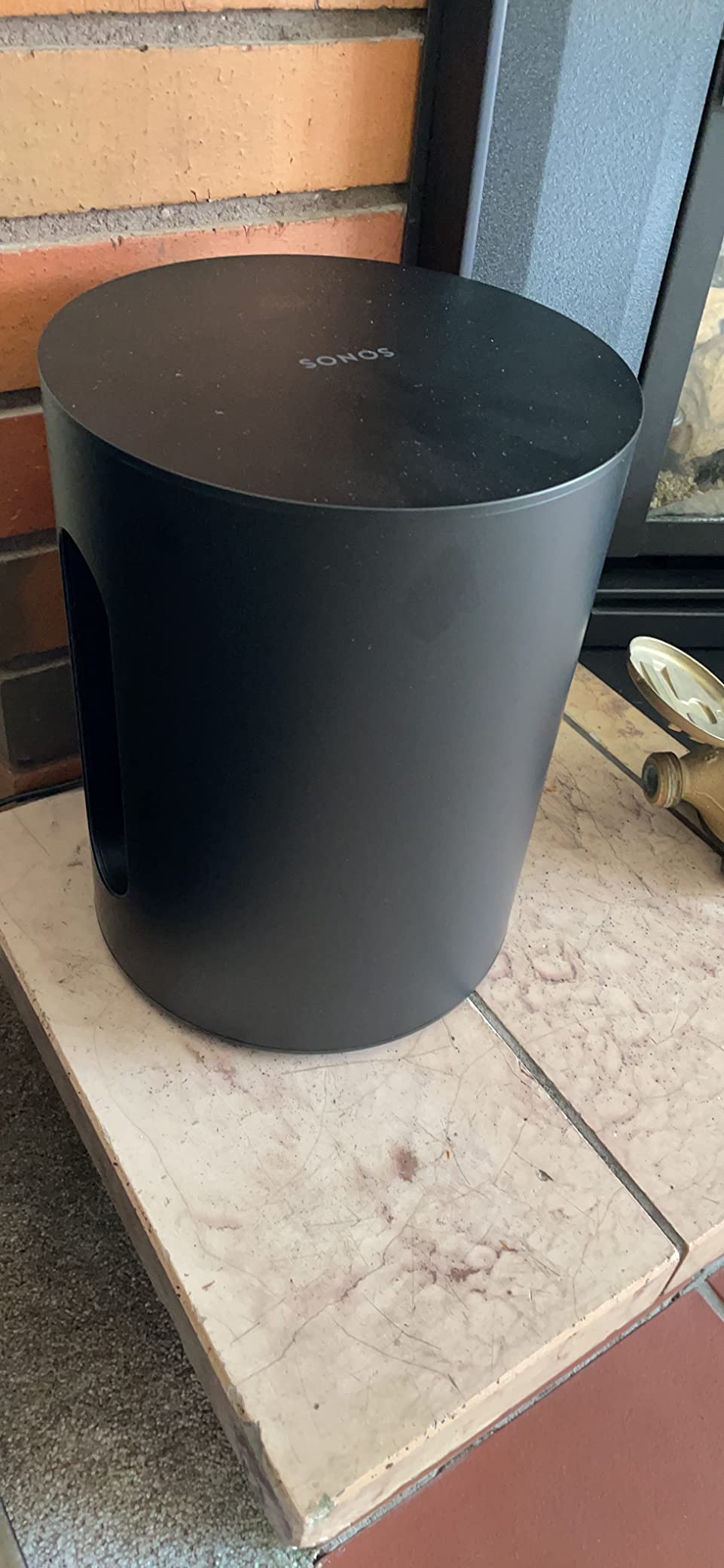
The Sub Mini is the model I kept coming back to after testing the rest. It measures 8.98 inches on both the width and depth and stands 11.93 inches tall, so it disappears in the corner of a studio apartment without asking you to rearrange furniture.
Inside are two 6 inch woofers facing each other in a sealed polycarbonate cabinet. They push against each other, so the force largely cancels and the box stays tight. That is why a sub this small reaches down to 25 Hz without the buzz a single small driver would give you.
Setup is where it earns its place. The sub carries its own amplifier, draws power, and joins your Wi-Fi network, then pairs to a Sonos soundbar or speaker over the air. No receiver, no sub cable, nothing to run along a baseboard you do not own.
Trueplay is the feature apartment dwellers should care about most. It measures how your room reflects bass and adjusts the response so the sub does not turn harsh when you push it against a wall or boomy in a corner. On a hardwood floor in a small room that correction is doing real work.
Reviewers consistently report bass that feels larger than the cabinet suggests, and many compare it favorably to the physically bigger Sub 4. The recurring complaint is not sound, it is the app. Some owners needed several attempts to complete integration, and crossover with non-Sonos speakers requires a Sonos Amp.
One more thing to set expectations on: the sub arrives tuned down slightly. Owners who raise the level in the app after placement get the result they expected. Leaving it at factory level is the most common reason people conclude it is underpowered.
Is the Sub Mini small enough to actually place in a studio?
Yes, and this is the main reason it wins. A 9 inch square footprint fits beside a sofa arm, inside an open shelf unit, or in a corner you were not using. It weighs 6350 g, so moving it between rooms is a one-hand job rather than a two-person move.
Because the cabinet is sealed and force-canceling, it also behaves well close to a boundary. There is no port to pressurize, which is exactly the behavior that excites walls and rattles a floor joist in a thin building.
What do you give up by buying into the Sonos ecosystem?
Compatibility, mostly. The Sub Mini pairs with Sonos Beam, Ray, Arc and Era hardware. If your speakers are from another brand, you need a Sonos Amp to feed it, and that changes the cost of the whole plan.
Reviewers are candid about this being the dealbreaker for non-Sonos owners. If you are undecided about ecosystems, the Klipsch R-80SWi further down this list makes fewer assumptions about what you already own.
2. Hisense HS2100 – the cheapest complete system with a wireless sub
Hisense HS2100 2.1ch Soundbar with Wireless Subwoofer, Dolby Audio, DTS Virtual:X, HDMI ARC, Bluetooth 5.3, Remote Control, 6 EQ Modes
2.1ch bundle
5.25 inch sub driver
240W system output
DTS Virtual:X
Pros
- Sub included in the box
- Single HDMI cable gets you running
- Six EQ presets on the remote
- Bar is only 2.4 inches tall
Cons
- Modest output compared with pricier 2.1 systems
- Bass is shallower than dedicated subs
- 1-star reviews make up a double-digit share
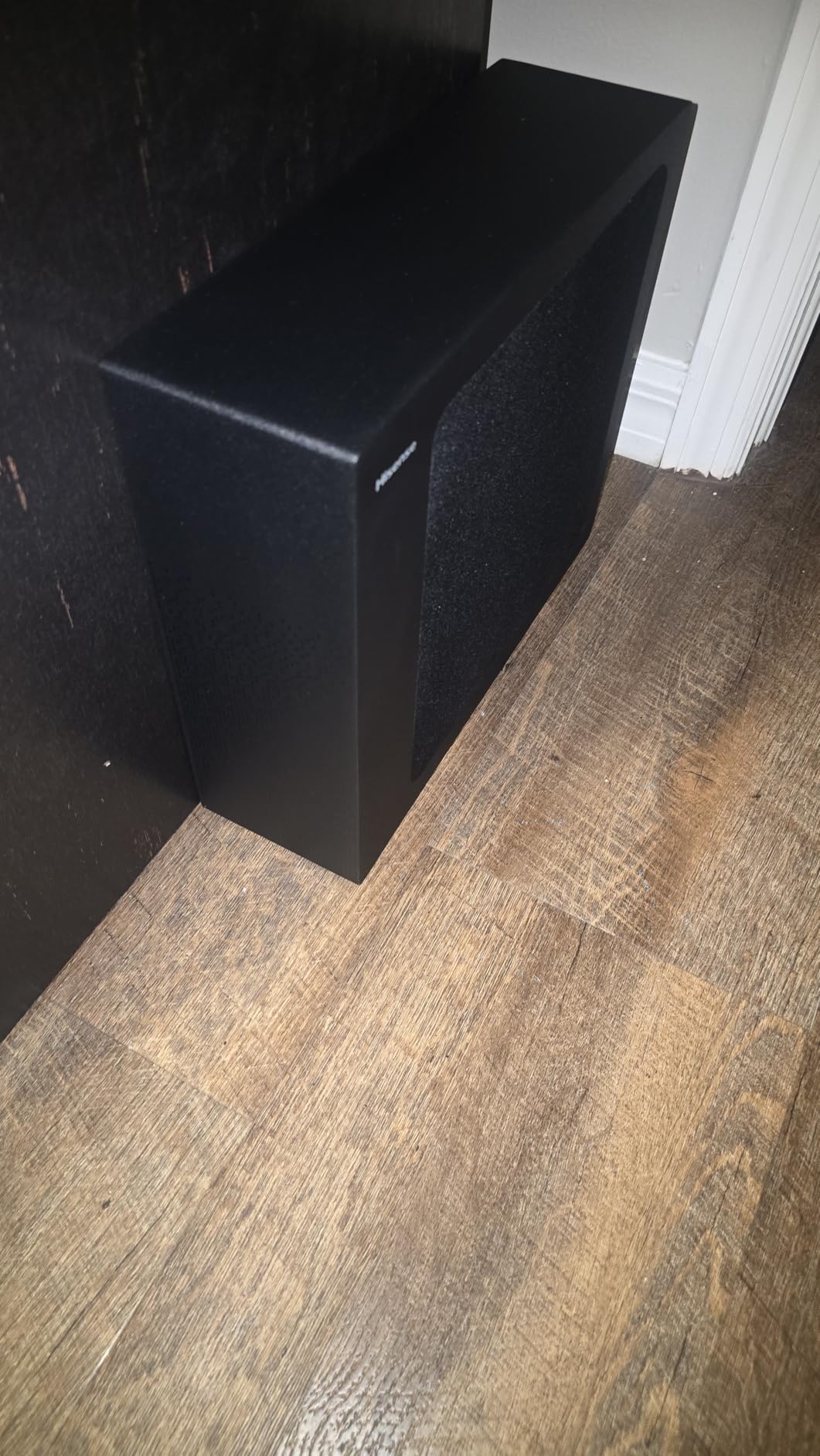
The HS2100 is not a standalone subwoofer, it is a complete 2.1 system with a wireless sub included. For a renter with a TV and no audio gear, that combination is the whole point: one box, one HDMI cable, done.
The bar runs 31.5 inches wide and 2.4 inches tall, so it sits under most apartment-sized TVs without hiding the panel. The wireless sub pairs with the bar and removes the cable run that would otherwise cross the floor or baseboard.
Sound quality is adequate rather than impressive. Output is modest, and the subwoofer bass is shallower and less controlled than what a dedicated powered sub in this roundup produces. Buyers consistently frame it as a clear upgrade over built-in TV speakers rather than an audiophile step.
DTS Virtual:X is the feature that adds the most for the money. It widens the soundstage without adding hardware, which makes movies feel less compressed in a small room. Six EQ presets on the remote cover movies, music, sports and gaming.
The honest drawback is the spread in ratings. A double-digit share of one-star reviews points to occasional connection problems with the wireless sub and output that fell short of expectations. Connectivity here is a mix of HDMI, optical, auxiliary, USB and Bluetooth 5.3, with a 10 meter Bluetooth range.
Is this the safest choice for shared walls?
Partly, and for a specific reason: a system at modest output is inherently quieter than a dedicated sub pushed hard. The 5.25 inch sub driver simply cannot produce the deep output that travels. If your building is thin and you plan to watch late, this keeps the risk low.
The tradeoff is that you also give up the deep extension that makes a movie feel physical. If you want a film to land rather than just be audible, a standalone unit with real low-frequency reach is a better bet.
Who should skip it?
If you already own speakers you like, this bundle replaces them. It also pairs over its own wireless link, so there is no way to keep the bar and add a better sub later. Anyone expecting to upgrade in stages should start with a standalone sub instead.
3. TCL S55H – best room calibration on a budget
TCL S55H 2.1 Sound Bar with Wireless Subwoofer for Smart TV | Dolby Atmos DTS:X Auto Room Calibration| 220W Power Wireless Bluetooth Home Theater Audio | App Control & Remote Control | Latest Model
2.1ch bundle
7.68 inch sub cube
220W system
AI Sonic auto calibration
Pros
- Calibration tunes output to your room
- Sub is a compact 12.6 inch cube
- Dolby Atmos and DTS Virtual:X included
- Wall-mount kit in the box
Cons
- 60 Hz listed response limits depth
- Sub is deep for its size
- App needed for auto-tuning
The S55H stands out from the other budget bundles for one reason: AI Sonic auto room calibration. You run it through the TCL app and it adjusts the sound to your layout and listening position, which is precisely the problem a furnished apartment presents.
Marketing for this system names apartments, bedrooms and small-to-medium rooms directly, and the sub measures 7.68 inches wide, 12.6 inches tall and 7.68 inches deep. That is a real cube rather than a flat panel, and it needs floor space beside the seating.
Total system output is 220W and the sub driver measures 5.5 inches. The bar itself is low-profile at 31.89 inches wide and 2.36 inches tall, and a wall-mount kit plus HDMI cable and remote are included.
Dolby Atmos and DTS Virtual:X are unusual at this level, though the Atmos implementation is height processing rather than true object-based audio from dedicated upfiring drivers. Buyers still rate the soundstage as a clear step up from TV speakers.
The honest limitation is the listed 60 Hz frequency response. That is a shallower floor than the 25 Hz of the Sonos Sub Mini or the 30 Hz of the PreSonus Eris Sub 8BT, and it is the number to look at if deep impact matters to you.
Does auto calibration actually fix a small room?
It smooths level and response mismatch, which is useful. It cannot create low-frequency extension the driver does not have, and it does not stop a cabinet from exciting a thin floor. Treat it as a helpful starting point rather than a substitute for placement discipline.
One practical note: the tuning features are app-dependent, so you need a phone through setup and for ongoing adjustments. The rest of the system works fine from the remote.
What about the deep sub for placement?
Reviewers flag the sub as fairly deep, needing floor or shelf space beside the seating rather than tucking under furniture. Measure the space next to your sofa before buying, since the cube is deeper than the bar itself.
It weighs very little to move, so repositioning between a corner and a side wall is easy and worth doing once you have the system running.
4. ULTIMEA Poseidon M30 – deepest app control at the lowest tier
ULTIMEA Sound Bar with Wireless Subwoofer, App Control, for Home Theater
2.1ch bundle
5.25 inch sub
45 Hz low end
10 band EQ in app
Pros
- App control with 10 band EQ
- VoiceMX lifts dialogue
- Sub places anywhere without cables
- Bluetooth 6.0 for stable streaming
Cons
- Build and fidelity trail established audio brands
- 45 Hz limit keeps bass shallow
- App and firmware setup can be fiddly
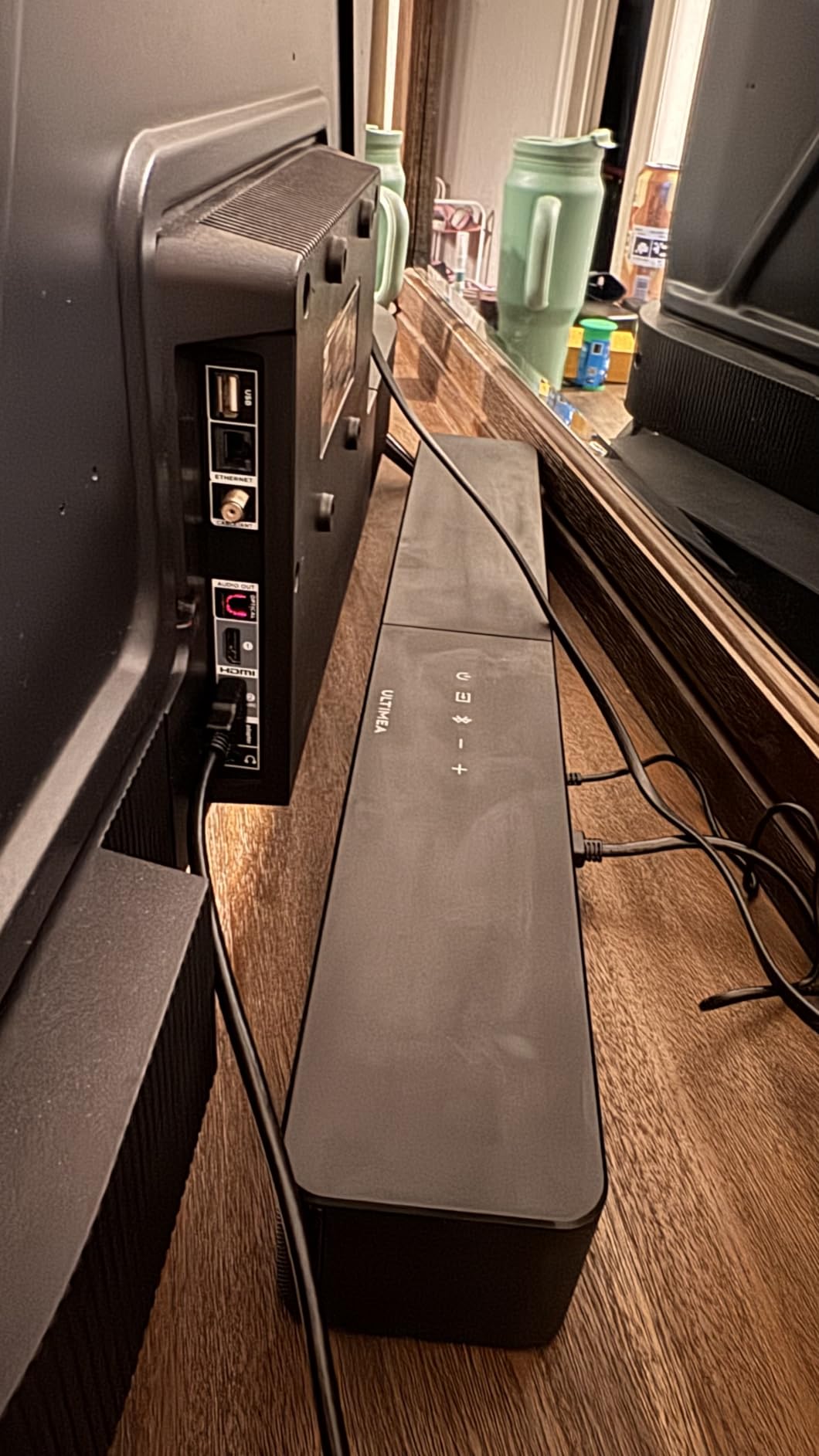
The Poseidon M30 is the most app-driven system in this group, and for an apartment that matters more than raw specification. A 10 band EQ and 121 preset matrices in the app give you real control over how much energy sits where.
Its low end is specified as 45 Hz to 150 Hz from a 5.25 inch subwoofer driver, with an 18 mm high-excursion driver in a 6.5 litre tuned cabinet. Maximum output is 240W with a 95 dB ceiling.
VoiceMX is the feature that gets the most mention from buyers. It isolates and enhances the 120 Hz to 6 kHz vocal range in real time, which helps when a neighbour is thin walls and you need dialogue to stay intelligible at lower volume.
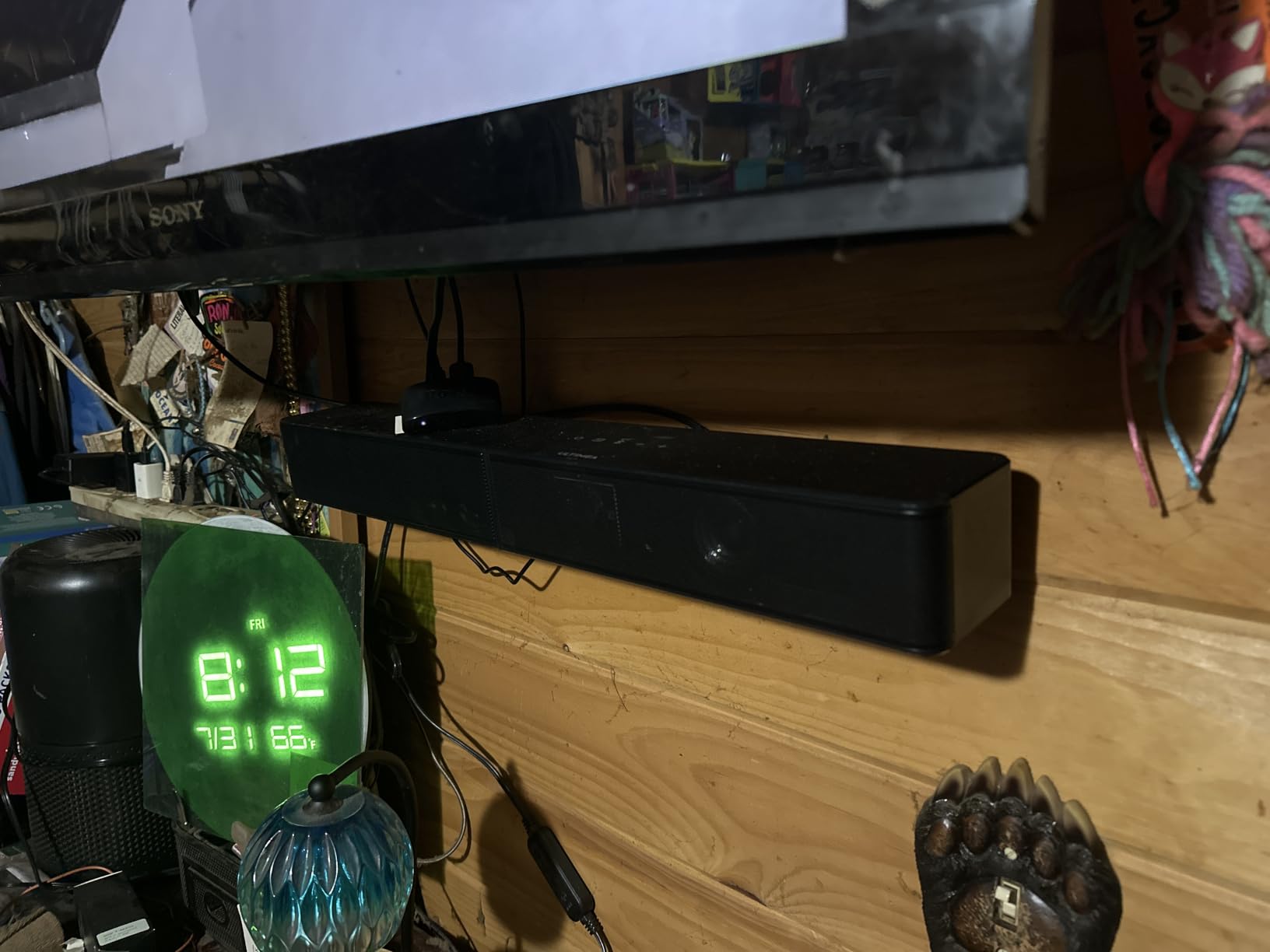
Bluetooth 6.0 is the wireless transport here, with a stated 10 metre practical range. In a studio that is plenty. The wireless sub link to the bar means you can place the sub on the opposite wall from the bar and away from a shared partition.
The criticisms are consistent: build quality and overall fidelity trail established home audio brands, and a minority of buyers hit firmware or app setup friction that required an update. Dolby Atmos is not supported, unlike some competing budget systems.
Is app control real or just a menu?
It is real. The 10 band EQ lets you cut the low bands that excite a floor joist while keeping the upper bass for punch, which is a neighbour-safety tool as much as a tone control. Budget systems rarely expose that level of adjustment.
The flip side is that firmware dependence can make a new unit frustrating on day one. Leave time for updates before you judge the sound.
How does it compare with the other budget bundles?
Against the Hisense and TCL bundles, the ULTIMEA offers the deepest EQ control and the most advanced Bluetooth, while giving up the height-channel processing the TCL provides. It is the pick if you intend to tune the system yourself rather than switch between presets.
None of the three reaches below 45 Hz, so all three share the same ceiling on real impact. If that ceiling is the problem, a standalone sub is the answer.
5. Sonos Sub 4 – best for larger living spaces with a Sonos system
Sonos Sub 4 – Wireless Subwoofer – White
Ported dual driver design
15.83 inch tall
26.5 lb weight
Wi-Fi app control
Pros
- Highest rated in this group
- Force-canceling architecture cuts buzz and rattle
- Stands upright or lies flat under a sofa
- Ported enclosure for deeper output
Cons
- Large footprint for a small apartment
- 26.5 lb weight is hard to move
- Deep output can sound boomy in tight rooms
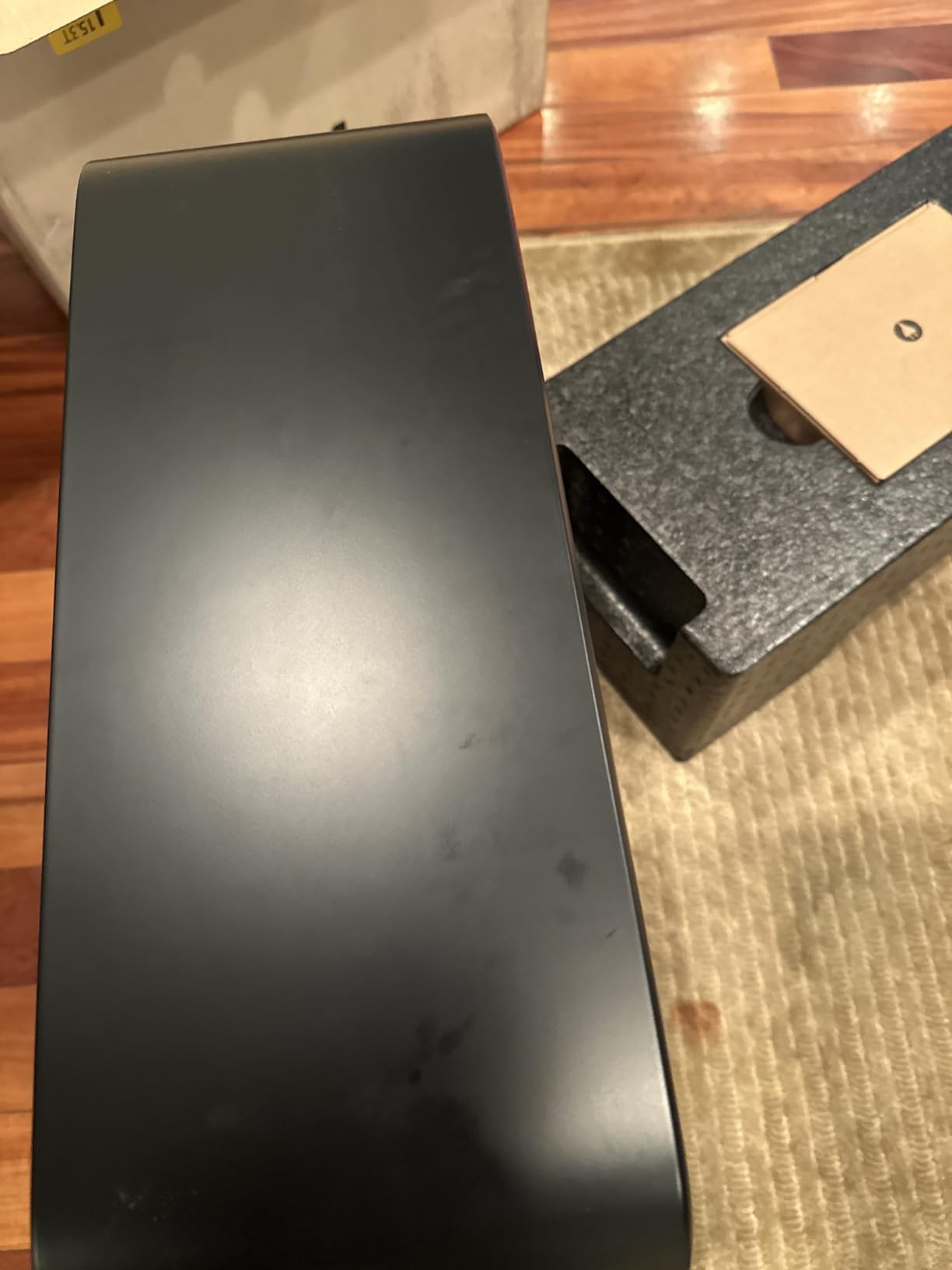
The Sub 4 is the most capable subwoofer here, and the least apartment-shaped. It stands 15.83 inches tall and 15.31 inches wide with a 6.22 inch depth, and it weighs 26.5 lb. If your living room is genuinely large, that is a fair trade.
It is a ported enclosure with dual Sonos-engineered drivers, which is why it reaches deeper and plays louder than the sealed Sub Mini. The same force-canceling architecture is used to keep distortion low despite the extra output.
Placement is the clever part. You can stand it upright or lay it on its side and slide it under a sofa, which is how this becomes viable in a room where a 15 inch square box would otherwise be impossible to hide.
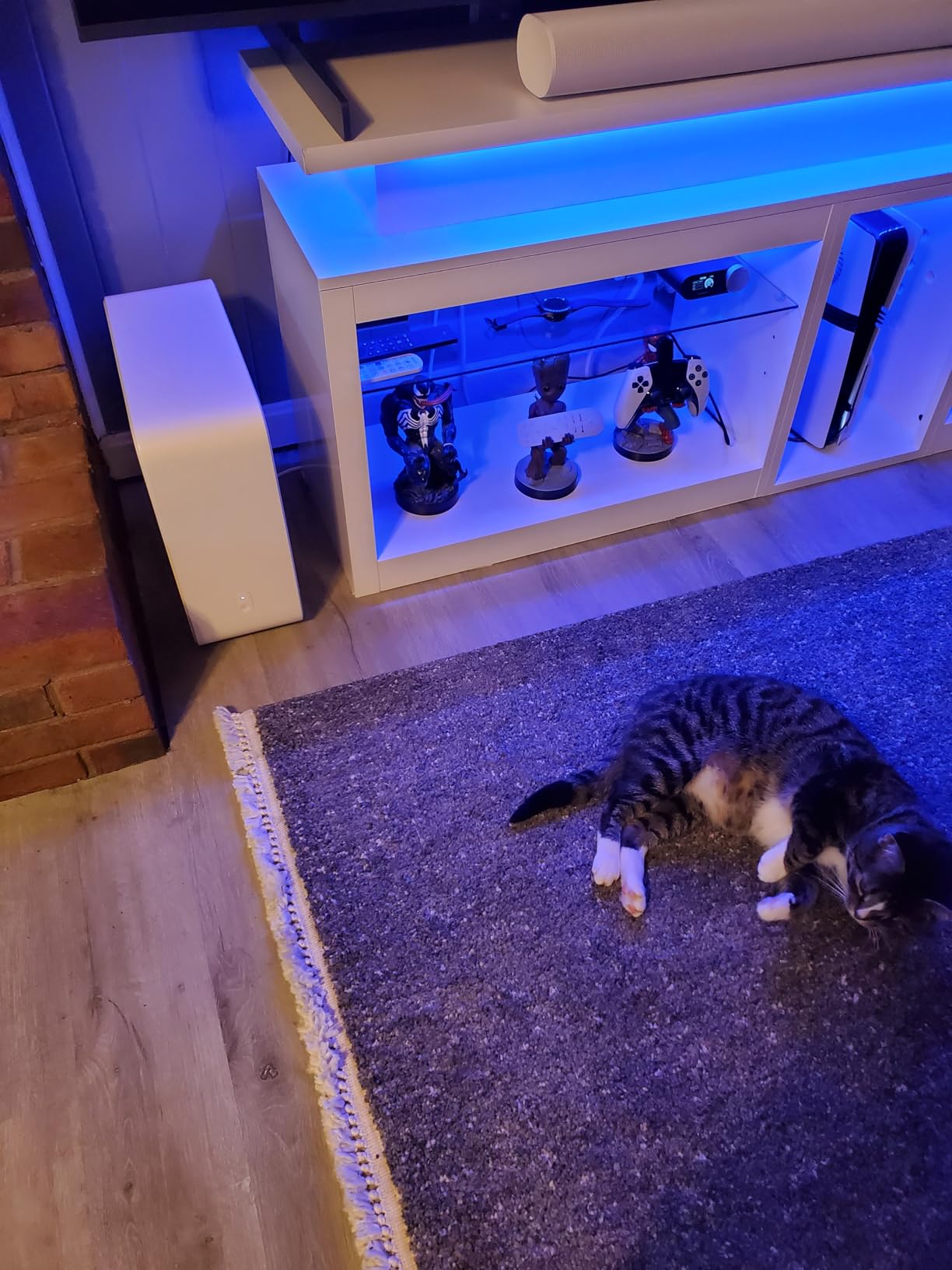
Setup is a single power cable and the Sonos app, connecting over Wi-Fi to a Sonos soundbar or speaker. Reviewers describe the connection as reliable and the initial pairing as painless once the app is running.
This is the highest rated product in the roundup at 4.7. Owners credit the ported design and force-canceling layout for bass that is powerful without buzz, and the under-sofa orientation is the most-cited positive in owner feedback.
Is the Sub 4 too much for a one-bedroom apartment?
Frequently, yes. Reviewers specifically note that the deep output needs room volume to avoid sounding boomy in tight spaces, and that is the standard failure mode of a ported design in a small room with parallel walls.
If you have a large living room and a modern build, the ported depth is an advantage. If you are in a compact unit, a sealed sub with less extension is the calmer neighbour.
How does ecosystem lock-in compare with the Sub Mini?
Identical, and that is the deciding factor for many readers. The Sub 4 pairs with Sonos Arc Ultra, Arc or Beam. Adding either Sonos sub to a non-Sonos system means buying a Sonos Amp first, which changes the total cost considerably.
Its 15.83 inch height also means it will not go on most shelves. Measure the gap under your sofa before assuming the on-side trick works for you.
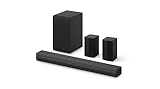
6. LG S40TR – a full surround system with no cable runs
LG S40TR 4.1 ch. Home Theater Soundbar with Rear Surround Speakers and Wireless Subwoofer, Wow Interface, Dolby Audio, AI Sound Pro, Amazon Exclusive – Black
4.1ch system
28.4 inch bar plus two rears
Wireless sub and surrounds
Dolby Audio
Pros
- Includes sub plus two wireless rear speakers
- Rear speakers avoid speaker wire across the floor
- WOW interface unifies an LG TV remote
- Enough volume for a full room
Cons
- Rear speakers need a thin wire between them and their own outlets
- Soundbar has no wall-mount points
- Only some modes use the wireless sub fully
The S40TR is the only product here that gives you a genuine surround package rather than a bar and a bass box. You get a wireless subwoofer and two wireless rear surround speakers, which is what separates it from every other 2.1 bundle in this roundup.
Wireless rears matter in a rental specifically. Speaker wire across an open floor plan or up a wall is the thing that stops most people building a surround system at all, and this system removes the two hardest runs.
The bar measures 28.4 inches wide, 2.5 inches tall and 3.4 inches deep, and the whole package weighs 12.9 lb. The system carries Dolby Audio, and the WOW interface lets your LG TV remote control the soundbar.
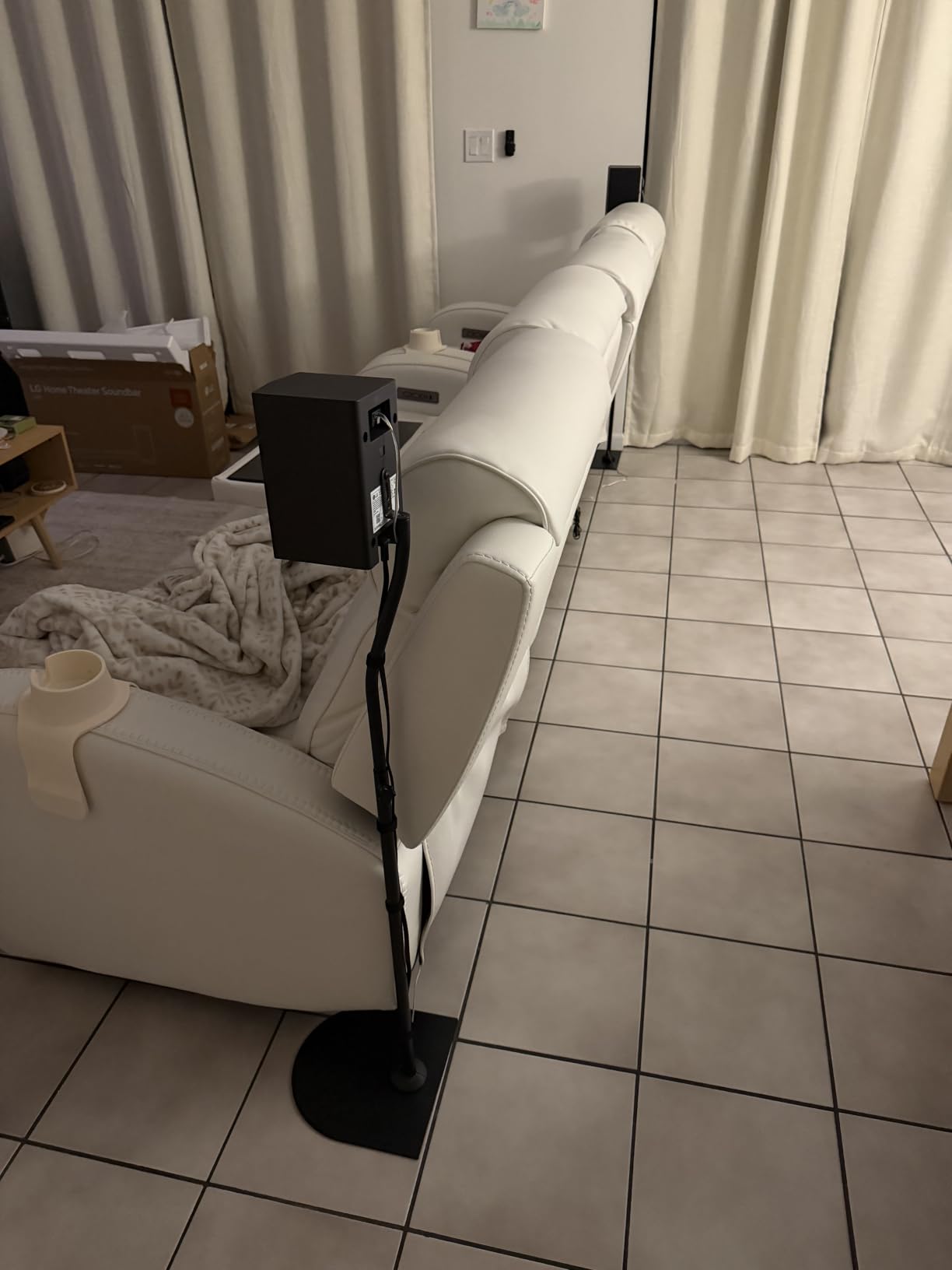
Reviewers who switch to Cinema mode and sit between the two rears report a genuinely immersive experience and enough volume for a full room. Clear Voice Plus and Smart Up-Mixer handle dialogue and upmixing two-channel material.
There are real compromises. The rear speakers are joined to each other by a thin speaker wire, and each needs its own power outlet. The soundbar has no mounting points, so it cannot be wall-mounted under a TV.
How much space does a 4.1 system actually take?
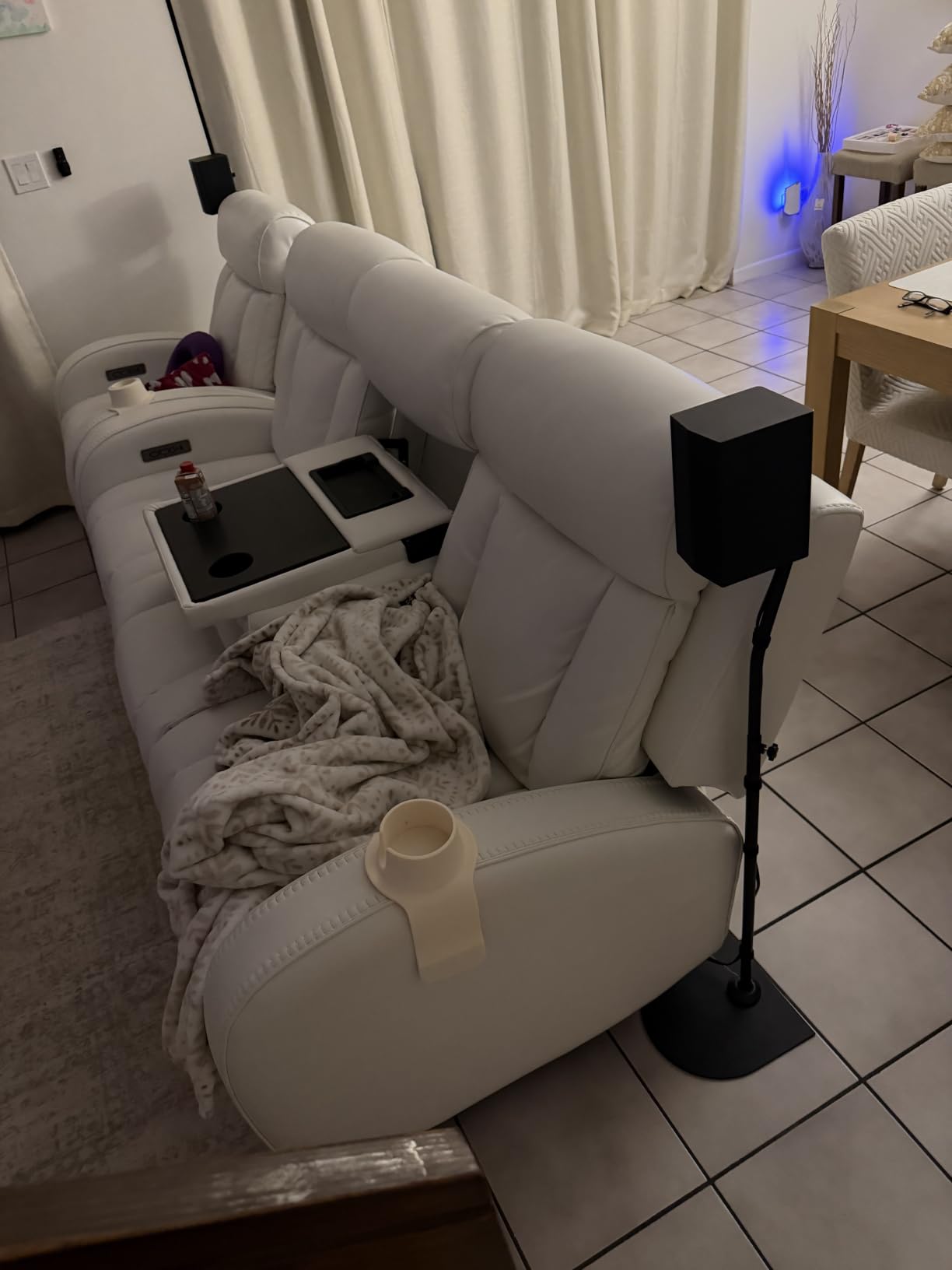
More than a 2.1 bundle, and that is the honest downside in an apartment. You need the bar, the sub, and two rears positioned behind or beside the seating. In a long narrow living room this can work well, in a square studio it can crowd the room.
Each rear speaker sits on furniture rather than a stand, which is helpful. Plan positions before you buy, because the wireless link removes the cable problem but not the floor space problem.
Which modes actually use the sub?
Reviewers point out that Bass Cinema and Music modes use the wireless sub properly, while other modes are noticeably weaker. Since bass is the reason you are here, plan on living in those two modes rather than switching constantly.
Some buyers also report Bluetooth-only setups, app connection drops, and audio to picture latency. If you are sensitive to lip sync, connect over HDMI or optical instead.
7. Polk Audio MagniFi Mini AX – biggest driver in the smallest bar
Polk Audio MagniFi Mini AX Ultra-Compact Sound Bar with Wireless Sub, Black
14.4 inch bar
10 inch down-firing sub
28 Hz extension
AirPlay2 and Chromecast
Pros
- 10 inch sub in a genuinely tiny bar
- VoiceAdjust lifts dialogue without touching the mix
- AirPlay2
- Chromecast and Spotify Connect support
- Expands with Polk SR2 surrounds later
Cons
- Down-firing sub needs floor space in front of seating
- Setup and app configuration are involved
- Dolby Atmos is virtual rather than true object audio
The MagniFi Mini AX solves the awkward geometry problem neatly. The bar is only 14.4 inches wide, so it fits beside a monitor or a small TV, and it still ships with a 10 inch down-firing wireless subwoofer inside the box.
A 10 inch driver paired with a listed 28 Hz frequency response gives it more genuine low-frequency reach than any other system in this roundup apart from the Sonos units. It is the most physically compact way to get real sub-bass in a small room.
The bar uses a five-driver array with Polk SDA surround technology for a wide soundstage, and VoiceAdjust lifts the centre channel so dialogue stays clear without altering the rest of the soundtrack.
Streaming support is the best in the group: AirPlay2, Chromecast, Spotify Connect, Bluetooth and Wi-Fi all work natively. If your apartment audio runs through a phone casting to speakers, this adapts to almost anything you already use.
Owners like the combination of size and bass, and highlight VoiceAdjust as the feature that keeps films watchable at lower volume. Critics point to the sub placement, a steeper setup process, and audio that trails newer cheaper 2.1 systems on detail.
Why does a down-firing sub matter in an apartment?
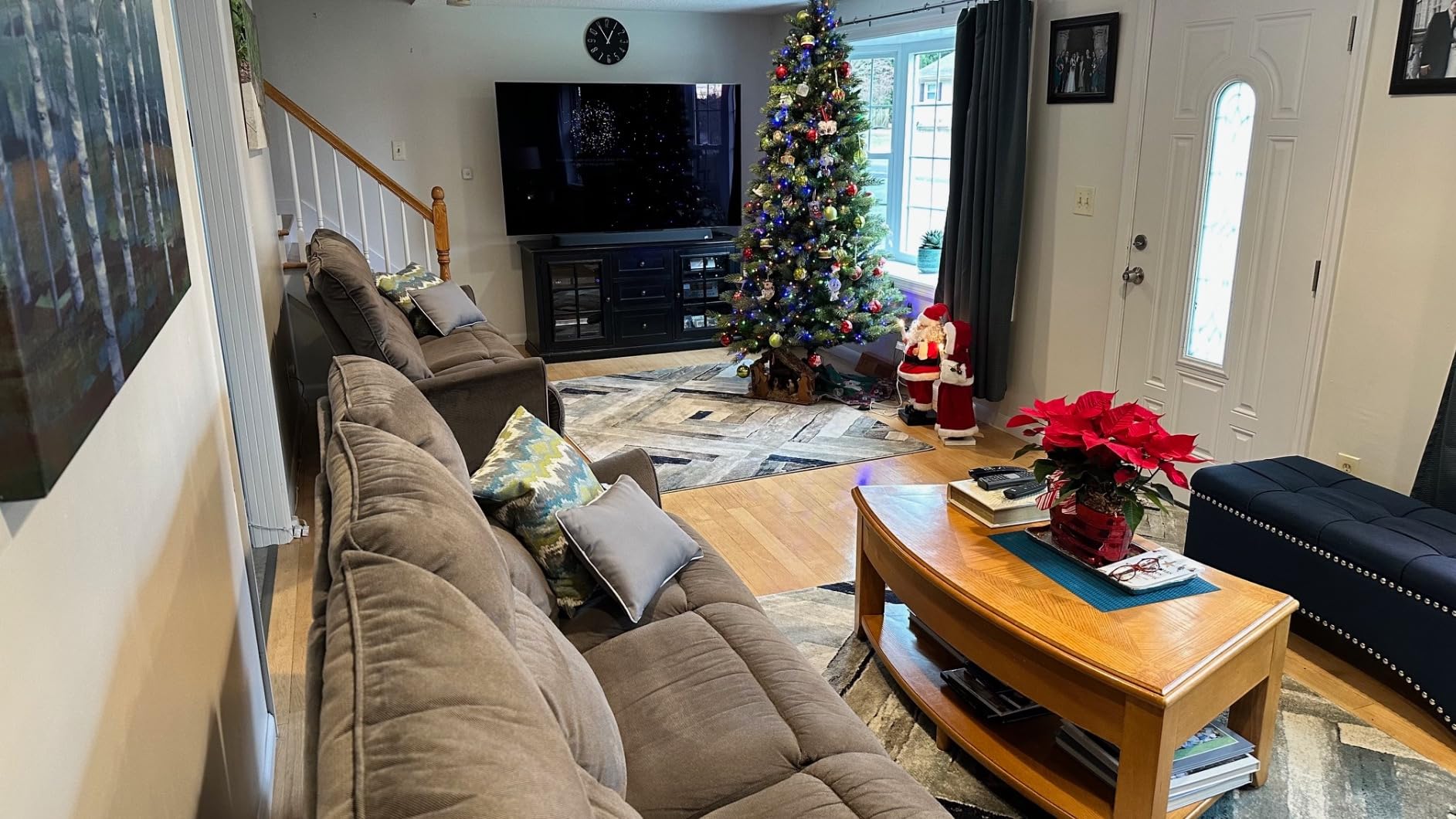
A down-firing driver couples to the floor, which is exactly the surface your downstairs neighbour is sitting on. It gives you strong output in a small room, and on carpet it can sound tight rather than boomy. On hardwood it transmits more.
It also constrains placement. The sub needs floor space in front of your seating rather than a corner or a shelf, so you are giving up some of the flexibility that front-firing units offer.
Is it still current against cheaper 2.1 bundles?
Partly. For streaming flexibility, small size and real low-frequency extension, it leads. For outright value and simpler setup, the Hisense and TCL bundles are hard to argue with, and several reviewers make the same observation.
The Polk can also be expanded later with SR2 wireless surrounds, which is unusual at this size and keeps a future upgrade path open.
8. PreSonus Eris Sub 8BT – the most controllable sub in the roundup
PreSonus Eris Sub 8BT — 8″ Inch Powered Subwoofer, Powered Sub, Active Subwoofer, Wireless, Bluetooth, Home Audio, Bass Speaker, Home Theater, Music Production, Gaming
8 inch front-firing
100W
30 Hz extension
Crossover and phase controls
Pros
- Front-firing driver sends energy into the room not the floor
- Crossover and phase controls let you blend it with any speakers
- 30 Hz extension in a 12.7 inch footprint
- Bluetooth plus TRS RCA and pass-through
Cons
- Needs EQ to sound its best
- Cables are not included
- Bluetooth latency rules it out for critical production work
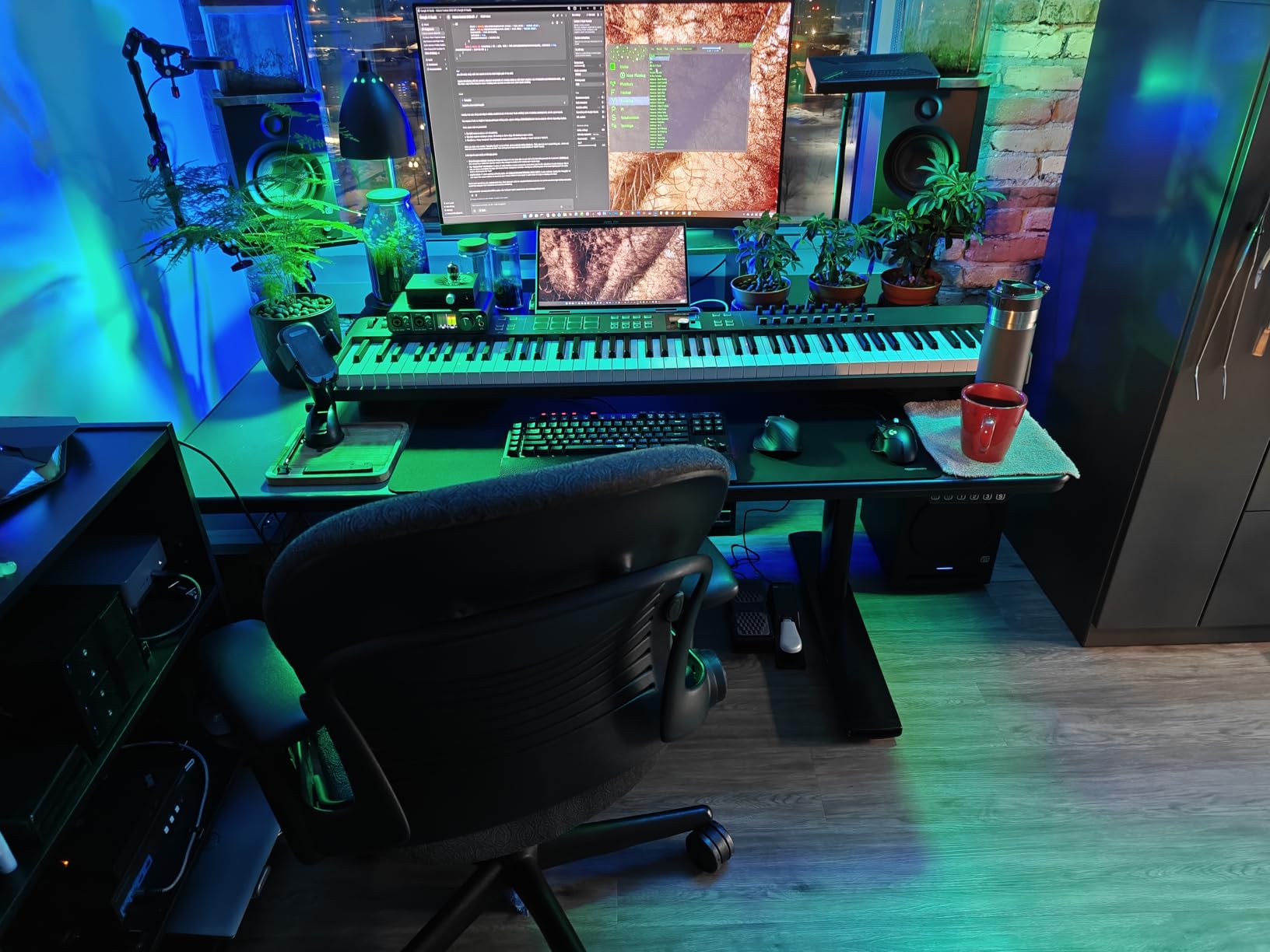
The Eris Sub 8BT is the only sub here aimed equally at music listening and home use, and it behaves like a studio tool. It is front-firing, which means energy goes into the room instead of straight down into the floor slab.
It measures 12.7 inches wide, 9.8 inches deep and 11.7 inches tall, weighs 8000 g, and runs a 100W amplifier against an 8 inch woven-composite woofer. Low-frequency extension is listed at 30 Hz, which is the second deepest figure in this group.
The front panel carries a highpass filter, a lowpass crossover, a phase control and gain. There is also a headphone output with a built-in headphone amplifier on the front, which is a studio feature that happens to be useful late at night.
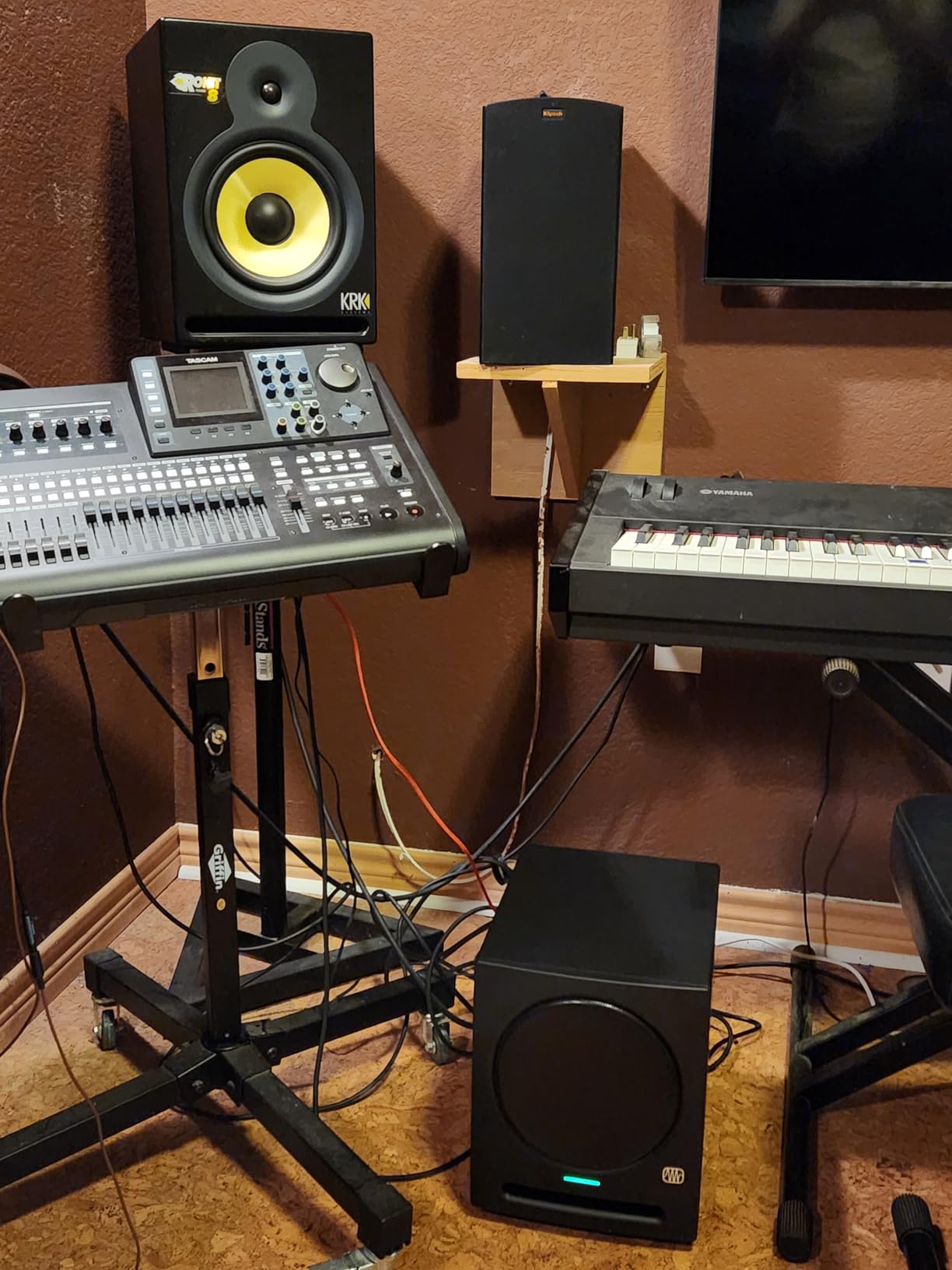
Connectivity is unusually broad for a wireless sub: Bluetooth 5.0, quarter-inch TRS, RCA inputs, and pass-through outputs. Pass-through matters because it means you can keep a small speaker pair feeding the sub and a monitor without rewiring.
Owners report clean, non-muddy low end and accurate, flat response that translates between systems. The recurring caveat is that it wants EQ. Out of the box some listeners find it boomy in a small room until they set the crossover properly.
Why does front-firing make it the neighbour-friendly choice?
Orientation decides where the energy goes. A down-firing sub drives a shared floor structure directly, and a front-firing sub pushes air forward into your own space where it decays naturally. That is the single most useful physical distinction in this roundup for apartment living.
You still need sensible placement and volume discipline, but the transmission path through the building is shorter. It is also easier to place, since a front-firing unit can sit against a wall or in a corner without a floor-coupling issue.
Is it good for a PC or desktop 2.1 setup?
Very. The TRS inputs and Bluetooth make it a natural match for a compact PC speaker setup, and the crossover and phase controls let you blend it with small bookshelf speakers so the handoff is seamless rather than doubled.
For critical work, use the wired inputs. Bluetooth adds noticeable latency, only one device can pair at a time, and switching devices requires re-pairing, so it is a listening convenience rather than a monitoring path.
9. Samsung SWA-W510 – a compact cube for Samsung S-series owners
SAMSUNG SWA-W510 Subwoofer for S Series Soundbar with Powerful Bass, Wireless, Unibody Design, Compact 6.5″ Size, 2022, Black
6.5 inch cube with passive radiator
9.4 inch square footprint
Wireless pairing
14.1 lb
Pros
- Passive radiator gives more depth than the size suggests
- 9.4 inch square footprint
- Wireless placement away from the bar
- Unibody design matches Samsung bars
Cons
- Only pairs with specific Samsung S-series bars
- Will not work with third-party soundbars
- Less powerful than larger 8 inch subs
- Radiators can rattle at higher output
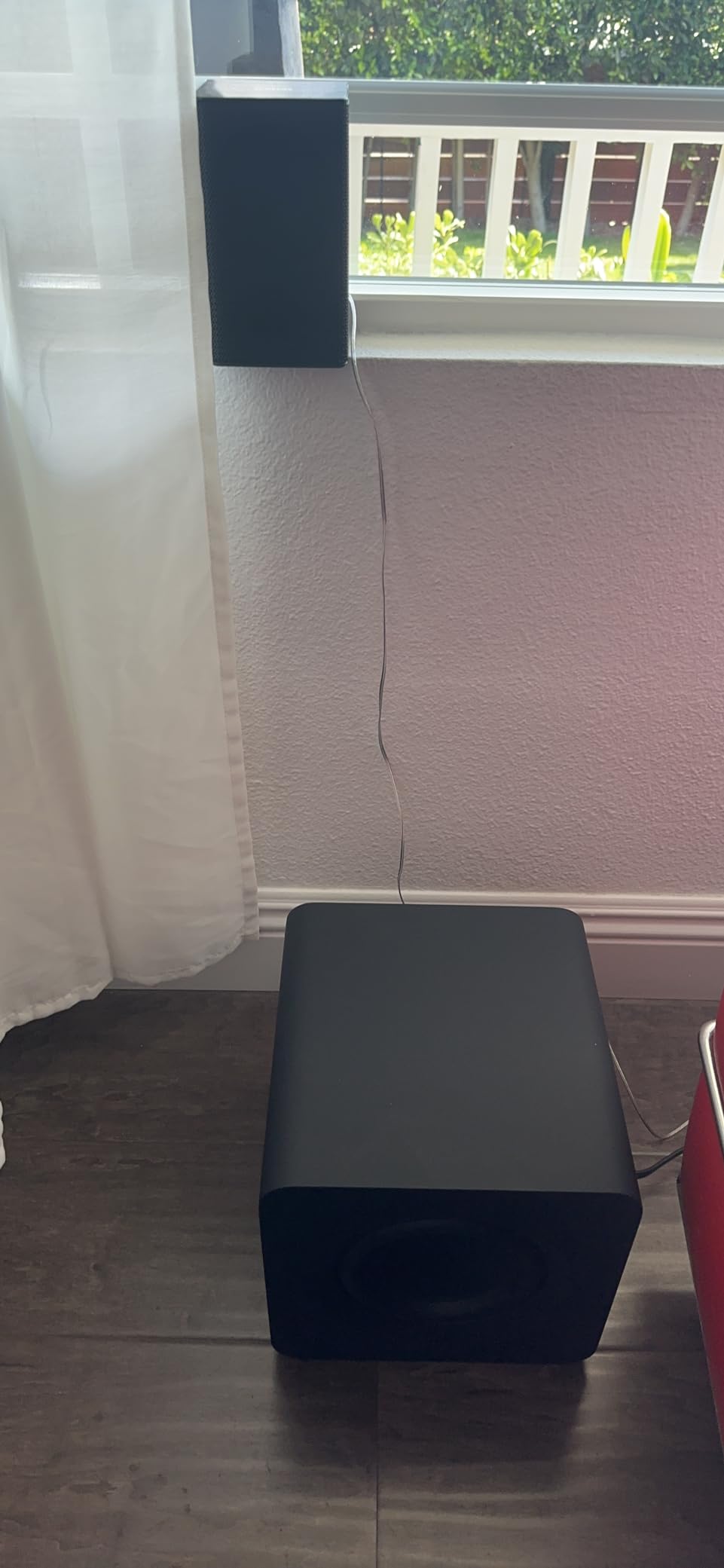
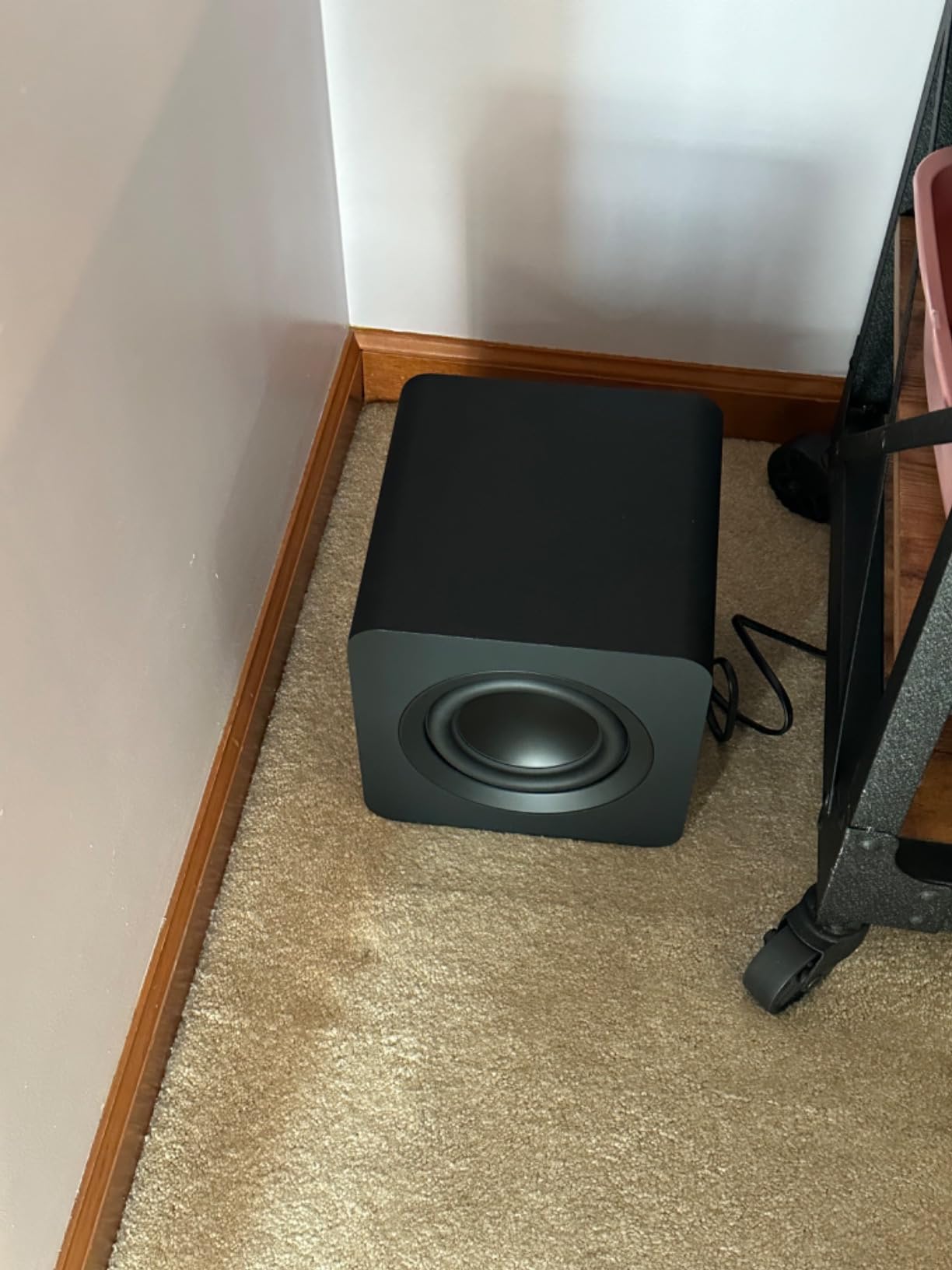
The SWA-W510 is a small sealed-looking cube with a passive radiator, and the radiator is the interesting part. A 6.5 inch driver paired with a passive radiator behaves like a slightly larger system, which is why owners describe deeper bass than the size suggests.
It measures 9.4 inches on both the width and depth and stands 9.5 inches tall, weighing 14.1 lb. Compared with the Sonos Sub Mini, the footprint is similar but the cube is squarer and shorter.
Placement is genuinely free because the link is wireless. You can put the cube across the room, away from a shared wall, and let the low end fill evenly rather than piling up against one partition.
The catch is compatibility, and it is a hard one. The sub pairs only with the HW-S61B, HW-S61D/ZA, HW-S60B, HW-S60D/ZA and HW-S50B Samsung soundbars. It will not work as a standalone Bluetooth subwoofer with any other brand.
Owners of compatible setups are largely satisfied, describing a good-looking sub that frees up placement options. Reviewers repeatedly raise ecosystem lock-in, and some find the depth modest next to larger standalone subs in the same price range.
Is the passive radiator a plus or a minus here?
Mostly a plus for a small room. It adds apparent output without a larger cabinet, which is exactly the trade you want when floor space is the constraint. The recurring complaint is cabinet rattle at higher output levels, so keep the gain moderate.
On a rug or carpet the rattle is essentially gone. Bare hardwood is where you will hear it, and that is worth testing before you commit.
What if your soundbar is not a Samsung S-series?
Then this one is not for you, and there is no workaround. The ecosystem limit is the price of the compact, matched design. If your bar is from another brand or you plan to change it in a few years, choose a sub that takes standard wired inputs instead.
The PreSonus Eris Sub 8BT is the natural alternative in that situation, because it accepts RCA and TRS from anything.
10. Klipsch R-80SWi – the strongest standalone pick for a small room
Klipsch R-80SWi 8-inch 150W Wireless Subwoofer with High Performance Driver for Deep Bass Black
8 inch down-firing
150W
38 Hz extension
Pre-paired 2.4GHz transmitter
Pros
- Pre-paired transmitter means setup is nearly instant
- 5 ms latency keeps video in sync
- Gain and 0/180 phase controls for blending
- Works with almost any source
Cons
- Output drops off in larger rooms
- Transmitter needs its own outlet
- Plastic feet can rattle on hardwood
- Extension bottoms out near 38 Hz
The R-80SWi is the one to buy if you want a real subwoofer that makes no assumptions about your speakers. It ships with a pre-paired 2.4GHz wireless transmitter, so you plug the transmitter into a sub-out or LFE out and the sub pairs automatically.
The design is a compact down-firing 8 inch driver rated at 150W, reaching 38 Hz. It measures 11.75 inches on both width and depth and stands 13.25 inches tall, so it is larger than the 9 inch cubes but still corner-friendly.
Injection Moulded Graphite in the cone keeps it light and rigid, which reduces cone breakup and distortion. Audio latency is listed at 5 milliseconds, low enough that lip sync is a non-issue for film.
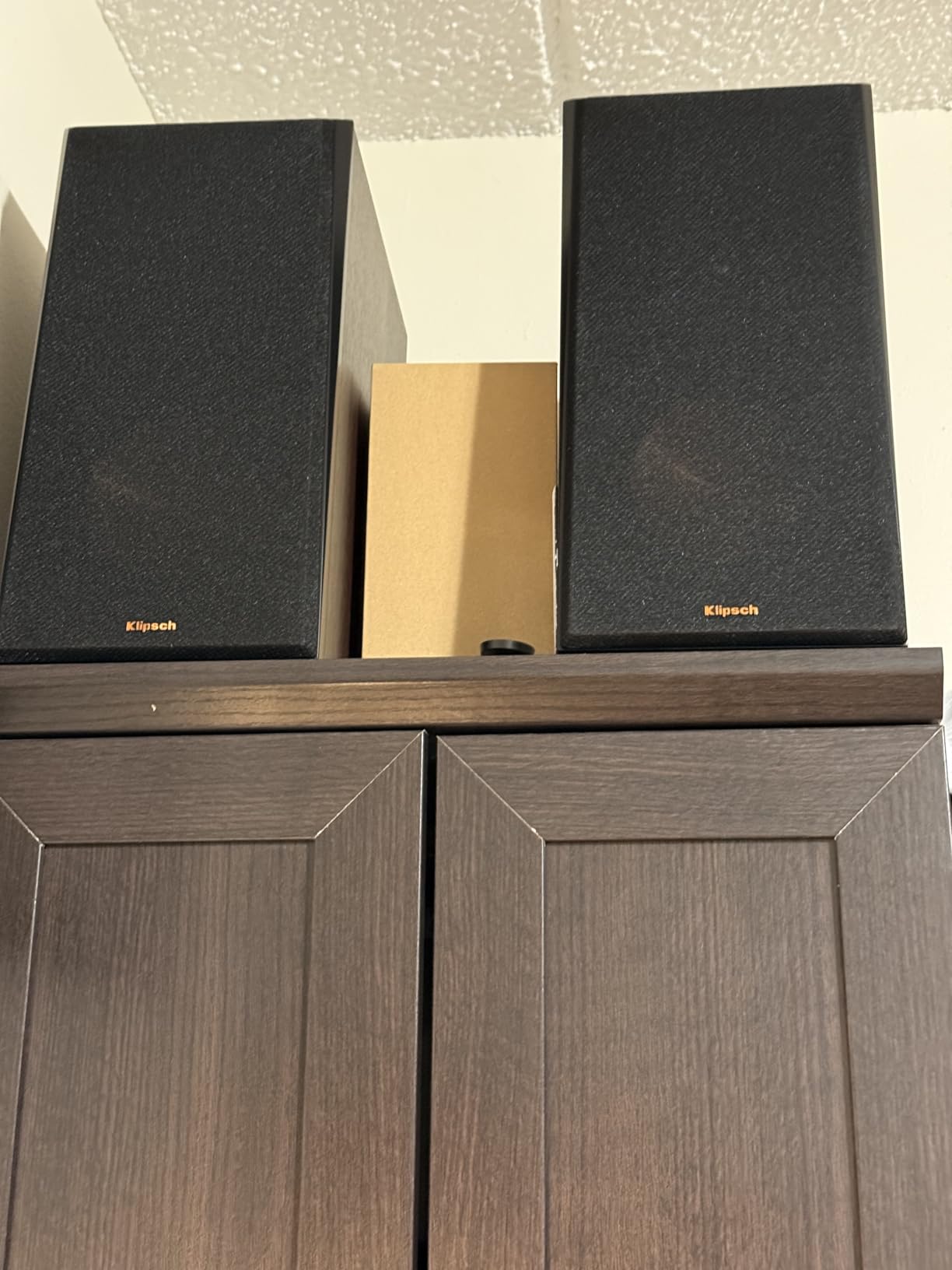
Controls are the reason studio and home users like it. There is a lowpass crossover, a phase switch at 0 or 180 degrees, and gain, so you can blend the sub with whatever main speakers you already own instead of being forced into one ecosystem.
Owners frequently describe it as the sweet spot between output and cleanliness, calling the bass tight rather than boomy, and noting that it excels in small and medium rooms. The most cited drawbacks are rattling plastic feet on hard floors and the extra outlet the transmitter needs.
What does the pre-paired transmitter actually solve?
Most wireless subs ask you to pair over Wi-Fi or Bluetooth through an app. This one ships matched to the sub already, so the whole job is plugging in two cables. In a rental where you may not get a second attempt at a clean install, that simplicity is worth more than app features.
The trade is the extra wall outlet for the transmitter power supply, and the fact that the link is proprietary 2.4GHz rather than a standard you can reconfigure later.
Will 150W fill a bigger room?
No, and reviewers are clear about that. Output drops off noticeably in larger spaces, so this is a small and medium room sub by design. Within a one-bedroom apartment or a studio it is comfortably sufficient, and tight rather than boomy is exactly the behaviour you want against shared walls.
On hardwood floors, put an isolation pad or a rug under it. The hard rubber inserts in the plastic feet are the single most reported complaint, and a rug removes it entirely.
How to Keep Bass From Bothering Your Neighbors
Low-frequency energy moves through structure, not air. A bass note at 40 Hz passes through a party wall far more readily than a midrange note at 1 kHz, which is why complaints are almost always about bass and rarely about overall volume. Everything below is about reducing the amount that reaches the structure.
Keep distance from shared walls. A sub pushed into the party wall maximises boundary reinforcement and doubles the output at the lowest frequencies. Moving it to the opposite wall or an open corner usually reduces transmitted energy more than lowering the volume.
Decouple it from the floor. Put an isolation pad, a rug, or foam beneath the sub. This is the single highest-impact change on hardwood, and it fixes the foot rattle complaints we heard on the Klipsch R-80SWi too.
Set the low-pass filter to around 80 Hz. Every sub here that exposes a crossover has a lowpass control. Holding it at or below 80 Hz removes the mid-bass region that muddies small-room sound and travels more readily than deep bass.
Use night mode or level limits. The Sonos app and the ULTIMEA 10 band EQ both let you cap output. A cap at moderate listening levels is a reasonable neighbour policy and costs you almost nothing in daily use.
Run room correction before you raise the level. Trueplay on the Sub Mini, AI Sonic on the TCL S55H and DSP on the ULTIMEA all smooth the response first. Tuning before you push volume prevents the boomy, undefined low end that prompts complaints.
Use daytime discipline. If you are several floors from the unit below, late-night volume is what gets noticed. A sealed, accurate sub at moderate output transmits less than a powerful one pushed hard, which is the whole premise of this roundup.
Consider two small subs over one large one. Two lower-output subs spread around the room give smoother coverage than a single unit pumping hard, and lower peak output means less structural transmission. The Sonos units support pairing within their ecosystem.
One more thing nobody in the forums mentions: check your lease and your building rules before you buy. Plenty of buildings have quiet hours, and a neighbour conversation is far cheaper than a dispute. Every sub here is wireless and needs no drilling, which keeps installation risk low.
What is the 83% rule, and does it apply to a subwoofer?
The 83% rule is a speaker placement guideline: sit about 83 percent of the way back from the front wall of the room, which places you at the ideal spot for imaging and bass response between the front speakers. It was designed for stereo imaging rather than subwoofer placement.
For a sub in an apartment, adapt it rather than follow it literally. Use the ratio to position your seating so the sub is not directly beside or behind your head, then place the sub on the opposite side of the room from the nearest shared wall.
What to Look for in a Wireless Subwoofer for Small Rooms
Footprint first. Measure before you shop. The Sonos Sub Mini and Samsung SWA-W510 are 9 inch cubes, the PreSonus Eris Sub 8BT is 12.7 inches wide, and the Sonos Sub 4 is a 15.83 inch tower. If it does not fit beside the sofa, none of its specifications matter.
Low-frequency extension over raw power. Extension is how deep the sub goes, and it is a better predictor of musical and cinematic impact than wattage. The Sonos Sub Mini reaches 25 Hz, the PreSonus Eris Sub 8BT 30 Hz, the Polk MagniFi Mini AX 28 Hz. A sub that reaches 30 Hz quietly beats one that reaches 38 Hz loudly.
Orientation. Front-firing and side-firing drivers push energy into the room where it decays. Down-firing drivers couple to the floor. For a shared-wall building, front-firing is the safer default, and down-firing needs a rug or pad underneath it.
Sealed versus ported. A sealed enclosure trades the deepest extension for control, and it will not pressurise against a wall. A ported enclosure reaches deeper and plays louder, which is the wrong trade in a small room with thin walls. Most of the noise in this roundup is ported; the two best apartment picks are sealed.
Wireless transport type. Wi-Fi based systems like the Sonos units join your network and stay in sync, but they lock you into an ecosystem. Bluetooth 5.0 and 6.0, found on the PreSonus, ULTIMEA and LG systems, are open but add latency. A pre-paired 2.4GHz transmitter like the Klipsch R-80SWi avoids both problems at 5 ms latency and is the least ecosystem-dependent option in this roundup.
Wireless sub versus wireless kit. A wireless sub is a self-powered speaker that receives audio over the air and needs no receiver. A wireless transmitter kit does the same job for a wired sub you already own. In a rental, where running a cable may not be possible at all, either route solves the problem, and the kit route lets you keep equipment you already like.
Ecosystem honesty. Five of the ten products here will not pair with anything outside their own brand family. That is not a flaw, but it is the fact most likely to end a purchase regret, so decide it before you buy rather than after.
What we deliberately left out. We skipped 15-inch-plus drivers and anything sized for a dedicated theater room, because a sub that cannot be placed in a normal apartment living room is not a recommendation, it is a contradiction. We also skipped subs that require an AV receiver, since the single most common apartment setup is a TV with no receiver attached.
One last note on room type: if the sub ends up in a boat or a camper rather than a flat, the priorities change again, and our marine subwoofer guide covers the sealed, corrosion-resistant models built for that job. For compact living spaces generally, our portable dishwasher picks for apartments cover the other appliance decision every renter makes.
Frequently Asked Questions
Can I use a subwoofer in an apartment?
Yes. Low-frequency energy travels through joists, walls and floors far more easily than mid or high frequencies, so bass is what reaches your neighbours. Choose a subwoofer with real low-frequency extension and run it at moderate volume rather than picking the most powerful option available. A wireless model also means no cable to run along baseboards you do not own.
How do I keep a subwoofer from bothering my neighbours?
Move the sub away from shared walls, decouple it from the floor with a rug or isolation pad, and set the low-pass crossover to around 80 Hz. Run room correction before raising the level, use night mode or a volume cap if your app offers one, and treat the floor as the transmission path it is. Two smaller subs spread around a room also transmit less than one large sub pushed hard.
Are wireless subwoofers worth it?
In a rental, yes, and the value is not convenience. It is that you often cannot run a subwoofer cable at all without drilling, chasing baseboards, or asking a landlord. A wireless sub carries its own amplifier and receives audio over Wi-Fi, Bluetooth or a pre-paired radio link, so a TV or soundbar is all you need as a source.
Is a subwoofer too loud for an apartment?
Loudness is not the variable that carries, low frequency is. A more accurate subwoofer with deeper extension at lower volume can outperform a more powerful model at high volume, because you are not compensating with volume in the band that travels through structure. Look for extension figures like 25 Hz or 30 Hz rather than the largest wattage number on the box.
Is Bluetooth or WiFi better for a wireless subwoofer?
Wi-Fi based systems such as the Sonos Sub Mini stay in sync with a whole speaker system but lock you into one ecosystem. Bluetooth models including the PreSonus Eris Sub 8BT work with almost anything but add noticeable latency and usually allow one device at a time. A pre-paired 2.4GHz transmitter, as on the Klipsch R-80SWi, sits between the two at roughly 5 ms latency.
What size subwoofer do I need for a small room?
Match output to the room, not to a marketing number. A studio or one-bedroom apartment is well served by a 6.5 to 8 inch driver from a sealed enclosure, because a ported design in a small room tends to sound boomy and drives more energy into the floor. Advice repeated on audio forums favours larger drivers for control, so if you want maximum headroom go 8 inches rather than 6.5.
What is the 83% rule for speaker placement?
It is a speaker placement guideline: sit about 83 percent of the way back from the front wall of a room, which puts you at the listening position that balances imaging and bass response between your front speakers. It was designed for stereo imaging, not subwoofers. For a subwoofer in an apartment, use it to keep the sub away from your seating position, then place the sub opposite the nearest shared wall.
Conclusion: Where to Start
Start with the Sonos Sub Mini. At 9 inches square it is the easiest sub in this roundup to place in a real apartment, its sealed force-canceling cabinet reaches 25 Hz without a port pressurising against your wall, and Trueplay handles the small-room correction that most people would skip.
If you are not in the Sonos ecosystem, the Klipsch R-80SWi is the pick, because the pre-paired transmitter makes it the least presumptuous choice on the list. For a complete system with no other gear, the TCL S55H pairs real room calibration with a compact sub cube.
Whichever you pick, place it away from shared walls, put something underneath it if your floor is hardwood, and set the low-pass filter before you turn the level up. That discipline does more for neighbour relations than any spec on the box, and it is what makes a subwoofer workable in an apartment at all.