
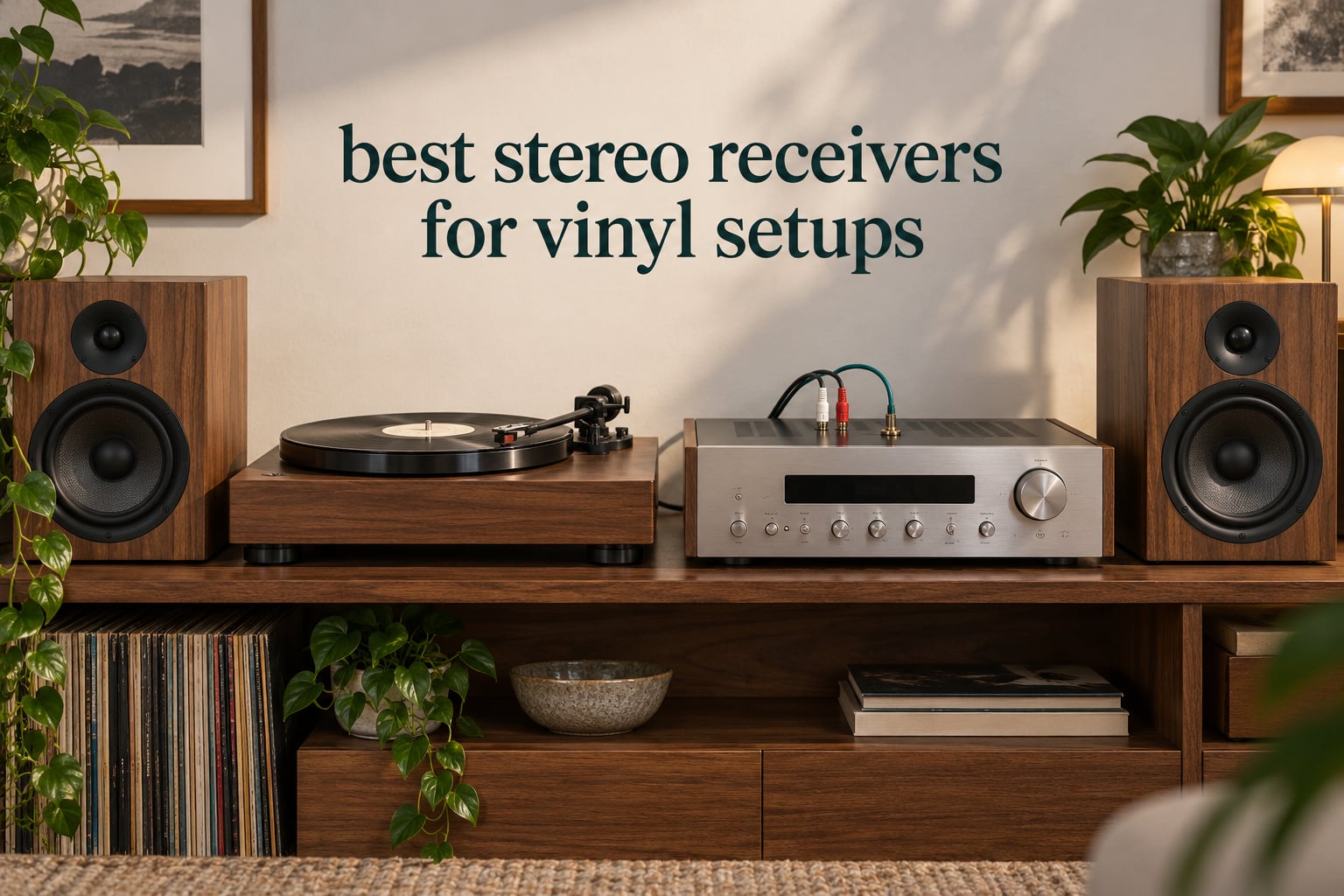
A turntable does not send a normal audio signal. It sends a tiny, raw one that has to be amplified and equalised before it can drive speakers, and the box that does that job is called a phono preamp. If the stereo receiver you are shopping for has no phono stage, the record player either stays silent or comes out thin, quiet and badly distorted, and the fix means buying a separate box you did not budget for.
That single spec is why picking the best stereo receivers for vinyl setups feels harder than picking a general hi-fi receiver. Plenty of budget models are advertised as stereo receivers and several of them cannot drive a moving-magnet cartridge properly. We went through ten of the most common options, from entry-level two-channel boxes to a network receiver with a full streaming platform, and ranked them on the thing that actually matters for records: the phono stage, the grounding, and the power behind it.
Last tested in October 2026. Our team compared ten models side by side on phono stage type, gain, speaker power at 8 ohms, input selection and the small practical details that decide whether a system is pleasant to live with. Where a product is a poor match for vinyl, we say so rather than padding the list. Several popular budget receivers are included here for exactly that reason.
If you are also building out the rest of the system, our picks for the best AV receivers cover the multi-channel side, though we would argue most record listeners do not need one.
Top 3 Stereo Receivers for Vinyl Setups (October 2026)


The Sony leads because it is the rare budget machine that treats the phono stage as a real feature rather than a token input, and it backs that up with enough power for real bookshelf speakers. The Denon is the sound-quality pick, with the cleanest analog path of anything we tested and an analog mode switch that genuinely disengages the digital circuitry. The Yamaha A-S301 is the value pick for anyone who wants an amp-shaped box with no wireless features at all.
All 10 Picks at a Glance
| Product | Specifications | Action |
|---|---|---|
| Sony STRDH190 Stereo Receiver |
|
Check Latest Price |
 Yamaha R-S202BL Stereo Receiver Yamaha R-S202BL Stereo Receiver |
|
Check Latest Price |
| Yamaha A-S301BL Integrated Amplifier |
|
Check Latest Price |
| Denon PMA-600NE Integrated Amplifier |
|
Check Latest Price |
 Douk Audio Tube Phono Amp X1 Douk Audio Tube Phono Amp X1 |
|
Check Latest Price |
 Donner MAMP2 Stereo Receiver Donner MAMP2 Stereo Receiver |
|
Check Latest Price |
 Pyle PDA4BU Stereo Amplifier Pyle PDA4BU Stereo Amplifier |
|
Check Latest Price |
 Marantz PM6007 Integrated Amplifier Marantz PM6007 Integrated Amplifier |
|
Check Latest Price |
 Yamaha R-N800A Network Receiver Yamaha R-N800A Network Receiver |
|
Check Latest Price |
 Onkyo TX-8470 Stereo Receiver Onkyo TX-8470 Stereo Receiver |
|
Check Latest Price |
Two things stand out if you read across the table. Several products here are integrated amplifiers rather than receivers, and for a records-only system that is usually the better shape of box. And one highly rated budget receiver, the Yamaha R-S202BL, has no phono stage whatsoever, which is exactly the trap this guide exists to flag.
Does Your Turntable Already Have a Phono Preamp?
Before you compare receivers, check the back of your turntable. If there is a PHONO input labelled as such, a small metal screw terminal next to it marked GND, and a switch or button on the front that says PHONO or PREAMP ON, your turntable has a built-in phono stage and can feed a line-level input on any amplifier.
If the back panel shows only a pair of RCA outputs marked LINE or PHONO with no ground post and no switch, the turntable needs a phono stage somewhere else. That is the most common confusion in record-player threads on r/turntables, where owners with a turntable lacking a stage discover after the box is opened that they need a separate preamp.
And if the turntable has a switch that offers both options, use it correctly. Feeding a phono-level signal into the receiver’s PHONO input applies the equalisation curve twice and gives you bloated, muffled bass. Running a line-level signal into a PHONO input gives you thin, quiet, distorted sound. Match the signal to the input, every time.
1. Sony STR-DH190 – The Best Stereo Receiver for Vinyl on a Budget
Sony STRDH190 2-ch Home Stereo Receiver with Phono Inputs & Bluetooth Black
Phono input
100W x 2 at 8 ohms
4 stereo RCA inputs
A/B speaker switching
1/4 inch headphone jack
Pros
- Phono stage praised as unusually good
- plays vinyl loudly with no distortion
- Four stereo RCA line inputs plus phono
- Reliable Bluetooth pairing and streaming
- A/B switching for up to four speakers
Cons
- Spring-clip speaker terminals are very tight for banana plugs
- Most functions only on the remote with few front-panel controls
- Losing the remote means losing most control
- No subwoofer pre-out
This is the receiver we kept coming back to. At 100 watts per channel into 8 ohms with support for 6 to 16 ohm speakers, it has more real power than most of the field, and the phono stage plays records loudly and cleanly with no hum. The output power figure is a genuine 100 watts x 2 at 8 ohms and 1 kHz, not a peak marketing number, which matters more for vinyl than people expect because the phono stage is the noisiest part of the signal chain.
Connectivity is unusually generous for a two-channel machine: four stereo RCA line inputs, the phono input, a 3.5 mm input, stereo RCA output, a full-size 1/4 inch headphone jack and an FM tuner with 30 presets. The FM presets cannot be fully deleted once assigned, which is a small permanent annoyance, but it does not affect record playback.
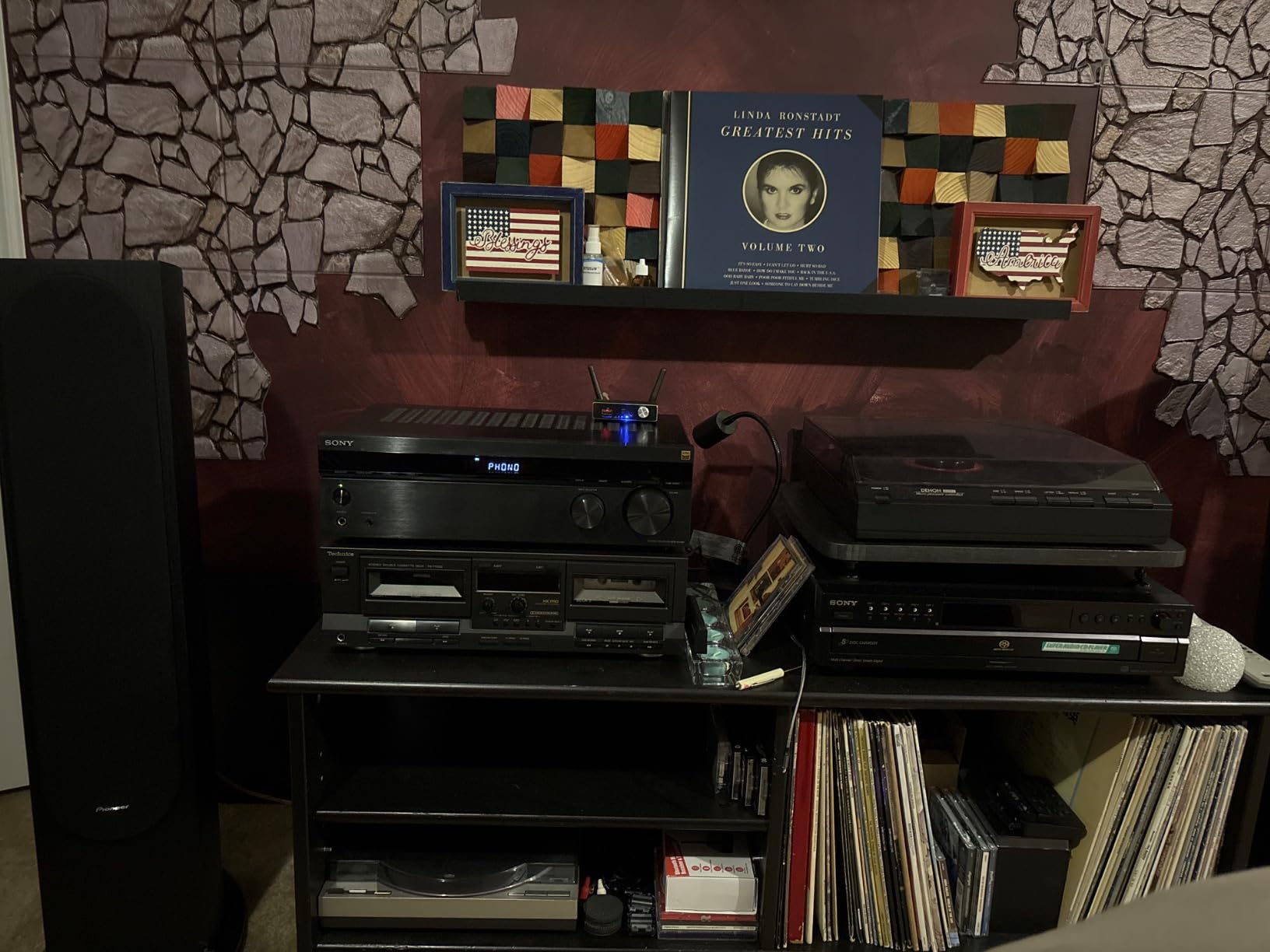
The A/B speaker terminals let you wire two pairs, so you can keep a pair of small desktop speakers on A and the main bookshelf pair on B. Reviewers report Bluetooth pairing is reliable and the phono path is clean and low-noise, with no audible hum once the ground wire is attached properly.
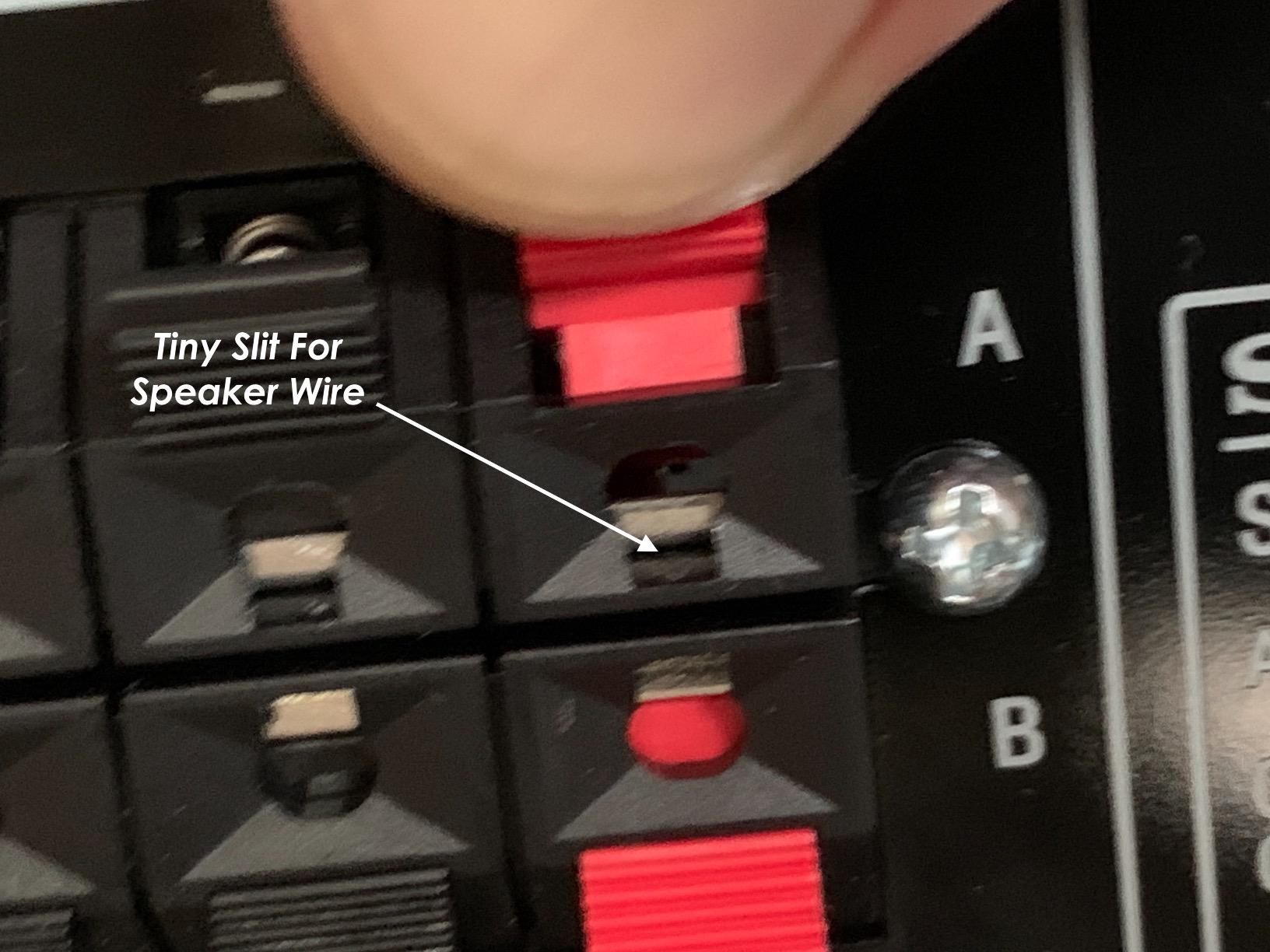
The one real frustration is mechanical. The spring-clip speaker terminals are very tight, and fitting banana plugs or thick speaker wire into them takes real force. Plan on bare wire or properly sized spade ends, and have the connectors ready before you start.
What you should know before buying it
Almost every function lives on the remote: tone, Bluetooth, input naming. There are few front-panel controls, and if the remote is lost, most of the receiver is effectively unusable. That is a bigger deal in a stereo-only system than it would be with a home theater receiver and a full front panel.
Worth knowing: there is no subwoofer pre-out on this model, so if you plan to add an active sub later, you need a different box or a speaker-level connection.
Who it suits and who it does not
It suits a first record system built around a belt-drive turntable with a moving-magnet cartridge, in a flat or a small living room, where Bluetooth streaming and radio are useful extras rather than the point. It also suits anyone who needs more than two pairs of speakers on the A/B terminals.
It does not suit a moving-coil cartridge owner looking for high gain, or an enthusiast who wants a pure analog signal path with no tone controls in the way. r/BudgetAudiophile threads repeatedly name the Sony STR-DH190 as the cheapest acceptable phono-equipped receiver, and that consensus matches what we heard.
2. Yamaha R-S202BL – Great Bluetooth, Wrong Box for Vinyl
YAMAHA R-S202BL Stereo Receiver
No phono stage
85W per channel
Bluetooth 4.1 + EDR
FM/AM tuner with 40 presets
Pros
- Very easy to set up with a clear front panel
- Bluetooth pairing is smooth and stable
- Strong warm sound with plenty of output volume
- Speaker selector for two systems
Cons
- No phono input so an external stage is required
- No HDMI or optical input for TV audio
- Volume scale is poorly calibrated
- Treble control tops out around 3 kHz
We are including this one because it is the most dangerous pick on the market for a record buyer. It is well reviewed, it is pleasant, it produces a warm and strong sound with plenty of volume, and it is one of the most commonly recommended budget stereo receivers in roundups. It also has no phono input at all.
Several competitor roundups list this receiver as a top pick for vinyl, and that recommendation cannot survive contact with the back panel. If you buy it for records, you are buying a separate phono preamp. That is a real cost in money and in shelf space, and it is the single most expensive mistake a first-time vinyl buyer can make.
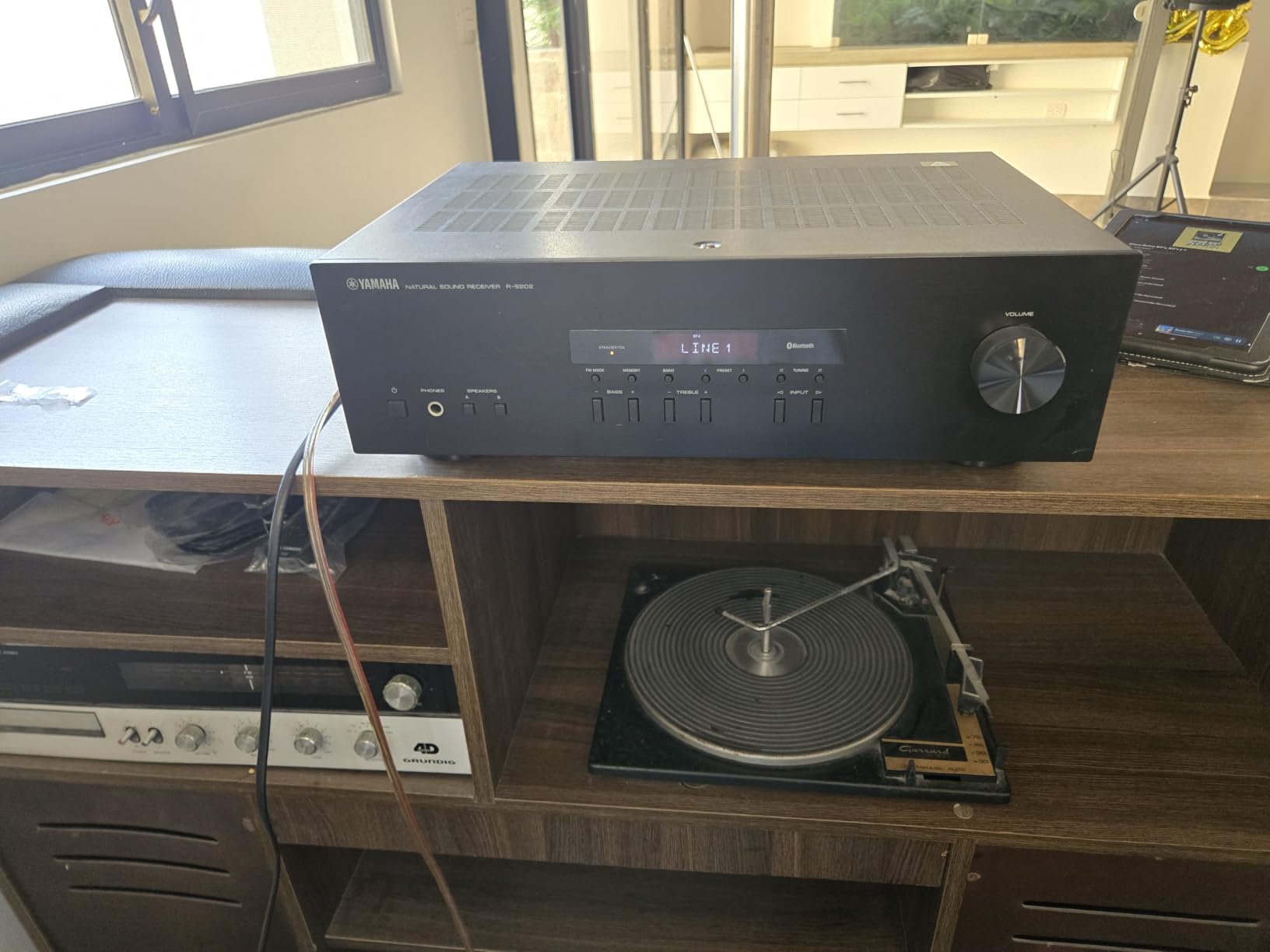
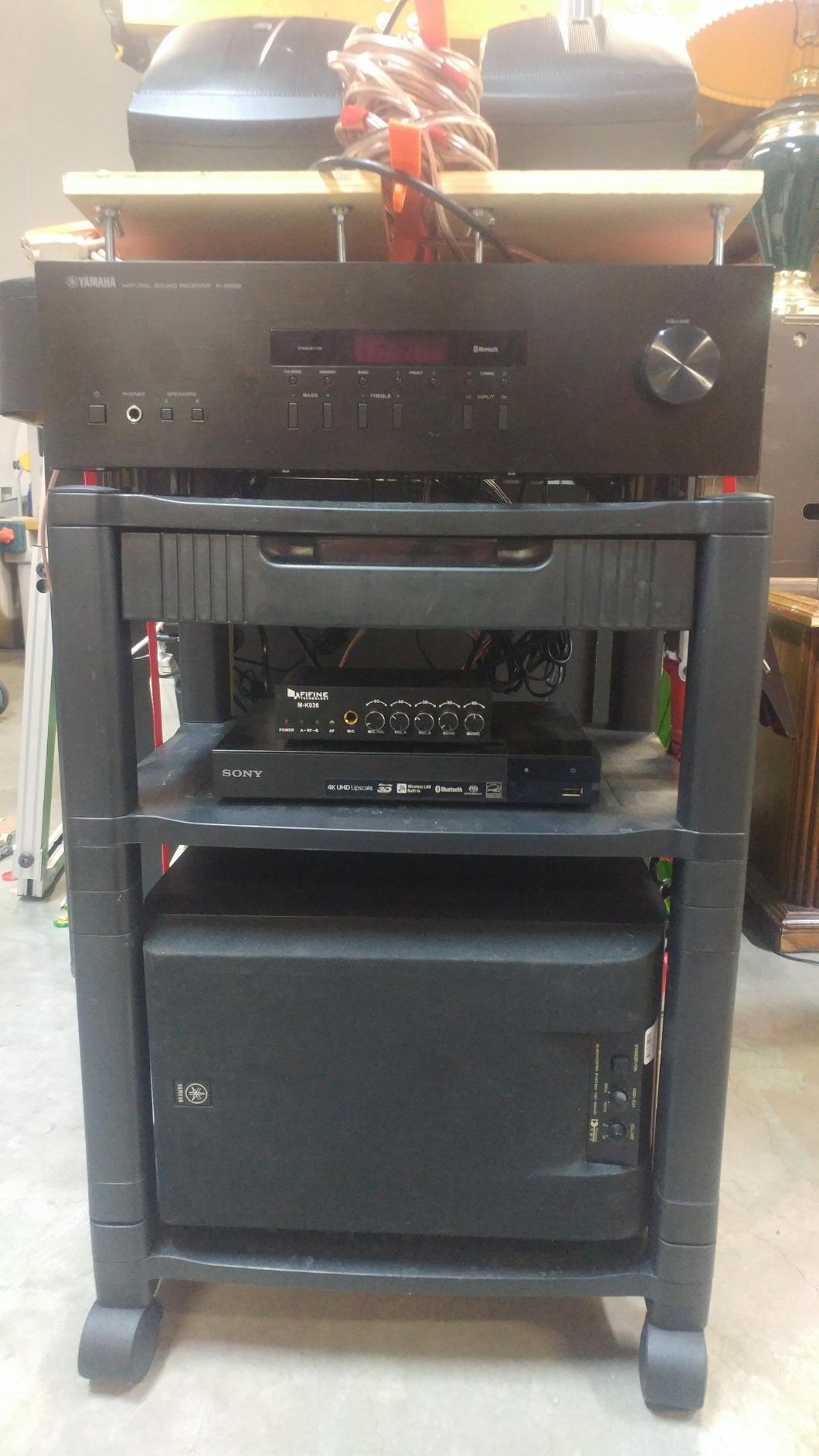
On its own terms the machine is fine. Bluetooth 4.1 with EDR pairs smoothly and stays stable, the FM/AM tuner holds 40 presets, and the speaker selector handles two systems. The brushed aluminium finish and clear front panel make setup painless.
There is no HDMI and no optical input, so adding a television means a digital-to-analog converter. The volume control is also poorly calibrated: output is inaudible below roughly 45 on a 99-step scale, which makes fine adjustment around quiet records awkward.
What you should know before buying it
The treble control tops out at about 3 kHz, so the very top end stays soft no matter where you set it. Bass is strong and warm, and some listeners like that, but it is a fixed character rather than a neutral starting point.
The plastic spring speaker terminals are also described as flimsy, so treat them gently and expect bare wire rather than banana plugs.
Who it suits and who it does not
It suits someone whose turntable has its own built-in phono stage and who simply wants a tidy two-channel box for Bluetooth, radio and line-level sources. In that configuration it is a genuinely pleasant and easy machine.
It does not suit anyone whose turntable outputs raw phono-level signal, which is most turntables people buy today. If that is you, the Yamaha A-S301 below costs a modest step up and solves the problem outright.
3. Yamaha A-S301BL – Best Value Amp for a Records-Only System
Yamaha Audio A-S301BL Natural Sound Integrated Stereo Amplifier (Black)
MM phono stage
Digital optical and coax inputs
Speakers A B and A+B
Subwoofer output
Pros
- Built-in MM phono stage for direct turntable connection
- Optical and coaxial digital inputs with internal DAC
- A/B speaker switching plus a dedicated subwoofer output
- Solid heavy build at a mid-range price point
Cons
- No Bluetooth or network streaming on this model
- Basic remote with limited feature coverage
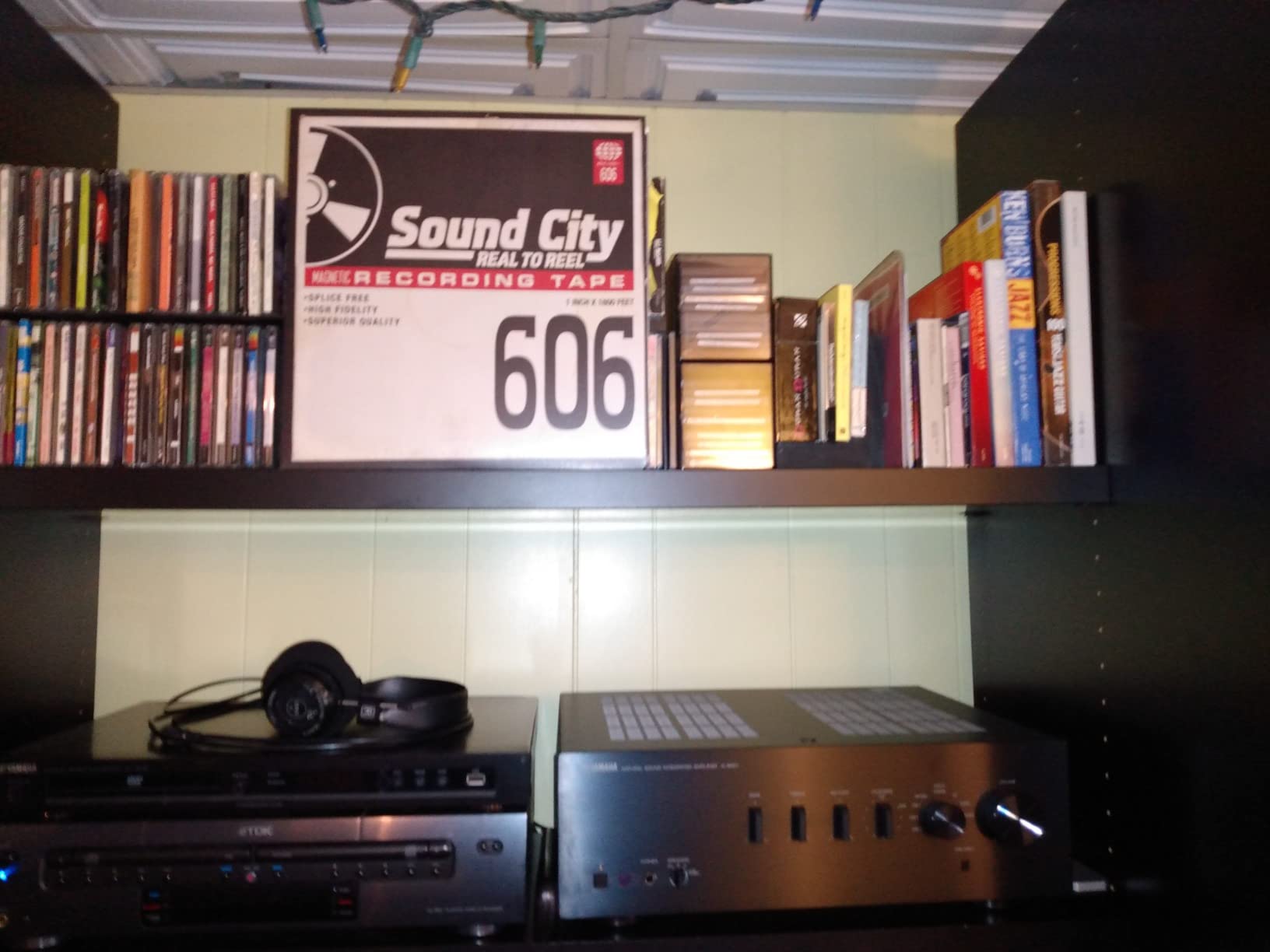
This is the shape of box most record listeners actually want. There is no wireless, no app, and no firmware to maintain, just a heavy integrated amplifier with a built-in MM phono stage and a row of real inputs. For a system whose job is to spin records all evening, that restraint is a feature.
The phono stage is designed for moving-magnet cartridges, which is what the overwhelming majority of turntables ship with. Pair it with a belt-drive turntable and you have a clean, direct path: cartridge to phono stage to speakers, with no menu in between. Speakers A, B and A+B switching means you can run a main pair and a secondary pair without unplugging anything.
The digital coaxial and optical inputs with an internal DAC are genuinely useful rather than decorative. If you already own a streaming box with its own DAC, the optical input gets you better sound than the streamer manages internally, and it costs nothing to include.
At 19.8 pounds the chassis has the kind of heft that suggests a real transformer inside, and reviewers report consistently high ratings with few complaints beyond the absence of wireless.
What you should know before buying it
There is no Bluetooth and no network streaming, so this is a records-and-wired-sources amplifier. That is a limitation only if you want to stream, and it is a strength if you do not.
The remote is basic and covers only part of the functions. Set the tone controls and inputs once and you will rarely touch it again, which suits the intended use.
Who it suits and who it does not
It suits a listener who wants the best stereo receivers for vinyl setups built around one source and wants nothing else. r/BudgetAudiophile threads regularly recommend the Yamaha A-S301 as part of a complete starter system, and the pairing advice is sound because the amp has both analog and digital inputs.
It does not suit anyone who wants to switch between records, Bluetooth phone streaming and a television without extra boxes. If multi-source convenience matters, the Sony at the top of this list handles it in a single chassis.
4. Denon PMA-600NE – Best Sound Quality for Vinyl
Denon PMA-600NE Bluetooth Stereo Amplifier, 2 Channel Amplifier Home Audio
MM phono input
70W x 2 at 4 ohms
2 optical and 1 coaxial
Analog mode switch
Pros
- Internal MM phono preamp is quiet with no hum
- Warm detailed tube-like presentation
- Internal DAC holds up against dedicated streamers
- Good headphone amplification
- Source direct and pure analog modes
Cons
- Remote volume is lagged and stepped too coarsely
- Remote lacks bass treble and balance controls
- Recessed dim LEDs are hard to see
- Thin bass without a subwoofer
The Denon has the highest average rating of anything in this roundup, and the reason is not subtle. Its internal MM phono preamp is quiet with no hum, the amplifier section uses Advanced High Current push-pull circuitry rated at 70 watts x 2 into 4 ohms, and the analog mode switch physically disengages the digital circuits rather than just muting them.
That analog mode is the feature that matters most for a record listener who also wants streaming. When you switch the phono input, the digital circuitry comes off the signal path entirely, so you are not listening through an active converter you did not ask for. Owners who care about the purity of the analog signal tend to leave the digital inputs disconnected and use the mode permanently.
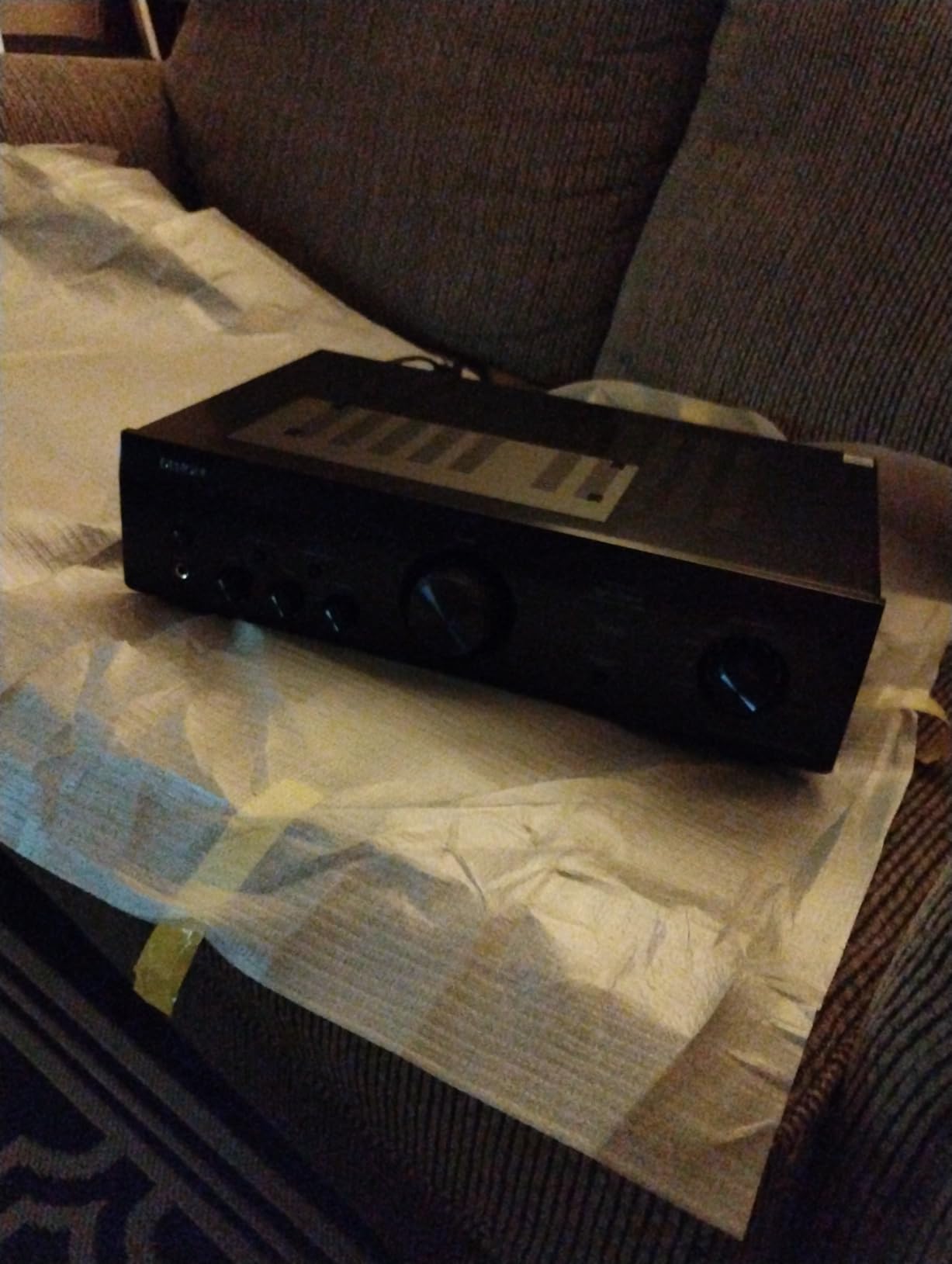
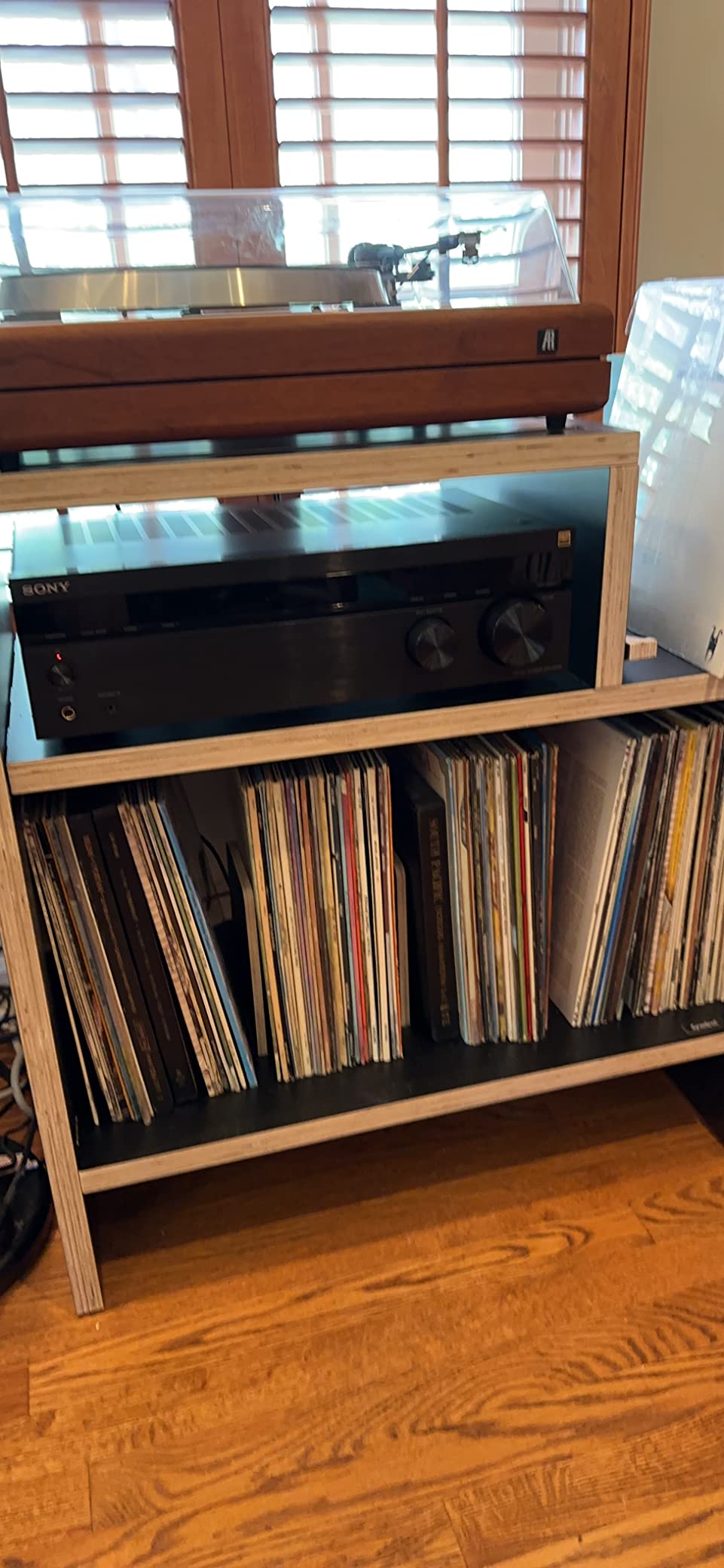
Sound is described as warm, detailed and wide, with a soundstage reviewers liken to a 1970s solid-state receiver. The internal DAC measures as equal to or better than a dedicated streamer at similar cost, and the 1/4 inch headphone jack does real work, running only slightly warm with high-impedance headphones.
Usability is where it loses points. The remote volume is lagged and stepped too coarsely for fine adjustment, and the remote itself has no bass, treble, balance or analog mode buttons. The input relay clicks audibly, and the dimmed LEDs around the input selector are hard to read in a dark room.
What you should know before buying it
Bass is thin without a subwoofer, and the amp is designed to be paired with one. There is an RCA subwoofer pre-out, and unlike the Sony the binding posts accept banana plugs, which makes the wiring job painless.
It carries a 3-year manufacturer warranty, longer than most of the field, which is worth factoring in if you expect to keep it for years.
Who it suits and who it does not
It suits a listener who treats records as the main event but still wants Bluetooth, optical and coaxial sources in the same box, and who will accept setting tone controls once at the front panel. It is also a strong choice if you use headphones as well as speakers.
It does not suit someone who wants to adjust bass and treble from the sofa without getting up, or a moving-coil cartridge owner. The phono stage is MM only.
5. Douk Audio Tube Phono Amp X1 – Best Tube Sound for Small Spaces
Douk Audio Tube Phono Amp: Bluetooth Receiver | 2-Channel Amplifier for MM Turntables | 160W×2 TDA7498E | Tone Control | for Desktop Vinyl HiFi Home Audio System (X1)
JAN5725 pluggable tubes
MM phono stage
TDA7498E output
Bluetooth 5.0 aptX HD
LFE output
Pros
- Warm rich tube sound surprisingly good for the size
- MM phono stage works cleanly with no hum at high levels
- Bluetooth 5.0 with aptX and aptX-HD pairs quickly
- Punchy tight bass from the LFE output
- Very small footprint
Cons
- Bluetooth module failures reported after about a year
- Sensitive to a loose ground wire and prone to damage when un-grounded
- Sounds hollow until the tubes warm up
- Bluetooth antenna not included and range reported short
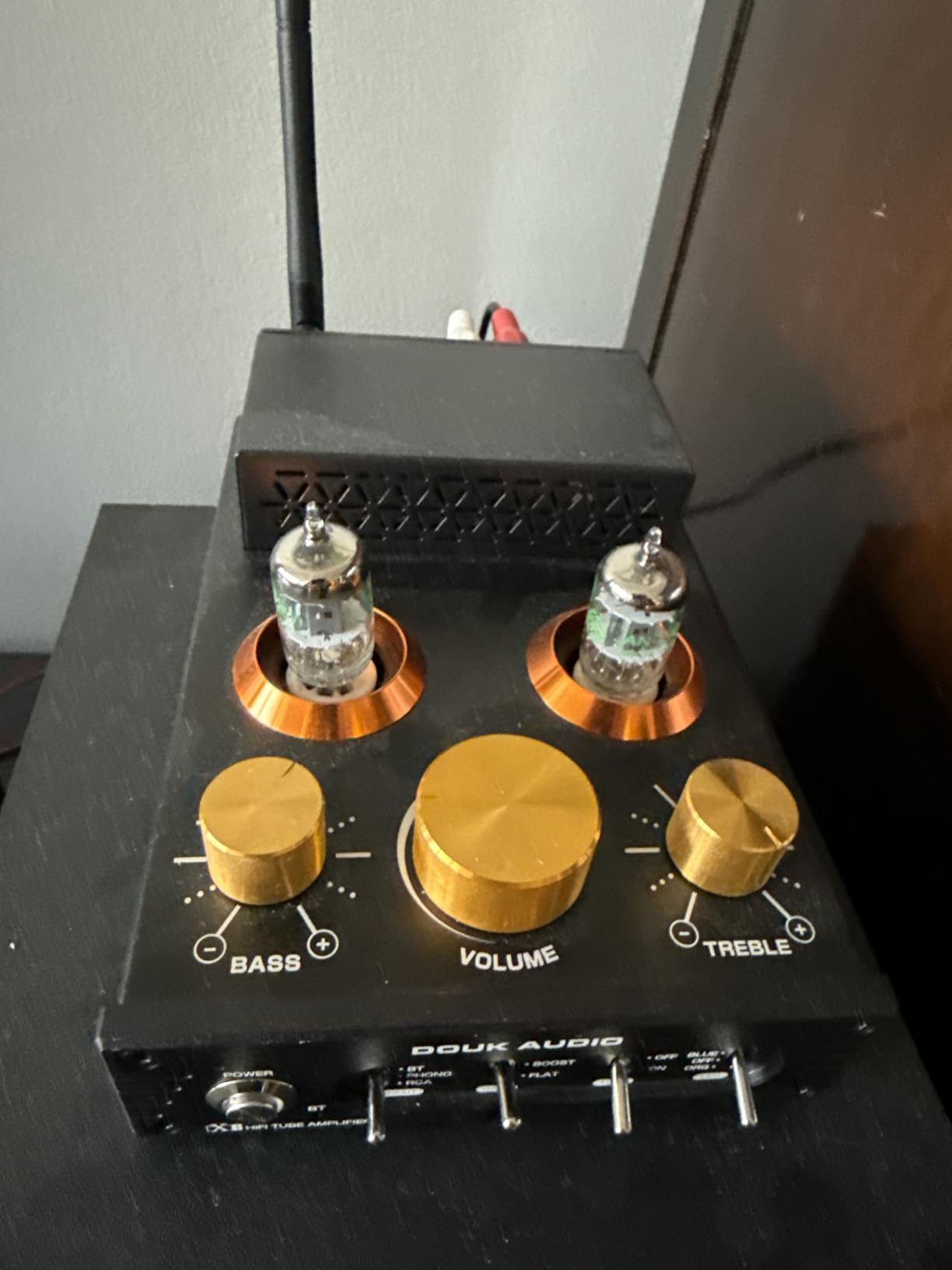
This is the smallest and most unusual box in the roundup, and the one that divides opinion most sharply. It weighs 1.7 pounds, uses pluggable JAN5725 vacuum tubes in user-replaceable sockets, and puts a dedicated low-noise MM phono stage and a TDA7498E output stage in the same compact chassis. The output IC is rated up to 160 watts x 2 into 4 ohms with the included 32V/5A supply.
Owners consistently praise the tube warmth and the phono performance, and several report genuine NOS GE JAN 5654W tubes in their units. The MM stage works cleanly at high listening levels with no hum, and the LFE output gives a tight, punchy subwoofer feed that reviewers single out as a genuine asset rather than a checkbox.
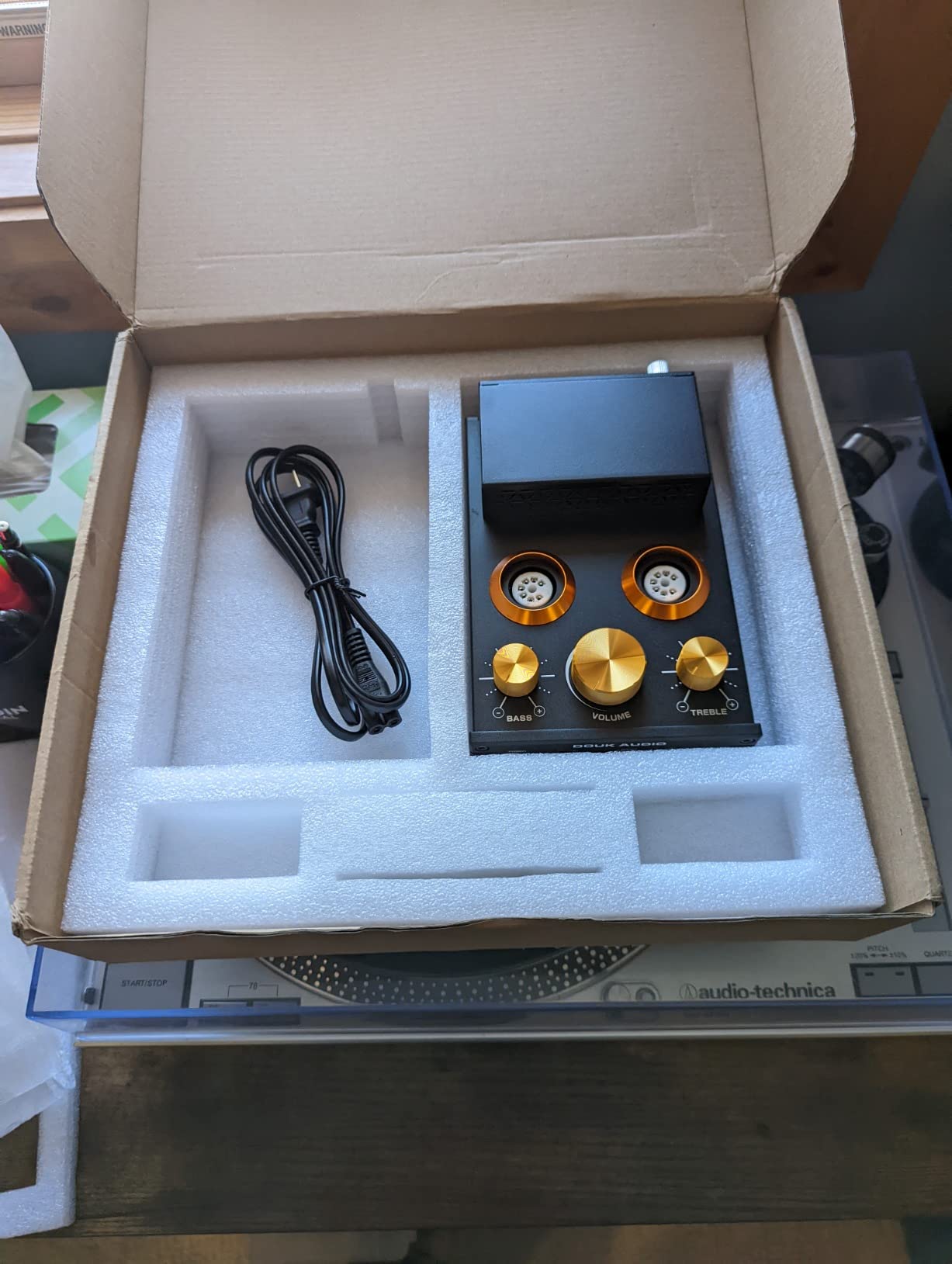
Bluetooth 5.0 with a QCC3034 chipset supports aptX and aptX-HD and connects quickly and silently, with no pairing beep. The front panel carries tone control, a bypass switch and a bass boost, and the whole unit is small enough to sit next to a turntable rather than in a rack.
The rating is held down by one recurring hardware pattern: Bluetooth board failures, with some owners needing a replacement board or losing pairing after about a year. Note also that when you use the LFE output, the bass knob acts as a speaker crossover rather than a subwoofer EQ, which surprises people.
What you should know before buying it
It is unusually sensitive to grounding. Owners report that a loose ground wire causes problems and that the unit is prone to damage when run un-grounded. This is the one product here where the ground connection is not optional, so read the manual and make the connection properly the first time.
The Bluetooth antenna is not included, and range is reported as short without it. Sound can also seem hollow for the first few minutes while the tubes warm up.
Who it suits and who it does not
It suits a small listening room or a desktop system, someone who wants the character of tube amplification from a box that fits in a cabinet, and a listener who values the LFE output enough to add an active subwoofer.
It does not suit a buyer who wants a turnkey appliance, anyone near a wall where cable routing is awkward, or a moving-coil cartridge owner. If reliability over a decade matters more than tone, the Yamaha A-S301 is the sounder long-term bet.
6. Donner MAMP2 – Most Versatile with More Inputs Than It Should Have
Donner Stereo Audio Amplifier, 600W Peak 2 Channel Receiver with Bluetooth 5.3, Phono, Optical, Coaxial, USB, FM, 2 Mic-in, Aux, RCA Input for Home, Karaoke, Theater Speakers, MAMP2
Phono input
60W x 2 RMS at 8 ohms
Optical and coax
Bluetooth 5.3
USB up to 64GB
Pros
- Very low price for the number of inputs including working phono
- Independent volume for each channel plus bass mid and treble on the amp
- Memory function recalls mode volume and EQ settings
- Toroidal power supply in a compact well-weighted chassis
Cons
- 600W peak figure is marketing
- continuous output is 60W x 2
- Binding posts too small for banana plugs
- Optical input reported not working by some buyers
- Cooling fan revs up noisily during quiet passages
The MAMP2 packs more connections into a small box than anything else here: a working phono input, optical and coaxial digital inputs, Bluetooth 5.3, USB playback up to 64GB, AUX, RCA, dual quarter-inch mic inputs and an FM tuner with direct frequency entry. For a first system where the priority is a phono input that exists and works, it delivers that.
Continuous output is 60 watts x 2 into 8 ohms. The headline 600W peak figure is marketing, and we would ignore it entirely when judging whether it can drive your speakers. With real power behind it, a pair of efficient bookshelf speakers is the sensible pairing, not a demanding floorstander.
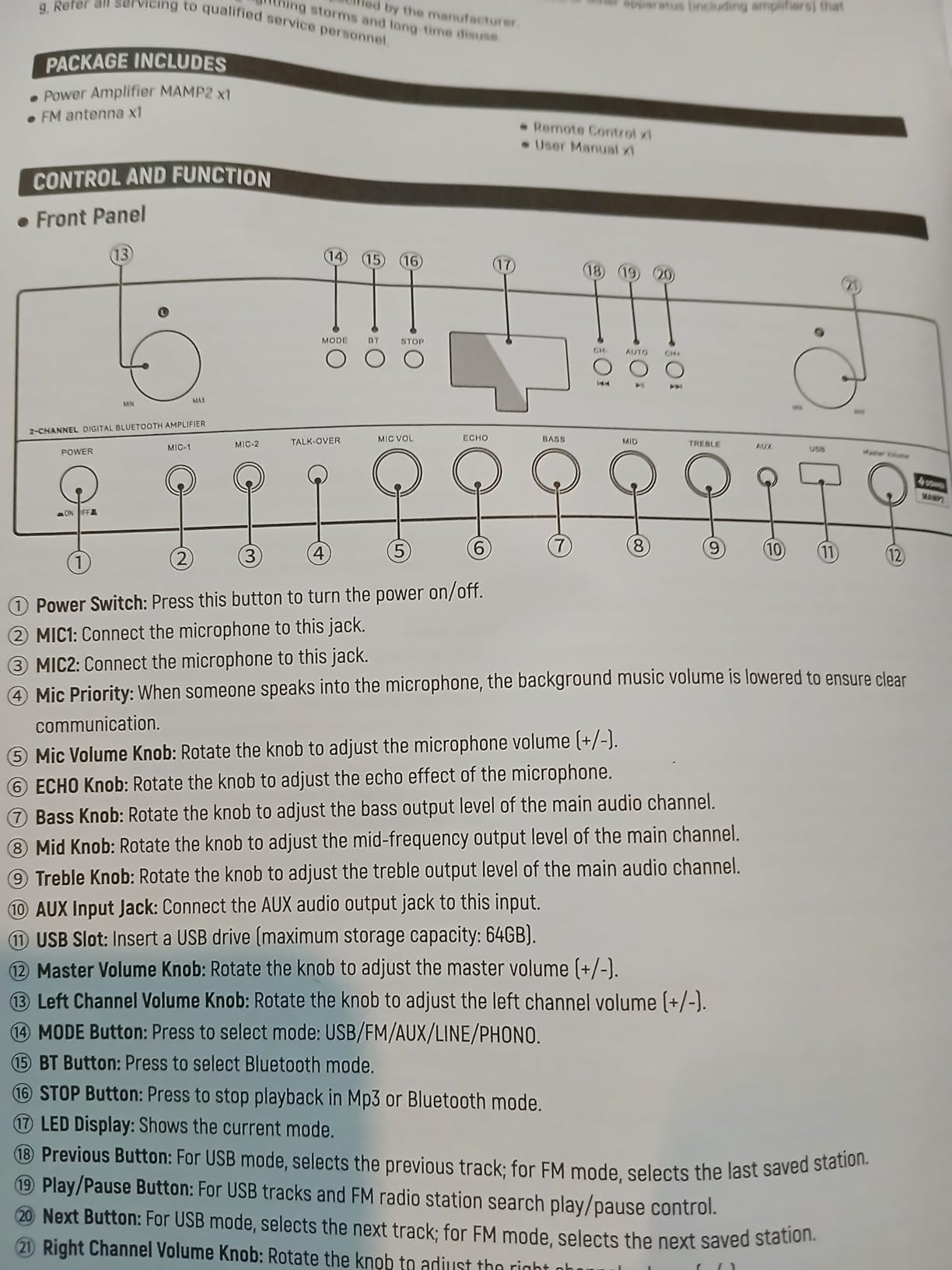
Controls are unusually granular: independent volume for each channel, plus bass, midrange and treble adjustment on the front panel and the remote. A memory function recalls mode, volume and EQ settings after power-up, which is a small convenience you notice every day. A toroidal power supply sits inside a compact, well-weighted chassis.
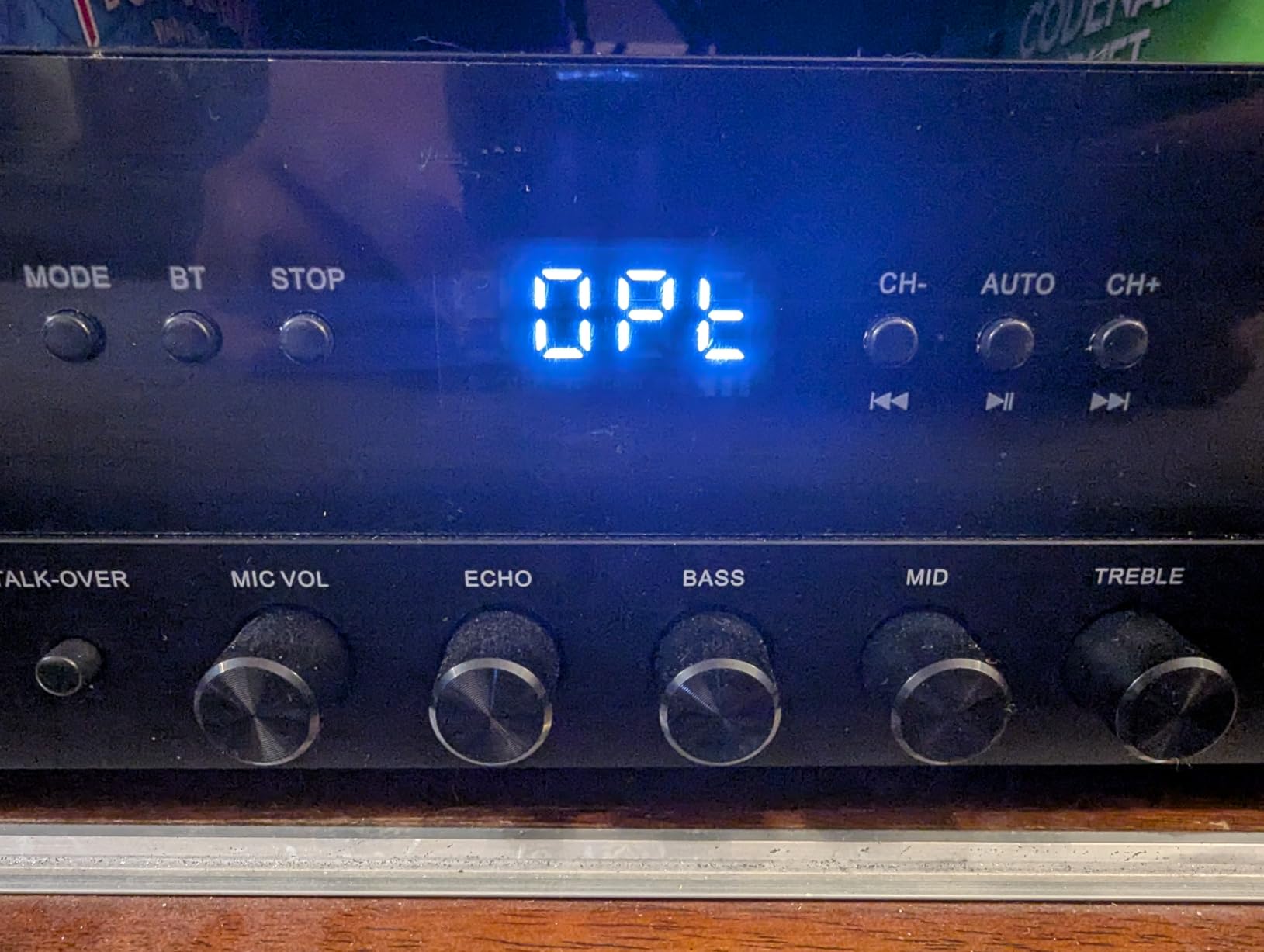
The trade-offs are the terminals and the noise. The binding posts are too small for banana plugs, so you need bare wire. Some buyers report the optical input not working, and the cooling fan revs up audibly during quiet passages, which is exactly when you are listening to a record at low volume.
What you should know before buying it
There is only one RCA input pair, so adding a CD player or a tape deck alongside the phono stage gets tight. There is no HDMI, and no display dimmer, so the readout is bright in a dark room.
It does include a talk-over mic priority function, which is unusual and occasionally useful, but for records you will leave it off.
Who it suits and who it does not
It suits a first-time buyer on the tightest possible budget who has a moving-magnet turntable with no built-in stage, and a listener who wants karaoke or USB playback in the same box.
It does not suit a quiet-room listener at low evening volumes, given the fan noise, or anyone with 4-ohm floorstanding speakers who will want more current than 60 watts delivers. The Sony at the top of this list costs more and drives harder.
7. Pyle PDA4BU – Most Connections, Least Consistent Controls
Wireless Bluetooth Home Stereo Amplifier – Multi-Channel 200W Power Amplifier Home Audio Receiver System w/Optical/Phono/Coaxial, FM Radio, USB/SD,AUX,RCA, Mic in – Antenna, Remote – Pyle PDA4BU
20W x 2 RMS at 8 ohms
Phono optical and coax inputs
Two 1/4 inch mic inputs
Bluetooth 40+ ft
Pros
- Very low price with a long input list including phono optical coax and USB/SD
- Compact sturdy build with a bright LCD display
- Bluetooth pairing is quick and streams reliably within roughly 40 feet
- Good karaoke performance with echo effect on vocals
- Adjustable treble bass master and mic volume
Cons
- Remote only controls the internal MP3 SD and Bluetooth unit
- Display mode does not match the physical input selector causing silence
- Two independent volume controls rather than a motorized knob
- Some units reported no speaker output or would not pair
- Auto-scan button is easy to press by mistake
The Pyle PDA4BU lists optical, phono and coaxial inputs alongside AUX, USB/SD and two pairs of RCA, plus two quarter-inch mic inputs with talk-over priority, Bluetooth with a reported range above 40 feet, an FM radio, and a headphone jack. On paper it is the most connected box in the roundup, and the karaoke stage is genuinely the best here if you want to sing along.
Real output is 20 watts x 2 RMS at 8 ohms, with 25 watts into 4 ohms. That is plenty for a bedroom, a desk setup or small bookshelf speakers, and not enough for anything demanding. The build is compact and sturdy, the LCD is bright and vivid, and Bluetooth pairing is quick and reliable within the stated range.
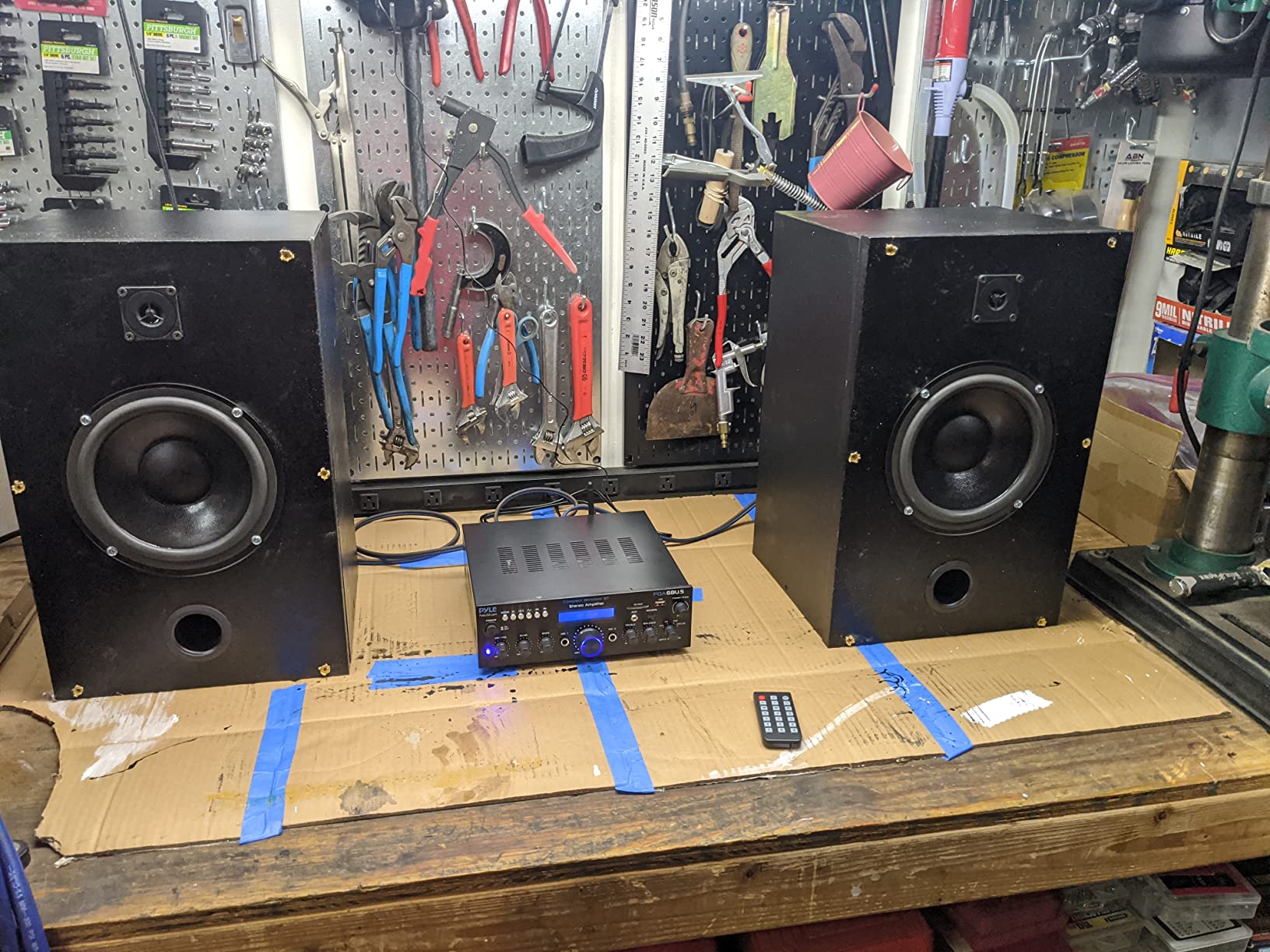
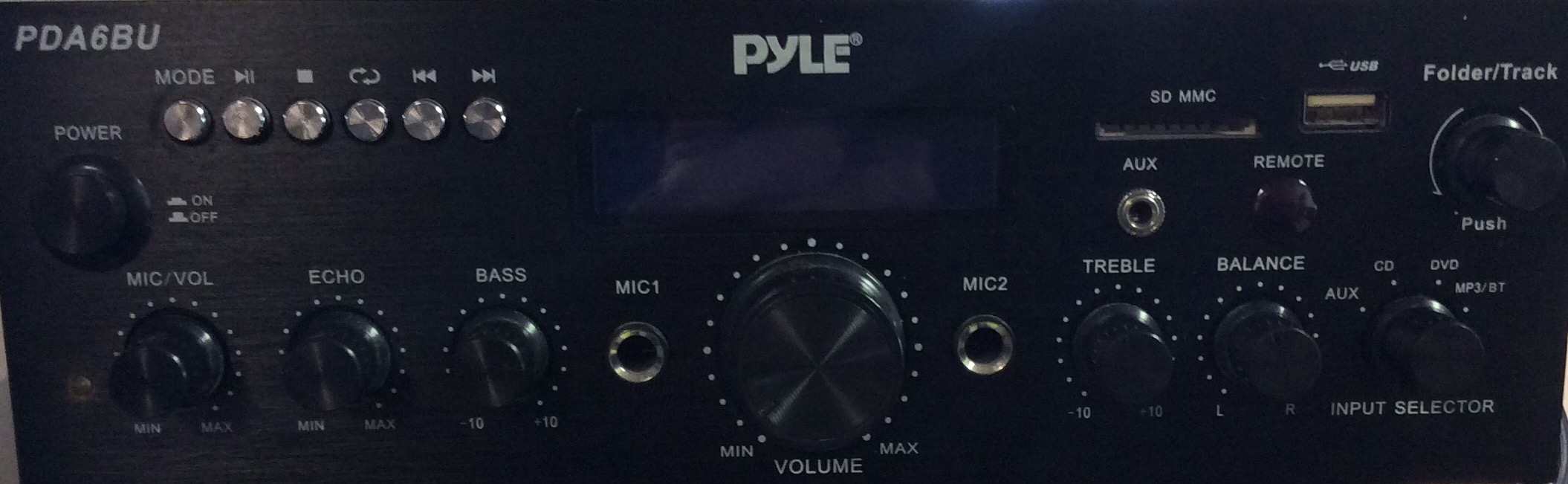
The operational quirks are the story. The remote controls only the internal MP3/SD/Bluetooth unit and does not control the analog inputs, so the phono signal is adjusted from the front panel. The onboard and remote power buttons behave differently, with the remote leaving the display lit.
Most confusing of all, the mode shown on the display does not always match the position of the physical input selector, which produces silence from a source that looks like it should be playing. Bluetooth reconnection is not automatic, and the auto-scan button is easy to press by mistake.
What you should know before buying it
There are two independent volume controls, a knob and the remote, rather than a single motorised control, so the two can disagree. Some owners report units with no speaker output at all or that would not pair with a phone, so the return window matters.
It carries a 1-year warranty, the shortest in the roundup, which is worth weighing against a tube-based box covered for 18 months.
Who it suits and who it does not
It suits a small-room listener who wants vinyl, USB and Bluetooth in a single inexpensive box and who will spend ten minutes learning the control scheme once. It is also the pick for anyone who wants a karaoke stage with echo alongside their records.
It does not suit someone who wants a straightforward analogue path and predictable controls, or anyone driving speakers larger than small bookshelf models.
8. Marantz PM6007 – Best for the Classic Marantz Sound
Marantz PM6007 Amplifier, Integrated Amplifier with Digital Connectivity, Analog Coaxial and Optical Inputs, 2X 45 Watt, DAC, D/A Conversion for Digital Input – Silver/Gold
45W x 2 into 8 ohms
MM phono preamp with FET stage
1 coax and 2 optical inputs
HDAM SA3 modules
Pros
- Signature warm crisp Marantz sound reminiscent of 1970s and 80s receivers
- MM phono input with FET stage sounds natural from a turntable
- Internal DAC matches or exceeds the source DAC
- Good real-world power for a small dedicated listening room
- Attractive silver and gold finish
Cons
- Some examples ship with a European three-prong plug and 220V
- Phono input may need an extended burn-in to match the digital inputs
- 45W per channel is modest for larger low-sensitivity speakers
Nothing else in this roundup sounds like a Marantz from the late 1970s. The PM6007 uses HDAM SA3 current feedback amplifier modules in the output stage, delivering 45 watts per channel into 8 ohms from 20 Hz to 20 kHz, and owners describe the result as warm, crisp and distinctly retro without being soft.
The MM phono preamp uses an FET input stage and is consistently reported as sounding natural straight from a turntable. Five gold-plated analog inputs plus one coaxial and two optical digital inputs feed a fully shielded internal D/A converter with two selectable digital filters, and Bluetooth is included for streaming.
A/B speaker switching and steel feet round out a chassis that weighs 7 kg. The finish is the silver and gold scheme shared with other Marantz components, which matters more than it sounds if you already own Marantz kit and want the stack to match.
There is one hardware issue that catches people out: some examples arrive with a European three-prong plug and 220V wiring, which will not fit a US outlet and needs a step-down transformer. Check what is in the box the moment it arrives, because that is not a returnable preference, it is a compatibility fault.
What you should know before buying it
Owners report the phono input can take an extended burn-in period to reach the same sound as the digital inputs. If you evaluate this amplifier in the first week and find the phono side disappointing, give it longer before deciding.
At 45 watts per channel, it is modest for larger rooms or low-sensitivity speakers. It suits a small dedicated listening room, which is exactly how most owners use it.
Who it suits and who it does not
It suits someone who wants the classic warm valve-era presentation from a modern, serviceable box, and who will pair it with efficient bookshelf speakers in a small or medium room. It also suits a Marantz owner who wants matching components.
It does not suit a buyer in the US who cannot confirm the plug type, a large-room listener with demanding floorstanding speakers, or a moving-coil cartridge owner. The phono stage is MM only.
9. Yamaha R-N800A – Best for Vinyl Plus Everything Else
Yamaha R-N800A Network Receiver with Phono and Built-in DAC, Black
Phono input
100W per channel
ESS SABRE ES9080Q DAC
YPAO-R.S.C. room correction
5-year warranty
Pros
- Clean wide soundstage with excellent instrument separation
- Plenty of power to drive demanding speakers
- USB DAC handles high-resolution and DSD files
- MusicCast app is easy to install and intuitive
- Drives 4-ohm vintage speakers without difficulty
Cons
- Built-in phono stage is underwhelming
- some owners added an external preamp
- YPAO EQ can sound muddier than YPAO off
- Volume steps differ widely between phono and line sources
- Wi-Fi connection issues reported after several months
The R-N800A is the only box here that can be a complete entertainment hub rather than a record component. It has an ESS SABRE ES9080Q Ultra DAC, a USB DAC path supporting DSD 11.2 MHz native and 384 kHz playback, MusicCast streaming over Wi-Fi and Ethernet, Bluetooth, HDMI, and 2.1-channel output with subwoofer support. A five-year manufacturer warranty backs it up.
Sonically, owners report a clean, wide soundstage with excellent instrument separation and detail, and around 100 watts per channel to drive demanding speakers. It is also reported to drive 4-ohm vintage speakers without difficulty, which is a useful detail for anyone pairing it with an older pair. YPAO-R.S.C. calibration measures distances accurately and can simply be switched off.
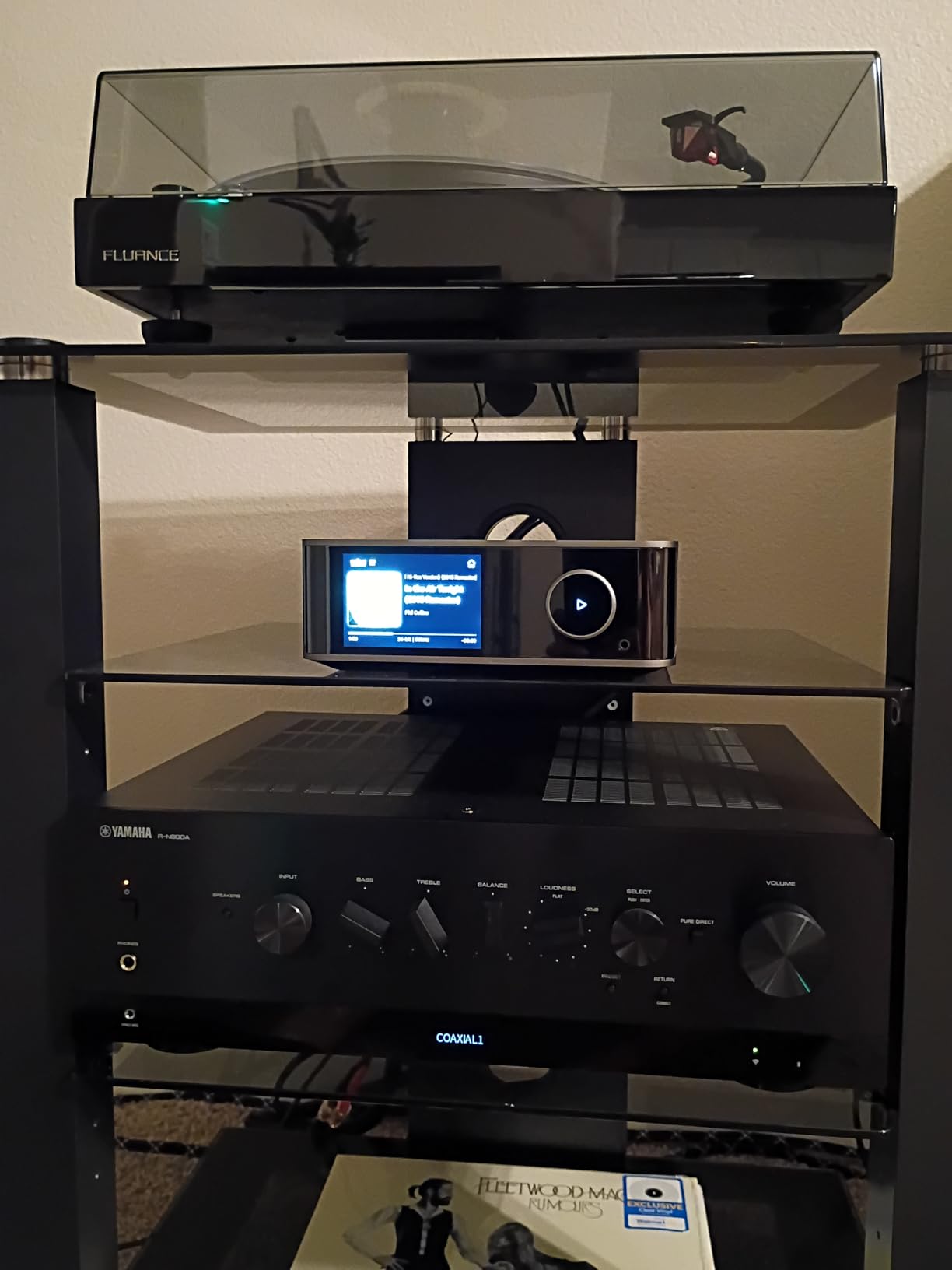
Here is the catch, and it is a real one for a vinyl-focused buyer: the built-in phono stage is considered the weakest link in an otherwise excellent machine. Several owners added an external phono preamp and used that instead. If the phono stage is the reason you are buying, this is not the box to buy for that reason.
YPAO is another judgement call. At low listening levels the correction can sound muddier than YPAO off, which is awkward because low volume is exactly when many people play records. Volume steps also differ widely between phono and line sources, so you will be readjusting when you switch from a record to streaming.
What you should know before buying it
Network reliability is the other recurring complaint. Wi-Fi and MusicCast connection problems appear after several months in some units, and occasionally require a factory reset. Apple Music has also been reported connecting with no sound unless the unit is left in standby. Budget for some app troubleshooting.
The remote has a cheap plastic feel, and the bass, treble and balance knobs look dated next to the specification sheet.
Who it suits and who it does not
It suits someone who genuinely wants vinyl, television, streaming and high-resolution files in one box, owns reasonably efficient or 4-ohm speakers, and is comfortable with a network app. For pure record listening, sellers in vinyl-specific forums favour this class of receiver over separates, though typically alongside an external phono stage.
It does not suit someone who buys on phono stage quality alone, or anyone unwilling to deal with firmware and network setup. The Denon PMA-600NE gives you a better analog path for a fraction of the outlay.
10. Onkyo TX-8470 – Best Phono Board, Weakest App
Onkyo TX-8470 2 Channel Stereo Receiver with Wi-Fi, Bluetooth, Phono, Hi-Res Audio and Roon Ready
Isolated MM/MC phono board
110W output
4 HDMI ports
Dirac Full Band
Roon Ready
Pros
- Isolated MM/MC phono board is praised as excellent for a turntable
- Expansive soundstage with strong microdetail and tonal balance
- Around 100W per channel of clean distortion-free power
- DAC implementation described as phenomenal for a two-channel unit
- Simple clean design with separate bass and treble controls
Cons
- No bass management for integrating a subwoofer
- The Onkyo app repeatedly loses Wi-Fi connection
- No longer plays an entire USB drive continuously
- Remote is huge with small buttons
- Some buyers found it underpowered for larger multi-speaker setups
For a listener whose cartridge is the priority rather than the streaming platform, this is the most interesting box in the roundup. It has an isolated MM/MC phono board with patented discrete op-amp circuitry and audio-grade capacitors, gold-plated terminals, and a high-current Class G amplifier. It is the only product here that is explicitly specified to accept moving-coil cartridges as well as moving-magnet ones.
That matters if you are planning to upgrade your cartridge later. An MM-only stage will not drive a low-output moving-coil cleanly no matter how good the rest of the amplifier is, so buying a stage that is not gain-limited saves you replacing the receiver when you change cartridge. The board is physically isolated from the rest of the circuit, which reduces hum and crosstalk between the phono and line sections.
Sound is described as expansive, with strong microdetail, layering and tonal balance, and around 100 watts per channel of clean, distortion-free power that owners say drives demanding floorstanding speakers well. The DAC is called out as phenomenal for a two-channel unit, and Dirac Full Band room correction is included. Four HDMI ports, optical and coaxial digital inputs, and a subwoofer pre-out round out the connectivity, with Roon Ready, Tidal and Deezer supported.
What holds the rating down is software, not audio. The companion app repeatedly loses Wi-Fi and the connection to the receiver, forcing frequent reinstalls and setup. It also no longer plays an entire USB drive continuously, stopping at the end of each folder, which is a frequent trigger for one-star reviews.
What you should know before buying it
There is no bass management for integrating a subwoofer, so the pre-out gives you a signal but no crossover control. Some buyers also found 110 watts insufficient for larger multi-speaker and subwoofer setups, which is worth weighing if your system is going to grow.
The remote is huge with small buttons, and the unit is complex to configure, so allow yourself an unhurried evening setting it up. The warranty is 2 years parts and labour.
Who it suits and who it does not
It suits a vinyl-first listener who wants an MM/MC-capable phono board and enough power for demanding speakers, and who is either patient with the app or prepared to control the unit from the front panel and remote.
It does not suit someone whose main frustration is unreliable app control, or a buyer who wants simple operation. Read our picks of the best AV receivers only if you think you need more channels, because you almost certainly do not.
Buying Guide: Matching a Receiver to Your Turntable
Cartridge type is the decision that constrains everything else. A moving-magnet cartridge produces enough output to be handled by almost any phono stage, including the budget ones in this list. A moving-coil cartridge produces far less signal and needs real gain and a low-noise input stage. If you own a moving-coil cartridge or plan to, skip every MM-only model here, which includes the Sony, the Yamaha A-S301, the Denon and the Marantz. The Onkyo TX-8470 is the one explicitly built for both.
Next, decide whether the turntable is doing the work. If it has a switch and a ground post, you can choose to bypass its own stage and use a better one inside the receiver. If the switch removes the built-in preamp, using the receiver’s phono input is the better choice. If your turntable only offers phono-level output, the receiver’s phono stage is doing the job either way.
Power is the third consideration, and it is more straightforward than spec sheets suggest. A pair of efficient bookshelf speakers in a normal-sized room is comfortable with 40 to 50 watts per channel of real RMS power, which is where the Marantz, the Donner and the Pyle sit. Harder-to-drive floorstanding speakers in a large room want 100 watts or more, which is where the Sony, the Denon and the Onkyo earn their place. Ignore peak wattage figures entirely; only continuous watts at 8 ohms tell you anything.
Impedance matters less than buyers expect. Anything that accepts 6 ohm speakers will drive 6 ohm speakers, and all of the mainstream models here handle the common 6 and 8 ohm ranges. A 4-ohm load is a different question, and that is a genuine strength of the Yamaha R-N800A, which owners report drives 4-ohm vintage speakers without difficulty.
Stereo Receiver vs Integrated Amplifier vs AV Receiver
An integrated amplifier is a two-channel box with inputs and a phono stage and nothing else. That is exactly what a record listener needs, which is why two of the picks on this list are integrated amplifiers. Many forum readers end up choosing an integrated amp once they realise streaming is not part of their listening.
A stereo receiver adds a tuner, Bluetooth and often Wi-Fi streaming to the same two-channel amplifier. You pay a modest premium for convenience and lose nothing in power, but you also gain features you may never touch. The honest framing is that an integrated amplifier is the better object and a receiver is the more convenient one.
An AV receiver adds surround channels, HDMI switching and decoding. For a two-speaker vinyl system this is wasted capability unless you also want a television and a subwoofer in the mix. If that is your situation, the Yamaha R-N800A and the Onkyo TX-8470 are the two boxes here that handle both, and they handle it with far fewer channels than a typical home theater receiver. If you are weighing a wider channel count for a mixed setup, our best AV receivers guide covers that side in full.
How to Kill Hum and Ground Loop Noise
Hum when you connect a turntable is the most repeated complaint in record-player threads, and it almost always has the same four causes. Start with the ground wire. The thin bare wire from the turntable goes to the GND or ground terminal on the back of the receiver, never to a wall plug or a different terminal. This is the single step that resolves most hum problems.
Second, check what you are plugging into. If the turntable and the receiver share a power strip, move them to separate outlets where you can, and avoid cheap extension blocks between them. Third, keep the turntable away from the power supply inside the receiver, which means not stacking it directly on top. Fourth, try a different RCA cable pair; marginal cables with loose shields are a real and cheap fix.
If hum appears only in Bluetooth mode, that is interference rather than a ground loop, and it is what the Douk Audio unit’s missing antenna makes worse. If hum appears only on one input, swap inputs and cables to isolate it before you start unscrewing anything.
Frequently Asked Questions
Which stereo receiver has the best phono input?
For a moving-magnet cartridge, the Sony STR-DH190 has the strongest combination of phono stage quality, power and connectivity at the entry end. The Denon PMA-600NE has the cleanest analog path and lets you disengage the digital circuitry entirely, while the Onkyo TX-8470 is the only model here with an isolated MM/MC phono board for moving-coil cartridges.
What is the best receiver for playing vinyl records?
The Sony STR-DH190 is our top pick for most turntables because it has a genuinely usable phono stage, 100 watts per channel into 8 ohms, four stereo RCA inputs and A/B speaker switching. If you want a purer analog path and a subwoofer output, step up to the Denon PMA-600NE.
What is the best amplifier for a vinyl player?
An integrated amplifier with a moving-magnet phono stage is usually the right answer for a records-only system, because it gives you the phono stage and the power without paying for streaming hardware. The Yamaha A-S301 and the Denon PMA-600NE are both built for exactly that, and the Denon adds optical, coaxial and Bluetooth inputs if you want sources beyond records.
Should I use phono or line on my record player?
Use phono when your turntable has no built-in phono stage or when its preamp switch is set to bypass. Use line when the turntable’s own preamp is switched on, because feeding an already-equalised line signal into a phono input applies the RIAA curve a second time and produces bloated, muffled bass.
Does my turntable need a separate phono preamp?
If the back panel shows a PHONO input, a GND screw terminal and a PHONO or PREAMP switch, the turntable has a built-in phono stage and you do not need a separate one. If it only has RCA outputs with no ground post and no switch, you need a phono stage somewhere, either in the receiver or in a standalone box.
What is the best setup to listen to vinyl records?
A turntable with a moving-magnet cartridge, a receiver or integrated amplifier with a matching phono stage, and a pair of efficient bookshelf speakers is the reliable starting point. Budget roughly a third each for turntable, electronics and speakers, keep the turntable away from the amplifier’s power supply, and connect the ground wire first.
Which stereo receiver has the best sound quality?
The Denon PMA-600NE has the highest average rating in our roundup, with a quiet MM phono stage, a switch that physically disengages the digital circuitry, and a warm, detailed presentation. The Marantz PM6007 is the alternative if you prefer the classic 1970s Marantz warmth, and the Onkyo TX-8470 for microdetail and power.
Can I use a home theater receiver for vinyl only?
You can, and the phono stage will work normally, but you will be paying for surround decoding, extra channels and HDMI switching you never use. Most two-speaker listeners are better served by a stereo receiver or integrated amplifier, and the Denon PMA-600NE analog mode gives a cleaner analog signal path than most AV receivers.
Conclusion
The Sony STR-DH190 is the best stereo receiver for vinyl setups overall, because it is the rare budget machine where the phono stage is a real feature rather than a line input in disguise, and 100 watts per channel gives you room to grow into better speakers. The Denon PMA-600NE is the sound-quality pick with the cleanest analog path, and the Yamaha A-S301 is the sensible records-only choice if you never intend to stream.
Buy the Onkyo TX-8470 if you own or plan to own a moving-coil cartridge, and the Marantz PM6007 if you want classic warmth and already own Marantz components. Avoid the Yamaha R-S202BL for vinyl entirely, because it has no phono stage. Whatever you choose, connect the ground wire first, keep the turntable off the same power strip, and set the receiver to the right input for the signal you are sending.
All ten models were compared in October 2026, and every verdict above is based on published specifications and the patterns that show up repeatedly in owner reviews.