
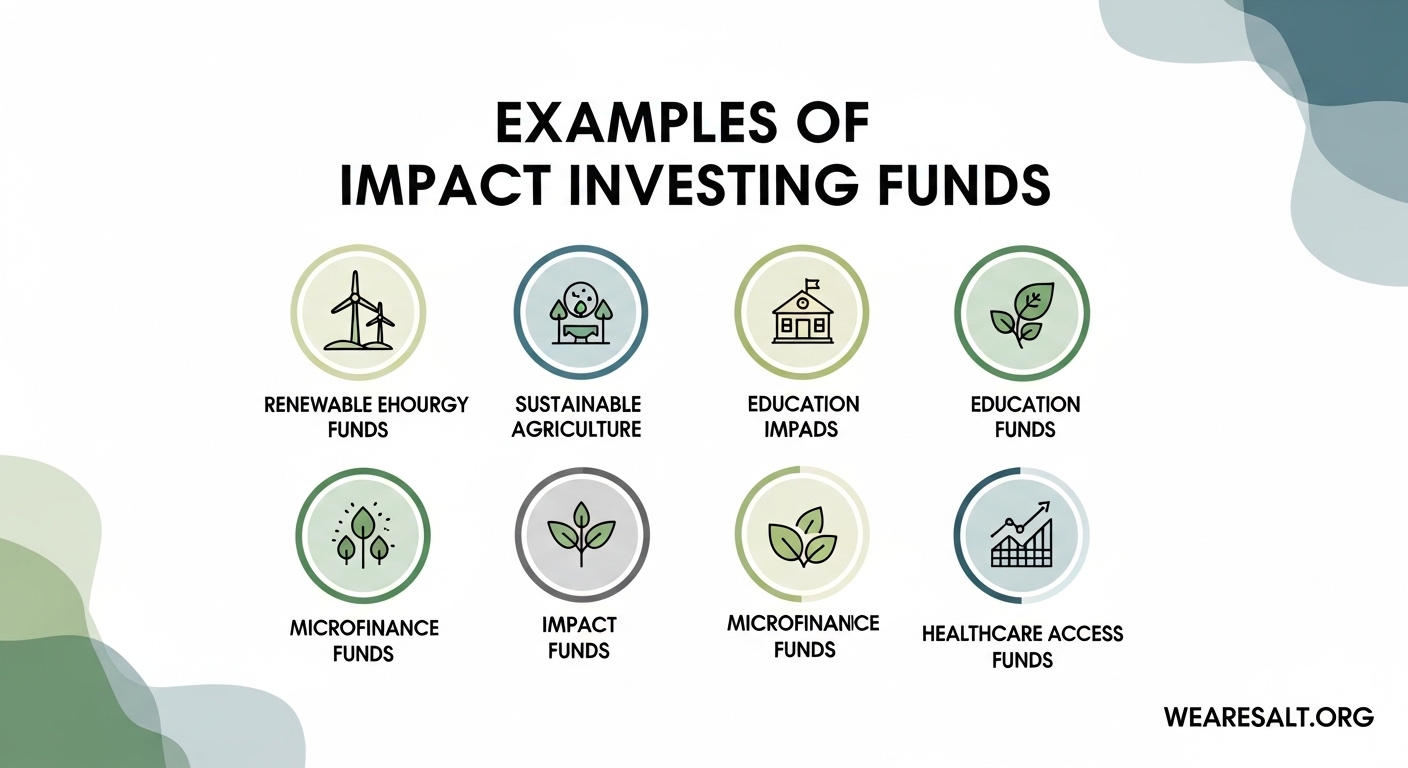
Impact investing funds deploy capital into companies, organizations, and projects with the explicit intention of generating positive, measurable social or environmental impact alongside a financial return. Unlike traditional investing that focuses solely on profit, or philanthropy that expects no return, impact investing seeks to create competitive returns while addressing pressing global challenges.
The global impact investing market now exceeds $1.57 trillion in assets under management according to the Global Impact Investing Network (GIIN). This represents one of the fastest-growing segments of the investment landscape as investors increasingly seek to align their portfolios with their values without sacrificing performance.
In this guide, I will walk you through real examples of impact investing funds across all major categories. You will learn how these funds structure investments, what returns they target, and how they measure outcomes. By the end, you will have a clear framework for evaluating any impact investment opportunity.
Table of Contents
What Are Impact Investing Funds?
Impact investing funds are pooled investment vehicles that channel capital toward enterprises creating measurable social or environmental benefits. These funds operate across asset classes including private equity, venture capital, fixed income, and real assets. Each fund establishes specific impact targets alongside financial return expectations.
The defining characteristic of impact investing is intentionality. Fund managers must explicitly set out to create positive outcomes, then measure and report those outcomes to investors. This separates impact investing from other forms of values-based investing that may screen out harmful industries without actively seeking positive change.
Impact Investing vs ESG vs SRI: Key Differences
Many investors confuse impact investing with ESG investing and socially responsible investing (SRI). These approaches differ fundamentally in their objectives and methods.
ESG investing integrates environmental, social, and governance factors into investment analysis to manage risk and improve long-term returns. ESG investors might still invest in oil companies if they score well on governance metrics. The goal is risk management, not social change.
SRI typically uses exclusionary screening to avoid companies in industries like tobacco, firearms, or fossil fuels. SRI focuses on what not to invest in rather than actively seeking positive impact.
Impact investing actively seeks to create measurable social or environmental outcomes as a core objective. An impact fund investing in renewable energy measures carbon offset tons. A microfinance fund counts loans to underserved entrepreneurs. The impact is intentional, measured, and reported.
The Core Elements of Impact Investing
Every legitimate impact investing fund incorporates four core elements into its structure.
First, intentionality. The fund explicitly declares its social or environmental objectives before deploying capital. These objectives guide investment selection and portfolio construction.
Second, investment with return expectations. Impact investing expects financial returns ranging from below-market (concessionary) to market-rate competitive returns. Pure philanthropy with no return expectation does not qualify as impact investing.
Third, range of asset classes. Impact investing spans private equity, venture capital, fixed income, real assets, and increasingly public equities. This flexibility allows investors to match impact exposure with their risk tolerance and liquidity needs.
Fourth, impact measurement. Funds must measure and report the social and environmental performance of underlying investments. Leading funds use established frameworks like IRIS+ metrics or the Five Dimensions of Impact.
The Four Main Types of Impact Investing
Impact investing funds organize into four distinct models based on investment structure and asset type. Understanding these models helps investors identify opportunities matching their capital capacity, risk tolerance, and impact priorities.
1. Asset-Based Impact Investing
Asset-based impact investing involves direct ownership of physical assets generating both financial returns and measurable impact. Common asset classes include affordable housing developments, renewable energy infrastructure, sustainable agriculture land, and healthcare facilities.
This model appeals to investors seeking tangible collateral backing their investments. A solar farm produces measurable megawatt-hours of clean energy. An affordable housing property serves specific numbers of low-income families. The physical nature of these investments creates clear impact metrics.
Typical returns range from 6% to 12% annually depending on asset type and geographic market. Liquidity remains limited as these are private, illiquid investments requiring multi-year commitments.
2. Enterprise Impact Investing
Enterprise impact investing involves direct equity or debt investment into operating companies with explicit social or environmental missions. These companies embed impact into their core business models rather than treating it as corporate social responsibility.
Examples include microfinance institutions serving unbanked populations, clean technology companies reducing emissions, affordable healthcare providers serving underserved communities, and agricultural technology firms improving smallholder farmer productivity.
Enterprise investing spans venture capital (early-stage, high-risk, high-return potential), growth equity (scaling proven models), and private debt (secured lending to established impact enterprises). Returns vary dramatically from 0% to over 25% IRR depending on stage and sector.
3. Fund-Based Impact Investing
Fund-based impact investing involves committing capital to pooled vehicles managed by specialist impact investment managers. These funds aggregate capital from multiple limited partners to build diversified portfolios of impact investments.
Fund structures include private equity funds (buying and improving established impact companies), venture capital funds (backing early-stage impact entrepreneurs), and debt funds (lending to impact enterprises or securitizing impact loans). Fund sizes range from $10 million micro-funds to multi-billion dollar strategies.
Fund-based investing offers professional due diligence, portfolio diversification, and impact measurement infrastructure. Minimum investments typically start at $250,000 for individuals, though some fund-of-funds and donor-advised fund platforms offer lower entry points.
4. Thematic Impact Bonds
Thematic impact bonds represent fixed-income instruments where proceeds fund specific environmental or social projects. The three main categories are green bonds (climate and environmental projects), social bonds (social outcomes like affordable housing or education), and sustainability bonds (combination of green and social objectives).
Bond structures range from investment-grade issuances by development banks and corporations to high-yield community development bonds. The World Bank, European Investment Bank, and major corporations like Apple and PepsiCo have issued green bonds exceeding $100 billion collectively.
Thematic bonds offer the most accessible entry point for retail investors. Many green bond funds and ETFs trade on public markets with minimum investments under $100. Returns typically range from 2% to 6% depending on credit quality and duration.
Comparison of Impact Investing Models
| Model | Typical Returns | Risk Level | Liquidity | Minimum Investment | Best For |
|---|---|---|---|---|---|
| Asset-Based | 6% – 12% | Medium | Illiquid (5-10 years) | $100,000+ | Investors seeking tangible collateral |
| Enterprise (VC) | 0% – 25%+ IRR | High | Illiquid (7-10 years) | $250,000+ | High-risk tolerance, high-return targets |
| Enterprise (Growth) | 12% – 18% IRR | Medium-High | Illiquid (5-7 years) | $250,000+ | Balanced risk-return impact investors |
| Fund-Based | 8% – 15% IRR | Medium | Illiquid (10 years) | $250,000+ | Diversified exposure with professional management |
| Thematic Bonds | 2% – 6% | Low-Medium | Liquid | $100 – $1,000 | Retail investors, conservative allocations |
Real-World Impact Investing Fund Examples
The following examples showcase actual impact investing funds across all four models. Each example includes specific capital amounts, return data, and measurable outcome metrics demonstrating the real-world application of impact investing principles.
Asset-Based Examples
Enterprise Community Partners Affordable Housing Fund deploys capital into affordable housing developments across the United States. The fund has invested over $3.5 billion creating 78,000 affordable homes since inception. Returns average 8.5% annually through rental income and property appreciation. Each investment includes measurable outcomes: number of units created, percentage of area median income served, and community stability metrics.
Generate Capital Sustainable Infrastructure Fund owns and operates distributed renewable energy and sustainable resource infrastructure. With $2 billion under management, the fund owns over 2,000 assets including solar installations, battery storage systems, and sustainable agriculture operations. Returns target 10% to 12% net IRR. Outcome metrics include megawatt-hours of clean energy generated, tons of CO2 avoided, and water resources conserved.
Iroquois Valley Farmland REIT provides land access to organic farmers through long-term lease structures. The REIT has invested in over 18,000 acres supporting more than 100 organic farm operations. Investors receive returns from land appreciation and lease payments averaging 6% to 8% annually. Impact metrics include acres converted to organic production, number of farmers supported, and soil health improvements measured through organic matter content.
Enterprise Examples
Acumen Fund pioneered patient capital investing in enterprises serving low-income populations across Africa, South Asia, and Latin America. Since 2001, Acumen has invested $137 million in 140 companies. Their portfolio includes d.light (solar lighting reaching 100 million people), Ziqitza Healthcare (emergency medical services in India), and dozens of agricultural and education enterprises. Returns target 8% to 12% with concessionary periods allowing companies time to reach scale. Outcomes measured include lives impacted, income increases for customers, and quality of life improvements.
LeapFrog Investments focuses on financial inclusion and healthcare in emerging markets. With over $2 billion in assets under management, LeapFrog has invested in companies reaching 500 million emerging consumers. Portfolio companies include BIMA (microinsurance reaching 35 million people), M-KOPA (pay-as-you-go solar reaching 1 million households), and numerous fintech platforms. Target returns of 15% to 20% IRR have been achieved across multiple exits. Impact measurement includes number of emerging consumers reached, affordability metrics, and health outcomes.
Root Capital provides trade credit and working capital financing to agricultural cooperatives in Africa and Latin America. Since 1999, Root Capital has deployed over $1.6 billion to 700 businesses benefiting 1.3 million farm families. Returns of 4% to 6% reflect the fund’s blended finance structure combining philanthropic and commercial capital. Outcomes include tons of sustainable crop production, farm income increases, and cooperative business viability improvements.
Fund-Based Examples
Bridges Fund Management operates multiple impact-focused private equity and property funds in the United Kingdom. With over 1 billion pounds under management, Bridges targets investments in underserved areas and sustainable businesses. Their Evergreen Fund achieved a 22% net IRR across its portfolio while creating thousands of jobs in disadvantaged communities. The fund measures outcomes through job creation, environmental footprint reduction, and community economic vitality indicators.
Omidyar Network deploys both grants and investments to create social change at scale. The investment portfolio includes early-stage funding for companies like d.light, Khan Academy, and numerous civic technology platforms. While some investments target concessionary returns, the overall portfolio demonstrates that impact investing can achieve market-rate outcomes. Omidyar measures success through breadth of impact (millions reached), depth of impact (life changes), and systems change (policy improvements).
TCV Impact Fund invests in technology companies creating positive social outcomes. The fund targets market-rate returns of 20%+ IRR while requiring portfolio companies to demonstrate measurable impact. Investments include Peloton (fitness accessibility), Coursera (education access), and numerous healthcare technology platforms. Impact metrics vary by company but include access metrics, affordability improvements, and outcome quality measures.
Thematic Bond Examples
World Bank Green Bonds have raised over $15 billion since 2008 for climate change mitigation and adaptation projects. Proceeds fund renewable energy installations, energy efficiency programs, and climate-resilient infrastructure. Returns match comparable World Bank bonds (approximately 3% to 5% depending on duration). Impact reporting includes CO2 emissions avoided, renewable energy capacity installed, and communities protected from climate impacts.
European Investment Bank Social Bonds finance projects supporting socially excluded populations including affordable housing, vocational training, and healthcare access. Over 50 billion euros in social bonds have been issued. Returns range from 1% to 4% depending on maturity. Outcomes tracked include housing units created, training participants placed in jobs, and healthcare patients served.
Apple Green Bond (2021 issuance) raised $1.4 billion for renewable energy, energy efficiency, and carbon reduction initiatives. Proceeds funded the company’s transition to 100% renewable energy and carbon neutrality across its supply chain. Returns matched comparable corporate bonds (approximately 2.5% to 3.5%). Environmental outcomes include 2.5 million metric tons of CO2 avoided annually through funded projects.
Comparison: Impact Investing vs ESG vs SRI
| Characteristic | Impact Investing | ESG Investing | SRI (Socially Responsible) |
|---|---|---|---|
| Primary Goal | Measurable social/environmental impact + financial return | Risk management through ESG factor integration | Align investments with ethical values |
| Approach | Active investment in impact-generating enterprises | Integrate ESG factors into financial analysis | Exclude harmful industries/sectors |
| Measurement | Mandatory impact metrics and reporting | ESG scores and ratings | Screening compliance |
| Return Expectation | Below-market to market-rate competitive | Market-rate | Market-rate |
| Examples | Acumen, LeapFrog, green bonds | ESG-rated index funds | Sin stock exclusions |
Notable Impact Investing Firms and Their Focus Areas
The impact investing landscape includes hundreds of specialized firms ranging from boutique impact specialists to major asset managers with dedicated impact divisions. The following firms represent the most established and influential players in the market.
Bill & Melinda Gates Foundation Strategic Investment Fund deploys program-related investments and mission-related investments alongside traditional grants. With over $2 billion in impact investments, the fund targets global health, education, and agricultural development. Investments include vaccine distribution platforms, agricultural technology companies, and financial inclusion initiatives. Returns expectations vary from concessionary to market-rate depending on strategic importance.
Ford Foundation Mission Investments committed $1 billion to impact investing through social bonds, private equity, and catalytic capital structures. The foundation targets affordable housing, civic engagement, arts and culture, and economic fairness. Returns target 3% to 8% to preserve endowment value while advancing mission. Outcomes include housing units preserved, civic participation increases, and economic mobility improvements.
MacArthur Foundation Impact Investments focus on conservation finance, affordable housing, and criminal justice reform. The foundation pioneered conservation easement investments and affordable housing preservation strategies. With over $500 million in impact investments, MacArthur demonstrates how large foundations can leverage endowment capital for mission advancement while earning competitive returns.
PGGM (Dutch pension fund manager) manages over $300 billion including a significant impact investing allocation. PGGM’s impact strategies focus on climate solutions, water management, and health through public and private market investments. The fund requires all impact investments to meet market-rate return expectations while demonstrating measurable sustainability outcomes.
APG Asset Management (Dutch pension fund) manages over $600 billion with dedicated impact investing mandates in sustainable agriculture, affordable housing, and renewable energy. APG targets 10% to 15% allocation to sustainable and impact investments by 2026. Their impact portfolio achieved 9.8% returns in 2026 while reducing carbon intensity by 40% compared to benchmarks.
BlackRock Impact manages over $10 billion in impact strategies across public equities, fixed income, and private markets. Strategies include the BlackRock Impact Bond Fund (green and social bonds), iShares Global Clean Energy ETF, and private market impact funds. BlackRock’s scale demonstrates mainstream asset management adoption of impact investing principles.
How to Evaluate Impact Investments
Evaluating impact investing funds requires analyzing both financial and impact dimensions. The best funds demonstrate excellence across both areas with transparency and third-party verification. Use the following framework when assessing any impact investment opportunity.
The Five Dimensions of Impact Framework
The Impact Management Project developed the Five Dimensions of Impact framework now widely adopted across the industry. This framework provides a structured approach to understanding any investment’s impact profile.
What outcomes does the investment generate? Identify whether outcomes are positive or negative, intended or unintended, and which stakeholders experience them. A renewable energy fund might generate clean electricity (positive) while requiring mining for components (negative).
Who experiences the outcomes? Consider demographics, geographic location, and whether stakeholders are underserved relative to the outcome. An education technology company serving low-income students creates different impact than one serving affluent suburbs.
How much impact occurs? Assess scale (number of people affected), depth (degree of change), and duration (how long benefits last). A microfinance fund reaching 1 million women with income doubling for five years demonstrates significant scale, depth, and duration.
Contribution assesses whether the investment caused outcomes that would not have occurred otherwise. Would the affordable housing have been built without this investment? Would the healthcare clinic have opened? Additionality matters for genuine impact claims.
Risk considers what could reduce impact achievement. Implementation risk (can the team execute?), external risk (policy changes, market shifts), and stakeholder participation risk (will intended beneficiaries engage?) all affect ultimate impact.
Red Flags to Watch For
Several warning signs indicate potential impact washing or inadequate impact measurement.
Vague or marketing-oriented impact language without specific metrics suggests weak impact management. Claims like “improving lives” or “building a better world” mean nothing without quantified outcomes.
Missing baseline data makes impact claims impossible to verify. A fund claiming to “create jobs” must show how many jobs existed before the investment versus after.
No third-party verification or audit of impact metrics raises credibility concerns. Leading impact funds commission independent verification of their outcome claims.
Impact reporting that focuses only on outputs (activities completed) rather than outcomes (changes achieved) indicates shallow impact measurement. Training 1,000 people means less than 800 securing living-wage jobs.
Financial returns that seem too good to be true for the stated impact level warrant scrutiny. Extraordinary financial claims paired with extraordinary impact claims may indicate one or both claims are inflated.
Financial Performance of Impact Investing
The financial performance of impact investing funds has consistently demonstrated that impact and returns can coexist. According to GIIN’s 2026 Annual Report, 80% of impact investors reported financial performance meeting or exceeding their expectations. This data challenges the outdated assumption that social good requires financial sacrifice.
The impact investing market reached $1.57 trillion in assets under management according to GIIN’s 2024 market sizing study. This represents significant growth from $502 billion in 2019, demonstrating accelerating institutional adoption.
Returns vary by asset class and impact strategy. Impact private equity funds targeting market-rate returns achieved average net IRRs of 12% to 16% over the past decade according to Cambridge Associates data. This matches or exceeds conventional private equity benchmarks.
Impact debt funds achieved annual returns of 5% to 9% depending on credit quality and geographic focus. Thematic bond funds delivered 3% to 6% returns comparable to conventional fixed income with lower volatility due to high credit quality of issuers like development banks.
Venture capital impact funds showed wider return dispersion, with top quartile funds achieving 20%+ IRRs while median funds delivered 8% to 12%. Early-stage impact investing carries higher risk but offers substantial return potential for successful investments.
Risk-adjusted performance analysis suggests impact investing offers competitive or superior risk-adjusted returns compared to conventional investing. The focus on sustainable business models, stakeholder alignment, and long-term thinking may actually reduce investment risk over time.
Frequently Asked Questions
What are some examples of impact investing?
Examples include Acumen Fund investing in solar lighting companies reaching 100 million people, LeapFrog Investments backing microinsurance reaching 35 million emerging consumers, World Bank Green Bonds funding renewable energy projects, and Bridges Fund Management creating jobs in underserved UK communities while achieving 22% IRR.
What are impact investment funds?
Impact investment funds are pooled vehicles deploying capital to generate measurable social or environmental impact alongside financial returns. These funds include private equity, venture capital, debt funds, and thematic bonds targeting outcomes like affordable housing, renewable energy, financial inclusion, and healthcare access while delivering competitive financial performance.
What is the difference between impact investing and ESG?
Impact investing actively seeks to create positive measurable outcomes as a primary objective. ESG investing integrates environmental, social, and governance factors to manage risk and improve returns. An impact fund invests in a solar company to reduce carbon emissions. An ESG fund might invest in an oil company with strong governance practices to minimize risk.
Is impact investing profitable?
Yes, impact investing is profitable for most investors. According to GIIN research, 80% of impact investors report financial performance meeting or exceeding expectations. Market-rate impact funds achieve 8% to 16% annual returns comparable to conventional investments. Some concessionary impact funds accept below-market returns (3% to 6%) to prioritize deeper impact in underserved markets.
How do impact investments perform financially?
Impact investments perform competitively with conventional investments. Private equity impact funds average 12% to 16% IRR. Debt funds return 5% to 9% annually. Thematic bonds yield 3% to 6%. The $1.57 trillion impact investing market continues growing as institutional investors recognize that impact and financial returns are compatible objectives.
Who is making impact investments?
Impact investments come from diverse investor types including pension funds (PGGM, APG), foundations (Gates, Ford, MacArthur), family offices, development finance institutions, wealth managers, and increasingly individual investors through ETFs and mutual funds. The market includes over $1.57 trillion across institutional and retail capital.
Conclusion
Examples of impact investing funds demonstrate that capital can generate competitive financial returns while creating measurable social and environmental progress. From Acumen’s solar investments reaching 100 million people to Bridges Fund Management’s 22% IRR in underserved communities, real-world funds prove impact and profit coexist.
The four models of impact investing (asset-based, enterprise, fund-based, and thematic bonds) offer options for every investor type from retail buyers of green bond ETFs to institutional limited partners in private equity funds. The $1.57 trillion market continues expanding as more investors recognize that intentionality and measurement enhance rather than compromise financial performance.
When evaluating impact investing funds, apply the Five Dimensions of Impact framework to assess what outcomes occur, who benefits, how much impact is achieved, whether the investment caused the outcomes, and what risks exist. Demand specific metrics, third-party verification, and transparent reporting to separate genuine impact from marketing claims.
The evidence is clear: impact investing funds represent a legitimate and growing investment category where values and value creation align. Whether you are an individual investor beginning with green bonds or an institution building a dedicated impact portfolio, opportunities exist to deploy capital for both returns and meaningful change.