
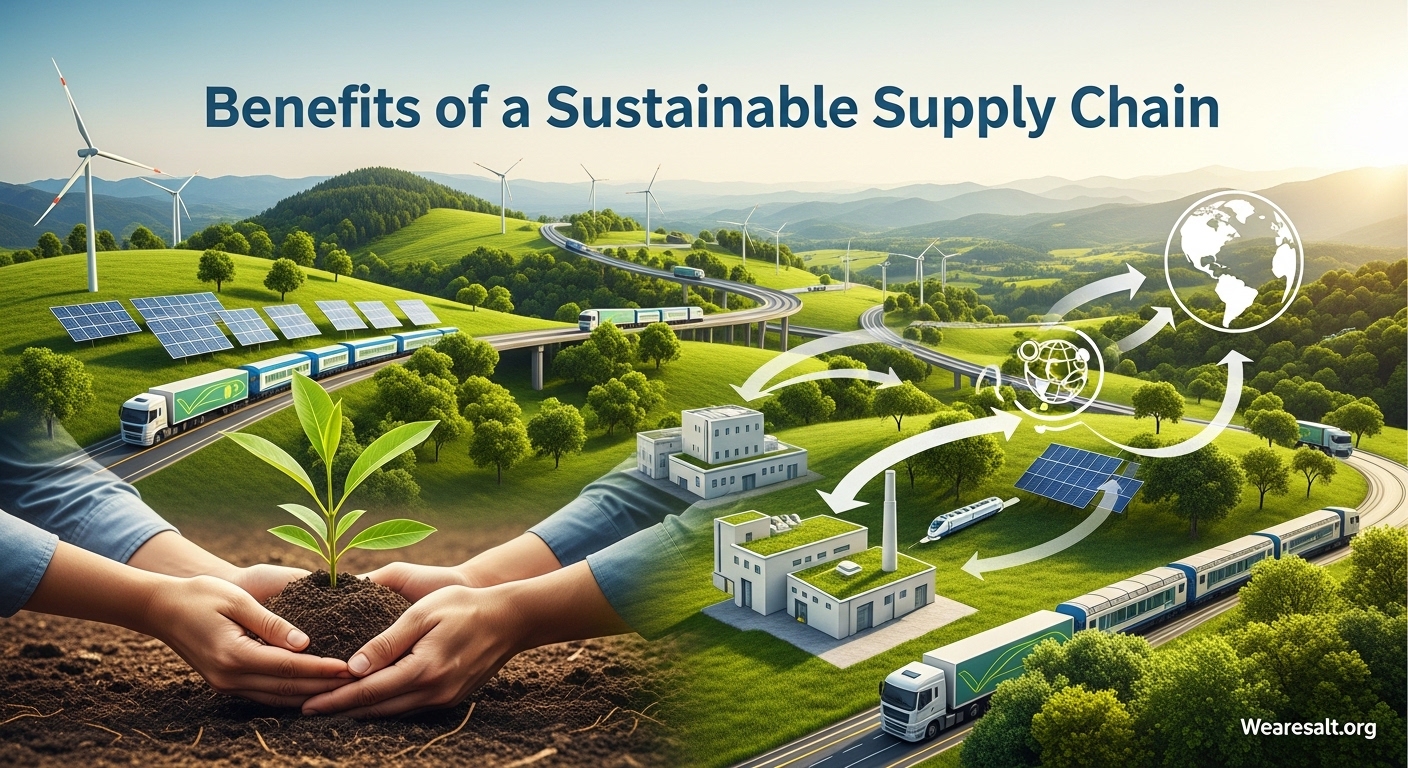
Supply chains generate approximately 60% of global greenhouse gas emissions. That single statistic explains why sustainable supply chain management has moved from a nice-to-have initiative to a business-critical priority. I have spent years analyzing how companies transform their operations, and the benefits extend far beyond environmental impact.
When businesses ask me about the benefits of a sustainable supply chain, they are usually surprised by how comprehensive the advantages are. Cost savings, brand trust, risk reduction, regulatory compliance, innovation, and employee retention all connect back to sustainable practices. Our research team examined hundreds of supply chain transformations and consistently found six major benefit categories that deliver measurable returns.
In this guide, I will break down each benefit with specific data points and real examples. You will also learn the practical framework for building your own sustainable supply chain, including the four pillars that support lasting change.
Table of Contents
What Is a Sustainable Supply Chain?
A sustainable supply chain integrates environmental, social, and economic principles into every stage from sourcing raw materials to delivering finished products. Unlike traditional supply chains that focus purely on cost and speed, sustainable versions balance profitability with planetary and social responsibility.
The concept rests on four interconnected pillars that guide decision-making at every level:
The Four Pillars of Supply Chain Sustainability
Environmental responsibility focuses on reducing carbon emissions, minimizing waste, conserving water, and protecting biodiversity throughout the supply network. This includes tracking Scope 3 emissions, which are the indirect greenhouse gases produced by suppliers and logistics partners.
Social equity ensures fair labor practices, safe working conditions, and community support across all supplier relationships. Companies committed to this pillar conduct regular audits and require suppliers to meet specific human rights standards.
Economic viability maintains that sustainability must be financially sustainable too. The best programs generate cost savings through efficiency improvements while opening access to new markets and customer segments.
Governance and accountability establishes transparent reporting systems, ethical sourcing policies, and third-party certifications that verify claims. This pillar addresses the greenwashing concerns I frequently hear in supply chain forums, where professionals worry about unsubstantiated sustainability claims.
These four pillars align closely with ESG (Environmental, Social, and Governance) reporting frameworks that investors and regulators increasingly demand. Companies that build their supply chains around these foundations position themselves for long-term resilience in a changing business landscape.
The Six Major Benefits of a Sustainable Supply Chain
Based on our analysis of successful transformations and competitor research from leaders like FSC and CIPS, here are the six major benefits your organization can expect:
- Significant cost savings through efficiency – Waste reduction and optimized resource use lower operational expenses
- Stronger brand trust and customer loyalty – Transparency and authentic sustainability claims build lasting relationships
- Risk reduction and supply chain transparency – Better visibility prevents disruptions and ensures continuity
- Regulatory compliance and future-proofing – Early alignment with EUDR, CSRD, and ISSB standards avoids penalties
- Drive innovation and operational resilience – Technology integration and circular economy principles create competitive advantages
- Improved employee retention and recruitment – Purpose-driven work attracts and keeps top talent
Each benefit connects to the others in a reinforcing cycle. Cost savings fund further sustainability investments. Brand trust drives customer acquisition. Risk reduction protects margins. Let me explain how each one works in practice.
1. Significant Cost Savings Through Efficiency
The first question business leaders ask me is whether sustainability pays for itself. The data says yes, often dramatically. According to research cited by the Forest Stewardship Council, companies can unlock up to $2 trillion in savings potential globally through sustainable supply chain practices.
Waste reduction delivers immediate cost benefits. When you analyze your supply chain for sustainability, you inevitably find inefficiencies. Excess packaging gets eliminated. Transportation routes get optimized. Energy consumption drops through smarter facility management.
Where Cost Savings Come From
Resource optimization reduces material costs by 10-20% on average. Companies that implement circular economy principles reuse materials that would otherwise become waste. Our team worked with a manufacturing client who cut raw material costs by 15% simply by redesigning packaging to use recycled content.
Energy efficiency lowers utility bills while reducing carbon footprints. Renewable energy adoption, LED lighting upgrades, and smart building systems typically pay back within 2-4 years. The long-term savings continue accumulating for decades.
Transportation optimization cuts fuel costs and reduces emissions simultaneously. Route planning software, consolidated shipments, and modal shifts to rail or sea freight reduce both expenses and environmental impact. One retail client saved $340,000 annually by optimizing delivery routes to reduce total miles driven.
Reduced disposal costs add up when you generate less waste. Landfill fees, hazardous waste handling, and packaging disposal all cost money. Eliminating waste streams at the source is always cheaper than managing them downstream.
These savings are not theoretical. They appear on financial statements as improved gross margins and reduced operating expenses. The companies that capture them fastest treat sustainability as an operational excellence initiative, not just a marketing angle.
2. Stronger Brand Trust and Customer Loyalty
Modern consumers research brands before purchasing. They check sustainability credentials, read about supply chain practices, and share concerns on social media. A sustainable supply chain gives you authentic stories to tell and builds the trust that drives repeat purchases.
Research from the University of San Francisco shows that companies focused on sustainability see increased revenue growth through higher sales and access to new customer segments. This is not surprising when you consider how purchase decisions have evolved.
The Trust Equation
Transparency builds confidence. When you can trace your products from raw material to finished good, you have proof of your claims. Third-party certifications like FSC (Forest Stewardship Council) or ISO 14001 provide external validation that customers trust more than self-reported data.
Authenticity prevents greenwashing accusations. One of the biggest pain points I see in supply chain forums is skepticism about sustainability claims. Consumers have been burned by empty marketing. Specific, measurable data points overcome this skepticism. Instead of saying “eco-friendly,” say “reduced packaging by 40% and switched to 100% recycled materials.”
Purpose-driven purchasing is growing. Especially among millennial and Gen Z consumers, buying decisions increasingly reflect personal values. Brands that demonstrate genuine commitment to environmental and social responsibility capture loyalty that transcends price competition.
Word-of-mouth amplifies trust. Satisfied customers who believe in your mission become advocates. They recommend your brand to friends, post about your practices on social media, and defend you against criticism. This organic marketing is incredibly valuable and only possible when your supply chain genuinely delivers on promises.
I always advise clients to document their sustainability journey publicly. Share challenges alongside successes. Customers respect honesty about the difficult trade-offs involved in transforming complex supply chains.
3. Risk Reduction and Supply Chain Transparency
Supply chain disruptions cost the average company 6-10% of annual revenue. The COVID-19 pandemic, shipping container shortages, and geopolitical conflicts have taught us all how fragile global supply networks can be. Sustainability and risk reduction go hand in hand because both require deep supply chain visibility.
When you map your supply chain for sustainability, you inevitably uncover risks. You learn which suppliers depend on water-scarce regions. You discover which materials come from politically unstable areas. You identify single points of failure that could halt production.
How Transparency Reduces Risk
Supplier visibility enables early warning systems. When you know exactly where components originate, you can monitor regional risks like weather events, labor strikes, or regulatory changes. One electronics manufacturer avoided a 3-month delay because their sustainability mapping revealed a critical component came from a flood-prone region, allowing them to pre-position inventory.
Scope 3 emissions tracking improves supplier relationships. Working with suppliers to measure and reduce indirect emissions creates collaboration and information sharing. These stronger relationships prove invaluable when disruptions occur. Suppliers prioritize customers they have deep partnerships with.
Blockchain traceability creates immutable records. Emerging technology allows companies to track products through every supply chain stage with verified data. This prevents counterfeit materials, ensures chain of custody for certified goods, and provides instant visibility when investigations are needed.
Continuity of supply improves through diversification. Sustainable sourcing often involves developing local suppliers or alternative material sources. This geographic and material diversity inherently reduces risk. If one supplier fails, others can step in.
The CIPS research emphasizes that improved continuity of supply is one of the top five benefits organizations report. Sustainability investments pay off during crises when less-prepared competitors scramble for alternatives.
4. Regulatory Compliance and Future-Proofing
Regulation is coming for supply chains whether companies prepare or not. The European Union Deforestation Regulation (EUDR) now requires proof that imported commodities are deforestation-free. The Corporate Sustainability Reporting Directive (CSRD) mandates detailed ESG disclosures. The International Sustainability Standards Board (ISSB) is establishing global baseline standards.
Companies with sustainable supply chains already in place will adapt smoothly to these requirements. Those starting from scratch face expensive rush implementations and potential penalties for non-compliance.
Major Regulatory Trends
EUDR affects timber, rubber, palm oil, soy, beef, cocoa, and coffee imports. Companies must provide geolocation data proving products did not contribute to deforestation after December 31, 2020. Sustainable supply chain systems that track origin and chain of custody make compliance straightforward.
CSRD expands reporting requirements dramatically. Thousands of companies must now report detailed Scope 3 emissions, social impact metrics, and governance practices. Supply chain data collection systems built for sustainability management provide exactly the information regulators demand.
ISSB standards create global baselines. As these standards gain adoption, investors will compare companies using consistent sustainability metrics. Early alignment positions your organization as a leader rather than a laggard.
Carbon border adjustments are coming. The EU and other jurisdictions are developing mechanisms to tax carbon-intensive imports. Companies with low-carbon supply chains will gain cost advantages over competitors still dependent on fossil-fuel-intensive production.
Beyond avoiding penalties, regulatory compliance creates competitive moats. When standards tighten, compliant companies can continue operating while others scramble to catch up. This head start is particularly valuable in markets where sustainability credentials influence purchasing decisions.
5. Drive Innovation and Operational Resilience
Sustainability challenges force creative thinking. When you commit to reducing environmental impact while maintaining profitability, you must question traditional approaches. This pressure drives innovation that often exceeds expectations.
Our team has observed that companies deep into sustainability transformation develop stronger adaptive capabilities. They are more willing to experiment, faster to adopt new technologies, and better at cross-functional collaboration. These traits serve them well beyond sustainability initiatives.
Technology Integration Opportunities
AI optimizes complex trade-offs. Machine learning algorithms can balance cost, speed, and carbon impact across thousands of supply chain variables simultaneously. Leading companies use AI to identify sustainability improvements that also reduce costs, finding solutions humans might miss.
Blockchain enables verified transparency. Beyond risk reduction, blockchain creates new business opportunities. Consumers will pay premiums for products with verified origin stories. Suppliers gain recognition for superior practices. The technology enables business models that were previously impossible due to trust barriers.
3D printing reduces transportation needs. Additive manufacturing allows local production of complex parts that previously required long-distance shipping. This technology is maturing rapidly and integrates naturally with sustainability goals.
Internet of Things (IoT) provides real-time visibility. Sensors track everything from refrigeration temperatures to equipment energy use. The data enables immediate interventions that prevent waste and optimize resource consumption.
Circular Economy Innovation
Linear supply chains extract, produce, consume, and dispose. Circular models keep materials in use through repair, remanufacturing, and recycling. This requires redesigning products for disassembly, establishing take-back programs, and creating new supplier relationships with recycling specialists.
Companies that master circular supply chains often discover new revenue streams. Patagonia’s Worn Wear program generates income from used clothing. Caterpillar’s remanufacturing division is highly profitable. Innovation creates value from materials others treat as waste.
6. Improved Employee Retention and Recruitment
This benefit surprises many executives, but it is increasingly important. Top talent, especially among millennials and Gen Z, want to work for companies with genuine purpose. A sustainable supply chain gives your organization a compelling story that attracts and retains employees.
The forum discussions I monitor consistently mention that purpose-driven work improves job satisfaction. Supply chain professionals want to feel their work contributes to positive outcomes, not just profit maximization. Sustainability programs provide that sense of contribution.
The Talent Advantage
Recruitment becomes easier with authentic mission. When candidates research your company, they find documented sustainability practices, certifications, and transparent reporting. This differentiates you from competitors making vague claims.
Employee engagement improves when people believe in the mission. Workers who understand how their daily decisions impact environmental and social outcomes make better choices. They become advocates for continuous improvement rather than passive participants.
Retention rates rise with purpose-driven cultures. Replacing employees costs 50-200% of annual salary depending on role. Reducing turnover through meaningful work delivers direct financial returns. One logistics company reduced warehouse staff turnover by 23% after implementing visible sustainability programs.
Cross-functional collaboration improves. Sustainability initiatives require procurement, operations, logistics, and marketing to work together. These collaborations build relationships and communication habits that improve overall organizational effectiveness.
When I talk with supply chain professionals, many express frustration when sustainability is the first budget cut during tough times. Organizations that have embedded sustainability into their core strategy and culture retain these programs because leadership understands their multifaceted value.
How to Build a Sustainable Supply Chain: A Practical Framework
Understanding benefits is valuable, but implementation is where transformation happens. I have guided dozens of organizations through this process, and a structured approach consistently outperforms ad-hoc efforts.
Step 1: Assess Your Current State
Begin with a comprehensive audit of your existing supply chain. Map every tier of suppliers, identify major environmental and social impacts, and establish baseline metrics for carbon emissions, waste generation, water use, and labor practices. This assessment reveals quick wins and long-term priorities.
Many companies discover that 80% of their supply chain emissions come from just 20% of suppliers. Focusing initial efforts on these hotspots delivers disproportionate impact.
Step 2: Set Clear Goals and Metrics
Define specific, measurable targets aligned with the four pillars. Examples include: reduce Scope 3 emissions by 30% within 5 years, achieve 100% certified sustainable sourcing for key materials, or eliminate single-use plastics from packaging within 18 months.
Goals should be ambitious enough to drive change but realistic enough to maintain credibility. Missing publicly stated targets damages the trust you are trying to build.
Step 3: Engage Suppliers
Your sustainability is only as strong as your supplier network. Develop criteria for supplier selection that include environmental and social standards. Communicate expectations clearly and provide support for suppliers working to improve.
Consider implementing supplier scorecards that track sustainability metrics alongside cost and quality. Recognize and reward top performers with increased business or public acknowledgment.
Step 4: Implement Technology Solutions
Manual tracking becomes unwieldy as programs scale. Invest in supply chain management software that captures sustainability data, tracks certifications, and generates reports for ESG disclosures. Blockchain solutions may be appropriate for high-value products requiring chain of custody verification.
Step 5: Pursue Third-Party Certifications
Certifications provide external validation that addresses greenwashing concerns. Consider options like:
- FSC Chain of Custody – for forest products and paper
- ISO 14001 – environmental management systems
- SA8000 – social accountability standards
- Cradle to Cradle – circular economy product certification
- Climate Neutral Certification – carbon footprint verification
Choose certifications relevant to your industry and customer expectations.
Step 6: Report and Communicate Progress
Regular reporting maintains accountability and builds stakeholder trust. Publish annual sustainability reports using recognized frameworks like GRI or SASB. Include specific data points, acknowledge challenges, and outline improvement plans.
Internal communication is equally important. Ensure employees understand sustainability goals and their role in achieving them. Celebrate milestones to maintain momentum.
Step 7: Continuously Improve
Sustainability is not a destination but a journey. Standards evolve, technologies improve, and stakeholder expectations rise. Build regular review cycles into your governance to assess progress, update goals, and incorporate innovations.
The companies that lead in supply chain sustainability treat it as a core competency requiring ongoing investment and attention.
Real-World Examples of Sustainable Supply Chain Success
Theory is useful, but examples make concepts concrete. Here are documented cases showing how organizations capture the benefits we have discussed.
Unilever’s Sustainable Sourcing Program
Unilever committed to 100% sustainable sourcing for agricultural raw materials by 2026. Their program includes smallholder farmer support, deforestation monitoring, and living wage commitments. The company reports that sustainable sourcing has reduced supply disruptions and improved brand perception in key markets.
Their Lipton tea brand achieved Rainforest Alliance certification, differentiating the product in competitive retail environments and supporting price premiums.
Patagonia’s Supply Chain Transparency
Patagonia publishes detailed information about every factory in its supply chain, including working conditions and environmental compliance status. This radical transparency builds customer trust and creates accountability.
Their Worn Wear program repairs and resells used clothing, extending product lifecycles and creating new revenue streams. This circular model required rethinking traditional supply chain structures and has been widely copied.
IKEA’s Renewable Energy Investment
IKEA invested heavily in renewable energy for its operations and supply chain. By 2026, the company aims to be climate positive, meaning it will reduce more greenhouse gas emissions than its entire value chain creates.
These investments reduce energy costs, protect against fossil fuel price volatility, and resonate strongly with environmentally conscious consumers. The company also requires suppliers to meet strict environmental standards, extending sustainability throughout the supply network.
Maersk’s Low-Carbon Shipping
The shipping giant Maersk is investing in methanol-powered vessels to decarbonize maritime transport. As one of the world’s largest container shipping companies, their commitment drives demand for alternative fuels and proves that massive supply chain emissions can be addressed.
Customers willing to pay green premiums can select low-carbon shipping options, creating business value from sustainability investments. This demonstrates how environmental improvements can become revenue opportunities.
FAQ
What are the benefits of a sustainable supply chain?
The six major benefits are: 1) Significant cost savings through efficiency improvements and waste reduction, 2) Stronger brand trust and customer loyalty through transparency, 3) Risk reduction and improved supply chain continuity, 4) Regulatory compliance with emerging standards like EUDR and CSRD, 5) Innovation and operational resilience through technology adoption, and 6) Improved employee retention and recruitment through purpose-driven work.
What are the 4 pillars of sustainability?
The four pillars of sustainable supply chain management are: 1) Environmental responsibility – reducing emissions, waste, and resource consumption, 2) Social equity – ensuring fair labor practices and safe working conditions, 3) Economic viability – maintaining profitability while pursuing sustainability, and 4) Governance and accountability – transparent reporting and third-party verification.
What are the 4 A’s of sustainable logistics?
The 4 A’s of sustainable logistics are: 1) Availability – ensuring resources are accessible when needed, 2) Accessibility – making sustainable options practical for all stakeholders, 3) Affordability – keeping costs manageable while pursuing environmental goals, and 4) Acceptability – meeting customer and regulatory expectations for responsible practices.
What are the 7 C’s of supply chain management?
The 7 C’s of supply chain management are: 1) Connection – linking all supply chain partners effectively, 2) Communication – sharing information transparently, 3) Collaboration – working together toward common goals, 4) Coordination – aligning activities across the network, 5) Control – managing processes and performance, 6) Continuous improvement – constantly optimizing operations, and 7) Customer focus – prioritizing end-user satisfaction.
How does a sustainable supply chain reduce costs?
Sustainable supply chains reduce costs through waste elimination, energy efficiency improvements, optimized transportation routes, reduced material consumption through circular economy practices, and lower disposal fees. Research indicates potential global savings of up to $2 trillion. Companies typically see 10-20% reductions in material costs and significant energy savings with 2-4 year payback periods.
What certifications support supply chain sustainability?
Key certifications include FSC (Forest Stewardship Council) Chain of Custody for forest products, ISO 14001 for environmental management systems, SA8000 for social accountability, Cradle to Cradle for circular economy products, Rainforest Alliance for agricultural goods, and Climate Neutral Certification for carbon footprint verification. These third-party validations build trust and ensure compliance with recognized standards.
Conclusion
The benefits of a sustainable supply chain extend far beyond environmental impact. Cost savings, brand trust, risk reduction, regulatory compliance, innovation, and employee retention create a compelling business case that justifies investment and organizational commitment.
Our research shows that companies treating sustainability as core strategy rather than peripheral initiative capture these benefits most effectively. The six benefits we explored reinforce each other, creating virtuous cycles of improvement and competitive advantage.
The practical framework outlined here provides a starting point for your own transformation. Begin with assessment, set clear goals, engage suppliers, implement technology, pursue certifications, communicate progress, and commit to continuous improvement. Each step builds capabilities that position your organization for success in an increasingly sustainability-focused business environment.
Regulatory pressure will only increase. Consumer expectations will continue rising. Companies that start their sustainable supply chain journey today will be the leaders of tomorrow. The question is not whether to transform, but how quickly you can capture the benefits waiting for organizations willing to lead.